February Poem 2019

Why Poetry?

A robin comes 

to my yard in spring, 

breast like sun,

bead-black eyes,

slate-blue wings.

He cocks his head,

this way and that,

listens for breakfast,

grubs and insects

rustling in fresh soil.

No promise in those eyes

how long he’ll stay.

He may follow other birds,

songs from somewhere far away

muffled in the gusting wind.

He may leave when cold

begins to mute the green,

or morning frost spreads

sparkling icing

on the ground.

Winter comes, steals

my memory of spring.

But I return to this poem’s page.

The robin never flies away. 

– Sarah Edwards 

Crossing That Bridge

How a home designed by a famed Greensboro architect in the 1960s ushered one couple into a new phase of life half a century later

By Maria Johnson     Photographs by Amy Freeman

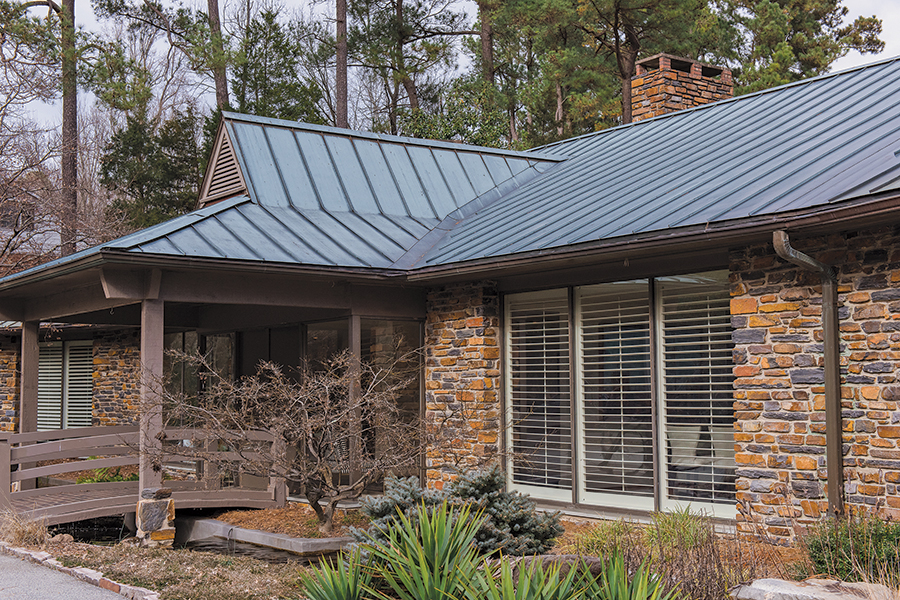
small bridge delivers visitors to Lovelle and Alan Overbey’s Modernist home.

The bridge’s span is short: 13 feet from driveway to double doors. The deck arches slightly, and the planks and rails are painted a tasteful, receding taupe. But the tendency is to notice the roof over the bridge — a pointy Asian-flavored cap of weathered copper. Or you can find yourself staring down into the gurgling water, a hyphen of a koi pond that hugs the house. Physically, there’s not much to the bridge.

But figuratively, it bears a lot of weight. It has carried the Overbeys into a new phase of life.

They came to a place that’s familiar to the fortunate. Their children were in college, and Alan was selling his business — an employee benefits consulting firm — as the couple edged toward early retirement.

They loved the two-story white brick home where their two boys had grown up on Greensboro’s Starmount Drive, just around the bend from a country club golf course. They had great neighbors, great memories and the great luxury of choice at a crossroads.

Their house was “done,” their parenting was mostly “done,” and Alan’s CEO responsibilities were fast approaching “done.” What would they do together next?

Lovelle, who has a master’s degree with a concentration in English education, had lusted after a mid-century house ever since she read The Fountainhead, an Ayn Rand novel that loosely echoes the life of legendary architect Frank Lloyd Wright. “It inspired me to want to live in a house that was completely an American original,” she says.

She loved the lines of mid-century houses, the openness, the history and the furniture that went with them. Alan didn’t care for mid-century homes — he didn’t know much about them, he’d later admit — and so he’d often nix the houses that Lovelle pointed out in their drive-by games of “Do you like that one?” “What about that one?”

They agreed on a few places. A tawny, low-slung home on nearby Kemp Road East was one of them. They studied it as they walked the trails around Hamilton Lakes. Yup, that horizontal honcho had character.

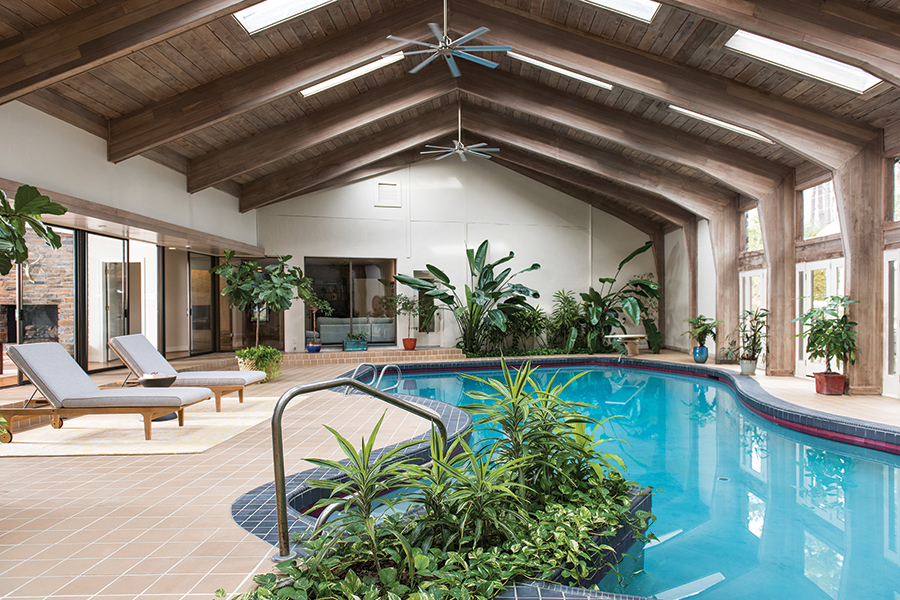
And so, when it came up for sale in 2017, Alan agreed to see it — all 9,400 square feet of it, including the indoor swimming pool — but he was reluctant. He was sentimental about the home where they’d raised the boys. The move was going to cost a fortune. And they really didn’t need to add one more change to their lives.

He sighed, went to meet the real estate agent, and was sold by the time he hit the bridge. A walk-through confirmed it. “It was different from anything I’d ever seen before,” says Alan, a Greensboro native. “It was open. It was bright. It gave me the excitement of the next chapter of our lives. We had to have it.” The fact that celebrated Greensboro architect Edward Loewenstein had designed the house made it even more appealing.

Built in 1964, the house was the residential fantasy of Greensboro internist Dr. Edgar Marks, who was in his early 40s when the home was built. Marks knew Loewenstein socially; the architect was the go-to guy if you wanted Modern in Greensboro. Marks hired him to design a medical building on Olive Street, and later to draw plans for a seven-bedroom home on side-by-side lots in Hamilton Lakes. Then a hive of construction, the neighborhood was a boon for Loewenstein; he drew at least nine homes around the lakes.

Marks, now 97 and still living in Greensboro, remembers the must-haves he directed Loewenstein to include in his showplace: floors with radiant heat, a feature he’d learned about as an Army doctor in post–World War II Korea; an indoor swimming pool with a retractable roof; front doors carved in Mexico; a master and guest bedroom on one side of the house; a separate bedroom wing, on the other side of the house, for the family’s four children; another room for the housekeeper; and a façade of the very same tricolored volcanic rock that distinguishes buildings at Duke University, where Marks was an undergraduate.

Loewenstein made it happen with style, using plate glass windows, asymmetrical rooms, recessed lighting, ceilings of various heights and slopes, and a squiggle-shaped pool.

Marks, his wife, Ellen, and their kids, moved from a home on Hammel Road in Irving Park to their new home near Starmount Forest Country Club, where Marks enjoyed hacking around the course. When the Greater Greensboro Open came to town, Marks and family entertained pro golfers in their home. Tony Lema, Lee Trevino and Tony Jacklin visited what became known as the Marks House. Others stayed with the family.

“One night, I came in after the GGO, and Tom Weiskopf was lying on the floor, looking up at the TV in our bedroom. Everyone made themselves at home,” says Dr. Marks.

Marks and his wife divorced in 1972. She got the house. There was a fire, then renovations. The house changed hands three times before the Overbeys walked over the bridge.

Moving was tougher than they’d thought it would be. Lovelle and her mother packed up the house. They climbed into the attic, where, over the years, the family had stashed the markers of their lives.

Cribs. Children’s toys. Books. Sorting was nostalgic; discarding was painful. Alan and Lovelle felt the pangs of what-have-we-done?

Their friends, who’d hopped online to discover how vast the house was, despite its modest appearance from the street, were more pointed. “Are you nuts?” they asked. “Why are you moving into a house that big, at this point in your lives?”

It was true; the new house would be the biggest house they’d ever lived in, and it would bring not only a new address, but a new style and new stuff. Their old furniture didn’t fit the contemporary spirit of the house, so they farmed it out to a consignment shop. Later, while browsing for mid-century pieces in the same store, they had the eerie experience of seeing their old furniture for sale, of seeing other people pause, consider the pieces they’d lived with for so long, reject them and move on.

“When you walk in and go, ‘Oh, that was ours,’ and ‘That was ours,’ you kinda feel like you’re dead,” says Alan. “It was like we were starting over, in a new life. It was weird.”

“It was weird,” says Lovelle.

Life did what it always does; it went on. Alan and Lovelle got help. Interior designer Donna Keel showed them how to kindle warmth in the vast, sometimes chilly spaces of Modern architecture.

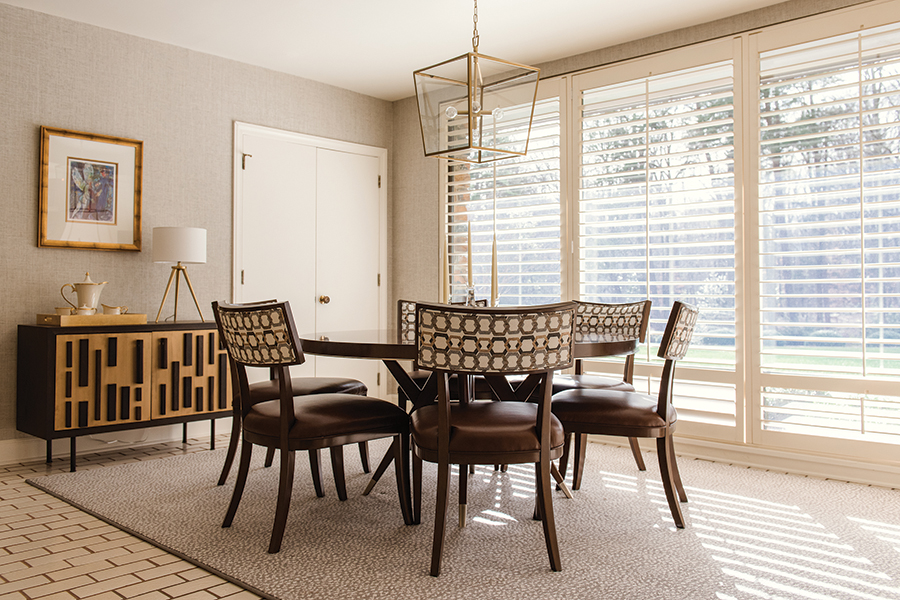
Thanks to the collaboration, the creamy formal living room — with its towering chalky fireplace — is punctuated with loud pillows, funky chairs, Picasso-like art and a gleaming ebony grand piano.

The “kids’ den,” a gateway to the wing of children’s rooms, is an open intersection defined by dove grays, a giant arcing lamp and a formidable painting of a Chinese food take-out box.

Lovelle jolted a couple of bathrooms to life with wallpaper. The pool bath teems with pink flamingoes. The bath nearest the formal living room swims with foil fish on a black background.

In shopping for the house, Lovelle has rediscovered the thrill of the hunt. She and Alan prowl art galleries in North Carolina and New York.

“It makes you feel young again,” she says, noting that instead of combing Pier 1 like she used to, she now haunts Modernist stores such as Area and West Elm, as well as antique shops, eBay, and designer-only caches.

The harvest is evident in the main den, a trove of mid-century icons: a cushy black leather Eames chair with footstool, a chestnut leather sofa, a bristling metallic wall sculpture, a skinny Lucite table, a spotted cowhide rug, a plush chartreuse ottoman on splayed legs and a 75-inch flat-screen TV that’s easily viewed from the pool, on the other side of a glass wall.

The Overbeys have let the house be, structurally. They’ve mostly freshened surfaces, keeping intact many of the original features: mirrored walls, louvered closet doors, grass cloth (now painted) and some classic 1960s bathroom fixtures.

They foresee a few crowbar moments — in the bar and a couple of bathrooms — but nothing major. They feel a certain amount of pressure, Alan says, to maintain and preserve the home in its original form.

“We’re really caretakers. The goal is for us to leave it better than we found it,” he says. “We’re fortunate enough to be able to enjoy it.”

Entertaining helps them to justify the home’s size. They’ve hosted a smattering of parties: political fundraisers; a sorority function; a business gathering of Alan’s associates. Their sons invited friends over during the holidays. One day, the Overbeys hope, the pool will draw grandchildren.

“I want people to make memories in this house with us,” says Alan.

You’ll see them standing on the bridge almost every evening, just before bedtime. They come outside to feed the fish. There are 17 of them, koi and goldfish of various colors. Some of them have names: Pongo and Perdita, the black-and-white pair named after the canine heroes of Disney’s 101 Dalmations. Then there’s Franco, the slippery black-and-gold stand-in for former Pittsburgh Steelers’ running back Franco Harris, a favorite of Lovelle, who grew up in western Pennsylvania.

The fish surface, all eyes and mouths, when they see the couple approaching to cast food pellets. The water roils and splashes with life.

“It’s like a feeding frenzy,” Alan says, smiling broadly. “It’s a lot of fun.”

“When we have company, we love to take them out there,” says Lovelle. “It’s an event. I think it’s my favorite part of the house.” OH

Maria Johnson is a contributing editor of O.Henry magazine.

February Almanac 2019

Spring violets follow snow; the daffodils push through it.

Whoever grumbles curses at this cold month need only witness an explosion of February Gold, the early bloomer that utterly beams with exaltation.

We thaw from the inside out.

In the garden, wren and titmouse sing out from bare branches, and something within you stirs. You put on the kettle, light a candle, phone a friend you didn’t know could use the extra warmth.

Come over, you say, reaching for an extra mug. 

Some days, just as the daffodils push through snow, your kindness is the February Gold that lights up the world.

Say It in Flowers (or Spoons)

This and every month, red roses say I love you. But if you’re looking to dazzle your sweetheart with something different this Valentine’s Day, here are a few customs from around the world:

Exchange pressed snowdrops (Denmark).

Pin the name of your one true love on your shirtsleeve (South Africa).

Offer carved melons and fruit (China).

Although the Welsh celebrate their patron saint of lovers on Jan. 25, this gift might take the cake: the love spoon. Carved with intricate patterns and symbols, these wooden spoons have been given as tokens of affection for centuries.

Let us love winter, for it is the spring of genius. — Pietro Aretino

This Little Piggy

Tuesday, Feb. 5, marks the celebration of the Chinese New Year. Cue the paper lanterns for the Year of the Pig, a year of wealth and good fortune. Also called the Spring Festival, this lunar New Year is considered a fine time to “sweep away” ill fortune and create space for your abundance to arrive. It’s also a fine time for dumplings.

Because they resemble ancient gold ingots, Chinese dumplings are made by families on New Year’s Eve for the same reasons we slow-cook black-eyed-peas and collards.

In honor of the Year of the Pig, consider trying your hand at homemade dumplings. Or, in case you missed out last month, here’s a Hoppin’ John recipe adapted from The Traveling Spoon Chef on Instagram:

Ingredients:

1 pound dried black-eyed peas

10 cups water

1 medium onion, diced

1/4 cup butter

1 ham steak, diced

1 teaspoon liquid smoke

1 teaspoon salt

1 teaspoon pepper

1 bunch chopped kale (optional)

1-2 cups cooked rice (optional)

Directions:

Soak black-eyed peas overnight in 6 cups of salted water. Rinse and drain well. In a large pot, sauté onion in butter until tender. Next, add one diced ham steak (optional), 4 cups water, liquid smoke, salt and pepper. Add drained black-eyed peas to the pot, cover, and let simmer for 4 hours, stirring occasionally. If desired, stir in kale and rice just before serving. And a pinch of extra luck.

“Save some leftovers for the following day,” says the chef, and call it “Skippin’ Jenny.”

There is a privacy about winter which no other season gives you . . . Only in winter can you have longer, quiet stretches when you can savor belonging to yourself. Ruth Stout, How to Have a Green Thumb without an Aching Back

The Garden To-Do

This month, plant your greens, Brussels, peas and beets. Turnips and radishes. Broccoli and carrots. Asparagus. And Irish potatoes, three inches deep.

The Soul of the Circuit

Once a preferred stop on the legendary R&B Chitlin’ Circuit, The Historic Magnolia House reclaims the glory of its Green Book days — and then some

By Grant Britt

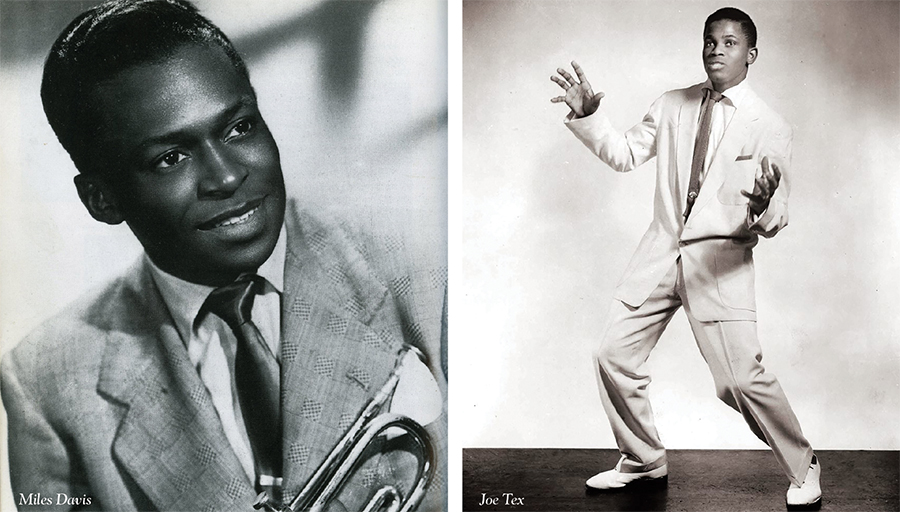
Once upon a time, there was a magical musical pathway that wound through the Piedmont, carrying deliverers of soul on their appointed rounds. African-American singers and musicians toured the country on a beltway that connected the East Coast to a string of clubs specializing in R&B and soul. The pathway was called the Chitlin’ Circuit, named after a stinky comfort food made from a pig’s large intestine, initially favored by folks who by economic necessity had to use every part of the hog but the squeal. James Brown spotlit some of the Chitlin’ Circuit’s whistle stops including Raleigh, North Carolina, on his 1961 version of “Night Train,” recorded at one of the Circuit’s top venues, the Apollo Theater in New York City. Other notable stops along the way included The Howard Theatre in D.C., the Royal Peacock in Atlanta, Richmond’s Hippodrome Theater, and The Ritz Theatre in Jacksonville, Florida. Greensboro was an important stop along the way as well, with The Ritz and the Carlotta Club providing a showplace for big names like Brown and Joe Tex.

Getting there was the easy part. But finding a place to eat,or more important a place to stay, was a problem for black artists for decades in those preintegration days. In 1936, New York City mailman Victor Hugo Green compiled a coast-to-coast compendium of establishments that catered to African- American travelers. The Negro Motorist Green Book, (inspiration for the current Oscar-nominated film, Green Book) became the Negro Travelers’ Green Book in the early ’50s when it expanded its coverage to Mexico, Canada and part of the Caribbean. It provided names and addresses of restaurants, bars and hotels that would let road-weary African-Americans eat, drink and rest with dignity and in comfort. The 1939 edition, expanded from early editions only listing New York destinations, shows a variety of establishments in Greensboro that welcomed black travelers, including the Legion club, listed under hotels on 829 East Market Street and the Travelers Inn, also on East Market, and several private “Tourist” homes on East Market: T Daniels at 912 East Market, Mrs. Evans at 906, Mrs. Lewis at 829, as well as the Paramount Tavern at 907 East Market.

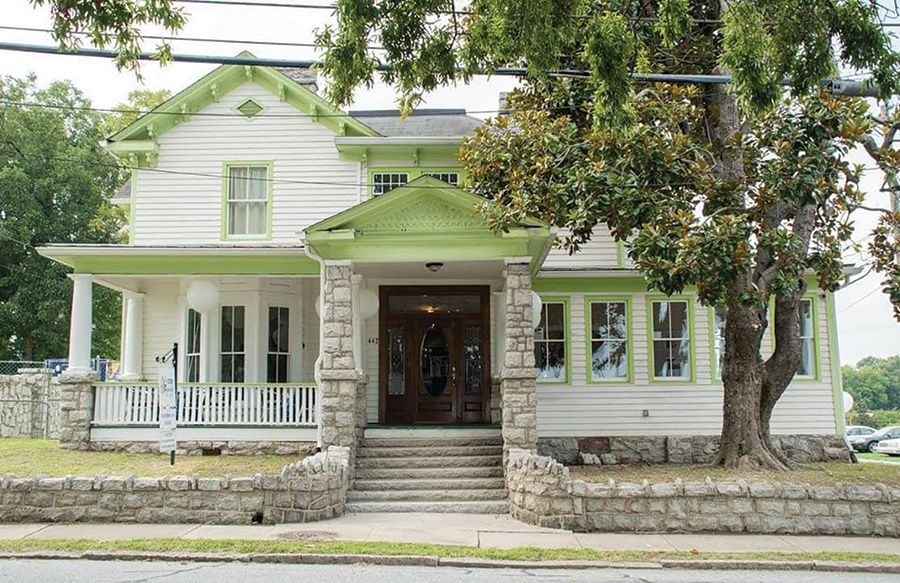
But one of Greensboro’s most prestigious Chitlin’ Circuit rest stops wouldn’t show up in the Green Book till 1955. The Magnolia House Motel was built by Daniel D.Debutts in 1889 at the corner of Gorrell and Plott streets in the Southside community. The 5,000- square-foot Victorian was a showplace even back then with its wraparound porch and imposing façade with five chimneys. The house began its career as a lodging destination when the Gist Family bought the property in 1949, catering to a Who’s Who of Chitlin’ Circuiters including James Brown, Ray Charles and Hank Ballard and the Midnighters. State legislator Herman Gist and his wife, Grace, inherited the property from their parents and ran it as a motel for several years. But the house fell into disrepair in the ’70s and remained a decaying shadow of its former self till 1996, when neighbor Sam Pass, who lives right around the corner on Martin street, saw the property up for sale. “It was in pretty bad demise. The roof was caving in, she [Grace Gist] couldn’t keep the street people out of here.” Pass was so determined to own the property that he ripped the for sale sign out of the ground and hid it until he could make Gist an offer, which she accepted.“ I remember the big marquee in the front yard,” he recalls. “It always said ‘NoVacancy.’ Magnolia House has been in existence as long as my generation has been in existence.”

“I noticed Magnolia House when I was a kid,” Pass continues, recalling that his older brother Bobby, a music promoter, brought his 13-year-old sibling to the house and introduced him to Joe Tex, who was playing in town. Pass met Tex on the front porch and remembers him as being very cordial to his tongue-tied, star-struck younger self. Pass’s brother introduced him to several other of the celebs staying at the Magnolia, and Pass says he heard stories of Tex and Brown playing baseball with the neighborhood children. “We knew about the Magnolia House even before then.” Pass says. “This was the first black hotel. When they couldn’t stay anywhere else, they stayed here.”

Greensboro had several musical hot spots from the mid-’40s through the ’60s. The black-owned El Rocco club on Market Street in Greensboro also brought in big names in the ‘50s including Jackie Wilson and James Brown, as well as Otis Redding. It also served the best fried chicken in town. “James Brown used to come to El Rocco,” Pass recalls. “My cousin George Simms was a drummer. He [James] used to come to my grandmother’s house and beg her to let George play for him. ‘I’ll keep him outta trouble, Miz Pass,’” he remembers Brown promising.

“El Rocco was something like in New York,” says Chic Carter, former pitcher for the Winston-Salem Pond Giants, a Negro League team in the 1950s. Evoking comparisons to Gotham’s famous Apollo Theater and a few others on the Circuit, he adds, “El Rocco had a nice place over there for them to come.”

Although it was a black club, some white visitors were welcome. “I used to take some girls to the El Rocco,” says Greensboro-based shag dancer Larry McCranie, who is white. “One time in the mid-’50s, I took four girls down there and we were the only white folks in there. They were cool girls, they ended up dancing with all the black guys and I danced with black women and we just had a ball. Not too many white kids went over there,” he reminisces, “but occasionally they were invited, the girls could dance, and you could just have a good time.”

McCranie also recalls a tobacco warehouse in Greensboro outside the city limits on South Elm/Eugene Street that hosted big-name acts about every other month. He says he remembers seeing Fats Domino, Lavern Baker, Ruth Brown and Chuck Berry, all on one show. Sheriff’s deputies hired to keep order between the races would put a rope from the front where you entered, all the way up to the middle of the stage. “White folks would go on one side, and black folks would go on the other. Everybody had a little bottle in their pockets, they’d get to drinking when they opened around 8:30 or 9 o’clock,” McCranie says. “Around 11 o’clock, that rope would come down and there was nothing they could do about it. There weren’t that many sheriffs there, and then everybody danced with everybody.”

Pass also heard about the warehouse and mentions another club, the Carlotta, down off Market Street, that was also a popular destination for Chitlin’-esque performers. There was the ABA club off High Street near Ray Warren Homes. “Then there was this little club called the Americana up near Gillepsie Golf Course. My brother used to frequent the place,” Pass says, recounting an anecdote about how older sibling Bobby once introduced their sister Ruth to Ben E. King of “Stand By Me” fame.

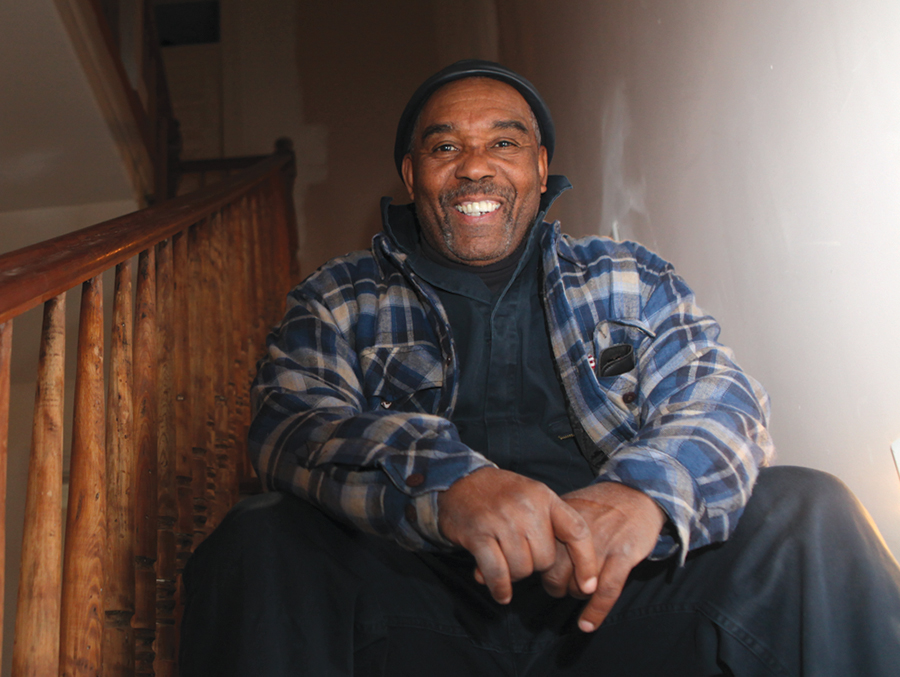
The clubs showcased them, but the Magnolia nourished black entertainers and gave a place to rest their weary heads; Pass wanted to pay homage to that tradition as well as preserving a piece of African-American history. He had the house, but now he needed help with the restoration. Retired from FedEx, Pass set up a mobile kitchen outside the property, selling ribs, chicken and fried fish to help raise money to put with $70,000 of his own. The city of Greensboro gave him a community block grant, and he got some help from suppliers impressed with what he was undertaking.

“It’s family basically,” Pass says of his renovation and restoration team. “Me, my wife [Kimberly], my oldest daughter [Natalie Miller] are what’s making this happen. Hopefully I’ll be keeping it in the family. That’s why I restored it.”

On a guided tour of the property, Pass’s pride in the work is evident in his voice as well as in the finished product. “A lot of it I did. But of course, I don’t have the talent to do all of this,” he says. “We didn’t renovate; we totally restored it.” With the help of local cabinetmaker Pete Williams, the Magnolia was gutted to its skeleton. “Then we came back with everything.” The heart pine floor came from the American Tobacco Company Warehouse in Reidsville. The owner of Reidsville’s Tobacco-Pine Reclaimed Timber was so impressed at what Pass was doing, he gave him a steep discount. “The entire house is the same heart pine lumber — the chair rails, the window casings, door casings, all the interior doors,” Pass says. “The baseboards, quarter rounds, the crown moldings, all of that are from heart pine lumber. We did the house the way it was supposed to be done.”

Working from the original blueprints, Pass and family did their best to keep the house true to its original design. “It was important that we leave the outside just like it was, as far as structure was concerned, since the house was on the National Register of Historic Places.” He did do a kitchen makeover, installing a commercial kitchen.

The outside wall was improved on as well to create the majestic stonework that surrounds the house today. Part of the restoration phase was to repair and restore the original 2-foot retaining wall going around the house at 442 Gorrell Street. He approached Mount Airy’s North Carolina Granite Corporation about cutting the granite for the needed repairs. The company ended up donating not only rocks to make repairs but additional granite. “So we were able to repair the wall, but they also gave us 160 tons of it,” he says. “That’s how we got that 7-foot wall built around the house on our property line.”

Architectural Salvage of Greensboro donated period furniture, including a dresser with an impressive pedigree. “We didn’t know what we had until one of our customers for Sunday brunch came through, looked at the piece and said, ‘That looks like Thomas Day furniture,” referring to perhaps North Carolina’s most famous black cabinet maker. “Of course, we researched it, and come to find out, it is.”

Daughter Natalie Pass Miller oversaw the furniture restoration. Pass calls her “an innovative Alpha woman,” which causes Miller to break out into peals of laughter when told of the description. “That is so Sam,” she says, when she can catch her breath. “Oh gosh, I don’t know about that. I’m just trying to help Daddy carry out his vision.”

Miller stepped in about a year ago, bringing back period pieces from Atlanta, where she was living at the time. “This was my very first time driving a U-Haul packed with furniture long distance, praying all the entire way cause I’d never done it before,” she says. “When I pulled up, Dad just happened to be on the porch and you could see the look on his face, like, ‘Is that my kid driving a U-Haul? It is!’”

But her furniture -moving project turned to operational matters once she started probing her father about his intentions for Magnolia House. “Dad’s tone changed to a sad one,” she recalls. Pass’s renovation work was going slowly due to his daily commute to Durham, where he inspects buildings for Duke University in advance of fire marshal visits. His daughter could tell he needed some help. She suggested to him “Dad, why don’t I come in, and let’s work together to see if we can complete this vision that you have now that you’ve done the hard part of restoring the house?”

Pass’s efforts hit another snag when he had a stroke in early November. These days, he is just getting back to work and seeing the changes Miller has implemented. “One of those priorities, including making over the ambiance is, ‘How do we rebuild our brand and reputation and what do we want people to experience when they walk in the house?’” Miller explains. To that end, she’s changed up the serving format of the weekly Sunday Jazz Brunches from a buffet line to family-style dining in the large front room that was once a porch. “The room is cavernous, with 14-foot ceilings,” she says. “The Gist family had renovated it and lowered the ceiling with tile, but I put it back the way it was,” Pass explains. Brunch is served here, with servers bringing out large bowls of sides and entrees to several long trestle tables set end-to-end along the length of the room. “When the Gist family had it as the historic Magnolia House, one of the key things that I noted was that they were really big on creating a sense of family and engagement and unity, bringing that concept to the table,” she says. “And if you think about it, that process exists even in the overnight stay, because not every room had its individual bathroom, so if that doesn’t bring a community together, nothing does,” Miller chuckles. “So moving over to the family-style dining was really created as a part of continuing the legacy of what the motel created.”

The current menu has a number of staples, but introduces a few unique dishes every week. Feedback from guests plays an important role as well, with Magnolia brunch regulars praising the fish and grits, and fried chicken. “We also have a penne pasta in garlic Parmesan sauce with seasonal vegetables that is just to die for,” Miller says of the fare she’s proud to label as comfort food.

But Pass is quick to point out that the family is not calling the new Magnolia House completely a restaurant. “We do have a commercial kitchen in the facility, but it was our intention to open up as a bed and breakfast, and will still be a component because we have the upstairs mostly finished, Pass says. But we haven’t gotten to that point yet.” Right now the focus is on using the house for special events, with bridal showers and baby showers, as well as hosting several local clubs and civic associations parties, including A&T State University Alumni Association events.

Pass has also introduced a series of presentations he calls the Juke Joint Series, dinner and a show, sort of like The Barn Dinner Theatre. “We do tributes to some entertainers that registered here during segregation. First one, we did a tribute to Ray Charles and Ruth Brown, and we just recently did a dinner and a show, a tribute to Gladys Knight and the Pips, and we’re working on a Valentine’s show now. So we do events here, Sunday brunch here every Sunday from 11 til 3:30. And the public will come here for some of the good food that we cook.”

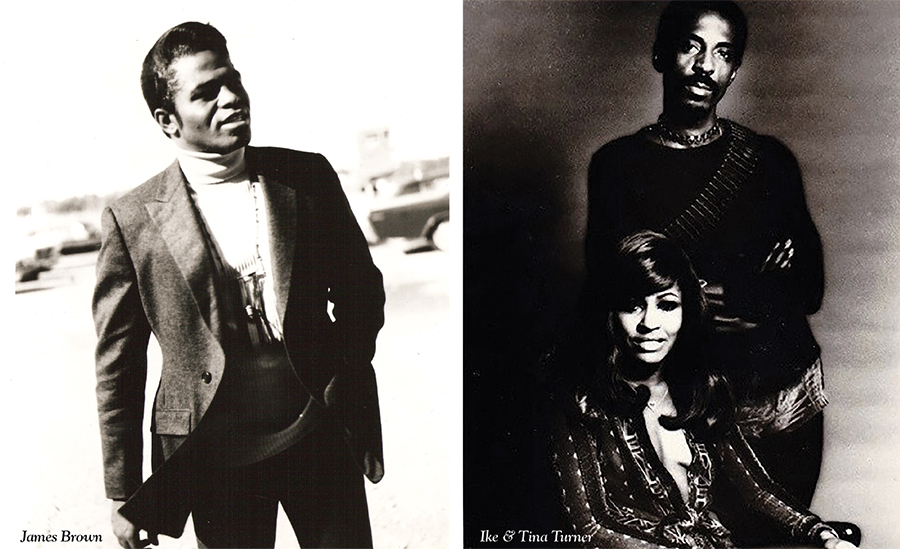
He’s got quite a list of celebs who stayed at Magnolia to sustain the Juke Joint Series for quite a while. Duke Ellington almost made the list. “Duke didn’t stay here, but his band did, “ Pass says. “Duke was comfortable enough financially to have his own rail car. So he stayed in his own car on that train,” he explains. “Ray Charles stayed here, Ike and Tina Turner, James Brown, heavyweight champ Ezzard Charles. Jackie Robinson, Satchel Paige, they came here to play at War Memorial Stadium. And Ruth Brown stayed here; she was very hot, had top billing on the Chitlin’ Circuit. Gladys Knight and the Pips, stayed here, Smokey Robinson stayed here, The Midnighters stayed here. Buddy Gist donated Miles Davis’ trumpet to UNCG. He talked often about how his mother used to cook for Louis Armstrong when Armstrong would come here. The place was just the vortex of the African -American community here,” Pass says.

Pass and family hope to return to the Magnolia House’s long tradition of hospitality both for events and as a bed and breakfast. “We hope to cater to the furniture market when we finish upstairs,” Pass says, referring to the five bedrooms on the top floor, two of which are fully completed and ready for guests, but currently used only for family and friends. “People who own homes in the High Point area rent out their entire houses to people who come to furniture market. We’d be interested in doing that same thing with the Magnolia House,” he says explaining that they would offer a full package of services — concierge, transportation to Market, for example.

To kick off Black History Month, Miller has organized an event to share the Magnolia House’s current path and history with the public. “We’re calling it our Magnolia Table Talk. And it’s the Green Book edition because we’re celebrating that we’ve been listed in the Green Book for six of their editions,” she says. Miller adds that she envisioned the event as an upscale intimate setting “with my dad and all of his siblings sitting at the table leading a panel discussion with the audience, talking about the history of the Magnolia House, how it tied into history of the Triad and how our family line contributed to that history of the Triad as well.” Pass says that the Magnolia House resurrection is for his community as well as his family: “I restored it because I am interested in preserving our history. My grandchildren won’t know where they’re going until they know where they’ve been.” OH

Grant Britt lives in a much humbler abode than the Magnolia House, but he shares the same reverence for its soulful musical guests who provided the soundtrack of his young life and still resonate in his residence and his head.

For a complete list of events open to the public at The Historic Magnolia House, please visit thehistoricmagnoliahouse.com.

Greensboro’s Next Wave

Greensboro’s Next Wave

One simply needs to look around town to realize that Greensboro is on the move — the Next Wave of young and creative people are already shaping the Gate City’s future. We thought you’d like to meet a few of them

Photographs by Mark Wagoner

Cooking Up Change

Table Seven needs a birthday dessert, a pavlova.

On the hot side of the counter that divides the cooks from the customers at Chez Genèse (pronounced zhu-NEZ), owner-chef Kathryn Hubert centers a beige cake made from meringue on a small white plate — its magnificent foamy peaks and furrows baked into place by a brief encounter with a furious oven.

She slaps the creation with a heavy spoonful of homemade whipped cream. Her gloved hands rain blueberries and blackberries over the gleaming pond. The inky berries land with soft plops.

She rocks a chef’s knife on cutting board to yield juicy geodes of strawberries, then she upends a tin canister of powdered sugar and makes it snow over crags of red and blue.

“Runner!”

Server Ben Lugo, who describes himself as autistic, carefully lifts the plate from the counter and takes a few steps to present it to the honoree.

“Happy birthday to you, happy birthday to you, I forget the rest of the song, buhhhhhhht . . . HAPPY BIRTHDAY TO YOU!”

What Lugo lacks in words, he makes up for with enthusiasm. Laughter bathes the moment.

Lugo, 22, laughs, too.

Behind the counter, the oval-faced owner Hubert, who traps her long brown hair under a trucker cap, frees a giggle. She is prematurely calm at 30.

“That’s great,” she says of Lugo’s improvisation. “I’ve never seen him do that before.”

Ten years ago, when she was chipping away at a degree in hospitality management at UNCG, Hubert imagined her future.

She could see herself leaving Greensboro for Oregon.

Maybe Portland. Someplace awash in young people who wanted to make the world a better place.

Sustainable. Fair. Inclusive.

Those were her values.

But another thought tapped at her mind as she pondered what might be elsewhere: There was plenty of work to be done here.

“There were people walking by me every day that needed help,” she says.

Living on the cusp of campus and downtown, she saw homeless people frequently. She worked in a community garden in the Glenwood neighborhood, where families prized the vegetables that sprang from the dirt. She tutored children in an after-school program run by the nonprofit Hope Academy and, later, in a similar one operated by the Autism Society of North Carolina. That’s where she met Joey, a profoundly autistic boy whom she describes as “very sweet, very in tune.”

Hubert was on familiar ground. She’d grown up with three male cousins with autism, a wide-ranging condition marked by difficulty in making social connections.

Portland would have to wait. After graduating from UNCG, she stuck around for Joey. She became his full-time assistant at his elementary school, a paid position in the school system. 

The job with Joey was rewarding — for him, and for her — but when Hubert looked ahead, as she is prone to do, she saw a sad truth: The Earth is, indeed, flat for people like Joey, who often fall off the edge once they leave high school and find that job opportunities for people with intellectual and developmental disabilities are practically nil.

Once again, she pitched herself into the future and saw a solution: a French cafe that would employ people with intellectual and developmental disabilities — folks like Joey and her cousins.

Hubert was a foodie from way back. Coming of age in the mountain college town of Boone, she cooked at The Inn at Crestwood and Hound Ears Club. She bagged a degree in culinary arts from Caldwell Community College and spent a year volunteering in a resort kitchen in the Burgundy region of France.

The experience left a lasting impression.

“I fell in love with French food and culture, and how generous French people are with their time. They’re very relational,” she says. “When they invite you into their homes, there’s no time limit on it.”

Her experience propelled her to study hospitality at UNCG, which led her, in turn, to meet Joey, which led her to understand that she could whisk together everything she had learned — about food, about people with disabilities, about being the change she wished for — to create an inclusive workplace.

“This has been a dream a long time in the making,” she says.

She toned her restaurant chops by working in catering at the Iron Hen and, later, by helping to get the now-shuttered Morehead Foundry complex off the ground.

She cultivated a coterie of advisers: an attorney, an interior decorator, small business owners and fellow chefs.

The stove jockeys devised a menu rooted in Gallic ethos.

“The French don’t cram a lot of ingredients into their food,” she says. “They pick a few and let them shine.”

The breakfast-and-lunch offerings would glow with fresh baguettes, croissants and brioche from Camino Bakery in Winston-Salem.

House-made egg dishes would wear simple accessories: asparagus and chèvre; smoked salmon and dill crème fraîche; spinach, roasted red potatoes and Camembert.

Strawberry crepes would travel with crème fraîche or Nutella.

Ham and butter on a chewy baguette would equal a sandwich.

A fancy sandwich might combine olive tapenade, fresh tomatoes, goat cheese, sliced chicken, pepperoncini and arugula on a baguette.

A tart might require just potatoes, thyme and red onions.

Chocolate mousse would leave tiny air pockets in a small mason jar and wear a fluffy hat of whipped cream.

Hubert stitched together financial backing from various sources: family and friends; online crowdfunding campaigns; grants from downtown development advocates; and a personal loan of $30,000.

She secured a location on the southern hem of downtown — an airy space which last held PB&Java, a sandwich and coffee shop near the corner of South Elm and Bain streets, a block removed from Gate City Boulevard.

She didn’t have to advertise for applicants. After local media announced her plans, emails rolled in from people who wanted a job. If parents contacted her on their children’s behalf, Hubert asked them to have their children contact her directly. Applicants had to want it for themselves. She wasn’t in the business of handing out jobs. She was in the business of hiring people who could do the job, never mind their disabilities.

She conducted interviews, culled the best candidates, and arranged for job training with lots of role-playing and explicit instructions on how to read and react to social cues, a common deficit among people with developmental issues.

Among the lessons: Do not interrupt when customers are deep in conversation; and when diners set their plates aside or their silverware on their plates, assume they’re probably be finished. There were moments of levity.

Once, when Hubert played the role of a diner, a would-be server asked if she wanted dessert. Sure, she said. What are your favorites? Impulsively, he proceeded to tick off a litany of sweets that weren’t on the menu.

She then diplomatically reminded him that the context called for a list of confections that were available to diners.

One of her cousins helped with the training.

“He said, ‘Hey, I’m Zachary. I’m autistic, and I’m not ashamed of it,’” she says. “There was an immediate connection between him and the staff because they thought, ‘He understands.’”

Hubert mobilized an army of volunteers to blanche the restaurant’s interior to simple chic. They painted the walls white, wrapped support columns in rope, hung sail cloth drapes in the many windows, and striped the walls with shiplap siding and floating shelves that breathed with terra cotta pots, feathery ferns and trailing tendrils.

A friend hung a banner of brown butcher paper near the front door. In wispy script, she translated the cafe’s French name:

“Chez Genèse, A Place of New Beginnings.”

Hubert’s mom and dad, Lori and Barry, came from Boone and camped in the construction zone, lending muscle and experience. Convinced that she could never pay back, only pay forward, their love, Hubert planted one white chair in a sea of black bistro seats. The first person to occupy that seat every day gets a meal on the house, along with a brief history of the reason behind the largesse.

“It seemed like a good way to share the story, in a practical way,” says Hubert.

She opened her breakfast-lunch cafe in late-October, the same week that A Special Blend, a coffee shop that also employs adults with cognitive disabilities, opened on West Market Street near Starmount Forest (see this month’s Life’s Funny, page 17).

It was a coincidence. But Hubert believes the events are rooted in the same time and place. It’s a time, she says, when people who are inclined to quash employment barriers for those with disabilities have successful role models like Wilmington coffee shop-turned-franchise Bitty and Beau’s.

Greensboro, she says, is fertile ground for people like that.

“There is, I think, a sense of community in Greensboro that isn’t in other places,” she says. “I think there are a lot of businesses and individuals here who care about making an impact, and I’m honored to be a part of that.”

More than half.

That’s how many of Hubert’s 22 employees deal with evident disabilities: autism, Down syndrome, lower-than-average IQs, and other conditions that make processing information a challenge.

Brianna Oliver, 21, says she deals with attention deficit and hyperactivity disorder, anxiety and depression. She graduated from high school, tried college for a while, and lost a job as a preschool assistant before coming to Chez Genèse.

“I’m either all too much at once, or not engaging enough. It’s hard to be myself with people because I feel like they won’t want to be friends with me,” she says.

At Chez Genèse, she says, she can be herself, knowing that her bosses — Hubert and her neuro-typical lieutenants — understand and can help if needed. As a result, Oliver has relaxed into her job as server, a job she wanted so she could improve her social skills.

Katya Hedrick, 25, a prep cook, left her parents and a job helping with horseback tours in Boone to see if she would like living on her own.

“I already knew I wasn’t good at talking to people, so I’m learning to communicate better. When I came to Greensboro, I had to talk more,” she says deliberately. 

The change was scary, she admits, but chocolate croissants and supportive co-workers have made it easier. Also, they have helped her refine one of her best skills: hugging.

“This is like a big family that tries to help one another,” she says.

Lugo, the birthday crooner, also tried college. It didn’t work out, he says, so he now works four jobs, three in food service.

Ask him what’s good about working at Chez Genèse, and he shifts to the hypothetical second-person to answer.

“If you were a jerk, or pardon my French, an asshole, you would say the pay and no tips,” he says, referring to the slightly-better-than-minimum-wage pay and no tipping in the French tradition.

But because Lugo is not a sarcastic asshole, he will say no such thing. Instead, he will say that Chez Genèse has allowed him to see a future job that might involve his passion: games. Online games, board games, trading card games. He’s good at memorization. Show him the rules, and watch him go.

“It got me thinking, maybe I’ll open a store and help people,” he says.
— Maria Johnson

Katei Cranford – Community Advocate

A tireless purveyor of everything local, Greensboro gadfly Katei Cranford wears a lot of hats, none of them boring: Event organizer. Historic preservationist. City council candidate. Yes! Weekly columnist. Radio DJ. Social media flamethrower.

Where does the 34-year-old get all her energy? “There’s a certain inspiration that comes with the frustration of not necessarily being a city that has a lot going on.”

Many will know her best from her long-running Tuesday afternoon radio program on WUAG that spotlights musical groups playing around North Carolina.

Instant Regrets and Basement Life are local faves but Katei confesses, “A lot of the bands I’m most excited about are coming out of Raleigh right now.” That’s because a viable music scene is predicated on a platform of appropriate entertainment venues, so she’s often engaged in nudging developers into expanding creative outlets and performance spaces. “It can be really fun here and I want to share that. And everybody else I talk to does too,” she says. 

Things are looking up on the music scene, Cranford says: “When you get solid touring bands coming here there’s an extra element of passion and enthusiasm. We don’t take them for granted.”

Like they say: Right what you know. — Billy Ingram

Witneigh Davis & Giovanni Ramadani – Founders Greensboro Fashion Week 

Lights! Cameras! Music! Yes, Greensboro Fashion Week has all the glamour and excitement one would expect from a runway show, but for founders Witneigh Davis and Giovanni Ramadani, it has always been as much about substance as style, starting with their initial vision in the fall of 2014. 

New York Fashion Week, says Giovanni, a former model, had become “watered down” and rife with pay-to-play participants.” Gotham “got outside the major designers they’re showcasing.” Talent was secondary. Greensboro, on the other hand, boasted “textiles driving industry back in the ’60s,” says Witneigh, a former stylist with marketing chops. “Knowing that the history and roots were here in the fashion world, we just kind of resurfaced in a modern way.”

The two entrepreneurs saw an opening to fill the fashion gap in the Southeast, between New York and Miami, by showcasing local designers with the help of sponsors, such as Greensboro’s Foreign Cars Italia and no less than Bentley, among others. After all, as Witneigh points out, clothes and cars are “a natural fit.” She and Giovanni also noticed that Greensbororians sported their own polished and casual, if a bit subdued style, and could be encouraged to take more daring sartorial steps.

Fast-forward five years, and the two entrepreneurs, both of whom who will be 32 this year, will tell you GFW has morphed beyond expectations, becoming a true platform for fashion. Designers — from all over the world —  are vying for the opportunity they’ve provided. “We had over 100 applicants last year and we only had room for eight,” says Giovanni. “We wanted to pick the best ones.” And they are hands-on. Witneigh says the two constantly communicate with the designers by Skype, every step of the way before the razzmatazz in fall that includes multiple shows at various hip locations around town. (Last year they snagged a hangar at Honda Jet for one of their shows.)

But Witneigh and Giovanni haven’t stopped there: They started a modeling camp for kids in the summer, the first, Giovanni believes, in North Carolina, to teach aspiring models the ins and outs of the industry and how to comport themselves professionally so as to be agency-ready. (Some were signed on at last year’s Fashion Week.) The dynamic duo are also putting their energies behind Twin City Fashion Week in Winston-Salem this spring and a daylong Summer Show before the GFW revs up again in October.

They’re excited that the event is becoming a destination. “That’s the thing,” says Giovanni. “We want to make Greensboro cool. We want to make Greensboro fashionable. We want to make Greensboro fun.” — Nancy Oakley

Maurice Hicks – Filmmaker

It takes a visionary to see life’s big picture, then project it on the big screen. Just months ago, UNCG film grad Maurice Hicks, 32, completed a feature film he wrote and directed, Rap and Rhyme, an underbelly exam of the music biz, which he says is “an accurate reflection of who I am as a person, an artist, and what I’m capable of.” As a financial and artistic roll of the dice, “it was absolutely terrifying but we did it.”

Timing seems right. His highly acclaimed short from a few years ago was recently picked up by an entertainment channel, a circumstance so rare as to be almost unheard of. An unflinching commentary on American racial injustice, A Letter To My Son stars Cranston Johnson (Hap and Leonard), who’ll be seen in two new series on ABC and Netflix this year.

It takes a creative fervor to be constantly producing in spite of overwhelming uncertainty, but it’s paying off. “I like Hip Hop, I like urban characters,” Maurice says. “I grew up in an urban environment so I like to think I write them pretty authentically.” Hollywood agrees. Maurice currently has a major motion picture being shopped around with Outkast’s Big Boi attached.

Meanwhile, his latest movie treatment, about romance in the digital age, is a finalist for Best Screenplay at the South Carolina Underground Film Festival. “I’ve never been to Charleston,” the filmmaker confesses. “It should be fun.” — Billy Ingram

Jessica Mashburn – Singer, Songwriter

The next time you see her, you might be forgiven if you fail to recognize Jessica Mashburn, the gifted chanteuse whose physical appearance seems to change like the weather. Long a favorite among patrons of Proximity Hotel’s Print Works Bistro, which hosts the popular Wednesday night jazz gigs, the 36-year-old Mashburn performs with partner Evan Olson, not to mention countless events ranging from private parties to splashy weddings. The colorful and chameleon-like songwriter-songstress might be the closest thing in the Triad to a musical theater Renaissance woman. One minute she’s a sultry Berlin cabaret singer from the 1930s, the next a blonde bombshell à la Some like it Hot.

“I love to adapt to whatever is needed the more dramatic the better,” she says. “If someone needs a flapper from the ’20s to greet people and sing them through the door, hey, I’m just the person.” That’s because she sees herself primarily as an entertainer: “My job is to leave folks happy and maybe even inspired.”

Born the daughter of bluegrass musicians from Southern Pines who relocated to Greensboro in 1984 to give their precious daughter “a better exposure to the arts,” Jessica thrived in theater and music at Southeast Guilford before enrolling at UNCG to study music. The large classes prompted her to switch to her hometown, Sandhills Community College, where she sang with the jazz band, taught herself piano and guitar, and earned a degree in music before moving for a brief time to Raleigh to work for Quaintance-Weaver’s Lucky 32 Restaurant, having been a server at the Green Valley Grill during her time at UNCG. 

The divine Miss Mashburn’s versatile talents led to a post at the O.Henry Hotel as events manager in 2005, a job she performed until 2007 (singing on weekends with pianist Dave Fox), when Dennis Quaintance recruited her for the design team of the sister Proximity Hotel. In 2011, this musical polymath who makes her own outrageous hats, “demoted” herself back to server in order to free up weekends for performing — and never looked back. Though she still works as the hotel’s music coordinator, her career has soared like a bird.

“Funny you should say that,” she quipped on a recent afternoon wearing a hairdo done to look like a maple tree in autumn splendor. “My favorite song with Dave is ‘Feed the Birds’ from Mary Poppins. That was Walt Disney’s favorite song. I love to sing it because Greensboro is such a special place and feeds me in a spiritual way.” She went on to say that the Gate City is “a place where artists are welcomed and encouraged. I feel so lucky to be here.”

So do we, dear Jessica. — Jim Dodson

Savio Nazareth – Head Professional, Starmont Forest Country Club

Savio Nazareth was 7 when he first played golf in his native Tanzania. “I hated golf. I was much more into soccer as a kid,” he says with a laugh. “Funny how golf took me to places I could never have imagined.”

It was indeed a long and winding road to venerable Starmount Forest Country Club, where Savio, 39, is completing his first year as club’s eighth head professional in 2018.

His story is one of an East Indian family and great faith — plus times that are a’ changing. In his teens, Savio began winning golf tournaments in Africa and started to think seriously that golf might be his ticket out of Tanzania. His parents arranged for him to attend school and live with his older brother Andrew in Orlando, Florida, where he found a spot on the school golf team. After a stint at junior college, he was recruited by Guilford College’s late beloved coach Jack Jensen, who found scholarship money, guided him through some tough academic transitions and helped him land a sports internship at Southeast Guilford High. “Jack got me through some difficult times. He was more than a mentor to me,” Savio says with emotion. “He was like a father figure.” In 2002, Savio helped guide Guilford College to the National Collegiate championship.

After college he played two years on the Hooters Tour and enjoyed some success, but was soon married and looking for something more stable than the vagabond life of a touring pro. In the spring of 2005, he found a gig as assistant to Starmount Forest’s head man Eric Gaskell, a post he held for the next decade. Popular with the club’s golfing members, Savio qualified for his first Wyndham Championship in 2008 and started seriously thinking about earning his class-A PGA credentials.

The critical moment came in 2016 when he lost his mother, Sabina, and brother Andrew, just five months apart  — and almost his desire to play golf. “I spoke to my mother almost every day, and I owed my brother so much for his support. Losing them was devastating. I felt lost.”

The one thing that kept him going, he says, was wife, Lisa, and their two children, Hillary and Trent, along with guidance from his minister at Shady Grove Wesleyan Church in Colfax. “They helped me see that everything has a purpose and you simply have to keep going and keep the faith that you’re on the right path.”

That faith was redeemed at the PGA Sectional Championship in Wilmington when Savio — thinking of his late brother — rolled in a 4-foot putt to claim the title and went on to win Sectional Player of the Year Honors, earning his exemptions in several major professional tournaments. “I cried like a baby,” he allows.

Maybe the biggest prize came last year, however, when Starmount Forest’s head man Bill Hall retired and Savio Nazareth was rewarded with the top job.

“It’s 13 years and been an amazing journey here, and I’m still learning more every day. This place is really a big family to me. The club has enjoyed a great revival of young families and I’m just honored to be part of that new phase of life.” — Jim Dodson

Jessika & Veronika Olsen – Owners, Sonder Mind & Body

Flotation Therapy, something Tom Brady and Gisele Bündchen practice, offers the extraordinary opportunity to experience weightlessness without entering outer space, thanks to 1,000 pounds of epsom salts (magnesium sulfate) added to a pod containing warm H2O. (The pod contains the same amount of magnesium sulfate as the Dead Sea.) My friend Stephanie Bolton, who calls herself a floater, finds that it takes you to inner space.

But to get there you’ll have to venture to Sonder Mind and Body on South Elm Street. The wellness center offers flotation along with infrared sauna, massage, hypnosis, yoga and an organic café.

Identical twins Jessika and Veronika Olsen, 33, believe their health spa and café is one of only two nationwide (the other opening in hipster capital, Austin, Texas). Both sisters battle autoimmune disease. Veronika previously operated a wellness clinic in Hawaii. Jessika owned a bakery business. Since age 19, they have been entrepreneurial with a focus upon wellness. Their mother, a nurse, promoted flotation, having experienced it.

“Flotation is not like anything most have tried,” explains Jessika. “It takes you away from all external things.”

I had to give this a try.

Following infrared sauna, I showered in a private room and with a twinge of trepidation entered the pod after a tutorial from Veronika. Initially I kept the lid open, but as soon as the lights dimmed, I closed it so that I was in a completely dark environment.

If the womb was this exhilarating, how did Mother Nature coax me out? Sixty minutes passed in luxurious slow-mo. My skin felt silken, limbs wondrously weightless, and I was suspended in honeyed, liquid quiet. 

Floating reduces anxiety in veterans who suffer from post-traumatic stress, and gives others relief from pain. It offered me meditative calm; utterly, peacefully transporting.

“We don’t want anyone to stress about relaxing,” smiles Jessika.

The original Olsen twins are Greensboro’s newfound treasure. And I’m now a floater, too. — Cynthia Adams

Sonder Mind and Body, 515 S. Elm St., (336) 663-7562 www.SonderMindandBody.com

Joe Rotondi – Executive Director, Forge Greensboro

Once upon a time, Joe Rotondi’s great ambition in life was to work as a bartender all across America, meeting the locals. “Bartending is a great way to take the pulse of a community and really learn what’s going on,” says the friendly 33-year-old. It was his love of people that led him to volunteerism and community development for nonprofits — and eventually studies in social entrepreneurship at UNCG, where he’ll pick up a degree this spring.

Several years back, Joe’s interest in making a bench for City Market led him to Forge Greensboro, an innovative makerspace. At the time it was just off West Lewis Street in a former turn-of-the-century blacksmith shop — hence the name — in a once forgotten part of downtown. What he found there spoke powerfully to his inner community developer — a shared place. There, budding inventors, artisans, trade professionals, tinkerers, entrepreneurs or simple hobbyists could create, learn, collaborate and produce just about anything they could imagine for a simple monthly fee that provides access to proper workspace, advanced tools, and the collective wisdom of a hands-on creative community. 

Joe Rotondi came aboard as facility manager in late 2014 not long before robust membership growth prompted a move to a building on Lewis Street that once served as an auxiliary livery stable and more than doubled the Forge’s usable space, becoming an anchor of the area’s spectacular transformation. Now as executive director, he oversees a grass-roots powerhouse that boasts 195 members and has launched at least 30 different businesses in just five years of existence. On any given day, at any hour, you’re likely to find an inventor of an electric car hard at work on a high-tech 3-D laser machine or a class underway in the brilliantly equipped woodshop. Since opening, the Forge has taught more than 700 diverse classes and skills to nearly 2,000 students of all ages and backgrounds.

“The real beauty of this place is its diversity and the people,” says Joe, who points out that a recently completed capital campaign raised $200,000, funds that will go in part for teaching grants and more advanced equipment for budding engineers, welders, furniture makers, or, who knows, maybe the next Elon Musk. “The Forge’s diversity is its strength, a place designed to teach, share and grow a community by hand,” Joe allows as he leads a visitor through the various workspaces where members are making their dreams take shape, followed by his “shop dog” Mira, a friendly cattle dog he saved from an Alabama kill shelter last August.

“She’s found a home here,” Joe reports. “And so have a lot of very talented people.” — Jim Dodson  OH

“In our January issue, we misidentified Starmount Forest Head Professional Savio Nazareth’s lovely wife, Hillary, as his daughter. In addition, he only has one child, a promising young golfer named Trent. We regret this error and seriously deserve a two-stroke penalty.” — The Editors

To D.I.Y. For

To D.I.Y. For

Betsy Brodeur applies ingenuity to her Sunset Hills home

By Cynthia Adams     Photographs by Amy Freeman

Oh-so-desirable Sunset Hills was developed in the mid-1920s, featuring woodsy green swaths and homes with distinct personalities. According to historians, deed restrictions ensured a “quiet, park-like setting,” requiring that houses be built farther than 45 feet from the street.

Homes here are snapped up quickly by eager buyers, often before a “for sale” sign goes up. When Betsy Brodeur and her husband, Lee, heard the house they’d eyed in Sunset Hills was on the market one February day five years ago, Betsy had to do a look-see. When she did, it was a case of instant, physical attraction.

“The hair on my arms stood up when I first saw it,” she says, recalling stopping for an open house. “When I saw the house, I felt love, and healing.”

As a family, the Brodeurs needed more room for their three daughters, something more spacious and soulful. “We had been looking for so long,” Betsy says. “That same night, somebody broke into our garage and stole all of our lawn equipment.” The urge to move grew more urgent after the burglary. 

When the Brodeurs did a subsequent drive-by, the six-bedroom home with style to spare was already sold. 

They were crestfallen, but they discussed paying off their house in Lindley Park and buying a beach house.

Fortunately, they discovered the sale had fallen through from Melissa Greer, the Realtor who is now their neighbor. They moved swiftly and decisively

There was even a downstairs bedroom and bath, rare in a home of its vintage. Here, the Brodeurs could age in place. 

Almost all of the original footprint of the house was left intact with only one major addition on the rear. They just knew — the ways in which the home wasn’t exactly to their liking were just matters of cosmetics. “It was a spiritual, emotional decision,” says Betsy Brodeur as she stands in the Arts and Craft–style game room, the newest portion of the house overlooking an outdoor kitchen and fountain. 

“We should be downsizing at this point in our life,” Betsy says cheerfully, and chortles. But the couple did the opposite of what their friends were doing in anticipation of retirement. The Brodeurs went bigger. They upsized from that “cute little Lindley Park bungalow” to a 4,500-plus square foot home.

“Lee said, ‘I’m buying the house. But any updates are on you.’” Fine, Betsy thought without hesitation. She immediately thought of her clever mother, who had done far more with far less when it came to fixing up houses, and knew she could handle it. The Brodeurs moved in by April 2013.

The 1929 house was gorgeous, yet the interiors were serious, featuring darker jewel tones. 

The Brodeurs preferred the colors of the sand and sea. “I grew up on the coast; my influences are teals and blues.” Betsy says of their tastes, which were lighter, airier and coastal.

What she wanted was to recreate the light-filled vibe she had always loved as a Floridian from Siesta Key near Sarasota. 

Betsy left Florida in 1996 and moved to Charlotte. “My mother died, and that rocked my world. Eventually, she met Lee while at the beach. 

“A girl from Florida meets a guy from North Dakota in Myrtle Beach!” she laughs.

Their golden retriever is named Myrtle to honor where the couple met.

In some ways, their home is another homage to her mother. Betsy began doing what her mother had done repeatedly as a minister’s wife, polishing up drab parsonages. She showed Betsy that ingenuity could transform a space. Time and again, her mother did the impossible with spaces that were anything but beautiful.

“She was artistic. She made things look fantastic, and also made it great for the next couple coming in,” Betsy recalls. “New minister, new minister’s wife, and they go to this crappy house. It became her gift to the next family.”

The lesson stuck. Betsy followed in her mom’s footsteps, becoming the consummate do-it-yourselfer.

She set out with neutralizing things, deleting Mediterranean and French influences. She gave it the feel that she loves — “beachy,” she repeats. But appropriately so. 

“I had a wonderful teacher in my mother,” Betsy reiterates, using one of her mom’s oft-repeated expressions, “tending the hearth.” “I’ve always liked making my homes comfortable,” she adds, “but this one meant even more. I was almost channeling my Mom and didn’t realize it.”

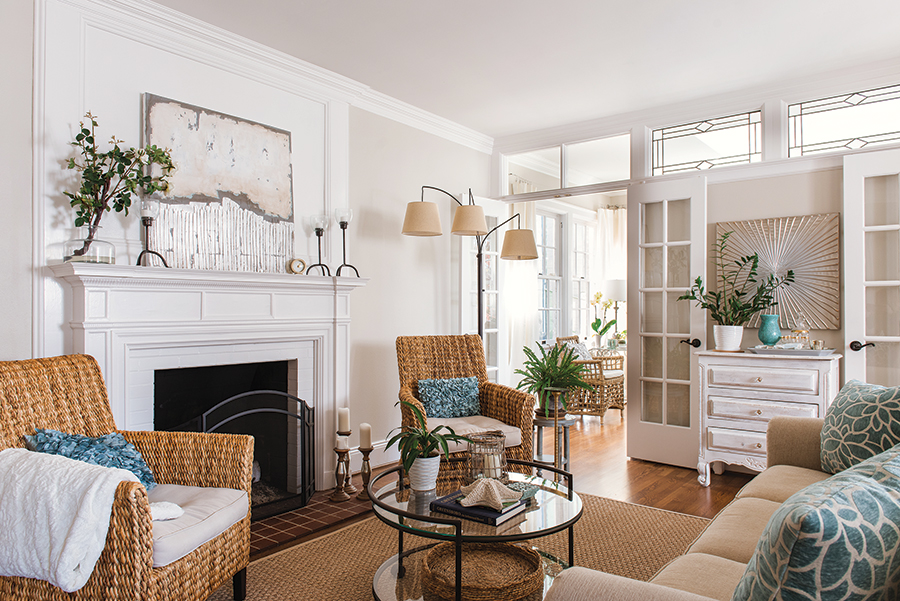
A year into the move, Betsy had officially made best friends with Benjamin Moore. She began painting and switching a more formal interior to a decidedly beachy one, with wood and wicker furniture and accents. She created a tight color palette, using natural finishes, creamy white and even robin’s egg blue. Paint was going to be the biggest ally in making an already gorgeous home the Brodeurs’ own.

She went at the project after-hours even when exhausted from her workday. Lee eventually suggested Betsy might want to retire and “tend the hearth” full time. Four years ago, she did.

“I’ve always worked with nonprofits, most recently with the Women’s Resource Center,” says Betsy. Retirement would mean she could devote herself completely to updating the home. 

Betsy, now retired, grabbed even more gallons of creamy greige, white and blue Benjamin Moore paints, and rolled up her sleeves to finish the job.

Although Betsy insists “we did things on the cheap,” their refreshed home reads casually refined. “Paint mostly,” she insists modestly. “I learned so much about color. I guess you could say I did it myself,” she says with a throaty laugh. 

She particularly wanted the house to be a haven for her three stepdaughters, even though the eldest is now 25 and will soon marry.

She felt the need for the house’s colors to reflect her stepdaughters’ tastes and preferences, too. “Subtly, I can make their spaces comfortable and mirror them,” she says.

The space gained by the move from a smaller home was more comfortable for the entire family.

“With a limited fix-up budget, I had to be even more resourceful,” says Betsy. Out went beautiful red velvet drapes and formality. The house seems to relax into the new owners’ style. 

The kitchen spiff-up was her second major task after painting. Flooring was replaced with new hardwoods and countertops and backsplash were replaced.

She kept with period-specific updates. Betsy stuck with marble for the kitchen counters, a material that could look as if it had been there for 90 years. The Brodeurs retained the Wolfe professional range, and also kept a pantry with ample shelving and wine fridge, but opted to remove the pantry doors to open the space more.

Betsy, who loved all things color-related, would work alongside the painter hired to work on the kitchen’s cosmetic changes. And she loved having done that, giving herself over to whatever work needed to be done, even the tedium of cabinet painting. 

“To redo the kitchen would have cost us a fortune. But I enjoy seeing the brush strokes.”  She learned new skills by supervising the kitchen work.   

“I did the whole house,” Betsy says with no small pride, doing a walk-through of the sunny downstairs living room, sunroom, dining room, kitchen and added playroom with a secret powder room. 

Spacious for its vintage, it has, in addition to the six bedrooms, a seventh upstairs was converted into a laundry room. “It could be seven bedrooms,” says Betsy. There is room for a workout room and a cozy den upstairs, as well. 

The floors were refinished; surfaces were made more neutral.  Furnishings were kept airy and bright.

As with most homes, the heart is the kitchen, where the marble countertops complement the crisp, white subway tile (versus the previous French hand-painted tiles and darker colors). Betsy stops in what they now call the keeping room. Betsy admits she never heard of it, the one space that had perplexed her. 

Here alone did she rely upon the advice of a pro, Greensboro designer Maria Adams, regarding one thorny problem at the kitchen entry.

“I never had gotten used to the area, with its beams,” says Betsy.  It was walled off and awkward. “We never used it. My husband started saying, should we discuss creating an open floor plan?  Should we move?”

They didn’t want to take down any walls. How to make it work, she wondered?

“Lee bought me an hour’s consultation with Maria, and the designer suggested it be switched out from kitchen eating area to keeping room,” says Betsy. In the meantime, Adams admired how Betsy had taken an already lovely house and made it even more so. 

“She walked in and said, ‘You don’t need me, this is beautiful.’”

Betsy had noticed the designer’s style and was a fan. “I’d seen Maria’s work, I liked her style.  I told her we weren’t using the space correctly. It felt very uncomfortable.” 

But when the designer explained it should be a keeping room, a throwback to colonial days when families would sleep in a room adjacent to the hearth for warmth.

“She said it very well could have been built for that purpose.” The designer sent pictures of suggestions and furnishings. Adams recommended a small sofa and chairs to create a sitting area.

At first, Betsy balked at the designer’s notion, but once the concept of a keeping room took shape, she discovered it was a successful and creative idea. It also honored the house’s history.

Betsy dislikes when history is stripped away. She didn’t want the original beauty of the house to be lost or compromised, which can happen with big-budget remodels.

“When I was in such a hurry, I had to redo things. I couldn’t really rest if the paint color wasn’t quite right,” she recalls. “When you live with it long enough, it will tell you what is needed. It reaffirms I didn’t hire out all the things I wanted to do, “she says.

Today the imprint of Betsy’s coastal theme is complete. 

The sea is imprinted here, too; starfish motifs abound. Betsy admires the starfish because it can regenerate its legs and keep on going.

“I felt the house going ‘thank you,’” she says, relaxed in a wicker chair by the living room fireplace. “I called my husband and said thank you, because I felt the house saying it to me.”

Nonetheless, there is always a project calling to the do-it-yourselfer. She says a 2008 remodel to the upstairs master suite is perfectly serviceable, yet . . . she hopes to eventually make it completely her own. It is spacious and pleasant, “but I’ve had five different paint colors trying to make it work,” she says. “But I have to wait until we win the lottery.”  OH

Cynthia Adams is a contributing editor to O.Henry.

Lightcatcher

Lightcatcher

For landscape painter John Beerman, beauty is everywhere

By Nancy Oakley

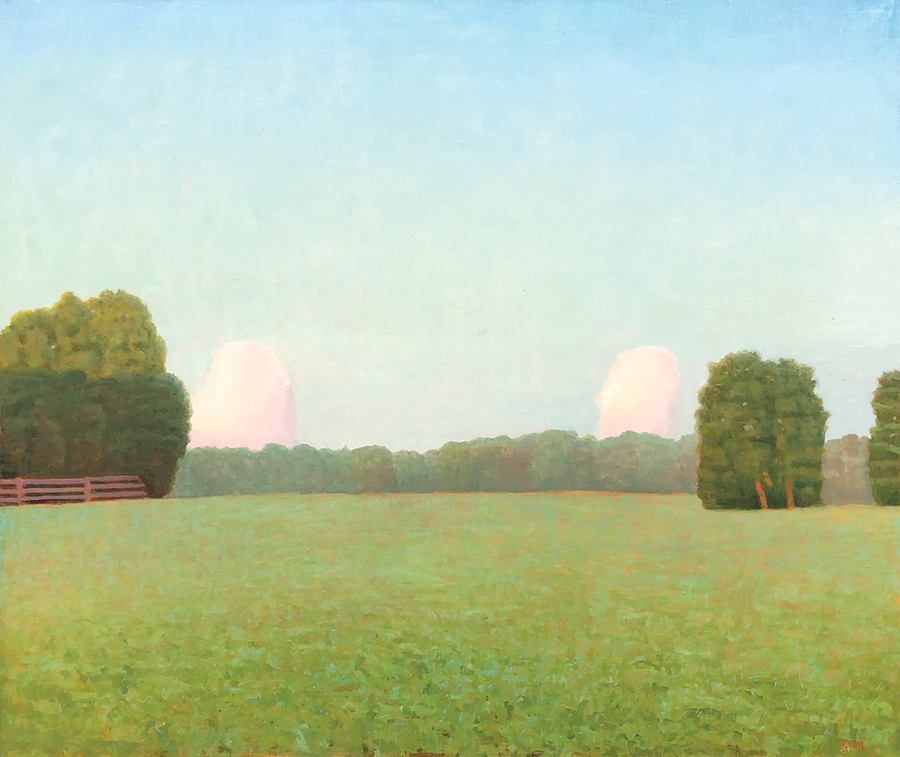
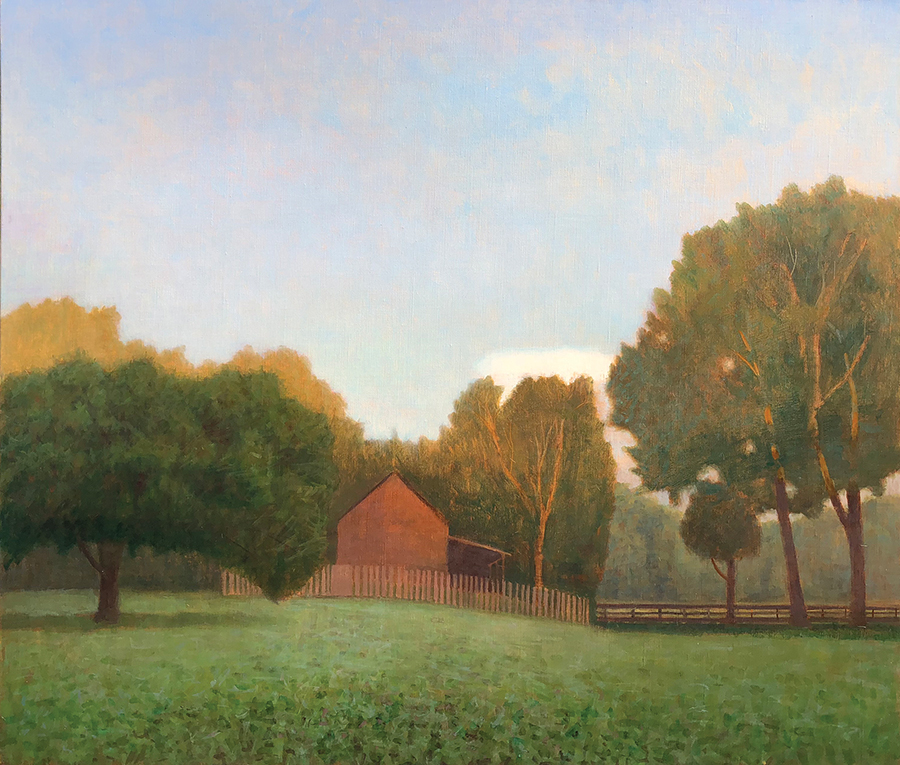
A sweeping lawn on a sunny day glistens in shades of greens and yellows, then blues and grays where trees have cast their shadows. You can fairly catch the scent of freshly cut grass, feel a faint breeze skip across your brow. Just as you might absently mop your brow from the scorching heat of a late summer day, while gazing at a dry and dusty country road that curves endlessly toward the unknown. Never mind that the scenes before you are of North Carolina and Texas, respectively. Or that you might never have visited either one of them. “It doesn’t have to be the actual place,” says John Beerman, painter of the two landscapes. He smiles, recalling traveling down a similar dirt road in the flatbed of a pickup truck, with his paints and easel in hand. “It’s not so much about the image as how it’s put together,” he says. And, of course, how the image makes the viewer feel. At some point, we’ve all experienced the elation of being alive on a sunny summer day, or weariness from its oppressive heat.

Eliciting such emotional responses hinges on the play of light in nature, a fascination for the artist and Greensboro native, who stands before the canvas of the summery lawn in his Hillsborough home that he shares with poet Tori Reynolds. “When you look at grass, it has all these things going on. At first you think it’s just a green stripe or a yellow stripe. There’s all this richness.” But capturing that richness in a painting is not about “flash” or a “horn blast,” Beerman insists. “Rich color is not the most brilliant blue you can get out of a tube.” Rather, it’s a matter of, “How do you enrich a gray to make it a full gray? How do you make these subtle nuances glow?”

In another painting of a cottage in New Mexico lit from within at dusk, Beerman has carefully applied several shades of blue, blue-gray, violet and aqua to replicate the building’s corrugated metal roof. He points out the telephone pole and wire in the scene, a feature he once included in a series of paintings of churches. “I’ve had several people come up to me and ask: ‘Why did you mess it up with the telephone wires?’” he laughs. “I just think it’s kind of fascinating the way it curves.” He was similarly taken with, of all things, a Rhode Island trailer park. “The light as it’s falling on the dreary old trailer in a certain way, that speaks to me as much as a beautiful mountainside,” Beerman says. “I’m not really concerned with the ‘beautiful.’ Anything can be beautiful.”

He couldn’t help but be struck by the beauty of the North Carolina mountains during his childhood. It was then that his artistic journey began. His mother had always encouraged art as a pursuit, buying her youngest son chalks and pastels, and enrolling him in private lessons. “I was taking art classes before first and second grade,” he recalls of the sessions with a family friend, Barbara Covington. “She lived on Princess Anne and taught out of the back of her house.” Beerman reels off other memories of the Gate City from those early years: Fisher Park and attending Irving Park elementary school. “I remember the old Lawndale Shopping Center. I’d go to the GI 1200, down from Roses. It was called GI 1200, because it was Government Issue. They had Army knapsacks and such.”

But it was those visits in the early 1960s to his grandparents’ cottage in the mountains that left an indelible impression. In those days, Beerman says the place had no TV, and with few children his own age in the area, he had a lot of time on his hands. He spent it in the company of a distant relation whom Beerman describes as “an amateur kind of a Sunday painter.” The young child was mesmerized. “I’d watch him paint on the deck overlooking this beautiful lake. I think watching him showed me: How do you make use of your time? Nobody wants to sit around. I like to do something. It seemed like a pleasant thing to do. It got me going.” He pauses for a moment, “Plus it was in this beautiful setting . . . maybe that’s what sent me to Vermont.”

The Green Mountain state is a long way from Greensboro, but it beckoned the budding artist as he was starting 10th grade at Page High School. Six weeks into the fall semester, he was working on an assignment in an art class. “At that time it was [called] commercial art,” Beerman remembers. “The first assignment was to go through a stack of magazines and make an ad for GM,” he laughs. But it was an advertisement of a different sort that would transform his life as he dutifully went through the periodicals, choosing one titled New York Times Magazine. “I’d never heard of it, at that point in my life,” says Beerman (ironically, now a loyal subscriber to the Times). “I started to cut stuff up in it, and I noticed in the back, they used to have these little ads for schools,” he continues. One of them, for Woodstock Country School, on a 300-acre farm in Vermont, caught his eye. As did its small size — only 60 people in the student body — and the curriculum. “That little ad said, ‘stresses the arts and humanities,’” Beerman recalls. “And that’s what really stood out to me. I’m not much of a science guy.” The school’s fall term started in early October, so Beerman figured there was still time to enroll; with money set aside from his grandparents, he could cover the cost of tuition.

He was ready to embrace change. His parents had divorced years earlier, his older siblings had all left home for college, and Greensboro in the mid-1970s held little appeal for the 15-year-old. “Downtown was dead; the big thing was Four Seasons Mall; that’s where everybody went. And for whatever reason, I never felt a part of that scene,” Beerman says. “There was not much to keep me around.”

So, he packed his bags and headed north, and for the next three years, he blossomed. “There were kids from all over the place, from out in the country. It was beautiful, Vermont.” Though not particularly outdoorsy, Beerman says he has always loved being outside. “I felt solace in nature,” he reflects. “It’s ever-changing, it kind of feeds my soul  . . . and I love light.” Particularly how it changes. He had ready inspiration in his rural surroundings, where he continued drawing and became involved with photography. So much so, that when it came time to apply to art school  — in Beerman’s case, the prestigious Rhode Island School of Design (RISD) — he submitted a portfolio in photography and film.

But once again, his trajectory took a detour. “My first figure drawing class at RISD was just charcoal and newsprint. I loved the immediacy of it. I loved — I guess it was the hand quality,” Beerman says. In addition to requiring long, solitary hours in a darkroom, photography, he emphasizes, was “not a hand-to-hand tactile thing, and I loved the tactile thing.”

Beerman quickly changed his major to painting, which provided him with the opportunity of “actually building something. You’re making something with your hands, and I like that. I liked it a lot. Still, to this day, I try all these different papers and linens and supports,” he says. In another landscape, featured in a recent exhibit at Anne Neilson Fine Art in Charlotte, olive and cypress trees on a Tuscan hillside glow in tones of green, yellow and silver, and appear to sway. “This is an egg tempera painting,” Beerman explains, adding that the simple mixture of egg yolk and pigment produces a translucent effect. “It adds a complexity to the color,” he says — as opposed to some of his oil paintings that create what he calls a “mushy” effect.

Beerman discovered egg tempera during his training at RISD. “Craft,” he says, “was really important to me.” At a time when Abstract Expressionism was de rigueur, he felt he had to explore other avenues to inform his painting. “I had to go into the illustration department and take egg tempera classes,” he recalls, “because in painting it’s really frowned on; craft was academic.”

He likes the medium because it dries quickly once it’s applied to a surface primed with gesso [pronounced “Jess-OH”] that he makes himself, with rabbit skin glue and calcium carbonate. “Same thing they used back in the old days before oils came in,” Beerman says of the Italian Renaissance painters. And indeed, another of his Tuscan landscapes is reminiscent of the stylized backgrounds one might see in Piero della Francesca painting. Or perhaps 17th-century French master Nicolas Poussin. “I’ve been all over the place,” Beerman allows. “I had evolved through influences, from Modern to Ancient, and somehow it filtered through me. It’s kind of a mystery because you don’t know it till you see it.”

He saw it clearly in the East Hampton Library while he was living in an artists’ enclave of Springs, on the south fork of New York’s Long Island, following his tenure at RISD and Maine’s Skowhegan School of Painting & Sculpture. “I discovered the Luminist School, which I’d never known about, had a lot of influence on me.”

Considered among art historians an offshoot of the Hudson River School, the Luminists came later, in the mid-19th century, directing their attention to the effects of light on landscapes. Unlike the Impressionists, who followed a similar quest with diffuse brushstrokes, the Luminists tended toward more precise renderings, their works more muted and reflective. Or as Beerman observes, “The Hudson River School was more dramatic — drama with a big ‘D’ — whereas the Luminists were not melodramatic.” Their subdued paintings, particularly those of Fitz Hugh Lane and John F. Kensett resonated with him. “That’s when I really got married to the landscape,” he says.

Borrowing his father’s VW camper, he retraced Fitz Hugh Lane’s travels through Maine and produced works for his first show in Manhattan — at a time when landscape painting was not in vogue among the intelligentsia. “It was not considered cutting-edge,” Beerman acknowledges. “I don’t like it when art becomes like an echo chamber of a very small group of people. I don’t want art cut off from most people.”

Just as he forged his own path in his youth, leaving Greensboro for Vermont, or exploring those illustration techniques at RISD, Beerman made his singular mark on the art world, his works ultimately finding places in the permanent collections of New York’s Metropolitan Museum of Art, the Whitney, the Museum of Fine Arts, Houston, and the North Carolina Museum of Art in Raleigh.

Based in Nyack in the Empire State’s Hudson River Valley, he relished being only 30 minutes from Gotham’s museums. “Frederic Church did oil sketches when he was traveling. I got to go to Cooper-Hewitt and pick them up — put white gloves on my hand and look at these paintings,” Beerman remembers. “I was like, ‘Oh my God!’ It was great!” He maintained close ties with his professors at RISD, where he also taught, and painted his environs, such as a large horizontal of the Hudson River, its imposing cliffs rendered in shades of violet and dwarfing the town of Yonkers in the distance. “Yonkers is an industrial town, factories and all that stuff,” Beerman explains. “And right across are the Palisades — basically the same thing Henry Hudson saw 400 years ago, which is really cool.”

The painting hangs in the hallway of Beerman’s home in Hillsborough. He had heard about the small burg after returning to North Carolina in 2009 when his marriage ended and rented a place there. It was a challenging period, but Beerman reconnected with his roots. His brother Bob, who with his wife, Teresa had established the Bass Violin Shop near downtown, and as Beerman concedes, “The silver lining was, my father was in Well-Spring [retirement community] and dying, and I got to spend the last three months with him.”

There have been other silver linings, as well. After his 40-odd-year absence, North Carolina proved a revelation to the artist. “It’s a wonderful place!” he says enthusiastically. In the 10 years since his return, he’s rediscovered his old hometown, serving on the board at GreenHill for a time, and getting to know a revived downtown with new places, such as Scuppernong Books, which has become a favorite, along with the Greensboro History Museum and, as one would expect, Weatherspoon. Most important: “We’re surrounded by this beautiful landscape.”

A landscape that has been a prolific muse. A frequent subject is Chatwood, the Hillsborough estate of friend and writer Frances Mayes, and where Beerman painted that large expanse of grass in summer. (Mayes also lent him the use of her property in Cortona, Italy, where he painted the Tuscan landscapes.) Beerman likes to revisit the same locations on Chatwood’s grounds season after season: the barn in summer, snow-covered in winter; a pasture bristling with greens in one panel or in somber gray and brown hues of a November day in another. He’ll often make oil sketches, or notes or drawings in a sketchbook and then refine them in the larger paintings in his studio, sometimes working on multiple paintings at different times throughout a given year. Until such time as a proper studio is completed in his house, he uses his garage, where among several neatly labeled crates full of paints, brushes, rags and other materials, he produces a small sketchbook. Its pages contain blocks of color and drawings of trees, studies for a larger painting, commissioned by Rex Hospital in Raleigh.

The artist has also conducted painting workshops at Chatwood, and in other locations around Hillsborough, as one former student recalls. Greensboro painter and interior designer Bill Crowder says he learned to “look at things and see things better” under Beerman’s tutelage. “How blue wasn’t just blue, but many colors,” Crowder explains. “The main thing I learned: How things aren’t what they seem necessarily, and seeing what we don’t perceive as being there.” Beerman uses the example of the tufted titmouse to make the same point. “It’s the most gorgeous bird. It’s just subtle grays, that’s all it is. Most beautiful color ever. But you’d be hard-pressed to say, ‘What color is it?’ That’s what’s so fascinating to me about color.”

He’s constantly experimented with color in a number of projects since his return home: still lifes of Jugtown pottery, the shadows of a clapboard yellow house next to his old studio in downtown Durham, studies of Reynolds, one of the few figure paintings he’s done. The two have collaborated on a poetry project, a volume of broadside verse, one of which Beerman illustrated with a brilliant red Tuscan poppy that seems suspended in time. Another depicts a shaded garden where, in a touch of whimsy, a black cat is stretched out on a patch of grass. “My dealer in New York said, ‘Love the painting, but can’t do the cat.’ That’s the problem with New York,” Beerman says, shaking his head. “Why do you have these rules and stuff? Cats are like, soft and cuddly and not cutting-edge, I guess. But, no way I’m getting rid of that cat!”

And, of course, Beerman revisited the place where it all began, the mountains. There, for an entire month, he created “a whole mess of paintings from one spot” — the porch of a house that a collector had made available to him. The experience proved challenging. “I’d get it just right, go away. And then that moment would not just come back the next day, or the next day. That’s the trick, as a landscape painter: It’s never the same twice, and how do you work on a painting for a long time and somehow keep focus for that moment you originally set out to do?” Beerman posits. One solution is to go the mythic route, as in Mountain, New Moon, a standout in the recent exhibit at Charlotte’s Anne Neilson gallery. In it, an oversized orb dominates a shadowy peak of the Blue Ridge. “I sometimes fool with nature,” says Beerman. “The moon was not that big, but I felt I should go ahead and make it that big. It’s not always literal.”

It’s a testament to a master in full command of his art, this North Carolina native son with the light of his native sun — and moon — at his fingertips . . . that shines from within.  OH

Nancy Oakley is the former senior editor of O.Henry.

Our Christmas Sing

Our Christmas Sing

A tradition that measures the years

By Margaret Maron     Illustrations by Laurel Holden

John thought it was probably the Christmas of 1978.

Scott said, “No, I think it was earlier.”

“Maybe 1976?” asked Celeste.

Carlette thought that sounded about right.

After hearing them puzzle over when it all began, I finally went through some of my old journals and found this entry: “First time all five Honeycutts here for dinner since the summer. By candlelight, firelight, and tree lights, we sang carols till midnight.”

It was December 23, 1977.

As farm girls growing up amid the tobacco fields of Johnston County, Sue Honeycutt and I had sung in our church choir. I can carry a tune as long as it is pitched no higher than B♭, but Sue’s voice soared like an angel’s. 

After school and marriage, we were separated first by an ocean and then hundreds of land miles, yet we kept in touch; and once my husband and I moved down to the family farm where I grew up, the friendship became even stronger.

There were eight of us that first Christmas: Sue and her husband, Carl, had two nearly-grown daughters and a teenage son; my husband and I had a 13-year-old boy. That evening together had been so much fun that we did it again the following December.

Do something twice in the South and it immediately becomes a tradition. The first three or four years, our ritual was to sing every seasonal song we could remember, from “Silent Night” to “Silver Bells” to “I Saw Mommy Kissing Santa Claus,” followed by a sit-down dinner, and ending in an exchange of gifts. We eventually scrapped the gift exchange — boring and too time-consuming. Instead, everyone is now encouraged to perform a party piece.

This might be a dramatic scene from a school play, an original comic skit with hand puppets, an operatic aria by a granddaughter who has inherited Sue’s voice, or a Christmas poem. (I have to be restrained from reading A.A. Milne’s “King John’s Christmas” every year.) Early on, our sons made us laugh with their take on the classic “Who’s On First?” routine. This past year, Sue’s 6-year-old great-granddaughter donned a blue shawl and shyly mimed “Mary, Did You Know?” When her father was that age, he came with a stash of Christmas riddles: “What do snowmen eat for breakfast? Frosted Flakes, of course.”

Getting measured soon became another part of the tradition. One end of our kitchen wall is thick with dated lines that mark the years. Off come the shoes and everyone who’s still growing stands up straight, heels against the baseboard. A granddaughter will proudly announce that she’s grown two full inches since last year, while her cousin is delighted to see that he’s almost as tall as his uncle was when that uncle was 10 years old. Sue and Carl’s newest great-grandchild went on the wall this past Christmas. She was only six weeks old and her daddy had to straighten out her little frog legs to get an approximate measure.

For several years, as people began to put on coats and hats and look for their car keys, the evening would wind down with a child’s whisper, “Is it time to get silly yet?” I would nod and slip her a handful of clothespins, which she quickly shared with equally mischievous cousins. Looking like innocent angels, they maneuvered among their elders, surreptitiously clipping a clothespin on the back of an uncle’s shirt, a grandparent’s sleeve, the hem of an aunt’s skirt. Soon everyone would be laughing and slapping their clothes to find the clothespin, which they immediately transferred to someone else’s scarf or hat. More than one clothespin went home on the coattail of an unsuspecting victim.

There are 26 of us now and our sit-down dinner has devolved into little plates of finger foods. The meal still ends with coffee and a Yule log elaborately decorated with meringue mushrooms, but I’ve passed the recipe on to our older granddaughter.

Some songs are dropped as new ones are added, but we’ll never drop “The Twelve Days of Christmas.” Everyone joins in on all the words except for the “gift” itself, which becomes a solo or duet, depending on how many people are here. Early on, Carl croaked out “two turtledoves” in a distinctly tone-deaf baritone, which so cracked us up that he was awarded permanent possession of the second day. With her beautiful voice, Sue was a natural for “five golden rings.” The rest of us split up the remaining days in no particular order, although my husband is rather fond of “three French hens.”

Carl left us last year and his pitch-perfect son inherited those two turtledoves. It breaks our hearts to know that this year someone else will have to sing Sue’s five golden rings. It will be a bittersweet continuation and more than one pair of eyes will glisten in the candlelight.

But laughter has always been a huge part of our tradition, too. As the first generation of grandchildren matured, their slapstick silliness faded away, but two of Sue and Carl’s great-grandchildren are now 10 and 7.

I think it’s time to slip them some clothespins.  OH

A native Tar Heel, Margaret Maron has written more than 30 novels and dozens of short stories. She was inducted into the North Carolina Literary Hall of Fame in 2016.

A Magical Plant

A Magical Plant

When life hangs in the balance, hang some mistletoe

By Ross Howell Jr. 

The more I write about plants, the better I see how we humans are compelled to invest them with meaning.

Consider mistletoe. Practically all of Western civilization hangs on its evergreen, parasitic little branches.

Escaping Troy’s annihilation by invading Greeks, Aeneas would be named the ancestor of Rome by the poet Virgil. Along the way, Aeneas used mistletoe, the “golden bough,” to light his way “through a vast and gloomy forest” to the river Styx, according to Professor Frank H. Tainter. There, he shows the bough to the ferryman, Charon, and “both were immediately transported to the nether world.”

Says Professor Tainter, “Such was the power of the mistletoe plant!”

The ancient Celts viewed it as a fertility plant; the Druids as a magical cure for most anything. This pagan primal power was translated delicately into a Christmas kissing tradition in 18th-century England. And that’s how most of us think of the plant today.

Shirley Broome remembers her mother — known as “Mom” to Greensboro Farmers Curb Market goers — having two big maples in front of her house. The maples were dying and loaded with mistletoe, but they were her mother’s favorite trees. Finally she agreed to have one felled.

“Some of the branches of mistletoe were as thick as my thumb,” Shirley says. “We left part of the maple limb attached, so customers could see how the mistletoe grew into the bark.

“People were surprised at the size of the clusters! I had one bunch that must’ve been 12 inches in diameter.”

Did Mom ever hang a sprig of mistletoe in her own house?

“Goodness, no,” Shirley says. “We didn’t have time for that!”

For O.Henry Contributing Editor David Bailey, gathering mistletoe meant getting to fire his father’s 12-gauge shotgun. Near Reidsville, “We’d head to an old home site where there were several massive oaks,” David says. “There’d be a nip in the air and to this day whenever it starts to get cold, I recall the acrid scent of cordite.”

David’s father loaded No. 8 shells, small shot used for dove or quail. For a 6-year-old boy, aiming accurately enough to bring down mistletoe from a towering oak wasn’t easy.

“Two or three shots would leave my shoulder bruised, but I was ecstatic,” David says. “We’d usually get a third of a bushel basketful to take to neighbors and friends.”

“Mom would’ve whipped up eggnog by the time we got home and I was allowed just a whiff of nog,” David continues. “Good memories, even if my sister planted a big old, sloppy wet smooch on me under the mistletoe.”

Some of his wife’s earliest memories of Christmas revolve around the search for mistletoe. “My mother’s younger sister Hope was in high school then and dating, so of course mistletoe hanging from the doorways was essential,” Anne says. “The urgency of procuring the stuff, and the ritual of gathering it, made it plain to me that mistletoe was a magical plant.”

As her father drove down woodland dirt roads of South Carolina’s Lowcountry, her mother, aunt and Anne would search the tall trees. Once they’d spotted a fine growth, “Dad would park the car, get his gun and shells from the trunk, and confer with Mom and Hope,” Anne remembers. “Which bunch was fullest? Which least obscured by intervening branches?”

With all the input from her mother and aunt, and her own squeals added into the equation, “It could take almost an hour to get down to the nub of gathering mistletoe,” Anne says.

“At last Dad would take aim, and after the blast the air under the tree was filled with a snowfall of small green clusters, peppered with waxy white berries,” Anne continues. “We’d retrieve the fullest twigs and pile them into a box in the trunk of Dad’s Ford. Dad was a good shot and he’d always bring down a few more clumps, just in case we ran out, I suppose.”

O.Henry’s editor Jim Dodson says his earliest memory of mistletoe dates back to seventh grade, when his mother asked his father to collect mistletoe for the Christmas holiday.

“Dad loaded my brother and me in the car along with a shotgun and we headed out Buckhorn Road near Mebane,” Jim says.

Driving on what was then a country road, “We turned into an overgrown sideroad and hiked half a mile into an oak forest to an abandoned house with giant oak trees out front,” Jim adds. “Those trees were loaded with mistletoe.” This was the spot, his father informed the boys, where their great-grandfather, “Jimmy” Dodson, had grown up. Nearby was the house where their great-grandmother, Emma Tate Dodson, had been raised.

Both the Dodsons and the Tates had journeyed to North Carolina on what Jim’s father called the “Great Road,” or “Great Wagon Road,” the path that many Scots-Irish immigrants followed in search of places to settle in their new country.

“We blasted away with the shotgun,” Jim continues. “I remember we had so much mistletoe we loaded it in a cardboard box.” On the way back, they hiked to a spot on the Haw River, where the Dodsons had operated a gristmill in the early 19th century.

“That was the first time I remember my father sharing with us a sense of family history,” Jim says. “The idea of the Great Wagon Road really caught my imagination.”

With more than enough mistletoe to satisfy their mother’s request, they took what remained to the Lutheran Church. And you can read about the Great Wagon Road when Jim completes his current book on the historical road.

See? Quite a bit still depends on a branch of mistletoe.  OH

Ross Howell Jr. is circulating a collection of short stories to various publishers. Please wish him luck.