One Tract Mind

With ingenuity and a homegrown talent for doing it yourself, a Greensboro designer and her husband make their subdivision home a one-of-a-kind gem

By Maria Johnson     Photographs by Amy Freeman

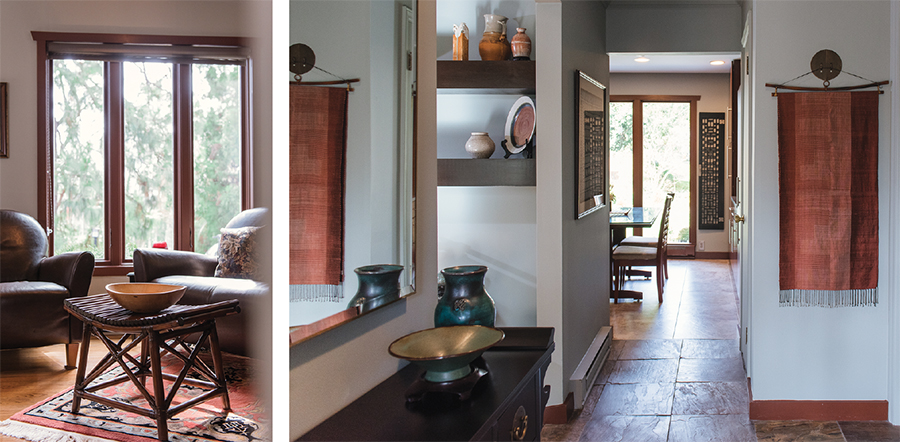
Linda and John Oskam, who slept in a ground-floor master suite, knew it was time to move from their estate home near Winston-Salem when they smelled a foul odor coming from upstairs.

No one used the second floor any more, and the water in one of the toilets had evaporated, allowing sewer gas to escape into the home.

Another sign that it was time for a change: John, an electrical engineer retired from an oil company, was yoked to outdoor projects from sunup to sundown.

It was time to pare down and settle into one level, but unlike the last time they “downsized” — from a 5,200 square-foot behemoth in Greensboro to their Lewisville manse, which weighed in at a mere 4,700 square feet — this time they meant it.

Returning to Greensboro, where Linda had lived after her first marriage, seemed the right thing to do.
Her son and daughter still lived in the Gate City, and her daughter soon would deliver Linda’s first grandchild.

Plus, Linda, a native of Winston-Salem who’d lived for several years in Reidsville, liked the vibe of Greensboro better than any Piedmont city she’d lived in.

“Greensboro was very, very good to me when I was single,” says Linda, who worked at both Blue Cross and Blue Shield of North Carolina and  First Union National Bank in Greensboro.

She met John, a native of Holland, on a blind date. He was living in Durham, where he and his first wife had moved so she could get treatment at Duke University Hospital. After John’s wife died, his landlord fixed him up with Linda, who worked with the landlord’s wife.

“I was about as interested in a blind date as I was in a piece of dust on the floor,” Linda says.

She changed her mind after meeting John, especially after he volunteered to accompany her on decorating jobs. His learning curve was steep.

At one client’s home, he gasped when she lifted a brush, heavy with black paint, to a piece of pretty white furniture she intended to base-coat then marbleize.

We don’t gasp on the job, she told him later.

Point taken, he said.

They lived in Greensboro’s Brassfield area for awhile, then shipped out to Lewisville. When they were ready to return to Greensboro, their real estate agent, the late Tom Chitty, showed them a patio home in The Grande, a development built in the early aughts in the Lake Jeanette area.

At 2,000 square feet, the home was much smaller than any place the Oskams had lived, but it ticked several of their “must haves,” including three bedrooms (one master, one guest and one for an office), a two-car garage, and a sliver of outdoor work, the rest being covered by homeowners fees.

The home was freestanding, too, which meant no noise coming from neighbors above, below or beside.

Moving into a development — the kind built by a single builder with slightly different plans and elevations — would be a sharp departure from the high-end custom homes they’d lived in.

“We’d had two really fine homes, and here we were, living in a tract home,” Linda says.

Did they have a problem with that?

“No,” they say in unison.

“This is where we should have been all along,” says John.

But Linda was determined that, while their home’s exterior might not be unique, the interior would be.

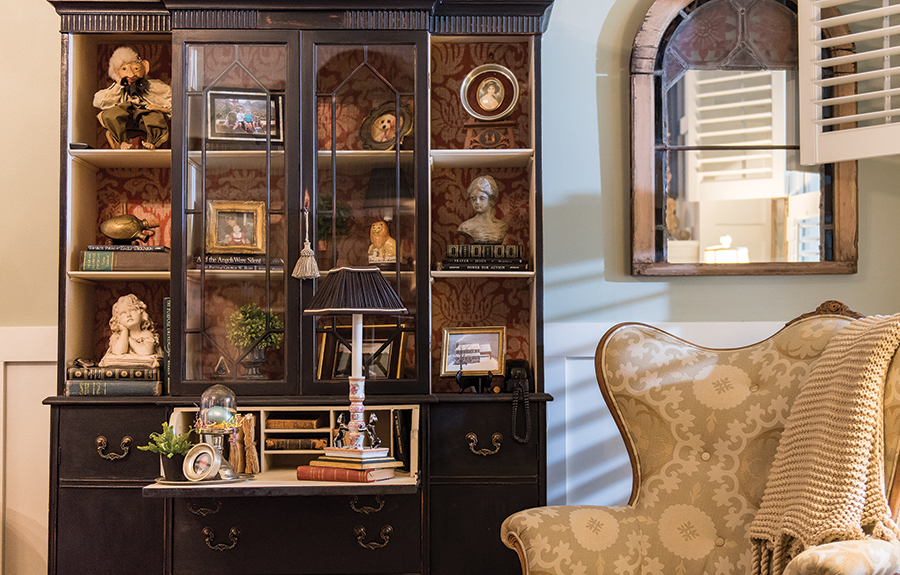
The result: an English-flavored nest that glows with gilt and antiques but feels more “sit a spell” than stuffy.

“We have neighbors come in here and say, ‘We have this plan. How come ours doesn’t look like this?’” says Linda.
To achieve the wow factor, she applied skills gleaned from more than 30 years of interior designing and faux finishing, first for herself and then, after her divorce, as a sideline to her full-time jobs.

She never has advertised her design work, but she stays busy.

“It’s all word of mouth,” she says.

Part showplace, part petri dish, the Oskams’ home shows what clever designers — and do-it-yourselfers with imagination and patience — can do on a budget.

“There are a lot of things you can do inexpensively and have it look great,” Linda says.

The best example is their living area, which anchors the back of the home and answers to a central fireplace.

Above the fireplace hangs what looks to be a nice reproduction of a Mary Cassatt painting. Truth be told, it’s a poster that Linda mounted on a canvas and brushed with clear acrylic gel using the same size brushes that she imagined Cassatt used. Linda bought a sculpted gold frame — “The frame cost more than the poster and other materials” — and small lamp for the frame.

Another bit of ingenuity: She goosed an antique secretary by cutting up a remnant of coral-and-beige damask and using double-sided tape to stick the rectangles to the back of compartments in the hutch.

She points to a tiered end table she snared at a local consignment shop for about $40. The traylike top, made of yew wood, was badly marked by water. “You couldn’t have sanded it out,” Linda recalls.

Her solution: Trace a template of the top, buy a square of dark vinyl tile at a home improvement store, use the template and a utility knife to cut the tile, and presto, a fresh top that stands up to cups of hot coffee and glasses of chilled wine, no coasters needed.

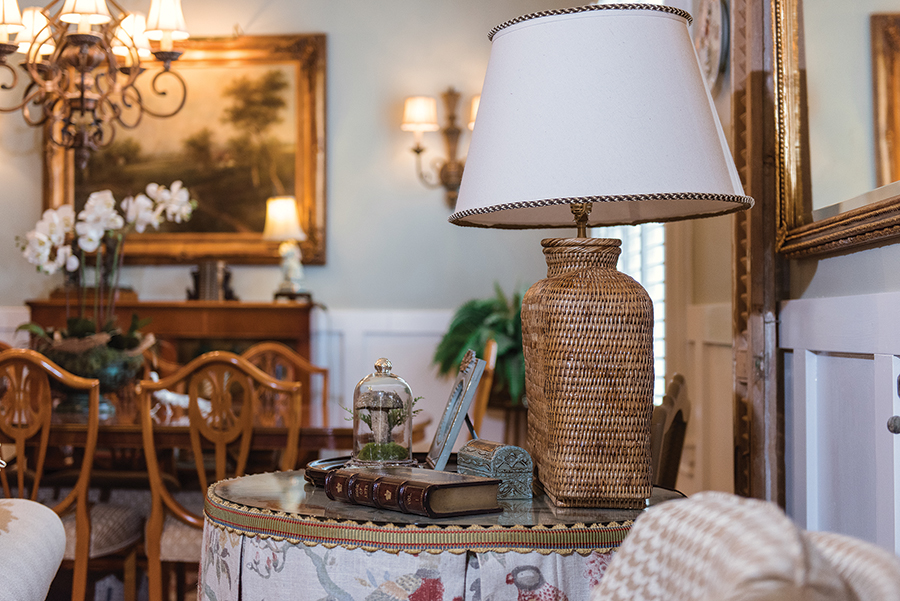
Nearby is another victory: a lozenge-shaped wicker lamp. Linda paid $19.99 for the busted base at a consignment store. She took it to her favorite lamp shop, where they repaired the base. Linda bought a new shade and hot-glued trim around the top and bottom edges. The lamp sings on pitch with its backdrop, an expensive gold-leaf mirror flanked by a pair of skinny, rustic shutters.
“There’s still dirt on those shutters,” Linda notes, pleased at the harmony of disparate styles and finishes. “I like things that are different.”

And things that are used in ways not originally intended. Mind you, this is a woman who once dragged a highboy from a client’s bedroom, down the stairs and into the living room, where she pronounced it the room’s new focal point.

“I tell people, ‘You gotta get out of your box and use things in different ways,’” she says. “Ideas are everywhere.”

You can start by imagining new places and uses for pieces you already own, she says.

“I tell my clients, ‘Before we go shopping, let’s go shopping in your house and see what you got.’ I’ll say, ‘What are you married to? What do you really love?’ and I’ll spin off that. If you love something, you can find a place for it.”

Another Linda tenet: Invest in a few well-made pieces, then fill in around the edges with less costly finds. People will notice the expensive pieces, and the halo effect will spread to surrounding items.

She gives the example of her Ethan Allen sofa, which she bought new when she was single, paying $25 a month. She has recovered it three times.

A high-end, glass-topped LaBarge coffee table sits before the sofa, near a massive Century Furniture bookcase that has been reincarnated as an entertainment center. The Oskams hired a carpenter to reconfigure the shelves for a flat-screen TV, then Linda got to work. She lightened the dark wood finish — and therefore the visual weight — with eggshell blue chalk paint, coats of brown and clear wax, and gold leaf accents.
According to Linda, people who are downsizing often goof by tossing all of their big furniture.

“If you put small furniture in a small room, it’s gonna look small,” she says.

Hang on to a few linebackers, she advises, and use them sparingly. They create the illusion of space.

She employs other visual tricks in their home: In John’s office, the smallest bedroom, she hung the curtains high and painted the crown molding the same deep teal as the walls, lifting the eye and making the room look taller.

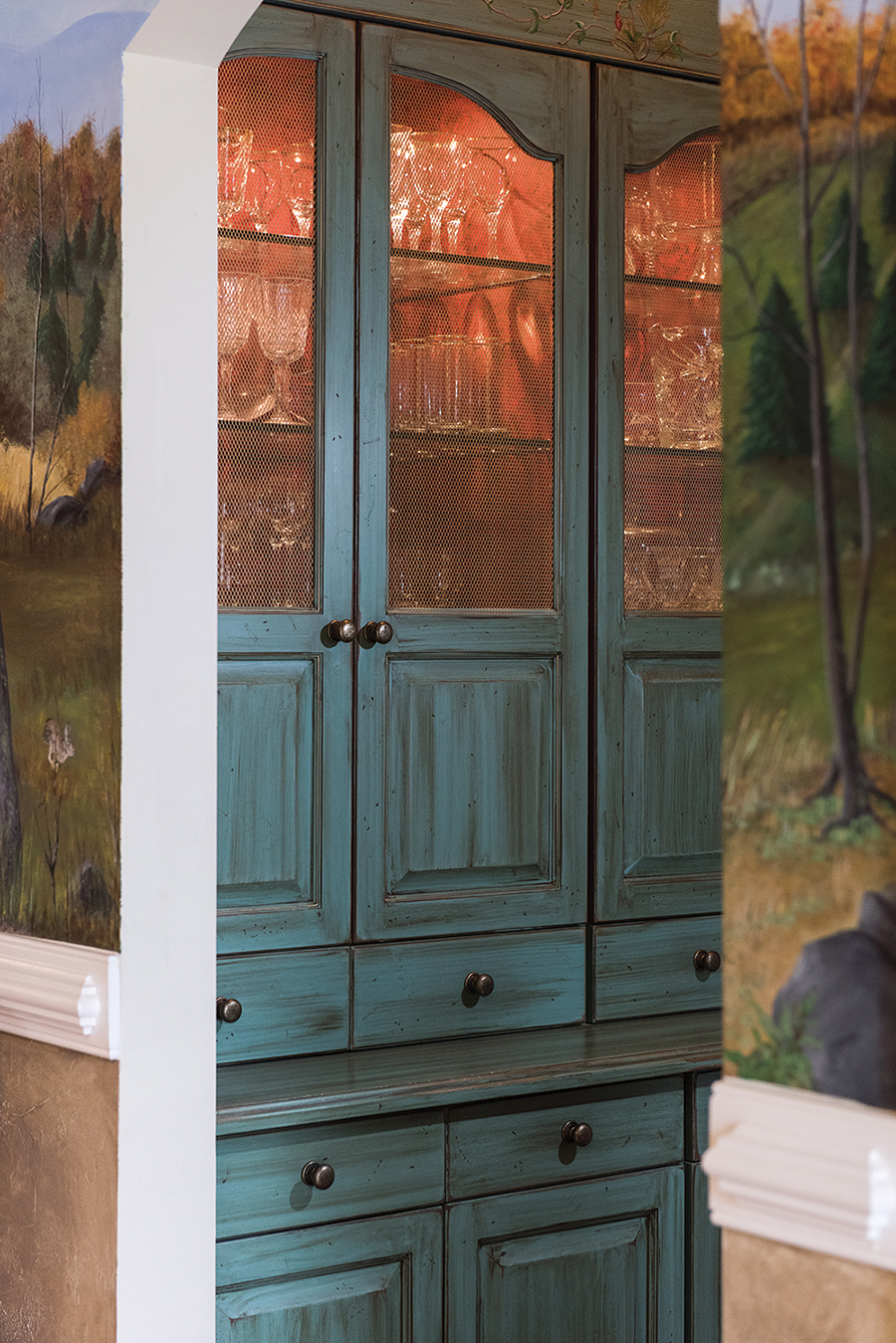
For truly tight spaces, she suggests built-in furniture, such as the china cabinet that she and John commissioned for the niche once filled by washer and dryer.

When a carpenter was done with the boxes, Linda distressed the raw wood and painted it.

“I beat the you-know-what out of it,” she says.

They slid the washer and dryer to another side of the utility room, where John built a wall-to-wall desk for Linda in front of a south-facing window.

“If I have to draw a floor plan bigger than this desk, I have to go the kitchen,” Linda confesses.

She turned loose in the kitchen, too, making sure no one would mistake it for a tract-house galley.
She faux-painted the white fiberboard cabinets, slathered the walls with sand paint and troweled it for texture, and created faux brick walls by taping off rectangles, brushing them with joint compound, then removing the tape and painting the “bricks.”

More faux shows up in John’s office, where Linda cribbed the wainscoting from the social lobby of Greensboro’s O.Henry Hotel. John bought some unfinished wood molding, used a router to shape the edges, and tacked it to the drywall. Linda distressed the molding by stabbing it with a screwdriver, then she painted the whole thing to resemble knotty wood. The knotholes are her thumbprints in brown glaze.

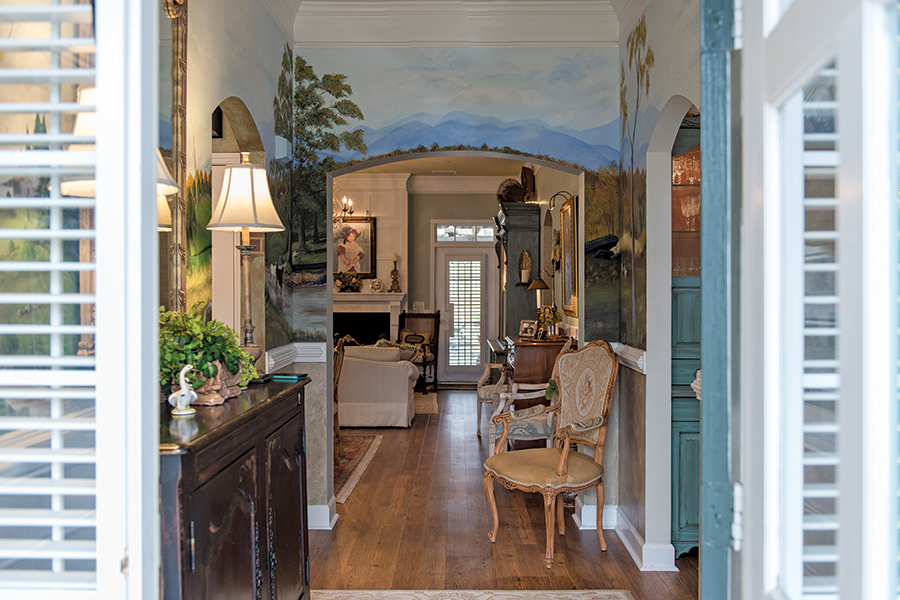
Her passion for paint spilled into the foyer, where she covered every wall with a mural inspired by trips to the North Carolina mountains? Rows of Christmas trees, hay bales, and undulating blue horizons mix with hounds, horses, cows and streams. Linda stands ready to amend the murals, as she did when her grandson pointed out that the cows did not have tails.

Dab-dab, stroke-stroke. Tails.

Need to see more creativity? Follow Linda to the master bathroom, where old door knockers serve as towel holders. An iron hand pins a towel next to the shower.

Another knocker, by the vanity, wears the face of a soul who looks none too happy about his stint in the linen department.

“My son says it looks like Jacob Marley’s face in the door knocker in that scene in A Christmas Carol,” Linda allows.

She sweeps by a favorite antique on her way out of the bedroom: a curvy chair with a solid, polished maple back and a wooden arm on one side. It’s a hoop chair, made for women wearing hoop skirts.

“People say, ‘Linda, I want that chair.’ I say, ‘I don’t think so,’ “she says merrily.

Time to go outside.

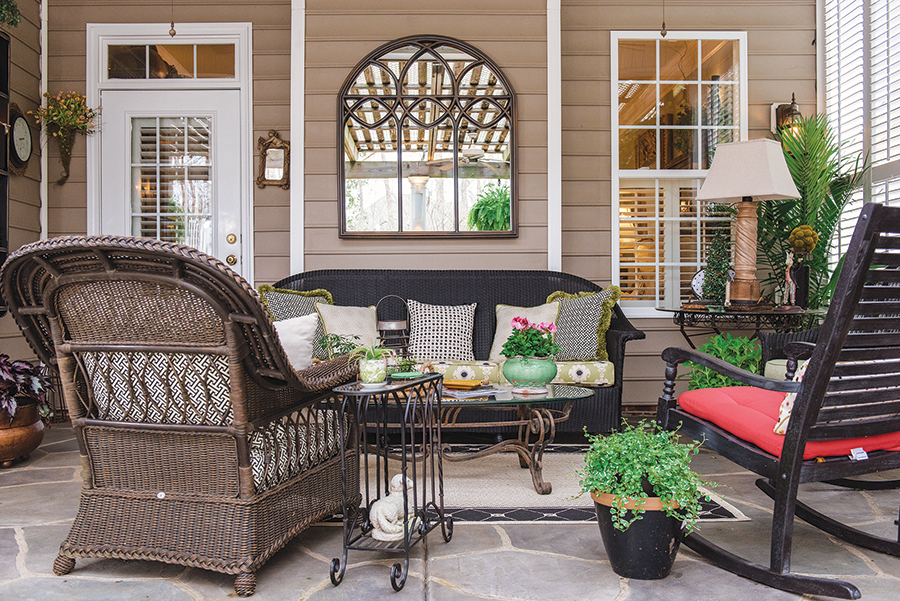
One tough thing about downsizing was losing space for entertaining, Linda says, so she and John created a huge outdoor living space dotted with iron patio sets.

Using lumber he ordered from a home improvement store, and working from the garage, John built a 60-foot-by-20-foot arbor over a concrete patio stamped and painted to look like Pennsylvania bluestone. John also built freestanding wooden closets — onto which Linda painted a couple of topiaries — to store garden supplies. To block the sun, he raised a wall of shutters and lattice — and wired the wall for 110-volt current. We see you, electrical engineer.

Next, they trained English ivy onto the lattice. The ivy fanned into a plush green wall. For sparkle, Linda set a mirror and lanterns into the foliage. A contractor stacked fieldstone for a pool and fountain next to the patio.

Standing in this botanical room, enveloped by gurgle and green, you’d never guess that you were visiting a “tract house.”

Mission accomplished, Linda says, but only with the help of her secret weapon, who stands nearby, hands clasped behind him, a proper gentleman.

“I want her to succeed,” says John, who stands ramrod straight at age 89, thanks to daily walks and calisthenics.

“He’s very supportive,” says Linda, a relative puppy, who turns 74 this month. John basks in the appreciation.

“That’s how she gets me,” he says.

“And it works every time.”

“And I don’t mind.”  OH

Maria Johnson is a contributing editor of O.Henry. She can be reached at ohenrymaria@gmail.com.

The House & Garden of Earthly Delights

Lee and Bill Britt’s Japanese-inspired retreat echoes with the cycles of life

By Jim Dodson     Photographs by Amy Freeman

Daffodils are in bloom but snowflakes dance in the air on the chilly mid-March afternoon Lee Britt greets a visitor at her front door facing Green Valley Road.

“It’s always like this in March, isn’t it?” Britt says with a musical laugh. “It’s like we are between seasons!”

Discreetly hidden from street view behind two longleaf pines and a trio of magnificent Cryptomeria (Japanese cedars), the charming mid-century, bungalow-style wood and stone house the Britts built in 1968 from plans Lee clipped from the News and Record’s lifestyle pages, is the result of a half century of thoughtful living and Lee Britt’s evolving fascination with — and spiritual connection to — Asian culture.

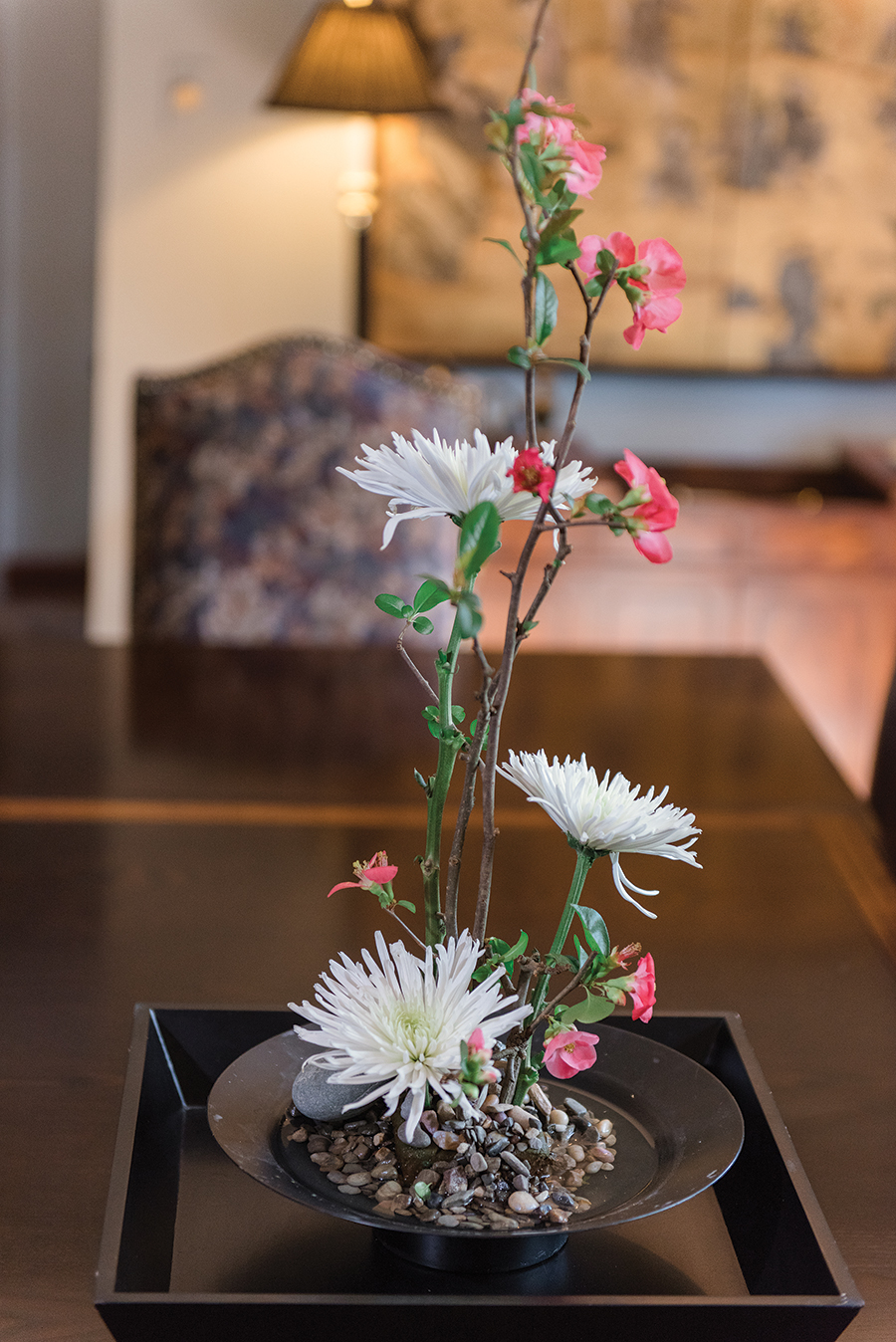
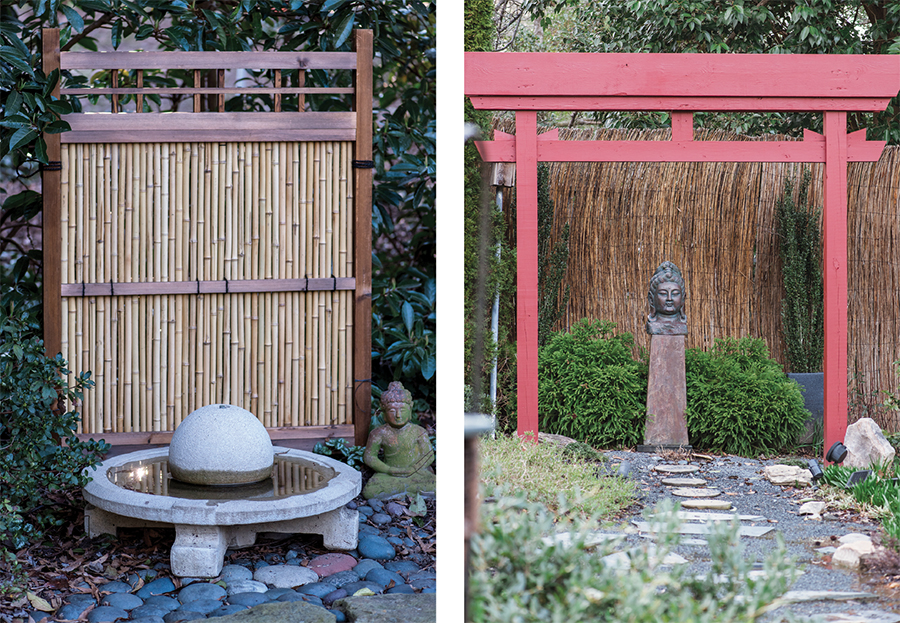
This becomes even more apparent in the tidy foyer of the house, where slate underfoot, a silk wall hanging from the Asian Art Museum of San Francisco and the handiwork of Seagrove master potter Ben Owen III, among others, make the entry feel a bit like stepping into a Kyoto teahouse — complete with a view of the garden. The hues are earth-toned, muted and invitingly intimate. Light seems to stream from several sources; straight ahead an elegant Asian-style window frames a vignette of Britt’s spectacular backyard, inviting the eye up a meandering pebble and stone pathway that symbolizes a tranquil stream. It winds to the rear of the property to a focal point, an earthen red torii gate commonly found at the entrances to Shinto shrines in Japan.

The effect is remarkable: a spacious sense of life flowing into nature, a sudden feeling of peace and unity one feels even before seeing the rest of a modestly sized house that seems much larger than its 2,200 square feet. When her visitor comments on this fact, she smiles and confirms, “That’s nice to know. I’ve had people say that before — especially my garden club, which likes to hold meetings here.”

Britt breaks the spell “That [window] was originally supposed to be a large circular window like you find throughout the Far East. But when our builder was doing the big renovation here in 2006, he drew a peace symbol in the circle I’d placed on the wall, causing me to think that might be a little too pretentious.”

In the next breath, she is quick to point out that both the house and garden, with their unmistakable references to Eastern simplicity and style, are not specifically Japanese. “I prefer to think of [them] as Asian, featuring elements that are common to many Japanese gardens and houses — my interpretation of them, at least. It’s been a fun evolution for me, to see it all come together and change over time.”

At the time Bill and Lee Britt purchased the last lot available on Green Valley Road and began building in 1968, most of the houses around the Britts in Starmount Forest — still newlyweds — were traditional brick affairs with classic Southern details. 

“But I wanted something different, something very contemporary, clean and simple,” she explains. “At that time I really didn’t know much about Asian design principles of home and garden. I just knew what I liked,” Lee explains. “They more I learned about the importance and care the Japanese put into sense of home and place, and certainly their gardens, the more I was drawn to their concepts. I’m really self-taught. Nature is all about evolution, isn’t it?”

For the Britts, this process began in earnest when they expanded their garage into a sunroom in the early 1980s. “We had two teenager girls and needed the room for them to have their friends over. Teenage boys have large feet,” she says with her ever-ready laugh. “They needed somewhere to place their feet.”

About that same time, Lee joined the Tar Heel Garden Club, the Guilford County Horticultural Society and Greensboro Beautiful, volunteering for projects that enabled her to absorb knowledge and ideas from local gardening icons like Irene McIver, Jeannette Windham and Dr. Graham Ray.

“Jeannette and Mrs. McIver knew everything about gardening. They were really the first of many mentors I’ve had in Greensboro. I knew so little, to begin with. But I was fortunate to have the opportunity to listen and learn directly from them,” Lee says. “That’s where it all really took off for me — the desire to create my own house and garden in Asian style. That’s what gardeners do. They share plants and knowledge and learn from each other, and each other’s gardens.”

It was during this period that Bill Britt, who ran the Gate City’s sports programs for Parks and Recreation for 33 years, collaborated with McIver, Windham and others to create the Greensboro Arboretum and Bicentennial Garden, ultimately overseeing the creation of three major public gardens that came to define Greensboro’s love affair with the natural world. Lee Britt had a hand in creating the city’s fourth public garden — Gateway — following Bill’s retirement.

Something of a Greensboro icon for transforming the city’s various sports programs into a national model, Bill Britt joined Parks and Recreation straight out of NC State in 1959. At that time Greensboro boasted 66 youth teams in four sports. By the time he retired in 1992, there were more than 1,200 teams representing 11 different sports. Among his many notable accomplishments, Britt played a major role in creating the Spencer Love Tennis Complex and the golf courses at Bryan Park.

He also served on the national board of directors of Pony League Baseball, a post that carried him to Japan to represent the organization in 2004, allowing Lee — newly elected chair of Greensboro Beautiful — to tag along and explore some of the finest pubic and sacred gardens of Tokyo and Kyoto, the country’s fabled garden city.

“One of the pluses of spending my married life sitting on bleachers,” she says half in jest, “is that wherever we went to see games, I was able to see gardens and meet gardeners. We did this all over America. The trip to Japan, however, was very special, really the culmination of things I’d been learning and picking up on my own study of Japanese culture and gardens for years. I picked up lots of ideas and inspiration.”

“I don’t think she missed a garden,” Bill chips in with a chuckle.

“That’s true,” Lee allows. “But it’s the peaceful quality and strong connection to nature that I find so appealing in their traditional houses and gardens. If it’s authentic, that sort of thing just comes to you. It’s all about natural elements found in nature — stone, water, trees and shrubs.” She catches herself and smiles. “I love tree bark.”

As she says this, music with an unmistakable Asian influence filters gently through the Britts’ great room. An invitingly calm and open space done in soothing tones of muted browns and grays, it is the result of a significant house renovation the Britt’s undertook upon their return from Japan.

In 2006, father-son builders Bob and Scott Richardson incorporated Lee’s ideas into reality by flipping the traditional living spaces, removing a major wall and creating the great room that “flowed” beautifully into the kitchen and small dining area overlooking the garden.

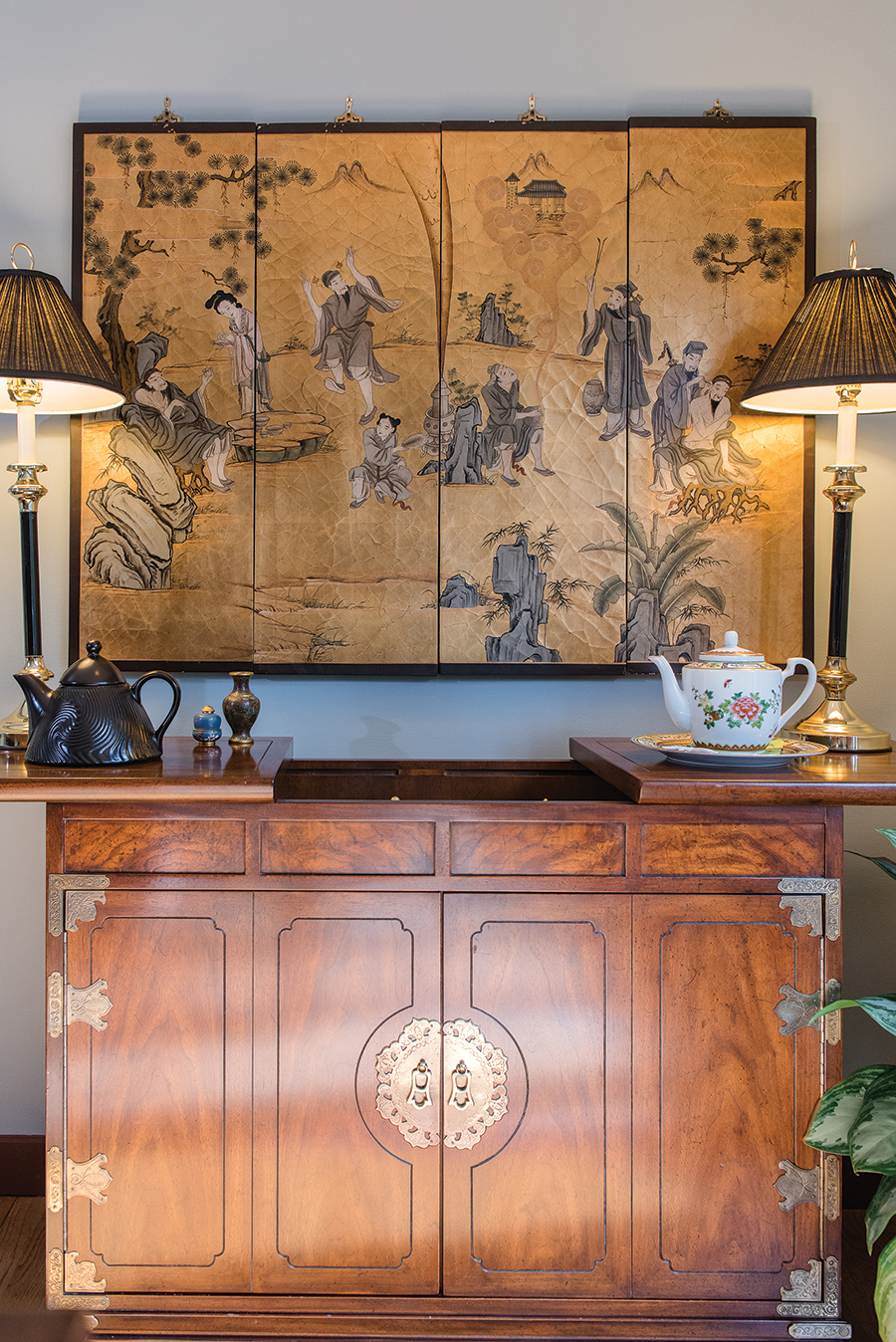
Where their sunroom and former garage formerly existed, the great room took shape with oversized windows overlooking the back garden. Anchoring the south end of the room, a wall of custom-built birch cabinetry by local craftsman Pete Williams, stained a rich burgundy red, provided shelves for displaying books, artwork, pottery and other Asian treasures the Britts have collected from their many journeys.

Tucked discreetly around a corner, meanwhile, sits perhaps the only laundry room in the Triad that features an Asian shoji screen door. “We actually found that at Home Depot,” Lee explains with her beguiling laugh.

Simplicity and practicality also shaped their expanded dining room, a beautiful gathering place done in the same soothing tones of earth and sky, with a formidable Hurtado table, handcrafted in Spain, as a centerpiece, and Henredon buffet with Asian screens. At the south end of the room is a reading nook with a cozy leather chair.

“Our family is rather large and everyone comes at Thanksgiving, at least 30 people,” Lee explains. “The larger dining room really solved a problem for us.”

Three basic design principals anchor the foundation of traditional Japanese gardens. The first has to do with intimacy with nature, a connection that copies rather than creates something new. Or as famed Japanese garden designer Shiro Nakane once told Architectural Digest, his goal is “not to make a new nature but to make a copy of existing, desirable nature.”

Since most Japanese gardens are traditionally contained in smaller spaces, the landscape becomes a living metaphor for the world beyond, its natural elements scaled to reflect this symbolism. Streams replicate rivers, rocks stand in for mountain ranges, and winding gravel pathways are roads through a peaceful world in miniature.

Finally, quite often one finds Asian gardens enclosed by fences or conifer surrounds, becoming sanctuaries meant to inspire one to step away from the hubbub of daily life, a spiritual retreat that is never complete and forever changing, a reflection of nature itself.

These are some the ideas Lee Britt had in mind when she began her garden and half a lifetime ago, eventually growing it into a cozy paradise that is Asian in influence that is hers alone.

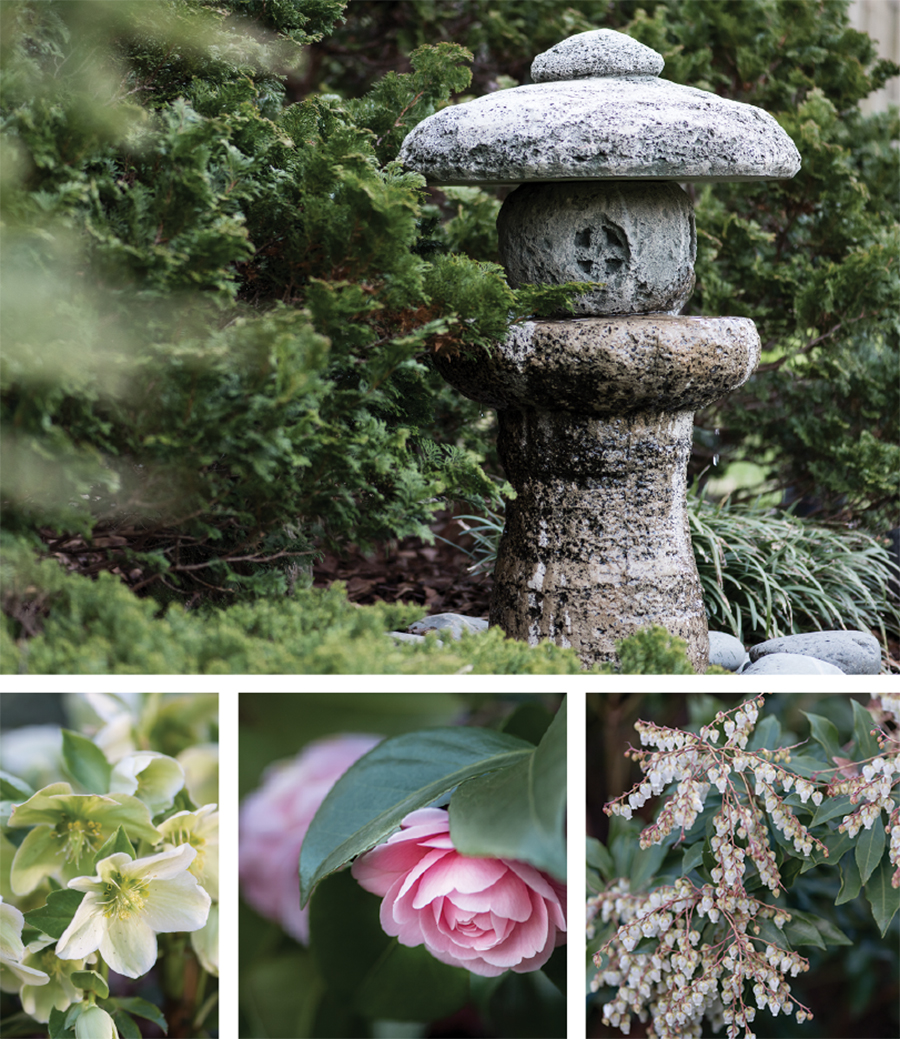
On a walking tour as the snowflakes still dance, she relates intimate stories of how her garden took shape — how the twin longleaf giants out front have somehow survived years of winter storms, reciting both the Latin and common names of mugo pines, Japanese hollies, yews, camellias and ground covers that are just awakening to Carolina spring.

At the top of her driveway, where a trio of large cherry trees, pink azaleas and hostas are about to rise and burst into bloom, a small iron Eastern symbol stands guard.

“What does that mean?” asks her visitor.

“I believe it simply means good luck.”

On the nearby deck stands a collection of garden gnomes, a congregation of tiny figurines that represent a beautiful story of remembrance and continuity in this peaceful household.

In 2011, the Britt’s son-in-law, Will Caviness, a Greensboro firefighter, collapsed and died while running in the Chicago Marathon on behalf of the International Association of Fire Fighters Burn Foundation that helps burn victims.

“It was devastating. Will was such a vibrant young man, seemingly in the peak of good health,” Lee relates, smiling at the gnomes. “He loved to tease me by placing gnomes in my garden where I’d find them in the oddest places. Once, while we were attending the Christmas Eve services, he put an illuminated Santa on our roof. That was Will. Such a wonderful guy.”

The city of Greensboro, she adds, as the garden tour continues, “wrapped their arms around our daughter Jenny and their children, Jack and Caroline, who continue this tradition today. They love to show up when we’re not here and hide these gnomes in the garden. It’s such a lovely way to remember their father.” At a young age, their third grandchild, Elizabeth, announced that someday she planned to buy this house and garden of earthly delights.

Following the pebble and stone “stream” that winds serenely around and through her Asian garden, the story of life and death and rebirth flows on. One learns about the large sweet gum that a storm toppled onto a 40-year-old wax myrtle, requiring the garden keeper to change out shade plants for sun-loving perennials; about the benches and stone borders she built herself; the old fashioned “Pink Perfection” japonica she took from her mother’s garden on a tobacco farm in Creedmoor, and so forth. Every planting has its own life story, including the twin crab apple trees, the false yews and a large summer perennial bed that will achieve its glory in mid summer.

“You’ll have to come in June to see it because it has everything — phlox, salvias, rosemary, sedums. . .” she pauses and laughs again. “Goodness, everything. It’s always changing. Come see.”

And at the end of the day, that is the beauty of the house and garden that the family Britt has made, a personal sanctuary from the madding world beyond the trees, a loving balance between east and west, sunrise and sunset, death and rebirth and endless new beginnings in the natural world that is their home.  OH

The peace of Jim Dodson’s own Asian-inspired garden has been disrupted by the rapacious Star of Bethlehem that has overrun his garden beds.

Return of the Birds

John James Audubon on exhibit again

By Jim Moriarty

It is such a small space to hold the passion of a lifetime.

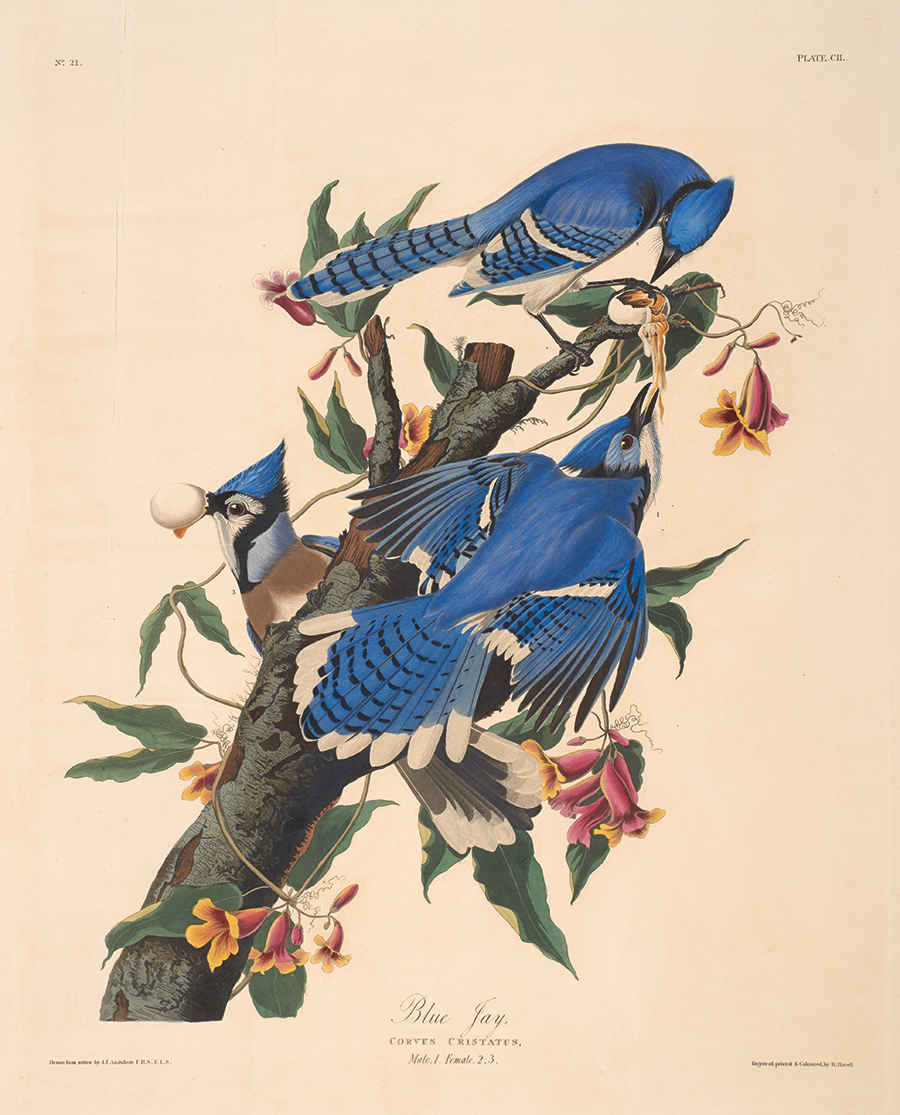
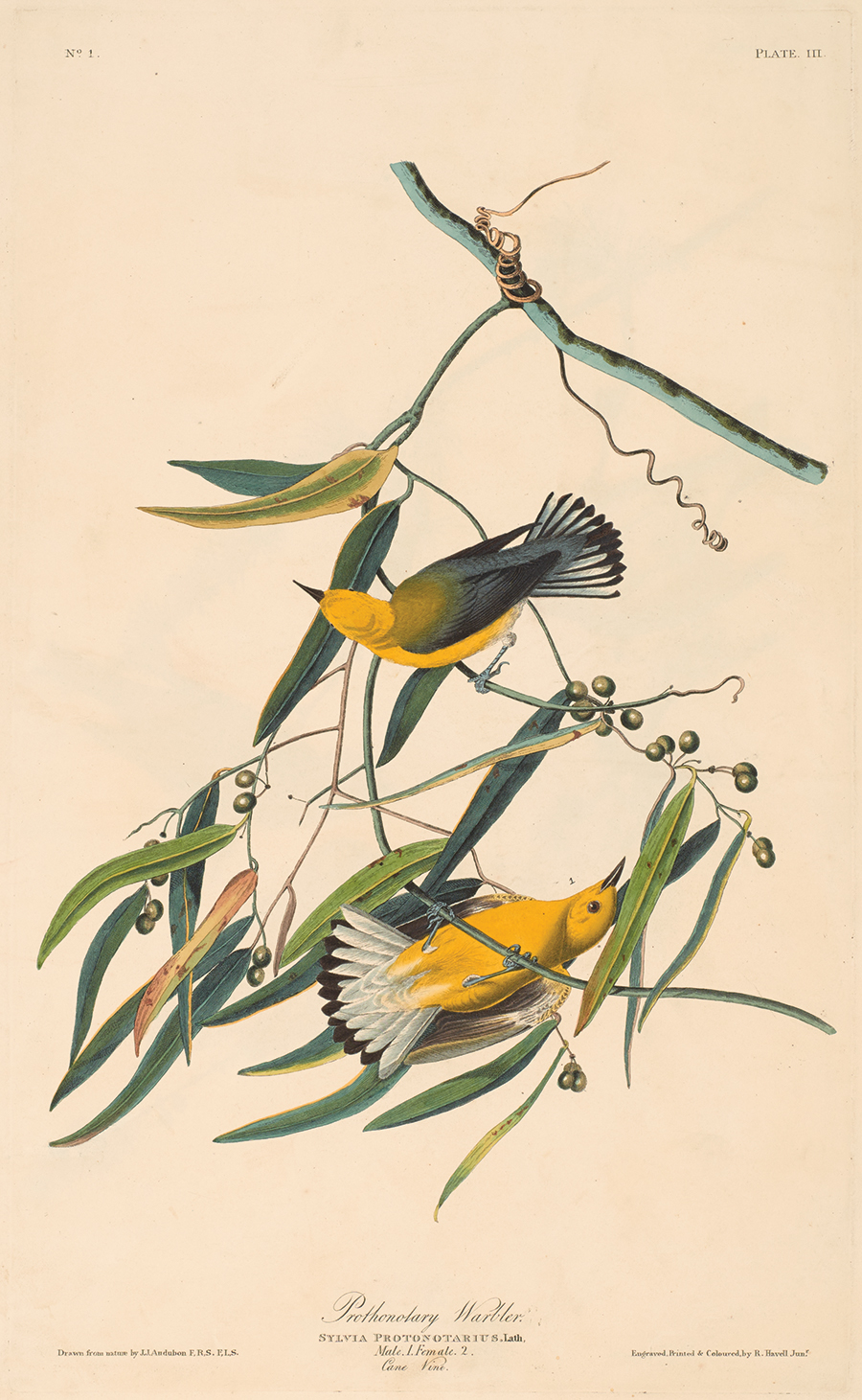
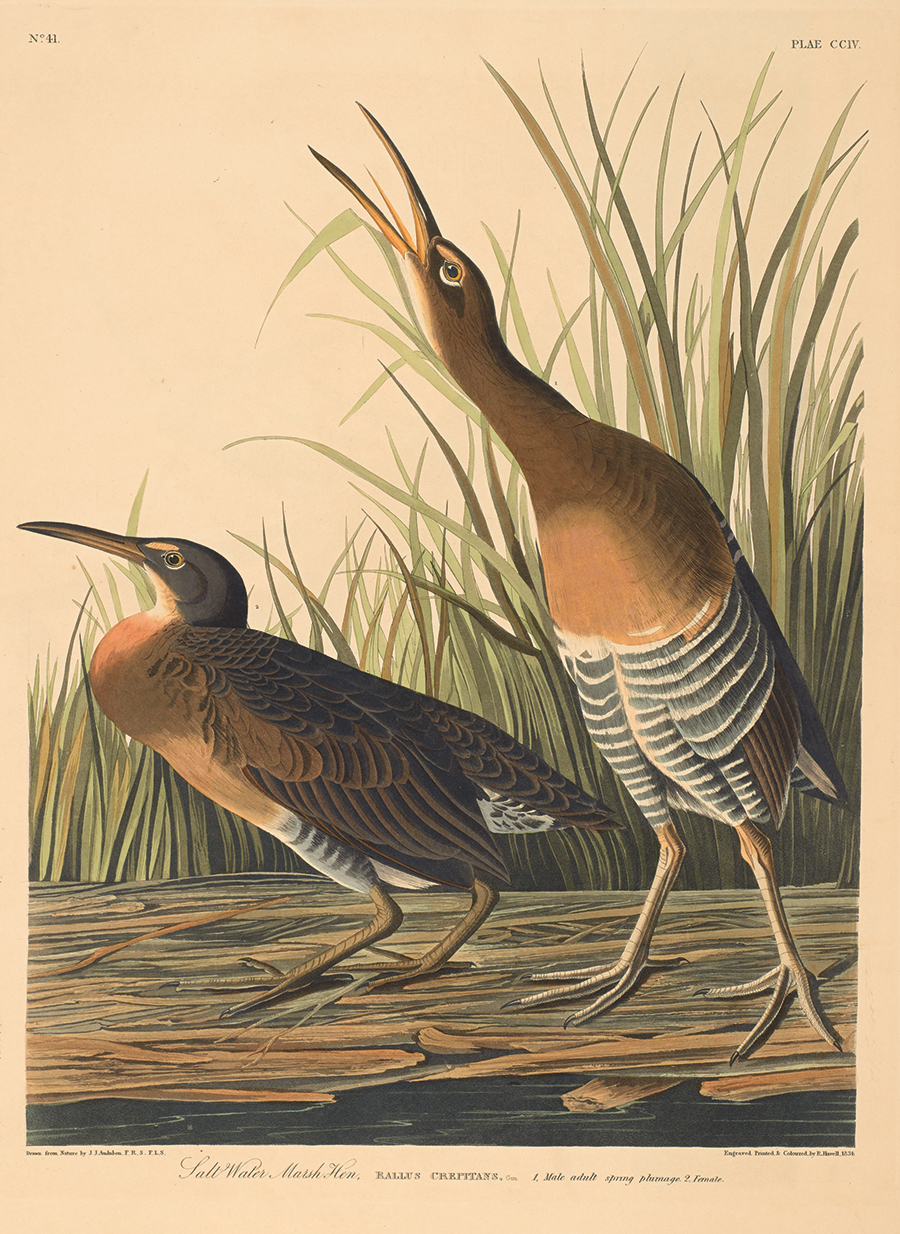
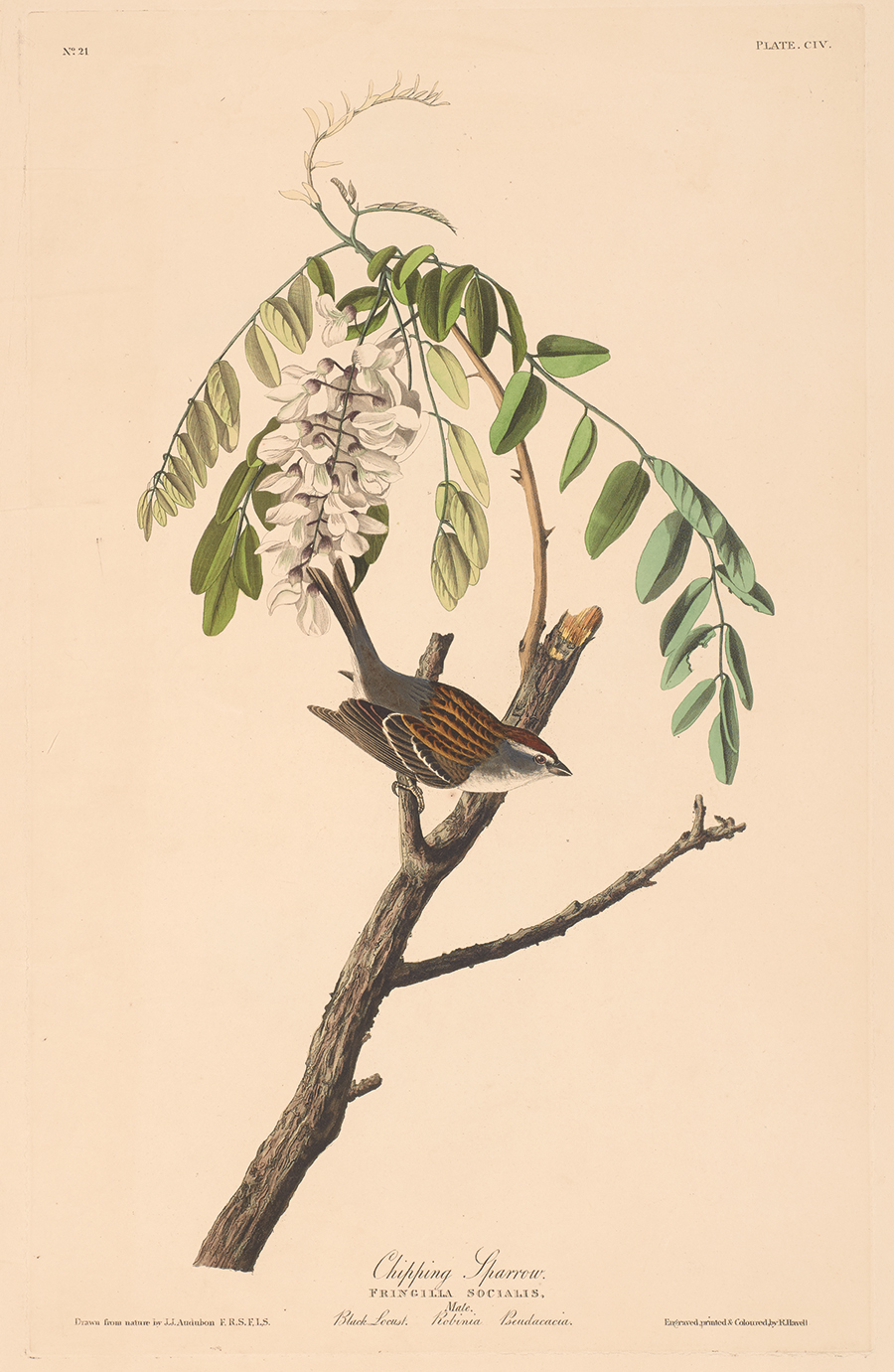
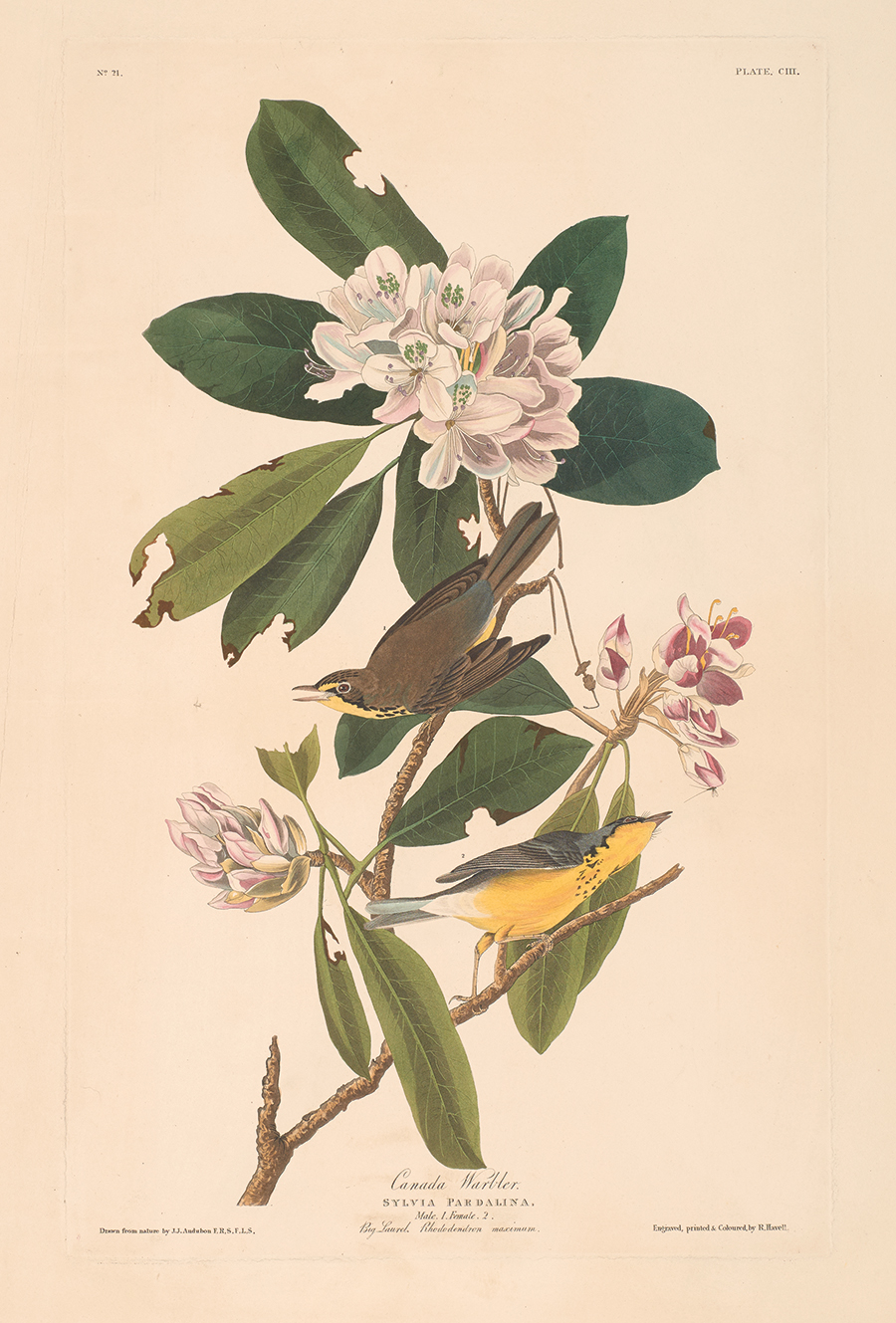
In a corner on Level B of the North Carolina Museum of Art, John James Audubon’s four bound volumes of The Birds of America are back on exhibit, joined by instructive videos and an immersive wilderness experience. There are roughly 200 extant copies of the so-called double-elephant folio version, comprised of 435 hand-colored, life-size prints. North Carolina’s copy — minus two pages that were added later — was acquired in 1846 from Joseph Green Cogswell, a book dealer in New York, as part of a larger purchase by North Carolina’s then-governor, William Alexander Graham, who was intent on expanding the state’s library. It was transferred from the N.C. State Library to the museum in 1974. The last time the four volumes, each enclosed in its own specially constructed case, were on exhibit was July of 2016.

The engravings will be shown one page per volume — so, naturally, four at a time — for three months before changing them in the open-ended exhibit. The four on exhibit now include a wild turkey looking back as it crosses a Louisiana canebrake — the first plate produced in the project that consumed near the entirety of Audubon’s life. “The hand-coloring is light sensitive so we don’t want to expose it too long,” says John W. Coffey, the museum’s deputy director for Collections and Research. “People approach any art exhibit with different expectations. You have people that just stumble into the exhibition and, hopefully, they’re engaged by the story of Audubon. And then there are people who are bird lovers. There are lots of those who venerate Audubon as a naturalist. There are people who just like fine art. What Audubon created were not just accurate renditions of the birds of America but also quite beautiful compositions. They held their own as works of art in their own right.”

John James Audubon was born Jean Rabin, the “backstairs” child of the sea captain Jean Audubon and a French chambermaid, Jeanne Rabin, on Audubon’s sugar plantation in Les Cayes, Saint-Domingue. The child’s mother passed away from an infection mere months after the boy’s birth. The sea captain had his son and the boy’s half-sister (the daughter of a second mistress) transported to his home in Nantes, France, in advance of the revolution that engulfed Saint-Domingue, eventually establishing the Republic of Haiti. His lineage a closely held secret to preserve his inheritance, the boy grew up in Nantes as Jacques Fougère Audubon during the Vendéan counterrevolution and the terror that accompanied it.

“Losing his mother in infancy, separated from whoever mothered him afterward on Saint-Domingue when he was shipped off to France at six, just months ahead of a bloody revolution, enduring dreadful days as a young boy in Nantes when Carrier [Jean-Baptiste Carrier] was emptying the prisons with slaughter and his family feared for its life, was a full burden of trauma for a child,” writes Pulitzer Prize-winning Audubon biographer Richard Rhodes. “In maturity Audubon would expunge the stigma and the trauma from his family story by relocating his birth to Louisiana and to ‘a lady of Spanish extraction . . . as beautiful as she was wealthy’ when he knew full well that he was the bastard son of the chambermaid Jeanne Rabin.” And, if in the fullness of time, he found his résumé in need of further padding, Audubon would sometimes claim to have studied under Jacques-Louis David, Napoleon Bonaparte’s favorite neoclassicist painter.

Sent to America by his father to avoid conscription into Napoleon’s army, Jacques Fougère Audubon became John James Audubon on his transatlantic journey, settling on his father’s Pennsylvania farm, Mill Grove. “He had begun drawing birds in France,” writes Rhodes. “Now, ‘prompted by an innate desire to acquire a thorough knowledge of the birds of this happy country, I formed the resolution, immediately on my landing, to spend, if not all my time in that study, at least all that portion generally called leisure, and to draw each individual of its natural size and coloring.’ This is retrospect, of course, but it catches the eighteen-year-old’s excitement and bravado.”

Audubon cut a dashing figure. The wife of a physician friend would describe the 30-something ornithologist and painter this way: “Audubon was one of the handsomest men I ever saw. In person he was tall and slender, his blue eyes were an eagle’s in brightness, his teeth were white and even, his hair a beautiful chestnut brown, very glossy and curly. His bearing was courteous and refined, simple and unassuming. Added to these personal advantages he was a natural sportsman and natural artist.”

While at Mill Grove, Audubon met his wife, Lucy Bakewell. He would begin a career as a merchant, floating down the Ohio River to Louisville and Henderson, Kentucky, and eventual bankruptcy. It was in Louisville that Audubon met Alexander Wilson, who was selling subscriptions (the method of the day to finance costly reproductions) to his own book, American Ornithology, but Audubon’s work was already vastly superior to Wilson’s.

Like any artist, Audubon’s style matured. One of the earliest innovations was the creation of his “board,” allowing him to pose the birds he killed — alas, it wasn’t as though he could hire them as models; besides, some made excellent eating — in the positions he observed in life. By May of 1812, he was drawing birds in flight. “Unlike birds posed on branches or standing on the ground, birds in flight required foreshortening to create the illusion of depth across the span of their wings or down the length of their bodies,” writes Rhodes. “Since Audubon’s limited formal art training had not progressed to foreshortening, he had to learn that complicated technique on his own by trial and error.”

Another breakthrough came when he added color chalk. “I resorted to a piece that matched the tint intended for the part, applied the pigment, rubbed the place with a cork stump and at once produced the desired effect!” he wrote. Then, in 1821 and ’22, he revamped his style again. “He already knew the traditional French medium of pastel very well; he had been perfecting it since he was a young man. Now he added to his repertoire a crystal-clear watercolor technique, the ability to use gouache effectively, and an extraordinary varied use of the pencil, together with the talent for combining all of these graphic means to render a single bird,” writes art critic Theodore E. Stebbins, Jr. “No one in America equaled him for graphic inventiveness until Winslow Homer some sixty years later; as for European parallels, one can only think of the great English watercolorists, both contemporaries of Audubon: J.M.W. Turner and Samuel Palmer.” The original watercolors for The Birds of America are in the collection of the New-York Historical Society and rarely seen because of their sensitivity to light.

Having run financially aground in the Panic of 1819, Audubon journeyed to New Orleans to collect a debt from Samuel Bowen that involved the ownership of a steamboat. Things didn’t go well. Bowen had already given the boat over to settle debts of his own. One thing led to another and Bowen attacked Audubon. As it turned out, he brought a cudgel to a knife fight, and Audubon stabbed him with his dagger. Later, appearing in front of Judge Henry P. Broadnax, Audubon defended himself before the court and was acquitted by reason of self-defense. “Mr. Audubon,” the judge added, “you committed a serious offense — an exceedingly serious offense, sir — in failing to kill the damned rascal.”

Having lost everything in Henderson, Audubon turned to portrait painting to make a living. Then, envisioning himself as “a one-man ornithological expeditionary force,” as Rhodes put it, he went back down the Mississippi, returning to New Orleans in 1821 with his assistant, Joseph Mason (one of several assistants who painted the backgrounds in Audubon’s works). His commercial portraits included the nude of a woman, Mrs. André, a mysterious client requiring his absolute discretion and to whom he referred as “The Fair Incognito” in his diaries. Eventually, he was joined in New Orleans by his wife, Lucy, living at what is now 505 Dauphine Street. Audubon was producing his ornithological paintings at a dizzying pace. After New Orleans it was up to Natchez, Mississippi, then Louisville and Philadelphia and Pittsburgh and on and on. His sources of income weren’t confined to portraits. He taught dancing, drawing, even fencing.

Knowing that obtaining engravings of the number and quality necessary to produce The Birds of America could only be done in Europe, Audubon sailed from New Orleans on the Delos on May 18th, 1826. The ship was carrying 924 bales of cotton and a seasick John James Audubon with more than 300 drawings in tin-lined wooden portfolios.

An American backwoodsman with crates full of art proved a topic of considerable novelty in an Old World keen for knowledge of the new one. Audubon was well received. The first engraver to take on his project was William Lizars in Edinburgh. Lizars did approximately 10 engravings before a strike by his colorists forced Audubon to turn to Robert Havell Sr. and his son in London.

“Robert Havell Jr. was a more painstaking engraver than William Lizars and his father supervised the London colorers perhaps more carefully but there was a qualitative difference between the technologies Lizars and the Havells used to make Audubon’s colored plates,” writes Rhodes. “The Havells used a process known as aquatint, which allowed them to print shadows and shadings in a range from light gray to black, leaving the colorists only the more limited task of applying a uniform wash of color over the aquatinted area: the shading made the color appear darker.” Havell retouched the early Lizars plates, something that’s noted in the lower right-hand corner of the wild turkey engraving currently on view. While even the Havells had their ups and downs satisfying Audubon’s very specific instructions and expectations, it proved a match made in artistic heaven.

The last plate of The Birds of America was completed in June of 1838. Audubon was 53. His estimate of the project’s cost, monies he raised himself, was “$115,640 — in today’s dollars, about $2,141,000,” reckons Rhodes. He began work on the octavo edition (a smaller and, hence, more profitable version) two years later. Audubon would suffer a stroke in 1848, and begin slipping into dementia. “His vivid personality faded into vacancy,” says Rhodes. He passed away in January of 1851.

“What’s beautiful about Audubon is that these birds are so dynamic and alive, it feels like they’re almost jumping out of the page,” says Silvia Fantoni, the director of Audience Engagement and Public Programs who put together the immersive exhibit comprised of 19 of Audubon’s birds in varied habitats over a 24 hour period. “That’s what we wanted to do. I find his work fascinating, how driven he was by this project. It’s always interesting to see when an artist has this kind of obsession and vision and dedicated his life to do that. That’s why we still celebrate him almost 200 years later.”  OH

Jim Moriarty is senior editor for PineStraw magazine.

10 Things You Never Knew about the Battle of Guilford Courthouse

By Jim Dodson     Photograph by Lynn Donovan

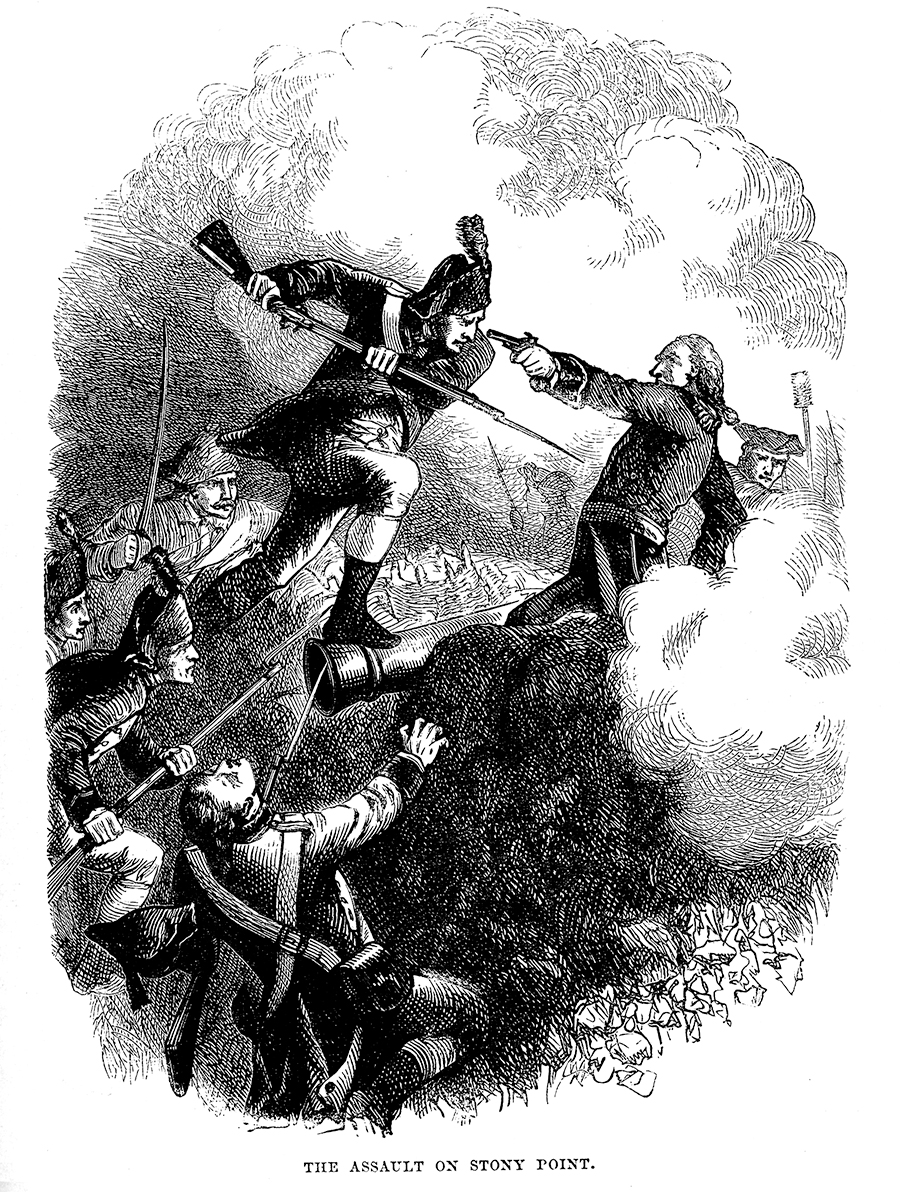
Many of us had the great fortune to grow up with the historic Guilford Battleground  in our backyard, the place where the city’s namesake General Nathanael Greene met British General Cornwallis’ army. The fateful showdown on March 15, 1781, helped turn the tide of the Revolutionary War in favor of the Patriot struggle for independence from Great Britain. Today, when you are driving over streets named New Garden and Battleground or through neighborhoods called Kirkwood and British Woods, you are covering bloody ground where arguably the pivotal battle for American independence took place. One local story holds that the name “Brassfield” derives from brass military ornaments recovered in the vicinity of Horse Pen Creek where the shopping center exists today.

If you’ve never witnessed the battle’s annual series of re-enactments live, an event that attracts hundreds of “Rev War” re-enactors and battlefield buffs from across the nation to what is now officially called Guilford Courthouse National Military Park, you are in for a real treat. It’s the perfect mix of history and military pageantry on an early spring day. 

Jay Callaham not only happens to be an expert on military history and a veteran re-enactor of more than 50 years, but also the narrator of the action at Guilford Courthouse for approaching 20 years. Among other things, he also served as an advisor on the film The Patriot. Callaham portrays an officer of the Coldstream Guards, and for many years acted as a British field commander, and has performed the role of Lord Cornwallis. During his nearly 20 years of narrating the battle presentations, he is typically uniformed as a British Officer.

We caught up to the retired communications executive and former Army major on a recent afternoon at the Greensboro Masonic Temple on Market Street, wondering if there might be 10 curious and lesser-known facts about the famous battle.

Lord Callaham happily obliged.

1. The Super Bowl of the Revolutionary War

By the time Cornwallis marched his troops to Deep River Friends, where he camped prior to the battle, having unsuccessfully engaged  General Greene’s army for six weeks across the Carolinas to the Dan River and back, both armies were showing serious wear and tear. “Both were in pretty terrible shape. Cornwallis halted his march in Salisbury, for example, just to find shoes for his troops. As they came through Old Salem,” notes Callaham, “the British and their camp followers stole clothes off lines. Despite their worn appearance, Cornwallis’ 33rd Regiment was among the best in the world. His force included the renowned Royal Welch Fusiliers, and veteran 71st Highland Regiment, as well as the battle-hardened Brigade of Guards and Hessian Regiment von Bose (pronounced bose-a), all led by seasoned commanders. Not to mention American Loyalist or Tory troops. Greene’s force was a mix of militia troops from the Carolinas and Virginia, many of whom had prior experience and training in the Continental Army, as well as the 1st and 2nd Maryland Continental Regiments and Kirkwood’s Delaware Continentals. One army was led by a British General who’d never lost a fight in the field, the other by a Colonial general who’d never won a fight in the field — and wouldn’t win this one. In many respects, despite their tattered condition, this was the Super Bowl of the American Revolution, the battle that changed the whole complexion of the war and brought it to a close.

2. The Myth that the North Carolina Militia failed to hold its ground.

In his report following the battle, General Greene asserted that the front line of the deployed Americans — manned by the North Carolina Militia — failed to hold its ground during the first assault by the British.  “He wrote that the Carolina militia broke and ran at the start of the action. It’s simply not true,” says Callaham. “They weren’t even a true militia, rather a mix of local farmers and tradesmen and highly seasoned Continental troops that had proven themselves in plenty of action. They were deployed behind split rail fences overlooking Horse Pen Creek. The next line up was the Virginia militia followed by the 1st and 2nd Maryland. The commander of the 71st Highland Regiment — one of the finest units in the British army — reported that the lost half his company in the first volley. The North Carolina Militia troops did their job splendidly, in fact, enduring a 30-minute cannonade from three-pounder Royal Artillery cannons. Greene was simply trying to cover his rear end for losing the battle, which broke out everywhere and was mostly one of complete chaos. Fighting was brutal and bloody, hand-to-hand at times.”

3. The Scope of the Battlefield

The scope of the battlefield was huge, stretching from New Garden Friends — where Kirkwood’s Delaware troops engaged along New Garden Road — to the Guilford Courthouse site, a distance of about four miles. Cornwallis’s 2,000 troops were deployed along what is now Battleground Avenue, roughly from where Lowe’s Home Improvement is today all the way to Walmart. Artifacts from the battle have been found around both big box stores and along Battleground. The national battlefield encompasses only about a third of the actual battleground, and does not include skirmish sites along New Garden Road. Other parts of the battlefield are under Forest Lawn Cemetery and Greensboro Jaycee Park, both places where many artifacts have been found.

4. Rifles vs. Muskets

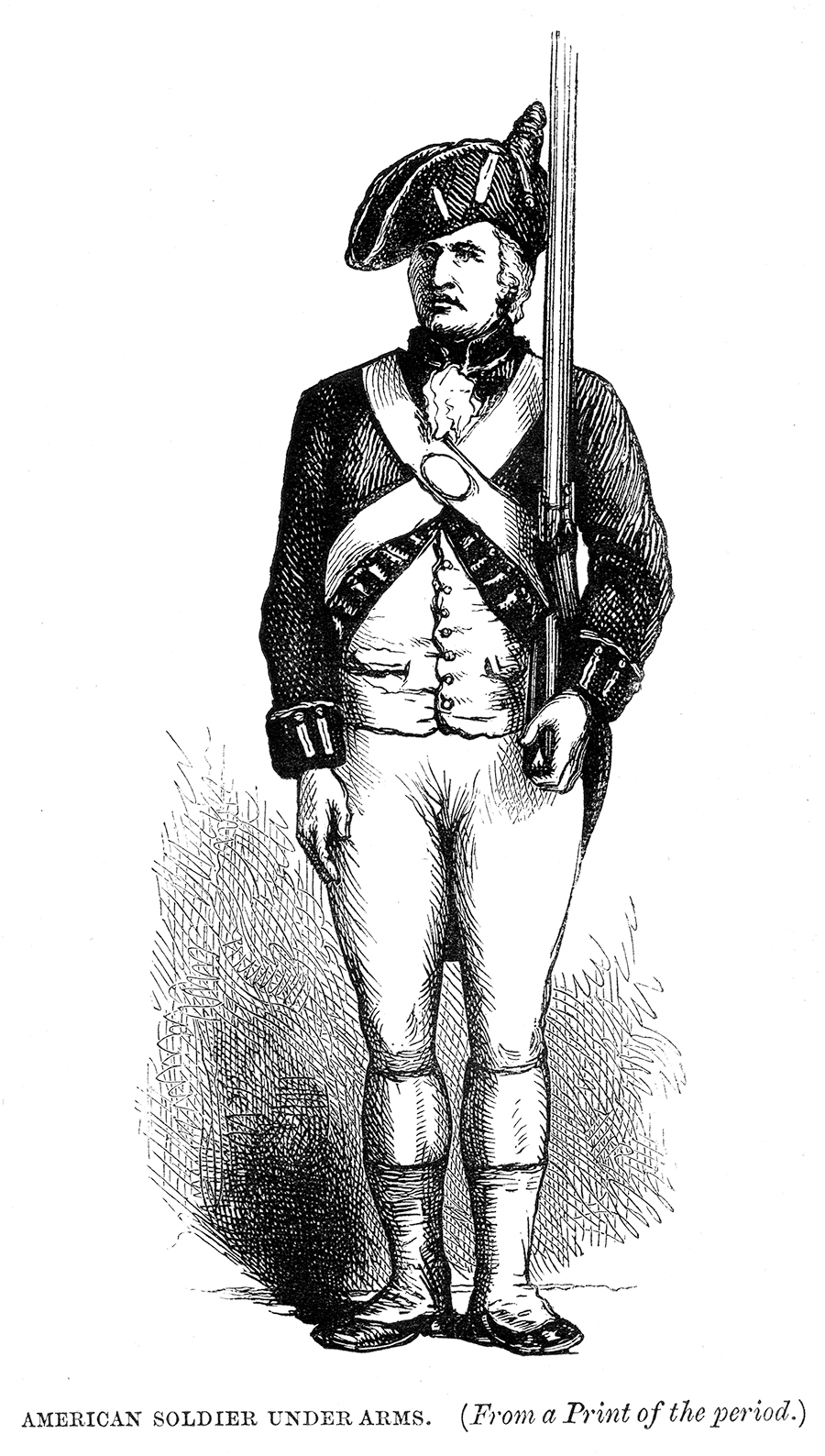
Soldiers in both armies used similar weapons, mostly muskets made in France or the venerable British Brown Bess muskets commonly used by infantrymen on both sides. Muskets fired a ball about three-quarters of an inch in diameter, loaded from paper cartridges containing powder and bullet or buckshot, rammed down the unrifled, smooth-bore barrel to the breech. A skilled fighter with a musket could load and fire his musket three times within a minute. The musket had an auxiliary weapon as well — a fixed bayonet — used effectively by the tenacious 1st Maryland at the Battle of Guilford (though by the 18th century, deaths in battle from bayonets were becoming less common). Rifles were a more specialized weapon, defined by a barrel with twisted grooves along its interior that allowed for a more accurate shot. The problem was a slower loading process that could be problematic in close-quarter fighting. On the other hand, rifles had extended ranges of accuracy — up to 300 yards — and were used effectively by both sides during Britain’s failed Southern Campaign, whose objective was to sever the South from the North, destroying the “bread basket” of the Colonial Army and ending the war in Britain’s favor. Rifles affected the outcome of at least three major Southern battles — at Kings Mountain, Cowpens in South Carolina and to some extent Guilford Courthouse, where the British used Jäger riflemen from Germany to great effect. These were skilled hunters dressed in green, whose deadly accuracy and discipline made them formidable foes. “The Jägers were professional huntsmen and were crack shots. The problem was every rifle had its own caliber, which often meant a rifleman had to make his own ammunition. Rifles played a significant role but muskets and bayonets won the war,” says Callaham.   

5. Question: Which Side was dressed in Blue? Answer: Both sides

A key regiment of the British force at Guilford that saw intense action was the von Bose regiment composed of well-drilled German soldiers who wore dark blue uniforms that resembled the uniforms worn by both the Colonial Army, and both British and Continental artillery units — producing confusion in the fog of battle. The British army’s uniforms were bright red so they would stand out in the smoke of battle. The proud von Bose unit was composed of Hessians who came from a number of places across Germany, leased to the British army by King George III’s German allies. Fighting on the right flank of the advancing British force, the von Bose unit was savagely attacked both front and back by the Americans, distinguishing themselves and affecting the outcome of the battle. “Contrary to the myth, these troops were not mercenaries. They belonged to the lord of their home principality. An interesting postscript: Most Hessians who were captured were sent as prisoners to Pennsylvania where German farmers employed them. Many were encouraged to stay in America and were even given land. Many became American citizens.”

6. Did Cornwallis really fire upon his own troops?

Not intentionally, insists Callaham. “That’s one of the biggest myths about the battle. At one point in the battle, he came upon a melee in close combat between the 2nd Battalion of the Guards and 1st Maryland and ordered his soldiers to use a 3-pounder [cannon] to fire on Lt. Col William Washington’s light dragoons [calvary] that had attacked the Guards and in so doing had come between Cornwallis and his troops. Cannon doesn’t discriminate between red and blue. But the decision halted the Dragoons, separated the Guards from the 1st Maryland, prompting Greene to leave the field to preserve his Continental troops — and allowed Cornwallis to escape. It would have been very bad for the British if he’d been killed or taken prisoner. General Cornwallis also had at least one horse shot out from under him and was almost captured during the confused fighting in the woods. The fighting was that intense, neither side yielding, convincing General Greene to leave the field, in good order, to preserve his Continental troops.

7. Light Horse Harry Lee vs. Banastre Tarleton

Both were legendary cavalrymen. Tarleton was commander of the green-clad British Legion and the subject of a rebel American campaign, which claimed that his men terrorized the countryside and massacred surrendering Continental Army troops at the Battle of Waxhaws, South Carolina, in 1780. The alleged outrage earned him the nickname “Bloody Ban.” As leader of the highly mobile Continental Light Dragoons, cavalry and infantry, Lee won fame for his hit-and-run guerilla-style harassment that helped stymie the British army during General Greene’s “Race to the Dan.” Both men saw action at Guilford Courthouse. Both men presided over the massacre of unarmed soldiers — Tarleton at Waxhaws, Lee in Alamance County, whose Legions cut down a large group of royalist volunteers marching to join up with Cornwallis, camped in Hillsborough, N.C. before returning to Guilford County. “Light Horse Harry’s Legion basically slaughtered them, hacked them to pieces,” Calaham says. Adding insult to injury, the survivors were fired upon by British sentries when they sought shelter with Cornwallis. Harry Lee went on to become governor of Virginia and father to Robert E. Lee. Tarleton lost two fingers on his right hand in the battle at Guilford Courthouse and back home was elected to Parliament. “The truth of the matter is, Harry Lee wasn’t as great as he’s made out to be and Tarleton wasn’t as bad,” Callaham allows. Lee, he notes, was a terrible businessman who went bankrupt and nearly lost the Lee family estate, Stratford Hall — placed in trust, allowing Henry Lee IV to inherit it. “Tarleton had taken the town of Charlottesville, Virginia on a raid prior to the investment of the army at Yorktown. He had also taken Monticello, and could have destroyed it, but didn’t. There were good and bad men on both sides of the fight. The war brought out both aspects in them.”

8. The Numbers Game

No one knows for sure how many men were involved in the Battle of Guilford Courthouse, but the accepted number includes 4,000 Patriots and 1,700 men fighting for the Crown. “They were the best troops in both armies,” says Callaham, “the most elite troops with the best leaders. One of the most fascinating aspects is the disparity in their numbers.” The Brigade of Guards went into the battle with about 700 men and lost almost 50 percent of them — their worst day in the war, in part because the Americans had roughly a 2-to-1 advantage in numbers. “Traditional battlefield strategy holds that, if you’re going to attack an enemy, you should have at least a 3-to-1 superiority. Cornwallis had almost a 50 percent inferiority in numbers and still won the battle.” That was good news for the visitors. The bad news is that the British general lost a quarter of his troops. They were never quite the same after that. After withdrawing to Wilmington to rest and refit, Cornwallis abandoned the Carolinas, and moved into Virginia, joining his troops to another British force. Before marching into Virginia. Weeks later, Cornwallis surrendered 7,000 troops at Yorktown, ending the war.

9. A Dark Legacy

Col. Charles Lynch was also present at the Battle of Guilford Courthouse, commander of a rifle unit for the Virginia militia, a planter-class judge who was infamous for the harsh brand of frontier justice he meted out to British spies and Tories during and after the war. Lynch coined the phrase “Lynch’s Law” to describe the hasty trials and punishment he meted out, particularly if the sympathizer happened to be a loyalist. Legend holds that his worst offenders were tied by their thumbs to branches of a black walnut tree and given 39 lashes with a whip known as the cat o’nine tails. If the convicted individual hollered “Liberty forever!”, so the story went, he would be spared the remaining lashes and forced to enter American military service for one year.  “Basically,” says Jay Callaham, “he loved to hang Tories.” The term “Lynching” is commonly believed to have derived from his name and dark legacy. A young Sam Houston — who later avenged the Alamo and gave his name to the largest city in Texas, saw his first action as a sharpshooter serving in the Virginia Rifles at Guilford. Supposedly, he walked home to western Virginia after the battle.

10. On and a brighter note, Spring is back — Let’s Play Ball!

After you’ve checked out this year’s re-enactment scheduled on Saturday, March 16 and, Sunday, March 17, weather permitting, why not be a super patriot and show up for opening day of our beloved Greensboro Grasshoppers on Thursday, April 4, at 7 p.m.? The Hoppers, at least in part, take their name for the highly mobile and effective 3-pounder cannon used so effectively by the Americans at the Battle of Guilford Courthouse. Look sharp and you’ll find the replica of the famous cannon owner Donald Moore acquired for the occasion. “Our park, after all, sits only five or six miles from the scene of the battle,” says Moore with a laugh. “You probably could have heard the cannon fire from home plate — if there’d been one in those days.”

O.Henry Editor Jim Dodson has attended two re-enactments — one almost two decades ago and again in 2018. He plans to be there this year with his camera and tricorn hat.

Resonant Dwelling

Architect Michael Clapp’s poetic barn conversion in Whitsett

By Cynthia Adams     Photographs by Amy Freeman

Michael Clapp is living what he calls “the poetics of architecture.” His vision, expressed in a family barn in the countryside that is his new home, reveals what is extraordinary in the ordinary.

Clapp, a practicing architect and a lecturer in the School of Architecture at UNC-Charlotte, is wiry and slim, dressed in monotones of gray: jeans, sweater, shirt and scarf. Only his tan-colored shoes differ; they are neatly polished and laced.

In describing the project located on a Whitsett farm, he compares his architecture to poetry. As poetry lovers understand, taut writing must reveal, not conceal, essences.

Much like poetry, effective architecture must also be deliberately devised, revised and constructed. Nothing extraneous, nothing left to chance. Multiple interpretations, however, are both expected and welcome.

Now on rural land that has long been in his family, Clapp grew up in the Adams Farm community in southwest Greensboro. He and his partner, Méric Ozgen, moved into their barn conversion in December last year. The barn always spoke to him.

“For years, I saw it and thought there was potential to create a really wonderful space.”

Work on the structure began in 2017, the year Clapp launched his practice, Schemata Studio, after finishing graduate school. The barn functions as both home and studio with 940 square feet of heated space — there is additional unheated footage on the ground level, which features a laundry room, outdoor shower, storage and a garage. It has been reinvented yet not. It still possesses its barn essence, honest and rough-hewn. As Clapp knew it must: “It retains vestiges of the past.”

“My grandparents lived next door,” he explains, gray gravel crunching beneath the impeccable shoes. The barn is adjacent to his grandparents’ traditional clapboard farmhouse. And while the farmhouse is a rental now, Clapp’s older sister may consider returning to what could grow into a small family compound. At this, he smiles.

A cabin across the road from the barn was restored to his father’s specifications — another story altogether — Clapp says as he circles the barn’s exterior. He points out the outdoor shower and space where animals and farm equipment were once kept; they reveal the history and yes, even the granular poetics of the place.

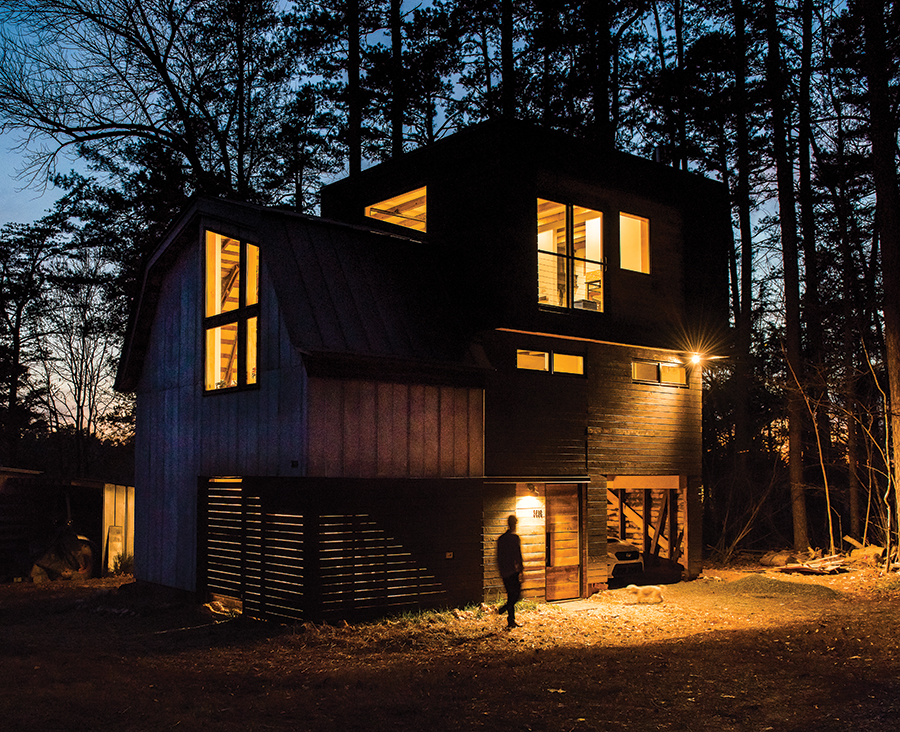
The barn does a curious thing. It disappears. UPS drivers miss it constantly, Clapp explains. Brown trucks whizz past the gravel drive, which wends by a bisected felled tree, a pine lost in a winter storm, which he laughingly calls “the gate.”

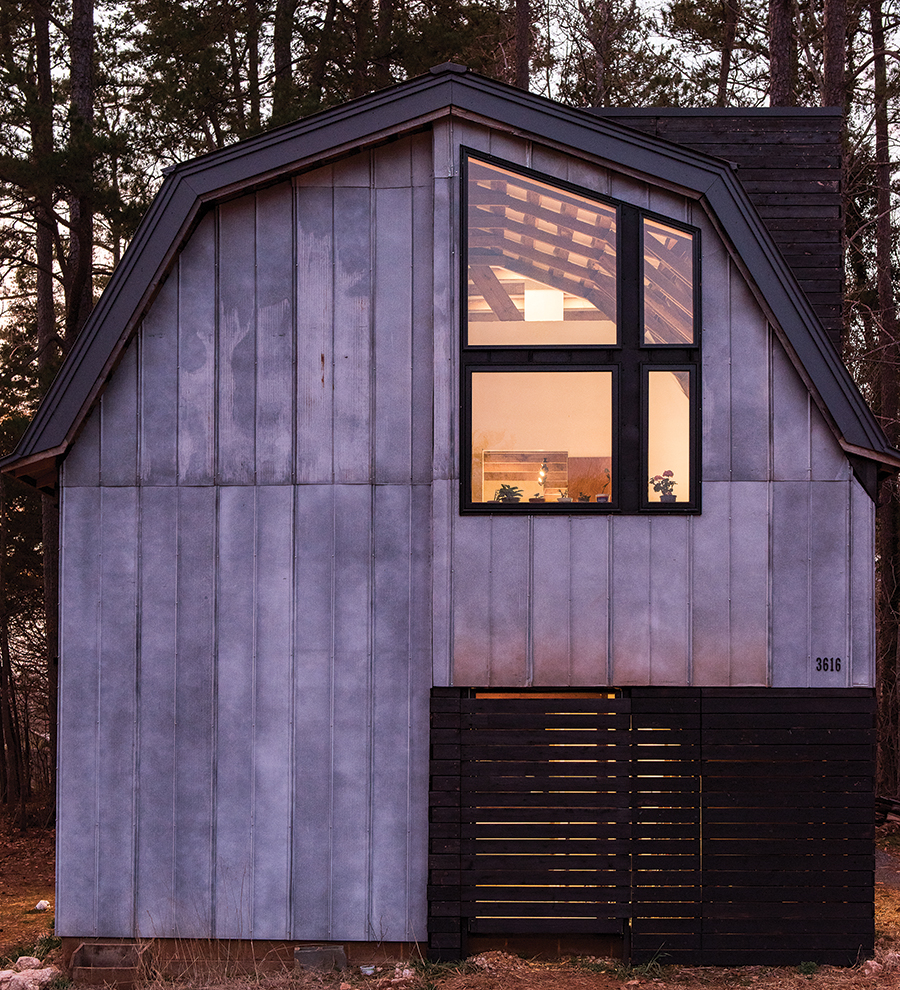
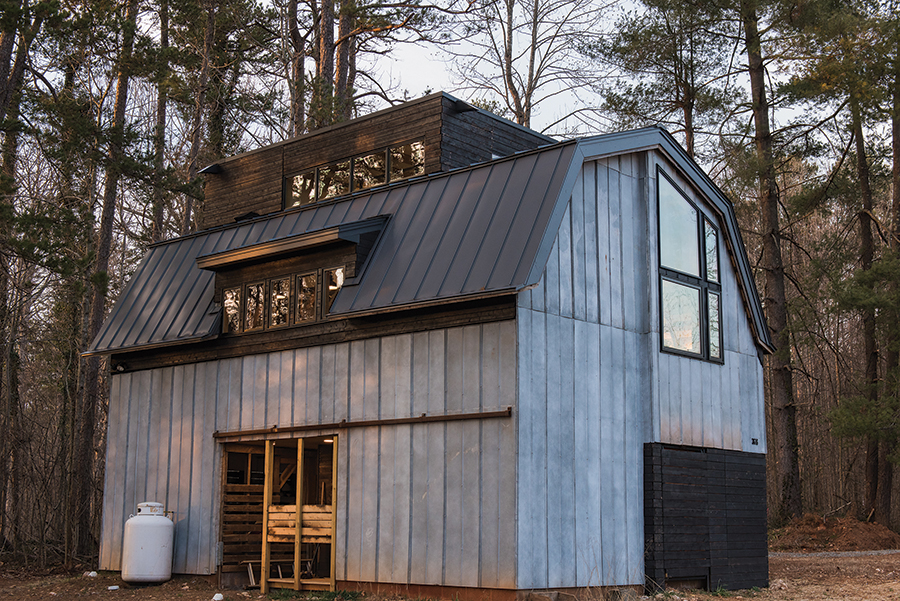
The barn hides in plain sight, with charred board siding, metal roof and a separate shed, so organically conceived it blends into the winter’s landscape. The exterior form is a combination, Clapp says, of the original tin panels and oak plank. The rain screen, an architectural modification to the original barn, is made of charred slat siding, a Japanese technique, not stained, he qualifies. The charring technique is redolent, too, recalling a family home that was lost in a fire.

So, altered, the barn echoes the past but it is changed. It is of the place, yet not. Clapp will explain later; this, too, concerns resonance.

There are small innovations to be seen from the very first glimpse. The large front door, wood and metal-edged, has a load-bearing wheel on the inside that is both quirky and industrial-chic.

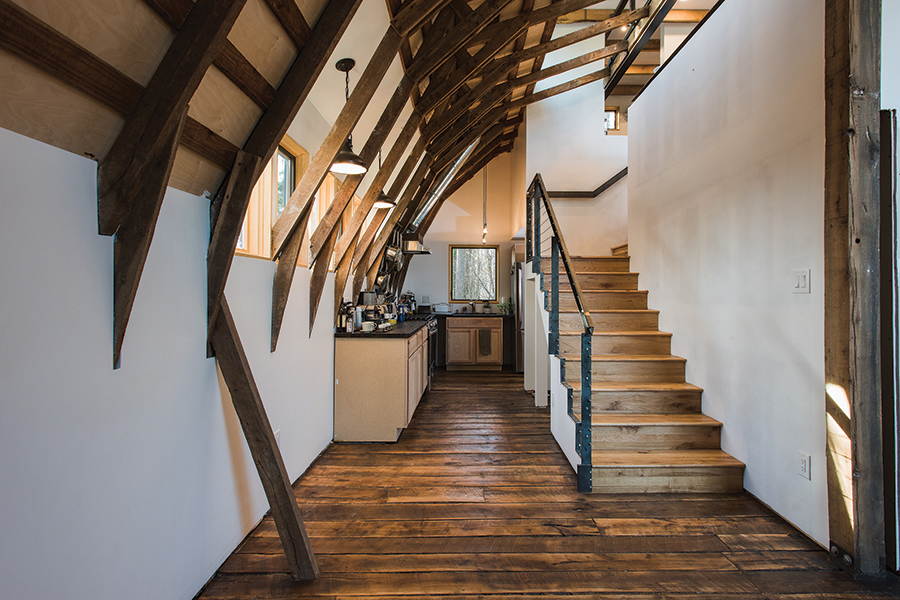
Stairs lead up from the entry, through a grid-like exposure of rough beams. Clapp says code modifications were made to the stair treads, in order to retain the original wood yet make them compliant. The original treads, he says, “are articulated with new rough cut oak.”

There is the undeniable romance of hefty timber beams, raw edges and decades-old wood.

Where once there was a hayloft, there is now work and living space. Overhead, the gambrel roof is a show-stopper, a humbler version of a vaulted ceiling in a European cathedral. The beams were cleaned, faced with plywood, and serve as the most impressive feature, the one that no doubt inspired everything. Windows artfully sliced into the upper walls provide light yet recede, more generous than traditional barns allow.

Clapp discusses the way “the new space was grafted” onto the old. He mentions palimpsest, usually defined as discernible traces of writing, as on a pad, or it can mean something that has been altered yet bears the traces of its earlier form.

“We are standing on the original floor and under the gambrel roof structure,” Clapp says, his blue eyes narrowing in emphasis. “All original,” he adds, right down to the insects they had to shoo away. “We had to vacuum off the cobwebs and dirt dauber nests. We seemed to find new ones every day.”

Clapp points out that the revealed oak rafters are 24 inches on center. “It gives a harmonious feel. The vernacular resonates towards that end.”

He also mentions pondering the finer points of a baseboard finish only feet from where his desk is, neatly stacked with multidimensional studies. Clapp anticipates growing the business, and requiring another, separate location. Then he and Ozgen will claim the nearly 1,000 square feet of the barn as their living space only.

As he makes an espresso on the stovetop in the L-shaped (surprisingly spacious and workable) kitchen, he sets cups and cream onto a dark-stained butcher block counter.

Both Clapp and Ozgen are avid cooks who did not want to scrimp on the kitchen, which he admits appeared smaller on paper before being built. So the fridge was carefully deliberated — they eschewed French-style doors to maximize space.

There are three levels, the third comprising a sleeping loft. The loft contains a bathroom, with exposed copper pipes in the industrial-styled tiled shower. The bedroom features a Juliet balcony across from the bed, providing a tree-filled view. There are evergreens and deciduous trees, whose stark branches will soon leaf out, filling the frame in a profusion of green like an animated painting.

The interior is largely complete with some finishing touches still in process. Clapp points out that furniture is on order but not yet arrived. Two camp chairs provide seating near the office where the couple are still testing various details within the space and revising ideas. There is the baseboard, for example. He points to a raised metal lip along the baseboard behind one of the camp chairs. The original idea, he explains, for the entire floor. The more practical option, he says, is one being tested on another wall called a shadow line — which appears to delineate the base of the wall without complicating construction and housekeeping.

The couple, both in their 30s, are the occupants and also the makers. They are doing the work largely themselves. Clapp sprinkles conversation with ideas about living minimally, of craft, of intention. There is discovery, tweaking and refinement all ongoing as the makers explore, as they have been, since taking occupancy last December.

He discusses conservation versus preservation, saying conservation focuses on retaining the past, preserving the flavor of the place. “Done in a way that can be sensible.” Clapp uses a professorial term: “resonant dwelling.” He has dubbed the barn project that.

“Farm architecture is what you build when you can’t afford to get it wrong,” N.C. architect Frank Harmon once commented. It is a quote found on Clapp’s website, though Clapp received his architectural training at the University of Tennessee and Harvard, where he also met Ozgen. So what if the barn was once a humble outbuilding on a farm? In the architectural context, Clapp says, good design can lend identity and a sense of place.

Only briefly did he doubt his vision.

As he recalls, there was a particular memory before the project began. It occurred after they cleared out all the detritus and items stored in the barn. For the first time, he could see the barn he had long admired emptied out.

“There was a weird moment,” Clapp confesses. “The essence of the space was exposed.”

It seemed larger. And he recalls feeling sudden reservation about altering it at all, thinking, “Oh, no, we’re going to start breaking this space down and compartmentalizing it. But once fully realized, the vision enhanced the existing space. We retained certain aspects of the original structure, so you could tell the story.”

Later, Clapp shows some of his elaborate sketches. Three days a week he travels to UNC-Charlotte, where he lectures on architecture. The remaining days, he works here in Whitsett, occupying the project nearest to his heart.

The family dog, Kar, snuggles into a bed near his desk, also reporting for work. “Kar,” he explains, “is the Turkish word for snow.” Ozgen is Turkish.

She works with Gensler, a Raleigh architectural firm but also is involved with Schemata, something Clapp long contemplated opening.

“A schema is an organizational tool that our minds use to understand certain situations. Schemata, as its plural form in Greek, help bridge between images and concepts to facilitate that understanding. We seek to challenge traditional ways of thinking about architecture and space to create pleasing new forms of occupations and residences.”

Standing on the ground level, which still has relics of its farm-past, Clapp says they are still pondering how the unfinished footage may one day be used. But he very much likes the fact that the old feed bins and stalls where his grandparents kept a pony and other animals are visible. Palimpsest personified.

“I think architects are uniquely positioned to help expose hidden value through thoughtful design,” Clapp reflects.

He adds that the “Amazon-ized society and culture have come to equate the lowest price with the best value but this couldn’t be further from the truth . . . “I like to ask: ‘When’s the last time you were truly delighted by something?’ Architecture and the space that is designed within and around it has the ability to present that.”

The grounds will change, too. Come spring, the couple envisions there will be planting in the field outside, just as there once was. Clapp says they are discussing planting pecans and mulberries. “A true Turkish breakfast will have mulberry jam,” something that he says Ozgen anticipates. The delicate mulberries are shaken from the branches, then caught in linen sheets before they hit the ground and are bruised, he explains.

Part of the poetics of architecture concern how man relates to the land. Clapp honors the place where his father and uncle came of age, and where his grandparents farmed.

“Christmas Day, we opened one of the few remaining canned jars of green beans from my grandmother,” he recalls. “She also made fresh apple pies,” he adds.

So inasmuch as Clapp is a philosopher, he too, is also a “maker,” just as he says.

Cynthia Adams is a contributing editor to O.Henry. Many of her happiest childhood moments were spent playing inside a Cabarrus County barn, observing life from the hayloft.

From Here to Ubiquity

Barn conversions are not uncommon in New England and certainly the U.K. But in the South, like the barn of my childhood, many have been lost, erased from the landscape by the ravages of time or a developer’s bulldozer. Ours fell to the latter.

Mike Cowhig is a longtime community planner with the City of Greensboro who works historic districts and guides the Historic Preservation Commission. He and Benjamin Briggs, the head of Preservation Greensboro, pondered how many barn conversions exist in Greensboro. Neither possesses an inventory of the county’s barns.

In an email, they mention the Carlson Farms barn conversion (part of the Greensboro Country Club), Stancil Farm, and Starlight Meadow, which is also near Whitsett. Then Briggs’ emails a quip about how such facilities often pop up and disappear, joking that anyone with a cow, a barn, and a golf cart is suddenly a wedding venue. There is something egalitarian about a barn, after all. — C.A.

Poem March 2019

Tilt Toward Spring

Night’s frozen mantle sparks

in early morning rays, luminous

as a bride’s new diamonds.

Tree’s crystalline coatings

slip soundlessly from drooping

branches, twinkling fairy lights

pirouetting to the ground.

Ice sheets slide from the eaves

dropping iridescence on unsuspecting

tender daffodils waking from winter

slumber.

Air comes alive with birdsong

and fluttering wings.

Lawn strewn with early robins,

pecking for sustenance, puffing

their breasts for warmth.

Signaling Earth’s inevitable tilt

toward spring.

— Patricia Bergan Coe

The Art of Reinvention

Agnes Preston-Brame’s take on Abstract Expressionism

By Nancy Oakley

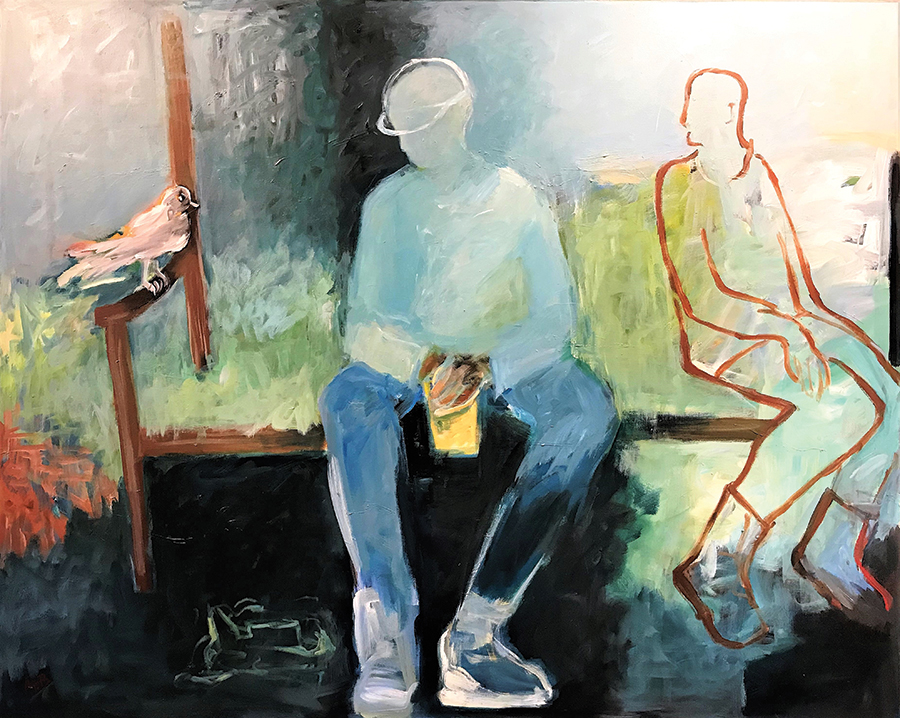
I’m reinventing myself, as I always say,” Agnes Preston-Brame chuckles from her perch on her living room sofa, which just so happens to be upholstered in an elegant fleur-de-lys pattern that she designed. Behind her hang two large paintings, one of a group of faceless figures swathed in broad strokes of blue and green paint, another of a single ghostlike figure, entirely in white, save for a red splotch where its heart might be. “Well, I had breast cancer on that side. Because of that, it will never be sold,” Agnes allows, with just a trace of her native Hungarian accenting her words.

The two canvases are among several adorning the walls of the Southside Greensboro home that the prolific painter and self-described Abstract Expressionist shares with her husband, Gary Brame. In an earlier painting, two white, feathery figures spring in opposite directions from a blue-gray background, as if rising from an ocean’s depth to its surface. “It’s called Separating,” Agnes says, explaining that at one point she held a fascination for trees, the inspiration for the unusually elongated lines of the human forms.

She has always been attracted to figures, since her childhood in Budapest, Hungary, when, “I started doodling, like most kids.” For an only child of divorced parents, art was an escape. Agnes also recalls a talented classmate from that period: “She was always drawing models. I admired her doing it. I think maybe she poked something in me early, because I always went right to figures.” In time, Agnes would attend the Desi Huber School of Art and later the Academy of Fine Art (no mean feat, as husband Gary points out: “It was the Soviet system; you did not get into an advanced school unless you were a straight-A student.”)

But the curriculum was rigid. “You start out in art school doing shapes, you know, balls and squares and then you get into the figure from models, for portraits,” Agnes recalls. She didn’t realize just how stifling her education was until she was allowed to visit her mother, who had remarried and escaped Hungary’s revolution in 1956, and had become an American citizen. After several appeals to Hungarian authorities, Agnes, then 19, was at last granted a passport and flew to Montreal, where her mother was then living. It was to be a three-month visit.

Or so the young artist thought. “My mom, obviously, insisted that I stay and wanted me to stay. But she did a very tricky thing.” She drove the impressionable teenager down to New York City and took her to all the museums and all the galleries. “I was blown away by the different styles — Expressionism and Abstract Expressionism — that we were censored from in Hungary.” The ruse worked, as Agnes realized, “I probably couldn’t have achieved what I really wanted to achieve to become a professional artist, because it was still very difficult under communism, under Russians.”

She defected, much to her father’s ire. Years later, after his death and the fall of communism, Agnes and Gary traveled to her father’s flat in Budapest, which they’d inherited. There, hidden in the back of what Gary describes as a “primitive storage unit,” was a box of sketches. “Wonderful little sketches of her grandfather,” Gary remembers. “They were not childish in any way. Very professional.”

But for Agnes, a truly professional artist’s path would take many twists and turns. Because of her mother’s status as an American citizen, Agnes, who spoke no English, had to live in America, not Montreal. So her mother deposited her daughter at the YWCA in New York, and appealed to some wealthy restaurateur friends to secure for her daughter a hat-checking job. Agnes had created a portfolio while living with her mother in Canada, but the language barrier foiled her chances of attending Cooper Union, as she had hoped. She enrolled in the prestigious Art Student’s League of New York, whose alums include the likes of Thomas Eakins, Jackson Pollock, Alexander Caldwell, Helen Frankenthaler, Willem de Kooning and others in recent years, including Chinese dissident Ai Weiwei. Though the institution offered instruction without academic credit, Agnes benefited from the tutelage of Modernist painter Vaclav Vytlacil, who preached the gospel of Hans Hoffmann, which is to say Abstract Expressionism, the style that had so captivated her.

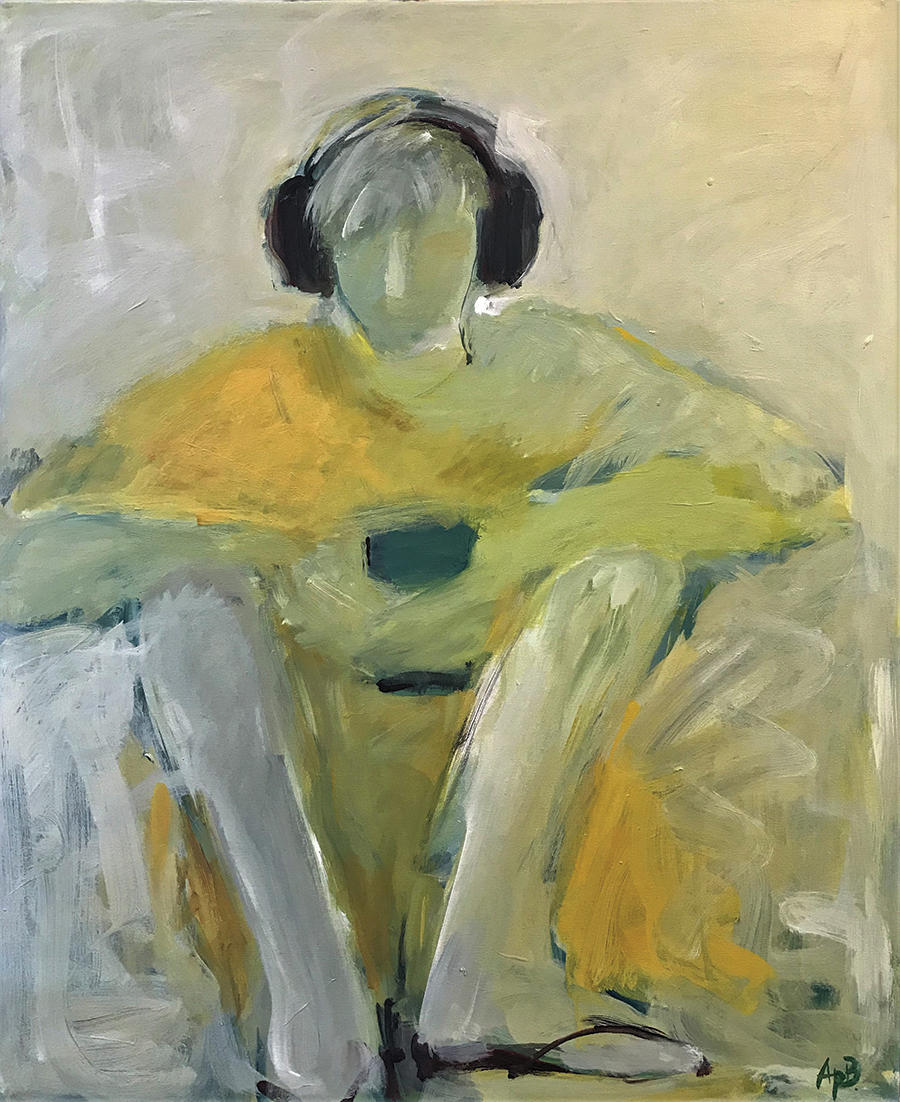
But she never abandoned her love of painting figures and ultimately blended the two passions, a signature style that underpin her work today: fluid, faceless figures whose poses or gestures convey multiple possible meanings. “To me, the body expresses a tremendous amount,” says Agnes. In a recent painting titled In Another World, a seated figure in a bright yellow background wears a pair of headphones while staring at a hazy object, presumably an iPhone. Is he or she engaged? Bored? It’s up to the viewer to decide. In another called Wish You Hadn’t Told Me, a seated woman carries herself in such a way as to appear concerned, while another woman — the messenger implied in the painting’s title — walks away in the background. Has she delivered devastating news? Or merely conveyed something annoying and trivial? Again, it depends on the viewer’s imagination. “I often call my work ‘situational,’ because they are stories,” Agnes explains.

She continued her studies, thanks to a scholarship to the League’s summer campus in Woodstock, New York, where again, she flourished under the instruction of mentors like Arnold Blanch and painter Philip Guston, and garnered yet another — and full — scholarship to New York University at New Paltz. Here, she obtained a fine arts degree, graduating summa cum laude, and met her first husband, Steve Preston. “My maiden name, nobody could pronounce. So I was happy when I married my first husband because his last name was easy enough to pronounce!” Agnes jokes.

But his fellowship at Columbia University landed the couple back in New York City — where Agnes’ fine arts degree held little, if any cachet among prospective employers. “They were like, ‘You don’t know how to type,’” Agnes recalls. She had to reinvent herself again.

After seeing an advertisement for a textile designer at a Broadway address, Agnes armed herself with her portfolio and went to apply. She discovered that the entire building was filled entirely with textile companies. “So, I decided, ‘to heck with the one I looked up.’ So I went up to the 24th floor and started. And on the second floor they hired me,” Agnes says with a laugh. It marked the beginning of her career as a textile designer.

As a trainee, she learned the trade from the ground up, visiting various mills and learning the entire fabrication process. In less than two years, Agnes left the job to her own business designing for high-end companies, such as Brunschwig & Fils, Schumacher, among others — including the one that employed Gary Brame. He and Agnes met almost immediately after his arrival in New York in the mid-1970s. At the time, he recalls proudly, “She was one of the most pre-eminent designers.”

The two married (“She accepted me when she learned I could dance,” Gary quips), and lived the good life in the Big Apple. Agnes’ business flourished while she put her painting on hold, but another revolution would affect her life’s course: “Computers started to come into being,” Agnes says. “Some of my good buddies who were designing, we had good jobs, we were out of jobs because the computers started making the designs, copying what we tried to do.” It was time to move on — literally, for Gary had gotten a job offer in Greensboro. “It worked perfectly, because I could still do some design work,” Agnes says (at one point she scored a freelance gig with a High Point manufacturer resulting in many years of travel to China.) “But I really started painting.”

She began exhibiting across the country, and became a stalwart of the local art scene, involving herself with United Arts Council, serving for nine years as president of Center for Visual Artists, exhibiting in GreenHill’s Winter Show for several years, and as Gary, her most ardent champion likes to point out, “winning” a certificate for a piece, Beach Scene exhibited in Weatherspoon’s Art on Paper juried show. It is a tongue-in-cheek portrayal of midlife ennui in which a paunchy, vacationing couple stand at water’s edge, she gazing out to sea, he turned toward the viewer, but too preoccupied to return the viewer’s gaze.

The work is one of several in Gary’s office, which also contains the painting that garnered Agnes the scholarship and a splashy still life of colorful flowers. “To some extent, I call myself a colorist. Partly because of the textiles I designed, and because I like color. But I like black and white, too,” Agnes says. In another “airport” series, figures rendered in black and white and tones of gray express the frustrations of air travel — cancelled flights, the boredom of waiting in line, checking luggage and so forth. The series came about after Agnes and Gary were stranded in the Brussels airport during a snowstorm last winter. “It was a miserable experience,” Agnes concedes. “Shoulder-to-shoulder,” Gary adds, “You couldn’t even find which line you were supposed to be in.” By the time they got to their destination, Budapest, the memories stayed with Agnes and ultimately filled her canvases.

Always painting from memory, she prefers to “give in to my intuitions and emotions. I don’t really have a preconceived idea when I start working. I just kind of start with colors and lines on canvas or paper, and so it’s very spontaneous. And then some image starts coming. And the painting goes through a metamorphosis.”  Like the one of the cat on a red background in her studio. Or the small pen-and-ink doodles or “diaries” that she does every day. Or perhaps she’ll infuse a painting with memories, such as the series of chairs, tables and other pieces of furniture, inspired by the antiques business that she and Gary owned for about 10 years.

On a whim in 2006 the Brames, both antiques buffs, bought Jules Antiques & Fine Art in the old Curran Bank Building on South Elm (now occupied by the consignment boutique, Vintage to Vogue), where Agnes had an office on the second floor. By then, she had also gotten into interior design under the aptly chosen handle, Metamorphosis. “We had famous First Fridays,” Agnes says of the antique store’s wine-fueled openings. “Hundreds of people came through. It was a very nice store.” The two especially loved getting to know the clientele and learning the backstories and provenance of their inventory. “I thought of layering the people and the objects. Some of the stories people brought in with their things — it gives me chills,” Agnes reflects.

And it’s impossible not to feel a frisson, looking at the large rectangular painting, Chippendale, featuring the outlines of a chair in the foreground, while muted figures hover in the background. Are they admiring the chair? Will it remain empty and unsold? There is an air of melancholy to the painting. All the more so, when one considers how the Great Recession, not to mention grueling hours for Gary, prompted the Brames to shutter Jules Antiques a couple of years ago.

In contrast, a lively profusion of musical notes and instruments fairly blasts from another nearby canvas in Agnes’ tidy studio, a playbill that she designed for the Greensboro Symphony. “Over the years I did a lot of musical themes,” she explains. Birds also appear frequently in her work, though the artist is at a loss to explain why. She is more prolific than ever, with her design business moving at a slower pace since the Recession, and a few solo shows under her belt and another at Ambleside Gallery this month. Meantime, Agnes and Gary “are on the road again,” seeking out galleries for representation.

One, the Present Thyme in Roanoke, Virginia, has accepted seven paintings, much to the artist’s relief. “I love to paint big,” she says, laughing about the freed-up space in her garage. No doubt she’ll fill it right back again, as suggested by several works in progress scattered near her worktable filled with accoutrements of her avocation — oil and acrylic paint, brushes, frames (made by Gary, who also does personal property appraisals on the side). One painting is a commission that requires her painting a car — a first. But firsts are part and parcel of the reinvention game. “I don’t even remember wanting to be anything else but an artist,” Agnes muses. “Even though I’ve changed course from time to time: I have been doing what I like and what I was trained for, you know? . . . And I didn’t have to waitress all my life!”

Nancy Oakley is the senior editor of O.Henry.

For more information about Agnes Preston-Brame and her paintings, visit paintingsbyapb.com. Ambleside Gallery: amblesidearts.com.

March Almanac 2019

“And here is the serpent again,” wrote the late poet Mary Oliver, “dragging himself out from his nest of darkness . . . looking for the sun.”

Three decades after she wrote it, Oliver’s “Spring” slides into consciousness. Oh, how you’ve missed these sunny mornings. As soft light filters through the kitchen window, you think of the snake, moving “like oil” over pine needles, tasting the air with its tongue.

March is here, and as an owl cries out from its distant nest, you taste the glorious poetry of spring.

Pink blossoms against leafless branches on the saucer magnolia.

Pink squirrel babes, blind and wriggling in their drey.

Pink rain jacket left hanging on the porch, pocket full of pine straw, blue bird flitting in and out of periphery. 

This year, the spring equinox arrives on March 20, in tandem with World Poetry Day on March 21.

Fitting.

And as you gently scoop the contents from your jacket pocket — a beautiful tapestry of needles and grasses — you think again of Mary Oliver, and of the delicate treasures she wove with nature and light.

Thank you, blue bird, for starting over.

Thank you, black snake, winding round the rising grass.

Thank you, poet within each of us, for acknowledging the beauty that is always waiting for us, like sunlight after a long, dark winter.

Hello, sun in my face. Hello you who made the morning and spread it over the fields . . . Watch, now, how I start the day in happiness, in kindness. Mary Oliver

Nature’s Bard

In honor of the beloved and recently departed best-selling poet Mary Oliver, who made tangible the heart-breaking beauty of the natural world, and World Poetry Day on March 21, below is an excerpt from “When Death Comes,” in which the poet “considers eternity as another possibility.”

When it’s over, I want to say: all my life
I was a bride married to amazement.
I was the bridegroom, taking the world into my arms.

When it’s over, I don’t want to wonder
if I have made of my life something particular, and real.

I don’t want to find myself sighing and frightened,

or full of argument.

I don’t want to end up simply having visited this world.

Thank you, dear poet, for taking such transient beauty into your arms. And for those considering eternity: Oliver’s “Such Singing in the Wild Branches” is good medicine.

Amethyst Falls

I once heard someone dub wisteria the “evil overlord of the plant kingdom” and, for better or worse, have never been able to shake it. If ever you’ve battled with wisteria in your backyard, perhaps you’ve given it a comparable name. But if you’re still reading this . . . if ever you’ve wished to make friends with this intoxicatingly fragrant vine, consider introducing a native cultivar, amethyst falls.

Less aggressive than its exotic Asian relatives known for choking out trees and, yep, swallowing houses, amethyst falls blooms on new growth, making the vines easier to prune back and train. Although the leaves and cascading purple flowers are smaller than the common wisteria you may have given a less-than-kind name, an established amethyst falls plant can climb 15–20 feet per season.

Bonus points: It’s drought tolerant and deer resistant.

March Garden To-Do

Replace winter mulch

Sharpen dull mower blades

Sow seeds for spinach, radishes, turnips, and kale

Stop and smell the flowering redbud and dogwood.

Botanicus

Heaven in a Wildflower

Finding infinity in the mottled leaves of a trout lily

By Cheryl Capaldo Traylor 

In late winter I watch in anticipation for the pointy maroon tips of our native Erythronium umbilicatum leaves to push up through the hard winter soil. I run outside to my garden several times a day — looking, feeling, hoping.

After the leaves emerge and unfurl, you can see the reason this plant’s common name is trout lily. The brown-and-green mottled leaves look similar to the markings on a brook trout. Not only is this a sweet little North Carolina wildflower, but it is also a tangible, seasonal reminder for me to slow down, take one day at a time and try not to rush through my life to the next big thing. Let me explain.

One sunny, but chilly, March afternoon many years ago, I stopped by my sister, Reco’s, house on the way back from visiting my mother in West Virginia. The precarious horseshoe curves of the narrow country roads were the only thing keeping me awake. Look away for one minute, and I might end up on the wrong side of the road, or worse, on the wrong side of the battered, flimsy-looking guardrail. I was tired from the drive, and from the last few days shuffling Mom to doctor’s appointments. As often happens, if we are lucky enough to have our parents with us as they phase into their silver years, the tables had turned. It was now my responsibility to carpool Mom wherever she needed to go. Even if that meant driving in from North Carolina — two states away.

Reco met me in the driveway, and we greeted each other with big hugs and kisses. My family has always unabashedly engaged in public displays of affection. We were a big, loud Italian tribe who argued and loved with equal intensity, always knowing the love was so much stronger than anything we could ever argue about. After catching up inside over a cup of coffee and relaying all of the news from home, I got up, stretched my legs, and said I’d better be hitting the road. I still had a little over three hours to go.

“Just one more thing before you go,” Reco insisted. She wanted to walk in the woods behind her house so she could show me the carpet of yellow wildflowers. “You will not believe their funky, spotted leaves,” she said in wonder. I didn’t want to spoil the surprise, but I knew just the plant she was referring to. It was one of my favorites that crept throughout the woodlands on the private estate in Hillsborough where I tended the gardens. I was eager to get back on the road and ready to get home, but we trudged over the hills covered in apples trees and invasive trumpet vine seedlings.

We walked through her woods, and talked about my upcoming plans to go back to school. She confided she hadn’t been feeling well, and the doctor was trying a new medication to quell the worsening symptoms of Crohn’s Disease

“There,” she emphasized as she stopped and pointed. “There. Do you see it?”

Yes, there they were, their telltale fishy leaves carpeting the forest floor. Reco bent down and took a large kitchen spoon out of her back pocket — she wasn’t a gardener, I guess only I had inherited that gene from our maternal grandmother — and dug several of these yellow-belled beauties for me. She pressed them into a Ziploc baggie and said, “I wanted you to have these in your garden.”

Walking out of the thick underbrush and trees toward her house, we caught a glimpse of the sun reflecting off the bright white church next door. Stopping and pausing, as if on cue, we took in the sunbeam bouncing off of the steeple and into the woods. But, I was tired and ready to go. “Better get going,” my words pierced the moment.

I drove home to North Carolina, gas pedal pressed to the floor, as usual, thinking of all the busyness that awaited me in Cary. Work, family, church, volunteer commitments, school preparations, an upcoming daughter’s high school graduation: My life was an endless merry-go-round of activity.

This is where I say, even though it sounds like a cliché life is precious, life is short, and I need to savor each day, even each moment, with those I love. Because today could possibly be my last day with them. And, although this was not my last day with Reco, it was one of the last days. Had I known, had I any inkling of foresight, I wouldn’t have rushed that day. I would’ve watched that little country church beam a luminous miracle into the woods. I wouldn’t have insisted on leaving so soon. I would have stayed and had supper with her, maybe even stayed the night.

But, I was too busy.

I miss her sense of wonder. I miss her slow country pace. I miss her.

Now, I don’t take anything for granted — my family, my friends, my health, my sanity, my breath. Not even a tiny yellow flower with mottled leaves.

Life is too brief. Like trout lilies, our time here is over so quickly. This spring, won’t you join me near some trout lilies or bloodroot or bluebells and pause in their presence? They’re just little things, but what you’ll grow to understand is the little things in life are truly the big things. Actually, they’re the only things. And they, like trout lilies, pass away too soon.

Cheryl Capaldo Traylor writes about nature, local happenings, and the unsung brilliance of everyday people. She finds inspiration in gardening, hiking, and reading. She blogs at Giving Voice to My Astonishment at http://www.cherylcapaldotraylor.com.