
Fit for a King

FIT FOR A KING

Fit for a King
Today’s princes and princesses learn skills to become tomorrow’s leaders
By Billy Ingram
Photographs by Betsy Blake
Society’s crustiest curmudgeons disparaging the aberrant behavior of today’s youngsters has practically become a national pastime. Modern-day kids, many insist, are rebellious, insolent, lazy, entitled, unable to communicate effectively whether speaking or writing, and devoid of core American values such as hard work, accountability and responsibility. Oh wait, that’s exactly how society characterized those of us who grew up in the ’50s and ’60s, my generation. Raised to be considerate, kind and obedient, to curtsy and bow when company arrived, to be seen, not heard . . . and we all know how that turned out. But has the pendulum of propriety swung way too far in the opposite direction?
Just imagine what effect it might have if today’s youngsters were taught etiquette, the importance of courtesy, respect, punctuality, politeness, eye contact, proper dressing and grooming.
That’s precisely the focus of Geovanni Hood, whose Charmed School of Etiquette is spearheading a return to refinement and civility, most recently in conjunction with D-UP in the enlivened Washington Street Historic District in High Point. His six-week course engages kindergarteners to teens in lessons that stress proper manners and comportment, encouraging youngsters to gaze away from a constant barrage of pixelated stimulation in order to effectively face life’s three-dimensional challenges.
Founded by Jakki and Corvin Davis in 2007, D-UP (Develop Skills, Uprise Education and Power-Up For Life!) began as an after-school basketball program. A year after achieving nonprofit status in 2010, D-UP moved its headquarters to Washington Street, expanding outreach efforts to include nutritional education to combat childhood obesity, while promoting academic achievement and character development.
“We wanted to make sure that the students went through etiquette classes,” D-UP’s Jakki Davis tells me, “because this is something they can learn now and it will be forever ingrained in them.”
Hood was brought in as a visiting instructor, says Davis. “When I met Geovanni and saw his interest in our students and what he was doing, I thought, ‘This will be perfect.’ ” Plus, she adds, he makes it fun.

“When your child steps out the house, they are not only a representation of themselves, but they are a representation of you,” Hood says. They’re creating their brand, so to speak. Your brand, he says, involves knowing “how to be socially active, how to make friends, how to engage in conversations and build character.” Cultivation reflects positively on parents as well.
Besides collaborating with nonprofits such as D-UP, Hood’s outreach includes local churches, the YMCA and the Piedmont School at Andrews High School. “I’ve taught at Howard University in D.C. as well, so I pretty much just travel.” Most organizations will bring him in for a day, but longer sessions may stretch into two eight-hour days back to back “or I might come in one day a week for five weeks.”
As former Human Relations Commissioner for the City of High Point and a certified career coach and navigator, his book Navigating Success: Interview Eitiquette Guide for Teenagers is a primer for anyone who believes chivalry is not dead, merely moribund. “Young people can’t do what they don’t know,” Hood insists. “When somebody comes along, leading by example, then others will get it and hopefully follow suit.” As for getting through to teenagers, he says, “If I’m teaching them how to be properly mannered versus calling it ‘etiquette,’ they understand it better.”




A Greensboro resident by way of Brooklyn, what inspired Hood to lead the way in teaching etiquette to a new generation? A room at the O.Henry Hotel dedicated to the memory of Dr. Charlotte Hawkins Brown.
Beginning at the turn of the last century, with determination undeterred by mob violence and an overwhelming resistance toward efforts aimed at assimilating African Americans into polite society, Dr. Charlotte Hawkins Brown established, then tenaciously re-established after everything was burned down by residents opposed to the very idea, institutions of higher learning for people of color. By 1940, Brown became known as the “first lady of social graces,” following the publication of her manners manual, The Correct Thing to Do, to Say, to Wear, a more reality-rooted companion to Emily Post’s Etiquette, published two decades earlier.
Hood shares Brown’s basic philosophy: “Educate the individual to live in the greater world.”
“What I teach is situational etiquette, but also interview etiquette, and I love teaching both,” he says, reflecting his background in corporate culture and client services. “I’ve been in management for the last 13 years and interviewed plenty of candidates who don’t know how to answer a situational question, may only answer one part of the question, or arrive in incorrect attire, not wearing a tie or not having access to resources to be dressed properly for an interview.”
Knowing the difference between a salad fork and a dinner fork is one indication of how far socially you’ve climbed, but more crucial is learning how to handle those unexpected forks in life’s roads we find ourselves navigating. But it’s important to note that the aforementioned Emily Post, America’s esteemed etiquette expert, once famously stated, “Nothing is less important than which fork you use. Etiquette is the science of living. It embraces everything. It is ethics. It is honor.”
One day last winter at D-UP’s new workshop, converted from a former house, I was able to observe firsthand how eager preschoolers are to learn new skills. “The little ones, they’re one of my favorite groups,” Hood says. “They’re so young and impressionable, just super excited about learning at such an early age before they have other impressions put on them.” He begins by focusing on what goes into creating a great first impression: “What does that look like? What does that sound like? And how to leave a lasting impression.” To demonstrate the practicality of his instruction, he guides the kids through different role-playing scenarios.
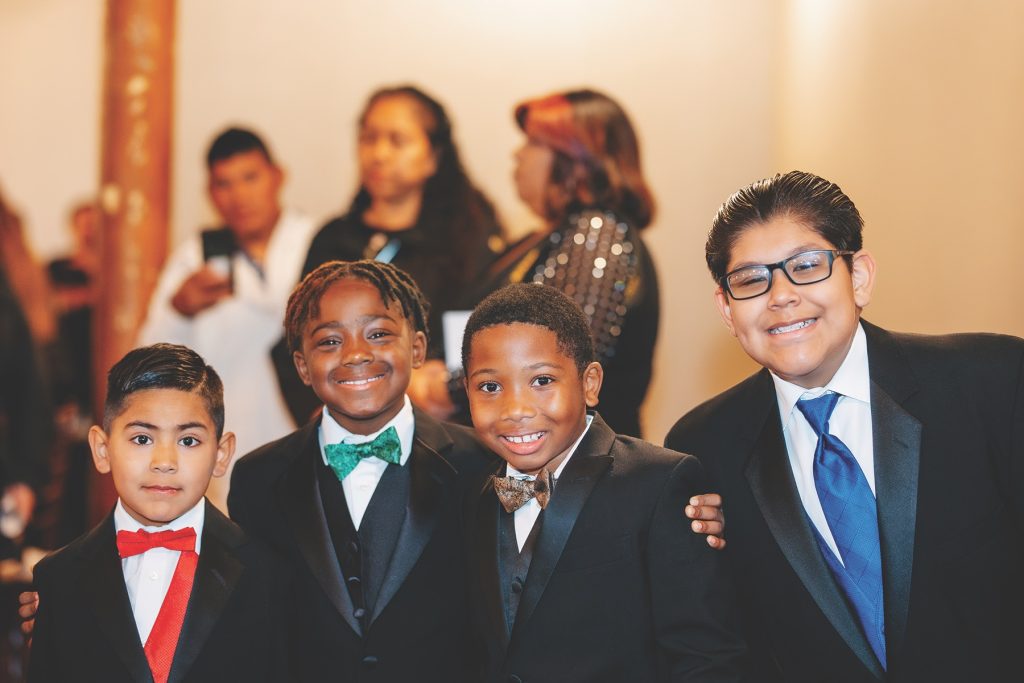
At the end of the six-week program, both those youngsters and the older students enrolled in the etiquette course would have an opportunity to utilize their newfound expertise by rubbing tiny little elbows with the city’s elite during D-UP’s annual Royal Celebration held in December 2024 at Congdon Yards in Downtown High Point. The culminating event serves as a graduation ceremony of sorts, centered around a formal dinner served amid enchanting surroundings.
Inspiration for the Royal Celebration occurred a decade ago when Davis was accompanying children on a trip to Octoberfest. “I was in the backseat with one of our little boys and his sister, who had on a princess gown,” she recalls. “I said, ‘Look at my little princess,’ just admiring her, and her brother says, ‘She ain’t no princess.’ I said, ‘Of course, she is. And you, a prince.’” The young man objected, saying, “I ain’t no prince.” But Davis encouraged him, saying “Yes, you are prince and don’t ever feel like you’re not.”
The next day, reflecting on that exchange, Davis realized, “We can tell kids who they are but sometimes we truly have to show them. All of these thoughts started coming to me — like limousines, tuxedos, a sit down meal, empowering kids to be able to talk with adults and not fumbling over the words.” Within weeks, D-UP cobbled together the very first Royal Celebration, “just by reaching out to our partners, because it was already the end of the semester and we had no budget for this at all.” That was nine years ago.

There were around 30 enrollees that first year, but by 2024 enrollment had grown to 65 participants, all outfitted in tuxes and elegant gowns donated by VIP Formal Wear at Four Seasons Mall. “We have community members who understand exactly what we’re doing and it means a lot to them,” Davis says about VIP and other sponsor contributions for the Royal Celebration. “You could see an instant change in the boys’ demeanor when they were trying on tuxedos. The same with the girls trying on their dresses and shoes.” Arriving in style to the venue by limo, Davis says, the kids emerged with a new attitude. “It’s such a positive experience for them, but also for us to see their reactions.”
Attended by local dignitaries and business leaders, the purpose behind a Royal Celebration is instilling confidence in the young ones when in a formal setting. “We have a three-course meal for them,” Davis says. “They don’t even have to question which fork to pick up. Using their manners, not speaking [out of turn], it’s such a confidence builder.” The children were paired with adults at each table so they could engage in grown-up conversations and put their newly-honed skills to work.
During the social hour, the courtly kiddos were encouraged to mingle and introduce themselves before striding on stage to receive their awards based on performance and improvement. Another highlight of the evening was a round of ballroom dancing. “We offer dancing here anyway,” Davis points out. “Ballet, modern and hip hop, but here they got to practice ballroom.” By all accounts, the Royal Celebration was once again triumphant. No surprise that, around this same time, Davis was crowned 2024 Businesswoman of the Year by the High Point Chamber of Commerce.

Lately, Hood has been venturing into middle schools, instructing students on developing resumes. While that may seem premature to an outsider, “We are preparing children for the future,” Hood says. “If they understand these things at a young age, then start practicing these skills, just imagine how far ahead they’ll be later on, perfecting skills instead of learning them for the first time.” He’s also instructing teenagers on interview techniques and leading, “a social skills class that will be a summer program to help prepare them for returning back to school.”
Is Emily Post still relevant to modern life? “There’s a way society works in order to gain opportunities in your favor,” says Hood. In fact, he suggests the pathway to happier happenstances begins “by carrying yourself correctly, having genuine morals and values that you stick to and, more importantly, being an example for the person that’s watching you. Because you never know what an inspiration you can be for them.” Naturally, there are times when potential participants walk out on his classes. “This is for those who want it, for those who want to be their best, who want to strive for change. So if you’re not ready to make that difference right now, I’m not mad at you. You’ll get it eventually . . . or you won’t.”
Uber-ing back to High Point’s palatial train station for the rail ride home, by happenstance, I had the same driver returning who picked me up earlier. He somewhat warily asked what I was doing on Washington Street. In that instant, staring out onto this clean shaven boulevard as excited children are exiting a bus to scurry into an after-school program, where across the street young men are shooting hoops, killing time before a scheduled lesson in checkbook economics, I blurted out, “I think I just witnessed a revolution.”