
It’s Her Churn

IT'S HER CHURN

It's Her Churn
For Shafna Shamsuddin, cardamom is the spice of life
By Cassie Bustamante
Photographs by Bert VanderVeen
Dessert is just a way to tell the stories,” says Shafna Shamsuddin, creator of her own cardamom-infused and globally-inspired ice cream company, Elaka Treats. Even though she’s inspired by the Indian traditions of her childhood, she’ll tell you with a laugh that her own story doesn’t begin there.
“My story started at Williams-Sonoma,” Shamsuddin admits with an easy smile. Born and raised in United Arab Emirates by Indian immigrant parents, Shamsuddin, as well as her siblings, came to America for college. She began her studies at Purdue University in Indiana, studying psychology and Earth science. From the time she was a child, she had her sights set on becoming a psychologist. However, she was matched with her husband during her undergrad years and relocated with him to Gastonia. In the end, she earned her bachelor’s degree from UNC-Charlotte. From there, her plan was to enroll in a clinical psychology graduate program at Duke University. “But due to personal reasons . . .” she trails off, preferring to look forward instead of into the past.
After a moment, she picks back up. Pressure from her community was overwhelming and first loneliness and then restlessness followed. “Everyone advised that I should focus on my marriage,” she says. “I am not Indian enough for Indians because I am not born and raised there,” she says. “And I am not American either, so, it’s like, where do I belong?” So she put her goals on the back burner, “hoping that one day I could pick it up and go back.” But, little by little, she began throwing herself into all sorts of projects: “plumbing, electrical, carpentry — I’ve done all kinds of stuff.” She found herself often wandering through the glimmering displays of kitchen-and-entertaining merchandise at Williams-Sonoma. “The kitchen tools and gadgets really fascinate me,” she says.
But there was one small appliance in particular that she kept coming back to. “I used to see the Cuisinart ice cream maker and that always caught my eye.” However, she says, the price tag was too much for her wallet. After years of gazing at the machine in wonder, she says, “finally, one day, I was like I am going to make the splurge.”
That small and mighty Cuisinart has long since been retired, but it got Shamsuddin’s wheels churning. Her first endeavor with it was kulfi ice cream, a traditional frozen Indian treat flavored with pistachio, cardamom and saffron. While kulfi is generally a no-churn dessert, Shamsuddin gave it a whirl in her ice cream maker.
But all of that tinkering didn’t ease her homesickness. She started dreaming of the anything-but-frozen unnakai, a sweet treat from back home, “especially where my parents are from in India, from their home state of Kerala.” The labor-intensive dessert, according to Shamsuddin, is made of a mashed plantain that’s been stuffed with coconut, cardamom and cashew nuts, then deep-fried. And while the flavors indeed melt in your mouth, it was the ritual around it, tea time, that she was missing.
“I was really craving having that experience of not just having the treat, but the experience of getting together with people and family and relatives, and just sitting and chatting over tea and tea-time snacks,” she says wistfully. But, she adds, “I felt that it was really sad for me to go through that process and eat it alone.”
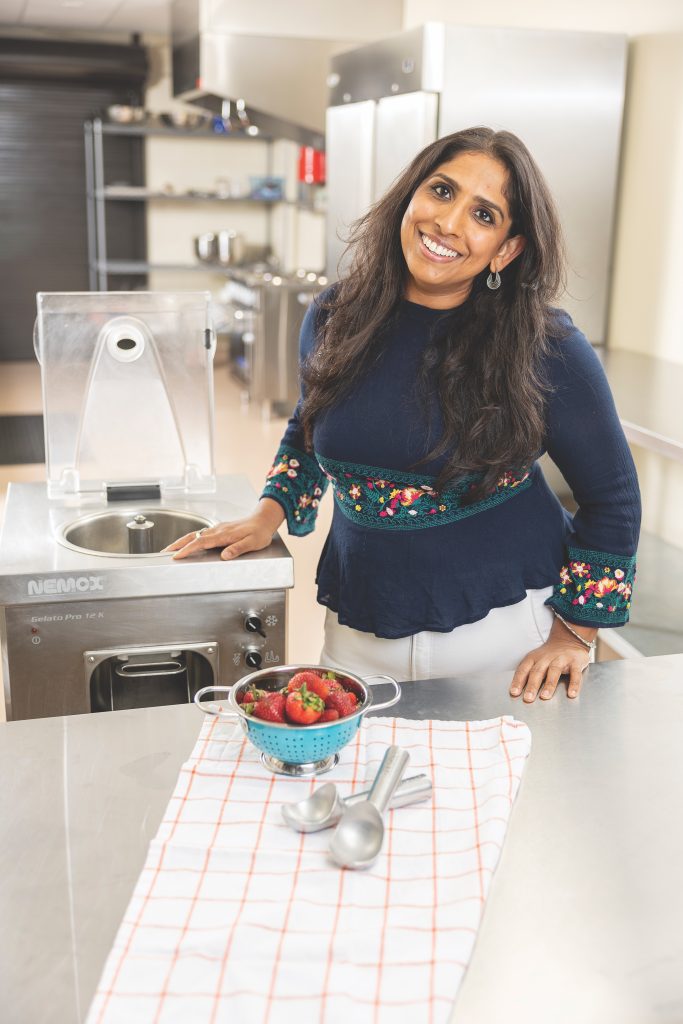
Shamsuddin wondered how she could take the unnakai flavors and create a frozen dessert that she could enjoy. An idea hit her: Use plantains as the base. “I knew I had something here,” she says.
She began testing out her confections on friends when she’d host dinner parties. The result? “Everyone loved it.” Shamsuddin found gratification in serving others. And watching people savor her creations filled her cup. “It’s something that gives me a lot of pleasure.”
Plus, she says, the Indian tradition she learned from her own mother is that, when you entertain, you make everything from scratch as a way to celebrate your guests’ presence at your table. As her dinner-party pals spooned in bite after bite, they confirmed what she’d suspected — she was indeed onto something.
By the early-2010s, Shamsuddin and her husband had settled in Greensboro and later that decade welcomed their only son, Zahin. But that desire to make her confections into something bigger kept nagging at her. The only problem was she had no idea how to start a business. And she knew that she’d be on her own in this endeavor.
In Greensboro, Shamsuddin began to find her way. She joined a training group at Club Fitness, but she got much more than she expected out of those gym sessions. Her workout comrades and trainer also became her support system, her social circle and her laboratory, allowing her to test samples on them. “My gym buddies, they were really my everything,” Shamsuddin says.
As luck would have it, her trainer coached another client, Lindsay Bisbee, who had launched the homemade pickle brand Kyōōkz. He connected the two women, and Bisbee, in turn, introduced Shamsuddin to the Piedmont Food Processing Center, aka PFAP. The 10,000-square-foot building in Hillsborough offers commercial kitchen space as well as support for food entrepreneurs.
But the biggest thing Shamsuddin picked up at the gym wasn’t the heavy weights, nor was it the connections. It was confidence. Shamsuddin, who describes herself on LinkedIn as a “Rule Breaker,” learned, she says, “I am physically strong and mentally strong, so what is holding me back? Nothing, I can depend on myself.”
With a new-found belief in herself, Shamsuddin began her production in 2019 at PFAP, where executive director L. Eric Hallman provided her with the guidance she’d desperately needed. “It was Eric who kind of gave me that first big missing piece of the puzzle,” she says, laughing about how basic those missing pieces were — business registration, insurance, scheduling inspections.
Registration meant Shamsuddin needed a business name, which was something she hadn’t even considered. Elaka is what people in the Indian state of Kerala call cardamom. Every confection Shamsuddin offers features the exotic flavor — a warm, aromatic spice known for its peppery and piney palate. So, she decided, why not call her business Elaka Treats? Officially in business at PFAP, Shamsuddin learned how to navigate a commercial kitchen, essential in the ice cream business. After months of back and forth between Greensboro and Hillsborough, often hauling Z with her and hiring a babysitter there, she scheduled her Department of Agriculture inspection for March, and, a week later, was due to officially launch at the 2020 RiverRun International Film Festival, held in Winston-Salem each year. “And then COVID hit, cancels the RiverRun International Film Festival, cancels my inspection,” she says, “and I panicked.” In tears, she called her brother, feeling as if she’d brought the pandemic upon herself. “You think the whole world is going through a pandemic because you decided to run a business?” he asked her. She laughs now at the memory, but, at the time, she answered him with a resounding, “Yes.” After her momentary meltdown, Shamsuddin picked herself up off the floor and trudged onward. “I wasn’t ready to give up. I’d barely started.” While inspections were on pause, Shamsuddin says, “I found out that if I can convince the Department of Agriculture that I am going to do everything per code and my product is safe to consume, then they will give me a letter that says . . . it is OK for us to be in business.” She was able to obtain the approval letter and, like many businesses in 2020, made a new plan.
“I started thinking, How did Coke create a market?” Salesmen originally went door-to-door, coming face-to-face with potential customers, she says. And now? “There isn’t a soul on this planet that if you tell them ‘Coke,’ they don’t know what it is.”
Shamsuddin, donning a mask, began peddling her pints at farmers markets, everywhere from Raleigh to Charlotte, and at The People’s Market in Greensboro. She ran pop-up shops, even setting up where it all began — at Friendly Center’s Williams-Sonoma.
Farmers markets opened doors, allowing Shamsuddin to take steps toward her goal of eventually adopting a business-to-business (B2B) model. At the Chapel Hill Farmers’ Market, Vimala Rajendran, owner of Vimala’s Curryblossom Café, introduced herself — and, soon after, Shamsuddin had her first wholesale account.
Since then, she’s grown to having a dozen wholesale accounts. “It’s been a slow build,” she admits. But that pace has given her room to expand her small but mighty part-time teams. She’s also relocated her operations to the much more conveniently located Nussbaum Center for Entrepreneurship, where she rents an office and a warehouse-style storage space, and utilizes the shared-use kitchen, which is managed by Out of the Garden Project, for production.
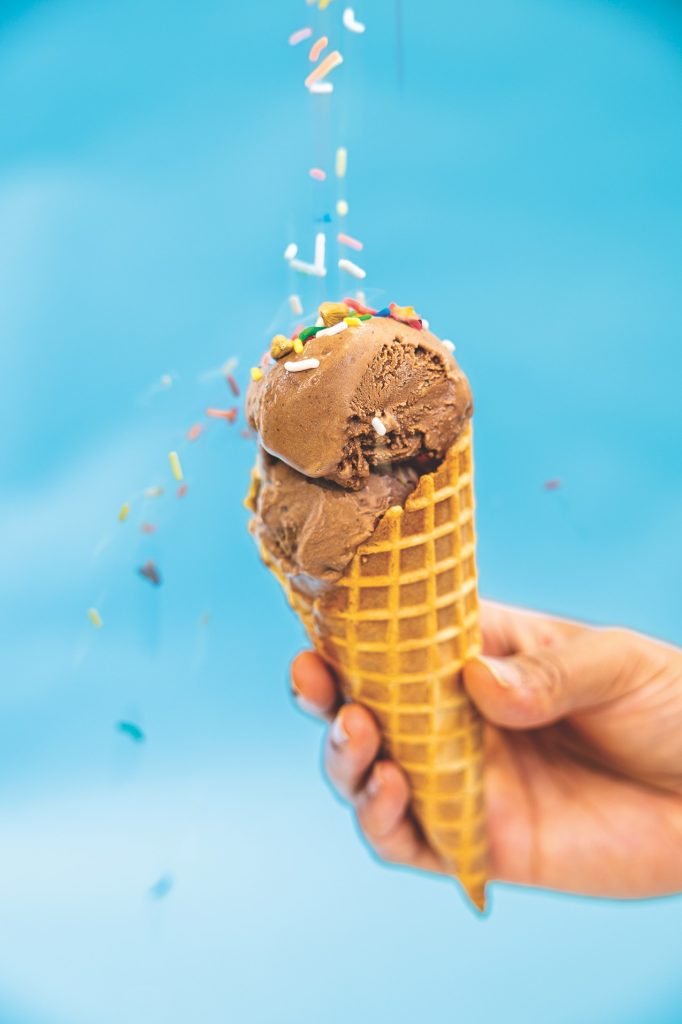
Her menu has grown, too, including a half-dozen collaborations with local brands. She’s added a variety of cream-based flavors as well as vegan options and says that every flavor has its own story. Z’s lemonade, a flavor her son requested on his fifth birthday, is popular among the kiddos.
Zucchini orange blossom resulted from the purchase of a giant zucchini. “It was really big, more than my whole family needs,” she says, and it was the last remaining piece of produce a young girl had under her People’s Market tent. With no idea of what to do with it — she just wanted that young vendor to have the satisfaction of a sold-out day — she bought it. Zucchini, which she says “doesn’t have much of a flavor,” is popular in Middle Eastern cuisine, as is orange blossom, which tickles the tongue with hints of honey and citrus. Shamsuddin blended a cream base with the two, plus, naturally, her signature cardamom.
And then there’s the time that she added dates to ice cream. Working on a batch of plantain ice cream, Shamsuddin knocked the last of her plantains onto the floor. In an attempt to save the rest of her ingredients, she grabbed some dates to use in their place. “Sometimes it’s accidental!” she quips.
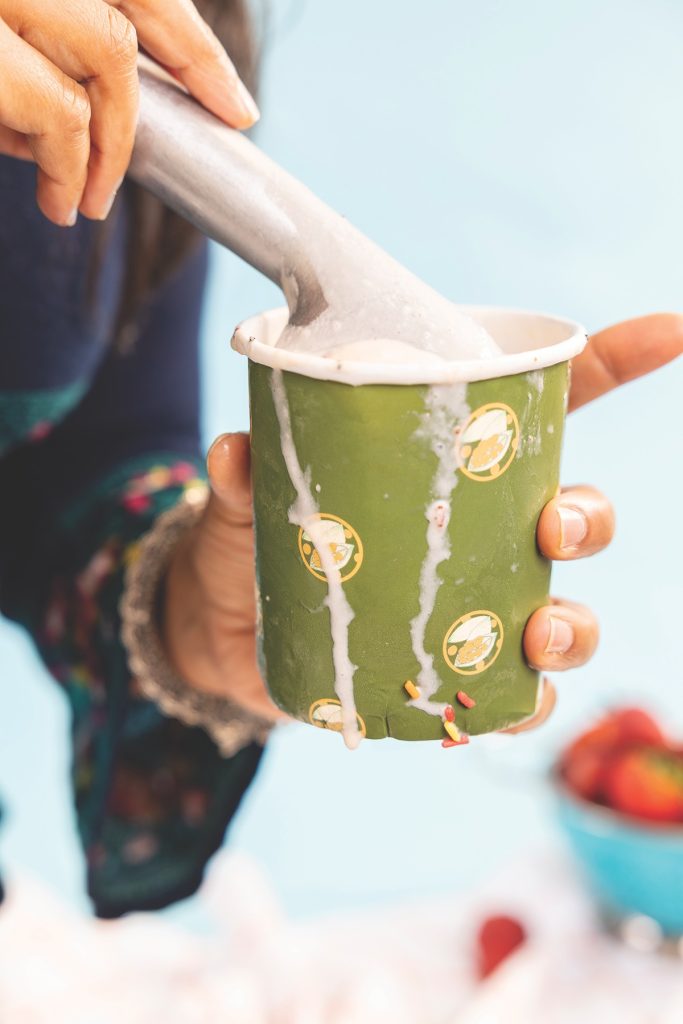
One day, Shamsuddin would like to see Elaka Treats stocked in national grocers’ freezers. In fact, her desserts are under review at Whole Foods currently and she feels hopeful. “It’s a global brand, that’s what the dream is.” And the cherry on top? That would be to see Elaka pods, self-serving freezers, in every cultural space.
“Initially, Elaka was about me. It was about telling my story,” says Shamsuddin. Over the past six years, it’s grown into something else. It’s about community, belonging “and how, through food, you can see how we’re all connected.”