
Long Gone Avalon

LONG GONE AVALON
Long Gone Avalon
A what-if of what once was
By David Claude Bailey
In 1977 while I was working at the Winston-Salem Journal as a cub reporter, Ola Maie Foushee sent a signed, self-published book to my dad: Avalon, a Pictorial and Sentimental Journey. The book joyfully heralded the happy, idyllic days of the now-abandoned mill town 2 miles from Mayodan. And there, on page 14 of the introduction, was my father: “Claude Bailey, a little boy next door, was my constant companion. We . . . made mud pies from dirt we mixed with water.” But sometimes there were no hand pumps or mud puddles to get water from, and my dad, Claude Colonelue Bailey, being a resourceful lad, had an idea. Ola Maie recalls, “When I needed water in a hurry, I considered him my most convenient source.” But not without consequences. “My father looked out the window just as Claude performed his favor,” she says, “And I was called home and given a good switching.” Ola Maie made no mention of my dad’s punishment, although, remembering my grandfather, Walter Fletcher Bailey, a no-nonsense, stern overseer at the cotton mill and a pillar in the Moravian Church, I suspect my father ate standing up for a few days.
The picture Ola Maie painted of Avalon, as she emphasizes in the title, is sentimental — to a fault. “Avalon was truly a fairyland,” she writes. “Spread over an apron-like bluff on 100.33 acres of rising land, it overlooked the winding Mayo River, the Norfolk and Western railroad, and the new cotton mill — its raison d’être.”
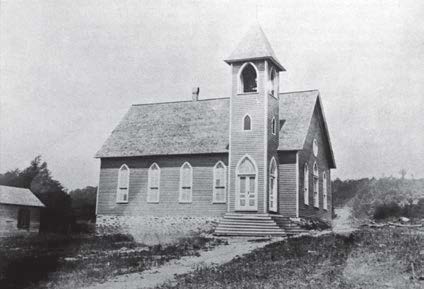
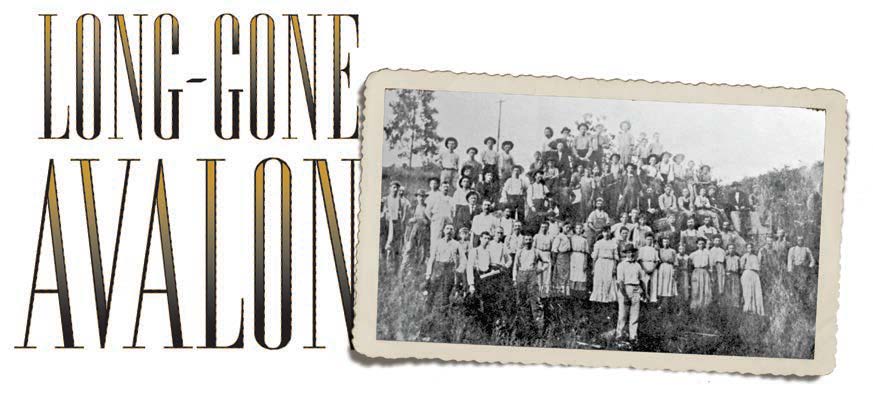
Ola Maie fondly remembers free-range children and chickens roaming up and down the streets among the 62 newly built houses, many of which had picket fences with roses and morning glories climbing them. She shares her memories of Easter egg hunts at the company-built Moravian Church, Sunday afternoons with the Avalon baseball team at play, summer picnics where watermelons cooled under the tables as cakes, pies and country ham biscuits spread out on tablecloths, boys swinging from grapevines into the river while couples courted along its banks. She tells of families cooking meals over the hearth in their company mill houses (provided at a rent significantly lower than in Mayodan or Madison), of out-of-towners coming to visit in the 11-room company hotel, of bowling and roller skating upstairs at the country store, and of town folk square dancing as old-time music echoed off the four-story-high cotton mill. At its peak, 400–500 people lived in the village.
I remember my family and relatives poring over Ola Maie’s book, finding a photo of dad looking like a young 5-year-old ruffian; another of my granddad grimly posing as a foreman on the factory floor with the workers he oversaw; and a picture of the Bailey house, where my dad was born, sitting proudly next to the hotel. Although my father’s fame as Avalon’s most infamous mud-pie maker was short-lived, it inevitably came up at Bailey family reunions.
Avalon Mills was incorporated in 1899 by tobacco tycoons R.J. Reynolds and B.N. Duke. Leading the charge was a relatively young upstart, Colonel Francis Fries, who, by the age of 45, had already helped establish the Roanoke & Southern Railway, of which he was the first president, as well as Mayo Mill in Mayodan. When Avalon Mills went into operation in 1900, it was not only a “modern,” state-of-the-art operation, but the largest textile mill in the state. By 1910, the mill employed 250 workers, a quarter of them under the age of 16 and some even younger than 12. To her credit, Ola Maie does not gloss over the issue of child labor in the mill, along with low wages, but I’ll get to that later.
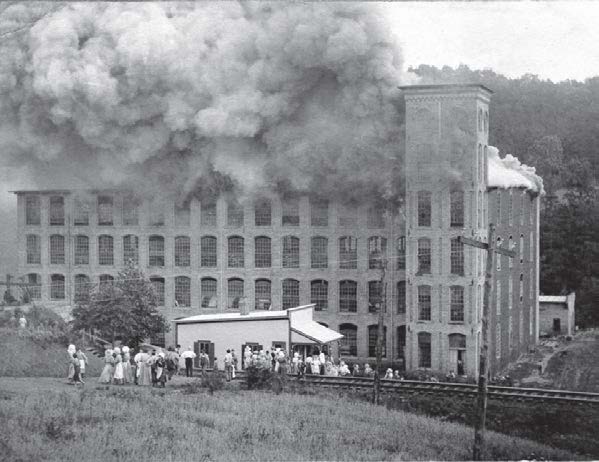
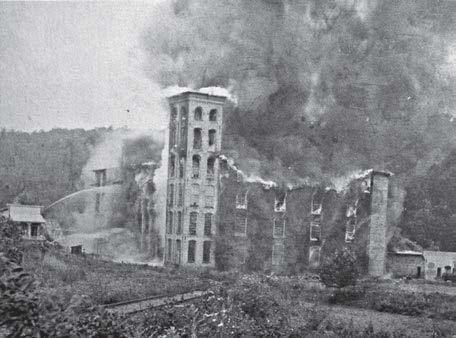
Spoiler alert. On June 15, 1911, 11 years after the mill opened, John Richardson was overseeing some spinning frames on the mill’s fourth floor. It’s worth pointing out that all the mill’s machinery was driven by leather belts that ran all the way down, floor-to-floor, to the mill’s river-driven turbine, so all the floors of the mill were open to one another. It was around 6 p.m., quitting time, when John smelled, and then saw, smoke. A bucket of water he threw on the fire proved to be too little, too late. Layers of machine oil, lint and dust covered almost every surface, and with the wind blowing through open windows, flames soon engulfed the fourth floor. In minutes, the flames spread to lower floors via the leather belt system. Although two teenage brothers ran down the stairs, screaming “FIRE” at the top of their lungs, workers heading for supper and home decided it was a prank. By dusk, all that remained of the mill was a ghostly shell, with a hulking six-story tower looming over the ruins. Miraculously, no one died, although several of the mill’s overseers had to be rescued via fire ladder. A state-of-the-art sprinkling system never activated because a bearing in the 1,000-gallon-a-minute pump failed.
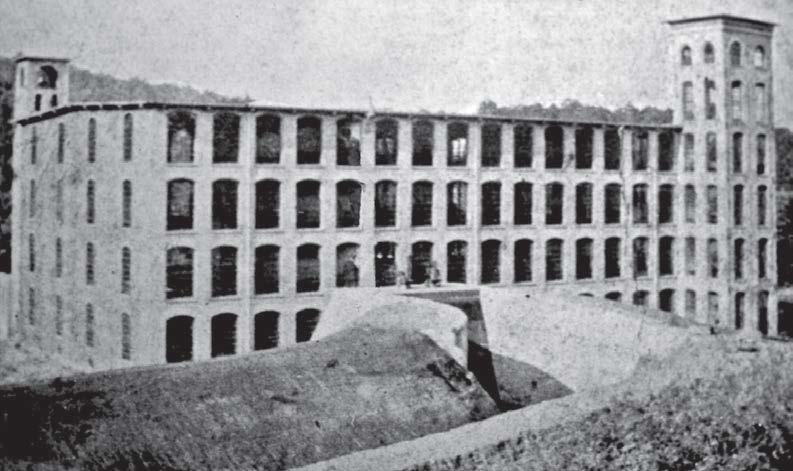
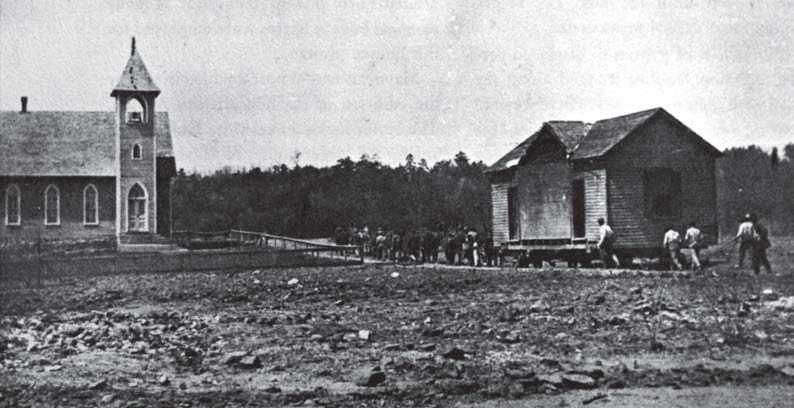
Initially, the mill’s owners talked about rebuilding, but, in the end, families lost both their jobs and their homes. The houses they had once rented were rolled atop logs by horses and mules to Mayodan, where some still stand, including the house my dad was born in. Even the church was disassembled and sold off piece by piece.
“Like bands of gypsies or displaced persons, Avalon families trudged along the road with their possessions,” Ola Maie laments. “None of us wanted to go. We were like one big family.” Many of the workers took jobs at other mills operated by Fries or found work in the plethora of mills that had sprung up along the Piedmont’s rivers. Inexplicably, my grandfather decided to go back to farming tobacco. Why, I’ve always wondered, did Walter Fletcher Bailey, in the prime of life at age 35 with five children, choose to go back to the unpredictable and back-breaking occupation of dirt farming? A foreman in the mill before it burned down and a chairman of the board of the Moravian Church, surely he would have been offered a job. My aunts and uncles had no clue.
I think maybe I do.
As someone who covered business working for O.Henry’s sister pub, Business North Carolina, I have, by choice and occupation, become something of a student of what mill life was like in the South. An excellent website, Avalon: Documenting the Rise and Fall of a Cotton Mill Village, provided me with a keener insight into the town and mill. But my eyes were really opened when I read Like a Family: The Making of a Southern Cotton Mill World, UNC Press’ landmark compilation of oral histories gathered from mill workers all across the state. BNC’s publisher at the time, David Kinney, whose mom worked in a mill, required every new hire to read the book. While many remembered a community that was, in fact, like a family, it was definitely a dysfunctional family, with an often overbearing and often heartless “father.” While former workers, like Ola Maie, waxed nostalgic about church and baseball teams and close-knit neighborhoods and picnics, mill workers interviewed for Like a Family were quick to paint a picture of life in the mill as harsh, dangerous and monotonous.
The hours at Avalon were from 6 a.m. in the morning until 6 at night, five days a week, plus nine more hours on Saturday. Lint and dust filled the air, and the atmosphere inside the mill was often almost unbearably hot and humid. The pace of work was unrelenting and overtime was common. Pay at Avalon reflected what was generally paid statewide in 1911. It ranged from $1 a day to $2.50 a day for the highest paid workers ($37–93 in today’s money). Workers who showed up minutes late could be docked from a quarter day’s work up to a full day. Children, who made up a quarter of the workforce at Avalon, were often tasked, because of their size, to crawl atop the machines or into their inner working to fix snags and snafus. They were paid $.20–.30 cents a day ($7.31–11.27). Unskilled women were paid the second-lowest wages, $.30–.75 ($11.27–28.18). So wages ranged from about $44 for a six-day week to $558 a week for the highest paid employees.
Admittedly, housing was provided at a very reasonable rate, but if you lost your job, you lost your home, encouraging workers to go with the flow. Injuries, like losing a finger, hand or arm, often meant both unemployment and homelessness. The houses, though newly built, were 600 square feet, with some accommodating four families. Plumbing was outdoors, of course, and the houses didn’t have electricity, though the mill did. Cooking happened over hearths, with no cook stoves.
Of course, life on a farm in that era was, arguably, even more grueling — harsh, dangerous and unpredictable. Crops failed and prices went unpredictably up and down. The hours were just as long as, if not longer than, in the mill, and you worked outdoors in the blazing summer sun or freezing winter weather, unlike mill work. And anyone who’s ever worked on a farm will tell you that child-labor laws don’t extend to farm families.
My father and my aunts and uncles painted a sometimes grim picture of life on the farm, but they also had warm and loving memories of rural living. I found it interesting that none of the five boys turned to mill work, with all of them distinguishing themselves by following other successful careers. My granddad was his own boss and with, eventually (God bless my grandmother), nine children, he had a captive workforce. He didn’t get rich, but made a good living and, from my memory, they sure ate well, with country ham, fried chicken and biscuits aplenty.
Over the years and little by little, I came to appreciate why — I imagine — my grandfather decided to go back to farming.
If my father had worked in the Avalon mill as a child, I’m certain he would have told me, along with the many stories he spun about the mischief he and his brothers got up to on the farm, all about mill work. And maybe the course of history, in Avalon at least, might have been altered if he had. What if, on that fateful day, he had worked on the fourth floor and had been standing by with his “most convenient source” of water?