
Profiles in Courage

PROFILES IN COURAGE
Profiles in Courage
Lucky for us — these women enjoy running into burning buildings for a living
By Ross Howell Jr. • Photographs By Mark Wagoner
When women first joined the Greensboro Fire Department as firefighters in 1978, they often were met with doubt and resistance.
But, through generations of service, female firefighters have shown that they have the mettle to take on the physical and mental challenges of firefighting — and to excel.
In Greensboro today, there are 34 women who are full-time firefighters. I had the opportunity to speak with a few of them.
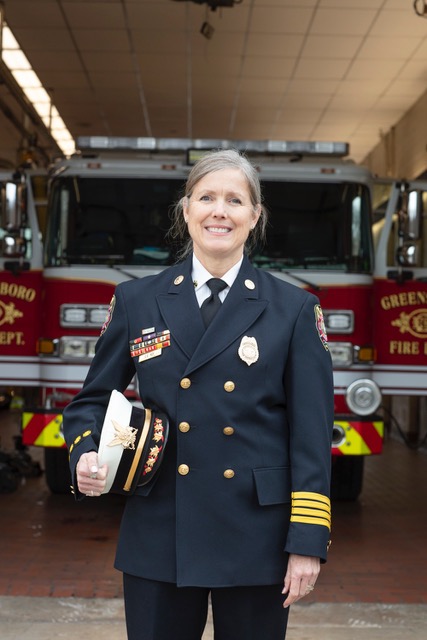
Carol Key
Deputy Chief Carol Key invites me into her corner office in the GFD administrative suite of Fire Station 1 on North Church Street.
I can’t say precisely what I expected her background to be, but it certainly wasn’t art! Key studied at the Savannah College of Art and Design and holds a bachelor’s degree from the N.C. State School of Design.
She and her husband, Kevin, are the only married couple to go through the grueling, six-month recruit training program at the same time. Her husband now serves as captain in the GFD critical resources branch.
“We’d been married for one month and four days when our class started,” Key says. Everything about the program is intense. An individual recruit is allowed to fail two exams. If they fail a third, they’re out.
“Kevin and I spent the first six months of our marriage together — seven days a week, 24 hours a day,” she continues.
She pauses.
“About halfway through training,” Key says, “we got into a knockdown, drag-out fight in front of everybody.”
“And we’d tried to be so professional,” she continues. “We wouldn’t even kiss in public.”
“But after the argument,” Key adds, “we both acknowledged we needed a little space now and then, and we were OK.”
And they’re still OK — happily married, with two daughters studying at UNC-Chapel Hill.
I ask her how she and Kevin managed raising young children on 24-hour shift schedules.
“We had to make a decision about that,” she says. The one-day-on, two-days-off schedule results in three separate firefighter shifts — “A,” “B” and “C” — so that a full complement of firefighters covers the entire city 24/7, 365 days a year.
“We decided that I would work ‘A’ shift and Kevin would work ‘B,’” Key continues. So each parent had the kids home to themselves on “A” and “B” shifts, and on “C,” the whole family was together.
“The kids loved it!” Key laughs.
Since “C” shift was their “together time,” she and Kevin resolved to do things as a couple.
“We’d go on lunch dates, we’d go see a movie during the day, whatever we could do to enjoy each other’s company,” she says.
“That was nice,” Key adds.
“This is the first time I’ve been 8 a.m.–5 p.m. since I was in training back in 2008,” she says.
Through all the years, Key has kept her hand in graphic design and art. She has her own freelance graphic-design business, has painted expansive murals in the education wing of West Market Street United Methodist Church and consulted on the website design for the Greensboro Firefighter Historical Society, where she serves as president.
“Firefighting is such a gritty profession,” Key says. “It’s not for everybody. But I love it.”

Yakima Fox
Yakima Fox has been a Greensboro firefighter for 18 years. She serves at Fire Station 59, West Vandalia Road. Born in Salina, Kan., Fox moved here when she was 3 years old.
Firefighter is just one of the roles she plays. Fox also performs in community theater and even has a talent agent, though she doesn’t devote the amount of time to acting that she used to.
Her brother was the reason she considered trying out for the Fire Department.
“He was a GFD firefighter,” Fox says, “and he just kept bugging me and bugging me. ‘They need women,’ he said. ‘You should try out.’”
At the time, Fox was a student, studying biology at N.C. A&T.
“I wanted to do something in the medical field,” she explains.
While Fox’s brother was pestering her, an aunt’s comment made her absolutely determined to apply. When the aunt heard Fox was thinking about trying out to be a firefighter, she said, “Well, I don’t think you can do it.”
Fox looks me straight in the eye.
“I’m the kind of person,” Fox says, “you tell me that I can’t do something, I’m going to do it just to prove you wrong.” Fox also thought, pragmatically, that a Fire Department salary would surely be a big help paying tuition.
She was accepted. Then came training.
“It was a whole realm I didn’t know, it was all foreign,” Fox says. “It was a challenge in so many ways — mentally, emotionally, physically.”
“I’m 5 feet, 2 inches tall,” she continues. “I couldn’t even reach certain things!”
But Fox adapted, finding her own ways to meet the recruitment trainers’ strict standards.
Fox tells me one of the most difficult training tasks was putting out her first car fire.
She had to work alone, wearing full turnout gear, breathing oxygen from her self-contained breathing apparatus (SCBA). Her suit felt like it was closing in on her. The SCBA air she was breathing was getting warmer and warmer from the heat of the flames.
The fire was producing a lot of smoke, so much that it was difficult for her to see. The pressure of the hose was pushing her back as she moved toward the fire.
“It was a workout that I hadn’t ever experienced,” Fox says. “I was using muscles I’d definitely never used before. And I was thinking, Man, this was just a car fire.”
“That’s the mental part of it,” she continues. “You say to yourself, ‘I’m going to be OK.’”
“So you take a moment,” Fox says, “and you go in there and do what you need to do.”
That moment cemented her confidence.
“From then on,” she concludes, “I enjoyed it.”
Fox believes her 15-year-old son has mixed emotions about her profession.
“He’s quiet, he’s a teenager, he doesn’t say much,” she says. “Sometimes I think he worries about my safety a little bit.”
She tells me her son is a good actor — “better than me,” she exclaims — and has performed in community theater with her.
Fox also hopes her son will participate in the Greensboro Fire Department Explorers program, where young people meet with firefighters for an inside view.
“I want him to understand what my job is,” she says. “I want him to understand the challenges and the benefits.”
“I want him to see how you can help somebody,” Fox says.
“That’s why I like this work so much,” she continues. “I’m helping people who really need it. When somebody sees me, they are not having a good day — maybe they’re even having a tragic day. And I’m able to make their day just a little bit better.”
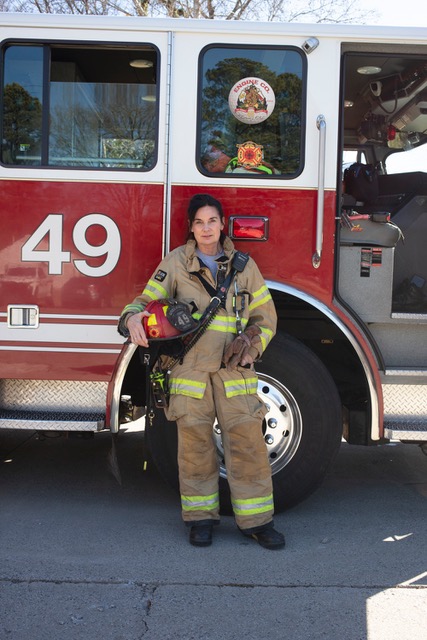
Wendy Cheek
As I enter the Fire Station 49 office on West Friendly Avenue with Captain Wendy Cheek, one of the firefighters nods his head in her direction as we pass.
“You’re talking to a legend,” he says.
A few days after our conversation, Cheek is due to retire from the GFD after 30 years — 20 years as a captain, riding an engine. And she stays plenty busy outside the station, too.
An advocate for healthy eating and fitness since losing her mother to cancer, Cheek took up massage therapy 24 years ago and has a loyal list of clients. She started her practice as a backup, in case she was injured as a firefighter and couldn’t continue the work.
And she has a small farm near Madison where she keeps chickens, raises hay as a crop and maintains a truffle orchard.
“After I retire, I’ll get some goats,” Cheek laughs. “The little ones. And a dog.”
But what drives her now, what fills her with pride and emotion, is her work in the Fire Department.
Cheek grew up in the N.C. mountains among the foothills near Elkin and Jonesville, and moved to Greensboro in 1989, “following a boy,” she says, shaking her head.
The boy thing didn’t work out, but she stayed on, working at a downtown deli and studying law enforcement and computer programming at GTCC.
“I was thinking I might go into the FBI,” she says, “until I learned they could place their agents anywhere in the United States.”
“I really wasn’t sure I wanted to move away from family,” Cheek adds. Looking for a challenge both physically and mentally, she called the GFD to see if they hired women.
At the time she was accepted for training in 1995, there were only four women in the department, as she recalls, and no others had been hired for years.
An avid hiker then and now — Cheek celebrated her 50th birthday by hiking the Grand Canyon rim-to-rim — she was also a competitive bodybuilder. Still, she remembers fire training school as one of the most difficult challenges she’s ever taken on.
And during her career, she’s done her best to guarantee every crew member riding a call, siren blaring and lights flashing, is trained, fit and prepared to give their very best.
“When I ride the truck,” Cheek says, “I ride in the back a lot.” Typically, the captain leads the crew from the front seat, next to the driver. From that position the captain receives computer information on the status of the emergency. Less experienced crew ride in the back seats.
By riding caboose, the captain makes it possible for junior crew to get valuable experience.
“I want them to know what I know — or more than what I know,” she explains, “because if I’m the weakest link on the truck, then I know we’ll be OK.”
Cheek is very direct in communicating what she expects of her crew’s interaction with the public.
“I always tell the guys, ‘You treat every person like they’re your grandparents,’” she says. “It doesn’t matter if it’s a stubbed toe or a heart attack, we’re going to treat them with kindness and respect.”
How does she hope her firefighters will remember her?
“Well, I don’t see myself as any kind of legend,” she says. “It’s not like I’ve been doing anything out of the ordinary.”
“I want them to remember that I always took care of them, that I stood up for them,” Cheek adds. “I want them to remember I gave them 100% until the day I walked out this door.”

Jurica Isangedighi
In January, Jurica Isangedighi marked her 10th year with the GFD.
She grew up in Chapel Hill, was a standout point guard for the women’s basketball team at Chapel Hill High School and attended High Point University on a full basketball scholarship. When she graduated in 2011, Isangedighi wanted to become a college coach. To get experience, she returned to her old high school as an assistant to her former coach. For the next two years, they led their teams to the women’s state basketball championship finals.
Isangedighi moved to the collegiate ranks the following year, coaching at Mount Olive College, now the University of Mount Olive.
It was then that a former teammate who was applying for a Fire Department position, encouraged Isangedighi to try as well.
“After attending High Point, I loved this area, and I always wanted to come back,” Isangedighi says.
But she’s thorough. She applied not only to the Greensboro Fire Department, but also to the Winston-Salem and Raleigh departments.
The Greensboro department offers candidates the additional benefit of practice dates.
“You can go through the course and get your hands on the equipment,” Isangedighi says. For women, she believes, that’s essential experience.
“We’re not as strong as men, so we have to rely more on technique,” she continues. And instructors showed candidates the proper way to do things.
So when it came down to passing the tests required to qualify, Isangedighi says, “It wasn’t so bad. Still, it’s very, very demanding — physically and mentally.”
In the relatively short time since her hiring as a GFD firefighter, Isangedighi has earned the coveted title of “engineer.” That’s “driver” to you and me.
Think about it. She’s piloting — on city streets — a behemoth machine that weighs more than 20 tons, measures some 10 feet wide and 40 feet long, and is powered by a 500-horsepower diesel engine. Ladder trucks, which Isangedighi is also qualified to drive, are even bigger.
But she can go you one better.
Isangedighi’s Fire Station 21 on Horsepen Creek Road is a three-bay GFD facility with both fire and ladder trucks. It’s also part of the state regional response hazardous materials team.
“The hazmat truck is actually a tractor trailer,” Isangedighi says. “And I recently got my Class-A license, so I can drive it.” She smiles broadly.
“I love driving the trucks,” Isangedighi continues. “I have a really great crew. I have a captain who knows a lot about trucks and engines, so he’s teaching me.”
She explains that the trucks can be quirky and the engineers check them every day, lifting the cab to inspect the engine, testing the pump to ensure it’s working properly, checking all the tools on board.
“Every single day, every engineer does that,” she says. “Then, once a year, we’ll take them into the garage for service. These trucks constantly have eyes on them.”
And on her days off?
“Oh, I’m back home with my two kids and my wife, hanging out,” Isangedighi says. “Our son is 4 and our daughter is 1.”
She tells me her son likes to Facetime with her when she’s on the truck, and sometimes the whole family will stop by the station.
“He’ll get on the truck,” Isangedighi says. “He thoroughly enjoys it.”
“But the little one,” she laughs, “has no idea. She’s too young.”
Isangedighi intends to remain with the department for her whole career.
“I think the Fire Department is a great transition for athletes,” she says.
“You’re part of a team, you’ve got a goal to accomplish, you train and you get to help people in the community,” Isangedighi concludes. “That’s a good thing.”