Sazerac December 2025

SAZERAC

December 2025

Making a Mark

After graduating from Savannah College of Art and Design May 31, 2015, Blythe Leonard turned down an offer to work with Ralph Lauren, despite her background in fashion. Instead, she made a beeline back home to Thomasville.

By June, she had created her own brand of handcrafted leather goods and opened shop April 1, 2016. “I placed an order for my sewing machine before I even graduated.” 

The other part of her plan was to support other “makers.”

“I wanted to uplift locals. I have a service heart; I’m always hoping to help people up.” Blythe smiles. “It is Hallmark-y.”

Today, Blythe Leonard Leather at 606 Davidson St. features her hand-crafted goods. Miranda Kerr and the late Diane Keaton are among celebrities who have owned her handbags.

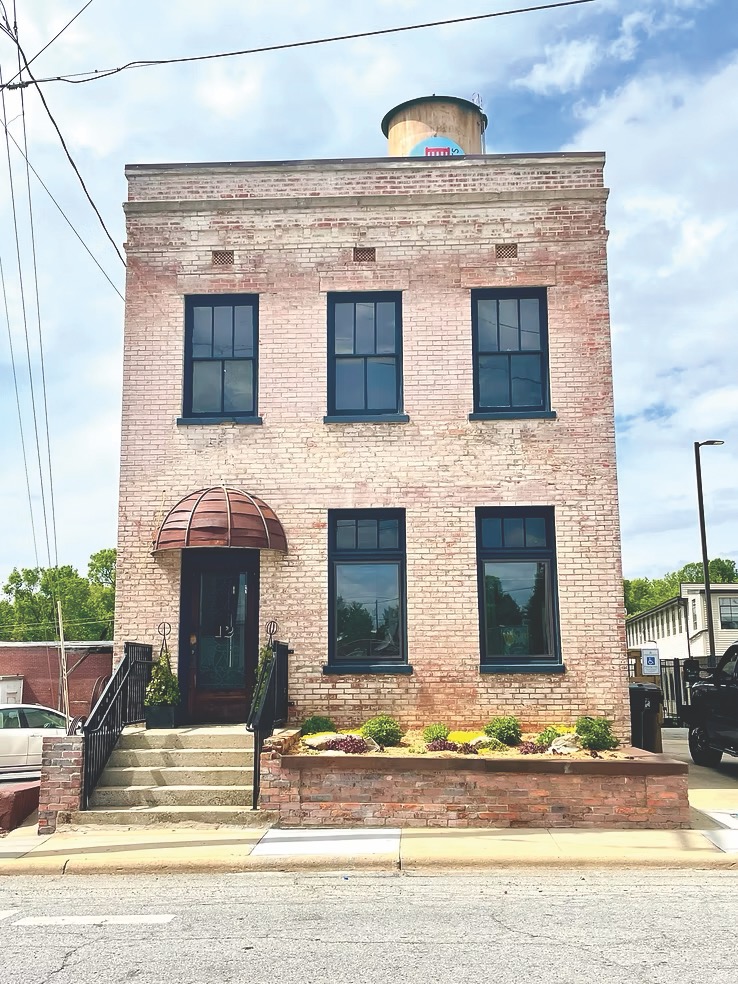
Her second location, 12 East Guilford St., was once headquarters for Lambeth Furniture Company, precursor to giant Thomasville Furniture.

She bought the 1898 building on October 1, 2020. 

With support from entrepreneurial parents Jane and Mark Leonard, third-generation owners of Hill Spinning Mill in Thomasville,

and a slew of paid and volunteer labor, a spiffy remodel resulted in the perfect showcase for one-of-a-kind items. Leonard transformed the down-on-its-luck building during the pandemic, stocking two stories with the work of 100 artists.

Maker’s Market opened on May 29, 2021.

Now, nearly 350 “makers” produce wares sold in artful displays: handmade jewelry, pottery, gardening tools, specialty food items and artwork — all using American materials. “If they make candles, even the glass they pour the candles into has to be made in the U.S.,” says Blythe.  Her woodworker brother, Nick, creates cutting boards and 16 other woodworkers sell everything from spoons to ornaments. 

Blythe considers the quality, pricing and work of friendly makers. “I won’t work for or with anybody that’s rude,” she insists.

Come the holidays, Blythe casts a wider net for those who cannot make the trek to historic Thomasville. 

“We are always looking for avenues to bring customers to our makers so that they are successful. So, we reached out to Piedmont Crossing [a Thomasville retirement community] to see if we could set up a tour bus to come visit the store.” 

On-site pop-up shops have grown popular.

Maker’s Market recently co-hosted a pop-up at Pennybyrn, extending invitations to other retirement communities.   

Blythe says the residents appreciated the opportunity to shop where they live since many use walkers, canes or wheelchairs.

Meanwhile, Blythe’s writing about how she got here. Her working title, “A Whole Lot of Faith and a Whole Lot of Crazy,” looks back on the exciting past decade. 

“I tell people I must be crazy to have opened a second business during COVID.” — Cynthia Adams

Unsolicited Advice

In 2021, PBS declared, “The misunderstood fruitcake has a magnificent shelf life — and history.” In fact, it dates back to ancient times. Perhaps the one your neighbor brought you last Christmas was, in fact, a relic of the past. Antiquated or not, we’ve got some alternative uses for that unwanted fruitcake your family is likely to forgo in favor of snowman-shaped sugar cookies.

Small and dense, it’s practically a brick, making it a perfectly weighty doorstop — though we don’t endorse building your home from fruitcake. Great for holding the door while you hustle through with present-laden arms, we recommend changing it out before spring and the onset of ants, though we cannot confirm that they’ll even eat it.

Sliced, you can take out some of that holiday angst on the ice with a family-friendly game of fruitcake hockey. 

Need a moment of om? Maybe a little hip release? Stretch yourself into the pigeon, a yoga pose that opens up those flexors and glutes, and rest your forehead on the next best thing to a yoga block — Aunt Helen’s fruitcake.

When all else fails, listen to the advice of your old buddy, Sam-I-Am. Don’t be a fruitcake Grinch. Try it! Try it! And you may . . . actually like it. Especially after a festive meal of Green Eggs and Ham.

Just One Thing

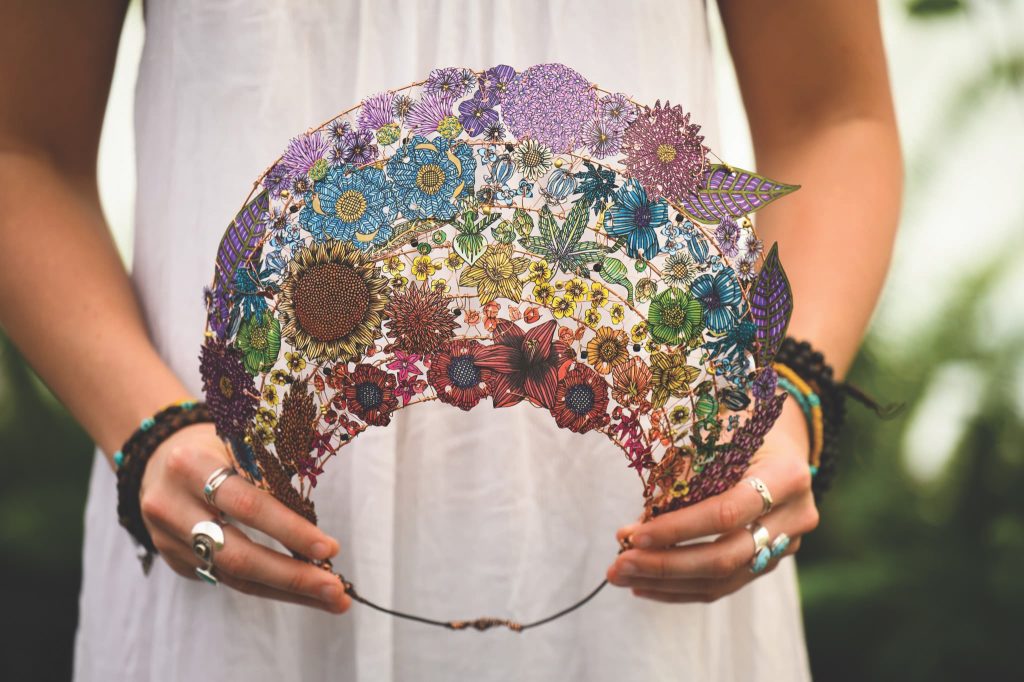
Every year, Greensboro’s GreenHill Center for NC Art gathers the works of over 70 artists state-wide in one glorious, two-month-long exhibit. Winter Show, now in its 46th season, has become a Gate City staple for both art connoisseurs and those who believe in supporting local artists. No matter where you land, you’ll find something unique that grabs your attention — perhaps one of Asheville creator Heather Divoky’s crowns. Divoky, who describes herself as “an artist, designer, and sometimes-poet,” utilizes marker and ink on paper, copper wire, and beads to fabricate these one-of-a-kind fashion statements. Divoky draws “in all sorts of fantastical, deeply detailed ways” to create vibrant, fanciful crowns, allowing you to wear her wildest whimsies — everything from moths and possums to celestial bodies and flora. Pictured here is Pride I, a royal rainbow of blooms. While we’re told this specific crown won’t be at Winter Show, we do know that ones similar will be on display in all their crowning glory. Want a head start? Don’t miss Winter Show’s First Choice event from 5:30–7:30 p.m., Thursday, Dec. 4, or Collector’s Choice from 7–10 p.m., Saturday, Dec. 6. The Public Opening follows from 1–3 p.m., Sunday, Dec. 7. Info: greenhillnc.org/winter-show-2025

Carol W. Martin collection at the History Museum

Window on the Past

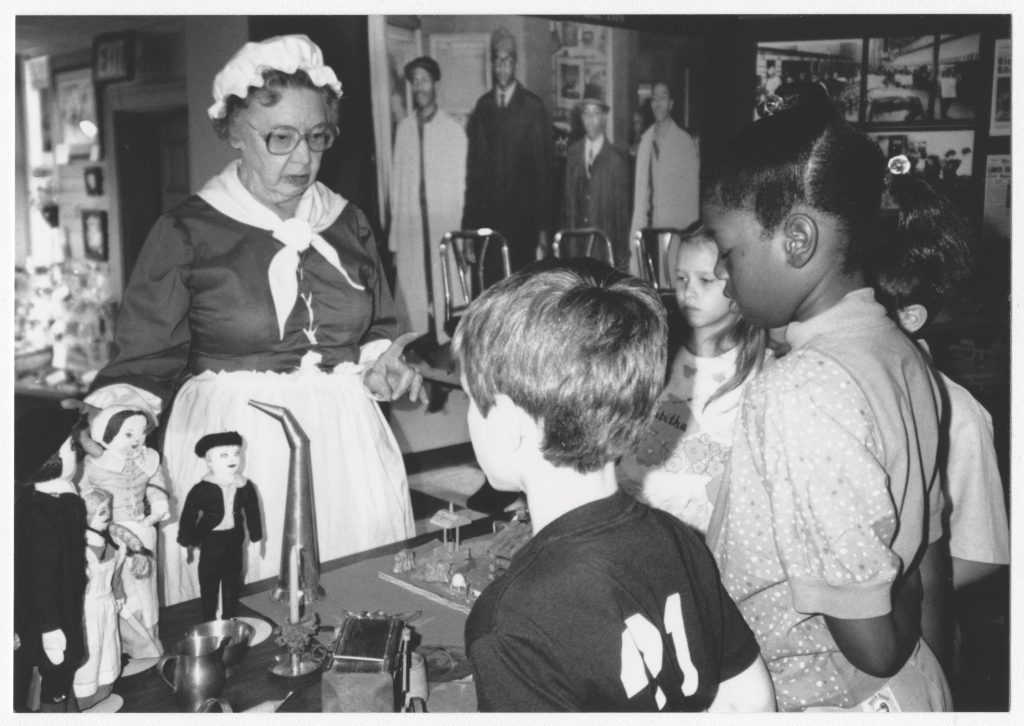
Many of the traditions we have in Greensboro have stayed the same, including holiday storytelling. Pictured is Elizabeth Holder, a volunteer at the Greensboro History Museum during the 1990s, using miniature figurines to relay the Moravian settlers’ history to Global Studies Magnet School students. Some things never change — like the snap of the perfect Moravian cookie.

Sazerac November 2025

SAZERAC

November 2025

Just One Thing

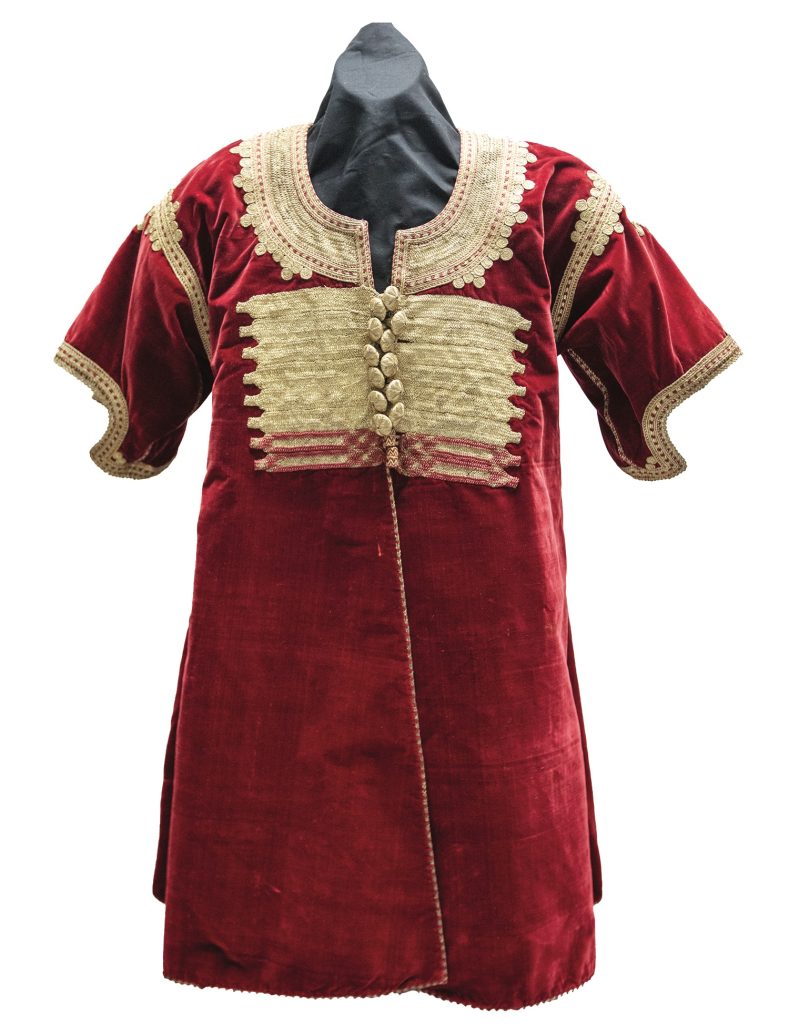
There’s nothing like a history museum celebrating, well, its own long history. On November 11, the Greensboro History Museum unveils an exhibit honoring its centennial: GHM100: Treasures. Legacies. Remix. Featured, you’ll find rarely seen museum goodies, including what Curator of Collections Ayla Amon says is her personal favorite in the collection, a Tunisian kaftan that was given to Dolley Madison in 1805 by Sidi Soliman Mellimelli. It is said that Mellimelli wrapped the Tunisian garment — made of red velvet, lined with green silk damask and decorated with gilt silver thread — around Dolley as a gift intended to bring childbearing fortune to her and husband James Madison, who was then serving as U.S. Secretary of State. Fabricated from heavy, luxury materials, it’s not just a cloak, but a work of art that Amon says is a must-see in person. Notably, Mellimelli was the first Muslim envoy to come to the United States. He came, hoping to avert a war between Tunis and the U.S., who had violated a treaty by capturing Tunisian vessels. At the conclusion of his visit, he sent a letter to James Madison. The letter concludes, “With heartfelt regret I shall leave this Country while our affairs wear so inauspicious a complexion . . .” Behold the kaftan along with 100 years of archival treasures at the Greensboro History Museum. Info: greensborohistory.org/exhibition/ghm100-treasures-legacies-remix
Window on the Past

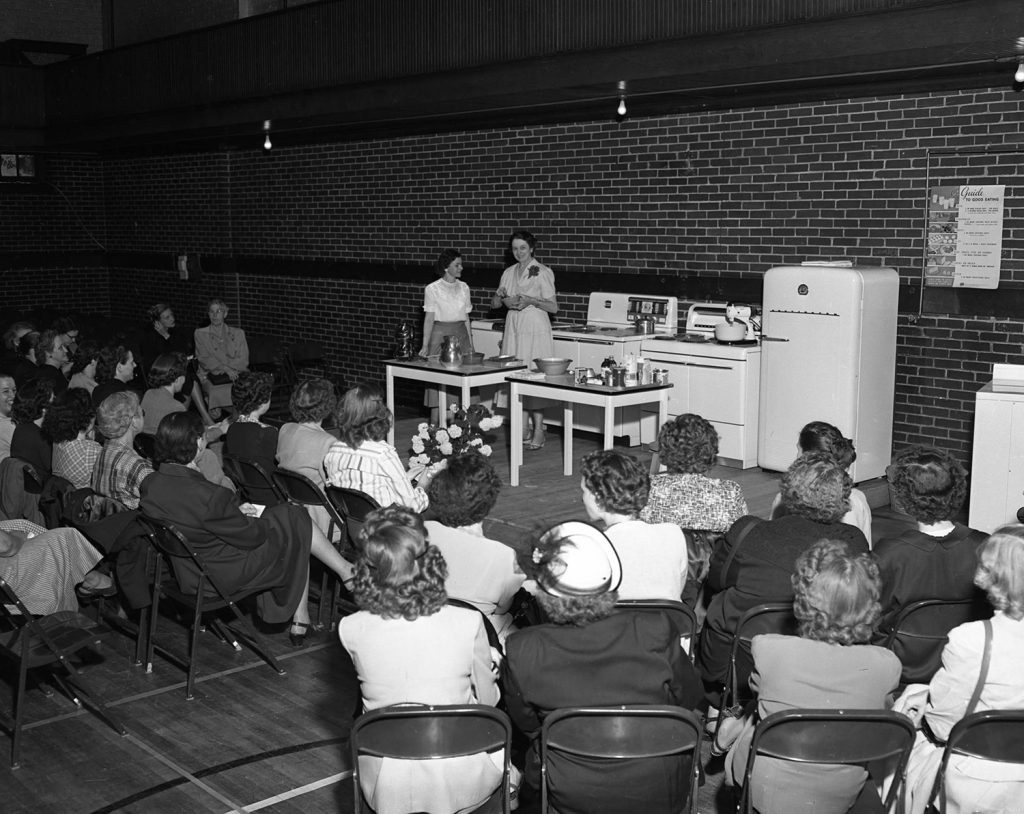
At a 1950s Cone Mills Cooking School demo, we aren’t sure what’s being said, but we imagine it’s along the lines of what came out of Lessons in Chemistry’s Elizabeth Zott: “Children, set the table. Your mother needs a moment.” As Thanksgiving chaos rolls around, we gently remind you to take a moment for yourself, too.

Sage Gardener

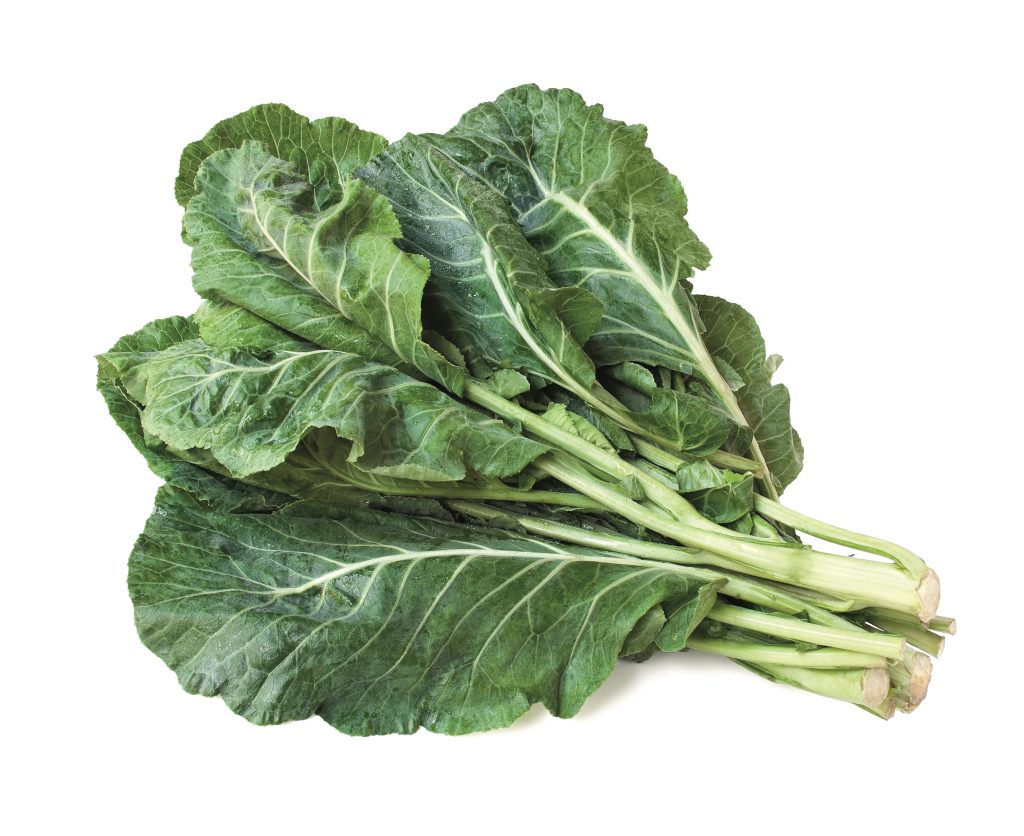
Why wait until New Years Day to serve collard greens? If, after reading this, collards don’t make an appearance at your Thanksgiving or Christmas feast, you’re not paying attention.

Collard greens are bristling with vitamins A, C, K and B-6, plus iron, magnesium, folate, potassium — and lots of silica in the form of sand — that is, if you don’t rinse them twice. My rule of green thumb: Rinse thrice just to be nice.

Speaking of the rinse cycle, let’s talk about cleaning your colon with fiber, which reduces inflammation and balances blood sugar. The Cool Kids comedian David Alan Grier observes that collards “get outta you faster than they get in you.”

Before they began making their appearance served upon crisp linen table cloths in tiny boîtes, collards were seen as poor folks’ food, with recipes for cooking them imported by enslaved people along with, unwillingly, themselves. They thrive in nutrient-poor soil and adverse conditions, making them ideal for hard times.

Lutein. Zeaxanthin. Don’t worry about pronouncing them. You’ll soon see that these sulfur-rich compounds (along with our old friend vitamin K) guard against age-related eye diseases. 

And go ahead and savor that second glass of wine. The sulfur-rich compounds in collards clean out your liver.

Kamala Harris confessed that her collard green recipe is so popular she uses her bathtub to wash her big mess of collards around the holidays.

If you have a slab of fatback and fry it up, and also have some leftover cornbread from your Thanksgiving Day feast, you have all the makings for a collard-green sammie as featured in Bon Appétit. May we recommend the addition of some Texas Pete.

If people are worried about eating the official state vegetable of South Carolina (where more collards are grown than anywhere else), just tell them they’re eating Brassica oleracea.  

Grey Poupon

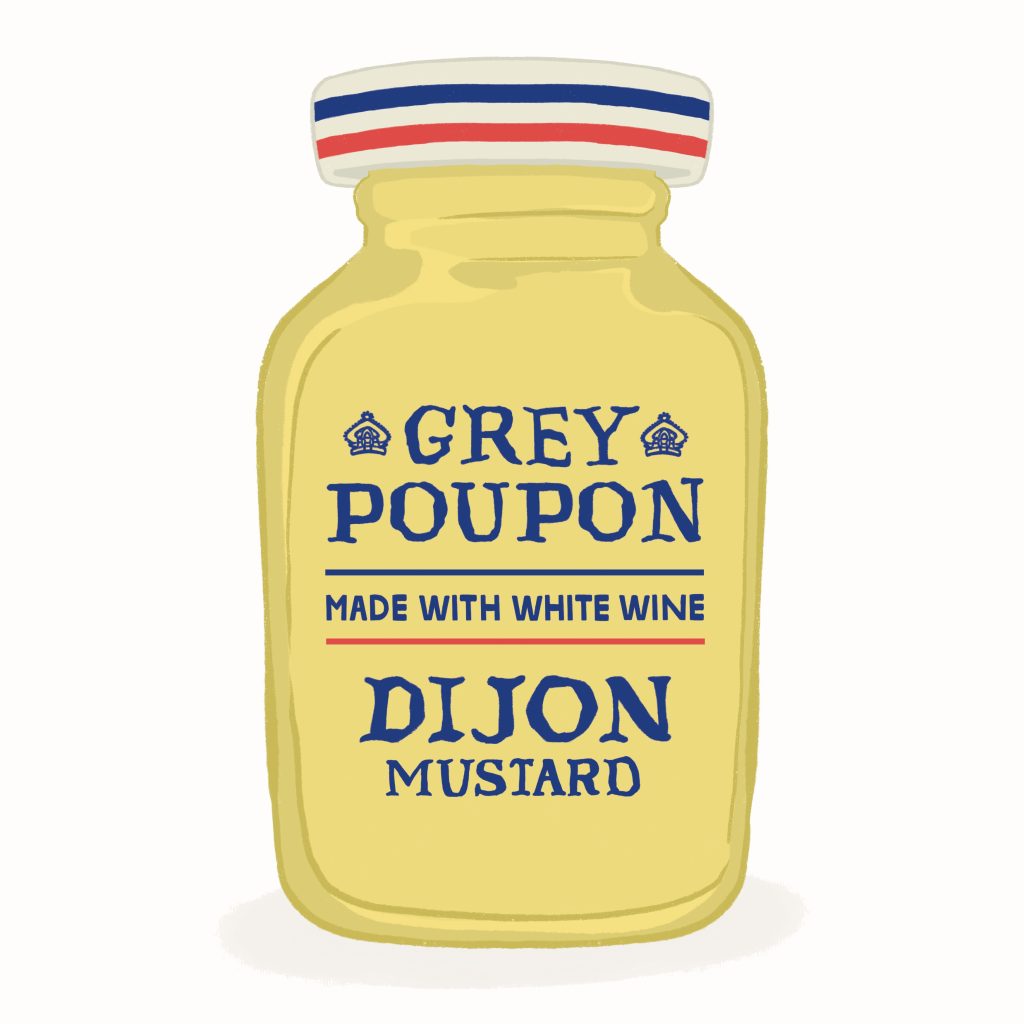
One day, when I was 7, the jar of Grey Poupon appeared in our refrigerator, heavy and rare as an apple in our steak-and-potatoes house.

After Dad’s shift at the print shop, I asked him about this new jar of mustard. He turned to me, setting down his Busch Light, shook his head, and said, “Your mother is trying to be all fancy.”

“Have you tried it?” I asked.
“It’s just mustard,” he said.

The next morning, I peeked around the corner as my father made his daily ham and cheese. After dipping the butter knife into the Grey Poupon, he brought it to his tongue, nodded as if satisfied, then slathered a generous helping on his sandwich.

When I stepped into the kitchen, he jumped, as if I’d caught him in some dirty act.

Unsolicited Advice

November is about giving more than just thanks for your many blessings — it’s about giving back. These days, donating money to a near-and-dear cause is just a simple QR code away, but it’s not always that easy when your budget is tighter than your post-pecan-pie pants (never mind that thin slice of pumpkin pie you also ate — it barely counts). True, November might be hard on your waistline, but we’re gonna make it easier on your bottom line with things you can give other than Benjamins.

Stuff. Local organizations are often in need of gently used clothing, toys, furnishings and decor. Closet more stuffed than your vegan cousin Nina’s tofurkey? Clean it out while doing some good in the world. Somewhere, Marie Kondo is sitting at her Thanksgiving table, full of gratitude for the millions of us who are sparking some joy in the world — and her wallet.

Skills. Got a special talent that could be of service? Maybe you’re a website designer who can level up your fav nonprofit’s site. Service with a smile — and style. As MLK Jr. once said, “Life’s persistent and most urgent question is, ‘What are you doing for others?’” Don’t be caught without an answer.

Energy. Instead of giving 5K, register to run a 5K for a cause. Maybe this is the year your family turns into the one we all love to hate. You know ‘em — they show up to the Turkey Trot in matching costumes that should make it hard to jog, but they still finish in the lead, having barely broken a sweat.

Time. Carve out a little of your most precious commodity to spend it volunteering in a soup kitchen or playing with shelter pups. Bonus if you bring home Fido and give him a home for the holidays and fur-ever after. And since we’re talking about time here, maybe he could even be your loyal watch-dog.  

Up. After that last joke, this is what we’re giving.

Merry Makers

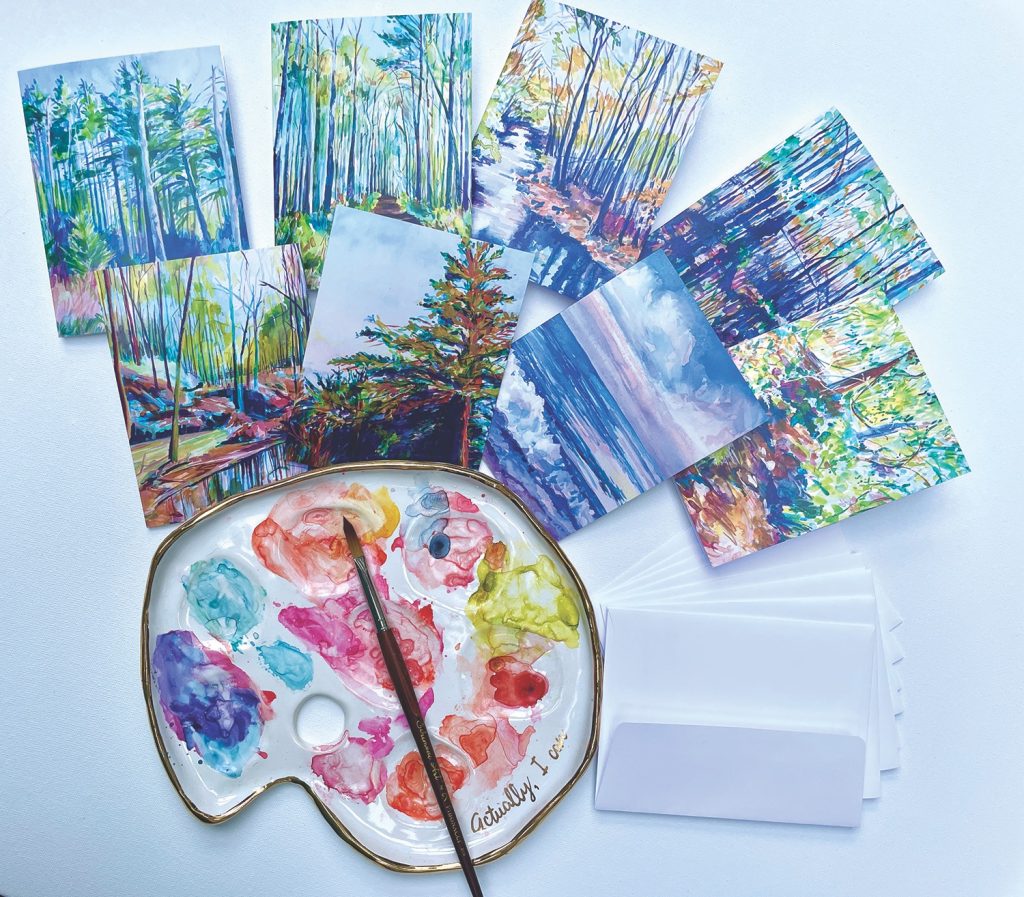
“I feel like my art is love made visible,” muses Katie Podracky, a teacher and first-time vendor at Merry Merry Market this year. “I love that people who know nothing of that story can come to it and also feel some type of hidden connection.” Katie takes inspiration from North Carolina, the state in which she was born and raised. The vibrant scenery and lively nature — who doesn’t love a galloping white-tailed deer or the sound of a rushing waterfall from time to time? — influence her canvas. After a little mountain climbing and several animal encounters from her local state parks, Katie and her husband became avid outdoor lovers. “I had a friend tell me, ‘Oh you should paint something’ and I was like, ‘Oh that’s a good idea, let’s do that’ and it really connected me to North Carolina.” Katie says she learned a lot about her home state through her art.

Katie has long loved Merry Merry Market and is excited to be on the other side of the vendor table this time around. “I tell all of my friends and my students that Merry Merry Market is such a great event because they collect quality vendors who happen to be local artists.” Katie’s paintings, plus accessories, home decor and other artisan wares, are among the many items you could buy as a gift for a family member, friend or even for yourself. We always enjoy the saying, “one for you, three for me.” And, as if that wasn’t enough to draw your attention, a portion of the $5 admission will be donated to BackPack Beginnings, a nonprofit that connects children and their families with the resources they need to develop and grow. So, mark your calendars to get some much needed holiday shopping done at Merry Merry Market, 9 a.m.–8 p.m., Wednesday, Nov. 19, at Revolution Mill’s Colonnade Events Center. Did we mention the bar opens at 5 p.m.? Info: merrymerrymarketgso.com.

Sazerac October 2025

SAZERAC

Sage Gardener

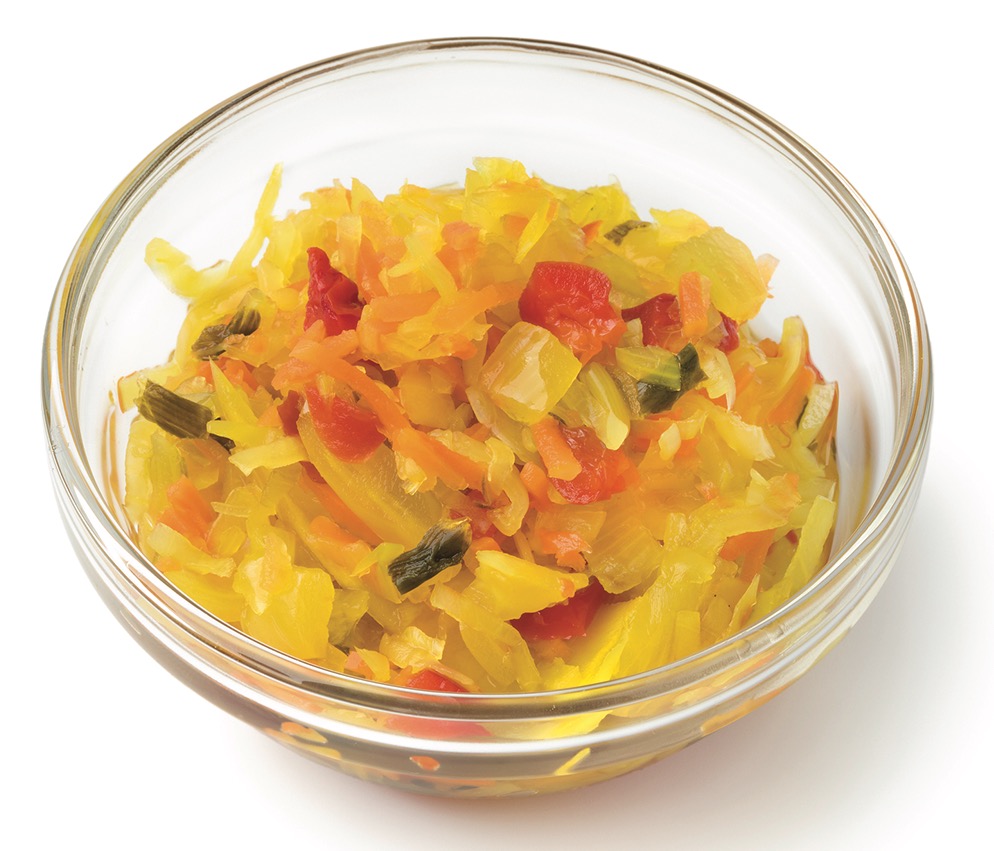
I thought I knew what chow chow was, a traditional Southern relish that my daddy put on pinto beans and my mother whipped up using up the tail end of the garden — cabbage, onions, green tomatoes and peppers, accented with mustard seeds. When I run out of the version I make myself, similar to Mama’s, I buy what I consider a really decent alternative, Mrs. Campbell’s Chow Chow, made mostly from cabbage, red bell peppers and onions, and produced by Winston-Salem’s Golding Farms. (Tony Golding got started in 1972, making and distributing Mr. and Mrs. John Campbell’s homemade version.)

Then I started poking around. Southern? Hardly. Food historian John Mariani informed me that the name of chow chow may come from Mandarin Chinese “cha” and originated in America in 1785, when Chinese laborers working on railroads in the West introduced it, amped up with ginger and orange peel. North Carolina-born “Southern Fork” blogger Stephanie Burt muses that the French Acadians from Canada might have brought chow chow to the United States, since their word for cabbage was “chau.” But her personal theory is that “the Carolina version I know originated with the Pennsylvania German and Dutch settlers, who traveled the wagon road to the South bringing their love of relishes and mustard with them.”

My Pennsylvania Dutch mother might have consulted her Mennonite Community Cookbook, but she sure didn’t put any lima beans, green beans or cucumbers in hers. She used the version, as I do, from the Rockingham County Home Demonstration Cookbook, featuring, like Mrs. Campbell’s, cabbage, onions and peppers, but also green tomatoes. Head north and chow chow gets even greener, made predominantly with green tomatoes, especially in Nova Scotia and New Brunswick.

If you want to make some from the remnants of your garden veggies, type into Google what you have too much of and you’ll find oodles of recipes.

But what really grabbed my attention was what some people do with it. Sure, I heap it on hamburgers, hot dogs and collard greens. And it’s the secret ingredient in my devilishly delicious deviled eggs. But, really, fish cakes and mashed potatoes? Heaped on biscuits and gravy or on corn bread? Don’t even mention ice cream — unless it’s chocolate.

Unsolicited Advice

You know the house that the kids clamor to every Halloween? It’s the one with the flashing lights, “Monster Mash” blaring and a fire pit out front surrounded by witches and werewolves sipping their brews. Green with envy? Don’t be — we’ve got tips to make your front door the top stop on the block.

Don’t dole out off-brand candy imposters. No one wants your Crisp-Cat, Wacky Taffy or Chuckles bar. Even toddlers know they’re a cheap imitation of the real thing and taste like chocolate-covered disappointment.

The biggest fright of the night? Nothing screams “I’m a dentist” like handing out toothbrushes at the door. If you’re going to do it, at least toss in some sugar-free candy, too. Plus, from a business standpoint, more cavities means more income.

Ambience? More like zombie-ence. Think eerie mood music, orange and purple lights and — the icing on the individually packaged Tastykake, which also makes a great treat — a frightful ’fit for yourself. And we all know nothing is scarier than a homemade Halloween costume.

Window on the Past

Captured on the heels of the Great Depression, these two goblins are prepared for the coldest of winters and the largest of pumpkin pies. Better stock up on the whipped cream!

Just One Thing

While one red balloon floating up from a drain says “Stephen King-level creepy,” soon, several red balloons in front of an art studio will scream creativity. Since 1996, ArtStock Studio Tour has offered art collectors and lovers the opportunity to tour several local studios — marked by red balloon bouquets — where they can peruse and perhaps purchase a piece for their own homes. This year, ArtStock is stretching that canvas all the way into High Point. Witness here the work of Greensboro resident and mixed-media artist Linda Spitsen, who is participating for her third year. For the first time, she plans to open the doors to her in-home studio. Spitsen says she traces her creativity all the way back to kindergarten. “For forever, people have always received a handmade card from me for their birthdays,” she says. But that creativity was reignited on a larger scale in 2016 when she retired from a longtime career as vice president of HR at a tech company. Now, Spitsen has collectors all over the globe — “in all the continents but Antartica,” she quips. Her brush, she finds, generally yields works that are floral or earthy in nature, as seen here in Thursday’s Child, a bold acrylic on gallery-wrapped canvas. Asked who, exactly, Thursday’s Child is, Spitsen simply says, “I was born on a Thursday.” As was her husband, Stu Nichols, she notes. The painting, as it turns out, was completed on the eve of her birthday earlier this year. Just follow the red ArtStock balloons to see Spitsen’s work as well as that of 30+ local artists, Oct. 2–5. Info: artstocktour.com

All Bark

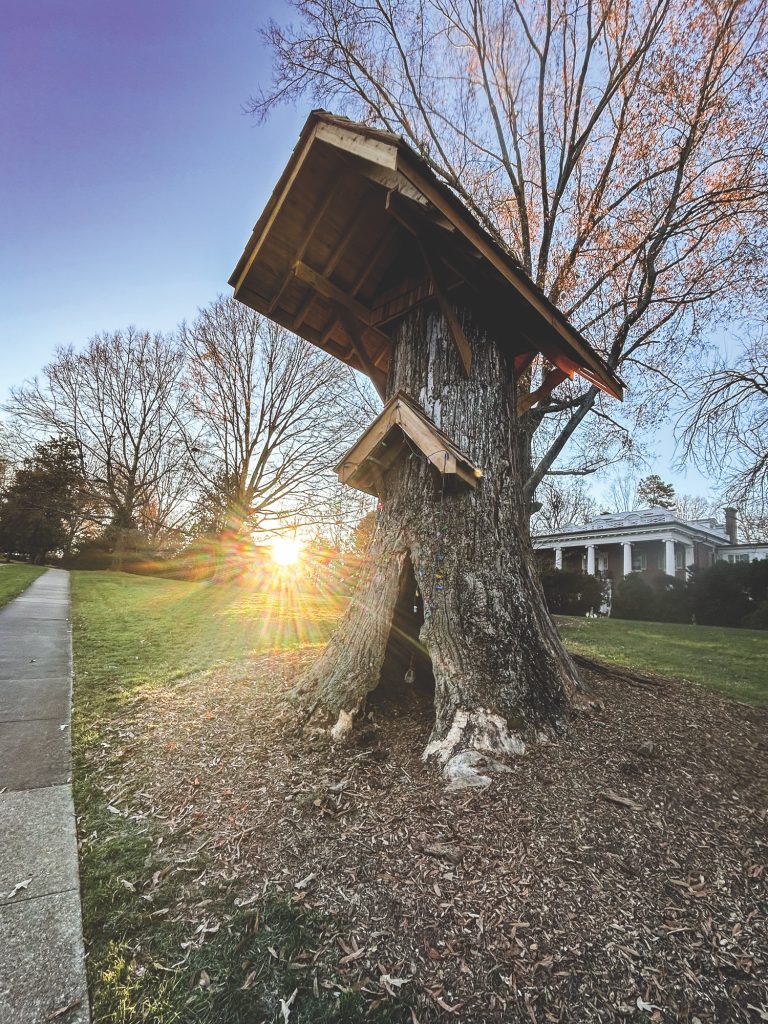
Poplar Hall, a Neoclassical Revival home in Irving Park, now features what may be the first tree that’s been remodeled of its kind — notable in a neighborhood where grand old mansions routinely receive every imaginable home improvement.

You read that correctly. If tree superlatives were handed out, this tree would win “Most Improved,” hands down! 

The much-loved poplar stands on the lawn of the historic 1914 family home of politician and lawyer Aubrey Brooks. Poplar Hall was among the first houses built in Irving Park. In recent years, arborists and experts could be seen administering TLC to a particular tree, across from the entrance to the Greensboro Country Club. 

Why care so for this tree? It had star power, an earthly wonder to all who passed by.

The same feature that made the tree charmingly irresistible, sparking the imagination, also indicated its vulnerability. Its heartwood having died, its center was enchantingly hollowed out so much so, a child could disappear into its interior.

Generations of fans have visited the tree, standing conveniently by a public sidewalk. Passersby, runners, walkers and parents with strollers have invariably slowed for a better look. Like the Angel Oak in Charleston, South Carolina, it had quietly become a natural attraction, one the children in my family always requested to visit. 

Years ago, a fire was set inside the hollow. Though it bore the signs on the charred interior, the tree seemed to defy death.

But, despite the care of intergenerational owners who gave it their best efforts, the tree steadily declined.

Advancing decay and time further ravaged the tree. And who could even guess its age? Hardwoods such as this often live over 250 years, according to treehuggers.com.   

The ailing tree recently underwent a series of incredible transformations. First, a breathtaking amputation. The dying top was lopped off, leaving it truncated and sad-looking. Fans and neighbors worried. What next?

The tree trunk — the main attraction — remained with at least 20 feet of its magnificence intact. The natural “doorway” was saved, its ancient portal still open.

Since then, a cedar shake roof was constructed, reinforcing the tree’s appeal and storybook charm. More embellishments followed: gingerbread trim and two charming windows. Delighted children dubbed it the “Keebler Elf tree” after the well-known cookie commercials, where elves whip up Fudge Stripes in such a tree.

As a final, playful touch, garden gnomes — perhaps Keebler kin — appeared inside the hollow, establishing residency, proving the remodel was a habitable success.

It was a remarkable save for a tree with legions of fans.

But not everyone unreservedly loves the elf tree at Poplar Hall. Occasionally, the darkness of the walk-in tree spooks little ones, fearful of encountering unseen guests.

When my niece, Bailey Sparks, visited the tree, we urged her to step inside for the full experience. Just as she entered the shadowy hollow, she screamed out in pain and fright. A bee had stung her.

Later, she shakily recorded the event on a blackboard in my home, which bears chalk-scrawled messages from visiting children. “I will never forget this day! The first day I got a bee sting! July 15, 2007,” she wrote. The child had no more to say on the subject, wishing to never return.

But the majority of those paying homage to the tree get a pleasurable shot of dopamine rather than bee venom. Most of us are tree lovers, like generations of the Brooks family seem to be.

According to historic records, the name itself is proof. Poplar Hall is the namesake “of a stately tulip poplar” that stood on the front lawn of the property more than a century ago.

Sazerac September 2025

SAZERAC

September 2025

Sage Gardener

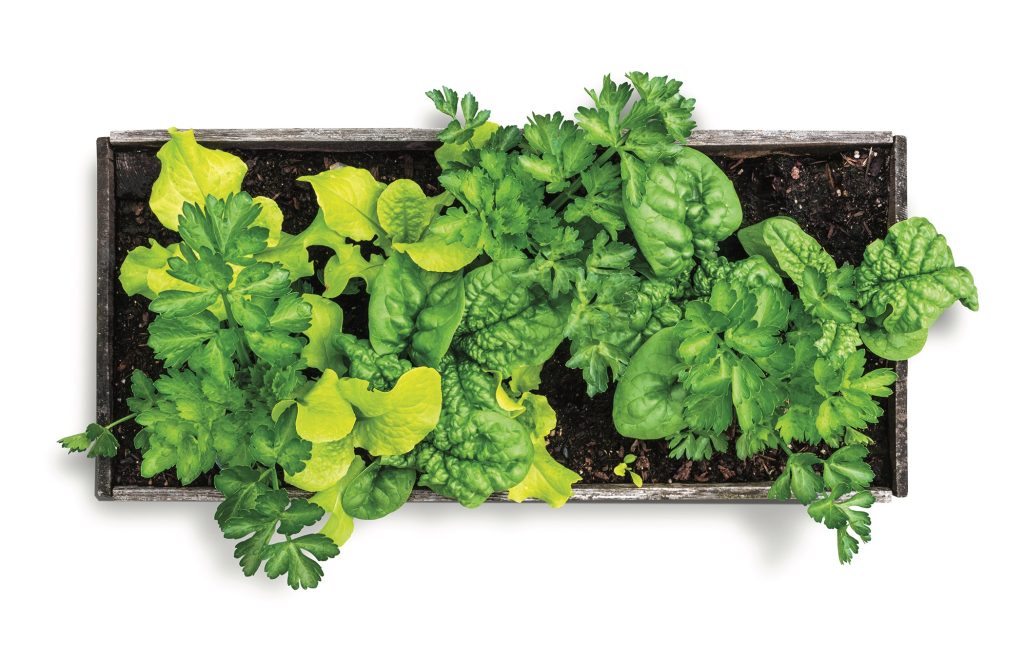
With the end of summer comes the inevitable garden turnover, and the Sage Gardener is thinking about what he can grow without even stepping foot outdoors. You can get a kit delivered right to your front door, from $20 for a 10-piece ensemble found on Amazon all the way to an $899, smart technology, hydroponic, LED-lit, automatically-watered unit (remote camera extra) from Gardyn.com. But a quick survey of my friends suggests you don’t have to break the bank to bring the outdoors in. “I buy basil and parsley at the local Harris Teeter and torture them until they wither,” says an artist friend. “I’ve begun to notice that when I go by the baby plants in the produce aisle, they’ve started recoiling at me.”

Another friend fills her kitchen with herbs from Trader Joe’s, popping the ones that don’t thrive from the pot into the frying pan. Her partner has labeled the sunny little corner of their kitchen, “The Rainforest.” She’s found that mint in particular thrives like kudzu until Derby Day, when it tends to disappear.

Another friend restricts his indoor gardening to chives, which he snips and puts on salads and baked potatoes. My wife and I have found that “mowable” plants are the best bet for our window garden: herbs or leaf lettuce, spinach, endive and Swiss chard. We also grow root veggies for their edible greens. Think beets, turnips, mustard greens and radishes.

A friend in New York City warns that you need the right angle of sun for certain plants to thrive: “The growing season on our south-facing back deck lacks the early spring warmth of North Carolina, but my reliable winter-overs are lovage, chives and sage. This year’s sage plants are almost teenagers.”

A hiking buddy who actually harvested tomatoes from her potted plants says, “I’m no expert but I’ve learned the importance of light, food and water. The key lies in figuring out how much of each, when, and then adjusting the ratio to fit their needs.”

O.Henry colleague Maria Johnson takes her struggling plants to “the urgent plant-care clinic at Plants & Answers on Spring Garden Drive for a quick diagnosis.” If declared fatally wilted on arrival, “there are plenty of healthy replacements to choose from.”

If you’re really serious about all this, I suggest that you google “indoor garden links by Guilford County Master Gardeners.” Or check out a primer written by an extension agent in Person County, who, among many other tips, suggests using equal portions of peat and vermiculite for your soil; fertilizing your plants with a water soluble 15-30-15 formula; and choosing the right window or spot on the patio so that fruiting plants get at least 12 hours of bright light a day. Finally, remember, says the gardening-in-the-kitchen magician, that, except for root and leaf plants such as carrots and lettuce, “vegetables must be artificially pollinated for fruit development. Pollination can be accomplished by taking the powdery pollen from the bead-like anthers with a camel’s hair brush and placing it upon the stalk-like pistil.” And by now we all know plants respond well to music, so may I suggest you set the mood with your Marvin Gaye album? Because it’s time for your plants to get it on.

Just One Thing

Harriet Tubman, Mohandas Gandhi, Frederick Douglas and, seen here, Marian Anderson are just some of the familiar figures artist William H. Johnson (1901–1970) painted in his mid-1930s Fighters for Freedom series. Born to a poor African American family in Florence, S.C., in 1901, Johnson left his hometown behind at the age of 17, following his dreams of being an artist to the Big Apple. There, he worked a variety of odd jobs, saving money to put himself through the National Academy of Design and later serving as general handyman at the Cape Cod School of Art in Provincetown, Mass., where he studied with painter Charles Webster Hawthorne. It was Hawthorne who influenced Johnson’s bold use of color, seen throughout this series, which was created to honor African American activists. Featured were scientists, teachers and performers, as well as international heads of state who were valiantly working toward peace. Among his Fighters stands Marian Anderson, mouth open in song. A contralto, she was the first Black soloist to perform at both the Metropolitan Opera and the White House. In 1939, just a few years before Johnson painted this series, the head of the Daughters of the American Revolution denied Anderson permission to perform at the DAR Constitution Hall because of the color of her skin. Subsequently, First Lady Eleanor Roosevelt resigned from DAR and, just a couple months later,  presented Anderson with the Spingarn Medal, which recognizes outstanding achievement by an African American. Anderson died in 1993 at the age of 96. You can admire her vibrant, colorful portrait, along with several Fighters for Freedom, at Weatherspoon Art Museum’s exhibit, Sept. 6–Nov. 29. Info: weatherspoonart.org/exhibitions_list/fighters-for-freedom-william-h-johnson-picturing-justice.

Window on the Past

Among the vast vinyl collection of the Greensboro History Museum, one shines brightly — the 1976 Rick Dees gold record of the satyrical novelty song “Disco Duck.” Dees, who graduated from Grimsley decades ago, is still rocking a smashing radio broadcasting career. You can tune in to his voice on his syndicated Rick Dees Weekly Top 40 Countdown, and, if you’re a really lucky duck, you might catch him going quack-quack, quack-quack.

Unsolicited Advice

You’ve seen them already, the early signs of fall. No, we’re not talking about foliage — this is North Carolina, folks. But Starbucks released its seasonal menu late last month, so don’t be surprised to catch a whiff of pumpkin spice on someone’s breath. Get used to it. How about some ideas to get into the spirit of the season, Southern style?

Haul out the flannel shirt! But rip off the sleeves for a look that says, “I love fall!” Or, “Wanna hop on my hog?” Either way, we’re into it. And you can repurpose the sleeve by filling it with maize to use as a door draft stopper for when the fall breezes actually start blowing.

Forget the steaming cup of mulled cider. Since we’re in Piedmont North Carolina and it’s still September, cool off with a chilled cider slushy. Sugar, spice and loads of crushed ice. And a dash of brandy for the 21+ crowd.

Crank up the oven for fall baking. Think chocolate-chip pumpkin bread, homemade cider donuts or apple spice cake, the cozy scent of cinnamon and nutmeg wafting throughout your home. Just don’t forget to also crank up the AC, or hints of perspiration will also be in the air.

Take a leaf-peeping road trip. According to Google Maps, it’s only about 17 1/2 hours to Maine’s Mount Katahdin.

And if there’s one thing no other region can top, it’s college football season. Where else is it warm enough to go shirtless and paint your entire torso for game day? Take it from us and spring for the sweatproof paint or you’ll be a puddle of school colors by halftime.

Sazerac August 2025

SAZERAC

August 2025

Unsolicited Advice

August, it turns out, is the month that most babies are born in the United States. Editor Cassie Bustamante and her older brother are both early-month Leos, born a couple years apart. Knowing that, we don’t have to guess what many Americans are up to in early November, when the weather cools and the days darken. Brown chicken brown cow, if ya catch us. We thought we’d share a list of words we’re fond of that sound like they’d make beautiful baby names, but which we beg you not to use for your August child.

Calamity. Sure, it means sudden disaster, but it rolls adorably off the tongue. And wouldn’t Callie be a sweet nickname?

Dash. Em dash, en dash, DoorDash. Frankly, we like all the dashes. It could even be short for Kardashian, but, whatever you do, never — ever — call them Hyphen.

Lattice. Like Gladys — and makes us think of flowering vines. Or atoms arranged in a crystalline solid, whichever floats your boat.

Typhus. Dionysus was the Greek god of wine, vegetation and fertility. His brother, Typhus, may have been the god of lice, chiggers and fleas.

Arugula. She’s feminine but a little peppery, too. And we bet anyone with this name won’t fight you on eating her greens.

Imbroglio. Sounds masculine and Italian and we’re here for it. Google the meaning before you use it, though, or you might find yourself in “an acutely painful or embarrassing misunderstanding.”

Sage Gardener

What’s in a name? Well, everybody who’s had a halfway decent English teacher knows that dandelion is derived from the Anglo-French phrase “dent de lion” (lion’s teeth, from the leaf’s indented teeth). But did you know that tulip comes from the Turkish “tülbent,” meaning turban; or that the petunia’s name is from the Tupi word petíma for tobacco, stemming from how the two plants are botanically related; or that azalea is Greek for dry, parched and withered, so named for its ability to thrive in a dry climate?

Probably not, unless you subscribe to Merriam-Webster’s Word of the Day.

It’s my guess that the author of that piece probably has a copy of Diana Wells’ 100 Flowers and How They Got Their Names, along with William T. Stearns’ Dictionary of Plant Names for Gardeners. And I suspect his or her copy is as tattered as mine is. 

So let’s start with the dogwood, our state flower, whose wood was supposedly used to build the Trojan horse and whose berries turned Odysseus’ men into pigs. That, according to Wells, who also says the tree’s leaves, bark and berries “have been used to intoxicate fish, make gunpowder, soap and dye, make ink and clean teeth.” You’ve doubtless heard the legend that the old, rugged cross was made of dogwood, and Jesus, feeling the tree’s remorse, transformed it henceforth into a twisted dwarf so that it could never be used for another crucifixion. As for its name, I’m understandably partial to the 1922 theory of L.H. Bailey that its leaves were used to shampoo mangy dogs.

The pine, our state tree, springs from the Latin “pinus,” which etymologists guess (they do a lot of that) derives from a form of the verb “pie,” which means “to be fat or to swell,” with their opining it’s a reference to the pine’s sap or pitch.

Let’s just skip over orchid, which comes from the Greek “orchis,” meaning testicle. And who wants to dwell on the origin of forsythia, named after English gardener William Forsyth, whose recipe for Forsyth’s fruit-tree-healing plaster consisted of cow dung, lime and wood ashes amplified by a splash of soapsuds and urine?

Let’s just go back to Merriam-Webster’s Word of the Day, which once featured plant names that sound like insults. Go ahead, call someone a hoary vervain, stink bell, bladderwort or a dodder. I could go on and on, but my editor has a thing about brevity. So I’ll close with my favorite names of wildflowers — whorled tickseed (whorled means a pattern of spirals or concentric circles), Jacob’s ladder, sweet William, Dutchman’s breeches, foam flower, American boneset, Joe Pie weed, white turtlehead and lanceleaf blanket flower. Pure poetry on the stem or vine.  What is it about our wanting to know the names of plants and animals, as if that little tidbit of knowledge gives us some kind of power? And what is it about a plant’s name that seems so intriguing? As my guide once blurted out after two weeks on a tributary in the furthest reaches of the Amazon River, “Bailey, most people just want to know the name of the dingus, and once told, they shut up. But you’re relentless and keep asking questions.” I told him that it was in my job description as a reporter and an incredibly nosy parker. Besides, I said, I was an English major — until I changed my major to Classical Greek. He just shook his head.    

Window on the Past

Back in the 1950s when families still swam in Lake Hamilton, most moms chatted on the shore as they kept a watchful eye on their children. But not Betty. She just wanted to be left alone with her magazine. And who can blame her?

Just One Thing

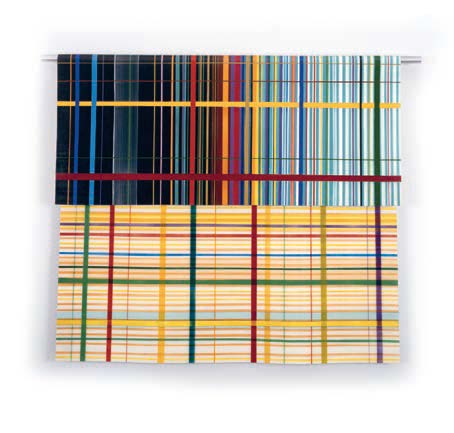
As children, we’re taught to recognize patterns. Our music teacher has us clap out one-two, one-two-three. Our science teacher shows us how to recognize patterns in nature’s wonder — the gills of a mushroom or the arrangement within a DNA molecule. Often, as adults inundated with information, we forget to take a moment to appreciate how patterns stimulate our brains. Weatherspoon’s current exhibit, “Pattern Recognition,” reminds us to find the beauty and meaning in them. Linda Besemer’s Baroquesy, 1999 — featuring acrylic paint over aluminum rod, is part of the Weatherspoon collection on display in this exhibit. California-based Besemer knows a thing or two about pattern recognition and society’s strictures about the use of color. “What’s so predictable about the ‘too colorful’ rejection is that it implies that some color is OK, but too much is unacceptable,” she told Scottish artist and writer David Batchelor just a few years after this piece’s creation. She went on to say that she thinks “that the real problem with color is its containment and regulation.” Which, she says, reminds her of how  artists have regarded the female body throughout the history of Western art. Submerge your mind into Weatherspoon’s world of pattern  — and so much more —  through Jan. 10, 2026. Info: weatherspoonart.org/exhibitions_list/pattern-recognition.

Memory Lane

Leaving Lowe’s on Battleground one weekday, I felt a massive pang of nostalgia. The center of that entire property, directly across from ALDI, was the location of the studio and tower for WBIG 1470 AM radio, where Bob Poole broadcast his enormously popular morning show, Poole’s Paradise, throughout the ’50s, ’60s and ’70s.

The quick-witted, basso-buffo voiced, self-anointed “Duke of Stoneville” relocated to Greensboro from his New York network perch in 1952. Soon after, Bob and my father became drinking buddies. As a toddler visiting WBIG’s “Poole Room” while he was broadcasting live, I joined in whistling his theme song, which made Bob burst out laughing. As a teenager, some mornings I’d drop by the station with joke and trivia books.

After faithfully awakening Gate City denizens for 25 years with an audience share that will never be equalled, Bob Poole signed off mere weeks before his death in 1977. Legendary WCOG DJ Dusty Dunn inherited the “BIG” morning slot. In an interview conducted years ago, Dunn recalled negotiating his contract and, of all things, being asked if he wanted batteries included in his employment package: “I said, ‘Batteries? Batteries for what?’ She said, ‘Well, we gave Bob Poole batteries for his flashlight when he wakes up in the morning so he didn’t have to turn on the lights and wake his wife up.’ I couldn’t believe it!”

On the afternoon of November 20, 1986, after celebrating 60 years on the air, the parent company informed WBIG’s general manager that the station would go dark at 6 that evening. Shocked staffers and longtime on-air personalities gathered for a tearful sign-off led by Dusty Dunn.

That decision was basic economics — a relatively small operation was nestled atop an entire city block along Battleground Avenue’s exploding retail corridor, a plot of dirt far more valuable than any revenue a weak AM radio signal could generate.

The last shred left of WBIG’s existence on Battleground is Edney Ridge Road, separating ALDI and Lowe’s, in the 1950s paved for and christened after the founder of the station whose call letters were an initialism for We Believe In Greensboro.

Sazerac July 2025

SAZERAC

Sazerac July 2025

Unsolicited Advice

Nothing makes us prouder to be American than watching people stuff their faces with as many hot dogs as possible in 10 minutes. No, we’re not talking about mealtime around your cousin’s table. We’re talking about the Nathan’s Famous International Hot Dog Eating Contest, held annually on the Fourth of July. We don’t recommend you try it at home, unless you’re up for more explosions than the celebratory fireworks that night. But how ’bout a trip across America (courtesy of hotdog.org) to discover which toppings reign supreme in each region. And don’t forget to try ’em on a veggie dog. We’re not saying it will help the flavor, but it might just mask it enough.

In our home state, chili, slaw and onions are the name of the game. Because nothing pairs better with meat than more meat. And nothing follows it better than breath mints.

Boston’s Fenway Frank is both boiled and grilled, then served with mustard and relish, sometimes topped with baked beans. It’s basically a Beantown protein bar when you think about it.

The New Jersey boasts strong Italian vibes, served up on thick pizza bread and topped with onions, peppers and deep-fried potatoes. Fun fact: For just $3,500 a night, you can stay at the actual Jersey Shore house, but this hot dog will whisk you there for about $5 a pop.

Chicago-style dogs are more loaded than the bases at Wrigley when the visiting team is at bat. May we recommend going all the way with yellow mustard, dark-green relish, chopped raw onion, pickle spear, sport peppers, tomato slices and a dash of celery salt, which might just be enough explosive flavor to make that vegan dog palatable?

Window on the Past

Greensboro’s  love for downtown’s Zesto soft-serve ice cream shop, frozen in time in this early-1950s image, must have melted quickly because, according to records, the establishment lasted only a little longer than a soft-serve cone on a hot July day. Too bad — a 15-cent sweet treat would hit the spot right now.

Just One Thing

The intense stare of a 15-year-old Pablo Picasso reaches across one-and-a-third centuries vis-a-vis an India-ink-and-watercolor-pencil sketch by Greensboro artist Roy Nydorf. The retired Guilford College professor has works in the Hirshhorn, the Smithsonian, the Honolulu Academy, Weatherspoon — and now in the theater wings of the Steven Tanger Center for the Performing Arts. Curated by GreenHill Center for NC Art and on display until December, the exhibit features portraiture by a rich and varied cross-section of artists who have strong connections to the Triad area, including Sachi Dely, Aimée García, Zoe Grace Kamiya, Travis Lee Hicks, Jalen T. Jackson, Isabel Lu, Zaire Miles-Moultrie, William Paul Thomas and Joyce Williams. Nydorf once said, “If the simple image contains a vast complexity while retaining its purity and grace, then I have achieved my purpose.” We think Picasso would have agreed. Info: greenhillnc.org/portraits-from-the-triad.

Sage Gardener

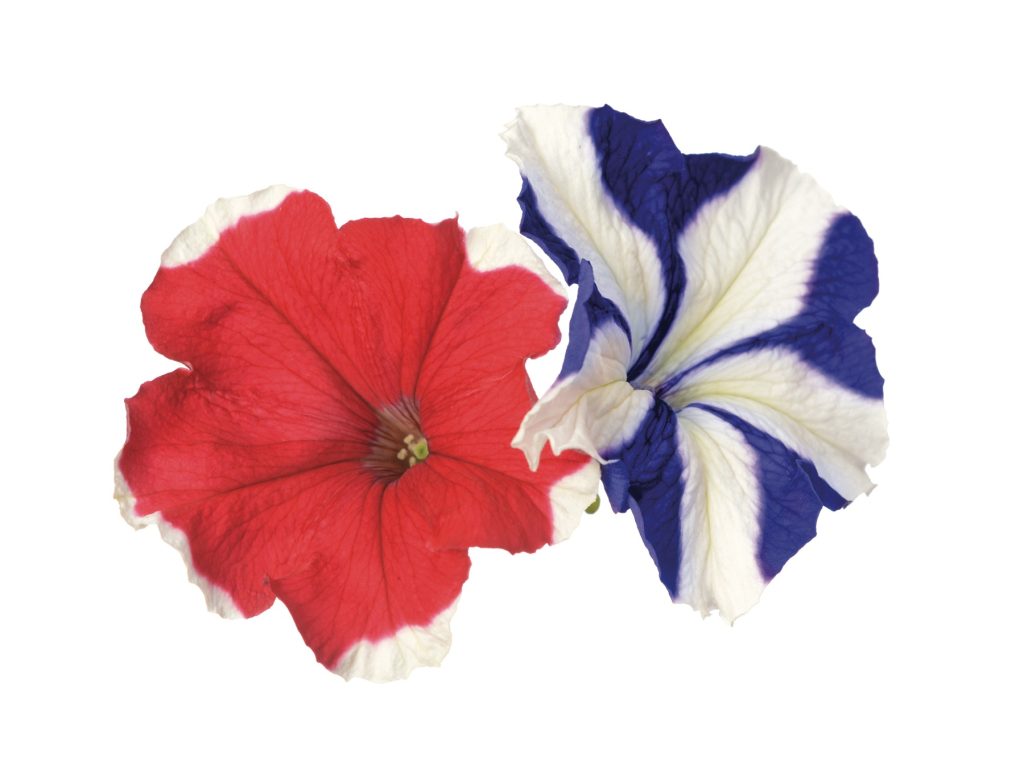
Happy 249 years of flowering Democracy, America! And what better way to celebrate your birthday than to reflect on what the Founding Fathers would think of cultivars such as Stars-and-Stripes Petunia, the Freedom Flame Tulip and the Presidential Peony? 

These are just some of the star-spangled blooms that sprang from my hiking buddy’s iPhone when he asked it for a list of patriotic flowers. 

Randall’s a big fan of artificial intelligence, while I have my serious doubts. 

“American Beauty Rose,” Chat GPT chirped, “is a classic red rose symbolizing love and patriotism, and Liberty Bell Iris is a bearded iris named after the famous American symbol.” Not bad for a brain made up of ones and zeros, I conceded.

Next he turned to Microsoft Copilot. American Gold Rush Coneflowers led the list, “reflecting the historic pursuit of American dreams.” What? “Wasn’t the gold rush inspired more by greed than dreams,” I asked. Picky, picky, picky. Copilot also came up with Union Jack Phlox! Isn’t the Union Jack the national flag of Britain, whom we fought to become the United States? Copilot also recommended Edelweiss, puzzlingly, with the following explanation: “While not exclusively American, its white, star-like shape can symbolize the stars in the American flag, and it also symbolizes bravery.” Really? We both decided if we were students desperately using AI to write a term paper for American History the night before it was due, we might want another copilot.

Then Randall turned to his favorite artificial brain, DeepSeek, the Chinese latecomer that’s shaking up the whole AI industry by delivering high performance at a fraction of the development cost. Although it may not be particularly patriotic to point out, DeepSeek was, in our opinion, smarter, much more conversational and able to produce 20 decent candidates, compared to Chat GPT’s 12 and Copilot’s 13. And it sussed out some salute-the-flag names the other artificial brainiacs missed: the Betsy Ross Rose, for instance, “named after the historic flag maker, this white rose with a red blush honors early American history.” Sorta poetic, eh? Also, the Yankee Doodle Coreopsis, “a cultivar with red-and-yellow blooms, referencing the patriotic song.” And, finally, the “Old Glory Rose, named after the iconic U.S. flag’s nickname, often featuring red, white or blue hues.” These were well-penned, we decided, and certainly not sounding as if they had been made in China. 

Which got us thinking about how the Founding Fathers themselves would have reacted to the emergence of artificial intelligence. The answer came in seconds using Meta AI, a division of the company that owns and operates Facebook and Instagram. 

Thomas Jefferson would have been fascinated by it, we’re told. Benjamin Franklin would likely see it as a natural extension of human ingenuity. George Washington and John Adams would have been wary of it, worrying about job displacement, privacy concerns and its implications on social structures, morality and the human condition.

How about Alexander Hamilton? “Hamilton’s creative and imaginative nature might have inspired him to explore AI’s potential in science fiction or speculative writings, envisioning a future where humans and machines coexist.” 

At that point, we decided to put our phones away and be thankful for the fireworks display of wildflowers all along the trail.   — David Claude Bailey

Writing Contest Last Call

We will accept submission to our 2025 writing contest only until the end of the month. What are you waiting for? This one is a bit unique in that we’re asking you to write your own obituary — a faux-obituary, that is. Get to your keyboard and let it RIP. Is this an exercise in imagining how you want to live the rest of your days or is it all about what you want to be remembered for? Whether dead serious or playful and fun, let it be something to make O.Henry readers remember you forever.

Don’t forget the rules.

  • Submit no more than 250 words in a digital format – Word or Pages document, a PDF. Paste it into an email, or carve into stone. More than 250 words? You’re dead to us.
  • One submission per person: Email entries to cassie@ohenrymag.com
  • Deadline to enter is July 31, 2025.
  • Winners will be contacted via email and their submissions will be printed in a forthcoming issue.
  • Lastly, life is short. Have fun with this assignment!

Sazerac June 2025

SAZERAC

June 2025

Just One Thing

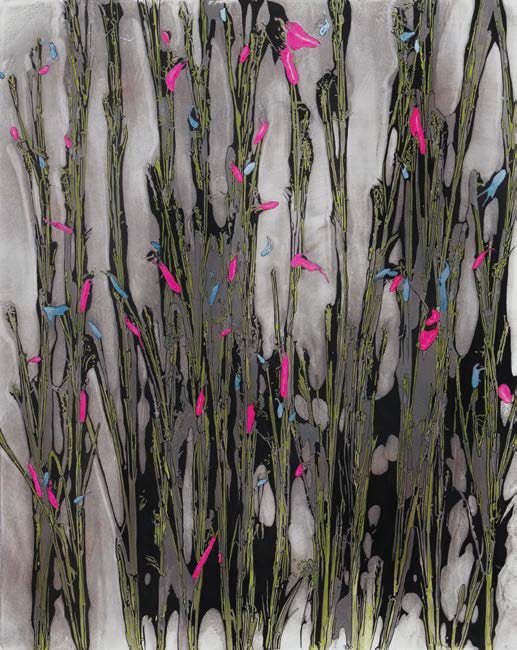
“My bond with nature began in childhood with time playing in the woods and helping my grandmother in her flower gardens,” says artist Emily Clare, named for both her grandmother, Emily, and her grandfather, Clarence. Since 1987, Emily Clare’s work has been exhibited in galleries throughout much of the Southeast and has reached as far as Australia. These days, Emily Clare can be found strolling by evening light around her Winston-Salem home or exploring woodlands of the Southeast, where she collects native, invasive and exotic plants she then presses as the basis of her work. Rather than traditional paint and brushes, she uses leaves, vines or blades of grass, and ink, allowing nature to dazzle as it unfurls its wondrous design. “Each one has a message they leave on paper,” she says. For her, creation is meditation. And for us, the observers, her work invites us to be more mindful, to reflect on being stewards of Earth’s natural resources. Seen here, Native Grass 1 depicts tall, wild and free — rather than meticulously mowed — blades printed using Akua ink and accented with gouache, watercolor and iridescent paint on Arnhem 1618 paper. Its shots of neon pink and cerulean blue catch the eye as you take an indoor nature walk through her “Botanical Dreamscapes” exhibit in Revolution Mill’s Central Gallery, on display through June 20. Info: revolutionmillgreensboro.com/events.

Another Candle on the Cake

Last of the late-1950s Rockabilly stars, Billy “Crash” Craddock turns 86 years old this month. A lifelong resident of Greensboro, he was 18 years old in 1957 when he recorded his first 45 single locally on the Sky Castle label, named after the teenybopper hangout on High Point Road known for its elevated WCOG-AM DJ booth. He was signed by Columbia Records a year later.

In 1959, he became a bonafide teen idol in Australia, where, during his first tour there, screaming fans greeted him everywhere he went. “Boom Boom Baby” rocketed to No. 1, the first of four top-10 platters down under. “I was excited just to be in the business and nervous at the same time,” Craddock told me in 2009. “The record company took a picture of me combing my hair on top of a building in New York. When it came out in a magazine they called me ‘pretty boy.’ I didn’t like that.”

Hits mostly eluded him stateside in the ’60s, but that changed in a big way after his 1971 “Knock Three Times” hit No. 3 on the Billboard country chart. “Wow, what a feeling riding around Greensboro,” he recalled. “Seemed like every time I’d move the radio dial, it was playing. Every station, ‘Knock Three Times’ was either getting started or ending. I thought, Is this for real?” His followup country radio release, “Ruby, Baby,” cruised into the No. 1 spot.

A string of chart-toppers followed, culminating in his biggest smash in the summer of ’74, “Rub It In,” which not only landed in first place on the country chart, but also hit No. 16 across all musical genres on the Billboard Hot 100. Still rockabilly to the roots, country to the core in his 80s, Craddock thrilled the studio audience on Country Road TV in 2024, covering a Tammy Wynette tune, “Darlin’ Take Care of Yourself.” 

A bridge over the rail lines on 16th Street is dedicated to Billy “Crash” Craddock, but locals who knew him before he began mining gold records remember him as the down-to-earth guy who hung sheet rock in their homes during those lean years before he began mining gold records. Rub it in, why don’tcha?  — Billy Ingram

Window on the Past

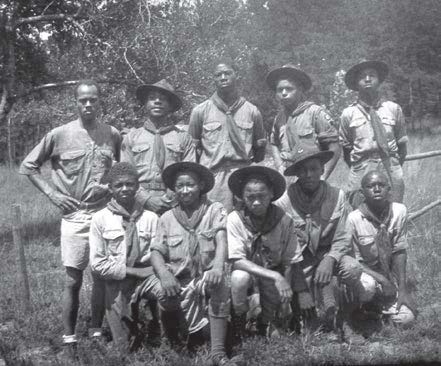
This photo, taken in the 1940s, is part of the Abraham H. Peeler collection held by the Greensboro History Museum. Peeler, long-time principal at the historic J.C. Price School, was heavily involved with Camp Carlson, one of the first camps in North Carolina created for Black Boy Scouts. These 10 lads are definitely dressed for adventure with the classic campaign hats and official-issue field uniforms, complete with kerchiefs and knee-high socks with garter flashes. Obviously trustworthy, loyal, helpful, courteous, kind, obedient, thrifty, brave, clean and reverent, they were on their honor to do their best to help other people at all times and to keep themselves physically strong, mentally awake and morally straight.

Unsolicited Advice

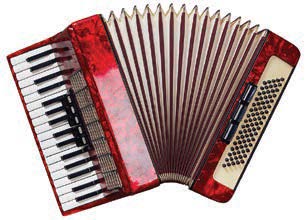
June is chock-full of celebrations, some we’ve already marked in our planners — Father’s Day, Summer Solstice, Juneteenth, Pride Month and the highly anticipated National Accordion Awareness Month. (This is not a joke. Nor is Bed Bug Awareness Week. Look it up.) In 2014, June was also designated as Alzheimer’s & Brain Awareness Month, so we thought we’d share some of our favorite ways to boost brainpower:

Brain teasers: Ever play The New York Times’ Connections? You have to find the common bond between several words. Try this: safety, candy, DJs, home ownership. Answer: They all have their own national month in June.

Board games: Our fav? The one where someone puts bits of cheese and fruit all over the board and challenges us to eat it all. Haven’t lost yet.

Crossword puzzles: Like Katy Perry, you’re up then you’re down — but never clueless. Amp up your cognitive flexibility and reserve, short- and long-term memory, and problem-solving skills.

Sleep: Catching Z’s is vital for brain restoration and repair. But maybe you lie awake at night already fully aware of bed bugs. Let a Calm app celebrity-narrated “Sleep Story” lull you to slumber. Because the last voice you want to hear at night isn’t your partner’s. It’s Matthew McConaughey’s.

Learn a new skill: Think languages or instruments. Accordion, anyone?

Sazerac May 2025

SAZERAC

May 2025

Celena Amburgey, Blue Ridge Venus, 2024. Oil Paint, vines, mason jar rings, cardboard, love letter from the artist’s father (paper), and a childhood bedsheet (fabric) on burlap, 30 x 38 x 1 ½ in.

Just One Thing

For Celena Amburgey, home is where the art is. “By intertwining paint, mixed media and deeply personal items like my daddy’s bed sheets, my work becomes a vessel for layered narratives,” says the creator of Blue Ridge Venus, which combines oil paint, vines, Mason jar rings, love letters from her father and a childhood bedsheet. “These intimate objects carry the weight of my heritage,” says the artist, who hails from Jefferson, N.C. Utilizing both personally precious as well as oft-discarded items such as plastic bags and grocery sacks, she says, “I craft a powerful dialogue on the tension between what is cherished and what is disregarded, drawing attention to how we assign worth and value in our lives.” Amburgey’s works, along with art by two other M.F.A. candidates, Paul Stanley Mensah and Nill Smith, will be on exhibit through May 25 at Weatherspoon Art Museum. Meet the artists on Thursday, May 8, from 5:30 until 7:30 p.m. Info: weatherspoonart.org/exhibitions/current-exhibitions.

May 25 Unsolicited Advice

If, like the rest of us, you’re trying — but struggling — to break up with your smartphone, this one’s for you. Those little buggers are full of dopamine hit after hit, lighting up our brain in a way that screams, “More, more, more!” When we find ourselves in a moment of quiet inaction, our fingers wander to that tempting touchscreen, desperate to fill the void. Well, we’ve come up with some digital-free ways to occupy those digits while taking a note from Depeche Mode: “Enjoy the Silence.”

Get hooked on something new: Learn to crochet. If you start now, you’ll have an entire collection of colorful hats to gift friends and family during the holidays.

Play solitaire. And not on an app, but with a real, tactile deck of cards. Best part? No one will ever know if you cheat — not that we’re endorsing that behavior. We just have the luck of the draw.

Try your hand at building. Scandinavians are consistently ranked among the happiest in the world and it’s probably because they’re constantly creating with Legos, which originated in Denmark, or putting together Swedish-made Ikea furniture. We certainly smile — through gritted teeth while cursing — when we assemble a Kallax shelf.

Read. As the proverb goes, “A book in the hand is worth two in your library queue.” Or something like that.

Window on the Past

Though much of Greensboro has changed over the years, the charming facade of this Irving Park Dutch Colonial, the historic R.J. Mebane House, remains very much the same since its circa 1912–13 construction. Wondering about the interiors? See for yourself as this and many other Irving Park abodes throw open their doors, welcoming guests of Preservation Greensboro’s Historic Tour of Homes, May 17 and 18. History, architecture and design come together to help you reach your step goal. What more could you want? Tickets and info: preservationgreensbo.org/events.

Must Love Books

Reading, writing and arithmetic? No, thanks on that last part of the equation. The Greensboro Bound Festival is where reading, writing and book fanatics create a buzz of all-day literary activity descending upon the cultural epicenter of downtown Greensboro.

But first, at 7 p.m. on May 15, how ’bout a little pre-fest fun with . . . (if this were an audiobook, you’d hear a drumroll right now) . . . Percival Everett, The New York Times-bestselling author of several novels, including the 2024 National Book Award for Fiction winner, James? A reimagining of Mark Twain’s The Adventures of Huckleberry Finn, James is told through the eyes of the runaway, enslaved Jim. Everett is sure to draw a huge crowd, filling up UNCG’s Elliott University Center Auditorium. Registration is required ­ and is now waitlist only by May 12 and can be found via the Greensboro Bound website.

Now, hold onto your pen caps and block out May 17 in your planner because this year’s one-day festival is, well, one for the books.

Dreaming up your own manuscript? Learn every trick in the book at the Greensboro Public Library. Three O.Henry magazine contributors, plus a few local notables, help you sharpen your skills — and pencils. Our founding editor, Jim Dodson, teaches “The Art of Memoir” — something he knows a little something about after writing Final Rounds, a New York Times-bestselling memoir. Maria Johnson hones your humor and Ross Howell Jr. shows you how to easily slip between fiction and nonfiction writing. Poets Ashley Lumpkin and Elly Bookman, plus Chapel Hill-based cookbook author Sheri Castle know how to measure for success.

In the Greensboro Cultural Center’s Van Dyke Performance Space, take a page from several authors in conversation. O.Henry editor Cassie Bustamante, yours truly, interviews Winston-Salem’s New York Times-bestselling author, Sarah McCoy, and Reidsville’s Sir Walter Raleigh Award winner, Valerie Nieman, about making herstory with historical fiction. Former Wall Street Journal writer Lee Hawkins, whose 2022 nonfiction book, I Am Nobody’s Slave: How Uncovering My Family’s History Set Me Free, was a Pulitzer Prize finalist, chats with Aran Shetterly, author of the harrowing account of the KKK vs. Civil-Rights demonstrators, Morningside: The 1979 Greensboro Massacre and the Struggle for an American City’s Soul. Andy Corren, whose Dirtbag Queen: A Memoir of My Mother was born out of the obituary he wrote for her that went viral, chats with Cassie. Finally, wrap up your evening with a conversation between Christopher A. Cooper, author of Anatomy of a Purple State, and spiritual writer, preacher and community cultivator Jonathan Wilson-Hartgrove, moderated by Raw Story investigative reporter Jordan Green.

Beyond the Greensboro History Museum’s doors, Kristie Frederick Daugherty, known for her book of Taylor Swift-inspired poetry, and UNCG M.F.A. alum Elly Bookman, plus local high school poet laureates read and discuss their modern take on the ancient art form. Known for her New York Times bestsellers Wench and Take My Hand, NAACP Image Award-winning author Dolen Perkins-Valdez chats about her latest book, Happy Land, which hit the shelves last month.

And what’s a festival without something for the littlest readers and aspiring writers? The second floor of the cultural center is chock full of children’s authors including Kamal Eugene Bell, Natasha Tarpley and Patrice Gopo.

Sage Gardener

“Wait,” says our hiking companion at the head of our group. “You’re saying that bees are not native?”

“Honey bees,” our citizen-scientist hiker responds. “It’s honey bees that are not native to the Americas. But there are hundreds of species of native bees.” (More than 500 in North Carolina alone, in fact.)

“How about honey,” the disbeliever shoots back. “Are you telling me that the honey I put on my toast in the morning is a non-native species?”

“The bees that gathered and regurgitated it are originally from Europe, brought over here to pollinate the Colonists’ crops in the 1600s,” says our apiculturist.

“Yeah, I read that the Virginia Company brought hives over when they established Jamestown,” pipes up the group’s historian. “So, yes,” says our honey bee detractor, “the honey comes from the U.S.A. — unless it’s imported from India, Argentina or Brazil, like a lot of cheap honey is.”

To say that our trail discussions are often lively is a gross understatement. At least it’s not politics this time around, I think to myself.

“I’m going to look that up,” our lead hiker says, an all too common refrain on these hikes. Moments later, Siri chirps, “Here’s an answer from gardenmyths.com: ‘The honey bee is a non-native import into North America and most other countries.”

“But honey bees pollinate our crops,” our dissenter insists. “Without them we would starve!”

Citizen scientist says, “A lot of crops are now engineered to be self-pollinating or even wind-pollinated. I’ve grown tomatoes in my living room with no bees and I still had tomatoes,” she counters. “Besides, a big hive of honey bees can outcompete native bees, sometimes the sole pollinators for certain native plants.  Without that bee, the plant can go extinct.”

You can read all about it in our Raleigh sister publication, Walter (waltermagazine.com/home/the-buzz-north-carolina-coolest-native-bees) in a piece by Mike Dunn, a Chapel Hill naturalist and educator. “Our native bees are truly bee-autiful and bee-zarre,” he writes. Plus, he points out, practically no one ever gets stung by native bees.

Or dive into the N.C. State Extension Service’s The Bees of North Carolina: An Identification Guide, available online (content.ces.ncsu.edu/the-bees-of-north-carolina-identification-guide), where you can see stunning photos of wood carder bees, rotund resin bees, cuckoo leaf cutter bees, zebra cuckoo bees, along with scintillating anatomical diagrams.

A whole ’nother subject is plants that nurture and support native pollinators. In March of last year, the Greensboro City Council adopted an official policy to promote native plants and eliminate invasive plants at city-owned facilities.

“Native plants help maintain, restore and protect the health and biodiversity of local ecosystems, supporting native pollinators, birds and other wildlife,” the City proclaimed. The Guilford County Extension Master Gardener volunteers couldn’t be more enthusiastic about those plants our native bees love, sponsoring periodic workshops on them. On Saturday, August 23, from 10 a.m. until 1 p.m. (guilford.ces.ncsu.edu/2025/02/2025-great-southeast-pollinator-census), they plan a count’em-if-you-got-them session as part of the the Great Southeast Pollinator Census.

Meanwhile, detractors of honey bees — especially lovers of native wildflowers like our citizen-scientist hiker — continue to blast Apis mellifera, that European intruder to our shores. One enthusiast at ncwildflower.org/honey-bees-friend-or-foe suggests, “Do not buy honey. Kill any wild hives you encounter. And discourage the use of domesticated hives transported to pollinate crops.” 

Y’all bee careful out there, now.     — David Claude Bailey

Sazerac April 2025

SAZERAC

Just One Thing

Paperhand Puppet Intervention’s mission is anything but pedestrian: tell stories, beat drums, work up a sweat, push boundaries . . . and steal people’s hearts away all while making the world a better place. Through largerthan- life puppets, Paperhand transports audiences into a world where greed, hate and fear are defeated, while love of the Earth and its creatures triumphs. Combining papier-mâché, house paint, cardboard and silk, puppet-makers in their Saxapahaw studio bring to life characters mythic in scope and kaleidoscopic in hue. Two decades worth of drawings, marionettes, shadow puppets, and clay and papier-mâché characters will be on display at GreenHill Center for NC Art from Saturday, March 22 (public opening 3–5 p.m.), until Saturday, June 21. Check GreenHill’s website for music, performances and hands-on cardboard-puppet fabrication as part of its ArtQuest program, plus a series of events, including a robot-costume family night and parade (April 5), an Earth Day Celebration (April 19), an artist talk (May 14) and a workshop (June 7). Discover how you can change the world with your own two hands, just as as Paperhand Puppets have. Info: www.greenhillnc.org/of-wings-and-fe

Unsolicited Advice

Here at O.Henry, we are all about literacy. After all, our namesake is one of America’s greatest short-story writers. The month of April honors a different kind of literacy — financial. Turns out, our namesake was not so hot at that and, in fact, served five years in Texas prison on charges of embezzlement. So, while we wouldn’t recommend taking money advice from the man himself, here’s our two cents on the subject. Make a grocery list and stick to it. Unless, of course, the Tillamook ice cream is BOGO. Build an emergency fund. Also, define “emergency.” A 401K, as its name suggests, is a very long race, but, when you reach the finish line, the participation trophy is worth it. Put in the work and go the miles. Before you know it, you’ll be retiring in the lap of luxury. Invest. And we don’t mean in Beanie Babies. With the help of a financial advisor, invest in stocks. Or invest in yourself — earn more accreditations or learn new skills that bring added value to your resumé. Cancel unnecessary subscriptions. Lucky for you, there are free magazines for your entertainment. Like the one in your hands.

Tour de Plants

Whether your thumb is vivid green or you’re chlorophyll deficient, The Greensboro Council of Garden Clubs is opening the vine-covered gates on six private — though not necessarily secret — gardens. This year’s tour features the secluded beds in the neighborhoods of Irving Park, Sunset Hills and Starmount Forest. Traipse through backyard wonderlands so enchanting that they exceed Lewis Carroll’s wildest dreams and wander onto front lawns bordered by lush bushes, flowering vines and blooming bulbs galore. You’re sure to head home mulch inspired and ready to dig into your own outdoor oasis. Plus, you’ll have a chance to mingle with club members while exploring how you can become a part of their growing community, too. Plentiful fun awaits! Tickets are $25 each and, as of April 1, can be purchased at A. B. Seed, The Extra Ingredient, Fleet-Plummer, Guilford Garden Center, Plants & Answers: The Big Greenhouse, and Randy McManus Designs. The tour runs from 10 a.m. to 4 p.m., May 17 and 18. Info: facebook.com/gcgcinc.

April Window on the Past

Plot twist? On April 2, 1936, a tornado ripped through the south end of Greensboro. The storm created a path of destruction 11 miles long, extensively damaging some buildings, including the former Blue Bell factory shown here. Restored to its former glory, it serves as home to Centric Brands and Transform GSO on the northwest corner of Gate City Boulevard and South Elm Street.

Our 2025 Writing Contest

When O.Henry’s team decided to put a twist on our annual writing contest, we ended up with what some will see as a twisted creative writing contest. We want you to write your own obituary — a faux-bituary, if you will. But this is no grave matter. No, this is an opportunity to dredge up the wit, humor and magic from your darkest depths. If you need inspiration, google “Idaho witch Holly Blair obituary.” Blair crafted her own whimsical memorial and it had us wishing we’d known her when she was alive. Or take, for instance, Renay Mandel Corren’s obituary, written with such love and hilarity by her son Andy Corren that it went viral, spurring him on to author Dirtbag Queen: A Memoir of My Mother, which released earlier this year. Maybe this is your own memoir in the making. Every day, we’re buried in deadlines and daily housework. Imagine, instead, just being buried — six-feet-under buried — and how you’d want to be remembered.

But first, rules.

Submit no more than 250 words in a digital format – Word or Pages document, a PDF, pasted into an email, or carved into stone and sent via photographs. More than 250 words? You’re dead to us.

One submission per person: Email entries to cassie@ohenrymag.com

Deadline to enter is July 31, 2025.

Winners will be contacted via email and their submissions will be printed in a forthcoming issue.

Lastly, life is short. Have fun with this assignment.

Sage Gardener

In one of my favorite flicks, Tim Burton’s Mars Attacks!, Jack Nicholson as POTUS makes a final appeal to the Martians who have invaded Earth, pleading, “Little people . . . why can’t we all just . . . get along?” His answer comes after he shakes hands with the take-me-to-your-leader commander of the attack, whose hand detaches and proceeds to stab the president in the back, a Martian flag popping up from his corpse.

Let’s admit it. It’s pretty obvious from the evening news that we humans don’t get along very well with one another, and in this dog-eat-dog world, things aren’t much better for man nor beast.

But plants. Those trillium, trout lilies and anemones bursting into bloom all around us, they certainly know how to get along.

Or do they?

Unless you’ve been hiding under a garden rock, one of the hottest horticultural topics in recent years has been plant communication. In an article entitled, “Plants Can Talk. Yes, Really,” Mamta Rawat, a program director at the National Science Foundation, muses, “I think we’re seeing that the complexity [of communication] is just as great with plants as it is with animals.”

And it ain’t all friendly.

Researchers have discovered that leaves can trigger defenses when they detect predators. When some roots sense problems with nutrients, water and predators, they respond accordingly. Plants even signal nearby kin telling them that the ever-dreaded aphids (or Martians) have landed.

In fact, gardeners have had a solution for this problem for centuries. It’s called companion planting. Basil disorients moths that lay tomato hornworm eggs. Aphids can’t stand garlic! Nasturtiums lure caterpillars away from your kale, cabbage and broccoli. You can read all about these and other suggested pairings at www.almanac.com/companionplanting-guide-vegetables.

Relying on the latest scientific info instead of old wives’ tales, Benedict Vanheems, longtime contributor to Kitchen Garden, Britain’s longest-running garden magazine, digs into which plants love one another and which ones wage war on the competition. Asparagus thrives with petunias and tomatoes close by. And, yes, it makes sense to plant squash so it shades the roots of corn and to plant pole beans to climb up corn stalks. Cabbage loves garlic, nasturtiums and sage as neighbors. Peas pair well with lettuce, radish and spinach. And both zucchini and summer squash love oregano, nasturtiums and zinnias. Chemicals similar to humans’ pheromones are at work in many of these cases.

But what plants don’t play well with others? Sunflowers, walnut trees and fennel are among the plants that are allopathic, meaning they release a toxic chemical from their roots to hamper the growth of certain surrounding plants. Broccoli and cauliflower are happiest at some remove from peppers and tomatoes. And onions and garlic can retard the growth of peas and beans.

Recently, researchers found that some plants even communicate through sounds that can be picked up by other plants and animals. Although I have not heard any of my plants trash talking, plant cells can emit vibrations that other plants sense, letting them know they’re getting a little too close for comfort. Chinese researchers even observed that when they broadcast sound waves of a certain frequency in a field, crop yields improved.

So maybe you ought to talk to your plant companions, but just be sure you use a soft voice and the right frequency.

Sazerac March 2025

SAZERAC

Sage Gardener

I love raw onions so much I’ve devised a stratagem so that fast-food employees don’t get my hamburger order wrong. (“Extra onions” is often misconstrued as “no onions.”) So, I tell the clerk, “I’d like an onion sandwich . . . and it’s OK if you leave the hamburger on it.” Whether baked, fried, char-grilled or caramelized, onions are, as the Egyptians believed, a gift from the vegetable gods. But the Sage Gardener’s sagacity on the subject of onions does not extend much further than knowing there are two basic types, branching (or green) onions and bulb onions. And I hereby confess that I’ve never been able to grow a bulb onion any larger than a small lime, but I may have finally figured out why. Sure, some sources say growing onions is as easy as poking a hole in the dirt with your finger and dropping in a seed or a set, but a friend convinced me the seed route is not for me. After he ordered a number of enticingly named varieties such as cipollini, big daddy and red zeppelin, my permaculturistic pal nursed what few seeds germinated, misting them with water and even encouraging them with some baby talk, only to watch almost every single one of his transplants wither and die. Me? For years, I’ve been lured by the sets that pop up in garden section of big-box stores in the spring. But then I read about “long-day,” “intermediate-day” and “short-day” onions. “Long-day onions are not recommended for our area,” writes Lisa Rayburn, an agent with the N.C. Cooperative Extension Service. “Unfortunately, the onion sets sold in big-box stores are usually long-day onions and will not form properly in our area.” Duh! While onion maps show that the Northern U.S. has long days, the Tar Heel landscape is in the short-day territory or intermediate-day range. Rayburn says if you plant long-day onions in the state, “They will produce only greens or very small, if any, bulbs.” Further research, however, revealed that “recently, long-day and intermediate-day-type onion varieties have been developed that are well-adapted to North Carolina conditions.” That, according to Chris Gunter, a former prof and vegetable specialist at N.C. State. Browsing the Burpee catalog that just came in the mail, I see that they have several different varieties of sets hybridized for intermediate and short-day climates. B-I-N-G-O! Of course, all this is something I’m sure I would have learned in a Master Gardener class if I weren’t too bull-headed to take one. So this month, I’ll be poking a hole with my finger in the still frigid soil and dropping in a Georgia Queen hybridized set or a Snow White. (Warmer climes, by the way, produce sweeter onions.) And later in the summer, when I top a big, bad sizzling burger with some freshly picked butter-crunch lettuce and a fat, juicy slice of Cherokee tomato, I’ll weep from joy — and onion juice — as I slice up my first huge homegrown onion and plop a ring or two atop the stack.

Window on the Past

Since 1905, a lot has changed in the Greensboro Fire Department. For starters, we’re no longer relying on horses and steam engines. And, these days, women are wading into the smoke and putting fires out alongside men. What hasn’t changed is the epic heroism of the GFD.

Taking Flight

William Mangum, Greensboro resident and North Carolina’s artist, is accustomed to high-flying success. But, not long ago, he soared to new heights by winning an international competition to come up with the livery on the fuselage of Boom Supersonic’s Overture aircraft.

How Mangum managed to snag one of the competition’s most coveted awards over more than a thousand entries from across the globe is a tribute not only to the artist’s famous versatility, but also a prime example of how traditional art form can still fire the imagination in a highly digital world.

We recently sat down with Mangum at his downtown studio on a quiet winter afternoon to get the details.

It started, he explains, when a notice in Triad Business Journal caught his eye. It announced a competition to design the outer skin — aka the “livery” — of Boom’s forthcoming supersonic jet.

“It really excited me because as a kid I was enthralled with building model airplanes,” he says. “The problem was that submissions were due the following Monday, less than 48 hours away. After pondering the opportunity for about 30 minutes, I called my wife, Cynthia, and told her I really wanted to give it a shot, but would have to spend two nights at the studio to make the deadline.”

Mangum’s approach was to produce a painting of the aircraft and graphically transfer it to a model of the plane. “My idea was to imagine an American flag draped on the plane moving at Mach-speed, shearing it off against the fuselage.”

To accompany his submission, he included a note describing his participation in North Carolina’s aviation history, specifically his work celebrating the centenary of the Wright Brothers at Kitty Hawk.

A short time later, he received the good news in an email from the sponsors.

“By dang, out of 1,100 international submissions, I won the top prize of ‘Most Original Design.’ It was incredible. Their email said they were going to take my design and put it on a working model of the project.”

He’s not sure if his imaginative rendering will grace the skin of Boom’s first supersonic jet, expected to roll out sometime in 2029, but he plans to stay in touch with the company.

“I’d love to be one of the first folks to fly in it,” he admits. “The plane will have only 80 seats, all business class, and will fly to London in just three and-a-half hours. That would be a big thrill for sure.”

In the meantime, he has a major Earth-bound commission to paint portraits of High Point University’s 41 campus buildings. That project will take flight over the next 18 months.

“I’m very excited about that, too,” he says. “It has a much easier deadline.”

Just One Thing

If you are a fan of Gossip Girl, chances are, you’ve spied a Marilyn Minter piece. Frostbite hangs in the bedroom of Blake Lively’s character, Serena van der Woodsen, honing in on a determined blue eye that dazzles with shimmering silver shadow and dewy lashes. And then there is the iconic Stepping Up, which hangs in the van der Woodsen family’s hallway and features a grime-covered ankle and heel in a sleek, rhinestone-covered stiletto. It’s no wonder that during the show’s last season, Minter created a piece entitled Gossip. Born in 1948 in Shreveport, Louisiana, Minter has worked for more than a half-century, challenging standards around sexual imagery. In this C-print, Minter plays with bokeh, and we see a blurred-out, red-lipped mouth, slightly open as if whispering. Droplets of water that look as if they’re on the camera lens seem to suggest gossip, true or not, is being broadcast. Purchased by UNCG’s Weatherspoon Art Museum with funds from the Burlington Industries Endowment and the Lynn Richardson Prickett Acquisition Endowment, Gossip is part of the current “Embodied” exhibit, curated by students in Art History 490 and running through March 29. Info: weatherspoonart.org/exhibitions/current-exhibitions.

Unsolicited Advice

Sure, we’ll take a pint o’ green beer on St. Paddy’s Day, but why stop there when you can celebrate Irish American Heritage Month all March long? We’ve got the craic to make the Emerald Isle shenanigans last. Erin go Bragh!

1. Binge Bad Sisters. Set in Dublin and filmed in Ireland, this Apple TV+ series follows the five Garvey sisters as they navigate the sudden, mysterious death of one of their husbands. If you’re into murder and mayhem, but in a pretty, pastoral setting, hit play — it’s gas.

2. Hozier, U2, The Cranberries, Ed Sheeran, Van Morrison, The Pogues. What do they all have in common? They’re on our “Irish I Was There Right Now” playlist. Make yourself one for hours of nonstop Irish-made music that’ll have you shamrockin’ a’round the clock.

3. Crank up the corned beef-and-cabbage crockpot. Irish American immigrants originally cooked up this concoction based on the homeland’s bacon-and-cabbage dish, substituting more affordable meat. While we prefer the salty, savory scent of bacon to broim — which is what this dish reeks of — we’ve got no other beef with this meal.

4 Don your wooden-soled clogs, cue up “Riverdance” and go mad yoke. Not recommended for apartment dwellers. Or anyone whose neighborhood has a noise ordinance, for that matter, because the jig will surely be up.

5. Indulge in an Oreo Shamrock McFlurry. There’s nothing particularly Irish about this, but, hey, at least it’s green. And delicious.

In the Market

I attended an event recently where half of the folks were talking about this guy, “Chad,” and his amazing spices. One lady raved about a pie she’d just made with what I found out later was his King Blossom Apple Pie blend. The very next Saturday morning, I set out in search of this suddenly illustrious spice meister.

Chad Smith sets up a booth where he peddles his Guilford Hill Spice Blends (most) Saturdays at the Greensboro Farmers Curb Market downtown, where I asked about his line of seasonings. I wanted to know where the inspiration sprang from. “I couldn’t find a Cajun that didn’t have so much salt, so I decided to make my own,” he answers. After Smith created a palate-pleasing blend, he shared the results. “At first I gave my Two Step Cajun to friends and family and they all told me I should sell it. So I developed a whole collection that I’ve been selling now for five years and it’s all natural.” 

The most popular seasoning is his Painted Lady Garden. “It has rosemary and basil out front, then blended with sage, thyme and oregano on the back end,” Smith says. “The idea behind all of my recipes is that you won’t taste any one ingredient at a time — everything works together for one big flavor.”

For an added boost, his Scotch Bonnet Pepper is mixed with a little bit of brown sugar and cinnamon. “As your meat cooks,” Smith explains, “that brown sugar makes a nice glaze over everything. The Fitz Roy Adobo I use for my taco meat, whether it’s chicken, pork or beef. Fantastic. We’ve been using this lately with burgers as well.”

Selling 1.9-ounce jars for $10 each, Smith named his spice line after the neighborhood he lives in, Guilford Hills. “It’s a nice community with lots of families, and families need a way to make their meals easier. Where Mom and Dad can put dinner together and it’ll be flavorful, everyone will be happy, and the blend does most of the work for you.” Plus, he notes that because his blends are salt free, customers can add salt to fit their personal taste. The first ingredient in his Green Stone Greek is tomato powder, “and you have garlic, black pepper, onion, oregano, sage, beet powder, coriander, cinnamon and nutmeg.” Delish!

Chad Smith creates these proprietary small-batch mixes in Out of the Garden Project’s shared-use kitchen, a commercial grade facility that allows local entrepreneurs to produce prepackaged food products for the marketplace in a safe and sanitary environment. “This time of year, the Chihuahua Chili Powder sales increase because it’s made with smoked, dried jalapeño,” Chad tells me. “The smoke will deliver a bold flavor to anything you cook it with — a big bowl of chili or just do some nice bean dip. The Eighteen Arms Chinese is also popular; we just did a stir fry with that the other night.”

Besides the farmers market, Guilford Hill Spice Blends can be found at the Extra Ingredient in Friendly Center and online at Guilfordhillspice.com. Get it while it’s hot.