Simple Life

SIMPLE LIFE

The Light in August

Catch it before it fades

By Jim Dodson

Most mornings before I begin writing (often in the dark before sunrise), I light a candle  that sits on my desk.

Somehow, this small daily act of creating a wee flame gives me a sense of setting the day in motion and being “away” from the madding world before it wakes. I sometimes feel like a monk scribbling in a cave.

It could also be a divine hangover from early years spent serving as an acolyte at church, where I relished lighting the tapers amid the mingling scents of candle wax, furniture polish and old hymnals, a smell that I associated with people of faith in a world that forever hovered above the abyss.

According to one credible source, the word “light” is used more than 500 times in the Bible, throughout both Old and New Testaments. On day one of creation, according to Genesis, God “let there be light” and followed up His artistry on day four by introducing darkness, giving  light even greater meaning. The Book of Isaiah talks about a savior being a “light unto the gentiles to bring salvation to the ends of the world.” Throughout the New Testament, Jesus is called the “Light of the world.”

But spiritual light is not exclusive to Christianity. In the Torah, light is the first thing God creates, meant to symbolize knowledge, enlightenment and God’s presence in the world. Surah 24 of the Quran, meanwhile, a lyrical stanza known as the “Verse of Light,” declares that God is the light of the heavens and the Earth, revealed like a glass lamp shining in the darkness, “illuminating the moon and stars.”

Religious symbolism aside, light is something most of us probably take for granted until we are stopped in our tracks, captivated by the stunning light show of a magnificent sunrise or sunset, a brief and ephemeral painting that vanishes before our eyes.

Sunlight makes sight possible, produces an endless supply of solar energy and can even kill a range of bacteria, including those that cause tetanus, anthrax and tuberculosis. A study from 2018 indicated rooms where sunlight enters throughout the day are significantly freer of germs than rooms kept in darkness.

The intense midday light of summer, on the other hand, is something I’ve never quite come to terms with. Many decades ago, during my first trip to Europe, I was fascinated (and quite pleased, to be honest) to discover that, in most Mediterranean countries, the blazing noonday sun brings life to a near standstill. Shops close and folks retreat to cooler quarters in order to rest, nap or pause for a midday meal of cheese and chilled fruit. I remember stepping into a zinc bar in Seville around noon and finding half the city’s cab drivers hunkered along the bar. The other half, I was informed, were catching z’s in their cabs in shaded alleyways. The city was at a complete, sun-mused halt.

The Spanish ritual of afternoon siesta seems entirely sensible to me (a confirmed post-lunch nap-taker) and is proof of Noel Coward’s timely admonition that “only mad dogs and Englishmen go out in the midday sun.” Spend a late summer week along the Costa del Sol and you can’t avoid running into partying Brits on holiday, most as red as boiled lobsters from too much sun. 

In his raw and gothic 1932 novel, Light in August, a study of lost souls and violent individuals in a Depression-era Southern town, William Faulkner employs the imagery of light to illuminate marginalized people struggling to find both meaning and acceptance in the rigid fundamentalism of the Jim Crow South.

For years, critics have debated the title of the book, with most assuming it is a direct reference to a house fire at the story’s center.

The author begged to differ, however, finally clearing up the mystery: “In August in Mississippi,” he wrote, “there’s a few days somewhere about the middle of the month when suddenly there’s a foretaste of fall, it’s cool, there’s a lambence, a soft, a luminous quality to the light, as though it came not from just today but from back in the old classic times. It might have fauns and satyrs and the gods and — from Greece, from Olympus in it somewhere. It lasts just for a day or two, then it’s gone . . . the title reminded me of that time, of a luminosity older than our Christian civilization.”

I read Light in August in college and, frankly, didn’t much care for it, probably because, when it comes to Southern “lit” (a word that means illumination of a different sort), I’m far more attuned to the works of Reynolds Price and Walker Percy than those of the Sage of Yoknapatawpha County. By contrast, a wonderful book of recent vintage, Anthony Doerr’s All the Light We Cannot See, tells the moving story of a blind, French girl and young, German soldier whose starstruck paths cross in the brutality of World War II’s final days, a poignant tale shot through with images of metaphorical light in a world consumed by darkness.

But I think I understand what Faulkner was getting at. Somewhere about middle-way through August, as the long, hot hours of summer begin to slowly wane, sunlight takes a gentler slant on the landscape and thins out a bit, presaging summer’s end.

I witnessed this phenomenon powerfully during the two decades we lived on a forested coastal hill in Maine, where summers are generally brief and cool affairs, but also prone to punishing mid-season droughts. Many was the July day that I stood watering my parched garden, shaking my cosmic gardener’s fist at the stingy gods of the heavens, having given up simple prayers for rain.

On the plus side, almost overnight come mid-August, the temperatures turned noticeably cooler, often preceding a rainstorm that broke the drought.   

When summer invariably turns off the spigot here in our neck of the Carolina woods, sometime around late June or early July, I still perform a mental tribal rain dance, hoping to conjure afternoon thunderstorms that boil up out of nowhere and dump enough rain to leave the ground briefly refreshed.

I’ve been fascinated by summer thunderstorms since I was a kid living in several small towns during my dad’s newspaper odyssey through the deep South. Under a dome of intense summer heat and sunlight, where “men’s collars wilted before nine in the morning” and “ladies bathed before noon,” to borrow Harper Lee’s famous description of mythical Maycomb, I learned to keep a sharp eye and ear out for darkening skies and the rumble of distant thunder.

I still gravitate to the porch whenever a thunderstorm looms, marveling at the power of nature to remind us of man’s puny place on this great, big, blue planet.

Such storms often leave glorious rainbows in their wake, supposedly a sign (as I long-ago learned in summer Bible School) of God’s promise to never again destroy the world with floods.

Science, meanwhile, explains that rainbows are produced when sunlight strikes raindrops at a precise angle, refracting a spectrum of primary colors.

Whichever reasoning you prefer, rainbows are pretty darn magical.

As the thinning light of August and the candle flame on my desk serve to remind me, the passing days of summer and its rainbows are ephemeral gifts that should awaken us to beauty and gratitude before they disappear.

Simple Life

SIMPLE LIFE
Bravo, Ben Franklin

And may there be more questions and answers on the road ahead

By Jim Dodson

My wife, Wendy, and I are a true marriage of opposites. She’s your classic girl of summer, born on a balmy mid-July day, a gal who loves nothing more than a day at the beach, a cool glass of wine and long summer twilights.

I’m a son of winter, born on Groundhog Day in a snowy Nor’easter, who digs cold nights, a roaring fire and a knuckle of good bourbon.

With age, however, I’ve come to appreciate our statistically hottest month in ways that remind me of my happy childhood.

Growing up in the deep South during an era before widespread air conditioning, I have fine memories of enjoying the slow and steamy days of midsummer.

Like most American homes in the late ’50s and early ’60s, the houses where we lived during my dad’s newspaper odyssey across the deep South were cooled only by window fans and evening breezes. The first time I encountered air conditioning was in a small town on the edge of South Carolina’s Lowcountry, where only my father’s newspaper office and the Piggly Wiggly supermarket were air-conditioned.

Trips to the grocery store or his office were nice, but I had my own ways to beat the heat. I’d pedal my first bike around the neighborhood or crawl beneath our large wooden porch, where I’d conduct the Punic wars with my toy Roman soldiers in the cool, dark dirt.

On hot summer afternoons, I’d sit in a wobbly wicker chair on the screened porch, reading my first chapter books beneath a slow-turning ceiling fan, keeping a hopeful eye out for a passing thunderstorm, probably the reason I dig ferocious afternoon thunderstorms to this day.

July also brings the Fourth of July, our national Independence Day, which I unexpectedly gained a new appreciation for during my long journey down the Great Wagon Road over the past six years. The Colonial backcountry highway brought my Scottish, German and English ancestors (and probably yours) to the Southern frontier in the mid-18th century.

My fondest memory of celebrating the Fourth was sitting on a grassy fairway at the Florence Country Club, watching my first fireworks display. My mother brought along cupcakes decorated with red, white and blue icing.

That same week, Mr. Simmons, a cranky old fellow on our street, told my best friend, Debbie, and me that “only Yankees celebrate the Fourth of July because they won the War Between the States.”

My dad, a serious history buff, told me this was complete hogwash and began taking my older brother and me to hike the Revolutionary War battlefields of South Carolina at Camden, Kings Mountain and Cowpens, drawing us into the story of America’s fight for independence from Great Britain. When we moved to Greensboro in 1960, one of our first stops was the  Guilford Courthouse National Military Park, where the pivotal battle of the Revolutionary War was fought.

My favorite Fourth of July celebration took place at Greensboro’s Bur-Mil Club in the mid-1960s. It was a lovely affair that featured races in the swimming pool and a par-3, 9-hole golf tournament for kids, followed by a huge company picnic in the dusk before a fireworks display.

That summer, I joined the club’s swim team and even briefly set a city record for 10-and-under in the backstroke, developing a daily routine that made beating midsummer heat a breeze. Every morning after swim practice, I played at least 27 holes under the blazing sun (bleaching my fair hair snow-white by summer’s end), grabbed a hot dog and Coke in the club snack bar for lunch, then headed back to the pool to cool off before my dad picked me up on his way home from work. Looking back, it was hard to beat that summertime routine.

Fast forward several decades, I was thinking about these pleasant faraway summers on the first day of my journey down the Great Wagon Road, beginning in Philadelphia. The city was still draped in the tricolors of Independence Day amid a record-breaking heat wave. After a morning hike around the historic district, I walked into the shady courtyard of the historic Christ Church, hoping to find some relief, but found, instead, Benjamin Franklin sitting on a bench.

I couldn’t believe my good luck. Rick Bravo was a dead ringer for Philly’s most famous citizen and said to be the most beloved of Philly’s Ben Franklin actor-interpreters. 

He invited me to share the bench with him while he waited for his wife, Eleanor, to pick him up for a doctor’s appointment.

Over the next hour, Ben Franklin Bravo (as I nicknamed him) regaled me with several intimate insights about my favorite Founding Father, including how “America’s Original Man” shaped its democratic character and even had a hand in designing the nation’s first flag, sewn by Betsy Ross.

I thanked him for his stories and wondered if I might ask one final question.

He gave me a wry smile and a wink.

“God willing, not your last question nor my last answer,” he replied with perfect Franklin timing, casually mentioning that he was scheduled to undergo heart surgery within days.

I asked him what it was like channeling Benjamin Franklin.

Rick Bravo glanced off into the shadowed courtyard, where a mom and three small kids were cooling off with ice cream cones, chattering like magpies. My eyes followed his.

He grew visibly emotional.

“Let me tell you, it’s simply . . . wonderful. Next to my wife and children, being Ben Franklin is the most meaningful thing in my life.”

He told me how he met Eleanor many decades ago in the first of their many musical performances together, a major production of Oliver!

“Like America itself, we’ve weathered the ups-and-downs of life with lots of grace from the Almighty and a good sense of humor. As Ben Franklin himself observed, both are essential qualities for guiding a marriage or shaping a new country.”

Looking back, my hour with the man who was Ben Franklin proved the most memorable conversation of more than 100 interviews I conducted along the Great Wagon Road.

He even suggested that I drop by Betsy Ross’s shop over on Arch Street to buy a replica of the young nation’s first flag as a symbol of the birth of America.

Over the next five years, I carried this beautiful Ross flag, with its red-and-white stripes and circle of 13 stars, the only purchase I made during my entire 800-mile journey, down the road of my ancestors.   

To celebrate publication of my Wagon Road adventure this month, my Betsy Ross flag will proudly hang in front of my house for the first time, a gesture of gratitude to the dozens of inspiring fellow Americans I met on my long journey of awakening.

It will also hang in memory of my dear friend, Ben Franklin Bravo, my first interview on the Great Wagon Road, who died in January 2022.

I understand that Eleanor sang “Where is Love?” to him from their first musical together as he passed away.

Simple Life

SIMPLE LIFE

The Gift of Nature

And the power of the Earth to heal

By Jim Dodson

One morning this past February, I stepped out to assess how my garden had fared from one of the coldest, soggiest winters in memory.

It wasn’t a pretty sight. 

The Asian-themed shade garden I’d spent a decade creating in our backyard under towering oaks appeared to be devastated, buried beneath drifts of sodden leaves and dozens of downed tree limbs. The only visible signs of life were weeds and grass creeping over the garden beds like an insurgent army.

I’m no rookie in landscape gardening. I’ve built — and restored — three major gardens in my life, including an ambitious native garden in a forest on a coastal hilltop in Maine, where we lived for two decades.

Hard weather, as they say up in Maine, makes good timber — a theory, I’ve discovered, that’s applicable to human beings as well as gardens.

I remembered this eternal truth as I took stock of my battered garden, wondering if it would ever look as glorious as it did last summer.

After a morning of clearing debris and raking out beds that showed little to no signs of life, I ruefully joked to Wendy, my wife, that our “ruined” garden was the final insult from a winter we were both eager to forget.

It started on All Saints’ Day back in November, with the death of Wendy’s mom, a lovely Irish lady who spent her career teaching children how to love art. In the end, dementia robbed “Miss Jan” of her sparkling wit and even the ability to recognize those she loved. At least she spent her final days on our terrace, warming her face in the late autumn sunshine. The last thing she said to me was, “Look, isn’t the sun beautiful today?” She never spoke again.

For the first time ever, three of our four children, admittedly all grown-ups, failed to make it home for the holidays, which made for a too-quiet house at Thanksgiving and lots of empty stockings. Fortunately, our youngest, Liam, showed up two days before Christmas, briefly brightening the mood before I went under the knife for a full left-knee replacement that left me wondering, as the New Year dawned, what dump truck ran over me.

I skipped the narcotic painkillers in favor of Tylenol, however, because I was under the intense pressure of a tight deadline to correct and return within a fortnight my editor’s marks on the most important book of my life. As a proud Luddite, I was forced to use a complex digital editing system that left me feeling like a child trying to operate a jumbo jet. Fortunately, in the nick of time, my digitally savvy bride stepped in to get the job done. Printed manuscripts, I learned, evidently went out of fashion with handwriting. 

To make things more fun, as I wrestled with a hoisted leg and new technology, a work crew arrived to renovate our Donna Reed-era primary bathroom, knocking down walls and pulling up floors — making such a godawful racket, it seemed they were taking out half the house.

Most disturbing of all, amid this clamor and craziness, I lost my longtime gardening pal, Boo Radley, our beloved 14-year-old cat, who suffered a sudden series of seizures that grew more horrifying as the days went along. We finally put him peacefully to sleep on his favorite blanket.

Every family, of course, goes through periods of intense stress and challenge when the chaos of life seems to pile up like snow against the door. That’s just part of making the human journey. To place our winter of discontent in proper context, as my late Scottish father-in-law liked to say, ours were “pretty high-class problems in a world that is full of sorrow and woe.”

It took an unexpected birthday card from a dear old friend to lift my cloud of gloom and remind me of what’s really important in the grand scheme of things.

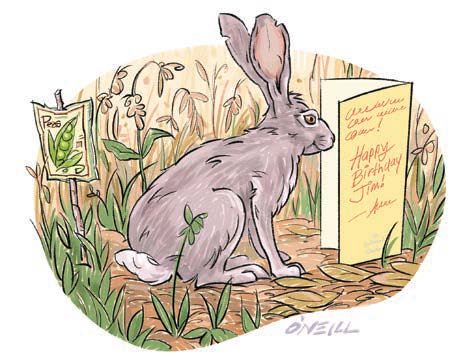
Ashley Walshe’s clever card amounted to a gentle poke from the universe, depicting an old, gray rabbit nibbling something in the garden. She knows I have a thing for woodland rabbits.

“Another year,” read the card. “Another gray hare — Happy Birthday!”

You may know Ashley from the soulful monthly Almanac she writes for the magazine, and from her many years adding earthy wisdom and wit to our editorial team. Among other things, she is a gifted poet and a true daughter of the Earth.

Not surprisingly, it was her accompanying hand-written message that reminded me of the lessons in gratitude and joy we’ve shared over the many years of friendship:

“In all seriousness,” she wrote, “thank you for showing me the joy of growing backwards . . . The secret, perhaps, to this wild, wonderful life on Earth.”

The idea of growing backwards is simply our way of describing a life in tune with nature, timeless values (some would call “old-fashioned”) that promote kindness and compassion to all living creatures and a deep reverence for the Earth.

In a year that has already seen apocalyptic wildfires out West, a record number of killer tornados in the heartland and a hurricane that will be remembered for generations, it isn’t much of a stretch to realize Mother Earth is sending us a serious message about our behavior.

Last November, Ashley and husband Alan nearly lost everything they own — including their lives — when their first home on a pretty hillside just outside Asheville was almost washed away by Hurricane Helene.

“At the height of the storm,” she remembers, “we were huddled in our house with our dog, Dirga, watching frightening torrents of water roar down the mountainside, washing away many of the houses around us. I remember asking Mother Mary to please keep us safe.”

Moments later, the couple heard a loud crash of trees that fell directly in the path of the rampaging waters, diverting the Biblical flood away from their home.

It was, she says, “a miracle. Nature saved our house.”

After escaping for a time to stay with friends outside the danger zone, the couple returned to find their home still intact but surrounded by a world of mud and debris.

“Helene brought me back to a higher level of consciousness, a desire to let go of things that don’t really matter in the course of daily life,” she says. “It also brought out an amazing amount of kindness and support among complete strangers who helped each other through the crisis. I think it changed many lives.”

The good news, she says, is that her bare yard is now a blank canvas awaiting the creation of a “wonderful new garden.”

Days after she told me this, she sent me a photograph of the lone plant that miraculously survived the Great Flood — a single, gorgeous tulip that popped up with the coming of spring. “Nature always gives us a gift,” she wrote.

That same afternoon, I noticed my own garden miraculously springing to life.

By now, it should really be something.

Simple Life

SIMPLE LIFE

Gone But Not Forgotten

The legendary newspaper woman who changed my life

By Jim Dodson

According to latest government projections, a record 3.7 million high school kids and 4.11 million college students will graduate this spring. In a world turned upside down by partisan politics and unpredictable economics, worries about the future are understandable. 

Once upon a time, I was there myself, waiting for the direction of my life to present itself.

In late spring 1976, America’s Bicentennial year, I was enrolled in a new M.F.A. writing program at UNCG and working part-time for my dad in advertising until I could figure out what to do with my life. America was slowly coming out of a powerful recession and job prospects were thin on the ground.   

Sadly — or maybe not — I turned out to be a lousy ad salesman. I could talk up a storm with my old man’s clients but never quite close the deal.

I also had an alternative plan of caddying for a year on the PGA tour, which proved to be a bust when I was assigned a tubby, wisecracking CBS TV star for the Wednesday Celebrity Pro-Am who’d never played the game. He told vulgar jokes to young women in the crowd and roguishly passed gas loudly to amuse the gallery. After a long and humiliating afternoon fetching my client’s lost golf balls from creeks, backyards and thorny bushes, he handed me a $2 tip and advised with a wink, “Don’t spend all that in one place, Sonny.”

I hurried straight to the Sedgefield Country Club bar with just that in mind.

At that early hour of the evening, the bar was empty save for an elderly gentleman sitting around the corner of the bar, nursing a cocktail.

As I drank my beer, to my shock and delight, I realized the gentleman at the end of the bar was none other than Henry Longhurst, the celebrated Sunday Times golf writer and CBS commentator — one of my literary heroes.

“Young man,” he spoke up with his charming grumble, “you look like I feel most mornings when confronting myself in the bathroom mirror.”

When I mentioned my horrible afternoon of caddying for a farting buffoon who killed my dream of caddying on the Tour, Henry “Longthirst” simply smiled. He asked what other options I had in mind. Confessing that my heart wasn’t into my graduate studies, I boldly commented that my real goal was to someday become a golf writer.

The great man nodded and slowly rose, placing a fiver on the counter. As he headed to the door, he placed his hand on my shoulder and said quietly, “Well, young man, if you do decide to write about this ancient game, you will find no shortage of rogues, bounders and peculiar characters, but also inspiring champions and some of the finest people on Earth. Good luck to you, then!”

I was thrilled by this encounter, taking it as a sign that the universe would deliver something good down the fairway of life.

A few days later, I received a phone call from Juanita Weekley, the managing editor of the city’s beloved afternoon newspaper, where I’d interned for two summers. She invited me to drop by for an interview.

“Be here at 5:30 sharp,” she said. “But don’t get your hopes up. You have lots of competition.”

I found her alone in her office the next afternoon. “Come in and close the door,” she said in her famous no-nonsense way.

Mrs. Weekley was a newspaper pioneer, the first woman to edit a major newspaper in the state, a tough, plain-spoken redhead who reminded me of Lou Grant, the crusty editor from The Mary Tyler Moore Show.

As I sat down, she pointed to a stack of folders on her desk. “These are applications from half a dozen outstanding candidates for this job. They are all female from top journalism schools. I’ve been instructed by personnel to hire a female. My question to you is, why should I even consider a skinny white kid from the west side of Greensboro?”

I understood her point. But I also had nothing to lose. I was still buzzing from meeting one of my sports journalism heroes.

Brazenly, I replied, “Because I’ll write circles around them all.”

Madam Weekley did not appear amused. Instead, she reached over her desk, picked up the wickedest-looking letter opener I’d ever seen and tapped it slowly on her desk.

“OK,” she said after a long pause. “I’m going to take a chance on you. But listen closely. If you’re not the best damn writer in this newspaper in a year, I’ll chase you out of the building with this thing.”

I spent the next year writing like mad to avoid being run off by her evil, sharp tongue and even sharper letter opener. At one point, however, Mrs. Weekley called me into her office and handed me the keys to a wheezing, 1970 day-glow orange AMC Pacer staff car and instructed me to drive a 75-mile circumference around the Gate City, searching for “good stories about country life” for the Sunday paper’s Tar Heel Living section.

“Think of it this way,” she said. “You’ll be our version of Charles Kuralt, writing about rural life and colorful characters you meet along the way. It’s right up your alley.”

She wasn’t wrong. 

Over the next six weeks, roaming the backroads of the western Piedmont and the Blue Ridge foothill country, I found an assortment of fascinating small-town stories and colorful folks to write about, including several homegrown artists, a brilliant Yale-educated physician running a clinic in an impoverished mountain town, an award-winning poet, a famous moonshiner, the biggest Bluegrass festival in history, and the winner of a Bear Creek talent show, whose mom invited me to marry her daughter after she graduated from high school. I politely declined.

Looking back, it was the best job any rookie reporter ever had — one that shaped my life.

My “country” tales won a major newspaper award and landed me a staff job at the Sunday Magazine of the Atlanta Journal-Constitution, where I was the youngest writer of the oldest Sunday magazine in the South.

Two decades later, I was back in my hometown on a national book tour for my bestselling memoir, Final Rounds. 

I stopped off to say hello to Juanita Weekley, the pioneering woman who took a chance on me way back when, and bring her a signed copy of my book.

She was in declining health. But her face lit up when she opened the door. We hugged and sat for an hour, and I thanked her for not running me off with her letter opener.

As she walked me to the door, she took my hand. “I knew you were going to be a superb writer,” she said, holding back tears. “I just didn’t want you to know that! I couldn’t be prouder of you, dear. Hiring you was one of the best things I ever did in my career.”

I kissed her cheek and thanked her. “It would never have happened,” I said, “without you.”

Juanita Weekley passed away in 2003.

Gone but never forgotten.

Simple Life

SIMPLE LIFE

A Spring Awakening

And a journey from darkness to light

By Jim Dodson

I celebrate April’s return every year because it’s the month that a divine awakening changed my life.

It was 1980. I was the senior writer of Atlanta Weekly, the Sunday magazine of the Journal-Constitution, the oldest newspaper magazine in the nation. It was probably the best writing gig in the South. Over the previous three years, I’d covered everything from presidential politics to murders in the “City Too Busy to Hate,” as Atlanta liked to promote itself in those days.

One minute I was interviewing a grand dragon of the Ku Klux Klan in Alabama, the next riding along with the Repo King of Atlanta as he repossessed cars in the city’s most dangerous federal housing project, a shotgun on the seat of his truck. I’d also written several pieces about young women from the South who were drawn to Atlanta’s bright lights only to wind up murdered or missing.

Looking back, though I didn’t realize it then, I was in search of an answer to a question that had no answer.

Three years before I snagged that job, Kristin, my girlfriend back home in North Carolina, was murdered in a botched holdup by three teenage boys at a Hickory steakhouse where she worked as the weekend hostess. I’d left Kristin on a beautiful October Sunday after making plans to get married and move with her to England, where she had a job as an understudy awaiting her in London’s West End.

The low point of my Atlanta odyssey came on a hot July night in 1979. I was working on a cover story about Bob Stivers, the city’s famous medical examiner, whose forensic sleuthing reportedly inspired the popular TV show Quincy. The week before that Saturday night, I’d watched half a dozen autopsies at the ME’s elbow, equally mesmerized and horrified. When Stivers invited me to ride along with the squad that picked up murder victims, I jumped at the chance. Saturday nights were particularly busy in the city that had recently been declared America’s “Murder Capital.”

My new fiancée, Hank Phillippi, was the nighttime weekend anchor at WSB-TV. We shared an old, brick house near the east-side entrance to Piedmont Park. Our weekend routine was to have a glass of wine and watch Saturday Night Live when Hank got home from the studio before midnight.  

On that fateful night, waiting for a call from Bob Stivers’ death crew, as I was standing in the darkness of our backyard, waiting for my dog, Magee, to do her business, I saw a car pull up beside our neighbor’s house. We were friendly with the Emory med students who lived there.

As I watched, a man emerged from the backseat of the car and calmly walked to our neighbor’s backdoor and knocked. A med student still in scrubs opened the door. There was a brief exchange of words, followed by two gunshots. The medical student collapsed on the ground. The assailant bolted for the running car, which sped away.

By the time I reached his side, a young woman from the house was screaming hysterically. I asked her to fetch me a couple towels and call 911.

Fortunately, at that moment, Hank arrived home. She took charge and phoned the police as I cradled the wounded man in my lap, attempting to keep him conscious. He died 15 minutes before cops arrived. “We get drug hits like this every weekend,” the cop said.

I chose not to follow the victim’s body down to the city morgue.

The next morning, though, as I was walking Magee, I heard a chapel bell in the distance softly chiming “Blessed Be the Tie That Binds,” one of my favorite hymns since childhood. Tears filled my eyes.

As Hank slept in, I fetched a cup of coffee, sat on our front steps taking stock of my life, and suddenly realized what was missing. I hadn’t been to church in five years.

I got dressed and went to services at the historic All Saints’ Episcopal Church downtown, famous for feeding the homeless and never locking its front doors. The rector, a wonderful man named Harry Pritchett, gave a powerful sermon about how God finds us in the darkness when we least expect it. It felt like he — or maybe God himself — was speaking directly to me.

Not only did I begin attending All Saints’ regularly, but also made a decision in favor of writing stories that enriched life rather than revealed its dark side. I even set my mind on attending seminary, until a wise old Bishop from Alabama named Bill Stough, the editor of the Bishop’s Fund for World Relief, convinced me to follow a “ministry closer to your heart,” as he put it. “You are a born writer,” he said. “You can serve the Lord better by writing about life than becoming a parish priest.”

Not long after that harrowing summer night, Hank and I called off our engagement, but have remained dear friends for more than 45 years.

As for me, that following April while working on a sample story about youth baseball tryouts, I ventured over to a rundown ball field in my midtown neighborhood, where a desperate league director convinced me to take on the coach-less Orioles. They were a wild bunch, many of whom lived in Federal housing. This was during the peak days of the “Missing and Murdered” crisis affecting Atlanta’s Black teens. I made a deal with my team’s families to drive them home after all games and practices.

I also made a deal with my rambunctious “Birds”: If they played hard and behaved like gentlemen, I would buy them all milkshakes after winning games.

They took the offer to heart. We won the Midtown League Championship in a romp that season, which convinced me to stick around Atlanta for one more year. We went undefeated for a second time. It only cost me 200–300 milkshakes.

I never wrote another crime story again.

Crazy as it sounds, almost a year to the day later, I woke on an April night to find Kristin standing beside my bed. She looked radiant. I thought I must be dreaming, but she was so lifelike, especially when she smiled and spoke. “Pook,” she said, using her pet name for me, “it’s time for you to leave here and go north. That’s where you’ll find what you are looking for. I’ll always love you.”

Days later, I resigned from the magazine, turned down what might have been a dream job in Washington, and headed for a trout stream in Vermont.

God, Kristin and my baseball team found me in the darkness when I least expected it.

It’s been a wonderful life ever since.

Simple Life

SIMPLE LIFE

The Art of Healing

With the dawn of spring, we begin again

By Jim Dodson

If you live long enough, the saying goes, you will discover that healing takes time.

This ancient wisdom is being driven home to me because 15 days before I sat down to write this column, I received a complete left knee replacement.

Friends who’ve been down this path were quick to assure me that the pain and discomfort that accompanies major joint surgery can only be mitigated by time, patience and committing to an aggressive program of physical therapy.

Owing to a lifetime of sports injuries and a fulsome style of landscape gardening my cheeky bride, Wendy, once called a “blood sport with bushes and trees,” I suppose I’ve always downplayed my naturally high tolerance for pain — until now.

“Did you happen to catch the number of the city bus that ran over my leg?” I groaned to my wife on post-op day three, often described as the peak moment of pain during joint recovery.

“Just relax and let your body heal,” was her response. “By March, you’ll be back in the garden and playing golf with a brand-new knee that feels great. It just takes some time to heal, babe.”

Of course, she was right. So, I shut my yap and let my body get on with its healing business without further interference from me.

It proved to be a wise move. Upon completing my second week of physical therapy, not only did I learn that I was a week and a half ahead of the normal recovery rate from knee replacement, but had also begun to regain the ability to walk without the assistance of a cane. The pain was also slowly vanishing — so much so that I did a walking tour of my garden to assess the winter damage. 

This adventure got me thinking about how waiting for the pain to stop and the healing to begin is a common experience that touches every aspect of our lives.

As children, we fall down or cut a finger and run to Mom or Dad, who applies the bandage and a kiss that makes the injury soon forgotten.

Every day on the news, however, we learn about children who live in war zones or are victims of child abuse. Their young lives will forever be damaged by the trauma they’ve suffered — a pain that will likely never quite vanish, leaving a wound that may never heal.

On a much larger scale, the recent devastation of homes and lives lost from Hurricane Helene and the raging wildfires of Los Angeles have produced pain and suffering on an apocalyptic scale, something that will take decades for communities to rebuild and heal. The outpouring of love and assistance from complete strangers to our mountain neighbors, however, speaks volumes about our shared human instinct for healing. A similar outpouring is already underway in the City of Angels.

On the scale of normal, everyday life, a lover’s broken heart may only require a few healing months of intense self-care, a good therapist and a new pair of shoes to begin the mending process.

The psychic pain of losing a job, sending a child off to college, ending a close friendship, or saying goodbye to a loved one or special place you may never see again can impose their own unique weight on the human heart. In time, only memory and gratitude for what was may soften the pain.

That, at least, is my hope.

One evening over this past Christmas, as we sat by the fire watching a holiday movie, our beloved cat, Boo Radley, suffered a sudden massive seizure. Boo was a large, gray tiger cat who entered our lives 14 years ago when Connor, Number Two son, brought him home as a tiny feral kitten found at the Southern Pines train depot on a winter night.

Connor named him “Nico” and kept him in his upstairs bedroom for several weeks before he moved on to Boston to accept a new job. At that point, we renamed the inherited young cat “Boo Radley” and watched him quickly take over the house. One minute he was grooming the ears of our big golden retriever, Ajax, the next sleeping in kitchen pots and pans. He was always up to some amusing mischief that made us all smile.

For some reason, Boo took a particular shine to me, showing up at my desk every morning to playfully tap my computer keys as I wrote. The first time I let him outside, he followed me entirely around the backyard watching me plant roses and mow the lawn.

One summer evening near dusk, I saw Boo bolt across the backyard being chased by a young gray fox. Before I could come to his rescue, I saw the young fox running back the other way — chased by Boo. Crazy as it sounds, their game of tag went on for weeks.

When we moved to the old neighborhood where I grew up in the Gate City, Boo really found his stride. He supervised as I re-landscaped the entire property and faithfully came to sit under the trees with me every afternoon when the day’s work was done. Likewise, for over a decade, he never failed to appear from his nighttime rounds to sit together under the early morning stars while I sipped coffee and had a friendly chat with the universe. He usually snuggled up in my lap as the Almighty and I sorted things out. On most afternoons, he napped in the golden-hour sun in his favorite part of the garden, which I eventually named “Boo’s Garden.”

Like the original Boo Radley, he particularly didn’t care for strangers, and proved to be fiercely territorial, ready to chase off any feline intruder foolish enough to get too close.

Wendy liked to say Boo was simply guarding his turf — and his best buddy.

I do believe this may be true.

On the fourth night after my knee replacement, however, during the deepest pain of my recovery, Boo suffered his sixth seizure in five weeks. The promising medication he’d been on for a month simply didn’t work, proving the art of healing is as much mystery as it is science.

Following a sleepless night, we made the painful decision to end Boo’s suffering. Hours later, a lovely vet from Lap of Love came and put my best pal to sleep on his favorite blanket. I don’t think I’d ever felt such emotional pain. Over a cat, no less.

Every moment of this life, as my late Grandmother Taylor liked to say, someone is waiting beneath a clock for a birth or a death or a chance to begin again.

The return of spring brings winter’s long wait to an end. It’s nature’s moment to heal and begin again.

With my brand-new knee, I can’t wait to get out into the garden.

But my best friend is gone, a pain that will probably take years to heal.

Simple Life

SIMPLE LIFE

The Pleasures of a Good Old Age

Miracles can come true, it can happen to you

By Jim Dodson

Not long ago, I heard an elderly gentleman in a coffee shop comment to a younger friend, “Someday, when you’re as old as I am, you will look back on your life and realize that everything is a miracle.”

His words brought to my mind Albert Einstein’s famous quote on the subject: “There are only two ways to live your life. One is as though nothing is a miracle. The other is as though everything is a miracle.”

Though it varies slightly from country to country, age 72 is the global median lifespan of most people on the planet — the statistical onset of “old age.”

This month, I turn 72.

Am I worried? Not so much. True, I walk more slowly and with more care these days due to a pair of arthritic knees, the painful legacy of 40- to 50-year-old sports injuries and having probably walked too many golf courses for one duffer’s life. By the time you read this, however, I hope to have a new left knee replacement for the new year with a second one on the way. Talk about a miracle.

Like many older folks my age, I’ve also survived cancer once and am winding up a second waltz with the dreaded disease, reportedly doing quite well, thanks to my brilliant young doctors and the miracles of modern medicine.

Despite these physical challenges, I’ve never felt happier or more productive. This seems to be a common trait among active elders who find the arrival of so-called old age to be a liberating force and an opportunity to experience life on a new and more meaningful level. A true case of attitude is altitude, as the saying goes.

One of the rarely mentioned gifts of being old is realizing what you no longer need or care about.

Two years ago, I donated half of my home library, roughly 300 books, to a pair of charities. This year, I plan to give another 200 away, leaving me approximately a hundred books I cherish and will continue to read again and again until my light in this world permanently dims.

At my pragmatic wife’s suggestion, I also went through my clothes closet and sent a large donkey cart’s worth of fine clothing I haven’t worn in more than two decades to a wonderful thrift shop owned by Freedom House, a local organization that provides drug rehabilitation programs to women. I hope whoever purchases the two fine custom suits, five Brooks Brothers blazers, nine crested-wool golf sweaters, eight pairs of worsted-wool slacks and 19 golf shirts will enjoy them with my blessing. Seriously, who needs 21 solid white golf shirts anyway?

Speaking of gratitude — and something of a miracle — I’ve reached an age where watching sports of any sort feels like a colossal waste of time. I’d rather take a long walk with the dogs, read a new book or watch seasonal birds at the feeder.

This is no small change. Once upon a time, now fading fast into memory, I was the original sports-mad kid who played every game in every season and died a little death anytime my favorite golfers and favorite professional sports teams lost. A decade ago, as my passion for all sports mysteriously began to wane, I wondered if this was because I’d changed — or if the games themselves had?

The answer is probably both. The sports teams I once worshipped, college and professional alike, were generally true hometown affairs where you could name (and root for) every player on the roster. This made the games feel much more personal and relevant. Today, almost all sports are shaped by staggering amounts of money flowing through their ranks. Not long ago, I heard about a local high school junior who recently signed with a major college program and pocketed $50,000 in NIL money. Add legalized sports betting to the state of our games and you may have a fast road to ruin for millions of fans who care less about the games than their payoff.    

The real beauty of aging, I long ago realized, is the light that comes from the soul. Reaching statistical old age brings with it freedom to do your own thing along with the opportunity to forge new paths and adventures.

“A good old age can be the crown of all our life’s experiences,” wrote Helen Nearing, “the masterwork of a lifetime.” Considerably late in life, Nearing and her husband, Scott, became world famous advocates of simple living and pioneers of the organic farming movement in America. Helen lived to be 91. Scott, 100.     

As Helen points out in her lovely book, Light on Aging and Dying, Socrates learned to play the lyre — and wrote his most famous poems — in his dotage. Thomas Edison was still inventing at age 92; Michelangelo did some of his finest work past 80; and Frank Lloyd Wright, at age 90, was considered the most creative architect in the world.

Likewise, numerous poets and artists proved to be at their creative best in their good old age. Thomas Hardy, Robert Frost and Carl Sandburg did some of their best work past 80. Ditto artists Goya, Titian, Manet, Matisse and Chagall. Shortly before his death at 91, Picasso said, “Age only matters when one is aging. Now that I have arrived at a great age, I might just as well be 20.”

Almost every day, we read about some octogenarian who still runs marathons or a septuagenarian who just climbed Mount Everest — for a second time. The list goes on and on.

“I am so busy being old,” wrote author and playwright Florida Scott-Maxwell in her 90s, “that I dread interruptions.”

As for this relatively new septuagenarian, one who will soon have new knees but no interest in running marathons or climbing mountains, I find the simple beauty of the natural world, a deepening spiritual life, a love of dogs and friends, plus an unquenchable passion for writing books reason enough to celebrate arriving at the ripe old age of 72.

The truth is, I’ve always enjoyed being with older people. And now that I’m one of them, I have no intention of slowing down.

That’s proof that everything really is a miracle.

Simple Life

SIMPLE LIFE

The Island Baby

A tale of the most perfect storm

By Jim Dodson

January is a special month in our family. That’s because three members of our scattered tribe are January babies. It could have been four if I hadn’t missed my due date by two days and wound up being a February groundhog.

My late father’s birthday is the 18th and my mother’s the 24th. But our oldest child’s birthday on the 28th holds the true winter magic.

Back in September 1990, as we lay in bed looking up at the stars through the skylight on our first night in the house on Bailey Island, my first wife, Alison, said quietly, “Let me have your hand.”

She placed it on her belly, and, sure enough, for the first time ever, I felt something flutter, soft as a hummingbird.

“That’s him,” I whispered in awe.

“Or her,” she said.

Friends were concerned when we told them we planned to move to an island off the Maine coast for the winter while beginning construction of our house on the mainland.

In good weather, they pointed out, the hospital was a good 45-minute drive away — across two adjoining islands, over three narrow bridges and through three tiny villages. In bad winter weather, the trip had been known to take hours.

From Labor Day to June, only about 300 souls inhabited the durable rock island where we set up housekeeping in a fine cottage, which provided us with a 20-mile view of the coast. Within days of our arrival — news spreads fast on a small island — we’d met the folks who ran the community store, the postmistress, several lobstermen and a chatty gentleman named Bob, sort of the island’s de facto mayor and charge d’affaires of information and snowplowing.

“When the snow flies, the drifts can get pretty wicked out here,” he explained, and turned pale when we mentioned we were in the family way — due in early February. “I’m awfully glad you told me,” he said seriously. “We’ll keep an eye on you.”

A few days later, a lady at the store slipped me a scrap of paper with a phone number and said, “I heard about your situation. Call anytime if you need to — Herman’s got four-wheel drive.” Not long after that, one of the local lobsterman pulled me aside and said, “I’ve got a boat that’ll chew through anything. Just give a holler.”

Such nice folks, those island souls.

While we settled in to wait for the baby, they prepared for winter snow, fixing drafts, hooking up plows, topping up the woodpile and getting buckets of sand ready. I realized how much the mariners loved the drama of winter storms. Hard weather makes good timber, as they say in the north country.

There was a dusting of snow two days before Christmas, followed by wind, arctic cold and nothing more. While the islanders scanned the skies for telltale flakes, we scanned a baby book for boy names. Everyone — I mean everyone — was certain we were going to have a boy, including yours truly.

“How about Herman,” I suggested.

Alison laughed. “You mean after the four-wheel guy?”

“More as in Melville, the great white-whale guy.”

Given our location, I suggested other strong nautical names, including Noah, Davy Jones, Billy Budd and Horatio Hornblower — “Hank” for short.

Alison merely smiled and shook her head. Other family members chipped in several male family names.

As the winter deepened and the delivery day approached, only my wife and my dad believed the baby would be a girl.

In the meantime, the islanders grew visibly tense from the absence of snow. Snowplows sat idle; the boys around the stove grumbled over their morning coffee at the community store.

It turned out, in fact, to be the unsnowiest winter on the island in a century. Just our luck. Poor islanders. By early January you could feel their desperation to push snow and fling sand. A few days before the month’s end, Alison joked that our baby would arrive with a snowstorm.

Her mouth to God’s ear.

That Friday night, as we were dining at our favorite restaurant in town, it began to snow like mad. Mainers live for the winter’s first good snow. You could see the relief in their faces. “Better late than never,” our waitress cheerfully declared as she delivered dessert. “Hate to waste my new snow tires!”

Moments later, Alison’s water broke. We left our dessert behind and went straight to the hospital down the block.

The delivery doctor said we still had several hours to go. So, as mother and baby settled in, I drove out to the island to get some clothes and feed the dog. By the time I got there, a blizzard was in full force and even my four-wheel Blazer had difficulty navigating our unplowed lane.

It took another two hours to get off the island, over the bridges and back to the hospital. By the time I climbed the final hill into town, the snow had stopped and a brilliant sunrise bathed a silent white world in golden light. It was a sight I’ll never forget.

I got to my wife’s side 10 minutes before the baby arrived.

The next afternoon, we brought our newborn home, bundled up like an Eskimo baby. The snow was so deep, we had to park at the community store and slide down the hill on our rumps to our cottage doorstep.

Stamping around, folks on the island were downright giddy. Bob was deeply relieved. Snowplows roared and news of the birth quickly spread.

Everyone who peeked at our new arrival wanted to know what we named our sweet island lad.

“Margaret Sinclair,” I proudly told them.“Maggie for short — after both of her grandmothers.”

Simple Life

SIMPLE LIFE

Christmas Wishes

Peace on Earth and pickup trucks

By Jim Dodson

Late last summer, my wife Wendy asked what I want for Christmas this year. She’s a woman who likes to plan ahead.

Figuring peace on Earth and good will toward men were probably not in the cards, a couple options came to mind.

“A wheelbarrow and a new Chevy pickup truck.”

She laughed.

“You’ve wanted a new pickup truck for almost as long as I’ve known you,” she said. “I’m not sure either would fit under the Christmas tree.”

She was right, of course. “But if I had a new Chevy pickup truck,” I pointed out, “we could bring home a really big Christmas tree and all kinds of other great stuff.”

“I thought we agreed to start getting rid of stuff we no longer need or want,” she reminded me. “Not bringing more home.”

She was right about that, too. We are de-stuffing our house right and left these days. But an old dude’s perpetual dream of owning a new Chevy pickup truck doesn’t go away easily.

So, I asked what she wanted for Christmas this year.

“I’d like to go to a very nice hotel by myself for a night — and just do nothing,” she said.

I’ll admit, this surprised me, but it shouldn’t have.

Wendy is the most organized, generous, and busiest person I know.

She runs her own custom baking business, keeps the family finances, and does the bookkeeping for both our businesses. She also does most of the grocery shopping, regularly gives blood and platelets, and somehow keeps up with the secret adventures of our far-flung children. Someone is always asking her to do something — volunteer to make pies for church suppers or donate ten dozen exquisite hand-painted cookies for a charity fundraiser. Family, friends and neighbors routinely turn to her for advice on a range of subjects, and then there’s her egg-headed husband who can never find where he left his car keys, eyeglasses, lucky golf cap or favorite ink pens. Somehow, she can find these vital items within seconds — just one of her many superpowers.

That’s a lot of stuff to keep up with, I grant you.

Then there was her sweet mom, Miss Jan, who resided at a lovely assisted care facility in town but spent every weekend at our house. With her dementia growing more apparent by the month, Wendy’s focus on her mom’s comfort and needs ramped up dramatically. Daily visits and doctor appointments filled her calendar, which also included lunches at Jan’s favorite restaurants, and bringing her mom clean clothes and delicious dinners every evening, even as Jan’s appetite began to ebb.

No wonder she fantasized about a quiet night alone at a nice hotel.

“How about two or three nights at the Willcox Hotel for our anniversary?” I proposed as the date approached. The Willcox is in Aiken, South Carolina. It’s our favorite hotel, charmingly quaint, blissfully peaceful and located a mile from our favorite golf course.

She loved the idea and promptly booked us a nice long weekend. She even arranged for Jan’s kind caregiver to look in on her every day while we were gone.

Ironically, our anniversary trip to the Willcox didn’t come off because we couldn’t find someone to look after our three dogs and two cats for the weekend. It was the heart of the summer vacation season, which meant every kennel in town had been booked solid for weeks.

So much for a needed break.

Suddenly, it was middle autumn and life was speeding up dramatically. Wendy was busy baking for the larger crowds at the weekend farmers market where she sells her spectacular baked goods, and I was finishing revisions of my book on the Great Wagon Road, scheduled for a spring publication, and starting a new Substack column.

More importantly, Miss Jan’s condition was worsening by the week. Her physician advised us that she would probably be gone by Christmas.

Early on the morning of November 1, the eve of All Saints’ Day across the world, Jan quietly passed away.

Suddenly, what either of us wanted for Christmas was completely irrelevant.

Losing a beloved parent puts life in a different perspective. In Jan’s case, her quiet passing brought an end to suffering from an insidious disease that cruelly robs its victims of speech and memory. What’s left is a hole in the heart that can never be filled.

Jan’s passing also reminded us that we’re at a stage of life where material things no longer hold much magic. There’s really nothing more we need or want. Except more time with each other.

For Dame Wendy, the simple pleasure of the holiday is finding the perfect live Christmas tree, putting on holiday music, cooking for family and friends and doing small things that make Christmas feel special. Last year, she gave me a sensational pair of wool socks and a nifty garden shovel. I gave her a nice, fuzzy sweater and tickets to a concert at the Tanger Center, along with a jumbo box of Milk Duds, her favorite forbidden pleasure.

This year, I plan to give my amazingly busy wife two nights at the luxury hotel a few miles from our house, where she can put her feet up, drink very good wine, eat Milk Duds to her heart’s content and maybe find peace and joy in doing absolutely nothing. Miss Jan would wholeheartedly approve.

As for me, well, forget the Chevy pickup truck for now. But I figure the wheelbarrow is a cinch to show up beneath the tree.

Simple Life

SIMPLE LIFE

The Sacred Month

A time to go inside

By Jim Dodson

Long ago, I decided that November is the most sacred month.

To my way of thinking, on so many levels, no other holds as much mystery, beauty and spiritual meaning as the 11th month of the calendar.

The landscape gardener in me is always relieved when the weather turns sharply cooler and there’s an end to the constant fever of pruning and weeding, plus fretting over plants struggling from the heat and drought of a summer that seems to grow more punishing each year.

Once the leaves are gathered up, and everything is cut back and mulched for the winter, not only does my planning “mind” kick in with what’s to be done for next year, but the beautifully bare contours of the Earth around me become a living symbol — and annual reminder — of life’s bittersweet circularity and the relative brevity of our journey through it.

The hilly old neighborhood where we reside is called Starmount Forest for good reason, owing to the mammoth oaks and sprawling maples that kindly shelter us with shade in summer and stand like druid guardians throughout the year, season after season. Beginning this month, the skies become clearer and the nighttime stars glimmer like diamonds on black velvet through their bare and mighty arms, hence the neighborhood’s name: a “mount” where the “stars” shine at night.

Of course, there is risk living among such monarchs of the forest. Every now and then, one of these elderly giants drops a large limb or, worse, topples over, proving their own mortality, sometimes taking out part of a house or a garage, or just blocking the street until work crews arrive with chainsaws. As far as I know, no one has ever been seriously injured or killed by our neighborhood trees, though the growing intensity of summer storms seems to elevate the danger. Lately, some neighborhood newcomers, prefiguring catastrophe, have taken to cutting down their largest oaks as an extra measure of security in a world where, as actuaries and sages agree, there really is no guaranteed thing. In the meantime, the rest of us have made something of a Faustian bargain with these soulful giants for the privilege of living among them. We care for them and (sometimes) they don’t fall on us.

Speaking of “soul,” no month spiritually embodies it better than November.

All Souls’ Day, also called The Commemoration of All the Faithful Departed, comes on the second day of the 11th month, a day of prayer and remembrance for the faithful departed observed by Christians for centuries. The day before All Souls’ is All Saints’ Day, also known as All Hallows’ Day or the Feast of All Saints, a celebration in honor of all the saints of the church, whether they are known or unknown.

Every four years, the first Tuesday that follows the first Monday of November is our national Election Day, a day considered sacred by citizens who believe in the right to vote their conscience and tend the garden of democracy.

Congress established this curious weekday of voting in 1845 on the theory that, since a majority of Americans were (at that moment) farmers or residents of rural communities, their harvests would generally have been completed, with severe winter weather yet to arrive that could impede travel. Tuesday was also chosen so that voters could attend church on Sunday and have a full day to travel to and from their polling place on Monday, arriving home on Wednesday, just in time for traditional market day across America.

Like daylight saving time (which, by the way, ends Sunday, Nov. 3) some critics believe “Tuesday voting” is a relic of a bygone time, requiring modern voters to balance a busy workday with the sacred obligation of voting. For what it’s worth, I tend to fall into the camp that advocates a newly established voting “holiday weekend” that would begin with the first Friday that follows the first Thursday of November, allowing three full days to exercise one’s civic obligation, throw a nice neighborhood cookout and mow the lawn for the last time.

While we’re in the spirit of reforming the calendar, would someone please ditch daylight saving time, a genuine relic of the past that totally wrecks the human body’s natural circadian rhythms? Farmers had it right: Rise with the sun and go to bed when it sets.

Next up in November’s parade of sacred moments is Veterans Day, which arrives on the 11th, a historic federal holiday that honors military veterans of the U.S. Armed Forces, established in the aftermath of World War I with the signing of the Armistice with Germany that went into effect at the 11th hour of the 11th day of the 11th month of 1918. In 1954, Armistice Day was renamed Veterans Day at the urging of major U.S. military organizations. 

November’s gentler sunlight — at least here in the Northern Hemisphere — feels like a benediction falling across the leafless landscape, quite fitting for a month where we go “inside” literally and figuratively to celebrate the bounty of living on Earth. In the Celtic mind, late autumn is the time of the “inner harvest,” when gratitude and memory yield their own kind of fertility.

“Correspondingly, when it is autumn in your life, the things that happened in the past, the experiences that were sown in the clay of your heart, almost unknown to you, now yield their fruit,” writes the late Irish poet John O’Donohue.

First shared by Squanto and the pilgrims in 1621, Thanksgiving was decreed  “a day of public Thanksgiving and Prayer” on November  26, 1789, by George Washington. Then it was proclaimed a national holiday on the last Thursday of November by Abe Lincoln. Finally, during the Great Depression in 1939, it was moved to the third Thursday of the month by Franklin Roosevelt to extend Christmas shopping days. But for most folks, the observance of Thanksgiving embodies, I suspect, many of the things we hold sacred in life:

The gathering of families, memories of loved ones, lots of laughter, good food and friendly debates over football and politics.

I give extra thanks for Thanksgiving every year, especially the day after when some who hold bargain-hunting on “Black Friday” a sacred ritual thankfully disappear and I am free to enjoy my favorite “loaded” turkey sandwich and take a nice long afternoon nap by the fire to celebrate my favorite holiday.