
Strolling with Fungi

STROLLING WITH FUNGI
Strolling with Fungi
A woodland garden flourishes in an old Winston-Salem neighborhood
By Ross Howell Jr. • Photographs by Lynn Donovan
Managed by the Piedmont Land Conservancy, the Emily Allen Wildflower Preserve is a reminder that the natural world lies right at our feet.
In 1954, Allen and her husband, O. G., moved into the dream home they’d built on 6 acres of land — with a creek — in a leafy Winston-Salem neighborhood.
One spring, Allen noticed the purple-and-white petals of a wildflower emerging beneath what she described as “a mess with poison ivy, honeysuckle and blackberries growing everywhere” near the creek.
That wildflower was a showy orchid (Galearis spectabilis) and, somehow, it sparked a passion in Allen to learn everything she could about North Carolina native plants.
She took a botany class at Wake Forest University and went on to serve as president of the North Carolina Native Plant Society. Over some 40 years, Allen collected wild plants from the mountains of Western North Carolina, nursing them in her backyard.
Emily and O. G. donated their land through easement to the PLC in 2000. Since then, Allen’s care for what she always called her “Friendship Garden” has been bolstered by PLC staff and stalwart volunteers.
O. G. passed away in 2006 and Emily in 2015. Upon her death, their home was donated to the conservancy to be developed as an educational center.
Allen’s wildflower garden and house feature not just flowers from the mountains, but also a bounty of eastern North American trillium, along with native ferns, creeping phlox, Dutchman’s breeches, cranesbill geranium, flame azalea, Carolina buttercups, columbine, plus Oconee bells (Shortia galacifolia), a rare wildflower found in the southern Appalachian Mountains.
As you’d expect, the site is best known for its spring wildflower group tours, which are available by appointment only.
But photographer Lynn Donovan and I are here to participate in a fall “Mushroom Stroll,” one of several programs offered annually at the garden.
It’s raining steadily, and I should’ve given more thought to my outerwear. Veteran photojournalist Donovan has wisely brought a slicker and hood.
We’re greeted at the door by Janice Lancaster, manager of the garden. Lancaster received her undergraduate degree in dance from the University of North Carolina School of the Arts. In addition to her work with the PLC, Lancaster has developed a dance-ecology course at Wake Forest University and her choreography often features environmental themes.
A group of mushroom strollers are already inside, as is Kenneth Bridle, who will lead our tour.
Bridle has a Ph.D. in biology from Wake Forest and has worked with the PLC for more than 30 years. Recently, he retired from his position as stewardship director and now acts as a conservation adviser, leading nature walks and other activities.
Bridle’s career in environmental preservation is truly remarkable.
He is the author of several natural heritage inventories as well as rare plant and animal surveys. A founding member of the Dan River Basin Association, the Carolina Butterfly Society and the Triad Mushroom Club, he also teaches classes in a selective and rigorous Master Naturalists’ program that prepares volunteers to lead stewardship, education outreach and citizen science projects.
Bridle gives us a quick tour of the improvements to the Allen house.
Split units now replace the original heating system. A downstairs bathroom was remodeled to serve as a wheelchair-accessible restroom.
“The last part is taking out cabinets and countertops in the old laundry room,” Bridle says. In their place, a catering kitchen will be installed.
“It’s slowly turning into more usable space, which is what Emily always wanted,” Bridle says.
He should know. He met Allen when he came to her garden as a graduate student.
That started a friendship that lasted for years. Bridle often served as Allen’s driver on her plant-collecting expeditions and, like her, Bridle would go on to serve as president of North Carolina Native Plant Society.
“After a hot, dry summer, we usually have some kind of rain event,” Bridle says, “and the following week, the mushrooms go crazy.”
Bridle clears his throat.
“So, we’re going to wander around outside,” he announces to our group. “Everybody keep your eyes peeled.”
As we go outside, we can hear the steady drum of raindrops in the leaf canopy.
After a few steps along the path, Bridle pauses and points to the ground.
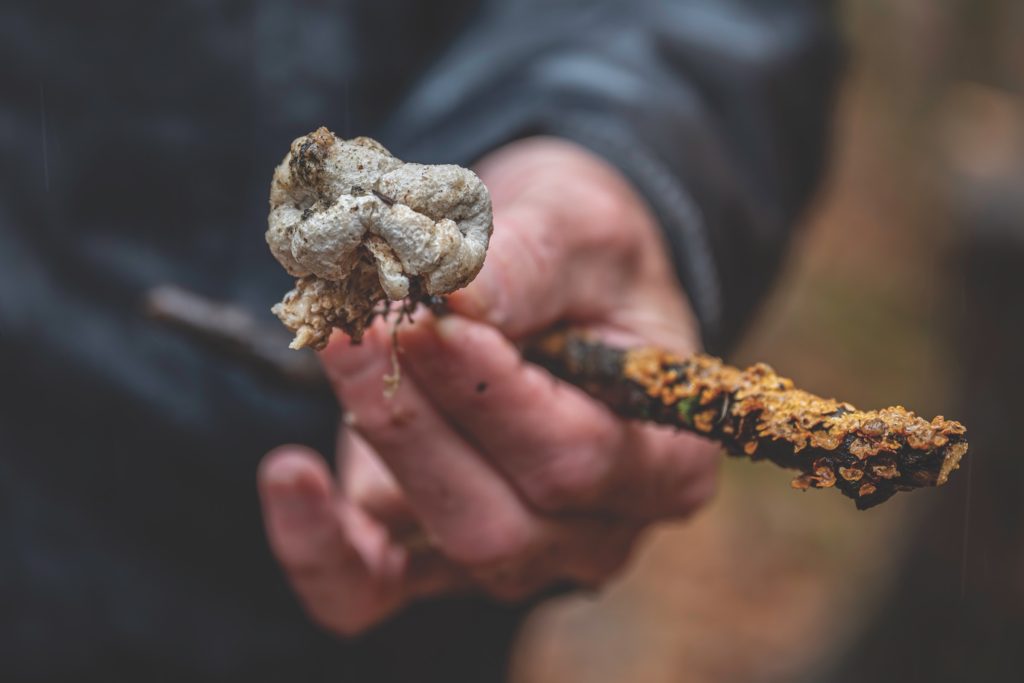
“Right there, bird’s nest fungi,” he exclaims. Bird’s nest fungi (family Nidulariaceae) are small, cup-shaped fungi containing spore-filled discs that resemble tiny eggs. The fungi feed on decomposing organic matter, such as wood and plant debris.
“When a drop of water falls in the nest,” Bridle says, “those spores blast out.”
He points out a dark mass spreading among leaves and sticks.
“That’s a whole colony of them,” he explains.
A few more steps into the woods, we spy a tree trunk glistening in the rain. On its side are orange-colored growths with the texture and shape of oyster shells.
“That’s shelf fungi called orange crust,” Bridle says. “They come in many different versions.”
Shelf fungi have a tough exterior and are a favorite of mushroom enthusiasts because they can be observed year-round, even when other types of mushrooms might not be in season.
Bridle tells us that an unusual variety grows in the Blue Ridge Mountains, feeding on decaying rhododendrons.
“Those are iridescent blue and will glow in the dark,” he says.
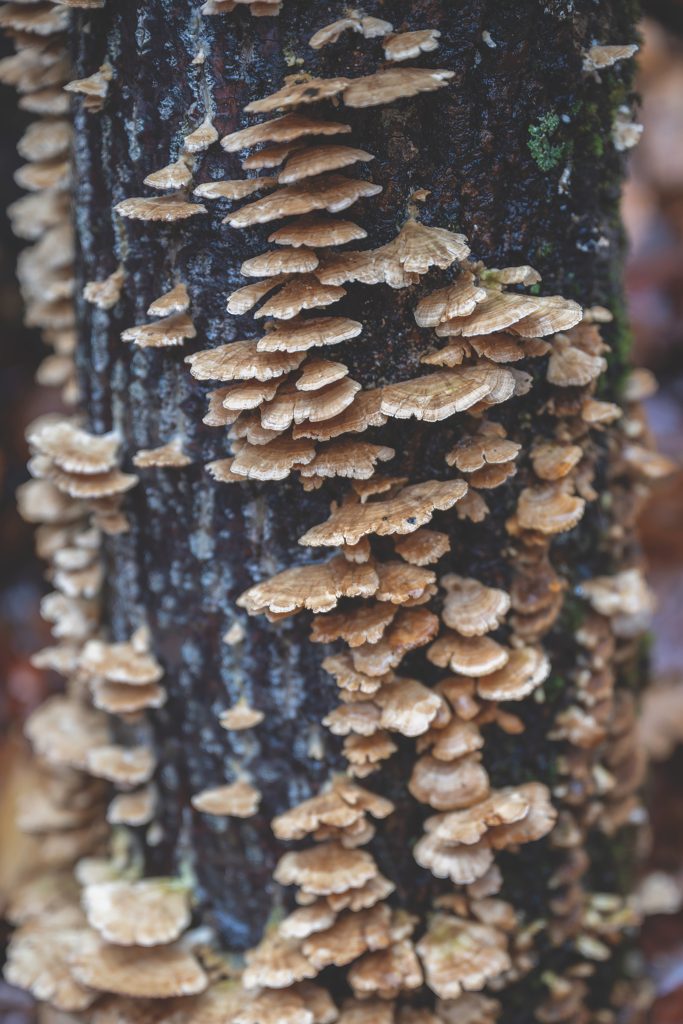
Farther along, we come upon more shelf fungi. These are called turkey tails. They’re nestled in groups along a rotting limb, bearing the shape and color of a tiny tom turkey displaying his tail feathers.
“They always have those nice, multicolored, concentric rings,” Bridle says. “And they have a long tradition in Asian medicine.”
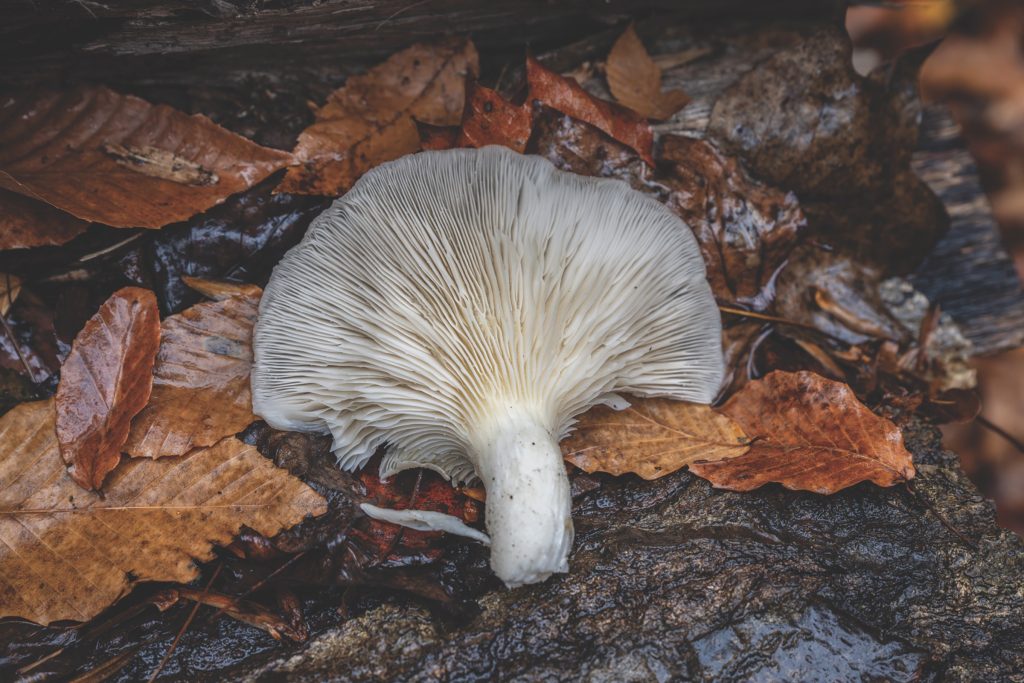
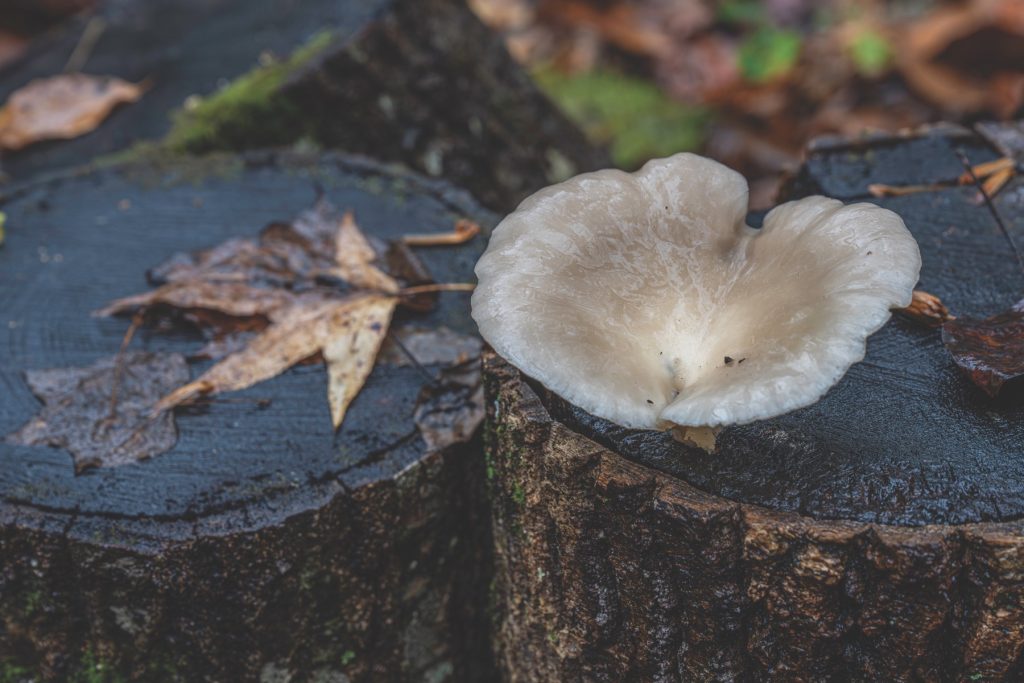
As we make our way farther down the swale toward the creek, we come upon oyster mushrooms (Pleurotus ostreatus). Pale and serene, they’re edible, prized for their delicate texture and flavor.
“Of the mushrooms we find in the woods, the oysters are probably the most common,” Bridle says.
Nearby, Bridle points out another mushroom growing on a tree stump. It’s a resinous polypore (family Fomitopsidaceae).
“See that orange resin?” he asks. “They produce that resin even in the driest of summers.” These mushrooms are perennials, producing a new ring of growth each year.
On a decaying log farther along the path, Bridle spots a small specimen of an edible shelf mushroom. It’s called chicken of the woods (genus Laetiporus) and can grow to be quite large, stacked in shelves, some 10 inches in width.
He tells us that the flesh of the mushroom is soft and tasty, and stores well wrapped in a paper bag and kept in the refrigerator. Vegans often prepare it as a substitute for meat, cooking it in a variety of ways.
“Anything you can do with a chicken finger you can do with chicken of the woods,” Bridle says.
He describes other fungi that are common to the area — hen of the woods, shrimp of the woods and lion’s mane.
“You’ll often find lion’s mane high up in a standing, dead tree,” Bridle says.
No excursion into the world of fungi is complete without at least one bizarre fact, and Bridle points out some beech trees growing on the other side of the creek.
“In September, I always take people down among those trees,” he says, “because that’s where you’ll find the beech aphid poop-eater.”
Our group laughs nervously. Sometimes with a mycologist (a scientist who studies mushrooms), you wonder if they’re just pulling your leg.
Bridle explains that beech trees in September are hosts to colonies of beech blight aphids.

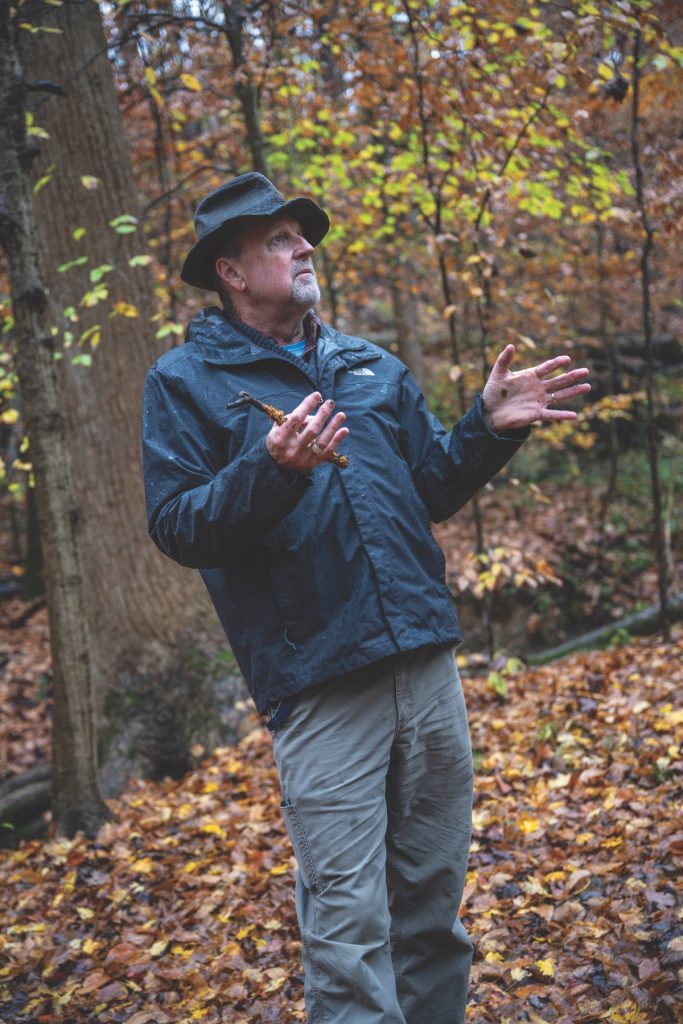
“We call them boogie-woogie aphids, because, if you tap on the tree branch, all the aphids do the wave.” That is, the aphids all at once start throbbing in unison.
See what I was saying about a mycologist?
These tiny insects suck sap from the beech trees, feeding on the sugar. Their excretions are politely referred to as “honeydew.”
So, on the limbs and leaves beneath the aphid colony, you’ll see masses of black fungus that look like sooty sponges.
That’s Scorias spongiosa, the beech aphid poop-eater.
“Everybody remembers that one,” Bridle concludes.
The rain is falling in earnest now, so even the well-equipped are ready to retreat. My barn coat feels like it’s holding about a gallon of water.
Donovan stows her camera gear and we get into the car.
We’re wet as bird dogs after a hunt. But we’re both grinning like crazy.
High on mushrooms, you might say. And filled with wonder for the natural world.