
The House Next Door

THE HOUSE NEXT DOOR
The House Next Door
A hard-won dream is realized some 40 years later
By Cynthia Adams • Photographs by Amy Freeman
What happens when a house lover pines for the house next door? Ultimately, something wonderful.
While scouting business locations in the ’80s, Larry Richardson suddenly noticed an aristocratic house. A plummy one, as the Brits say. A grand Georgian Revival, the historic Stroud house featured rich architectural details, including Corinthian columns and pilasters, and tiled roof.
“I remember to this day driving down that street and looking at properties and seeing the house,” says Richardson. “And thinking that’s the most beautiful house I’ve ever seen! It’s as clear as yesterday.”
Unavailable, and for a small business owner, also unattainable.
So he did as he always did. He worked harder.
Richardson, who grew up near Burlington, has a work ethic that won’t quit, something he attributes to his grandmother in particular. “I wouldn’t take anything for the lessons of rural life,” he says.
“Everything that could be used was used. And reused.” She collected buttons in a jar, he remembers. Was resourceful in the way that Depression-era country people were. “Quilts,” he muses, “were really the first recycling.”
She taught him to value — and save — everything. And thrift worked in his favor. In the early days of his businesses, he was at the Super Flea each month, selling plants and cultivating customers for a nursery business that was growing faster than the hanging baskets and houseplants he sold by the truckload. He supplied plants for furniture showrooms in High Point each Market. He scoured estate sales every weekend to stock booths at three consignment shops.
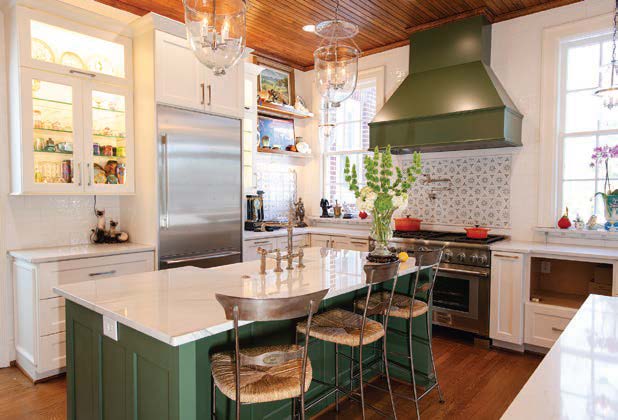
Instead of the Georgian, in 1989, he snapped up the historic Hollowell house next door, named it “Seven Oaks” and spent 30 years making it a worthy neighbor to the object of his affection. He filled it with finds, sourcing furnishings far and wide. At 5,000 finished square feet after a top floor conversion, his fixer upper was nothing to sneeze at. The pièce de résistance? A stunning kitchen renovation (“Purveyors of Beauty,” Seasons, December 2020), he says, a dream realized.

Having transformed “the heart of the house,” Richardson declared that he and his partner, Clark Goodin, would never leave.
That was in 2020.
The two houses differed in style down to the brick color and roof — Seven Oaks was a Colonial Revival with sand-colored brick. The Stroud house, affectionately known as Hilltop, was larger. (Officially listed as the Stroud house on the National Register of Historic Place after original owners Bertha and Junius B. Stroud.) And, it had space to create a downstairs main bedroom suite — something that the original footprint of Seven Oaks did not.
Yet both houses had more than their Sunset Hills location in common — two-story garages complete with living quarters and full basements. Both were also listed on the National Register of Historic Places.

Since 1925, the century-old Stroud house has had few owners.
According to census data and city directories, after four years, the Strouds sold to Alice and John K. Voehringer, president of the textile concern Mock, Judson, Voehringer Company.
William Clement Boren Jr. and his wife, Ruth, owned the property from 1935–1940.
By 1941, Pearl and Charles Irvin, president of Elam Drug Company, had moved from their home at 900 North Eugene, becoming the home’s longest residents and raising sons Charles and David and daughter Doris there. The eldest son, Charles Jr., and his wife, Mary, acquired the house in the 1990s. Charles Jr. died in 2015, and Mary in 2019, leaving the house unoccupied.
Slowly, the grand house was emptied of years of family memorabilia.
Richardson debated and pondered. It would make a fabulous project. On occasion, despite his day jobs as a nursery owner and antique retailer, Richardson had flipped “at least four houses, maybe more,” converting worse-for-the-wear properties to stunners, carefully preserving architectural integrity. Mere blocks away, a skillful Arden Place flip practically sold before the paint was dry in 2016.
He was familiar with the home fixer-upper journey: Take a good house, one with fine bones and possibilities, in a great location, then modernize all systems, redo baths and kitchen, and finesse cosmetic updates. “Landscaping, of course,” he says.
Before leaving for work, he would glance next door, imagining the landscape possibilities at the Stroud house. (After all, plants were his longtime passion and career.) Time passed.
This was the opus — the house he studied every single day. The family agreed to give him first right of refusal — but it was a sobering, massive project.
Standing at their kitchen sink looking across the driveway, he and Goodin began seriously talking: This could be the ultimate flip. In his mind, Richardson could already see it restored to its former grandeur. It could again be the most beautiful house on a street lined with fine residences.
What he had never experienced, however, was a remodel that would take nearly five years to complete, thanks to a global health disaster and the chaos that ensued.
Nor could he anticipate that what began as admiration might deepen into love and a new opportunity to age in place.

Richardson and Goodin closed on Hilltop in the fall of 2020, soon after completing a dreamy kitchen of their own that was the culmination of years of collecting and saving.
The house next door was tired. Interiors that were au courant 30 years ago were no longer.
The previously redone kitchen would be gutted. The baths were 1925-era and had never been modernized. The house’s infrastructure had to be addressed from electrical and plumbing to central air and heating. “The only heat was an old boiler, and they had one air conditioner on the second floor,” Richardson recalls.
The Georgian’s ballroom filled the entire third floor. To claim that square footage as living area would require support beams and a stairway relocation, plus electrical, plumbing, heating and air systems.
As for the rest, it came into view as the house was stripped of the cosmetics. Out went pastels, mint green and maroon carpeting, floral valances and Venetian blinds, along with 1980-era floral wallpapers.
Fully emptied, a vision took form. Early on, Richardson chose a color palette then picked tiles. Then cabinetry for kitchen and bath, with plans to create the ultimate main closets. Relocated a door or two. Scheduled floor refinishing. Imagined architectural restorations and enhancements. He splurged on choices, fittings, new baths — the whole house aesthetic — before the tedium of scraping, caulking and painting both interior and exterior.
“Then we got into COVID.”
“It was awful, and had I known what I was going to face I would have passed. I would have run the other way. Even with people and workers I had relationships with, I couldn’t get any momentum. Things just languished,” he recalls.
Renovations were suddenly uppermost for those stuck at home, and workmen and supplies were in demand during a time of uncertainty and scarcity.
“Workers got sick with COVID, then their partners. Then their families. It went on and on. Worse yet, the supply chain drove up prices of everything that went into it. A two-by-four went to at least triple the price. Any budget you had was gone.”
Amidst the chaos that overtook the globe, both Richardson and Goodin had businesses to run. Owners of Plants & Answers’ two locations, Richardson oversees the Big Greenhouse on Spring Garden, and Goodin runs the floral business in downtown Greensboro.
Time dragged by and the work — on the largest renovation they’d ever undertaken — proceeded in hiccups.
They consoled themselves, knowing they still could flip the property and make a nice profit if they proceeded as planned. It was, at least, a project greatly simplified by living next door.
At the time, they were still thinking strictly in terms of a flip.
Fast forward a few years later? It would be late in 2024 — four years since purchasing — before they could see the project’s end in sight.
Renovations had not come easily.
Even now, things remain tough, Richardson explains. For example, the custom front storm door he ordered didn’t work and had to be redone. It rested on its side in the living room. But the creative vision worked.
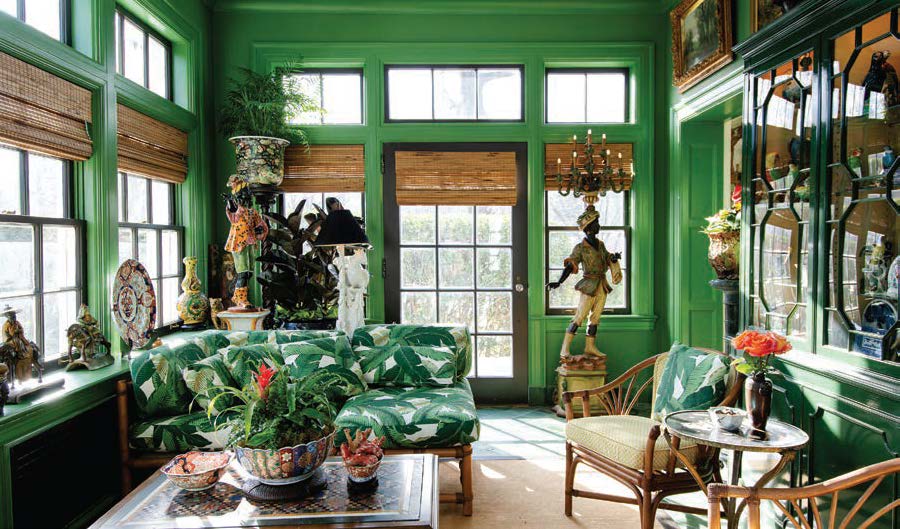
“I [always] knew green would have to be a tie-in color,” Richardson says indicating the original green tiled sunporch that opens to the dining room. (There is a second sunporch at the rear of the house.)
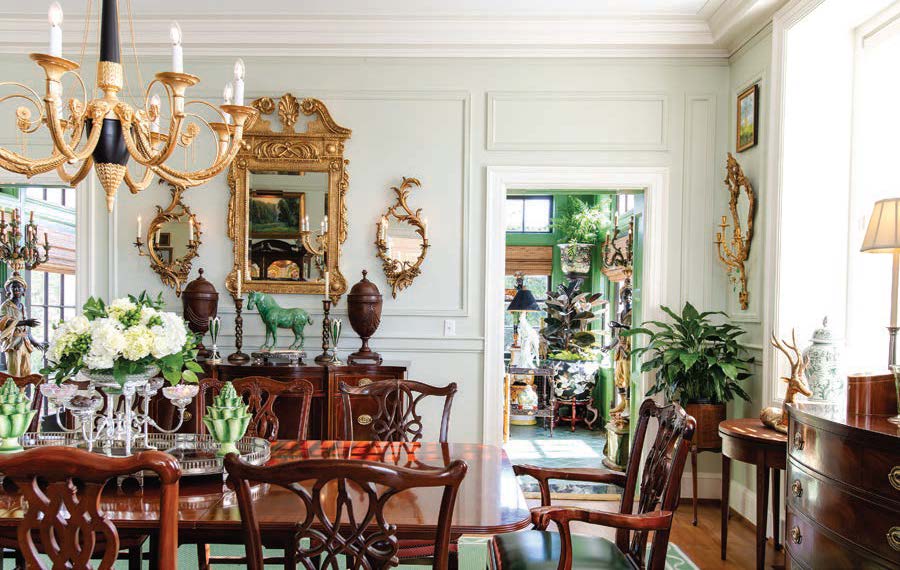
Whereas pastels ruled in the old interiors, they were not going to survive in the new design. Green, however, would stay, replaced with supersaturated colors like Greenfield (Sherwin-Williams) and a bronze Benjamin Moore hue for the sunporch’s trim and casement windows.
The redone kitchen features yet another strong green, Sherwin-Williams Basil, as a unifying accent. In the breakfast area, he reused Sherwin-Williams Restrained Gold, a rich ochre tone from his former kitchen. He also installed a stained tongue-in-groove kitchen ceiling, and white quartz countertops.
A pot filler and porcelain farm sink were suggested by Goodin, who loves to cook. Richardson points out the natural light: “It’s fabulous.”
Master carpenter Marty Gentzel built the kitchen cabinetry, as well as other cabinetry, molding and architectural touches throughout the house. Gentzel, whose work is in high demand, could only begin full-time work on the house last September.
He previously worked on the renovated and newly created third floor baths last April, then tackled replacement shutters for the exterior ones that were ruined by age.
Gentzel created arched kitchen doorways, unifying the opened space that combines the breakfast and butler’s pantry area, while tying in existing archways at the front of the house. The previously squared off doorways showcase his favorite work in the house, custom arches painstakingly matched to existing trim work. “That was tricky,” he adds.
“When you do an arch, it opens up everything,” says Richardson. He felt they would be a wonderful flourish.
“This whole house, it’s a canvas all its own,” says Gentzel. “You care more than anyone I’ve seen,” he says, turning to Richardson.
“I’m almost done,” Gentzel says, having worked daily only months ago.
“No, you’re not,” Richardson quips, then grins. “I’ve got more projects for you.”
For the central, inner core of the house, Richardson used an aged white on the walls, describing “a creamy white, and trimmed in Dover White,” also used for trim throughout the home. For the formal rooms, “Livable Green and Ethereal White lent green undertones, tying the rooms together.”
Three years after the renovations began, Richardson had invested far more time and money than he had imagined. During a kitchen table conversation, Goodin hazarded an idea: Why not move into Hilltop themselves?
Richardson was amazed. He’d idly imagined keeping the house. But he hadn’t allowed himself to imagine actually living there.
Goodin pressed. They could complete the two planned bathroom renovations for Seven Oaks when empty and prepare it for sale. Hilltop would become their permanent home. “We could have a downstairs bedroom and age in place,” he argued.
Goodin made strong points. Why shouldn’t they benefit from all the work they’d poured into the restored home? Plus, they’d worked their entire lives. This was a fabulous home large enough to handle all their collections.
Privately, Richardson considered: Had it always seemed more than just a flip?
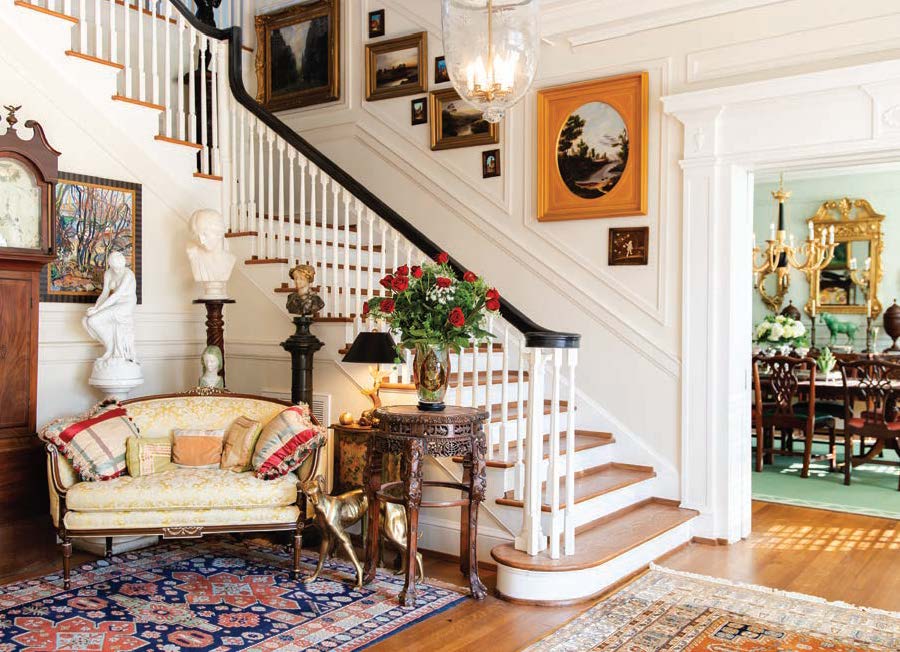
Had he stood in the grand foyer, staring at the sweepingly dramatic staircase and envisioned what he would do with the final interiors? Yes, he admittedly had.
The problem with doing flips, he admits ironically, is that he always wants to do the house as if he will live there.
Then Richardson laughs; he had been shopping in earnest for the house even before he and Goodin contemplated keeping Hilltop.
“I was going to do some light staging for it,” he explains. “I began to do it with opposing sofas in the living room. Something people would relate to. But I didn’t start buying furniture and rugs until Clark said, ‘I think we should move into the house.’”
Richardson immediately ramped up his search. He raked through estate sales across the state. Soon he was bidding on furnishings that were scale appropriate, and Venetian glassware and hand painted plates that would accent the dining room.
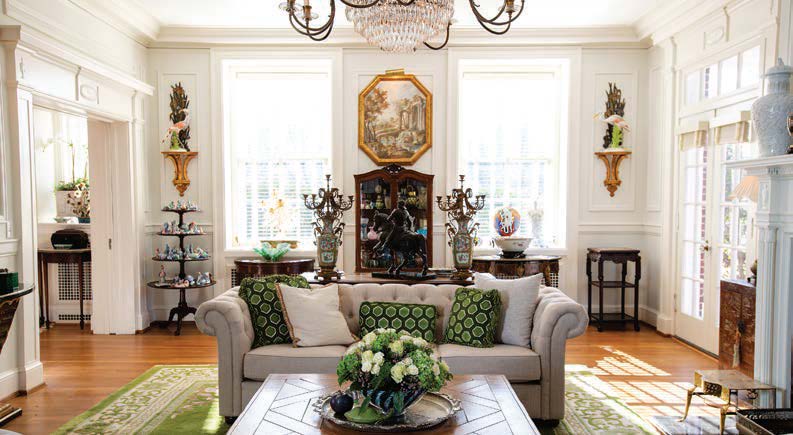
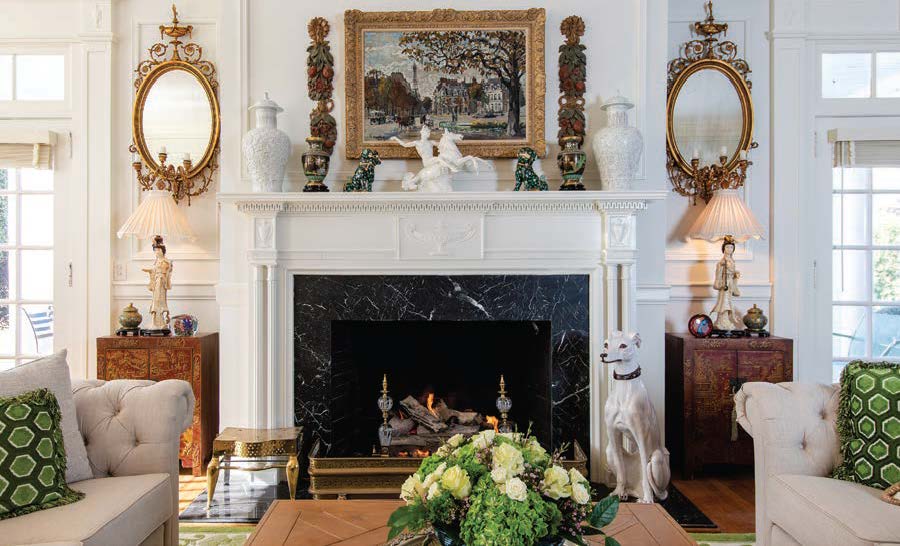
Stacks of artwork awaited hanging, including a painting by former Greensboro artist David Bass. A federal mirror found a place in the stunning living room.
“I looked for the right rug, and it was tough,” he says, pulling two chinoiserie chairs into the main living room to be used as accent chairs beside a side table. A new-to-him grandfather clock found a home.
“I already knew what I was going to do,” he says, scrolling through pictures on his phone of vintage acquisitions. He hung lighting found at estate sales and auctions. Period lighting for the dining room was purchased from the Dupont estate. The dining room’s central candelabra is a Versace design, one of only eight made.
Even as the furnishings awaited placement, Richardson’s eyes shone with the certainty of his vision — instinctive vision.
Richardson acquired 18th-century Irish mirrors for the living room, which is approximately 18’ x 30’ in dimension. It can swallow up a whole lot of furniture, he admits, but he wanted ample open space. A green chinoiserie secretary and a narrow Irish wake table, “useful for overflow dining,” are in the living room.
The hallway, whose new molding matches surrounding rooms, features Impressionistic paintings and serves as an art gallery. “There was no molding before, just plain walls,” says Richardson. Over 500 feet of molding, according to Gentzel, was replicated from the main level and added. “He redid this entire room,” Richardson says, indicating the family room, with a newly built in Baker cabinet he bought for $100.
An expanded downstairs bath is a step towards having the option of converting the den to a main bedroom.
But it is the powder room that had guests buzzing when Richardson and Goodin hosted their new home’s first event in November 2023, even with the house mostly empty and work still underway. (They sponsored a fundraiser last winter for a local animal rescue.)
The tiniest of all the rooms, it punches well over its weight. Artist Cheryl Lutens was commissioned to faux paint a chinoiserie bronze/gold design on the walls, so deftly done it rivals luxurious de Gournay hand-painted paper. The ceiling is gilded with gold leaf, lending depth and dimension. A guest called it “the jewel box.”
It nearly upstaged the central stairway — a “Federal style, sweeping staircase,” as Richardson describes Hilltop’s showstopper.
The expansive upstairs landing is large enough to serve as office space. The house, however, still in a state of flux between renovation and occupation, was like a theater set before the opening show. Furniture partially filled the landing, which served as a staging area.
The Irvins’ daughter, Doris, was in attendance for the fundraiser along with other family members, including eldest son, Mose Kiser and wife, Jean. She regaled guests with stories of her family home in its heyday. She chortled over how her mother unceremoniously goose-stepped an intruder, who had crawled through an upstairs bedroom window, out the front door.
The upstairs, neutralized and fully functional, sports essential yet invisible changes that consumed large chunks of the budget. Heating systems, reworked roofs and copper guttering were costly; built-ins cleverly conceal necessary ductwork.
Similar to downstairs, baths were either gutted or expanded where possible, and redone in sympathetic style to the originals. Two were added on the third floor.
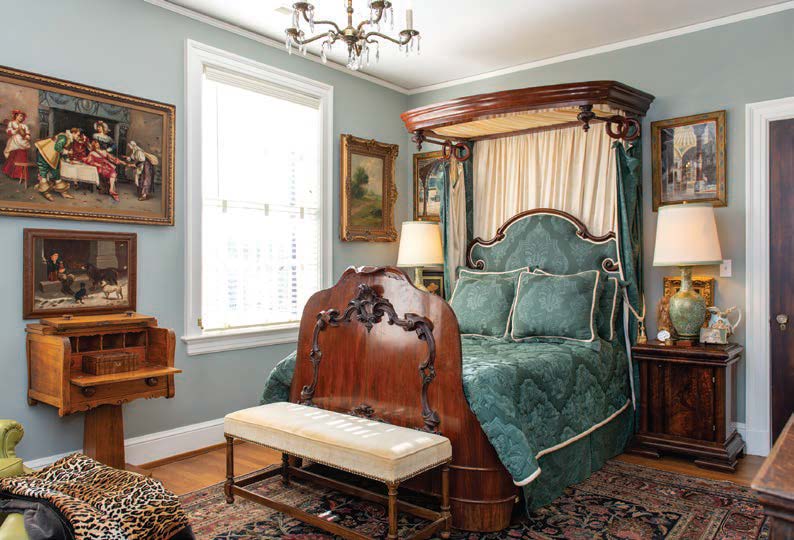
The color palette upstairs is a noticeably calm, “restful gray,” Richardson says, which has further served to open the space.
The main upstairs bedroom has a French door providing access to a walk-out space — the same one where the intruder had hoisted himself up. “It’s beautiful at night here,” says Richardson. “You can watch the stars.”
It will overlook a garden he is planning, where, years ago, the Irvins created three holes for the children to learn golf, he explains.

Several French doors lead to walk-out exterior terraces upstairs, including on the front of the house directly over the entrance.
Most radically altered is the third floor. The former ballroom (pressed into service for Greensboro High School’s student prom) has been transformed into new bedrooms and baths. The unfinished oak floors now shine.
Richardson is pleased with the new iron staircase leading to the third floor with a gracefully curving handrail in a fanciful design called “the lamb’s tongue,” designed by craftsman Randy Valentine of Southside Iron Works.
“Randy said he’d never curved a piece [of iron] this thick. He was very proud of it.”
New stairs replaced narrow, cramped steps — once the sole access.
Richardson is especially fond of one of the new third-floor showers featuring a light-providing window.
He leads the way down three floors to the least changed space: the basement.
Here, the house seems to audibly breathe. He envisions a finished wine room. The whitewashed basement is mostly empty apart from a zinc-topped counter relocated from the kitchen.
Standing in the quiet, cool space, Richardson grows thoughtful, confessing it may seem odd to upsize when others nearing retirement do the opposite. Hilltop now has nearly 6,800 heated square feet. Here they can begin to “curate carefully and eliminate excess.”
“It’s an opportunity to thoughtfully place things.” He adds, “We can actually see our collections versus having them stuck away in closets and drawers.”
Can he envision living at Hilltop?
“I do,” he adds quietly. “But I was conflicted. Because I still love our old house.”
He takes stock, absorbing the rhythms of the house. A quiet lull before a brick mason arrives to discuss an outdoor water fountain, one Richardson found at an estate sale near the mountains.
“Listen, I never imagined we could have something so wonderful. But we’ve both worked hard for everything we have.”
As wonderful as a dream realized is, he later phones to share what he likes best about the beauty he wooed and won.
Forget the sweeping stair, grand entry and front rooms. He’s happiest with the everyday spaces. “The rooms at the back of the house. The kitchen. The sunporch.” Here, he and Clark read papers, drink coffee, share meals. Ordinary moments in a dream of a house.
He sighs happily. One day, too, he adds, “I’ll slow down.”