
The Preservationist and the Painter

THE PRESERVATIONIST AND THE PAINTER
The Preservationist and the Painter
A marriage of opposites dances in the light on Magnolia
By Cynthia Adams
Photographs by John gessner
Preservationist Mike Cowhig was a longtime bachelor in his 50s living on Eugene Street in a Craftsman-style home when he met his wife, artist Denise Landi. He worked excessively, golfed occasionally and sometimes, she jokes, “held up the wall” at the original Rhino Club downtown, which recently reopened.
Formerly married with two young girls and a boy, Landi studied art history at Carolina. Over a 40-year career, she has dramatically incorporated her personal history, memories and fragments of dreams into paintings.
Art was a consuming passion for her; community planning, history and preservation were his.
The couple dated for two years before deciding to marry but were torn between her recently acquired house on Magnolia and Cowhig’s bachelor bungalow.
Magnolia Street won. His impression when he first toured the house? Smitten.
“I love this house,” admits Cowhig, a longtime community planner for the City of Greensboro.
“I’m glad we decided here,” he adds, “although I loved the house on Eugene.”
They were married in the backyard of the house in 2004, a year after Landi purchased the Colonial Revival. Neighbor Nicole Crews hosted a wedding reception, and the celebration continued afterward at local hangout Fishers Grille. (A gate in her back fence, Cowhig explains, then conveniently opened to the backside of the bar.)
The wedding party and guests merrily trooped through the house, out the gate and into Fishers, he remembers. The bride hired a new local band called Beaconwood for the occasion.
“Beaconwood played bluegrass and other types of music and were fantastic!” Cowhig adds. Fast forward 15 years after their raucous musical wedding party at Fishers Grille.
“Steve Robertson, a local attorney, moved into a house on Leftwich Street very close by,” says Cowhig. His son Eric Robertson founded Beaconwood while in high school. Their members now played on a world stage with artists like Rhiannon Giddens and Steve Martin.
If Beaconwood set the tone for a mellow relationship, not every note played smoothly in the early phases of marriage. Initially, while planning an addition to the rear of the two-story clapboard back on Magnolia, the new family of five squeezed into Cowhig’s bachelor pad at 923 N. Eugene St., the three young children “bunking in one room.” It was a madcap jumble of Barbies and G. I. Joes. Landi’s youngest daughter was still a toddler.
“I think he fell in love with my kids. And he liked me, too, you know?” Landi says with a twinkle.
“Our contractor did that thing where they get close to completion and then they move on,” Cowhig recalls. “Denise read them the Riot Act. I was glad — she had every right. She let them know she was not happy.” After that, the addition came together.
Cowhig was naturally interested in the particulars, being a walking compendium of Greensboro’s original neighborhoods. Living in Fisher Park, designated as a historic district in 1982, was a form of work immersion for Cowhig.
Early in his professional life, he assisted in gathering supportive evidence for the district, inventorying the neighborhood’s original layout and structures. Cowhig worked on the creation of Greensboro’s three historic districts, now including Dunleath and College Hill.
Consider the context: When the Schoonover house was built, Fisher Park was evolving as Greensboro’s first suburb, featuring a variety of architectural styles and opulent mansions on a section of North Elm Street dubbed the “gold coast.” Iconic churches nearby — Holy Trinity Episcopal (built in 1922), the imposing gothic First Presbyterian (built in 1928) and Temple Emanuel (built in 1922) — all sprang up in that period.
But even an expert can be thrown off by clues contained within an old house. Just how old was it?
He discovered a piece of children’s homework dated 1912 “so I assumed it was built around 1911–12.” But further research placed the house as being built later, in 1921, for physician Robert A. Schoonover. So much for circumstantial evidence. The doctor kept an office nearby on South Elm Street, mentioned in the 1925 edition of Hill’s Greensboro Directory.
As pleasant as the attributes of a century-old home may be — nicely sized rooms, original windows and two working fireplaces — the historic record matters less than evidence of a family thriving here.
Their children’s heights are not just marked but colorfully illustrated (by the hand of a painter mother) inside a doorway into the kitchen. Cowhig and Landi planted roots in a neighborhood, not merely a house. A walkable, convivial area where neighbors know their neighbors.
Fred Rogers would have been pleased.
Whereas Cowhig is a man of measured speech and action, the woman of the house is a dynamo of color and vitality.

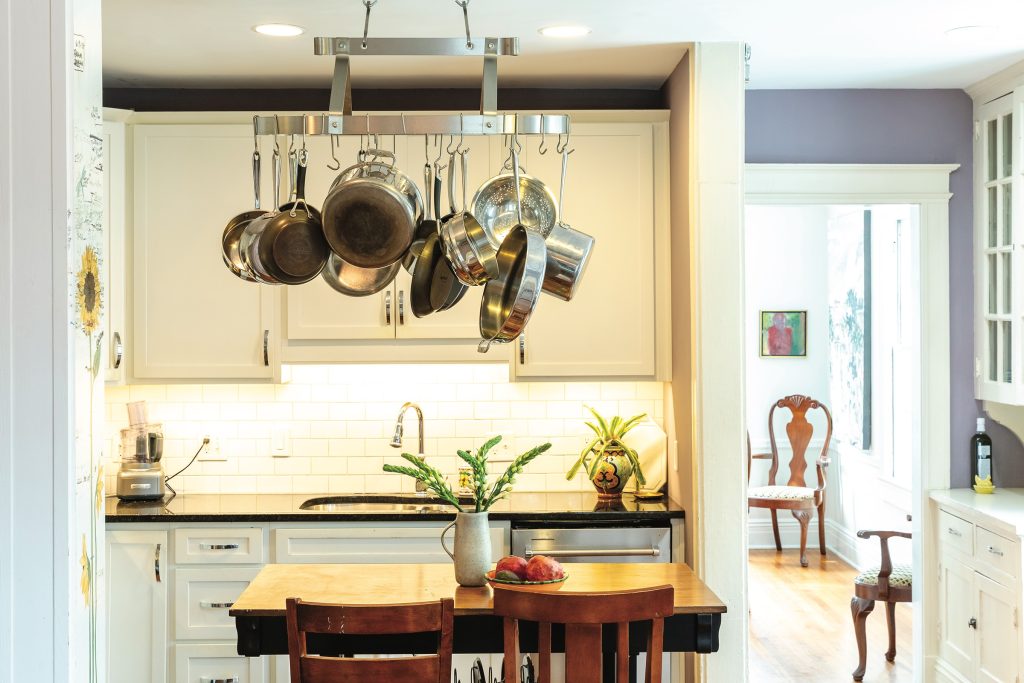
She laces a hot coffee with creamer and immediately takes a bold drink — no cautious sipping first. Landi bristles with energy even without caffeine but pauses long enough to enjoy her coffee in a kitchen shot full of life and light. An adjacent butler’s pantry with original cabinetry creates a conduit to the dining room.
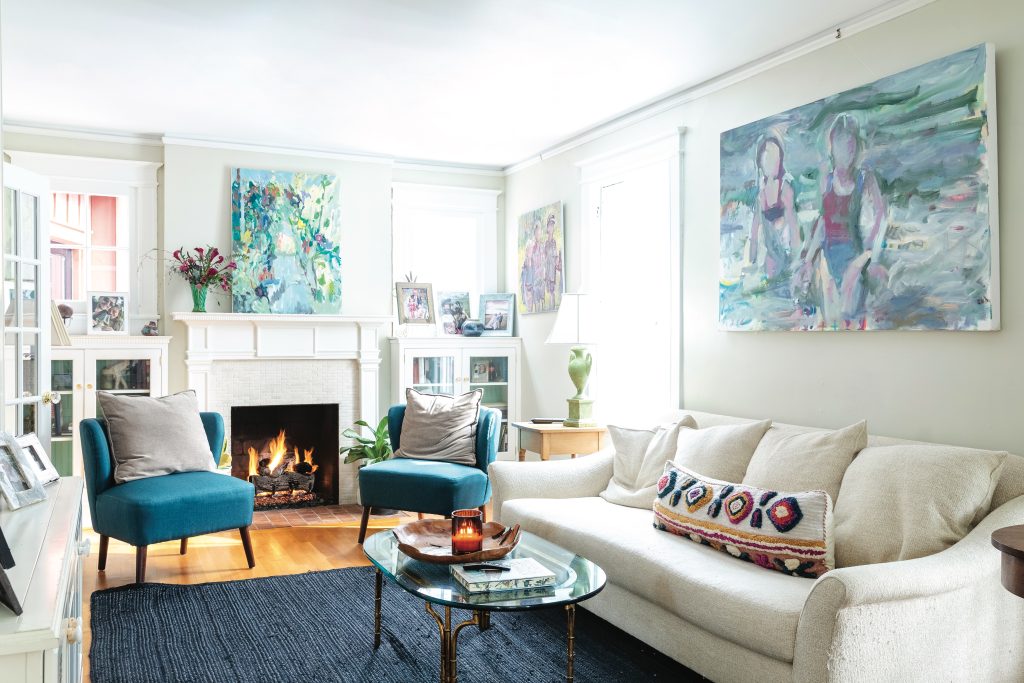
As you might expect in the home of an artist, furnishings and clutter are deliberately edited to allow artwork to take center stage.
Generous molding, handsome mantels, built-in bookcases (which they supplemented with more during the building of the addition) and French doors separating the living room, den and the dining room up the charm factor. With ample wall space painted in pale tones, Landi’s art serves as the chief source of color — she is a prodigious artist who sometimes produces multiple works in a single week. Their home is a perfect showcase for it.
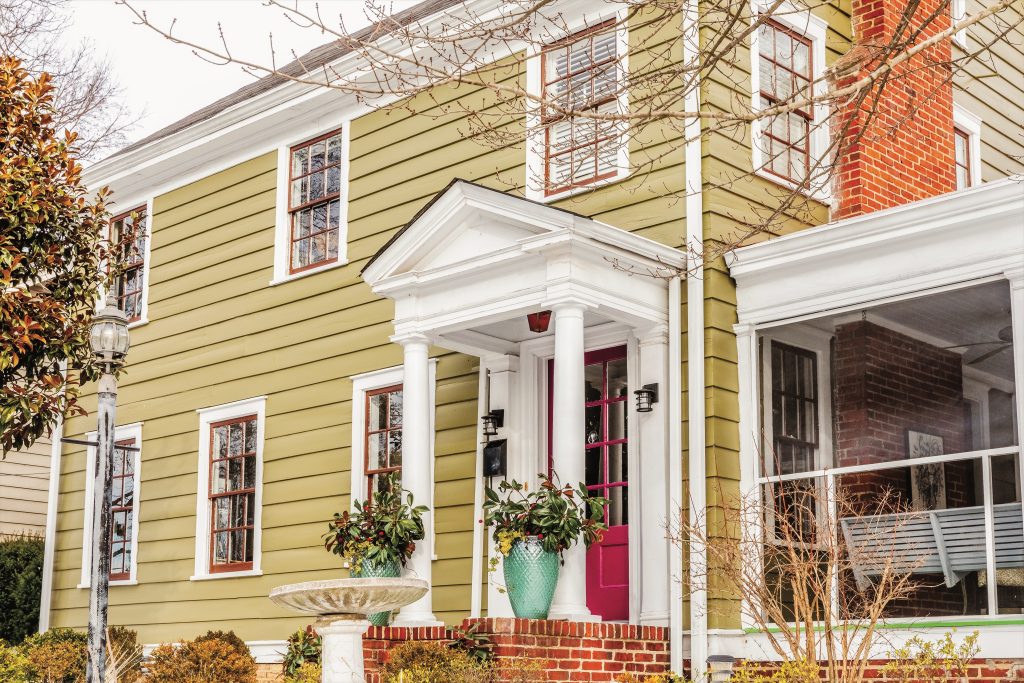
After ridding the house of aluminum siding long ago, its original, albeit in need of a refresh, beauty emerged.
Tax credits were instrumental in being able to afford a historically accurate rehabilitation: “We used North Carolina historic tax credits, which was 30% at that time,” Cowhig recalls. “That credit really made the difference for us.” Once the siding was banished, Landi chose new exterior colors, bolder than the original white found beneath the siding.
“It’s a house that was built without a front portico, [but] which has a nice classical roof and columns, and a nice, screened side porch,” Cowhig says.
Landi again mentions that every room has good light, something deeply valued by one whose work depends upon it.
Given her artistic focus, it is surprising that it was not her original career plan. “I was going to Carolina intending to become a journalist” before that notion ground to a halt once there. “I couldn’t type,” she says with a rueful shake of her head.
“I never learned to type!” she repeats with incredulity. Her mother, who studied fashion at Parsons School of Design in New York, strongly discouraged her daughter from wasting time on pedestrian skills.
Landi changed her major to art history. Following her degree, she began seriously studying painting. She completed an M.F.A. in Florence, Italy, at the Dominican University, devoting two years to the Italian Renaissance.
Initially, the idea of becoming an artist seemed “just too easy.”
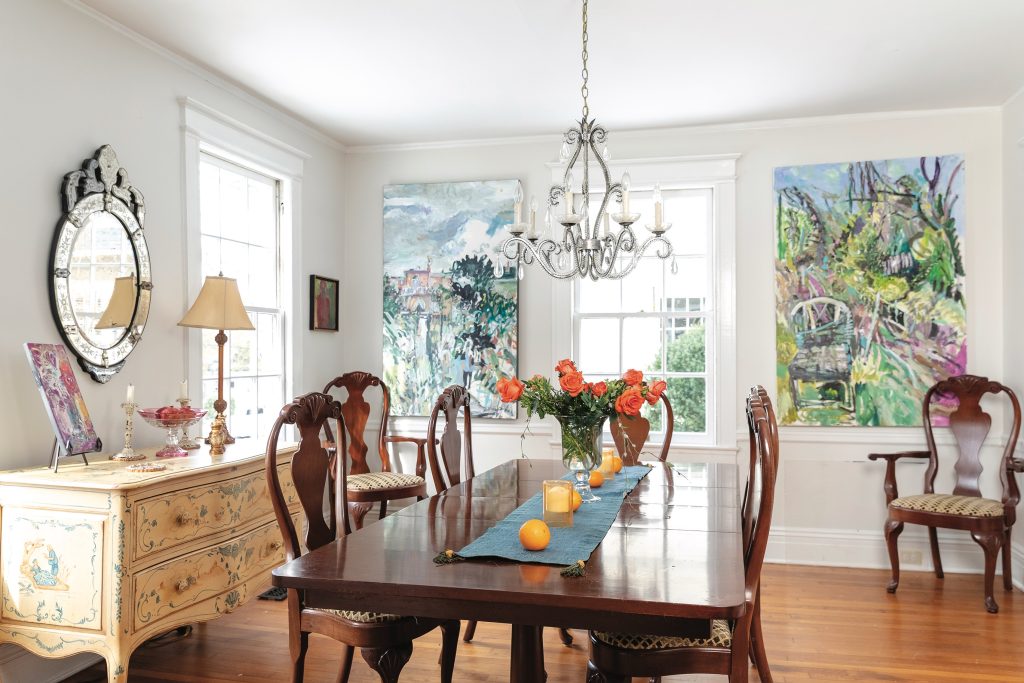
“My very first words were ‘pretty light.’ I did not say mama, hi, daddy, anything. And it was at my grandmother’s chandelier,” says Landi. No coincidence, then, that her first show at The Marshall Muse Gallery this year was titled “Categories of Light”.
Landi’s largest work there? Chandelier (Southern Lights).
The inspiration for that painting is the dining room’s Italian chandelier, which features a light-refracting, antique, Venetian mirror found at Carriage House.
On the same brusque, wintry morning that Landi meets to discuss the house, Cowhig pops over to his old office in City Hall where he began working in 1975. He is technically retired yet still putting in a few hours weekly with a South Benbow project. In fact, he shared recognition with two others for a Voices of the City Award last November for contributions to that work.

Bert VanderVeen, a volunteer member of the Historic Preservation Commission, or HPC, first met Cowhig 25 years ago.
“What do you say about Mike, who is and does so much?” asks VanderVeen. “One of my first calls in 2001 was to the city planning department when I bought a historic house in Dunleath and needed a COA [certificate of appropriateness] to make repairs.”
VanderVeen has seen firsthand how Cowhig works tirelessly to bring about preservation, as in the case of the newly developing South Benbow district, the first of its designation in the state. “He can shepherd you to a solution. One thing that struck me on the commission was that even when we did not agree completely, Mike would get us there.”
When historic buildings could not be saved, Cowhig advocated for an architectural salvage program benefiting Blandwood, the historic Governor Moorehead mansion. He rallied and worked alongside volunteers to salvage slate tiles from my own Latham Park home a few years ago.
His retirement is keenly felt.
“I really miss working with Mike both on the Greensboro commission and at Architectural Salvage [ASG],” says Commissioner Katherine Rowe, who lives in Sunset Hills. “Salvage volunteers felt lucky to learn from Mike. He has a deep knowledge of Greensboro’s history and neighborhoods.”
She fondly remembers doing pickups with Mike. “We’d rumble around town in the rattly Architectural Salvage van, picking up six-panel doors in Fisher Park or prying out house parts in an abandoned home way out in the country,” she recalls. “We’d gather doorknobs and butterfly hinges to sell back at ASG.”
He recruited Landi to help with a pickup in his absence. “To her credit, Denise very cheerfully helped me load it in the white van,” says Rowe. “We had never even met!”
“I love history just as much as he does,” Landi adds. “And houses.”
Her aunt lived in a Tarboro antebellum house, one Landi stayed in and admired. She also visited her godparent in Toronto during the summer, whose grand home was furnished with antiques. She mentions granular details right down to the home’s fine marble doorknobs.
Her husband is “a man whose life has been about helping save old houses,” she notes. “I love the way Mike . . .” Landi stops, searching for the right phrase. Then she brushes the air with her hand.
“OK, here is the problem. In the same way that we love them spiritually, sometimes we forget to love them physically.”
She adds meaningfully, “I can be messy.”
Placing her coffee cup on the kitchen table, Landi gesticulates, trying to describe their relationship. Her father was Italian, she explains, so she requires both hands when passionate.
She borrows a visual from something she read of a slow-moving person holding a balloon which pulls him along. “And that’s kind of like me and Mike. Mike keeps me from flying off too far. I can see that.”
Her expressive face opens with a smile. She, in turn, helps to prevent her husband, a quietly sanguine man, from being overly cautious. Even if she might veer and “pull him over the rocks.”
“She’s the real deal when it comes to her artwork,” he says about his wife. “The painting, the artwork is what gives her energy. She will wake up, cannot sleep, and she gets up and starts painting.” The next morning, he finds she has created something remarkable.
Landi spontaneously offers a full tour while searching for a misplaced phone. Wherever the eye lands, there is a point of beauty: a vintage Empire-style dress she recently wore to a Jane Austen birthday celebration hanging in a bedroom, an antique Italian tile hung on the wall like an icon.
“Actually, it is an icon,” she decides.
She scans the foyer, elegantly spare with a center painted table, leading to the side porch where she often works.
When painting outside, she says, “I feel expanded and unfettered. I sometimes put paintings on the fence and go at it.”
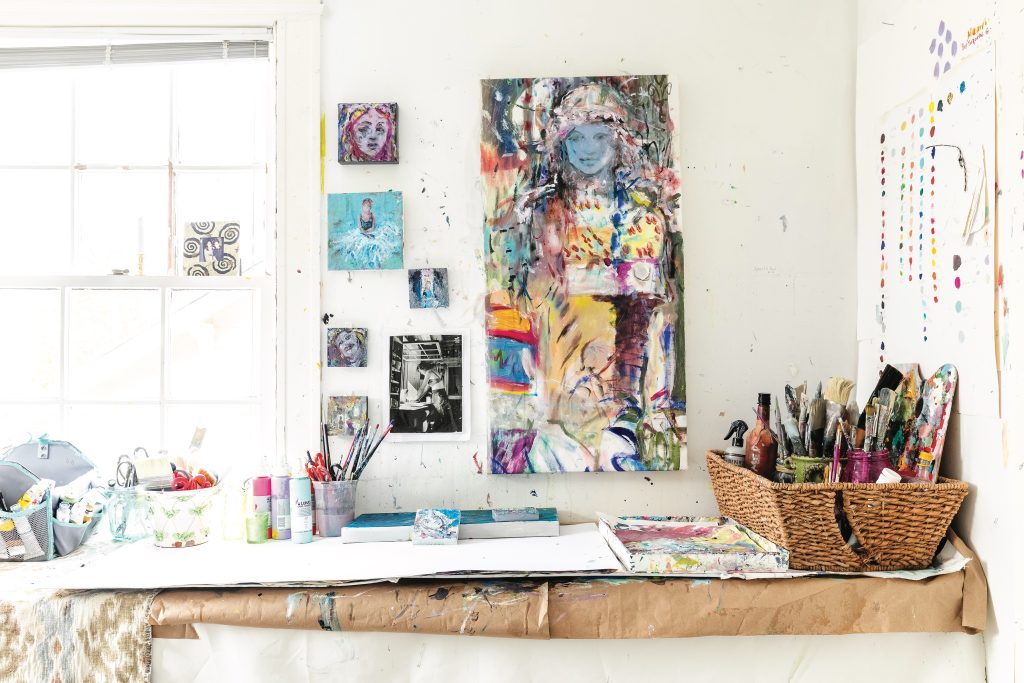
Landi then weaves through private rooms downstairs, to the addition at the back, which created office space, bathrooms and bedrooms. Looping back into the original portion of the house, she proceeds upstairs to the bedrooms where she reclaimed a vacated bedroom as a studio.
Scribbled notes and elaborate, artful doodles paper the studio walls.
“This was my son’s room for a long time,” she explains. Her visual process involves prompts from writing, she explains.
“I write a lot and also write things on the wall.” She traces notes made, recalling the vagaries of mind and process.
There is a striking variety of visual approaches: sometimes pastel, ghostly abstractions, sometimes vividly bold black-and-white charcoals. Some of the large-scale, acrylic paintings hung throughout the hallways and rooms of the house are already sold and awaiting shipment.
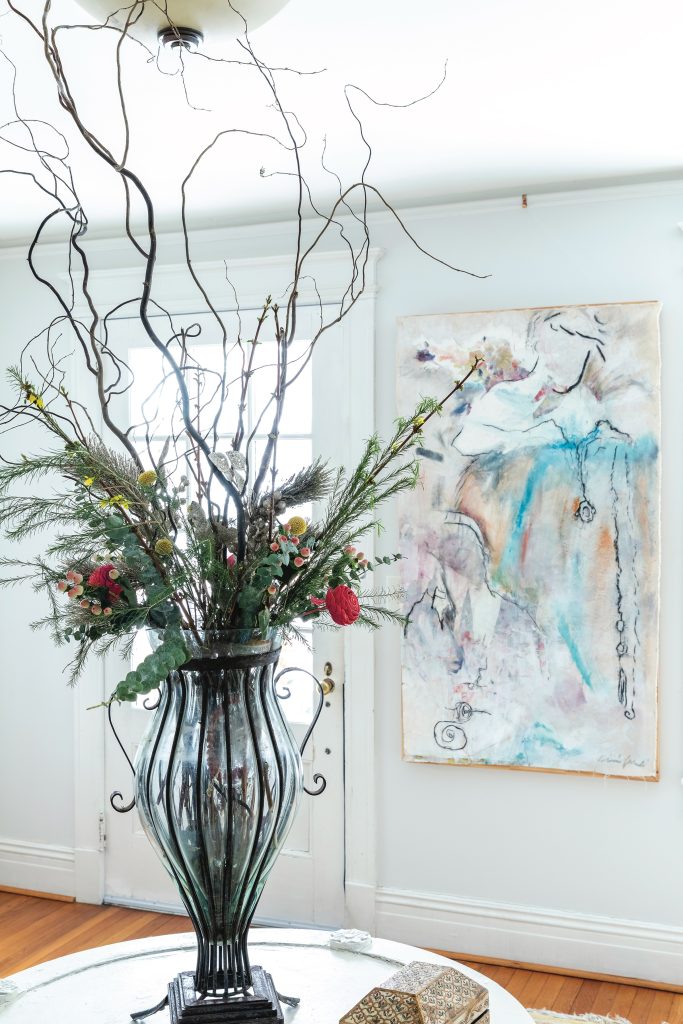
Landi has shown at the GreenHill Center for NC Art and the Center for Visual Artists. Her figurative paintings hang in permanent collections at Moses Cone Hospital, Schiffman’s Jewelers and Blue Denim restaurant.
Her work has common denominators, she stresses: light and spirit.
Larry Richardson, a family friend for decades, speaks to this.
“Denise does not see the world as you or I do,” he says. “She sees things in spiritual terms.” He describes how her work is sometimes overtly feminine, or dark and masculine.
“She isn’t just painting what she sees,” he explains. “She paints the energy.”
Florence opened Landi’s eyes to a new way of seeing and working. It was, she says, spiritual. “When I would paint scenes, I would paint spirits.”
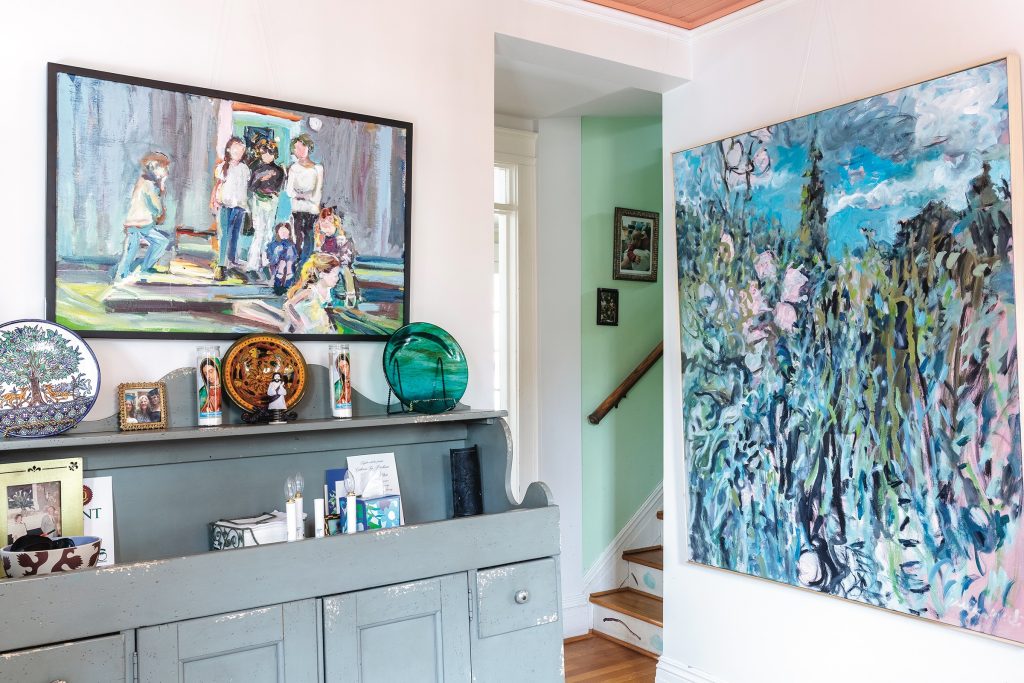
“There was a small river, and I saw the whole town (of Florence) as a heart. And then I saw that river as . . . this artery.”
Phone found, she returns to the kitchen and produces a vintage family portrait. Her Italian father, with Mediterranean coloring and effusive, ebullient personality, is a contrast to her mother, a serene, ladylike blonde with pale eyes. A woman of great composure.
“Isn’t she beautiful?” she asks. “Like Grace Kelly. A classic, Hitchcock beauty.”
There is no mistaking that Landi’s parents’ union, like her own, was a marriage of complementary opposites.
Cowhig will be home at any time, she expects. He is happiest, Landi notes, when holding the new grandbaby, Wolfie, soon to be a year old.
He is delighted when grandchildren visit, calling out “Michael!” and heading straight to his office, where they find him keeping a hand in historic projects. By his reckoning, Greensboro’s oldest structures are art of a different kind.
She rests the family picture against a colorful, flower-filled pottery vase by a dish of lemons on the rustic table. An instant composition.
One worthy of her hand