
The Sweet Life of Lindsay Emery

THE SWEET LIFE OF LINDSAY EMERY
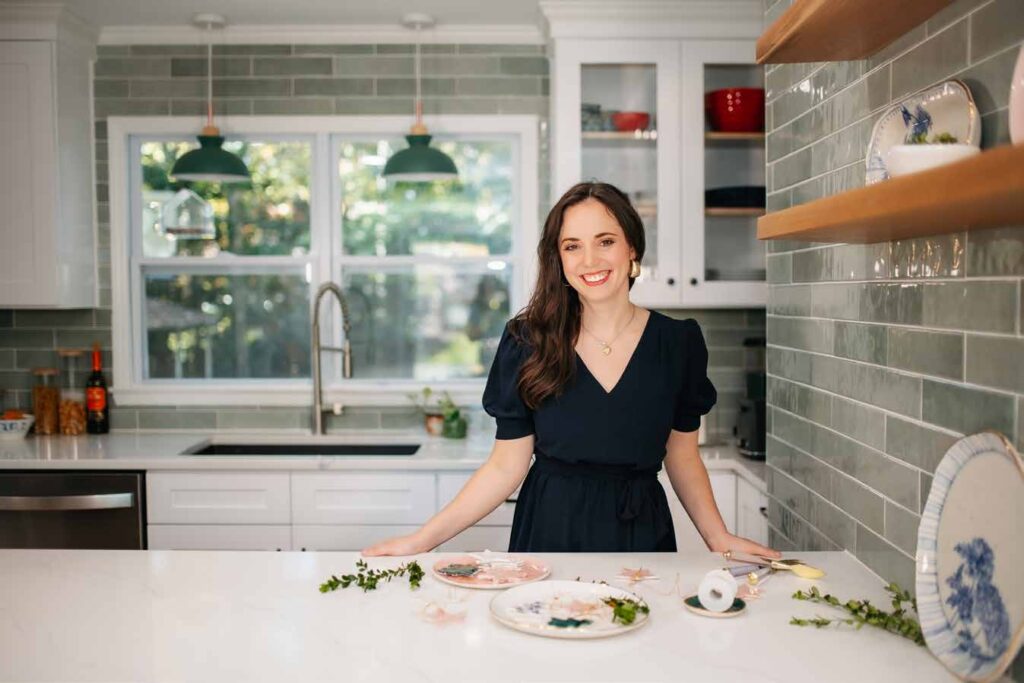
The Sweet Life of Lindsay Emery
On Suite One Studio and hand-making a life full of everyday beauty
By Cynthia Adams

At 38, Lindsay Emery has managed enviable successes, despite a once-in-a-century pandemic and all which that entailed for a small business. Above all, she learned to pivot and nimbly found her mark.
When Emery first launched Suite One Studio in 2009, her delicately embellished, airily romantic, handmade ceramics swiftly gained national press: Bon Appètit, Elle Decor, Food & Wine, and Coastal Living. She made the September 2014 cover of Better Homes & Gardens and, in 2015, House Beautiful spotlighted the “soft, irregular” porcelains.
“Bowls are thrown on a potter’s wheel, and platters and plates are rolled out by hand,” House Beautiful wrote. “Emery washes each in colors that fire into watery glazes” sold as one-off pieces online.
That year, Better Homes & Gardens named Emery a “Rising Stylemaker,” before she ranked 34th among Country Living’s 100 most creative people three years later (hailing her work as “the next wave of pottery.”)
You might guess — wrongly — that the brand’s name was drawn from an address. Suite One Studio was inspired by Emery’s student waitressing days, when a favorite customer dubbed her “sweet one.”
Which made her smile. And Emery smiles easily and often, especially now when discussing her spouse, Kim Cannan, their nearly 2-year-old toddler, Lydia — or Suite One, which she calls her “first baby.”
“The day before she was born, I was loading a glaze firing.” Heavily pregnant, she kept to her work amidst their pre-holiday busy season. “Twenty-six hours later, baby!”
Whereas most North Carolina pottery is primarily utilitarian, Suite One Studio’s wares differ from the familiar. They are painterly — Emery was first a painter — possessing a delicate softness, punctuated by pastel shades and light touches of gold, a contrast to the earth-toned sturdiness of most Seagrove pottery.
“I love florals, and the blue-and-white, traditional palette for porcelain done in a modern way.” Emery’s designs echo a nostalgic beauty that works well with heirloom pieces, she says.
She describes a “near reverence” gathering around her great-grandmother and great-aunt’s table. “They spent hours cooking and then serving everything ‘just so.’”
Those family meals felt intentional and important. “When I design and create tableware, I’m reaching for a similar feeling.”
Her theme, “time at the table,” whether with pottery or, now, painting, signifies the underrated, “small moments of everyday beauty.”
Her creative odyssey took a surprise turn when she was a student at Guilford College, where she met Cannan, who was also studying psychology and art.
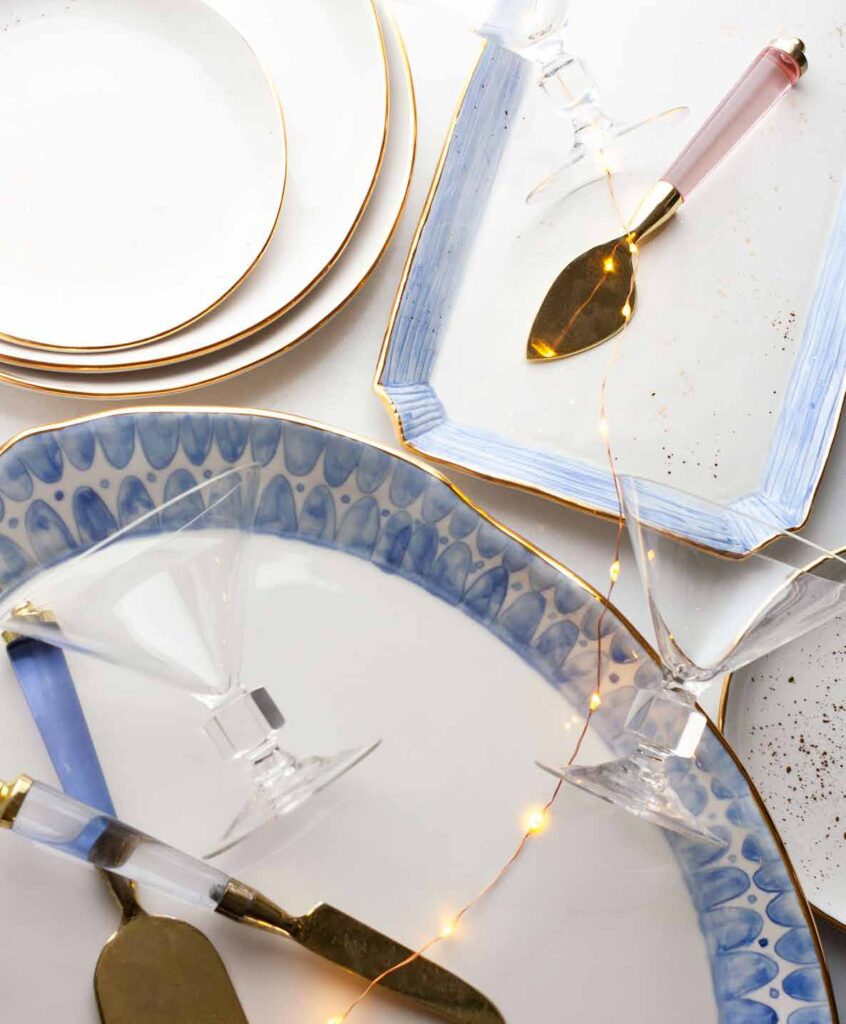
“Ceramics was not my intended path. I planned to paint, and then I planned to do art history.”
Adapting to Guilford College’s offerings, Emery fell in love with pottery, making more pots than she knew what to do with. “I started gifting them to friends and family, and then I started selling them online on Etsy.”
Surprised by sales of a “squat little mug set,” she added trays and platters to her Etsy shop.
“People were getting more comfortable buying online. Etsy was doing more advertising. I started to get exposure in areas I would never have gotten exposure.”
Food bloggers “found my work on Etsy and started buying plates, platters and bowls. It gave me a sense of what people were attracted to . . . I was finding my way.”
Not a techie by nature, Emery’s strength is in recognizing trends. “I think that served me really well.” Soon able to live comfortably from online sales, Cannan joined the company, coordinating operations.
By 2011, Instagram offered yet another social media avenue. Emery jumped in as an early adopter, developing more extensive relationships with food bloggers and up-and-coming influencers, allowing her business to spread via digital word of mouth. Collaborations came with online retailers Chairish and Anthropologie. Working with Chairish, she styled her feminine pastel pieces with vintage tableware to help collector’s “rethink vintage pieces.”
“Platters, trays, serving bowls are almost always accent pieces mixed with items they [customers] inherited,” Emery says.
She designed wine glasses for her website, having studied glass blowing earlier in Norfolk, Va. Working with glassblowers in Star, N.C., “I was able to bring ideas in glass to life,” later featured in magazines and at Chairish.
When Anthropologie dispatched a team of stylists and photographers to Greensboro, Emery had only just moved. The creatives were somewhat surprised by her modest garage studio.
She designed a series of mugs for Anthropologie (laughing at the irony, given she dislikes making mugs), with the retailer handling mass production. A “watercolor-inspired” collection, Mimra, was sold at selected Nordstrom stores in partnership with Anthropologie Home.
Pressures mounted along with success.
Bon Appètit commissioned an oversized platter for a photo shoot in its December 2018–January 2019 issue, with only six days to produce. “Which meant freehand carving the form,” she says. Emery managed.
Eventually, British stores carried Suite One Studio housewares. Commercial success demanded more staff producing hundreds of pieces monthly. By 2018, Suite One Studio moved into a 1,200-square-foot studio with two huge kilns. Running high production, Cannan handled the back side of the studio and the couple eyed expansion.
Emery’s relationship with Anthropologie continued for a few years, leading to other possibilities. What seemed like success on the outside, Emery says, didn’t feel like it. Social media had created a hungry beast, even throughout COVID. Keeping up with the demand “felt like a really hard pivot.”
Potters. Weavers. Printmakers. All face an endless demand to produce, Emery says. “You want more. The more you can make, the more you can market and sell. And streamline. And the more orders you can fill.”
Ultimately, Emery decided against creating a small factory, sticking with small-batch production.
“I had to close [my studio]”, she adds. “I changed the trajectory of my business from being focused on volume and production to being focused on self-fulfillment, creativity.”
“I wanted to do less and love the work more. That’s when I made the shift. For things that look successful now, there were things I had to give up,” says Emery.
Anthropologie was surprised by how small her business was versus her large brand recognition.
“How are you making this work?” its team members asked.
She spun off complementary businesses, consulting and teaching fellow artists the art of social media.

During 2018, Emery and fellow artist Allie Dattilio cofounded The Studio Source. Their online program taught artists “how to build their dream online art careers.”
“We ran it for six years. It has been a place for online learning for artists, who are starting to grow their online services. Support, training, everything they needed to know. Photography, marketing, collection releases,” she says.
Over 1,100 artists went through The Studio Source. Many left unfulfilling work places to start six-figure creative businesses. Then, Emery stopped doing that, too.
“I don’t like feeling stuck.”
She loved working one-on-one with artists. And being a painter working on actual canvases, something she had stepped away from due to her work with ceramics. She missed it. And having a child was life-changing. So, she pivoted again.
On a late summer morning, Emery stands among metal racks in her home studio stacked with various pieces awaiting painting, glazing and firing.
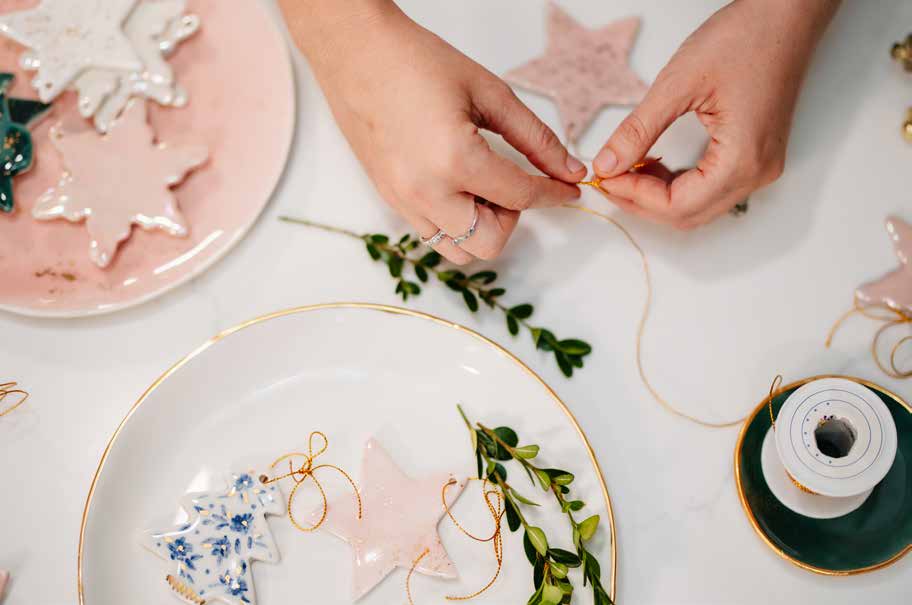
All of which, from the raw clay to those final, shimmery plates, platters, vases, pitchers and vessels, are created and finished by hand.
What does Emery’s family eat on daily?
“My plates,” she answers. “I like basics. A lot of the stuff I kept for myself is simple, white porcelain. I have some pink. Sometimes with a gold rim, but usually just plain.” She likes the heft of her plates — their conformation. “I find them comfortable in the hand,” she says. “They feel nice.”
Not too heavy, not too thin.
Just white.
Lydia, playing on the floor, calls, “Mama.”
For nine years, Cannan worked alongside Emery as “the one behind the scenes — keeping things organized and on track.”
Cannan was also Lydia’s primary caregiver during the day until recently accepting a position with the City of Greensboro.
There are still adjustments to their new dynamic. “Slowing down my business and closing my other business has been a huge decision, but I can feel in my gut there’ll be other opportunity to hit the gas.”
She smiles. Lydia is at the core of that decision. The secret to her success, she reflects, “is I had a great support system behind the scene,” meaning Cannan.
Lydia swings a broom among the stacks of porcelains, but her mom never flinches.
“This is what I want to be doing,” she says, “and it’s such a short time that she is little.” Emery wants to model running a business to her daughter too.
“I had the banana bread going, and my baby was napping, and an interview going,” she says happily, “and I like that! That’s what I’ve always wanted with my business, for it to fit into my life.”
The business has been adapted to fit her life, she adds proudly.
Lydia cries, “Draw . . . draw!”
Emery finds paper and pencil. Her daughter happily draws.
She tells a story about a friend relocating to the Triad after years of being apart. Helping her unpack, Emery spotted items she had made. In that moment, she understood how, despite years of separation, she was a part of her friend’s dinner parties and memories, “through pieces I made, objects we take for granted.”
When she sees her friends using sometimes completely forgotten work, she is moved. “But they remember, and I think, ‘Ah, I made that!’”
From a young age, Emery’s own parents supported her love of art, which she wants to do for her child. “The human condition, I think we’re wired to create things, but fear gets in the way, and insecurity.”
A plane goes over. Lydia pauses. Watches, then speaks.
Emery interprets her daughter’s baby-talk as saying “art.”

“I love now having someone mentor me,” Emery says, standing near an easel.
Having spent 15 years working three-dimensionally, Emery worried her painting skills “had gone dormant.” Putting brush to ceramics is not the same as painting on canvas.
Before Lydia’s birth, she signed up for a painting class with artist and teacher Kelly Oakes throughout the 2021 COVID surge. Now, the two artists share a studio in a former factory, now the Eno Arts Mill in Hillsborough. A vaulted ceiling, pale walls and a tall window provide light, even on a gray day.
Artworks line the walls and Emery’s still lifes wait on an easel.
Figs. Peaches. Soft colors and vivid fruits find their way into Emery’s feminine, color-saturated works. Occasionally, her ceramics are part of the composition.
Even the fruits have a story. Mango was Lydia’s first solid food. “At 9 months, Lydia decided they were her favorite food.”
Looking back on leaving with a friend to attend a 2023 Better Homes & Gardens influencer event, Emery winces at the memory of leaving 10-month-old Lydia at home for the first time. While away, she noticed a piece of blue fabric.
It symbolically figures into a painting. Interestingly, their studio is in a former cloth factory, she mentions.
The red fabric in another painting is an apron specifically worn for a Southern Living feature at an editor’s request.
“I was the first artist to get a studio here,” says Oakes about the industrial building, “and then less than a week later COVID hit.” Until pandemic restrictions relaxed, she could only use the studio if isolating alone. She values Emery’s creative company.
“Kelly has been so supportive of my motherhood dream, too,” she says, as the toddler plays at their feet on the polished wooden floor.
Katie Murray, executive director of the Orange County Arts Commission, has since opened offices there, too. During First Friday events each month, artists open their studios to the public.
“It has become a real known event since we first started,” says Oakes, who teaches classes, accepts art commissions and does portraiture since retiring from art education.
“I do think if you’re doing anything creative, you have to think if you want to monetize it; you have to develop a plan for that. If you don’t want to, and are just learning about it to deepen your own creative life, then that is fine,” Emery says as Oakes offers Lydia a toy. “But find a mentor if you can.”
“She has this exceptional brain,” Oakes says about Emery, adding that she is equally left- and right-brain, a rarity.
As Cannan pursues her new career, Emery occasionally brings Lydia with her to Hillsborough.
You work toward having art fit into your life.
“You don’t stretch your life to fit your art,” Emery repeats. Her art now conforms to fit her life.
It is her mantra; a wife, mother and artist’s North Star.
***
Keep up with Lindsay on her new substack, Courage & Creativity (Lindsayemery.substack.com). Thanks to the Thompson family for allowing us to shoot in their bright and beautiful kitchen, recently remodeled by Triad Flooring & Bath (triadflooringandbath.com).