Wandering Billy

Wandering Billy

Tales of a Fisher Park Paperboy

What was once a way of life is now unthinkable

By Billy Ingram

“The newspaper carrier hasn’t time to get into trouble. He finds it fun to hold a job, to earn money and learn to meet people. He may not be aware of it, but he is developing individualism and learning to accept responsibility.”      – J. Edgar Hoover

Can you imagine allowing — no, encouraging — your preteen to leave the house unaccompanied during the twilight hours before sunrise, meet up with some random stranger in a pickup truck, then roam the neighborhood going door-to-door before your alarm even goes off in the morning? Inconceivable? Yet, that was a common occurrence in my youth, no less than a Norman Rockwellian cultural touchstone . . . the hometown paperboy.

Technically, I suppose Ben Franklin could be considered America’s first newsie as he handed out the Pennsylvania Gazette he published in the 1700s, but in truth that distinction belongs to 10-year-old Barney Flaherty, who was hired in 1833 to deliver The New York Sun. At that time, child labor was an accepted practice in factories and sweatshops around the country. That now unthinkable practice was outlawed a century later, but employing schoolboys to distribute the local news continued unabated by simply labeling these pint sized couriers “independent contractors.”

Dr. Martin Luther King, Tom Cruise, our current President? All paperboys at one time, as was a friend I met at Mendenhall Junior High in the late-1960s, John Hitchcock. 

Being a morning person as a youngster, I would occasionally tag along on weekends, when bundles of newspapers were tossed off a truck at 6 a.m. for 12-year old Hitchcock and another nearby paper carrier, Norfleet Stallings. Pick-up was at what was once a spectacular 1920s-era, California Art Deco-inspired former firehouse once occupied by the City and County Council of Civil Defense. It was not in the best of neighborhoods, located alongside the railroad tracks on Church Street between Hendrix and Bessemer.

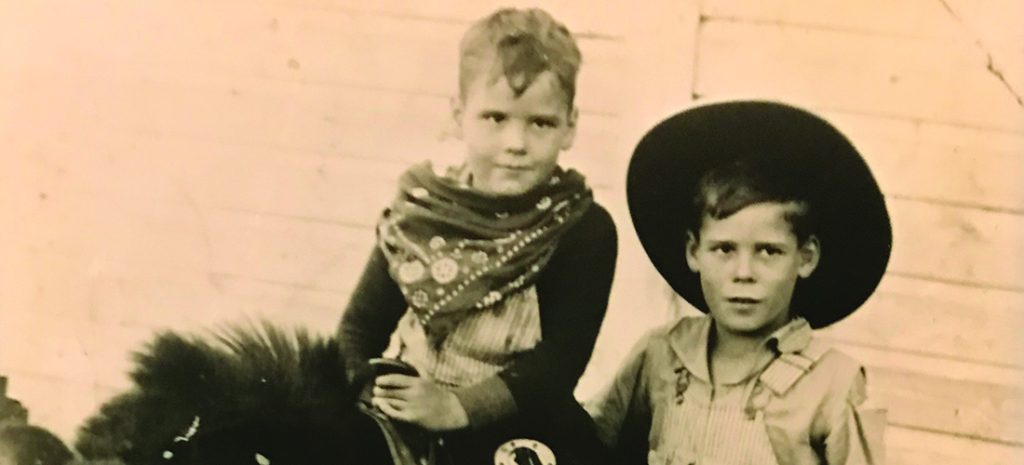
After rolling the papers, then fastening them with rubber bands, Hitchcock would throw a Greensboro Daily News-branded canvas bag over his shoulder and slide onto his silver Stingray 3-speed bike’s banana seat. Then he’d peddle and fling that morning’s edition onto dewy lawns across a seven-block route bordered by Bessemer Avenue, Church Street, Elm Street and North Park Drive.

His take for the week was 5 or 6 bucks, around $50 adjusted for inflation. “I was the richest kid in town,” Hitchcock says, perched behind a crowded counter at his shop, Parts Unknown: The Comic Book Store. “I could buy all the comic books I wanted and, if it was cold, get a bowl of chili, a bag of Fritos and a drink at Woolworth’s for like 35 cents. Then I’d high tail it home.”

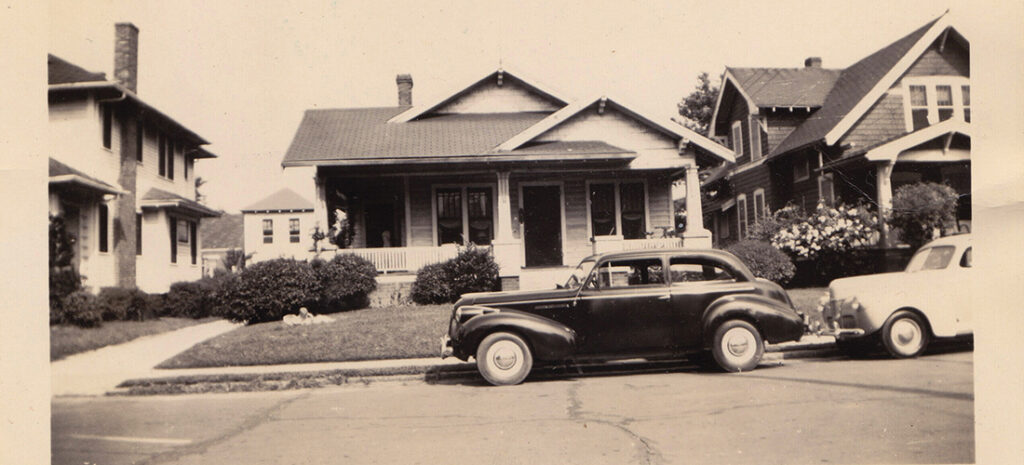
Hitchcock still lives in the Fisher Park Craftsman-style home on Olive Street his family has owned since the 1930s. One recent evening, the two of us wander the neighborhood while Hitchcock points out houses and mentions some of the customers that lined his route.

“Mrs. Coble lived there forever. She was the sweetest old lady,” Hitchcock tells me as we approach 904 Olive. “After her kids were grown, she started renting out rooms.” Behind her house sat a square cinder block hut, no longer there. Word has it that back in the early-’50s, “for about a month, legendary Hall-of-Famer Mickey Mantle and a couple of bonus babies [rookies] lived in that house when they were sent here to get seasoned for playing with the Yankees.” After the games as those ballplayers would hang out drinking beers, Hitchcock’s uncle would join them. “He said they were really down-to-earth guys.”

This former paperboy had his share of eccentrics along the route. “My friend, Ken Edwards, came to my house one day and he says, ‘Look what I’ve got,’” showing Hitchcock a stack of early Fantastic Four and Spider-Man comics. Edwards explained that one subscriber on Hendrix was selling 12-cent Marvels for 10 cents apiece. “I slowly ended up buying all of them from him. What was weird about the guy, and I mean really weird,” says Hitchcock, “is he would give you a comic if he could spank you with a paddle. I never did it, but Ken did, and he said the guy didn’t hit worth a damn compared to his dad.”

A couple of blocks west at 113 Hendrix sits a large two-story duplex. “Alan McLeod had one of the greatest butterfly and moth collections anyone ever saw,” Hitchcock recalls. “He would buy cocoons, hatch them and mount them for display.” McLeod’s grandmother resided in the adjoining unit. “There was a welcome mat in front of her door. The paper had to be placed directly on the mat. If it wasn’t there, she would call and tell me to ‘bring my paper in.’ Sometimes it would be just a foot away. And I never got a tip.”

On the corner of Hendrix and Church, there’s a house Hitchcock remembers well. “Behind that house was a square metal cage where this guy kept squirrels,” he says. “Don’t ask me why, but he did.” Crossing the bridge over the railroad tracks to the other side of Hendrix was a dwelling with a more exotic habitat. “They had monkeys in a 5-foot by 8-foot pen. We’d bring pecans for the monkeys to eat and the homeowners would yell at us to get the hell out of there.”

In a charming bungalow at 1005 Magnolia, “There was a wonderful woman, Mrs. Noah. She lived by herself,” Hitchcock recalls. “She had a framed lithograph of Robert E. Lee, must’ve been passed down through the family. She told me that her daughter was seeing a guy and when the boyfriend walked in, saw the picture of Robert E. Lee, he says, ‘Why, General Grant! I’m glad you have such a nice place in this house.’ Mrs. Noah looked at her daughter and said, ‘He’s got to go.’”

In the 1980s, papergirls joined the carrier ranks. During the next decade, falling circulations and rising liability costs spelled the end for an American childhood tradition stretching back to the pioneer days.

Perhaps J. Edgar was right. John Hitchcock’s business on Spring Garden will be celebrating its 35th anniversary next year, so that entrepreneurial spirit did indeed start early and stuck.  OH

When not wandering, Billy Ingram can be found on Tuesday afternoons behind the counter at Parts Unknown, where one of the shop’s best-sellers is Brian K. Vaughan’s acclaimed graphic novel series Papergirls, which he highly recommends.

Wandering Billy

Wandering Billy
Grave Matters

Creating cleaner, greener pastures at Green Hill Cemetery

By Billy Ingram

“Never check an interesting fact.”     – Howard Hughes

It may seem odd that someone possesses warm fuzzies for a graveyard, but my fond memories of Green Hill Cemetery go back as far as I can remember.

At 10 years old, I convinced my younger brother and sister that my foot was stuck between the wooden ties of the railroad tracks along the western edge of Green Hill. With one ear on the rails, I could feel (or so I told them) the vibrations of a locomotive speeding toward us, imploring my siblings to run, to save themselves — there was no longer any hope for me.

My sister’s first name is Rives, same as my mother’s maiden name. Mom’s family has a plot at Green Hill centered with a monument that simply reads “Rives.” When she was 7 years old, I told my sister that she had an incurable disease and was going to pass away soon, so mom and dad were just waiting until she died to carve the dates on this, her headstone. She cried and cried and I guffawed like a peg-legged pirate. Was I an awesome brother or what?

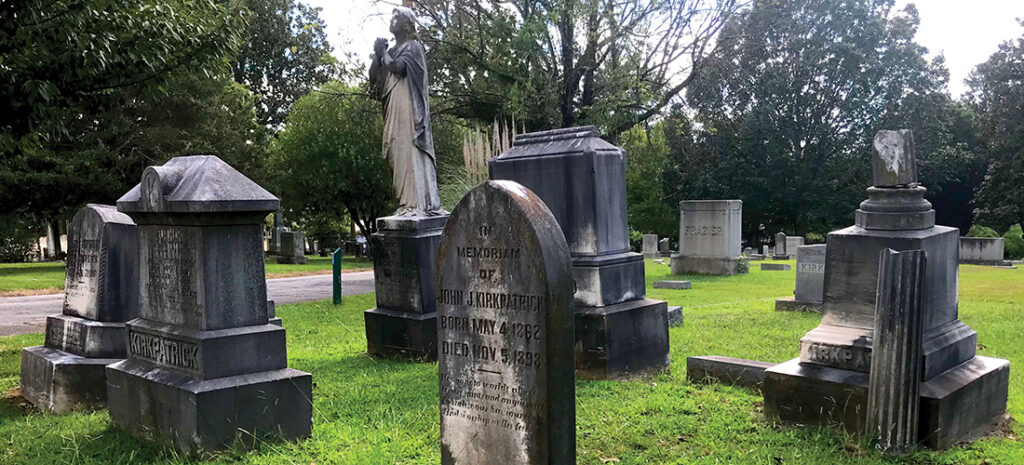
It’s been a decade or so since I’ve wandered over to Green Hill, where I recently caught up with my one-time neighbor David Craft, who, alongside a dozen or so stalwart volunteers from the Friends of Green Hill organization, are selflessly assessing, sprucing up and restoring smaller headstones that, over time, have become unmoored by mudslides. These crafty citizens dig out those sunk several feet into the ground and clean covered-over carved marble tablets long ago toppled onto their backs, presently embedded into the soil. At a glance, they tend to go unnoticed, this multitude of mangled monuments, askew stones of all sizes and shapes, spires weighing hundreds, perhaps thousands of pounds, cracked and fractured, resting on their sides, primarily in the oldest tracts.

“You’re walking and you see these gravestones fallen over,” David says about what spurred him into action, pointing out monoliths and burial sites in dire need of rehabilitation. “They’re in the wrong places, they’re broken, and these things are so beautiful, they’re almost like artwork. And I was kind of looking for something else to do.” David dubbed this merry band of recreational restorationists the “Billies” as a hat tip to his dad, Bill Craft — but he’d prefer if you didn’t preface that nickname with “Green Hill.”

In his own way, David is advancing a legacy that took root more than a half-century ago, when his father began implementing his sylvan vision for Greensboro, one that continues to flourish and likely will for generations to come.

As a teenager in the 1970s, I’d notice Bill Craft almost daily planting assorted flora directly across the street from our Blair Street home. Guilford County’s Johnny Appleseed, with persistent prodigality, transformed a perfectly ordinary two-block-long, grassy, creekside strip into a lush environ, what is now known appropriately as Bill Craft Park. With virtually nowhere left to dig at that location, he turned his attention to Green Hill Cemetery’s relatively sparse surroundings beginning in 1980, toiling in that soil for the next 20 years.

When this self-taught botanist began his arbor days-turned-years at Green Hill, there were around 100 trees dotting the 51-acre landscape. By the time Bill was done, he’d seeded an additional 400 saplings and shrubs, just about every species known or suspected to survive here: a rubber tree from China, live oaks from the coast, Florida palms, Atlantic white cedar, Chinese pistache, Savannah holly, Japanese maple, Tupelo gum, Colorado blue spruce, to name a few. Bill Craft passed away in 2010, his herculean efforts costing this city not one dime.

Last year, David attended a seminar in Statesville led by Shawn Rogers, director of Jamestown’s Mendenhall Homeplace, on the proper methods for restoring and repairing marble, slate, and granite markers and footstones without being invasive or intrusive. A precision-oriented approach appealed to David, who likes “doing things with my hands, simple things.” He continues, “So we got permission to straighten [smaller stones and slabs], which is kind of within our skillset.” The goal for these Green Hill aficionados is to perform as many minor repairs as possible while raising money for larger, more difficult projects that will require heavy machinery and extensive expertise.

In addition to this behind-the-scenes undertaking, there are two October happenings at Green Hill I’m personally looking forward to.

Not far from the southern gate (near Fisher Avenue) stands a most striking monument, a 7-foot-tall depiction of a firefighter standing at the ready, carved in Italian marble, perched atop a 10-foot-high granite plinth. Dedicated in 1924, this became the annual site for a service devoted to Greensboro Fire Department personnel who had perished over the last year. For whatever reason, this custom ended around 1970, but in 2021 that yearly ceremony was revived with a well-attended memorial honoring the 16 line-of-duty and retired GFD deaths during that dormant period. On Saturday, October 7, at 2 p.m., the city will once again honor the fallen.

Separately, for the 15th year, Ann Stringfield of the Friends of Green Hill Cemetery’s leadership team leads a tour on October 29 at 1 p.m. Her topic? “The Plants and the Planted” that inhabit the southern portion of Green Hill. Interested in assisting with restoration or want more info about these events, including rain dates? Visit: FriendsOfGreenHillCemetery.org.

A couple of months back, I profiled Gerald Smith, a charming, colorful gentleman who’d recently published a terrific memoir entitled Cotton Mill Hillbilly. Sadly, Gerald passed away on June 26, but what a privilege it was to have met him. Before my time comes, I can only hope to be blessed with even a fraction of his enthusiasm for life and the abundant love that obviously surrounded him.  OH

Despite so many familial connections at Green Hill, Billy Ingram’s final resting place will likely be Potter’s Field.

Wandering Billy

Wandering Billy

Poetry Is Life

And life is poetry for Greensboro’s first Poet Laureate

By Billy Ingram

“Poetry is just the evidence of life. If your life is burning well, poetry is just the ash.”      – Leonard Cohen

For the first time ever, the City of Greensboro has appointed a Poet Laureate, Josephus Thompson III. Some people might envision a pointy-headed intellectual with a snowy beard spouting iambic pentameter while safely ensconced inside an ivy-covered garret. In contrast Josephus is a tall, lithe 46-year old who appears considerably younger in person.

It was a fourth grade classroom assignment that led Josephus into discovering his previously undiagnosed love for wordplay. “I won a fourth place ribbon for an essay about my father,” he tells me. “And I was ecstatic that I won fourth place.” Later, in high school, Josephus composed a poem for an English course that he performed in front of the entire student body. “I got a few accolades for it and I was like, people like my writing. I should do more of it.”

Although it’s a part of every school’s curriculum, “So often the poetry that we hear — the Mayas, the Frosts — it doesn’t sound like us, doesn’t look like us,” Josephus remarks about society’s overall failure to connect students to creative expression. “It’s all about education through correlation, something they can actually relate to.” This dichotomy led to the creation of The Poetry Project in 2005 for, “using poetry to teach, inspire and build the communities that we call home.”

What began inside individual classrooms turned into packed school assemblies. “When I go into a space, maybe 70 percent of the kids probably don’t like poetry,” Josephus says. “They think it’s whack, it’s boring. But when I’m able to relate it to hip-hop, to music, to empowering their voice, all of a sudden the light switch goes on. They’re like, ‘Wait a minute. You wanna hear what I have to say?’”

Over time, Josephus developed a scintillating Monday through Thursday curriculum rooted, but not mired, in traditional English Language Arts. “Then on Friday,” he says, “I’ll bring in a poet, a singer, a rapper, a guitar player, so they are able to see what we’ve talked about all week in real life.” Wildly popular, this avant-garde bard poetically pied piper-ed impressionable audiences, winning over a multitude of restless, attention deficient pupils, a paroxysm attributable not only to Josephus’ charismatic delivery, but also his impressive lexiconical athleticism.

Funded primarily by fees for service plus occasional grants, The Poetry Project has provided literacy-based programming not only in Guilford and Forsyth Counties, but also in Harrisburg, VA, and as far afield as Malaysia and the Phillippines. “I had the pleasure of performing with the Greensboro Symphony in 2019,” says Josephus. “It was phenomenal.” For that event, every third and fourth grader in the county school system was transported to Grimsley High School’s auditorium for five daily jam sessions, experiencing for themselves Josephus’ participatory prestidigitation. The result? It’s poetry emotion: “A thousand kids singing along and chanting.”

“I’m able to talk about the fact that the money is in songwriting,” Josephus remarks, explaining that most youngsters don’t realize musical artists generally don’t compose their hit songs. “The people that write the music are sitting at home collecting a check, a lot more than the singer. By the end of the class everyone wants to be a writer.”

Having piqued students’ interest, Josephus realized budding authors had nowhere to hone their craft. “There’s a place for Frisbee, and basketball and soccer, but, if you’re going to be a writer, where do you go?” To fill that void, Josephus partnered with the McGirt-Horton branch of the Greensboro Public Library to establish an after-school outlet for aspiring scribes. “Every person has a voice,” Josephus says of his motivation. “Everyone wants to be heard, period.”

As a side gig that has since expanded exponentially, Josephus launched The Poetry Café at Triad Stage in 2009 to serve as a launching pad and showcase for emerging regional wordsmiths. It was then that one of his mentors, D. Cherie’ Lofton, at that time operations manager and content manager for N.C. A&T State University’s radio station, began urging him to adapt his concept for the airwaves. “I didn’t want to be on the radio, but I had no idea the number of people I could reach.” It took Lofton more than a year to talk him into it, but in 2012 Josephus began broadcasting The Poetry Café over 90.1 FM, WNAA.

Earlier this year, The Poetry Café became a weekly syndicated radio show, airing Sundays at 6–7 p.m. on WUNC radio, recorded in his studio on the second floor of Triad Stage. “We already have artists that are coming now to Greensboro to be featured on the show because it’s statewide.”

Last year, Josephus created a monthly retreat called Poetry Field Trip in conjunction with the Van Dyke Performance Space located in downtown’s Cultural Center. “We were able to bring in 300 kids for 90 minutes to experience poetry up close and personal with a full band,” Josephus says, somewhat amazed. “Before they leave, I’m giving autographs to fourth graders — as a poet in Greensboro.”

Josephus is on track to host a combined 3,000 kids for October’s Poetry Field Trip at the Van Dyke Performance Space (info@thepoetryproject.com). “Beginning at 9 a.m., there’s ‘Poetry is Life’ breaking down what poetry is, how it connects,” our Poet Laureate explains. “In the afternoon, we do a second part called ‘The Cypher: From the Page to the Stage.’ The same kids can come back and write their own poetry, then get up on stage to perform it. Three hundred kids coming in the morning and the afternoon for a full day field trip.”

It’s not just about poetic license, but poetic licensing. The Poetry Café is headed to the National Public Radio convention this month. “The goal is to pick up another 10 to 12 stations,” Josephus says, “so the show will be national by the end of the year.” He’s already submitted a proposal to PBS North Carolina. “We’d love to get on their network with The Poetry Café, featuring North Carolina artists, which means advertising dollars.”

In April of 2024, The Poetry Project returns to Tanger Center. “We’re talking about video, audio, all of that being accessible, sellable and licensable,” Josephus notes. In 2025, he’s looking to export The Poetry Café to London, Dubai and Durban, South Africa. Having grown up a military brat with frequent upendings, he says, “I’ve been to those places, so I know it’s possible.”

Set the clock for inevitability. “As Poet Laureate of Greensboro, it’s my due diligence to make it happen,” Josephus contends. “We’re setting the mold, breaking barriers, proving every single day that poetry is life and life is indeed poetry.”  OH

Billy Ingram is O.G. — Original Greensboro.

Wandering Billy

Wandering Billy

Downtown’s New Grub Hubs

Eating Across Elm

By Billy Ingram

“Uptown is for people who have already done something. Downtown is where they’re doing something now. I live uptown, but I love downtown.”                         – Andy Warhol

Readers of this column know I cover downtown like the green shag carpeting in my first apartment. It hasn’t escaped notice that there’s more than a cuppa recently opened coffeehouses percolating an assortment of customized caffeinated concoctions inside storefronts along South Elm. Joining them are several new places where you can overeat.

Far and away, the most elaborate of these up-and-coming klatches is Dusty Keene’s second Common Grounds location on the corner of Elm and Gate City. Much more elaborate than its original Lindley Park spot, the new digs are imbued with a funky, old-world inspired interior we’ve not seen in the center city since long ago nights and afternoons misspent lounging at the Sofa Bar in the 1990s.

Metal sculptures forged by Greensboro’s own Erik Beerbower and Kelsey Wyatt are central to the coffee shop’s vibe, including metal sculptures lining the exposed brick walls indoors and a flurry of other sculptures incorporating recycled and discarded metal elements that define and accent multiple outdoor patios. Most eye-catching of all is the stunning, south-facing owl fabricated from hubcaps, industrial scraps and oversized o-rings, greeting customers in the parking lot.

With artworks on display across the state, this metallurgically gifted duo created that gargantuan, gurgling waterfall sandwiched between buildings on the 200 block of South Elm a decade or so ago.

The building that houses Common Grounds at 631 South Elm has an effervescent history. A century ago, this was where Lime Cola was manufactured and distributed in the 1920s. During that same period, just a few doors north at 621 South Elm, currently a parking lot, Coca-Cola was brewing, while Pepsi-Cola, Orange Crush and Chero-Cola were bubbling up blocks away on West Lewis.

But back to coffee. Truth to tell, I’m a lightweight when it comes to caffeine. However, when in Rome . . . selecting from Common Grounds’ Star Latte selection this past Sunday, my companion, Cory Wagoner, fresh from playing bass for Mount Pisgah Church’s contemporary praise band, ordered a Marilyn Monroe (white chocolate and caramel), while I gave in to temptation with a Robert Downey Jr. (dark chocolate, caramel and salt). As a result, as I write this, I’ve got more twitches than Samatha Stephens but zero regrets.

Behind its orange doors, smoothies and, for those wishing to rollercoaster the day away, a selection of top shelf liquors to slug into your café au lait awaits non-coffee drinkers. Most inviting is a variety of scrumptious fresh baked goods direct from Veneé Pawlowski’s Black Magnolia Southern Patisserie, located next to Cugino Forno in the Revolution Mills complex. Bear with me while I take a detour to tell you more about Pawlowski.

This past May, she won her second General Mills national contest, the grand prize of $20,000, for her savory upside-down apple-praline biscuit recipe. Would it be bragging to point out I was the first to trumpet her culinary abilities here in this very column three years ago? At that time, she’d been laid off, a newlywed with a newborn to look after just as that pesky lockdown was getting under way. Faced basically with no options, she resorted to a strategy only the most creative individuals turn to — leaning into a dream. From a small kitchen in a Church Street apartment that she and her husband Ian shared, Veneé began offering baked goods for sale on Facebook.

After reading about her in this forum, O.Henry readers began ordering. More published accolades followed and, shortly thereafter, her bourbon banoffee pecan rolls recipe earned her a top-20 spot in the 2021 General Mills Neighborhood to Nation Restaurant Recipe Contest. Last year, she launched her brick-and-mortar bakery, Black Magnolia Southern Patisserie, where, right from the start, there were literally lines around the building every morning. She’s since expanded capacity and ramped up to meet demand. Don’t you just love stories like that?

As an added treat, Common Grounds Downtown hosts DJ Patrick Killmartin on the second Sunday of every month, who lays down a multifarious mix of past, present and future beats. Catch him on the other three Sundays at Common Grounds’ original grinder at Walker and Elam.

A couple of doors north at 611 South Elm, platters of a different type are spinning. Jake’s Diner is plating what you haven’t been able to get downtown on Elm since the lunch counter in the Southeastern Building closed many years ago: scrambled and fried eggs, hash browns, bacon, sausage, and country ham, served up all day, from 7 a.m. to 3 p.m.

Built in 1950 for Blue Bell’s pattern department and servicing its sprawling denim factory across the street, the space that Jake’s Diner grills in was for many years an Earl Scheib Auto Painting shop, so it’s quite spacious.

A retro-esque atmosphere with a high ceiling and enormous picture windows makes this an ideal spot for what one comes to expect from a diner: staples such as burgers, BLTs, pork chops, wings, subs and salads, plus fried chicken on weekends. I’ve eaten here a few times, both alone and with friends . . . every time, it’s met my expectations.

Still on the subject of dining downtown on weekdays, in the Piedmont Building at 114 North Elm, you’ll thank me for turning you on to International Food, a tucked-away cafe serving up authentic Mexican cuisine similar to what someone’s abuela would prepare. I delighted in the quesabirria platter (four deep-fried tacos filled with shaved, braised beef with two dipping sauces). I’ll be back for steak or chicken tortas, milanesa (fried chicken breast with rice and beans), fish tacos, chori pollo, chimichangas and the obligatory arroz con pollo. Pop in for lunch and you’ll likely find me there.

There’s also a recently opened honest to goodness, old-school luncheonette situated on the first floor of a newly renovated Renaissance Building across from Tanger Center. Often, my noontime cravings are for nothing more than what Mother and I would typically order at Brown-Gardiner, so I was thrilled to discover Cafe 13, with a pleasing selection of basic comfort foods such as a simple toasted chicken salad sandwich with lettuce and tomato. Nothing fancy, more down-home if anything, it’s the kind of place Rob, Buddy and Sally ordered down from for a working lunch on The Dick Van Dyke Show. One of the ladies’ aunties even makes the pound cake they sell by the slice. Ground floor lunch counter in a high-rise office building isn’t something I expected would make a comeback. Seems everything new is old again! OH

Like his father and grandfather before him, Billy Ingram is the third generation to do business in Downtown Greensboro.

Wandering Billy

Wandering Billy

A Storied Life

Peeking into the pages of 90-year-old Gerald Smith, self-proclaimed Cotton Mill Hillbilly

By Billy Ingram

“I never thought my cotton gin would change history.” – Eli Whitney

I have a shelf in my library devoted to books about growing up in and around the Gate City. That bookshelf just got a little more crowded with the recent addition of a brand new release, Cotton Mill Hillbilly, written by 90-year-old, first-time author Gerald A. Smith, a project he entered into reluctantly.

“My daughters were after me for about six months before I said I would do it,” Smith confesses. “They said, ‘We don’t know anything about your early life.’ They suggested very strongly that, if I valued my life and I wanted to keep eating, I should start writing.” It took him less than six months to complete 302 breezy pages. Raised in Siler City in the 1930s, population 1,775, not counting the livestock, Smith was “surprised it all came back to me once I started.”

Ever hear someone say, “We grew up poor but we didn’t know it?” Not in this telling. “My daddy was a drunk. You couldn’t depend on him for anything,” Smith explains. “We were really poor. We didn’t even have water in the house.” Well, that wasn’t entirely true during inclement weather. “When it rained we had buckets all over the floor. If you got up during the night you had to watch that you didn’t step in the buckets.”

As a youngster, his family had no means of transportation. So, one Saturday his older brother and father ventured out with $125 to buy an automobile. “And they came back on a Czechoslovakian made motorcycle,” Smith says. “That started my career on motorcycles.” Over his lifetime, “I’d have one right after the other and just keep upgrading,” eventually ending up with a top-of-the-line Triumph.

Siler City was the only world Gerald Smith knew as a young’un. “Greensboro was like going overseas, it was so far away,” he recalls. “My dream was to work at Hadley-Peoples, one of the biggest employers in town. I grew up in their mill houses for the first 16 years of my life.” In high school he took a mechanics position for Hadley-Peoples’ petticoat factory, where, some years later, he would meet his future wife, Esta. “It got so hot inside and they had no air conditioning. You could see the lint flying out the windows.” The labor was grueling, the benefits miniscule. “But you had to work somewhere,” says Smith, who earned around $40 a week at the mill. “My brother was at Western Electric in Greensboro and he was making $20 a week more than I was.”

At his sibling’s suggestion, in 1960, Smith went to work at Western Electric in the Pomona district, where “they manufactured top secret, future products. I remember a machine called a Hysteresis Loop. You put a piece of metal on the machine, it gives you a loop and you record the loop.” A couple of years later, an ad in the Greensboro Daily News for “technical minded people” at IBM caught his eye. After interviewing 125 people for one single position, IBM management told Smith they needed to meet his wife before committing.

“Esta was a housewife at the time. She’s beautiful and she knows all the etiquette and everything,” Smith recalls. “She was waiting at the door, greeted them, served refreshments and joined in the conversation. After an hour they got up and said, ‘We’ll make up our decision and let you know.’” As the two recruiters began exiting they stopped and enquired, ‘You still want the job, Gerald?’ I said, ‘More than ever.’ They said, ‘Well, you’re hired.’ They told me later they hired me because of Esta.” Settling in Greensboro — hard times a vanishing point in his motorbike’s rearview mirror — this country boy joined the ranks of the button-down corporate world. “I didn’t know what to expect. I didn’t have any suits. I had to go in debt,” Smith says of his Mad Men-era uniform. Wherever he went, ranging out as far as Danville, Virginia, to repair IBM office products, “I had on my suit, crisp white shirt, the shoes had to be shined and you better look good.” Equipped with a proprietary set of tools tucked into a briefcase, employees at his destinations often mistook him for an executive or a doctor, so they routinely waved him through. “I’d go out to Cone Hospital and get right into the area where they kept the radium and isotopes and see all this stuff around and wonder whether this is gonna kill me or not.”

IBM instituted a robust suggestion program with a bonus of up to $50,000 for any employee who submitted a cost-cutting idea that was adopted by the company. “A lot of times we’d be running short of money and they’d present me with a suggestion award.” Smith won 21 of these bonuses before being promoted to field and distribution services manager, allowing him to retire in 1990 and devote more time to church activities. 

Looking back, he wonders if maybe he had a bit too much time on his hands, like the time he discovered a baby bird lying on the ground after a windstorm. “This little bitty thing, he just cracked open the egg when he fell and the mother wasn’t there,” Smith says. “Different people said, ‘Feed him some egg yolk.’” Using an eyedropper, “I raised him from the egg to a bird old enough to fly.” He named the bird Nod (bonus points if you get the Andy Griffith Show reference, Wink, Wink). While strolling the neighborhood, Smith tied a string on one of the birdie’s legs and attached it to his baseball cap, using that hat’s bill as a launching pad in an effort to teach the fledgling to fly.

His walks with Nod got the neighbors talking, so much so that Channel 2 dispatched Arlo Lassen to document this Birdman of Hamilton Forest for the 6 p.m. news. Before Nod flew the coop for good, he made a final electrifying appearance: “One morning a telephone guy was coming out to do some work on the lines.” Smith was on the front porch waving to the repairman when Nod flew off a wire, landing on top of his head. “That repairman said, ‘I’ve never seen anything like that before!’”

In so short a space, there’s no way to do justice to the mischief and mayhem contained in this madcap memoir. I recommend you dive into Cotton Mill Hillbilly yourself, available where books are sold and on Amazon. I wouldn’t be at all surprised if some savvy producer turns Smith’s story into a movie.

After 90 revolutions around the sun, despite his soulmate, Esta, passing away in 2010, Gerald Smith isn’t slowing down that much. “I got my driver’s license renewed a few weeks ago,” he tells me. “I thought maybe I’d have trouble taking the eye test. I really can’t see that good, so I spent a couple days memorizing eye charts.” Sure enough he passed and was even grandfathered in for a motorcycle license. He quips, “I might buy me a new Harley or something.” He’s joking, of course . . . at least I think he is.  OH

Billy Ingram’s new book about Greensboro, EYE on GSO, is available wherever books are sold or pulped.

Wandering Billy

Wandering Billy

On The Record

Any way you spin it, a documentary featuring Greensboro’s role in the Chitlin’ Circuit remains unfinished

By Billy Ingram

“Owning vinyl is like having a beautiful painting hanging in your living room. It’s something you can hold, pore over the lyrics and immerse yourself in the artwork.” – Steven Wilson

Just a short distance from the liquor store — er, the many exciting sights and attractions downtown Greensboro has to offer — is a set of concrete steps at 610 S. Spring Street, stubbornly clinging to relevance below a parking lot and a patch of grass destined for development.

In the ’50s and ’60s, this stairway to heavenly sounds led to what has been described as an inviting domicile fronted by two large maple trees, one of which still shades those steps. That’s where, during evenings and weekends off from his day job at the post office, longtime resident Edward Robbins began dabbling in music production and directing promotional television spots.

In the lo-fi world of the mid-’50s, this audiophile invested in the area’s only multitrack, high-fidelity Concertone stereophonic reel recorder when virtually every 45 and LP album in America was pressed in mono — and would be for years to come. Radio stations weren’t even equipped to play stereo discs in 1954 when Robbins Recording Studio was established in the back of his Spring Street home. The brand that touted “We Record Anything Worth Keeping” advertised not only futuristic technology, but also a grand piano and Hammond organ for backing tracks.

Robbins’ bread-and-butter was capturing church choir recitals and high school band performances, as well as recording local artists attempting to break into the music business. Just a few years later, 18-year-old Billy Crash Craddock laid down his first single, “Smacky-Mouth,” at Robbins’ for Greensboro’s Sky Castle label. Months later, the rockabilly crooner signed with Columbia Records. Also recorded there, the million-selling 45, “Radar Blues” by Coleman Wilson, released in 1960 on King Records.

A decade ago, Doug Klesch’s film project, Gate City Soul, got underway documenting the vibrant East Greensboro music scene with an emphasis on the Chitlin’ Circuit era. “I started realizing that there was this layer of stars and people that we hadn’t heard about,” Klesch tells me over coffee at the new Common Grounds downtown. “Nobody really seemed to have put it all together before.”

In the 1960s and 1970s, Robbins Recording Studio was only one of perhaps half a dozen or more recording studios and small-time record labels operating at any one time in Greensboro. “You go in, you pay your 40 bucks and you could record whatever you want,” Klesch says. Around 1960, Walt Copeland began recording and mastering out of his modest home at 4106 Peterson Avenue, relocating in 1964 to the WWll-era Overseas Replacement Depot district before becoming Crescent-City Sound Studios around 1969, located primarily at 1060 Gatewood Avenue.

“Robbins and Copeland were sort of the pioneers around here,” according to Klesch. “Crescent-City Sound, from what I’m told, was state of the art for that time, built on a floating floor. It wasn’t really as mom-and-pop as I would’ve imagined it to be in a market like Greensboro. These guys had a pretty nice little thing going.”

Greensboro R&B sensation and Carolina Beach Music Awards Hall-of-Famer Roy Roberts is one of the central characters in Klesch’s documentary. “Roberts is still alive and performing in his 80s,” he reports. “Bobby Williams — I think he’s still around — he had a band, Soul Central, that was playing a lot. George Bishop died shortly after I interviewed him in 2014.” In the 60s, Bishop corralled a bunch of A&T students working towards a music degree to form The Mighty Majors, who not only gigged around the East Greensboro scene and beyond, but also provided backup for big name touring acts. In the 1970s, Bishop owned a nightclub called The Command Post and later a record store, Mr. Entertainer, on Phillips Avenue.

Owned and engineered by David Lee Perkins, Tornado Records, located at 1712 Farrell Avenue, was one of the more prolific mid-1960s labels here, distributing primarily country and western, gospel, and bluegrass 45s by artists such as the South Mountain Boys, Dewey Ritter & the Panhandle Boys and The Caravans from Chicago. Although the label’s motto was “Another Tornado Hit,” their platters never really charted. Still, a handful have gained cult followings, like “Sensational New Discovery” by The Nomads, a psychedelic/garage rock combo out of Mt. Airy who released their second single, “Thoughts of a Madman,” through Tornado.

Walter Grady, a local impresario and independent music producer, launched several record labels throughout the 1970s, specializing in funk, soul and gospel recordings under the names Linco, Cobra, Graytom, Grayslak and Witch’s Brew. Produced by Slack Johnson, Electric Express recorded “It’s The Real Thing — Pt. I” at Crescent-City Sound for Linco. That instrumental track was quickly picked up by Atlantic Records’ subsidiary Cotillion for national and overseas distribution and spent four weeks on Billboard’s Top 100, peaking at No. 81 in August of 1971. “It was probably the biggest hit that came out of here as far as anything that went national. I want to say it was No. 13 or 14 on the Billboard R&B national chart,” Klesch says. He adds that the 1963 song, “Mockingbird, by Greensboro’s Inez and Charlie Fox, was, “probably the biggest national hit that wasn’t recorded here.” That tune was famously covered by Carly Simon and James Taylor 10 years later, reaching No. 5 on the Billboard pop singles chart.

Doug Klesch’s fascinating documentary remains incomplete but largely finished. Around 45 minutes of Gate City Soul can be found in three parts on YouTube. It’s the only comprehensive history of East Greensboro clubs and performers ever attempted, paused until someone can jump in to navigate the murky music rights legal maze. “I knew this from the beginning, but it became a reality the further I got into it,” Klesch says. “A lot of these recordings were bought up by companies whose business model is to sue anybody who samples them.”

Coincidentally, my buddy Jeremy Parker operates a recording studio out of his home where he lays down everything from punk to pop. It happens to be positioned just about a hundred feet from the steps that once led to Robbins Recording Studio, lo those many decades ago. A reminder that every generation has a potential to forge their own golden age.


In Passing . . .

I still haven’t fully come to grips with Natija Sierra Salem’s recent passing from complications due to a car accident that had occurred months earlier. Only 23 years old, tentatively blossoming into womanhood, she was one of those rare individuals who’d run up with a warm embrace whenever we bumped into each other, always thrilled to see me.

She was a tender ingénue with an arid sense of humor, eyes lit brightly, barely concealing a shadowy undertow. I say it often — and it’s true — the good die young, which speaks volumes as to why I’m still upright. There’ll never be another you, Salem. On that, everyone warmed by your smile can agree. I suppose one day life will begin to make sense, but it won’t be this day.  OH

Billy Ingram’s new book about Greensboro, EYE on GSO, is available wherever books are sold or pulped.

Wandering Billy

Wandering Billy

A Musical Visionary

Tuning into Tyler Millard

By Billy Ingram

“Those who wish to sing always find a song.”  — Author Unknown

There are few truly revelatory moments in life. Covering the nascent punk/post-punk music scene in East Los Angeles from 1980–83, witnessing teenage bands and young musicians like Red Hot Chili Peppers, Social Distortion, Minutemen, Fishbone and Perry Farrell thrashing through their earliest gigs was one of those moments for me. This week brought another revelation: discovering the music of Tyler Millard.

Singer/songwriter Tyler Millard didn’t pick up a guitar until he was 21. Admittedly, mostly by necessity when life threw him a curveball. And yet, in little over a decade, he’s produced some of the finest original compositions this region has seen since Rhiannon Giddens ascended into the multiple Grammy-winning heavens.

Hard to believe? Check out Tyler’s latest single dropping this month on Spotify, “Gold and Green,” a dreamy ballad lyrically reminiscent of Conor Oberst or David Bazan, sans their concussive bleakness. Those crooners’ caterwauling stands in stark contrast to Tyler, whose haunting harmony reverberates into the mind’s sacred soil reserved for your all-time favorites, as if his soothing assuredness has always existed inside your ears. It’s the fourth single from an album that will be released later this year.

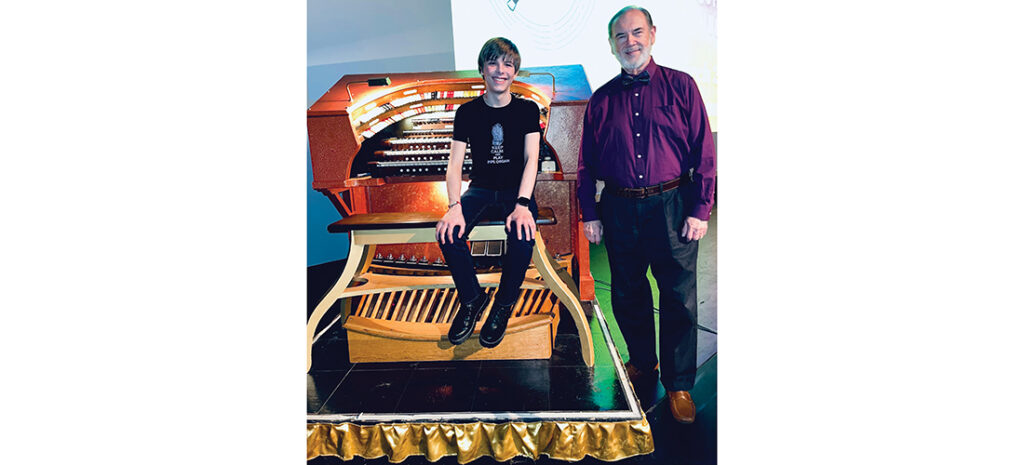
On a recent Saturday night at One Thirteen Brewhouse + Rooftop Bar, I caught a performance by The Ghosts of Liberty, a tight three-piece band Tyler formed with his wife, Emma, joining him on vocals and father Richard Millard on keyboard. For these types of gigs, the combo mixes original tunes with twists on classics such as “Brown-Eyed Girl” and “Tennessee Whiskey.” Elevated by Emma’s classically trained, velveteen voice and stunningly pristine vocal styling, their romantic, anthemic composition, “Sundown to Sunrise,” has racked up close to half-a-million listens on Spotify.

Tyler might actually have an advantage over other singer/songwriters, sonically at least, because he’s sightless — a slightly more accurate description than blind. He can still detect bright sources of light, but little else.

“I’d always had bad vision. It just got a little bit worse every year,” Tyler explains. Majoring in mathematics at UNCW, he was 21 when “driving was starting to get scary for me already.” Forfeiting his driver’s license, he was ultimately diagnosed with retinitis pigmentosa or RP for short. “Honestly, at the time, it was a little bit of a relief because I knew I shouldn’t be driving anymore.”

Finishing his degree and faced with an inability to compete in the sporting events he excelled in, Tyler picked up a guitar, meticulously teaching himself to play. “I wasn’t talented naturally, out of the box. It just never even occurred to me that music would be a part of my life.”

Pretty much every successful creative person I’ve ever encountered has found themselves at a crossroad leading a wholly unanticipated but gratifying future. “As I’ve moved through life, I’ve seen other people cope with mourning their expectations,” Tyler says. “I now recognize that’s kind of what I was going through at the time. You think your life’s going to be one way, then realize everything’s going to be very different.” Feeling fortunate in a way, he adds, “It wasn’t like I had some sort of an accident and lost my vision. I had time to kind of ease into the water.”

As luck would have it, college campuses are a hotbed of wannabe guitar heroes. “So there were tons of people to learn chords from,” Tyler recalls. He admits to being obsessed with mastering the instrument, saying “I think you kind of have to. There’s such a barrier of entry with a guitar. It literally hurts your fingers getting the guitar to become so familiar that it feels like part of your body.”

After an unsettling attempt at teaching high school, Tyler returned to UNCW for grad school in order to teach at the community college level. It was there that he got serious about writing music. “By the time those two years were up, my fate was sealed,” he recalls. “I’d played too much guitar and couldn’t go back. So I moved home to Oak Ridge where my dad lives.”

After earning his teaching certification, he switched gears and instead pulled together his first band. “I was still living at home, so I wasn’t concerned with money as much,” he tells me. The Tyler Millard Band found receptive audiences first in Wilmington, “where I got to see my old friends from college. And we played in Greensboro a bunch when Buckhead [at Plaza Shopping Center] was open.” In 2014, the group released an album, Carolina Blues, which harkens back to Carolina-inspired, shit-kickin’ Southern rock of the ’70s.

In 2018, Tyler’s proposal to his wife, Emma, came in the form of an exquisitely tender refrain he composed then serenaded her with. Together they recorded the song, entitled “Prologue,” with Doug Davis of The Plaids producing, credited to Em & Ty. A poignant, poetic melody sure to dampen dry eyes, “Prologue” is genuinely worthy of becoming a standard performed during every matrimonial party, as commonplace as “Wedding Song (There Is Love).”

By then, Tyler had abandoned the bar band concept for a more practical approach to making a living with music. You might say he did the math. “My dad and I play the wineries around here,” he says. “The economics of it are that the patrons are older and the owners are older, so everybody’s got more money.”

Occasionally joined by Emma, their first set is made up half of covers, half originals. “It takes a little bit of warming up just to get our voices sounding good and we also want to stay sharp on our own material,” Tyler says. “The second two sets are all bangers. We like to end really strong.”

Tyler sings while fingering an electric acoustic Fender Telecaster. Switching off on vocals, Emma strums her own acoustic six-string, forming the nucleus of The Ghosts of Liberty. “We put out three songs and did the whole Nashville thing — production, writing and everything,” recalls Tyler. For several days they hunkered down in Music City, collaborating with professional song stylists “who literally write 10 songs a week sometimes. We would sit in a room and they’d be like, ‘What do you wanna write about?’ Or, ‘Do you have any pieces you’ve been working on, a chunk of a song or anything?’ And we’d take it from there.”

No doubt, Tyler Millard and The Ghosts of Liberty will fast become yet another facet into what is evolving into a recognizable 21st century “Greensboro Sound” exemplified by Laura Jane Vincent, Josh Watson, Emily Stewart, Caleb Caudle, Tom Troyer and so many others. Although those musicians primarily root around in their respective and respectable country folk backyards, Tyler’s solo work is more rock-oriented.

“Another blind friend of mine from London taught me how to mix,” Tyler says. “Right now I’m laying down backing tracks, some drums and bass for us to play along with for bigger shows.” He tells me Taylor Swift’s “Shake It Off” is one of the tunes the band plans to cover “just because it’s kind of cool to turn it into a rock-and-roll and not a pop song.”

Down the road from his dad, Tyler and Emma currently reside in Oak Ridge with their 18-month old daughter, Clara, and Emmett, the dog. “She’s the best,” the proud father says of their baby girl. “All of a sudden she’ll be hugging my leg and I’ll have no warning that was gonna happen, you know? And that makes your day.”  OH

For concert dates, go to tylermillard.com.

Billy Ingram’s first book (mostly) about Greensboro, Hamburger², is available as a free PDF at: tvparty.com/1-hamburger.html.

Wandering Billy

Wandering Billy

As Seen on TV

Greensboro native Shannon Cochran returns from screen to stage

By Billy Ingram

“Many roads lead to Rome, it doesn’t matter which one you take, as long as you mean to get there and you keep walking.”      — Author Unknown

Recently, I caught up with a former Page High School classmate, Shannon Cochran, who has appeared on an impressive number of the comedy and drama series you’ve likely watched over the last 30 years: NCIS, Fringe, Grey’s Anatomy, Desperate Housewives, Law & Order, Modern Family . . . the list goes on and on. She emasculated George Costanza (“What’s wrong with you?!?”) in the seminal Seinfeld episode, “The Parking Space.” On the big screen, she was Senator Tal’aura in Star Trek: Nemesis; and best known, perhaps, for invoking nightmares as Anna Morgan’s sinister spirit in the horror classic, The Ring.

However, theater is Shannon’s true calling, primarily but not exclusively in Los Angeles and Chicago. In fact, she has been nominated no less than a dozen times for the Windy City’s prestigious Joseph Jefferson Equity Award for acting excellence, winning twice. This talented Greensboro gal has also brought home Obie and Theatre World Awards for a role she originated in the psycho-thriller, Bug, at London’s esteemed Gate Theatre.

Shannon made her original TV debut on my weekly, summer of ’75 Public Access comedy half-hour comedy show that boasted a budget of 23.5 cents. Can I spot talent or what?

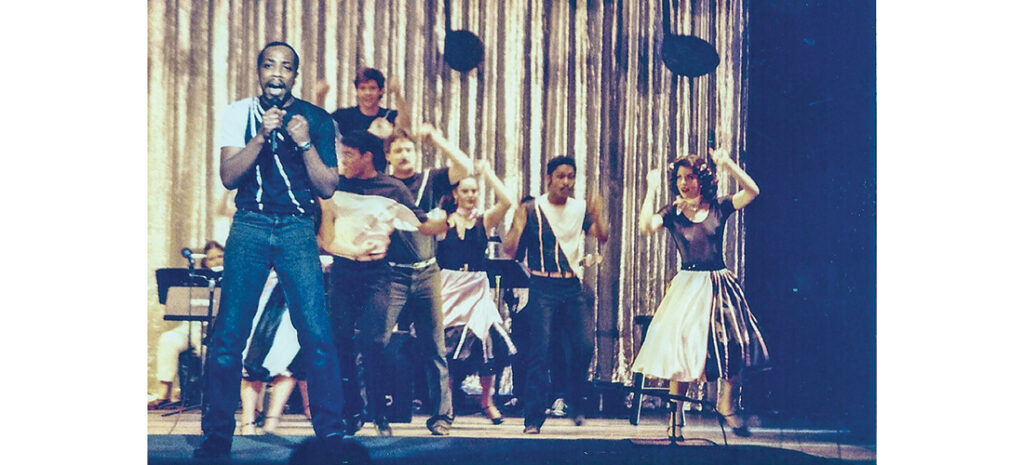
Shannon contracted the acting virus — no vaccine anticipated — at Page in Louis Hrabovsky and Frank Holder’s whimsical (I can say it  ’cause I saw it) 1975 production of West Side Story. “I was Anita,” Shannon recalls of her transcendent performance. “Funnily enough, for a skinny, 5-foot-10 Irish girl, I played Anita four times in my career before it became completely inappropriate for me to play a Puerto Rican.” Page’s music teacher, Sam Doyle, was the show’s choral director. “He was a huge influence on me,” Shannon recalls. “Fortunately I’ve been able to tell him that.”

As a teenager, this statuesque ingenue blitzed the stage in productions mounted by Youth Theater, and Barbara Britton and Carol Lindsay’s Livestock Players Musical Theatre, which was situated during the summer in a sprawling cattle barn on Burlington Road where, perhaps hours earlier, the spotlight shone more on cud than scenery chewers. “I did that for several years in high school,” Shannon says. “Those people introduced me to theater and were my first teachers.”

After a stint at Wake Forest University, then graduating Summa Cum Laude from the Cincinnati Conservatory of Music, Shannon barnstormed the boards up and down the East Coast. “When the rights for A Chorus Line were released nationally, I came to Chicago to audition,” she says. At age 24, she landed that role, and then another immediately after. “I just fell in love with Chicago. Sometimes you land in a city and you know it’s the right place to be. I started working and never stopped.”

In the late-1980s, she began making three-month-long excursions into Los Angeles for pilot season before returning to the Windy City. She did that for about five years, then, as demand for TV spots increased, moved to Los Angeles around 1995.

Distinct differences exist performing for the stage as opposed to television and movies, where you arrive on set, character established. “I love the rehearsal period where you’re stumbling around, trying to figure things out,” says Shannon. Also missing for her is that visceral audience reaction theater affords. “In TV and film there’s lots of sitting around and waiting. At times it just seems more technical than anything else, but the money is obscene compared to what you make onstage.”

In Los Angeles, an actor can endlessly guest-star on TV shows, never get typecast, make piles of money, and still be available for theater gigs. “That’s kind of what happened,” Shannon says. “I thought, ‘Oh my gosh, this is the greatest thing.’ I did probably 50 or 60 commercials in my 20s and 30s.”

In The Ring, no one stroked a mane more menacingly than Shannon, depicting a malevolent matriarch who comforts a vulnerable child by bagging her head before chucking her into the well. “I had a great, great time because I got to wear waist-length hair extensions for a month,” she says. “It was thicker than a horse’s tail. People stopped and stared at me wherever I went.”

On television, you might recognize her as Pam’s raven-haired mom on The Office. “I got so much feedback from that,” Shannon tells me. “They decided to do another storyline with Pam’s mom, but I was on the road so Linda Purl replaced me.”

Shannon was particularly impressed working alongside Patrick Stewart, who directed the Star Trek: Next Generation episode for which she was cast. On day one, “He gathered all the actors together to talk about the scenes, like they were [individual] acting scenes. And I thought, ‘Somebody pinch me!’” That’s highly unusual on a television production, but, “People that come from the theater have a kind of humility because they did the same thing we all did, going into a barn and putting on shows.”

She made a guest appearance at her first Star Trek convention last summer: “I got to be a Klingon on Star Trek: Deep Space Nine. I’ve never felt so powerful in my life. And I met my husband on the set.” She was seen on two episodes of that series, but “had never been to a convention. The people were so great and they also wanted a picture from The Office or from Seinfeld, my first Hollywood job.”

Portraying Barbara Fordham in the touring company of Tracy Letts’ Tony Award-winning melodrama, August: Osage County, led to brawling under the lights with Oscar-winner Estelle Parsons. “She’s known for being irascible,” Shannon confesses of her choleric costar. “A great actress who did a very, very believable job, but she was not pleasant to tour with and not nice to most of the cast. So we all kind of rallied around each other. A wonderful show to be a part of but I cannot bring myself to compliment Estelle Parsons’ personality.”

Shannon’s dream role? “The one I’m playing now, which I also got to play seven years ago, Regina in The Little Foxes, one of the great roles of the theater. It’s a mature actress’s dream. A Little Night Music is probably my favorite musical, but Regina is my favorite role.” This may surprise you but the theater isn’t all curtain calls and stage door Johnnies. The night before we spoke, Shannon broke a finger onstage, requiring emergency surgery.

Her undoubtedly proud mother resides in Greensboro. While she visits every two or three months, Shannon Cochran is not likely to return to the Gate City to live. “I’m sure I could fall back in love with Greensboro. It’s just that I’ve gotten used to bigger city environments. San Francisco [where for almost 2 years she demolished audiences in Harry Potter and The Cursed Child], Los Angeles, Chicago, I’ll probably always live adjacent to one of those cities.”

So, no more shows between cattle auctions?  OH

Billy Ingram’s new book about Greensboro, EYE on GSO, is available wherever books are sold or pulped. Shannon Cochran’s hauntingly beautiful rendition of “Send in the Clowns” from a Writer’s Theatre performance of A Little Night Music can be found on YouTube.

Wandering Billy

Wandering Billy

Grab Your Popcorn

A locally produced WWII film hits the big screen

By Billy Ingram

“Strip away the phony tinsel of Hollywood and you’ll find the real tinsel underneath.”       — Oscar Levant

Our fair city has been a hotbed of independent filmmaking over the last quarter century or so. Recently, perhaps inevitably, a number of locally produced motion pictures have been attracting worldwide audiences. With the wide release of Condor’s Nest in January, one cadre of Greensboro-based filmmakers, Lost Galleon Films, has burst onto the Hollywood landscape in a big way with a rollicking, star-studded revenge flick set in 1950s South America focused around a search for Nazi war criminals.

While writer/director Phil Blattenberger grew up hither and yon, he’s considered Greensboro home for more than two decades now. “So yeah, I’m a local filmmaker if you wanna call it that, kind of by default,” he tells me. “I grew up on all the ’80s pastiche.” His favorite films as a youngster were those blockbuster, so-called popcorn flicks that didn’t take themselves too seriously. “Obviously all the classic Indiana Jones and Back to the Future movies.”

In Blattenberger’s latest motion picture, Condor’s Nest, a German Colonel played by Arnold Vosloo (Imhotep in The Mummy) sadistically executes an American bomber crew during WWII. Ten years later, the commander of that doomed mission travels to South America to exact revenge and, in the process, uncovers a sinister plot to ignite a Fourth Reich to finish what Hitler had only just begun.

It’s a fact that thousands of high ranking Nazis fled Germany after the fall of the Third Reich, establishing new lives and new identities in South America. It’s been convincingly posited that Hitler and Eva Braun lived out their lives in Argentina.

“It’s a really rich narrative that’s not been touched on, surprisingly,” Blattenberger says of what he proudly calls his own popcorn flick. “The type of film that your older brother brought you to when you were 13 and not supposed to see R-rated movies, and you sat in the theater with a bag of popcorn and just watched a bunch of Nazis get their asses kicked. Nazi ass-kicking movies do extremely well globally and have a grand appeal.”

Condor’s Nest is a motion picture shot on a grand scale, including constructing an 85-foot-long, 80-year-old historic aircraft. It serves as a major set piece for the opening scenes, which take place alongside a little farmhouse in Eastern France. “We built a full scale crashed B-17 bomber down to the centimeter in terms of engineering,” Blattenberger notes. “Museums donated original pieces from B-17s to really build this thing out.”

Making a motion picture of this caliber means there are thousands of moving parts and, if any one of them doesn’t look right, the whole thing falls apart. “We were amazed the first time actually looking at scenes through the monitor on the day we were shooting,” Blattenberger says. “All right, smoke’s pouring out the engines — these things look like real engines. We have car chases and explosions, some really high production value elements that are so easy to fall flat if you don’t have the crew that can put it together right. In fact, those elements became some of the strongest points in the film.”

Name actors invariably help to sell films, giving it more commercial cache globally. “Obviously Nazis are bad,” Blattenberger says, chuckling. “It’s been done so many times. What you don’t want to do is just get the stereotypical Nazi with an evil laugh. We wanted to find somebody with gravitas who was going to bring a bit of nuance to the role, in the sense that his character was internally justifying his own horrible actions, actually making him the good guy in his own head. And we knocked it out with Arnold Vosloo who went toe-to-toe as the villain in Blood Diamond up against Leonardo DiCaprio.”

Michael Ironside appears as a Russian agent. He’s been in dozens of movies like Starship Troopers and Total Recall, and was featured in Top Gun. “We pulled in Twilight star Jackson Rathbone to play a really seedy character,” Blattenberger says. “He shows up about halfway through the movie and turns into one of the big third-act villains.” Cast as Heinrich Himmler is James Urbaniak (Robert Crumb in American Splendor). “He had never spoken a word of German in his life,” Blattenberger says of Urbaniak’s performance. “He had to learn his entire role in German, doesn’t speak a word of English in the entire movie. We cast Academy Award nominee Bruce Davison (Longtime Companion). He did his whole scene in German.”

Key setups with these actors were filmed in and around the Julian Price House, a Tudor-revival estate that looks as if it could exist anywhere in the world, most improbably in Greensboro. “That’s actually the Condor’s Nest,” Blattenberger notes. “The titular location for this film that’s supposed to be set in the mountains of Bolivia.”

Lost star Jorge Garcia portrays a turncoat bartender in Buenos Aires spying for both the Russians and Germans. The basement of Havana Phil’s Cigar Company, for some four decades known as Cellar Anton’s, one of the city’s most revered dining rooms, served as his bar. “We shot our big wide establishing shots in South America,” Blattenberger explains, “selling the idea that you’re in another continent, so we could jump in the movie to the interior of a bar that’s on a different continent. Greensboro was a great location for that.”

“The real guy to talk about is Jacob Keohane,” Blattenberger says of his lead actor. “He’s been active on the East Coast theater circuit for years. He had a major role in Halloween Kills that came out last year. The guy’s absolutely brilliant.”

This locally produced picture proves there’s no need to lower expectations just because a film isn’t made in Hollywood. No less than Paramount Pictures picked up the distribution rights for a dozen or so major cities including New York and Los Angeles, and the movie is available on streaming platforms as you read this.

I can tell you first hand, there is no other experience in life comparable to working on a movie set. The writer/director agrees: “Running around with a crew of 30 or 40, there’s a mania and an energy to it, a coordinated chaos. It’s addictive. It’s something that you latch onto and, man, you just wanna keep making movies, you know?”

As for Phil Blattenberger and Lost Galleon Films’ next project, “We’re officially in pre-production on Without Consequence, a crime thriller set in the American West in the early 1960s, shooting in New Mexico this October or November. We’ll pull a few familiar faces from Condor’s Nest on it and there will probably be a scene or two shot in Greensboro.”  OH

In another of life’s moments reminding us just how old we are, Billy Ingram actually worked on the posters and trailers for Indiana Jones and the Last Crusade and Back to the Future 2 and 3.

Wandering Billy

Wandering Billy

12 Cent Dreams

Remembering a local legend in ink

By Billy Ingram

“Comic books helped me to define myself and my world in a way that made both far less frightening. I honestly cannot imagine how I would have navigated my way through childhood without them.”   — Bradford W. Wright

Wright’s not wrong. As a young comic book collector, one of my fave artists was Murphy Anderson. His fluid brushwork bestowed an air of sophistication few artists of that genre possessed. I was surprised to learn, years later, that Anderson was born and raised in Greensboro before moving to New York to work for DC Comics.

Murphy C. Anderson Jr. recognized early on the transformative power that words commingling with pictures could have on the imagination. As a youngster in the 1930s, he’d spend hours lying on the living room floor of his North Spring Street home poring over the comic pages of local papers and, on Sundays, the New York Journal-American, which allowed him to follow the adventures of The Phantom, Mandrake the Magician, and his favorite strip, the scientifically forward-looking Buck Rogers in the 25th Century.

Amy Hitchcock, a former classmate, says, “At Central Junior High there were two boys that sat together all the time and they drew in their notebooks all the time. My impression of Murphy was that he was withdrawn, quiet and always did his own thing, but he was pleasant.” Later, Anderson and Greensboro newspaper legend Irwin Smallwood would become co-editors of Greensboro Senior (now Grimsley) High School’s newspaper.

A college dropout facing certain military service in 1944, Anderson borrowed $100 from his skeptical father to make the rounds of New York City’s funny book publishers. Unknowingly, he was marching into what has become known as the Golden Age of Comics, so christened because sales were so astronomical, upwards of 6 million copies per title.


Anderson landed a gig illustrating for Planet Comics, whose main selling point seemed to be the undulating breasts belonging to whichever curvaceous blond was being snatched up by salivating bug-eyed monsters that month. He continued slinging ink for Fiction House while serving two years in the Navy, stationed in Chicago, where he met his soon-to-be wife, Helen. Completing his military stint in 1946, he happened upon a notice from the National Newspaper Service in search of an artist for Buck Rogers in the 25th Century. Anderson took over daily art chores in 1947. “I grew up on Buck, it was a dream come true,” he related decades later.

Anderson left Buck Rogers in 1949 just as the golden age of comics was drawing to a close. He and his bride made their way to Greensboro, where, during the day, he served as office manager for his father’s fledgling business, the Blue Bird Cab Company.

Before long, Anderson was once again canvassing the concrete jungle. Julius Schwartz, editor for National Periodical Publications’ (as DC Comics was known in 1951) new line of science fiction comics, recognized Anderson’s work as compositionally superior to and more finely rendered than many of the company’s slickest artists. Schwartz met with him and sent him home with a script to illustrate.

Schwartz allowed Anderson, now with children and not ready to give up his Carolina roots, to mail his contributions in from Greensboro, an unheard of arrangement. Still trafficking for Blue Bird Cab, Anderson spent his nights conjuring up compelling covers populated with pointy-eared giants capturing fighter jets in butterfly nets, radioscopic weirdos from other dimensions invading and terrifying the tourists, and genetically superior gorillas confounding the laws of man and nature. Stories were then written around his phantasmagorical scenarios.


The family relocated to New York in 1960 in order for Anderson to work full-time for DC, a company undergoing an unexpected resurgence. On a whim four years earlier, editor Julius Schwartz had re-imagined one of the brand’s dead-as-a-doornail superheroes from the 1940s, The Flash. With this act, the Silver Age of Comics was born. Anderson’s meticulous flourishes defined DC Comics’ house style of the ’60s and early ’70s — so much that Schwartz preferred to have him inking others’ pencilled art, most notably Carmine Infantino (Adam Strange, Batman) and Gil Kane (The Atom, Green Lantern).

Meanwhile, years of poorly drawn short stories with Batman, Robin, Batwoman and Ace the Bathound confronting bulbous-bodied aliens and overcoming silly transformations (“Batman Becomes Batbaby!”) led to sales so dismal that cancellation of the entire Batman line was all but certain. Schwartz was yanked off the sci-fi comics in 1964 and given six months to save the bat-franchise. The result was a monthly onslaught of playfully gripping covers sketched by Infantino, the best of which were inked by Anderson, re-introducing The Joker, Riddler, Catwoman and Batgirl to a new generation. By 1966, business was booming when the Batman TV show sent DC’s sales into hyperdrive.

When Schwartz rebooted Superman in 1970, Anderson was teamed with Curt Swan. So meshed were their styles that the duo took to crediting their art as “Swanderson.” Then, in 1972, the Greensboro native’s dynamic portrayal of Wonder Woman graced the first issue of Ms., becoming one of the most striking and culturally significant magazine covers of that decade.


In a twist not unlike those found in the comics, it was Anderson’s one time schoolmate Amy Hitchcock’s son, John, who organized Greensboro’s first major comic convention in 1983, featuring Murphy Anderson as a guest of honor. “Murphy was here in 1985 when Jack Kirby was here,” John Hitchcock (owner of Parts Unknown: The Comic Book Store) says, a significant moment since the only controversy in Anderson’s career came when he was asked to redraw Kirby’s Superman faces to more closely conform to the DC style. “[Anderson and Kirby] were in the kitchen of my apartment when Murphy went up and apologized to Jack. He was always embarrassed that he had to change his artwork because he had so much respect for Kirby. Jack went out of his way to thank him and say, ‘Murphy, that’s OK. That’s the way business was back then. I have no ill will,’ and they shook hands. That shows you what a great guy Murphy was — it bothered him all those years.”

Murphy C. Anderson Jr., universally respected as both draftsman and gentleman, passed away in 2015 at the age of 89. He left behind his wife of 67 years, Helen, two daughters, a son, grandkids and an indelible impression on millions of thrill-seeking comic book lovers everywhere.  OH

Billy Ingram still has comic books he purchased from a spinner rack located next to the back entrance of Woolworth’s downtown.