
The Five Faces of O. Henry

The Five Faces of O. Henry
Local artists turn paint, sequins and ephemera into portraits of William Sydney Porter
By Joi Floyd
In honor of O.Henry magazine’s 15th anniversary this month, there’s no better time to celebrate the many faces of our namesake, Greensboro-born William Sydney Porter — more commonly known by one of his pen names, O. Henry. In just a few decades, he went from a prison inmate in Texas to one of America’s most popular writers, selling nearly 5 million copies of his books in the U.S. We asked five local artists to take a crack at portraying the elusive storyteller through their own creative lens. Maybe their interpretations will reveal something new or maybe they’ll only deepen the mystery. Either way, we’re happy to keep the legend alive — and we’re raising our Sazerac to another 15 years of carrying on his literary legacy. (See page 60 to learn more about O. Henry.)

Artist: James Celano
“It’s a visual art. Just look at it,”
Some people can’t resist looking for the hidden meaning in a work of art. Others are happy to let it have the last word. William Sydney Porter trusted his stories to speak for themselves, and Greensboro artist James Celano, a graduate of the Pennsylvania Academy of the Fine Arts, takes the same approach. The best way to experience art, he says, is simply to look at it.
Much like our esteemed O. Henry, Celano chose to focus solely on the image, allowing viewers to create their own interpretations. “The trickiest part was working from a black-and-white photograph,” he says. Still, where there’s a will, there’s a way. Using oil paint on a birchwood panel, Celano transformed the reference image into a striking portrait.
When asked about his process, Celano prefers to keep the mystery intact. Referencing a quote from renowned Frenchman Paul Valéry, he says, “I think a French poet once said, ‘One must apologize for talking about painting.’”
Artist: Sky Bradshaw
“Stitch by stitch, sequin by sequin.”
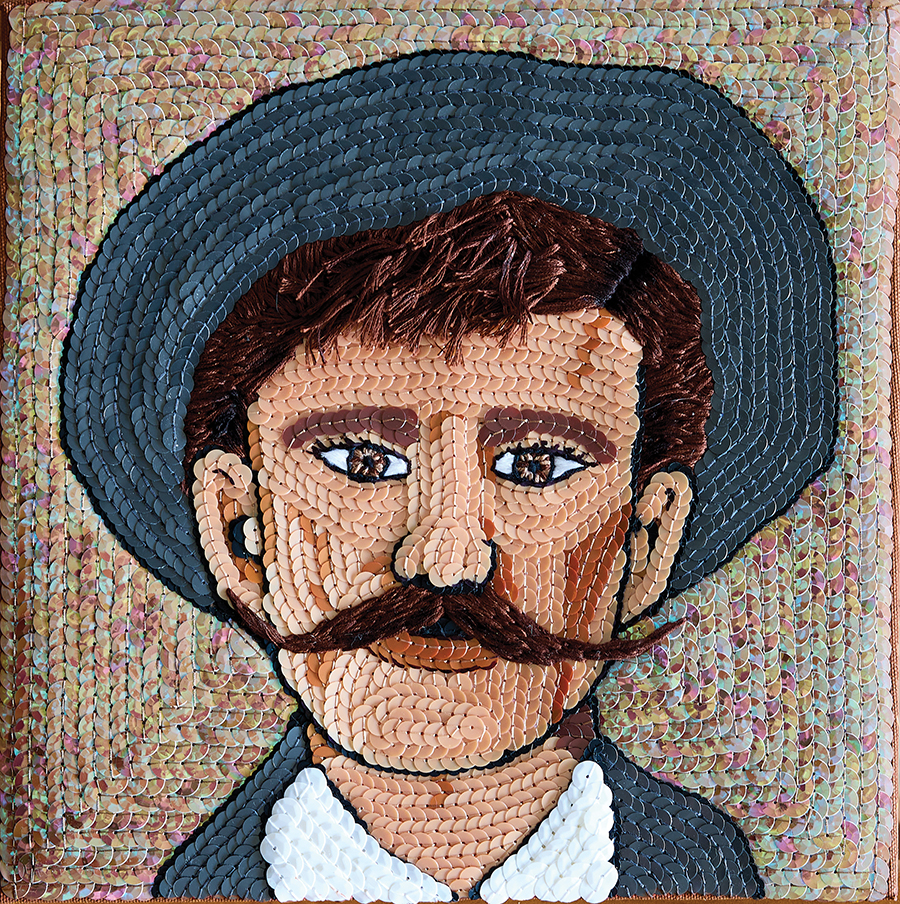
In Porter’s prime years he was a short-story star. His writing is where he shone most, whether fiction or poetry. And what better way to commemorate a life that sparkled than with sequins?
Sky Bradshaw, a sequin and textile artist, says her creative process brought her a deeper understanding of Porter as well as the city she calls home. “I felt like it rooted me in a lot of ways with history in Greensboro that I never touched on,” says Bradshaw.
With needle, thread and thousands of glimmering sequins, Bradshaw stitched a scintillating adaptation of O. Henry’s face, drawing on the myriad of stories that were told about him. Beginning with a simple white cloth, she sat quietly with her sketch, letting it unfold through meditation before weaving embroidery and shimmering embellishments into a portrait worth a thousand stories.
“Connecting with his energy, history and story allowed me to tune into the underdog aspects of myself,” says Bradshaw. One O. Henry quote specifically spoke to her: “There are stories in everything.” And in this piece, Bradshaw has connected an invisible string from herself to Porter, artist to artist.
Artist: Christina Hill
“It just goes to show that your life doesn’t have to
be perfectly lived in order to be something amazing.”
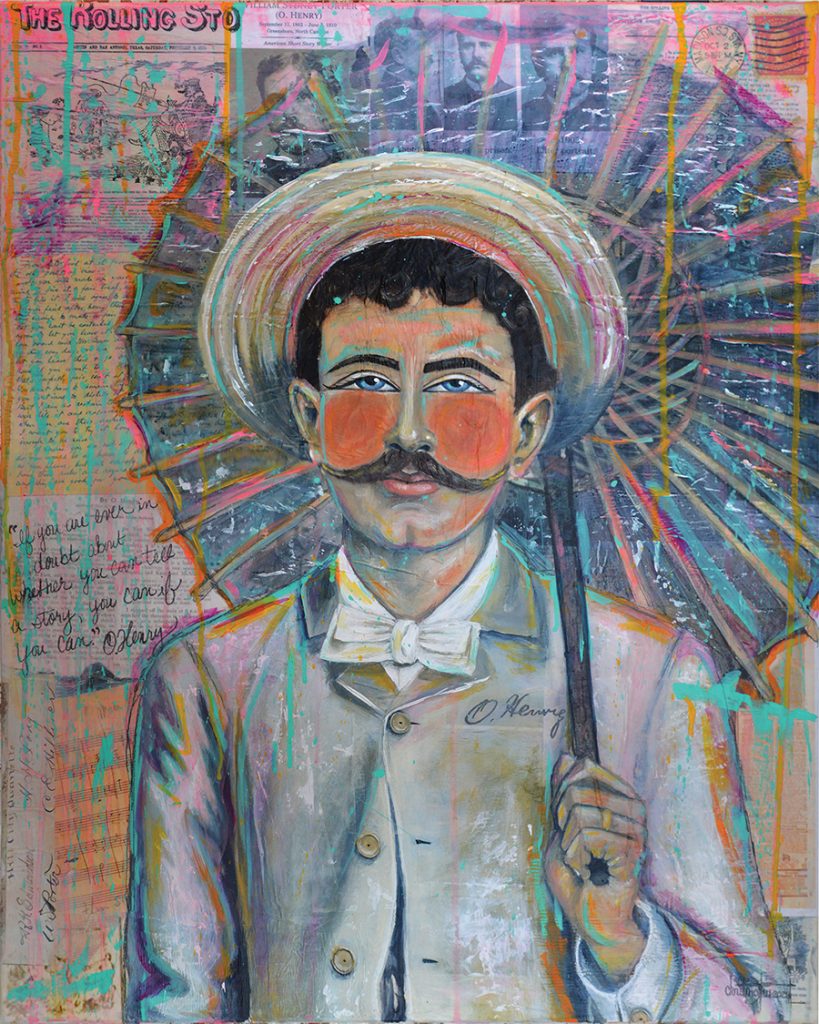
William Sydney Porter’s talent carried him to remarkable heights. From founding The Rolling Stone — no, not that Rolling Stone — magazine to writing for The New York Sunday World magazine, he painted the picture of a successful writer. But, behind every carefully crafted portrait lies a different story.
Greensboro artist Christina Hill, known for her bold color palettes and blushing portraits, chose to focus on the more flawed side of Porter’s life rather than presenting an idealized image. “There’s so much more to him that you can’t speak through him, so I felt like it needed to be behind him to show who he was,” Hill says.
Through her research, Hill found beauty in Porter’s imperfections. His life was marked by setbacks, including an embezzlement conviction and time in federal prison. Yet under the pseudonym O. Henry, he transformed hardship into enduring short stories. To reflect the complexity of his life, Hill incorporated layers of vintage materials, such as old newspaper articles, into the work. “The paper is from the 1950s. I found it years ago at the Salvation Army,” she explains.
Hill’s portrait invites viewers to see more than just face value. Embedded within the painting are traces of his past and the experiences that shaped him as a writer.
Artist: Leti Reis
“It was kind of like a lost story.”
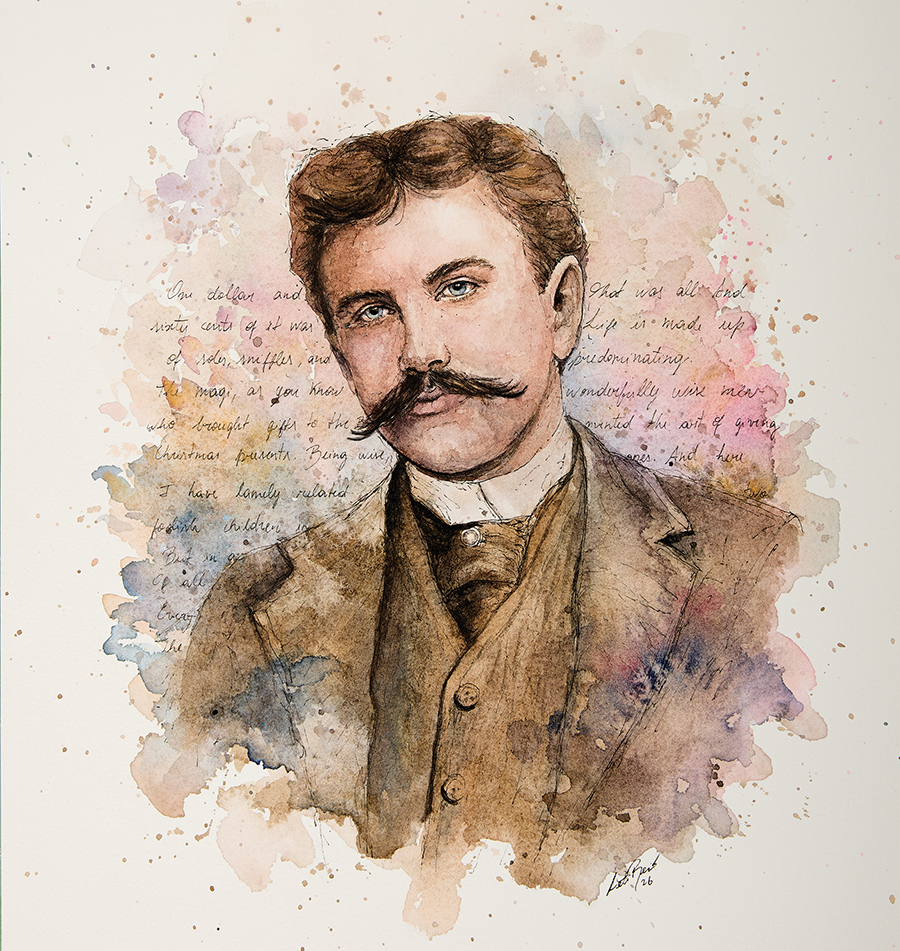
“For me, what I was trying to give with the painting was that he was [immersing] himself in the story,” says Leti Reis, a Greensboro-based artist. Rather than focusing solely on technique, Reis painted from feeling, creating a portrait that she can only describe as “emotional.”
“I like to have this watercolor background and just let the paint flow,” Reis says. Because Porter was a writer, she wanted his words to become part of the piece itself. Layering blooming watercolor with passages from O. Henry’s writing in ink, she created a portrait that blends the author’s words with his image, inviting viewers into both his world and his work.
For Reis, the tie between an artist and their art begins with the eyes. “I couldn’t find any pictures with him looking at the camera, so I changed it. I wanted that connection in the painting,” she says. By meeting the viewer’s gaze, her portrait creates an intimate encounter with Porter, much like his short stories.
Artist: Rukiya Williams
“I wanted to know what’s in between.”
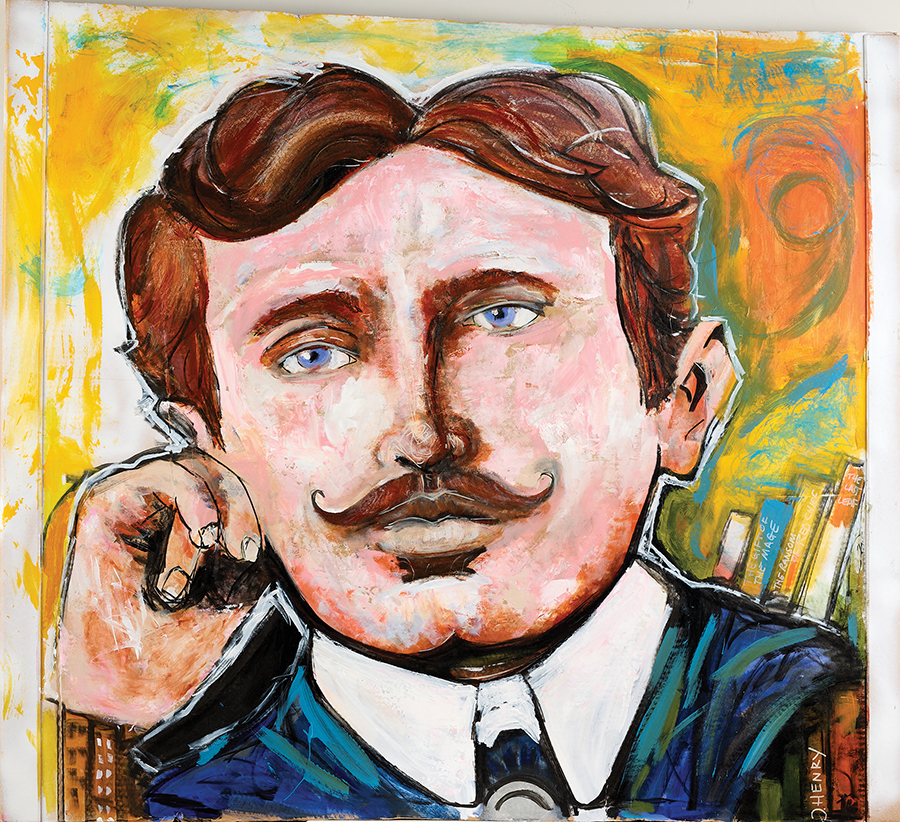
There are many ways to describe William Sydney Porter; clever, witty, a genius storyteller. But, for Rukiya Williams, local artist and filmmaker, “layered” suits her fancy best.
Working with recycled cardboard and acrylic paint, Williams built O. Henry’s portrait one layer at a time, creating a face that reflects the many stories he told — and the many lives he lived — while suiting her creative mission. “The repurposed supplies and layer concept speaks to me more as an artist, so I incorporated that into the painting,” she says. For her, one facial feature mattered most: “The main thing I wanted to showcase was his eyes.” Piercing blue and hard to overlook, Porter’s eyes steal the show, rivaled only by his signature ’stache.
“Art is about trying to find another angle and perspective,” notes Williams. It’s a sentiment our beloved Porter himself might have appreciated. No stranger to seeing the world from a different point of view, in his 1904 novel Cabbages and Kings, O. Henry writes, “I wanted to paint a picture some day that people would stand before and forget that it was made of paint. I wanted it to creep into them like a bar of music and mushroom there like a soft bullet.” OH