Simple Life

The Stuffed Potatoes

Sustaining power of wise friends — and a good lunch


By Jim Dodson

Two or three times a month, we meet for lunch at a quiet bar of a local restaurant.

We catch up on news and work, talk about books we are reading and swap tales about the adventurous lives of our wives, grown children and grandbabies. Sometimes it’s history and politics that dominate the conversation. More often than not we share thoughts on life, love and matters philosophical. In a nutshell, we attempt to solve most of the world’s problems in the span of time it approximately takes to consume a couple of stuffed baked potatoes.

That seems about right since the three of us always order the same items off the bar menu.  Joe and I routinely order fully loaded stuffed baked potatoes while our worldly friend Pat — who prefers to be called Patrick — gets a fancy club sandwich. There’s always one in every crowd.

Some time ago, I began calling our gathering The Stuffed Potatoes Lunch and Philosophy Club.

Spud Buds for short.

You see, we’ve known each other for more than half a century. Pat (as I call him) is my oldest pal; we grew up a block from each other and have spent years chasing golf balls and trout in each other’s company. Pat and Joe grew up attending the same Catholic church. But I got to know and like Joe in high school.

To look at us, you might think we’re just three old geezers telling war stories in a booth.

Technically speaking, I suppose we are “old” guys, though none of us thinks of ourselves that way in the slightest. 

We were born weeks apart in 1953 — Joe in January, me in February, Pat in March.

What a banner year it was: Dwight Eisenhower became president and the Korean War ended. Hillary — the mountaineer — reached the summit of Everest. Elizabeth II was crowned Queen of England. Gas cost 20 cents per gallon. The first Corvette went on sale. Albert Schweitzer won the Nobel Prize. From Here to Eternity was the top Hollywood movie. Ian Fleming published his first James Bond novel, Casino Royale. Mickey Spillane was the king of crime fiction.

Our mothers, bless their hearts  — suburban housewives of the 1950s — knew what they were doing giving us simple 1950s names like Joe, Pat and Jimmy, names that fit us like a pair of Buster Brown shoes, names from a Mickey Spillane novel or a Burt Lancaster movie.

I’m guessing nobody these days names their kid Joe, Pat or Jimmy. Not when you’ve got so many exotic choices like Brendan, Rupert or Hamish floating around in the Millennial baby pool. Just to be sure what I’m talking about, I looked up the most popular male names for millennial babies in 2020.

Michael, Christopher, Matthew and Joshua are actually the top Millennial male names for 2020. Daniel comes in fifth.

That’s four Biblical names shy of a Christian baseball team. With a starting lineup like that, you could almost write your own New Testament  — if Millennials bothered to go to church anymore.

Joe’s the only one of us who has achieved exalted granddad stature. He and wife Liz have two, in fact. One’s in Durham, the other, Asheville. They go see them all the time and who can blame them for that? If I had grandbabies somewhere within shouting distance I’d burn up the highway just to make a proud and happy fool of myself every dang weekend.

As of this month, we’ve all turned 67 years old. No applause necessary.

Truthfully, it’s rather amazing how quickly this happened. Once upon a time, 67 sounded positively ancient to our youthful ears — one bus stop shy of the boneyard, as Mickey Spillane might say.

The funny thing is, none of us feels at all ancient or even looks terribly old, according to our thoughtful wives and daughters. Then again, they might need new glasses.

With age, however, comes a number of often unadvertised benefits.

We’ve each buried family and friends, suffered setbacks and experienced comebacks, seen enough of life and sudden death — not to mention the drama of our own aging bodies — to know that bittersweet impermanence is what makes living fully so important and precious.  To laugh is to gain a taste of immortality.

Failed projects and busted business deals have taught us that there’s really no failure in this life — only reasons to get up, dust off our britches and try a different path. A new summit always awaits.

Our faith has been tested and found to be alive and kicking, after all these years.

We’ve learned that joy and optimism are spiritual rocket fuel, that divine mystery is real and the unseen world holds much more intriguing possibilities than anything we read about in the news, or watch on Netflix, Hulu or Amazon. 

Ditto the natural world of woods and fields and streams.

It’s no coincidence that we share a profound love of nature, drawing comfort and wisdom from its many lessons.

Joe, a forester by training, spends his days helping clients find and set aside wild lands for future generations to enjoy. He and Liz are dedicated wilderness hikers, walking encyclopedias of botany and flora, forever in search of new trails and unspoiled vistas when they’re not slipping off to see those beautiful grandbabies of theirs.

Pat is a top businessman whose real love is the spiritual solitude of remote trout streams and the joy of chasing a golf ball around the highlands of Scotland with his oldest pal. He’s also a skilled bird-hunter but these days shoots only clays with Joe some Wednesday afternoons.

Several years ago, Pat and Joe built a cabin on Pat’s land up in Meadows of Dan, Virginia. They set up cameras just to film any wildlife that happened by, cleared roads and got to know the locals. Since both are still working and have no plans to retire, that cabin became a way, as Joe puts it, “to reset our clocks — inside and out.” We take from nature, said Theodore Roethke, what we cannot see.

As for me — a veteran journalist and writer who is busier than ever and shares their view of the dreaded R-word  — I’m an “old” Eagle Scout, fly-fishing nut, bird-watcher and gardener who once spent six glorious weeks in the remote bush of South Africa with a trio of crazed plant hunters dodging black mambas and spitting cobras just to see the world’s smallest hyacinth and other exotic plants in the ancestral birthplace of the world’s flowers. The baboons, birds, springboks and elephants weren’t bad, either. I felt like a kid in a Rudyard Kipling tale.

At that time, I also lived in a house I built with my own hands, on a forested hill near the coast of Maine. I also rebuilt the stone walls of a long abandoned 18th-century farmstead and created a vast English garden in the woods that nobody but family, friends, the FedEx guy and local wildlife ever saw. My late Scots mother-in-law, cheeky women, suggested I name my woodland retreat “Slightly Off in the Woods.”

I called it my Holy Hill, my little piece of Heaven.

My two children grew up there watching the seasons come and go, learning to look and listen to the quiet voices of nature. Today, one is a documentary journalist living and working in the Middle East, the other a top copywriter and screenwriter in New York City. Both claim they carry the peace of that Holy Hill with them in their hearts, and I believe them. I do, too.

Maybe that’s what I love most about lunches with the Stuffed Potatoes.

At a time of life when a lot of men our age lose their curiosity and zest for living, spending their days grumbling about sports, politics or the weather, we take genuine pleasure in each other’s company, swapping tales of life’s natural ups and downs while sharing wisdom for the road ahead.

Joe has stories galore and the most infectious laugh you’ve ever heard. He was the fifth of nine kids, has 53 cousins and an uncle who became the voice of the American environmental movement. He’s always coming out with pearls of wisdom that I promptly write down. We call them “Joeisms.”

Everybody has to be somewhere, he once observed about an a certain disagreeable fellow. I just don’t have to be there with him. 

Patrick is gifted with what the Irish call the craic  an ancient Irish word that means he can talk to anyone and entertain them royally while he’s doing it. He’s a master at solving complex problems and has quietly done more things that help teenagers and homeless folks than anyone I know. He’s also the only guy I know who’s probably read more books than me, which is really saying something. At least he hasn’t started writing them — yet.

So we are three for lunch — the forester, the fisherman and the gardener.

A fictional Forrest Gump got famous for saying that his mother once said that life is like a box of chocolates because you never know what you’ll get. I beg to disagree, believing a happy life is actually more like a gloriously stuffed baked potato because, the more you put in, the better it tastes.

My Spud Buds, I suspect, would agree — even if one of them prefers the club sandwich.

There’s always one in every crowd.  OH

Contact Editor Jim Dodson at jim@thepilot.com.

The Creators

Man of Iron

How Raleigh’s bold investment in sculptor Jim Gallucci’s art led to a revitalization of the city’s urban center

By Wiley Cash
Photographs by Mallory Cash

In 2007, just as the world was spiraling toward financial ruin, Greensboro sculptor Jim Gallucci received the largest commission of his career. The city of Raleigh selected him to construct four light towers to sit on either corner of downtown’s City Plaza in an attempt to redefine the empty space in front of the old Civic Center.

“It started out as a $65,000 project,” Gallucci says. “We kept saying, ‘You know, guys, we can do more with this,’ and they said, ‘Really? You got any ideas?’ These towers were going to be 65 feet tall. The next thing you knew it turned into a $2.5 million project.”

However, as the reality of the global financial crisis set in, Gallucci was certain the project would be pulled; but leaders in Raleigh decided to move ahead. In the fall of 2009, City Plaza, complete with Gallucci’s four 65-foot light towers bedecked in steel oak leaves, opened to the public. City officials hoped the plaza would serve as a “public living room” that would host concerts and events while attracting organizations from around the country that were searching for event and reception space. The plaza project was part of the now completely revitalized area of Raleigh’s Fayetteville Street, and towering above all the new businesses, concertgoers and tourists are Jim Gallucci’s glowing behemoths.

Raleigh proved that an investment in the arts could lead an economic revitalization. Gallucci was not surprised that the city’s bet paid off. “The arts are always the catalyst,” he says. “We’re the stick in the stream. Next thing you know there’s a leaf that’s caught by the stick, and before long the stick has gathered an entire island around it.”

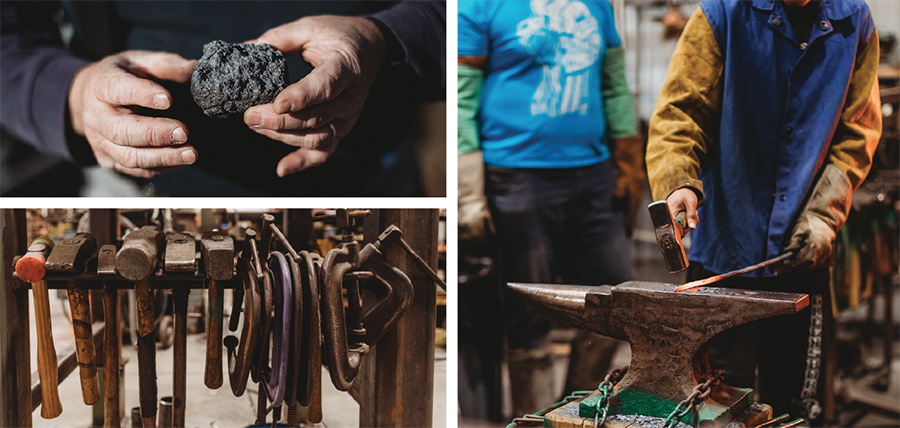
Jim Gallucci’s enormous studio — which he admits to thinking of less as a studio and more as a tool that assists in his art — sits just south of downtown Greensboro. Going off Gallucci’s own metaphor, his studio could be described as an island that has gathered things over the years: sculptures of dizzying heights and varying colors; scraps of metal from local salvage yards; beams from the World Trade Center; and people from around the state interested in anything from sculpture to metalworking to glassblowing to having a cup of coffee and chatting. This is exactly what Gallucci hoped this space would become after opening the studio in 2006, not only for him but for the collective community of local and statewide artists of which he is part.

***

Gallucci’s collective approach is quickly made apparent when you spend time discussing art with him; you will discover that he consistently speaks in the collective first person we.

“We’d been in the old Civil War rifle factory on East Washington in downtown Greensboro for 21 years,” he says. “There were holes in the ceiling. The floors weren’t strong enough to hold the sculptures we were making.” He smiles, takes a sip of his coffee. “We knew we needed four things from a studio: We needed plenty of space. We needed heat. We needed an office. And we needed a bridge crane.”

That checklist — especially plenty of space and the bridge crane — came in handy as the full lengths of the six-story Raleigh towers were being fabricated inside the studio. Gallucci had plenty of hands on deck as the towers were lifted by the bridge crane and prepared for transport.

You would not know it now, but there were times when Jim Gallucci felt more like that single stick in the stream than the island that would gather around it. As a working artist, he had spent years teaching at the college level, but that came to a halt in 1986, when the University of North Carolina Greensboro did not renew his teaching contract after nine years in the classroom. He had a decision to make: Should he and his family leave Greensboro in search of another teaching job, or should they stay in the community, where they had forged relationships for nearly a decade?

He and his wife made the conscious decision to stay. “We’d made a lot of friends,” he says. “We had a community. We knew a lot of people in the fabrication business, and we’d trade sculptures for steel. You don’t buy those relationships; you assemble them during your life.”

After leaving the classroom, Gallucci decided to put his faith in his local community, and he decided to keep his faith in his art. “I took unemployment for six months, and I called it my arts grant. I went in my studio every day like a worker at 8 a.m., and I’d work until 4 p.m. I worked every day in that studio, and we were able to trade for steel, and we made three good sculptures during that six months and tried to get into shows.

“Those three pieces we made? All of them were sold, and two of them ended up in Brisbane, Australia. I suddenly went from an unemployed art teacher to an international sculptor.”

***

Gallucci’s sculptures began to pop up around Greensboro, then around the state, then around the country. He is perhaps best known for his gates and arches, especially the Millennium Gate in Greensboro’s Government Plaza, a project that found 17 artisans creating 106 icons that represent major figures, moments and movements from American history. The icons are affixed to the enormous arch and comprise the gate at its center. Viewers are able to both witness history and pass through it, and that interaction is vital to Gallucci’s vision.

“With gates, it’s easy to get into the art,” he says, “literally and figuratively. I try to get people to enter the work, to engage with it.”

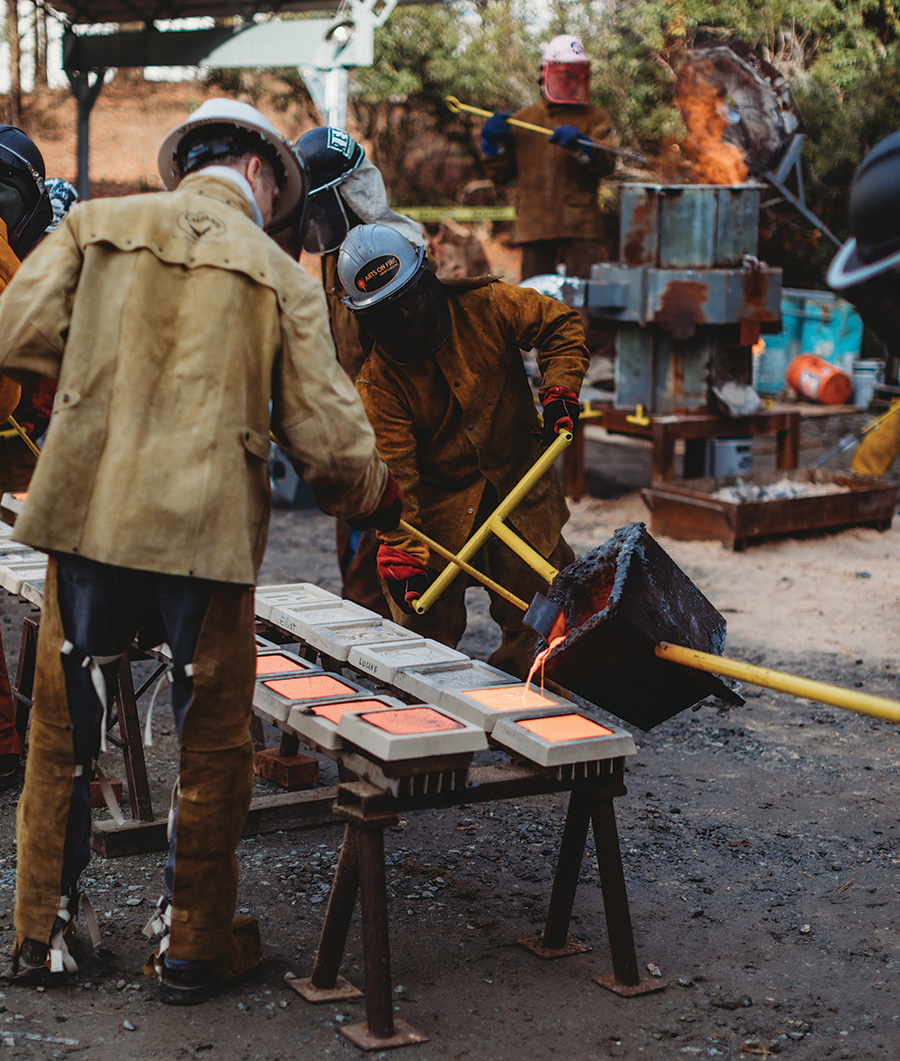
Gallucci also gives people the opportunity to engage with their own artwork several times a year when he opens his studio to host a public iron pour. Hundreds of people show up in the early afternoon, many of them with small sand casts on which they will use any number of tools to etch a symbol or a name or an image that will then be cast in iron later in the day.

People come not only to pour iron, but to work with blacksmithing tools or to try their hand at glassblowing. Others come for the live music or the hot food that is served. The noise of the conversations and music and hammers rises into a pleasing din that fills the enormous studio space and pours outside, where men and women in masks and leather gloves and aprons are stoking the foundry and melting metal into what looks like bright orange lava. Jim Gallucci is there, talking to old friends, making new ones, offering words of encouragement to someone who is trying their hand at metal casting for the first time.

As the sky tips toward dusk, the scene is otherworldly. Sparks fly. Flames reach into the air. Metal is turned into liquid. The vague notions of creativity that people arrived with are slowly hardening into shape.

“Creativity happens when you experience something you’ve never experienced before,” Gallucci says. “The elements: the sand, the dirt, the heat; it’s almost primordial. People may not become iron casters after this, but that’s not the point. It’s igniting other things, inviting other ways to look at the world. That’s what art inspires.”

***

What does Jim Gallucci hope his art inspires? He thinks for a moment, the light from sparks and flames glinting in his safety glasses, which he wears casually, the way other people wear sunglasses or bifocals. “I hope I’m perpetuating ideas, goodwill, community, sense of purpose, reflection. If you’re doing that with a piece of art, you’re doing OK.”

No man is an island, right? Well, perhaps Jim Gallucci is.  OH

Wiley Cash lives in Wilmington with his wife and their two daughters. His latest novel, The Last Ballad, is available wherever books are sold.

March Almanac

Spring makes its own statement, so loud and clear that the gardener seems to be only one of the instruments, not the composer.

— Geoffrey B. Charlesworth


March is the blushing maiden, bright-eyed and smiling, her wild locks softly brushing your skin as she frolics past.

You knew she was coming. The birds have been singing her name for weeks. And yet her arrival has taken you by surprise. You, too, are blushing.

March is the blossoming redbud, soft light, a tapestry of pine needles, bark and grasses.

The nuthatch has crafted her nest, and like the pregnant doe, belly swollen with late winter pansies, a new energy is alive inside of you — a new innocence.

Pale pink blossoms adorn the saucer magnolia, but a tiny yellow flower has caught your eye.

Dandelion.

Simple, immaculate, glorious dandelion.

You see it as if through the eyes of a child, pluck it from the tender earth, tuck it snug behind your ear.

The birds are singing louder now. Ballads of clover, crocus, daffodil. And in the garden, each tiny blossom smiles back.

March has arrived and, with it, spring — as much in your heart as the outside world.


Dandelions don’t tell no lies. — Mick Jagger

Destination Dandelion

Sometimes, especially on dreamy March mornings, the gentle pull of adventure arrives.

On such mornings, you will wander for the sake of wandering, nectar-drunk as a hummingbird as the fragrance of spring blossoms swirls around you.

You might follow the warmth of the sun, or a sweet aroma, or the distant rapping of a woodpecker, any of which will guide you someplace new.

Then maybe, on some quiet woodland trail, you will discover a fluffy young dog.

He won’t look hungry. Or lost. And from the way he is looking at you, he seems to be inviting you farther down the path.

You’ll walk together, for a mile or so, before the path reveals a rolling field. This is when you’ll realize that, across the field, inside the cottage with the smoking chimney, someone might be wondering where their dog went.

And so you’ll walk him home.

Inside the cottage, which smells of rich and exotic spices, an elderly woman is cooking dal on the stovetop. Her husband thanks you for returning Houdini (he slipped the gate again), and invites you to stay for lunch.

“I’ve just gathered greens for the dandelion salad,” he tells you.

You can’t say no to that.


Dandelion Salad

All you need: dandelion greens, wild and tender. Wash thoroughly, then toss with whatever you’d like. Lemon juice, fresh dill, olive oil and pepper.

Glory of Spring

Goddess of Fertility Day is observed on Wednesday, March 18 — the day before official spring. Among the goddesses celebrated on this day, Aphrodite is by far the most widely known.

Born from the foam of the sea, it’s fitting that this goddess of love and blinding beauty be remembered at a time when tender green shoots and brilliant flowers seemingly appear out of nowhere. 

Historically, those seeking to conceive would make offerings to Aphrodite on this day — flowers, greenery, dessert wine, and triangle-shaped honey cakes.

Or, grow a garden in her honor.

Laugh in Flowers

The earth has softened. In the garden, sow seeds for spinach, radish, turnip and kale. Plant a Flower Day is celebrated on Thursday, March 12 — but why stop at just one? March is a good month for planting lilies, tulips and roses. And don’t forget landscaping beauties, like rock cress, sweet pea or — in celebration of Saint Patrick’s Day on March 17 — clover.

The Omnivorous Reader

Mystery of the Hunley

What killed the Confederacy’s submariners?


By Stephen E. Smith

With an estimated 60,000 to 100,000 Civil War—related titles published in the last 155 years, you might wonder if there’s anything left to write about. But science and technology have offered new methods of verifying the previously unverifiable, no matter how esoteric or insignificant the subject might be.

An April entry into the Civil War marketplace is Rachel Lance’s In the Waves: My Quest to Solve the Mystery of a Civil War Submarine. This 315-page semi-technical analysis of a single black-powder detonation that changed naval warfare forever should be of interest to anyone living in the Carolinas, taking place, by and large, at Duke University, and concerning an artifact that has, in recent years, attracted thousands of tourists to the city of Charleston.

Lance is a biomedical engineer and blast-injury researcher at Duke. She spent several years as an engineer developing specialized underwater equipment for the Navy and was working toward her Ph.D. when she took on, at the insistence of her dissertation advisor, the mysterious demise of the H.L. Hunley’s crew.

Any Civil War enthusiast (let’s dispense with the pejorative term “buff”; many Civil War readers are serious historians) will be happy to tell you that the Hunley was an experimental submarine developed by the Confederacy in hopes that it would break the Union blockade, and that it might have succeeded except that it disappeared along with the USS Housatonic, the first warship sunk by a submersible craft, and remained cloaked in mystery until 1995, when it was located 4 miles offshore in 30 feet of water. The sub was raised from the bottom in 2000 and has since become Charleston’s most popular attraction.

For those unfamiliar with the details of the Hunley’s story, Lance supplies a history of early submersibles and details the little sub’s short life, including the circumstances surrounding the first two Hunley crews, who perished when mechanical problems arose during testing. Even H.L. Hunley, the sub’s inventor, died when he accidently depressed the bow planes when surfacing following a test dive. After each sinking, the sub was raised and put back into service, even when it required that the bloated bodies of the dead be dismembered to facilitate removal, a decidedly unpleasant task relegated to slave labor.

For many years, it was assumed the Hunley had survived its attack on the Housatonic — it was reported that the crew signaled success by flashing a blue light — but there was no satisfactory explanation as to why the boat did not return to fight another day. Survivors of the Housatonic testified to seeing the Hunley shortly after the explosion, but no further evidence as to the fate of the sub and its crew was offered at the time.

Lance’s study focuses on the crew’s cause of death. Archaeologists found all eight men slumped at their stations in the submarine. Seven men were seated at the propeller crank, and the remains of the boat’s captain, Lt. George Dixon, were discovered in the forward conning tower. None showed signs of skeletal trauma, and there was no indication that the crew had attempted to escape the sinking craft. A careful examination of the boat’s skin revealed that the explosion had not breached its hull.

Since Lance is a blast-injury expert, readers might assume that she was seeking confirmation that the crew was killed by the shock wave from detonation of the Hunley’s torpedo, and not from suffocation or drowning. In fact, Southern newspapers speculated shortly after the sub’s disappearance that such a wave had sunk the little boat, and knowledgeable observers at the time of the sub’s testing warned that the Hunley would likely fall victim to its own torpedo, which was suspended on the end of a spar extending from the bow of the boat.

Lance’s objective was to prove beyond all doubt that a blast wave killed the Hunley’s crew, and In the Waves is a narrative history of her quest to gather evidence to that effect and to procure, in the process, her Ph.D. To do this she constructed a miniature Hunley-like craft (the CSS Tiny), procured black powder of the sort available during the Civil War, constructed a miniature facsimile of the torpedo, and conducted extensive testing in an appropriate body of water. Instruments to measure the true force of the blast had to be obtained from the Navy and made to function correctly under circumstances that were anything but ideal.

The development of testing criteria consumes most of Lance’s book, at times growing a trifle tedious and dauntingly technical. Failed test follows failed test, subjecting the reader to the same level of frustration suffered by Lance and her team of researchers. But she wisely couches much of the technical information in understandable terms and refers more punctilious readers to the open-access journal PLOs One. “This is a descriptive version of the math and physics,” she writes in a footnote, “and was written to be understandable for the general reader. It does not, therefore, go into all the complex details necessary to justify and complete the scientific analysis.”

While working to replicate the explosive force of the Hunley’s torpedo, Lance reveals the intriguing story of George Washington Rains. Born in Craven County, North Carolina, Rains almost singlehandedly supplied the Confederacy with black powder and torpedo technology. Southern soldiers may have run short of food and clothing, but they were never without powder and shot, a fact that no doubt prolonged the slaughter and destruction occasioned by the war.

In the Waves’ entertainment value is mostly a matter of scientific revelation. As a narrative it is made less successful by the inclusion of unnecessary details regarding the author’s personal life, and the occasional irrelevant sidebar and annoying digression. Is it worth reading? Certainly. If you have an abiding interest in Civil War history, you’ll no doubt find a place for In the Waves in your already overburdened bookshelves.  OH

Stephen E. Smith is a retired professor and the author of seven books of poetry and prose. He’s the recipient of the Poetry Northwest Young Poet’s Prize, the Zoe Kincaid Brockman Prize for poetry and four North Carolina Press awards.

First Class

How the Page Pirates got their swagger

By Billy Ingram

In 1958, three seemingly unrelated events would lead to unforeseen inevitabilities, all but assuring that life in America would never again be the same — the nation’s first satellite was blasted into orbit, credit cards were test marketed in one small city and an obscure Texas Instruments’ engineer developed the first microchip. But, as far as teenagers around here went, they were under the thrall of Kookie’s comb and Wham-O Hula Hoops.

An assembly was held at Aycock Junior High in the spring of 1958 during which ninth graders were asked to come up with a mascot for Greensboro’s brand-new Walter Hines Page High, the school where most of those students would be attending in the fall.

Ironically to this day, it remains something of a mystery why the school was named for Walter Hines Page. The student body came up with “Page Pirates.” Perhaps apropos when one considers that, in addition to that enormous lake to the north of the property, just beyond the trees in front of campus sat another large body of water where Sherwood Country Club and Fountain Manor are today. Surrounded on all sides by lagoons and tall pines, Page High School was essentially an island unto itself.

On Thursday, September 4, 1958, around 500 students along with 30 teachers and administrators began a scholastic journey that continues to this day. A ready-to-go opening with varsity football, junior and varsity basketball, wrestling, cheerleaders, majorettes, band, along with girls speedball and basketball teams. Extracurricular activities included Junior Engineers, Hi-Y, Civitans, and Junior Optimists. Page was the first school in North Carolina history to earn accreditation in its first academic year.

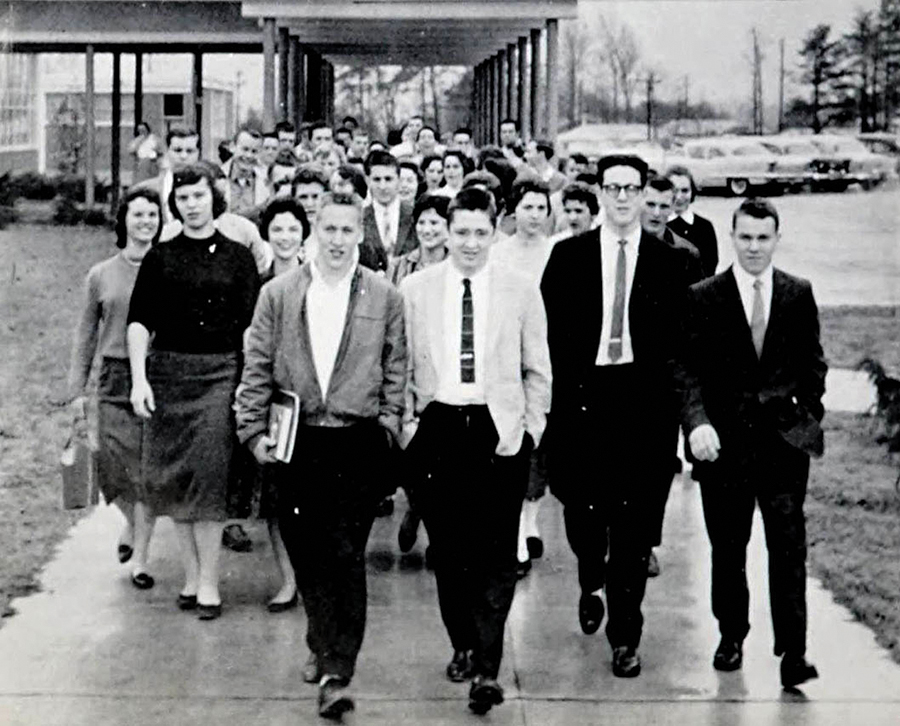
Casual school day attire for men consisted of Madder-Tone shirts, polished cotton slacks and penny loafers. Male students were no longer required to wear coats and ties on a daily basis but it was still de rigueur for picture days. In a photo of the first senior class walking toward the camera, some subversive beatnik in the front row has no tie on, clad in a windbreaker instead of a sport coat. That guy’s cruisin’ for a bruisin’!

Co-eds strolled the halls in Kerrybrooke car coats, pullover sweaters, sensible blouses with Peter Pan collars, pleated calf-length dresses, with nylon stockings tucked into E-Jays saddle shoes or black ballerina flats. Single strand of petite pearls optional. Slacks? You’d be sent home to change into something more ladylike.

In Mrs. Luther’s Family Life class, students were subjected to educational films instructing kids on how to navigate the boundaries of a polite society, with titles like How to Say No: Moral Maturity, The Bottle and the Throttle and Duck and Cover (“when an atomic bomb explodes”).

Page’s Cafeteria was up and running on day one but students with wheels peeled out at lunchtime for Alpat or the snack shop inside the GI 1200 store, both on Bessemer. State Street Grill was closest to campus. No fast food chains, the city’s first McDonald’s on Summit was a year away from opening.

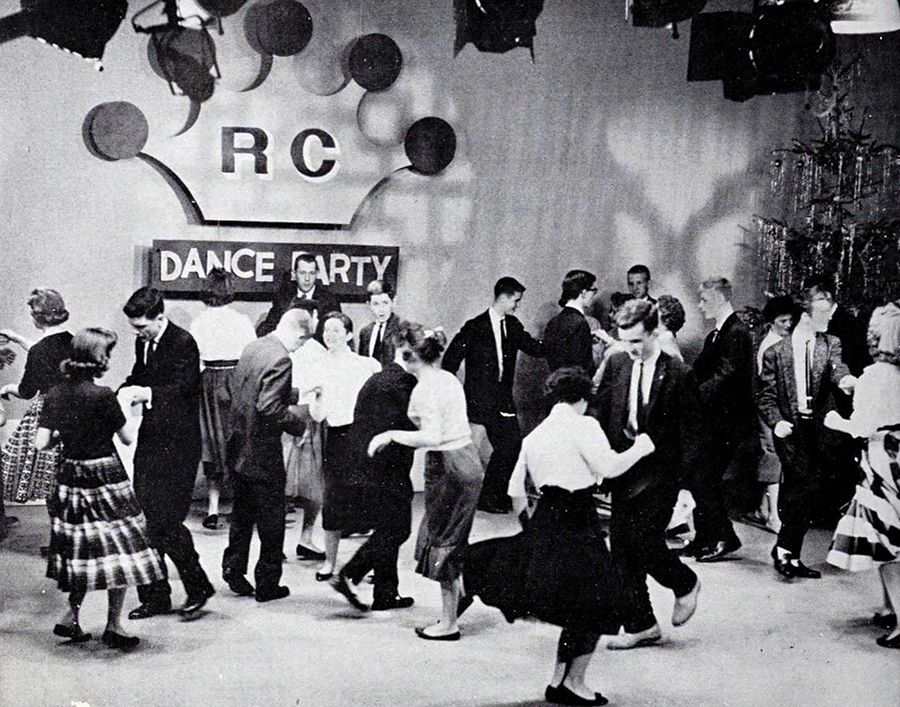
On Thursdays after school, cool cats and kittens pointed their jalopies toward WFMY’s studios to make the scene on the RC Dance Party, airing live at 5:30 p.m. Sponsored by Royal Crown Cola, Twisting teens gyrated to the sounds of The Big Bopper, Teresa Brewer, Ricky Nelson, and The Purple People Eater by Sheb Wooley. Like endsville, man!

Changing out of school clothes, that’s when girls slipped into their pedal pushers, Blue Bell Jeanie capri pants and tight, pink cashmere sweaters (“Daaaad . . . all the kids dress like this!”). Date nights began with a fellow in his Sunday best appearing at the door, gotta chat up the old man before escorting his dish for a night on the town in his ’55 T-bird meatgrinder.

Daddy-os and dolls burned rubber to the edge of town at night for curb service at the Boar and Castle, a ‘Flake Shake’ with two straws at Monroe’s, making goo-goo eyes over a “Bucket Full” of spaghetti for only a buck at McClure’s Sky Castle, or catching — not necessarily watching — a double feature at the South Drive-In Theatre where guys hoped to engage in some Back Seat Bingo (“Hey baby, I’m layin’ it down but you’re not pickin’ it up!”).

With no athletic field to speak of, Pirate home games were played on the football field at Greensboro High School, soon to be renamed Grimsley. Taking to the gridiron on the Friday night after school started, it was a blowout, Fair Grove whipping Page 14-0. Next week was even worse, 21-0 in favor of Mebane. Finishing the 1958 season 2-8, it wasn’t until 1960 that Pirates and Whirlies squared off against each other, sparking a never-ending rivalry.

Yes, 1958 may have been an inauspicious beginning to the proud Page Pirates dynasty but at least a dozen athletic stars went on to impressive professional careers including Michael Brooks (Chargers, Cowboys), Lamont Burns (Jets, Eagles, Redskins), Lee Rouson (Giants, Browns), and Mo Spencer (Cardinals, Saints) who all played for the NFL. Former professional basketball player Danny Manning is currently head coach of the Wake Forest Demon Deacons.

The most famous Page alumnus would have to be pro tennis great John Isner, who twice reached the quarterfinals at the US Open, and physician turned actor Ken Jeong (Knocked Up, The Hangover).

Never underestimate the underdog, our landlocked Pirates continue to thrive on their veritable island of imagination, opportunity and individual visions for the future. Isn’t that the ginchiest?  OH

Billy Ingram attended Page High from 1971–74. He went on to a career in Hollywood as a movie poster artist and is the author of five books including Hamburger², a book (mostly) about Greensboro.

O.Henry Ending

Body(shop) and Soul

Rolling into a new decade


By Nancy Oakley

A totaled car wasn’t how I expected to start the new year. To the anonymous hit-and-run driver who mangled my beloved 14-year-old Scion xB — those funny, retro-looking Toyotas resembling breadboxes on wheels — I wished a bad hangover, since he or she had left me with one of my own: untangling the red tape of dealing with the body shop, the insurance company, and — cue the score to Halloween — the DMV, not to mention the expense of buying another car. In spite of the New Year’s mantra, “out with the old, in with the new,” I wasn’t ready to replace Quicksilver.

Yes, I’m one of those people who names cars. But if the Navy and cruise lines christen ships, why not? And what was more apropos for my dearly departed Scion than the moniker acknowledging its paint job and agile maneuvering into tight parking spaces and heavy traffic — and only on the rarest of occasions (Cough! Cough!) breaking the speed limit? Hi-ho, Quicksilver!

His predecessors were The Woody, my mom’s old five-speed Toyota Corona station wagon with peeling faux wood paneling, and the Merlot Mobile, a Nissan Altima, so dubbed not because I drove under the influence, but because the car was a deep burgundy color — a magnet for state troopers on the lookout for vehicles exceeding the speed limit.   

These were part of a long line of named autos, starting with my parents’ unreliable Renault, the Fire Car, then a behemoth station wagon, Betsy and Herbie, a standard Volkswagen Beetle]. OK, so I lose points on originality for that one, but, hey, I was only 7 years old. The first car I ever owned was a gas-guzzling Chevy Impala that my eldest sister had cast off when she moved to New York City. We called her “Swix,” after the license plate letters, SWX. A friend of mine referred to her as “The Sled.” He, by the way, owned a Honda Civic he named “Tojo.” 

Another friend of mine also drove a Civic named Barbie because it was such a ubiquitous model in the IBM parking lot in the Research Triangle. She even attached a Barbie doll head to the car’s antenna to identify it among the other look-alikes. That was before she bought her Scion, Tuk-Tuk, an onomatopoeic moniker replicating the sound of the car’s four-cylinder engine: tuktuktuktuktuk. Her sister also had an xB, Toasty. As in, a toaster on wheels, get it?

Tuk-Tuk carries on, but Toasty, like my Quicksiver, has crossed the rainbow bridge. My friend’s sister has since relied on a Fiat, Ravioli. Me? I tooled on borrowed wheels for a time while mourning my boxy vehicle. Nothing could replace him but something had to. I didn’t want a Camry like my middle sister’s white one, Blanche. I looked at a Honda Fit, like my nephew’s Bean (because it’s black and resembles a coffee bean), before taking the advice of two gearheads (thanks, Glenn, thanks, Sparky), and settling on a charcoal gray Kia Soul.

But how should I address, thee, little car? As “Kingsford,” or “Briquet” or simply “Brick,” owing to your sedate color, which won’t attract the attention of state troopers? And then he named himself while I tried to master his multiple bells and whistles: back-up camera, Bluetooth, music that plays when you open and close his doors, and a “sport” feature on the gear stick for pulling out and ahead of slowpokes. It seems there isn’t any job this car can’t do.

And that’s how he became Oddjob, after the badass Korean henchman in the Bond movie Goldfinger (though Hollywood being Hollywood, Japanese-American actor Harold Sakata was cast in the role). Dispatched by the film’s titular villain, Oddjob is bodyguard, chauffeur, caddy — and destroyer of statues, which he beheads with the flick of his razor-edged bowler. 

It didn’t take long for my Oddjob to live up to his name. While cruising down the highway recently (and watching my speed), I happened to gain on, of all things, a silver Scion xB. I felt a sudden pang for my old cute Kleenex box-on-wheels, noticing, as I pulled closer, that the corner of its hatch door was bashed in. I recalled how the handle of my old hatch had fallen off, the front grill, too. 

The xB plodded along, tuktuktuk, and I edged closer, feeling less sentimental and well, irritated. I suddenly remembered how the sales guy with a man bun had remarked how I probably wouldn’t be using the “sport” feature much. Instinctively I tapped the gear stick into sport mode, and in the blink of an eye, I had shifted lanes, passed the xB and shifted back. 

I looked in the rearview mirror for any sign of a state trooper, only to see the xB leagues behind. “Out and around,” I murmured, patting Oddjob on he dash. “Over and out.”  OH

Technologically challenged Nancy Oakley is still trying to figure out the electronic gizmos on her car. 

Wandering Billy

Grunge and Grind

A backward glance at College Hill’s Crunchy Music Stuff

By Billy Eye

“There’s a stigma to skating. People think of it as a kid’s sport. People kept telling me I couldn’t possibly make a living out of it. Then they said I couldn’t keep it up in my 30s. And here I am in my 40s, and I’m still improving my skills.” — Tony Hawk

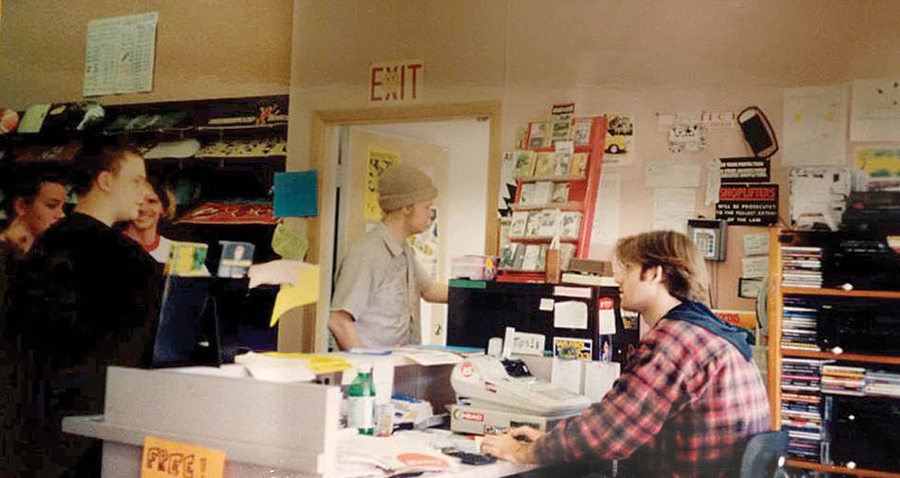
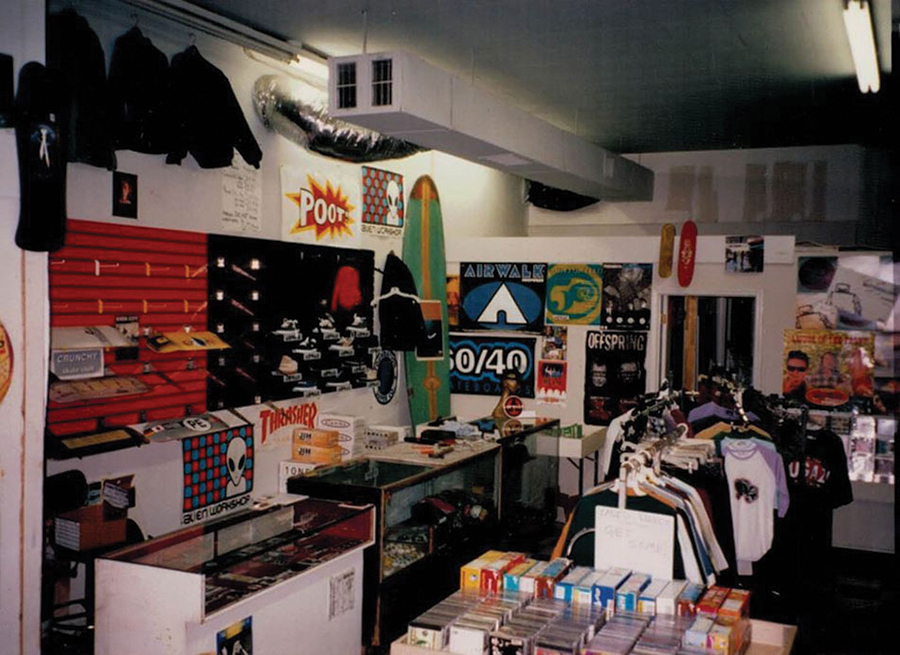
Just days ago, I commandeered a corner table at the Lindley Park Filling Station to reminisce with Michael Driver and Jae Skaggs, proprietors of one of our city’s most fondly remembered record retailers, Crunchy Music Stuff. Established in 1993, first at Spring Garden and Mendenhall then on the corner of Tate and Walker, for seven years Crunchy was the epicenter of Greensboro’s underground music and skateboard scene. Crunchy closed 20 years ago this year. As for how it started . . .

Michael: I blame Jae. The whole thing was your idea.

Jae: Was it? No, no, I think halfsies.

Michael: We were just nerds who didn’t want a job.

Jae: Right. We just sat around and talked about music anyway.

Michael: Somebody in Creamy Velour was playing at Infiniti. He worked at that record store out by the waterpark. He came up to me and said, “You know, they’re selling the store.” “Man that would be awesome to have a record store. How much?” It was like $250,000. I didn’t have any money. I was bitching about it that night and Jae said, “Why don’t you open your own record store?” Genius! We opened that store with a hundred CDs.

Jae: [The time period] was phase two of Grunge. Pavement broke out, Weezer broke while we were there.

Michael: You know who we sold a lot of? NOFX. And Green Day, we sold the hell out of that thing! They put out the first Beck record on an independent label, that “Loser” single was on a 12” EP. That we sold the hell out of. We were the only one in town that had that single.

Jae: Even before Napster, we started suffering when Best Buy opened. They bought every CD and sold everything for like nine bucks.

Michael: People would come in and say, “I just got this at Best Buy for $9.99,” and I’m like, “They’re losing money!” Nothing we could do but stock the stuff they didn’t have. So we mined our niche. That’s all any indie business can do. We had vinyl and nobody else did except for Record Exchange on Battleground; Ed LeBrun’s Spins had the electronic market locked up there. The punk rock stuff, that’s what we listened to and that made us money.

Jae: The flip side of that, the kick flip was, once people started coming in, we would get their used records. We paid as well as anybody else did, but in used records we had all of that indie punk catalog which other stores didn’t have.

Michael: We made money on Green Day because we sold thousands of them. We did well with Ill Communication [by The Beastie Boys]. It was a midnight release. We had like a hundred people there. Jae’s band Rebar was playing. There were so many people in the store it was like a sweaty New York nightclub. We sold every single copy we had, we went all in on that. It was one of the best nights we had, there were people lined up outside because they couldn’t get in, jumping up and down on the street.

Jae: Before the Internet you could do things like that. [Laughing] We were a legitimate business, generating revenue for the city.

Michael: Within the first week we had our first batch of skateboard items. That was Jae’s idea. I thought that was a great idea because nobody else was covering that market.

Jae: At the time there was no skate shop in town, I think the closest place was Winston, at EV, and they might have been gone by then. To keep both halves of the store alive it really worked out. Just barely, because there’s more overhead on skate stuff and it’s also seasonal. It’s also more of a gamble; you could really hit some duds and you will never sell them. Instead of, “oops, I bought too many $8 things,”[it was]  “oops, I just bought too many $50 things.”

Michael: Every major skateboarder had their own shoe. We stocked Tony Hawks from Airwalk and we were the only ones that had them. We had The Beastie Boys’ weird, expandable clothing line, X-girl and XLARGE, those really big pants, even though I thought they were stupid but that’s what the skaters were wearing in the mid-1990s. Hook ups, Birdhouse, Girl, Stereo . . . we could buy clothes directly from the record labels.

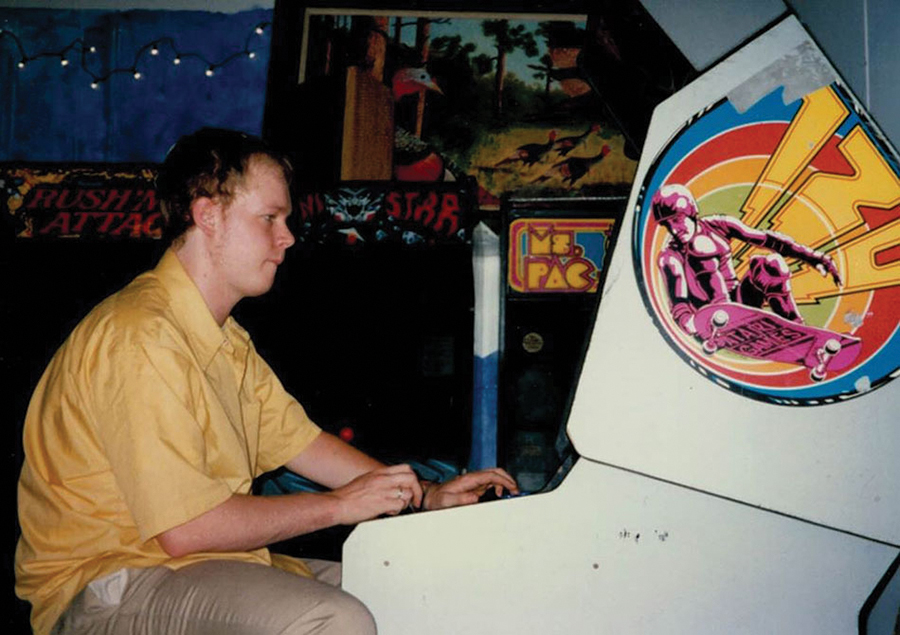
Jae: We had Tony Hawk in the store, Shawn Briley, we had all these skateboarders appear. We also had vintage arcade games, which weren’t too vintage at the time, like the 720° skateboard game from the ’80s. I was very excited to see Tony Hawk playing that one in the store.

Michael: We got Tony Hawk for $500. It was a bargain at four times the price. For the record, I met Tony Hawk and I couldn’t speak. You meet your hero and it’s like, “Holy crap! It’s Tony Hawk!” So literally, that’s what I said, “Holy crap! It’s Tony Hawk!” I couldn’t think of anything else to say. The night before I stayed up all night to set up a half piperamp in the parking lot at Sam’s Club. The guys from Birdhouse Skateboards, Tony Hawk, Geoff Rowley, were there for a demo. We had like 200 people there, it was crazy.

Jae: Tony was recovering from a broken foot so he wasn’t fully skating. He rode just enough for the kids to love it. He wasn’t doing any 900s or anything like that. When you run a skateboard shop, to this day, you have to do that kind of thing.

Michael: We released four records on our own label, Crunchy Record Stuff. Two by Rebar, a 7-inch by Rights Reserved, “The Kids Are Not Alright,” and the fourth by The Get Gos. We recorded the Rebar album at the record store because it had that high ceiling, great acoustics.

Jae: We booked showcases at Somewhere Else Tavern and at Zoo Bar or Kilroy’s or Fuzzy Duck’s, I don’t remember because they would change the name every two or three years. And The Turtle Club at Lee and Aycock. They changed the name of both of those streets, that’s how notorious The Turtle Club was.

Michael: As far as how it ended, first I ran [employee] Scott Hicks off, then I ran Jae off.

Jae: I was kind of like eased out of [Crunchy], suddenly eased out of it, and then it kept on going. Michael kept it going so I didn’t take anything out of it. I didn’t take anything to remember it by, because I thought, “Well, It’s all going to be with Michael.” But I wonder why now, it was a big part of my life. Probably everything that has happened to me since then was because of that place. Both positive and negative.

Michael: I still have all that junk! I’ve got a bunch of posters, memorabilia from the record labels, all in two or three boxes in my attic.

The biggest year we had was ’96. By 1999, the skate shop started to decline and the record sales decliiiiiiined. Thank you Napster. By then Jae was gone, it was just me and an employee. In the mornings I would vomit. Then I would open the store. That’s what retail does to people, it makes you physically sick. After a few months of that I was like, “I don’t want to do this anymore.” About that time Andrew Dudek approached me about selling it all out to him and he basically bought the inventory and turned it into Gate City Noise, which was a much better concept because Andrew had all the connections with touring bands and it became an even bigger center of the music scene with the independent bands playing there.

You know, they have Record Store Day every year now, “Appreciate your local record store,” like Free Comic Book Day. About 20 years too late. . . I have yet to go to a Record Store Day event. I’m old and bitter! But I’m going to see Patrick at Hippo Records every week. Hippo carries the new stuff on vinyl. I’ve still got a thing for the vinyl. It’s an addiction.  OH

Today Michael Driver is a successful realtor with RE/MAX of Greensboro while Jae Skaggs  is an  IT / System Administrator consultant. Both reside not too far from each other in Lindley Park. Next month, Billy Eye will tell you about Judy Garland’s life-changing Greensboro appearance.

March 2020

Awoken

The moon awoke me

howling for attention

the stars were distant, aloof

a few gregarious, Gregorian twinkles

made celesta accompaniment

lunar fugue

a chorus of seas

echo of my cathedrals

trumpets and choirs

the organist’s foot pedals

faster than tap

Did the moon not wake you?

No tom toms, no Tchaikovsky cannons?

Oh your serene dreams of a

more melodious siren

That is why I love you

listening to the moon in your eyes

Ry Southard

A Page Out of History

The greatness of Walter Hines Page


By Bill Case

Woodrow Wilson spent the bulk of his first term steering America clear of World War I, which had raged over Europe for 2 1/2 years when he made his bid for reelection. He used the slogans “America First” and “He Kept Us Out of War” during his 1916 campaign, which led to his narrow electoral victory. However, a growing number of Americans felt that Wilson’s neutrality policy was wrongheaded following his response to a German U-boat’s May 1915 sinking of the unarmed British ocean liner Lusitania with 128 American passengers aboard. Few in his administration spoke in opposition.

One member of the inner circle who dared to question the president’s approach was Walter Hines Page, America’s ambassador to Great Britain. Wilson had appointed his longtime confidant to the prestigious post in 1913. Page’s selection was not based on his diplomacy experience, since he had none. It had more to do with rewarding the native North Carolinian for his role in aiding Wilson’s political advancement over a 30-year period.

It was presumed the ambassadorship would provide the 57-year-old Page a mostly trouble-free conclusion to a remarkably eclectic career that had included successful turns in academia, journalism, publishing, social reform, public policy advocacy and farming. But the ambassador considered it his duty to inform the president of British (and his own) disapproval with the administration’s failure to act more decisively toward Germany. His fault-finding missives from London irritated Wilson, who complained that Page “seemed more British than the British.” A degree of frost formed over their relationship.

Page was born in 1855 in a small settlement in Wake County, North Carolina, that eventually became the city of Cary. His father, Allison Francis (Frank) Page, founded the town. A rugged, God-fearing Methodist, Frank Page made a small fortune extracting turpentine from pine trees and sawmilling them into lumber. Standing an impressive 6 feet 5 inches, he commanded respect bordering on awe. Walter’s mother, Catherine, was of a more intellectual bent, usually observed with a book in her hands.

The tall, gangling, curly-headed boy’s parents steered their scholarly son in the direction of the ministry, sending the 16-year-old to Methodist-run Trinity College, located in the backwoods of Randolph County (later the school moved to Durham and was renamed Duke University).

Wat, as he was called, was miserable at Trinity, and after an unhappy year transferred in 1872 to another Methodist school, Randolph-Macon College, in Ashland, Virginia.

“It was at Ashland that I first began to unfold,” Page would later remark. “Dear old Ashland!” Though he loved school he resisted his father’s wishes that he become a minister. “I’m damned if I’ll become a Methodist preacher,” he told his father. After a disappointed Frank refused to pay for further tuition, Walter self-financed the remainder of his education.

In 1876, Page was one of 21 students gaining admittance to America’s first graduate school at Johns Hopkins University. Initially, he flourished in the intense regimen, but by the midterm of his second year, he had become bored with the nuances of Greek and Latin, disparagingly calling himself a “Greek drudge,” and left without completing his course of study.

Visualizing a career in journalism and harboring “dreams and aspirations” of owning and editing a magazine, he invested $1,000 and became half-owner and the editorial writer of a fledgling Louisville weekly called The Age after teaching there.

Unfortunately, it folded in June 1879, barely three months after his investment.

Undaunted, Page combed his native North Carolina looking for “any sort” of journalistic position, but, as he ruefully put it, “journalism didn’t seem in any hurry to make up its mind to admit me.”

During a summer stay in Cary, Page fell in love with Alice Wilson, whom he’d first met as a teenager. The smitten couple became engaged during the 1879 Christmas holidays, postponing marriage until Page could obtain gainful employment.

Unable to find his footing as 1880 loomed, a breakthrough occurred in January when Walter Page landed a job as a reporter at a St. Joseph, Missouri, newspaper, The Gazette, contributing all kinds of articles “from stockyard reports to political editorials and heavy literary articles.” After five months, the publisher promoted young Page to editor-in-chief and raised his salary, giving

Walter and Alice the wherewithal to tie the knot in November 1880. Page wrote to several Northern newspapers, advising them of his intention to travel, observe and write about the post-Civil War South.

His letter-writing gambit succeeded. The big-city papers printed his submissions and paid for the privilege. “I had money in my pocket for the first time in my life,” he recalled. Moreover, the essays impressed the editor of the New York World, who offered Page a correspondent’s job with the paper. He accepted and headed north. His beat included congressional hearings regarding tariff measures as well as the tariff commission itself.

Page’s coverage of the commission brought him to Atlanta in 1882, where he met 26-year-old Woodrow Wilson. The two men engaged in a discussion regarding the merits of protectionism versus free trade. Believing he had discovered a budding political star, Page would gush to a colleague that Wilson “has one of the finest minds in America. Keep your eye on him!”

When the World changed ownership in May 1883, Page resigned and returned to North Carolina hoping to personally own and edit a publication in his home state. With financial help from his father, he launched a weekly newspaper in Raleigh, The State Chronicle. Page’s editorials lauded Democratic presidential candidate Grover Cleveland and derided local politicians as “small men” holding obsolete and parochial views.

The paper proved unprofitable, however, and in February 1885, Page ceded its control to Josephus Daniels (who would later buy Raleigh’s principal newspaper, the News and Observer), and retreated to New York. Though still revering North Carolina, the frustrated Page abandoned thoughts of making a living there. He told his father, “there is no (use) in my trying to do anything down south anymore. I have proved disastrous every time.”

Comfortably ensconced in Manhattan with Alice and two toddlers, Ralph

and Arthur (who would later be joined by two more children, Frank and

Katharine), Page penned freelance articles for magazines like The Atlantic and Harper’s Magazine mostly pertaining to the South and national politics. He was becoming, as one biographer put it, “a self-appointed but recognized ambassador from the South to the North.”

Page rose to prominence in New York’s magazine scene — unusual for a Southerner at the time — ultimately landing in Boston as the editor of The Atlantic — the magazine industry’s gold standard — and its book-publishing parent, Houghton, Mifflin & Company.

As editor, Page cultivated the era’s top fiction writers, and expanded Atlantic’s treatment of political topics such as American imperialism and the perils of unregulated monopolies. At Page’s behest, his friend Woodrow Wilson contributed three public policy articles.

Page’s gravitation toward national politics did not deter him from expounding on a pet concern: Southern educational reform. He spoke on the subject in Greensboro at the Normal School’s 1897 commencement exercises. In his eloquent “Forgotten Man” speech, which served as an important catalyst for educational reform in North Carolina, Page maintained that the state had

failed to develop its most valuable resource, “the people themselves . . . forgotten and neglected.” He decried North Carolina’s long history of providing scant resources to educate the less fortunate. These were the people whom “both the politician and the preacher have failed to lift.”

Though sitting in one of publishing’s most prestigious editorial chairs, Page still longed to be his own boss. He resigned from The Atlantic in 1899 and, after a brief misbegotten adventure with McClure’s Magazine, ventured into the book publishing business with Frank   in New York. Doubleday, Page & Company started small, but grew quickly. Page enticed prominent men of letters like Theodore Dreiser, Booker T. Washington, Rudyard Kipling and Upton Sinclair to join the publisher’s list. Woodrow Wilson’s book The New Freedom was sold under the Doubleday, Page umbrella. The company published a magazine, The World’sWork, which became Page’s primary focus.

Sons Ralph and Frank would follow their father into journalism. Ralph wrote a successful book as well as articles for The World’s Work. Frank became an editor.

Meanwhile, Page continued to assist Woodrow Wilson’s political advancement.

He came to his fellow Southerner’s aid in 1910 when Wilson, then the president of Princeton University, successfully ran for governor of New Jersey.

Wilson’s meteoric political rise was capped by his election to the presidency two years later. Page played a significant role in Wilson’s presidential campaign, raising money and providing reams of favorable publicity in The World’s Work. Following the election, Wilson met with Page to obtain the latter’s advice regarding prospective administration appointments. The Washington rumor mill speculated that The World’s Work editor would soon be appointed either secretary of Agriculture or secretary of the Interior.

On March 26, 1913, now-President Wilson threw Page a curveball. Instead of the anticipated Washington Cabinet post, Wilson offered Page the position of ambassador to Great Britain. The surprised Page harbored misgivings over the prospect of leaving America for an extended period but understood the ambassadorship was a glamorous assignment. He agreed to serve, and boarded the ocean liner Baltic sailing for England on May 15, 1913. “Here I am going to London to talk international affairs with the men who rule the British Empire,” wrote Page while aboard ship.

Indeed, he got along famously with the bluebloods in London’s highest places: royalty, members of Parliament, and most especially Sir Edward Grey, the foreign minister, who would become a close personal friend.

Page regarded it his responsibility to provide the president unvarnished

British reaction to U.S. policies. One such example occurred when Congress enacted legislation in 1912 exempting American ships from the payment of tolls when passing through the Panama Canal. An outraged British government claimed this measure breached a treaty providing that ships of all nations would be treated equally in their use of the canal. Page’s September 13, 1913 letter to Wilson cited “the dishonorable attitude of our Government about the Panama Canal tolls . . . We made a bargain — a solemn compact — and we have broken it.”

Wilson agreed with Page’s view and appreciated the ambassador’s hard-hitting assessment. “Your letters are like a lamp to my feet,” responded the president. Wilson persuaded Congress to repeal the exemption.

Throughout the first year-and-a-half of Page’s ambassadorship, Wilson expressed delight with his friend’s erudite correspondence. “I hope that Walter Page’s letters will be published. They are the best letters I have ever read!” exclaimed the president.

The outbreak of World War I in July 1914 aggravated the manifold burdens of Ambassador Page’s office. London-based Americans, fearful of being caught in the middle of the war, were leaving England in droves, requiring the ambassador’s assistance. But the ambassador’s hardest task was to avoid doing anything that would contravene American neutrality toward the belligerents while at the same time conveying his personal sympathy and friendship to Great Britain. The exhausting duties caused his health to deteriorate as an ulcer flared up, made worse by Page’s incessant smoking.

During the first years of the war, Wilson sought to be an impartial mediator, hoping to obtain peace by seeking common ground between the warring countries. Page considered the president’s impulses noble but naïve. According to Page, the German leaders, were “another case of Napoleon— even more brutal; a dream of universal conquest . . . Prussian militarism (must) be utterly cut out, as surgeons cut out a cancer. And the Allies will do it — must do it — to live.”

Wilson’s reading pleasure dissipated as Page’s increasingly unwelcome correspondence advanced positions out of synch with those of the administration.

With his re-election campaign looming, Wilson was determined to do nothing that could draw America into the war or undermine his role as a mediator of peace. The antagonized president ignored his ambassador’s entreaties, other than to warn him through staff “to please be more careful not to express any unneutral feeling either by word of mouth or by letter.”

Page was stunned by Wilson’s failure to comprehend the threat to democracy caused by autocratic Germany. His exasperation grew when the president issued a “we are too proud to fight” statement in response to the sinking of the Lusitania. After the Germans torpedoed another ship with Americans aboard,

Page wrote the president in January 1916 that officials in the prime minister’s cabinet had confided their impression “that the United States will submit to any indignity.”

American state department diplomats began meeting regularly with their British counterparts without bothering to notify the out-of-step ambassador.

Page visited America during August and September 1916, ultimately gaining an audience with the president on September 23. Although cordial enough, the president stiff-armed Page’s assertion that Germany was the world’s scourge. The ambassador was profoundly discouraged with Wilson’sassessment that the war was “essentially a quarrel to settle economic rivalries between Germany & England.”

Wilson assumed his bargaining hand as peacemaker would be strengthened by his re-election, but he was wrong. Two events in early 1917 would end his mediation efforts and draw America into the conflict.

In an attempt to starve out its enemy, Germany announced that it would henceforward commit unrestricted submarine warfare against any neutral countries’ ships transporting goods to England, including the U.S. This was followed by British intelligence’s discovery of the “Zimmerman telegram” cabled by the German Foreign Office to the Mexican government. It proposed a military alliance between those two countries in which Mexico would ultimately recover the states of Texas, Arizona and New Mexico in the event America entered the war. Americans were outraged at Germany’s treachery, and public opinion suddenly turned in favor of entering the war.

It took another month for Wilson to abandon hopes for peace and ask Congress to declare war, but he finally did so on April 2. Page was elated. “I cannot conceal nor can I repress my gratification we are in the war at last,” he wrote. He felt vindicated that his “letters & telegrams . . . for nearly two years” had proved clairvoyant and helped alter Wilson’s pacifistic stance. “I have accomplished something . . . I swear I have.”

The war dragged into 1918, and American casualties mounted, including

Page’s nephew, Allison Page, a U.S. Marine, killed in battle at Belleau Wood.

Page’s health, never robust, got progressively worse. He suffered from hardening of the arteries, high blood pressure and early-stage emphysema. Told he would require six months’ rest, Page wrote Wilson on August 1 and submitted his resignation. When he left London on October 2, he required support on each arm to make it to his private railroad car. Upon reaching New York, further examination added diagnoses of retinal hemorrhages, heart congestion and kidney failure to Page’s mounting woes.

On December 11, Page boarded a private railroad car and came home to North Carolina. Literally carried off the train by his son at the Aberdeen station, he remarked, “Well, Frank, I did get here after all, didn’t I?”

Walter and Alice Page rented a cottage in Pinehurst.

Page was reunited with several of his siblings, but his condition declined a week later. He died on December 21. Following its practice of not printing a word about deaths in Pinehurst, the Pinehurst Outlook, coincidentally edited by Ralph, made no announcement of his father’s demise.

But Page’s Christmas Eve funeral at Page Memorial Church and burial at the Page family plot at Old Bethesda Cemetery in Aberdeen did receive international attention. Given his role in ending the “War to End All Wars,” virtually giving his life to the cause, Walter Page was hailed as an American hero. His grave became a mecca, visited by grateful Americans paying him honor. The state built a road to the cemetery to absorb the traffic.

Johns Hopkins would honor Page by founding the Walter Page School of International Relations.

While Wilson and his administration did not always appreciate Walter Hines Page, England still does. In a vestibule of Westminster Abbey is a sculpture of Page with a testament that reads, “The friend of Britain in her sorest need.”  OH

Pinehurst resident Bill Case is PineStraw’s history man. He can be reached at
Bill.Case@thompsonhine.com.

Papadaddy

A Close Shave

What’s old may be new


By Clyde Edgerton

If I use a plastic drinking straw, I get grief from my family.

As I should. So I decided to stop using plastic straws and plastic razors — those disposable ones, usually orange or blue — and buy an electric razor.

My father, back in his day, used an implement that looked very much like a plastic razor, but his was metal, and when you twisted the handle about a quarter-turn, two little doors on the head of the razor opened toward the ceiling. He’d then drop in a thin, almost weightless Gillette razor blade. He’d twist the handle so that the little doors closed and the blade would be enclosed snugly, with its two sharp outside edges exposed.

He’d drip some warm water from the spigot into a mug that had a bit of soap in the bottom, then work up some lather with a soft round brush. He’d brush the white lather onto his face, and then carefully shave.

My grandfather did it the same way, except he used a straight razor, sharpened by sliding the blade along a leather strap, or “strop.” The strop looked like an extraordinarily wide leather belt.

Anyway, I realized I’d have to shop for a new electric razor.

For me, shopping often produces anxiety and indecision. I do it as rarely as possible. For example, I bought my newest sport coat before my very old cat was born. Cats don’t live that long. And I just found out that some blue jeans are black.

First stop: Target. I find the electric razor section. It’s as long as a gymnasium wall. My heart rate ticks up. I look closely and read packaging information: dryfoil, proskin, lithium ion, microcomb, flexible foil cutters, pivot head. I grab one in the mid-priced range: $69 — the going price of a sink, commode and bathtub when my father started shaving in about 1917. The brand is a Braun, and something extra is in the box. I’m not sure what, but I just want to get out of the store.

I take my Braun home and try to open the box with several kitchen implements. I finally open it with my chain saw, avoiding injury, get the razor out, and unpack the rest of the box. I find a thick booklet of instructions in English and many other languages, as well as a fairly large “recharging stand.” And inside the recharging stand is a small, clear plastic container. And . . . stay with me . . . inside that container is a container of some special liquid that every night will clean the shaver while the razor is being recharged and  . . . no joke . . . oil it. I read that every few months I’ll need to buy more of that special liquid. A reasonable person might wonder if this thing will shave me like those vacuum cleaners that vacuum the house while you watch TV.

What happened next is I nervously decided to do a bit of research. What was I getting into? When I Googled “electric shavers” I got this many hits: 41,300,000. (Check it out.) And then because I Googled “electric shaver,” I now have a new electric shaver image pop-up on my speedometer screen when I start my car — the latest deal between Honda and Google.

Next stop: Target. I returned the electric razor. I bought a bag of disposable razors, the blue ones, and a can of shaving foam.

Soon, I’m going to visit my father’s grave as I sometimes do, and we will have a talk. I think I know what he’s going to suggest: mug, soap, soft round brush, and an old-timey metal razor.  OH

Clyde Edgerton is the author of 10 novels, a memoir and most recently,
Papadaddy’s Book for New Fathers. He is the Thomas S. Kenan III Distinguished Professor of Creative Writing at UNCW.