The Accidental Astrologer

More Changes Afoot

Hold your sigh of relief that 2019 is almost over because the stars predict a ride of a lifetime in 2020


By Astrid Stellanova

Humankind dances to the tune of celestial music, the sky full of stars seemingly winking at us to its beat. But there is more to know, Star Children. The universe is shifting, and its secrets will soon be revealed. We are on the verge of astrological history ahead, when Ceres, Mercury, Pluto, and Saturn line up at 22 degrees Capricorn.  As we conclude a year with more drama and ruckus than anybody, even me, could have predicted, with more change coming. You ain’t seen nothing yet.

The December-born, whether Sagittarius or Capricorn, make a mark so big they only need one name to remember: Beethoven, Sinatra, Disney, Matisse, Bogart. What future greats will be born this month?


Sagittarius (November 22–December 21)

Honey, when you look back, you’ll realize this year has been one of transformative changes. Just as Dorothy opened up the farmhouse door (’cause it’s the 80th anniversary of The Wizard of Oz this year) to a vivid, colorful reality so different from the black-and-white one she knew in Kansas, you, too will enter a new world. Technicolor was a miracle then, and it is going to be a miracle that your own black-and-white life is drab no more!

Capricorn (December 22–January 19)

Sometimes you may feel like you’re in a bewildering, upside-down and bass-ackwards family. But like a redneck marriage, even if you got a divorce, well, Sugar, you still are connected.

Aquarius (January 20–February 18)

Would you be willing to go all in for your dreams to come true? What would you eliminate? Strip away? Like a lady of the night promised for the right price, “Everthang but my earrings.”

Pisces (February 19–March 20)

A reckoning is ahead. Might as well be rolled in meal and fried in lard if you don’t face facts. It’s sometimes more important to be honest than to be right. Darlin’, here comes your truth test.

Aries (March 21–April 19)

You found yourself after a lot of searching, Sweet Pea, like finding a car when they mowed the yard. Treasure found! Keep the grass cut and enjoy the wheels of discovery.

Taurus (April 20–May 20)

Holy shiplap! Here is you, your fine self, doing honest work and feeling good about yourself. How’s it feel, Honey Bun? Can you admit that it wasn’t so hard after all to be a team player?

Gemini (May 21–June 20)

It don’t require a trip up the hog’s rear end to know where there’s bacon. Despite everything, you seem to want to do things the hard way. Maybe this is a time to reconnoiter.

Cancer (June 21–July 22)

Sugar, it’s like buying a camouflage toilet seat: You will still get busted when you miss. If you spend too much time on covering up the possibility of error, you don’t gain a dang thing.

Leo (July 23–August 22)

Like being too drunk to fish, your life has been a contradiction in terms. Seems like you want two entirely different paths, but can’t see they eventually converge in the — say whaaaat? — parking lot.

Virgo (August 23–September 22)

Mind your own biscuits, and life will be milk gravy. You got so close to the dream, then you changed your order when you heard somebody else talking to the waitress.  Find your truest ground.

Libra (September 23–October 22)

Saw the T-shirt that says, “You ain’t Baroque. You’re just out of Monet.” Like the person who printed it, you have a sense of humor and it must be used. In the toughest of times, it will save you, Funny Bunny.

Scorpio (October 23–November 21)

You keep wondering why folks don’t get you. You love the South, a good story, and home for the holidays. Truthfully, you ain’t as mysterious as people think. You’re just better-dressed.  OH

For years, Astrid Stellanova owned and operated Curl Up and Dye Beauty Salon in the boondocks of North Carolina until arthritic fingers and her popular astrological readings provoked a new career path.

Crystal Clear

Celtic Pottery’s painstaking art of crystalline pottery

By Maria Johnson     Photographs by Sam Froelich

Mixing everyday elements to create something new and beautiful — that’s the juice that keeps artists going.

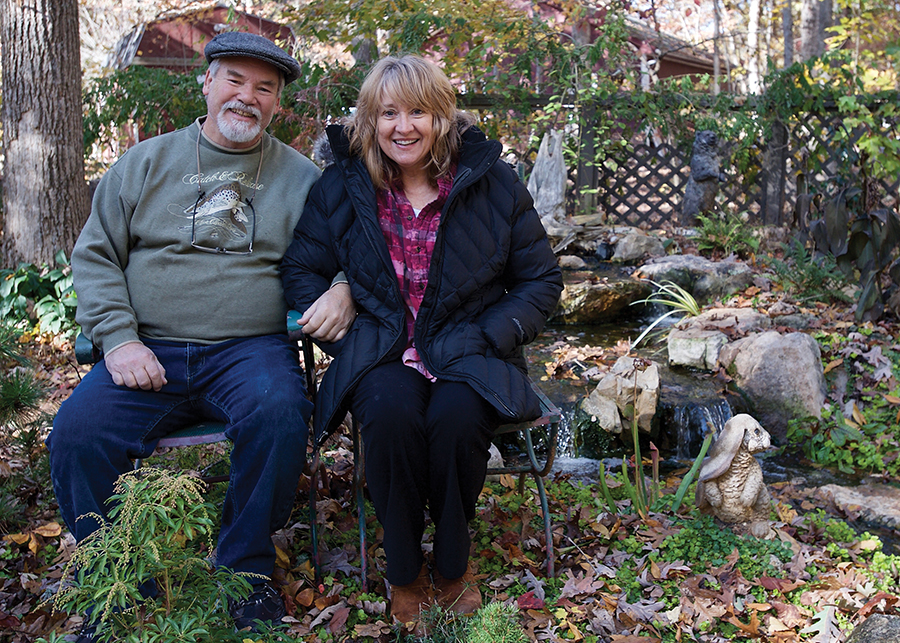
It also could be the theme of Janet Gaddy and Tim Moran’s life together.

In pottery circles, the Browns Summit couple are known as accomplished “crystaleers,” people who finish their pieces with crystalline glazes, shimmering topcoats that blossom with frosty crystals after being fired in super hot kilns.

“This isn’t for the faint of heart,” says Tim, explaining that only one in three pieces survives the process. “There are very few potters who do crystalline — and very few who do it well.”

The couple’s skill with the painstaking craft — and the vividness of their crystals — have landed their pieces in galleries in Raleigh, Wilmington and Black Mountain. More than a third of their business comes from custom orders.

They also pack a trailer and roll off to more than a dozen shows every year.

They’re regulars at the Carolina Pottery Festival, which happens every November in Shelby, N.C., and at the selective Catawba Valley Pottery & Antique Festival in Hickory in March.

“To be in that show is an absolute honor,” Tim says of the Catawba event. “It’s one of those shows you dream about.”

Locally, the pair can be found hovering around their booth at Potters of the Piedmont, a spring and fall show at the Leonard Recreation Center in Greensboro. They keep a few pieces in the gift shop at the Greensboro History Museum downtown.

The rest of their time is spent making the earthen pieces that are literally — because of the capricious nature of crystals — one-of-a-kind works.

“Mother Nature has a lot to do with it,” Tim explains. “When she smiles on you, it’ll send a chill up your spine.”

That’s how he and Janet felt when they met. Tim, who’d just sold a chain of small radio stations, was in the throes of a divorce, the final act of a 28-year union.

Janet, a potter and high school art teacher, was stinging from the dissolution of her 20-year marriage.

Both were wounded and wary when they crossed paths in a weeklong life-coaching workshop in Chapel Hill in 2001. They got to know each other during sessions that required them to divulge their histories and feelings. They had dinner together. At the urging of her counselor, Janet made an announcement to the class at the end of the week.

Tim was the one she’d spend the rest of her life with, she said.

For once, he was speechless.

They hugged.

“I whispered ‘Thank God’ in her ear. I’d prayed about it,” he remembers.

They forged a life together. At first, that involved him driving from Roanoke Rapids, N.C., to Danville, Virginia, Janet’s hometown, to take a pottery class with her. It was a blatant excuse to be together.

“I told him I’d seen kindergarteners who made better pottery,” she says.

Tim cups his hands around an imaginary vessel then splays his fingers wide to mimic throwing a piece of pottery hastily.

“I’d be like, ‘OK — let’s go to dinner,’ “ he says.

Pottery assumed a bigger role after Tim had triple-bypass heart surgery, the byproduct of years of stressful living, he believes.

“He traded a three-piece suit for a potter’s wheel,” Janet says.

“Pottery became my therapy, my obsession,” adds Tim, who now favors denim and flannel. “Anything I do, I do 110 percent.”

For years, Tim had collected art glass, a passion that sent him on frequent trips to glass-blowing centers of the Czech Republic, Austria, Hungary and Poland.

He bought hundreds of museum-quality pieces from the Art Nouveau period of the late 1800s and early 1900s.

As much as he appreciated art, he found there was a difference between collecting and creating.

“I enjoyed taking a lump of dirt and making something beautiful,” he says.

Janet, who’d inherited a hobby kiln from her father, had long known the satisfaction of creating.  She studied pottery and sculpture in Cortona, Italy, in 2006, the same year she started teaching art at Greensboro College.

“She’s truly the artist,” says Tim.

Pottery became their thing, a common pursuit and a way to learn and grow together.

In 2004, they took a master potter’s class at Rockingham Community College in Wentworth. The class took a stab at crystalline glazes, a finish that had been around since the ninth century, when it appeared as a mistake in Chinese pottery.

The glaze was revived and refined by a 20th-century English potter named Peter Ilsley.

In North Carolina, which is recognized internationally as a pottery hub, only a few people had reputations for crystalline glazes, among them Phil Morgan and Al McCanless in Seagrove and Sid Oakley in Creedmoor.

The class members in Wentworth didn’t have much luck with the finicky glaze.

Tim, who holds a degree in geochemistry from the University of Georgia, was upset at the group’s failure. He was determined to make the glaze work.

He noodled with the formula — zinc and titanium form the crystals while cobalt, copper, iron and manganese provide the colors — until he fired a few successes. His mentor at RCC, Sally Hayes, encouraged him.

“She said, ‘You need to be showing,’” he says, pausing to wipe away tears. Hayes recently died, and Tim has just returned from the Carolina Pottery Festival, which was the first festival he attended with Hayes. She invited him to tag along and bring a few pieces to sell.

“I sold everything,” he says. “I said, ‘This is pretty cool.’”

He and Janet have concentrated on crystalline glazes ever since.

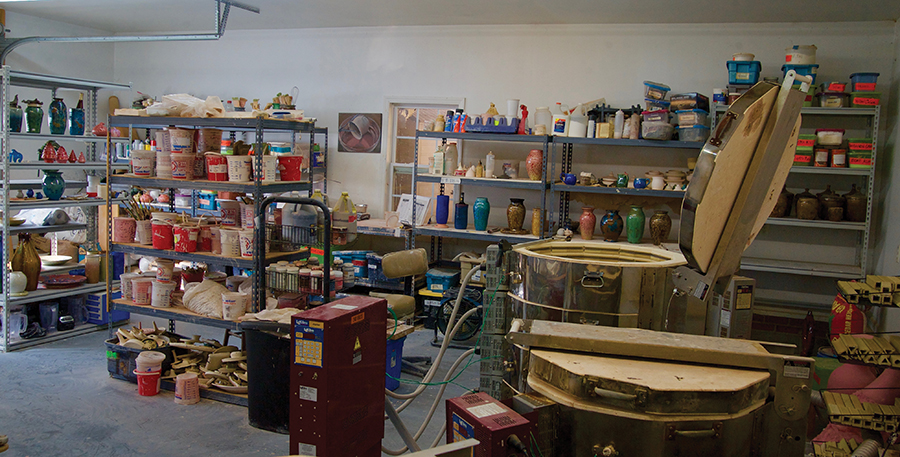
Their studio is a former three-car garage behind their home in the woods.

No longer an art teacher, Janet works daily with Tim on the couple’s business, Celtic Pottery, a name that reflects her Scottish heritage and his Irish roots.

Each of them makes their own pottery — his are more functional pieces such as platters, vases and bowls, and hers are more figurative, incorporating animal and human forms. Currently, she’s selling the heck out of sea turtles that gleam with mottled crystalline glazes.

Often, she mounts them on pieces of driftwood that washed ashore at Kerr Lake or the Outer Banks.

“We like to use things from North Carolina and Virginia, since that’s where most of our shows are,” says Tim.

They mold their works from clay that’s custom made for them by STARworks Center in Star, N.C. The blend combines porcelain and stoneware clays. The soft porcelain clay, used to make fine china, is hard to handle, but it’s extremely durable when fired. It also makes a smooth surface required for the formation of crystals.

“It’s like throwing cream cheese,” Tim says.

After the first firing, their pieces come out of the kiln as bisque, ready to receive the liquid glazes that distinguish the couple’s work. They use a kitchen blender to whirl cocktails of water, powdered chemicals and additives that affect the hardness and shine.

“We’ve gone through several blenders,” Tim says.

Some recipes yield large fan-shaped crystals that resemble the leaves of gingko trees.

Some produce small crystals that interlock like frost on a windshield.

Others crystals arrange themselves in a lattice of shamrocks.

“Our stuff is functional, but there’s a sort of elegance, and people are attracted to that,” Tim says.

Like chefs perfecting new dishes, the duo make detailed notes on every glaze and its complex firing schedule, which can start at between 2,300 and 2,400 degrees Fahrenheit, then dip and rise, at various temperatures, for more than 16 hours.

They use four electric kilns with computerized controls. Because of the energy demand, Duke Power installed a transformer outside the studio just for them.

“They knew they were gonna get their money back,” says Tim.

Once out of the kiln, the pieces must cool under controlled conditions for another 15 hours. Cracks and blowouts are common. Tim lifts a large vase to reveal a jagged hole in the bottom.

“You can’t guarantee anything,” he says.

Their misses are many, but their hits are spectacular.

Multicolored award ribbons cover the bulletin boards in their studio.

A show poster on the wall features several of their red pieces. Red is a difficult color for potters to attain. The pigment burns out easily at high temperatures, and the glaze contains cadmium, which is lead and must be applied in an encapsulated stain before bisque firing.

The two enjoy pushing themselves to learn new formulas and techniques.

They recently returned from a class in Dunedin, Florida, with renowned crystalline potter Ginny Conrow.

“I’m 72, but I’m going to be a student for the rest of my life,” says Tim.

“We work on glazes every day,” says Janet.  OH

Celtic Pottery will display work at the Appalachian Potters Market in Marion on December 7. Their work also is part of a crystalline pottery exhibit and sale at the North Carolina Pottery Center in Seagrove until December 14.

Papadaddy

The Chainsaw Saga


By Clyde Edgerton

I am groggy (after a nap) when, chainsaw in hand, I head for the small, dead tree in the yard adjoining our yard. My neighbor has asked me to cut it down — and I’m always looking for an excuse to use our trusty chainsaw. My youngest son, age 14, is with me. This is a good parent-child bonding opportunity. Had my daughter been around — same.

One thing I can teach my children is that old Boy Scout motto: Be Prepared. Gas and chain oil are nearby, as well as a spare chain. “See, I’m prepared,” I say to my son.

As we walk up to the tree, I set the toggle switch to “choke,” pull the crank cord, reset the toggle switch to normal, pull the cord again. “Wang-wang.” It’s running. Sweet.

My son points to the chainsaw. Covering the chainsaw bar and chain is a lightweight orange plastic sleeve — a safety cover. I’ve forgotten to remove it. I haven’t even seen it. The sleeve is there for a reason: The bare chain, with the engine off, is sharp enough cut you.

You are, of course, supposed to take that plastic cover off before cranking the engine, but being groggy from my nap, I’d been . . . well, groggy from my nap. I’d forgotten.

When I grab the sleeve to remove it, I do not realize that the engine is idling at a good clip and thus the chain is rotating rapidly. In less than a second, I pinch the plastic just enough for the rotating chain to 1) engage the sleeve; 2) cut through it and into my middle finger; and 3) shoot the plastic sleeve off the chain. It lands about 20 feet away.

I look at my finger, look away, and manage to quickly cut off the chainsaw and place it on the ground. I look at my finger again. The cut, just above that first joint, is deep, and jagged, and I see something white. The skin is kind of like a large flap, if you know what I mean. I am not prepared for this.

But while in pain — during this emergency — I’ll be a role model for my son. Isn’t there another part of the Boy Scout motto somewhere that says Be Brave or Be Calm or something like that?

My son walks over and I show him. Blood is flowing. Normally, I would be able to deliver a lecture: “Be prepared: thick gloves, removal of chain sleeve.”

But now that’s out the window, I’ll Be Brave and Calm. I’ll be a role model.

My wife is not at home, so my oldest son, 16, with a driver’s permit, will have to take me to Urgent Care or the Emergency Room. He calls Urgent Care. They are open. We will go there — and avoid a long wait, perhaps.

I’m in the car and my oldest son is driving. The youngest decided to sit out this next part. I’m holding my right hand up, my left providing towel pressure on that middle finger to stanch the bleeding.

“What happened?” he says.

I tell him.

He says, “Aren’t you supposed to . . . ”

“Yes,” I say.

We are at an intersection. “Which way?” he asks. I
tell him.

We are at another intersection. “Which way?” he asks. I tell him.

This happens a few times.

We finally park and walk into the large Urgent Care waiting room. Ah! It’s empty! What luck. We walk over to the little window. The receptionist smiles, then sees blood. “Oh, my goodness,” she says. “Can I get your insurance card and an ID?”

With my good hand I reach for my billfold. Back
left pocket.

The pocket is empty.

“Forgot my billfold,” I say. I’m sure my smile doesn’t mask the deep pain in my eyes.  “Can I go get it after my finger is sewed up?” I ask. “My son has a permit only, and I’d have to ride back with him home to get my billfold. And then back here.”

“I’m sorry sir. We can’t treat you if we don’t have an ID and insurance information.”

We are at an intersection. “Which way?” he asks. I tell him.

“How could you forget your wallet?” he asks.

I don’t answer. Then I say, “It’s a billfold.”

“Not these days, Dad.” We are at an intersection. “Which way?” he asks.

“Straight ahead. Then right at the stop light.”

“I can’t believe you forgot your wallet,” he says.

Not only will I stay calm and brave, I will be humble.

I retrieve the billfold. When we get back to Urgent Care, six people sit in the waiting area — honest — with two standing at the window.

About a half-hour later, I’m in a room waiting for the doctor. My son is with me. I want him to see my calmness. The doctor comes and explains that getting stitches means you must lie down on the patient table, so that you can’t watch and faint. So OK. To deaden my finger before the stitches go in, the doctor will give me a couple of shots. It’s a very long needle. The very long needle will be inserted all the way into the joint on one side of my middle knuckle. I tell myself to stay calm. The needle goes in.

I scream. Then, “What the hell,” I say. That kind of pain has to be rare.

The needle is then inserted into the joint on the other side of my middle knuckle. I scream again.

In about 10 minutes six stitches go in. No pain.

As I prepare to return a couple of weeks later for stitches removal, I don’t ask my sons or daughter to go with me to the doctor for any role model stuff.

They’ve learned enough from Papadaddy.

Be prepared. Be brave. Be calm.  OH

Clyde Edgerton is the author of 10 novels, a memoir and most recently, Papadaddy’s Book for New Fathers. He is the Thomas S. Kenan III Distinguished Professor of Creative Writing at UNCW.


Illustration by Harry Blair

True South

Candy Hierarchy

All sweets aren’t born equal


By Susan S. Kelly

Did you come by my house on Halloween? You know, the one with no pumpkin on the stoop, no lights on, and a Grinch upstairs watching Netflix behind the shutters? I loathe Halloween, and with grown children, am now able to confess as much.

I do, however, love candy, and since you’re still picking Nestlé Crunch wrappers from your children’s pockets or out of your dryer lint trap, now seems as good as time as any for a little treatise on the topic.

Blaming a parent for obsessions — never mind neuroses — is always convenient. I grew up in an era when mothers thought nothing of buying six packs of candy bars for dessert, the same way they thought nothing of serving syrupy pineapple slices straight from a Del Monte can. Hence my first true love: Black Cow suckers, which, tragically, are nearly impossible to find these days.

I like Common Candy. By “common,” I mean common to convenience store aisles. Caramel Creams. Tootsie Rolls. Tootsie Roll Pops. Sugar Daddies. BB Bats. Kits. I like the cheap stuff, the fake stuff. And while my preferences are common, they’re not as common as my husband’s, who’ll actually buy and eat those jellied things called Orange Slices. Again, blame the previous generation.

As a child among a dozen first cousins at their lake house, my husband’s grandfather took the passel of them each day to the gas station and let them pick out a piece of candy. If that ain’t cheap entertainment, I don’t know what is, and I plan to do the same thing with my grandchildren as soon as they get enough teeth in their head to rot. One friend has a candy drawer in her kitchen especially for her grandchildren. Now, that falls in the Great Grandparent category, beating Tweetsie Railroad or some old butterfly garden like a drum. Plus, I know where the drawer is.

Like Mikey in the old Life cereal advertisements, my husband will eat anything even slightly candy-like, including peppermints. The only people who consider peppermints candy and not breath mints are children with candy canes at Christmas. I had a boarding school friend who ate Mentos like popcorn. I can still see her putting her thumb in the roll and wedging one out. Mentos are not candy. They were precursors to Tic Tacs. Peppermints are desperation candy in the same way that my sister thinks meatloaf is Depression food. Then again, I absolutely love meatloaf, which means that I keep a bowl of peppermints available for my husband. Each to his own tastes.

Has anyone ever even eaten a Zero bar but me? It’s a personal process. You peel off the waxy white coating with your front teeth, then the fake chocolate nougat, and finally, the peanuts, or almonds or whatever they are, after you dissolve the caramel they’re embedded in. This process may explain why I can’t eat M&Ms. The way I eat M&Ms, after about a dozen, my tongue has started to get raw and cracked, the way it did as a child with Sweet Tarts. Plus, milk chocolate. Eh.

Higher up on my candy food chain: Snickers. Milky Way. Mounds. Rolos. 3 Musketeers. Yup.

Beneath discussion: marshmallow peanuts and Peeps. Easter candy is a bust in general.

Sweet Tarts = not candy. Also not candy: Reese’s cups. Butterfingers. Paydays. Junior Mints. Too much peanut butter, peanuts, and, again, peppermint. Still, in a pinch I’ll eat most of those, the same way you’ll settle for a Fig Newton if there are no real cookies around. Red Hots don’t really qualify as candy either, but they definitely qualify as common. Where else but the place where I get my tires rotated could I find a vending machine that cranks out a handful of Hot Tamales for a quarter? Not a fan of Pixie Stix — why not just buy a packet of Kool-Aid, sprinkle some powder in your palm, and lick it off? — but I’ve always loved those disgusting four-packs of Nik-L-Nips and the oversized wax lips only available at (you guessed it) Halloween.

Seeing a pattern here? Clearly, I favor candy with taffy, teeth-pulling textures. Caramels, nougats, taffy itself, fudgy chocolate like a Tootsie Roll, Laffy Taffy. Milk Duds. Bit-O-Honey. Starburst in a pinch. For one birthday, a friend gave me a 12-pack of Sugar Daddys — vastly preferable to Sugar Babies — which I take to the movies. That (literal) sucker lasts the whole movie, especially if you eat the paper stick too, as I do. Nothing better than a spit-and-sugar soaked stick.

I totally do not get Skittles, but I’ll buy a Costco jar the size of those things pink pickled eggs are usually found in if it’s filled with Jelly Bellys.

But Jolly Ranchers? I’m not much on hard candy. Hard candy is for colonoscopy prep.

Fancy-pants products from “chocolatiers” are trying too hard. Just keep your Toblerone and Godiva. Riesens are as upscale as I get. Nor have I ever understood Necco wafers, Pez, or Valentine hearts. Why not just eat chalk? Same thing for those elastic band necklaces strung with pastel candy discs that you eat while wearing it, though I admire the concept.

You know that friend with the candy drawer? She keeps all her Halloween candy corn that’s gone rock hard for me. I love the stuff, and candy just doesn’t get any more common. So don’t think poorly of my October 31 antipathy. My attitude concerns the costumes, not the candy. Besides, I just love All Saints Day on November 1. Almost as much as I love Cow Tales.  OH

Susan S. Kelly is a blithe spirit, author of several novels, and a proud grandmother.

O.Henry Ending

Taking Root

The richness of autumn’s bounty finds a home in a humble root cellar


By Cheryl Capaldo Traylor

Each year when the leaves turn yellow, orange and brown, then float down to ever-growing piles and the comforting scent of woodstove smoke fills the air, I’m reminded of the stark beauty of this darkening season. It’s not quite winter, and yet Mother Nature’s crisp breath chills my neck each time her wind lifts my scarf. Gardeners can smell the acrid miasma of frost-burnt plants as the land enters its longest season of rest. These sensory experiences transport me back through the years to a place where winter arrived early, and by November the land was already blanketed in a layer of snow. Summer long gone, no more running barefoot through the dewy lawn taking coffee to Daddy as he worked in our big vegetable garden. No more homegrown tomatoes eaten straight from the vine. But summer’s harvest was always carried into the following seasons through canning, drying and preserving.

Growing up we had a two-room cinderblock building we dubbed “the Washroom” that stood an arm’s length from our white clapboard house. Dad kept his tools in the Washroom’s larger room where he tinkered, built and repaired all sorts of things. A small plastic 3-D image of Christ’s head hung on the heavy wooden door; his pale blue eyes followed me as I followed Dad around the room. The temperature dipped as you stepped down from the concrete floor of the main room into the smaller room — the root cellar. There were no windows. You had to reach up and fumble in the dark to find the light chain that hung from the ceiling. The floor was hard-packed earth, and wooden shelves covered three of the walls.

Countless jars full of fruits and vegetables in a rainbow of colors adorned the shelves: fruit preserves, tomato sauce, peppers, corn, beets, blackberries, applesauce and apple butter, jellies and homemade wine. One jar both fascinated and repulsed me: pickled pigs’ feet. Where did this oddity come from? We didn’t have pigs, so I can only guess it was a gift. People often shared what they had preserved with their neighbors. To the right of the cellar door there was a bin that resembled an animal stall where potatoes lay completely buried in a mix of sawdust and dirt. Onions rested nearby in a separate slot. Braids of garlic dangled from the rafters. For a man who worked on highway construction, money could get tight in the winter and a root cellar was almost a necessity.

As a child, I didn’t appreciate this food grown and preserved literally by the sweat of my parents’ brows. But as an adult who hasn’t the time, talent or space to preserve my own food, I now understand the work involved. I tried canning tomatoes once as a young bride. It ended in disaster. My husband came home to find a blood-red ceiling and splattered countertops that looked like a scene from a horror movie. Every jar of tomatoes had burst open. I underestimated how important temperature and capacity were when canning. Preserving is an art form and takes practice. Afterward, Mom wanted to teach me, but I got caught up in life and caring for my own little family. I assumed there would be plenty of time to learn from her in the future.

I am humbled by my parents’ sacrifice. Dad spent weeknights after work, and all day on weekends, in the garden during growing season. The intense summer sun turned his Italian skin into brown leather. Mom spent day after day in an unairconditioned kitchen, standing over a Hotpoint stove while the sweltering steam from canning pots fogged up the windows. Because they had four small mouths to feed and not a whole lot of money with which to do it, they worked together. And though many meals were modest — brown beans and biscuits made with water instead of cream; potato-onion soup; chopped bologna instead of meatballs in tomato sauce; or garlic-and-dandelion-greens salad — there was always something out in the root cellar that Mom could turn into a good meal.

Sometimes these memories arise and take me by surprise. In a way they make me feel fortunate to have grown up in a home that often knew lean times, yet never knew lack. And although West Virginia winters were bitter cold outside, inside we were warm. The stove glowed as Mom prepared something from those old Mason jars filled with homemade love from the root cellar.  OH

Cheryl Capaldo Traylor is a writer, gardener, reader, and hiker. She blogs at Giving Voice to My Astonishment (www.cherylcapaldotraylor.com).

Scuppernong Bookshelf

Hey, Good-Lookin,’ Whatcha Got Cookin’?

’Tis the season for cookbooks


Compiled by Brian Lampkin

Country Living magazine published a study a few years ago that tried to measure which country does the most home cooking. At the top of the list with over 13 hours a week were India and Ukraine. (It’s so good for Ukraine to have some positive publicity every once in a while.) The United States wound up just below the average of 6.5 hours with a total of 5.9 hours each week. Perhaps the books below will help you find your way to more time in the kitchen. It’s cheaper, healthier, and, with the right amount of wine, probably more fun than eating out every night. And the tips are better. November provides a bounty of new cooking books:

November 5: Lateral Cooking: One Dish Leads to Another, by Niki Segnit (with an introduction by Yotam Ottolenghi) (Bloomsbury, $40). Niki Segnit used to follow recipes to the letter, even when she’d made a dish a dozen times. But as she tested the combinations that informed her previous work, The Flavor Thesaurus, she detected the basic rubrics that underpinned most recipes. Lateral Cooking offers these formulas, which, once readers are familiar with them, will prove infinitely adaptable.

November 5: Pastry Love: A Baker’s Journal of Favorite Recipes, by Joanne Chang (Houghton Mifflin, $40). James Beard awardwinning baker Joanne Chang is best known around the country for her eight acclaimed Flour bakeries in Boston. Chang has published two books based on the offerings at Flour, such as her famous sticky buns, but Pastry Love is her most personal and comprehensive book yet. Nothing makes Chang happier than baking and sharing treats with others, and that passion comes through in every recipe, such as Strawberry Slab Pie, Mocha Chip Cookies and Malted Chocolate Cake. The recipes start off easy such as Lemon Sugar Cookies and build up to showstoppers like Passion Fruit Crepe Cake. The book also includes master lessons and essential techniques for making pastry cream, lemon curd, puff pastry, and more, all of which make this book a must-have for beginners and expert home bakers alike.

November 5: The Pacific Northwest Seafood Cookbook: Salmon, Crab, Oysters, and More, by Naomi Tomky (Countryman Press, $27.95). For thousands of years, the abundance of fish and shellfish in the Pacific Northwest created a seafood paradise for the indigenous peoples hunting and gathering along the region’s pristine waterways, and, later, for the Chinese, Scandinavian, Filipino and Japanese immigrants (along with many others), who have made this region home. Drawing on these diverse influences, the region fostered a cuisine that is as varied as its people, yet which remains specifically Northwestern.

November 5: Jubilee: Recipes from Two Centuries of African-American Cooking: A Cookbook, by Toni Tipton-Martin (Clarkson Potter, $35). Toni Tipton-Martin, the first African-American food editor of a daily American newspaper, is the author of the James Beard Award–winning The Jemima Code, a history of African-American cooking found in the lines of three centuries’ worth of African-American cookbooks. Tipton-Martin builds on that research in Jubilee, adapting recipes from those historic texts for the modern kitchen. What we find is a world of African-American cuisine — made by enslaved master chefs, free caterers, and black entrepreneurs and culinary stars — that goes far beyond soul food. It’s a cuisine that was developed in the homes of the elite and middle class; that takes inspiration from around the globe; that is a diverse, varied style of cooking that has created much of what we know of as American cuisine.

November 12: Joy of Cooking: 2019 Edition Fully Revised and Updated, by Irma Rombauer, et al. (Scribner, $40). I know, I know: AGAIN! The 75th Anniversary edition came out in 2006, and this new edition promises “an expansive revision based on the celebrated 1975 edition, restoring the voice of the original authors and returning the focus to home-style American cooking.” I was recently at an estate sale at which the deceased collector had over 30 Joy of Cooking editions, so I know there’s no stopping you. You’ll get the new one.

November 26: An Unofficial Harry Potter Fan’s Cookbook: Spellbinding Recipes for Famished Witches and Wizards, by Aurélia Beaupommier (Racehorse, $19.99). From cauldron cakes and chocolate frogs to everyday meals in the Weasley household, one of the most spectacular aspects of Harry Potter is the food. Now with this fantastical cookbook, you can create breakfast, entrees, desserts and drinks inspired by some of your favorite aspects of the Harry Potter universe. And then bring your creations to the Scuppernong Yule Ball Harry Potter Party on Saturday, December 14 at 7 p.m.!  OH

Brian Lampkin is one of the proprietors of Scuppernong Books.

The Omnivorous Reader

The Transformation of a University

Two presidents elevate an institution


By D.G. Martin

Looking back 100 years to the situation at the University of North Carolina at the end of World War I might give a little comfort to current-day supporters of its successors, the University of North Carolina System and the campus at UNC-Chapel Hill.

The system is looking for a new president to replace former President Margaret Spellings, who left March 1, and for the acting president, Bill Roper, who plans to step down not later than the middle of next year. Meanwhile, UNC-Chapel Hill is searching for a new chancellor to replace Carol Folt, who departed Jan. 15.

Both Spellings and Folt had been unable to work out a good relationship with the university system’s board of governors and the legislature.

In 1919, the university’s situation was, arguably, even more severe. It was reeling from the recent death of its young and inspirational president, Edward Kidder Graham, and facing the challenges of dealing with an inadequate and worn-out set of campus buildings, along with a post-war explosion of enrollees. Meeting those challenges became the responsibility of Graham’s successor, Harry Woodburn Chase.

Graham had been UNC’s president from 1913, when he was named acting president, until his death in 1918, a victim of the flu epidemic that scorched the nation at the end of World War I.

The Coates University Leadership Series published by UNC Libraries recently released Fire and Stone: The Making of the University of North Carolina under Presidents Edward Kidder Graham and Harry Woodburn Chase. The book’s author, Greensboro’s Howard Covington, explains how the “fire” of Graham and the “stone” of his successor, Chase, transformed UNC from a quiet liberal arts institution into a respected university equipped to provide an academic experience that prepared students to participate in a growing commercial, industrial, and agricultural New South.

At the time Graham became president, approximately 1,000 students were enrolled. The campus consisted primarily of a few buildings gathered around the South Building and Old Well. Classrooms and living quarters were crowded and in bad condition.

In his brief time as president, the youthful and charismatic Graham pushed the university to reach out across the state. Speaking at churches, alumni gatherings, farmers’ groups and wherever a place was open to him, he preached that universities should help identify the state’s problems and opportunities, and then devote its resources to respond to them. 

He coined the phrase “The boundaries of the university should be ‘coterminous’ with the boundaries of the state.” These words came from a University Day speech by Graham, although he used the term “coextensive” rather than “coterminous.”

Leaders and supporters of the university often use this language to embrace a wider partnership with the entire state. He traveled throughout the state and delivered moving speeches about the role of education in improving the lives of North Carolinians.

Graham’s ambitious plans to transform the university were interrupted by World War I when the campus and its programs were, at first, disrupted and then commandeered by the military. His death shortly after the war ended left the university without a magnetic and motivational figure to carry out his plans and vision. That task fell upon Henry Chase, a native of Massachusetts, who had gained Graham’s trust as a teacher and talented academic leader.

Although he did not have Graham’s charisma, Chase had something else that made him an appropriate successor to the visionary Graham. He had an academic background, and a talent for recruiting faculty members who supported Graham’s and Chase’s vision for a university equipped to serve the state and gain recognition as a leading institution.

Chase had the plans, but lacked sufficient resources from the state. However, he had an energetic organizer in the form of Frank Porter Graham, a cousin of Ed Graham and a junior faculty member.

In 1921, Frank Graham helped mobilize the university’s friends that Ed Graham had inspired. Covington writes, “The campaign had been flawless. The state had never seen such an uprising of average citizens who had come together so quickly behind a common cause. Earlier rallies around education had been directed from the top down, with a political figure in the lead. This time, the people were ahead of their political leaders, who eventually came on board.”

Chase took advantage of the public pressure on the legislature to secure the resources to expand the campus. He organized and found support for university programs that included the graduate and professional training needed to serve the public throughout the state, as Ed Graham had hoped. 

By 1930, when Chase left UNC to lead the University of Illinois, the UNC campus had more than doubled in size, and the student body approached 3,000, including 200 graduate students. His successor was Frank Graham. 

Chase’s ride to success had been a bumpy one. For instance, in 1925, about the time of the Scopes-evolution trial in Tennessee, Chase faced a similar uprising in North Carolina from religious leaders who attacked the university because some science instructors were teaching Darwin’s theory of evolution. 

The state legislature considered and came close to passing a law to prohibit teaching of evolution. During the hearings on the proposal, one such professor, Collier Cobb, planned to attend to explain and defend Darwin’s theories.

Covington writes that Chase told Cobb to stay in Chapel Hill because “it would be better for me to be the ‘Goat,’ if one is necessary on that occasion than for a man who is known to be teaching evolution to be put into a position where he might have to defend himself.”

Chase respectfully told the committee that he was not a scientist. Rather, he was an educator and he could speak on the importance of the freedom of the mind. He also countered the proposal by emphasizing the point that Christianity was at the university’s core. His strong defense of freedom of speech gained him admiration of the faculty and many people throughout the state.

But his defense of freedom was not absolute. He could be practical. When Cobb wrote a book about evolution and the newly organized UNC Press planned to publish it, Chase vetoed the idea. He explained that the book “would be regarded by our enemies as a challenge thrown down and by our friends as an unnecessary addition to their burdens.”

Chase explained, “The purposes for which we must contend are so large, and the importance of victory so great, that I think we can well afford for the moment to refrain from doing anything, when no matter of principles is involved, that tends to raise the issue in any concrete form, or which might add to the perplexities of those who will have to be on the firing line for the University during these next few months.” 

Chase’s pragmatic handling of a delicate situation showed how academic leaders, perhaps all leaders, sometimes have to temper their principles in the interest of achieving their goals.

Covington writes that Chase “took the flame that Graham had ignited and used it to build a university and move it into the mainstream of American higher education.” 

Without Ed Graham’s fire and Chase’s stone, UNC would not have become what it is today, one of the most admired universities in the country. 

Robert Anthony, curator of the North Carolina Collection at UNC-Chapel Hill’s Wilson Library, asserts that there is a wider lesson. He writes, “In this thoughtful, skillfully written examination of the University and its two leaders during the earliest decades of the 20th century, Howard Covington reminds us that individuals with vision and determination can make a difference.”  OH

D.G. Martin hosts North Carolina Bookwatch Sunday at 11 a.m. and Tuesday at 5 p.m. on UNC-TV. The program also airs on the North Carolina Channel Tuesday at 8 p.m. To view prior programs go to http://video.unctv.org/show/nc-bookwatch/episodes/

Life’s Funny

Virtually There

Mother and son game the system


By Maria Johnson

They just kept coming, those ugly-as-sin, violence-prone Barbarians called Orcs. We’d chop down one wave of them, and before you knew it, here’d come another line, rushing our peaceful, law-abiding, walled-off village on a hill.

Then we — meaning my 22-year-old son and I, who were posted on towers — would rain arrows down on them while they hurled axes at us.

It was all in good fun until one of their axes came helicoptering, thwap-thwap-thwap, for my head.

I hit the dirt. Hard. Right onto the padded floor of my booth at Dimensional Drop, a virtual reality arcade that opened in Greensboro earlier this year.

Co-owner Christine Werner rushed over to help me up. She adjusted the headset that fed me the sights and sounds of the game Elven Assassin, and untangled me from the wired controller in each hand.

“Did they get me?” I asked.

“Yeah, I’m afraid so.”

“Am I dead?”

“Yeah.”

“Dammit. Can I play again?”

“Sure.”

“Let’s go,” I said, brushing off an aching right hip.

The next onslaught of Orcs didn’t stand a chance.

“Whoa,” said my son through the headset. “You shredded them.”

“Mama don’t play,” I said.

Actually, I was playing because, as I learned years ago, when your kid asks you to join him in a game, you do it. Even if he dunks on you then accuses you of flagrantly fouling him, which, of course you did. Even if he aces you with the serve you taught him. Cold. Even if he knocks your block off in boxing. More on that later.

My son already had tried virtual reality gaming with friends, and they’d had a blast. Plus, he said sweetly, VR gaming was easier than console gaming, a not-so-veiled reference to my long-ago, wreckage-strewn experiment with the Grand Theft Auto. Too many buttons, not enough neurons.

So off we went to Dimensional Drop, the brainchild of 34-year-old Brian Doyle, his wife Christine Werner, and Doyle’s childhood friend Marc Colaco, a urologist who figured there weren’t enough ways to scare the pee out of people.

Just a guess.

Actually, the trio figured that technology had finally caught up to VR gaming, an immersive experience that puts you inside the game as a character.

Brian remembers going into a virtual gaming pod at Disneyland’s Epcot Center in the early 1990s. “It was glitchy, and there was a delay in the feedback,” he says. “If you tilted your head, it took a second for the picture to follow you. It made you nauseous.”

Today, computer processors are a bajillion times stronger, which means that when you move your head in a virtual reality game, the scenery moves with you smoothly. “Graphics cards only recently became capable of this kind of brute-force power,” says Brian, adding that VR parlors are mushrooming nationwide.

Dimensional Drop, which opened in February, was Greensboro’s second virtual reality arcade. A third, VR Dimensions, opened shortly afterward. The pioneer shop, Shift, was open for three years before closing recently.

To shore up its chances of survival, Dimensional Drop aims for a wide swath of customers, not just the young men that dominate console gaming.

Christine, a digital project manager for Bassett Furniture, built a user-friendly website that explains the 65 games customers can chose from.

She also called most of the design shots in the open-concept arcade, where playing booths are separated by fabric dividers, cutting down on possibility of injuries and drywall repairs.

The team built the dividers themselves. “We MacGyvered the whole place,” says Brian, referring to the TV character who used resourceful fixes to carry out government missions.

Brian says most of their customers are young couples looking for a fun date night. Kids’ birthday parties are starting to fill up the weekends, though the arcade waves off children younger than 6 years old.

“We feel like under 6 has a hard enough time with reality anyhow,” says the website (dimensionaldrop.com).

The best VR players tend to be hard-core console gamers and, because the games reward intuitive movement, people with no experience, Brian says.

He recalls a family who came in recently: a grandfather, his son and two grandchildren. Pops, who’d held nary a controller but who’d been an archer in his younger days, outplayed everyone in Elven Assassin.

Full disclosure: I’m that mom who loathes violent video games, especially shooter games. Training your mind to kill, even if it’s pretend, is still training your mind to kill.

That’s what I always said, anyway, until my son and I moved onto Arizona Sunshine, which put us in an abandoned mine shaft with zombies that I promptly riddled with bullets.

Like I’m going to stand there and be devoured by walkers.

Finally, we played the boxing game Creed, based on the Rocky movies. We donned our virtual gloves. The kid was Creed. I was Mr. T. because I pity the fool who hits his mama.

And yet, that’s what he did.

I fought back furiously.

“Mom,” my son said calmly through his headset.

“What?” I said, panting.

“Kicking doesn’t work in this game,” he said.

OK, fine. I went toddler on him, both fists churning like paddle wheelers.

For some reason, he won.

That’s OK. It was a good time.

I’m virtually sure I’d go back.  OH

Maria Johnson is a contributing editor of O.Henry. She can be reached at ohenrymaria@gmail.com.

Birdwatch

Sneaky Beak

The street-smart American crow


By Susan Campbell

The crow is an oft-maligned bird, even feared by some. It is both smart and sneaky. Historically, crows were considered a bad omen: a common familiar of witches. Groups are still referred to as “murders.” Today the species remains the bane of farmers, being a large bird with a big appetite that tends to arrive with “murderous” intent when it comes to their crops.

Our common, year-round crow is the American crow. However, for a good part of the year we also have fish crows in the area. They, too, breed here but move east (and probably south) in the fall in large groups. Interestingly, they are often one of the first migrants to return to the Sandhills by early February. Although not noticeably different, fish crows are a bit smaller than their American cousins and have not a one- but a two-syllable call that is a very nasal “a-ah.” And as their name implies, these birds are drawn to wetter environments where they may feed upon the remains of fish and other aquatic creatures. (Ravens are a bird of a different feather and deserve a whole column of their own one of these days.)

Crows are more scavengers than they are predators. Without hesitation, they will take advantage of defenseless young birds and animals, but are more likely to be found picking at prey left by others or feeding on roadkill. They lack talons and the raptorial grip of hawks and owls. Their bills are very strong, however. Crows can bite, tear and dig through a variety of materials.

Vision is the one of the sharpest of their senses. In wet habitat, they will seek out female turtles laying eggs and lie in wait until the nest is complete. Even though the turtle may carefully rearrange the vegetation or leaf litter to disguise the nest’s location, the crows aren’t fooled and after the female turtle has crawled off, they’ll make a meal of the eggs buried in the soil.

Not only do they possess tremendous visual acuity, crows have demonstrated the ability to remember familiar patterns, such as the faces of people who feed them, or, conversely, torment them. In feeding experiments, not only were American crows able to remember where food was hidden, but in what order investigators left a series of treats. They have also been observed using tools: deliberately manipulating sticks with their bills to pry insect prey from cracks and crevices.

For large birds, crow nests are well-concealed. In our area, they often use abandoned hawk or squirrel nests. When they do create a nest from scratch, it is most likely a stick-built affair, hidden at the very top of a tall pine. The only hint of its location tends to be parents chasing away intruders. Watch for a soaring hawk that is being harassed or a squirrel being pursued as it makes its way from tree to tree. But finding a nest’s exact spot requires the sharpest of eyes and may take some time, especially after the arrival of the young, prompting parents to make frequent trips in and out of the nest.

American crows often gather in loose aggregations to breed. Two or three nests may be close to one another. That results in not only better protection but more eyes on the lookout for food resources. Also, adolescents — young from the previous year — may act as helpers during their first spring. It comes as no surprise that crows tend to be rather successful breeders.

With our gardens, henhouses, bird feeders and compost piles, humans are a major source of food for crows. Given their patience and perseverance, they have figured out how to take advantage of us. Maybe the time has come for us to step back and appreciate them for the amazing creatures that they are.  OH

Susan would love to hear from you. Send wildlife sightings and photos to susan@ncaves.com.

Fungus Among Us

Haw River Mushrooms literally strike paydirt with organic farming techniques

By Ross Howell Jr.    Photographs by Sam Froelich


For many, mushrooms are the Rodney Dangerfield of the plant world. They get no respect. Heck, they aren’t even called plants anymore.

Up to the mid-19th century, scientists categorized fungus as nonchlorophyll-producing plants. But German botanist Heinrich Anton de Bary (1831–1888), who spent much of his career studying plant blights, slime mold, wheat rust, and the like, realized that what he was observing wasn’t plant material at all, but something different.

In the process, de Bary was able to show that potato blight was spread by fungus. This was a big deal, since hundreds of thousands of Irish a few years earlier had perished in the Great Famine. For his discovery, de Bary would be recognized as the father of mycology, a branch of biology devoted to the study of fungi.

Mushrooms differ from plants in that they secrete digestive enzymes to process food, which makes them more closely related to animals than to the vegetables we buy at farmers’ markets. To me, that’s a little creepy.

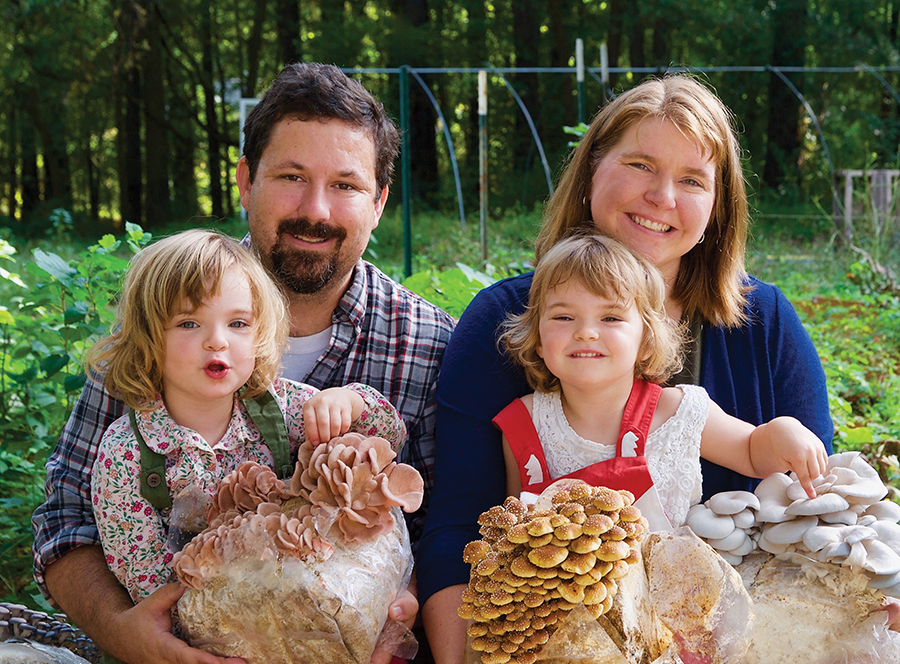
So you have to respect any farmers’ market grower who opens an online presentation with the words, “I’m Laura Stewart, and I grow fungus for a living.”

And Laura Stewart — along with her husband Ches — is the reason I’m turning into the gravel drive of Haw River Mushrooms, an organic farm outside Saxapahaw, a town on the banks of the Haw River. The town’s name was influenced by a Native American tribe first chronicled as the “Sauxpa” by Spanish explorers in the 16th century.

Along the driveway some pickups are parked. To the right I can see a couple semitrailers. Next to them stands a low cinder-block skirt and a metal superstructure for what looks like a soon-to-be-completed growing house.

I park by a big oak tree and step out of the car. Two men are working in front of a big shed at a substantial piece of equipment I don’t recognize.

A woman drives up in a dark minivan. She pulls a lock of auburn hair behind an ear as she gets out, gathering items from the front seat. She closes the driver’s door with a hip. Her hands are full of keys, mail, a cup of coffee and a half-eaten muffin. She smiles, looking at me quizzically.

“You must be Laura Stewart,” I say.

“Oh, my goodness,” she says. “We’ve been so busy I forgot! I just did a mushroom growing program at my daughters’ day care. Have you been waiting long?”

“Just got here,” I answer.

We walk toward a pretty farmhouse with a vegetable garden by the porch. Inside, I’m greeted by a big, friendly shepherd dog named Isaac.

Laura introduces me to her husband Ches, a compact, powerfully built man who’s just about to head out the door with an interviewee for a full-time job at the farm. Ches and I shake hands.

He tells me he’s from South Carolina and was interested in horses when he was younger.

“My background’s agricultural,” Ches says. He attended Middle Tennessee State University Auburn University, and received a master’s degree at Clemson University. “All I ever wanted to do was farm,” he adds.

Ches and the interviewee head out the door, Isaac trotting along behind them.
Laura and I sit down at a thick-legged dining table. She tells me she and Ches founded Haw River Mushrooms in 2012, when each of them still had full-time jobs. Ches was working for a company as a crop adjuster and she was education director at the Carolina Farm Stewardship Association, a nonprofit organization in Pittsboro that encourages people in the Carolinas to grow and eat local, organic food.

Like Ches, Laura has seen a good bit of the country, too. She studied at Knox College in Galesburg, Illinois, and received a master’s degree in management at Antioch University in Seattle, Washington. The couple met in Columbus, Ohio.

“Our first date we went to Polyface Farm,” Laura says. My initial thought is, well, maybe that’s the name of a fancy restaurant in Columbus.

Was I ever wrong.

Polyface Farm — the “Farm of Many Faces — is located in the Shenandoah Valley near Swoope, Virginia. For anyone deeply interested in sustainable, organic agriculture, the farm is a place of pilgrimage, offering a variety of educational tours, programs and seminars.

Back in 1961 William and Lucille Salatin purchased a worn-out, eroded property and settled there with their young family. Rather than follow the conventional principles of farming at the time, they used nature as a pattern and began the long process of organically restoring the land.

The Salatins planted trees, built compost piles, dug ponds and moved grazing livestock daily using electric fencing. They were pioneers in grass-fed beef production. Along the way they invented portable sheltering systems for cattle, chickens and rabbits, and introduced sustainable methods for raising pigs in woodland areas.

One of the Salatins’ sons, Joel, is the spokesman for Polyface Farm. Considered by his fans to be “the most eclectic thinker from Virginia since Thomas Jefferson,” he is sometimes labeled a “charlatan” by his detractors.
Whatever Joel Salatin is, he’s inspirational. He’s written 12 books and delivers inspiring educational presentations around the country.

“Ches and I read Joel’s book, You Can Farm,” Laura says. “And it had a big impact on us. We started thinking even more seriously about how farming could earn us the living we wanted for ourselves and our children.”

So the couple moved to our part of North Carolina — for the climate and the close access to local urban markets.

“This is a great area to locate a small, sustainable family farm,” Laura says. In addition to climate and markets, there are excellent resources, like Laura’s former employer, the Carolina Farm Stewardship Association, and the Rural Advancement Foundation International-USA(RAFI), also headquartered in Pittsboro. RAFI’s mission is to cultivate markets, policies and communities that support thriving, socially just and environmentally sound family farms.

In the end, though, it all comes down to hard work and good dirt. And mushrooms are about as efficient at making good dirt as any living thing you can think of.

The vegetative part of a fungus is called the mycelium, a system of fine, branching filaments. Think of the mycelium as the “roots” of a mushroom, and the edible part as its “fruit.” Mycelium may form a colony too small to see with the naked eye, or one that can spread for thousands of acres.

Secreting enzymes that are remarkably effective at breaking down plant material, these colonies add essential organic material to the soil. They also enhance nutrient and water absorption by the roots of plants, increasing their resistance to disease. And the mycelium colonies release carbon dioxide into the environment.

And carbon dioxide is just what green plants need. By photosynthesis, they use carbon dioxide and water to produce sugar and oxygen, vital to sustaining their life and growth. Of course, the oxygen green plants manufacture is fairly important to us human beings, too.

“We’re surrounded by an amazing system of abundance,” as Laura likes to put it. She suggests we head outside so I can see how they grow fungus at Haw River Mushrooms.

As we walk toward the machine where the two men are working, Laura points out a raised bed in the garden by the house. She explains that it’s an example of what the Germans call Hugelkultur, a technique using compost materials to build beds where plants can be grown. Here the bed is underlaid with mushroom-inoculated logs covered with straw. Atop the bed grows a squash vine.

“We harvested more than 40 yellow squash,” Laura says. “And there are healthy mycelium developing on the logs under the straw.”

She stops by an enormous oak tree near the garden. There’s a mulched bed surrounding the tree. Laura reaches into the mulch, carefully exposing the white tendrils of mushroom mycelium with her fingers.

“In the wild, mushrooms often grow at wood’s edge, so we thought we’d give this a try,” Laura says. She tells me she and Ches have farmer friends who are trying to grow mushrooms between rows of sweet corn. She calls all these growing experiments — the squash bed, the mulched bed around the oak, the corn row mushrooms — “citizen science.”
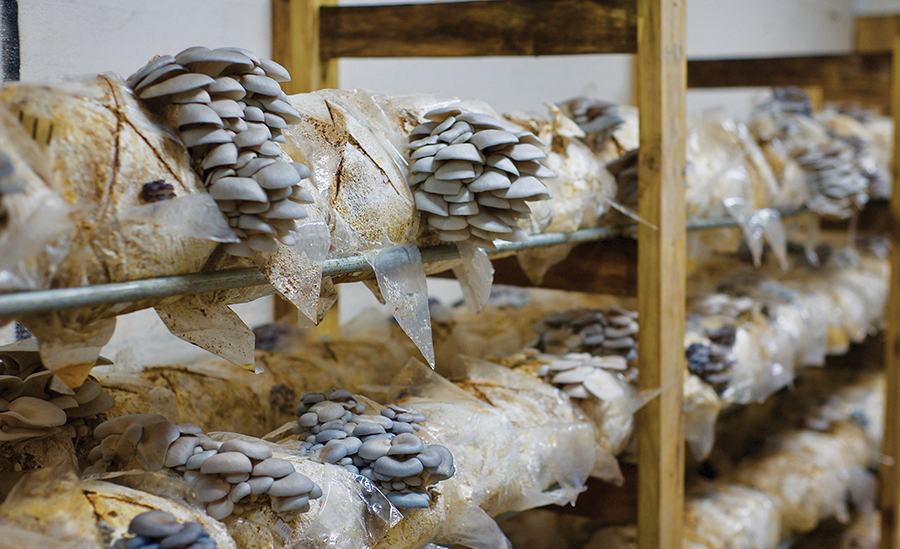
Now we’ve reached the machine in front of the shed. It’s used to inject substrate — the material in which the mushrooms will grow — into clear bags. After the substrate, a splash of water is injected. The tops of the bags are folded over. Then they’re placed into a galvanized livestock watering trough that has been outfitted with propane burners on the bottom.

“The substrate is a mix of mulch, soybean hulls, straw and oak sawdust,” Laura says. “There’s a sawmill in Liberty where we especially like to get our sawdust,” she adds.

Once the trough is filled with bags, a lid is put over the top and the burners ignited. Since they are so rich in organic materials, the bags have to be sterilized.

“Otherwise, any sort of bacteria or fungus could start growing inside,” Laura says. Once they’re sterilized, the bags are transferred to racks in the cooled shed behind us. There they’ll be inoculated with the spores of the various types of mushrooms that are the farm’s specialties.

We walk across the drive to one of the semitrailers, or “grow houses.” Laura closes the door behind us. Inside the space is dimly lit.

Laura explains the growing houses could be lit with blue light only, since that’s the range of the spectrum the mushrooms respond to.

“We thought one Halloween we might hang blue lights when we do tours, just for effect,” she says.

It’s cool and damp. The only sound is the whirring of air-moving equipment. Clear bags now removed, blocks of substrate with mushrooms emerging at various states of development rest on racks running the length of the trailer.

As I’m making notes, I look up, befuddled to see I’m suddenly shrouded in fog. Laura smiles.

“The misters come on every six minutes,” she says.

Outside I blink in the sunlight. Laura points out the new growing house with the metal superstructure.

“We’re going to plant blackberries,” she says. “The native soil is poor, so we’ll compost. When the blackberries are growing, we’ll pipe in carbon dioxide from the mushroom growing houses.”

An amazing system of abundance, indeed.

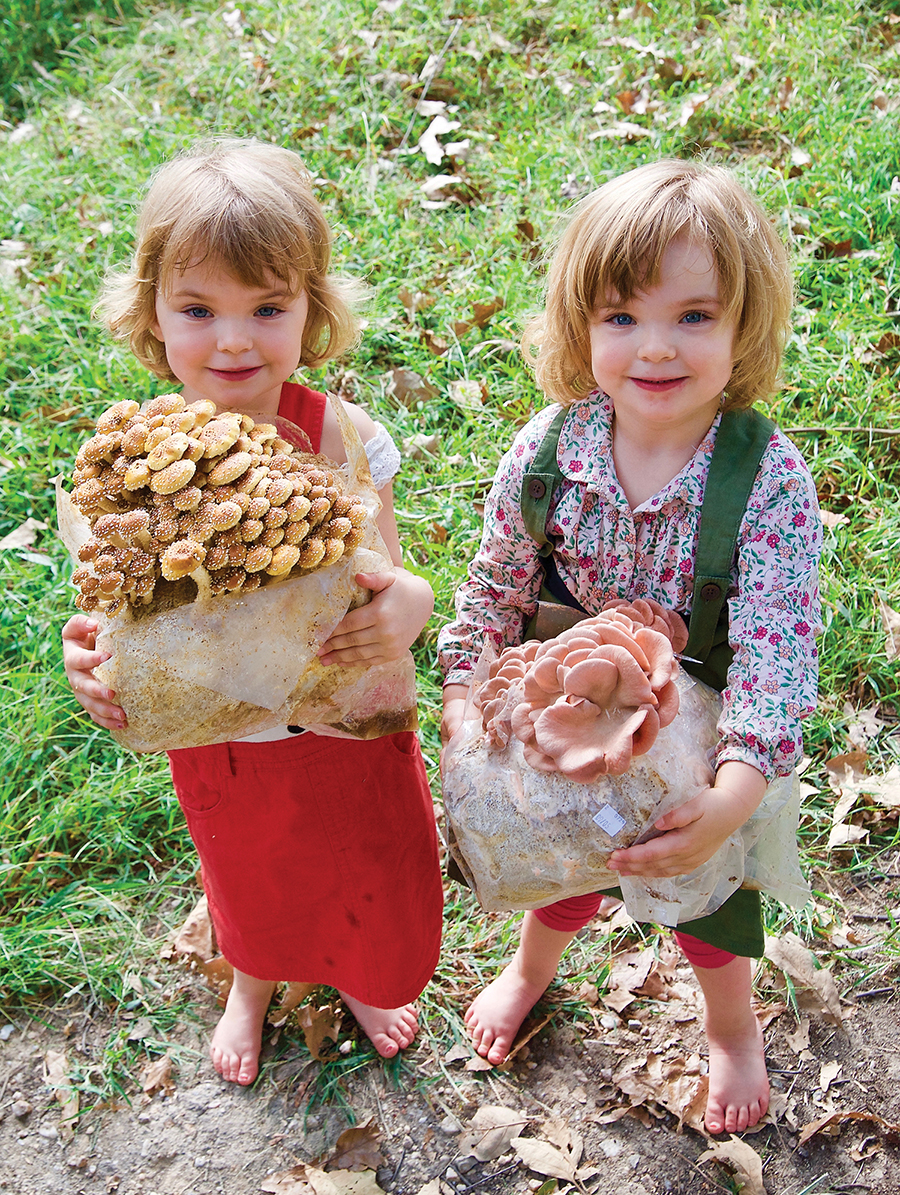
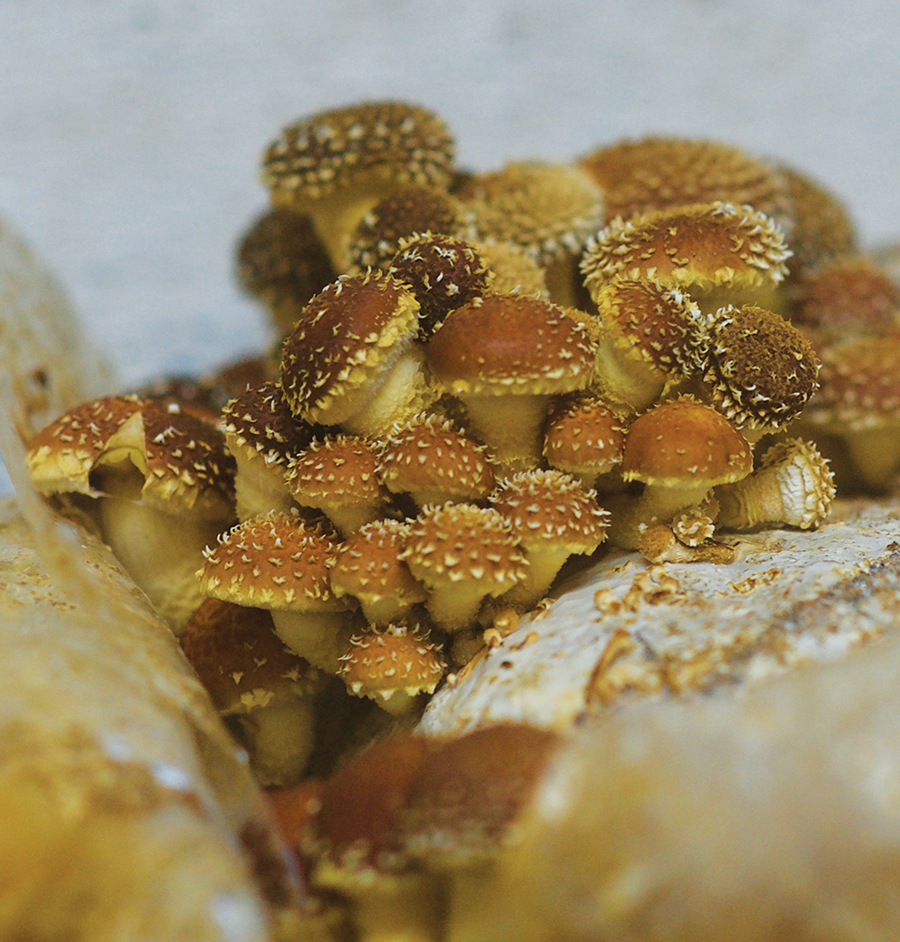
Haw River Mushrooms now has six full-time employees, counting the Stewarts, and several part-timers. They organically grow lions mane, oyster mushrooms, shiitake, cinnamon caps and reishi, supplying mushrooms to several restaurants in the Triangle and Triad.

Haw River also sells mushrooms at the Eno River Farmers Market in Hillsborough, the Chapel Hill Farmers’ Market, the Durham Farmers’ Market, and the Greensboro Farmers Curb Market. They ship mushroom vegan jerky to customers throughout the country.

The farm offers classes on mushroom cultivation and tincture-making.

“Mushrooms have amazing medicinal powers we are just beginning to understand,” Laura says. While they’ve long been studied for their curative and culinary value, there’s a great deal that remains unknown. With more than 600,000 known varieties on Earth, only about 44,000 have actually been studied.

“The lions mane we grow here at the farm is a North Carolina native,” Laura says. “It’s recently been studied to see if it might have value in treating dementia.”

Or consider the cordyceps mushroom, a species native to the North Carolina mountains. Like its nearly 400 cousin species around the world, our native cordyceps is an endoparasitoid, meaning that it’s parasitic, feeding primarily on insects.

But it gets way weirder. Once cordyceps invades the body of a host insect, its mycelium begins to grow, replacing the bug’s innards. In the process, the cordyceps somehow gains control of its host’s brain, so that the insect climbs to the highest point of whatever bush or tree it might be inhabiting. There, it dies.

Since Laura has told me about maybe using the blue lights in the growing houses for Halloween, I ask her if she’s pulling my leg.

“Oh, no,” Laura assures me, “You can Google it.”

In fact, cordyceps reproductive strategy is very effective. There are a plenty of insects on which it can hitch a ride, and when its fruit appears, it’s perfectly perched for its spores to achieve their widest geographical distribution.

Maybe this one can be researched for its psychedelic powers?

A perennially popular class at Haw River Mushrooms is “log inoculation,” offered in fall, winter and spring. Hardwood logs three to six inches in diameter that have been harvested by local farmers — typically in annual field brush-clearing, since sustainability is so important to the Stewarts — are cut into roughly four-foot lengths.

“After leaf fall, the logs have a high concentration of sugar,” Laura says. The concentration of sugar lengthens the amount of time that the logs will sustain mushroom growth.

Students then drill holes in individual logs, inoculate them with mushroom spawn, then take their logs home to enjoy the fruits of their labor. Actually, it’s a bit more complicated than that, which is why you’ll enjoy taking one of the classes.

For those of you who’d like to forage for wild mushrooms and avoid poisoning yourself in the process, the farm also offers field trips. Laura is a certified mushroom forager for North Carolina, South Carolina and Georgia.

There are also programs on mushroom growing for kids, using mushrooms in raising other crops and soil building in the garden. Laura, Ches and staff regularly welcome groups to the farm for tours.

With all the interest, the Stewarts are looking for a larger farm nearby.

“Long-term, we’d love to be able to convert everything to solar power,” Laura says.

I’d say mushrooms are finally getting the respect they deserve. Cue Aretha Franklin..  OH

If you have a garden or landscape topic you’d like Ross Howell Jr. to write about, email ross.howell1@gmail.com (don’t miss the number 1 in the address).

For more information on Haw River Mushrooms programs or products, visit its website, hawrivermushrooms.com, or follow on Facebook and Instagram at the handle @hawrivermushrooms, or check out the farm’s Pinterest page.