Simple Life

Letter From an Enchanted Hill

And life-changing leaps of faith

By Jim Dodson

For Christmas, my clever wife gave me a pair of expensive boxer shorts that claimed to be “nothing short of life-changing.”

The gift was the result of a running joke between us. During the consumer melee that is the holiday shopping season, you see, she was amused by my reaction to half a dozen TV spots and radio commercials that claimed their products were “life-changing.”

My short list of disbelief included a magical face cream that can allegedly make you look 30 years younger in less than two minutes, an expensive brain supplement that can supposedly restore failing memory to youthful vigor, and a luxury mattress so “smart” it can cure snoring and calculate your annual earned income credit.

Funny how times have changed. And here I thought it took things like falling in love, surviving a crisis, awakening to nature, taking the cure, making a friend, finding faith or discovering a mentor to change a life. Anytime I hear an ambulance or happy news of a baby being born, I think “someone’s life is changing.”

Looking back, my life has been changed — I prefer to say shaped — by a host of people, events and moments both large and small.

One example that stands out early was my old man’s passion for history and the lessons of nature, which probably explains why both my older brother and I became history nuts as well as Eagle scouts. History and nature, Dad believed, were life’s finest teachers, the reason he brought along a small satchel of classic books on our early camping and fishing trips in order to share bits of timeless wisdom from his favorite poets and philosophers by a blazing fire. This was his version of the Athens School, a campfire Chautauqua. It’s also why I took to calling him “Opti the Mystic.”

“All history is personal,” Opti liked to say, “because someone’s life is being changed. We grow by learning to pay attention because everything in nature is connected — including people and events.”

He illustrated both points powerfully on a cold February day in 1960 when Opti unexpectedly turned up at our new elementary school to spring my brother and me from class. We’d only been in town since the week before Christmas, barely enough time to acquire public library cards and reconnoiter the neighborhood on bikes. But we sensed that one of his entertaining field trips was in the offing, possibly a romp through the nearby battlefield where General Greene’s ragtag army gave Lord Cornwallis and his redcoat army all they could handle.

Instead, a short time later, we wound up standing near the “colored” entrance of the Center Theatre across the street from the F.W. Woolworth building in downtown Greensboro, where four brave young men from A&T State University were attempting to peacefully integrate the all-white lunch counter, an event regarded today as a defining moment in the birth of the nonviolent American Civil Rights movement.

“Boys,” he told us, “this is living history. This isn’t just going to change the South. It’s going to change America.”

The date was February 2, my seventh birthday as it happens, and Opti was right — though that change has yet to be fully realized more than half a century later.

A few days before my birthday this month, my daughter Maggie turned 30. She’s a senior copywriter for a major Chicago advertising firm and a gem of a writer with a bright future, a chip off her granddaddy’s block.

The summer after Mugs (as I call her) turned 7 in the aftermath of a divorce neither of us had seen coming, she and I and our elderly golden retriever took a two-month road trip around America, a fly-fishing and camping odyssey to the great trout rivers of the West. We rode horses, frightened a few stunning cutthroat trout, met a host of colorful oddballs and characters, lost the dog briefly in Yellowstone, blew up the truck in Oklahoma and generally had the time of our lives. I eventually put these adventures in a little book called Faithful Travelers that is still in print two decades later and closest of my books to my heart.

One night, sitting by a campfire on a remote mesa near Chaco Canyon, in a state that calls itself the Land of Enchantment, my precocious companion wondered why her old man had never bothered to write her a letter offering thoughts and advice the way she knew Opti had done for me many times in life. Just days before, she’d written me a letter thanking me for taking her on the trip.

When she and Amos the dog turned in, I tossed another log on our signal fire, sending up a spiral of embers to the gods of Enchantment, reached for a pen and paper bag and jotted the following letter from the heart to my wise and faithful fellow traveler. Every year around our shared birthdays, I take out that letter and read it just to remind myself how all history is personal and everything really is connected in nature.

Dear Maggie,

I’m sorry I’ve never written you a letter before. Guess I goofed, parents do that from time to time. I know you’re sad about the divorce. Your mom and I are sad too. But I have faith that with God’s help and a little patience and understanding on our parts, we’ll all come through this just fine. Being with you like this has helped me laugh again and figure out some important things. That’s what families do, you know — help each other laugh and figure out problems that sometimes seem to have no answer.

Perhaps I should give you some free advice. That’s what fathers are supposed to do in letters to their children. Always remember that free advice is usually worth about as much as the paper it’s written on and this is written on a used paper bag. Even so, I thought I would tell you a few things I’ve learned since I was about your age. Some food for thought, as your grandfather would say.

Anyway, Mugs, here goes:

Always be kind to your brother and never hit. The good news is, he’ll always be younger and look up to you. The bad news is, he’ll probably be bigger.

Travel a lot. Some wise person said travel broadens the mind. Someone wiser said TV broadens the butt.

Listen to your head but follow your heart. Trust your own judgment. Vote early. Change your oil regularly. Always say thank you. Look both ways before crossing. When in doubt, wash your hands.

Remember you are what you eat, say, think, do. Put good things in your mind and your stomach and you won’t have to worry about what comes out.

Learn to love weeding, waiting in line, ignoring jerks like Randy Farmer.

Always take the scenic route. You’Il get there soon enough. You’ll get old soon enough, too. Enjoy being a kid. Learn patience, which comes in handy when you’re weeding, waiting in line, or trying to ignore a jerk like Randy Farmer.

Play hard but fair. When you fall, get up and brush yourself off. When you fail, and you will, don’t blame anyone else. When you succeed, and you will, don’t take all the credit.

On both counts, you’ll be wiser.

By the way, do other things that make you happy as well. Only you will know what they are. Take pleasure in small things. Keep writing letters — the world needs more letters. Smile a lot. Your smile makes angels dance.

Memorize the lyrics to as many Beatles songs as possible in case life’s one big Beatle challenge. Be flexible. Your favorite Beatles song will probably always change.

Never stop believing in Santa or the tooth fairy. They really do exist. God does too. A poet I like says God is always waiting for us in the darkness and you’ll find God when it’s time. Or God will find you.

Pray. I can’t tell you why praying works any more than I can tell you why breathing works. Praying won’t make God feel any better, but you will. Trust me. Better yet, trust God. Breathe and pray.

Always leave your campsite better than you found it. Measure twice, cut once. If all else fails, put Duct tape on it.

Don’t lie. Your memory isn’t good enough. Don’t cheat. Because you’ll remember.

Save the world if you want to. At least turn it upside down a bit if you can’t. While you’re at it, save the penny, too.

When you get to college, call your mother every Sunday night.

Realize it’s okay to cry but better to laugh. Especially at yourself. If and when you get married, realize it’s okay if I cry.

Read everything you can get your hands on and listen to what people tell you. Count on having to figure it out for yourself, though.

Never bungee-jump. If you do, don’t tell your father.

Make a major fool of yourself at least once in life, preferably several times. Being a fool is good for what ails you. We live in a serious time. Don’t take yourself’ too seriously. Always wear your seat belt even if I don’t.

Remember that what you choose to forget may be at least as important as what you choose to remember. Someone very wise once said this to me — but I can’t remember who it was or exactly what it means.

Admit your mistakes. Forgive everybody else’s.

Notice the stars but don’t try to be one. Always paint the underside first. Be kind to old people and creatures great and small.

Learn to fight but don’t fight unless the other guy throws the first punch.

Don’t tell your mother about this last piece of advice.

Learn when it’s time to open your mind and close your mouth. (I’m still working on this one.) Lose your heart. But keep your wits.

Be at least as grateful for your life as I am.

Despite what you hear, no mistake is permanent, and nothing goes unforgiven. God grades on a curve.

One more thing: Take care of your teeth and don’t worry about how you look. You 1ook just fine. That’s two things, I guess.

Finally, there’s a story I like about an Indian boy at his time of initiation. “As you climb to the mountaintop,” the old chief tells his son, “you’ll come to a great chasm — a deep split in the Earth. It will frighten you. Your heart will pause.

“Jump,” says the chief. “It’s not as far as you think.”

This is excellent advice for girls, too. Life is wonderful, but it will frighten you deeply at times.

Jump, my love.

You’ll make it.

Love, Dad

For the record, my fancy new boxers didn’t change my life. They are quite comfortable, in fact.  OH

Contact Editor Jim Dodson at jim@thepilot.com.


True South

Be My Valentine ‒ for Life

You may get a good laugh out of it

By Susan S. Kelly

I don’t know how you’re spending Valentine’s Day, but if you’re feeling blue, hie yourself to the Harris Teeter around 5 p.m. and hang out around the flower counter. Just watching the clerks pumping out last-minute arrangements for all those lost men scrambling to purchase posies is bound to make you laugh. If that fails, call a single friend to regale you with fun facts about dating after 40. A favorite is my pal who has a “guillotine realization” for blind dates. As in, “He was wearing a necklace.” Chop. Another has a Jesus clause in her marriage: If he ever gets religion, she’s excused. And for those of you eyeing that 10-years-younger mate, remember this: You’ll have to take on all their 10-years-younger enthusiasms too, for organic food and exhaustively researching kindergartens. Ugh. Makes reaching the point in a marriage where you get up every morning, ask each other how you slept, and actually answer each other seem far preferable.

Valentine’s is an industry now, but then so are weddings, and if you don’t believe me, ask my friend who went around at his daughter’s reception offering $20 bills to people if they’d just go home. Now, even “the ask” is elaborately planned for some mountain top or sunset beach scenario. As opposed to, say, the way my husband asked me to marry him, in the parking lot of the SAE house, where we’d gone with the rest of a frat friend’s reception carousers because we’d broken every glass at Hope Valley Country Club in Durham. It just doesn’t get any more romantic than that, unless you count my son’s friend who let everyone know he’d gotten engaged by sending a mass email with “Man Overboard” in the subject line. My husband and I — well, OK, my mother — set my wedding date depending not on weather or venue availability, but by asking the folks at Tiffany’s how long it would take to get the invitations printed and counting backward from there. My sister was so jealous of my getting married. She said, “Just think. Now you can do anything to your hair and he still has to love you.”

And then, happily ever after. Or as my other sister put it, “I’ve loved him ever since he had that awful The Price Is Right furniture.” Forty years on, I’m still wondering if I get marital points for putting on mascara for my husband just for dinner. But I gave up on wishing for a What Now? day many anniversaries ago. A What Now? day is a Saturday when your husband just follows you around all day and says, “What needs doing now?” Although I once read the lips of a new bride dancing that first dance with her new husband. “Turn me now,” she instructed him. Wonder how that’s going.

Ah, the nuptial valleys and peaks. Not the toothpaste caps, or shirts put inside out in the laundry basket, rather, the day my father came home for lunch, as he did every day, and it wasn’t ready.  “What have you been doing all morning?” he asked my mother. For the first and last time, I bet. Or my sister, who once proclaimed, “All we talk about are calendars.” Yes, at one stage, marital conversation gets pared down to timetables.

And while toothpaste tops may be a cliché, the bathroom does seem to be the locale for many a Grrr moment. Take this direct quote from an email: “This amazes me. We’ve had the rug on our bathroom floor for 10 years. D (name withheld to protect the guilty) steps on it when he gets out of the shower, stands on it while brushing his teeth, ponders on it while on the commode. Today when I asked him to bring the rug up from the dryer, he asked what bathroom it belonged in.”

Still, the bathroom moment I recall most fondly took place not in a bathroom, but in an aisle at Lowe’s. It’s a weeknight in a nearly vacant, fluorescently lit, concrete-floored, utterly charmless big box store. My husband and I are debating a new shower door for a bathroom renovation. Most decisions are easy: a towel bar on the outside, a grab bar on the inside. Small house and aging issues we’re used to, and don’t even blink.

We look at those doors a long time, slide them back and forth, compare, dither.  I’m leaning toward the clear, see-through panel — contemporary, clean, trendy — and a significant departure from our old frosted one. My husband nods, thinks, and finally says, “You know, I just don’t think I can go there.” 

I laugh. “Who do you think is going to be looking at us besides each other?”

He laughs too, then, admitting to an idiotic objection, after 28 years. Never mind that both of us had nine years of two to four roommates before we got married, and have experienced countless shared-bathrooms oops moments on family vacations.

But then, I lift my shoulders and say, “You know, I can’t go there, either.”

And there, in the middle of Lowe’s, on a weekday evening, under fluorescent lights, the pair of us double over, giggling at our ridiculous, bogus-modest, long-married selves. If that ain’t the essence of romance, I don’t know what is.

And they’ve lived happily ever after. With the clear shower door.  OH

Susan Kelly is a blithe spirit, author of several novels, and proud grandmother.

Doodad

Good Hare Day

Chatham County Rabbits Revisited

Most folks go rabbit hunting with a rifle. Sarah McCombie’s weapon of choice is a banjo. But bludgeoning the furry little buggers with her axe or feeding them a lethal lead and copper sandwich with a firestick is not on her agenda.

With husband Austin, the duo pay musical tribute to their adopted hometown’s former favorite pastime and means of support. The mill village of Bynum in Northern Chatham County was once the rabbit capital of the United States. “Tons of people were coming here to hunt, and there were lots of rabbits being shipped out of Chatham County, even to Europe,” the singer/banjoist says. To keep their millworkers’ spirits up, the cotton mill sponsored a string band, the Chatham Rabbits.

The original group was quite an ensemble. “We had two good fiddle players and a banjo player and a harp and a mandolin and two guitars,” original member Frank Durham bragged in a 1970 interview with UNC’s Southern Oral History Program. With the blessings of their neighbors, the McCombies adopted the name, preserving the sound, but not the size. “It wasn’t so much of a decision as just like naturally how we ended up,” McCombie says. “We’ve always played music as a duo. We really enjoy it that way, and we’ve been really successful so far just as a two-person band.”

Sarah’s intro into string-band show business sounds like Lifetime movie material. A rabid fan of David and Ivy Sheppard’s outfit, The South Carolina Broadcasters, she joined them onstage at a show in 2012 at Prissy Polly’s BBQ in Kernersville. McCombie’s sing-along warbling from the audience so impressed the Sheppards that they called her later that night, said they were looking for a banjo player and a singer and invited her to come on a radio show with them.

Under the Broadcasters’ tutelage, she perfected her banjo skills and became a band member for three years, before and finishing college and marrying Austin. They ended up in Bynum living in the house formerly owned by Randolph Riddle, the guitarist for the original Chatham Rabbits string band. The duo has since taken up music full time, selling the house and living the road dawg life in an ’86 mini Winnebago. They funded their debut release, All I Want From You, with some unique pledge inducements on Kickstarter, like baking pies for a $50 donation. “I made close to 50 pies for people this summer,” McCombie says. With a few more to make, she adds, “If we ever do that again, I don’t think I’m gonna put that on there.”

She wants people to remember this iteration of the Chatham Rabbits for their Carter Family–style vocal harmonies as well as their songwriting. “I really hope people view Chatham Rabbits and listen to our music long after we’re gone because we really do feel like it’s timeless, like a lot of old-time and bluegrass music is. Ours just happens to be a little more of the 2018 and 2019 version of that.” — Grant Britt  OH

Catch the Chatham Rabbits’ album release on February 3 at the Carolina Theatre. Info: chathamrabbits.com.

The Soul of the Circuit

Once a preferred stop on the legendary R&B Chitlin’ Circuit, The Historic Magnolia House reclaims the glory of its Green Book days — and then some

By Grant Britt

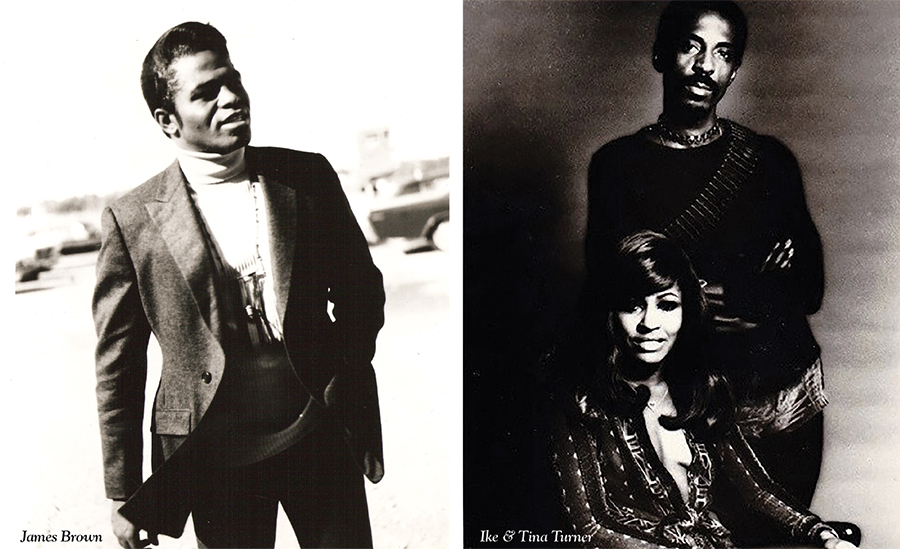
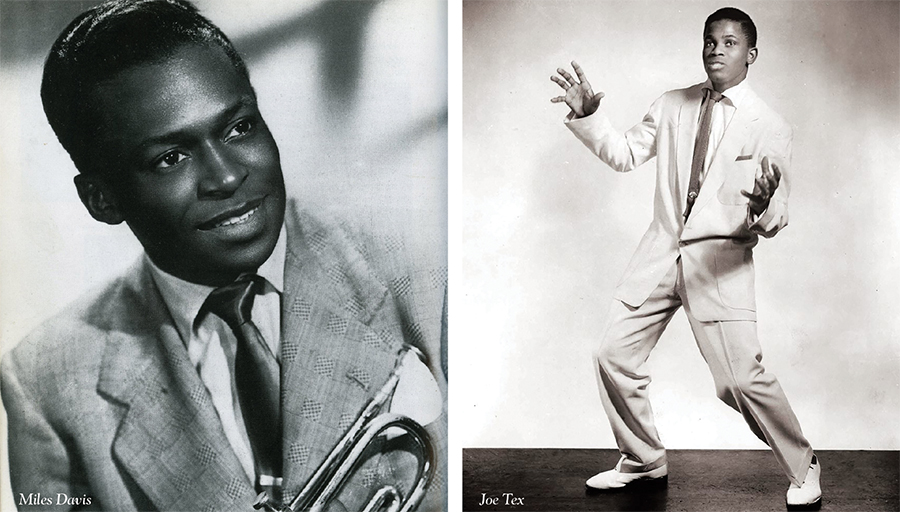
Once upon a time, there was a magical musical pathway that wound through the Piedmont, carrying deliverers of soul on their appointed rounds. African-American singers and musicians toured the country on a beltway that connected the East Coast to a string of clubs specializing in R&B and soul. The pathway was called the Chitlin’ Circuit, named after a stinky comfort food made from a pig’s large intestine, initially favored by folks who by economic necessity had to use every part of the hog but the squeal. James Brown spotlit some of the Chitlin’ Circuit’s whistle stops including Raleigh, North Carolina, on his 1961 version of “Night Train,” recorded at one of the Circuit’s top venues, the Apollo Theater in New York City. Other notable stops along the way included The Howard Theatre in D.C., the Royal Peacock in Atlanta, Richmond’s Hippodrome Theater, and The Ritz Theatre in Jacksonville, Florida. Greensboro was an important stop along the way as well, with The Ritz and the Carlotta Club providing a showplace for big names like Brown and Joe Tex.

Getting there was the easy part. But finding a place to eat,or more important a place to stay, was a problem for black artists for decades in those preintegration days. In 1936, New York City mailman Victor Hugo Green compiled a coast-to-coast compendium of establishments that catered to African- American travelers. The Negro Motorist Green Book, (inspiration for the current Oscar-nominated film, Green Book) became the Negro Travelers’ Green Book in the early ’50s when it expanded its coverage to Mexico, Canada and part of the Caribbean. It provided names and addresses of restaurants, bars and hotels that would let road-weary African-Americans eat, drink and rest with dignity and in comfort. The 1939 edition, expanded from early editions only listing New York destinations, shows a variety of establishments in Greensboro that welcomed black travelers, including the Legion club, listed under hotels on 829 East Market Street and the Travelers Inn, also on East Market, and several private “Tourist” homes on East Market: T Daniels at 912 East Market, Mrs. Evans at 906, Mrs. Lewis at 829, as well as the Paramount Tavern at 907 East Market.

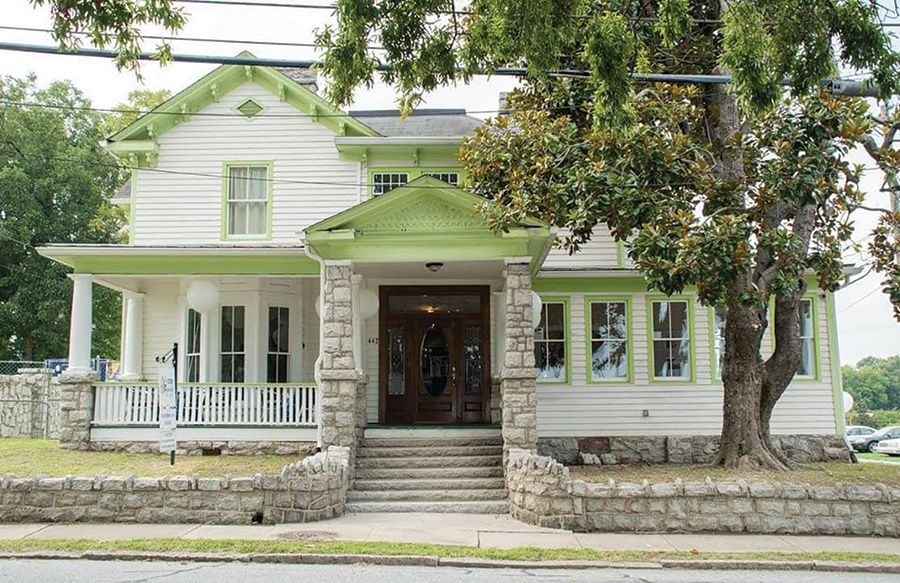
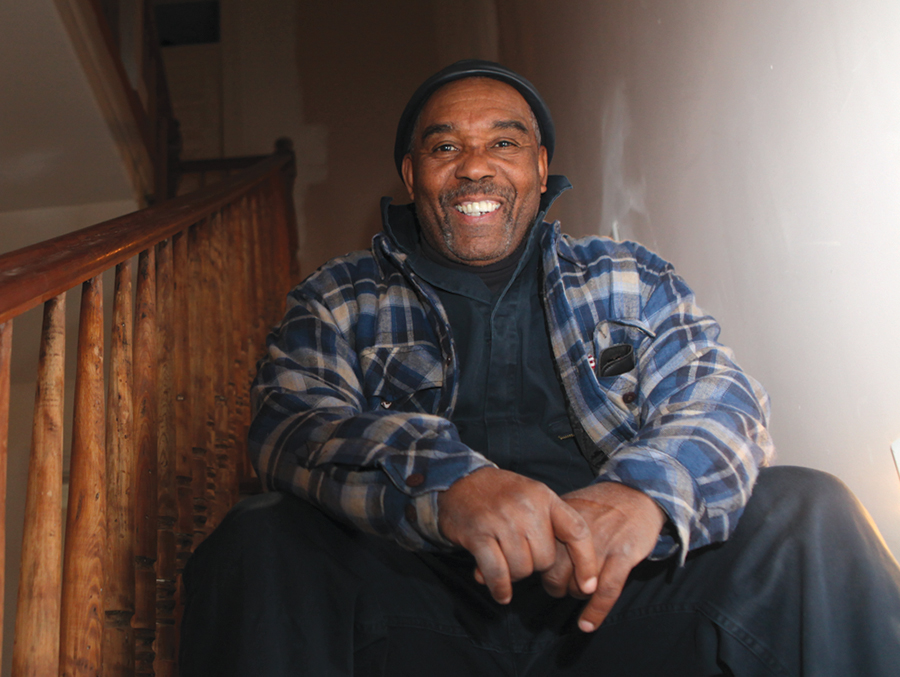
But one of Greensboro’s most prestigious Chitlin’ Circuit rest stops wouldn’t show up in the Green Book till 1955. The Magnolia House Motel was built by Daniel D.Debutts in 1889 at the corner of Gorrell and Plott streets in the Southside community. The 5,000- square-foot Victorian was a showplace even back then with its wraparound porch and imposing façade with five chimneys. The house began its career as a lodging destination when the Gist Family bought the property in 1949, catering to a Who’s Who of Chitlin’ Circuiters including James Brown, Ray Charles and Hank Ballard and the Midnighters. State legislator Herman Gist and his wife, Grace, inherited the property from their parents and ran it as a motel for several years. But the house fell into disrepair in the ’70s and remained a decaying shadow of its former self till 1996, when neighbor Sam Pass, who lives right around the corner on Martin street, saw the property up for sale. “It was in pretty bad demise. The roof was caving in, she [Grace Gist] couldn’t keep the street people out of here.” Pass was so determined to own the property that he ripped the for sale sign out of the ground and hid it until he could make Gist an offer, which she accepted.“ I remember the big marquee in the front yard,” he recalls. “It always said ‘NoVacancy.’ Magnolia House has been in existence as long as my generation has been in existence.”

“I noticed Magnolia House when I was a kid,” Pass continues, recalling that his older brother Bobby, a music promoter, brought his 13-year-old sibling to the house and introduced him to Joe Tex, who was playing in town. Pass met Tex on the front porch and remembers him as being very cordial to his tongue-tied, star-struck younger self. Pass’s brother introduced him to several other of the celebs staying at the Magnolia, and Pass says he heard stories of Tex and Brown playing baseball with the neighborhood children. “We knew about the Magnolia House even before then.” Pass says. “This was the first black hotel. When they couldn’t stay anywhere else, they stayed here.”

Greensboro had several musical hot spots from the mid-’40s through the ’60s. The black-owned El Rocco club on Market Street in Greensboro also brought in big names in the ‘50s including Jackie Wilson and James Brown, as well as Otis Redding. It also served the best fried chicken in town. “James Brown used to come to El Rocco,” Pass recalls. “My cousin George Simms was a drummer. He [James] used to come to my grandmother’s house and beg her to let George play for him. ‘I’ll keep him outta trouble, Miz Pass,’” he remembers Brown promising.

“El Rocco was something like in New York,” says Chic Carter, former pitcher for the Winston-Salem Pond Giants, a Negro League team in the 1950s. Evoking comparisons to Gotham’s famous Apollo Theater and a few others on the Circuit, he adds, “El Rocco had a nice place over there for them to come.”

Although it was a black club, some white visitors were welcome. “I used to take some girls to the El Rocco,” says Greensboro-based shag dancer Larry McCranie, who is white. “One time in the mid-’50s, I took four girls down there and we were the only white folks in there. They were cool girls, they ended up dancing with all the black guys and I danced with black women and we just had a ball. Not too many white kids went over there,” he reminisces, “but occasionally they were invited, the girls could dance, and you could just have a good time.”

McCranie also recalls a tobacco warehouse in Greensboro outside the city limits on South Elm/Eugene Street that hosted big-name acts about every other month. He says he remembers seeing Fats Domino, Lavern Baker, Ruth Brown and Chuck Berry, all on one show. Sheriff’s deputies hired to keep order between the races would put a rope from the front where you entered, all the way up to the middle of the stage. “White folks would go on one side, and black folks would go on the other. Everybody had a little bottle in their pockets, they’d get to drinking when they opened around 8:30 or 9 o’clock,” McCranie says. “Around 11 o’clock, that rope would come down and there was nothing they could do about it. There weren’t that many sheriffs there, and then everybody danced with everybody.”

Pass also heard about the warehouse and mentions another club, the Carlotta, down off Market Street, that was also a popular destination for Chitlin’-esque performers. There was the ABA club off High Street near Ray Warren Homes. “Then there was this little club called the Americana up near Gillepsie Golf Course. My brother used to frequent the place,” Pass says, recounting an anecdote about how older sibling Bobby once introduced their sister Ruth to Ben E. King of “Stand By Me” fame.

The clubs showcased them, but the Magnolia nourished black entertainers and gave a place to rest their weary heads; Pass wanted to pay homage to that tradition as well as preserving a piece of African-American history. He had the house, but now he needed help with the restoration. Retired from FedEx, Pass set up a mobile kitchen outside the property, selling ribs, chicken and fried fish to help raise money to put with $70,000 of his own. The city of Greensboro gave him a community block grant, and he got some help from suppliers impressed with what he was undertaking.

“It’s family basically,” Pass says of his renovation and restoration team. “Me, my wife [Kimberly], my oldest daughter [Natalie Miller] are what’s making this happen. Hopefully I’ll be keeping it in the family. That’s why I restored it.”

On a guided tour of the property, Pass’s pride in the work is evident in his voice as well as in the finished product. “A lot of it I did. But of course, I don’t have the talent to do all of this,” he says. “We didn’t renovate; we totally restored it.” With the help of local cabinetmaker Pete Williams, the Magnolia was gutted to its skeleton. “Then we came back with everything.” The heart pine floor came from the American Tobacco Company Warehouse in Reidsville. The owner of Reidsville’s Tobacco-Pine Reclaimed Timber was so impressed at what Pass was doing, he gave him a steep discount. “The entire house is the same heart pine lumber — the chair rails, the window casings, door casings, all the interior doors,” Pass says. “The baseboards, quarter rounds, the crown moldings, all of that are from heart pine lumber. We did the house the way it was supposed to be done.”

Working from the original blueprints, Pass and family did their best to keep the house true to its original design. “It was important that we leave the outside just like it was, as far as structure was concerned, since the house was on the National Register of Historic Places.” He did do a kitchen makeover, installing a commercial kitchen.

The outside wall was improved on as well to create the majestic stonework that surrounds the house today. Part of the restoration phase was to repair and restore the original 2-foot retaining wall going around the house at 442 Gorrell Street. He approached Mount Airy’s North Carolina Granite Corporation about cutting the granite for the needed repairs. The company ended up donating not only rocks to make repairs but additional granite. “So we were able to repair the wall, but they also gave us 160 tons of it,” he says. “That’s how we got that 7-foot wall built around the house on our property line.”

Architectural Salvage of Greensboro donated period furniture, including a dresser with an impressive pedigree. “We didn’t know what we had until one of our customers for Sunday brunch came through, looked at the piece and said, ‘That looks like Thomas Day furniture,” referring to perhaps North Carolina’s most famous black cabinet maker. “Of course, we researched it, and come to find out, it is.”

Daughter Natalie Pass Miller oversaw the furniture restoration. Pass calls her “an innovative Alpha woman,” which causes Miller to break out into peals of laughter when told of the description. “That is so Sam,” she says, when she can catch her breath. “Oh gosh, I don’t know about that. I’m just trying to help Daddy carry out his vision.”

Miller stepped in about a year ago, bringing back period pieces from Atlanta, where she was living at the time. “This was my very first time driving a U-Haul packed with furniture long distance, praying all the entire way cause I’d never done it before,” she says. “When I pulled up, Dad just happened to be on the porch and you could see the look on his face, like, ‘Is that my kid driving a U-Haul? It is!’”

But her furniture -moving project turned to operational matters once she started probing her father about his intentions for Magnolia House. “Dad’s tone changed to a sad one,” she recalls. Pass’s renovation work was going slowly due to his daily commute to Durham, where he inspects buildings for Duke University in advance of fire marshal visits. His daughter could tell he needed some help. She suggested to him “Dad, why don’t I come in, and let’s work together to see if we can complete this vision that you have now that you’ve done the hard part of restoring the house?”

Pass’s efforts hit another snag when he had a stroke in early November. These days, he is just getting back to work and seeing the changes Miller has implemented. “One of those priorities, including making over the ambiance is, ‘How do we rebuild our brand and reputation and what do we want people to experience when they walk in the house?’” Miller explains. To that end, she’s changed up the serving format of the weekly Sunday Jazz Brunches from a buffet line to family-style dining in the large front room that was once a porch. “The room is cavernous, with 14-foot ceilings,” she says. “The Gist family had renovated it and lowered the ceiling with tile, but I put it back the way it was,” Pass explains. Brunch is served here, with servers bringing out large bowls of sides and entrees to several long trestle tables set end-to-end along the length of the room. “When the Gist family had it as the historic Magnolia House, one of the key things that I noted was that they were really big on creating a sense of family and engagement and unity, bringing that concept to the table,” she says. “And if you think about it, that process exists even in the overnight stay, because not every room had its individual bathroom, so if that doesn’t bring a community together, nothing does,” Miller chuckles. “So moving over to the family-style dining was really created as a part of continuing the legacy of what the motel created.”

The current menu has a number of staples, but introduces a few unique dishes every week. Feedback from guests plays an important role as well, with Magnolia brunch regulars praising the fish and grits, and fried chicken. “We also have a penne pasta in garlic Parmesan sauce with seasonal vegetables that is just to die for,” Miller says of the fare she’s proud to label as comfort food.

But Pass is quick to point out that the family is not calling the new Magnolia House completely a restaurant. “We do have a commercial kitchen in the facility, but it was our intention to open up as a bed and breakfast, and will still be a component because we have the upstairs mostly finished, Pass says. But we haven’t gotten to that point yet.” Right now the focus is on using the house for special events, with bridal showers and baby showers, as well as hosting several local clubs and civic associations parties, including A&T State University Alumni Association events.

Pass has also introduced a series of presentations he calls the Juke Joint Series, dinner and a show, sort of like The Barn Dinner Theatre. “We do tributes to some entertainers that registered here during segregation. First one, we did a tribute to Ray Charles and Ruth Brown, and we just recently did a dinner and a show, a tribute to Gladys Knight and the Pips, and we’re working on a Valentine’s show now. So we do events here, Sunday brunch here every Sunday from 11 til 3:30. And the public will come here for some of the good food that we cook.”

He’s got quite a list of celebs who stayed at Magnolia to sustain the Juke Joint Series for quite a while. Duke Ellington almost made the list. “Duke didn’t stay here, but his band did, “ Pass says. “Duke was comfortable enough financially to have his own rail car. So he stayed in his own car on that train,” he explains. “Ray Charles stayed here, Ike and Tina Turner, James Brown, heavyweight champ Ezzard Charles. Jackie Robinson, Satchel Paige, they came here to play at War Memorial Stadium. And Ruth Brown stayed here; she was very hot, had top billing on the Chitlin’ Circuit. Gladys Knight and the Pips, stayed here, Smokey Robinson stayed here, The Midnighters stayed here. Buddy Gist donated Miles Davis’ trumpet to UNCG. He talked often about how his mother used to cook for Louis Armstrong when Armstrong would come here. The place was just the vortex of the African -American community here,” Pass says.

Pass and family hope to return to the Magnolia House’s long tradition of hospitality both for events and as a bed and breakfast. “We hope to cater to the furniture market when we finish upstairs,” Pass says, referring to the five bedrooms on the top floor, two of which are fully completed and ready for guests, but currently used only for family and friends. “People who own homes in the High Point area rent out their entire houses to people who come to furniture market. We’d be interested in doing that same thing with the Magnolia House,” he says explaining that they would offer a full package of services — concierge, transportation to Market, for example.

To kick off Black History Month, Miller has organized an event to share the Magnolia House’s current path and history with the public. “We’re calling it our Magnolia Table Talk. And it’s the Green Book edition because we’re celebrating that we’ve been listed in the Green Book for six of their editions,” she says. Miller adds that she envisioned the event as an upscale intimate setting “with my dad and all of his siblings sitting at the table leading a panel discussion with the audience, talking about the history of the Magnolia House, how it tied into history of the Triad and how our family line contributed to that history of the Triad as well.” Pass says that the Magnolia House resurrection is for his community as well as his family: “I restored it because I am interested in preserving our history. My grandchildren won’t know where they’re going until they know where they’ve been.” OH

Grant Britt lives in a much humbler abode than the Magnolia House, but he shares the same reverence for its soulful musical guests who provided the soundtrack of his young life and still resonate in his residence and his head.

For a complete list of events open to the public at The Historic Magnolia House, please visit thehistoricmagnoliahouse.com.

O.Henry Ending

Mama Patty’s Scar

And the perfection of a soul

By Cynthia Adams

It’s there.

Right where Mama Patty’s soft pink nightgown flares slightly open at the armhole. I stare furtively at the depression, the angry network of scars, as she reads, cat-eye reading glasses in place, blue-black curls propped against a lace-edged pillow. She’s gripped by one of her Zane Grey novels.

Beneath the gown she wears a white cotton bra. A form pinned into the left empty cup is held by two gold safety pins. At age 6, I am dying to ask her about this, but something stops me. She says I ask too many questions, which vexes her.

Questions about my grandfather, Lewis Clive Tucker, and their baby Roy vex her, too. Both dead.

My friend Tony died when he ran in front of an Oldsmobile. Baby Roy died, too, writhing on the kitchen table. Spinal meningitis, misdiagnosed.

Mama Patty walked outside, frantic for the doctor’s arrival, and had a vision of a small white coffin.

Little Roy was buried in such a coffin, the color of pearls.

Yet she lies beside me, reading her western like nothing in the world is wrong apart from the worry that I might interrupt with another question.

Until she reaches up and turns the knob on the bed light, I watch that angry pink place on her left side until it becomes my scar, too.

The sheets smell of the sun. The Martha Washington bedspread is carefully folded. The mourning dove sings its mournful song. This all fills my head, imprinting something in me in the darkest of darkness.

Mama Patty breathes deeply. I try to sleep, thinking of the morning to come, dreading that she may want to fish. Snapping turtles and water moccasins sometimes appear at the wild old pond. The fish, once hooked, wrenches and arcs until it is placed, flapping, into the tin bucket. When she cuts off its head and strips out its guts, the gore splashes onto her apron.

The next day, although I do not know this as I drift to sleep, she will fill a large washtub and let me splash to my heart’s content.

Mama Patty will give me a baloney-and-mustard sandwich to eat, and take me to check the rabbit boxes. We will walk to the mailbox, wearing red flip-flops and sucking the juice from a honeysuckle.

The questions that come in daylight are easier than questions that come in darkness. I do not think of the scar all day, forgetting completely that a part of her has already been cut away.

Her beloved Pearl Grey Zane (Pearl was his first name) was a sensation in his time. He was untamed. He feared man would destroy all that was untamed in the natural world.

I need this wild life, this freedom, he wrote.

The next night, as Mama Patty turns a page and the gown gapes again, it is impossible to look away from the depression where a breast should be.

I do not want them to cut one more thing away. Mama Patty is just right as she is. Perhaps perfect.  OH

Cindy Adams is a contributing editor of O.Henry.

Greensboro’s Next Wave

Greensboro’s Next Wave

One simply needs to look around town to realize that Greensboro is on the move — the Next Wave of young and creative people are already shaping the Gate City’s future. We thought you’d like to meet a few of them

Photographs by Mark Wagoner

Cooking Up Change

Table Seven needs a birthday dessert, a pavlova.

On the hot side of the counter that divides the cooks from the customers at Chez Genèse (pronounced zhu-NEZ), owner-chef Kathryn Hubert centers a beige cake made from meringue on a small white plate — its magnificent foamy peaks and furrows baked into place by a brief encounter with a furious oven.

She slaps the creation with a heavy spoonful of homemade whipped cream. Her gloved hands rain blueberries and blackberries over the gleaming pond. The inky berries land with soft plops.

She rocks a chef’s knife on cutting board to yield juicy geodes of strawberries, then she upends a tin canister of powdered sugar and makes it snow over crags of red and blue.

“Runner!”

Server Ben Lugo, who describes himself as autistic, carefully lifts the plate from the counter and takes a few steps to present it to the honoree.

“Happy birthday to you, happy birthday to you, I forget the rest of the song, buhhhhhhht . . . HAPPY BIRTHDAY TO YOU!”

What Lugo lacks in words, he makes up for with enthusiasm. Laughter bathes the moment.

Lugo, 22, laughs, too.

Behind the counter, the oval-faced owner Hubert, who traps her long brown hair under a trucker cap, frees a giggle. She is prematurely calm at 30.

“That’s great,” she says of Lugo’s improvisation. “I’ve never seen him do that before.”

Ten years ago, when she was chipping away at a degree in hospitality management at UNCG, Hubert imagined her future.

She could see herself leaving Greensboro for Oregon.

Maybe Portland. Someplace awash in young people who wanted to make the world a better place.

Sustainable. Fair. Inclusive.

Those were her values.

But another thought tapped at her mind as she pondered what might be elsewhere: There was plenty of work to be done here.

“There were people walking by me every day that needed help,” she says.

Living on the cusp of campus and downtown, she saw homeless people frequently. She worked in a community garden in the Glenwood neighborhood, where families prized the vegetables that sprang from the dirt. She tutored children in an after-school program run by the nonprofit Hope Academy and, later, in a similar one operated by the Autism Society of North Carolina. That’s where she met Joey, a profoundly autistic boy whom she describes as “very sweet, very in tune.”

Hubert was on familiar ground. She’d grown up with three male cousins with autism, a wide-ranging condition marked by difficulty in making social connections.

Portland would have to wait. After graduating from UNCG, she stuck around for Joey. She became his full-time assistant at his elementary school, a paid position in the school system. 

The job with Joey was rewarding — for him, and for her — but when Hubert looked ahead, as she is prone to do, she saw a sad truth: The Earth is, indeed, flat for people like Joey, who often fall off the edge once they leave high school and find that job opportunities for people with intellectual and developmental disabilities are practically nil.

Once again, she pitched herself into the future and saw a solution: a French cafe that would employ people with intellectual and developmental disabilities — folks like Joey and her cousins.

Hubert was a foodie from way back. Coming of age in the mountain college town of Boone, she cooked at The Inn at Crestwood and Hound Ears Club. She bagged a degree in culinary arts from Caldwell Community College and spent a year volunteering in a resort kitchen in the Burgundy region of France.

The experience left a lasting impression.

“I fell in love with French food and culture, and how generous French people are with their time. They’re very relational,” she says. “When they invite you into their homes, there’s no time limit on it.”

Her experience propelled her to study hospitality at UNCG, which led her, in turn, to meet Joey, which led her to understand that she could whisk together everything she had learned — about food, about people with disabilities, about being the change she wished for — to create an inclusive workplace.

“This has been a dream a long time in the making,” she says.

She toned her restaurant chops by working in catering at the Iron Hen and, later, by helping to get the now-shuttered Morehead Foundry complex off the ground.

She cultivated a coterie of advisers: an attorney, an interior decorator, small business owners and fellow chefs.

The stove jockeys devised a menu rooted in Gallic ethos.

“The French don’t cram a lot of ingredients into their food,” she says. “They pick a few and let them shine.”

The breakfast-and-lunch offerings would glow with fresh baguettes, croissants and brioche from Camino Bakery in Winston-Salem.

House-made egg dishes would wear simple accessories: asparagus and chèvre; smoked salmon and dill crème fraîche; spinach, roasted red potatoes and Camembert.

Strawberry crepes would travel with crème fraîche or Nutella.

Ham and butter on a chewy baguette would equal a sandwich.

A fancy sandwich might combine olive tapenade, fresh tomatoes, goat cheese, sliced chicken, pepperoncini and arugula on a baguette.

A tart might require just potatoes, thyme and red onions.

Chocolate mousse would leave tiny air pockets in a small mason jar and wear a fluffy hat of whipped cream.

Hubert stitched together financial backing from various sources: family and friends; online crowdfunding campaigns; grants from downtown development advocates; and a personal loan of $30,000.

She secured a location on the southern hem of downtown — an airy space which last held PB&Java, a sandwich and coffee shop near the corner of South Elm and Bain streets, a block removed from Gate City Boulevard.

She didn’t have to advertise for applicants. After local media announced her plans, emails rolled in from people who wanted a job. If parents contacted her on their children’s behalf, Hubert asked them to have their children contact her directly. Applicants had to want it for themselves. She wasn’t in the business of handing out jobs. She was in the business of hiring people who could do the job, never mind their disabilities.

She conducted interviews, culled the best candidates, and arranged for job training with lots of role-playing and explicit instructions on how to read and react to social cues, a common deficit among people with developmental issues.

Among the lessons: Do not interrupt when customers are deep in conversation; and when diners set their plates aside or their silverware on their plates, assume they’re probably be finished. There were moments of levity.

Once, when Hubert played the role of a diner, a would-be server asked if she wanted dessert. Sure, she said. What are your favorites? Impulsively, he proceeded to tick off a litany of sweets that weren’t on the menu.

She then diplomatically reminded him that the context called for a list of confections that were available to diners.

One of her cousins helped with the training.

“He said, ‘Hey, I’m Zachary. I’m autistic, and I’m not ashamed of it,’” she says. “There was an immediate connection between him and the staff because they thought, ‘He understands.’”

Hubert mobilized an army of volunteers to blanche the restaurant’s interior to simple chic. They painted the walls white, wrapped support columns in rope, hung sail cloth drapes in the many windows, and striped the walls with shiplap siding and floating shelves that breathed with terra cotta pots, feathery ferns and trailing tendrils.

A friend hung a banner of brown butcher paper near the front door. In wispy script, she translated the cafe’s French name:

“Chez Genèse, A Place of New Beginnings.”

Hubert’s mom and dad, Lori and Barry, came from Boone and camped in the construction zone, lending muscle and experience. Convinced that she could never pay back, only pay forward, their love, Hubert planted one white chair in a sea of black bistro seats. The first person to occupy that seat every day gets a meal on the house, along with a brief history of the reason behind the largesse.

“It seemed like a good way to share the story, in a practical way,” says Hubert.

She opened her breakfast-lunch cafe in late-October, the same week that A Special Blend, a coffee shop that also employs adults with cognitive disabilities, opened on West Market Street near Starmount Forest (see this month’s Life’s Funny, page 17).

It was a coincidence. But Hubert believes the events are rooted in the same time and place. It’s a time, she says, when people who are inclined to quash employment barriers for those with disabilities have successful role models like Wilmington coffee shop-turned-franchise Bitty and Beau’s.

Greensboro, she says, is fertile ground for people like that.

“There is, I think, a sense of community in Greensboro that isn’t in other places,” she says. “I think there are a lot of businesses and individuals here who care about making an impact, and I’m honored to be a part of that.”

More than half.

That’s how many of Hubert’s 22 employees deal with evident disabilities: autism, Down syndrome, lower-than-average IQs, and other conditions that make processing information a challenge.

Brianna Oliver, 21, says she deals with attention deficit and hyperactivity disorder, anxiety and depression. She graduated from high school, tried college for a while, and lost a job as a preschool assistant before coming to Chez Genèse.

“I’m either all too much at once, or not engaging enough. It’s hard to be myself with people because I feel like they won’t want to be friends with me,” she says.

At Chez Genèse, she says, she can be herself, knowing that her bosses — Hubert and her neuro-typical lieutenants — understand and can help if needed. As a result, Oliver has relaxed into her job as server, a job she wanted so she could improve her social skills.

Katya Hedrick, 25, a prep cook, left her parents and a job helping with horseback tours in Boone to see if she would like living on her own.

“I already knew I wasn’t good at talking to people, so I’m learning to communicate better. When I came to Greensboro, I had to talk more,” she says deliberately. 

The change was scary, she admits, but chocolate croissants and supportive co-workers have made it easier. Also, they have helped her refine one of her best skills: hugging.

“This is like a big family that tries to help one another,” she says.

Lugo, the birthday crooner, also tried college. It didn’t work out, he says, so he now works four jobs, three in food service.

Ask him what’s good about working at Chez Genèse, and he shifts to the hypothetical second-person to answer.

“If you were a jerk, or pardon my French, an asshole, you would say the pay and no tips,” he says, referring to the slightly-better-than-minimum-wage pay and no tipping in the French tradition.

But because Lugo is not a sarcastic asshole, he will say no such thing. Instead, he will say that Chez Genèse has allowed him to see a future job that might involve his passion: games. Online games, board games, trading card games. He’s good at memorization. Show him the rules, and watch him go.

“It got me thinking, maybe I’ll open a store and help people,” he says.
— Maria Johnson

Katei Cranford – Community Advocate

A tireless purveyor of everything local, Greensboro gadfly Katei Cranford wears a lot of hats, none of them boring: Event organizer. Historic preservationist. City council candidate. Yes! Weekly columnist. Radio DJ. Social media flamethrower.

Where does the 34-year-old get all her energy? “There’s a certain inspiration that comes with the frustration of not necessarily being a city that has a lot going on.”

Many will know her best from her long-running Tuesday afternoon radio program on WUAG that spotlights musical groups playing around North Carolina.

Instant Regrets and Basement Life are local faves but Katei confesses, “A lot of the bands I’m most excited about are coming out of Raleigh right now.” That’s because a viable music scene is predicated on a platform of appropriate entertainment venues, so she’s often engaged in nudging developers into expanding creative outlets and performance spaces. “It can be really fun here and I want to share that. And everybody else I talk to does too,” she says. 

Things are looking up on the music scene, Cranford says: “When you get solid touring bands coming here there’s an extra element of passion and enthusiasm. We don’t take them for granted.”

Like they say: Right what you know. — Billy Ingram

Witneigh Davis & Giovanni Ramadani – Founders Greensboro Fashion Week 

Lights! Cameras! Music! Yes, Greensboro Fashion Week has all the glamour and excitement one would expect from a runway show, but for founders Witneigh Davis and Giovanni Ramadani, it has always been as much about substance as style, starting with their initial vision in the fall of 2014. 

New York Fashion Week, says Giovanni, a former model, had become “watered down” and rife with pay-to-play participants.” Gotham “got outside the major designers they’re showcasing.” Talent was secondary. Greensboro, on the other hand, boasted “textiles driving industry back in the ’60s,” says Witneigh, a former stylist with marketing chops. “Knowing that the history and roots were here in the fashion world, we just kind of resurfaced in a modern way.”

The two entrepreneurs saw an opening to fill the fashion gap in the Southeast, between New York and Miami, by showcasing local designers with the help of sponsors, such as Greensboro’s Foreign Cars Italia and no less than Bentley, among others. After all, as Witneigh points out, clothes and cars are “a natural fit.” She and Giovanni also noticed that Greensbororians sported their own polished and casual, if a bit subdued style, and could be encouraged to take more daring sartorial steps.

Fast-forward five years, and the two entrepreneurs, both of whom who will be 32 this year, will tell you GFW has morphed beyond expectations, becoming a true platform for fashion. Designers — from all over the world —  are vying for the opportunity they’ve provided. “We had over 100 applicants last year and we only had room for eight,” says Giovanni. “We wanted to pick the best ones.” And they are hands-on. Witneigh says the two constantly communicate with the designers by Skype, every step of the way before the razzmatazz in fall that includes multiple shows at various hip locations around town. (Last year they snagged a hangar at Honda Jet for one of their shows.)

But Witneigh and Giovanni haven’t stopped there: They started a modeling camp for kids in the summer, the first, Giovanni believes, in North Carolina, to teach aspiring models the ins and outs of the industry and how to comport themselves professionally so as to be agency-ready. (Some were signed on at last year’s Fashion Week.) The dynamic duo are also putting their energies behind Twin City Fashion Week in Winston-Salem this spring and a daylong Summer Show before the GFW revs up again in October.

They’re excited that the event is becoming a destination. “That’s the thing,” says Giovanni. “We want to make Greensboro cool. We want to make Greensboro fashionable. We want to make Greensboro fun.” — Nancy Oakley
Maurice Hicks – Filmmaker

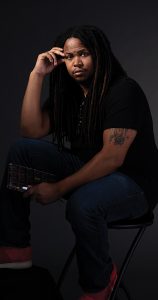
It takes a visionary to see life’s big picture, then project it on the big screen. Just months ago, UNCG film grad Maurice Hicks, 32, completed a feature film he wrote and directed, Rap and Rhyme, an underbelly exam of the music biz, which he says is “an accurate reflection of who I am as a person, an artist, and what I’m capable of.” As a financial and artistic roll of the dice, “it was absolutely terrifying but we did it.”

Timing seems right. His highly acclaimed short from a few years ago was recently picked up by an entertainment channel, a circumstance so rare as to be almost unheard of. An unflinching commentary on American racial injustice, A Letter To My Son stars Cranston Johnson (Hap and Leonard), who’ll be seen in two new series on ABC and Netflix this year.

It takes a creative fervor to be constantly producing in spite of overwhelming uncertainty, but it’s paying off. “I like Hip Hop, I like urban characters,” Maurice says. “I grew up in an urban environment so I like to think I write them pretty authentically.” Hollywood agrees. Maurice currently has a major motion picture being shopped around with Outkast’s Big Boi attached.

Meanwhile, his latest movie treatment, about romance in the digital age, is a finalist for Best Screenplay at the South Carolina Underground Film Festival. “I’ve never been to Charleston,” the filmmaker confesses. “It should be fun.” — Billy Ingram

Jessica Mashburn – Singer, Songwriter

The next time you see her, you might be forgiven if you fail to recognize Jessica Mashburn, the gifted chanteuse whose physical appearance seems to change like the weather. Long a favorite among patrons of Proximity Hotel’s Print Works Bistro, which hosts the popular Wednesday night jazz gigs, the 36-year-old Mashburn performs with partner Evan Olson, not to mention countless events ranging from private parties to splashy weddings. The colorful and chameleon-like songwriter-songstress might be the closest thing in the Triad to a musical theater Renaissance woman. One minute she’s a sultry Berlin cabaret singer from the 1930s, the next a blonde bombshell à la Some like it Hot.

“I love to adapt to whatever is needed the more dramatic the better,” she says. “If someone needs a flapper from the ’20s to greet people and sing them through the door, hey, I’m just the person.” That’s because she sees herself primarily as an entertainer: “My job is to leave folks happy and maybe even inspired.”

Born the daughter of bluegrass musicians from Southern Pines who relocated to Greensboro in 1984 to give their precious daughter “a better exposure to the arts,” Jessica thrived in theater and music at Southeast Guilford before enrolling at UNCG to study music. The large classes prompted her to switch to her hometown, Sandhills Community College, where she sang with the jazz band, taught herself piano and guitar, and earned a degree in music before moving for a brief time to Raleigh to work for Quaintance-Weaver’s Lucky 32 Restaurant, having been a server at the Green Valley Grill during her time at UNCG. 

The divine Miss Mashburn’s versatile talents led to a post at the O.Henry Hotel as events manager in 2005, a job she performed until 2007 (singing on weekends with pianist Dave Fox), when Dennis Quaintance recruited her for the design team of the sister Proximity Hotel. In 2011, this musical polymath who makes her own outrageous hats, “demoted” herself back to server in order to free up weekends for performing — and never looked back. Though she still works as the hotel’s music coordinator, her career has soared like a bird.

“Funny you should say that,” she quipped on a recent afternoon wearing a hairdo done to look like a maple tree in autumn splendor. “My favorite song with Dave is ‘Feed the Birds’ from Mary Poppins. That was Walt Disney’s favorite song. I love to sing it because Greensboro is such a special place and feeds me in a spiritual way.” She went on to say that the Gate City is “a place where artists are welcomed and encouraged. I feel so lucky to be here.”

So do we, dear Jessica. — Jim Dodson

Savio Nazareth – Head Professional, Starmont Forest Country Club

Savio Nazareth was 7 when he first played golf in his native Tanzania. “I hated golf. I was much more into soccer as a kid,” he says with a laugh. “Funny how golf took me to places I could never have imagined.”

It was indeed a long and winding road to venerable Starmount Forest Country Club, where Savio, 39, is completing his first year as club’s eighth head professional in 2018.

His story is one of an East Indian family and great faith — plus times that are a’ changing. In his teens, Savio began winning golf tournaments in Africa and started to think seriously that golf might be his ticket out of Tanzania. His parents arranged for him to attend school and live with his older brother Andrew in Orlando, Florida, where he found a spot on the school golf team. After a stint at junior college, he was recruited by Guilford College’s late beloved coach Jack Jensen, who found scholarship money, guided him through some tough academic transitions and helped him land a sports internship at Southeast Guilford High. “Jack got me through some difficult times. He was more than a mentor to me,” Savio says with emotion. “He was like a father figure.” In 2002, Savio helped guide Guilford College to the National Collegiate championship.

After college he played two years on the Hooters Tour and enjoyed some success, but was soon married and looking for something more stable than the vagabond life of a touring pro. In the spring of 2005, he found a gig as assistant to Starmount Forest’s head man Eric Gaskell, a post he held for the next decade. Popular with the club’s golfing members, Savio qualified for his first Wyndham Championship in 2008 and started seriously thinking about earning his class-A PGA credentials.

The critical moment came in 2016 when he lost his mother, Sabina, and brother Andrew, just five months apart  — and almost his desire to play golf. “I spoke to my mother almost every day, and I owed my brother so much for his support. Losing them was devastating. I felt lost.”

The one thing that kept him going, he says, was wife, Lisa, and their two children, Hillary and Trent, along with guidance from his minister at Shady Grove Wesleyan Church in Colfax. “They helped me see that everything has a purpose and you simply have to keep going and keep the faith that you’re on the right path.”

That faith was redeemed at the PGA Sectional Championship in Wilmington when Savio — thinking of his late brother — rolled in a 4-foot putt to claim the title and went on to win Sectional Player of the Year Honors, earning his exemptions in several major professional tournaments. “I cried like a baby,” he allows.

Maybe the biggest prize came last year, however, when Starmount Forest’s head man Bill Hall retired and Savio Nazareth was rewarded with the top job.

“It’s 13 years and been an amazing journey here, and I’m still learning more every day. This place is really a big family to me. The club has enjoyed a great revival of young families and I’m just honored to be part of that new phase of life.” — Jim Dodson

Jessika & Veronika Olsen – Owners, Sonder Mind & Body

Flotation Therapy, something Tom Brady and Gisele Bündchen practice, offers the extraordinary opportunity to experience weightlessness without entering outer space, thanks to 1,000 pounds of epsom salts (magnesium sulfate) added to a pod containing warm H2O. (The pod contains the same amount of magnesium sulfate as the Dead Sea.) My friend Stephanie Bolton, who calls herself a floater, finds that it takes you to inner space.

But to get there you’ll have to venture to Sonder Mind and Body on South Elm Street. The wellness center offers flotation along with infrared sauna, massage, hypnosis, yoga and an organic café.

Identical twins Jessika and Veronika Olsen, 33, believe their health spa and café is one of only two nationwide (the other opening in hipster capital, Austin, Texas). Both sisters battle autoimmune disease. Veronika previously operated a wellness clinic in Hawaii. Jessika owned a bakery business. Since age 19, they have been entrepreneurial with a focus upon wellness. Their mother, a nurse, promoted flotation, having experienced it.

“Flotation is not like anything most have tried,” explains Jessika. “It takes you away from all external things.”

I had to give this a try.

Following infrared sauna, I showered in a private room and with a twinge of trepidation entered the pod after a tutorial from Veronika. Initially I kept the lid open, but as soon as the lights dimmed, I closed it so that I was in a completely dark environment.

If the womb was this exhilarating, how did Mother Nature coax me out? Sixty minutes passed in luxurious slow-mo. My skin felt silken, limbs wondrously weightless, and I was suspended in honeyed, liquid quiet. 

Floating reduces anxiety in veterans who suffer from post-traumatic stress, and gives others relief from pain. It offered me meditative calm; utterly, peacefully transporting.

“We don’t want anyone to stress about relaxing,” smiles Jessika.

The original Olsen twins are Greensboro’s newfound treasure. And I’m now a floater, too. — Cynthia Adams

Sonder Mind and Body, 515 S. Elm St., (336) 663-7562 www.SonderMindandBody.com

Joe Rotondi – Executive Director, Forge Greensboro

Once upon a time, Joe Rotondi’s great ambition in life was to work as a bartender all across America, meeting the locals. “Bartending is a great way to take the pulse of a community and really learn what’s going on,” says the friendly 33-year-old. It was his love of people that led him to volunteerism and community development for nonprofits — and eventually studies in social entrepreneurship at UNCG, where he’ll pick up a degree this spring.

Several years back, Joe’s interest in making a bench for City Market led him to Forge Greensboro, an innovative makerspace. At the time it was just off West Lewis Street in a former turn-of-the-century blacksmith shop — hence the name — in a once forgotten part of downtown. What he found there spoke powerfully to his inner community developer — a shared place. There, budding inventors, artisans, trade professionals, tinkerers, entrepreneurs or simple hobbyists could create, learn, collaborate and produce just about anything they could imagine for a simple monthly fee that provides access to proper workspace, advanced tools, and the collective wisdom of a hands-on creative community. 

Joe Rotondi came aboard as facility manager in late 2014 not long before robust membership growth prompted a move to a building on Lewis Street that once served as an auxiliary livery stable and more than doubled the Forge’s usable space, becoming an anchor of the area’s spectacular transformation. Now as executive director, he oversees a grass-roots powerhouse that boasts 195 members and has launched at least 30 different businesses in just five years of existence. On any given day, at any hour, you’re likely to find an inventor of an electric car hard at work on a high-tech 3-D laser machine or a class underway in the brilliantly equipped woodshop. Since opening, the Forge has taught more than 700 diverse classes and skills to nearly 2,000 students of all ages and backgrounds.

“The real beauty of this place is its diversity and the people,” says Joe, who points out that a recently completed capital campaign raised $200,000, funds that will go in part for teaching grants and more advanced equipment for budding engineers, welders, furniture makers, or, who knows, maybe the next Elon Musk. “The Forge’s diversity is its strength, a place designed to teach, share and grow a community by hand,” Joe allows as he leads a visitor through the various workspaces where members are making their dreams take shape, followed by his “shop dog” Mira, a friendly cattle dog he saved from an Alabama kill shelter last August.

“She’s found a home here,” Joe reports. “And so have a lot of very talented people.” — Jim Dodson  OH

“In our January issue, we misidentified Starmount Forest Head Professional Savio Nazareth’s lovely wife, Hillary, as his daughter. In addition, he only has one child, a promising young golfer named Trent. We regret this error and seriously deserve a two-stroke penalty.” — The Editors

Wandering Billy

Partying Pilgrims and “Progress”

Two ships in the night, a lost garden and pork paradise

By Billy Eye

It’s not my place to run the train, the whistle I can’t blow,

It’s not my place to say how far the train’s allowed to go.

It’s not my place to shoot off steam nor even clang the bell,

But let the damn thing jump the track and see who catches hell!

— Author Unknown

Our parents and grandparents partied in different ways than we do today. In an era before anyone could buy a mixed drink in a bar or restaurant, like-minded tipplers generally congregated in smoky alcoves, like the M&M (Merchants & Manufacturers) Club, a private bar and grill tucked inside the confines of the O.Henry Hotel.

The party got kicked up a notch after WBIG Radio’s morning sensation Bob Poole relocated from New York City to Sunset Hills in 1952 (later to Irving Park), by way of New Orleans. In an act of conspicuous consumption, Bob, his wife Gloria, and my parents took to motoring from one neighborhood to another in a custom outfitted school bus converted into a rolling speakeasy. (A sordid story told in last February’s O.Henry.)

Around that same period, in November of 1955, WBIG sponsored a weeklong cruise aboard the luxury liner NS Stockholm. Destination — the isle of Bermuda. Young folks from some of Greensboro’s most prominent families were on deck that fall: Nancy Bryan, Betty Jane Bledsoe, Elizabeth Day, Margaret Anne Cowan, Robert Taylor and “Brother” Bill Taylor to name a few.

Once outside of American waters, the booze flowed freely. After that first night of over-imbibing, many folks who were supposed to be enjoying their breakfast were still struggling with last night’s excesses. Bob was noticeably hungover on that first morning’s ship-to-shore call back to WBIG studios.

Turns out, Bob and company tossing their cookies over the side of the ship wasn’t the worst calamity that befell the Stockholm over its illustrious career. That came a mere eight months later.

On July 26, 1956, following the same course as the WBIG tour, the Stockholm set sail for Bermuda under fog so thick revelers couldn’t see a few feet past their noses. By the time crewmembers detected the shadowy silhouette of a larger ship dead ahead, it was far too late for evasive maneuvers.

The Stockholm’s icebreaking bow hot-knifed into the side of a floating masterpiece of Art Deco-dence, tearing an 80-foot diameter gash into one of the last of the ultra-opulent European cruise ships of yore, a wound that spread open, in the words of one observer, “like a ripe watermelon.” Within minutes, dozens of panicking vacationers were plunged into an oceanic grave 200 feet deep under the frigid, murky waters of the North Atlantic.

It was one of the most catastrophic maritime disasters of the 20th century. The name of that world-famous cruiseliner the NS Stockholm sank under foggy conditions in 1956. None other than the Andrea Doria.

And now you know (borrowing from Paul Harvey) . . . the rest of the story.

***

You may remember, back in April of 2017, I profiled the last elegant house and grounds remaining on West Market Street west of Starmount Forest. Situated on 4 acres, it may as well have been the land of Wakanda. No one ever seemed to notice or could recall it being there, sandwiched as it was between garishly lit fast food franchises, grocery stores, a postal distribution center and a troublesome 1970s era apartment complex.

It was a decorative Craftsman-style farmhouse not unlike that place Dorothy Gale longed to return to, built more than a century ago when that parcel of land was far outside city limits on what was then called Winston-Salem Road.

By the time I stumbled across this hidden-in-plain-sight homestead, its life-long resident, Rosemary Barker, had just passed way at the age of 85. Miss Barker, as she was known to generations of school kids, taught fifth grade at Allen Jay in the ’50s before transferring to Bessemer and Erwin Elementary in the ’60s, then Lindley Junior High in the ’70s.

Her parents were pioneers in organic gardening techniques. It’s been said the Barkers’ garden was one of the most exquisite and luxuriant this city had ever known, populated with just about every species of flora known to thrive in this region.

From the 1930s on, spinsters could be spotted toddling across the property trimming boxwoods, tending to flowerbeds and hedgerows under shade trees grown to mammoth proportions, shielding the spinsters’ corner lot on West Market from view. An island of antiquitous gentility inexplicably flourishing long after being enveloped on all sides by what we laughably refer to as “progress.”

In last year’s column on this house I closed with, “It’s perhaps inevitable that this verdant locale where breezes whistled softly through the pines, air honeyed in wisteria and flowering pears, will one day reverberate with the words: “Welcome to Sonic.” I was wrong, but only slightly.

Instead, what you’ll hear at that location this morning, through a tinny speaker, will be, “Welcome to Biscuitville, may I take your order?” Bet you’ll take notice of that corner now!  OH

Billy Eye is unapologetically O.G. — Original Greensboro.

Food for Thought

Winter Salads

Eat well — and wild

By Jane Lear

Salad in the cold months can be tricky. The mild, tender lettuces available at any supermarket are all well and good, but most other salad staples — tomatoes are an obvious example — are disappointing out of season.

More important, though, a typical garden-variety salad doesn’t suit the heartier, richer food we crave at this time of year. Serving a plate of nicely dressed hothouse lettuces after braised short ribs or cassoulet, for instance, can seem tacked on and curiously unsatisfying. Dinner guests tend to pick at it and wonder what’s for dessert rather than appreciate the punctuation in the meal, so to speak, and feel revitalized.

For the sort of bracing counterpoint I’m talking about, look to bolder greens such as endive, watercress, arugula, the pale inner leaves of escarole, or springy, spiky frisée. Slivers of sweet, earthy celery root, tangy green apple or aromatic fennel will help matters along.

One of my favorite winter salads always puts me in mind of the Mediterranean — in particular, Provence and Sicily. The recipe stars fresh fennel and any members of the mandarin citrus family, which includes satsumas, tangerines and clementines. The large, relatively new hybrid marketed as “Sumo” (easily recognized by its prominent topknot) has a superb balance of sweetness and acidity, and the fruit segments, which can be neatly slipped out of their ultra-thin membranes, keep their shape on the plate.

Dandelion greens — which have become more readily available — have a clean, sharp flavor that also reminds me of the Mediterranean. That’s where their use in the kitchen was developed, and you can trace the word “dandelion” from the Latin down through the French dent-de-lion, or “lion’s tooth.” This is no big surprise, given the jagged shape of the leaves, but personally I have a fondness for the common French name, pissenlit, which reflects their purported diuretic properties.

Wild dandelion greens have intense flavor, but these days, I prefer them cultivated unless I know that the grass they’ve been plucked from is pesticide-free. Wild or cultivated, they have a great affinity for a hot skillet dressing. It won’t necessarily wilt the greens, but it mellows them and softens their rawness. Toasted nuts give the vinaigrette a suave sweetness.

The evolution of salad from a side dish or separate course into the main focus of a meal has come into its own, and this makes scratching together a nourishing, delicious weeknight supper — one of life’s greatest challenges — just a bit simpler. Two staples that I swear by are lentils and sausage, especially the smoked Polish variety called kielbasa.

Lentils are a great gateway legume. Unlike most dried beans, there’s no need to soak them beforehand, they cook quickly, and slide from homey to haute with aplomb. I suppose you could say they’ve been around the block and know a thing or two: After all, they were there in the beginning — er, Beginning — as the pottage for which Esau gave up his birthright in Genesis 25:34.

Although I’ve never met a lentil I didn’t like, I’m a sucker for the pretty green French ones called lentilles du Puy. Yep, I know they’re more expensive than other lentils varieties, but they’re worth it. Their characteristic flavor — peppery and minerally yet delicate — comes from the good volcanic soil and dry, sunny climate in which they’re grown. And because they contain less starch than other varieties, they exhibit a lovely firm-tender texture when cooked. In fact, if your opinion of lentils was formed by one too many mushy stews at indifferent vegetarian restaurants, then these will be a revelation.

French green lentils are delicious in soup, of course, or scooped into the hollow of a baked winter squash, or tossed with small pasta shells and crumbles of fresh goat cheese. What I do most often, though, is serve them in a bistro-style warm salad with kielbasa. Add some crusty bread, good butter, and a glass or two of red, and life will feel very civilized.

All three of the salads described above are incredibly versatile. As you’ll see in the recipes — think of them more as guidelines — one ingredient can often be switched for another, and as you go along, don’t be afraid to improvise, based on the contents of your refrigerator. Odds are, it will taste wonderful.

Mandarin-Fennel Salad

Serves 4

Add some cress or arugula sprigs if you like; substitute green olives for the black. Ruby-red pomegranate seeds would add sparkle and texture, and parsley leaves, an herbal punch.

1 large fennel bulb, trimmed of its feathery stalk and some fronds reserved

3 mandarins, peeled

1/4 cup brine-cured black olives

Your favorite best-quality extra-virgin
olive oil

Fresh lemon juice

Coarse flaky salt (Maldon adds a wonderful crunch) and freshly ground black pepper

Cut the fennel bulb in half lengthwise and discard the tough outer layer or two to expose the cream-colored heart. Then cut the bulb into very thin slices with a handheld slicer or a very sharp knife. Put them in a salad bowl.

Remove the weblike pith from the peeled mandarins (children love doing this and are very good at it). Separate the segments and, depending on the thickness and tightness of the membranes that enclose each one, remove those or not; it’s entirely up to you. Cut the fruit in half crosswise and add it, along with the olives, to the fennel.

Drizzle the salad with olive oil and lemon juice to taste and gently combine. Scatter with salt and a few chopped fennel fronds. Season with a few grinds of pepper.

Dandelion Salad with Toasted Pine
Nut Vinaigrette

Serves 6

I’ve called for sherry vinegar below, but balsamic or red wine vinegar would be fine. If you don’t have pine nuts, use pecans, hazelnuts or homemade croutons. Dried cranberries or cherries would be a nice embellishment, too.

6 handfuls tender dandelion greens, washed, spun dry, and tough stems removed

3 tablespoons extra-virgin olive oil

2 garlic cloves, finely chopped

3 tablespoons pine nuts

1 tablespoon sherry vinegar, or to taste

Coarse salt and freshly ground pepper

Shaved or very coarsely grated Parmigiano-Reggiano

Tear the greens into generous bite-size pieces and mound them in a large heatproof bowl.

Heat the oil in a small skillet over moderate heat until hot. Add the garlic and pine nuts, cook, stirring them often, until the garlic is golden. Stir in the vinegar, then pour over the greens. Season with salt and pepper and toss to coat. Add the Parm and toss once more. Serve right away.

Warm Lentil Salad with Kielbasa 

Serves 4

This salad, a staff favorite at Gourmet, varies according to my time and inclination. It’s perfectly delicious with nothing more than onion and garlic, or carrot and garlic. As for the kielbasa, feel free to substitute another smoked sausage, country ham, pancetta or lardons — thick-cut strips of bacon sliced into matchsticks and cooked until crisp. Serve it on a bed of watercress or tender leaves of a Boston or Bibb lettuce. If desired, gild the lily by topping each serving with a fried egg.

2 cups French green lentils (lentilles du Puy), picked over and rinsed

6 cups water

1 bay leaf

A couple of sprigs of fresh thyme or, if you can find it, winter savory

Coarse salt and freshly ground pepper

1/2 cup plus 2 tablespoons extra-virgin olive oil, divided

1 cup finely chopped onion

1 cup diced carrot

1 cup diced celery, plus chopped celery leaves for garnish

1 tablespoon finely chopped garlic

1/4 cup redwine or sherry vinegar

1 tablespoon Dijon mustard

1 smoked kielbasa sausage, cut crosswise into 1/4-inch slices

Bring the lentils, water, bay leaf and thyme sprigs to a boil in a 3-quart pot. Reduce the heat and simmer the lentils, covered, until they are almost tender, about 15 minutes. Add 1/2 teaspoon salt and keep simmering until tender but still firm, about another 5 minutes.

Meanwhile, heat 2 tablespoons oil in a large skillet over medium-low heat. Add the onion, carrot, celery and garlic and cook, stirring every so often, until the vegetables are just softened and smell delicious, 8 to 10 minutes.

While the lentils and aromatics are both working, make the vinaigrette: Whisk together the vinegar and mustard in a small bowl and then whisk in the remaining 1/2 cup oil. Season to taste with salt and pepper.

Drain the lentils in a colander, discarding the herbs. Return the lentils to the pot and stir in the vegetables and vinaigrette. Cook over low heat a few minutes until hot, remove from the heat and cover to keep warm. Wipe out the skillet and brown the kielbasa on both sides. Stir into the lentils and garnish with celery leaves.   OH

Jane Lear was the senior articles editor at Gourmet and features director at Martha Stewart Living.

True South

Make a Note of It

A catalog of the oddities of life

By Susan S. Kelly

For a certain kind of writer — OK, this kind of writer — what’s in your Costco cart, and what you do at night to get ready for bed, is invaluable and fascinating. Unfortunately, this sort of ephemera, discussed offhand in a grocery store parking lot, or city park, or next door on the treadmill, or at the office water cooler, tends to get lost, forgotten or ignored while you’re bringing in the trash cans, refilling the copier paper tray, or debating shredded or chunk parm.

So I make a practice of writing everything down, copying it to the computer, printing it out, punching holes in it, and filing it in notebooks under tabs, just like you did in fourth grade. A new year seems like a good time to revisit these collected works, and reconfirms my opinion that people will tell you anything.

What you may classify, in today’s parlance, as oversharing or TMI is pure gold for a writer. You never know when you’ll need an offhand comment like, “My grandchildren all sound like outlaws or whaling ships: Sophie Morgan. Casey Jackson. Wyatt James,” to punch up a scene. Or my friend’s house cleaners, a gay couple that comes while she’s at work, and routinely leaves complaint notes in the fridge saying, “Why don’t you get something decent to eat?” And while we’re on the subject of fridges, there’s my friend who told me she looked so terrible one day that she couldn’t go out in public. Instead, she went to the drive-through window at Krispy Kreme and bought four bottles of milk. Because she remembered that, as a child, Krispy Kreme had the best milk.

It pains me that I will likely never find a place to use this email: “Remind me to tell you the story some time about the husband of our class valedictorian (who herself picked her nose and ate it in class) who came to a hometown funeral and his tooth moved when he talked. I didn’t see it, but it was well reported by another friend.” Still, I’m comforted that, sooner or later, I’ll probably be able to fit in my Charleston friend’s road trip with her history-buff father to visit all the Civil War battlefields. But only the ones that the Confederacy won. So much for revisionist history. And Gettysburg.

Next time you make a move, stay focused on what’s really important and do what one friend did: While everything’s being wrapped, packed and stacked, draw a big smiley face on the box that has all the liquor in it.

Embarrassment tales are a dime a dozen, but here’s one I bet you won’t find in that long-gone “Was My Face Red” page in Reader’s Digest. The day after giving birth, a friend was immensely relieved when the doc came into her hospital room. She opened her gown, showed him her breasts and said, “I am sooo glad you’re here. My milk has come in and they hurt so badly and can you look at them and tell me if they’re normal and give me something for them?” The doctor looked at the floor for a long minute, then said, “I’m the pediatrician.”

But seriously, what is it about underwear? Stories tend from the mild — the friend who stained (OK, steeped) — all her heirloom linens in tea for the perfect antique shade, which was inspired by the memory of her mother boiling her bras when she came home from boarding school, to the lawyer who took off his blazer at work, not realizing a pair of underwear was stuck to the back of his shirt. Let that be a lesson to check your lint traps. Tricot has a natural affinity for non-iron Brooks Brothers shirts.

Underwear-related and completely unedited from the notebook original, this gem of a tail, I mean tale:

I know airport toilets are all about efficiency, but they are over-zealous. The best news is that every toilet I visited had seat covers plentiful, and I visited plenty between RDU, Dallas and Denver. So, I head for the toilet with 90 coats, backpack, luggage. As you disrobe, the toilet flushes because you’re moving. Then, I get the toilet cover assembled, and another auto-flush because you’re moving. Which creates the problem, because you’ve set the cover on the seat and it flushes the cover down, so you have to get another cover assembled. Of course it flushes again as you turn around to take off pants to sit down, but this time you’re holding the cover, but it keeps flushing forever and your cover is fairly mangled, so by that time you are holding it, trying to undo your pants and sit on it while it’s flushing, but still maintain sanitary integrity holding the seat cover and you sit down in a hurry still holding the seat cover that is trying to go down the toilet. It was exhausting and a complete waste of water.

And it’s only January.  OH

Susan Kelly is a blithe spirit, author of several novels, and proud grandmother.

Book Excerpt

In Deep Water

Huck Finn meets Moby Dick in Lee Zacharias’ delightful new novel

For a good wintertime read, lose yourself in the nautical-themed novel, Across the Great Lake by Lee Zacharias prize-winning author, longtime editor of The Greensboro Review and emerita professor at UNCG.

It’s the kind of book that immediately seizes the imagination. Part adventure in the vein of Moby Dick or Huckleberry Finn, part ghost story, part tragedy filled with a motley assortment of characters, Across the Great Lake (University of Wisconsin Press) tells the remarkable odyssey of 5-year-old Fern Halvorsen. Told in first-person by an aging Fern, the book recounts the single most defining experience of her life: a trip in 1936 aboard The Manitou, a freighter ferrying railroad cars across the icy waters of Lake Michigan. Fern’s father is the boat’s captain, who has brought his daughter with him, as her mother lies dying back in their home in Frankfort, on Michigan’s northwest Lower Peninsula (distinct from the state’s Upper Peninsula, or UP, as Fern learns). With no one but her teddy bear, also named Manitou, for company, the plucky child protagonist explores the ship’s nooks and crannies, befriending a gentle deckhand named Alv and fraternizing with the crew along the way. In the following excerpt, young Fern sits in on a poker game among the raucous “black gang” who stoke the coal fires of the boat’s engine room, among other characters — and learns first-hand that The Manitou is haunted.

Like Dick Butler, Nils was an oiler, one step above fireman, but I was confused because I didn’t know what a Yooper did on a ship, and Amund had to explain that he was a water tender, that was his job, but he was also a Yooper because he was from the UP. Supposedly the term is new, but sailors used it even before the Mackinac Bridge was built and the Yoopers started calling everyone who lived below the bridge, on the Lower Peninsula, trolls. Sitting at a table in the flicker playing cards the men called each other a lot of names, though no one seemed to mind. Nils picked me up and set me on his lap even though I was all sooty, but no one in the black gang cared about that, not as long as you washed your hands at one of the sinks along the bulwark between the flicker and the hold before you picked up your cards, because even after they washed up there was coal dust ground into the creases around their eyes and in the back of their necks and their wrists and knuckles. Nils showed me his cards and even let me hold them, making sure I pointed them straight up so no one else could see, and that’s how I learned to play poker. One of his fingernails  was black and sort of bubbled up, but it wasn’t from the coal dust, it was from catching his hand in a hatch. Malley, the other water tender, was at the end of the table playing a sad song on his harmonica instead of cards. That was because his girlfriend wouldn’t marry him, Amund said, she didn’t want to marry a man who was at sea all the time. Nils, Malley, and Amund, all of the men in fact except Bosun and Twitches, would explain a lot of things and tell all kinds of stories as we crossed the lake. They seemed so eager to explain how things worked it was like a contest, who got to tell me most, probably because there wasn’t anyone else to tell what they knew because the other men knew the same things and when they came home the people who hadn’t been to sea didn’t care. Or maybe it was just because I listened so hard. I wanted to learn everything so that I could grow up to work on a ship too.

Amund and Dick Butler each threw another penny in the middle of the table, but Nils took his cards back and laid them facedown. “I’m out.”

“I want to keep playing,” I protested, so Dick explained that when you folded it meant you knew you couldn’t win and if you couldn’t win and you were smart you got out of the game. He said it so nice I wondered if he knew I’d seem him smoking on the car deck. Not that I’d tell. Because that was the second rule on a ship. Though they might quarrel among themselves, sailors didn’t rat each other out.

But one thing no one explained was the shower. It was like I thought it would be, but in the shower you had to turn the faucets just right or else the water was ice cold, and then it was so hot I jumped back and fell, with scalding water pouring down all over my backside. I wanted someone to come, but my father didn’t know I needed help because at home the person who always helped me was my mother. So I had to get up by myself and reach around to the faucets, but finally I found the place that was like a warm summer rain, and after that I cheered up and sang a song because I had heard about singing in the shower. Later I would wonder if the ghost knew about the faucets, because if it did it could have helped me, though I guessed ghosts didn’t care to go around assisting people. What they wanted was some kind of help themselves, but ghosts can’t say what they want, and that’s why people are so afraid of them, though all that was something I thought about later, after I was used to it. That first night I wasn’t used to it at all.

When it came, it was after the rudder pin broke and the engineer began his walk across the ice, after the bowling alley closed and I could no longer hear the crack of the ball and explosions of the pins, and I began to hear the ship speak in a way you don’t hear it in the daytime, maybe because the way you listen in the dark is different. There was still the grinding of ice against the hull, though not as loud because we weren’t trying to push through it anymore. Instead the ship itself was groaning and creaking, moaning and carrying on like it was a ghost, or like you think a ghost might do, but it wasn’t the ghost, it was just the night air making the steel hull contract. A ship is built to flex or else the hull will break apart, so I knew what I heard was the ship and not a ghost, but even so I clutched Manitou tight against my neck and kept my eyes open. The snow had stopped hours before, and the air outside was colder now not just because it was night but because the sky had cleared, and before I went to bed I knelt in one of the hemp chairs in the observation room and saw all the stars like a sky full up with diamonds, the way you only ever see them from the beach on a winter night because up on Leelanau Avenue there were too many trees, and so I tipped my head up and looked until I was dizzy, and then I went back to my cabin and closed the door and got in bed and the ship started making all that night noise.

But even though my eyes were open I never saw the ghost, because no matter what some people say about glimpsing apparitions, figures you can see through or shadows without anyone to cast them, the main thing about ghosts is not what you see. Holgar, who was one of the deckhands, the one who didn’t like Finns and was always taking pictures with his Brownie camera, was forever asking to see the special compartment because he’d heard you could see the ghost’s face in the wood paneling, and he said that sometimes ghosts will show in pictures even when you can’t see them in real life, but the crew wasn’t allowed to hang around the passenger quarters, except Alv, who came and got my clothes and washed them and hung them to dry on the line strung across the flicker, so I don’t know whether this ghost would have showed in a picture or not. Also when the ghost came it was dark. Outside, all around the deckhouse and the aft pilothouse there are lights. On a platform on the forward spar below the crow’s nest, red and green port and starboard lights keep ships from running into each other in the fog or at night, and from the passenger lounge you can see the light that’s kept on all night in the galley, but inside my cabin with the door and shutters closed up tight it was what they call pitch black.

And what happened when it came, it wasn’t the way you would think, because it didn’t make any noise at all, and the way I knew it was there was how quiet the ship got. All of a sudden you couldn’t hear the ice or the flexing steel plates on the hull, all the moaning and groaning and shrieking just stopped. Some ghosts are supposed to weep, and the ghosts of the cholera victims buried alive on South Manitou Island cry out for help, their voices echoing over the water, trying to hail the passing ships. People hear footsteps on the stairs, the thump of an empty chair set to rocking, or the slamming of a door, though the only reason a ghost could have to slam a door would be to get your attention, because they don’t need doors or windows to go from room to room, not that they travel much—they don’t wander the earth like some people say, only a very little part of it where something terrible happened. I didn’t know what happened to the ghost on the Manitou or even who it was, nobody seemed to, only that in the daytime it lived in the special room the managers used when they crossed the lake. I’m not sure the men even knew that it came out at night and moved around the passenger quarters because it never went anywhere else on the ship, not down to the flicker, where the black gang bunked, or up to the pilothouse, not even to the galley or messes nearby, because if it had, the men would have talked about it, but they never did, not even the bosun, and he was not one to keep a ghost to himself.

So that was how I knew it was there, because everything got so quiet, and at the same time I felt it, because you don’t have to see or hear a ghost to know one’s there. You feel it the same way you feel a storm is coming, there’s a change in pressure, a heaviness in the air, you can’t breathe, and what you hear isn’t the ghost but your own blood pounding inside your ears and what you feel is that same blood beating in your throat, but a ghost doesn’t warn you like a storm will, it just comes all of a sudden and then it’s there. And what this ghost did, it reached down and took hold of my big toe. I can’t say whether it lifted the scratchy wool blanket, reached through it, or what, because I couldn’t feel anything but the pressure of its hand on my foot, not the nib of a fingernail or warmth of a palm, because the ghost didn’t have surface, only weight, a heaviness that was not like anything else, and all night long it gripped my toe and never said what it wanted or why it was there, and I wanted to be the girl I bragged I was, but I wasn’t, because that first night when the ghost came into my compartment and clasped my foot in its hand I was so scared I couldn’t even scream, and in the morning when I woke and the ghost was gone, my eyes were all crusty in the corners, and both Manitou and my pillowcase were wet, and I realized that I had cried all night long without ever making so much sound as a sniffle.   OH

Excerpted from Across the Great Lake by Lee Zacharias. Reprinted by permission of the University of Wisconsin Press. ©2018 by the Board of Regents of the University of Wisconsin System. All rights reserved.