O.Henry Ending

Mom’s Cure for Christmasitis

Real holiday page turners

By Nancy Oakley

When I was a child, Christmas always came late. Incredible as it seems in this age of ushering in the Yuletide season the day after Halloween, my parents didn’t put up a tree until the Solstice — and often waited as late as the 24th of December to finish shopping. “You’ll get tired of Christmas,” they’d say to my sisters and me. But their delay tactics only exacerbated our feverish excitement, a condition that Mom dubbed “Christmasitis.” To abate it, and to assure her own peace on Earth and goodwill toward us, she allowed a couple of seasonal concessions: Advent calendars, which we’d get in Sunday school and tape to the dining room window on December 1, and Christmas books.

The latter were stored in a large, flat, department-store gift box in the hall closet. Its annual appearance ramped up our collective case of Christmasitis — momentarily. For once we delved into the trove of tomes — storybooks, chapter books, picture books, coffee-table books — all was calm, all was bright. At least until Mom could get dinner on the table.

There were the classics, of course, Scrooge and his modern-day counterpart, the Grinch. We had two copies of The Night Before Christmas, one of which contained quaint and muted, turn-of-the-century illustrations that my eldest sister preferred. I, on the other hand, liked the edition with rosy, 1950s-style illos of Santa, and Ma-mah in her kerchief and the narrator of the poem in his cap and purple dressing gown. My boisterous middle sister had an inexplicable penchant for The Birds’ Christmas Carol, a maudlin Victorian tale about a saintly girl too ill to get out of bed who nonetheless arranges a festive Christmas for her poor neighbors — and then croaks. Talk about holly-jolly.

We didn’t much care for a paperback — another Sunday school handout —  about the three Wise Men chasing the Star of Bethlehem. It had ugly orange-and-green cartoonish illustrations. We, however, loved unfolding an accordion book with the lyrics of “The Twelve Days of Christmas,” on one side and “The Friendly Beasts,” on the other. My eldest sister developed an obsession for the partridge and the symbolism of the 12 gifts, and my middle sis, for the “donkey all shaggy and brown” on the book’s flip side, prompting her to sing the carol — over and over.

We pored over an anthology with its glossy cover of a red candle dripping wax. It consisted of several poems and short works, such as Dylan Thomas’ “A Child’s Christmas in Wales,” with our favorite sentence, “The dog was sick,” and O.Henry’s “The Gift of the Magi.” To our young minds the poor husband in the tale got a raw deal; after all, the girl’s hair would grow back and she could use those pricey tortoise-shell combs, but he’d never see that watch again. But what really worried me was the tale in Christmas Stories ’Round the World about the little girl who puts a wreath of lighted candles on her head for St. Lucia’s Day.

By far, our favorite book — and the one that endangered Mom’s peace and goodwill because we fought over it so often — was the overisized, Golden Book of Christmas Tales. In spite of its worn and dog-eared condition, the book’s illustrations are still vivid, if not lurid, starting with the angel on the cover in flowing red robes, skydiving toward Earth with a baby doll in her hands. Equally sensational are the stories, most of them biblical: the cherry tree that bends over so a pregnant Mary en route to Bethlehem can pluck a few healthy snacks from its branches; the cock that crows on its serving platter, scaring the, well, bejesus out of King Herod; and even more frightening, the wolf-like monsters called Callicantzari that fly around terrorizing Greek peasants who haven’t painted a cross on their doors.

An antidote to the thrills was a story in the tiniest book in the box, A Pint of Judgment, in which a little girl attempts to acquire an item jokingly scrawled at the bottom of her mother’s Christmas wish list: “a quart of judgment.” Puzzled, the child asks her congenial uncle for a definition. He tells her it’s common sense, which she understands to be common “cents,” so she saves all her pennies, which amount to only a pint. Still, she puts them in a cup inside her mother’s Christmas stocking, which then spills out on the floor on Christmas Day, giving everyone a good laugh. As it surely made my mother laugh when she was about the same age as the story’s protagonist. For written in neat handwriting on the book’s inside cover is an inscription: “To Ann from Daddy (because she had a pain in her stomach). December 11, 1939.”

Which just goes to show, whether for stomach-ache or Christmasitis, a good book can cure what ails you.  OH

Nancy Oakley’s grown-up Christmas reading includes David Sedaris’ Santaland Diaries and a coffee table book about kitschy Christmas decorations. Some would argue she could use a good deal more than pint of judgment.

Short Stories

Top Brasserie

’Tis the season for giving, so why not give yourself a gift that keeps on giving — to others? When Chez Genèse opened in October in the antiques district on South Elm Street (for breakfast and lunch only), it began serving la vraie cuisine française. But, above all else, it also sought to serve those who are less fortunate: “It is our goal, as a team, to come alongside incredible individuals who (due to intellectual or developmental disability) may have the odds stacked against them in the workforce, to help develop and celebrate their own interests and potential,” chef Kathryn Hubert writes on the back of a menu, the front of which I drooled all over. My advice? Start with une verre of Languedoc rosé ($6) and the charcuterie board ($14) — jambon, saucissons (little sausages), smoked salmon and, of course, fromage: the creamy tomme de Savoie or, perhaps, a bold chèvre or Roquefort (your choice). If it’s rainy, why not order a classic and comforting bowl of soup, the creamy red-potato-and-leek ($5) or a soupe au poulet ($6) that’s rich in the way only the French seem to attain? Daily plats du jours ($11-12) are stick-to-the-ribs, hearty French country fare — sausage with lentils, lamb stew with turnips or, on Fridays, bouillabaise! Baguette or croissant sandwiches, along with pizzas and tarts, complement five traditional salads on the lighter side. Et les desserts? Ooh la la! Bon appétit, salut and Joyeux Noël. Private evening events available. Info: chezgenese.com — D.C.B.

Saved by the Bell

No, not the kind that rings in a schoolroom, but the sort that accompanies the Salvation Army’s ubiquitous red buckets this time of year — and the focal point of Jacob’s Bell. The Yuletide tale by Triad author John Snyder is set in 1944 and flashes back to the 1920s and ’30s to reveal the journey of Jacob, a wealthy Chicago businessman, who suffers a fall from grace. But winding up as, of all things, a bell-ringer for the Salvation Army, the book’s protagonist ultimately finds redemption and as any good Christmas tale should include, love. Available at the usual suspects, Amazon, Barnes & Noble, Walmart and more. Info: johnsnyder.net.

Remember in December

Or specifically, on December 15, the date on which Wreaths Across America encourages U.S. communities to place wreaths on the gravestones of their fallen military heroes. You can participate in the Gate City’s version of the program, Wreaths Across Greensboro, by sponsoring a wreath (or several) and attending a ceremony at Forest Lawn Cemetery (3901 Forest Lawn Drive) that will include a shuttle to the veterans’ area, hot chocolate and coffee. For more information go to wreathsacrossgreensboro.com.

Show Ho Ho!

Meaning Winter Show at GreenHill (200 North Davie Street). Starting December 1 with Collector’s Choice Fundraiser, a preview of the exhibit that offers ticketholders first choice of 500-some works by North Carolina artists in advance of the public opening on December 2. You’ll wonder as you wander among the paintings, drawings, sculptures, and works in glass, fiber and ceramics at the wealth of creativity springing from our state’s red clay. Can’t make either date? Not to worry: Winter Show runs through January 18, adding a little springtime to the short dark days of the season. Tickets (for Collector’s Choice): greenhillnc.org.

Sounds of the Season

Jazz and jingle were made for each other, especially in a swank environment Check out Greensboro’s newly renovated Carolina Theatre (310 South Greene Street) on December 18th for a concert of seasonal tunes, courtesy of Piedmont Triad Jazz Orchestra. Boasting “new versions” of all genres, from sacred to secular, PTJO’s lineup will inspire toe-tapping, hand-clapping, head-bobbing, be-bopping, and more. Tickets: (336) 333-2605 or carolinatheatre.com.

Blades of Glory

Break the ice, quite literally (but not an arm or a leg), by channeling Hans Brinker, or better yet Olympians Joey Cheek and Dorothy Hamill, when you spin around the WFMY News 2 Piedmont Winterfest skating rink in LeBauer Park (208 North Davie Street). From now through January 27 you can rent a pair of skates for just $10 and practice your best Salchow or camel — or simply glide around without taking a spill. And speaking of gliding, how about some cool runnings on the ice slide? For information on public skate times, children’s rates and group rates (think: skating party à la Peanuts Gang) go to piedmontwinterfest.com.

Visual Treats

“A thing of beauty is a joy forever,” wrote Romantic poet John Keats. So why not spread a little seasonal joy with the gift of art? All month, you’ll have plenty of opportunities to attend the Center for Visual Artists’ Holiday Invitational, held through January 4 at the Cultural Center (200 North Davie Street). Opening on December 1, gift seekers can peruse art and fine, handmade wares as they sip craft beer, and on December 7, mingle with the 50-some local artists who created the items. Additionally, there will be craft-making sessions, among other events, throughout the season. Best of all, the beneficiaries are, not only the loved ones on your Christmas list, but the working artists and CVA’s educational programs that bring art to makers of all ages. Info: greensboroart.org.

Ball-de-Rol

By now it’s the stuff of Gate City legend, but what would the holidays be without the Running of the Balls? It might be too late by the time you read this to register for the race through Greensboro’s festive Sunset Hills, whose residents celebrate the season of light with thousands of illuminated orbs suspended from the neighborhood’s towering old oaks. But there’s nothing stopping you from cheering on the competitors on December 15, and enjoying hot chocolate, tasty eats, music and camaraderie — while supporting a cause that makes the lives of others merry and bright: the Northwest North Carolina Food Bank. Info: therunningoftheballs.com.

Ogi Sez

Ogi Overman

One of the beauties of the holiday season is the combination of Christmas-y and secular concerts. Granted, some radio stations have been playing carols since Halloween (it seems), but, hey, the FCC doesn’t require you to listen to it. And for the discerning listener, there is plenty of live music to choose from, traditional and otherwise, to make the season bright. So get out there and roast some dang chestnuts.

• December 4, High Point Theatre: Some years back I wrote a column on the five best voices in country music, those who were so operatic and polished that it was almost demeaning to call them “country.” Coming in at No. 2 was John Berry. He does a Christmas tour each year, which, come to think of it, is not country at all. You will walk away with goosebumps.

• December 7, Blind Tiger: Greensboro may rightfully claim two of the finest blues guitarists on the planet, ever since Eric Gales met a local girl and moved here (the other being Bob Margolin). But, just as with John Berry, Gales is hardly confined to a specific genre. In fact, there are those who question whether he is actually from this planet. He does stuff that’s otherworldly — upside-down and left-handed.

• December 9, Greensboro Coliseum: While most national touring acts shut it down for much of December, that’s when the Trans-Siberian Orchestra cranks it up. Their holiday show is so in-demand, there are actually two ensembles. Seriously. If you’ve never seen them, they will make you look at Christmas music in a whole different way.

• December 11, Ramkat: Could it have really been 20 years since Lucinda Williams set the alt.country world on fire with Car Wheels on a Gravel Road? Apparently so, since she’s doing a 20th anniversary tour behind it. After all these years that CD is still in regular rotation in my life, just as clever and fresh as it was in 1998. Can’t wait to see her again live.

• December 31, Westover Church: I’ve loved Dixieland jazz since grade school, and there weren’t then and aren’t now any finer purveyors of the style than the Dukes of Dixieland. Sending you to a show in a church may be a first, but you’re gonna have to just get over it. See you there.

Birdwatch

O, Tannen-Bird!

The feisty red-breasted nuthatch flocks to North Carolina’s evergreens in winter

By Susan Campbell

Every few years, certain species of birds show up in the South when their food supply to the north becomes scant. This winter seems to be one of those years for the red-breasted nuthatch. Weighing in at only a few ounces, these feisty songbirds travel in small groups, typically moving during the cooler months from Canada’s 1.5-billion-acre boreal forests into the northern coniferous forests of the United States. As long as they can find enough seeds to sustain them through the season, they may not travel very far. But this fall, the red-breasteds’ favorites, found in spruce and fir cones, are already hard to come by. Therefore, they have begun to move well southward in search of suitable alternatives and can now be found in forested areas across North Carolina.

Red-breasted nuthatches are easy to recognize with their white eyebrows and rusty colored undersides. Like all nuthatches, they have gray backs and short legs and tails, along with a distinctive pointed, upturned bill. It’s great fun watching these birds crawling forward, sideways or upside down in search of food. And they are experts at clinging on the tippy-tops of branches as they hunt for their next meal. Strong legs and sharp claws enable red-breasteds to navigate the challenging terrain of evergreens, and their specialized bills work well to pry out seeds that other birds cannot reach. They adeptly are able to ferret out seeds from the smaller cones of cedars, hemlocks and larches. Here in our area, the sizable cones of loblolly and longleaf are easy pickings for these ravenous little birds.

This species has a very distinct vocalization, like its cousins, the white-breasted and brown-headed nuthatches, which are common here in the Sandhills and Piedmont. Red-breasted nuthatches do not sing but rather call frequently. Listen for a horn-like “yank, yank” coming from the treetops. You are much more likely to hear this bird before you see it. But individuals may be mixed in with chickadees and titmice traveling through the area. Any location with abundant pines, such as Weymouth Woods Sandhills Nature Preserve or the edge of Fort Bragg or the Sandhills Game Lands, is prime territory for these little birds from now through February. I am hoping that our winter banding activities will include capture of at least a few individuals in the next couple of months. We have only been fortunate enough to study a couple close-up one winter in 2012, which was the last big invasion of the species this far south.

Red-breasted nuthatches readily do come to bird feeders. They are attracted to oil-rich sunflower seed above all else. They will, however, also take advantage of suet especially if it contains peanut butter (as mine always does). You may find them attempting to monopolize your feeding station and bullying other birds — even larger birds such as cardinals. Defending food sources is a big part of daily life for these small guys and gals who year round live much of their lives on the edge. Regardless, I am looking forward to a few of these winter visitors finding my offerings this winter.  Their colorful appearance and feisty behavior always make me smile.  OH

Susan would love to receive your wildlife sightings and photos. She can be contacted by email at susan@ncaves.com.

POEM – December2018

Winter Solstice

I dread dark-closet mornings,

cold feet in sloughing slippers,

thinning robes from Christmas past.

I stumble, squint to find the switch

that turns on a fluorescent dawn,

wander to the window,

feel the snow, its weight upon the trees,

feel the horsetail wind

fly off the roof to sting my cheeks.

I close my eyes, cover dark with dark,

dream a sun-path on the kitchen floor,

a yellow road like Oz to lead me

barefoot to sweet tea and sand.

I picture the azalea bush ablaze,

blooms redder than a cardinal’s wing,

dogwoods, baby blanket colors

crocheted creamy yellow, white.

I long for days

when skies stay bright until I sleep,

and morning is a lyric light sings.

— Sarah Edwards

Life’s Funny

Talkin’ ‘bout My Generation

Giving no quarter to the Top 25

By Maria Johnson

I resist click bait most of the time because it’s a total time chew.

But once in a while — in the same way I enjoy an occasional bag of Cheetos — I enjoy “news” that clearly isn’t.

Take, for example, the piece that snared me recently: The Top 25 Things Baby Boomers Think Are Cool, a compilation by the celebrated Millennial journalist Serget T.

The implication, Boomers, is that if you like anything on the list, you’re not cool. Spoiler alert: You’re not.

But you’re also not very disciplined. Soooooo, click.

1. Diamonds. Did you know that most jewels are a scam? People purposefully keep the stones out of the market to drive the prices up. Think of all the student loans you could pay off with the money spent on diamonds. I agree that natural diamonds are a rip-off, and they’re often mined under horrible conditions. But if you ever propose marriage to someone special, your high-minded self had better not cough up a piece of pink zirconia. Trust me on this, kiddos.

2. Golf. This is the most boring sport in the world, it hurts your back, and apparently it only exists as some sort of status symbol. Plus you have to spend tons of money just to start? No thanks. Agree. My husband probably could offer up a reasonable argument, but he’s out playing golf, so . . .

3. The mall. You can buy everything you want online without any need to go into a crowded store with a terrible parking lot. Unfortunately, this is true. I say unfortunately because I have great memories of Orange Bowl slushes, Spencer’s gifts, and walking counterclockwise around giant planters for no apparent reason.

4. Plain toast. Make fun of our avocado toast made on artisan bread all you want. But do you know what sucks? Plain, dry toast on boring white sandwich bread. Agree, but no one eats plain toast unless they have malaria.

5. 24-hour news networks. It’s basically just trash for your brain. Like Top 25 lists.

6. Crocs. I don’t care how comfortable they are. They still look ridiculous. Yes, they do. Call me when you develop plantar fasciitis — which you will, my little child of Vans with no arch support — and I’ll let you borrow mine.

7. Reader’s Digest. Wrong generation. That was your grandparents.

8. Ironing. It’s so boring. I’d rather let my clothes be a touch wrinkled than spend time ironing everything I own. Yes on the boring part, but as far as I know, only my grandmother ironed everything she owned, and I’m here to tell you that hell hath no fury like a cardboard bath towel. However, in defense of light starch, I will say this: Do not — I repeat, do not — wear a rumpled shirt to a wedding or a job interview.

9. Jorts (jeans shorts). The last time I checked, New York was awash in young women wearing cuffed denim shorty shorts. Granted, the effect was not the same as the knee-length dad jorts pictured in your list, but then again, do you really want to see your dad in cuffed shorty shorts? Mind your denim bias.

10. Scripted art from department stores. Whether it’s a wall decal or a painting, it just looks . . . tacky.  Bless Your Heart.

11. Airbrushed T-shirts. Woooo-hooooo! Daytona Beach, Spring Break, 1979. Yeah, baby — smoking free cigarette samples and playing that Devil’s Triangle drinking game that was so popular among Boomers.

12. Conspiracy theories. Baby Boomers are the generation that brought us JFK and moon landing conspiracy theories. It’s no wonder they believe sites like “infowars-freedom.blogz.us” these days. I’m so glad young people are beyond fringe theories (cough-cough, Kanye West and David Bowie are spirit-swapping soul mates, cough-cough).

13. NCIS. Damn straight. If you ever turn up dead and in the Navy, you’d better hope Jethro and Abs are on the case.

14. Sending emails. Emails are the worst. You’re right. It would be sooooo much better to have lengthy texts and attachments pouring into a place where I cannot ignore them.

15. Landlines. AKA cell phone finders.

16. Cruises. Wow, a prepackaged vacation where you’re trapped on a boat and get to visit another country for two hours and feel like an adventurous traveler. Agree. Never been on one, never wanted to.

17. Paper bills. Ugh. Paperless bills are SO MUCH BETTER. Yup, paper’s on the way out. And yet . . . have you ever noticed how quickly a feral Millennial will snatch a $20 bill from a Boomer hand? Watch your fingers.

18. Messages in ALL CAPS. IT LOOKS LIKE YOU’RE YELLING. TEXT US BACK, AND WE WON’T HAVE TO YELL.

19. Retirement funds. HAHAHAHA. YOU’RE FUNNY.

20. Mrs. Dash. There’s a WORLD of spices out there. Why are you yelling about spices?

21. Home shopping channels. I generally agree that we don’t need more stuff. However, the stretch puffer coat with removable hood and faux fur, in dark purple or black, is undeniably attractive.

22. Slacks (shown with picture of Boomer dude in billowing, cuffed UN-IRONED khakis) Do these look good on anyone? Wait. I think I’m starting to understand skinny jeans. Fabric under tremendous body heat and pressure needs no ironing.

23. Racquetball. What is the point of this sport? (To score points). Who plays it? (Racquetball players). Why don’t you play tennis? (Because we are playing pickleball).

24. Patterned wallpaper. All wallpaper looks bad, but Baby Boomers tend not to notice. True, it looks bad. And false, we notice.

25. Giant cable TV packages. Point taken. Roku to the rescue. With a high-def antenna to pick up local network affiliates because . . . NCIS.

For the record, this list of 25 things ran on to 62 things, ending with “unpaid internships.” I agree. Fork over the dough, fellow Boomers.

And do yourselves a favor, Millennials: Learn to count.  OH

Also on Maria Johnson’s recommended reading list: Top 25 Reasons Your Dog Follows You to the Bathroom.

A Magical Plant

A Magical Plant

When life hangs in the balance, hang some mistletoe

By Ross Howell Jr. 

The more I write about plants, the better I see how we humans are compelled to invest them with meaning.

Consider mistletoe. Practically all of Western civilization hangs on its evergreen, parasitic little branches.

Escaping Troy’s annihilation by invading Greeks, Aeneas would be named the ancestor of Rome by the poet Virgil. Along the way, Aeneas used mistletoe, the “golden bough,” to light his way “through a vast and gloomy forest” to the river Styx, according to Professor Frank H. Tainter. There, he shows the bough to the ferryman, Charon, and “both were immediately transported to the nether world.”

Says Professor Tainter, “Such was the power of the mistletoe plant!”

The ancient Celts viewed it as a fertility plant; the Druids as a magical cure for most anything. This pagan primal power was translated delicately into a Christmas kissing tradition in 18th-century England. And that’s how most of us think of the plant today.

Shirley Broome remembers her mother — known as “Mom” to Greensboro Farmers Curb Market goers — having two big maples in front of her house. The maples were dying and loaded with mistletoe, but they were her mother’s favorite trees. Finally she agreed to have one felled.

“Some of the branches of mistletoe were as thick as my thumb,” Shirley says. “We left part of the maple limb attached, so customers could see how the mistletoe grew into the bark.

“People were surprised at the size of the clusters! I had one bunch that must’ve been 12 inches in diameter.”

Did Mom ever hang a sprig of mistletoe in her own house?

“Goodness, no,” Shirley says. “We didn’t have time for that!”

For O.Henry Contributing Editor David Bailey, gathering mistletoe meant getting to fire his father’s 12-gauge shotgun. Near Reidsville, “We’d head to an old home site where there were several massive oaks,” David says. “There’d be a nip in the air and to this day whenever it starts to get cold, I recall the acrid scent of cordite.”

David’s father loaded No. 8 shells, small shot used for dove or quail. For a 6-year-old boy, aiming accurately enough to bring down mistletoe from a towering oak wasn’t easy.

“Two or three shots would leave my shoulder bruised, but I was ecstatic,” David says. “We’d usually get a third of a bushel basketful to take to neighbors and friends.”

“Mom would’ve whipped up eggnog by the time we got home and I was allowed just a whiff of nog,” David continues. “Good memories, even if my sister planted a big old, sloppy wet smooch on me under the mistletoe.”

Some of his wife’s earliest memories of Christmas revolve around the search for mistletoe. “My mother’s younger sister Hope was in high school then and dating, so of course mistletoe hanging from the doorways was essential,” Anne says. “The urgency of procuring the stuff, and the ritual of gathering it, made it plain to me that mistletoe was a magical plant.”

As her father drove down woodland dirt roads of South Carolina’s Lowcountry, her mother, aunt and Anne would search the tall trees. Once they’d spotted a fine growth, “Dad would park the car, get his gun and shells from the trunk, and confer with Mom and Hope,” Anne remembers. “Which bunch was fullest? Which least obscured by intervening branches?”

With all the input from her mother and aunt, and her own squeals added into the equation, “It could take almost an hour to get down to the nub of gathering mistletoe,” Anne says.

“At last Dad would take aim, and after the blast the air under the tree was filled with a snowfall of small green clusters, peppered with waxy white berries,” Anne continues. “We’d retrieve the fullest twigs and pile them into a box in the trunk of Dad’s Ford. Dad was a good shot and he’d always bring down a few more clumps, just in case we ran out, I suppose.”

O.Henry’s editor Jim Dodson says his earliest memory of mistletoe dates back to seventh grade, when his mother asked his father to collect mistletoe for the Christmas holiday.

“Dad loaded my brother and me in the car along with a shotgun and we headed out Buckhorn Road near Mebane,” Jim says.

Driving on what was then a country road, “We turned into an overgrown sideroad and hiked half a mile into an oak forest to an abandoned house with giant oak trees out front,” Jim adds. “Those trees were loaded with mistletoe.” This was the spot, his father informed the boys, where their great-grandfather, “Jimmy” Dodson, had grown up. Nearby was the house where their great-grandmother, Emma Tate Dodson, had been raised.

Both the Dodsons and the Tates had journeyed to North Carolina on what Jim’s father called the “Great Road,” or “Great Wagon Road,” the path that many Scots-Irish immigrants followed in search of places to settle in their new country.

“We blasted away with the shotgun,” Jim continues. “I remember we had so much mistletoe we loaded it in a cardboard box.” On the way back, they hiked to a spot on the Haw River, where the Dodsons had operated a gristmill in the early 19th century.

“That was the first time I remember my father sharing with us a sense of family history,” Jim says. “The idea of the Great Wagon Road really caught my imagination.”

With more than enough mistletoe to satisfy their mother’s request, they took what remained to the Lutheran Church. And you can read about the Great Wagon Road when Jim completes his current book on the historical road.

See? Quite a bit still depends on a branch of mistletoe.  OH

Ross Howell Jr. is circulating a collection of short stories to various publishers. Please wish him luck.

The Accidental Astrologer

Brilliant and Batty

A cold moon rising ramps things up for the ramped-up December born

By Astrid Stellanova

My Grandpa talked about the Cold Moon, which is what the old-timers used to call the Yule Moon. The Cold Moon falls on December 22, just as Old Man Winter tightens his grip over the Old North State.

So, baby, it’s going to be a cool Yule. Winter Solstice is just 19 hours earlier, with the full moon sitting just above the horizon in a show we won’t forget. What people do forget is how tough it is being a December child and competing with the biggest holiday season of the year.

Brilliant or batty, December babies bring it: Ozzy Osbourne is a December baby. Ditto for Samuel L. Jackson and Taylor Swift. Stalin, Sinatra, Spielberg, Walt Disney, Jane Fonda and Pope Francis, too. That’s the short list. — Ad Astra, Astrid


Sagittarius (November 22–December 21)

Here you are, Birthday Child, with a bucket list that is slap full of ink. Stop making lists and start making memories. After the holidays, go to what calls you: Graceland or Dollywood. Get a gee-tar. Back talk somebody who scares you. Pick a bone with the smartest one in the room. Be too big for your britches. Don’t hold your taters.  Have a hissy fit with a tail on it, or get as nekkid as the day you came into this world and take the Polar Bear Challenge. Just don’t fiddle fart around, ’cause a birthday reminds us to make the time count before we kick that bucket slap over.

Capricorn (December 22–January 19)

You owe a debt to Saint Nick Nack for your love of the holidays. Sugar, nobody can outdo you at the high altar of tackiness. If there is a corner in the house you haven’t put a bow or geegaw on, it wasn’t for lack of trying. Sprinkle all the fairy dust you can; in this big old world, more than a few are grateful to you for the smiles.

Aquarius (January 20–February 18)

Sugar, as much as you want to come clean, this ain’t the time to air your dirty laundry. Things could get nastier, faster. So make nice, bake something yummy for the neighbors and get into the spirit without taking the cap off the spirits.

Pisces (February 19–March 20)

Yes, you have a taste for the good things in life. But Darling, life in a gated community — like, say, a jail — wouldn’t be your cuppa tea. You have got to stop allowing some wild-child impuls es to get the better of you. Take a shine to normal.

Aries (March 21–April 19)

Honey, sometimes you just have to slam the gol dang door! This is that time. You want to believe the best. Someone walked back into your life with sass and attitude. Also, a sense of entitlement. You are being far too kind and generous.

Taurus (April 20–May 20)

You are on the highway to the danger zone, Baby. Yeah, you want to buy the world a Coke and shower it with love, but try reining in your impulse to pull out the wallet. Splash out on kindness, not dollars and you will be more than loved.

Gemini (May 21–June 20)

True, life can suck.  True, you seem to have managed to jam a straw right down in it and pulled from the very bottom.  Act like you have got some raising, child.  What happened has happened.  As for the sucky part, what you do with it is up to you.

Cancer (June 21–July 22)

Have fun, but try to be home before zero-dark-thirty. This is no time to be taking chances. Grandpa used to say when you finally get your ducks in a row, first be sure that all of them are yours once you start counting them little tail feathers.

Leo (July 23-August22)

If the saying is true, that there is an ass for every seat, then you are in luck.  You have something important in the wings and need everybody that ever waved or winked at you for support. They will be there, Sugar, both gems and asses, too.

Virgo (August 23 – September 22)

A dog may bark, but it is definitely not the same as a hyena. And bluebirds know better than to take up with a buzzard and build a nest.  Somebody has already warned you — don’t get into the Jell-O punch at the office party and forget that.

Libra (September 23–October 22)

Cuss and fuss if you want to, but you are going to enjoy the holidays a lot more than you expected.  Keep your superstitions tamped down and your wet shoes out of the oven. Don’t matter what temperature you set them on, shoe leather won’t turn into biscuits.

Scorpio (October 23–November 21)

If you drank act-right juice with the same determination you gulped down the Jack Daniels Root Canal Remedy, you might not have to face the long list of people you have ticked off. Make amends.  Send some fruit baskets. Like Mama said, try to act right.  OH

For years, Astrid Stellanova owned and operated Curl Up and Dye Beauty Salon in the boondocks of North Carolina until arthritic fingers and her popular astrological readings provoked a new career path.

Drinking with Writers

Poetry and Protest

The gravity of the written and spoken word

By Wiley Cash     Photographs by Mallory Cash

Khalisa Rae is a star, and like a star her presence bends the fabric of the universe in a way that draws creative people into her orbit: writers, activists, choreographers and artists. But it is not simply people who are drawn to Khalisa. Justice projects, writers’ workshops and femme empowerment movements have all found their way to her. Or maybe I have it wrong. Perhaps she is not the star but the explorer drawn to burning centers of mass where historical infernos rage hot and bright, where smoke burns the eyes, and where the good work of community building can begin once the fire is sated.

Khalisa Rae is a poet, feminist speaker, performance artist and educator who holds an MFA from Queens University in Charlotte, North Carolina.\Her first collection of poems,\Real Girls Have Real Problems, was published in 2012, and she has been a finalist for the Furious Flower Gwendolyn Brooks poetry prize. Her collection Outside the Canon: Poetry as Protest is forthcoming.

I first entered Khalisa’s orbit when my friend Lori Fisher told me the two of them had joined forces to start Athenian Press and Workshop in Wilmington. Along with a few others, the two women envisioned Athenian as an “anti-racist, feminist, creative organization” that would offer space for writers, artists and activists to work alone, together, and with their communities to effect change. According to their mission statement, the organization is based on core values that include social justice, feminism, accessibility, community building, sustainability and independence. Before long they had found a home they called Athenian House, where they regularly hosted open mics, readings, meetings and other community events.

When I met Khalisa at Drift Coffee in Wilmington’s Autumn Hall neighborhood in early November, I quickly learned that Athenian was only one of the many projects she had initiated, joined or planned to start, all of them centered on the writer’s role in social justice and community organizing.

Drift Coffee has done an exquisite job marrying the laid-back feel of Wilmington’s beach community with the city’s upscale tastes in fine coffee and food. The menu is focused and healthy, combining standard breakfast fare with surprises like the Acai Bowl that features house-made granola and the Za’atar Spiced Chicken Sandwich with apple and tomato chutney and a tahini spread on sourdough bread. Drift’s light-filled interior is bright and welcoming with white walls, slate-colored cement floors, and comfortable tables and chairs where people are just as likely to be holding business meetings as catching up with friends.

Khalisa and I ordered some coffee and found seats in a sun-drenched corner. I asked her what had brought her to Wilmington from her native Chicago.

“I wanted to write films,” she says. “And this was the place to do it, so I came to UNCW.”

But it was not long until Khalisa’s passion for writing turned toward poetry, and she found an opportunity to work with activist poets in Greensboro. She left the Port City for an undergraduate degree at North Carolina A&T. A few years after graduating, she found herself in Wilmington again, working in community outreach and programming for the YWCA, leading workshops in writing and diversity training around the city, and eventually discovering the literary and cultural home she had not found as an undergraduate.

The more time Khalisa spent in Wilmington, the more she uncovered painful remnants of the city’s racial strife, strife that is grounded in events like the wrongful convictions of the Wilmington 10 and the 1898 coup d’état, which is the only successful coup in American history and an event that would greatly affect Khalisa’s work as a poet and activist. 

While working at the Cameron Art Museum as part of their Kids at Cam initiative, Khalisa met Brittany Patterson, an artist and social worker who had just seen the 1898 documentary Wilmington on Fire. Patterson and Khalisa began a discussion about how to use art to repair the racial rifts that had run through Wilmington for more than a century.

“We wanted to curate something that was a medley of poetry and dance to focus on how 1898 affects people today,” says Rae. But the goal was not simply a performance. “The first thing we did was to have the cast sit in a circle and talk about what it means to be a person of color, what it means to be a white person moving around in spaces with people of color who were all affected by 1898.”

The outcome was the Invisibility Project, a performance that reaches across racial lines and combines dance choreographed by Patterson and spoken word poetry written and performed by Khalisa. The group’s first performance was in 2017, and their work has continued since with a special production to commemorate the 120th anniversary of the 1898 coup.

“It’s been interesting,” she says. “I’ve learned so much about this community, about what certain public spaces mean to certain groups of people, about how the past can push down on you without you understanding why.”

Khalisa and I finished our coffee. Nearly two hours had passed, and our conversation had run from our early fascinations with the written word to our hopes for our city’s racial reconciliation. As we got up to leave I could not help but feel pulled toward her energy and passion. I could say it was gravitational, but perhaps my feelings were anchored by the gravity of this generation’s struggle to reach through Wilmington’s painful past in the hope that, once the fire is out, there will be a hand to grasp.  OH

Wiley Cash lives in Wilmington with his wife and their two daughters. His latest novel, The Last Ballad, is available wherever books are sold.

ALMANAC-December 2018

ALMANAC-December 2018

By Ash Alder

It’s been a while since you’ve come to visit, and when you see her, you gasp.

She looks different. And not just the kind of different one looks from the passing of an ordinary spring, summer and fall.

She has stories.

In the sweeping meadow, the weeping cherry is the axis about which all of life revolves. It’s always been this way, at least for as long as you have known her. Which is why you’re so shaken to discover the woodpecker drillings along her trunk and branches.

Signs of decay.

As you sit beneath her trunk, comforted by her silhouette in purple twilight, three, four, five white-tailed deer slip through the longleaf veil in the distance. Either they do not see you, or they recognize you as one of their own.

Six deer.

Seven.

You watch them graze in the meadow — just feet away now — and as the last doe brushes past, you exhale a silent prayer.

Grace is here.

You place your hands on the weeping cherry’s trunk, honoring this perfect moment, this bare-branched season, the vibrancy among decay. 

It’s time to go home now. It won’t be the same. But there are stories to share. And grace.

Spirit of the Deer

As a child, Christmas Eves were spent at my grandparents’ house, where all the cousins hoped to be the first to spot the shiny pickle ornament Papa had hidden in the tree. After evening Mass, then dinner, where soft butter rolls, pumpkin bars and scalloped potatoes were first to vanish from the spread, gifts were exchanged. Whoever found the pickle got theirs first.

And then, the hour drive home.

“Watch for deer,” Papa would say before
we left.

We always saw them, frozen in the headlights on the roadside.

Three, four, five . . . six deer, seven.

I counted until drifting off to sleep.

Many ancient cultures believe that when an animal crosses your path, its spirit has a special “medicine” for you. The deer is a messenger of gentleness and serenity.

If you happen to see one in the thicket of holiday hustle and bustle, even if it’s the one you recall snacking on your hosta and pansies last spring, consider the ways you can bring more grace and kindness to yourself and the world.

Comet and Cupid

According to National Geographic’s Top 8 Must-See Sky Events for 2018, the comet eloquently named 46P/Wirtanen will travel past the luminous Pleiades and Hyades star clusters as it makes its closest approach to the Earth on Sunday, December 16 — the comet’s brightest-ever predicted passage.

Whether or not you catch the celestial show, don’t miss the chance to celebrate the “rebirth of the Sun” on Friday, December 21 — the day before the full cold moon. Call it winter solstice, Yule or midwinter, the longest night of the year is a time for gathering . . . and ritual.

In Japan, it’s tradition to take a dip in the yuzu tub, a hot bath filled with floating yellow yuzu fruit, to ward off the common cold.

Not a bad way to welcome winter.

Or around a fire with dearest friends, sharing stories and cider beneath the near-full moon.

The simplicity of winter has a deep moral.
The return of Nature, after such a career of splendor and prodigality, to habits so simple and austere, is not lost either upon the head or the heart. It is the philosopher coming back from the banquet and the wine to a cup of water and a crust of bread.

– John Burroughs, The Snow-Walkers, 1866

In the Garden this Month

Rake fallen leaves for compost.

Plant hardy annuals (snapdragon, petunia, viola).

Take root cuttings from cold-sensitive perennials and plant them indoors.

Order fruit trees and grape vines for late-winter planting.

Dream up, then plan for your spring garden. 

Folding Architecture into Christmas

Folding Architecture into Christmas

Greensboro’s Carl Myatt models good cheer

By Maria Johnson     Photographs by John Gessner

Jane Levy starts watching in late November for the distinctive Christmas card from her friend, architect Carl Myatt.

It always seems as if Levy’s out running errands when Myatt personally delivers the card, so he props the block-lettered envelope against her door, and Levy sees it when she gets home.

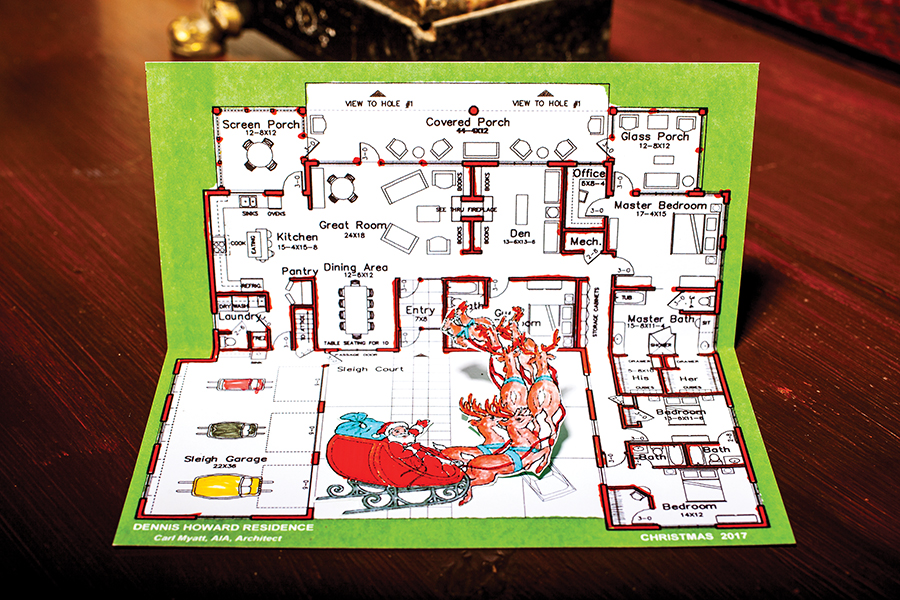
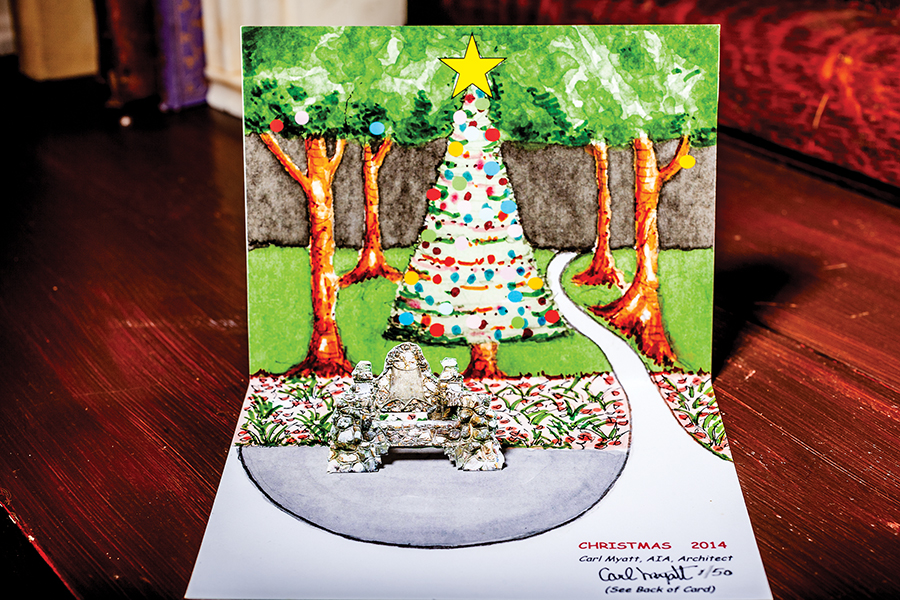
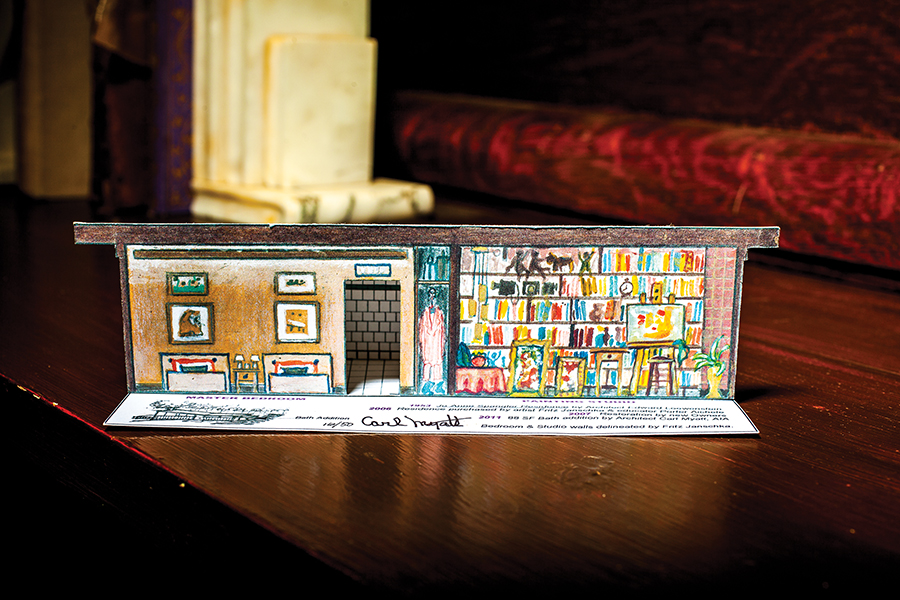
“The ritual is, I drop everything and open up this little toy miniature,” she says. “I don’t get very far. Honestly, I don’t think I even sit down. I just go to the sideboard and have at it.” Myatt’s pop-up greetings — renderings of buildings that he has designed — require some assembly.

Spatially challenged? He includes step-by-step instructions.

Pitch, fold, tuck, and behold: An enchanting blend of merriment and marketing.

“These little contraptions contain an oversized spirit,” says Levy. “They bring such joy.”

Levy understands the emotional power of structures; her father was the late Greensboro Modernist architect Ed Loewenstein, whose sleek residential and commercial designs elicit smiles to this day.

Myatt and Lowenstein never worked together, but Myatt has done projects for friends of Levy, and she admires his deft touch. She keeps his cards and displays them in the foyer of her home every holiday season. She doesn’t celebrate Christmas, but she delights in Myatt’s labor of love.

“I think it’s a joyful way for him to express himself to everyone,” she says.

Her visitors agree. They love to pick up and study the card-stock creations. Like dollhouses, some of the models contain interior rooms that coax viewers to peek through openings.

“They invite participation,” Levy says.

Myatt, who grew up celebrating Christmas in the Baptist church in Houston, Mississippi, started his card tradition with more “hum” than “ho.”

He sent a store-bought card in 1992. Two years later, he issued a Christmas letter of sorts, complete with a list of recent clients. In 1997, he turned out a three-dimensional arch covered with drawings of his recent projects. He saw it as a way to honor his clients — and to advertise to prospective customers.

From then on, his stand-up salutations were standard. They leaned on Myatt’s ability to make three-dimensional models, a specialty of architects.

“We do it all the time, so why not?” he says.

Every year, he mulls which of his projects can be shrunken, flattened to fit into an envelope and reconstituted by non-architects.

Occasionally, he opts for a simple trifold card that stands on edge.

But several of his cards require spatial skills to build.

To make them easier, Myatt — who works in the top-floor studio of a Fisher Park home he designed — spends untold hours drawing, cutting and folding prototypes. His color printer guzzles ink during trial runs. His models require no glue or staples, though he once enclosed two straight pins to secure a roof.

He sweats the choice of envelopes and stamps, too. He addresses each envelope — more than 200 last year — by hand.

“It’s like a project,” says Myatt. “When it’s finished, everybody says that looks simple, but it’s not simple.”

The reward, he says, is imagining his friends and clients opening and building his glad tidings.

“I can see their smiles,” he says, as a sympathetic grin lights up his face. “Architects are visualizers.”  OH