The Omnivorous Reader

A Masterpiece that Matters

To Kill a Mockingbird continues to resonate

By D.G. Martin

Last October, on the final episode of PBS’s The Great American Read, Harper Lee’s 1960 Southern classic To Kill a Mockingbird was named “America’s Best Loved Novel.”

From a list of 100 candidates and a total of 4 million votes cast over several months, Mockingbird was a clear winner, receiving 242,275 votes.

What explains the popularity of Mockingbird and its staying power more than a half century after its publication?

The host and leader of the The Great American Read, Meredith Vieira, said she was not surprised with the result. “Mockingbird,” she said, “is a personal favorite of mine — one that truly opened my eyes to a world outside of my own. Harper Lee’s iconic work of literature is cherished for its resonance, its life lessons and its impact on one’s own moral compass.”

Vieira told USA Today that she would have picked Mockingbird if it had been solely up to her. “I read it when I was 12. Of course it holds up; it’s a brilliant novel, and all of the lessons I learned then resonate deeply now. I think the reason I picked it is because I read it at a pivotal time in my life. I was a young kid growing up in Rhode Island and I didn’t know anything, really, about bigotry or racism, and that book pointed it out in the voice of a little girl, which appealed to me. And her dad (Atticus Finch), his ability to fight the good fight and step into other people’s skin. When you’re trying to determine your moral code moving forward, in that time in your life, your parents are influential, teachers are as well, but books are, too. And that book said to me, ‘You can do the right thing, or you can do the wrong thing.’”

For me, the book’s lasting success comes from its poignant story of Jean Louise, or Scout, whose love and respect for her father, Atticus, and his example gave her the courage to face the dangers and unfairness of a flawed world. It is also Atticus himself, the small town lawyer in the Jim Crow South of the 1930s, with his example of dignity, kindness and courage.

But it is much more complicated according to a new book, Why To Kill a Mockingbird Matters: What Harper Lee’s Book and the Iconic American Film Mean to Us Today, by Tom Santopietro.

That staying power is remarkable, according to Santopietro, because in “the nearly sixty years since Mockingbird was originally published, the world has changed much more than the previous three hundred years combined.”

Santopietro gives us a biography of the Mockingbird phenomenon. He takes us to Harper Lee’s hometown, Monroeville, Alabama, and introduces us to the friends, family and neighbors who were models for the characters of her book, to her gentle home life, and the town’s oppressive segregated social system.

In Mockingbird, Monroeville becomes the fictional town of Maycomb. Harper Lee as a child is the basis for the central character, the tomboy nicknamed Scout. Lee’s father, A.C. Lee, is the model for Atticus Fitch. Her childhood friend, Truman Capote, becomes Scout’s good friend, the irrepressible Dill. Her family’s troubled neighbor, Sonny Boulware, is the inspiration for the mysterious, frightening and, ultimately, heroic Boo Radley.

Santopietro explains how Mockingbird was first written and then rewritten. Lee’s early drafts focused on Jean Louise as a grown-up. The revisions eliminated the adult woman from the book and only told Scout’s childhood story.

When the revised work was sold to a publisher, it took the country by storm and won the Pulitzer Prize.

Then came the movie staring Gregory Peck as Atticus. Santopietro devotes twice as many chapters to his account of the production of the movie as he does for the making of the book.

On UNC-TV’s North Carolina Bookwatch recently, Santopietro explained how Peck’s star power enhanced the role of Atticus. “Peck was also a smart Hollywood star, and he thought, ‘I’m producing the film, I’m starring in the film, there’s gonna be a big courtroom scene in there.’ He was protecting his territory.”

In that powerful courtroom scene, Atticus defends the black defendant, Tom Robinson, who is accused of the rape of a white woman. Atticus demonstrates Robinson’s innocence, but the all-white, all-male jury convicts him nevertheless.

Mockingbird’s powerful message of racial injustice and oppression was clear, in the book and the film. Certainly, race is an important factor in the book’s continuing importance.

But Santopietro believes that something else explains why the book “still speaks to such a wide range of people.”

On Bookwatch, he explained, “What the book to me is about that’s so extraordinary — and I tried to write about this — it’s about what I call the ‘other,’ the concept of anybody who does not feel like they fit in. Every one of us in this room, every human being at some point, feels like the ‘other.’ You talk differently, you walk differently, you act differently, and that’s the journey through adolescence, which is universal. We all have felt that way sometimes. And, what Harper Lee is saying is that when we’re children, we think of the world as black and white, all good, all bad, but it’s so many different shades of gray. That’s our journey through adolescence, and she makes us realize that the people we fear, the monsters in our life, in fact can be our saviors. So, there are two people who fit the construct of the ‘other’ in Mockingbird. One is Tom Robinson, the African-American man unjustly accused of raping a white woman, and the other is Boo Radley. So, Scout and Jem think of Boo Radley as this monster in that dark house and, in fact, he’s their savior at the end, and I think that universal journey through adolescence — as we all learn those lessons — that to me is why the book still matters.”

In 2015, shortly before her death, the publication of Harper Lee’s Go Set a Watchman gave us a different and disturbing look at Atticus in the 1950s, set 20 years after the events in Mockingbird.

On a visit home, Jean Louise sees Atticus leading a meeting of the local White Citizens’ Council, one of many established throughout the South in the wake of the Brown v. Board of Education decision to resist the Supreme Court’s and the NAACP’s efforts to destroy “the Southern Way of Life.”

Confronting Atticus, she says the Citizens’ Council contradicts everything he had taught her. Do we now, like Jean Louise, have to push Atticus Finch out of our pantheon of heroic images?

Even though he is on the wrong side of history, Atticus’ core human values win out as they lead Jean Louise to confront him and to make him proud of her for doing so.

Many of our parents and grandparents who lived in Atticus’ times, like him, would never fully accept the changes the civil rights revolution brought to our region. But the core values of human kindness and respect for all people that they taught prepared their children to welcome and even work for those changes.

And for that, they and Atticus are for me, although imperfect, still heroes.  OH

D.G. Martin hosts North Carolina Bookwatch, which premiers Tuesdays at 8 p.m. on the North Carolina Channel and airs on UNC-TV Sundays at 11 a.m. and Thursdays at 5 p.m.

True South

Holiday Fantasies

Get on board or get out of the way

By Susan S. Kelly

My mother was having a Christmas cull one year and asked if I wanted the toilet lid cover. As one does.

This piece of church bazaar finery was my first claim as a child when the box of decorations came out every Christmas: a forest green, glitter-glued felt oval adorned with a ho-ho-hoing Santa face of pink, white and red felt with sequin eyes, a tufted cotton beard, and a clever drawstring to tighten the cover just so around the commode lid. I thought it was divine. I have it still, the outlined shapes of eyebrows becoming visible as it disintegrates, revealing the crafts-by-numbers kit it originally was. In the attic, Santa’s slowly getting de-flocked and de-felted somewhere under the Advent wreath candles that became a waxy purple unicandle during the 100-degree days of August.

The good news about Christmas, besides the obvious Good News, is that tastemakers and arbiters of Tacky are banished, or at the very least, muffled. That’s the bad news as well. Everyone is permitted his or her holiday indulgences and eccentricities. Last year my neighbor had an egg-shaped wreath on her door, and I have no idea whether it was accidental or intentional.

Flannery O’Connor famously said of William Faulkner, “Nobody wants his mule and wagon stalled on the same track the Dixie Limited is roaring down.” This sentiment applies to Christmas as well. Either get with it, or get mowed over by it. But we can agree on this sentiment: Without women, there would be no Christmas as we know it. Females are out there in the trenches, responsible for every holiday fantasy promulgated in mags and ads — caroling, cookies, gingerbread houses, the works. “I see more of the Salvation Army ringers than I do my husband,” a friend once remarked to me. Another friend drew the line in the sand, er, carpet. “I shopped, wrapped, mailed, decorated, planned, cooked, cleaned and organized,” she told her husband and two sons. “You guys have to take down the tree.” They took down the tree all right. They took it down at Easter. Another friend buys herself an additional piece of her Christmas china every time her ex-husband mentions his new wife’s name in her presence.  I suspect she’s on finger bowls by now.

As for that gingerbread house fantasy, here’s what I have to say about doing that with your children: Go for the pre-fab kits. I actually made gingerbread from scratch, spread it thinly on parchment-paper-lined baking trays, then cut it into wall shapes. Like many activities, it was cuter in the planning than the execution, never mind unappreciated. I’m still digging peppermint candy slivers out of the kitchen heating vents. Instead, keep an illustrated Hansel and Gretel book, complete with candy-covered fantasy gingerbread house, on the coffee table along with ’Twas the Night Before Christmas. Point out what really happens to bad little boys and girls, not getting switches in stockings.

I don’t understand the Fairness Doctrine of today, when couples routinely alternate Christmas between families. I get Christmas Eve, you get Christmas morning, they get Christmas Day dinner . . . logistics alone are on a par with the Normandy invasion, not to mention the emotions, prompting my next-door neighbor to wryly refer to the comings, goings and schedules as “the prisoner exchange.” To counter this trend, I had a third child after two boys — fully aware that the baby would likely be another boy — just to increase the odds that someone, someone, would come home to me at Christmas. Still, the in-laws have a powerful draw, in part because my sister-in-law concocts eggnog with five kinds of liquor, which she totes around during the holidays in a wheeled cooler. I don’t mean that the cooler holds containers of eggnog. I mean that the cooler actually holds the eggnog itself, sloshing around. Open the lid, and enticing clumps of a substance I’m afraid to ask about — Ice cream? Whipped cream? Egg whites? Butter? — float whitely on the surface. Five kinds of liquor soften, not to mention blur, the blow of absent family. And it was my mother-in-law who taught me the value of smilax at Christmas. I wrap the supple stems all through my (so-called) chandelier, and suspend papier-mâché angels from that green and leafy heaven. Ivy will not do that for you. I’ve also nurtured two smilax shrubs for years, for no other reason than to use their bright berries at Christmas, and have concluded I have two males or gender-neutral plants. Whatever their sexual preferences, they aren’t producing and I’m still using fake red berries.

Still, if I haven’t been able to fulfill every Christmas fantasy, I’ve managed to produce a few of the Christmas food fantasies out there. Clove-studded oranges: Check. Apples dipped in egg whites, then coated with granulated sugar so they appear to glisten: Check. On my friend Ginny’s birthdays, her mother would hand her some cash and say, “Run uptown and buy yourself a bathing suit for your birthday.” It’s not surprising, then, that Ginny’s ongoing fantasy for her own daughter was that she’d dash downstairs on Christmas morning, see wall-to-wall presents, and fall over in a dead faint at Santa’s largesse. If this is your fantasy, point your compass toward the North Pole of IKEA. Last I checked, a cloth tepee that covers 10 square feet of living room space was $5.99. Same for the fabric playhouse you drape over a card table. Never mind their two-hour shelf life; they come in desert browns and beiges, and jungle browns and greens. Because nothing says Christmas like camo.  OH

Susan Kelly is a blithe spirit, author of several novels, and proud grandmother.

Folly Jolly

Folly Jolly

At Körner’s Folly, nothing succeeds like excess

By Nancy Oakley
Photographs by Amy Freeman

At first glance Körner’s Folly appears to be the stuff of that old saw, “a riddle wrapped in a mystery inside an enigma.” But look closer, and you’ll discover it’s an extension of the man who built it, Jule Körner. Perched right on Main Street in downtown Kernersville, (the town having been named for Jule’s grandfather, Joseph Körner), the imposing Victorian brick house with the steep gabled roof is a product of Jule’s restless ingenuity and marketing savvy. Not to mention his “tongue-in-cheek” sense of humor, says Dale Pennington, executive director of the site, listed on the National Register of Historic Places. “There was method to his madness,” she says. Both of which were apparent in Jule’s early career.

After studying art in Philadelphia, he enjoyed a stint in advertising for the Bull Durham Tobacco Company, where, under the pseudonym Reuben Rink, he created a stir by painting advertisements on the sides of buildings and barns. According to The Reuben Rink Company, a marketing and ad agency in Winston-Salem named for the original “Reuben” and headed by Jule’s great-great-grandson J.G. Wolfe, Jule would paint the tobacco company’s bovine mascot as “anatomically correct” and then, in anonymous letters to local newspapers, express faux outrage at the so-called offending images. As intended, the letters succeeded in drawing crowds to the outdoor billboards — increasing public awareness of the Bull Durham brand. Just as surreptitiously, the mysterious “Reuben Rink” would then repaint the billboards, camouflaging the bulls’ extremities, often with strategically placed fences. But the puckish Jule didn’t stop there: He claimed to have painted similar billboards on the sides of the Great Pyramids and Mount Kilmnajaro, “which isn’t true,” Pennington affirms.

When he switched careers to interior design, the huckster in Jule again anticipated the notion, “build it and they will come.” So, in 1880 he constructed the gabled house on Main Street, which would double as his residence and a showroom, or living catalogue, for clients who were enjoying middle-class prosperity of the Industrial Age.

Where to begin?

The front porch is as good a place as any, with its intricate, hand-laid tile and “Witches Corner,” a small nook containing a cast-iron pot where visitors have cast pennies. “It’s a nod to Halloween, a European tradition,” Pennington explains. “If you deposit coins into the witches’ pot, it will keep evil spirits and witches out of the house.”

Not that a talisman is needed here. Any evil spirit that dares enter this wonderfully weird dwelling would be too confounded to stick around. For once inside, the senses are assaulted with an onslaught of high-Victorian flourishes, such as layer upon layer of molding in various patterns, heavy dark cabinetry with barley twist accents, a fireplace framed with ornate colored tiles, an intricately carved mantel, and a painted ceiling — and all of this in just the front entry hall that originally served as a carriageway. “A horse and buggy could pull in right off Main Street into the center of the house. And then stables were attached to the left, and to the right, rooms,” Pennington says.

An expression of Jule’s quirkiness, yes. But also an example of his efficient use of space, and again, his marketing genius. Those fireplace tiles, for example, came from Zanesville, Ohio. The moldings in the house are, to use Pennington’s word, “a hodge-podge,” of locally crafted work and newer materials of the period, such as Bakelite, all easily transported to Kernersville by rail.

In 1890, four years after Jule’s bride, Polly Alice, entered the picture, the first of several remodels began that would expand the structure’s 15 rooms to 22, all in varying dimensions. Among the modifications? That indoor carriageway and stable were moved across the street. The adjacent front parlor became the master bedroom (unheard of in the day), the stable and hayloft were closed in to accommodate a guest bedroom, the tack room became the library. To accommodate the Körner children, son Gilmer and daughter Doré, a playroom with the ceiling height of 5 1/2 feet was installed directly above the carriageway-turned-foyer. Polly Alice could not only hear the pitter-patter of her children’s feet, she could keep an eye on them, too — through the playroom’s floor-to-ceiling pivot windows. Though certainly a potential hazard to children who could easily have fallen through them (these were kids whose pet of choice was a raccoon named Bob, after all), the windows also helped air flow through the house.

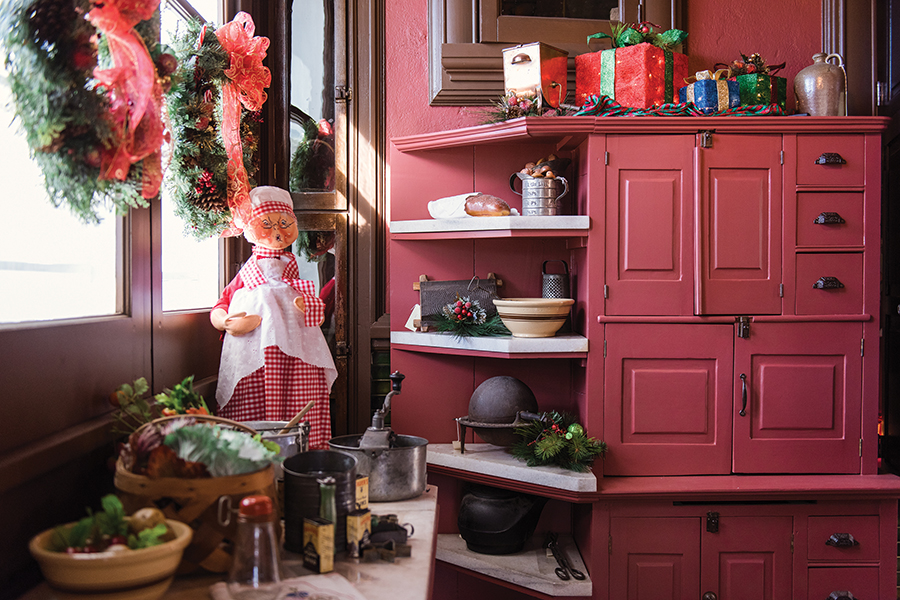
Other touches reflect Jule’s ingenuity, such as the sunny breakfast room, containing “one of the first skylights in a private home in America,” says Pennington — and one of the defining features for the house’s National Register status. She also points to an icebox, an alcove built into 14-inch thick walls of the main kitchen, and shelving outside one of its windows and covered with a screen that served as a pie-safe. Jule, she says, “considered this kitchen to be one of the most modern of its time because it was very efficient, in his opinion. No wasted space, all these custom built-ins.” And he was ahead of his time in other ways, for some of the finishes — painted cabinetry and subway tiles, for example, are de rigueur today.

Jule also cut trap doors in the floor and covered them with grates to let cool air flow from the basement in the summertime. To the smoking room he added small doors so as to seal off the space in the event of fire (and positioned the room with easy access to the water pump outside). Speaking of fires, the house had no shortage of heat, with some 15 fireplaces — remarkable, considering there are only six chimneys. “There’s an intricate flue system in the house,” Pennington explains, pointing to an archway over the master suite concealing a flue that connects a downstairs fireplace to another upstairs. “So it’s using the aesthetic to hide the pragmatic,” she observes.

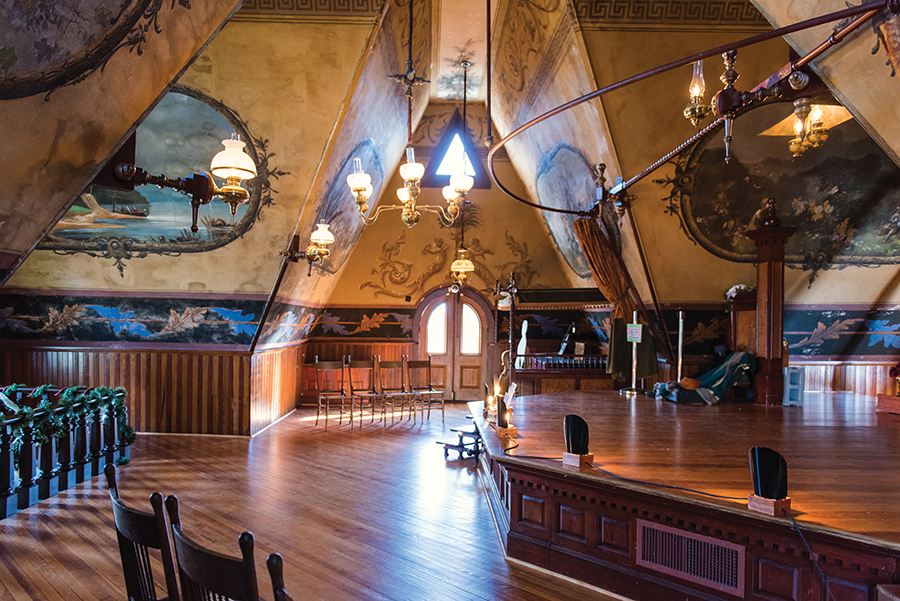
With Jule’s penchant for the theatrical, it’s not surprising that he converted the billiard room to a theater on the very top floor of the Folly (a moniker bestowed upon the place by his puzzled neighbors, one which the former ad man fully embraced). “There’s no attic. It’s the roofline. This is what it looks like in reverse,” says Pennington of the angled ceiling resembling the folds of an origami sculpture. Painted on them are murals of cupids; hence the venue’s name, the Cupid Park Theatre that opened in 1897 for stage and musical productions. “Polly Alice felt that her children had such unparalleled access, to travel, theater, vocational resources,” explains Pennington. Access that she extended to her children’s friends and other local youngsters in the formation of a youth theater group, believed to be one of the first private little theaters in the country. A crack seamstress, Polly Alice designed and sewed the costumes for the plays and taught music lessons alongside a Greensboro music professor, Charles Brock, while Jule, who fashioned an unusual circular curtain rod over the stage, built the sets. “I just imagine it being a wonderful time at the Folly,” Pennington muses. And it still is: To this day, the Cupid Park Theatre hosts community plays and revues, along with puppet shows, a staple of the Christmas season.

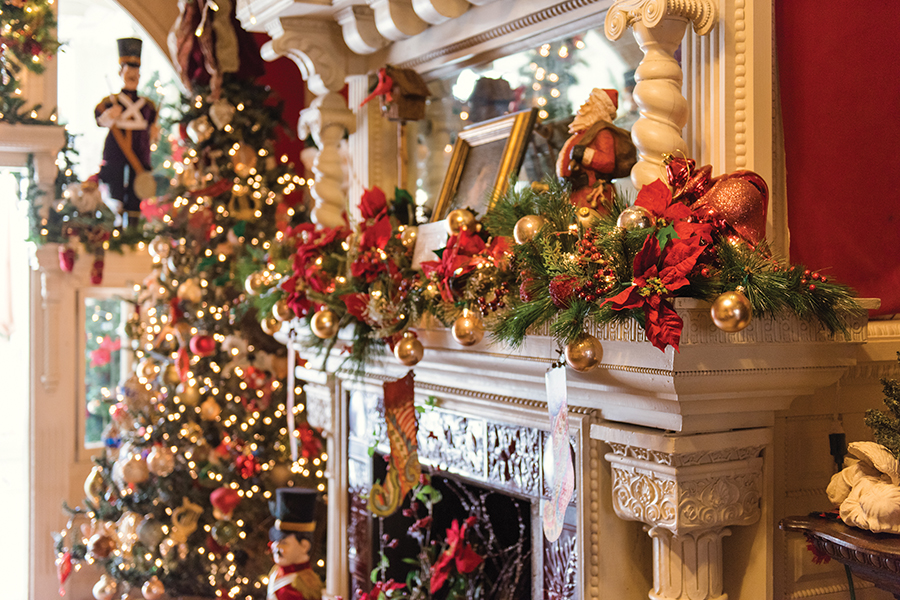
At Yuletide, Körner’s Folly quite literally shines. “If the house is over-the-top now,” says Pennington, “at Christmas it’s to the nines.” In late October local volunteer groups, each of which has “adopted” the Folly’s 22 rooms, start decking the halls, a process that continues through Thanksgiving, just in time for holiday tours. These, says Pennington, began about 15 years ago, but ramped up in the last decade. In the last five years, candlelight tours and additional puppet shows were thrown into the mix.

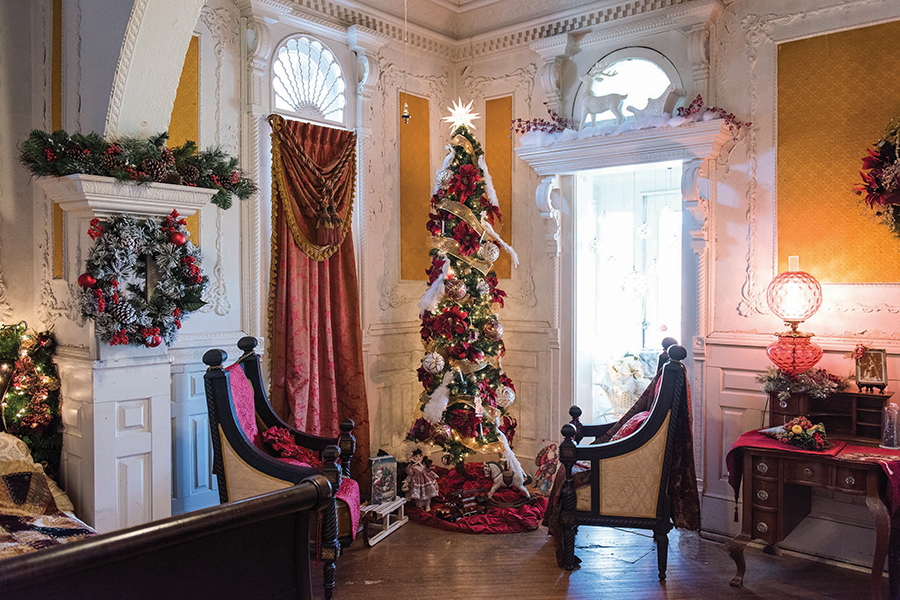
The decorations must be period appropriate. After all, the Victorian era, again because of mass production and middle class expansion, not to mention that other icon of the day, Charles Dickens’ A Christmas Carol, gave rise to many of our modern holiday traditions: Christmas cards, ornaments, ham and turkey dinners, eggnog, and of course, Christmas trees and garlands. Decorators have leeway to interpret a yearly Victorian theme. Last year’s was “Victorian Christmas Traditions,” this year’s, “A Körner Family Christmas.” Pennington says the Folly staff encourages the use of Moravian decorations, including the distinctive Moravian stars, in keeping with the family’s heritage. But they do make a couple of concessions to modernity and safety: Given the age of the house, greenery must be artificial (though of such high quality as to look real); and no actual burning candles are allowed so as to prevent the house from going up in a blaze as it could easily have done in the Körners’ day when son Gilmer slept under the Christmas tree with a bucket of water handy.

“We put the 12-foot tree in this room,” says Pennington, referring to the pièce de résistance of Jule’s vision: the grand reception room, with carved archways, ornate figures flanking fireplace mantels and seemingly in defiance of Victorian propriety, remote, curtained off corners, “where couples could steal a kiss at his parties,” Pennington explains.

The seasonal pageantry is a crowd-pleaser, drawing an estimated 3,000 visitors among an annual total of about 10,000, but the holiday tours serve a larger purpose: to help raise money for the ongoing restoration of the house that began in earnest in 2012. “In a lot of ways the restoration work we’re doing now is carrying out their vision,” says Pennington of the 26 local families who bought Körner’s Folly in 1970.

At the time, the house sat vacant, the Körner children long since having grown up and dispersed. Following Jule’s death in 1924, with the Great Depression and two World Wars, upkeep had become impossible. Taking smaller family heirlooms (the large Victorian furnishings, such as the foyer’s massive cabinets, being too large to disassemble and move), the family boarded up the house, which fell prey to vandals and looters. It became a haunt of local teenagers, some of whom carved their initials in one of the upstairs hallways. Even after the property’s purchase and placement on the National Register, it was manned solely by volunteers for 30 years.

Now, with a professional staff, three phases of restoration have been completed — the porch, the foundation, the roof and chimneys. The fourth phase, the Folly’s interiors, started in 2015 with daughter Doré’s bedroom, aka the Rose Room, a confection of soaring pink walls and floral trim. Gilmer’s room, it turns out, was a bright, robin’s egg blue, thanks to an architect’s color analysis. “With the technology today, they’re finding the colors are so much more vibrant than we used to think they were,” Pennington notes. They are also discovering Jule’s constant tweaking of the house’s interiors. “He was never satisfied,” says Pennington. Even up until his death, he had drawn plans for another renovation.

The house is still a work in progress, painstakingly refreshed room by room. The Cupid’s Park Theatre was upfitted last year, its 120th anniversary, and next up is the ground-floor master bedroom, but not until January. Meantime, Christmas comes again to Körner’s Folly, every day as festive as Fezziwig’s ball in Dickens’ classic opus. And surely that jolly old elf with the sly twinkle in his eye — not St. Nick, but Jule Körner — would be pleased that his calculation paid off: He built it, this oddity of oddities, and they are still coming — by the thousands.  OH

Nancy Oakley is the senior editor of O.Henry.

Christmas events at Korner’s Folly continue this month through January 5, 2019. For more info visit kornersfolly.org.

Separate and Equal

Though known as a creative visionary with an irreverent sense of humor, there is another side to Jule Körner, evident in the cottage that stands behind Körner’s Folly, containing the site’s gift shop and administrative offices. Known as Aunt Dealy’s Cottage, it was the residence of Clara Körner, nursemaid and surrogate mother to Jule Körner, whose biological mother died when he was 2 years old. As a slave owned by a family in Salem, just down the road, Clara had been hired by the Körners to care for Jule and his siblings (who gave her the nickname “Dealy,” a variation of “Dearie”); the family later bought her freedom, but she chose to remain with them, drawing income from rental property in Winston that Jule’s father, Philip, had bequeathed to her.

So revered was Aunt Dealy that every year, on the anniversary of Abraham Lincoln’s death, Jule Körner would hang black swags across the Folly’s windows and porches. “It was unusual for this area, says Dale Pennington, the Folly’s executive director. “To me, it speaks to someone who didn’t much care what people thought.” And when Clara herself died in 1896, a funeral, officiated by a black pastor was held on the Folly’s north lawn, drawing an integrated crowd. Refused burial in the whites-only cemetery in the Moravian church across Main Street, Clara’s body was interred in the Körner family plot — a standalone piece of property bordering the church graveyard that Jule purchased — separate in death from the rest of the Moravian congregation, but equal among Körners. -N.O.

In the Spirit

Beer on Whiskey

Not so risky. And sometimes surprisingly delicious

By Tony Cross

In holidays past, I would have a moment of clarity when visiting my loved ones. It would come on suddenly, and always within 12 hours of arriving. Like clockwork. “I’ve got to get out of here and get a drink.” The members of my family are not big drinkers. I would have a beverage or two around them, but I always craved my escape drink. It’s not because my folks are hard to be around — they’re amazing. It’s because this time of year stresses me out and I turn into Mr. McJerkface after a few hours of sitting around.

Mom and Pops live near me now, but for almost a decade they didn’t. There were no close bars that could whip up a decent drink, so off to the dive bars I went. One of my favorite things to order was a beer with a whiskey back. It did the trick every time. So, for this month’s column, I teamed up with Jason Dickinson, a certified Cicerone — think sommelier for beer or, as I like to call him, “beer nerd.” We had fun pairing up a few different styles of beer with spirits. And by we I mean that I texted him the three spirits I was bringing, and he used his expertise to bring a few pairing suggestions for each. Use these pairings anytime of the year, of course, but give these a shot when you’re out of town and are drawing a blank when you run away from your family.

Sour/Blanco Tequila

For our pairing, Jason brought Dogfish Head’s Sea Quench Ale Session Sour, and I provided El Jimador. Right off the bat, I sensed this would work. I spied a picture of a lime wheel on the can, and immediately saw the word “salt” in the description. That’s a margarita all day. “I chose this because of its year-round production,” Jason said. “It’s one of the few sours that we’re going to see on draft in more places pretty soon.” The first sip was all we needed. Tart and salty. Perfect with a blanco tequila — just make sure the label has “100 percent Agave” on it. If it doesn’t, I don’t think any beer will save you. If the spot you’re frequenting doesn’t have any sour-style beers, grab a Mexican lager. As I’ve mentioned before, a can of Modelo and tequila have been good pals of mine during the summer. However, I wouldn’t discriminate against them in winter.

Milk Stout/Spiced Rum

We combined a Nitro Merlin Milk Stout with Gosling’s Black Seal Rum, and it went together quite nicely. The Merlin is light, creamy and smooth. The Nitro comes from the beer having more nitrogen gas than carbon dioxide (like most traditional beer). This also gives the beer a touch of sweetness. I picked Gosling’s because there’s more likelihood of finding it behind a bar than other rums that I would drink straight (e.g., Smith & Cross, or rhum agricole). With that said, I never drink Gosling’s on its own. The distillery owns the trademark for “Dark ‘N’ Stormy,” so there’s that. But never on its own. But boy, oh boy, these two are yummy together. The sweetness of the rum and spice complement the chocolaty creaminess of the Merlin. I would pour my shot into the beer next time. Again, the chances of your finding the Merlin at a dive bar might be slim, so if you don’t see it anywhere, grab a Guinness. “A Guinness has a dry and roasty flavor profile, so adding the sweetness of the Gosling’s will bring a nice counterbalance,” Jason says. If they don’t have a Guinness, walk out.

Porter/Whiskey

“If someone asks what an American porter is, this is it to a T,” says Jason. “This is the beer a lot of people point to as the classic one in this category. There are a couple of producers that do one — Sierra Nevada makes a good porter. But Deschutes Black Butte Porter is generally thought of as THE porter for American style. They’re usually low ABV too.” That’s news to me. And if you’re as ignorant about porters as I am, keep reading. “Because bourbon and rye have been really popular over the past decade, the breweries rest their porters in bourbon and rye barrels. So, for me, this is a no-brainer.” This is one of the reasons I like Jason. Out of the park. One gulp of the Black Butte followed by a swig of Maker’s Mark (again, pretty much a trademark whiskey in myriad bars) pulls Jason’s theory together. The porter was dry on the end and having whiskey in between sips lent an oakiness to my palate. We both agreed that this was our favorite of the night. Bourbons tend to be sweeter than rye, but rye has spice. Me likey the spice. So next time, I’m having a porter with rye, that’s a what’s up, for sure.

In the pre-Jason era, when I paired beer and spirits, I’d make up my own boilermaker — by definition a shot of whiskey dropped into a glass filled halfway with beer. It was usually an IPA and a rye whiskey. Why? Because at the time, those were my favorite styles of beer and whiskey to drink on their own. As soon as I arrived at my getaway drink spot, that’s all it took to wash my Scrooge demeanor away. Now, as the saying goes, I got options.  OH

Tony Cross is a bartender who runs cocktail catering company Reverie Cocktails in Southern Pines.

The Return of the Light

A celebration of food and faith at Greensboro’s Temple Emanuel

By Jim Dodson     Photographs by Mark Wagoner

The third verse of the Book of Genesis in the Old Testament, sometimes known as the Hebrew Bible, describes the birth of divine light in a darkened world: “And God said, Let there be light: and there was light. And God saw the light, and it was good; and God divided the light from the darkness.”

This year, the Jewish observance of Hanukkah — a Yiddish word that means “dedication” — begins on Sunday evening, December 10, and ends on Monday, December 18. The beloved winter celebration of Jewish heritage called the “Festival of Lights,” observed by the sharing of traditional foods, the ritual lighting a special menorah and reciting of prayers, along with playing games and offering gifts over eight nights and days, commemorates the restoration of the Second Jerusalem Temple in 167 BCE.

At that time, the Holy Land was ruled by the Hellenistic Seleucid Empire of Syria, which was forcing the people of Israel to accept Syrian Greek culture and spiritual beliefs in place of their own Hebrew God. Against all odds, a small band of faithful Jews, led by a freedom fighter named Judah the Maccabee, defeated one of the mightiest armies on Earth, drove the Syrian Greeks from their land and reclaimed the Holy Temple in Jerusalem, rededicating it to the divine light of God.

When the victors sought to relight the Temple’s menorah (the seven-branched candelabrum) in celebration, they found only a single cruse of olive oil that had escaped contamination by the Syrian occupiers. Miraculously, they lit the menorah with the one-day supply of oil that somehow lasted for eight days until new holy oil could be prepared under conditions of ritual purity. To commemorate this miracle, Jewish sages instituted the festival of Hanukkah.

At the heart of the festival is the nightly lighting of a special menorah called the Hanukkiah, using the shamash (“attendant”) candle to light one candle each night until all nine candles are ablaze. Special prayers accompany the lightings, and blessings and songs of praise are sung after the candles are lit as families exchange “gelt” (everything from jelly beans to coins, often made of chocolate) and gifts large and small. They also play “dreidel” (a game of chance played using a four-sided top) and share special holiday foods cooked in oil to symbolize the endurance of the Jewish people. In observant households, lighted menorahs are placed in windows to bring light to the darkness.

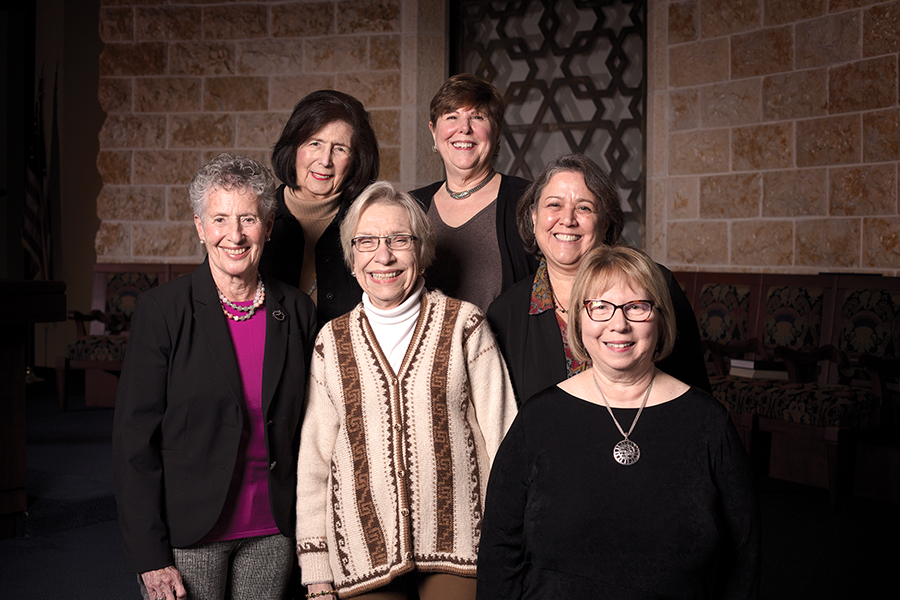
“Hanukkah really is a celebration of the return of the light, maybe not considered a high holy event in the Jewish calendar but a very big deal to families and especially children,” explained Ina Eisenberg one evening not long ago when we dropped by Greensboro’s historic Temple Emanuel to learn about the “Festival of Lights” from half a dozen of the congregation’s longtime members and finest cooks.

“Hanukkah is a celebration of memory and food, a time to light the menorah and say prayers and give small gifts, and certainly eat!” Eisenberg added with her distinctive Memphis-born laugh. “Purim and Passover may be the traditional cook-off holidays in Judaism, but the foods of Hanukkah are simple and fun. That’s part of their charm. They lift the spirit and bring people together. It’s all about sharing love and eating food you probably wouldn’t eat other times of the year. If I don’t make Mrs. Felsenthal’s famous matzo balls and chicken soup, for instance, which my mother got from Mrs. Felsenthal’s daughter decades ago, my husband is completely crushed. Ditto my challah bread.”

Diane Goldstein, who owns a collection of 25 different kinds of menorahs, was prompted to remember the lights of Hanukkah in the apartment building where she grew up in Queens, New York. “Almost everyone in the building was Jewish and there was always a large lighted menorah in the lobby at the holidays — a really beautiful sight on a winter night — lighted menorahs, in fact, in almost every window of the building,” she recalled. “It was to great step into that lighted lobby and smell all sorts of wonderful things being made for Hanukkah — brisket and jelly doughnuts and, best of all, potato latkes!”

Barbara Sohn, who grew up in Greensboro and is known not only for her baking prowess (“That’s my therapy”) and famous brisket recipe, added, “The unifying element in all these foods — of all Hanukkah cooking, in fact — is oil, a symbol of the oil that miraculously lighted the menorah. Everything from cookies to meat must be made with oil.”

“In other words,” quipped Ina Eisenberg, “Hanukkah food is a heart attack on a plate.”

“The old joke says that’s why Jewish men die early,” someone added, prompting a wave of laughter from the gathered cooks.

Amy Thompson, Emanuel’s current president, explained that her annual tradition is to peel and shred 10 pounds of potatoes and soak them in water to prepare for the annual gathering she and husband, Joe, host for friends and family one night during the holiday. “They come for our latkes. Mine is a very traditional recipe and I’ve learned that’s what everyone likes best.” And though some cooks experiment with other main ingredients, such as sweet potatoes or zucchini, Thompson has found there ain’t nothin’ like the real thing. “Nobody in our house liked them as much as my original recipe. Hanukkah is somewhat like Thanksgiving in that regard. There’s a turkey and stuffing that your family really likes. And if you try something new, well, it never works out. You end up going back to the tried and true favorite. That’s our latkes.”

Naomi Marks is a New Yorker who came to Greensboro to attend college after the Second World War, met her late husband, Arnold, and became a founding member of Temple Emanuel. She recalled how she and Arnold loved the family-centered quality of the holiday, teaching their three children, seven grandchildren and three great-grandchildren the traditions of the holiday.

“The first night, my kids always got a nice gift, something they really wanted, followed by smaller gifts the rest of the week — books and puzzles and things like that. They also loved playing the dreidel game. When they got a little older, our kids always brought their friends home for Hanukkah, many of whom weren’t Jewish,” she recalled. “They loved the food and intimacy of our celebration. In some ways it is a nice complement to Christmas — the lights, the food, the sharing of gifts with family. My potato pancakes were very traditional as well. But I always made my own warm applesauce to serve with them. That’s what made mine special.”

“I didn’t grow up with Jewish foods and holidays,” said Midge Pines, Temple Emanuel’s first female president, “because I was actually born into a Catholic family in New York. My mother, however, was Jewish, and when we moved out to Los Angeles I joined the synagogue. The fun part for me was learning the Jewish holidays and traditions along with my three young sons. These days, when you come to my house at the holidays, you’ll get pickled herring and a delicious kugel — which is not specifically a Hanukkah dish but, my goodness, you can’t eat latkes for eight days in a row!”

The lively conversation of Hanukkah fellowship and foods shifted back to an unexpected moment of “darkness.” The delightful cooks of Temple Emanuel agreed that the lights of Hanukkah would perhaps be even more meaningful this year in the aftermath of recent tragic events in Pittsburgh, when a hate-filled gunman attacked the Tree of Life Synagogue, killing 11 members of the congregation during their Saturday morning prayers.

Three days later, a gathering estimated at 2,000 people turned out for an impromptu rally against hate and violence at Temple Emanuel, an overflow crowd that filled the temple sanctuary and adjoining spaces to standing room only and spilled outside to hear reflections from a cross-section of the Gate City’s spiritual leaders. 

“It was a remarkable thing to witness,” said Amy Thompson. “People from every faith tradition in Guilford County showed up seemingly out of nowhere — Buddhists, Hindus, Catholics and Christians of all sorts — to show their support and help us grieve. It was mind-blowing and deeply touching to the Jewish community, sending a wonderful and much needed message of hope and solidarity — that there is always light in the darkness.”

Midge Pines’ Pickled Herring

1 6–8 ounce jar herring fillets in sour cream
1 hard-boiled egg
1/2 to 3/4 tart apple, pared, cored and chopped
1 medium onion, chopped
1/2 small can of red beets, chopped
4 tablespoons sour cream
2 tablespoons white vinegar
1 tablespoon oil
2 tablespoons sugar
Salt and pepper to taste

Chop herring fillets in very small pieces, removing any skin, bones and scales.
Chop egg, apple, onion and beets.
Add all together with sour cream, vinegar, oil, sugar and seasonings. Mix well.
Serve with crackers or cocktail rye.
Keeps for three or four days. Do not freeze.

Barbara Sohn’s Amazing Brisket

1 4–5 pound first cut brisket
1 cup dark brown sugar, lightly packed
1 package Lipton Onion Soup Mix
1 bottle Heinz Chili Sauce
Potatoes and carrots
Heat oven to 350 degrees

Place brisket in deep roasting pan. Combine sugar, soup mix and chili sauce; spoon over meat and cover pan. Cook for 2 1/2  hours, remove and cool for one hour.
Slice meat against grain, cover and cook brisket for another 2 hours, or until brisket is tender.
Add quartered red bliss or Yukon Gold potatoes (unpeeled) plus a small bag of baby carrots and cover with sauce, for the last hour.

Midge’s Kugel

12 ounces noodles
1 cup cottage cheese
1 cup sour cream
3 eggs, beaten
1 stick butter, softened
Salt and pepper to taste.

Cook and drain noodles according to package directions. While still hot, add the other ingredients and stir well. Pour mixture in greased casserole and bake in preheated 350-degree oven 35 to 40 minutes.
For variety (and to make it sweet), you can add 1/2 cup sugar, 1/4 teaspoon cinnamon and a handful of raisins,
To make it savory, add only 1/2 stick of butter. Then sautée one medium chopped onion, 1/2 cup chopped mushrooms and 1/4 cup chopped celery  When veggies are browned, add to noodle mixture and bake as above.
Pour mixture in greased casserole and bake in preheated 350-degree oven 35 to 40 minutes.

Can be frozen — defrost completely before warming in a 350-degree oven 10 minutes.

Mrs. Felsenthal’s Famous Matzo Balls

1 cup water
1 stick butter
1 cup matzo meal
Parsley, sugar, salt, paprika, ginger, nutmeg and grated onions to taste
3 eggs, separated

In a medium sauce pan combine water and butter. Heat until butter dissolves. Add matzo meal and stir until water is absorbed. Season to taste with parsley, sugar, salt, paprika, ginger, nutmeg and grated onions. Mix well.
Beat egg yolks until lemony and add to matzo mixture. In a clean bowl, with clean beater, beat egg whites until stiff; fold into matzo mixture. Chill well in covered container for at least 4 hours
To make the matzo balls, dip fingers in warm water and roll chilled mixture into balls.
If you wish to freeze, place on a cookie sheet and freeze. The frozen balls can be placed in a plastic bag until you need them. When ready to use them, drop them in boiling chicken broth and cook for 30 minutes on medium heat.
Add to your favorite soup! Yield: 27 medium/small matzo balls

Simple Chicken Soup

3 chicken breasts
4 carrots, halved
4 stalks celery, halved
1 large onion, halved
Water to cover
Salt and pepper to taste
1 teaspoon chicken bouillon granules (optional)

Put the chicken, carrots, celery and onion in a large stock pot and cover with cold water. Heat and simmer, uncovered, until the chicken meat falls off of the bones (skim off foam every so often).
Take everything out of the pot. Strain the broth. Pick the meat off the bones and chop the carrots, celery and onion. Season the broth with salt, pepper and chicken bouillon to taste, if desired. Return the chicken, carrots, celery and onion to the pot, stir together, and serve. 

Naomi Marks’ Easy Potato Latkes

2 cups raw grated potatoes
1/2 cup grated onion
Pinch of baking powder
1 1/2 teaspoons salt
1 tablespoon of flour or matzo meal
2 Eggs

Peel potatoes and soak in cold water for several hours, then grate and drain.
Beat eggs well and mix with other ingredients, add a little pepper if desired.
Drop spoonfuls on hot greased skillet and cook until golden brown, both sides.
Keep warm in oven until ready to serve with warm applesauce

Easy 10-minute Applesauce

3 Golden Delicious apples, peeled, cored and quartered
3 Fuji apples peeled, cored and quartered
1 cup apple juice
2 tablespoons cognac or brandy (optional)
2 tablespoons butter
3 tablespoons honey
½ 1 teaspoon cinnamon

Combine apples and all other ingredients in microwave-safe container. Microwave uncovered for 10 minutes.
Use blender or potato masher to blend to desired consistency.
Serve warm or chill for later use.

Amy Thompson’s Mandelbrot
(A sweet bread similar to biscotti)

3 eggs
1 cup sugar
1/3 cup vegetable oil
1 teaspoon vanilla
2 3/4 cups flour
2 teaspoons baking powder
1/2 teaspoon cinnamon
1/4  teaspoon salt
1/2  cup walnuts

Optional: chocolate chips, dried cranberries.
Beat the eggs and sugar until light and fluffy. Add the oil and vanilla and mix thoroughly.
Sift the flour, baking powder, salt and cinnamon together and add to the sugar mixture. Mix until blended, adding the nuts as the dough starts to come together.
Briefly knead the dough on a floured surface. Divide into 2 pieces and shape each into a log about 3 inches wide. (Add chocolate or cranberries at this point.)
Place logs on greased cookie sheet.
Bake at 350 degrees for 30–35 minutes, until golden.
Remove from oven and let stand until cool enough to handle. Slice logs diagonally into 1/2-inch slices. Lay them on the cookie sheet cut side up and return to oven.
Bake on the top shelf for 10 minutes and then on the bottom shelf for 10 minutes until toasted and brown.

Sweet Sufganiyot
(Traditional jelly doughnuts) 

3 cups flour
2 teaspooons baking powder
2 tablespoons sugar
1/2  teaspoon vanilla
1/2  teaspoon nutmeg (optional)
2 eggs
2 cups sour cream
Oil for frying
Jelly (any preferred flavor — black raspberry a favorite)
Powdered sugar

In a bowl, blend together the flour, baking soda, sugar, vanilla, nutmeg, eggs and sour cream.
In a skillet, heat the oil, and when very hot, drop tablespoons of batter into it. When the batter puffs up and turns light brown, turn it over and cook the other side.
Set doughnuts on paper towel to cool.
Make a small hole and fill with jelly. A cooking syringe can make this easy. Sprinkle with powdered sugar and serve immediately.  OH

A Walk on the Wild Side

A Walk on the Wild Side

Behind the scenes at the astounding Greensboro Science Center

By Jim Dodson 

Photographs by John Gessner

A wise man keeps his child’s heart. Or so advised the ancient Chinese sage Mencius.

As I dip a hand in the waters of Hands-On Harbor at the Greensboro Science Center, where five cownose rays are gracefully circulating in their pool, a lovely female ray rises to the surface and allows me to touch her silken back.

For one sweet moment, my child’s heart is back. Schedules and deadlines suddenly fall away.

“Oh, wow,” is about all I can manage.

Both Erica Brown, the Center’s marketing manager, and senior aquarium keeper Karla Jeselson laugh.

“A lot of people have that response,” says Jeselson, explaining how the stingrays are naturally curious about human beings and conditioned to come to an orange ball at feeding time, twice a day, beginning with a full meal before the Center’s official 9 o’clock opening time, followed by an afternoon snack. As a result of such conditioning, the aquarium staff once managed to attach a stylus to the ball that permitted the rays to paint on canvas, images that are now sold in the museum gift shop.

“The little male ray is particularly good at art,” she confides. “We fish people don’t generally give names to our animals but between us, we like to call him Picasso.”

This charming introduction to the natural wonders — and constant surprises — of the Greensboro Science Center serves simply as the prelude to a delightful before-hours walking tour of the museum’s diverse exhibits that include the spectacular Wiseman Aquarium (named after former VF Corp. CEO Eric Wiseman and his wife, Susan), an outstanding Animal Discovery Zoo, not to mention the award-winning Science Museum, which vividly explores everything from dinosaur bones to the starry firmament. The three-in-one destination makes the museum unique in North Carolina and only one of 14 such facilities nationwide to earn accreditation by the Association of Zoos & Aquariums and the American Alliance of Museums.

My purpose in calling on the Science Center this cool morning is pretty simple.

First is to make up for lost time. After I left my hometown in 1977, chasing a journalism career that took me from New England to Africa, I missed the remarkable transformation of what was then called the Nature Science Center into a spectacular showcase of science, technology and the wonders of the natural world.

Paradise in our own backyards, as a close friend and proud member of the Center likes to say.

My only point of reference, in fact, was the Gate City’s original Junior Museum of Greensboro, so dubbed by the local chapter of the Junior League that established it in 1957. It was a decidedly modest affair that featured — if memory serves — a few science exhibits highlighted by a nearby petting zoo with a few woodland creatures kept behind chain link fences and live snakes on display, all set down in the forest of Country Park. I remember live deer, a fox, a few monkeys, an alligator and maybe even a live black bear being the star attractions.

As I confide to Erica Brown during our eye-opening tour of the Center’s 35-acre campus, I can’t believe what I’d missed.

“That’s something we frequently hear from people who’ve lived in Greensboro their whole lives but never checked us out,” she explains with another knowing smile. “When they see what is here, they’re always impressed and usually become regular visitors or members. There’s always something new to see and learn.”

In my case, impressed didn’t quite cover it.

Over the course of a full morning, I see live sea horses, a mama Giant Pacific octopus straight out of Jules Verne and penguins being fed by hand. I meet Tai the red panda and Duke the silvery gibbon, exchange quizzical stares with a family of curious meerkats and watch a maned wolf doing his early-morning calisthenics in a patch of meadow sunlight. I see Drogo the komodo dragon and watch a female lemur named Reese receive her annual physical exam from staff veterinarian Sam Young and his able tech assistant. I also meet Sheldon the barn cat and Sidney the cockatoo, explore “Prehistoric Passages,” and learn interesting things about the human body in Health Quest Gallery.

Had I wisely thought to bring along my trusty knee brace, I might even have tackled Skywild, GSC’s extraordinary aerial adventure park, a roped obstacle course with seven different treetop challenge courses and three levels of difficulty that allow visitors and kids of all ages to get in touch with their animal spirits high over the forest floor.

Suffice it to say, having found the heartbeat of my own inner child again, however briefly, the other purpose of my visit is to hear from the Center’s indefatigable president and CEO, Glenn Dobrogosz, how this diverse and multifunctional wonder ship of science, nature and environmental sustainability came to pass.

Long a destination for local school groups and church field trips, the Center’s dynamic period of growth kicked into overdrive in 2000 when the voters of Greensboro passed a $3.5 million bond to create a new Animal Discovery Zoo, setting the scene for the arrival of a new president and CEO with even more ambitious plans in mind.

Appalachian grad and Raleigh native Dobrogosz arrived in Greensboro in 2004 with a resume that included the impressive revival of several leading zoos and a bold vision of growth that was supported by a board uniquely composed of forward-thinking civic, business and local foundation members, all of them eager to see the Center grow into a genuine destination park.

Animal Discovery Zoo opened to wide acclaim in 2008, doubling annual attendance from 125,00 to more than 250,000. One year later, an expanded planetarium that features 3D and laser projection technology also debuted.

The real watershed moment came in 2009, Dobrogosz says, when he approached the City Council with a long-range vision that included construction of an aquarium and a number of expanded exhibits that would make the Center, as he puts it today, “a one-stop shop for science, technology and environmental education.”

“If you recall that time,” he says, “the Great Recession had hit and Greensboro was still recovering from key economic losses going back further than that. It was, in short, a challenging time for everybody. The city was not your typical destination or tourist city.” He reels off the standard old jokes about Greensboro being “Greens-boring,” and suffering from “Charlotte envy.” But not everyone was laughing. “Then mayor [Yvonne Johnson, Greensboro’s current mayor pro-tem] and the council listened to our plan to create a signature three-in-one model that included North Carolina’s first inland aquarium combined with a zoo and asked how much we needed to make such a vision happen. Quite frankly,” he adds with a laugh, “I was taken by surprise.”

The result was a $20 million bond referendum that not only passed by a wide margin when it was placed before Guilford County voters that autumn, but also attracted a bevy of new corporate and private sponsors that funded the aquarium and enhancements of the Animal Discovery Zoo, setting new attendance records when the Wiseman Aquarium opened in 2013.

“It was really a gift to — and from — the people of Greensboro,” Dobrogosz adds. “But it was really just the beginning of what we hoped to accomplish.” He points out that in a city where tourism was never regarded as a major economic driver, the Center today is the No. 1 most visited attraction in Guilford County — a unique resource for the nearly half a million visitors who flock there every year now. Following an expansion of the aquarium that was completed in 2017, along with a newly reimagined dinosaur gallery, the Center broke attendance records yet again. 

The big news coming out of the Center’s annual “See to Believe” Gala this past October? A capital campaign called “Think Big” that doubled its goal of raising $6 million to fund new educational programs and a major expansion called “Revolution Ridge — Life on the Edge.” Scheduled to open in 2020, it will connect the American Colonists’ fight for freedom among the fields and forests where the Center now stands, with the plight of endangered species across the globe.

The vision includes habitats for endangered pygmy hippos, an okapi forest for rare creatures called “forest giraffes,” a Cassowary Cove (strikingly large and dangerous birds from New Guinea), a Greensboro water garden, a greenhouse complex designed to educate visitors on plants essential to the survival of animal and man, a learning plaza with Chilean pink flamingos, plus a home for endangered cats called Precious Predators.

An expanded animal heath center will provide state-of-the-art medical care serving up to 1,000 wild animals, birds and reptiles. A new multiuse amphitheater, meanwhile, will host concerts, science programs and outdoor events of all kinds.

If everything goes as planned, the good news for Center stalwarts still grieving over the recent passing of the Center’s aging tigers, Axl and Kisa, will be a pair of endangered Malayan tigers in an expanded endangered tiger breeding center. Delighting kids of all ages, the campus will also be home to a world-class old-fashioned carosel funded by the Greensboro Rotary Club.

Finally, the campus’ current buildings will undergo a major architectural makeover that unifies the complex and allows space for public artwork. This year, the Center also acquired the former home of the Greensboro Council of Garden Clubs, scheduled to be transformed into the SAIL Center (Science Advancement through advanced Learning), a facility for educators, and a venue for lectures and seminars.

“It’s very exciting time at the Science Center,” Dobrogosz enthuses. “It’s amazing to think how far we’ve come, with a talented staff of more than 50 — many of whom come from this community — and hundreds of dedicated volunteers and docents who have come to love this place and do inspiring work with our visitors.

“In this respect, we are unlike any other facility in the state,”Dobrogosz contends, crediting his staff, the museum members and sponsors for making the Center a “primary destination” with a bright future.

Indeed, over the course of four hours I learn about monarch butterflies and howler monkeys, watch a 16-foot anaconda get fed her monthly rabbit, make meaningful eye contact with a shy fossa from Madagascar and learn about the conservation of coral reefs. A paradise indeed, as my friend had told me. But there is still so much to see and learn about.

My morning walk on the wild side ends far too soon, downstairs, where I chat with longtime curator of reptiles and invertebrates Rick Bolling about his 40-year career at the Center. He joined the staff in 1977 and will retire a few days after Thanksgiving this year.

“My first job was cleaning the glass of the snake enclosures. I thought that was very exciting work,” he remembers with a laugh. “When I got here very few people seemed to know about this facility. We were a nice little museum that educated schoolkids and gave people a taste of wildlife and science.”

The last 15 years, he says, have been nothing “short of incredible” thanks to Dobrogosz’s infectious “can-do passion.” “Over the years, he has brought much-needed energy and fresh vision to the zoo and museum,” says Bolling. “The education the public gets about conservation and animals and all sorts of science is nothing short of incredible.”

Bolling says that upon retirement he hopes to take a trip out to see Yellowstone National Park “before it burns up.”

Would he miss his daily life at the Center, we naturally wonder.

“Of course I’ll miss it! It’s been my life’s work and I count my blessings that I was a small part of our amazing growth over the years,” he says, gazing into the distance. “Every day here is different, always exciting, always new. This facility is really a big family that includes the animals and the people who support the Center.

“In fact,” he adds with a sly grin, “I’ve told everyone don’t be surprised if I come back to work as a docent. That way, I’ll never have to leave.”  OH

Jim Dodson wrangles writers and editors in the zoo that is O.Henry magazine.

Doodad

The Faces of Revolution

One artist’s mission to democratize portraiture and preserve the past

When painter Suellen McCrary moved her studio to Greensboro’s Revolution Mill two years ago, curious walk-ins included folks who remembered the workspace from another era when the mill turned out flannel from 1898 to 1982.

“They had all kind of stories to tell,” says McCrary, who specializes in portraits. “Some of them said they’d worked there, or their grandparents had worked there.”

To honor that history, McCrary pitched a project to the mill’s current owner, Durham-based Self-Help Ventures Fund, which acquired the complex in 2012.

In return for a monthly stipend, McCrary would spend two years painting oil-on-panel portraits of 25 people connected to the mill, whether they’d worked on machines bolted to the maple floor, handled clerical duties, or lived in the mill village.

At the end of the project, the portraits would join the permanent historical collection at the mill, now a hive of live-work-play development.

The portrait subjects would receive free prints of their likenesses, making possible an otherwise costly keepsake. The price of an original oil portrait can range from $3,000 to six figures.

“I was looking for a way to democratize portraiture,” says McCrary, who solicited subjects on a Facebook page called Cone Mills Villages — My Family’s History.

A dozen former Revolution employees have reached out to her, and she has completed a few portraits, but she wants to round up more applicants.

“I would love to get a cross section,” says McCrary, 60, who grew up in Greensboro and attended Page High School with the children of mill families, though she didn’t personally know them at the time.

Now living in High Point, McCrary hopes to capture the faces and stories of her schoolmates’ families while there’s still time. She recently painted 101-year-old Dorothy Sheppard Davis Brewer, a former mill inspector.

“This is a generation that’s passing, so I’ve got to get moving,” says McCrary. — Maria Johnson OH

Contact Suellen McCrary at smccrary4@gmail.com or (336) 848-3900. She’ll post progress shots of the project on her Instagram account, @suellenmccraryart.

The Omnivorous Reader

Beyond Jaws

The tragedy of the Indianapolis revisited

By Stephen E. Smith

Just when you thought it was safe to go back in the bookstore, there’s a new best-seller about the worst shark attack ever — a book that details the feeding frenzy, past and present, that surrounds the sinking of the heavy cruiser USS Indianapolis on 30 July 1945.

Lynn Vincent and Sara Vladic’s meticulously researched and artfully constructed Indianapolis: The True Story of the Worst Sea Disaster in U.S. Naval History and the Fifty-Year Fight to Exonerate an Innocent Man is the latest in a plethora of books, history specials, movies, documentaries, TV news features, etc. that has, since the cruiser disappeared into the Philippine Sea 73 years ago, contributed to the lore surrounding the demise of the ship and crew that transported the first atomic bomb to the island of Tinian.

If you’re a reader with a basic knowledge of American history, you’re no doubt familiar with the tragic story of the Indianapolis. If you aren’t, anyone who’s seen the movie Jaws will be more than happy to tell you all about it, just as Quint, the shark hunter (played by Robert Shaw), told them: After delivering the components for the bomb, the Indianapolis was cruising at night when the Japanese submarine I-58 fired two torpedoes into the ship, sinking her in 12 minutes. About 300 crew died in the torpedo attack; another 900 went into the water. No lifeboats were launched, no actionable distress signal was transmitted, and the men had only flimsy life preservers and makeshift rafts to keep themselves afloat. Many of the crew died of saltwater consumption, others simply despaired and committed suicide. When the survivors were located almost five days later, only 316 remained to tell the story. Figures vary as to the exact number of the men taken by sharks, but experts theorize that the majority of those attacked had already died of exposure. Still, the horror engendered by a shark attack — the possibility of being eaten alive by a silent, subsurface predator — has resonated through popular culture.

To their credit, the authors aren’t obsessively concerned with sharks, focusing instead on a post-rescue conspiracy surrounding the Indianapolis disaster. In the months immediately following the sinking, the story was eclipsed by news of the surrender that occurred after the dropping of the atomic bombs, but a bureaucratic feeding frenzy began as soon as the survivors were rescued. According to Vincent and Vladic, Navy brass, intent on covering up their incompetence, subjected the ship’s captain, Charles B. McVay III, to a court-martial in which he was convicted of “hazarding his ship by failing to zigzag,” although zigzagging was not required or even recommended in the area in which the Indianapolis was cruising. In an unprecedented move, prosecutors brought in the commander of the I-58, a former enemy combatant, to testify against McVay. The Japanese captain stated emphatically that zigzagging would have made no difference in his attack on the Indianapolis, but McVay was found guilty anyway. He was blamed for the disaster, a reprimand was placed upon his service record, and a deluge of hate mail followed him for the remainder of his life. No other American captain has ever been punished for losing his ship to a torpedo attack. Whether out of guilt for his lost crew or the emotional distress brought on by a failing marriage, the former captain of the Indianapolis committed suicide in 1968.

Vincent and Vladic’s account doesn’t end with McVay’s death. They examine in detail his eventual exoneration. In 1996, a 12-year-old Florida boy, Hunter Scott, took an interest in the story of the Indianapolis and initiated a letterwriting campaign. He was supported by survivors who wanted to honor their late captain and by Sen. Bob Smith, who offered a congressional resolution that finalized McVay’s long-delayed vindication. But the reprieve didn’t come easy, and the military machinations and congressional intrigues surrounding the McVay hearings are at the heart of the book.

As the congressional inquiry neared its conclusion, Paul Murphy, one of the men McVay had led into harm’s way, wrote to the committee reviewing McVay’s court-martial, objecting to a previous report upholding the Navy’s original court-martial findings: “They contain falsehoods, statements taken out of context, and plain mean-spirited innuendos about our skipper and others who have attempted to defend him . . . The Navy report contained personal attacks on Captain McVay’s character. They were unwarranted, and in most instances, unrelated to the charges against him. On behalf of the men who served on the Indianapolis under Captain McVay, I would like to state our deep resentment and ask: Why is the Navy still out to falsely persecute and defame him?”

Most of the available histories of the Indianapolis sinking — Fatal Voyage, Left for Dead, Out of the Depths, Lost at Sea (there’s also a bad movie starring Nicolas Cage) — focus on the suffering of the crewmen abandoned by a Navy too busy or too disorganized to notice that a heavy cruiser had gone missing. The Vincent/Vladic book is, by and large, an update on the Indianapolis story and concludes with the August 2017 discovery of the ship’s remains, now a designated war grave, in the North Philippine Sea, bringing to a close the ship’s eight-decade saga.

“For the families of the lost at sea,” write Vincent and Vladic, “the news stirred high emotions, bringing back memories many had sealed away for decades. After nearly three-quarters of a century, children, nieces, nephews, and grandchildren were finding the peace that their parents and grandparents had sought for so many years.”

This cathartic effect notwithstanding, one thing is certain: With only 19 Indianapolis survivors still living, the finger-pointing and recriminations will soon enough cease to matter.  OH

Stephen E. Smith is a retired professor and the author of seven books of poetry and prose. He’s the recipient of the Poetry Northwest Young Poet’s Prize, the Zoe Kincaid Brockman Prize for poetry and four North Carolina Press awards.

Green Acres

Green Acres

Living above The Farmer’s Wife, proprietor Daniel Garrett enjoys both country and urban living

By Billy Ingram     Photographs by Amy Freeman

Would you believe me if I told you there’s a charming country home downtown, just steps away from Hamburger Square? As Daniel Garrett, owner of this urban oasis put it, “You can take the farm boy off the farm, but you can’t really get the dirt from underneath the fingernails.”

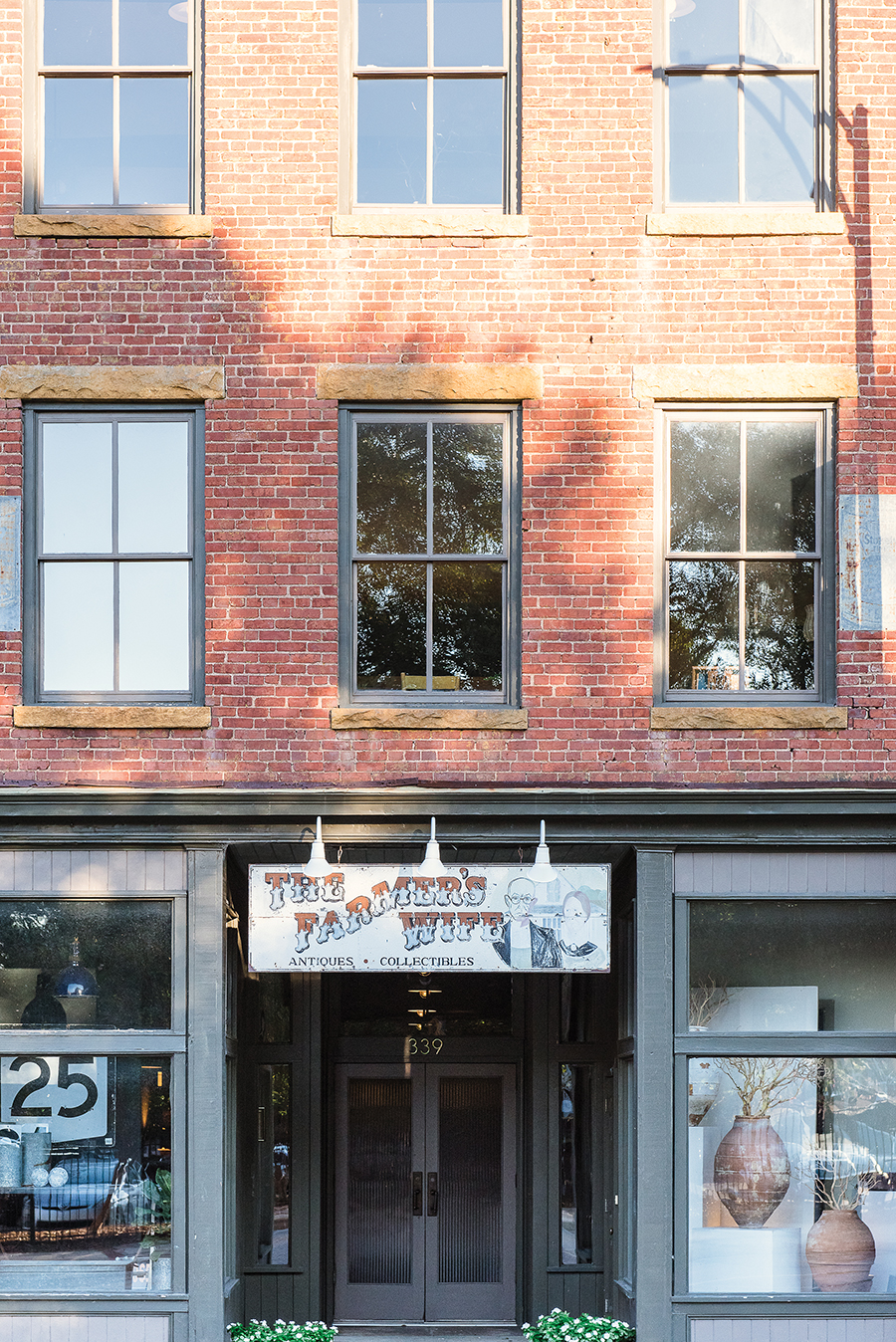
Garrett is purveyor of The Farmer’s Wife antique store at 339 Davie Street the cream filling in the only cluster of storefronts that survived a series of fires in the 1980s that wiped clean the Davie Street business sector. The area was once a thriving district with two- and three-story buildings on both sides of the avenue rivaling those on South Elm, one block west.

Garrett recalls, “My neighbor told me the story that, when the big fire was across the street where they were in the process of building [Greensborough Court], he said he got on top of his building and hosed it down, afraid that sparks might jump the street and spread to here.”

Garrett established his original antiques boutique on South Elm. His shop opened doors in the middle of a struggling downtown between Lewis and Lee streets (now Gate City Boulevard) in 1982, when just about every other downtown establishment had migrated to shopping centers and malls in the suburbs. “When I first started the business 36 years ago,” Garrett tells me, “you could rent a building on South Elm for $300 or $400 a month for a good sized-space. Of course, now people want $1,200–1,500 or more.”

It was a different environment then. “We were moving into a wholesale antiques district, and we knew that, there was no retail,” he says. “It was out-of-state people coming to buy items then take them somewhere else to sell for more money.”

Garrett had a notion to own a place of his own downtown, so when his neighbor on Davie told him about the building next to his being foreclosed on in 1994, that it was to be auctioned off to the highest bidder, he decided to check it out, mostly out of curiosity. “There were about 25 or 30 people there.” To his surprise, “At the end of the auction I was the last one to bid. It was serendipity, I guess.”

Built around the turn of the 20th century, this former grocery wholesale distribution center is crowned with a decorative, galvanized metal cornice. The upper two levels are fronted in brick, accented with limestone trim above and below the windows.

To call the purchase a fixer-upper would be a laughable understatement. After years of neglect, it was — how shall I put this politely — a dump. The kind of place you’d deposit a dead body if you didn’t want it found.

It was a roll of the dice. Downtown wasn’t the most hospitable environment back in the mid-1990s. Daniel Garrett recalls, “That first year I had power tools stolen, paint stolen.” After Southside and City View Apartments went up on the other side of the tracks, and the train depot was resurrected to serve as an all-purpose transportation hub, “It all became a little bit more gentrified, you might say,” he says.

This home is remarkably quiet considering it’s situated practically on top of the railroad tracks. When I told him one of the reasons I enjoy living downtown is the sound of the trains, Garrett replied, “Well, you have to love the trains because they’re right there.” Indeed, the reason for this cluster of four buildings’ very existence was proximity to the rail yard, the original Southern Railway system’s freight depot was located right next door.

It’s a bit of a mystery as to the exact date this place was constructed. The first tenant I can pin down was George T. McLamb wholesale grocers, who moved here from Lewis Street in 1906. McLamb’s neighbor at 337 Davie, in a nearly identical building, was the National Biscuit Company, one of over 100 satellite bakeries for the company we now know as Nabisco.

McLamb closed up shop around 1912. Another wholesaler, Transou Hat Company, traded chapeaus at 339 Davie before the address was once again home to a succession of wholesale grocers beginning in the 1920s until the mid-1960s when the building was vacated. Primarily used for storage after that, for brief periods in the 1980s it housed a college professor or two.

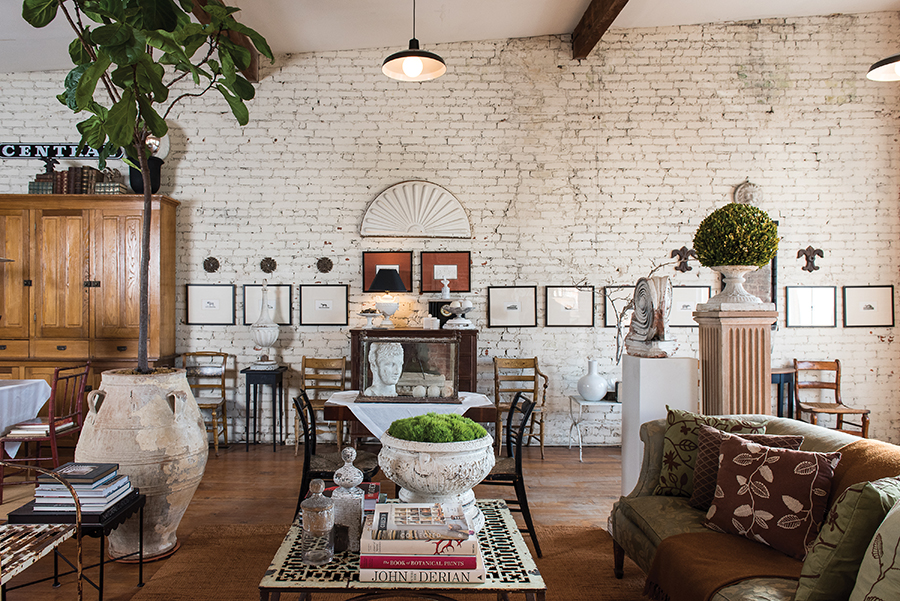
Entering the living areas on the floors above the street level storefront is like stepping into a country farmhouse that somehow sprouted in the heart of the city. Raised in Pleasant Garden where, as he put it, “You’re related to everybody and everyone knows your business,” the décor reflects Garrett’s small-town upbringing. His grandfather made one of the tables and two of the cabinets in this living room.

You would think an old structure like this would be dark, but it’s remarkably bright inside. Large picture windows to the front and rear flood the rooms with natural light. Plus, Garrett cut a horizontal window into the living-room wall to take advantage of sunlight emanating from a skylight on the other side.

A heavy eight-paned garage door slides to one side, leading to another wing of the home used mostly for storage. “We had to do things a little at a time,” Daniel explains. “I didn’t have the money to just do everything at once. I replaced windows one or two at a time.” A new roof was needed, the electrical wiring and plumbing had to be redone, “I had a very small budget to rehab the building. So when that money ran out we had to stop.” A new kitchen was installed about five years ago.

The store’s original front doors were flat and drab so a more inviting entrance with an Italianate feel was created. The project was a familial effort, “My brother-in-law, who had just retired from the post office, was a huge help at that time. He was wanting projects to do and he was one of those persons who was handy and could do things like that.” Until five or six years ago, off the kitchen, a dilapidated freight elevator sat stuck in place, “My brother worked for an elevator company and he said, ‘You’ll never get this to pass inspection’ so it was removed,” Garrett explains.

His bedroom on the floor above is one enormous warehouse-sized space with a 25-foot-high ceiling and three massive picture windows on the western-facing wall that overlook the park across the street behind Natty Greene’s.

As for the impressive and ubiquitous exposed brick walls and lightly colored hardwood floors, Garrett says, “This is exactly the way it was before I bought it, I haven’t unpainted or repainted the brick.” Because 341 Davie was built first, his southern-facing wall was that building’s exterior wall. The floors are imperfect but, “I’m leaving them that way. I can live with imperfection,” he allows. “I’d rather have it the way it was, and how it was used, versus getting too slick or sophisticated.”

A mirror in need of resilvering is a favorite item. “I like that one because it doesn’t make me look as old. It’s so fuzzy, it doesn’t necessarily tell the truth,” Garrett jokes. Numerous wooden architectural touches from building exteriors lend both scale and intimacy to these cavernous spaces. Pointing to a large mantel positioned just below the bedroom ceiling, Garrett explains its provenance:  “I bought that in Liberty, North Carolina, years ago. It’s actually the cornice from the top of a building that I had mounted to the wall.”

A large armoire stores dishes and glassware, because, “You have to have big things in a room this large; if you have a bunch of little things they just get lost,” Garrett notes, adding, “That’s why I did this line of prints down low, to pull the ceiling down to a more human scale.”

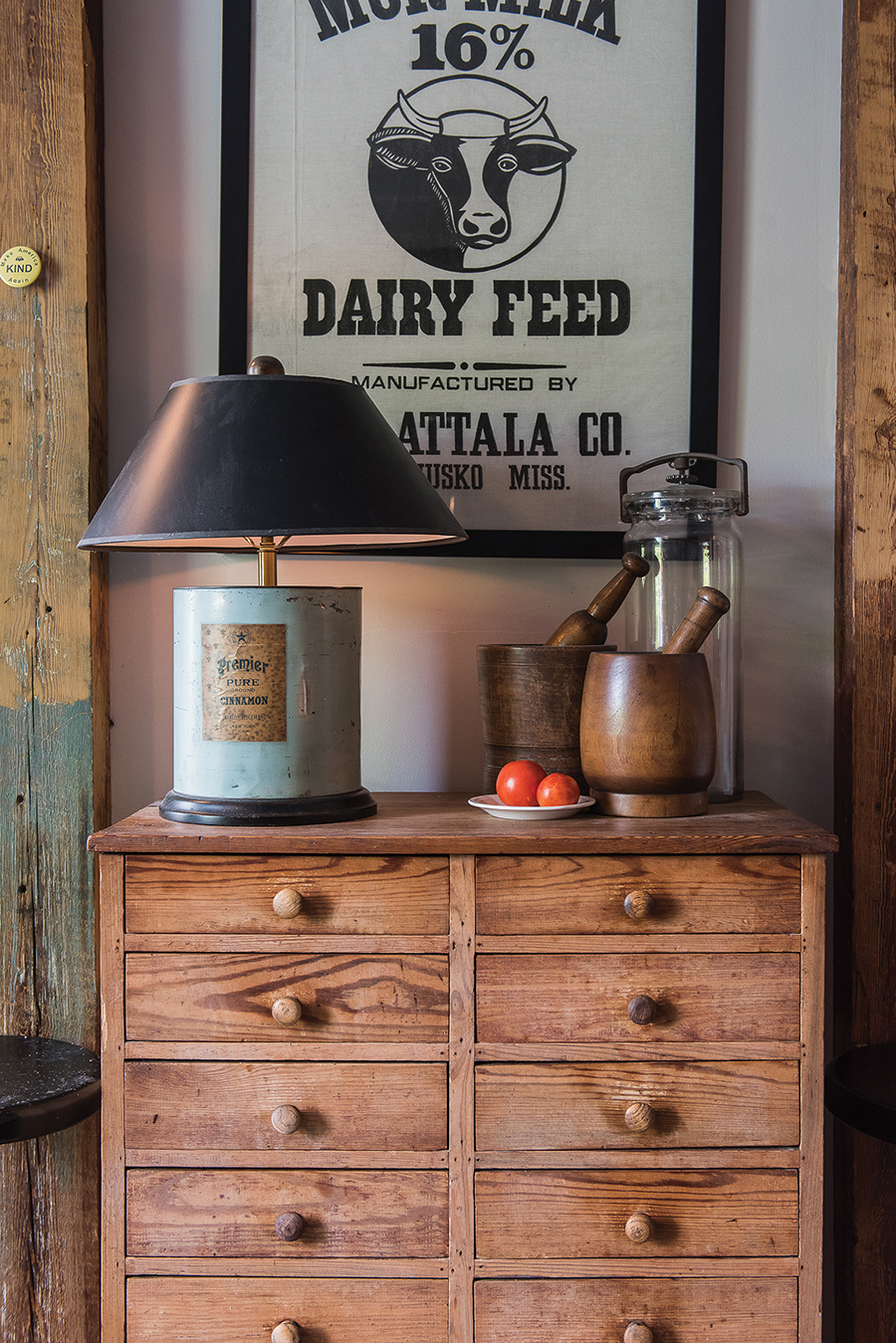
Also on display are a variety of mortars and pestles, “I’ve been collecting them for 25 or 30 years, one at a time. I don’t know why, I’m just infatuated with them.”

The pride of his collection is a windup fly swatter, an odd ornament from the Victorian age. “An antique dealer had it in his house,” Garrett explains. “I told him, ‘If you ever want to get rid of it I want to buy it.’ It would have been used in the middle of a table, with the same sort of mechanism that a clock would have. It supposedly keeps the flies away.”

In one corner there’s an antique writing desk while a rustic pie safe with perforated metal screens, manufactured around the time this place was built, hides a television and a collection of books. Everywhere you look there are bound volumes on just about every subject, many detailing the life and works of world renowned artists and photographers, about which the homeowner remarks, “Like Thomas Jefferson said, ‘I can not live without books.’”

“I was a design major in school,” Garrett says. “I ended up getting a degree in art education from UNCG. I did teach for a couple of years.” As an itinerate art teacher for the Greensboro Public Schools, he moved from one school to another.  “I rotated with instructors who taught music and physical education for fourth, fitth and sixth graders,” Garrett recalls. Following that stint, he taught art at Mendenhall and Kiser junior high, but ultimately gave it up for the same reasons many in the profession leave: “I quit teaching because I got tired of filling out forms and lesson plans that no one ever looked at.”

charming brick patio with a European flair awaits at the rear of the building. Beyond it is an English country garden populated with miniature shrubberies, stone pottery, a wispy Bonsai tree, with quirky accents that include a rusty, antique metal lamppost base.

The hearthstone from his grandfather’s fireplace has been repurposed for a bench that, Garrett recalls, ”Took four men and a couple of 12-packs to move.” A neat row of tall ginkgo trees, along with Japanese and Ming maples, shields any view of the train depot behind them. It’s a far cry from the mess that he inherited when he moved in, “Where we’re standing right now was trashed; you couldn’t even grow weeds back here.”

What could be more cosmopolitan than living above your store? Today a large portion of Garrett’s antique business, The Farmer’s Wife, is dedicated to flower arrangements, “I used to go to the farmers market and pick up a couple of bunches of flowers,” he explains. “I put them in the shop so as to not look so stuffy or stodgy.” When customers began to purchase them, “That mushroomed into people wanting me to do something with them for events or birthdays. It’s not something I was planning on happening, but now flowers are probably 65 percent of our business.”

Downtown Greensboro began roaring back to life in the 2000s. “I don’t know what started the resurgence of people wanting to come back to downtown,” Garrett reflects. “I think younger people are wanting the convenience where you can walk to businesses versus having to drive a car.” He found himself the beneficiary of a trend that few would have predicted back in 1994. “Next door they’re renting a man-cave for $1,200 a month . . . and it’s dark. In hindsight, this was probably the best business decision I ever made.”

The arduous journey that began with his hand being the last in the air at a sidewalk auction more than three decades ago has been completed, more or less. “It will always be a work in progress,” Garrett assures me. “But, as of June of this year, I paid off the mortgage. It’s finally mine.”  OH

Billy Ingram first moved downtown in 1997, to the mystification of almost everyone who inevitably commented, “Why would you want to live there? There’s nothing but bums down there.”

Drinking with Writers

After the Storm

Over cold ones at Flying Machine, writer Kevin Maurer remembers the impact of Hurricane Florence

By Wiley Cash     Photographs by Mallory Cash

When I moved to Wilmington in 2013, Kevin Maurer was one of the first friends I made. Over the years, I have gotten to know his family, and he has gotten to know mine. We have played on the same intramural basketball and football teams, and we have suffered losses and injuries, bonding over our bruised bodies and equally bruised egos. But what has informed our friendship more than anything else is the writing life. We regularly have dinner or drinks and talk about our decisions to become writers, and the effect our work has on our families and our friendships with people outside the publishing industry. A few months ago, I chronicled one of our conversations on Twitter, and it was retweeted over 1,200 times and responded to by writers as various as Neil Gaiman and Mary Alice Monroe, all of whom agreed that the writing life never gets easier, no matter who you are.

Kevin is one of the most successful writers I know — the New York Times best-selling co-author of No Easy Day: The First-Hand Account of the Mission That Killed Osama Bin Laden and American Radical: Inside the World of an Undercover Muslim FBI Agent; and a celebrated journalist who has written about the war in Afghanistan as an embedded reporter — but he is also one of the hardest working.

Our conversation once again turned toward the writing life when we met at the new Flying Machine Brewing Company in Wilmington a few days following my family’s return to town after evacuating in advance of Hurricane Florence. Kevin’s family had evacuated as well, but he had stayed behind to cover the storm and its aftermath for statewide and national news outlets.

Flying Machine Brewing Company, which is set to open in early November, is on Randall Parkway, where it sits along the cross-city trail and has views of the lake at Anne McCrary Park from its two-story patio. The interior of the taproom feels both enormous and inviting, with clean lines and industrial seating that mirrors the sheen of the brewing equipment that brews all the beer on-site. Borrowing from the name, flying machines and parts of flying machines inform everything from lighting fixtures to wall art to the pulls on the taps behind the bar.

Although they were not open for business before Hurricane Florence hit, Flying Machine jumped into the community effort after the storm had passed by offering free purified water to anyone in need of it. There were plenty of people in need, and there still are. Because of this, Flying Machine has pledged to donate a portion of their proceeds from their grand opening to local nonprofits.

As Kevin and I settle in at the bar, we are delivered a round of beers by co-founder David Sweigart. He offers us the “Passarola” Brut Pilsner and the “Electric Smoke” Alt Bier, and he lets us know we are being served the first beers poured and sampled in the brewery’s history. Kevin and I agree that the honor of sampling Flying Machine’s first pours is made even sweeter by the fact that both beers are delicious.

I ask Kevin about what it was like to write about Wilmington before, during and after Hurricane Florence. As he takes a sip of his lager, I mention something he wrote in an article about the aftermath of the storm: Wilmington has become a city of lines, he wrote. Lines to get food. Lines for gas. Lines to get supplies.

“That was the hardest part of covering the storm,” Kevin says. “The waiting and watching people wait.” He stares at the wall across from us where a huge mural of a globe featuring the words “Wilmington N. Carolina” hovers above us. “I watched people sit in their driveways and wait for the water to rise, and I watched it get higher and higher by the hour until they decided they couldn’t wait any longer before they left and took whatever they could carry.”

My family and I evacuated to Asheville, and we waited there, desperate for knowledge about what was happening on the coast, in Wilmington, in our neighborhood. I told Kevin I could not imagine being among those who were waiting here in town.

“It’s interesting,” he says. “My whole career has been spent covering crises around the world: war, famine, insurrection. It’s been hard to see some of the things I’ve seen, but I always get to come back home. Covering Florence was different. This is my home.”

After we finish our beers, Kevin and I are invited into the production area, where gleaming stainless-steel tanks tower above us. Taproom manager Marthe Park Jones, who has spent years working in the Wilmington craft brewing community, and retail manager Grant DeSantos, recently arrived from Asheville, where he managed retail for a major brewery, give us a tour and introduce us to a group of brewers who have spent years working and studying at breweries around the world. When the tour is over we stand around talking about the storm, and the long road the community and region have ahead. 

Later, on our way out to the parking lot, Kevin and I make plans to get our wives together for dinner that evening at a local restaurant that has recently reopened. The city is gathering itself and moving forward. Wilmington and its people — both the long residing and the recently arrived — are no longer waiting. OH

Wiley Cash lives in Wilmington with his wife and their two daughters. His latest novel, The Last Ballad, is available wherever books are sold.