Simple Life

SIMPLE LIFE

The Art of Healing

With the dawn of spring, we begin again

By Jim Dodson

If you live long enough, the saying goes, you will discover that healing takes time.

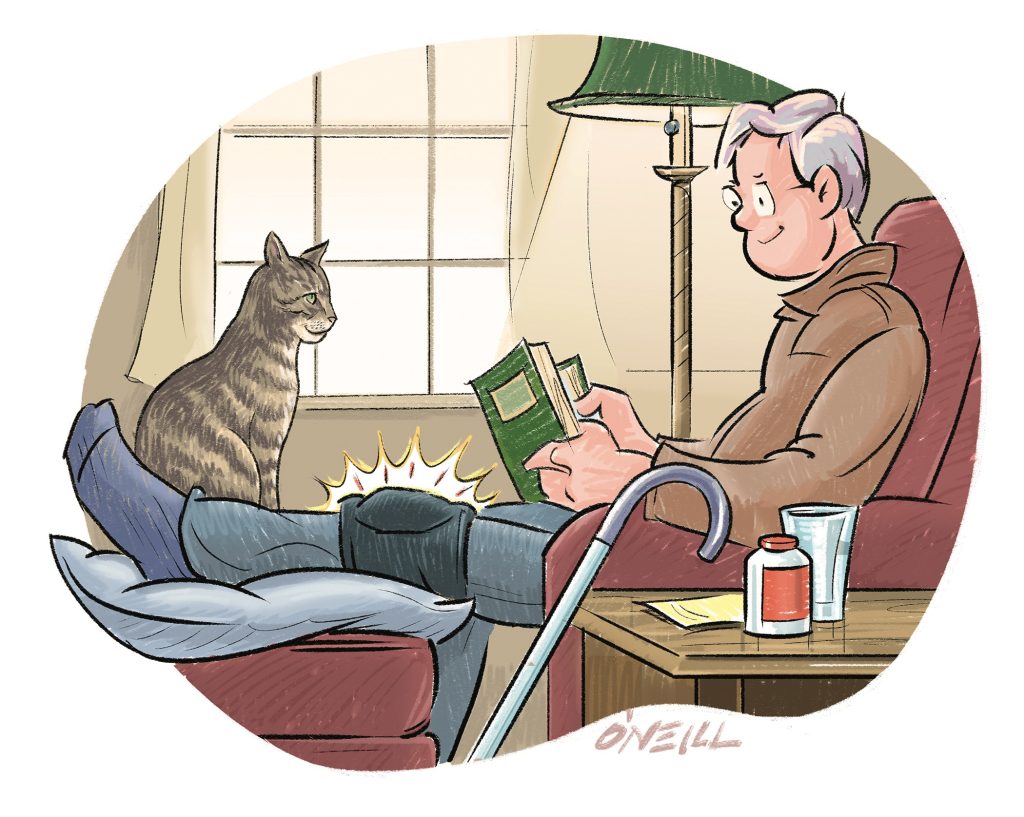
This ancient wisdom is being driven home to me because 15 days before I sat down to write this column, I received a complete left knee replacement.

Friends who’ve been down this path were quick to assure me that the pain and discomfort that accompanies major joint surgery can only be mitigated by time, patience and committing to an aggressive program of physical therapy.

Owing to a lifetime of sports injuries and a fulsome style of landscape gardening my cheeky bride, Wendy, once called a “blood sport with bushes and trees,” I suppose I’ve always downplayed my naturally high tolerance for pain — until now.

“Did you happen to catch the number of the city bus that ran over my leg?” I groaned to my wife on post-op day three, often described as the peak moment of pain during joint recovery.

“Just relax and let your body heal,” was her response. “By March, you’ll be back in the garden and playing golf with a brand-new knee that feels great. It just takes some time to heal, babe.”

Of course, she was right. So, I shut my yap and let my body get on with its healing business without further interference from me.

It proved to be a wise move. Upon completing my second week of physical therapy, not only did I learn that I was a week and a half ahead of the normal recovery rate from knee replacement, but had also begun to regain the ability to walk without the assistance of a cane. The pain was also slowly vanishing — so much so that I did a walking tour of my garden to assess the winter damage. 

This adventure got me thinking about how waiting for the pain to stop and the healing to begin is a common experience that touches every aspect of our lives.

As children, we fall down or cut a finger and run to Mom or Dad, who applies the bandage and a kiss that makes the injury soon forgotten.

Every day on the news, however, we learn about children who live in war zones or are victims of child abuse. Their young lives will forever be damaged by the trauma they’ve suffered — a pain that will likely never quite vanish, leaving a wound that may never heal.

On a much larger scale, the recent devastation of homes and lives lost from Hurricane Helene and the raging wildfires of Los Angeles have produced pain and suffering on an apocalyptic scale, something that will take decades for communities to rebuild and heal. The outpouring of love and assistance from complete strangers to our mountain neighbors, however, speaks volumes about our shared human instinct for healing. A similar outpouring is already underway in the City of Angels.

On the scale of normal, everyday life, a lover’s broken heart may only require a few healing months of intense self-care, a good therapist and a new pair of shoes to begin the mending process.

The psychic pain of losing a job, sending a child off to college, ending a close friendship, or saying goodbye to a loved one or special place you may never see again can impose their own unique weight on the human heart. In time, only memory and gratitude for what was may soften the pain.

That, at least, is my hope.

One evening over this past Christmas, as we sat by the fire watching a holiday movie, our beloved cat, Boo Radley, suffered a sudden massive seizure. Boo was a large, gray tiger cat who entered our lives 14 years ago when Connor, Number Two son, brought him home as a tiny feral kitten found at the Southern Pines train depot on a winter night.

Connor named him “Nico” and kept him in his upstairs bedroom for several weeks before he moved on to Boston to accept a new job. At that point, we renamed the inherited young cat “Boo Radley” and watched him quickly take over the house. One minute he was grooming the ears of our big golden retriever, Ajax, the next sleeping in kitchen pots and pans. He was always up to some amusing mischief that made us all smile.

For some reason, Boo took a particular shine to me, showing up at my desk every morning to playfully tap my computer keys as I wrote. The first time I let him outside, he followed me entirely around the backyard watching me plant roses and mow the lawn.

One summer evening near dusk, I saw Boo bolt across the backyard being chased by a young gray fox. Before I could come to his rescue, I saw the young fox running back the other way — chased by Boo. Crazy as it sounds, their game of tag went on for weeks.

When we moved to the old neighborhood where I grew up in the Gate City, Boo really found his stride. He supervised as I re-landscaped the entire property and faithfully came to sit under the trees with me every afternoon when the day’s work was done. Likewise, for over a decade, he never failed to appear from his nighttime rounds to sit together under the early morning stars while I sipped coffee and had a friendly chat with the universe. He usually snuggled up in my lap as the Almighty and I sorted things out. On most afternoons, he napped in the golden-hour sun in his favorite part of the garden, which I eventually named “Boo’s Garden.”

Like the original Boo Radley, he particularly didn’t care for strangers, and proved to be fiercely territorial, ready to chase off any feline intruder foolish enough to get too close.

Wendy liked to say Boo was simply guarding his turf — and his best buddy.

I do believe this may be true.

On the fourth night after my knee replacement, however, during the deepest pain of my recovery, Boo suffered his sixth seizure in five weeks. The promising medication he’d been on for a month simply didn’t work, proving the art of healing is as much mystery as it is science.

Following a sleepless night, we made the painful decision to end Boo’s suffering. Hours later, a lovely vet from Lap of Love came and put my best pal to sleep on his favorite blanket. I don’t think I’d ever felt such emotional pain. Over a cat, no less.

Every moment of this life, as my late Grandmother Taylor liked to say, someone is waiting beneath a clock for a birth or a death or a chance to begin again.

The return of spring brings winter’s long wait to an end. It’s nature’s moment to heal and begin again.

With my brand-new knee, I can’t wait to get out into the garden.

But my best friend is gone, a pain that will probably take years to heal.

Chaos Theory

CHAOS THEORY

Tanked

A terrible, horrible, no good, very bad day

By Cassie Bustamante

One of my favorite childhood books is Judith Viorst’s Alexander and the Terrible, Horrible, No Good, Very Bad Day. If you’ve read it, you know that poor Alexander has one of those days where everything goes wrong. And — spoiler alert — it doesn’t even have a happy ending. But what it does have is an assurance to kids far and wide that everyone has days like that. Everyone.

Chris, my husband, is away for work, so I’m on my own for a few days with our three kiddos. I pick up Wilder, 5, from his after-school program and we head home for the evening. Shortly after we walk in the door, he comes to me, his blue eyes looking sad and guilty, his cheeks slightly flushed.

“I know you got a text from the school today, Mom,” he grumbles.

A text from his teacher? I check my phone to see if I’ve missed it. Nope. “Why would the school message me?” I ask him.

He looks at his feet, kicking the carpet. “My card was flipped from green to yellow,” he mumbles. In kindergarten-speak, his behavior went from good to “you’ve been warned.”

“Oh, no,” I say. “What happened?”

“I talked when I wasn’t supposed to,” he replies. Welp, he’s definitely my kid. I can’t tell you how many classes I got kicked out of for disruptive chatter.

“Hey, it’s OK,” I say, hugging him. “You made a mistake and you learned from it. I’m sure it won’t happen again.” Though, if he’s like me, it will most definitely happen again. (My math teacher once called me the “Mayor of Math Class” because I had to greet everyone before taking my seat. What some deem disruptive, I call friendly.)

After dinner, I head to his room to snag dinosaur PJs from his bottom drawer. And that’s when I see it.

In the small aquarium sitting atop his dresser, Bluey — his cobalt beta named not for the hilarious Australian cartoon dog, but for his color — is vertical in the tank, pouty-face up, tail down.

Tap, tap, tap. I rap on the plexiglass side. Nothing. His little pectoral fins don’t make a flutter.

I take a deep breath, preparing myself to make Wilder’s no-good, very bad day even worse by letting him know the fish he’s loved for over a year is no longer.

“Hey, bud,” I say, “I’ve got some bad news.”

“I know,” he answers, suddenly awash with shame. “You got the text.”

I stifle the giggle trying to escape from my lips. Laughing while delivering the news that my son’s first pet has died is not exactly the kind of exemplary behavior I’ve read about in parenting books. Of course, I’ve never claimed to be an exemplary parent.

“No.” I pause. “Bluey died.”

He perks up, the corners of his little mouth even start to turn upwards. Is that a smile forming? This is not the reaction I was expecting.

He trots down the hall to his room, where his sister, Emmy, is ready to help me scoop out Bluey and send him off to a burial at sea, aka the commode.

Wilder stands on his bed and peers into the tank, where Emmy’s fishing around. She finally nabs him and Wilder asks, “Can I see him?”

Emmy holds out her hand, the limp, lifeless beta sitting in her palm.

Shocking both his big sis and me, he raises his hands in triumph. “I have been waiting for this day!” he shouts.

“What?!” I say, startled. “I thought you’d be sad.”

He peers at me sheepishly, then fakes a short-lived whimper. “Well, I am a little sad,” he says. Then his face lights up. “But now I can get a new fish — a glow-in-the-dark fish!”

While I’m relieved that this moment isn’t another page in Wilder’s own tale of woe, I can’t help but pull good ol’ Alexander off the bookshelf as our bedtime story that night.

Because I want him to know, “Some days are like that.”

Even for a fish.

Almanac

ALMANAC

Almanac March 2025

By Ashley Walshe

May your thoughts be as glad as the shamrocks,

May your heart be as light as a song,

May each day bring you bright, happy hours,

That stay with you all the year long.

— Irish Blessing

March is an arrival, a revival, tender life still wet from birth.

Listen.

A purple martin sings at dawn, hollow bones weary from 5,000 miles of flight.

“Join me,” he broadcasts to the others. “Over here! On past the flowering redbud. The air is sweet, and spring is nigh!” 

Yes, spring is nigh. We’ve much to celebrate. The journey through winter was long and arduous.

On the forest floor, where trout lily and bloodroot grace the softening earth, fiddleheads unfurl like soundless party horns.

One by one, swallowtails emerge from chrysalides as yellow confetti propelled in slow motion. Winged maple seeds sing in scarlet, cascading from naked branches like blazing garlands.

A chorus of peepers screams out.

Squirrel kits nuzzle nursing mothers in their dreys. Born pink and blind, their world is all warm milk and wriggling bodies. When they open their eyes, the violets will have opened, too.

In the garden, a cottontail kindles her first litter. Deadnettle and dandelions mingle with delicate grasses. A bluebird crafts her cup-shaped nest.

Can you sense your own revival? Your own tender blossoming? Spring is here, and so are you.

Emerge from brumation as the snake does. Wiggle your toes in the feather-soft grass. Let the sun melt the winter from your skin and bones as the sparrow trills rejoice!

Once in a Red Moon

According to National Geographic, two of the nine “must-see sky events” of 2025 are happening this month, beginning with a total lunar eclipse and blood moon on Friday, March 14. During the total eclipse, visible from 2:26 – 3:31 a.m., Earth’s shadow will cause the moon to appear otherworldly, glowing in shades of “pumpkin orange to coppery red.” Can you say le fantastique? Night owls: No reason to miss it. 

Next on the docket of celestial sensations is a deep partial solar eclipse on Saturday, March 29. Early birds: This one’s for you. Bust out those eclipse glasses for a show that will peak at sunrise.

A Time to Sow

The soil is thawing. The birds are twittering. The worms are back in business.

Earthworms are key to healthy, nutrient-rich soil. And did you know that just 1 acre of land can host upwards of 1 million of the cold-blooded wigglers? The more, the merrier.

As a new season begins, we, too, return to the garden.

In early March, sow carrot, spinach, radish, pea and turnip seeds directly into the softening earth. Chives, parsley, onion and parsnips can be planted mid-month. At month’s end, bust out the beet and arugula seeds.

Broccoli, cauliflower and cabbage seedlings can be transplanted outdoors mid- to late-month. Ditto kale, Swiss chard, lettuce and kohlrabi.

As robin exhales mirthful tunes of crocus and tulip and plump, soil-laced worms, you gently hum along.

Home to Port

HOME TO PORT

Home to Port

A roving designer settles in High Point’s Emerywood

By Cassie Bustamante
Photographs by Bert VanderVeen

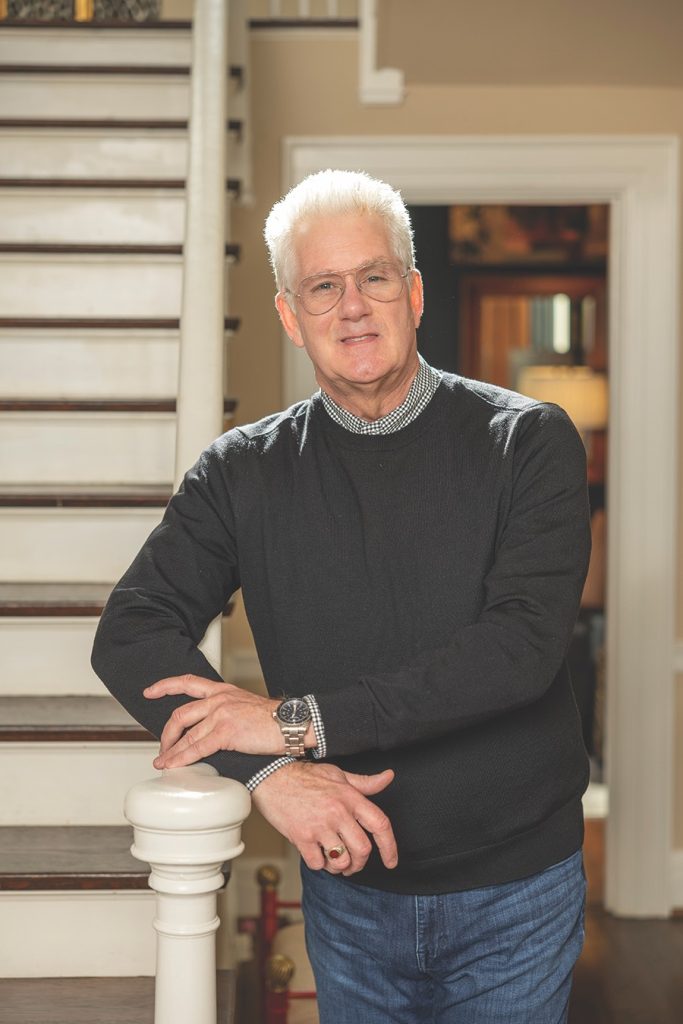
“How many times can one decorate and move?” asks Mark Abrams, co-owner of PORT 68, a home decor company based out of Chicago. He’s lived all over the States in his 62 years. As a young man in the mid-1980s, Abrams first visited the Furniture Capital of the World and had a sense of knowing he was going to one day call it home; friends told him he was insane. But he’s got the last laugh because “fast forward and here I am!” And, it turns out, his century-old Colonial in High Point’s historic Emerywood is the house this wandering spirit has lived in the longest. Perhaps this time he’ll pull his ship into harbor for good.

Born and raised in Demopolis, Ala., Abrams remained in the Yellowhammer State during college, initially planning to study architecture. “I realized real quick there’s a huge amount of math requirements,” he quips while petting his black-and-white cat, Freddie, perched in his lap. Instead, he graduated from the University of Alabama in 1985 with a degree in communication. At the time, the school didn’t allow double majors, so Abrams minored in fashion merchandising and design, considering a career as a retail buyer.

But, during his junior year of college, an internship with one of the largest design-marketing companies, Gear-Holdings, in New York City, shifted his trajectory. “Gear,” as Abrams refers to it, was co-founded and owned by a family friend, the late Raymond Waites, who also hailed from Demopolis. “I went to New York and it changed my life,” muses Abrams.

“It was like a big grad school,” he says, where he learned the ropes of both business and design as a Gear employee, eventually stepping into the role of visual director. “Because of Gear, and who I knew and what I was doing,” says Abrams, “I was published in every shelter magazine there was and on a few covers of books for my design work.” One of his first projects was a four-part publishing series with Better Homes & Gardens that wound up in a book. His work at Gear is what introduced him to High Point, where he set up a showroom for one of the company’s licensees.

Eventually, Abrams grew tired of grinding his gears. “I just worked and worked and worked and made no money.” What his bank account lacked in abundance, he made up for in a padded portfolio. Plus, Waites had introduced him to “the who’s who of the industry,” providing him with valuable connections. After a few years, he left Gear and jetted to Los Angeles, where new adventure awaited.

And ever since, he’s barely kept his feet in one spot for more than two years at a time. “I’ve moved 12 times cross-country,” he says. “I’ve lived in, let’s see, New York, L.A., Dallas, St. Louis, Kansas City, Greensboro — twice — New York again.” Plus, he adds, Ferndale, Washington, and, before High Point, Chicago.

In 2009, with industry veteran Michael Yip, Abrams co-founded PORT 68. Its mission? “Bringing home beautifully designed products from ports around the world to you.”

At the time, Abrams was living in Greensboro on Kemp Road. Before that, he’d been living just around the corner on Watauga in Hamilton Forest when a realtor knocked on his door and told him someone wanted to buy his house. Abrams, a sucker for flipping houses recalls, “I said, ‘As long as you can find me one in this neighborhood, that’s fine.’ And he did!”

But with the start of the company, Abrams relocated to Chicago, where PORT 68 has its headquarters. With showrooms in High Point, Atlanta and Dallas, the company decided to look for what Abrams calls a High Point “market house,” a place where the team could stay when they needed to be in the city. He called his pal, real estate agent Lee Kemp, and asked her to show him a house he had his eye on. Turns out, “it was way too much work.”

“I was just adding it up in my head and I am going no, no no.” But Kemp came through with another house that was being sold as an estate and was a stone’s throw away from the one he’d already seen. Abrams did a 15-minute walk through, made an offer he didn’t think they’d ever accept and hustled off to the airport.

As soon as he landed at O’Hare Airport, he got the call that the offer had been accepted. “I was like, ‘What!’” he recalls.

While he hadn’t planned on moving, after nine years of living in the Windy City, where “the snow would blow horizontally,” this warm-weather-loving Southerner had had enough. Abrams traveled often for work and was spending at least eight weeks a year in High Point as it was, and being in High Point would also put him within driving distance to the Atlanta showroom. Why not just move there?

After all, he says, High Point has a “very tight-knit design community” that you won’t find anywhere else, the sort of place where a close-knit group of industry friends can get together to “complain, discuss, egg each other on — all the things you need to talk about.”

During Market, the PORT 68 team infiltrates and makes his house their home base. “I call it the sorority house because people are all over the place and it’s kind of a wreck.” But, he adds, he always wants his guests to feel right at home. “My house is where you can put your drink anywhere and don’t worry about it, put your feet up anywhere and have a good time. I don’t live in fine antiques; I live in old things that I love and that’s kind of it.”

Of course, being in High Point also made it a little easier to get back to his hometown of Demopolis, where his aging parents still lived. About the time Abrams landed in High Point, his father had just begun battling Alzheimer’s. With his parents’ failing health, Abrams found himself traveling to Alabama every two to three weeks. Assuming the time would come, Abrams prepared his home for his mother to move in, readying the main-floor bedroom and handicap en-suite bathroom the previous owner added.

Sadly, he says, “That didn’t happen.” In 2022, his mother passed away, followed by his father in March of last year.

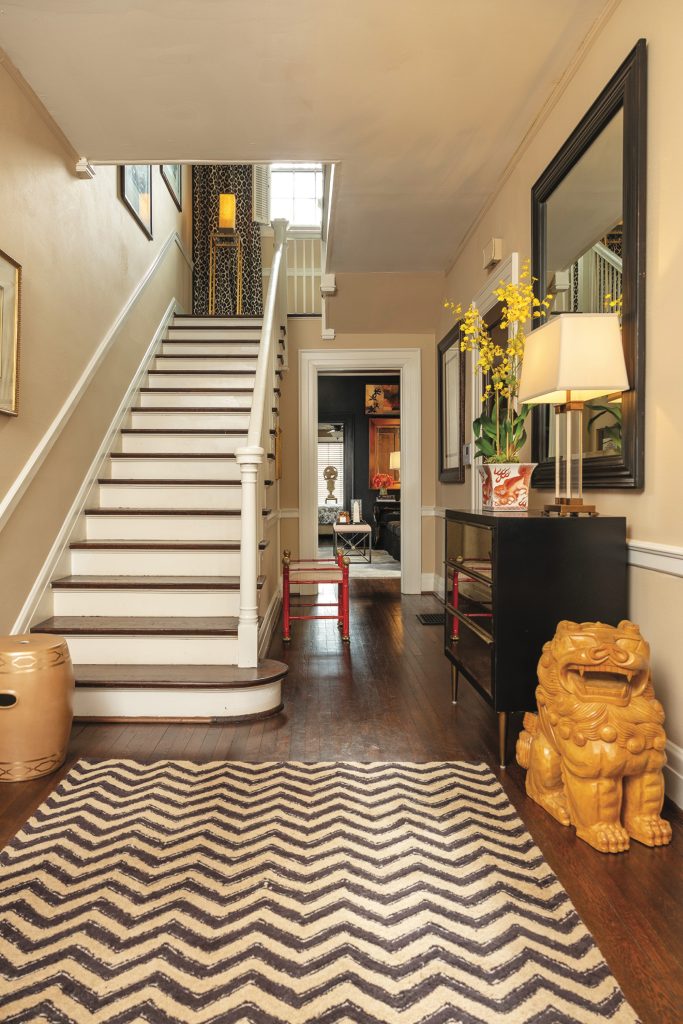
The bedding in that main-floor guest space was assembled originally with his mother in mind. A black-and-white duvet and bed pillows juxtaposed with playful, burnt-orange tiger “hide” throw pillows feature a “timeless” toile that was created by Gear in 1986. Fellow Demopolitan Waites wanted to craft the classic pattern with a hometown-homage twist. Using antique document fabric, Abrams says, they added “vine-and-olive people,” an homage to the French expatriates who founded Demopolis. For Abrams, the most exciting element is that the plantation-style house depicted on the toile fabric is historic Bluff Hall, which had been owned by Abrams’ grandfather before he sold it to the Marengo County Historical Society.

But the real kicker? “My mother turned down living in the house [Bluff Hall] because, she said, ‘I don’t want to live in an old barn,’” says Abrams with a chuckle. Judging by the toile design, Bluff Hall is far from being considered a barn.

These days, Abrams doesn’t travel back to Demopolis as much now that both parents are gone. “The estate is coming to an end so I feel a slight relief of just the physical driving back and forth.”

Making his house a home while running a business and taking care of his long-distance parents eventually took its toll on Abrams. In June 2024, he went into atrial fibrillation, abnormal rhythm of the heart, accruing the equivalent of “a weekend at the Ritz Carlton,” referring to his hospital bill. But, he says, “I am alive.” The cost was well worth it because “little High Point Hospital” was able to regulate his heart rhythm. And now, he says, it’s time for him to make himself a priority.

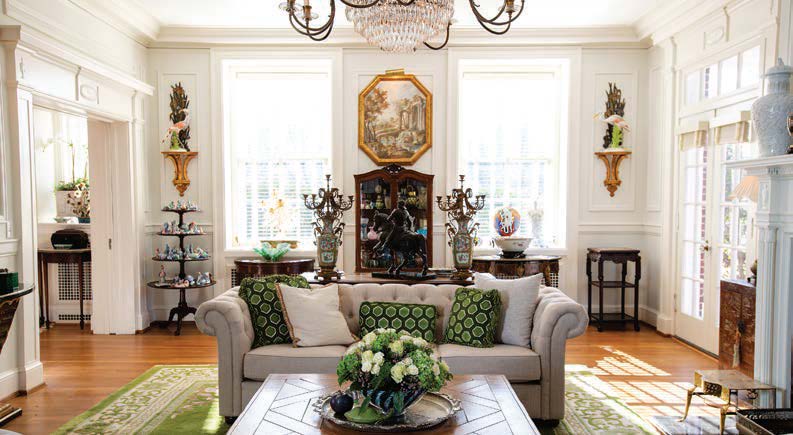
Abrams kept a few sentimental family pieces that he’s seamlessly blended into his design, such as a wooden box he’d given his father 30 years ago that now sits on the sofa table. While he describes his style as somewhat “eclectic” — a mix of tonal colors and metallics, texture, layers, and animal prints — he also says, “I am very calculating when designing.”

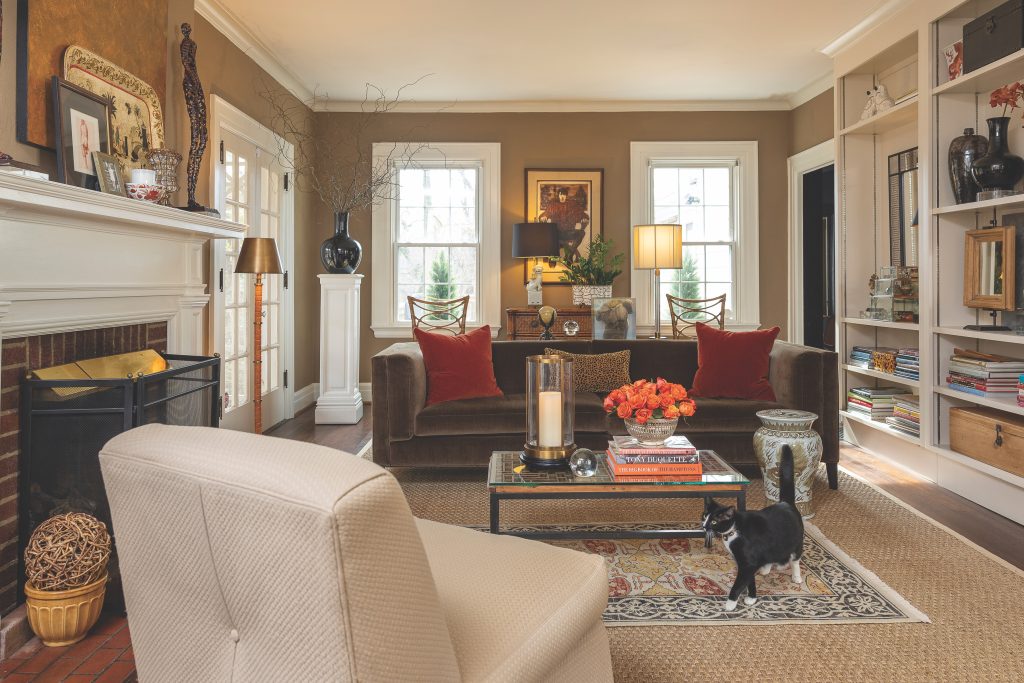
The living room, off of which sits a covered porch, is the prime example of his design ethos at play. A rich, streamlined velvet sofa faces two lush, armless chairs. A woven, natural rug anchors the space, layered with a smaller, vintage-style rug in the warm earth tones that reverberate throughout the home. In front of his windows, two white, carved-wood screens he found years ago at a Chicago antique shop — for an absolute steal — provide privacy.

Abrams has filled built-ins — stylishly and meaningfully — with books, decorative pieces and souvenirs, and, of course, PORT 68 mirrors. In front of one, three glass boxes display sentimental collections from his many travels to Vietnam, India, England and all across the globe. And, to top it off, a silver engraved vessel, “my baby cup.”

On the narrow strip of wall next to the built-ins Abrams points out a set of three steel, engraved bookplates found in Palio, Italy. “They’re all my initials.”

In the adjacent sitting room, a large, bright-orange Suzani tapestry picked up in Istanbul is stretched on a wooden frame, transforming it into a show-stopping work of art. Textiles are one of Abrams’ favorite souvenirs to purchase when abroad. “They don’t take up any room and they don’t break in your luggage,” he quips.

The Suzani, it turns out, hangs on a wall Abrams had hoped to knock down to create a spacious eat-in kitchen, but that turned out to be structurally impossible. Instead, he made small cosmetic changes, painting the kitchen and updating it with leftover wallpaper from a showroom. The paper, a neutral tan-and-white trellis design, is “Island House” by Madcap Cottage, a local High Point brand that is a PORT 68 licensee, along with iconic New York fabric house Scalamandré Maison and colonial classic Williamsburg.

Just off the kitchen is a 100-year-old original, a dark-wood butler’s pantry with glass-door uppers. Abrams has painted the wall behind it orange, echoing the color of his Suzani. “I wanted to gut this,” Abrams admits, noting that several drawers were not functioning, “but my business partner’s wife freaked out and she goes, ‘Do not take it out!’” His solution? He removed those drawers and added a wine refrigerator, which nestles in perfectly. And now, he appreciates the marriage of display piece and storage the cabinet offers. “I gotta put my mother’s junk somewhere,” he says with a laugh. “All the silver — lots of silver — I call it the burden of Southern silver” — a phrase he stole from Waites’ wife, Nancy, a fellow Southerner.

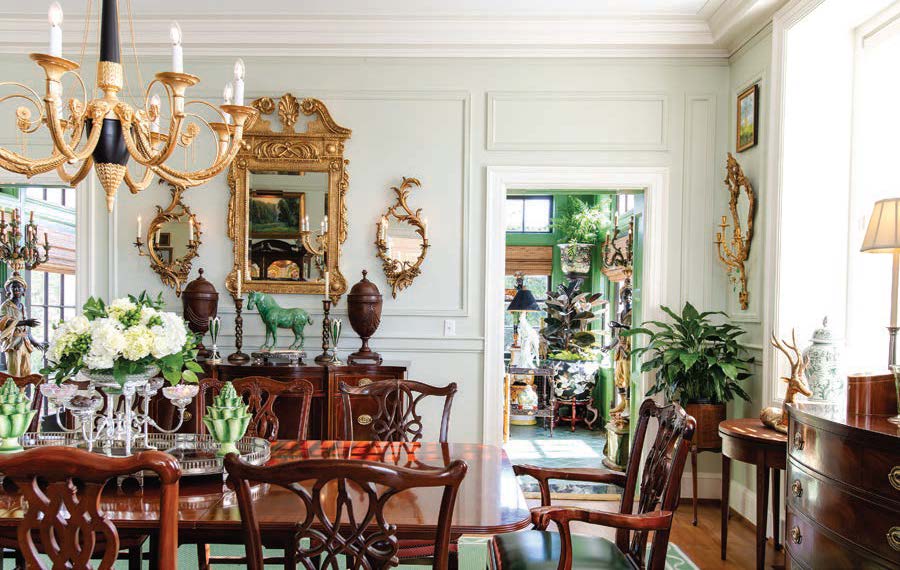
In the dining room, Abrams once again used wallpaper — a Thibaut metallic rafia in easy-to-remove vinyl — to refresh the space. Throughout the house, the plaster ceilings needed repair so he “wallpapered the ceiling so I didn’t have to deal with the cracks or the plaster.”

In the center of the dining room ceiling, a large-scale, traditional brass chandelier hangs, adorned by simple black shades, which, Abrams jokes, cost more than the fixture itself. “I bought my chandelier — my brass chandelier, which would be thousands of dollars if you bought it through Visual Comfort — 20 bucks at Habitat.”

He frequents the local Habitat for Humanity retail store because vendors regularly abandon showroom pieces there. Pro designer tip? “You just need to go. All. The. Time.”

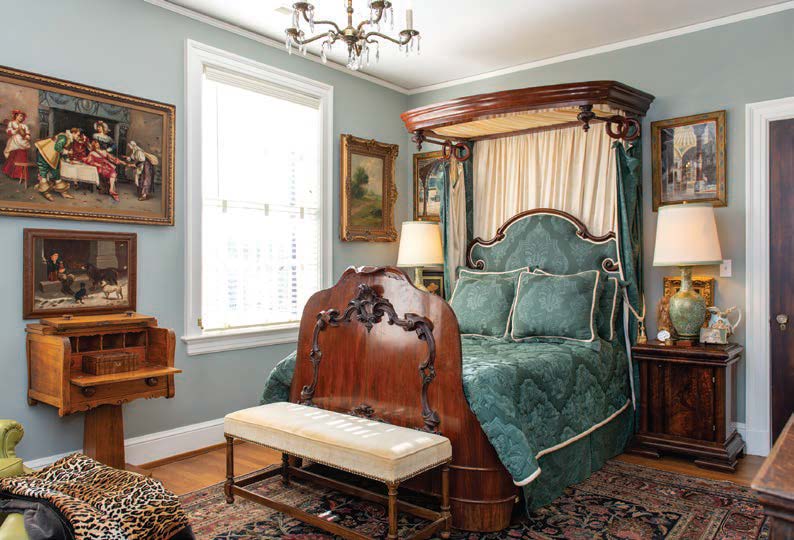
In his primary bedroom upstairs, another Habitat find covers the entire wall behind his headboard. Unseen to the naked eye, Abrams notes that there are two off-centered windows hidden behind pleats of creamy, linen-wool fabric, a visual trick that allows him symmetry. The whole treatment, he says, cost him just around “100 bucks.”

A study in cool neutrals — black, gray, tan and chrome — his bedroom is a comparatively soothing and minimalistic space. The rug, a tan-and-white plaid “was custom made for me through my friends at Momeni.” In the corner, an easel features a sketch of the human form and, above a black settee, two large astronomical prints mimic the room’s colors.

“This is the contrast,” says Abrams, leading the way to a chocolate-black bedroom one door down. “I always like having one dark bedroom for guests because it’s cozy,” he says. Flanking the windows, black-and-white zebras leap across scarlet Scalamandré drapes.

Abrams gestures to the smaller furnishings in the space. “A lot of this stuff I’ve had forever, from house to house to house, and it just works when you buy classic things,” he says. Metal pedestals purchased 30–40 years ago from Charleston Forge display porcelain urns.

The last “bedroom” of the upstairs is smaller and the staircase to the attic lines the back wall. Abrams, who doesn’t need a fourth bedroom, turned it into his dressing room. The pièce de résistance is the open cabinet displaying what he calls “my trust fund” and perhaps this collector’s most expensive pieces, amassed over time. Again, he reiterates the importance of buying something classic and taking care of it, except this time he’s talking about his extensive shoe collection. “Luckily, your feet sizes don’t change. This may change,” he says as he pats his stomach, “but that doesn’t change.”

For now, Abrams says, the house is “all done over.” He’s repaired, repainted and wallpapered almost every surface. Of course, there’s still an old basketball slab in the backyard that he’s contemplated painting to resemble a pool, complete with a big, inflatable rubber duck. “But,” he says, “I don’t know if anybody would get my humor.”

At home, relaxing on his velvet sofa, Abrams reflects on his life. “All from a boy from a small town in Alabama,” he muses. “It’s been a crazy adventure.”

Is it time to call an end to the crazy adventure and plant permanent roots in High Point?

As if he hadn’t yet thought of it, he says, after a beat, “Well, yeah, maybe.”

Art of the State

ART OF THE STATE

Wishes into Art

Paper and fiber artist Elizabeth Palmisano’s particular alchemy

By Liza Roberts

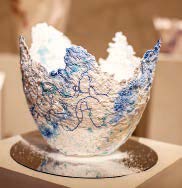
For Charlotte artist Elizabeth Palmisano, inspiration comes from many sources: the material she works with, often handmade paper and fiber; her community, which includes students, fellow artists and complete strangers; and lately and most importantly, from a deeply felt calling to collect and transform the hopes and wishes of those people into art.

That art is often three-dimensional and always colorful. It typically makes a bold statement through scale, composition or unexpected materials, but does so disarmingly, with a beguiling beauty. Her work has been exhibited at Charlotte’s Mint Museum and McColl Center, and Palmisano has twice been voted Best Visual Artist by the Charlotte’s Queen City Nerve newspaper.

It’s not surprising that her community — which she incorporates into nearly everything she does — loves her back. As a self-described wishkeeper, Palmisano has been actively collecting their anonymously submitted wishes to use in her art for the last few years, most recently gathering more than 1,000 handwritten ones to incorporate into a massive, multidimensional mural on Charlotte’s 36th Street. Completed in September, NoDa Cloud Wall transforms a 23,000-square-foot parking garage wall into a colorful skyscape featuring three-dimensional clouds inscribed with those wishes.

“It’s really beautiful to see all the similarities that people have, from all walks of life,” she says. “We all kind of want the same things: Always love, then wishes for family, or for children. Love and family are always first. It’s wild to me how vulnerable people will be if you give them an anonymous spot to ask for what they want.”

The pandemic started it all. “It was really hard for me,” she says. “I’m an artist with a capital ‘A’ first and foremost, but I teach classes and workshops because I love being with people. And I couldn’t do anything like that. So this was my way to collaborate with people without being in the same room. I asked them to digitally submit a wish, and it could be anonymous, and I was going to make a piece of art for each wish submitted. Those were my first wishes, 58 wishes, and I created a piece of art for each one.” One recent morning, at uptown’s McColl Center, Palmisano was busy printing a limited series of card decks that feature her illustrations alongside wishes and affirmations: “I love fiercely, beginning and ending with myself” was one.

She jokes that her focus on affirmations and wishes allows her to be “a professional fairy princess at 40 years old,” but “because I’m an artist, I can get away with it.”

Still, so much outward, public focus can take an artist away from her own center, her own source of creativity. A recent fellowship at the McColl Center, during which she made paper vessels and curated an exhibit, “Liminal Divine,” that included her work and that of six other McColl fellows, inspired her to look back within.

“I want to make art for me for at least the next six months or so,” she says. “So I’m diving really deeply back into my handmade paper and fibers.” The paper vessels at McColl and a recent commission to create a 60-foot-long piece of handmade paper and fiber to hang indoors allowed her to return to the delicate medium that she started with.

As a child in South Carolina and as a young adult living on her own without a high school diploma, Palmisano not only had no access to art materials, she didn’t know “artist” was something someone could be. “I grew up in poverty, in a culture of poverty,” she says. Those roots underpin everything she does today. The first time she took discarded scraps of paper and fiber and reworked them entirely into a piece of handmade paper and sold it at an art show, she says, it was a revelation; she felt she’d performed a work of alchemy.

“It made me think of the way I grew up and where that came from,” Palmisano says. “Using someone else’s trash. You figure it out when you have no other choice. You can’t say, ‘I’m not going to eat today.’ Or, ‘I’m just not going to get to work today.’ Or, ‘I’m just not going to have clean clothes today.’ You figure it out. And I think that has served me well.”

In late 2019, when she filled a giant wall at the Mint Museum with Incantation, an ethereal, abstracted skyscape made of handmade paper, paint and collage, it was the first time many viewers had encountered fiber art in a blue-chip museum.

“Boundary-pushing” is how the museum described the piece, both for its use of recycled materials and for “breathing new life into objects not typically considered for use in the creation of art.”

It’s clear that the process of taking something discarded, breaking it down to its elements, and reworking it into something valuable and beautiful is not just empowering for Palmisano, it’s metaphoric.

And it’s always new. “Right now, I’m leaning deep into: ‘What do I want to make?’ I’ve got a lot of experimentation underway,” she says. “In the spring, I’m sure there’ll be something. I’ll be excited, like a kid walking up and handing you a dandelion they just picked: ‘Here’s my offering.’ Good work takes time, and I really want to give myself that time, because I want to continue to be able to do this work.”

Life’s Funny

LIFE'S FUNNY

Saints Alive

Valentine, Patrick, Nicholas and Fanourios. Who are these guys anyway?

By Maria Johnson

I was so delighted by the earrings — a pair of verdigris dogs with copper ears as bright as new pennies — that I had to try them on right then and there, in the backseat of my husband’s car.  My older son’s partner, Tina, had just surprised me with them, following a family ramble through a row of seaside gift shops.

She and I have a custom of giving each other earrings, and she’d clearly hit a home run with the canines she’d just sniffed out.

I plucked out the faux-diamond studs I was wearing and carefully extracted the pups from their plasticized card. I hooked one hound to my left ear and was fiddling with my right lobe when the second pup slipped from hand.

I heard it hit something hard — the seatbelt buckle? — on the way down. Oops.

I expected to see the stray lying on the seat beside me.

No dice. No dog.

I unsnapped the seat belt and felt around for a metallic bump underneath me.

I bent double and pawed at the floor mat.

Tina, too, searched for the hound that had somehow slipped away in the space between us.

Minutes later, when we stopped at a landmark lighthouse, I stepped out of the car slowly, monitoring for anything that might fall from the folds of my T-shirt or shorts.

Knowing that wayward earrings can hang up in hair, snag on necklines or fall down shirts, I ruffled my own fur, patted myself down and snapped my sports bra, hoping to dislodge half of the gift.

I looked down my own shirt, disappointed to see that nothing (else) had fallen.

Meanwhile, the four scientists in the car — that would be everyone but me — converged at the seat where the lost dog was last seen. They postulated that the hound had taken a one-in-a-million dive into a crevice, or bounced at a weird angle and landed somewhere unexpected. They slid their hands between cushions, into map pockets, under mats, around seat tracks and anchors.

They could not prove their hypotheses that day. Or the day after. Or the day after that, when we meticulously vacuumed the car’s interior while listening for the rattle of success.

Alas, there was no need to pick through the dust cup.

I was deeply bothered by this loss, not just because it rendered the gift unwearable. The second earring was somewhere. It didn’t vanish.

And yet it had disappeared, to our senses at least.

Desperate, I called on heavenly help from Saint Fanourios, the Greek Orthodox saint who helps people find what is lost.

When I was growing up, my Hellenic dad often appealed to “Agios Fanourios,” which he pronounced in his native tongue as “eye-oos fan-NOO-rios” with an “r” that rolled like the Aegean Sea.

In the days before AirTags and GPS, Fanourios dropped a pin on missing objects and guided us to them by process of elimination.

He specialized in keys, pointing the way to fobs that were tucked into pockets, wedged between cushions or lodged between furniture and walls.

Usually, we found what we were looking for. Occasionally, we did not.

At these times, my dad offered a dose of common sense.

Ask Fanourios to find a necklace lost while body-surfing?

“C’mon now, honey,” Daddy would say. “Don’t be ridiculous. He’s just a saint. Even he has his limits.”

Also Fanourios did not, according to my dad, work cases involving stolen property. If someone swiped your basketball, it wasn’t lost; it was stolen. Fanourios was an intercessor, not a cop.

He was just a saint, a person who’d done some amazing things but was a person all the same.

Recently, I was thinking about my dad — who died several years ago — on his name day, December 6, the day that Greeks celebrate the feast of St. Nicholas. I searched online for a Saint Nick bio, curious about who he was before he became a saint and the forerunner of our very own Westernized Santa Claus.

Turns out, the original Nick was a bishop who, among other things, gave dowries to the father of three poor girls to save them from lives as prostitutes. So, you know, putting patriarchy aside for a minute, good on him.

Also, he is said to have revived three dismembered young people whose remains were hidden in a pickling barrel, which is disturbing on many levels, but I suppose still lands in the “plus” column.

Also, Nick might have slugged a heretic at a church meeting once. So there’s that.

For the sake of comparison, I snooped on a few other saints.

The soon-to-be celebrated St. Valentine, the patron saint of lovers, was a lawbreaker, said to have defied Roman Emperor Claudius by marrying couples so that the men would not be drafted into the military.

St. Patrick, in whose name we drink green beer and pinch people who aren’t wearing green — as if both of those behaviors are normal — was an English evangelist who converted lots of of Irish people to Christianity, but, heck, he wasn’t even a real saint. He was never canonized. And he never drove snakes from Ireland. The Ice Age, which snapped the chilly green isle off the continent, made it a no-slither zone for a long time.

And St. Fanourios? Very little is known about him, other than the usual saintly stuff: He spread the gospel, performed miracles and suffered on account of his beliefs. He was tortured and very likely died a gruesome death. His reputation for revealing lost items probably came because a pristine icon of him was unearthed from church ruins on the Greek island of Rhodes during Muslim occupation around the year 1400.

No wonder my earring was still lost.

My dad was right. These guys were “just” saints, not wizards (pickling barrel story notwithstanding).

Still, that doesn’t mean there isn’t some magic involved in appealing to them, letting go of a problem, letting your mind relax and coming back to it later.

I’m happy to report my missing dog was found. Sort of.

With my husband’s help, I Google-searched an image of the surviving earring, and up popped a boutique that sells identical litter mates.

As I write this, a new pair of hounds is bounding my way.

I can hear my pops now, giving Fanourios credit for his guidance and for keeping up with the times.

“Look, honey, he never said where you’d find it.”

Footsteps of the Fathers

FOOTSTEPS OF THE FATHERS

Descendants of the Greensboro Four support a legacy — and each other

By Ross Howell Jr.

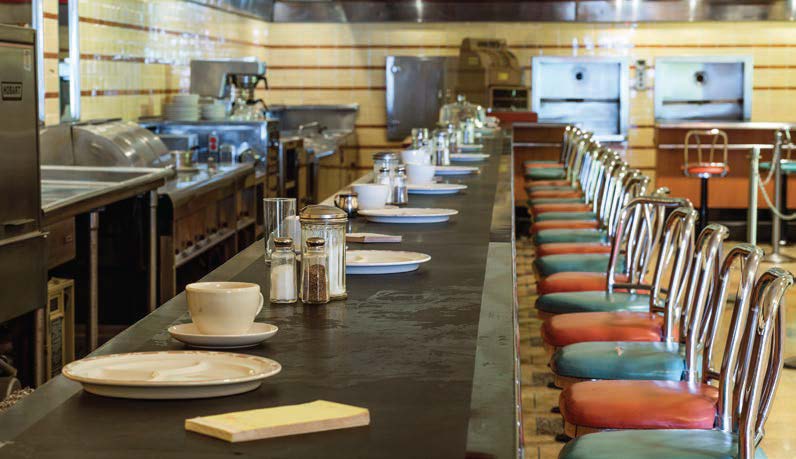
This month, our Greensboro community observes the 65th anniversary of the 1960 February 1 sit-in at the downtown F. W. Woolworth’s “whites only” lunch counter.

There’s a parade in front of the old five-and-dime, now the International Civil Rights Center & Museum on Elm Street, dedicated on a bitterly cold morning in February 2010.

As is customary, a wreath is placed on the February One statue, also known as the A&T Four Monument, on the N.C. A&T campus. It memorializes in bronze the four freshman students — David Richmond, Franklin McCain, Ezell Blair Jr. (now Jibreel Khazan) and Joseph McNeil — who, in 1960, walked from the A&T campus to downtown Greensboro and straight into Civil Rights history.

Sometime during the observance, members of the Richmond, McCain, Khazan and McNeil families will gather for a meal and conversation, just as they have for years, thanks to the generosity of Dennis and Nancy Quaintance of Quaintance-Weaver Restaurants and Hotels.

“I’m so grateful,” says Frank McCain Jr., president and CEO of the United Way of Greater Greensboro. “Every year, Dennis and Nancy join us in a private dining room at their restaurant.”

“It’s a time for us to have fellowship together,” McCain Jr. adds. “It’s a wonderful thing. There are no newspaper photographers around, no television cameras — we can have real, family conversations.”

McCain Jr. stresses how closely the Richmond, McCain, Khazan and McNeil families are knit. “We’re like blood relatives,” he says. “Remember, our fathers were extremely close. They were best friends — all brilliant minds, strategic thinkers, passionate in their beliefs.”

“And they made sure that their children got to know each other well,” McCain Jr. adds. “The Greensboro Four’s children are connected, their grandchildren are connected, and it will always be that way,” he says.

McCain Jr. believes that the four A&T students understood early on that what they were about to do would not only become a proud legacy but also a burden of responsibility that would be challenging to bear.

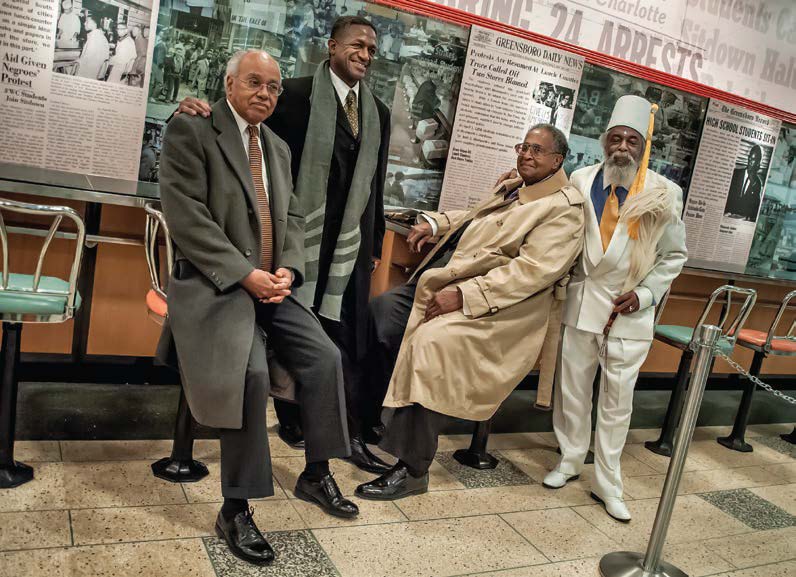
Think of the four young men in the iconic photograph or the bronze statue.

On the left is David Richmond. He was the first to pass away — in 1990 at the age of 49. It was on his shoulders that celebrity seemed to rest most heavily.

Born and raised in Greensboro, a popular student-athlete at Dudley High School, Richmond entered A&T with a sense of purpose. But after the sit-in, he grew uncomfortable in the limelight. His studies suffered.

Because of his activism, many locals labeled him as a “troublemaker.”

Richmond left A&T and found work. But after repeated death threats, he moved away to a community in the North Carolina mountains. Later, he made the decision to return — Greensboro was home.

Wrestling with depression and alcohol, Richmond struggled to find a job.

“He had been blackballed,” McCain Jr. explains.

Despite the turmoil in his father’s life, David Richmond Jr. remembers him fondly.

“We would always get together with the families in February,” he says. “I remember Dad driving us to those events when I was little.”

Richmond Jr. attended Wake Forest University on a football scholarship — making ACC Player of the Week his freshman year and playing in the Tangerine Bowl.

He remembers classmates asking him if his father had something to do with the sit-ins in Greensboro.

“I told them yes,” Richmond Jr. says. “I was proud of what my dad had done.”

When a football teammate asked him to talk about his father in front of a class, he hesitated. He didn’t think he could do his father’s story justice.

“So I thought, why not get it straight from the horse’s mouth?” Richmond Jr. says.

He invited his father to speak and sat in the back of the classroom, listening along with everyone else.

“I learned so many things I’d never heard,” Richmond Jr. says.

He recalls thinking at the time, “Here I am, the same age my father was when he walked into Woolworth, and all I’m thinking about is when’s the next campus party.”

When his father died, Richmond Jr. felt lost.

“I wanted to represent him, but I’m not comfortable in front of crowds,” he says.

A big help to him was the tall figure next to his father in the historical photo and statue.

“Franklin McCain was my godfather,” Richmond Jr. continues. “We were always tight. I remember visiting him in Charlotte — we could sit down and talk about anything,” he adds.

With McCain’s encouragement, Richmond Jr. went on to represent his father at the dedication of the February One statue on the A&T campus, the official opening of the International Civil Rights Center & Museum and the recognition at the Smithsonian’s National Museum of American History.

“I remember telling Frank Jr., someday he would have to step into his father’s place,” Richmond Jr. says.

He was right. Richmond’s godfather, Franklin McCain, passed away in 2014 at the age of 73.

McCain Jr. struggled with his father’s death, which, like Richmond’s, seemed to have come too early.

“When my father died, I could not have handled it as well as I did without the other families,” McCain Jr. says.

“They all came to town immediately, and I didn’t have to tell them what I needed them to do for me and my brothers,” he continues. “They knew what they needed to do.”

McCain and Richmond had been roommates their freshman year at A&T, and Khazan and McNeil lived in the same dormitory. When they discussed their frustrations and fears, they also talked about how to support each other.

When McCain Jr.’s father graduated from A&T and left Greensboro for Charlotte, his wife, a Bennett College alumna, had already found work in the city’s school system. But McCain couldn’t find a professional position at all.

“My father had moved away from Greensboro,” McCain Jr. says. “But he hadn’t moved far enough.”

Like his former roommate, Richmond, he’d been blackballed.

McCain took the only job he could — as a custodian with a chemical company in Charlotte.

“But as fate — or Divine Providence — would have it, he became the custodian in the C-suite, where all the senior executives, including the president, had offices,” McCain Jr. says. And from time to time, the president and the custodian would chat.

One day, the executive asked his father, “Franklin, have you ever thought about going to college? You’re very articulate, you’re a sharp guy.”

And his father replied, “Well, actually, I went to college. I have two degrees — in chemistry and biology.”

“Then why in the hell are you cleaning up the bathrooms?” the president asked.

“Because this is the only job I could get,” his father answered. “I tried to get a lab job here and they told me there weren’t any.”

McCain Jr. chuckles.

“Less than 10 days later, my father had a job in the lab,” he says.

“He worked for that company for 35 years,” McCain Jr. continues. “And when he retired, it was from his office in the C-suite.”

After his retirement, McCain often spoke at Charlotte high schools, encouraging teenagers to finish their academic work.

“My father lived long enough to meet all his grandchildren,” McCain Jr. says, “But he didn’t really get to see the fruits of his labor. We’ve been able to live the dream that he envisioned.”

McCain Jr. tells me his brother, Wendell, attended UNC as a Morehead Scholar and went on to become a Wall Street banker and venture capitalist. Wendell has a son who is a senior at Stanford and a younger son who’s attending Carolina — also as a Morehead Scholar.

“And my youngest brother has a child who is a senior at High Point University,” he says, “and his other child is a sixth grader.”

McCain Jr. goes on to say that his oldest daughter graduated from UNC and is the chief operating officer of a large snack food company in Miami, Florida. His son, Franklin III, is his grandfather’s namesake. Nicknamed “Mac,” he enjoyed a very successful collegiate football career at A&T and now plays in the NFL.

“I think that if my father were alive,” McCain Jr. says, “He would feel like — you know what? If he and those other three had not done what they did, maybe none of us would’ve had these opportunities.”

Next to the tallest figure in the February One monument — McCain stood 6-feet-2-inches and weighed more than 200 pounds — walks the smallest, Jibreel Khazan — who was said to weigh 130 pounds, soaking wet. But whatever Khazan lacked in size, he more than made up in eloquence and charisma.

Born Ezell Blair Jr. in Greensboro, where his father taught at Dudley High School and was active in the NAACP, Khazan graduated from A&T in 1965. Labeled a troublemaker like the others, he moved to New Bedford, Mass., joined the New England Islamic Center and changed his name.

Recently, a New Bedford public park was named for Khazan, honoring his years of dynamic community and youth group leadership.

Khazan, now 83, will be joining the family gathering this month in Greensboro.

Khazan’s son, Hozannah, lives in Atlanta, Ga., where he is a self-employed business telecom consultant. He tells me that he is regularly in touch with New Bedford family and friends.

Not long ago, he was on the phone with a buddy.

“Hey, I saw your dad out walking the other night,” his friend said. “It was 11 o’clock at night and it was snowing. I pulled over and offered him a ride, but he just kept going!”

“That’s him,” Hozannah laughs. “He’s still full of energy!”

Interested in computers since he was a teenager, Hozannah enrolled at A&T in 1989 and majored in industrial technology, a five-year program.

“I tell people I was born in Massachusetts, but North Carolina made me a man,” Hozannah says. “A&T was a real turning point for me.”

He tells me that, at times, his legacy felt overwhelming. But being able to talk with McCain Jr. was a big help.

“I made sure to be available to spend time with Hozannah because I had already lived what he was about to go through,” McCain Jr. says.

He told Hozannah not to make his college years stressful by trying to live up to people’s expectations. His father lived inside him and there was no changing that, McCain Jr. advised Hozannah, but he would have to find himself, find his own pathway in life.

“Because I was young, I was resentful,” Hozannah says. “But we’re like brothers. We don’t always agree, but we aren’t afraid to voice our opinions.”

Hozannah says that when he reached his 30s, he was better able to embrace his father’s legacy.

“I realized that I was representing a greater community,” he continues. “It’s a lot of responsibility, but I wouldn’t change it for the world.”

The figure striding next to Khazan is Joseph McNeil, who was born in Wilmington. Right after he graduated from a segregated high school, he moved with his family to New York City.

The next fall, he returned to North Carolina to enroll at A&T, where he joined ROTC. It was on his bus trip returning to campus from Christmas break — wearing his uniform — that he was refused service at a Greensboro hot dog stand.

For McNeil it was the final outrage. His fury was the call to action for his friends on February 1.

He would go on to graduate from A&T in 1963 with a degree in engineering physics and was commissioned as a second lieutenant is the U.S. Air Force. After service in Vietnam, he retired from active duty but continued in reserve service.

McNeil retired from the U.S. Air Force Reserve as a major general with numerous decorations. While a reservist, he also pursued a career in finance.

McNeil met his wife when he was stationed in South Dakota. She is Lakota — a direct descendant of chief Sitting Bull.

McNeil is 82 years old and is not expected to attend the family gathering this month. But his son will be there.

Joseph McNeil Jr. attended Sitting Bull College and lives with his family on the Standing Rock Reservation, Fort Yates, N.D. He is CEO of the area’s sustainable energy and community development organization.

A year ago this month, the North Dakota Monitor reported that the Standing Rock Sioux Tribe was celebrating a multimillion-dollar electric vehicle charging network project in Fort Yates —administered by McNeil Jr.’s organization.

McNeil Jr. told the newspaper he was overjoyed to see a group of local middle school students attend the event because the new EV infrastructure represents a much larger generational transition to clean energy. In the article, he said, “I was able to relate to them how our culture is involved in renewable energy as we talk about our relationship to the Earth. That was really important.”

The legacy of the Greensboro Four is complex, and the walk four young men took on a cold February day has led their descendants down diverse paths.

When the International Civil Rights Center & Museum was dedicated, Joseph McNeil sat down for an interview.

“We were very ordinary people,” he said, “with very ordinary lives to live.”

But what is an ordinary life? What were the four A&T freshmen seeking?

“There are certain things that everybody wants,” Frank McCain Jr. says. “You want to be able to live a decent life. You want to have food for your family. You want to live in a place that’s peaceful and safe. You want your children to grow up and be whatever they want to be in life.”

Four young A&T men were determined to show themselves and their families the way. And what a journey it’s been. OH

For more information, visit the International Civil Rights Center & Museum website, sitinmovement.org. The center and museum, the restored site of the 1960 F. W. Woolworth Company sit-in, recently was named a National Historic Landmark, the highest recognition awarded by the National Park Service.

The House Next Door

THE HOUSE NEXT DOOR

The House Next Door

A hard-won dream is realized some 40 years later

By Cynthia Adams     Photographs by Amy Freeman

What happens when a house lover pines for the house next door? Ultimately, something wonderful.

While scouting business locations in the ’80s, Larry Richardson suddenly noticed an aristocratic house. A plummy one, as the Brits say. A grand Georgian Revival, the historic Stroud house featured rich architectural details, including Corinthian columns and pilasters, and tiled roof.

“I remember to this day driving down that street and looking at properties and seeing the house,” says Richardson. “And thinking that’s the most beautiful house I’ve ever seen! It’s as clear as yesterday.”

Unavailable, and for a small business owner, also unattainable.

So he did as he always did. He worked harder.

Richardson, who grew up near Burlington, has a work ethic that won’t quit, something he attributes to his grandmother in particular. “I wouldn’t take anything for the lessons of rural life,” he says. 

“Everything that could be used was used. And reused.” She collected buttons in a jar, he remembers. Was resourceful in the way that Depression-era country people were. “Quilts,” he muses, “were really the first recycling.”

She taught him to value — and save — everything. And thrift worked in his favor.  In the early days of his businesses, he was at the Super Flea each month, selling plants and cultivating customers for a nursery business that was growing faster than the hanging baskets and houseplants he sold by the truckload. He supplied plants for furniture showrooms in High Point each Market. He scoured estate sales every weekend to stock booths at three consignment shops. 

Instead of the Georgian, in 1989, he snapped up the historic Hollowell house next door, named it “Seven Oaks” and spent 30 years making it a worthy neighbor to the object of his affection. He filled it with finds, sourcing furnishings far and wide. At 5,000 finished square feet after a top floor conversion, his fixer upper was nothing to sneeze at. The pièce de résistance? A stunning kitchen renovation (“Purveyors of Beauty,” Seasons, December 2020), he says, a dream realized.

Having transformed “the heart of the house,” Richardson declared that he and his partner, Clark Goodin, would never leave.

That was in 2020. 

The two houses differed in style down to the brick color and roof — Seven Oaks was a Colonial Revival with sand-colored brick. The Stroud house, affectionately known as Hilltop, was larger. (Officially listed as the Stroud house on the National Register of Historic Place after original owners Bertha and Junius B. Stroud.) And, it had space to create a downstairs main bedroom suite — something that the original footprint of Seven Oaks did not.

Yet both houses had more than their Sunset Hills location in common — two-story garages complete with living quarters and full basements. Both were also listed on the National Register of Historic Places.

Since 1925, the century-old Stroud house has had few owners.

According to census data and city directories, after four years, the Strouds sold to Alice and John K. Voehringer, president of the textile concern Mock, Judson, Voehringer Company.

William Clement Boren Jr. and his wife, Ruth, owned the property from 1935–1940.

By 1941, Pearl and Charles Irvin, president of Elam Drug Company, had moved from their home at 900 North Eugene, becoming the home’s longest residents and raising sons Charles and David and daughter Doris there. The eldest son, Charles Jr., and his wife, Mary, acquired the house in the 1990s. Charles Jr. died in 2015, and Mary in 2019, leaving the house unoccupied.

Slowly, the grand house was emptied of years of family memorabilia. 

Richardson debated and pondered. It would make a fabulous project. On occasion, despite his day jobs as a nursery owner and antique retailer, Richardson had flipped “at least four houses, maybe more,” converting worse-for-the-wear properties to stunners, carefully preserving architectural integrity. Mere blocks away, a skillful Arden Place flip practically sold before the paint was dry in 2016. 

He was familiar with the home fixer-upper journey: Take a good house, one with fine bones and possibilities, in a great location, then modernize all systems, redo baths and kitchen, and finesse cosmetic updates. “Landscaping, of course,” he says.

Before leaving for work, he would glance next door, imagining the landscape possibilities at the Stroud house. (After all, plants were his longtime passion and career.) Time passed.

This was the opus — the house he studied every single day. The family agreed to give him first right of refusal — but it was a sobering, massive project.

Standing at their kitchen sink looking across the driveway, he and Goodin began seriously talking: This could be the ultimate flip. In his mind, Richardson could already see it restored to its former grandeur. It could again be the most beautiful house on a street lined with fine residences.

What he had never experienced, however, was a remodel that would take nearly five years to complete, thanks to a global health disaster and the chaos that ensued.

Nor could he anticipate that what began as admiration might deepen into love and a new opportunity to age in place.

Richardson and Goodin closed on Hilltop in the fall of 2020, soon after completing a dreamy kitchen of their own that was the culmination of years of collecting and saving.

The house next door was tired. Interiors that were au courant 30 years ago were no longer.

The previously redone kitchen would be gutted. The baths were 1925-era and had never been modernized. The house’s infrastructure had to be addressed from electrical and plumbing to central air and heating. “The only heat was an old boiler, and they had one air conditioner on the second floor,” Richardson recalls.

The Georgian’s ballroom filled the entire third floor. To claim that square footage as living area would require support beams and a stairway relocation, plus electrical, plumbing, heating and air systems. 

As for the rest, it came into view as the house was stripped of the cosmetics. Out went pastels, mint green and maroon carpeting, floral valances and Venetian blinds, along with 1980-era floral wallpapers.

Fully emptied, a vision took form. Early on, Richardson chose a color palette then picked tiles. Then cabinetry for kitchen and bath, with plans to create the ultimate main closets. Relocated a door or two. Scheduled floor refinishing. Imagined architectural restorations and enhancements. He splurged on choices, fittings, new baths — the whole house aesthetic — before the tedium of scraping, caulking and painting both interior and exterior. 

“Then we got into COVID.”

“It was awful, and had I known what I was going to face I would have passed. I would have run the other way. Even with people and workers I had relationships with, I couldn’t get any momentum. Things just languished,” he recalls.

Renovations were suddenly uppermost for those stuck at home, and workmen and supplies were in demand during a time of uncertainty and scarcity.

“Workers got sick with COVID, then their partners. Then their families. It went on and on. Worse yet, the supply chain drove up prices of everything that went into it. A two-by-four went to at least triple the price. Any budget you had was gone.”

Amidst the chaos that overtook the globe, both Richardson and Goodin had businesses to run. Owners of Plants & Answers’ two locations, Richardson oversees the Big Greenhouse on Spring Garden, and Goodin runs the floral business in downtown Greensboro.

Time dragged by and the work — on the largest renovation they’d ever undertaken — proceeded in hiccups.

They consoled themselves, knowing they still could flip the property and make a nice profit if they proceeded as planned. It was, at least, a project greatly simplified by living next door.

At the time, they were still thinking strictly in terms of a flip.

Fast forward a few years later? It would be late in 2024 — four years since purchasing — before they could see the project’s end in sight.

Renovations had not come easily.

Even now, things remain tough, Richardson explains. For example, the custom front storm door he ordered didn’t work and had to be redone. It rested on its side in the living room. But the creative vision worked.

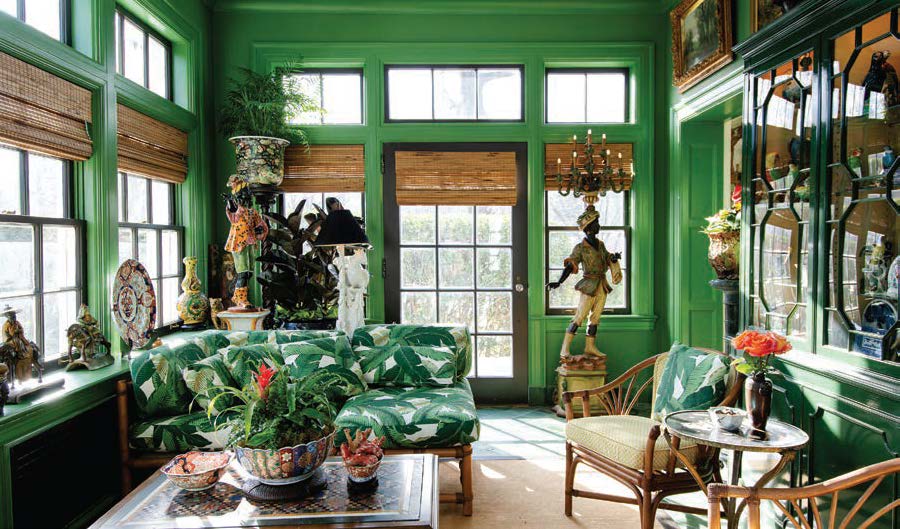
“I [always] knew green would have to be a tie-in color,” Richardson says indicating the original green tiled sunporch that opens to the dining room. (There is a second sunporch at the rear of the house.) 

Whereas pastels ruled in the old interiors, they were not going to survive in the new design. Green, however, would stay, replaced with supersaturated colors like Greenfield (Sherwin-Williams) and a bronze Benjamin Moore hue for the sunporch’s trim and casement windows.

The redone kitchen features yet another strong green, Sherwin-Williams Basil, as a unifying accent. In the breakfast area, he reused Sherwin-Williams Restrained Gold, a rich ochre tone from his former kitchen. He also installed a stained tongue-in-groove kitchen ceiling, and white quartz countertops.

A pot filler and porcelain farm sink were suggested by Goodin, who loves to cook. Richardson points out the natural light: “It’s fabulous.”

Master carpenter Marty Gentzel built the kitchen cabinetry, as well as other cabinetry, molding and architectural touches throughout the house. Gentzel, whose work is in high demand, could only begin full-time work on the house last September. 

He previously worked on the renovated and newly created third floor baths last April, then tackled replacement shutters for the exterior ones that were ruined by age. 

Gentzel created arched kitchen doorways, unifying the opened space that combines the breakfast and butler’s pantry area, while tying in existing archways at the front of the house. The previously squared off doorways showcase his favorite work in the house, custom arches painstakingly matched to existing trim work. “That was tricky,” he adds. 

“When you do an arch, it opens up everything,” says Richardson. He felt they would be a wonderful flourish.

“This whole house, it’s a canvas all its own,” says Gentzel. “You care more than anyone I’ve seen,” he says, turning to Richardson.

“I’m almost done,” Gentzel says, having worked daily only months ago.

“No, you’re not,” Richardson quips, then grins. “I’ve got more projects for you.”

For the central, inner core of the house, Richardson used an aged white on the walls, describing “a creamy white, and trimmed in Dover White,” also used for trim throughout the home. For the formal rooms, “Livable Green and Ethereal White lent green undertones, tying the rooms together.”

Three years after the renovations began, Richardson had invested far more time and money than he had imagined. During a kitchen table conversation, Goodin hazarded an idea: Why not move into Hilltop themselves?

Richardson was amazed. He’d idly imagined keeping the house. But he hadn’t allowed himself to imagine actually living there. 

Goodin pressed. They could complete the two planned bathroom renovations for Seven Oaks when empty and prepare it for sale. Hilltop would become their permanent home. “We could have a downstairs bedroom and age in place,” he argued.

Goodin made strong points. Why shouldn’t they benefit from all the work they’d poured into the restored home? Plus, they’d worked their entire lives. This was a fabulous home large enough to handle all their collections.

Privately, Richardson considered: Had it always seemed more than just a flip?

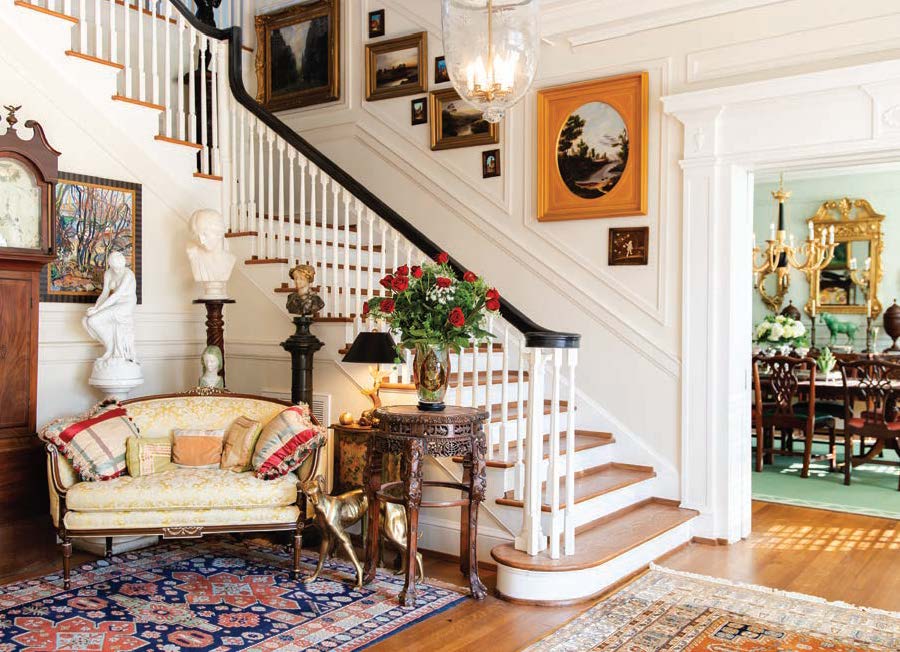
Had he stood in the grand foyer, staring at the sweepingly dramatic staircase and envisioned what he would do with the final interiors? Yes, he admittedly had. 

The problem with doing flips, he admits ironically, is that he always wants to do the house as if he will live there.

Then Richardson laughs; he had been shopping in earnest for the house even before he and Goodin contemplated keeping Hilltop.

“I was going to do some light staging for it,” he explains. “I began to do it with opposing sofas in the living room. Something people would relate to. But I didn’t start buying furniture and rugs until Clark said, ‘I think we should move into the house.’”

Richardson immediately ramped up his search. He raked through estate sales across the state. Soon he was bidding on furnishings that were scale appropriate, and Venetian glassware and hand painted plates that would accent the dining room.

Stacks of artwork awaited hanging, including a painting by former Greensboro artist David Bass. A federal mirror found a place in the stunning living room.

“I looked for the right rug, and it was tough,” he says, pulling two chinoiserie chairs into the main living room to be used as accent chairs beside a side table. A new-to-him grandfather clock found a home.

“I already knew what I was going to do,” he says, scrolling through pictures on his phone of vintage acquisitions. He hung lighting found at estate sales and auctions. Period lighting for the dining room was purchased from the Dupont estate. The dining room’s central candelabra is a Versace design, one of only eight made.

Even as the furnishings awaited placement, Richardson’s eyes shone with the certainty of his vision — instinctive vision.

Richardson acquired 18th-century Irish mirrors for the living room, which is approximately 18’ x 30’ in dimension. It can swallow up a whole lot of furniture, he admits, but he wanted ample open space. A green chinoiserie secretary and a narrow Irish wake table, “useful for overflow dining,” are  in the living room.

The hallway, whose new molding matches surrounding rooms, features Impressionistic paintings and serves as an art gallery. “There was no molding before, just plain walls,” says Richardson. Over 500 feet of molding, according to Gentzel, was replicated from the main level and added. “He redid this entire room,” Richardson says, indicating the family room, with a newly built in Baker cabinet he bought for $100. 

An expanded downstairs bath is a step towards having the option of converting the den to a main bedroom.

But it is the powder room that had guests buzzing when Richardson and Goodin hosted their new home’s first event in November 2023, even with the house mostly empty and work still underway. (They sponsored a fundraiser last winter for a local animal rescue.) 

The tiniest of all the rooms, it punches well over its weight. Artist Cheryl Lutens was commissioned to faux paint a chinoiserie bronze/gold design on the walls, so deftly done it rivals luxurious de Gournay hand-painted paper. The ceiling is gilded with gold leaf, lending depth and dimension. A guest called it “the jewel box.” 

It nearly upstaged the central stairway — a “Federal style, sweeping staircase,” as Richardson describes Hilltop’s showstopper.

The expansive upstairs landing is large enough to serve as office space. The house, however, still in a state of flux between renovation and occupation, was like a theater set before the opening show. Furniture partially filled the landing, which served as a staging area. 

The Irvins’ daughter, Doris, was in attendance for the fundraiser along with other family members, including eldest son, Mose Kiser and wife, Jean. She regaled guests with stories of her family home in its heyday. She chortled over how her mother unceremoniously goose-stepped an intruder, who had crawled through an upstairs bedroom window, out the front door.

The upstairs, neutralized and fully functional, sports essential yet invisible changes that consumed large chunks of the budget. Heating systems, reworked roofs and copper guttering were costly; built-ins cleverly conceal necessary ductwork. 

Similar to downstairs, baths were either gutted or expanded where possible, and redone in sympathetic style to the originals. Two were added on the third floor.

The color palette upstairs is a noticeably calm, “restful gray,” Richardson says, which has further served to open the space.

The main upstairs bedroom has a French door providing access to a walk-out space — the same one where the intruder had hoisted himself up. “It’s beautiful at night here,” says Richardson. “You can watch the stars.”

It will overlook a garden he is planning, where, years ago, the Irvins created three holes for the children to learn golf, he explains.

Several French doors lead to walk-out exterior terraces upstairs, including on the front of the house directly over the entrance.

Most radically altered is the third floor. The former ballroom (pressed into service for Greensboro High School’s student prom) has been transformed into new bedrooms and baths. The unfinished oak floors now shine.

Richardson is pleased with the new iron staircase leading to the third floor with a gracefully curving handrail in a fanciful design called “the lamb’s tongue,” designed by craftsman Randy Valentine of Southside Iron Works. 

“Randy said he’d never curved a piece [of iron] this thick. He was very proud of it.”

New stairs replaced narrow, cramped steps — once the sole access.

Richardson is especially fond of one of the new third-floor showers featuring a light-providing window.

He leads the way down three floors to the least changed space: the basement.

Here, the house seems to audibly breathe. He envisions a finished wine room. The whitewashed basement is mostly empty apart from a zinc-topped counter relocated from the kitchen.

Standing in the quiet, cool space, Richardson grows thoughtful, confessing it may seem odd to upsize when others nearing retirement do the opposite. Hilltop now has nearly 6,800 heated square feet. Here they can begin to “curate carefully and eliminate excess.”

“It’s an opportunity to thoughtfully place things.” He adds, “We can actually see our collections versus having them stuck away in closets and drawers.”

Can he envision living at Hilltop?  

“I do,” he adds quietly. “But I was conflicted. Because I still love our old house.”

He takes stock, absorbing the rhythms of the house. A quiet lull before a brick mason arrives to discuss an outdoor water fountain, one Richardson found at an estate sale near the mountains. 

“Listen, I never imagined we could have something so wonderful. But we’ve both worked hard for everything we have.”

As wonderful as a dream realized is, he later phones to share what he likes best about the beauty he wooed and won. 

Forget the sweeping stair, grand entry and front rooms. He’s happiest with the everyday spaces. “The rooms at the back of the house. The kitchen. The sunporch.” Here, he and Clark read papers, drink coffee, share meals. Ordinary moments in a dream of a house.

He sighs happily. One day, too, he adds, “I’ll slow down.”

Tea Leaf Astronomer

TEA LEAF ASTROLOGER

Aquarius

(January 20 – February 18)

Those who know and love you can attest: Humdrum just isn’t in your wheelhouse. This month, when life sprinkles a few so-called obstacles in your path, consider it a boon. Not only will you rise to the occasion, you’ll also land in the good graces of someone whose unconventional thinking both complements and challenges your own. Trust that any perceived failures are but compost for the goodness to come. Your life will be anything but boring.

Tea leaf “fortunes” for the rest of you:

Pisces (February 19 – March 20)

Take two whopping steps back.

Aries (March 21 – April 19) 

Read the subtle cues.

Taurus (April 20 – May 20)

It’s going to be worth all the mess.

Gemini (May 21 – June 20)

Deeper breaths, darling.

Cancer (June 21 – July 22)

Two words: lemon and cayenne.

Leo (July 23 – August 22)

Best to take smaller bites.

Virgo (August 23 – September 22)

It’s time for a new playlist.

Libra (September 23 – October 22)

Resist the urge to fold.

Scorpio (October 23 – November 21)

The laundry is behind you.

Sagittarius (November 22 – December 21)

Tend to your nervous system.

Capricorn (December 22 – January 19)

Don’t forget to stretch.

Chaos Theory

CHAOS THEORY

Traipsing Around the City of Love . . .

In a tres platonic way

By Cassie Bustamante

Google the most romantic city in the world and I guarantee you that Paris shows up at the top. Known as the “City of Love” and the “City of Lights,” its cobblestone streets abound with cozy corner cafés where couples can canoodle while sipping café au lait and munching on flakey croissants. And, of course, there are the scintillating lights of the Eiffel Tower, where close friends of mine got engaged. Ambient music abounds, thanks to street buskers. Everything about Gay Paree heightens one’s senses, creating a feeling of magic and wonder — similar, indeed, to the feeling of falling in love.

On our 21st wedding anniversary last September, my husband Chris and I head to RDU, but I’m the only one of us who will be boarding that JetBlue. From Raleigh, I fly to Boston, where I meet up with one of my very best friends, Chandra, and together we soar over the Atlantic, fulfilling a dream both of us have had for ages, landing at Charles de Gaulle Airport. Why Paris? To experience the art, architecture, cuisine and culture with the funniest human I know.

And Chris? We all know that Khalil Gibran quote: “If you love somebody, let them go, for if they return, they were always yours. If they don’t, they never were.” I’ll return. Chris knows it.

He and I have spent years in this dance, but usually it’s me who is left behind tending to children, home and dogs — sometimes chickens — while Chris travels for work. But all of those nights I spent single-parenting have led me to this one great adventure. Chris selflessly books two rooms at the charming Hotel Relais du Louvre, admittedly thanks to points he’s accrued. And that’s how my best friend and I find ourselves celebrating the greatest platonic love there is in the most romantic spot on the globe.

Like me, Chandra is a pun-loving gal whose passions include wordsmithing, traveling, Taylor Swift, exploring new restaurants and foods, reading, memes, and basking in glorious memories of our ’80s childhoods. We’ve only been friends for five years, but when you know, you know. When she visited London a few years ago, she brought me back a ceramic jewelry dish with a sheep that reads, “Ewe are amazing.” Upon my opening it, her eyes filled as she exclaimed, “It’s a pun!” She just gets me.

We are not exactly culture vultures, determined like some are to pack into a short week every iconic tourist stop while honoring the grand dame of European culture. After all, who are we trying to impress? We quickly realize we are just a couple of Americans who will inevitably be labeled innocents abroad, so who cares? For instance, one day I pause outside a restaurant called Les Éditeurs and shout, “C’est moi!” Chandra snaps my pic. So what if we’re not exactly sophisticated connoisseurs of Parisian haute culture. But pop culture? We’ve got that in spades, so on another afternoon we also pay homage to the Emily in Paris Savoir office, posing outside the building’s door as if we were Lily Collins — minus the over-the-top fashion choices — on our way to work where we’ll create a silly hashtag that’s sure to solve a brand’s dilemma.

After we’ve dropped our bags at our hotel, stomachs rumbling, we wander to the closest corner, where the Café des Arts awaits. We take one look at the menu and, naturellement, decide upon le café and savory crêpes. Having won the prestigious French award (c’est du sarcasme) at my small high school, I attempt to revive the almost 30-year-slumbering skill to order. When our meals arrive, we hungrily dig in, our forks stretching the melty, gooey cheese while bits of ham tumble onto the plate. My French has not come back as smoothly as I’d hoped and when we ask our waiter to divide our check in half, I notice that he’s taken the liberty to add a couple euros to each. Garçon, my math has not escaped me. He all but rolls his French eyes at us when I protest.

Turns out, he is the only Frenchman to attempt to take advantage of our American-ness. Every other server and shop attendant we encounter appreciates my attempts to parle Français. And when I blunder, I shrug and say, “J’ai essayé,” (“I tried.”) That little three-word French phrase becomes the anthem to our trip, so much that when we stumble upon a Parisian tattoo parlor, we contemplate burning the memory into our flesh forever.

Over the course of the next week, we meander through surrounding arrondissements, shopping in St. Germain, Champs-Elysées, Le Marais and the Latin Quarter — with a stop at the renowned bookstore Shakespeare and Company — picking up souvenirs for our families. Both of us writers, we reverentially stroll by cafés once frequented by Ernest Hemingway, Gertrude Stein and F. Scott Fitzgerald.

We walk through the impeccably landscaped Luxembourg gardens and take a day trip to see Giverny, where Monet’s impressive grounds explode in vibrant colors, even in autumn. We pore over art at the Louvre and the Musée d’Orsay. We dare to be silly. Inside the walls of the Louvre, Chandra spies a painting of a naked woman holding a white rag that appears to be dirty. She leans over and whispers, “That one’s called Self Tanner.” We erupt in giggles.

We dine on buttery, smooth escargot, fromage of all sorts, beef bourguignon so tender it falls apart at the touch of a fork, so many croissants we should grow tired of them — but never do. In one establishment, Chandra tells me she has to go to the ladies room and says to me, “Oui, oui — oh, my first French pun!” And more than once, we indulge in our mutually favorite flavor of gelato, pistachio. A little nutty, a little sweet and a touch salty, just like us.

As a gift to ourselves, we hire a professional photographer, who spends a couple of hours with us one damp and gray morning. And while I’m certain that the photos will be atrocious, thanks to disgusting weather, when we receive the proofs, all I see is our gleeful joy at spending time together. We’re lucky it was in Paris, but it could have been in Ottawa, Canada, one of the most boring cities in the world, according to Smarter Travel. No matter what, I’ll always return to the most romantic place I know — my life at home with Chris.