Forgetting Age

Has the age of forgetting just begun?

I’m glad to forget some things but others

I want to hold on to as if they’ve begun,

as if they’re new, yet familiar, like dawn.

Here comes the age of where-has-it-all-gone,

when I wonder what may have been before:

the color of someone’s eyes, someone who

lived nearby, someone whose name I once knew,

the certain way a dark cloud haunts the sky.

But like the cloud, they’re wisps and mist and last

only long enough to become heavy,

to fall into unknowing. Sweet and small.

I grasp at them. I know they will be missed,

as memory, like soft rain, starts to fall.

Paul Jones

Paul Jones is the author of Something Wonderful.

House Of Prayer

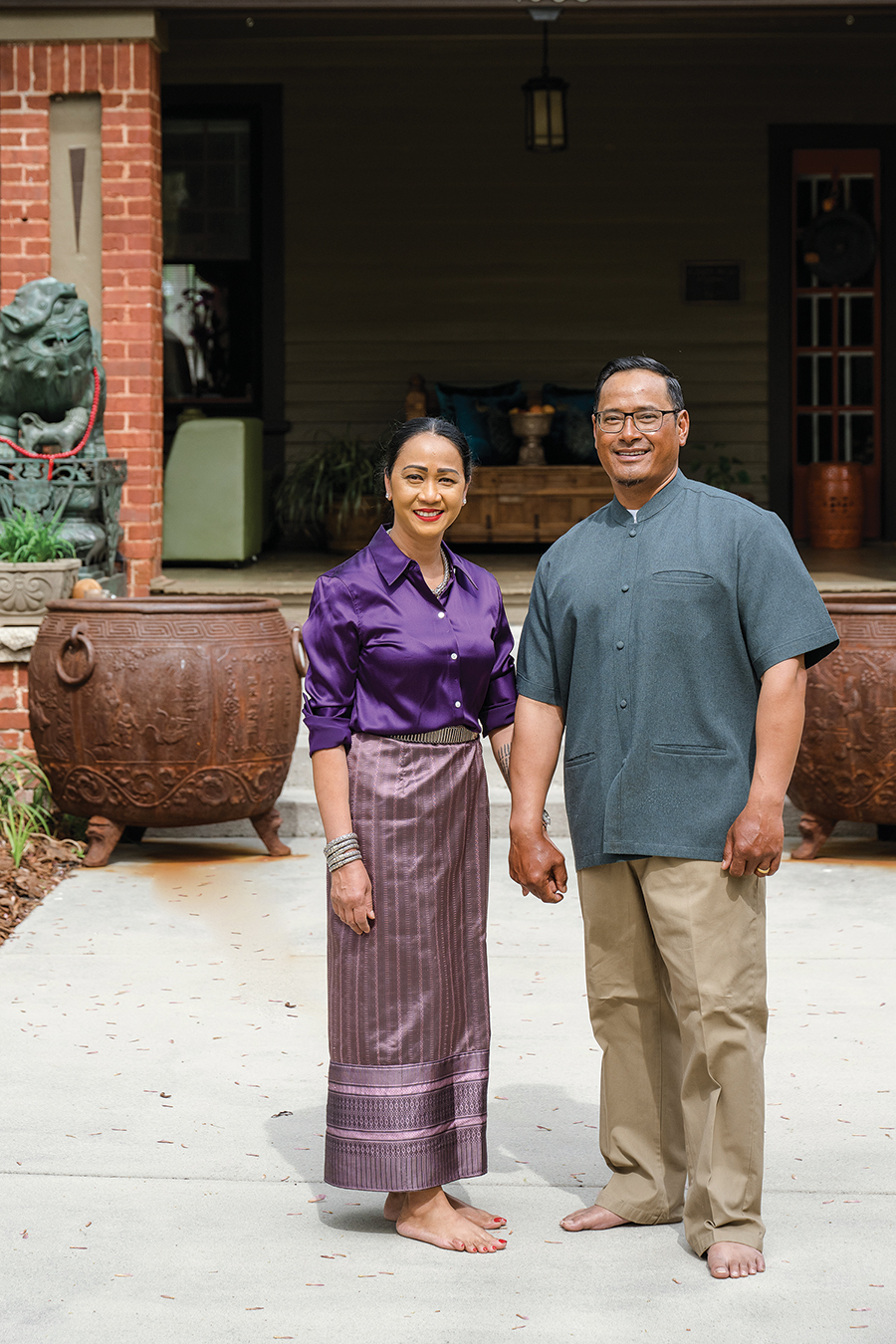
High Point restaurateurs Tu and Todd Sen revere the history of their Johnson Street home
By Maria Johnson • Photographs by Amy Freeman

The real estate listing popped up on Tu Sen’s Facebook page around midnight.

She went running to find her husband, Todd, who was minding a backyard fire pit with the couple’s daughter Tiffany Vanhpraseuth and godson Christian Thomas.

The family had just gotten home from working at their restaurant, 98 Asian Bistro in High Point.

“I said, ‘Oh my God, Todd, my dream house is for sale! We have to see it!’” Tu remembers.

Todd knew which house she meant, a wide-set Prairie-style gem that would fit right into Oak Park, Ill., where famous architect Frank Lloyd Wright lived and worked.

Built in 1910, Tu’s dream house sat squarely in High Point’s Johnson Street Historic District on the eastern edge of downtown. Officially, the place was called the Burnett-McCain House, after the structure’s first two owners.

A century later, whenever Tu and Todd passed the house at the corner of Johnson Street and East Farriss Avenue, Tu would ask Todd to put on the car’s emergency flashers and stop at the curb so she could get out, jab a couple of incense sticks in the corner of the yard, light them and pray to the house, asking permission to live there and take care of the structure some day.

Todd knew that Tu loved the house because it looked Asian, with its simple horizontal lines and deep front porch.

He knew, too, that she thought it would be a good home for the many Buddha statues that she kept in her prayer room, a shrine she created inside a storage shed at their suburban High Point home.

But even in the face of Tu’s excitement about the historic property, Todd was overcome by worries about money — and by an unspoken feeling that people like him and Tu, who came to this country as child refugees from war-torn Southeast Asia in the 1970s, shouldn’t, and couldn’t, live in a big house like that.

“We can’t afford it,” he told her that night. Undaunted, Tu made an appointment to see the house the next morning. After the showing, she called Todd. “We have to make an offer,” she said.

The house was charming and sophisticated, she reported. It was full of modern furniture and — although the owners weren’t Buddhists — it contained several Buddhas already. “I said, ‘No wonder I liked it,’” she recalls.

The owners were asking $350,000. They had three offers already.

Tu — who had a good idea of what she and Todd could afford — wanted to offer $358,990. Cash.

Todd knew how determined his wife could be when she wanted something. Usually, he was happy with the outcome. “OK,” he said. “Do it.”

They made an offer.

A few days later, Tu toured the house again. This time, she took fresh fruit as an offering, spread it on a white sheet in the foyer, lit 10 white candles and had a chat with the house.

“I said, ‘I’m here. You already know me. If you want me to be your next caretaker, choose me. If you feel I’m not the right person, I will accept it.’” Two weeks later, the agent called. The owners had taken their offer.

The Sens moved into their new-old home in November 2019.

Sitting in the front room, on a plush beige sofa that matches the couple’s blond Yorkshire terriers, Bang and Blue, Tu explains why she believes the former owners accepted their offer.

“The house talked to them” she says. Todd chuckles and points out that Tu talked to the house first.

“I’ve been with my wife 29 years and let me tell you,” he says, “I’ve seen miracles around her when she prays.”

Tu nods, adding that she prays for many things: family, friends, her hometown.

By hometown, she means High Point, not the U.S. military base in Laos where she was born 48 years ago. A lot has happened between then and now. “I pray for healing,” Tu says. “For what I went through.”


She remembers the sound of helicopter rotors slapping the air. Then a toddler, Tu was strapped to her mother’s chest with a bed sheet. Her mother had one foot in a Black Hawk helicopter and was telling Tu’s father to come on. Because Tu’s father had worked for the U.S. Central Intelligence Agency in Laos during the Vietnam war, the Americans offered to evacuate the family as Vietnam and neighboring Laos fell to Communist forces. If you stay, they will kill you, her mother told her father.

I’ll be fine, he said. Tu’s mother stepped out of the helicopter. Laotian officials arrested her father and threw him in jail, where he was chained in a dark basement. Tu, her mother and two sisters lived nearby. Her mother cooked and kept house for her husband’s captors. Gradually, they trusted her enough to release her husband. But he wasn’t the same when he got home.“He was broken,” says Tu.

Her mother, who was Thai, decided the family should risk an escape to Thailand. One night, when Tu was about 8, her family and a few others boarded canoes to paddle across the Mekong River to Thailand. Rain lashed the canoes. Thunder rattled their already raw nerves. Lightning strobed, exposing their location to Thai soldiers, who shot at them. “My mom told all of us to lie down,” Tu says. They made it.

A couple of days later, Thai police picked up the group, soaked and traveling on foot. Eventually they were taken to a refugee camp. The family stayed in camps for about four years. Tu remembers room dividers made of newspaper and bamboo. She remembers getting one fish, one bowl of rice and a five-gallon bucket of water every day. She remembers Thai vendors selling apples outside a barbed wire fence.

“I wished I could taste that apple,” she says.

Once her family was cleared for green cards because of her father’s service to the U.S., camp officials asked her mother where they wanted to go. Her mother pointed to a post card of the Statue of Liberty in New York Harbor.

“She said it was the land of gold,” Tu says. “My father said the Americans would never leave us. He believed that.”

The family lived in Jersey City, N.J., for several years, then followed their middle daughter, Mary, to Greensboro.

Tu’s parents worked in a mattress factory in Asheboro. Mary worked at a sock factory and grocery store in Greensboro. Tu waited tables in a Chinese restaurant, Empress Garden, in Greensboro.

“I did so well I had people waiting to sit in my section,” she says. “All my customers were elderly. They tipped me really well. They knew I was a single mom.”

Years later, when Mary and her husband, James, opened Thai Chiang Mai, a restaurant in High Point, Tu and her second husband, Todd, joined them in the family business.

Born in Cambodia, Todd also had lived in a Thai refugee camp — though not the same one as Tu — before his family immigrated to South Bend, Indiana. One spring weekend Todd came to a friend’s wedding in Lexington, N.C.


His parents saw photos of him wearing shorts in North Carolina while they still wore coats in Indiana.

They saw the red clay soil, which promised a longer growing season for their garden.

They were sold on the South. The family relocated to the Piedmont, worked in furniture factories, and planted a huge garden.

“I think my mom has never bought a vegetable,” Todd jokes. “For the older generation, they grow stuff to connect them to the old country. Myself, I go fishing because that’s what I did when I was younger, in Cambodia, for food.”

His fish-grilling skills came in handy when he and Tu opened their own place, 98 Asian Bistro, in 2015. The upscale restaurant, which occupies part of a former Chevrolet dealership on Main Street in High Point, memorializes the year Tu’s father died, 1998.

Tu and Todd insist on honoring those who have paved the way for them.


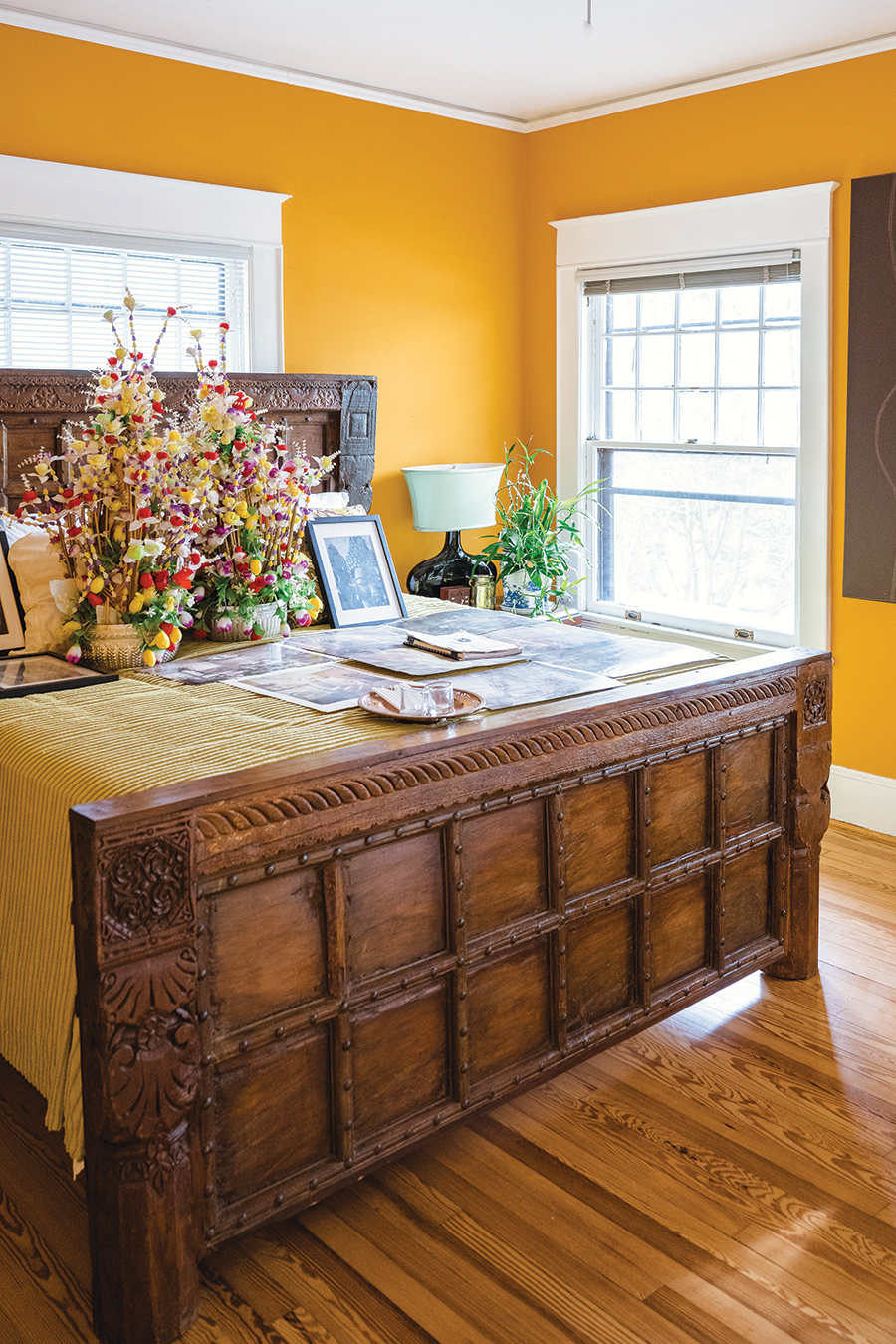
In their home, they have set aside the master bedroom to venerate the home’s second owner, physician H.W. McCain, whose family lived there more than 40 years. No one sleeps in the king-size bed, which is strewn with photos and write-ups about the home.

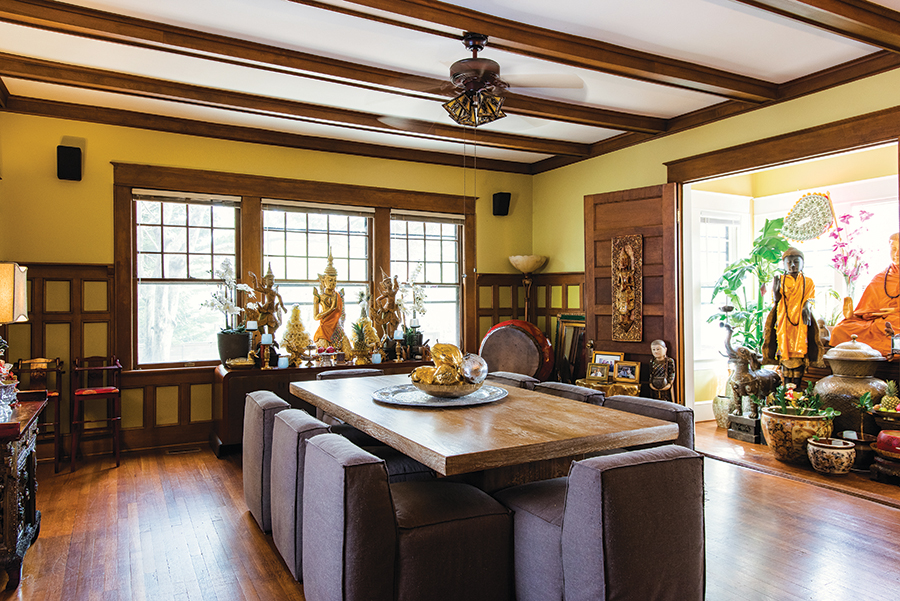
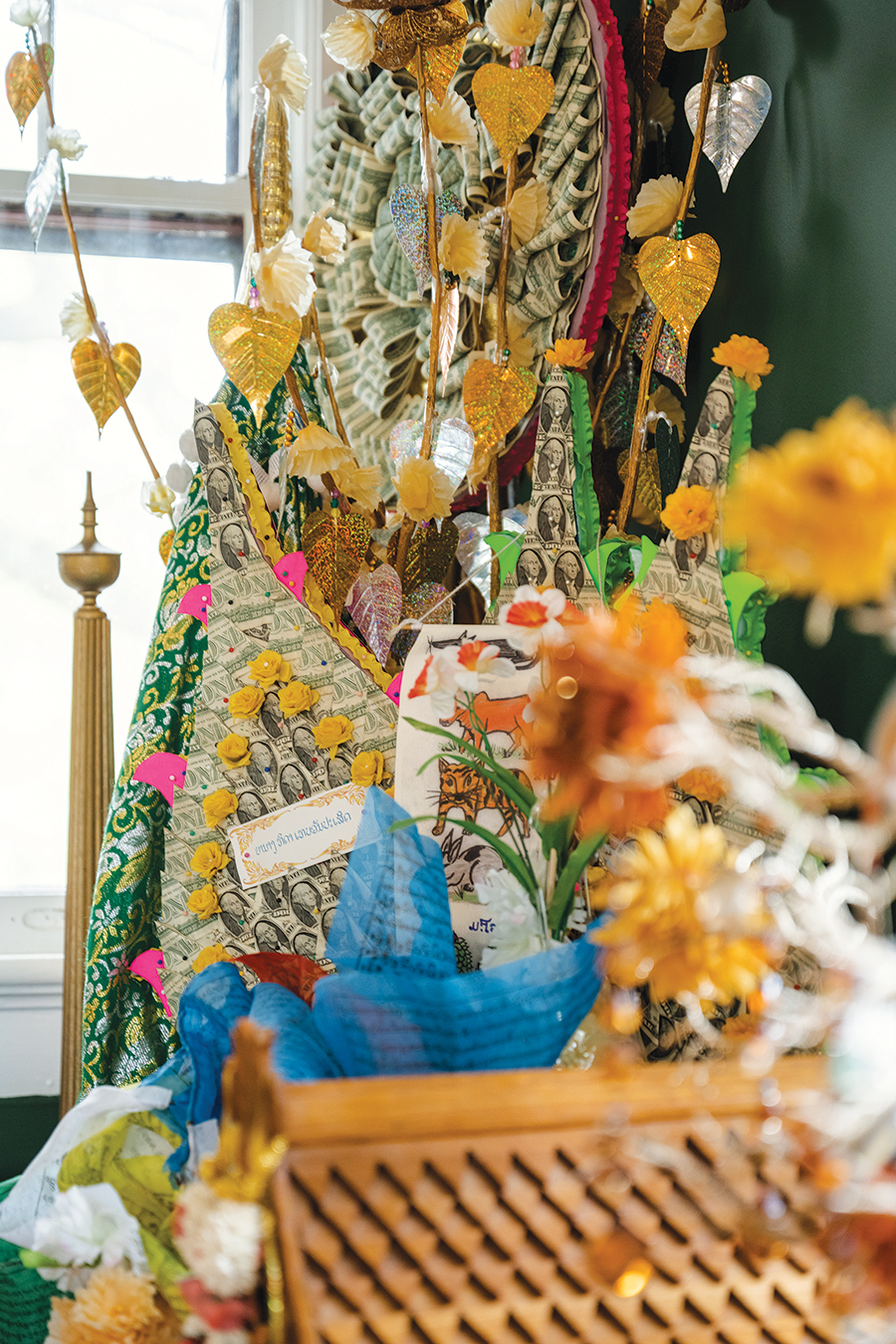
Another bedroom is Tu’s prayer room, which twinkles with banks of metallic figures representing both sides of her family: Buddhist and Thai cultures for her mother; Hindu and Indian cultures for her father. Fresh flowers, fruit, candy, bottled water and sweet drinks welcome the spirits. Incense perfumes the air.

A third bedroom serves as a closet for Tu and Todd.

The couple sleep in a modest fourth bedroom. It’s the only room that they have furnished themselves.


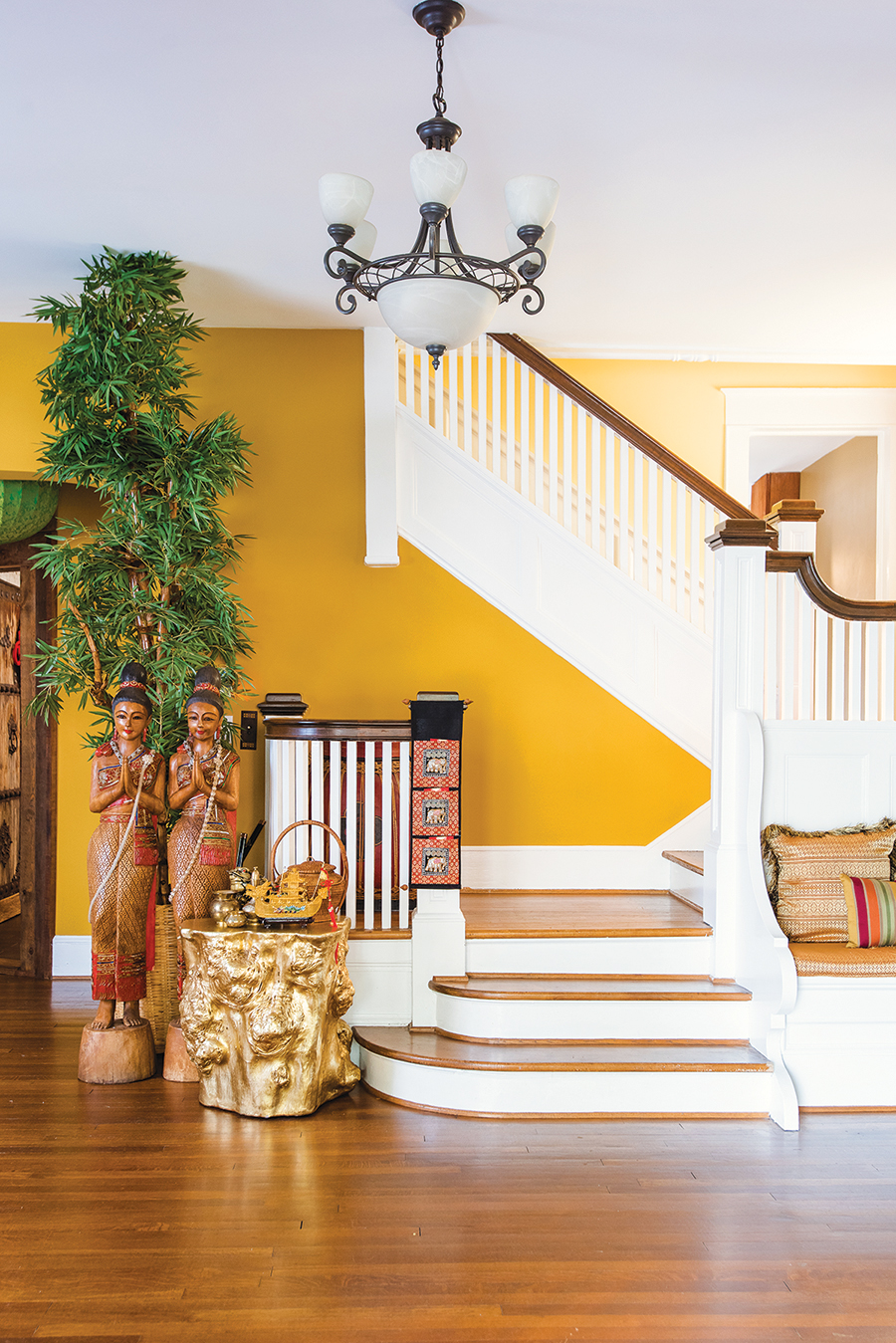
The home’s former owners, Michael and Patricia Bellocchio, who own a furniture manufacturing company, left behind many sleek pieces — the armless sofas in the front room, the minimalist dining room table and chairs — as well as carved Spanish Mission-style chests, sideboards and armoires that harmonize with Eastern flavors.

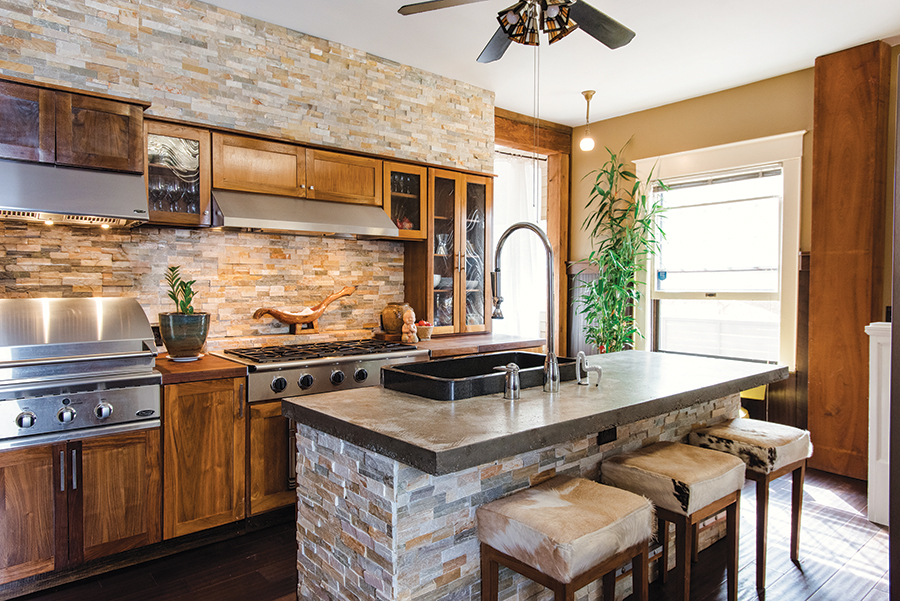
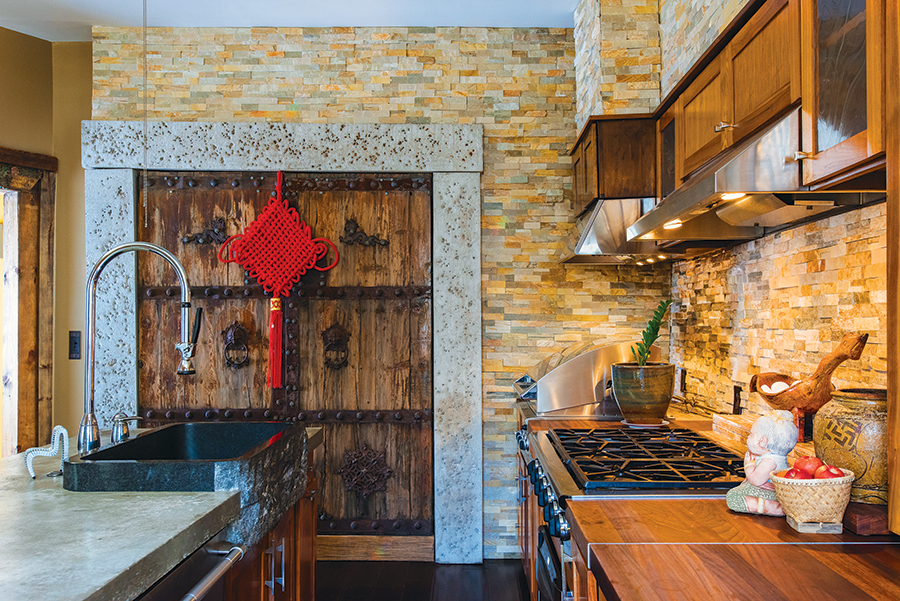
A pair of decorative wooden doors — supposedly from an Asian temple — are set into the wall of a professional kitchen that sports a six-burner gas stove, a concrete-and-mahogany topped island, an extra-wide refrigerator and freezer, a double oven and walls textured with stacked quartz stone.

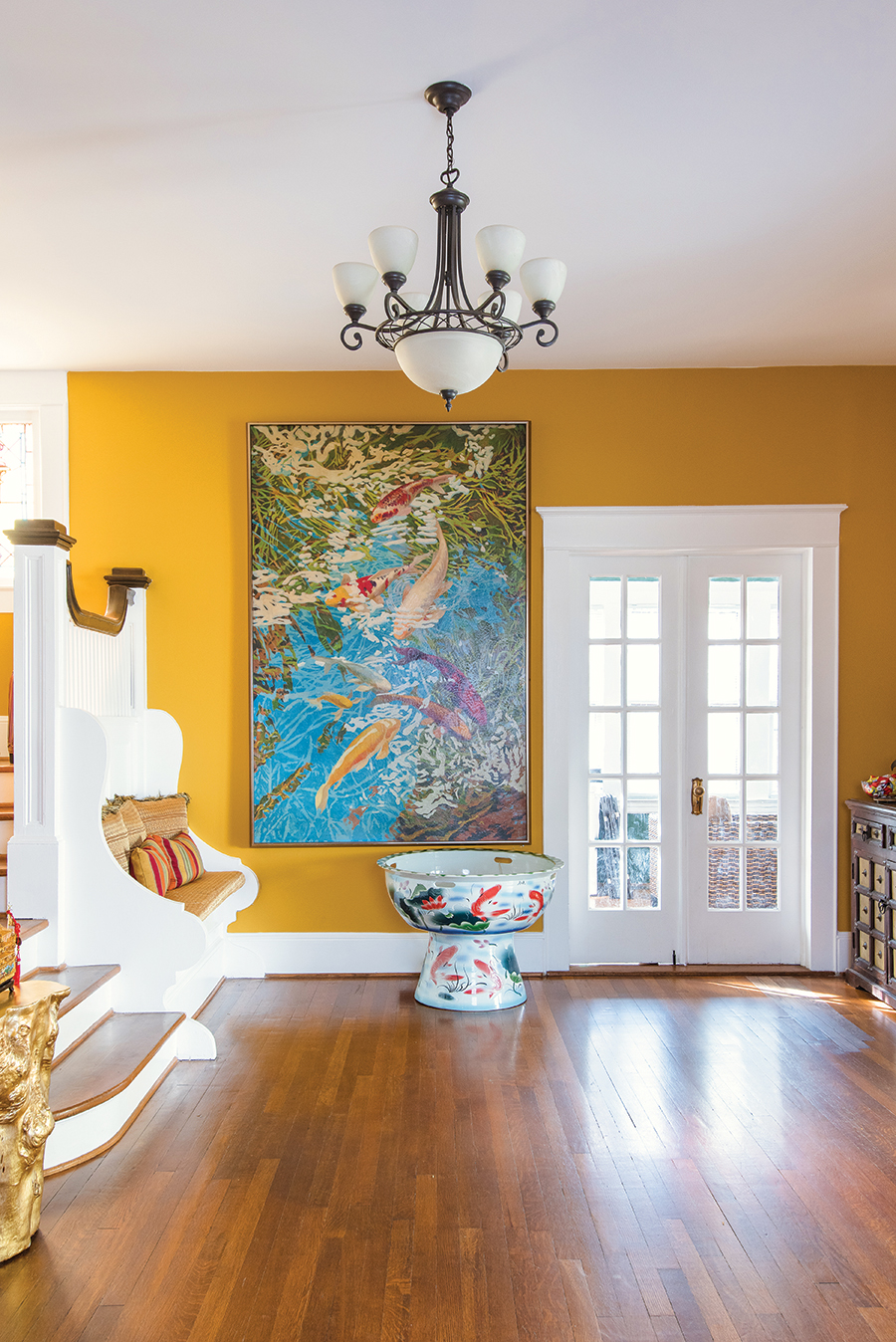
Other than painting the home’s interior walls gold and green, the Sens have done very little updating. They’ve filled in the gaps between furnishings with a bevy of treasures, many of which have been given to them or sold at a discount by friends in the furniture industry.

The faux pink cherry blossoms that fill giant metal vases on either side of the fireplace? A customer ordered them for her daughter’s wedding and gave them to Tu afterward.

The bronze Chinese lions in front of the house? Tu saw them in a High Point store more than 10 years ago. “I said, ‘If you stay here, I’ll come back for you,’” she says. When she returned, the big cats were waiting at a fraction of the original price. She took them home and draped them with red strings of Buddhist prayer beads.

The burbling orb fountain with water slipping down the sides? A gift from the owners of the Phillips Collection, who are Tu’s customers.

The house-warming gift that she wanted the most — an American flag — came from the High Point Chamber of Commerce, which named her Businesswoman of the Year in 2016.

“I always said I wanted to have a piece of America,” says Tu. “Owning this home is a piece of America.”

The house continues to inspire dreamers, Todd says.

“Every once in a while somebody will stop their car in front of this house, get out and take a picture.”  OH

Greensboro’s Johnny Appleseed

The green thumb of Bill Craft

By Cynthia Adams     Photographs by Mark Wagoner 

Bill Craft Park Greensboro NC

Bill Craft, head of Craft Insurance and self-styled nature lover, could have spent his dollars on self-aggrandizing gestures.

But no. Over 81 years, Craft expended resources and muscle making Greensboro better, more colorful and definitely greener.

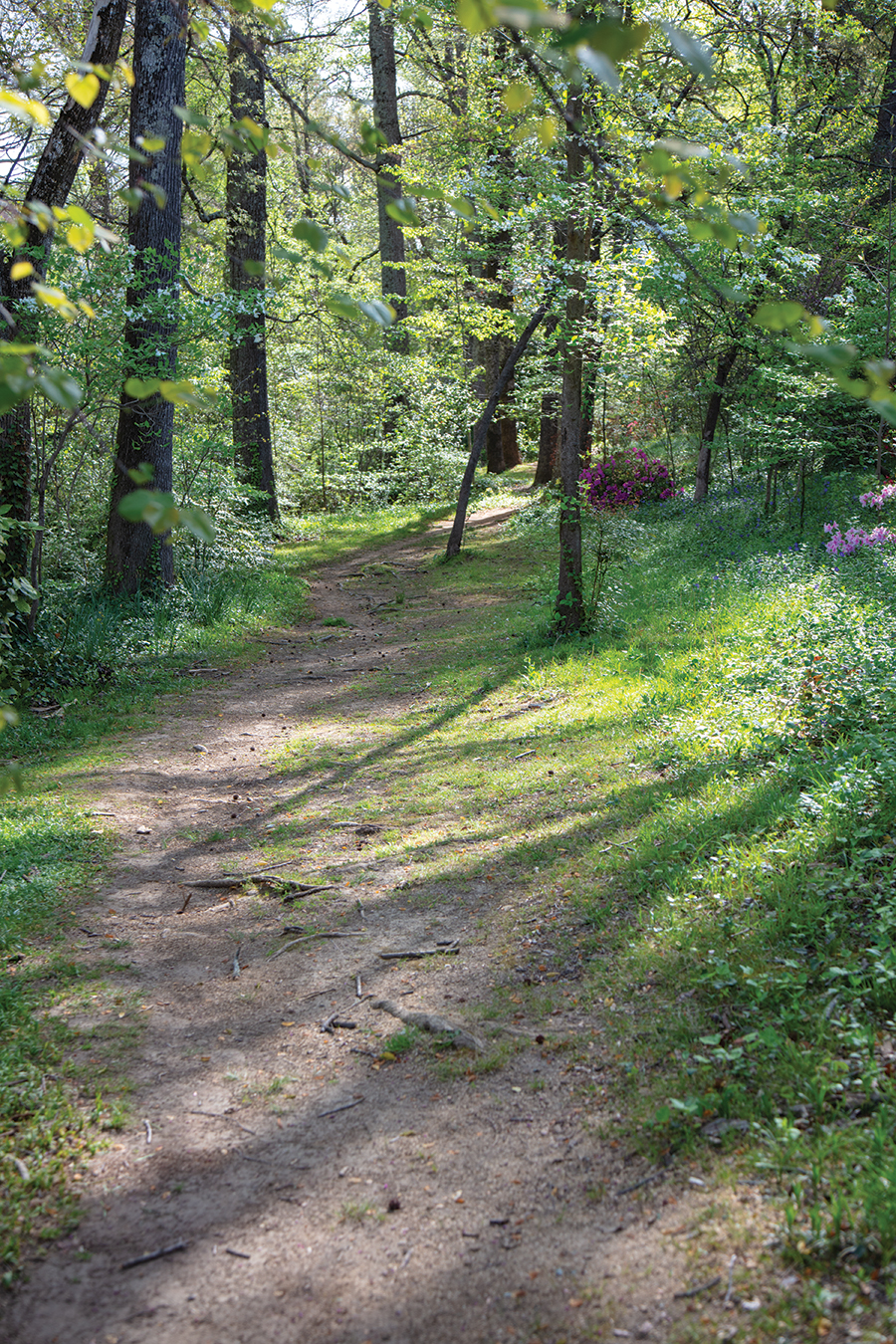
Wearing old shorts and battered sneakers, Craft took to the creek banks near the family home on Dover Road, rousing a few of his nine children to weed and play, creating a naturalized woodland “creek park.”

He toiled there and at other public spaces for 50 years until the end of his life.

Craft’s headstone at Forest Lawn Cemetery simply reads “Greensboro’s Johnny Appleseed.” Yet, according to a horticultural inventory, Craft planted almost everything but apples in the public spaces he beautified.

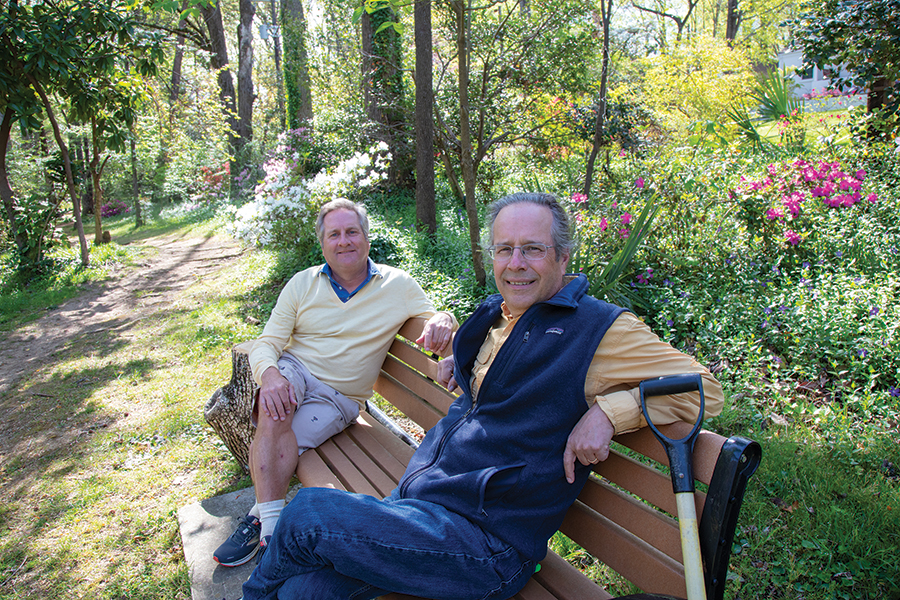
He singlehandedly planted and maintained more than 100 species of trees, shrubs and rare plantings in his pet project — a namesake park in Old Irving Park just south of Greensboro Country Club — Bill Craft Park. The “creek park” he created was a perfect backdrop for his father’s labors, says Daniel Craft. “He kind of had a blank slate. . . . Nobody [else] looked after them.” Worn, meandering and unpaved paths seemed perfect for walkers and children at play. Nothing overly manicured.

He invited others to fall in love with the great outdoors, as he had. Adding dollops of color through plantings and taming overgrowth was enough; Craft knew when to step back from the canvas.

Resident Ann Robinson says the idea was “to create a walk in the woods.”

Her sons Will and Patrick Robinson spent hours playing there when young, making forts from culled bamboo and splashing in the creek with their dog, Nipper.

Craft was restless, possessing an unusual amount of energy. As an only child, he inherited his father’s business, dutifully leading it from 1954 until 1996 when his children took over. But he bolted outdoors as often as possible on a dizzying mission: beautifying grounds at St. Francis and Holy Trinity Episcopalian churches, as well as at St. Pius and Brightwood Christian Academy.

He also turned his attentions to Fisher Park, the Greensboro Science Center and Irving Park School.

Bill Craft Park Greensboro NC

Craft even kept a garden for seniors at Evergreens Nursing Center and took them flowers.

After graduating from Carolina, he served in the Coast Guard before marrying Joanne Brantley. They had six sons and three daughters. Craft’s Chevy S-10 pickup’s tag read: “9Younguns”. David still has it.

Daniel recalls being “dragged to parks, to a playground or Scouts” on Saturdays. Craft led Boy Scout Troop 216 for years; all six sons earned their Eagle badge, like their dad.

David says their colorful father, turbocharged with energy, “didn’t like sitting around talking about things.” An understatement.

His favorite expression was, “Okey-doke.”

Robinson, whose family moved to Blair Street 25 years ago, soon encountered Craft’s energy. Despite his thatch of white hair, he carried buckets and buckets of water, tending plants.

“When we first moved to Blair Street,” Robinson remembers, “I ran into Bill in the park — working, planting as usual . . . and I told him that I had two boys who could help out if needed. He kind of nodded and pointed to our house on the corner to say, ‘Is that where you live?’” That Saturday morning, the doorbell rang, “and there was Bill with buckets and shovels. I opened the door and he said, ‘Where are those boys?’” Robinson woke her sons, and they returned exhausted.


The Craft boys related.

Equally fond of hiking and biking, Craft volunteered on Greensboro’s network of bike trails, which eventually extended through Lake Daniel, Latham Park and Lake Daniel Greenway, on the Benjamin Parkway.

Indefatigable and upbeat, Craft was “kind of a dreamer,” once driving a few of his children to Morehead City in search of Spanish Moss. He stuffed the station wagon, returning home the same day.

“The moss didn’t make it in our climate,” adds Daniel, “but it got us out of the house.”

Stories about Craft tumble out of family and friends.

After years of his beautification endeavors, the Chamber honored him in 1974. A comical exchange with philanthropist Joe Bryan became his favorite story.

“He got the Dolley Madison award the same night Joe Bryan got an award,” Daniel recalls.

“They both lived in Irving Park — knew each other. Dad started talking to him, and said, ‘I’m getting an award for my park.’ Joe says, ‘I’ve got a park named after me, too. But they don’t make me work in it.’”

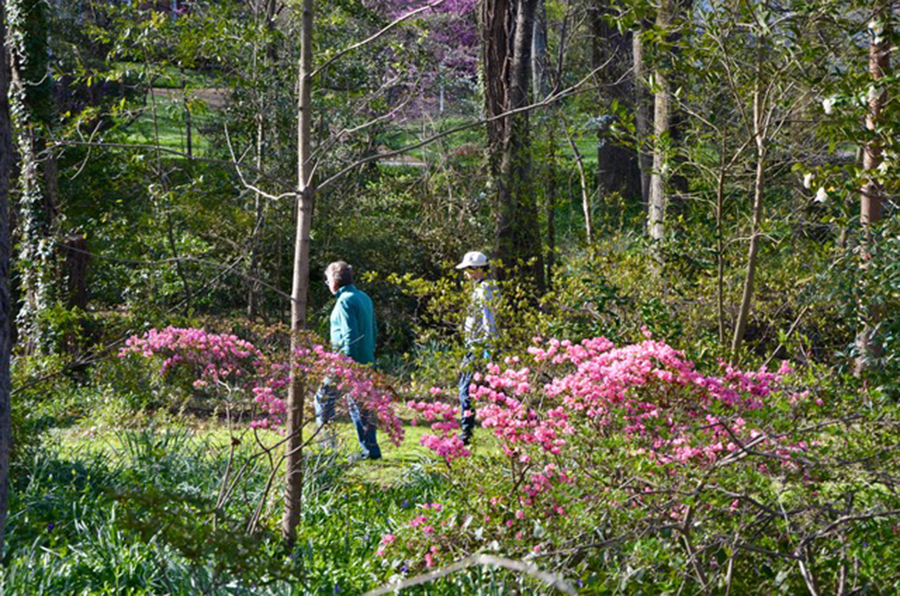
The Bill Craft Park grew as colorful as its namesake. Craft’s sons estimate there are easily “l00 azaleas and camelias alone — his favorites.”


Daniel mentions a 1990 summer date with his later wife, Kathy. They were cycling toward Greenhill Cemetery and spotted a man working. “I think I said, ‘Oh, s—t,’” he spluttered.

“Kathy said, ‘What?’ ’’ Daniel recognized the unmistakably tan, wiry figure of his father.

“There he is, tennis shoes, no shirt, and a black Speedo bathing suit, planting a tree! That’s how she met him.”

David groans at the Speedo story, saying, “Dad was just living. Didn’t care about judgment . . . I thought he was a kind of a nut when I was a teenager.”

But they admired how their father juggled a vocation and fatherhood with many interests, never missing dinners. He watched no television, and read with the same fever that he brought to gardening. His sons say he took pleasure “in very basic things.”

Sons No. 9 (Daniel) and No. 8 (David) remained in Greensboro as adult siblings scattered.

If there is an apple tree, seems the Craft sons did not fall far from it. Daniel also likes to do his own thing. “I don’t need validation for what I do.”

He points out that David has been instrumental in building trails and creating the Haw River State Park. David points out Daniel’s devotion to the Bill Craft Park auxiliary.

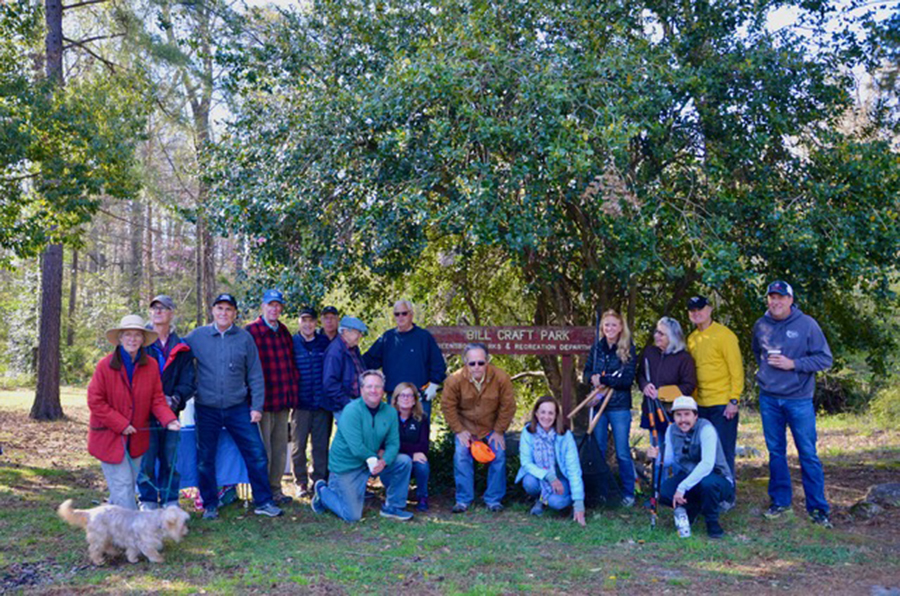
Ann and Russ Robinson were also among original members. “The auxiliary started after Mr. Craft passed away . . . We were in the group that got it going with the Crafts and other neighbors — many of whom were friends and contemporaries of Bill’s,” she recalls.

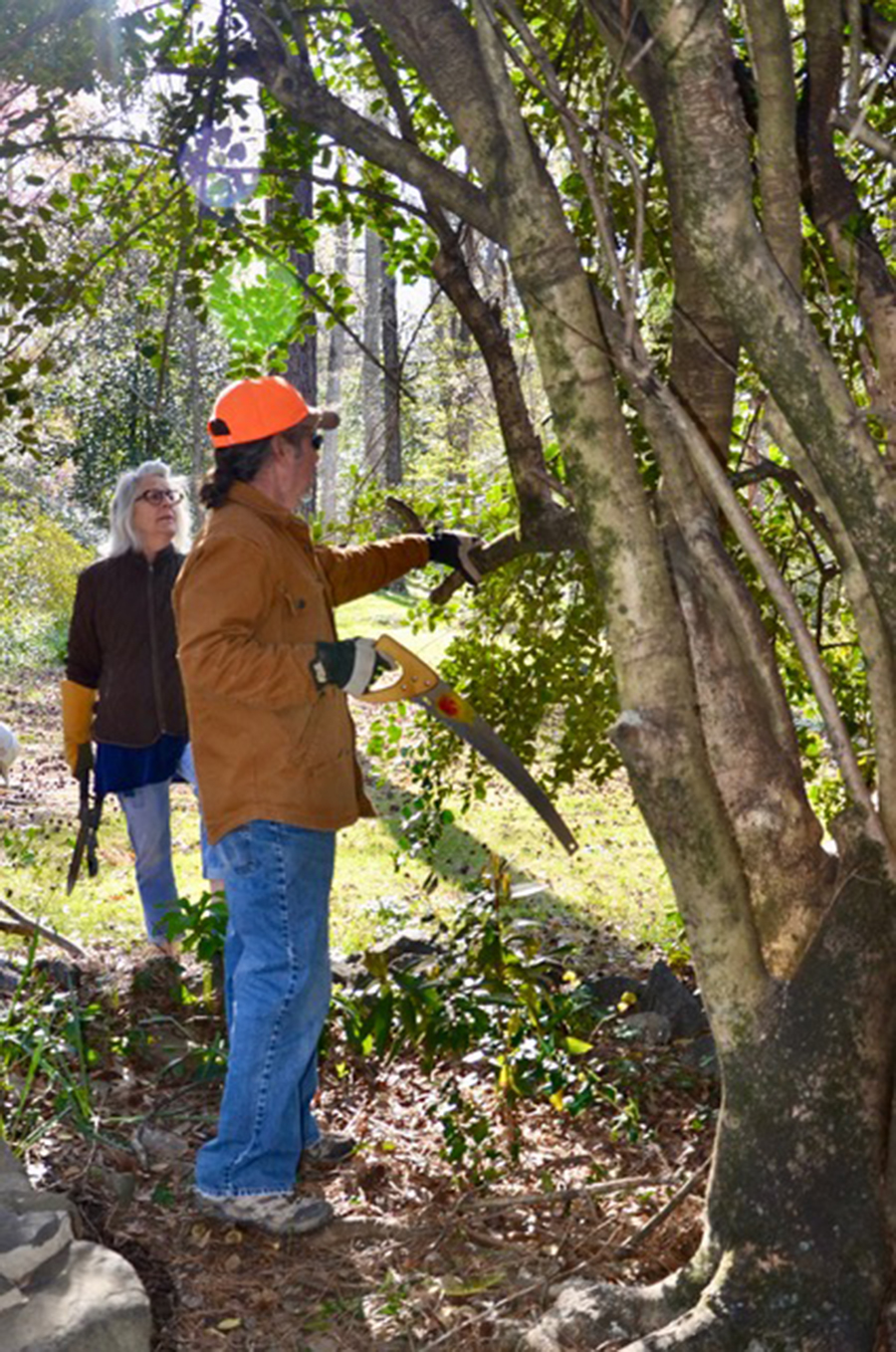
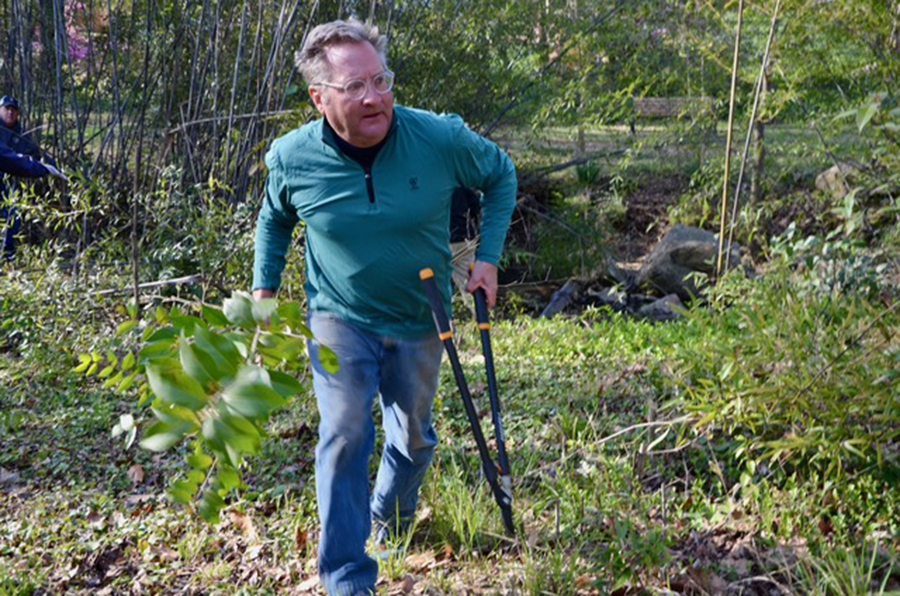
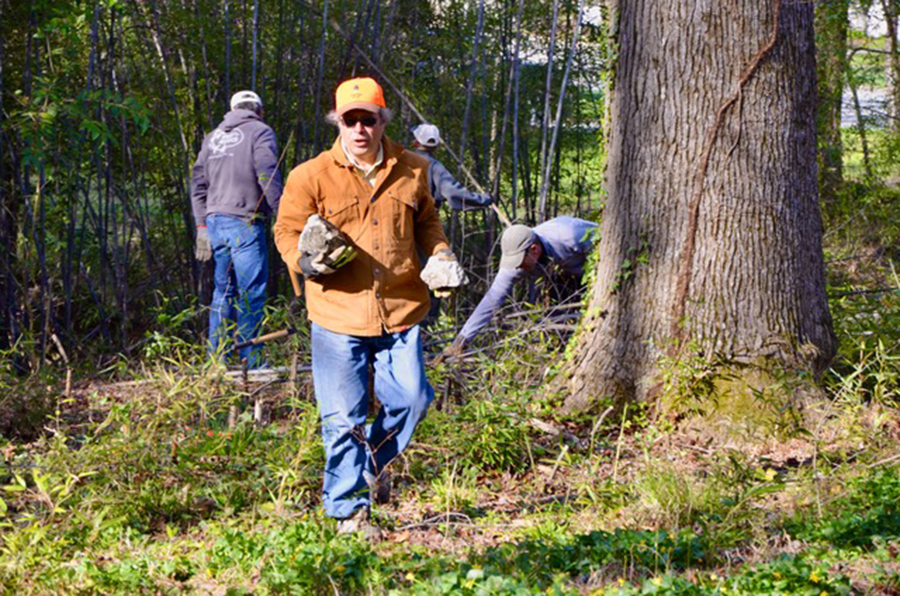
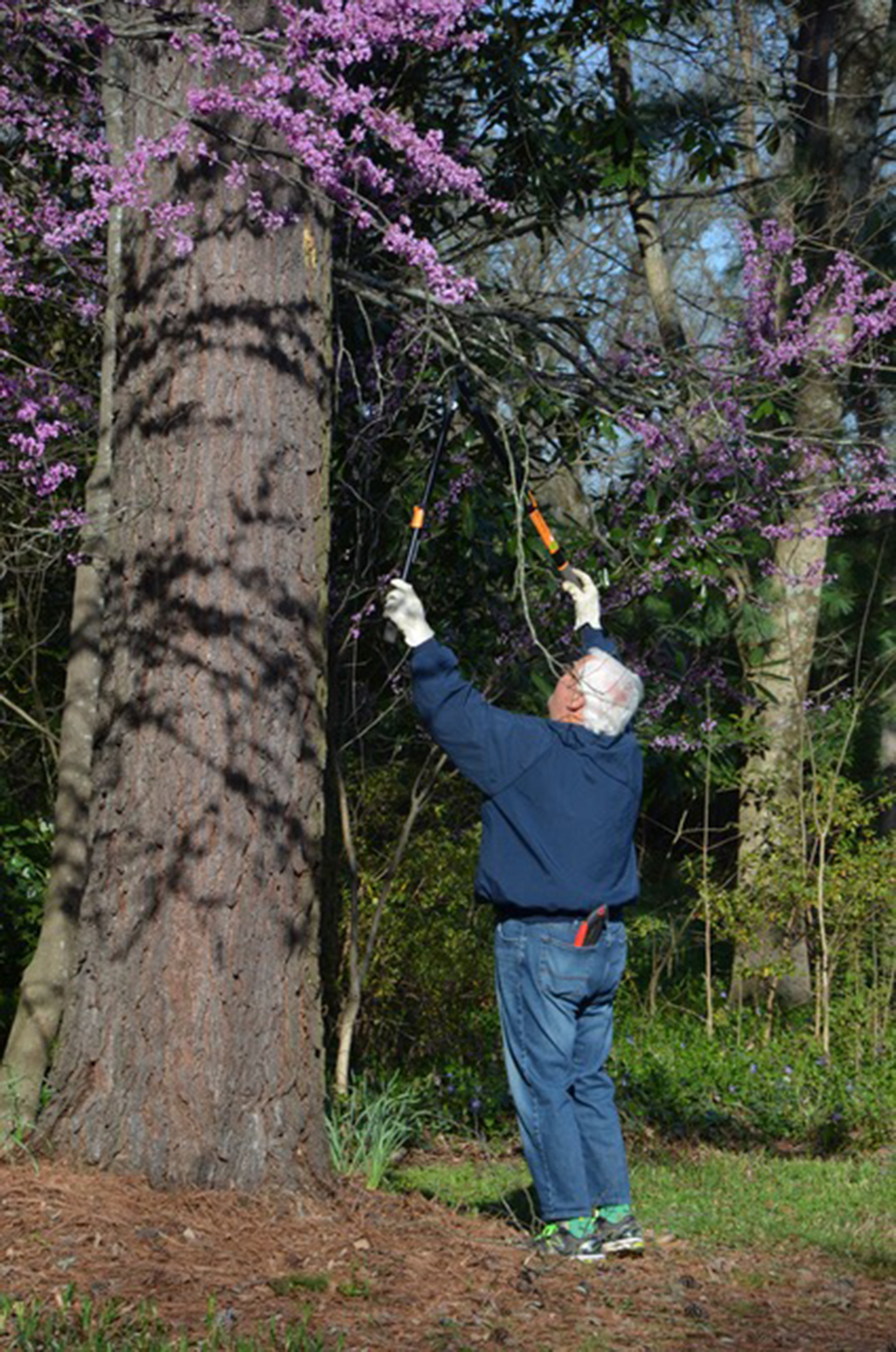
A dozen or so auxiliary members meet twice annually at the Bill Craft Park sign, sharing donuts and coffee the Robinsons bring before weeding, pruning and clearing.

Years ago, Styers helped with an inventory that totaled 117 plantings. The inventory documented varieties of dogwoods, hollies, birches, buckeyes, elm, redwood, magnolias, cherries and fruit trees, plus nut trees, hemlock, pines, persimmon, sweet gum, oaks, spruces, cedars, maples, cypress, and even unusual palms, roses, jasmine, lilac and anise.


Shelton Styers documents images on the Bill Craft Park Auxiliary Facebook page (www.facebook.com/groups/164265200263243/).

On workdays, stories emerge about the man who inspired it all.

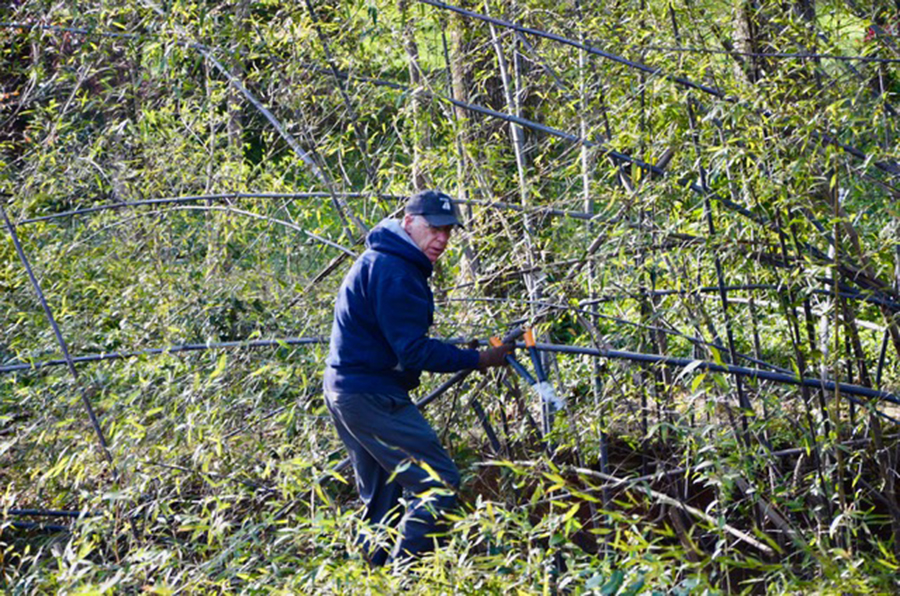
“We control the invasives. Prune some things here and there,” Daniel says. “One of Dad’s biggest regrets was planting bamboo there.” He tackles the dreaded bamboo first.

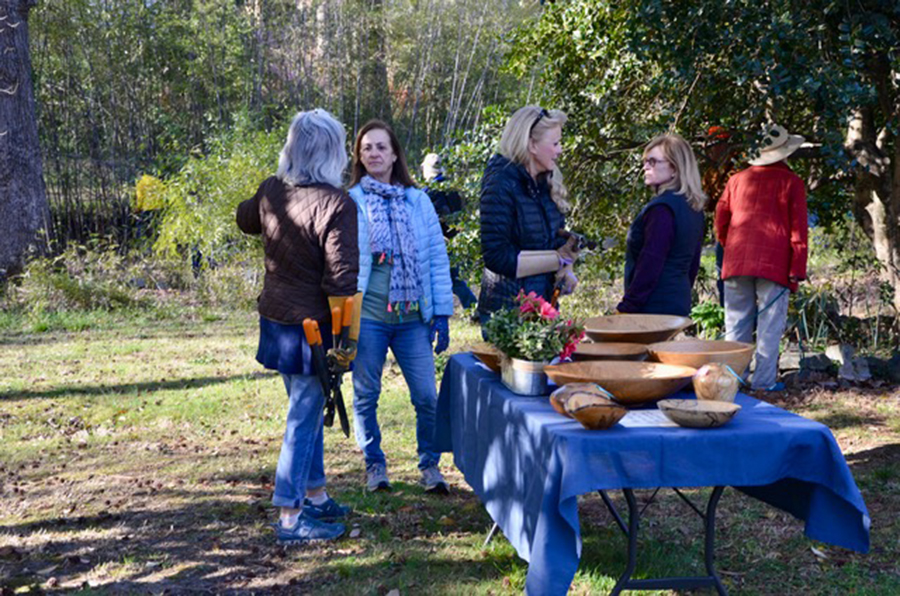
For the Robinsons, the park became important to their sense of community. “Our most recent park project has been very fun,” says Ann. “There was a really big Ash tree that came down in front of our house in the park. It was during COVID. I’d been involved in a fundraiser in the mountains that involved making wood-turned bowls from a tree that came down and thought we could perhaps do the same for Craft Park.”

Woodworker, Rick Andrews made wooden bowls and ornaments that were sold last year.

“We even had one bowl that we gave to Rip Bernhardt — an old friend of Bill’s who, although he lives at WellSpring now, always tries to come at least for the coffee before the clean-up and visit. He was very touched by the bowl we gave him and to have a ‘piece of the park’ and asked me to take his picture on the stump of the old Ash tree to send to his friends.”

David adds, “One of his buddies, probably 20 years ago, said, one of your dad’s greatest skills was he can talk to the janitor of the company and the CEO of the company and make them feel equally important.”

In 1991, the Greensboro Interclub Council recognized Craft’s outstanding civic leadership: a Jaycee, and a Red Cross and Kiwanis member, he served on most all the civic organizations. He joined nearly every outdoor group, including the Piedmont Appalachian Trail Hikers, the Guilford Wildlife Club and more.

David muses. “Dad used to say that being in the insurance business made him a good living and enabled him to do what he wanted to do . . . but if he could have been something else, he would have been a college professor.”

No doubt, a botanist.  OH


Adopt a Park  Adopting a park helps keep public parks beautiful. Contact Alex Alexandra Zaleski, the city’s volunteer coordinator, at (336)–373–7507.

Flower Power

All the yard’s a stage in Shellie Ritzman’s blooming world

By Maria Johnson

Photographs by Amy Freeman

Shellie Ritzman is having a vision.

Right here, right now, standing in the dirt beside the brand new, tin-roofed workshop in her backyard in Kernersville.

She’s waving her hands. Her voice and her body are animated.

She can see the future. She points to it.

See? There’s a bright floral design — one she has painted — on the exterior wall of the workshop.

Below the design, on the ground, there’s a bench. A long bench.

The bench is filled with Boho pillows.

“You can seat probably six, seven, eight people,” she says.

Her customers will mug for pictures there, she says. Young people, especially. They want pictures to post on social media to show people their memories before they’re even memories. That’s why Ritzman has painted cheerful background graphics on other walls around the property.

But back to the vision.

Gravel will go here, Ritzman says, brushing broad strokes with her palms to the ground.

Her hands fly up, and she draws lines overhead.

Bistro lights will go here.

Anchored by a tall post here.

And, of course, she says, her fingers playing arpeggios in the air, the space will be surrounded by gorgeous flowers and plants.

“There’s so much to do,” she says, turning on the heels of her sporty flip-flops.

Somewhere, there’s a stopwatch ticking, and Ritzman — who goes by Shellie Watkins Ritzman professionally — hears it loud and clear.

“I’m always thinking of stuff,” she says. “Always.”

Her feat isn’t so much the thinking, though.

It’s the doing.

The actions that make her vision real.

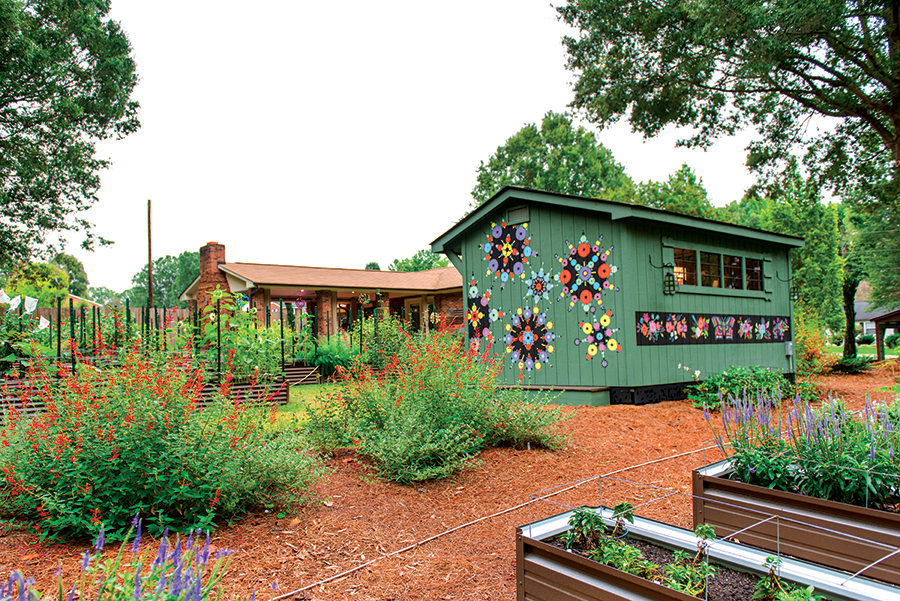
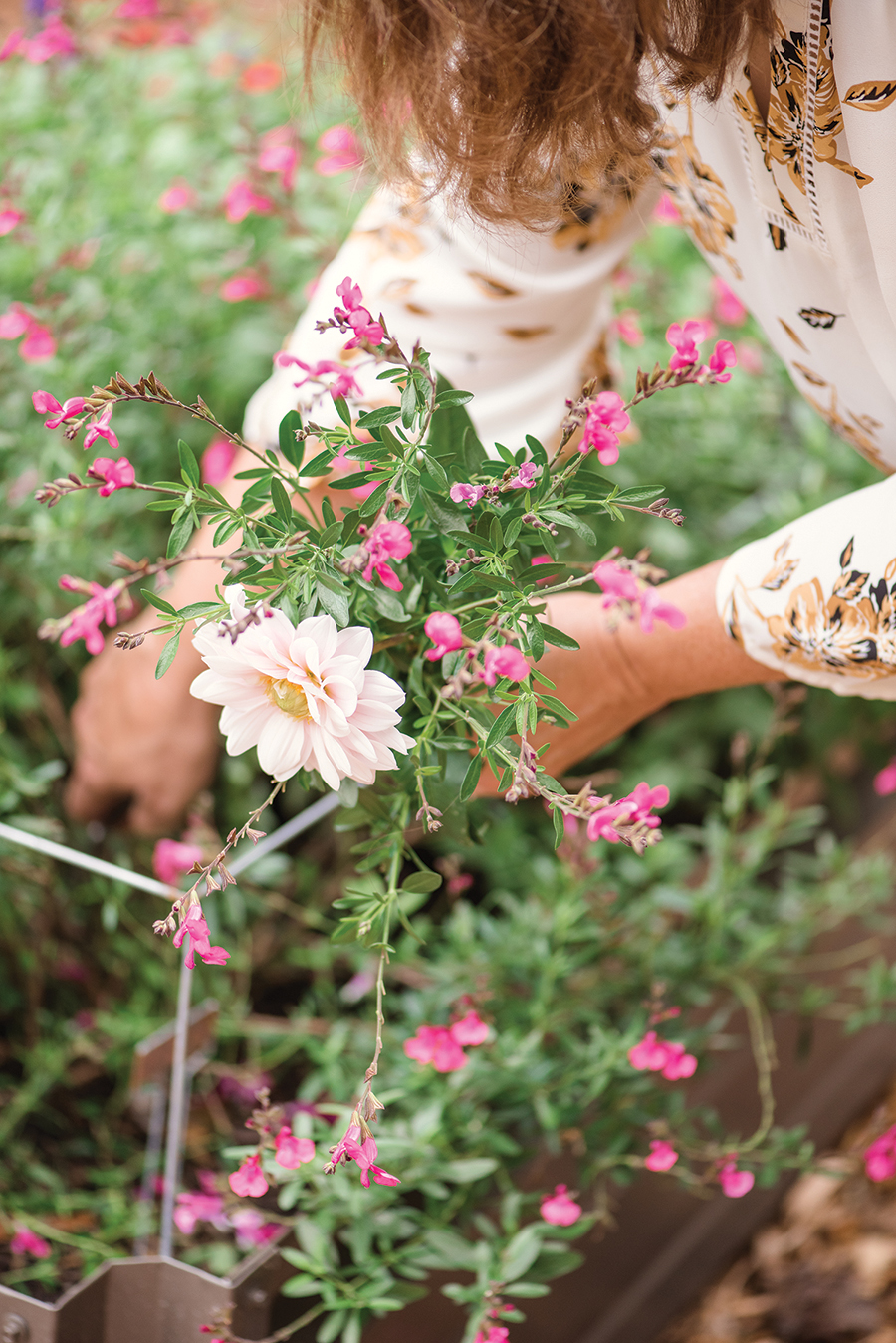
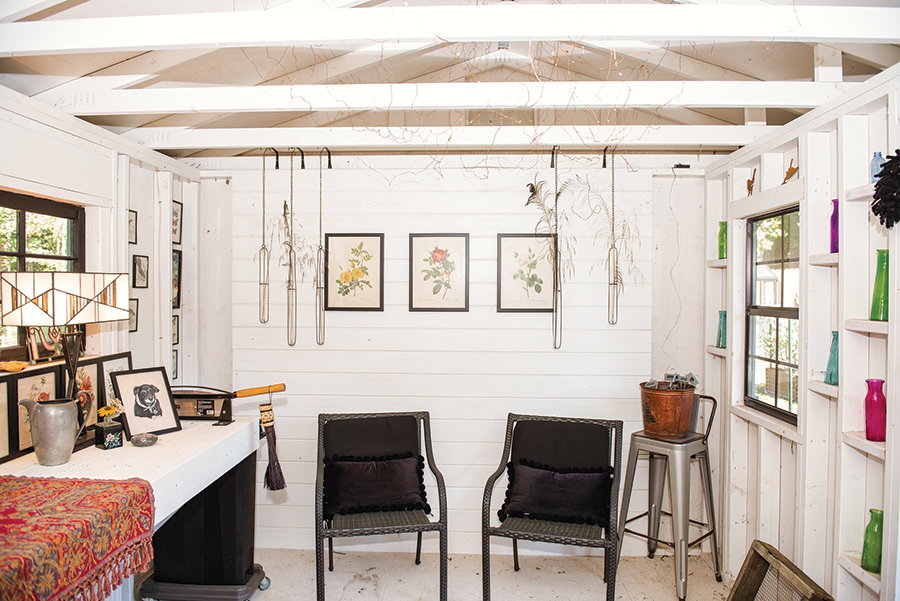
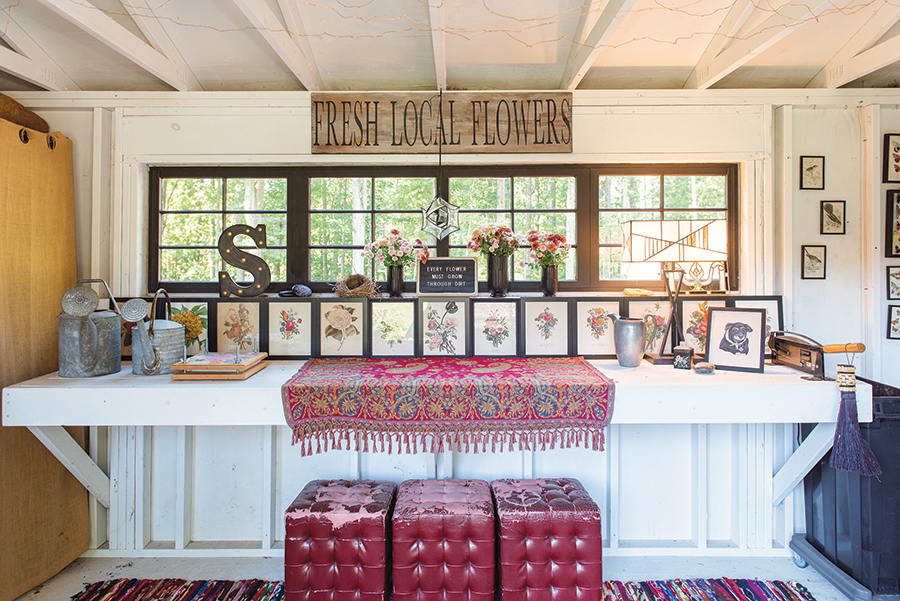
In the last two years, this semiretired executive assistant has created, from thin air and good dirt and more than a little sweat, My Garden Blooms, a homespun enterprise that wraps a cut-flower business — rooted in a backyard labyrinth of raised beds— around cozy staging areas where area artists and craftspeople conduct flower-friendly events for paying customers.

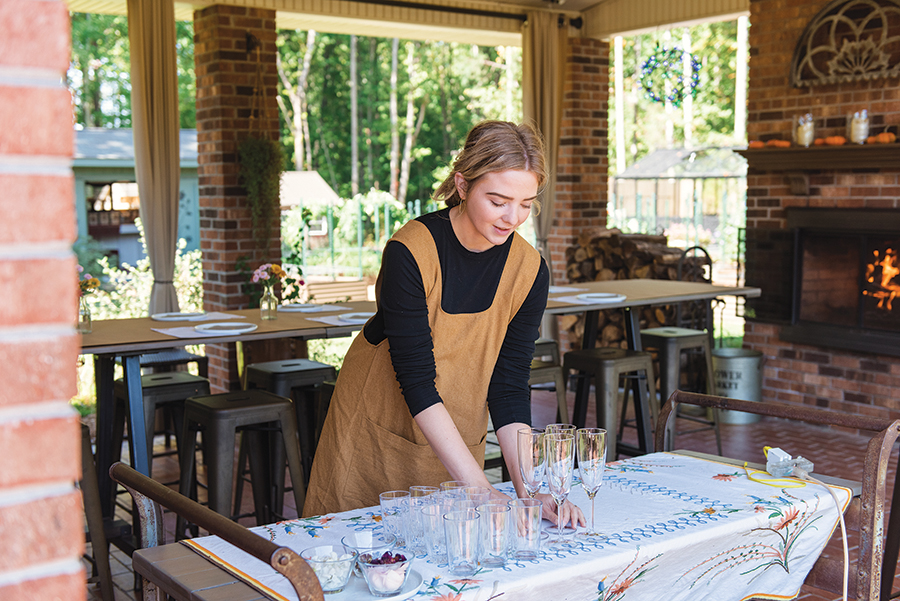
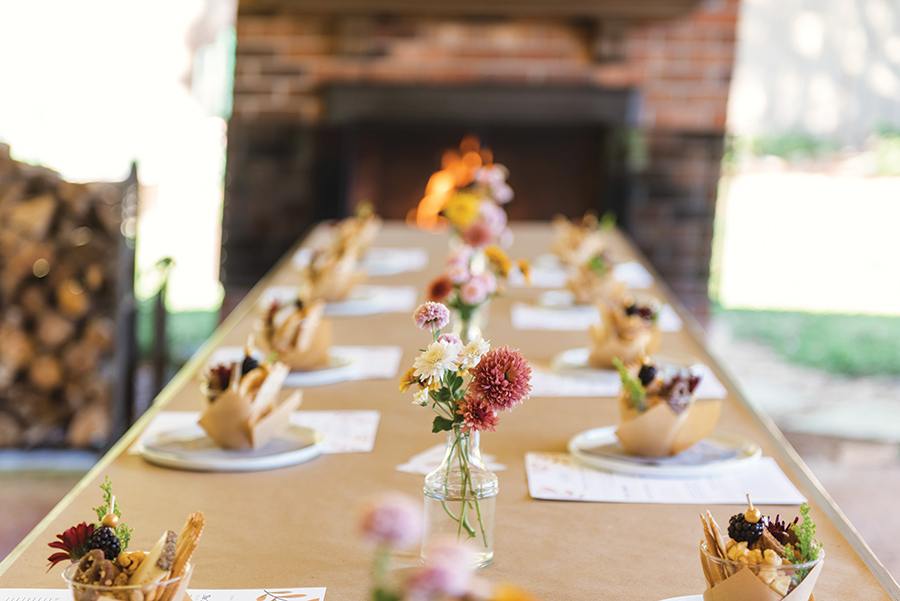
For example, later this month Ritzman will host a class called Board and Bloom Bar. For 65 bucks a head, a dozen people will gather in the breezy outdoor room that juts from the back of her ranch-style house to learn how to make a charcuterie board, the 21st-century term for a spread of meat, cheese, nuts and other antipasto.

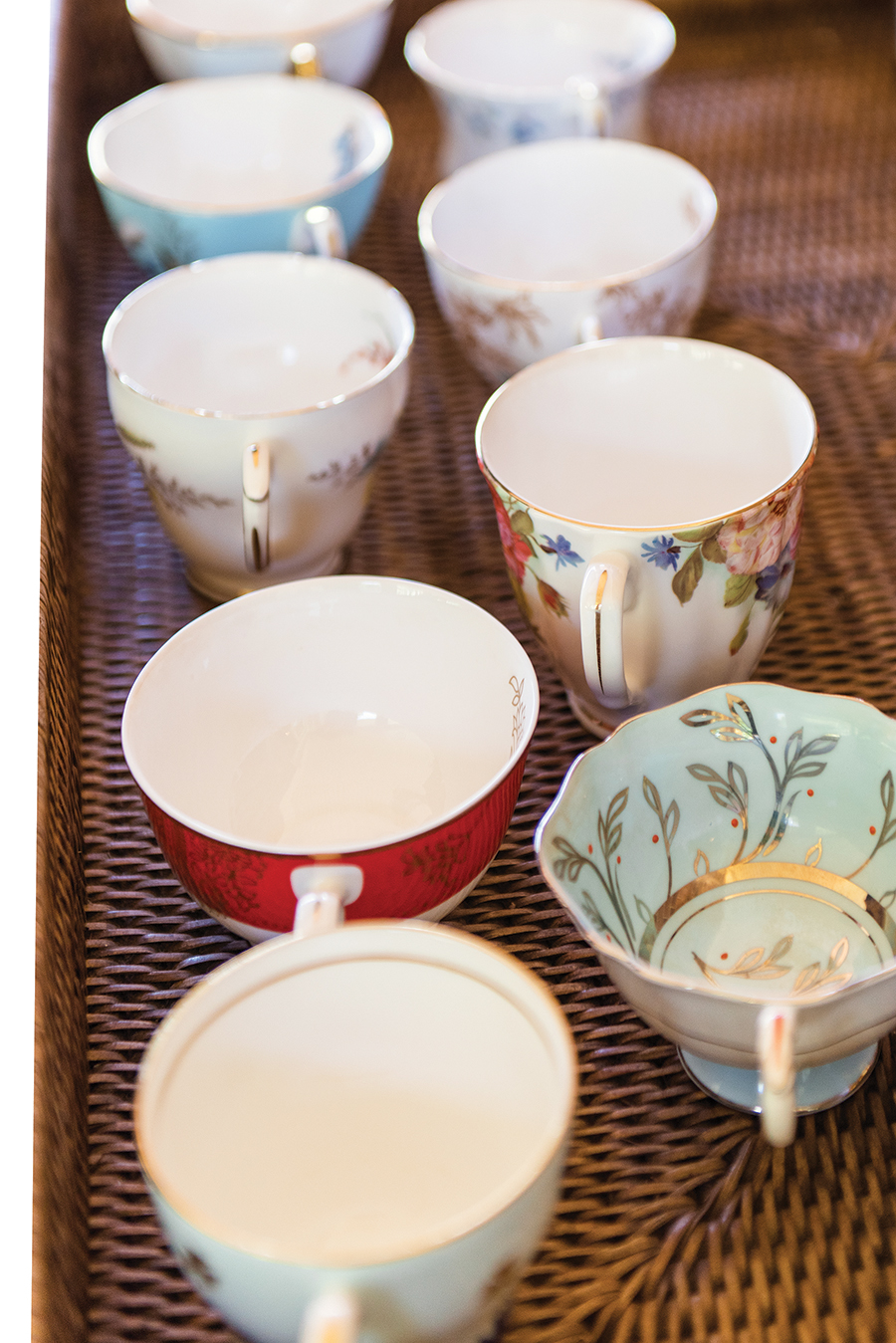
Whitney Chaney, owner of Gather & Graze Co. in Winston-Salem, will lead the session. Participants will sip botanical teas and lemonades and nibble from their own charcuterie cups. At the end, students will make a small bouquet from a selection of cut flowers to take home.

Next month, Kiley Duncan, who owns Tea + Toast, another Winston-Salem business, will show people how to make cocktails and mocktails using loose-leaf teas and botanicals. Customers will, of course, make themselves a parting bouquet. They’ll also have a chance to buy some of Kiley’s handcrafted bitters and elixirs.

Ritzman’s calendar stretches on, year-round, with tutorials on candle pouring, rock painting, flower pressing, wreath making and dried-flower arranging.

The events are good for her collaborators and for her. They raise the visibility of Ritzman’s property — which is available for private events, too — and they spotlight her primary stream of income, subscriptions to cut-flower bouquets that Ritzman wraps in brown paper and delivers weekly to pick-up points near her subscribers.

At the moment, her distributors are Cake and All Things Yummy in Kernersville and Lavender and Honey Kitchen in Winston-Salem.

“Hopefully they’ll buy a cinnamon roll and a cup of coffee while they’re in there,” Ritzman says. “I don’t know what it is about flowers and bakeries.”

Ritzman sees symbiotic relationships everywhere, especially in her second profession. Her pesticide-free flowers attract pollinators — birds, bees, butterflies and the like — which benefit the family farms that surround her. She stands in her driveway and points in three directions.

“100-year-old farm, 100-year-old farm, 100-year-old farm,” she says.

Her farmer-neighbors haven’t necessarily grown the same crops for a century. One neighbor has swapped tobacco for hemp. The point is, Ritzman sees herself as a part of the region’s agricultural tradition.

It just so happens that her boutique farm covers half an acre and that she’s wearing Ray-Ban sunglasses, a yoga studio T-shirt and cropped joggers with a snakeskin print.

“Can you tell I’m an old soul?” she asks.

She means it.

Ever since she was a girl in Amarillo, Texas — back when her mom played “tea party” with her and served graham crackers with chocolate frosting — her goal was to own a tearoom.

Then came life.

And two sons.

And the need to work as a single mom.

Ritzman typed. She took shorthand at 110 words a minute — almost as fast as most people talk.

Her fingers flew over a 10-key calculator.

“I learned real quick to say, ‘I’m finished. Is there anything else to do?’ I had a good work ethic, I guess,” she says.

She mastered bookkeeping, then spreadsheets. She transplanted her family and worked for various bosses — and their wives.

“When they said, ‘Oh, Shellie, can you design a garden club invitation?’ my little artsy self was on it,” she says.

She came by her little artsy self honestly. Her father had been a Marine, then an overall-wearing gas refinery worker, then, in a somewhat surprising turn, a self-employed commercial artist who took a mail-order course to learn to draw for profit.

He set up his own shop and designed business cards, letterhead and logos.

He painted watercolors.

He designed a commemorative coin celebrating Evel Knievel’s motorcycle jump over the Snake River at Twin Falls, Idaho, in 1974.

“The Texas Cattlemen’s Association still uses my dad’s logo,” Ritzman says.

She fed her own simmering talent with nature.

In her time off, she tended flowers in her yard — veggies never held much appeal for her — and read Victoria magazine, losing herself in slick pages filled with bowers of blossoms, smartly set garden tables and handicrafts fashioned by clever women.

Sound familiar?

When her sons graduated from college, and her boss sold his family’s Winston-Salem company, Ritzman saw blocks of time open up before her.

She bought a book called Floret Farm’s Cut Flower Garden: Grow, Harvest and Arrange Stunning Seasonal Blooms.

She followed up by taking Floret’s six-week class online.

“Their concept is, you can grow a lot of flowers in a small space,” she says.

She had the space, reclaimed from her boys’ soccer balls and go-carts.

She had the smarts.

She had the shovels.

She dug in. With the help of her second husband, Nevin Ritzman, a retired firefighter, she plopped raised beds made of corrugated metal atop islands of cypress mulch and started planting in 2018.

She made a lot of mistakes.

She buried bulbs, plugs and seeds at the wrong time of year.

She covered the beds with cloth that was too thin and shredded easily when it was removed and replaced for frost.

She misfired with flora that frowned on the climate along Cherry Vale Drive.

She tinkered until she found what worked best.

Peonies

Sweet William

Tulips

Mums

Gladiolas

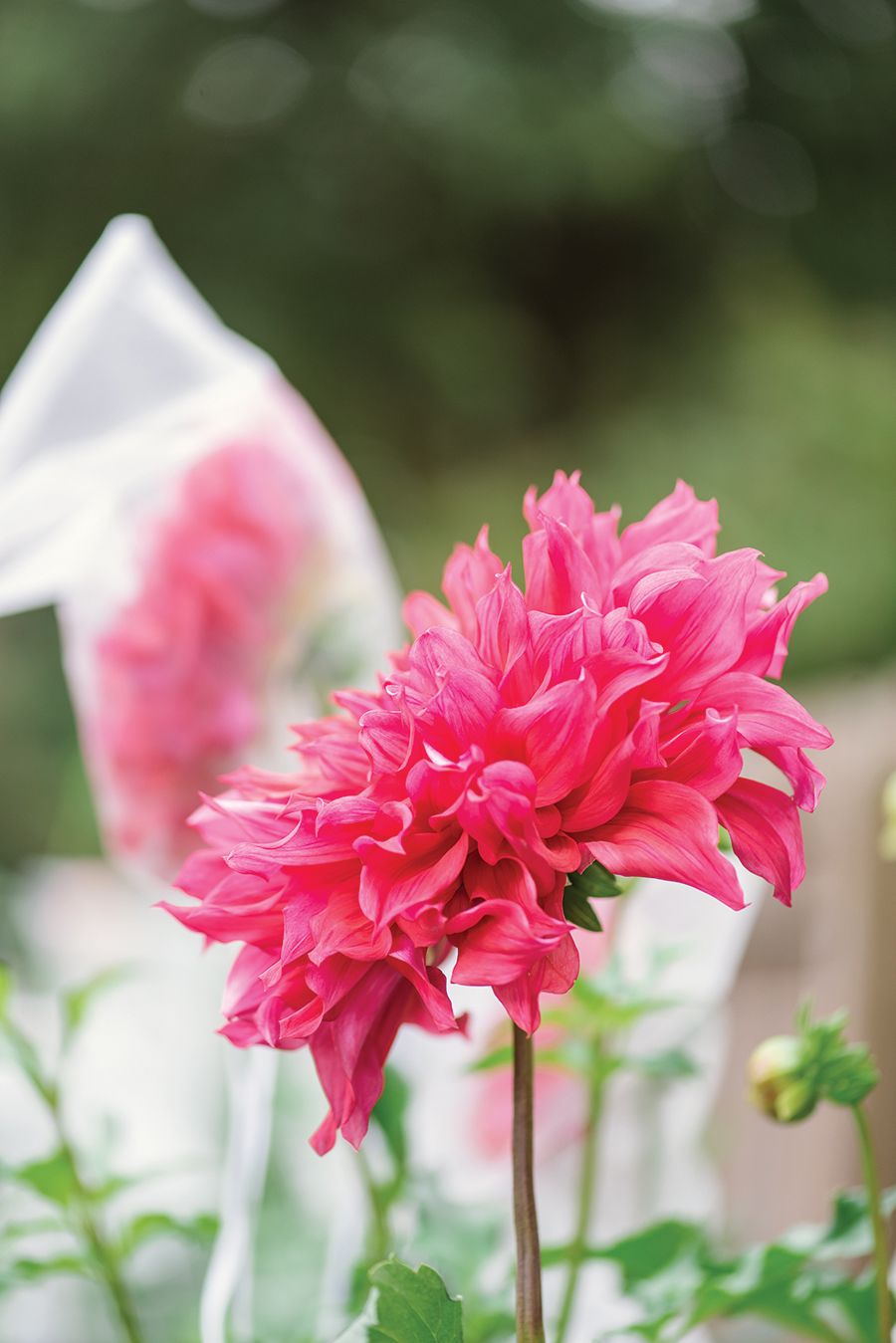
Dahlias

Zinnias

Snapdragons

Sunflowers

Yarrow

and more . . .

When she hit a snag, she got advice from a supportive online community.

“I follow probably 2,000 flower farmers,” she says. “It’s not a competitive community. It’s a collective community.”

She saved what she learned in her own databases.

“People say, ‘How do you manage it?’ I say, ‘It’s a skill set: Spreadsheets out the wazoo.’ ”

In 2020, she started delivering her prepaid subscription bouquets, the only business model that made sense to her.

“I’m not go gonna sit at a farmers’ market somewhere, and nobody buys my flowers, and then I take them home, and they die,” she says.

She opened her yard for the first class later the same year. COVID delayed the startup. People still came. Some wore masks, some didn’t. Ritzman left it up to them.

Most customers felt safer knowing that the classroom was an outdoor room, essentially a covered patio anchored by a fireplace, stirred by a ceiling fan, and decorated with hanging light balls.

Last year, the Ritzmans bought a slice of land next to their yard. They colonized it with more raised beds and a heated and cooled workshop that seats 12 people — the max for events— in all kinds of weather.

Calling it a workshop is an understatement.

“I thought, ‘OK, people are going to be dining out here. It needs to be froufrou,’” she says.

Mission accomplished. Smelling of paint and sawn lumber, swaddled in creamy fabrics, and floored with gray vinyl planks, the 14-by-28-foot space (which inspired the vision described at the beginning of this story) features a long, custom-built, bar-height table centered under an elegant light fixture.

A wallpaper mural, reminiscent of a Dutch still-life painting, reminds viewers that “In Joy or Sadness, Flowers Are Our Constant Friends.”

Apothecary jars parade dried petals of marigolds, peonies, roses and lavender.

Event participants can buy floral bookmarks, candles and other what-nots.

Ritzman will use the workshop for classes, bouquet assembly and private events, should someone want to rent it.

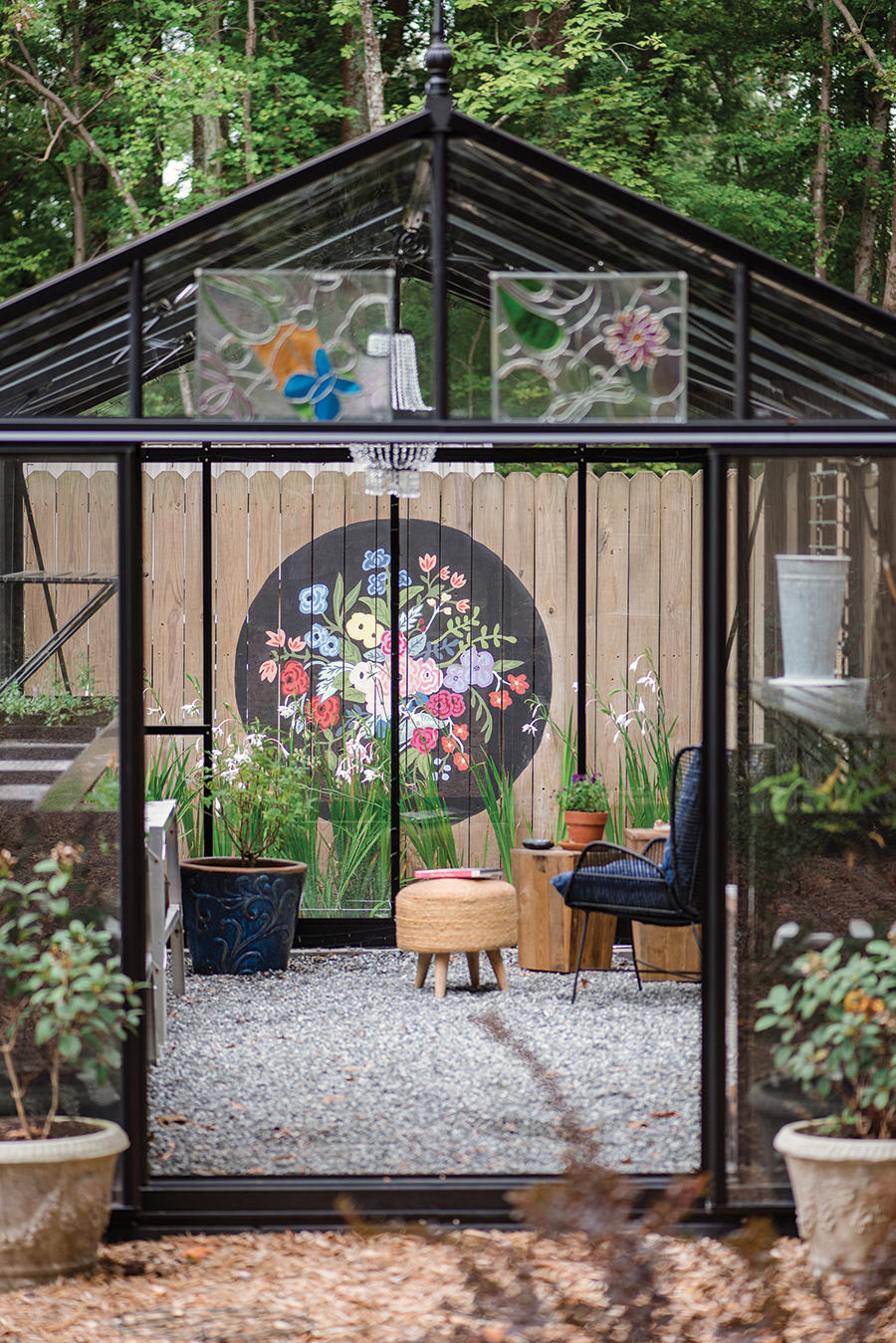
Her Victorian-style greenhouse also is available.

“You know the custom Boho picnic people?” she says. “If they want to offer somewhere to do a picnic, here it is.”

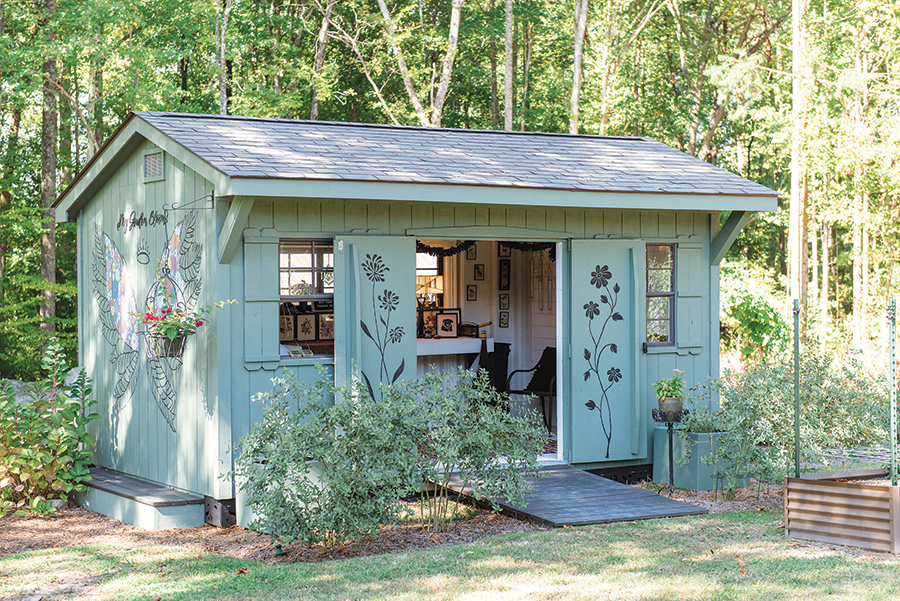
The same offer applies to the green outbuilding she calls the flower shed, which she uses chiefly as a photo studio for her wares.

“If someone calls and says, ‘Hey, can I have an intimate dinner out there with my girlfriend?’ sure, we’ll fix you up.”

Already, she makes the colorful grounds available, by the hour, for photography and video sessions.

Most visitors, though, come for the classes.

“Once they get here, they’re like, ‘OK, I get it. It’s a place to come play with flowers,’” Ritzman, 62, says.

Her customers are overwhelmingly women.

“You’ll have the sassy girls, all dressed up with their girlfriend groups. We had a group of homeschooled girls. We get a lot of sister groups, a lot of mother-daughter groups,” she says.

Recently, the first male student signed up to take a two-hour charcuterie class with his wife.

“I told my husband, ‘You have to be here so he won’t be intimidated,’” she says.

Regardless of gender, Ritzman believes, her customers are hungry for beauty and company. As the pandemic wanes, they’re emerging like the lime green knuckles of seedlings, testing the environment to see if it’s safe to bloom.

“Last year, we did really well, but this year we’re selling out quicker,” she says. “People are ready to get out.”  OH

Learn more about Ritzman’s business at her website, mygardenblooms.net or on her Instagram page, @mygardenblooms.

Maria Johnson is a contributing editor of O.Henry. She can be reached at ohenrymaria@gmail.com.

Against the Grain

The Remarkable Life and Legacy of Master Craftsman and Free Man of Color Thomas Day

By Jo Ramsay Leimenstoll

In the furniture and woodwork he crafted for a region’s elite, free Black Thomas Day (1801-1861) combined his cabinetmaking talents with his personal interpretations of fashionable styles to create a distinctive woodworking idiom unique to the mid-nineteenth century Dan River region of North Carolina and Virginia. His remarkable legacy of furniture and architectural woodwork reveals a familiarity with popular pattern books, mastery of furniture-making techniques, incorporation of emerging technology, and expression of a personal aesthetic that elevates him beyond the role of a craftsman to that of an artist. With his great artistic autonomy, Day is one of a few free people of color to leave behind a substantial body of work, one that includes more than 200 pieces of furniture as well as interior woodwork in more than eighty houses.

Born in Virginia to mixed-race parents, Thomas learned the woodworking trade from his father, John Day. When Thomas was a teen, the family migrated from Virginia to North Carolina, eventually settling in Warren County. In 1821, Thomas left his father’s cabinetmaking shop to set up his own shop in Hillsborough. Just two years later he joined his older brother John’s shop in the bustling town of Milton where access to the Dan River and two railroad lines generated a thriving community of artisans and merchants. Although John subsequently left for Liberia to become a Baptist missionary, Thomas remained in Milton where he continued to build his cabinetmaking business, purchasing property in 1827 and establishing his reputation as an artisan. In 1830, Day married Aquilla Wilson, a free Black from Virginia, but she could not join him because an 1826 law prohibited free people of color from migrating to North Carolina. In an unusual response that speaks to Day’s importance within the community, sixty-one prominent white men in Milton and Caswell County successfully petitioned the General Assembly to permit Aquilla to move to North Carolina. Romulus Saunders, the state’s attorney general, endorsed the petition adding:

I have known Thomas Day (in whose behalf the within petition is addressed) for several years past and I am free to say, that I consider him a free man of color, of very fair character — an excellent mechanic, industrious, honest and sober in his habits and in the event of any disturbance amongst the Blacks, I should rely with confidence upon a disclosure from him as he is the owner of slaves as well as of real estate. His case may in my opinion, with safety be made an exception to the general rule which policy at this time seems to demand.

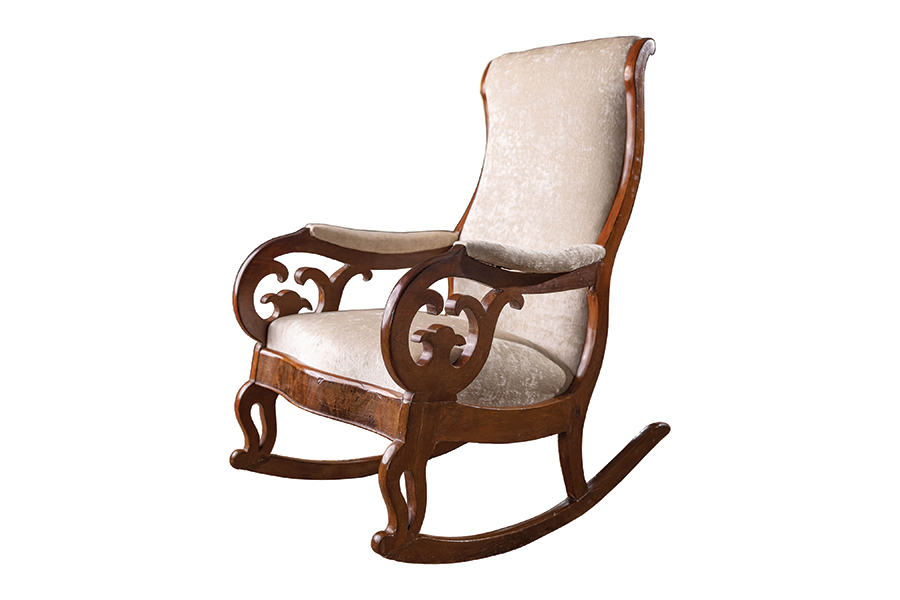
Rocking chair. Made by Thomas Day, ca. 1850. Mahogany, mahogany veneer, pine (upholstery not original).

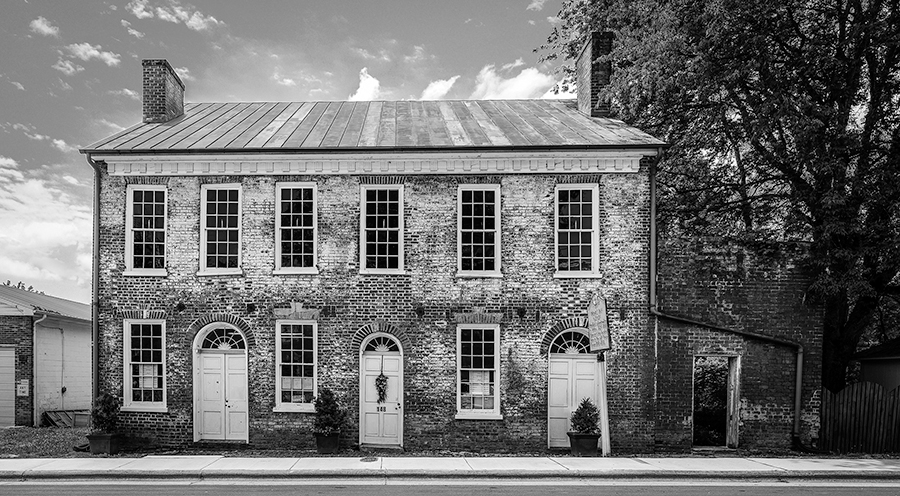
The petition was granted in late 1830, and Aquilla joined Thomas in Milton. During the decade that followed their household grew to include three children and eight enslaved people. Day was a husband, father, church-going Christian, and respected member of the community. He was also a gifted artisan and a clever businessman. As his clientele expanded and his business grew, he purchased more properties in Milton, eventually acquiring the prominent Union Tavern on Main Street to serve as his shop and residence.

Union Tavern/Thomas Day House, Caswell County, NC, ca. 1818. Jim Lamb , Capital City Camera Club, photographer. Courtesy of Preservation North Carolina.

Day benefitted from the economic boom-era in the Dan River region that sprang from the 1839 discovery of a process for curing tobacco with heat creating vivid yellow “Brightleaf” tobacco. As the wealth of white planters soared, Day was in the right place at the right time, ready to accommodate their aspirations for refinement and gentility. Many chose Day to express their status through his interpretations of the fashionable Grecian style of furniture that paralleled the emerging Greek Revival architectural style. A savvy entrepreneur, Day capitalized on the planters’ social network to establish the largest cabinetmaker’s shop in the state by 1850 — a shop with a diverse workforce of enslaved men, white and mulatto journeymen, and apprentices.

His furniture and woodwork were primarily crafted for the homes of wealthy planters and middle-class merchants, including such prominent citizens as physician and planter John T. Garland, attorneys Bartlett Yancey and Romulus Saunders, merchant John Wilson, and planters William H. Long, William H. Holderness, and Thomas M. McGehee. In addition, Day also received some institutional commissions, including furnishings for the Dialectic and Philanthropic Society Debating Hall at the University of North Carolina at Chapel Hill. He also fabricated the pews for the Milton Presbyterian Church where he and Aquilla were respected members.

Day’s early furniture reflects a familiarity with popular pattern books illustrating classically inspired pieces he skillfully replicated. Day was also quick to incorporate the emerging stylistic trends appearing on the national scene, including French, cottage, and Gothic influences. By the 1840s he adopted a more idiosyncratic design aesthetic that distinguished his work from his contemporaries and from the pattern books and broadside posters of the period. Day fabricated much of his furniture from imported mahogany, or he employed mahogany veneers over secondary woods. His repertoire included all the pieces needed to accommodate a genteel lifestyle, and his embrace of technological innovations such as a six-horsepower steam engine dramatically enhanced his productivity. Between his steam-powered shop equipment and large workforce, Day could rapidly produce orders even as large as Governor David Settle Reid’s 1855 request for forty-seven pieces of furniture.

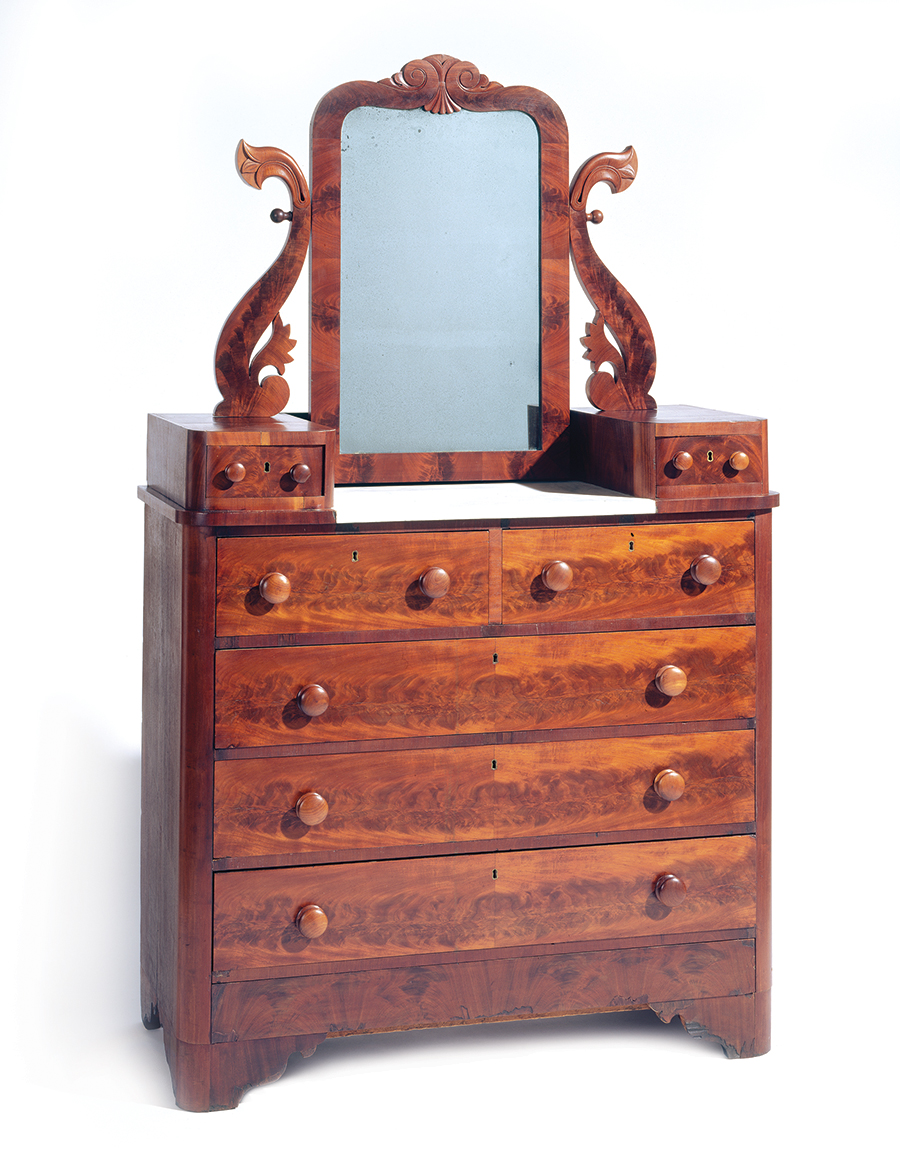
1850-1860 Thomas Day made bureau/chest of drawers. Originally owned and used by Gov. David Settle Reid and his wife, Henrietta Settle Reid at their plantation home in Rockingham county, NC.

Day’s custom-made cabinetry and furniture exhibit a powerful energy and a vocabulary of individualized motifs that define both form and detail. While his designs adhered to the principles of symmetry and balance, and utilized classical details, Day pushed beyond standard conventions with bold three-dimensionality, serpentine curves and exuberant ornamentation. The fluidity of his forms suggests a sense of motion that by contrast made the work of his counterparts appear staid. The popular S-shaped scroll motif is incorporated into many of his pieces such as the rocking chair arms and the mirror brackets of his open pillar bureaus. Day lightens the massiveness of Caleb Richmond’s sideboard with S-shaped pillars terminating at the base in scrolled feet, and he embellishes the mirrored gallery back with a pair of whimsical S-scrolls set on the diagonal.

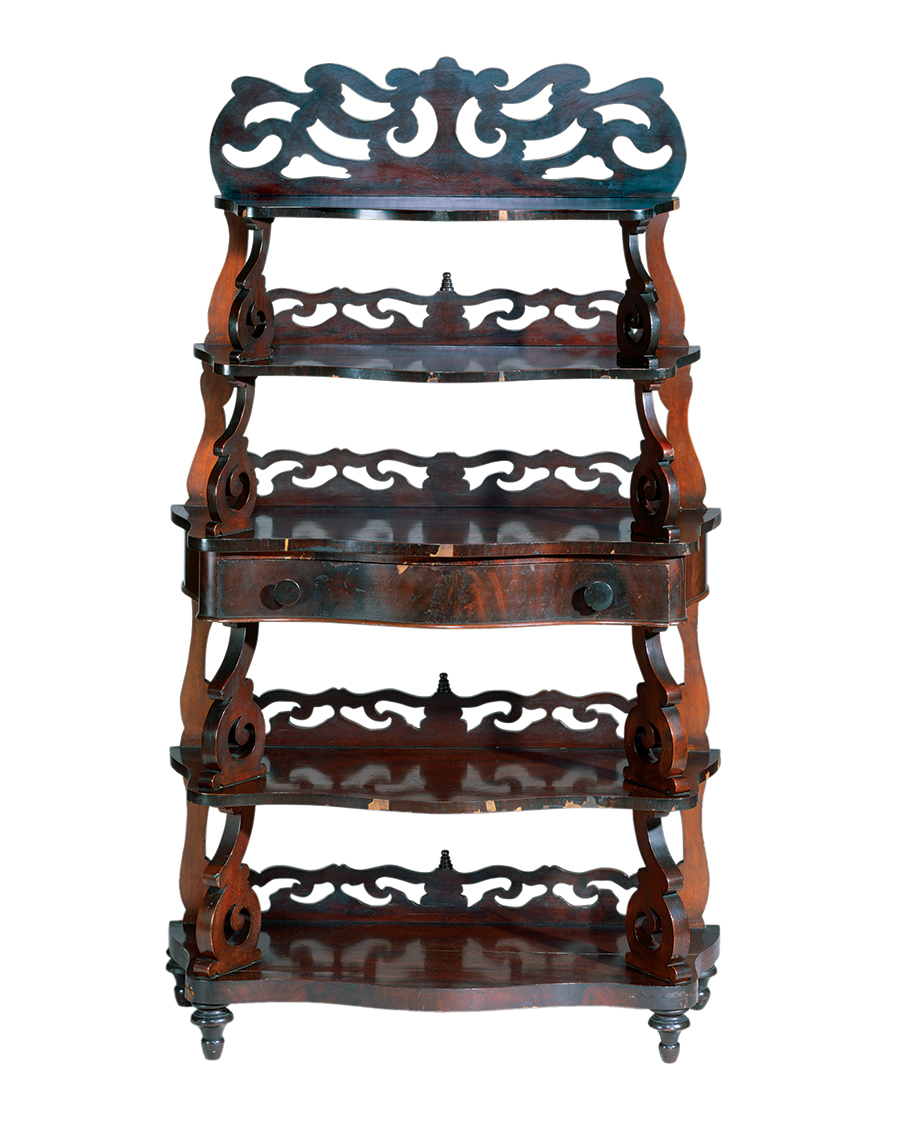
Day often detailed his side chairs and rocking chairs as well as other pieces with ornamentation composed of scroll shapes, ogee and reverse ogee forms, and foliage motifs. While such shapes are certainly not unique to Day, he applies them with more vitality and three-dimensionality than his peers. In particular, Day’s distinctive whatnots with pierced galleries illustrate his use of the jigsaw to create positive and negative shapes. Still balanced and symmetrical, these playful serpentine shapes convey motion and whimsy as do the S-shaped scrolls that support each of the shelves.

Thomas Day Whatnot Shelf, frontal view. Owned by Margaret Walker Brunson Hill, as of Oct. 2021.

The unique, signature lounge is the furniture form most closely identified with Thomas Day. It evolved from an upholstered lounge form popular in the early 1800s that incorporated a low back at one end. Day transforms this earlier model by suspending a slender backboard between arching rear pillars so it appears to float effortlessly across the length of the lounge and creates a complementary negative space in the open back below. Likewise, the side arm rails of the lounge mirror their shapes in both positive and negative forms.

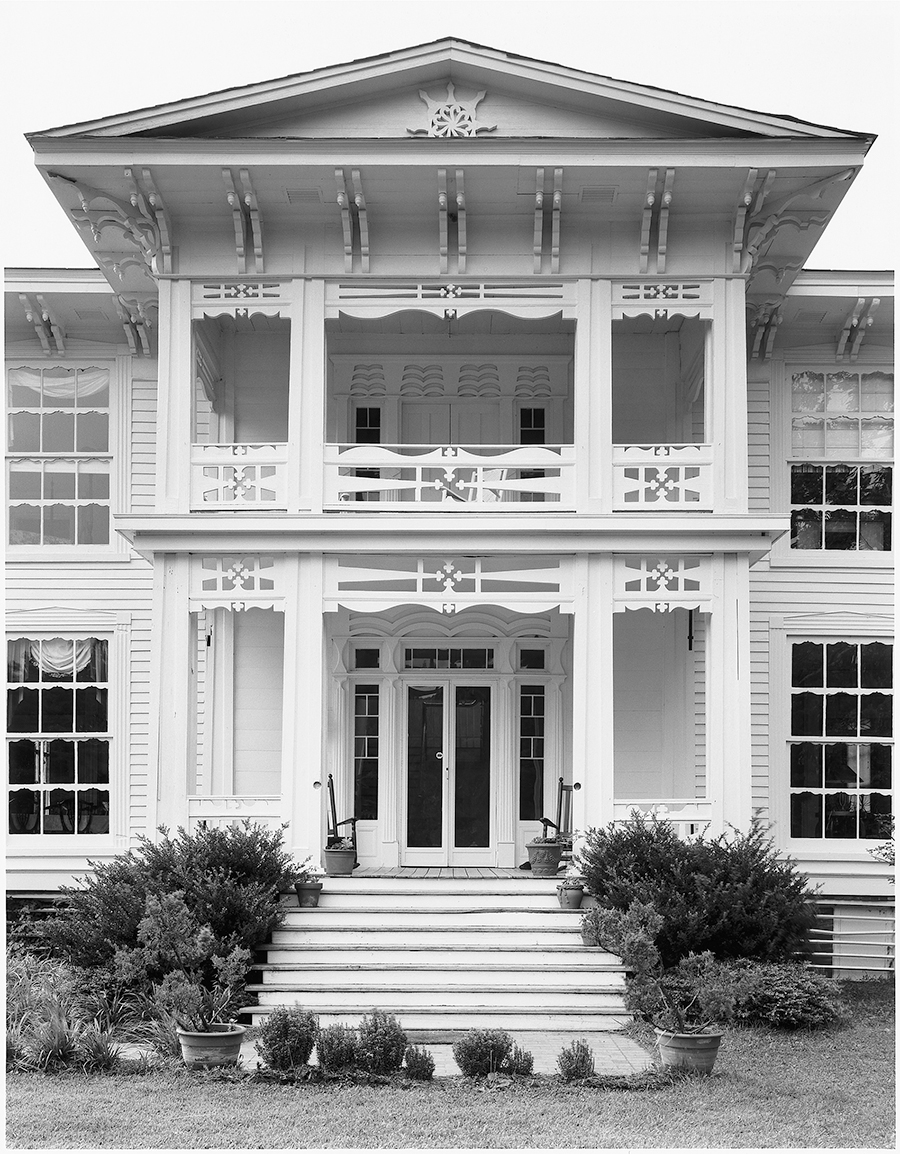
Like his furniture, the distinct and innovative architectural woodwork of cabinetmaker Thomas Day emerged from a specific context of race and place as planters in the 1840s and 1850s expressed their gentility through new boom-era Greek Revival houses and front additions to earlier homes in the Dan River region. More than eighty houses constructed or expanded over a quarter century radiate out from Day’s shop in Milton on either side of the Dan River, revealing the volume and scope of his work. Six intact North Carolina houses illustrate Day’s fully articulated woodwork ensembles of the mid-1800s. Two were built as additions to older houses: the 1856 front section of the Bartlett Yancey House and the ca. 1855 side addition to Longwood (lost to fire in 2013). The other four properties are large Greek Revival period houses: the Holderness House (ca. 1851), the Friou-Hurdle House (1858), the Richmond House (ca. 1850), and the Bass House (ca. 1855). In the next decade, Day embraced the emerging Italiante style with lively sawnwork crafted for the exterior and interior of the Garland-Buford House ( ca. 1860).

Commissions from wealthy planters provided a springboard for Day to create his own artistic signature writ large through architectural compositions. Using staircases, mantels, niches, corner blocks, baseboards, and casings as his palette to sculpt interior spaces, Day developed a fluid, exuberant, idiosyncratic interpretation of the Greek Revival style adopted throughout the Dan River region — all the while operating within the legal and social systems that constrained free Blacks at the time.

Day brought the vivacity of the curving line to his woodwork in innovative ways that continue to amaze and delight. In his entrance halls, bold and varied S-shaped newel posts with tightly coiled spirals and sinuous curves spring from the handrails, all in sharp contrast to the straightforward turned newel posts in most houses of the era. Many of these houses typically have turned newel posts or the more traditional circular ring of balusters supporting a horizontal spiral that terminates the handrail. In contrast, Day rotated the relatively serene horizontal spiral 90 degrees and enlarged the vertical spiral to form the entire newel, conveying a sense of energy and motion that extends the movement of the ramped handrail into the entry hall. Day’s signature newel posts proclaimed the owner’s social status to all who entered.

Complementing his newel posts, curvaceous stair brackets at the end of the treads display fluid-lined variations on standard patterns. While most Greek Revival staircases incorporate decorative stair brackets, only Day’s utilized coordinated motifs to reinforce the S-shaped newel post statements, such as those he crafted for the Glass-Dameron House and Hunt House staircases.

Day’s mantels, the focal point of many a planter’s parlor, invigorated standard Greek Revival idioms with robust serpentine mantel friezes to create a sense of movement unlike the static paneled friezes of their counterparts. As seen in the Holderness House parlor, Day reinforced the hierarchy of the parlor as the most formal interior space by flanking the mantel with arched niches framed by deeply fluted moldings. Likewise, around door and window openings, Day installed bold casings animated by the shifting patterns of light and shadow on their deeply fluted surfaces. The undulating forms and sharply cut sawnwork characteristic of Day’s interiors play upon the tension between positive and negative space.

Like his furniture designs, Day’s architectural woodwork grew out of the framework of classical architecture, respecting formality, symmetry and hierarchy. To his interiors, Day brought fluidity and movement as he abstracted, distorted, rotated, intensified and distilled to transform that vocabulary. Day skillfully maximized and celebrated the fluidity of form as someone who knew the rules and understood how to break them.

The remarkable design aesthetic of his furniture and architectural woodwork speaks to us of the complexity of the life and work of Thomas Day — an entrepreneurial free person of color who crafted a remarkable legacy equally complex in its style and expression. His amazing tangible body of work continues to astound and inspire far beyond the Dan River region. Day’s work also reveals the enduring power and innovative evolution of his appealing aesthetic, an aesthetic ironically empowered by the most powerful and wealthy white citizens of his time and place. 

To Learn More

If you are interested in knowing more about Thomas Day, check out Blandwood Estate current exhibit, “New Perspectives on Thomas Day — Pairing Furniture by North Carolina’s Free Black Master Craftsman With Contemporary Pieces From Governor Morehead’s Blandwood,” April 1 through Sept. 30. The exhibit will generate conversations about the acclaimed free Black cabinetmaker and artisan. Displayed with Day’s furniture are pieces once owned by Gov. John Motley Morehead. According to Blandwood, the show also examines Day’s furniture in period rooms and “introduces new approaches to understanding the work of this master craftsman as a successful Black entrepreneur operating within elite white social circles.”

“This special presentation of Day’s furniture acknowledges his role in American history and speaks for the legacy that people of color gave Blandwood,” says Benjamin Briggs, executive director of Preservation Greensboro. “This exhibit is dedicated to a more equitable approach to understanding the experiences of these individuals who have been overlooked in the past.”

A National Historic Landmark, Blandwood’s mission as a traditional house museum is to interpret historical narratives related to North Carolina history, architecture and the decorative arts. The exhibit’s mission is to expand the traditional narratives around race, gender and class in mid-19th century North Carolina during the mid-19th century.

The Day exhibit is open from April 1 through Sept. 30, Tuesdays through Saturdays 11 a.m. – 4 p.m. and Sundays 
2 p.m. – 5 p.m., with the exception of major national holidays. The last tour begins one hour prior to closing. Tickets are $8 at the door. 
OH 

Reprinted with permission from Preservation Greensboro. Jo Ramsay Leimenstoll is a preservation architect and a Professor Emerita at the University of North Carolina at Greensboro.

Pigeons

As the day star rises over a frozen field,

kissing the roofs of houses, the barren

limbs of pin oak trees and the long arm

of the church spire reaching toward the

wintry sky, I can’t help but think of the

rock pigeons we saw huddled wing-to-

wing early last evening, on two ropes of

electrical wire. We passed by them so

quickly, I only glimpsed these dozens of

dozing birds, though long enough to note

their cozy coexistence, their companion-

able willingness to keep each other warm.

Heads tucked into their necks, their chests

puffed like rising pastries, most slept but

a few, perhaps keeping watch, remained

vigilant. Like twin strings of black pearls,

they enhanced the beauty of the bright

firmament that would soon fold them into

its purpling light — their little bird hearts

beating as one through the cold, dark night.

— Terri Kirby Erickson

Terri Kirby Erickson’s most recent book of poetry is
A
Sun Inside My Chest.

The Zoo

Fiction by Daniel Wallace   
Illustrations by Harry Blair

We were listening to Vivaldi the night I died, the bed so soft, so warm, my wife of nearly half-a-century perched beside me with a cup of ice chips, there to wet my tongue, my lips. Even though I die at the end of it, this is not a sad story, really: I was very old, comfortable, cared for, weary and loved, loved my whole life long, ready to fade into whatever night was waiting for me. And of all the moments I might have conjured to accompany me as I was leaving, it was our very first date that I recalled.

Clara and I were grad students in English, just classroom friends, weeks away from defending our dissertations — hers on lute music in Shakespeare’s early plays, mine on Mary Shelly’s Frankenstein and the birth of modern science. I’d always liked Clara, but I think everybody did. She was smart but didn’t seem to care that she was, and made the rest of us — who were battling with each other, always burnishing the myth of our own brilliance — seem dumb. She was also funny, and the kind of pretty I was drawn to. Her nose was just a little longer than one thought it might have been, her eyes too big. They were emerald green, though, and rested on her big cheeks like marbles. Her knees were oversized for her long thin legs, like two snakes that had just swallowed one rabbit each. The truth was she wasn’t really picture-pretty at all, but carried herself as if she were, or didn’t care that she wasn’t, and that made her more beautiful than anyone I’d ever seen. She seemed wild to me, beyond anything I could ever capture. I was 27 and looked like a young man overly acquainted with Mary Shelley’s Frankenstein, by which I mean bookish in a sun-starved sort of way, shy around actual humans, shiny brown hair, still waiting for the peach fuzz on my upper lip to turn to fur. Somehow she let me know that she was free — “I’ve been kind of seeing somebody, but now . . . ” And she shrugged.

And there we were.

So we decided to go out for a beer one night. I picked her up in the first car I’d ever owned, an old Dodge Dart I’d bought used five years before, beaten and bruised, 210,027 miles and counting. There was a hole in the passenger side floorboard a mouse could have slipped through, and the engine was seriously flatulent.

“Nice car,” she said, hopping in. She was wearing jeans and a T-shirt, variations on which seemed to encompass her entire wardrobe. “Is it new?”

“Very funny.”

“Kidding,” she said. “But seriously, it’s a real car, right?”

“Ha ha.”

“I’m just having fun with you.” She punched me in the shoulder. “But honestly, want me to give it a good push? Happy to.”

She went on like this for a little while and stopped just before it became tedious. Maybe just a beat after it became tedious. But I was laughing. “For someone who doesn’t even have a car, you have strong opinions about mine.”

“I kid you,” she said. “But seriously.”

Off we went to a place called Brother’s, famous for its jukebox and onion rings and frosty beer mugs. We slipped into a booth and talked about what graduate students talk about — dissertation directors, anxiety, our cohorts and more anxiety. That was the thing: It was fine and fun and comfortable; we just got along so well. Even after a few minutes together it felt like we’d been coming to Brother’s forever and talking about nothing and laughing — when this guy appeared, an apparition materializing from the dark of the bar beyond us. Tall, wiry, a small face made angular by a well-trimmed goatee, and eyebrows like a mossy overhang. Our age. He was wearing a black jacket and a black T-shirt beneath it and black pants, and I’m assuming black socks and underwear as well. He sat down next to Clara — they clearly knew each other — and he smiled at me and shook my hand. A strong grip. Very strong.

Clara covered her face with her hands and moaned. “Jeremy,” she said, she sighed. “Jesus. Jesus Jesus Christ.”

Jeremy looked at me and rolled his eyes, like we were having so much fun and now Clara has to come and ruin it for us.

“I saw you and I had to say hello,” Jeremy said to her. Then to me, conspiratorially: “We were together, not too long ago. Clara and I.”

Clara nodded, but it was a grudging nod. I’m sorry, she mouthed to me.

Jeremy saw her. “You should be sorry,” he said.

“Please,” she said. “Jeremy. This is not the time or the place for this.”

Jeremy shook his head and shrugged. “I don’t know why. This used to be our place.”

“Our place?” She mocked him. “We came here twice.”

Someone put two quarters in the jukebox and “Raindrops Keep Fallin’ on My Head” began to play. Clara looked at me. “We should go, Richard. This isn’t going to get any more fun than it already is.”

“Richard,” Jeremy said. “What a great name. May I call you Dick, Dick? Great. So, Dick, about how long have you and Clara been an item . . . Dick.”

I didn’t answer. I was in a difficult position: Clara and I really weren’t an item, yet; I didn’t feel it was up to me — or in my wheelhouse — to step up and eject the interloper from our midst.

But then, slowly, Jeremy’s smile dimmed and died, and he looked at Clara as if she were a hideous thing.

“You’re a coward, you know,” he said to her. “How could you just
. . . disappear? No call back. Nothing. Not cool. Not how you break up with somebody.” He looked at me, back to her. “Just . . . not cool. In case you didn’t know.”

She closed her eyes and took a deep breath, as if she were about to plunge underwater.

Slowly, she exhaled.

“We didn’t ‘break up,’ Jeremy. We were never even really seeing each other, not like that. We were never even — .” She stopped, giving up the postmortem. “Listen. I’m sorry, okay? I should have called you or maybe written you back to say thanks and everything, it was great while it lasted but a talent-free hobo novelist who doesn’t know the difference between a semicolon and an ampersand is just not what I’m looking for in my life at this time. All the best, Clara.”

Jeremy tried to rally with a comeback, but he didn’t have one. “I’m not a hobo,” he said. “Just . . . between places.”

“For a year and a half,” Clara said.

Poor Jeremy. He had been defeated. “Raindrops” ended and began again. Jeremy shook his head, stared off into the faraway-somewhere. He looked like he was standing on the shore of a deserted island watching the ship that was supposed to save him sail on by. 

“Okay, well, I feel like it’s time for me to hitch a ride on the next prevailing wind! But before I go, I have a message for you, Richard. You’re going to be me one day. You’ll have the time of your life with this one. You’ll be so happy. It’ll be like the world went from black and white to color. Then everything will go to shit and you won’t be happy anymore because Clara will move on, and it will suck for you, just like it’s sucking for me now.”

By the look in his eyes he was taking a moment to relive some of the colorful times he’d shared with her, and he smiled. “But it will be worth it,” he said. “Because Clara . . . well, nobody is Clara.”

Then he stood, and just as quickly as he had come was gone, a shadow fading away into the darkness of the bar.

We paid up and left and walked to the car in the dusky quiet. We were a little unsettled.

A breeze ruffled the trees but fell short of the two of us, standing on either side of my car now in the gravel parking lot. No stars out yet but the moon was rising, low still and smoky white.

“Well, that sucked,” she said.

“Yeah. Yeah, but — ”

“But what?”

“You have to admire his pluck.”

“I love that word,” she said. “He’s not plucky, though. He’s . . . indecorous.”

“Unseemly.”

“Boorish.”

Looking down like there was something on the ground for her to see, her hair fell into her face and it was as if a big CLOSED sign went up. Even after she pushed it back behind her ears it was hard to really see her. “Jeremy,” she said. “Such a mistake. What if every mistake you ever made followed you around for the rest of your life? Like a parade of mistakes. The too-small shoes you bought, the undercooked chicken. Jeremy.”

“That would suck a lot.”

“I was mean to him.”

“He asked for it.”

“Really?”

I shrugged my shoulders. Maybe he did, maybe he didn’t, but I was on Clara’s side now. I looked back at Brother’s. I kept thinking Jeremy was going to follow us out here and stab me.

“I think we should make a mistake,” she said.

“Really?”

“We need to do something,” she said. “That or go home. And I don’t want to go home. Let’s do something stupid that will follow us around forever like undercooked chicken.”

“Sure,” I said, not really sounding like the devil-may-care-crazy guy she may have wanted just then. But what to do? I couldn’t think of anything: I’d always veered to the quiet, safe side of life. But she had an idea.

“You know what we should do?” she said. “Or what we shouldn’t do, I mean?”

She sat on the hood of the car and waited for me to join her. I did. This was as close as I’d ever been to her.

“What?”

“Go to the zoo.”

There was a small zoo in Bellingham, somewhere between a real zoo and a place where a bunch of animals had been collected from around the world and housed by a larger-than-life intrepid explorer in makeshift pens and a pit for lions and tigers, a skinny elephant, a fence for the giraffe, a cement island for the monkeys. The animals didn’t look abused, just disappointed.

“Great idea,” I said. “But it’s closed. It closes at dusk.”

“Who said anything about it being open?”

And she told me a story she’d heard, about an entryway at the bottom of the 12-foot-high metal fence, one you can slither through with ease, gaining access to the entire place. No alarms, no cameras. Just you and the animals in the dark.

“I know the way.”

“Sure,” I said, hoping to impress her with my newfound recklessness. I handed her the keys to the car.

“Really? Seriously?” she said, like a kid. “You’re up for this?”

Her face was so small I could cup it in one hand, and in the half-light of the parking lot outside of Brother’s she had the patina of a film from the ’40s. I think I was already in love with her. We got in the car and she looked at me, and it was as if she were saying, Are you ready? Because this is happening. If you’re going to wimp out this is your last chance. In just the few minutes we’d been outside night had fully fallen. A couple of frat boys came out of Brother’s braying at each other, and the tail end of a song comes out with them — “Raindrops.”

“Let’s do this,” I said.

She started the car and winked at me as she revved the engine. “Big mistake,” she said.

It was a terrifically muggy night but with the windows down I could feel a cool undercurrent to the air. I remember thinking that one day it would be fall, then winter, then spring and then summer again, and that whatever was about to happen will have happened a long time ago. The wind made Clara’s hair go wild, half of it flying out the window like streamers on a bicycle, the other half in her mouth and in her eyes, blindfolding her for seconds at a time. “I’ve got this,” she kept saying. “No problem.” Then she looked at me, mock-scared with a frightened smile, like the other part of her was saying, Don’t believe me! There is a problem! I don’t have this!
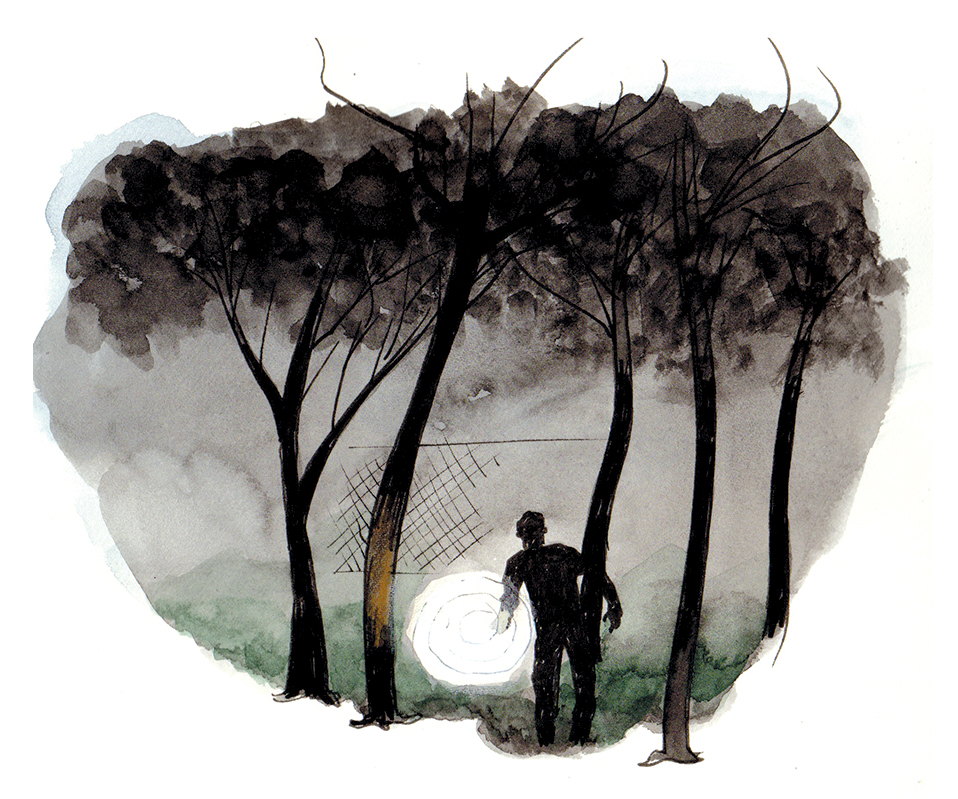
She took a sudden turn off of Greene Street, and then the road whipped around to the right, up and then down, the car beams breaking into what felt like a virgin dark. Just a pine tree forest, a forgotten road, nothing else.

She pulled over to the curb and cut the lights and we were under the cover of night.

“We’re here,” she said.

Gradually the world around me came into focus, and over the trees I could see the throbbing red light at the top of the WRDC radio tower. I positioned myself in the world and I realized we were in fact right behind the zoo, near a farm, an overgrown pasture. She put the car in reverse, pulled back, angled it, then turned the lights back on, spotlighting the secret entrance through the fence. She raised her arms into the air, fists clenched: victory.

“You’re pretty impressed with yourself.”

“I am,” she said, nodding. “As I should be.”

She turned off the car and threw the keys back to me.

“It’s go time,” she said.

The hole in the fence was big enough for a mandrill to crawl through. We got in on all fours. Neither of us said a word but communicated through hand signals and raised eyebrows and then suddenly — What’s that? Oh. It’s nothing. Continue . . . inching through the inky dark toward the animal quiet.

The woods ended, and we were on a path, dirt and gravel first and then lightly paved uneven asphalt. A yellow light spilled on the elephant cage, that fenced-in patch of hard dirt no bigger than a poor man’s front yard. There was no elephant there now — he or she was sleeping inside. I’d been here a couple of times, thrown a few peanuts over this wall. Clara looked at me. She was so excited she seemed to be vibrating. She leaned in close and stood on her tiptoes to whisper-yell in my ear: “We did it!” She held onto my elbow. “But it’s important to stay quiet,” she said. “That way they won’t know we’re not one of them. They’ll do things most people never get to see them do.”

It turned out that animals in the zoo at night do what most animals do. They sleep. It was absolutely still. The elephants, the giraffes, the monkeys, the spiral-horned antelope — they were all asleep. You could hear them; it was the humming sound of a living forest. Blue-black shadows everywhere. An ibis had a bad dream and shrieked, and a striped hyena answered (maybe it was an ibis, maybe a hyena), then it was silence again. What lights there were were kept low, and the moon was hidden behind a cloud. It turned out that sneaking around in a zoo full of sleeping animals was not unlike sneaking around in a zoo with not a single animal in it. Clara thought she saw something and gave a little involuntary gasp and turned and — it was a rabbit. She shrugged her shoulders, smiled, but I could tell she’d had high hopes for this adventure. It hadn’t lived up to its hype. “We can go now if you want,” she said.

I did want to go. I wanted to be back in the car talking about what had just happened, how great it was and can you believe that we actually did that? Clara had no idea how careful I normally was, how meticulous with my life, had no way of knowing that I was a man who folded his pants at the crease and arranged his shirts by kind and, within kind, color, whose life-plan was to be invisible on command, to follow directions, to go as far as a man with a Ph.D. in Frankenstein could go. So yes, I wanted to leave.

But she was just too defeated. 

If this were even our second date I would hug her, even kiss her until my kisses made her smile. A second date meant options. A first date, you couldn’t — I couldn’t — do more than take her hand. There was an old stone wall surrounding a duck pond, and I stepped up on it. It was only 2 feet high. Clara looked up at me and sort of laughed and said, “What are you — ?” but before she could finish the sentence I had my hand out and she took it and I pulled her up to stand beside me. “Listen,” I said. She listened and heard the same thing I did: almost nothing at all, just that humming sound. “Now listen,” and with my hands cupped around my mouth I shouted a quote from the book I had memorized: “Learn from me, if not by my precepts, at least by my example, how dangerous is the acquirement of knowledge, and how much happier that man is who believes his native town to be the world, than he who aspires to become greater than his nature will allow.”

That did the job: The night blew up. The animals rose. Plodding out of his concrete bunker pounded the elephant, the curious giraffes loped into the moonlight, and the island of monkeys began to wildly chatter. Every animal was baying and woofing and screeching. The animal world had awakened — just for us.

“Richard,” Clara said, still in whisper-mode. Wings flapped in the dark above us, water roiled somewhere nearby. Clara grabbed my arm and pulled me close. Our shoulders bumped. “This is just . . . so great!” Her big eyes were wide, the size of saucers for a miniature teacup. The moon, the stars, the sky, the animals of the Earth, this beautiful woman, all here, before me — and I felt as if I had created a moment that had never been created before, never in the history of the world. And I was sharing it with Clara.

But I woke up more than the animals. The zoo actually had a keeper. I saw him before I heard him, the beam of his super-powerful flashlight bouncing off of everything.

“Who’s there?” he called out, in a deep voice. “You’re trespassing, assholes. And yes, it’s a felony, and yes, I will prosecute. Do not think I won’t. Course I’ll let you spend some time in the hippo pond first, goddamn it.”


He sounded tired, and very serious. This had gone too far for me, and for Clara. She was frozen against my side, had stopped breathing I think, statue-still. I took her hand and we jumped down from the wall. I had no idea now where the hole in the fence was, but what choice did we have but to try and find it? We ran into the woods. I scratched my face on the lower branches of a pine tree and could feel the stripes of blood across my cheeks. But we didn’t stop running. The zookeeper could hear us, of course, and shined the light into the woods following our path. “Come out come out wherever you are, moron,” he said gleefully. He followed the sound of us, sweeping his light through the forest, coming closer. I had no idea where we were. But we came to a huge tree, and I pulled Clara behind it, wrapping my arms around her until we were as small as two people could be. The light of his flashlight fell all around us, but not on us. We were that close to being seen — inches away from being caught and caged. But we were not.

He gave up. “Damn it,” he said to himself now, thinking we were long gone.

Then he turned around and headed back the way he came.

Still pressed up against me she looked up at me and smiled.

“You did it,” she whispered. “You saved us.” She kissed me on the cheek, but her eyes did not leave mine. “Richard,” she said, “that was truly magical.”

And I thought, I actually remember thinking this as we huddled together behind that tree: in 30, 40, 50 years — whenever she buried me — no matter what may have happened through the decades of our life together, this was what I’d remember, this night, the story she’d tell too many times to our children, our grandchildren, our oldest friends, the story of that night we broke into the zoo and woke everyone up. And not because it was the best thing that ever happened to us, but because it was the first. It set the tone, she’d say, for the rest of our lives. That night at the zoo we were in our own cocoon, arms encircled, closer than close. She burrowed into me, and we stayed that way for a while, longer than we needed to, until the night returned to its rhythms, until all the wild animals in the world went back to sleep.

So of course, out of all the moments of my life, this would be the one I chose to see me out.

I felt a chip of ice on my lips, a damp cloth on my forehead. I didn’t know if my eyes were open or closed, but it was all dark now, and getting darker. I found my wife’s hand and held it.

“Clara,” I said. “Oh, Clara!”

Yes, your name was my very last word, so sweet I said it twice.

“Clara?” Gwendolyn said, and she shuddered, seemed to freeze and harden as if she’d died herself. “Richard, who is Clara?”

And I might have told her, but it was a long story from a long time ago, and by then it was much, much too late.  OH

Daniel Wallace is the author of six novels, including Big Fish and, most recently, Extraordinary Adventures. He lives in Chapel Hill, where he directs the Creative Writing Program at the University of North Carolina.

Book Wrapt

What constitutes a home library varies from one book lover to another

By Cynthia Adams

Imagine a library with 51,000 books towering two stories to the ceiling, amassed by Johns Hopkins professor Richard Macksey. Though Amazon’s Kindle debuted 15 years ago, print survives. Writer/actor Stephen Fry declared in 2013, “Books are no more threatened by Kindle than stairs by elevators.”

In January, The New York Times released a photo of the late Macksey’s dream library, which included extraordinarily rare editions. The image was retweeted nearly 40,000 times in a mere month. Although the library was dismanted after Macksey’s death in 2019, the Baltimore bibliophile, a towering intellect, curated a stunning dreamscape of books reaching two stories in height, with the surreality of a movie set.

Macksey was book wrapt — i.e. enchanted by his own home library.

George Vanderbilt’s Biltmore library contained 20,000 books, many of them first editions. When eight graders are taught North Carolina history, field trips to Biltmore Estate provide a breathtaking example of what it means to be book wrapt and want to assemble a library.

Gen Z and Millennial readers, whose affection for printed books mirrors screen-time fatigue, still dream of such a place. A real library, it is variously estimated, requires 1,000 titles — or 500 — or fewer. With the advent of e-books and so many people downsizing their homes, a small assembly of treasured volumes, artfully displayed, is very much a library.

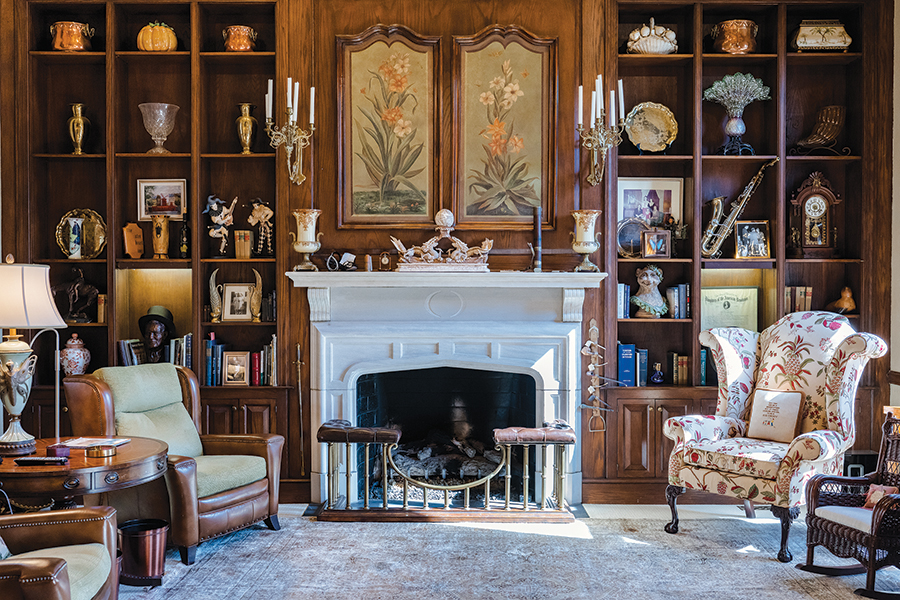
On these pages you find a number of book-wrapt Triad readers who have created personal libraries with varying numbers of titles and configurations — the largest of them symbolically filled with family heirlooms, like a Victorian cabinet of curiosities — yet all of them inspire.

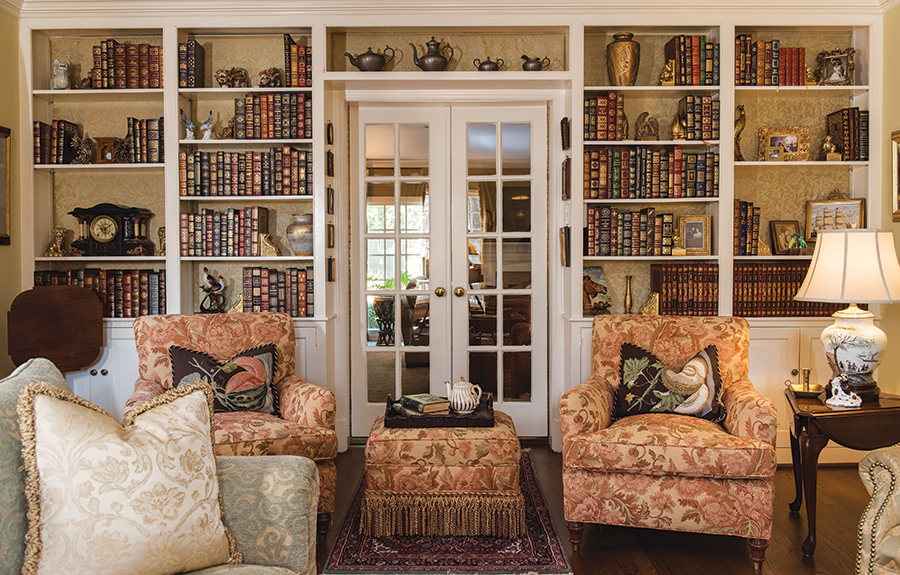
Sharon James is snugly book-wrapt in her Stoney Creek study/library. She is surrounded by artwork, collectibles and books as she works from home for a company that conducts international hospital inspections.

Here, she spends hours. Her husband, Tom, a High Point University economics professor, keeps a desk nearby.

“I love the warmth of books!” Sharon James says. “I have them lying around in every room. I love leather-bound books, the richness of their color, and I often wonder what prompts someone to write what they do.” Countless other volumes spill into the downstairs. Like many book collectors, James recently undertook a purge to make way for more. This led to a discovery that some favorite titles were duplicates. Lucky friends inherited those.

“I have always had to have bookshelves in my homes,” James says. “If there were none, then I had them built as I did here. Nothing is more relaxing to me than sitting in my favorite French chair, with a good book and a glass of wine. And once I start reading and am into it deeply, I hate being disturbed!”

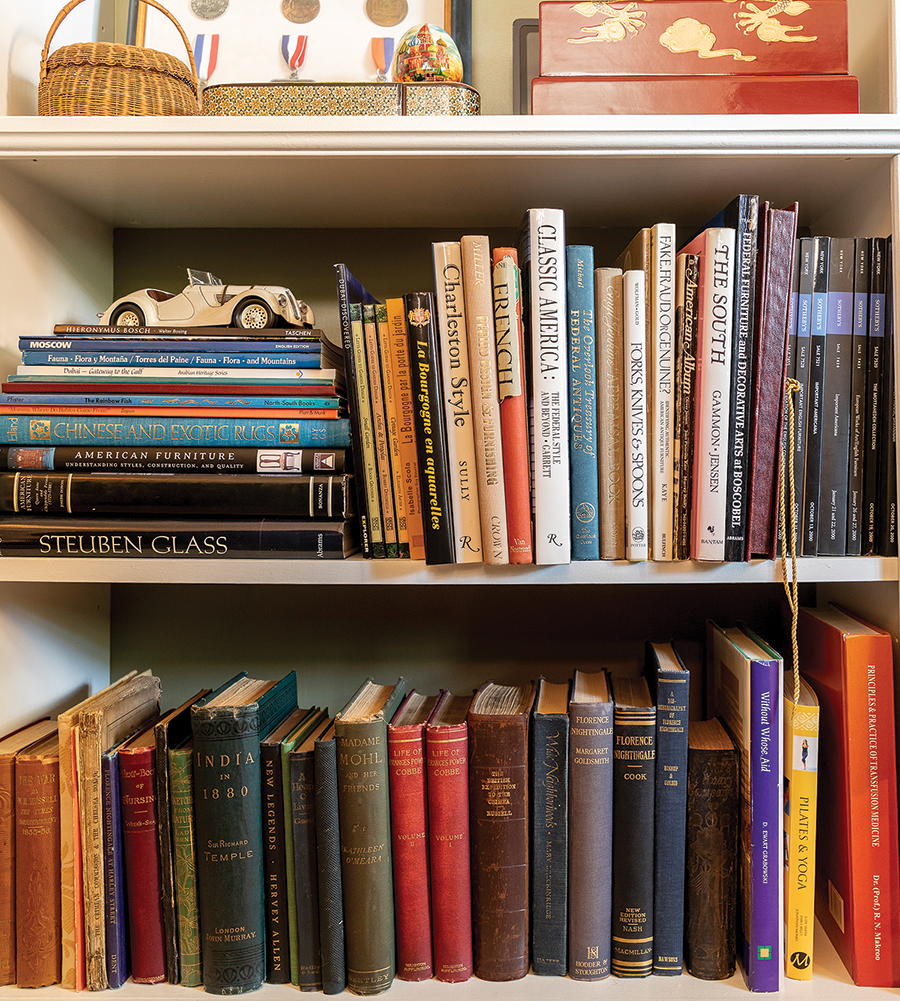
A former nurse, James enjoys “biographies about women who do great things,” prizing a first edition of Florence Nightingale’s Notes on Nursing. She is an avid collector of English and American antiques, so amasses books on the decorative arts.

This is a common thread among bookies: Private passions are revealed in their private libraries.

Recent New York transplants Rick and Randy Burge-Willis own approximately 1,500 to 2,000 volumes and remodeled to accommodate the excess. (See March 2022 O.Henry: www.ohenrymag.com/a-leap-of-faith.)

“There were existing bookshelves in the living room, but our previous home had a ‘main’ library and a ‘kitchen’ library. When we moved here, we only had enough space for about a quarter of our books. It seemed natural to turn our large office space into a library, so we had half of the walls lined with bookshelves.”

They were careful to maintain the original pecky cypress paneling. “We also wanted to mirror the classic moldings and trims of the rest of the house.”

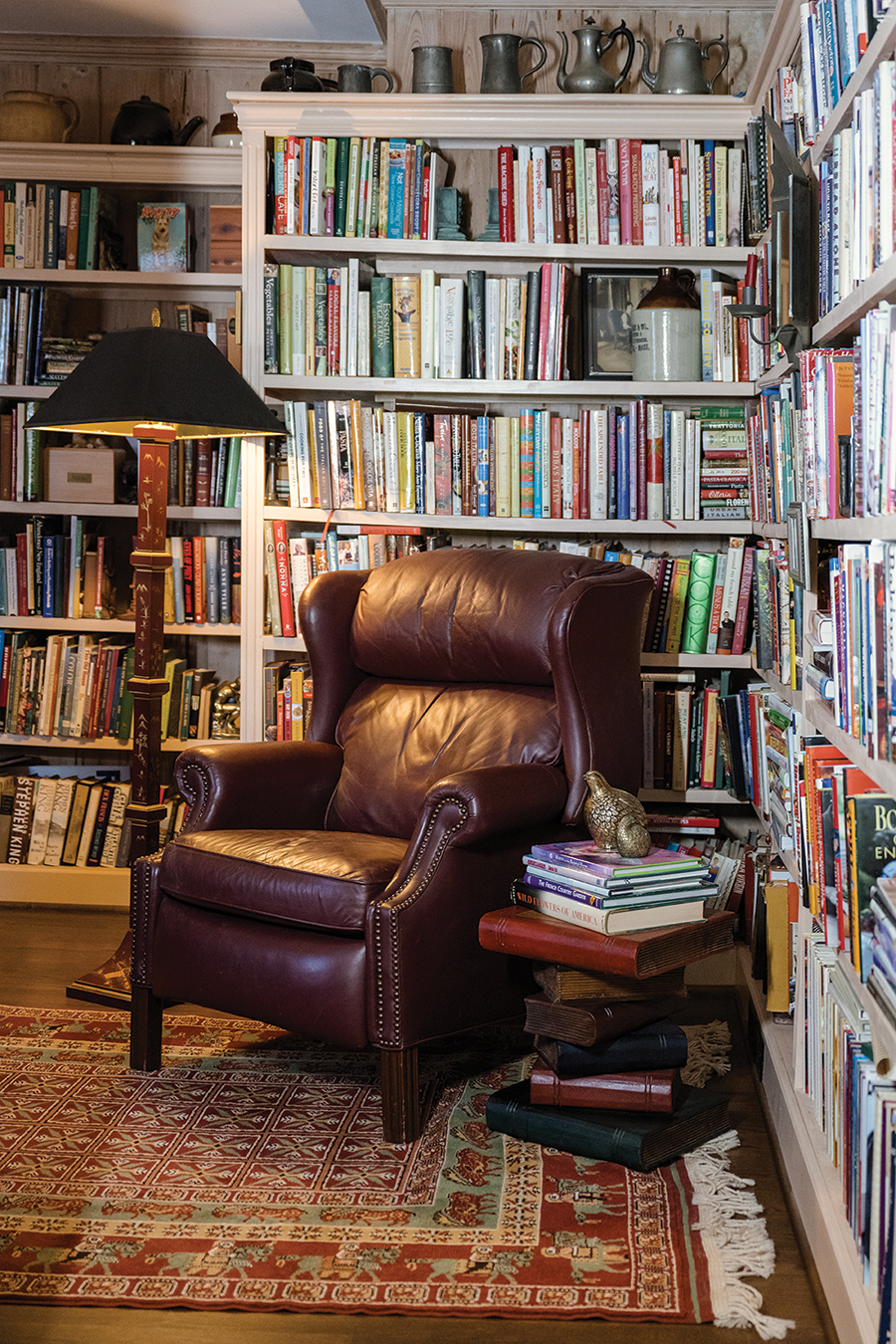
Cookbooks comprise the former restaurant owners’ largest collection, “from church cookbooks to James Beard – award winners, including every edition of the Southern Living Annual Cookbook since 1979.”

Ashley Culler’s Emerywood home library literally rose from the ashes. It is a pastiche of past and present — a mini-Biltmore, but she says their previous library was far grander.

Leather-bound volumes collected for decades burned in a fire that ravaged the entirety of High Point’s Shadowlawn, a French Revival Tudor, in a Gothic style straight out of Charlotte Bronte’s Jane Eyre. No personal images of the architecturally significant 1926 house survived.

Their current home is a smaller version, one that stood mere yards away. It is a beautiful echo of Shadowlawn, destroyed in 2010 by a Christmas fire. (See December 2016 O.Henry: www.ohenrymag.com/out-of-the-shadow-of-shadowlawn.)

The Cullers bought the carriage house that lay in its shadow, renovated decades earlier by Harold and Peg Amos. Over two years, the Cullers incorporated a few pieces from the ruins; stone from fireplaces, a few leaded glass windows, and a salvageable rear entry, and made it their own. (The Amoses had sold them Shadowlawn, as well.)

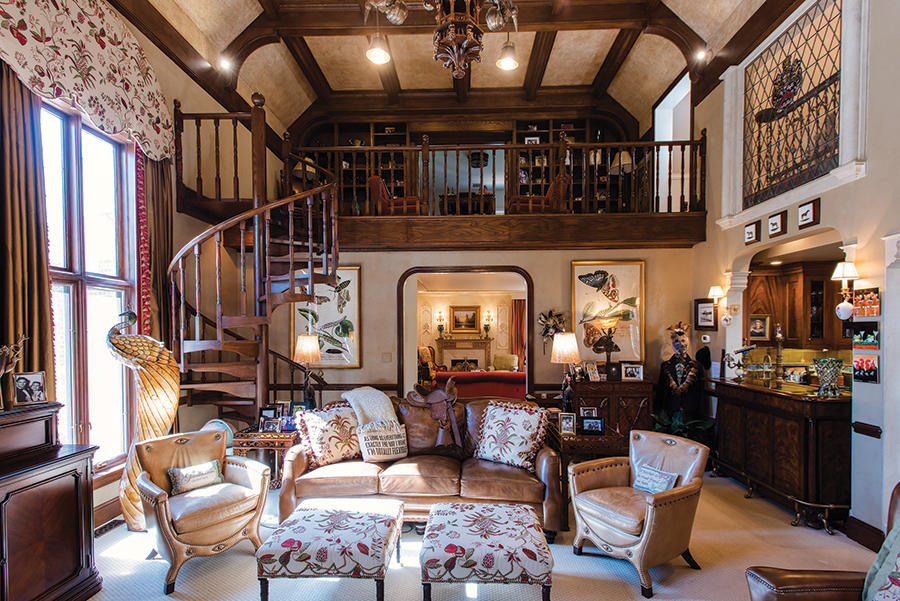
The “new” library built by the Amoses in the converted carriage house, as I wrote then, “most demonstrates the fineness of rooms in the lost house.” A paneled library, complete with a soaring, beamed ceiling, plaster friezes, marble fireplace, leaded windows, spiral staircase and balcony, is the Cullers’ “favorite room.”

Hundreds of collected leather-bound books in the Cullers’ former library were destroyed, along with family pictures, memorabilia and all but a few salvaged items — including a sword from Braxton Culler’s time at military school.

“He said to me, ‘I wish I had my sword back.’ So, one day I went through the ashes and the rubble, and I found it,” says Culler, who took the blackened sword to a local jeweler for cleaning and polishing.

“I surprised Braxton with that, giving it to him a year later.”

It again hangs by the fireplace.

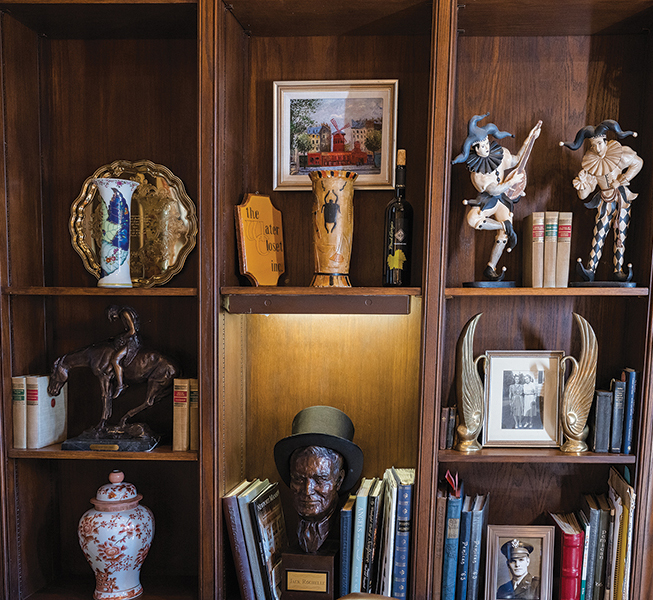
Now, their library features inherited, irreplaceable family items: a “worry” chair possibly bought in the Far East by Jack Rochelle, Ashley’s father, and a cock-fighting chair that was possibly reproduced by Globe Furniture, where he was president; an opium pipe from Burma; solid mahogany elephants that Braxton Culler acquired in Honduras; a bust of Rochelle by his niece, Kitty Montgomery, wearing his top hat from the Sedgefield Hunt.

But the most prized of all is a handmade chess table made for Rochelle and presented by Globe artisans on Christmas Eve in 1952. Here she now plays chess with her grandchild.

“Braxton’s daddy’s dog tags from the war,” are on the mantle, Culler says. At last, new photos from their parents, fill the room. It’s become a repository of memories.

The fire’s hidden blessing is this, Culler says: “We are able to incorporate treasured heirlooms into our newer home.”

Like Culler, many book lovers experienced a library lost.

They discussed how downsizing forces more attrition, less accretion.

Retired Greensboro anthropologist Tom Fitzgerald now raids Little Free Libraries while out on walks in Sunset Hills, returning later to donate. He reads extensively, but no longer stocks a personal library.

Attorney Charles Younce, lover of biographies, history and fiction, keeps stacks of books by his bed — but, he says regretfully, no library. He is winnowing out possessions, something he counsels friends to do.

Former Greensboro librarian Pam Norwood and her husband, Phil, downsized a library of 2,000 books when they retired. They culled in earnest. “We kept about 200 books,” she estimates. “We have books in each of our little condo’s rooms. There is not a room for a separate library.”

Norwood buys books, borrows from the public library and reads on Kindle when traveling. “I have been accumulating books all my life, and we still have some books from our childhoods.”

Bibliophile Regula Spoti, a Swiss transplant to the Triad, was inspired by Bibliostyle: How We Live at Home with Books. She buys e-books monthly but estimates now owning 150 books despite “giving books away liberally — and I only want meaningful books in my library.”

Greensboro reader Nancy Jones belongs to several book clubs, now keeping a minimum of 300 books in her home. “I have four different areas with books collected — one whole wall book-cased in my family room with mostly books, a few art objects. And a lawyer’s bookcase at the end of my hall.”

Virginia Cummings, avid reader and fellow “bookie,” created a wall of bookcases in a living room filled with books she and her husband still pull off the shelf to reread. “I love to see my family and friends browsing and conversing about the books,” she writes. But there’s a caveat: “One son, who reads classics, tries to sneak them back to his house.”

The Tender Bar, based on J. R. Moehringer’s book, features a scene in which the writer’s uncle opens a closet stuffed with classics. These, the uncle says, must be read before he can consider himself educated.

Moehringer’s first bosses at a bookstore explain that every book on the shelf is a miracle; “it was no accident they opened like a door.” Whether that door is discovered within a grand library, like Vanderbilt’s, or a closet, like his uncle’s, it opens us too.  OH

Almanac

April

By Ashley Walshe

April is a child of wonder, lord of the mud pies, the crown prince of play.

Yesterday it rained so hard the earthworms learned to swim. Today, the peepers are peeping. The sun is out. The prince of play gathers the essentials:

Large wooden spoon? Check.

Mixing bowl and pie tins? Check, check.

Measuring cups? Don’t need them.

There’s a watering can full of rain on the back porch. Or, there was. The boy squishes across the yard, settles onto the floor of his squashy kingdom.

Mud sings as sweet as any muse. But you must know how to listen.

The boy closes his eyes, readjusts his flower crown and scoops up a wet heap of earth. He dabs a little on his face. He squelches his fingers through it. He digs into the mire with his toes.

Eureka!

This is what the mud said:

In a large mixing bowl, combine two parts squish and one part rainwater. Wriggle your toes as you stir, mixing until the first hummingbird graces the first bearded iris.

When the cottontail rabbits multiply, fold in a dash of wet grass and a fat pinch of redbud before transferring to pie tins.

As the robins pluck their breakfast from the lawn, top with generous layer of dandelion leaves.

Garnish with snakeskin, snail shells and a
dollop of wisteria.
The sun will take care of the rest.
 

Fairy Rings

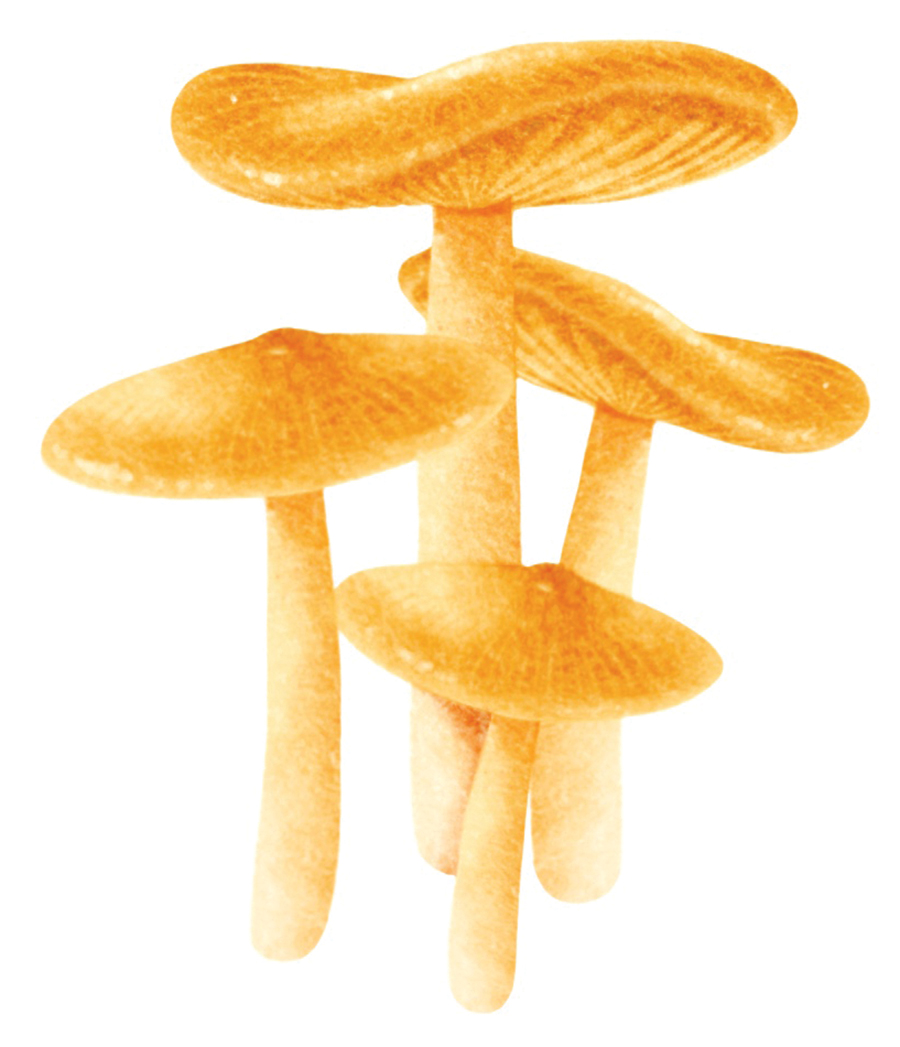
Spring is doing what spring does best. The earth is softening, once-barren landscapes now bubbling with tender buds and blossoms. In the garden, asparagus rises like birdsong. And after it rains? Enter Marasmius oreades, aka, the fairy ring mushroom.

If ever you’ve stumbled on a near-perfect circle of these buff-colored, wavy-capped fungi, perhaps you’ve smiled at the amusing “coincidence.” Or maybe it spooked you, particularly if one popped up on your own lawn. (Note: These boomers are known to kill turf.)

Myth and folklore refer to these circles as “fairy rings.” Can’t you almost see it? A wild band of wee folk dancing among these mushroom portals?

Tempting as it may be to step inside a fairy ring, myths warn against it. Long of the short of it, those who are lured inside become captives of an unseen realm where hundreds of years can pass in a blink.

On the subject of fair warnings: The fairy ring mushroom is actually a choice edible with a sweet quality that has made its dried caps the star ingredient of more than a few macaroon and cookie recipes. (Go on, look them up.) But this innocent wildling does have a toxic lookalike. Best not to harvest unless you know for sure. And, certainly, withhold from sautéing them.

Foxglove

How did the pretty foxglove get its name? Etymologists have spun many theories. In 1847, William Fox Talbot proposed that “foxglove” may have derived from “folks’ glove,” especially since the Welsh called the flower maneg ellyllon, aka, “fairies’ glove.”

This much we do know: They are bumblebee magnets.

If ingested, the common foxglove (Digitalis purpurea) is highly poisonous to people and animals. In this case, looks can’t kill. But one could see why the Scottish called them “witches’ thimbles.”  OH

Free to Go & Grow

Rob Brown

Finding the Promised Land
As told to Ross Howell Jr.     Photograph by Bert VanderVeen

When I was in fourth grade, my dad — who at 84 is still a Richmond Times-Dispatch photographer — took me to a football game between VMI and the College of William & Mary. He hung a camera around my neck, got me a press pass and told me to see what I could do.

I got a picture of a guy scoring a touchdown, which ran in the Times-Dispatch. The paper paid me $5.

I was hooked.

But when I graduated from high school, I didn’t see photography as a real job. So, I apprenticed with a brick layer. Later, I went to Longwood University, playing basketball in the summer with a guy named Leger Meyland. He was going to photo school and convinced me to go, too. He has been a mentor and friend for 40 years now.

After a year at Randolph Community College, I got a job at the Radford News Journal. Then I came here to Greensboro to work at the News & Record, where I met my wife, Lane. After she got a job in Chicago, we moved there. I found work at The Times of Northwest Indiana, a suburban newspaper.

We had kids and decided to move to Baltimore to be closer to our families. Lane landed a full-time job at The Baltimore Sun. I was a freelance photographer and stay-at-home dad.

When we learned the News & Record was looking for a director of photography, I applied. They took a chance on me, even though my only management experience was raising kids.

In 2015, when I was laid off from the paper, I felt spurned. For a while, I freelanced. Then I put my cameras away, rarely taking pictures.

I decided I’d try something completely different.

I signed up for brewing school at Rockingham County Community College, then got an entry-level job with Natty Greene’s Brewing Co. I was putting beer bottles in boxes in a cold warehouse. Eventually, I was trained to work in the cellar, and later, I handled brewing.

Then I went to Foothills Brewing in Winston-Salem. My work there also was very physical.

I realized brewing is a younger man’s game. So, I decided I’d give computer security a try.

After about two months of study at Guilford Technical Community College, COVID hit.

All my classes went virtual, except for geology. Even though I’d made the president’s list and was six hours away from my associate’s degree, I was feeling very isolated.

I knew when I finished, I’d be starting at ground level again. Worse, I’d be working with 19-year-olds who were real computer whizzes compared with me.

Because my son was getting married, I’d been helping him look for a wedding photographer online.

One evening, I was talking with Lane.

I showed her a photographer’s site and said, “Looking at these photos makes me want to take pictures again.”

And she asked, “Why don’t you?”

So, I got back into freelance photography. After about three months, I heard that the Elon University communications department was looking for a photographer.

I applied and got the job.

Now, I’m back to doing something I love and something I’m good at.

For years I was wandering in the desert and now I’ve found the Promised Land. I couldn’t have done it without Lane.  OH

A longtime writer for O.Henry, Ross Howell Jr. is doing research for a second historical novel.


Jessie Sloan

Landing on Her Feet

By Cynthia Adams     Photograph by Bert VanderVeen

For such a sunny personality, Jessie Sloan, a Shreveport, Louisiana, native, had a surprising first job after college — making bombs at the Louisiana Ordinance Plant.

“I was making 2.2 mortar shells, putting the mechanism on the back of the shells that made it propel.”

She also began hair-raising work as a cosmetologist — her mother having advised her to always have a side gig.

Next, Sloan vetted materials for Lucent Technologies in Shreveport, with top security clearances. (“If I did not approve it, they would not purchase it.”)

After 27 years, she “woke up one morning and, noting a Lucent posting in Greensboro, decided I wanted to see how the other part of the world lived.”

In a lickety-split, Sloan transferred.

Sloan remained in top clearance work — secure telephones for the White House and transatlantic junction cables.

Whenever she saw the President using a White House phone, she thought, “I had a hand in that. Oh, my goodness!”

Ever mindful (“My mama always told me, never settle for one thing. Have an A, B and C. I’ve always had more than one job”), she earned her N.C. license, resumed work in a beauty salon — and still worked for Lucent. Two years later in 1997, Lucent closed the Greensboro facility. Sloan retired.

For a while, she traveled, unable to do hair given a knee replacement. “I had to find something else!”

She laughs. “I don’t let anything get me down. I keep a positive attitude.”

A Louisiana podiatrist first introduced Sloan to reflexology. “If I had any sore places, he would massage a certain area on my foot, and the pain would go away.” She told him how she loved giving foot massages. He lent Sloan his books.

“One night I was in bed and said, ‘Well, Lord, what can I do?’ The Lord said, in my mind, ‘Do feet! You enjoy doing feet.’ I got up that morning and found a school.”

For a year, Sloan studied reflexology at Natural Touch Massage School, completing studies and clinical work in 2005.

She registered her business, Soles by Sloan, working at a State Street salon (plan A). Sloan advertised, appeared at health fairs and built a reflexology practice, which she later moved to her home.

Does she absorb the energy of clients as she works?

“You do. You’re transferring your energy to that person. And absorbing all that drains you,” she says.

Meanwhile she worked for Sears 14 years — plan B — in data entry.

Sloan giggles.

“A friend said, ‘You’re not from this planet. You’re not from here.’ I would say, ‘I am too from here! God made me, and He made me this way!’ So many things have happened to me that were unexplained. It’s amazing.”

Today, Sloan’s primary work remains reflexology. But, always, there’s a plan B. Last August she began working with special-needs children on school buses. She arrives at the terminal before 6 a.m.

“I keep them in their bus seats to be sure they don’t get up and hurt themselves. Help them off and on and help with their seat belts. It’s really rewarding.”

This repeats in the afternoon. Sloan returns after lunch to assist again, riding with the children, soothing them, and is home before 5 p.m.

“I’m learning to be thankful, patient. Learning to be caring. Understanding. To work with kids,” Sloan says. “I’ve always wanted to do it.”

She ends the call, preparing for a reflexology session.

“Reflexology is my first love. That is just part of me. That, I always tell people, is my calling.”  OH


Chris Hayes

Learning Lessons from COVID

By Maria Johnson     Photograph by Bert VanderVeen

Early one Sunday morning, after wrapping up his 7 a.m. to 7 p.m. shift in the intensive care unit of Greensboro’s Moses H. Cone Memorial Hospital, registered nurse Chris Hayes sniffs out the charge nurse, hands over a handful of badges and tags, and walks out of the Greensboro hospital in his blue scrubs for the last time.

The next afternoon, he sits in a sparsely populated Panera restaurant, sipping a cola and absorbing the new reality of his retirement.

“It hasn’t sunken in yet,” the 56-year-old Hayes says.

Bearded, burly and athletic, with sports sunglasses parked atop his closely cropped hair, the former high school wrestler explains why he left his beloved profession in January, after nearly 32 years.

It’s true, he says, he’d been thinking about retiring to have more time to travel and work on projects around the house.

The accelerator, he says, was COVID.

Specifically, one young man with COVID.

Chris cared for him last summer.

The kid — a college student with no history of health problems — had been moved to the ICU because his oxygen levels were falling. Chris saw him only one night. The kid was conscious, alert and talking through an oxygen mask.

And even though Chris had told himself — after doing it once early in his career — that he’d never get attached to a patient again, he connected with this young man.

“I could see my daughter there,” Chris says, eyes welling at the thought of his younger child, also a college student.

That night, the young man — who was not yet eligible for a vaccine because of his age — crumped.

That’s nurse-talk for took a sudden turn for the worse.

They put him on a ventilator to help him breathe. He stayed on the machine for three weeks.

One morning, when Chris was at home, he got a text from a colleague. They’d lost the kid.

“I about threw my phone through the wall,” Chris says. “It was anger, just anger wishing it had never happened.”

His anger surged at other times, too, especially when dealing with older, unvaccinated patients.

“Probably the hardest thing was listening to people when they were dying, saying they wish they had [gotten the vaccine],” he says.

The idea of retiring grew sweeter when his wife, Jamie, left her job. She’d also worked nearly 32 years as a public school teacher. She, too, was pushed out by COVID and the overwhelming demands it placed on educators.

They both were seasoned veterans with thick skins, Chris says, but COVID had found their breaking points.

“Everybody has one,” he says. “Anyone who tells you they don’t is lying.”

Still, he says he harbors no hard feelings about his pandemic experience.

“I’m probably smiling because it made me retire early,” he says.

Eventually, he adds, he’ll look for another job — a low-stress, part-time gig — maybe in landscaping or in a big-box hardware store, where he can get a discount to furnish his garage workshop. Lately, he has been building coffee tables, TV stands and end tables for his daughters and their friends.

Before the next job search, though, he’ll take several months to scratch some items off his to-do list: going to an Eagles concert with his wife; taking two cruises with his family (one to celebrate older daughter Rebecca’s graduation from pharmacy school); and attending every fall volleyball game of his younger daughter, Grace, a senior at Bridgewater College in Virginia.

One of Grace’s teammates had COVID in 2020 and developed a seizure disorder afterward. The teammate recovered and played again, Chris says, but seeing people who are younger and stronger than he is get seriously ill with COVID was not lost on him.

“Noticing that young people are not immune to all of this has taught me that life is precious,” he says. “It’s time to get out and enjoy it.”  OH