Farm Small Think Big

FARM SMALL THINK BIG

Farm Small, Think Big

Innovative niche farmers are making our lives better every day

By Ross Howell Jr.

Hard to think of a better time to talk to farmers than spring, so that’s just what I did. What follows is a small sampling of the many creative and determined small farmers in our area who are growing beautiful, fresh and healthy products for our kitchens and homes, season after season.

Bugle Boy Farm, Summerfield

Named to honor James Gillies, a 14-year-old “bugle boy” killed in a skirmish with British troops in the American Revolution, Bugle Boy Farm is emblematic of a major trend in modern farming.

“Our goal is organic,” says owner Elizabeth McClellan, who purchased the farm with her husband, Gero, in 2012.

Elizabeth is a big fan of Joel Salatin, an internationally known pioneer in “regenerative farming” — using modern agricultural methods to grow organic produce and meats while improving and sustaining the land on which they’re grown.

For years, Bugle Boy Farm has produced organic blueberries, pasture-fed beef and chickens, plus eggs.

But it was Elizabeth’s nephew, Christian Hankins, who suggested a unique niche.

Garlic.

Christian, a veteran who grew up in Rochester, Minn., and played minor league hockey, retired from military service during the pandemic. He had fond memories of his grandparents’ family farm and began to research garlic as a crop. For a couple of years, he grew garlic as a hobby, studying the process of growing and curing.

After becoming a member of the Bugle Boy Farm team, Christian purchased 22 acres of open land, expanding operations.

“The clay soil here tends to hold water,” he says. So he developed a special blend to amend the soil, including cow manure, gypsum, bone meal and lime.

“Curing the garlic is a big issue because of the humidity in our region,” says Christian. Recently the farm added a modern drying facility, with humidity and temperature control, where the bulbs are cured and stored until ready for market.

Bugle Boy Farms grows several varieties, each with distinctive flavors. The farmers also test cooking recipes, pairing specific garlic varieties with particular styles of cooking — Italian, Mexican, Asian and so forth.

Garlic is also available in old-fashioned, handmade braids.

“They’re edible craft,” Christian smiles. “People like to hang them up in their kitchens.”

“Customers really enjoy buying them as gifts,” Elizabeth adds.

Another specialty is scapes.

These are the long, slender flower stems that grow from garlic bulbs in the early spring. Growers remove the scapes to concentrate plant growth in the bulbs, which are harvested in early summer.

“Scapes have a scallion taste,” Elizabeth says. Some local restaurants buy them, and, she tells me, she has a special recipe for making scape butter. “It’s very tasty,” she adds.

A big advantage to buying Bugle Boy Farm garlic is its freshness. Plus, Christian says, “You can use less garlic because the quality is better.”

(For more information, visit bugleboygarlic.com)

Sprinkles Gourmet Mushrooms, High Point

If I ask you to envision an urban farm, I’m pretty sure what comes to mind is not a photographer’s studio.

But that’s what ingenuity and fungi can do for you.

Mushroom farmer Troy Sprinkles lived in Greensboro for decades before moving his professional photography studio to High Point eight years ago — continuing to work with a range of furniture industry clients.

But, during the COVID pandemic four years ago, Troy experienced an epiphany. He picked up a copy of a book about mycelium (the root-like structure of fungus) written by Paul Stamets, best known for the documentary film, Fantastic Fungi.

“It was a life-changing experience,” Troy says. He read all of Stamets’ books and every other reference he could find about fungi and began growing mushrooms in the basement of his house.

One day he thought, “Why not convert my studio into a fungi farm?”

Section-by-section, Troy expanded his “farm” in the 7,000-square-foot building that still also houses his studio.

He concentrates his fungi culture on nine varieties.

“We only grow species that are wood lovers and tree dwellers,” Troy says.

Among those are shiitake, blue oyster and lion’s mane.

“Lion’s mane is a native and is the most prolific,” he says. “In the wild, it usually grows on oak trees. It’s excellent for its medicinal value and for its gourmet flavor.”

Troy purchases his substrate materials from reputable producers in Tennessee and North Carolina.

Everything that goes into his growing rooms must be completely sterilized before being inoculated with mycelium spawn.

“What you’re creating is a perfect environment for mold to grow,” says Troy. And stray mold is a real no-no because it overwhelms the spawn.

His farm is a family operation.

Troy’s wife, Beverly Clary — whom he met when she was an art director at Pace Communications — helped him develop the business. These days, she only works with him in the summer months.

“She’s a full-time elementary school art teacher now, teaching seven classes a day,” Troy smiles.

His 34-year-old son, Zachary, who held different jobs before joining his father, works full-time in the business.

“I say growing things is good for your soul,” Troy says.

(For more information, visit sprinklesshrooms.com)

Rocky Forge Farm, Linwood

When I first heard about this niche farm’s specialty, I headed straight to my dictionary. I’ll save you a trip.

“Wagyu” (wah-gyoo) means “Japanese cow.” More broadly, the term applies to cattle bred in Japan that are noted for the rich marbling of their meat, which makes it more flavorful, tender and moist.

A few years back, when Rocky Forge Farm’s owners, Michael and Jodi Jones, were mostly raising horses and other animals, they were celebrating a special occasion with a dinner of Wagyu ribeye steak.

“That experience ignited a passion,” Michael says. Little by little, they decided to go all in on raising American Wagyu beef cattle.

They purchased a purebred Wagyu bull and purebred black Angus heifers. They cleared additional land and built a 30-by-50-foot shelter.

“The first years were hard,” Michael says. “We had no income.”

That’s because raising Wagyu cattle takes patience and time.

“Our cattle are best when they’re 3 years old,” Michael says. “One we took to the processor recently was nearly 4 years old.” Compare that to the industry standard of 18 months for feedlot cattle raised commercially.

The Joneses are careful practitioners of sustainable agriculture. They grow alfalfa and timothy grass, reseeding pastures in the spring for summer grazing.

“We move our temporary fences every other day, so the fields won’t be overgrazed,” Michael says.

The farm also produces more than 100 round bales of hay that’s stored for winter forage.

Remember, these are all natural methods for raising cattle.

Rocky Forge Farm Wagyu cattle follow the quiet rhythms of herding animals — grazing, going to water and resting.

After years of crossbreeding, Michael and Jodi’s herd is more than 87% pure American Wagyu stock now. And demand for Rocky Forge Farm’s beef continues to grow.

The Joneses are the fifth generation of his family to live in the old Rocky Forge farmhouse. They’re proud of the cattle business they’ve built. They’re proud of the picturesque corner of the Piedmont where they live. And thankful.

“We’re all stewards of the Earth,” says Michael. “None of it goes with us when we go. It has to be passed on to others.”

(For more information, visit rockyforgefarm.com)

PTB Farm, Reidsville

PTB is an acronym for “Pine Trough Branch,” a small stream that shapes the western boundary of Hillary and Worth Kimmel’s farm, purchased by Worth’s grandparents in 1953.

The couple were just acquaintances when they both studied ecological agriculture at Warren Wilson College, where students grow and harvest the food they eat using sustainable agricultural practices. They got to know each other when Hillary was growing vegetables on her family’s farm in Boone and Worth was raising livestock on PTB Farm.

Since the Piedmont offers a good environment for both vegetables and livestock, they joined forces.

“In 2014, we got married and started coming to the Greensboro Farmers Curb Market,” Hilary says. “It’s been really key for us, because it’s a year-round market.”

Now the Kimmels have a 3-year-old daughter, Juniper.

The family grows vegetables, herbs and cut flowers, along with grass-fed beef and pastured pork.

For Worth and Hillary, “soil is the heart of what we do.”

“We learned about that at Warren Wilson,” Worth says. Farming, they were taught, is an element of a sustainable ecosystem creating healthy food.

Since agriculture is such a seasonal business, the Kimmels set up a PTB Farm co-op.

“A CSA (community-supported agriculture) co-op really helps us with cash flow,” Worth explains.

“Ours is a market-style cooperative,” Hillary says. Members pay an annual membership for the farm’s products and receive a 10% discount when they purchase against the balance of their fee.

“Members choose the produce and meats they want, rather than receiving a regular allotment,” Hilary adds. “We have some members who’ve been with us since we started. They feel like family.”

Worth tells me that in their first decade, the farm had big expenses just for infrastructure — wells, water tanks and irrigation for their cattle and plants, portable fencing so the animals could be moved about.

“Now, finally, we have a walk-in cooler,” Worth says, smiling. Very handy when you’re packing up meat and flowers for farmers markets.

To market their products, the Kimmels divide and conquer.

During peak growing season on a Thursday, they pick flowers in the morning and put them in the cooler. On Friday morning, they harvest vegetables and lettuce and arugula. By lunchtime, all the vegetables are washed and their special “PTB salad mix” is finished. Friday afternoon, Hillary makes up her bouquets and Worth packs up the meat in coolers.

Then, on Saturday mornings, Hillary works the Greensboro market and Worth sets up at the Winston-Salem market.

Do they ever alternate?

“For some reason, no,” Worth grins.

“And that’s when Juniper spends time with grandmother!” Hilary laughs.

(For more information, visit ptbfarm.com)

Waseda Farm Flowers, McLeansville
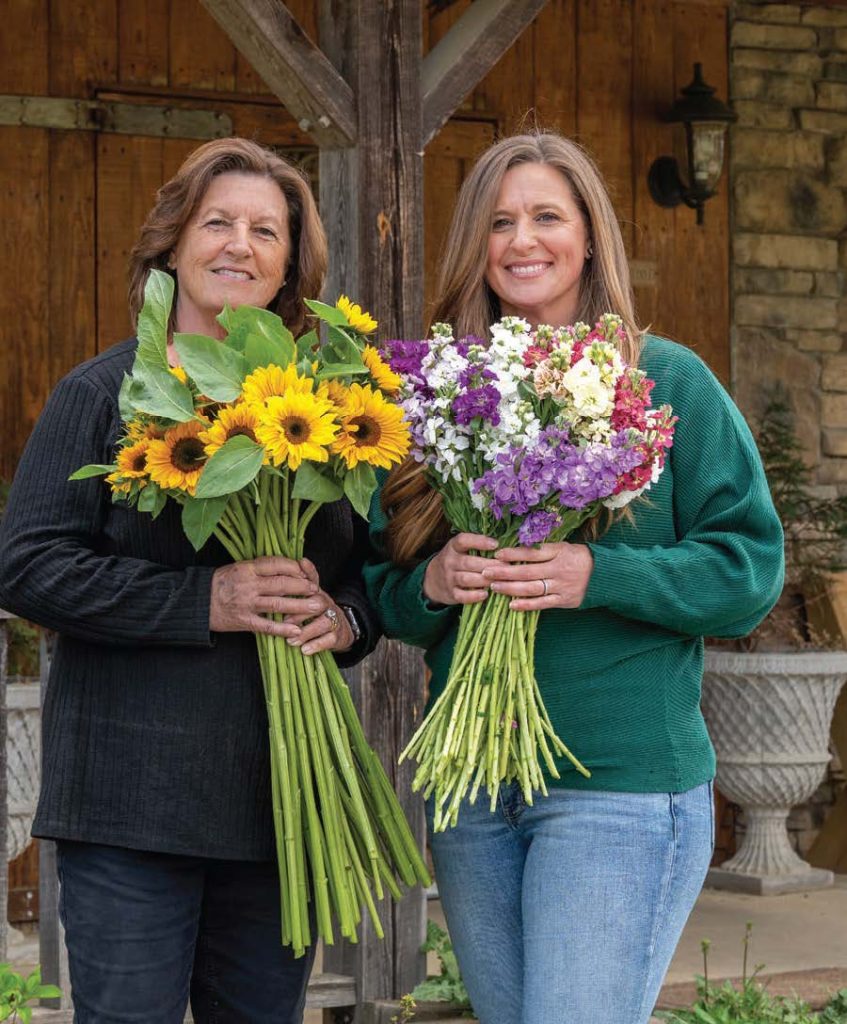
In 2020, Elaine Fryar and her daughter, Crystal Osborne, started growing cut flowers on a half-acre plot located on a 200-acre farm that’s been in the family of Elaine’s husband, Gerald, for more than a century.

Already, the two women have expanded their growing area to three-quarters of an acre, with plans to cultivate a full acre soon.

And, man, they have been keeping Gerald busy.

“We have a cooler now for the flowers,” Crystal says. “We were able to repurpose an old milking parlor from when the farm was a dairy.”

“Yes, Gerald made a nice walk-in cooler for us,” Elaine adds.

Two years ago, her husband completed an even bigger project.

“Gerald repurposed an old tobacco greenhouse for us,” Elaine says. “It measures 30 by 40 feet and has six beds. It was a lot of work for him.”

“There’s still a lot of glass left from the tobacco greenhouse,” Elaine continues. “But Gerald says if I want another flower greenhouse built, I’ll have to get a new husband.” She grins.

The women sell their flowers to other farmers who have their own market sites, to local florists and to a subscribers’ list online.

“And the Greensboro Farmers Curb Market has been fantastic for us,” says Crystal.

Crystal puts together all the bouquets.

She and her mother give a lot of thought to price points. They offer arrangements with names such as “Tiny Tots,” “Mason Minis” and “Nosegays” that come in BBQ sauce jars. They also sell more expensive arrangements in elegant vases or long-stemmed bouquets wrapped in plastic.

At the farm they also offer classes. In December, customers can take a wreath-making class.

“We use our own eucalyptus and purchase Doulas fir, cypress and cedar from local growers,” Crystal says.

In the summer they offer a class called “Petals and Prosecco.” Nothing like a nice bubbly to improve your blossom arranging skills, right?

“Our goal is to have one class each quarter,” Crystal says, noting that they announce advance ticket sales on social media.

There are more activities on the drawing board. This summer, Waseda Farm Flowers will offer its first pick-your-own sunflowers program.

“One day, we hope to have pick-your-own blueberries,” Elaine says. “Eventually, we’ll start keeping bees, to help with the pollination, and the honey, of course.”

“And we’ll be doing special, luxury, pop-up picnics,” Crystal smiles.

Sounds like whatever the future holds for Waseda Farm Flowers, it’ll be a bloomin’ good time.

(For more information, visit waseda-farm-flowers.square.site)

Healing Lands

HEALING LANDS

Healing Lands

A once tired farmland is now a thriving home to family and flock

By Cassie Bustamante     Photographs by Amy Freeman

At the end of a long, gravel drive, where two golden-white Great Pyrenees greet visitors as soon as they hear the crunch of tires, sits a modest, 1,800-square-foot, 1950s rancher. Ashlynn Roth, her husband, Tim, and their two young children, ages 6 and 8, have been settling into their Whitsett farm over the last month. Beyond their sliding-glass back door, Dorper sheep with their young lambs roam freely on a vast, grassy pasture, bleating loudly in response to the sound of Ashlynn’s voice. In front of the home is a movable henhouse, where chickens produce plentiful eggs. But just a few short years ago, none of this existed here — not even the house. Years of tobacco and corn farming had taken its toll, leaving behind unserviceable, rock-hard soil. The Roths, however, had a vision: Heal the land and create a homestead.

Ashlynn is a petite blonde with sparkling brown eyes. Her hair is styled in long, loose curls that frame her round face. She’s been known to don a glittery evening gown and even participated in pageants at one point in her life, earning the title of Miss Thomasville in 2003. It’s easy to imagine her as a beauty queen and it’s no wonder she’s the face of Tupelo Honey Farms, a regenerative farm in Whitsett. But, she’s quick to tell you, she’s also a serious, full-time farmer. “No way,” people respond. “Oh, yes,” she says. And she’s got the dirt under her fingernails to prove it.

Farming is hard, gritty work, she admits, but not as grueling, she discoverd, as being an executive in the human resources software field. “When I was a VP in corporate America,” she says, “that was a challenge.” Her days were spent kissing her babes’ heads then dashing out the door to catch early morning flights as a new, nursing mother. As soon as her plane landed, she was making a run for a bathroom to pump breast milk, dashing off to meetings with clients, then rushing back home just to see her young family, however briefly, before doing it all again the next day. Tim was also collecting frequent flyer miles as a medical-device salesman with a focus on dialysis care. “We would pass each other in the air sometimes,” says Ashlynn.

Ashlynn and Tim had known one another since they were teenagers, but romance didn’t blossom until much later. She was living in Atlanta after graduating from UNCG, but coming back to the area frequently because her mother, her “best friend,” had fallen ill. Tim, too, had left the area after growing up here, landing in San Francisco, but his father had suffered some small strokes. Since his job allows for him to live anywhere, he traded Golden Gate City for The Gate City to take care of his father and his father’s own regenerative cattle farm.

They began running into each other at Cone Health, where Ashlynn was frequently visiting her mom. Tim, who was there on business, reached out to Ashlynn, thoughtfully bringing her magazines and then asking her to have lunch with him. “He asked me out five different times!” she says, but dating was the last thing on her mind.

When her mother was moved to Duke Hospital, where a diagnosis of a rare form of cancer was pronounced, flowers arrived one day for her mother — from Tim. “And my mom goes, ‘I think you should go on a date with him.’”

She took the advice. In her mom’s hospital room, she prepped for the date, a casual outing to watch the Durham Bulls play ball. After the game, they wandered into a bar and munched on a charcuterie board featuring sheeps’ cheese. A portent of things to come? “You’re going to laugh at this,” she says. The provisions — and the company — were welcome, but as she tucked into the sheeps’ cheese, her mouth began to itch: “Now, sheep are my favorite thing, but I can’t eat the sheeps’ cheese!”

Weeks turned into months and, before she knew it, Ashlynn couldn’t imagine a future without Tim in it. Though she swore she’d never move back to Greensboro and only wanted to live in big, thriving metropolises, she finally packed her bags and left Atlanta behind to begin creating a life together.

Her mom, though still ill, was feeling better. And Tim’s father was back to working his own farm, giving the couple the chance to leave Greensboro behind again. Over the next decade, they zig-zagged across the country, living as far as Houston, Texas, and Cleveland, Ohio. They also married and welcomed their two children. Sadly, Ashlynn’s mother passed away when her first-born was just 5 months old.

Eventually, with an infant and toddler at home, Ashlynn made the decision to quit her job, allowing the family the chance to live almost anywhere in the world. “We chose Greensboro.”

The family settled into an expansive Irving Park home, and just months later, Veeva, a cloud-computing company, offered her a remote job. “It’s for people going through clinical trials,” she says. Having tried to get her mother into a clinical trial, it was something that tugged at her. It seemed too good to be true, so she went back to work and hit the ground running in her new role.

And then in 2020, during the pandemic, she woke up one morning feeling dizzy and as if she were moving even though she wasn’t. “I felt like I was flipping,” she says. “And day after day kept going by and it never went away.”

MRIs and all sorts of testing on her inner ear and vestibular system resulted in no concrete answers or solutions. “They couldn’t figure out what was wrong with me.” She recalls being told by doctors, “We think you might have MdDS [Mal de Débarquement Syndrome] — we don’t know — but here are some eye exercises. Good luck!” (MdDS is a rare vestibular disorder that makes you feel like you’re moving when you’re still.)

After two-and-a-half years of feeling like she was constantly riding ocean waves, Ashlynn decided it was time to be her own advocate. She began searching for answers on Instagram and discovered Alicia Wolf, aka @thedizzycook, whose account touts itself for its “delicious anti-inflammatory recipes for brain health.”

“Her symptoms sounded just like mine,” Ashlynn says. So, she reached out. Wolf immediately got back to her and recommended Dr. Shin Beh in Texas, who, according to Wolf, was one of only a handful of neurologists in the country who studied dizziness at the time. In turn, Ashlynn reached out to Dr. Beh and begged him to take her virtually since dizziness was making travel a challenge. He accepted her as a new patient and had her almost immediately diagnosed with vestibular migraines and MdDS. “And I just busted out crying because I was like, finally, I know what this is.”

While these afflictions are not curable, they are treatable. Ashlynn, who soldiered on in her demanding job, implemented a wholistic approach in the kitchen, creating recipes from Wolf’s cookbook. She took prescription medication and doctor-recommended supplements. All the while, she kept reflecting that Dr. Beh had also advised lowering her stress levels. The people who most often get diagnosed with MdDs were just like her. “He said, ‘It’s women that are hustlers, go-getters like you, A-type personalities — they’re always on,’” she recalls. “And he was like, ‘We have got to get your mind calmed down.’”

Her response? “I know how to handle stress.” But she didn’t know how to slow down. These days, women are told we can do it all — have a career, have a family, have a side hustle. No one, however, tells you it’s not sustainable to do it all at the same time.

Once again, a new company came calling, this time for a role as a VP, a title she’d longed for. “This was just such a step up in my career and more money,” she says, “So I was like, I’ve gotta do this.” She took the job and once again found herself on the move nonstop for work.

As if her plate weren’t full enough already, she and Tim, both with farming in their blood, had decided to look for farm acreage. Tim came upon what he thought was the perfect piece of real estate and drove Ashlynn out to it. When they arrived, she gasped. “What in the world?” she recalls saying. “This is my great-grandfather’s land!” The Whitsett property had once belonged to her great-grandfather and remained in the hands of distant relatives. Her grandparents, now in their 90s, live right across the street. The couple not only put in an offer on the 15 acres marked for sale, but reached out to the owners of bordering pieces of land to try to cobble back together the bulk of what had once been her great-grandfather’s. “They were like, ‘We’re not giving you a deal even though you’re family,’” recalls Ashlynn. “And I am like, ‘Well, I am not asking for a deal.’”

They got the land. “And it was rough looking,” says Ashlynn. Between working in demanding careers and raising kids, the couple drove out to Whitsett every chance they got to clean it up and make it once again suitable for farming.

But after the Roths closed their deal, Tim’s father fell ill and they once again took over his cattle farm, just over 10 minutes from their land. They’d previously taken over property ownership, but Tim’s dad still lived there and operated it until he needed to move to a longterm care facility. “So now we’re taking care of that, too.”

Even with the hustle of shuffling from Greensboro to their Whitsett land and the cattle farm, Ashlynn says the time spent outside working in the dirt provided a peace she hadn’t felt in years. It offered a chance to get out of her mind and into her body, and renew her sense of wonder. Nearby, a large flock of birds pecks at the ground. A single bluebird stands out against the rest; he takes off and settles on a nearby tree branch. Ashlynn stares in awe.

The answer was clear: quit her high-paying corporate job and focus full-time on farming. “I sat my husband on the steps . . . and I said, ‘I can’t do this anymore. I am about to lose my mind.’”

He was going to say no, she just knew it. “We were standing right out here and it looked like crap — it looked awful, trash everywhere,” she recalls. He looked into her eyes with understanding: “OK,” he said.

Ashlynn immediately got to work, spending her days dropping her kids off at school then driving out to Whitsett. Eventually, after several laborious months of clearing out dead trees and enlarging pastures, the land was ready for animals. On weekends, when Tim wasn’t visiting hospitals for work, the entire family pitched in.

Taking a page from Tim’s father’s regenerative farm, the first animals to roam Tupelo Honey Farms were pigs because “pigs are amazing for regeneration.” In regenerative farming, land is not cultivated. Instead, animals graze — and are moved from pasture to pasture — to restore its natural ecosystem. “Now there is green grass coming out up there, so lush,” says Ashlynn. “I get so emotional about it.”

Of course, her grandfather, who’d once farmed this land and lived just across the street, didn’t see it her way. According to Ashlynn, he told her animals should be raised in a massive barn. While the two lovingly butted heads for a bit, she says, he eventually came around, saying to her, “Just because you’re doing it different, doesn’t mean it’s wrong.”

Not only was the land healing, but so was she. Three months into being a full-time farmer, Ashlynn was able to go off her medication. Dizzy days are not a thing of the past, but they’re no longer a regular occurrence. Being in nature, watching clouds pass by and grounding — a wellness practice that involves direct contact with the land’s surface — is what’s helped her. “I put my bare feet right on the Earth.”

And finally, after a few years of back-and-forth from Irving Park to Whitsett, she is able to step right out her front door and sink her toes into her own farmland. Staying true to their belief in sustainable practices, the couple opted to move an entire 1950s rancher from Greensboro to the property. Turns out, their Irving Park neighbor and good friend, Robert Kleinman, is the owner and director of real estate and development for PARC companies. PARC was about to demo a couple of houses to build an apartment complex. “We were like, ‘Hey man, can we grab one of those houses?’” she recalls with a laugh.

Loaded onto a trailer, the house made its voyage. A drive that normally takes Ashlynn around 20 minutes took the driver hauling the house hours to complete. When it finally arrived at the farm, Ashlynn wept as she thought, “Oh my gosh, we’re saving a house!”

The house, even before its maiden voyage, was in disrepair, so they ripped it down to the studs, salvaging everything they could, including original hardwood flooring. Like the land it now rested on, Ashlynn says, “It hadn’t been loved on in a while.”

Now, the brick exterior has been painted white and a porch has been added, complete with the traditional Southern “haint blue” ceiling. To complement that, Ashlynn’s selected copper light fixtures from Charleston, one of her favorite cities. A warm-toned wooden door beckons guests inside, where Ashlynn’s done all of the design work.

This once dilapidated and dark home is now light and bright, with French-European appeal. Above the new kitchen island hangs a stunning crystal chandelier she scored at Red Collection. In fact, much of her lighting, which she calls “jewelry for the house,” has come from there.

Whites, wood tones and gold embellishments carry throughout the home, but her kids’ spaces each have a splash of color: French blue in her son’s room and Sherwin-Williams Malted Milk, a soft and earthy pink, in her daughter’s room.

At less than a quarter of the size of the family’s former home, Ashlynn admits, “It’s a whole lifestyle change.”

The space Ashlynn calls “the hangout area” features comfortable chairs the family can snuggle in to watch the sunrise while sheep graze on the back pasture. The sheep run to Ashlynn whenever they hear her nearby. In the front yard, chickens peck the ground near their mobile henhouse, which gets moved every day to different grass.

In the backyard, she imagines a stamped concrete patio and string lights swagged over tables and chairs. Beyond the patio, lush kitchen gardens. And she hopes to teach others how to implement regenerative practices in their own backyards by eventually leading workshops right there. After all, she notes, that’s the mission. Tupelo Honey Farms’ tagline is “nourishing the community while healing the land.”

Ashlynn, it seems, still doesn’t know any other speed but “go!” Since starting the farm, she’s also expanded into making nontoxic candles and tallow skincare, and creating floral arrangements using local flower farms’ stems. And, most recently, she opened a brick-and-mortar location on Bessemer Avenue in Fisher Park called Bloom & Nectar, a “farm-to-fork market and bloomery,” where customers can shop her products and meat as well as goods from other local farms.

Standing in the living room where black-and-white family photos dating back through four generations hang, Ashlynn muses, “This is about a legacy, right?” They’re building on what her great-grandfather started. And doing it their way.

Looking out at the property toward the road, Ashlynn has a vision for what is yet to be. She pictures pecan trees lining the gravel lane. And, yes, she’d harvest their nuts. “And sell them. I would do it all.”

Of course, she quips, “My husband is like, ‘Woah, slow down!’”

Buffalo Presbyterian Church

BUFFALO PRESBYTERIAN CHURCH

Buffalo Presbyterian Church

From generation to generation, Greensboro's pioneer church lives on

By Jim Dodson     Photographs by John Gessner

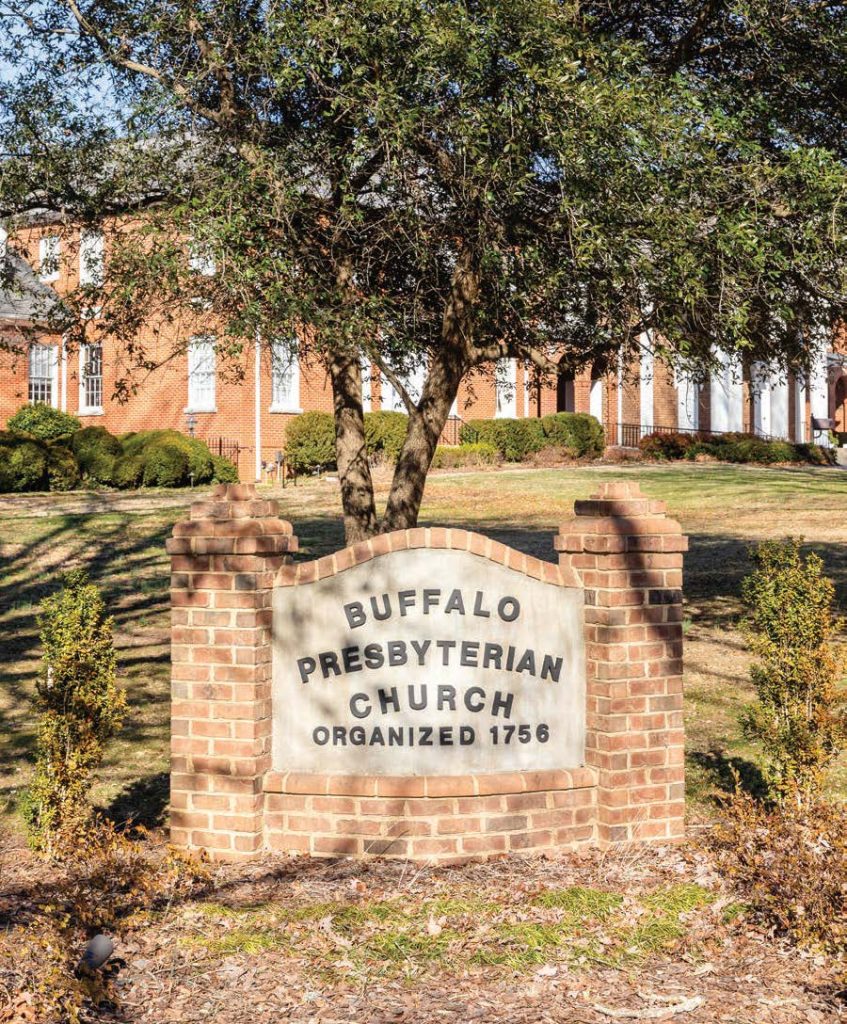
On a mild winter morning, welcome hints of spring in the air, the pews at historic Buffalo Presbyterian Church are nearly full for a Sunday service celebrating Rev. Brian Marsh’s second anniversary. Remarkably, Marsh is only the 17th minister in 269 years to occupy Buffalo’s pulpit since the church was organized by a band of Scots-Irish settlers in 1756. Such longevity speaks volumes about the faith and continuity of a church that predates the establishment of Guilford County by 15 years, the United States of America by 20 years, and Greensboro itself by 52 years. 

“I sometimes have to fight my emotions when I think about Buffalo’s historical importance to this community, a place where so many families of Greensboro have worshipped for centuries,” says Thomas McKnight, an eighth-generation member whose ancestor wrote the deed for the land on which the church sits. “Through the ups and downs of its history, good times and bad, literally war and peace, Buffalo Church has been a spiritual home where God’s word is preached and all are welcome.”

“I think that’s been the comforting message of Buffalo Church since its earliest days,” agrees Vinnie Gordy, another eighth-generation member who was baptized, grew up and was married in the church. “The settlers who created this church came out of a dangerous wilderness to make this their spiritual home. And that’s exactly what Buffalo Church is to many of us today — a home where we belong, sharing the love of Christ and the word of the Bible.”

Buffalo’s founders were liberty-loving, Scots-Irish immigrants who followed the Great Wagon Road from southern Pennsylvania to new lives in a wilderness area then known as the Nottingham Settlement, formed in 1750. It originally consisted of 33 plots of land purchased from Lord John Carteret, the second Earl of Granville, the last of North Carolina’s Lord Proprietors. The church today sits at the heart of the original settlement, which was framed by Horsepen Creek to the west, South Buffalo Creek to the east, Reedy Fork to the north and Muddy Creek to the south. Lore holds that the church, upon its establishment, took its name from the creek that bisects the modern city of Greensboro.

As I learned while researching my forthcoming book on the Great Wagon Road, America’s Scots-Irish Presbyterians were arguably the most determined travelers of the Wagon Road and the backbone of the country’s westward expansion, hardy souls who built more churches and log cabin schools than any other religious group in the Southern backcountry. They also brought with them a fierce sense of independence and a God-given talent for spreading the Gospels, making music, and educating their young. As Jim Webb writes in his 2004 bestseller Born Fighting: How the Scots-Irish Shaped America, they were also in the vanguard of fighting for liberty from the American Revolution onward.

If you want to know how old a church is, the saying goes, visit its graveyard.

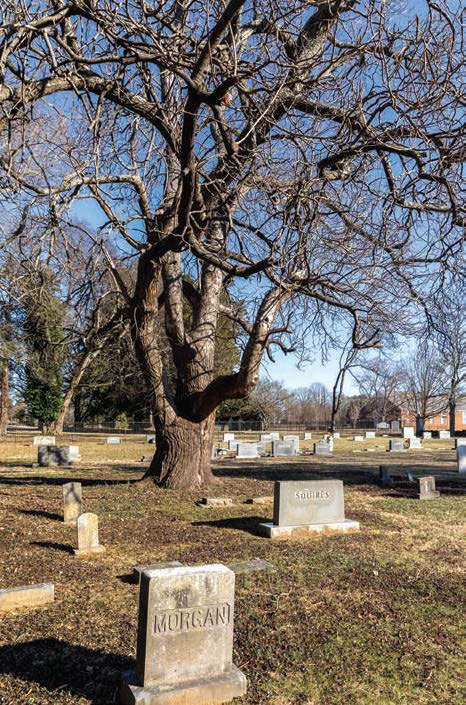
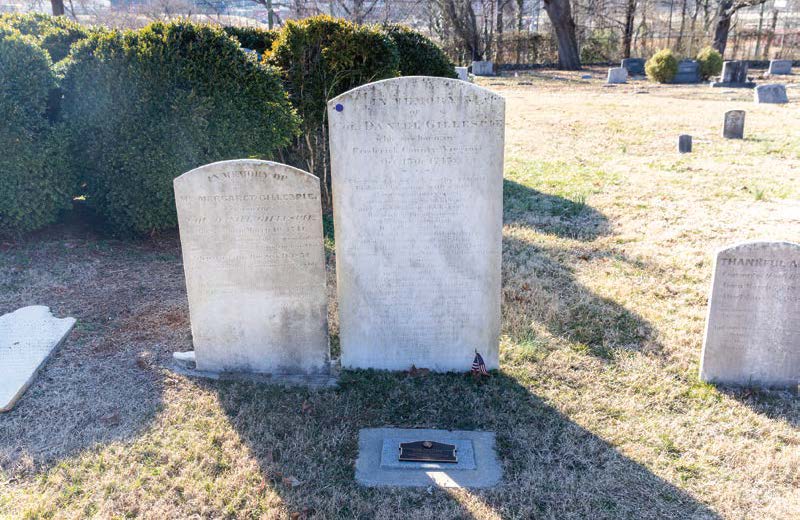
Testament to Buffalo Church’s powerful influence on the history of this region is a peaceful 6-acre cemetery that’s home to one of the largest catalpa trees in North Carolina and an estimated 1,200 graves, including the remains of at least 145 soldiers, many of whom fought in both the Battle of Alamance and the Revolutionary War. Men from the church, in fact, have fought and died in all American wars with exception of one — the Spanish-American War. Many of their gravestones have simply vanished over time.

“As a result, there are many more graves out there than we’ve identified,” says Pam Brady, a seventh-generation member who has researched the cemetery for many years. “That’s because many of the original graves were marked with wooden crosses or stones that simply disappeared over the years.” The cemetery’s earliest headstone identifies the grave of Mary Starrett, who was the wife of Benjamin Starrett and was buried in 1775.

Still, a stroll among the hundreds of gravestones that remain intact, however, reads like an honor roll of Greensboro’s pioneer names  — Gillespie, Forbes, Donnell, McKnight, Forbis, Dick, Lindsay, McNary, Albright, Mebane and Rankin.

Brady once set out to find the grave of her ancestor, William Rankin, but was only able to locate a faded stone belonging to his wife, Jean. “By the time I did my research on where he might have been buried — presumably near his wife — and got back to the cemetery, even her stone had disappeared,” she says with a laugh, adding that at least 20 current church members have ancestors from the 1700s — not all soldiers — buried in Buffalo’s historic cemetery. “We feel blessed to worship where our ancestors worshiped,” she adds, “because it connects us to the rich history of Guilford County and the creation of Greensboro in a very personal way. I like to think that Buffalo Church is to Guilford County what Bruton Parish Church is to Colonial Williamsburg and the North Church to the city of Boston.”

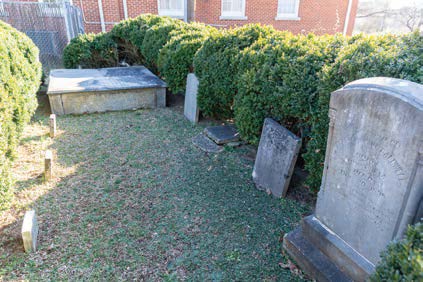
The most celebrated grave site exists directly behind the sanctuary, a family plot framed by century-old boxwoods. It belongs to Rachel and David Caldwell, a Princeton theological graduate who was called to serve as Buffalo’s first pastor in 1765, sharing pulpit duties with Buffalo’s sister congregation just east of what is now Greensboro at Alamance Presbyterian Church for the next 55 years.

Two years after Caldwell arrived, he established what became known as Dr. Caldwell’s Log College, a theological and classical academy for young men. His students included future N.C. governors, members of Congress and at least 50 ministers. He later became a trustee of Liberty Hall, the precursor of the University of North Carolina.

Today, Caldwell’s Log College Site — home to his farm, well-preserved Federal-style house (dating from 1781) and influential school — are part of David Caldwell Historic Park, a National Historic Site that shares space with the Tanger Family Bicentennial Gardens. Come spring, there is probably no more visited public grounds in Greensboro.

In addition to Caldwell’s reputation as a spellbinding pastor, due to a shortage of physicians in the region, he acquired medical books from Philadelphia and became a self-taught doctor, which came in handy during his years as a key patriot leader in the Revolutionary War. According to records, he was present at the Battle of Alamance during the Regulator insurrection of May 16, 1771, and urged his flocks to volunteer during the American Revolution and the War of 1812. His farm also became a prime staging ground for American troops prior to the Battle of Guilford Courthouse, the major turning point of the war.

Rev. Caldwell died in August 1824. His wife, Rachel Craighead Caldwell, daughter of a Presbyterian firebrand patriot leader named Alexander Craighead, followed him to the grave one year later.

Just three years later, in 1827, Buffalo’s congregation replaced a previous pair of wooden sanctuaries — one of which was said to hold as many as 1,000 worshippers — with a striking brick sanctuary that is believed to be the first brick church in this part of North Carolina.

Seventh-generation member Clyde Albright’s great-great grandfather, Jacob Albright, built the sanctuary from bricks made on the property. 

Just under a century later, a classical portico was added to the entrance of the sanctuary and a choir loft was constructed. Not long afterwards, an education building named for David Caldwell was built on the west side of the church. A similar structure dedicated to Rachel Caldwell was eventually added to the east side of the sanctuary, completing the evolution of the church campus.

To celebrate Buffalo Church’s bicentennial in 1956, the church underwent a major renovation and sanctuary expansion. Clyde Albright’s grandfather, Lonnie Albright Sr., showed Boren Brick where to dig the clay from the original site (reportedly near Friendly Center) used for the bricks of the expanded sanctuary.

The highlight of the celebration was a dramatic two-night outdoor pageant called Let Freedom Ring, featuring a cast and staging crew of more than 75 members of the church, several professional actors and the choirs of Buffalo and Alamance churches. The play, presented over a trio of outdoor stages, told the story of Buffalo’s extraordinary history, from early days before the church’s founding to the achievement of America’s independence. “It was quite an exciting production,” remembers Vinnie Gordy. “There was great music, and cannons firing and lots of fireworks. I was age 12 and sang in the children’s choir. My older sister, Magie Fishburne, however, had a major role as Hannah Meeks, and my aunt, Helen Andrew, played Rachel Caldwell. There was a large turnout both nights from the community. I don’t believe anyone had ever seen anything quite like it.”  

Longtime members also point out that, like many older churches, Buffalo Church has seen its ups and downs over the decades. “By 2015,” says McKnight, “we were a church with a lot of older members, many who were dying out. Before COVID hit, in fact, we were down to about 68 regularly worshipping members — probably the lowest point in the church’s history.”

Ironically, he adds, COVID proved to be the unexpected salvation. When churches everywhere were asked to shut down for the duration, Buffalo’s leadership opted to remain open, employing extreme spacing throughout its handsome sanctuary. “When the word got out that we were holding services as usual, our membership returned, along with a lot of newcomers from other churches. It may be proof that God works in mysterious ways,” McKnight adds with a smile. “But the growth has continued regularly since that time.”

Today, the congregation numbers over 200 and continues to slowly grow, a timely revival for a congregation some affectionately call the “Pioneer Church of Greensboro.”

At a recent Saturday morning men’s prayer breakfast, a record turnout of more than 45 included nine newcomers who’ve recently come Buffalo’s way from other churches.

“I think they are drawn to a church where the fellowship is genuine and the preaching is firmly Bible-focused,” reflects Albright. “When I sit in the choir loft and remember where my parents and grandparents once sat, looking out over a sanctuary that is now almost full every Sunday, I think about the generations of people who were born, got married and passed their lives through this wonderful old church. I think our ancestors would be very pleased to see new faces and a church family that is growing again.”

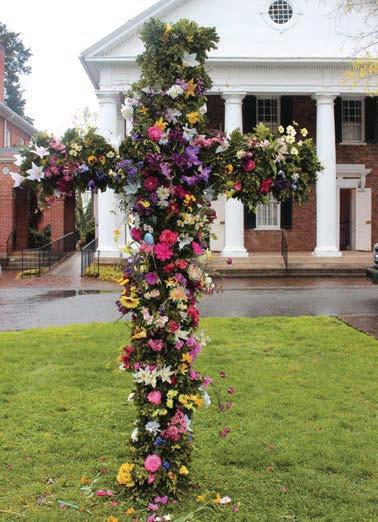
Three decades ago, Albright — a lawyer with a gift for woodworking — took the remains of an 80-year-old white oak that met its demise through a lightning strike during a storm and made a rugged wooden cross. He wrapped it in chicken wire and planted in front of the church portico during Easter week. Last November, the same salvaged wood was used to build a larger cross, which hangs from the organ pipes in the sanctuary.

On Easter Sunday, members adorn the original cross he built with flowers before a sunrise service and congregation breakfast.

“It’s become a very popular tradition at Buffalo Church,” confirms Albright. “As the sun comes up, I think that old cross covered with spring flowers expresses our gratitude for the return of spring and the glory of Jesus Christ’s resurrection.”

Architectural Details We Cannot Resist

ARCHITECTURAL DETAILS WE CANNOT RESIST

ARCHITECTURAL DETAILS
WE CANNOT RESIST

(Hint: Porches rock our worlds)

By Cynthia Adams •  Photographs by Bert and Becky VanderVeen

My dad stood on the brakes whenever he spied a house featuring grand, white columns and a generous porch sweeping across the front, his dusty pickup sputtering to a stop. He stopped, fully fixated, before puttering on, often headed to an antiques auction.

“Just beautiful,” he’d sigh, shaking his head in awe.

He most admired “grand old gals,” as he called the finest homes with slate roofs, copper gutters, working shutters and Juliet balconies. He would loop through historic neighborhoods, excitedly pointing and teaching me to recognize and value those details, too. Years later, I learned he had dismantled and salvaged materials from a ramshackle house to build our first family home just before my birth, proving just how much of a house guy he was — or, at least, proving his thrifty resourcefulness.

As for me, I was captivated by the interior details of homes. What treasures were to be found inside?

And I was anything but practical. 

With sparkling glass door knobs and a staircase to nowhere, even cobwebbing, cracking plaster and a dining-room floor that listed so much it gave you vertigo didn’t discourage my desire for a dodgy Westerwood home. It also possessed gorgeous molding (if an unfortunate, teensy fireplace) and a butler’s pantry — and a surprisingly serviceable floor plan featuring nooks and crannies galore. It quickly won the hearts of two neophyte homebuyers.
Old house lovers get it. 

Perhaps it takes preservationists and architectural buffs to fathom the irrational, deep affection historic homes and buildings inspire. And most can quickly tell you what particular details make their pulse quicken with pleasure — and why. They have an internal catalog of favorite things — from window details to arches. According to home blogs, they are particularly smitten by original details, especially French doors with mullions, substantial moldings and casings, ceiling details and medallions, and wall paneling.

So, I began asking some of my favorite old-house lovers, many of whom just so happen to have preservation credentials, to share some of their favorite architectural details up and down Greensboro’s streets and avenues.

Take Katherine Rowe, who lives in a classic brick two-story in the leafy and grand neighborhood of Sunset Hills and discovered a passion for historic homes while coming of age in Salisbury, where there is a thriving preservation movement. 

Proof? She served as an officer of Preservation Greensboro’s Board of Directors and dedicated 21 years volunteering with its Architectural Salvage program.

Rowe currently serves as a commissioner with the Historic Preservation Commission of Greensboro (HPCG). Two years ago, she helped judge the Community Appearance Awards of Winston-Salem and Forsyth County. Vocationally, she also does “small remodels and design work.”

Architecture is a topic she delightedly calls “fun!” 

If you ask what her favorite architectural detail is, Rowe hesitates to narrow it to one. Soon, she’s tripping over things she finds riveting. Firstly, she mentions the purple glass exterior sconces and cast concrete door surround at the old Masonic Temple on West Market Street “because they are so much themselves; bold, colorful. Meant to look a bit imposing, but they’re just adorable.” 

Rowe has difficulty choosing a single architectural detail that most delights. Then she discusses the elaborate cast-concrete Art Deco molding around windows “at 100 S. Eugene, next to the sheriff’s office, which are delightful because they are such a surprise. Detailed. A lot of work, and I appreciate the thought behind those windows, both from the architect and the guy who made them.”

Later she emails a list of admired architectural details around town, noting:

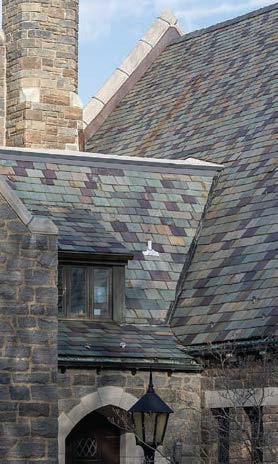
The miles of slate roof at Holy Trinity; graceful, symmetrical classical architecture at Temple Emanuel; arches and garages doors at the now defunct Central Fire Station on North Greene; robust arches at a private residence at 703 Fifth Ave. in Dunleath; the restored Gatekeeper’s Cottage (originally part of Green Hill Cemetery, now Carolina Home Partners) on Wharton Street; public spaces that are inspirational, such as War Memorial Stadium and East White Oak Community Center.

“There’s lots of good public architecture, right?” Rowe notes. “Charles Hartmann was responsible for much of it,” she adds, ticking off his greatest hits: “Grimsley High, Dudley High, the original Jefferson-Pilot building with Thomas Jefferson bust and Country Club Condos on Elm Street.”

On a personal note, she sends an email later, saying she was initially drawn to her home’s long sunroom with its three walls of windows and red quarry tile floor. “It reminded me of my great-grandmother’s sunroom in Albemarle; hers had jalousie windows, tropical barkcloth upholstery and bright, floral houseplants. Charming and cheerful to a child.”

Now that their sunroom is insulated, she and her husband, Jeri, spend weekend afternoons there reading or watching television. “And I bring in pots of geraniums and clover to overwinter on tables set up in front of two of the window walls. Which seems a bit full circle, don’t you think?”

Fellow volunteer, writer and preservationist David Arneke has also served with HPCG. Like Rowe, he has been an officer of Preservation Greensboro. He currently serves on the nonprofit Preservation Greensboro Development Fund.

Since 2017, he has written and edited piedmonthistorichomes.com, which serves as a comprehensive guide to “the most historic, notable and distinctive 18th-, 19th- and early- to mid-20th-century homes now for sale in North Carolina’s Piedmont Triad region.”

Notably, Arneke knows about succumbing to old house charms. For many years, he has lived in a circa 1900 College Hill home with Betty Work. Lured by certain charming architectural details when he first saw their future house, one distinction eclipsed all others.

“The feature that really grabbed us was the scalloped frieze boards that go all the way around the house. They were hard to even see when we bought the house because the entire exterior was painted beige — every last detail.” According to a November 1997 Greensboro News & Record interview, the couple took three years deliberating the perfect exterior paint colors.

“Also, inside the house, the back stairs,” he adds. “Neither of us had ever lived in a house with stairs in the front and in the back. Such a novelty for us.”

Having long chronicled features of older homes, he admires the columns on the Bumpas-Troy House, saying their size and prominence “make them grand and spectacular and unlike anything else in the neighborhood.” He muses, “It must have been quite a sight when it was built in 1847, out in the woods beyond the edge of town with no other houses around it.”

Arneke discusses a Dunleath home, which turns out to be the same one that Rowe had mentioned, notable for its “wonderfully distinctive front porch. I don’t remember seeing another one like it in Greensboro.”

Arneke recalls a striking historic feature of a Fisher Park house.

“The swooping roofline on 1101 Virginia Ave. . . . The whole house is remarkable, but that roofline, along with the portico, give it a whimsical look that you just don’t see very often. I get the feeling someone had fun designing that house.”

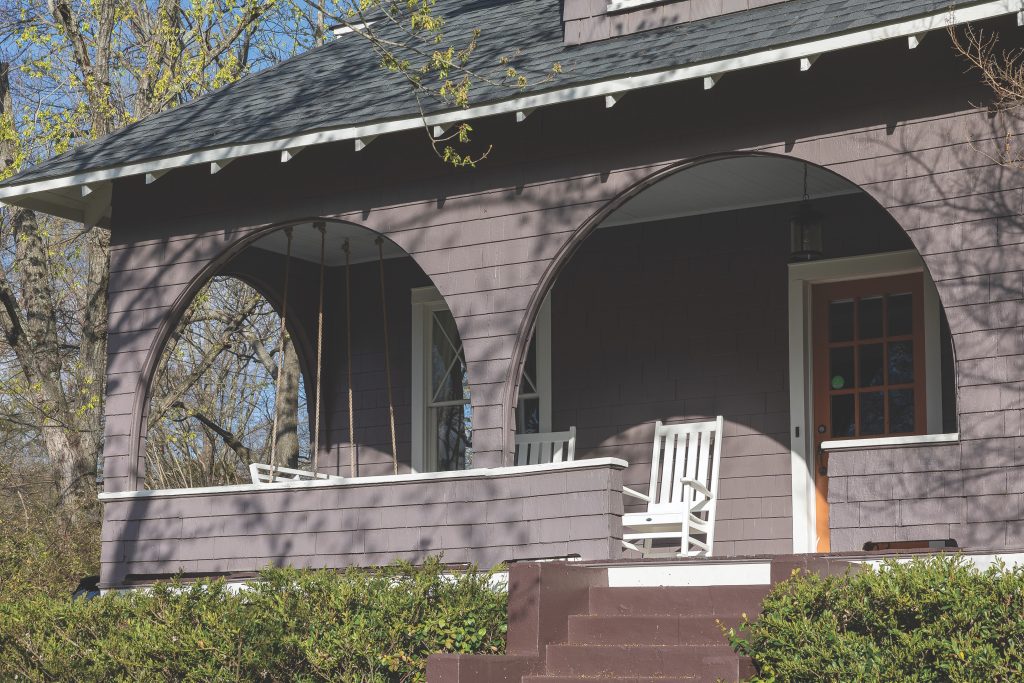
Fellow preservationist Deborah Kaufman, who lives in Sedgefield and now serves as an at-large commissioner on HPCG, says, “I absolutely love the front porches of older homes. They always make me nostalgic, especially if there’s a porch swing. I’m reminded of my childhood at my great-grandparents’ house.”

She qualifies details.

“Brick porch flooring and wrought iron rails just don’t give me the same warm feeling as those creaky wooden floors and white railings.” 

Even Greensboro City planner and preservationist Mike Cowhig, a Fisher Park resident, agrees with Arneke and Kaufman on the topic of porches, particularly when it comes to what’s directly under foot. In a word, Cowhig finds the commonplace touchingly affecting — and often overlooked. 

“There’s nothing like a well-preserved set of wood front porch steps and a tongue-and-groove porch floor,” he says. 

“Because they are exposed to the weather, [wooden] steps are often replaced with masonry steps, so they are increasingly rare. The treads are usually bullnose with a rounded edge like stair treads. Victorian era steps can have very decorative hand railings.”

As for historic tongue-and-groove porch floors? A yawping hole opened like a sinkhole in that Westerwood’s tongue-and-groove porch — just as I stepped out for the mail during our first week of residence.

Said porch’s beguiling Chippendale-style railings were rotting and much of the German siding cladding the entire house was also rotten. Only the concrete steps were not.

The next house that captivated us sold itself within minutes, even lacking a requisite front porch. But inside, it had handmade doors, brass knobs and gorgeous, deep windows (with wavy glass in the muntins!) offering a park view. Built in 1926 by former Greensboro mayor Ralph Lewis, we considered it “modern.” Sadly, the gorgeous slate roof was developing leaks, eventually requiring replacement a few years ago. As did the heating, air conditioning and rotting Tuscan columns at the front entry and side porch. 

But those windows with wavy glass? They survived, and they still slay me.

I was willing to overlook almost anything for its many sets of French doors (three!) and remarkably — how to express this to a saner person? — calming energy.  Laugh if you want, but the plaster walls inside our old house feel like a safe, sheltering place. 

Especially so if you forget the resident ghost.

From Central Park to Fisher Park

FROM CENTRAL PARK TO FISHER PARK

From Central Park to Fisher Park

A big-city transplant brings verve to a 100-year-old bungalow

By Maria Johnson
Photographs by Amy Freeman

About a dozen years ago, Richard Peterson was walking down Greensboro’s North Eugene Street where it feathers from the commercial glassiness of downtown into the residential coziness of Fisher Park, when he saw a 90-some-year-old lady.

She was faded and outdated.

But she had class.

And good bones.

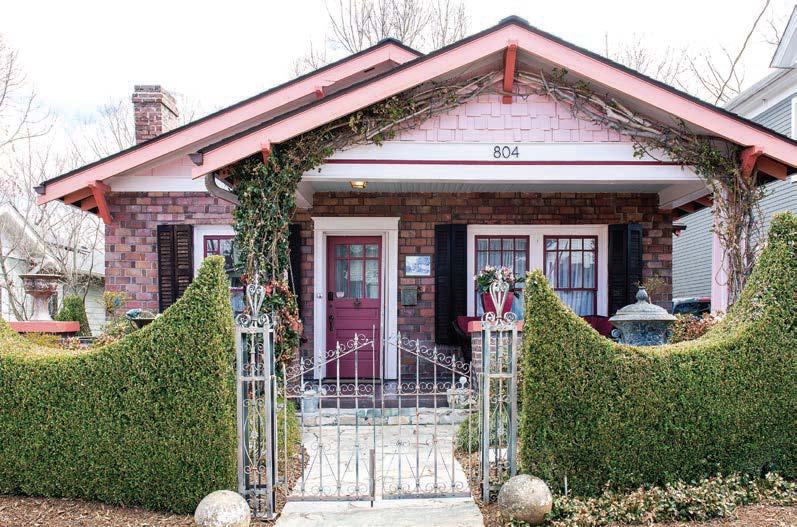
Peterson, once a jet-setting New York hair stylist with A-list clients, saw what she could be. So he did what he usually does: He made the most of her attributes, which, in this case, included a deep front porch, cedar shakes and rosy-brick walls stacked in a Flemish bond pattern, with alternating long and short sides in every course.

In the decade-plus since he bought the compact cottage, Peterson has artfully used tones from that brick palette — ranging from salmon to russet — to splash the property, inside and out, with blushing accents balanced by calming greens.

Now, especially in the spring, when the home’s English-flavored garden froths with blossoms inside the peaked waves of a boxwood hedge, the old Craftsman dame, petite though she may be at 1,000 square feet, still turns heads.

Her show stopper: the crown of pink Eden roses climbing above her front porch.

“When the roses are in bloom, people stop and take pictures,” Peterson says proudly. “If I’m outside, they tell me how beautiful the garden is and how much they enjoy seeing it.”

An anonymous passer-by once dropped off a pack of note cards with a picture of the house on the front.

“I think it’s a testament to the fact that the community around here is very thoughtful,” he says. “It’s a great place to live.”

Fifteen years a Piedmonter, Peterson still looks the part of Manhattanite with his oval glasses, shock of Warhol-white hair, low-cut Chuck Taylor sneakers, and jeans, henleys and hoodies in every conceivable shade of black.

Recently, he walked into a Greensboro furniture store.

“You must be from New York,” a saleswoman said.

How Peterson landed in Greensboro is as interesting as the transformation of his cottage from weary to whimsical.

He recounts some of his earliest memories as a child growing up outside Cleveland, Ohio, in the 1950s and ’60s. His father took the family for Sunday drives through swanky Shaker Heights, where the captains of shipping, steel and banking lived in grand homes.

Peterson wondered what life was like behind those walls.

His life was modest by comparison. His father owned a gas station. His mother was a housewife. His maternal grandfather, a Hungarian immigrant, tended a flower-and-vegetable garden behind the house that the two families shared.

Peterson was about 8 when his family moved to their own home, but he never forgot the flowers, partly because his grandfather incubated cuttings under Mason jars and literally passed on the beauty to the next generation.

When Peterson was 16, he went to work for a florist in Shaker Heights.

He accompanied the shop’s owner to the homes of wealthy clients to gather pretty vases, take them to the shop, fill them with botanicals and deliver them back to their stately homes. Peterson had found a way into the mansions that wowed him as a kid, and he liked what he saw.

“I drove my family crazy because all of a sudden I wanted Waterford and Baccarat crystal and sterling silver,” he says.

Soon, Peterson was arranging flowers.

Acting on the encouragement of a life partner who was a hairdresser, Peterson diverted his flair for composition into beauty school, where he learned how to snip, color and texture hair. He and his partner opened several salons in Cleveland.

“We were extremely successful,” Peterson says.

The couple moved to New York City in the late ’80s after Peterson snared a job with the late Kenneth Battelle, aka Mr. Kenneth, the darling of New York society women who wanted the cachet of being shorn by the man who is often described as the first celebrity hairdresser.

Mr. Kenneth created Jackie Kennedy’s iconic bouffant. Marilyn Monroe, Brooke Astor, Audrey Hepburn, Babe Paley, Katherine Graham, Nancy Kissinger, Joan Rivers and other notable noggins sat in his chair — but only for a cut.

Mr. Kenneth passed his wet-headed clients to his employees for styling. Peterson dried, combed, teased and lacquered his way into a loyal following.

He styled and schmoozed with Pamela Harriman, who was once married to Rudolph Churchill, the son of Sir Winston. Two husbands later, she was hitched to Averell Harriman, the U.S. Secretary of Commerce under President Harry Truman.

Peterson groomed the heads of many women affixed to heads of state.

When First Lady Betty Ford was in town, Peterson did her ’do. She told him about an Italian restaurant that she and the President liked. Peterson said that he’d love to take a friend there.

Ford made a reservation for them. When dessert was finished, Peterson called for the check. He was told that the dinner was compliments of Betty and Jerry Ford.

When the Crown Princess of Sweden was in New York and needed her hair styled, Peterson reported to her suite at the Waldorf Astoria; Mr. Kenneth’s salon was inside the hotel.

At the suite, Peterson was greeted by a man who led him to a room where he could work. Peterson directed the man to move some furniture so that the princess could sit in the best light.

After the princess was coiffed, her father walked into the room, and it dawned on Peterson who had helped him.

“I had the King of Sweden moving furniture around for me,” he says, dissolving into laughter.

With Mr. Kenneth’s blessing, Peterson worked part-time as a personal hairdresser to the CEO of two apparel companies. He traveled the world on her private jet.

“I was feeling all big-shot-like,” says Peterson. “It was a shock the first time I had to fly coach.” Except for a year-long stint with a salon in Palm Beach, Fla., Peterson camped in New York. He and his partner lived in an Upper West Side apartment overlooking Central Park, in the same building where actors Al Pacino and Andie MacDowell lived.

But, after a while, Peterson says, the magnets of love and work in the big city lost their pull. He started looking for a place to move solo. Someplace green, where he could have a yard. Someplace like his boyhood home, only warmer.

It just so happened that a friend, another New York stylist, flew to Greensboro every six weeks to style the hair of a local socialite he’d met in the Big Apple. Soon, he was doing the hair of several of her Greensboro friends. Peterson tagged along to help on one of those trips. During the visit, Peterson and his friend attended a drag bingo event in downtown Greensboro.

“The majority of the audience was straight people, and everyone was having a good time,” Peterson says. “It told me that this place was open and accepting. I thought, I could easily live here.”

A few phone calls later, he had a job at an upscale salon on North Eugene Street. He rented a room on Summit Avenue, watched way too much HGTV and set his sights on restoring an older home.

“I can’t tell you how many power tools I bought,” he says.

He haunted salvage stores, demo sites and antique shops, squirreling away hardscape for his someday yard: a wrought iron arch, a double metal gate, a white picket fence.

One day, as he walked down North Eugene, an aging swan caught his eye.

The sign out front said, “For Sale or Rent.”

Peterson rented with an option to buy. Then he opened his wallet.

He had the hardwood floors refinished and stained dark before he moved in.

Later, with deed in hand, he shelled out for a new roof, water heater, HVAC system and basement waterproofing.

The financial hits kept coming.

Inside the cottage, wood paneling peeled away from the walls. Under that, the original plaster flaked away. And under that, a brick wall crumbled. It was one of two side-by-side brick walls separated by a gap, an energy-saving style known as cavity construction, common in 1924, the year house was built.

Peterson had the inner brick wall repointed, hung with drywall and painted bright white.

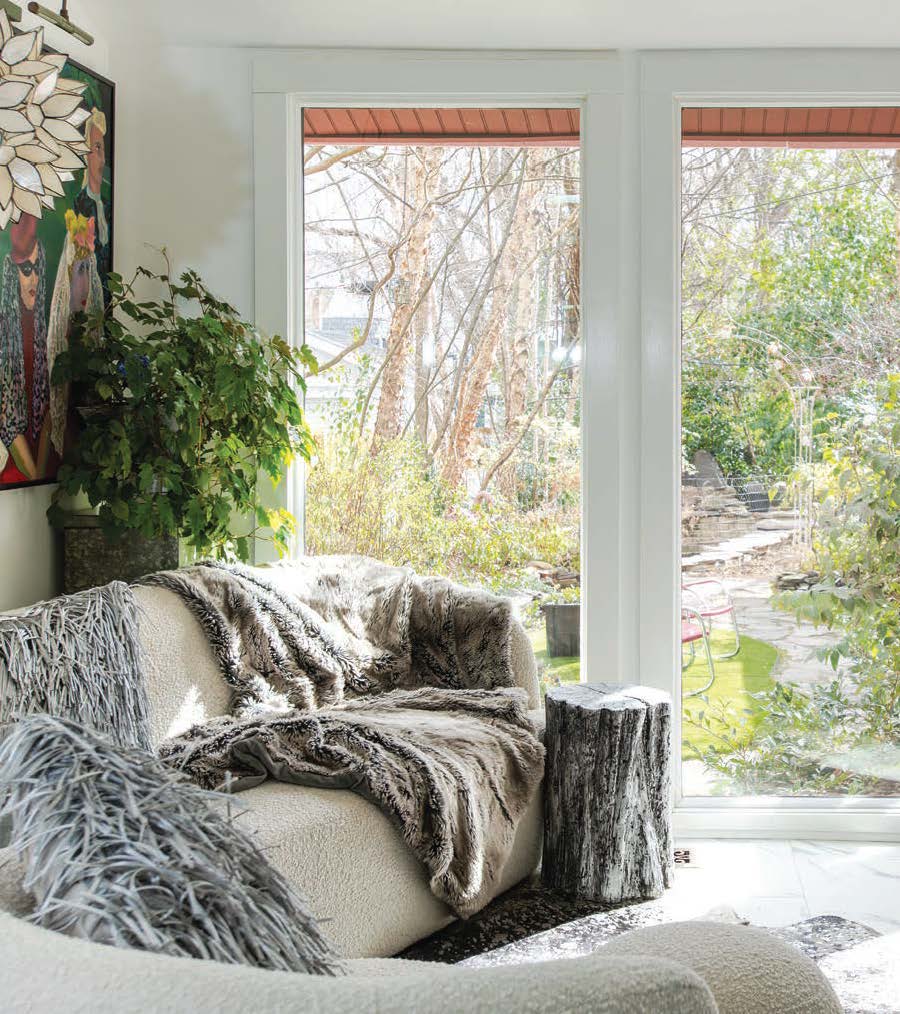
He added floor-to-ceiling windows in the sunroom, where he often watches TV with his Labrador retriever, Sammy,

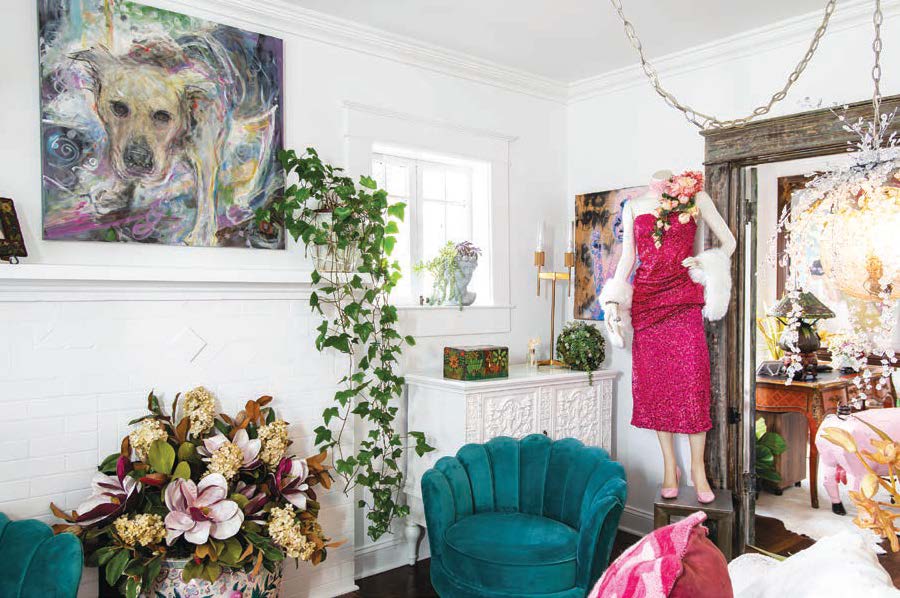
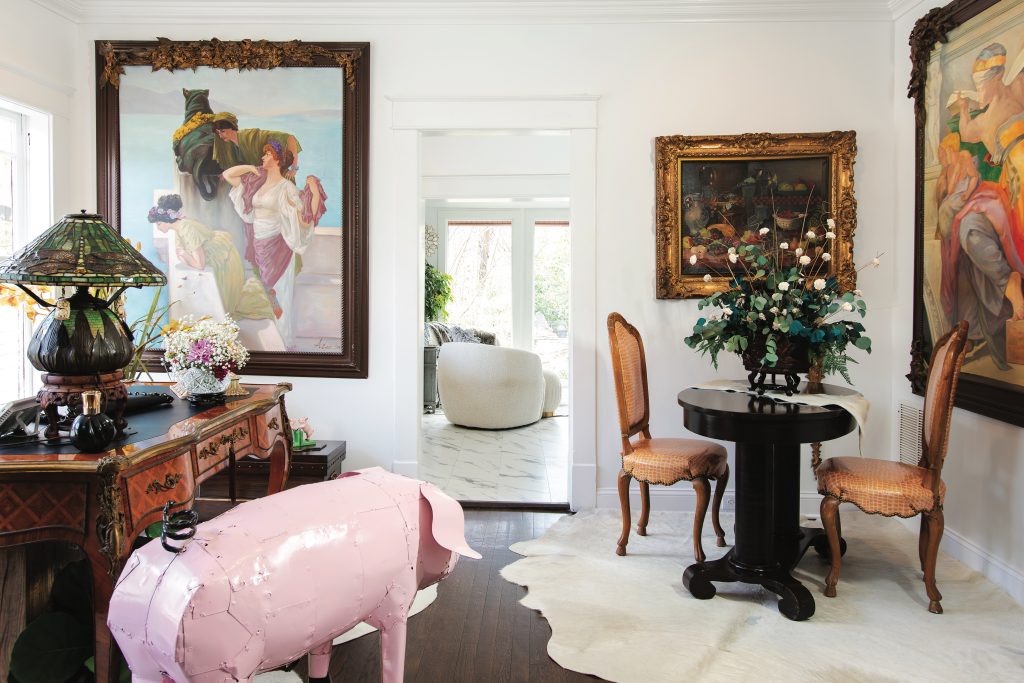
Waves of sunset and emerald tones — in the form of houseplants, artwork and punchy artifacts — carry the eye throughout the house. See a mannequin sheathed in pink sequins in the front room; a large metal pig in front of a Louis XVI repro desk in the middle room; and flying pigs perched in the sunroom.

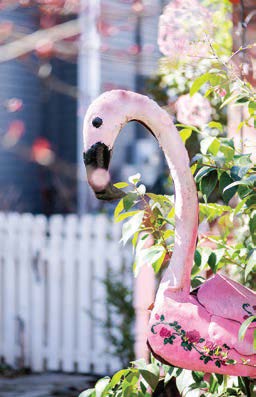
The glee continues in the backyard with curvaceous rose-colored balusters around porches — including a small wedge that Peterson calls his “Juliet Balcony” — fan-back garden chairs and  faux flamingos.

The blushing accents pop against vivid green islands of artificial turf, which Peterson installed so his dog could go outside without stamping the house with muddy paw prints.

The rest of the backyard resembles a wooded hallway. With help, Peterson sculpted fieldstone paths and planting beds down the length. He decked the hall with river birches, azaleas, ligustrum, distylium and ferns.

The walkway ends with a project in progress, an empty landscape-block pond that Peterson envisions catching a tumbling waterfall.

“My wish is to be in a forest,” he says.

For the front yard, his wish is to be in the Cotswolds.

The metal gate, which he found at the now-shuttered Mary’s Antiques soon after moving here, is flanked by concrete orbs given to him by a client. She imported the balls from England.

“I can’t imagine what it cost to ship them,” Peterson says.

He added salvaged porch railings, balusters and a swing.

“No Southern porch is complete without a swing,” he says.

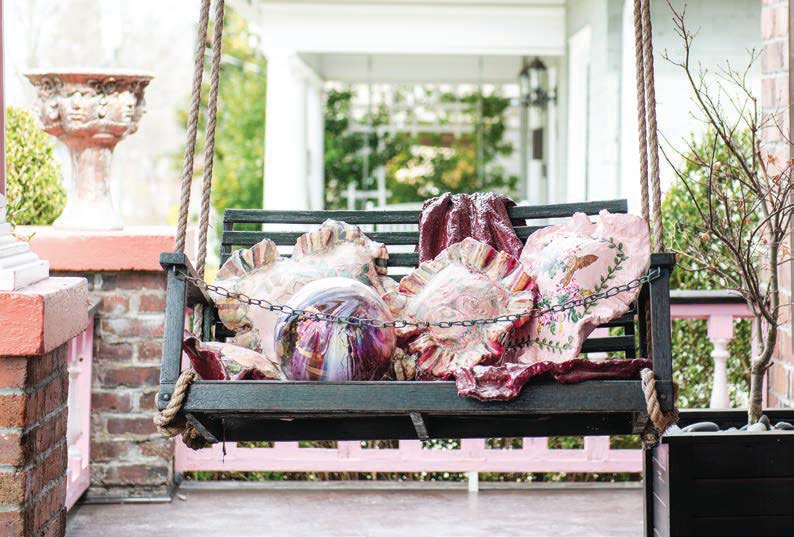
He filled the slatted seat with faux pillows and a throw that he made with spray foam, chicken wire, concrete slurry and paint. He spiked the arrangement with a gazing ball and contained the arrangement with a chain. The spectacle was made for eyes, not fannies.

Ditto the garden tucked between hedge and porch. In season, the space bubbles with a fountain that provides mood music for ferns, roses, azaleas, Asiatic jasmine, coleus, zinnias, impatiens, verbena and whatever else strikes Peterson’s fancy.

He bought a small pickup truck after moving to Greensboro, and he finds it difficult to pass a nursery without loading the bed with more plants.

“I was better off when I had a car, and not a truck, because now I’m not restricted,” he says.

He makes no apologies for his devotion to natural beauty, though.

“If you look at a flower — the color, the shape, the fragrance, everything — it’s a miracle,” he says.

He lets his observation hang before seeking a response.

“Isn’t it?” he finally asks.

The voice belongs not to a jaded urbanite, but to an awestruck kid.

A Way of Life

A WAY OF LIFE

A Way of Life

Ann Tilley makes her mark, as lightly as possible

By Cassie Bustamante Photographs by John Gessner

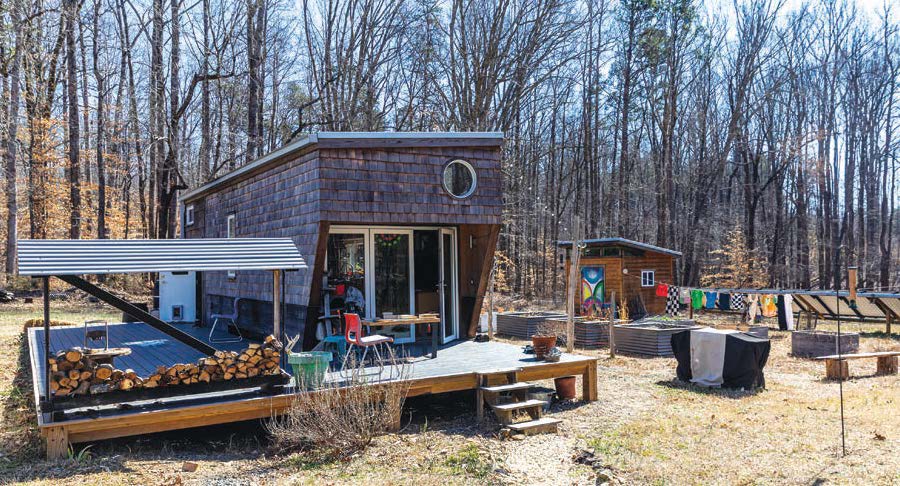
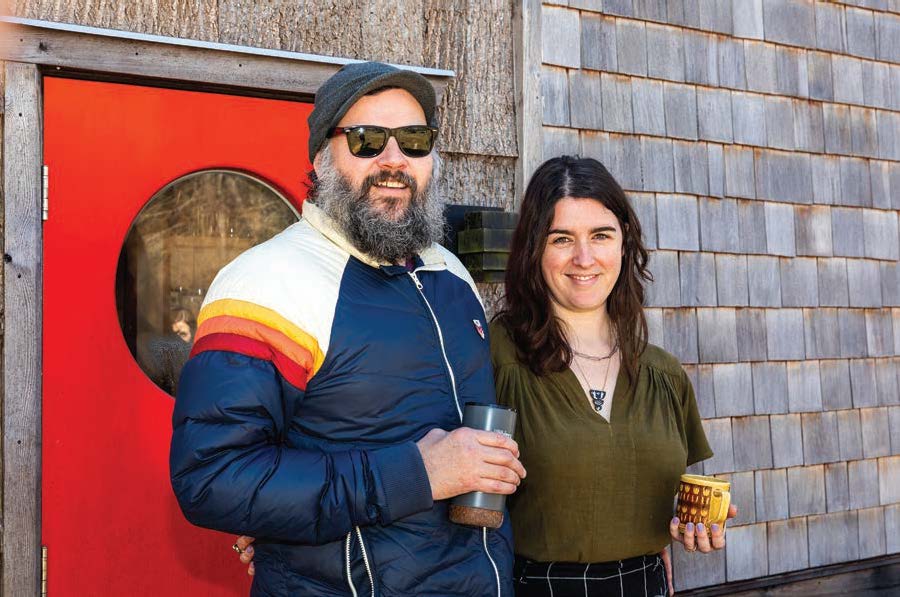
For me, it’s always been just to have the lightest impact on the world, on nature,” says Ann Tilley as she peers out from her sewing studio’s garage door, surveying the acreage that surrounds it. Nearby sits the narrow, tiny house with wood siding she and her husband, musician Adam Joyce, built and now reside in. The large family property is just about as far southeast as you can get in Guilford County. Just behind their home, a row of raised garden beds made from old refrigerators host early spring plantings, such as garlic, protected from the couple’s curious cats. Clothing pinned on a line strung along the garden’s exterior border waves in the breeze.

Tilley pauses, her fingers gently gliding along a patchwork T-shirt in shades of green with touches of lilac. “This is my absolute favorite shirt.” The garment has been created by stitching together pieces from old band merch. And not just any band — The Bronzed Chorus, Joyce’s group, whose sound is, according to Tilley, “instrumental post-rock, but then there’s a lot of synthesizer and electronic. I always say that if you listen to it in your car, you want to speed.” Tilley made a dozen or so of these tees and sold them at the band’s shows. The couple originally met at a Bronzed Chorus show in Durham, where Tilley was raised. Today, both are employees of Forge Greensboro. Joyce, a woodworker and furniture maker by trade, runs the makerspace’s wood shop while Tilley runs the textile shop.

Back in Bull City, Tilley’s parents own and run Acme Plumbing Company, originally founded by her great-grandfather. While her mother owned a sewing machine, Tilley, now 38, says the actual use of it sort of skipped a generation. “It was not progressive for her to sew,” she muses. Instead of traditional toys, Mom bought the kids sketchbooks and markers, nurturing creativity in other ways, while at the same time instilling in them environmentally conscious values.

“My mom was the first person I ever knew who wouldn’t buy something because of the packaging associated with it — before I ever heard of zero waste,” says Tilley.

Tilley recalls latching onto cross stitch as a child via Girl Scouts, discovering she loved fabricating art from fibers and how embroidery floss felt on her fingers. Later, in her tween years, a household book she happened to pull from a shelf opened her up to the world of sewing.

Foot to the pedal, she unearthed a means to express herself. “I like to be different,” she says. “I don’t like to wear what other people wear.”

Still, as the child of practical, no-nonsense parents, she says, “I thought fashion was frivolous. My parents are plumbers.”

Tilley’s interest in the arts led her to the Savannah College of Art and Design, a move that she says was good for her because it allowed her to explore painting, drawing, illustration and fashion. By the time she was an upperclassman, “I was obsessed with fashion magazines,” she recalls. “Harper’s Bazaar was my bible!” Tilley would flip through pages and, inspired, make her own versions of what she saw.

Her fashion interests led her to discover the fibers department, something she didn’t even know had a name. She recalls someone explaining to her what that department entailed and realizing it was exactly what she’d been after — “That’s me!” she recalls exclaiming. In 2008, Tilley graduated with her Bachelor of Fine Arts in fashion and fibers.

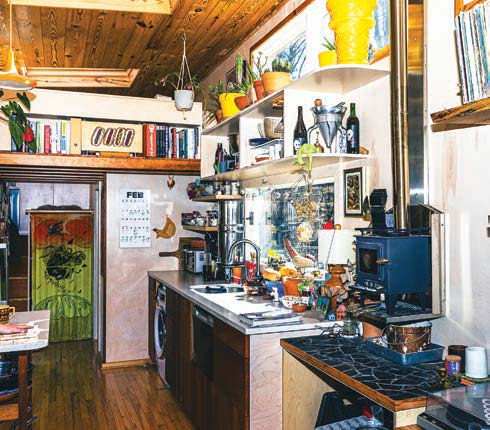
These days, Tilley calls herself a textile artist. The light-wood walls of her tiny home are filled with her own creations. “Pop art was my first love, which I think is really obvious.”

The art that hangs on her walls makes the house into something of a tiny museum that catalogues Tilley’s evolving interest in textiles. Inside a large, charcoal-gray, curved frame mimicking the shape of an iPhone is a woven textile she calls Hold Me, which is exactly what the text on the piece beckons. On the adjacent wall in the tiny home’s single spiral staircase leading to the loft, a complementary creation titled Current Reflections is framed in wood salvaged from old bleachers and given to them by a Forge friend. The piece itself is a chartreuse green, the yarn dyed by Tilley, and features a motif of toothbrushes, solar panels, poison ivy, trees and, in the center, tiny homes.

Up in the loft, the couple’s platform bed sits below a skylight. A shelf, inches away from the foot of the bed and made from the same recycled bleacher wood, provides ample room for books, plus space for guitar cases below. “It’s a little bit of a pain in the ass to change the sheets, but . . . ,” she trails off dreamily, looking up.

“I can literally see the Big Dipper,” she says. “And when you wake up in the middle of the night and the moon is there, I feel blessed every time.”

Next to the bed, a wall hanging Tilly fabricated faces the wrong direction so that the couple’s brindle-coated kitten, Tina — short for Patina — won’t damage it. Tilley takes it down and Tina immediately attacks.

The hanging is one of several Tilley made during a three-week art residency at Reconsidered Goods last November. Using denim yardage unearthed in “a ’70s storage unit,” Tilley crafted a piece that pays homage to Greensboro’s history in garment making, as well as her own background working as a Wrangler traveling on-site tailor and at a Raleigh denim factory. A pocket on the hanging is adorned with a leather Wrangler patch and Ralph Lauren rivets, a spray of bright, printed and embellished flowers emerging. Hot-pink felt lettering reads “Feeling lost? Discover crafts.”

“All of these pieces came from the idea of craft as therapy,” says Tilley of the work that came out of her residency.

Back downstairs on a gallery wall, a hanging fabricated from necktie silk reads “Days for Making, Days for Mending,” a necktie Tilley sewed hanging down its center. Along the bottom of the piece, “Salem” tags create a sort of fringe effect. Last fall, Tilley toured Salem Neckwear with Rene Trogdon, who was selling off and donating machinery and materials. His late father, James Trogdon Sr., had founded the company in 1964 to fill a niche market for premium neckties. Sixty years later, after Rene’s brother and the company’s then-president, James Trogdon Jr., became ill with long COVID, Rene found himself in a tough position and had to close. Sadly, James Trogdon Jr. passed away in December of last year.

“I mourn those stories of the loss of small and local,” she says, noting her parents’ own multigenerational company. Creating art with remnants from businesses such as Salem Neckwear, she gets to preserve a piece of their story.

“The thing I fear the most,” she continues, “is just that globalization is taking away all of that local personality.”

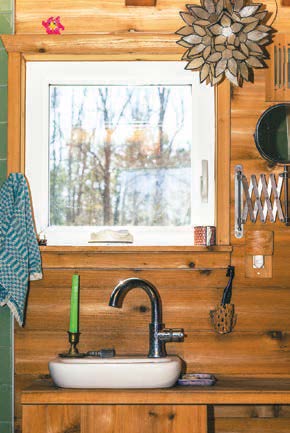
Every corner of their house, almost every nook and cranny in it, veers away from mass merchandising and designs driven by big-box retailers such as HomeGoods and Home Depot. The sliding door that leads to their single, green-tiled bathroom is a remnant from Tilley’s childhood bedroom. Where the original hardware sat, Joyce created darker-stained, midcentury-inspired wood inlays that flank the new nickel hardware. The exterior panels have been covered with mirrors to reflect light, giving the illusion of space. But the interior of the door was not such an easy task. Tilley struggled to strip all of the paint and eventually settled on covering it with a pastoral mural.

“I thought it was going to be done in a year without me doing anything,” quips Tilley about the home’s construction. But, she soon realized, “we need to do this together.”

Over the course of almost a decade, whenever they had time, Tilley and Joyce could be found outside of their rental home, just down the road in Julian, measuring, cutting, hammering. They also regularly visited the property, which had been in Joyce’s family for generations, first building and installing a solar shed.

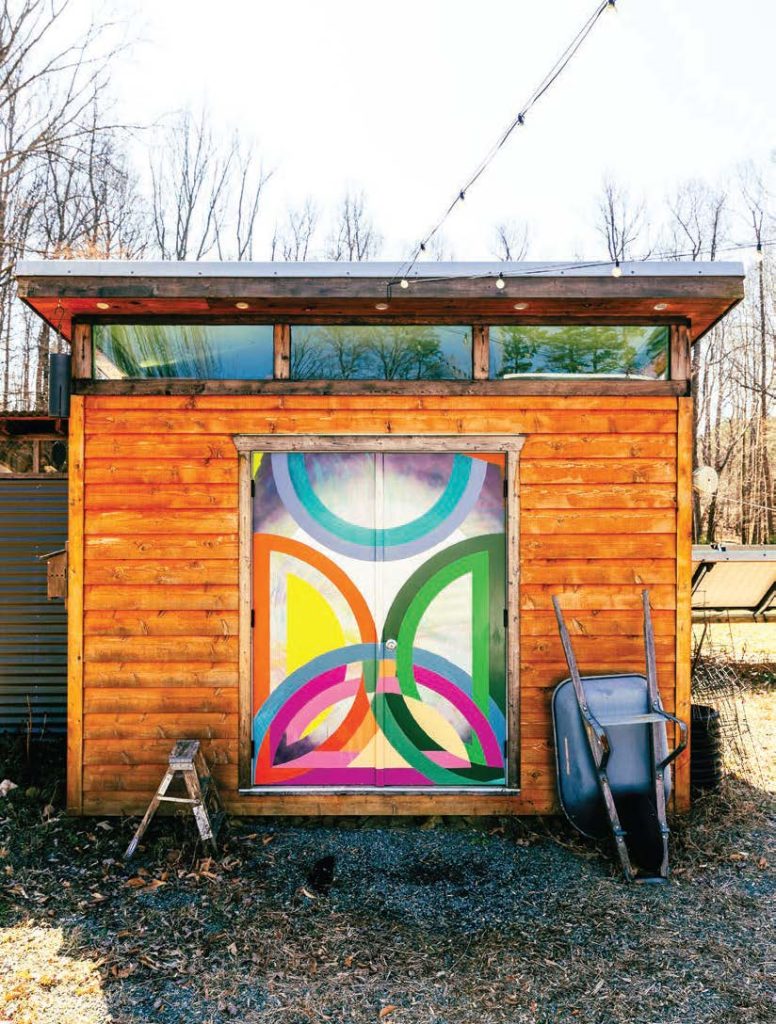
The doors to the shed feature a modern graphic design in vibrant colors, inspired by a Frank Stella piece. Stella, who passed away in May of last year, was known as one of the fathers of 1960s minimalist art. Tilley and Joyce painted the doors right after a particularly busy moment in life, “and then, on our week off, we were like, ‘Let’s do something fun.’” A moment later, she chuckles. “We can’t ever relax.”

Beyond its bold doors, the building houses the tiny home’s breaker box and a generator, plus the regular tools one would expect to find in a shed. As far as the solar system that runs the property’s power, Tilley says, “Adam just watched a bunch of YouTube videos” and figured it out.

Some yards away from the home, a curved hangar featuring a bold, turquoise garage door serves as her sewing studio. It’s not heated though, so she has plans to construct a new building and has marked stairs with old sewing machines leading to where it will exist a stone’s throw away. “Manifest destiny, you know?”

“Right now, it’s a little nippy,” Tilley says. She tugs tighter around her a lavender velvet jacket she made with a cherry-printed lining, all fabric sourced from Reconsidered Goods.

This is where the real “magic” Tilley is known for happens — Magic Pants, that is. In 2016, Tilley founded Ann & Anne, a ready-to-wear clothing brand, with Anne Schroth, owner of Red Canary. While there, the two women designed a high-waisted tailored pant that featured an invisible elastic band in the back, an elastic panel in the front, and a cinching strap. The result? A pant that flattered figures of all shapes and sizes. Her friends started calling them “Magic Pants” and the name stuck.

Ann & Anne closed officially in 2018 and Tilley pivoted to teaching sewing classes across the area, from Durham all the way to Winston-Salem, including a stint at the John C. Campbell Folk School in Brasstown.

At Village Fabric Shop in Winston-Salem, she offered a class on making Magic Pants and the shop employees suggested that she make a pattern for them. At the time, she was busy teaching, but when COVID shut that down for a while, she got to work. And now? “I have literally sold this [pattern] on six continents.”

Tilley has also created her own YouTube channel, which allows her to increase her reach, teaching people across the world how to make these pants. Sewing, she says, is what gave her the “first feelings of self-sufficiency,” something she hopes to pass on to others through her instruction. Nowadays, she makes practically everything she wears, right down to the undies, something she started making from scraps when she worked at Gaia Conceptions, a sustainable brand founded by Andrea Crouse and located “just behind Westerwood Tavern.”

“I worked there for years,” says Tilley. Gaia Conceptions, she says, features made-to-order organic clothing and the brand pays its employees fairly. “They really walk the walk.” Crouse, Tilley says, even showed her how to make her own deodorant.

Nearby, a pair of of underwear in blue and white sits on her sewing table. “I haven’t worn these — don’t worry” she quips. The fabric is soft, comfortable, and there’s no elastic that would dig into a waist.

While the temperatures have been less than ideal, Tilley has, for now, set up shop in Joyce’s music studio, settled a little farther back on their land. A makeshift desk in the middle of his space holds her Brother sewing machine, a row of guitars hanging on the wall behind it. Next to the machine, old fashion drawings from her SCAD days feature a flirty midi dress, a long embellished gown and a mod ’60s-inspired swimsuit. “I do make my own swimsuits now,” she says. “And having a well-fitting swimsuit is wild!”

Joyce’s studio serves as the hangout spot for the couple’s other cat, Go-Go Boots, a beauty with long fur everywhere except for — you guessed it — below her knees. With the sun beckoning, she requests to go outside. Tilley follows.

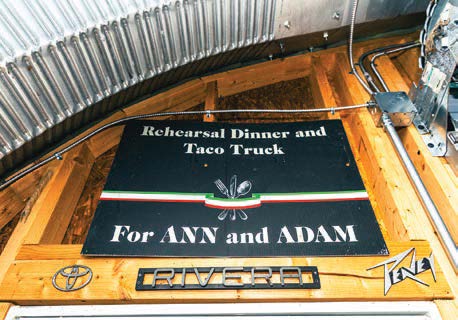
“We actually got married in this field,” she says, looking out into a large, cleared space of land. In July of 2016, the couple tied the knot. True to form, the large tent that provided shade for guests was made by a friend “from old Tyvek he dumpster dived.”

And do they plan to live out their days where they once said “I do”?

“Forever home, absolutely,” says Tilley. Perhaps, one day, they may consider building a different house with a main-level bedroom as they age. But, if they do, it will be right here. “It’s a way of life.”

Fit for a King

FIT FOR A KING

Fit for a King

Today’s princes and princesses learn skills to become tomorrow’s leaders

By Billy Ingram

Photographs by Betsy Blake

Society’s crustiest curmudgeons disparaging the aberrant behavior of today’s youngsters has practically become a national pastime. Modern-day kids, many insist, are rebellious, insolent, lazy, entitled, unable to communicate effectively whether speaking or writing, and devoid of core American values such as hard work, accountability and responsibility. Oh wait, that’s exactly how society characterized those of us who grew up in the ’50s and ’60s, my generation. Raised to be considerate, kind and obedient, to curtsy and bow when company arrived, to be seen, not heard . . . and we all know how that turned out. But has the pendulum of propriety swung way too far in the opposite direction?

Just imagine what effect it might have if today’s youngsters were taught etiquette, the importance of courtesy, respect, punctuality, politeness, eye contact, proper dressing and grooming.

That’s precisely the focus of Geovanni Hood, whose Charmed School of Etiquette is spearheading a return to refinement and civility, most recently in conjunction with D-UP in the enlivened Washington Street Historic District in High Point. His six-week course engages kindergarteners to teens in lessons that stress proper manners and comportment, encouraging youngsters to gaze away from a constant barrage of pixelated stimulation in order to effectively face life’s three-dimensional challenges.

Founded by Jakki and Corvin Davis in 2007, D-UP (Develop Skills, Uprise Education and Power-Up For Life!) began as an after-school basketball program. A year after achieving nonprofit status in 2010, D-UP moved its headquarters to Washington Street, expanding outreach efforts to include nutritional education to combat childhood obesity, while promoting academic achievement and character development.

“We wanted to make sure that the students went through etiquette classes,” D-UP’s Jakki Davis tells me, “because this is something they can learn now and it will be forever ingrained in them.”

Hood was brought in as a visiting instructor, says Davis. “When I met Geovanni and saw his interest in our students and what he was doing, I thought, ‘This will be perfect.’ ” Plus, she adds, he makes it fun.

“When your child steps out the house, they are not only a representation of themselves, but they are a representation of you,” Hood says. They’re creating their brand, so to speak. Your brand, he says, involves knowing “how to be socially active, how to make friends, how to engage in conversations and build character.” Cultivation reflects positively on parents as well.

Besides collaborating with nonprofits such as D-UP, Hood’s outreach includes local churches, the YMCA and the Piedmont School at Andrews High School. “I’ve taught at Howard University in D.C. as well, so I pretty much just travel.” Most organizations will bring him in for a day, but longer sessions may stretch into two eight-hour days back to back “or I might come in one day a week for five weeks.”

As former Human Relations Commissioner for the City of High Point and a certified career coach and navigator, his book Navigating Success: Interview Eitiquette Guide for Teenagers is a primer for anyone who believes chivalry is not dead, merely moribund. “Young people can’t do what they don’t know,” Hood insists. “When somebody comes along, leading by example, then others will get it and hopefully follow suit.” As for getting through to teenagers, he says, “If I’m teaching them how to be properly mannered versus calling it ‘etiquette,’ they understand it better.”

A Greensboro resident by way of Brooklyn, what inspired Hood to lead the way in teaching etiquette to a new generation? A room at the O.Henry Hotel dedicated to the memory of Dr. Charlotte Hawkins Brown.

Beginning at the turn of the last century, with determination undeterred by mob violence and an overwhelming resistance toward efforts aimed at assimilating African Americans into polite society, Dr. Charlotte Hawkins Brown established, then tenaciously re-established after everything was burned down by residents opposed to the very idea, institutions of higher learning for people of color. By 1940, Brown became known as the “first lady of social graces,” following the publication of her manners manual, The Correct Thing to Do, to Say, to Wear, a more reality-rooted companion to Emily Post’s Etiquette, published two decades earlier.

Hood shares Brown’s basic philosophy: “Educate the individual to live in the greater world.”

“What I teach is situational etiquette, but also interview etiquette, and I love teaching both,” he says, reflecting his background in corporate culture and client services. “I’ve been in management for the last 13 years and interviewed plenty of candidates who don’t know how to answer a situational question, may only answer one part of the question, or arrive in incorrect attire, not wearing a tie or not having access to resources to be dressed properly for an interview.”

Knowing the difference between a salad fork and a dinner fork is one indication of how far socially you’ve climbed, but more crucial is learning how to handle those unexpected forks in life’s roads we find ourselves navigating. But it’s important to note that the aforementioned Emily Post, America’s esteemed etiquette expert, once famously stated, “Nothing is less important than which fork you use. Etiquette is the science of living. It embraces everything. It is ethics. It is honor.”

One day last winter at D-UP’s new workshop, converted from a former house, I was able to observe firsthand how eager preschoolers are to learn new skills. “The little ones, they’re one of my favorite groups,” Hood says. “They’re so young and impressionable, just super excited about learning at such an early age before they have other impressions put on them.” He begins by focusing on what goes into creating a great first impression: “What does that look like? What does that sound like? And how to leave a lasting impression.” To demonstrate the practicality of his instruction, he guides the kids through different role-playing scenarios.

At the end of the six-week program, both those youngsters and the older students enrolled in the etiquette course would have an opportunity to utilize their newfound expertise by rubbing tiny little elbows with the city’s elite during D-UP’s annual Royal Celebration held in December 2024 at Congdon Yards in Downtown High Point. The culminating event serves as a graduation ceremony of sorts, centered around a formal dinner served amid enchanting surroundings.

Inspiration for the Royal Celebration occurred a decade ago when Davis was accompanying children on a trip to Octoberfest. “I was in the backseat with one of our little boys and his sister, who had on a princess gown,” she recalls. “I said, ‘Look at my little princess,’ just admiring her, and her brother says, ‘She ain’t no princess.’ I said, ‘Of course, she is. And you, a prince.’” The young man objected, saying, “I ain’t no prince.” But Davis encouraged him, saying “Yes, you are prince and don’t ever feel like you’re not.”

The next day, reflecting on that exchange, Davis realized, “We can tell kids who they are but sometimes we truly have to show them. All of these thoughts started coming to me — like limousines, tuxedos, a sit down meal, empowering kids to be able to talk with adults and not fumbling over the words.” Within weeks, D-UP cobbled together the very first Royal Celebration, “just by reaching out to our partners, because it was already the end of the semester and we had no budget for this at all.” That was nine years ago.

There were around 30 enrollees that first year, but by 2024 enrollment had grown to 65 participants, all outfitted in tuxes and elegant gowns donated by VIP Formal Wear at Four Seasons Mall. “We have community members who understand exactly what we’re doing and it means a lot to them,” Davis says about VIP and other sponsor contributions for the Royal Celebration. “You could see an instant change in the boys’ demeanor when they were trying on tuxedos. The same with the girls trying on their dresses and shoes.” Arriving in style to the venue by limo, Davis says, the kids emerged with a new attitude. “It’s such a positive experience for them, but also for us to see their reactions.”

Attended by local dignitaries and business leaders, the purpose behind a Royal Celebration is instilling confidence in the young ones when in a formal setting. “We have a three-course meal for them,” Davis says. “They don’t even have to question which fork to pick up. Using their manners, not speaking [out of turn], it’s such a confidence builder.” The children were paired with adults at each table so they could engage in grown-up conversations and put their newly-honed skills to work.

During the social hour, the courtly kiddos were encouraged to mingle and introduce themselves before striding on stage to receive their awards based on performance and improvement. Another highlight of the evening was a round of ballroom dancing. “We offer dancing here anyway,” Davis points out. “Ballet, modern and hip hop, but here they got to practice ballroom.” By all accounts, the Royal Celebration was once again triumphant. No surprise that, around this same time, Davis was crowned 2024 Businesswoman of the Year by the High Point Chamber of Commerce.

Lately, Hood has been venturing into middle schools, instructing students on developing resumes. While that may seem premature to an outsider, “We are preparing children for the future,” Hood says. “If they understand these things at a young age, then start practicing these skills, just imagine how far ahead they’ll be later on, perfecting skills instead of learning them for the first time.” He’s also instructing teenagers on interview techniques and leading, “a social skills class that will be a summer program to help prepare them for returning back to school.”

Is Emily Post still relevant to modern life? “There’s a way society works in order to gain opportunities in your favor,” says Hood. In fact, he suggests the pathway to happier happenstances begins “by carrying yourself correctly, having genuine morals and values that you stick to and, more importantly, being an example for the person that’s watching you. Because you never know what an inspiration you can be for them.” Naturally, there are times when potential participants walk out on his classes. “This is for those who want it, for those who want to be their best, who want to strive for change. So if you’re not ready to make that difference right now, I’m not mad at you. You’ll get it eventually . . . or you won’t.”

Uber-ing back to High Point’s palatial train station for the rail ride home, by happenstance, I had the same driver returning who picked me up earlier. He somewhat warily asked what I was doing on Washington Street. In that instant, staring out onto this clean shaven boulevard as excited children are exiting a bus to scurry into an after-school program, where across the street young men are shooting hoops, killing time before a scheduled lesson in checkbook economics, I blurted out, “I think I just witnessed a revolution.”

Profiles in Courage

PROFILES IN COURAGE

Profiles in Courage

Lucky for us — these women enjoy running into burning buildings for a living

By Ross Howell Jr.     Photographs By Mark Wagoner

When women first joined the Greensboro Fire Department as firefighters in 1978, they often were met with doubt and resistance.

But, through generations of service, female firefighters have shown that they have the mettle to take on the physical and mental challenges of firefighting — and to excel.

In Greensboro today, there are 34 women who are full-time firefighters. I had the opportunity to speak with a few of them.

Carol Key

Deputy Chief Carol Key invites me into her corner office in the GFD administrative suite of Fire Station 1 on North Church Street.

I can’t say precisely what I expected her background to be, but it certainly wasn’t art! Key studied at the Savannah College of Art and Design and holds a bachelor’s degree from the N.C. State School of Design.

She and her husband, Kevin, are the only married couple to go through the grueling, six-month recruit training program at the same time. Her husband now serves as captain in the GFD critical resources branch.

“We’d been married for one month and four days when our class started,” Key says. Everything about the program is intense. An individual recruit is allowed to fail two exams. If they fail a third, they’re out.

“Kevin and I spent the first six months of our marriage together — seven days a week, 24 hours a day,” she continues.

She pauses.

“About halfway through training,” Key says, “we got into a knockdown, drag-out fight in front of everybody.”

“And we’d tried to be so professional,” she continues. “We wouldn’t even kiss in public.”

“But after the argument,” Key adds, “we both acknowledged we needed a little space now and then, and we were OK.”

And they’re still OK — happily married, with two daughters studying at UNC-Chapel Hill.

I ask her how she and Kevin managed raising young children on 24-hour shift schedules.

“We had to make a decision about that,” she says. The one-day-on, two-days-off schedule results in three separate firefighter shifts — “A,” “B” and “C” — so that a full complement of firefighters covers the entire city 24/7, 365 days a year.

“We decided that I would work ‘A’ shift and Kevin would work ‘B,’” Key continues. So each parent had the kids home to themselves on “A” and “B” shifts, and on “C,” the whole family was together.

“The kids loved it!” Key laughs.

Since “C” shift was their “together time,” she and Kevin resolved to do things as a couple.

“We’d go on lunch dates, we’d go see a movie during the day, whatever we could do to enjoy each other’s company,” she says.

“That was nice,” Key adds.

“This is the first time I’ve been 8 a.m.–5 p.m. since I was in training back in 2008,” she says.

Through all the years, Key has kept her hand in graphic design and art. She has her own freelance graphic-design business, has painted expansive murals in the education wing of West Market Street United Methodist Church and consulted on the website design for the Greensboro Firefighter Historical Society, where she serves as president.

“Firefighting is such a gritty profession,” Key says. “It’s not for everybody. But I love it.”

Yakima Fox

Yakima Fox has been a Greensboro firefighter for 18 years. She serves at Fire Station 59, West Vandalia Road. Born in Salina, Kan., Fox moved here when she was 3 years old.

Firefighter is just one of the roles she plays. Fox also performs in community theater and even has a talent agent, though she doesn’t devote the amount of time to acting that she used to.

Her brother was the reason she considered trying out for the Fire Department.

“He was a GFD firefighter,” Fox says, “and he just kept bugging me and bugging me. ‘They need women,’ he said. ‘You should try out.’”

At the time, Fox was a student, studying biology at N.C. A&T.

“I wanted to do something in the medical field,” she explains.

While Fox’s brother was pestering her, an aunt’s comment made her absolutely determined to apply. When the aunt heard Fox was thinking about trying out to be a firefighter, she said, “Well, I don’t think you can do it.”

Fox looks me straight in the eye.

“I’m the kind of person,” Fox says, “you tell me that I can’t do something, I’m going to do it just to prove you wrong.” Fox also thought, pragmatically, that a Fire Department salary would surely be a big help paying tuition.

She was accepted. Then came training.

“It was a whole realm I didn’t know, it was all foreign,” Fox says. “It was a challenge in so many ways — mentally, emotionally, physically.”

“I’m 5 feet, 2 inches tall,” she continues. “I couldn’t even reach certain things!”

But Fox adapted, finding her own ways to meet the recruitment trainers’ strict standards.

Fox tells me one of the most difficult training tasks was putting out her first car fire.

She had to work alone, wearing full turnout gear, breathing oxygen from her self-contained breathing apparatus (SCBA). Her suit felt like it was closing in on her. The SCBA air she was breathing was getting warmer and warmer from the heat of the flames.

The fire was producing a lot of smoke, so much that it was difficult for her to see. The pressure of the hose was pushing her back as she moved toward the fire.

“It was a workout that I hadn’t ever experienced,” Fox says. “I was using muscles I’d definitely never used before. And I was thinking, Man, this was just a car fire.”

“That’s the mental part of it,” she continues. “You say to yourself, ‘I’m going to be OK.’”

“So you take a moment,” Fox says, “and you go in there and do what you need to do.”

That moment cemented her confidence.

“From then on,” she concludes, “I enjoyed it.”

Fox believes her 15-year-old son has mixed emotions about her profession.

“He’s quiet, he’s a teenager, he doesn’t say much,” she says. “Sometimes I think he worries about my safety a little bit.”

She tells me her son is a good actor — “better than me,” she exclaims — and has performed in community theater with her.

Fox also hopes her son will participate in the Greensboro Fire Department Explorers program, where young people meet with firefighters for an inside view.

“I want him to understand what my job is,” she says. “I want him to understand the challenges and the benefits.”

“I want him to see how you can help somebody,” Fox says.

“That’s why I like this work so much,” she continues. “I’m helping people who really need it. When somebody sees me, they are not having a good day — maybe they’re even having a tragic day. And I’m able to make their day just a little bit better.”

Wendy Cheek

As I enter the Fire Station 49 office on West Friendly Avenue with Captain Wendy Cheek, one of the firefighters nods his head in her direction as we pass.

“You’re talking to a legend,” he says.

A few days after our conversation, Cheek is due to retire from the GFD       after 30 years — 20 years as a captain, riding an engine. And she stays plenty busy outside the station, too.

An advocate for healthy eating and fitness since losing her mother to cancer, Cheek took up massage therapy 24 years ago and has a loyal list of clients. She started her practice as a backup, in case she was injured as a firefighter and couldn’t continue the work.

And she has a small farm near Madison where she keeps chickens, raises hay as a crop and maintains a truffle orchard.

“After I retire, I’ll get some goats,” Cheek laughs. “The little ones. And a dog.”

But what drives her now, what fills her with pride and emotion, is her work in the Fire Department.

Cheek grew up in the N.C. mountains among the foothills near Elkin and Jonesville, and moved to Greensboro in 1989, “following a boy,” she says, shaking her head.

The boy thing didn’t work out, but she stayed on, working at a downtown deli and studying law enforcement and computer programming at GTCC.

“I was thinking I might go into the FBI,” she says, “until I learned they could place their agents anywhere in the United States.”

“I really wasn’t sure I wanted to move away from family,” Cheek adds. Looking for a challenge both physically and mentally, she called the GFD to see if they hired women.

At the time she was accepted for training in 1995, there were only four women in the department, as she recalls, and no others had been hired for years.

An avid hiker then and now — Cheek celebrated her 50th birthday by hiking the Grand Canyon rim-to-rim — she was also a competitive bodybuilder. Still, she remembers fire training school as one of the most difficult challenges she’s ever taken on.

And during her career, she’s done her best to guarantee every crew member riding a call, siren blaring and lights flashing, is trained, fit and prepared to give their very best.

“When I ride the truck,” Cheek says, “I ride in the back a lot.” Typically, the captain leads the crew from the front seat, next to the driver. From that position the captain receives computer information on the status of the emergency. Less experienced crew ride in the back seats.

By riding caboose, the captain makes it possible for junior crew to get valuable experience.

“I want them to know what I know — or more than what I know,” she explains, “because if I’m the weakest link on the truck, then I know we’ll be OK.”

Cheek is very direct in communicating what she expects of her crew’s interaction with the public.

“I always tell the guys, ‘You treat every person like they’re your grandparents,’” she says. “It doesn’t matter if it’s a stubbed toe or a heart attack, we’re going to treat them with kindness and respect.”

How does she hope her firefighters will remember her?

“Well, I don’t see myself as any kind of legend,” she says. “It’s not like I’ve been doing anything out of the ordinary.”

“I want them to remember that I always took care of them, that I stood up for them,” Cheek adds. “I want them to remember I gave them 100% until the day I walked out this door.”

Jurica Isangedighi

In January, Jurica Isangedighi marked her 10th year with the GFD.

She grew up in Chapel Hill, was a standout point guard for the women’s basketball team at Chapel Hill High School and attended High Point University on a full basketball scholarship. When she graduated in 2011, Isangedighi wanted to become a college coach. To get experience, she returned to her old high school as an assistant to her former coach. For the next two years, they led their teams to the women’s state basketball championship finals.

Isangedighi moved to the collegiate ranks the following year, coaching at Mount Olive College, now the University of Mount Olive.

It was then that a former teammate who was applying for a Fire Department position, encouraged Isangedighi to try as well.

“After attending High Point, I loved this area, and I always wanted to come back,” Isangedighi says.

But she’s thorough. She applied not only to the Greensboro Fire Department, but also to the Winston-Salem and Raleigh departments.

The Greensboro department offers candidates the additional benefit of practice dates.

“You can go through the course and get your hands on the equipment,” Isangedighi says. For women, she believes, that’s essential experience.

“We’re not as strong as men, so we have to rely more on technique,” she continues. And instructors showed candidates the proper way to do things.

So when it came down to passing the tests required to qualify, Isangedighi says, “It wasn’t so bad. Still, it’s very, very demanding — physically and mentally.”

In the relatively short time since her hiring as a GFD firefighter, Isangedighi has earned the coveted title of “engineer.” That’s “driver” to you and me.

Think about it. She’s piloting — on city streets — a behemoth machine that weighs more than 20 tons, measures some 10 feet wide and 40 feet long, and is powered by a 500-horsepower diesel engine. Ladder trucks, which Isangedighi is also qualified to drive, are even bigger.

But she can go you one better.

Isangedighi’s Fire Station 21 on Horsepen Creek Road is a three-bay GFD facility with both fire and ladder trucks. It’s also part of the state regional response hazardous materials team.

“The hazmat truck is actually a tractor trailer,” Isangedighi says. “And I recently got my Class-A license, so I can drive it.” She smiles broadly.

“I love driving the trucks,” Isangedighi continues. “I have a really great crew. I have a captain who knows a lot about trucks and engines, so he’s teaching me.”

She explains that the trucks can be quirky and the engineers check them every day, lifting the cab to inspect the engine, testing the pump to ensure it’s working properly, checking all the tools on board.

“Every single day, every engineer does that,” she says. “Then, once a year, we’ll take them into the garage for service. These trucks constantly have eyes on them.”

And on her days off?

“Oh, I’m back home with my two kids and my wife, hanging out,” Isangedighi says. “Our son is 4 and our daughter is 1.”

She tells me her son likes to Facetime with her when she’s on the truck, and sometimes the whole family will stop by the station.

“He’ll get on the truck,” Isangedighi says. “He thoroughly enjoys it.”

“But the little one,” she laughs, “has no idea. She’s too young.”

Isangedighi intends to remain with the department for her whole career.

“I think the Fire Department is a great transition for athletes,” she says.

“You’re part of a team, you’ve got a goal to accomplish, you train and you get to help people in the community,” Isangedighi concludes. “That’s a good thing.”

Home to Port

HOME TO PORT

Home to Port

A roving designer settles in High Point’s Emerywood

By Cassie Bustamante
Photographs by Bert VanderVeen

“How many times can one decorate and move?” asks Mark Abrams, co-owner of PORT 68, a home decor company based out of Chicago. He’s lived all over the States in his 62 years. As a young man in the mid-1980s, Abrams first visited the Furniture Capital of the World and had a sense of knowing he was going to one day call it home; friends told him he was insane. But he’s got the last laugh because “fast forward and here I am!” And, it turns out, his century-old Colonial in High Point’s historic Emerywood is the house this wandering spirit has lived in the longest. Perhaps this time he’ll pull his ship into harbor for good.

Born and raised in Demopolis, Ala., Abrams remained in the Yellowhammer State during college, initially planning to study architecture. “I realized real quick there’s a huge amount of math requirements,” he quips while petting his black-and-white cat, Freddie, perched in his lap. Instead, he graduated from the University of Alabama in 1985 with a degree in communication. At the time, the school didn’t allow double majors, so Abrams minored in fashion merchandising and design, considering a career as a retail buyer.

But, during his junior year of college, an internship with one of the largest design-marketing companies, Gear-Holdings, in New York City, shifted his trajectory. “Gear,” as Abrams refers to it, was co-founded and owned by a family friend, the late Raymond Waites, who also hailed from Demopolis. “I went to New York and it changed my life,” muses Abrams.

“It was like a big grad school,” he says, where he learned the ropes of both business and design as a Gear employee, eventually stepping into the role of visual director. “Because of Gear, and who I knew and what I was doing,” says Abrams, “I was published in every shelter magazine there was and on a few covers of books for my design work.” One of his first projects was a four-part publishing series with Better Homes & Gardens that wound up in a book. His work at Gear is what introduced him to High Point, where he set up a showroom for one of the company’s licensees.

Eventually, Abrams grew tired of grinding his gears. “I just worked and worked and worked and made no money.” What his bank account lacked in abundance, he made up for in a padded portfolio. Plus, Waites had introduced him to “the who’s who of the industry,” providing him with valuable connections. After a few years, he left Gear and jetted to Los Angeles, where new adventure awaited.

And ever since, he’s barely kept his feet in one spot for more than two years at a time. “I’ve moved 12 times cross-country,” he says. “I’ve lived in, let’s see, New York, L.A., Dallas, St. Louis, Kansas City, Greensboro — twice — New York again.” Plus, he adds, Ferndale, Washington, and, before High Point, Chicago.

In 2009, with industry veteran Michael Yip, Abrams co-founded PORT 68. Its mission? “Bringing home beautifully designed products from ports around the world to you.”

At the time, Abrams was living in Greensboro on Kemp Road. Before that, he’d been living just around the corner on Watauga in Hamilton Forest when a realtor knocked on his door and told him someone wanted to buy his house. Abrams, a sucker for flipping houses recalls, “I said, ‘As long as you can find me one in this neighborhood, that’s fine.’ And he did!”

But with the start of the company, Abrams relocated to Chicago, where PORT 68 has its headquarters. With showrooms in High Point, Atlanta and Dallas, the company decided to look for what Abrams calls a High Point “market house,” a place where the team could stay when they needed to be in the city. He called his pal, real estate agent Lee Kemp, and asked her to show him a house he had his eye on. Turns out, “it was way too much work.”

“I was just adding it up in my head and I am going no, no no.” But Kemp came through with another house that was being sold as an estate and was a stone’s throw away from the one he’d already seen. Abrams did a 15-minute walk through, made an offer he didn’t think they’d ever accept and hustled off to the airport.

As soon as he landed at O’Hare Airport, he got the call that the offer had been accepted. “I was like, ‘What!’” he recalls.

While he hadn’t planned on moving, after nine years of living in the Windy City, where “the snow would blow horizontally,” this warm-weather-loving Southerner had had enough. Abrams traveled often for work and was spending at least eight weeks a year in High Point as it was, and being in High Point would also put him within driving distance to the Atlanta showroom. Why not just move there?

After all, he says, High Point has a “very tight-knit design community” that you won’t find anywhere else, the sort of place where a close-knit group of industry friends can get together to “complain, discuss, egg each other on — all the things you need to talk about.”

During Market, the PORT 68 team infiltrates and makes his house their home base. “I call it the sorority house because people are all over the place and it’s kind of a wreck.” But, he adds, he always wants his guests to feel right at home. “My house is where you can put your drink anywhere and don’t worry about it, put your feet up anywhere and have a good time. I don’t live in fine antiques; I live in old things that I love and that’s kind of it.”

Of course, being in High Point also made it a little easier to get back to his hometown of Demopolis, where his aging parents still lived. About the time Abrams landed in High Point, his father had just begun battling Alzheimer’s. With his parents’ failing health, Abrams found himself traveling to Alabama every two to three weeks. Assuming the time would come, Abrams prepared his home for his mother to move in, readying the main-floor bedroom and handicap en-suite bathroom the previous owner added.

Sadly, he says, “That didn’t happen.” In 2022, his mother passed away, followed by his father in March of last year.

The bedding in that main-floor guest space was assembled originally with his mother in mind. A black-and-white duvet and bed pillows juxtaposed with playful, burnt-orange tiger “hide” throw pillows feature a “timeless” toile that was created by Gear in 1986. Fellow Demopolitan Waites wanted to craft the classic pattern with a hometown-homage twist. Using antique document fabric, Abrams says, they added “vine-and-olive people,” an homage to the French expatriates who founded Demopolis. For Abrams, the most exciting element is that the plantation-style house depicted on the toile fabric is historic Bluff Hall, which had been owned by Abrams’ grandfather before he sold it to the Marengo County Historical Society.

But the real kicker? “My mother turned down living in the house [Bluff Hall] because, she said, ‘I don’t want to live in an old barn,’” says Abrams with a chuckle. Judging by the toile design, Bluff Hall is far from being considered a barn.

These days, Abrams doesn’t travel back to Demopolis as much now that both parents are gone. “The estate is coming to an end so I feel a slight relief of just the physical driving back and forth.”

Making his house a home while running a business and taking care of his long-distance parents eventually took its toll on Abrams. In June 2024, he went into atrial fibrillation, abnormal rhythm of the heart, accruing the equivalent of “a weekend at the Ritz Carlton,” referring to his hospital bill. But, he says, “I am alive.” The cost was well worth it because “little High Point Hospital” was able to regulate his heart rhythm. And now, he says, it’s time for him to make himself a priority.

Abrams kept a few sentimental family pieces that he’s seamlessly blended into his design, such as a wooden box he’d given his father 30 years ago that now sits on the sofa table. While he describes his style as somewhat “eclectic” — a mix of tonal colors and metallics, texture, layers, and animal prints — he also says, “I am very calculating when designing.”

The living room, off of which sits a covered porch, is the prime example of his design ethos at play. A rich, streamlined velvet sofa faces two lush, armless chairs. A woven, natural rug anchors the space, layered with a smaller, vintage-style rug in the warm earth tones that reverberate throughout the home. In front of his windows, two white, carved-wood screens he found years ago at a Chicago antique shop — for an absolute steal — provide privacy.

Abrams has filled built-ins — stylishly and meaningfully — with books, decorative pieces and souvenirs, and, of course, PORT 68 mirrors. In front of one, three glass boxes display sentimental collections from his many travels to Vietnam, India, England and all across the globe. And, to top it off, a silver engraved vessel, “my baby cup.”

On the narrow strip of wall next to the built-ins Abrams points out a set of three steel, engraved bookplates found in Palio, Italy. “They’re all my initials.”

In the adjacent sitting room, a large, bright-orange Suzani tapestry picked up in Istanbul is stretched on a wooden frame, transforming it into a show-stopping work of art. Textiles are one of Abrams’ favorite souvenirs to purchase when abroad. “They don’t take up any room and they don’t break in your luggage,” he quips.

The Suzani, it turns out, hangs on a wall Abrams had hoped to knock down to create a spacious eat-in kitchen, but that turned out to be structurally impossible. Instead, he made small cosmetic changes, painting the kitchen and updating it with leftover wallpaper from a showroom. The paper, a neutral tan-and-white trellis design, is “Island House” by Madcap Cottage, a local High Point brand that is a PORT 68 licensee, along with iconic New York fabric house Scalamandré Maison and colonial classic Williamsburg.

Just off the kitchen is a 100-year-old original, a dark-wood butler’s pantry with glass-door uppers. Abrams has painted the wall behind it orange, echoing the color of his Suzani. “I wanted to gut this,” Abrams admits, noting that several drawers were not functioning, “but my business partner’s wife freaked out and she goes, ‘Do not take it out!’” His solution? He removed those drawers and added a wine refrigerator, which nestles in perfectly. And now, he appreciates the marriage of display piece and storage the cabinet offers. “I gotta put my mother’s junk somewhere,” he says with a laugh. “All the silver — lots of silver — I call it the burden of Southern silver” — a phrase he stole from Waites’ wife, Nancy, a fellow Southerner.

In the dining room, Abrams once again used wallpaper — a Thibaut metallic rafia in easy-to-remove vinyl — to refresh the space. Throughout the house, the plaster ceilings needed repair so he “wallpapered the ceiling so I didn’t have to deal with the cracks or the plaster.”

In the center of the dining room ceiling, a large-scale, traditional brass chandelier hangs, adorned by simple black shades, which, Abrams jokes, cost more than the fixture itself. “I bought my chandelier — my brass chandelier, which would be thousands of dollars if you bought it through Visual Comfort — 20 bucks at Habitat.”

He frequents the local Habitat for Humanity retail store because vendors regularly abandon showroom pieces there. Pro designer tip? “You just need to go. All. The. Time.”

In his primary bedroom upstairs, another Habitat find covers the entire wall behind his headboard. Unseen to the naked eye, Abrams notes that there are two off-centered windows hidden behind pleats of creamy, linen-wool fabric, a visual trick that allows him symmetry. The whole treatment, he says, cost him just around “100 bucks.”

A study in cool neutrals — black, gray, tan and chrome — his bedroom is a comparatively soothing and minimalistic space. The rug, a tan-and-white plaid “was custom made for me through my friends at Momeni.” In the corner, an easel features a sketch of the human form and, above a black settee, two large astronomical prints mimic the room’s colors.

“This is the contrast,” says Abrams, leading the way to a chocolate-black bedroom one door down. “I always like having one dark bedroom for guests because it’s cozy,” he says. Flanking the windows, black-and-white zebras leap across scarlet Scalamandré drapes.

Abrams gestures to the smaller furnishings in the space. “A lot of this stuff I’ve had forever, from house to house to house, and it just works when you buy classic things,” he says. Metal pedestals purchased 30–40 years ago from Charleston Forge display porcelain urns.

The last “bedroom” of the upstairs is smaller and the staircase to the attic lines the back wall. Abrams, who doesn’t need a fourth bedroom, turned it into his dressing room. The pièce de résistance is the open cabinet displaying what he calls “my trust fund” and perhaps this collector’s most expensive pieces, amassed over time. Again, he reiterates the importance of buying something classic and taking care of it, except this time he’s talking about his extensive shoe collection. “Luckily, your feet sizes don’t change. This may change,” he says as he pats his stomach, “but that doesn’t change.”

For now, Abrams says, the house is “all done over.” He’s repaired, repainted and wallpapered almost every surface. Of course, there’s still an old basketball slab in the backyard that he’s contemplated painting to resemble a pool, complete with a big, inflatable rubber duck. “But,” he says, “I don’t know if anybody would get my humor.”

At home, relaxing on his velvet sofa, Abrams reflects on his life. “All from a boy from a small town in Alabama,” he muses. “It’s been a crazy adventure.”

Is it time to call an end to the crazy adventure and plant permanent roots in High Point?

As if he hadn’t yet thought of it, he says, after a beat, “Well, yeah, maybe.”

Footsteps of the Fathers

FOOTSTEPS OF THE FATHERS

Descendants of the Greensboro Four support a legacy — and each other

By Ross Howell Jr.

This month, our Greensboro community observes the 65th anniversary of the 1960 February 1 sit-in at the downtown F. W. Woolworth’s “whites only” lunch counter.

There’s a parade in front of the old five-and-dime, now the International Civil Rights Center & Museum on Elm Street, dedicated on a bitterly cold morning in February 2010.

As is customary, a wreath is placed on the February One statue, also known as the A&T Four Monument, on the N.C. A&T campus. It memorializes in bronze the four freshman students — David Richmond, Franklin McCain, Ezell Blair Jr. (now Jibreel Khazan) and Joseph McNeil — who, in 1960, walked from the A&T campus to downtown Greensboro and straight into Civil Rights history.

Sometime during the observance, members of the Richmond, McCain, Khazan and McNeil families will gather for a meal and conversation, just as they have for years, thanks to the generosity of Dennis and Nancy Quaintance of Quaintance-Weaver Restaurants and Hotels.

“I’m so grateful,” says Frank McCain Jr., president and CEO of the United Way of Greater Greensboro. “Every year, Dennis and Nancy join us in a private dining room at their restaurant.”

“It’s a time for us to have fellowship together,” McCain Jr. adds. “It’s a wonderful thing. There are no newspaper photographers around, no television cameras — we can have real, family conversations.”

McCain Jr. stresses how closely the Richmond, McCain, Khazan and McNeil families are knit. “We’re like blood relatives,” he says. “Remember, our fathers were extremely close. They were best friends — all brilliant minds, strategic thinkers, passionate in their beliefs.”

“And they made sure that their children got to know each other well,” McCain Jr. adds. “The Greensboro Four’s children are connected, their grandchildren are connected, and it will always be that way,” he says.

McCain Jr. believes that the four A&T students understood early on that what they were about to do would not only become a proud legacy but also a burden of responsibility that would be challenging to bear.

Think of the four young men in the iconic photograph or the bronze statue.

On the left is David Richmond. He was the first to pass away — in 1990 at the age of 49. It was on his shoulders that celebrity seemed to rest most heavily.

Born and raised in Greensboro, a popular student-athlete at Dudley High School, Richmond entered A&T with a sense of purpose. But after the sit-in, he grew uncomfortable in the limelight. His studies suffered.

Because of his activism, many locals labeled him as a “troublemaker.”

Richmond left A&T and found work. But after repeated death threats, he moved away to a community in the North Carolina mountains. Later, he made the decision to return — Greensboro was home.

Wrestling with depression and alcohol, Richmond struggled to find a job.

“He had been blackballed,” McCain Jr. explains.

Despite the turmoil in his father’s life, David Richmond Jr. remembers him fondly.

“We would always get together with the families in February,” he says. “I remember Dad driving us to those events when I was little.”

Richmond Jr. attended Wake Forest University on a football scholarship — making ACC Player of the Week his freshman year and playing in the Tangerine Bowl.

He remembers classmates asking him if his father had something to do with the sit-ins in Greensboro.

“I told them yes,” Richmond Jr. says. “I was proud of what my dad had done.”

When a football teammate asked him to talk about his father in front of a class, he hesitated. He didn’t think he could do his father’s story justice.

“So I thought, why not get it straight from the horse’s mouth?” Richmond Jr. says.

He invited his father to speak and sat in the back of the classroom, listening along with everyone else.

“I learned so many things I’d never heard,” Richmond Jr. says.

He recalls thinking at the time, “Here I am, the same age my father was when he walked into Woolworth, and all I’m thinking about is when’s the next campus party.”

When his father died, Richmond Jr. felt lost.

“I wanted to represent him, but I’m not comfortable in front of crowds,” he says.

A big help to him was the tall figure next to his father in the historical photo and statue.

“Franklin McCain was my godfather,” Richmond Jr. continues. “We were always tight. I remember visiting him in Charlotte — we could sit down and talk about anything,” he adds.

With McCain’s encouragement, Richmond Jr. went on to represent his father at the dedication of the February One statue on the A&T campus, the official opening of the International Civil Rights Center & Museum and the recognition at the Smithsonian’s National Museum of American History.

“I remember telling Frank Jr., someday he would have to step into his father’s place,” Richmond Jr. says.

He was right. Richmond’s godfather, Franklin McCain, passed away in 2014 at the age of 73.

McCain Jr. struggled with his father’s death, which, like Richmond’s, seemed to have come too early.

“When my father died, I could not have handled it as well as I did without the other families,” McCain Jr. says.

“They all came to town immediately, and I didn’t have to tell them what I needed them to do for me and my brothers,” he continues. “They knew what they needed to do.”

McCain and Richmond had been roommates their freshman year at A&T, and Khazan and McNeil lived in the same dormitory. When they discussed their frustrations and fears, they also talked about how to support each other.

When McCain Jr.’s father graduated from A&T and left Greensboro for Charlotte, his wife, a Bennett College alumna, had already found work in the city’s school system. But McCain couldn’t find a professional position at all.

“My father had moved away from Greensboro,” McCain Jr. says. “But he hadn’t moved far enough.”

Like his former roommate, Richmond, he’d been blackballed.

McCain took the only job he could — as a custodian with a chemical company in Charlotte.

“But as fate — or Divine Providence — would have it, he became the custodian in the C-suite, where all the senior executives, including the president, had offices,” McCain Jr. says. And from time to time, the president and the custodian would chat.

One day, the executive asked his father, “Franklin, have you ever thought about going to college? You’re very articulate, you’re a sharp guy.”

And his father replied, “Well, actually, I went to college. I have two degrees — in chemistry and biology.”

“Then why in the hell are you cleaning up the bathrooms?” the president asked.

“Because this is the only job I could get,” his father answered. “I tried to get a lab job here and they told me there weren’t any.”

McCain Jr. chuckles.

“Less than 10 days later, my father had a job in the lab,” he says.

“He worked for that company for 35 years,” McCain Jr. continues. “And when he retired, it was from his office in the C-suite.”

After his retirement, McCain often spoke at Charlotte high schools, encouraging teenagers to finish their academic work.

“My father lived long enough to meet all his grandchildren,” McCain Jr. says, “But he didn’t really get to see the fruits of his labor. We’ve been able to live the dream that he envisioned.”

McCain Jr. tells me his brother, Wendell, attended UNC as a Morehead Scholar and went on to become a Wall Street banker and venture capitalist. Wendell has a son who is a senior at Stanford and a younger son who’s attending Carolina — also as a Morehead Scholar.

“And my youngest brother has a child who is a senior at High Point University,” he says, “and his other child is a sixth grader.”

McCain Jr. goes on to say that his oldest daughter graduated from UNC and is the chief operating officer of a large snack food company in Miami, Florida. His son, Franklin III, is his grandfather’s namesake. Nicknamed “Mac,” he enjoyed a very successful collegiate football career at A&T and now plays in the NFL.

“I think that if my father were alive,” McCain Jr. says, “He would feel like — you know what? If he and those other three had not done what they did, maybe none of us would’ve had these opportunities.”

Next to the tallest figure in the February One monument — McCain stood 6-feet-2-inches and weighed more than 200 pounds — walks the smallest, Jibreel Khazan — who was said to weigh 130 pounds, soaking wet. But whatever Khazan lacked in size, he more than made up in eloquence and charisma.

Born Ezell Blair Jr. in Greensboro, where his father taught at Dudley High School and was active in the NAACP, Khazan graduated from A&T in 1965. Labeled a troublemaker like the others, he moved to New Bedford, Mass., joined the New England Islamic Center and changed his name.

Recently, a New Bedford public park was named for Khazan, honoring his years of dynamic community and youth group leadership.

Khazan, now 83, will be joining the family gathering this month in Greensboro.

Khazan’s son, Hozannah, lives in Atlanta, Ga., where he is a self-employed business telecom consultant. He tells me that he is regularly in touch with New Bedford family and friends.

Not long ago, he was on the phone with a buddy.

“Hey, I saw your dad out walking the other night,” his friend said. “It was 11 o’clock at night and it was snowing. I pulled over and offered him a ride, but he just kept going!”

“That’s him,” Hozannah laughs. “He’s still full of energy!”

Interested in computers since he was a teenager, Hozannah enrolled at A&T in 1989 and majored in industrial technology, a five-year program.

“I tell people I was born in Massachusetts, but North Carolina made me a man,” Hozannah says. “A&T was a real turning point for me.”

He tells me that, at times, his legacy felt overwhelming. But being able to talk with McCain Jr. was a big help.

“I made sure to be available to spend time with Hozannah because I had already lived what he was about to go through,” McCain Jr. says.

He told Hozannah not to make his college years stressful by trying to live up to people’s expectations. His father lived inside him and there was no changing that, McCain Jr. advised Hozannah, but he would have to find himself, find his own pathway in life.

“Because I was young, I was resentful,” Hozannah says. “But we’re like brothers. We don’t always agree, but we aren’t afraid to voice our opinions.”

Hozannah says that when he reached his 30s, he was better able to embrace his father’s legacy.

“I realized that I was representing a greater community,” he continues. “It’s a lot of responsibility, but I wouldn’t change it for the world.”

The figure striding next to Khazan is Joseph McNeil, who was born in Wilmington. Right after he graduated from a segregated high school, he moved with his family to New York City.

The next fall, he returned to North Carolina to enroll at A&T, where he joined ROTC. It was on his bus trip returning to campus from Christmas break — wearing his uniform — that he was refused service at a Greensboro hot dog stand.

For McNeil it was the final outrage. His fury was the call to action for his friends on February 1.

He would go on to graduate from A&T in 1963 with a degree in engineering physics and was commissioned as a second lieutenant is the U.S. Air Force. After service in Vietnam, he retired from active duty but continued in reserve service.

McNeil retired from the U.S. Air Force Reserve as a major general with numerous decorations. While a reservist, he also pursued a career in finance.

McNeil met his wife when he was stationed in South Dakota. She is Lakota — a direct descendant of chief Sitting Bull.

McNeil is 82 years old and is not expected to attend the family gathering this month. But his son will be there.

Joseph McNeil Jr. attended Sitting Bull College and lives with his family on the Standing Rock Reservation, Fort Yates, N.D. He is CEO of the area’s sustainable energy and community development organization.

A year ago this month, the North Dakota Monitor reported that the Standing Rock Sioux Tribe was celebrating a multimillion-dollar electric vehicle charging network project in Fort Yates —administered by McNeil Jr.’s organization.

McNeil Jr. told the newspaper he was overjoyed to see a group of local middle school students attend the event because the new EV infrastructure represents a much larger generational transition to clean energy. In the article, he said, “I was able to relate to them how our culture is involved in renewable energy as we talk about our relationship to the Earth. That was really important.”

The legacy of the Greensboro Four is complex, and the walk four young men took on a cold February day has led their descendants down diverse paths.

When the International Civil Rights Center & Museum was dedicated, Joseph McNeil sat down for an interview.

“We were very ordinary people,” he said, “with very ordinary lives to live.”

But what is an ordinary life? What were the four A&T freshmen seeking?

“There are certain things that everybody wants,” Frank McCain Jr. says. “You want to be able to live a decent life. You want to have food for your family. You want to live in a place that’s peaceful and safe. You want your children to grow up and be whatever they want to be in life.”

Four young A&T men were determined to show themselves and their families the way. And what a journey it’s been. OH

For more information, visit the International Civil Rights Center & Museum website, sitinmovement.org. The center and museum, the restored site of the 1960 F. W. Woolworth Company sit-in, recently was named a National Historic Landmark, the highest recognition awarded by the National Park Service.