Nights of the Opera

NIGHTS OF THE OPERA

Nights of the Opera

Director David Holley tells timeless stories on the stage

By Ross Howell Jr.

Photographs by Lynn Donovan

What happens in the Greensboro Opera Company’s production of Gian Carlo Menotti’s Amahl and the Night Visitors is magical. But it doesn’t happen by magic.

When David Holley, general and artistic director of the company and director of opera at UNCG, invited me to rehearsals last November, I jumped at the chance. After all — I hadn’t attended a rehearsal since playing clarinet in high school band practice!

So there I sit, in UNCG’s beautifully renovated and modernized auditorium, on a Tuesday night after Thanksgiving. The company is just two weeks from opening at the Pauline Theatre, located in High Point University’s Hayworth Fine Arts Center. 

The scene at the rehearsal seems anything but magical: Individuals dressed in casual clothes are milling about the auditorium and on stage, chatting and laughing. I notice that the singer who plays Amahl’s mother is wearing knee pads. The stage lighting seems harsh, casting shadows and washing out colors.

An accompanist at a piano on stage is talking with a boy who’s  leaning on a crutch, a wooden flute slung over his shoulder. That’s Amahl, of course, aka Thomas Burns, the 10-year-old soprano from the Burlington Boys Choir who’s playing the part.

For a few moments I speak with Greensboro native, John Warrick, a performer in the chorus. He tells me he received his musical part via PDF, learning it on his own long before rehearsals began.

Then, at a table next to the orchestra pit, a young woman seated with her back to the audience rises and turns. She has raven black hair that hangs down her back.

This is Hanna Atkinson, the stage manager. Hers is not a role that immediately comes to mind when you think of the opera, but you soon realize she’s indispensable. Opera has lots of moving parts.

“Rehearsal is open,” she announces. “Chorus should come to the stage. Kings should come to the bench.” She gestures to the row of four metal chairs upstage representing the “bench.”

Warrick heads off to join his colleagues.

The director and cast run through several scenes, and soon Irealize why Amahl’s mother is wearing knee pads. There’s a lot of lying down and getting up from “bed” before the kings arrive. But there are no beds, only the bare stage floor taped to indicate them, so the actors kneel or recline.

After a humorous singing exchange where Amahl tells his incredulous mother that he sees one . . . then two . . . then three kings knocking at their “door,” the kings make their entrance oneby- one and sit down on the “bench.”

The character Amahl is disabled, so through all the scenes rehearsed, Thomas must hobble about the stage on his crutch, dragging a foot.

“Thomas, your timing was perfect,” Holley says. “You brought them in perfectly.”

The kings are about to sing. Holley nods to the pianist, then raises his baton.

“Thomas?” Holley asks, craning his head around to look downstage. “Where are you going?”

Thomas is carrying his crutch in one hand, a sneaker in the other. He walks to the edge of the stage, drops the sneaker into the darkness, then hobbles back on the crutch to take his mark near the kings, having realized it’s easier to drag his foot in a sock across the stage instead of in a rubber-soled sneaker.

Holley nods and I smile. Too bad the grownups didn’t think of that.

The rehearsal continues. There’s a glitch when the kings enter from the back of the auditorium and miss the row they’re supposed to turn on to access the stage. The procession has to regroup and start all over again.
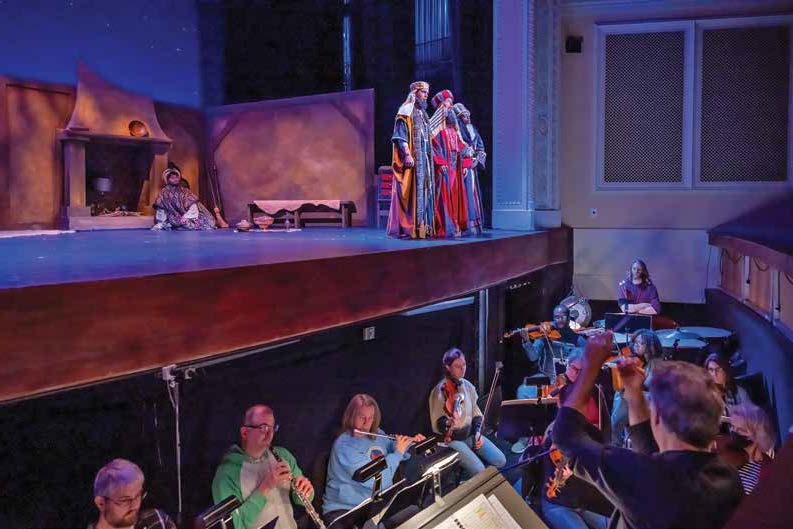
“Remember as you come in to watch my beat,” Holley says. “Don’t listen for it — watch, or you’ll fall behind the tempo.”

“And hit your marks,” he adds. “Otherwise, you’ll get all bunched up.”

The rehearsal lasts about two hours.

All the while, director Holley coaches, cajoles, encourages, praises. He reminds his singers to tell their choirs, church groups and friends to attend the performances. He reminds the kings that they’ll meet the following evening for practice.

Then stage manager Atkinson announces the rehearsal is closed. I feel as though I’ve been watching a documentary. And in my heart of hearts, I’m wondering, Will this turn out OK?

After very successful performances at High Point University, the company has returned for a final dress rehearsal at UNCG Auditorium, where they’ll present their closing performances of the season.

Even outside the building, there’s a completely different vibe. Lots of case-carrying orchestra musicians are making their way toward the auditorium, for one thing.

Lynn Donovan, the photographer for this story, lets me in the front door, along with a young cellist who’s unfamiliar with the cast entrance location at the side of the building. Donovan takes off to finish setting up her gear as the musician hurries across the lobby.

As I’m crossing the lobby, I see Thomas Burns emerging from a dressing room in full costume. A woman holds a crutch and wooden flute by the door. Turns out to be a happy surprise.

I recognize her — Patti Burns, lecturer of French at Elon University. We’d met, because I shared an office with her husband, Dan Burns, assistant professor of English, back when I taught part-time at Elon.

When I ask her about being a stage mother, we both laugh, and Thomas looks doubtful.

“Do I know you?” he asks.

“No,” I say. “But I was working with your father the year you were born.”

Thomas gives me a wary look and takes his mother’s hand. They head for the stage, and I find a seat in the audience, settling in for another night at the opera.

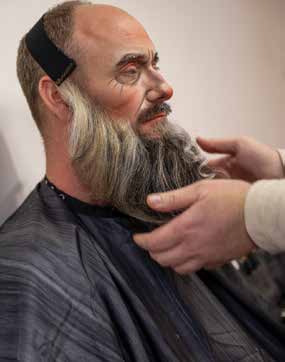
A few members of the cast have not yet retreated behind the curtain. I can hardly recognize their faces, since they’re in full makeup and costume. The kings have beards and flowing robes. The faux jewels in their costumes glitter.

The orchestra is invisible, though I can hear them in the pit warming up. I caught a glimpse of Holley as I walked in, but he too is now invisible.

A single trumpet player runs through scales. The strings are tuning. I can hear the strains of a harp, the muffled thumps of percussion. The violin flourishes run faster and faster. The brass and woodwinds grow louder. Then, suddenly, there’s silence.

At 7:01 p.m., the house lights go dark. Immediately, I hear Holley’s voice.
“One of the spotlights isn’t working,” he calls. I hear a voice in the wings respond, then watch as a big man ascends a ladder until he is out of sight.

I hear a clink, and the light comes on.

There’s a scattering of applause and laughter in the orchestra pit, and then, Holley’s voice.

“Let’s hear it for Scott Garrison!” he says. Garrison is the auditorium’s technical director.

There’s louder clapping, flourishes from the violins. The curtain rises.

The empty, garishly lit stage I saw at my first rehearsal is transformed, bathed in the deep blues and purples of night. There is a wall, a door, a bench. Rough-hewn pallets for sleeping. The set is bathed in warm, yellow light. A single star, the star the kings are following, shines brightly in the midnight blue firmament.

“Thomas, give me a G,” Holley says. He wants to make certain the boy has the right pitch for the Amahl solo they’re about to rehearse.

Thomas sounds the note and the music begins.

There’s still tweaking. Sound amplification for the first violins section is improved. Additional adjustments are made to the stage lighting. There are corrections in tempo, pitch and spoken lines. It’s a rehearsal, after all.

When the kings make their entrance from the rear of the auditorium — honestly — it’s thrilling. Voices booming, perfect tempo, perfect spacing. I hold my breath as they ascend steps to reach the ramp onto the stage, but no one trips on those long, beautiful robes.

Thomas’s soprano voice nicely resonates with the eagerness and purity of youth. The arias Amahl’s mother sings are beautiful and moving. And a pair of dancers, choreographed by Holley’s colleague in the UNCG school of dance, Michael Job, enhance the chorus’s welcoming celebration for the kings.
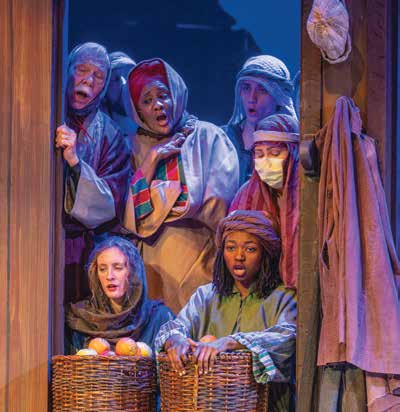
Later, Holley calls individual performers downstage, almost like a curtain call. Some musicians in the orchestra play short solos. The mood is celebratory. Then, rehearsal is over.

Holley tells me Amahl and the Night Visitors is the ideal opera to introduce people to the art form.

“It’s short, it’s in English, it’s got beautiful singing, it’s got a wonderful orchestra, it’s got stunning visual arts, it’s got dance, it’s got choral music,” he says. “It’s the perfect opera in miniature form.”

And it’s magical.

While I know that you’re just as excited as I am to see Greensboro Opera Company’s next performance of “Amahl and the Night Visitors”, you’ll have to wait until a new production is scheduled.

Still, in October, you can take advantage of a very special opportunity. The company is presenting “Don Giovanni”, with music by Wolfgang Amadeus Mozart and libretto by Lorenzo Da Ponte.

Holley tells me the production will be a “semistaged concert version,” meaning the orchestra performs on stage, rather than being hidden in the pit. The singers, in full costume, perform the opera downstage, right in front of the audience.

For those of you whose command of the Italian language is like mine, never fear — an English translation of the lyrics will display above the stage during the performance.

Based on the Don Juan legend of a Spanish nobleman who takes pride in his ruthless ability to seduce women, the opera premiered in 1787 in the city of Prague, with Mozart himself conducting. Sources describe the audience response as “rapturous and jubilant.” Some critics call “Don Giovanni” Mozart’s “opera of operas,” one of three masterpieces he created with librettist Da Ponte.

“It’s a very exciting production,” says Holley. “The story of “Don Juan” is timeless,” he adds. “You find versions of it in many cultures.”

Here’s the lineup of performers.

Sidney Outlaw returns to the Greensboro Opera to sing the title role of Don Giovanni after playing Jake in “Porgy and Bess”. Outlaw holds a B.A. in music performance from UNCG and a master’s from The Julliard School. He has performed internationally and is on the Manhattan School of Music faculty.

With a master’s of music from UNCG, Melinda Whittingon will sing the part of Donna Anna, a role she’s also performed with her home company, Opera Carolina, in Charlotte. She has sung with many operas, including The Metropolitan Opera in New York, and is an adjunct professor of voice at Davidson College.

Singing the role of Donna Elvira is Samantha Anselmo, who is pursuing doctoral studies in vocal performance and pedagogy at UNCG. Previously, she taught music and voice classes at the University of Southern Alabama. She has performed in two Mozart operas, “Così fan tutte” and “The Magic Flute”.

With a master’s degree of music in vocal performance from UNCG, Amber Rose plays the part of Zerlina in “Don Giovanni”. She performed recently in Opera Carolina’s production of “Madame Butterfly” and was the soprano soloist in Mozart’s Coronation Mass with the Masterworks Chorus of the Palm Beaches.

Another UNCG alum, Christian Blackburn, holds a master’s degree of music performance and is singing the role of Masetto, which he has previously performed with the North Carolina Opera in Raleigh. He has taken a step back from fulltime performing and runs a financial planning and advisory practice in Greensboro.

Donald Hartmann plays the role of Commendatore. He is both a UNCG alum and a colleague of Holley’s, earning his bachelor’s and master’s degrees of music, and serving as professor of voice in the college of visual and performing arts. He has performed more than 75 operatic roles in Europe, Canada and the U.S.

Holley is especially pleased that so many of his former students are returning to Greensboro to perform.

“That’s the beauty of the jobs I have,” he continues. “I wear these two hats — one as director of opera at UNCG; the other as general and artistic director of the Greensboro Opera Company.” In these roles, Holley not only trains young people who aspire to careers as singers, but also hires professionals to perform with the Greensboro Opera.

“Almost all the singers who are doing “Don Giovanni” in October came through my program or are colleagues,” Holley says. “I would say the UNCG College of Visual and Performing Arts is the flagship institution of music in North Carolina.”

Holley muses for a moment.

“You know, opera in this country has a stereotype of not being accessible,” he continues. “People think of it being the fat lady with the spear and the horns and that’s not what it is.”

“Opera is the greatest storytelling on stage,” Holley says. “That’s what we do. We tell stories. We just happen to put it in a context that uses beautiful music, and music speaks to your soul in a way that words by themselves cannot.”

Meet the Makers

MEET THE MAKERS

Meet the Makers

After a five-year hiatus, Westerwood’s art walk and studio tour returns

By Cassie Bustamante

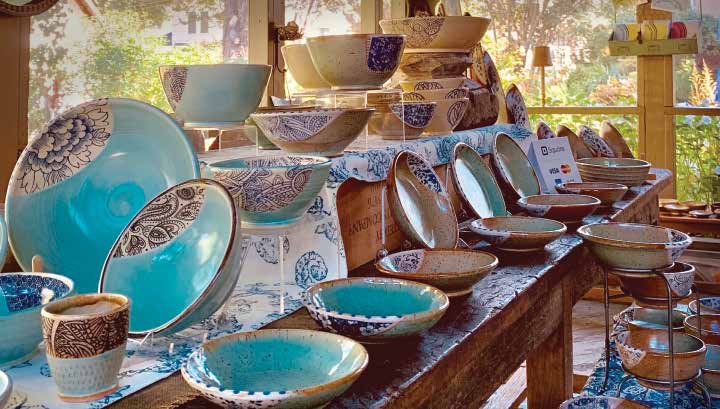
Twenty years ago, ceramicist Ann Lynch moved into the neighborhood of Westerwood and began working as the director of development for the United Arts Council of Greensboro. While in her job, she noticed something within the organization’s artist database: Westerwood was chock full of ’em. When Lynch, as she puts it, “luckily got to stop working in 2008,” like clay in her hands, an idea took shape in her mind: the city’s first and only meet-the-artists-in-theirstudios walking tour.

Lynch approached her Fairmont street neighbors, fiber artist Paige Cox and reduction linoleum printmaker Marianna Williams, who became instrumental in making the vision a reality. In mid-June of 2009, they held a meeting to gauge interest on launching an art walk and studio tour the first weekend of October, only a few months away. Thanks to an enthusiastic response, “We pulled it together very quickly,” says Lynch, adding that she recalls Paige saying, “Who says artists can’t be organized?”

Of course, a catchy name was a must. In a fit of giggles, Lynch and Cox recall a fellow artist suggesting “Bomb Diggity.” After all, it was the 2000s. “We tossed that out,” says Lynch. On a walk in the mountains, Lynch’s husband, Russ, said to her, “We should call it Art & Sole, S-O-L-E.”

For the next 10 years on the first Saturday of October, art lovers would stroll through the charming neighborhood, visiting 20 or so Westerwood studios, and to the delight of the artists, purchasing tons of art. But in 2020, as the world shut down due to COVID, Art & Sole reached what Lynch calls “a natural death.”

This year, thanks to two Atlanta transplants, it’s being revived.

Chandra Young, an “appreciator of art,” says she and husband Ed, a participating artist, moved to Westerwood in 2013 because of Art & Sole. Acrylic painter and photographer Parlee Noonan and her husband, Patrick, had been friends with the Youngs for two decades. Ready for a change, they sought small-city living within drivable distance to their second home in Boone. After visiting the Youngs, they found themselves comparing everything else to Westerwood — and nothing measured up. Last year, they said goodbye to Atlanta and hello to Greensboro.

Before she even moved into their new Westerwood home, Noonan recalls with a laugh how Young said to her, “We have to get Art & Sole going again!”

With Noonan at the helm and Young by her side, Art & Sole has once again found footing. And the aim is to keep Lynch’s original vision alive, celebrating the creative community of Westerwood. This year, you can lace up and log your steps while visiting 31 artists from 10 a.m.–5 p.m., Saturday, October 5.

“We all feel like we are living in a really special place and it’s nice to be able to show it off,” says Young.

Who the Folk

12 DAYS OF CHRISTMAS

Who the Folk?

The N.C. Folk Fest celebrates a decade with a worldly line-up

By Billy Ingram

“It’s our 10th anniversary and we’re coming home,” North Carolina Folk Festival Chief of Staff Savannah Thorne says, confiding that this year’s downtown musical gathering will strike a slightly different chord. From September 6–8, under new Executive Director Jodee Ruppel, some familiar headliners you’ve come to expect will take the stage, but, Thorne concedes, “we’re also packing the weekend full of musicians specifically from North Carolina. We really want to show off the best of our state.”

I suspect the term “Folk Music” has calcified in American minds — buffoonish imagery depicting raggedy-looking banjo plunkers, jug huffers, spoon clappers, corncob smokin’ hillbillies or perhaps six-string-strumming hippies packed into VW vans goin’ to San Fransisco with flowers in their hair.

I asked Savannah Thorne, who holds a degree in ethnomusicology from UNCG, about the protoplasmic catalysts in our region responsible for the earliest percolations of this widely misunderstood genre. “Folk music in North Carolina goes all the way back to the early times,” she tells me. “From the 1700s to the 1800s, you have Irish and Scottish immigrants settling in Appalachia, often indentured servants who managed to gain some wealth and acquire a piece of land.”

That cultural absorption bumped up against indigenous tribes forced into higher elevations after white settlers appropriated ancestral lands. “Then you have enslaved people who are also up there trying to make a living,” Thorne adds. “And all four of these cultures start to weave together folk music.”

Societal injustices from that period meant that rhythmical utterances were often the only legit methods of expression allowed to the powerless. Out of that desire to communicate, came the banjo and guitar from West Africa, rich singing traditions radiating outward from indigenous cultures, Irish and Scottish heritage gifting us with the fiddle. All of these melodious manifestations slowly unified into what we refer to as “old time,” the wellspring of folk music. After cotton mills lured workers from these emerging cultures down from the hills, harmonically aligning with Gullah immigrating from the coast, the Piedmont sound was born. Just one of a kaleidoscopic array of regional folk iterations.

Think of folk as an all-encompassing but never-to-be-finished tapestry, resplendent in hues of blues, jazz, hip-hop, rap, country, Tejano — whatever form the music takes, the underlying thread is authenticity rooted in cultural identity.

“Ethno USA is a partnership program that we have through the festival,” Thorne says about an underpinning of the Folk Fest we don’t see. “They’re a really fantastic example of international music sharing.” The Ethno program is a two- to three-week conference held in various cities around the globe, where musicians are flown in from all over the world to collaborate, fine-tune their skills, and expand each other’s musical horizons. “Then they play their music at the North Carolina Folk Festival. So you could hear anything from songs being shared from local indigenous communities to music from Chile, from Argentina, from Russia, incorporating all of these different languages.” There is a shift in booking the festival this season. Instead of mass attractions such as Grandmaster Flash or George Clinton, who have both performed in past years, there’s a rock-steady beat of high-calibre entertainment across myriad musical fields. Look for Lumbee Indian- and Oglala Lakota-rooted guitarist and songwriter Lakota John; Grammy- and Country Music Association-nominated husband and-wife duo The War and Treaty, who scored the hit single “Hey Driver” with Zach Bryan, leading to them opening for the Rolling Stones in July; Texican rockers Los Lonely Boys, whose infectious 2004 Grammy-winning No. 1 hit “Heaven” has never stopped lighting up jukeboxes. Then, closing out the festivities in a mellow tone will be Chapel Hill string band balladeers Mipso, who’ll bring down-home to downtown. Musicians in town from around the Tar Heel State embody that spirit of stylistic assimilation: traditional Appalachian steeped crooners Holler Choir out of Asheville; Pentecostal gospel-inspired Dashawn Hickman Presents Sacred Steel featuring Wendy Hickman; the electric R&B sounds of Charlotte’s Emanuel Wynter; then there’s ice cold country-time refreshment from this year’s barnstorming semi-finalist on The Voice, Tae Lewis.

This year’s festival will go a long way to rectify a fatal flaw I’ve complained about for, well, a decade — that there wasn’t enough emphasis on local musicians. “I feel like in a lot of ways Greensboro has been overlooked when it comes to the North Carolina music scene,” Savannah Thorne observes. “This is a rebrand for the festival. We really want to focus on making Greensboro the musical hub of the East Coast that we all know it is.”

I wonder at times if this city suffers from a municipal form of imposter syndrome, a subconscious belief that artists remaining in Greensboro must somehow be inferior to those that fled for more lucrative locales. The way music distribution is set up today, location is irrelevant. In the past, one needed to relocate to New York, L.A. or some other show-business hub to be in the game. That’s no longer true; artists are free to stay, and many are choosing to do so.

This year’s local lineup should forever dispel any possible imposter syndrome dysphoria. In addition to the Sam Fribush Organ Trio (see this month’s “Wandering Billy,” page 45), Colin Cutler and Hot Pepper Jam’s juke joint jive will have audiences bouncing like rod puppets. Many band members of Unheard are graduates from UNCG’s esteemed Miles Davis Jazz Studies Program, a defining undercurrent in their seemingly unstructured yet somehow traditional sounding jam sessions. Grinding out unbridled, guitar-driven Southern grit is Old Heavy Hands, firing up a live set embrued with anthemic energy.

As for Savannah Thorne — she’s dreaming big. “My goal for the Folk Festival is to be the largest free festival on the East Coast in the next two years.” That would entail attracting over 200,000 enthusiasts to downtown Greensboro. “Already the festival has a $20 million impact on Greensboro as a result of the jobs created and all the musicians that end up getting paid.” By focusing on North Carolina musicians this year, she adds, “We have a really fantastic return on investment in that way, and we’re putting our money back into Greensboro.” With a singing style rightfully described by Blues Blast Magazine as having “an uplifting, otherworldly quality,” North Carolina based composer-performer Rissi Palmer apparently has a protean refusal to drop that proverbial needle before letting it sail into a single groove, even when it proves to be highly successful. This Grammy-nominated artist released her latest recording just last summer, an inspirational three-song EP entitled “Still Here”, demonstrating that, not only is she indeed persistently present, but, armed with vocals as perfect as pearls, she’s a righteous songwriter with plenty to say. Tuned-in people are listening . . . Residing in Durham, Rissi Palmer has been allowing that inner songbird to soar since her childhood; “I actually have a picture of me at age four, standing on a milk crate to reach the microphones.” At 19, she was offered a record deal from Terry Lewis and Jimmy Jam but, “I ended up turning it down and didn’t get another deal until I was 26.” That signing resulted in her 2007 freshman album, Rissi Palmer, from which the single “Country Girl” catapulted this uncaged canary to the attention of the public, becoming the first Black woman in two decades to hit the Billboard Hot Country Songs chart. That same year, she debuted at the Grand Ole Opry, subsequently appearing at the White House and Lincoln Center. Coincidentally, this all took place just as Taylor Swift’s first chart-topper, “Tim McGraw,” was kicking up country dust alongside her. I had to ask. “This was at the beginning of both of our careers,” Palmer recalls with a chuckle. “We played quite a few new artist rounds together for radio stations. I was her opener for a music festival in Wisconsin — she was a baby at the time. I think she was 15.”

While Rissi Palmer’s first album was unabashedly country it’s safe to say, over the course of six ensuing recordings, assorted singles and videos, and after thousands of miles circling the globe, her direction and perspective are ever-evolving, “As I’ve gotten older — thanks to being an independent artist — I’ve had an opportunity to explore different sides of my influences. So I don’t know that it’s particularly fair to people who are traditional country artists to call what I do country.” She began calling her style “Southern Soul,” a boldly-blended Chex Mix of country, R&B, gospel, pop, “and all those things that I listened to and loved as a child.”

Written in 2014, initially recorded in 2018, Palmer’s stark protestation “Seeds” gets a galvanic redux on “Still Here”. It’s an uncomfortable yet ultimately uplifting ballad that reverberates as profoundly as “A Change is Gonna Come,” Sam Cooke’s puissant, 

cri de coeur of the early-’60s. “I wrote “Seeds” with Deanna Walker and Rick Baresford,” Palmer explains. Baresford has written #1 country hits for icons like George Jones while Walker is a prolific tunesmith teaching songwriting at Vanderbilt University. “We’ve been writing songs together for years.” Having grown up in St. Louis, Missouri, with close friends in the nearby Ferguson community, Palmer confesses the idea grew from a sense of powerlessness surrounding the 2014 murder of 18-year-old Michael Brown. “I wanted to say something, but, to be perfectly frank with you, I couldn’t think of anything positive to say — and I tend to be a pretty positive person. I understood why people were angry, why they were hurt.” When running across a quote from Greek poet Dinos Christianopoulos — They tried to bury us, they didn’t know we were seeds — inspiration hit. “I was like, that’s the way to look at this.”

Palmer had the misfortune of releasing an album in October 2019, subsequently booking all of 2020 to promote it. But, like everyone else, she ended up at home, “with my kids, teaching questionable math and making bread.”

That’s when the idea of her “Color Me Country” radio program came about. “One of my best friends was teasing me,” she says. “She was like, ‘Girl, you need to put all this information that you have about country music and do something with this and not just talk to me on the phone about it.’” In 2020, Linda Martell’s “Color Me Country” album, which the show is named after, celebrated its 50th anniversary. Palmer began by dialing up other country artists she was acquainted with. “I wasn’t exactly sure what this was going to be, but I wanted it to be conversations — not interviews. That’s why I started with people that I knew. We’re now in our fourth season and it has blossomed into exactly what I wanted it to be.”

Demeanor tornados his self-reflexive pop smoke, charged with je-ne-sais-quoi energy, into the atmosphere, a major highlight of the weekend. Born and raised in the Gate City, “I come from a very musical family,” Demeanor mentions casually. To say the least. He began playing banjo and bones around the age of 12, partially inspired by his aunt, Greensboro’s own Rhiannon Giddens. “She started the Carolina Chocolate Drops and Sankofa Strings when I was just learning what a banjo was. I grew up traveling around with her, listening to the music. It was just something so different than what I was listening to.” This young man mostly had New Edition, Bobby Brown, and hip hop CDs spinning at home but, “I’d go out with [Giddens] to these old-time festivals, bluegrass festivals, and I was like, whoa, this is very vibrant.” Keep in mind, this was before his aunt’s astonishing rise to fame, before landing her MacArthur Genius Grant, winning two Grammys and a Pulitzer, and NPR proclaiming her one of the “25 Most Influential Women Musicians of the 21st Century.”

Rhiannon Giddens. “She started the Carolina Chocolate Drops and Sankofa Strings when I was just learning what a banjo was. I grew up traveling around with her, listening to the music. It was just something so different than what I was listening to.” This young man mostly had New Edition, Bobby Brown, and hip hop CDs spinning at home but, “I’d go out with [Giddens] to these oldtime festivals, bluegrass festivals, and I was like, whoa, this is very vibrant.” Keep in mind, this was before his aunt’s astonishing rise to fame, before landing her MacArthur Genius Grant, winning two Grammys and a Pulitzer, and NPR proclaiming her one of the “25 Most Influential Women Musicians of the 21st Century.”

As a teenager whose mother was Giddens’ tour manager, Demeanor (he was Justin Harrington then) accompanied his family on the road during summer breaks from school. “We’re packed into a 10-seater van, just hoofing it in Missouri and the Methodically, Demeanor built a reputation as an independent artist the old-fashioned way. “There weren’t that many venues, so I was playing house shows. It was like bootcamp.”

In 2019, he participated in One Beat, a fellowship where musicians from some 20 countries come together to write and perform new music. Two years later, he became the first rapper to perform a full set at the Newport Folk Festival. “They were kind of first looking at me as — a rapper who plays the banjo? Like, is this a gimmick? Or what is this?”

But, as Demeanor is quick to affirm, rap music is folk music. “I don’t separate the root from the branch,” he explains. “I think that when it comes to music, we separate roots as its own thing. Whereas I’m kind of looking at it as, hey, even our roots have roots, and then those roots have roots.”

Immersed in a purposeful state of unwavering reinvention, transcending generational euphemisms, Demeanor attacks his original compositions with an unmistakable fearlessness, an almost undetectable vulnerability peering out from under rapturous lyrical onslaughts. As for his turn at the Folk Festival this year, “I definitely want this on the record,” Demeanor insists. “I’m so excited about my set. I think that this is going to be something that has never happened before, ever in America, ever. This is going to be one for the books for sure.”

I think he means it.

Poem

POEM

September 2024

Static Apnea

Toes taste water
before it swallows
our bodies.

In a waterfall embrace—
bones brush against
mossy boulders.

Our skin succumbs
to unknown atoms
when the wild decides
where we fall in.

The flow that washed away our sins
is saving someone else by now.

Miles away—
neck deep
in a faith pool,

we hold our breath
to float above
rock bottom.

— Clint Bowman

Clint Bowman’s debut full-length collection of poetry, If Lost, will be published September 5 by Loblolly Press.

Out of the Blue

OUT OF THE BLUE

Out of the Blue

A former neighborhood show house shines again

By Cassie Bustamante

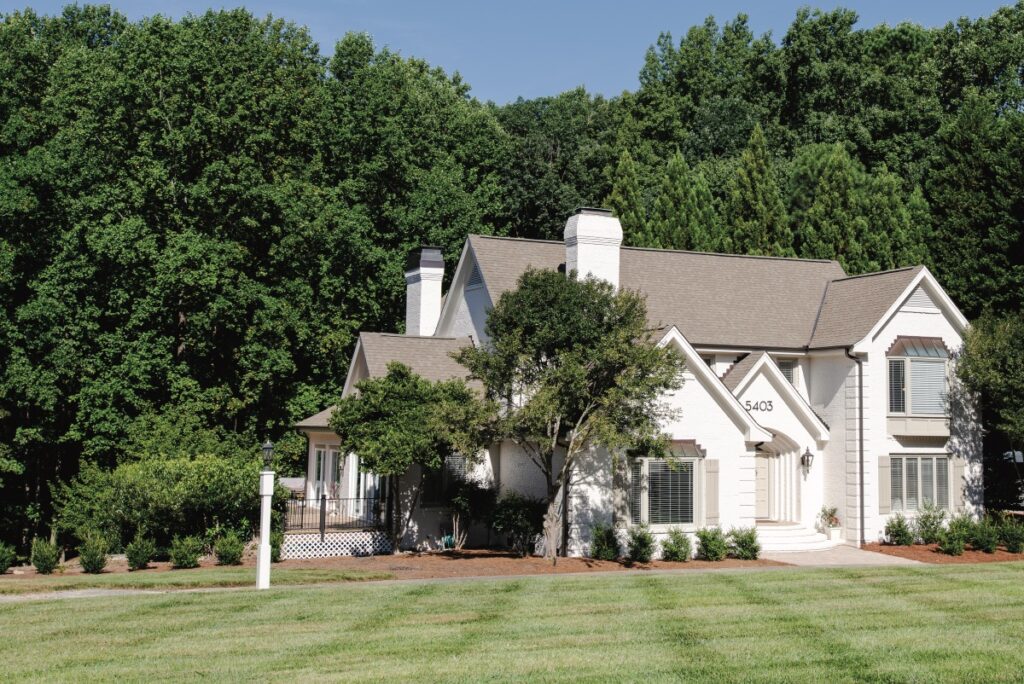
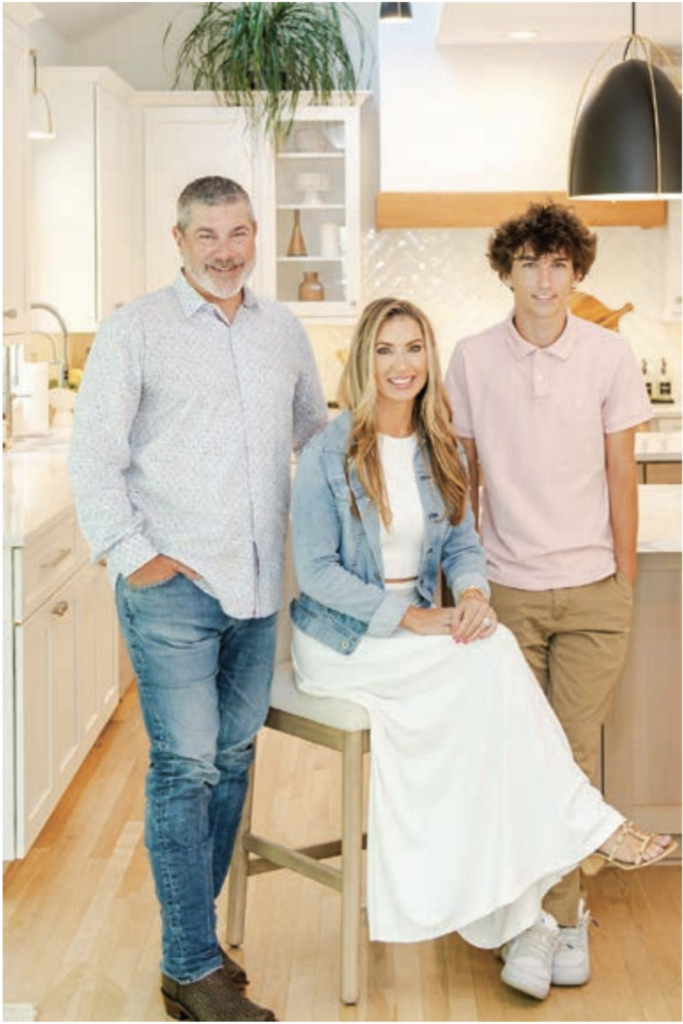
For years, Scott Bisbee had told his wife, Lindsay, about his dream of owning a grand, gray house. With the address in her GPS, Lindsay did a drive-by of a soon-to-be-listed Lake Brandt Estates home. “I got goosebumps,” she recalls. The muted gray-brick home sat far back on a large lot and, from her car window, it looked like the physical manifestation of Scott’s dream. The hidden-behind-overgrowth-gem version, that is.

Over a decade ago, the Bisbees became Greensboro residents when Scott, who has been with Honda for most of his career, took over management of the Crown Honda Greensboro franchise. Previously, they’d lived in California’s Bay Area in a town called Danville.

While their Golden State home featured a zero-lot line, their first Greensboro house, a new build in Gates at Brassfield, “sat on a pie shape with the house in the middle of it,” says Scott. “Coming from California to that house? That was a huge upgrade in property.”

But as the Bisbee children grew, the family’s needs changed, too. Plus, they wanted to be on the north side of the city because Scott, too, made a big career move.

“It’s kind of hilarious,” quips Lindsay. 

“It’s awesome!” adds Scott.

Years ago at a Honda meetup, before their move to North Carolina, the Bisbees spotted a man with a Danville baseball cap on and struck up conversation, asking if he was from the same East Bay town. Turns out the gentleman, Steve Padgett, was the owner of Honda of Danville in Virginia. Not California. But a friendship was forged and they stayed in touch throughout the years. “And then one day the guy calls Scott,” says Lindsay, in hopes of selling his dealership.

In 2019, Scott firmly put down East Coast roots, purchasing Honda of Danville. “We’re lifers now,” he says happily of North Carolina.

Lindsay, too, began her own business in North Carolina. Before having kids, she worked as a chemist and microbiologist and took her knowledge into cooking for her family, cutting out unnecessary chemicals. Eventually, in 2015, she launched Kyookz, an “artfully pickled” company that offers four pickle varieties in more than 450 store. Their daughter, Taylor, now 24, is currently running the company. Lindsay says that, now, her home is her “new job.”

With their wishlist in mind, the Bisbees struggled to find the fixer-upper of their dreams — a spacious home on a large lot in an established neighborhood, something Lindsay could put her own design spin on. After searching for a couple years, they all but gave up.

“We actually did give up,” says Scott.

But, “out of the blue,” Lindsay says, their friend and Realtor Frances Giaimo called. “She said, ‘Guys, I think I found the one for you.’”

The home had once been “the show house of the neighborhood, according to neighbors,” says Lindsay. It was built in 1987 for Irish-born Ingrid Dougan Hayes McMillan, a former wife of millionaire and textile giant Chuck Hayes, longtime Guilford Mills CEO. According to Lindsay, Ingrid lived there until she succumbed to brain cancer in 2011 at the age of 53. Neighbors have regaled the Bisbees with fond recollections of the beautiful woman who often hosted get-togethers. “Her hair and her makeup and her dress were just perfect and she would be riding her little lawn mower,” says Lindsay. “She took a ton of pride in it.”

Like Lindsay, Ingrid also had an eye for design that was evident throughout.

But the large, contemporary brick home had been occupied by renters for a few years and, before that, had sat vacant. The result? The former jewel of the neighborhood had become a diamond in the rough, buried in overgrowth. Frances, who lives just down the street, caught wind that it would soon be hitting the market.

The sellers’ real-estate agent allowed Frances to take the Bisbees through the home before it hit the market. “It was very 1980s,” recalls Lindsay of that first walkthrough. Plus, the renters had left behind cigarette burns and worse.

As they reached the landing at the top of the stairs that day, Scott remembers looking at his wife and saying, “Do you have any idea how much work this is going to be?!”

But Frances encouraged them to take a look at one more thing — the basement.

“It’s a huge walkout basement that goes underneath this large deck,” says Lindsay, who saw that space and imagined what it could be: an indoor-outdoor space for entertaining with a patio kitchen and views into the peaceful wooded creek behind the house.

“I just felt like it was the one we had been talking about for so long,” says Lindsay. And, having renovated homes on their own in California, a large project did not scare them.

They put in an offer, which the sellers accepted. “It was kind of win-win for everyone,” says Lindsay, since the home never even had to be listed.

Immediately, they got to work and hired architect Stephen Jobe to help them make structural changes on the main floor. Where a small dining room once sat adjacent to a guest room, the couple moved walls, creating a downstairs primary suite.

“We weren’t going to use [the dining room] anyways because we’re not fancy,” says Lindsay, whose style leans California casual. But a main-floor primary would be ideal to allow the couple to avoid stairs as they get older.

“You typically wouldn’t put a primary at the front of the house either,” says Scott, “but because we sit so far back, it’s still dark and private.” In fact, the front yard slopes downward toward the home, allowing their bedroom, decorated in soothing grays, tans and whites, to remain tranquil. Over the bed, a canvas Lindsay created using alcohol ink features soft colors and touches of metallic gold.

The en suite bathroom is Lindsay’s “second-favorite” space in the entire home. From the heated porcelain-tiled floors to the wet-room shower, “it’s just very cozy.” The soft, neutral palette of taupes and whites lends to a spa-like serenity.

In fact, the colors throughout the home remain cool and calming. In the main living area, white sofas are anchored by a beige-and-gray area rug. An ash-colored, large, square coffee table complements the light wood floors, which have been refinished throughout. But the fireplace wall provides contrast in Sherwin Williams Charcoal Blue, which helps to mask the wall-mounted television.

“It’s been really fun to play with some different colors,” says Lindsay. “I wanted it to be neutral and light, but then I had to do a pop of dark to offset it.” Textiles, such as throw pillows, play off the fireplace wall.

Sitting in this room, one could almost imagine the Pacific Ocean lapping at the shore just beyond the windows. “I think it would be very hard to shake the West Coast out of me,” quips Lindsay.

From his chair in the living room, Scott calls for the family dog, Astro, and asks him to take a selfie. Astro, you see, is not your standard pooch. He’s a Honda-made robot. A long camera extends from his head and he snaps a photo.

“He’s like our little security dog,” says Lindsay. When no one is home, Astro roams the interior with his camera. Of course, the couple’s sons — Hunter, a freshman at Providence College in Rhode Island, and Jake, a junior at Greensboro Day School — have discovered a workaround when they’re at home and their parents are not: “One time, they turned him on his side so he couldn’t roam around and find them and video them.” (Taylor lives in her own apartment locally.)

Astro rolls back over to his resting spot by the back door in the kitchen. Just beyond that door lies a large deck, a deck that Scott almost fell through. The renters had kept a fire pit on the wooden deck, which had then burned and rotted in spots. “It was probably a couple weeks away from collapsing,” says Scott. “And I am standing on top of it like, is it supposed to bounce like that?”

The couple had the deck reinforced but Scott says “Wendy” resurfaced the deck. Wendy?

“Wendy the builder from Bob the Builder,” Lindsay replies. Turns out Scott’s nicknamed his handy wife.

DIY skills seems to run in the family. Lindsay gestures to a homemade game table, complete with dice, sitting on the deck. “Oh gosh, this is part of our frat house now that our son’s home,” she quips about the makeshift piece her son crafted with his friends after a trip to Home Depot.

Of course, Scott sometimes gets in on the action, too, staying up late to be one of the boys. “Lindsay made me go to bed two weeks ago,” he says with a laugh.

“You do have to get up in the morning!” she notes.

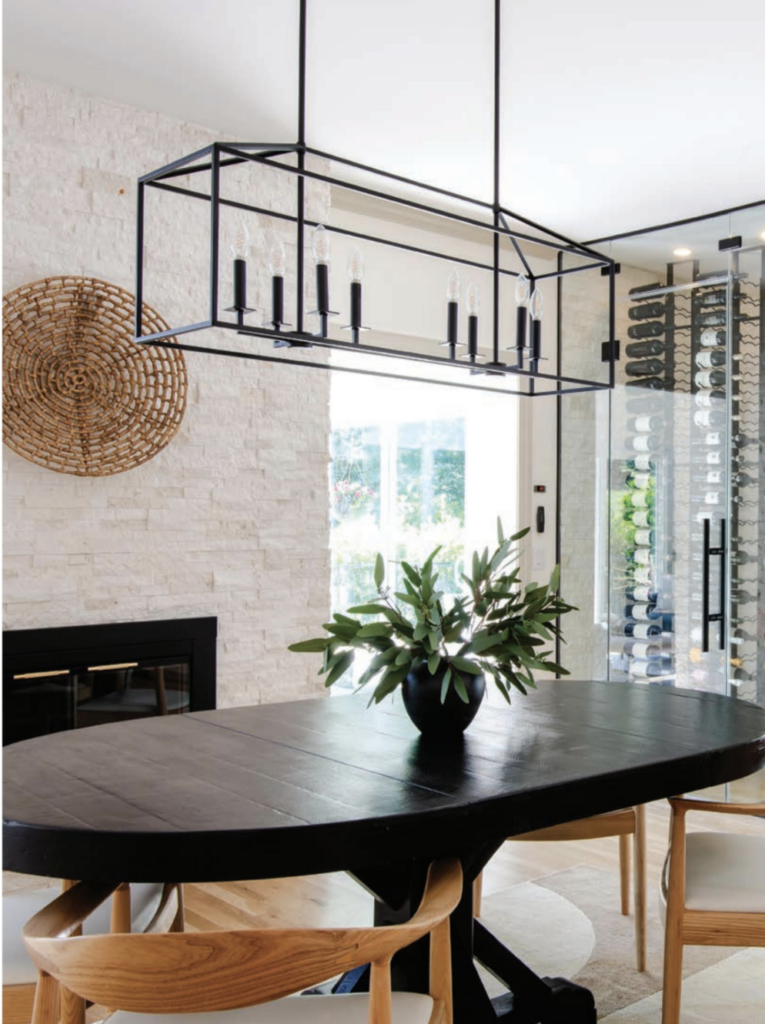
When the boys aren’t out there playing, Lindsay notes that she and Scott enjoy closing down their nights together on the deck with a glass of wine. In fact, when the kitchen was being remodeled, the couple added a large glass wine cellar, which sits in the corner.

When the Bisbees lived in California, Napa was a short drive away. While there, a friend introduced them to Scarecrow, a hard-to-acquire California cabernet. To even have a chance, you need to add your name to a list and hope that one day you get a call. Scott added his name and years later received the call.

“This one is in a league of its own,” Lindsay says of the wine, proudly displayed in the cellar, which stores up to 480 bottles.

“It’s like a trophy,” muses Scott of the Scarecrow bottles.

That makes the cellar itself a bit of a trophy case, tucked into the corner of their favorite renovated space — the kitchen. Lindsay had been dreaming for so long about renovating a kitchen before she even saw this house that she already knew what countertops and appliances she wanted. The Bisbees hired SR Design Group to bring their vision to life.

“It’s everything I ever wanted,” says Lindsay. Everything being double islands, two double dishwashers, white cabinetry, quartz countertops with taupe veining, a walk-in pantry.

The double islands have created conversation areas. “Everybody always congregates in the kitchen,” says Scott, recalling a party they hosted where only a couple people sat on the cushy living room sofas, but two groups were gathered around the islands talking.

And for Lindsay, who loves to cook, bake and entertain — just as Ingrid once did in this home — the storage space between all of the cabinetry and pantry closet makes a huge difference. “When we were in California we literally had our large serving dishes under beds,” she recalls.

While the kitchen was a complete transformation, Lindsay notes that they tried to keep some of the original character, such as the fireplace, which they had retiled. “It’s super random to have a fireplace in the kitchen, but I thought it was so charming,” she says. “It makes it feel old-school cozy.”

The look of that fireplace is mimicked in the fireplace of the upstairs primary, where Hunter stays during his summer break. Gesturing to the wall the headboard sits on, Lindsay notes that she’s recently wallpapered it with a large-scale palm leaf print in charcoal and tan. In fact, she says, she’s wallpapered a few more walls and nooks throughout the home. “It’s so in right now so I started and then I couldn’t stop,” she says with a laugh. “I think I should slow down.”

But her creative mind is always at work. The bedside dressers are from Ikea, but she’s painted them black and added modern gold hardware. The walls are adorned with decorative molding she installed and painted herself.

“Wendy the builder” has been at it in the spare bedroom as well, which features wall molding and a cherry ’80s dresser she’d contemplated donating. Instead, with paint and elbow grease, she gave it a fresh look.

“Where else are you going to find a green [dresser]?” Scott asks.

In Jake’s bedroom, a similar charcoal palette echoes the upstairs primary. Again, Lindsay’s added molding. A large painted canvas hangs over the bed — a Lindsay Bisbee original, like much of the artwork adorning the home’s walls.

On an adjacent wall, Jake — whom Lindsay still refers to as “my little guy,” despite the fact that he’s outgrown her — has created a grid gallery of square pieces. Photos? Nope, album covers he’s had printed.

Turns out he and his brother are both into records. Down the hallway in a little — wallpapered, of course — nook sits a vintage-style Victrola record player where Hunter plays old vinyls.

The teen boys also share their own upstairs laundry room. Lindsay peeks in and sees clothing strewn on the floor. She shuts the door. “They are working on some stuff in there — hopefully!”

But at the back corner of the house sits the boys’ well-used shared space — a lounge designed just for them.

“You can smell boys up here,” quips Scott. The back wall has been papered with a simple dash design in black and white and the furnishings are simple and comfortable. At the boys’ request, larger chairs were replaced with cost-effective beanbag chairs, perfect for video gaming.

Lacrosse helmets earned from various showcases line the walls leading to their retreat. Hunter, Scott says, earned his varsity letter in the sport during his freshman year in college. “Proud dad moment!”

Jake, it seems, is also making his mark on the sport, earning helmets and jerseys to add to the collection. In fact, for the first time in the school’s history, Greensboro Day School, the team he plays for, won the state championship this past May.

As it turns out, part of the reason the Bisbees initiated their move was that as their athletic sons grew older, their power and speed strengthened along with them. Lacrosse balls sometimes bounced off neighbor’s houses at their former Duck Club abode.

But now, in their Lake Brandt Estates home, they have the space and privacy they craved. No more errant balls make their way into neighbor’s yards or windows.

And thanks to Lindsay’s design eye and DIY skills, what was once a dream house is just that again. “The neighbors are appreciative, too,” says Lindsay. “They talk about [Ingrid] and how much she loved this house, so they’re very happy there are owners that care about it now.”

“I don’t want to say that she’s still here,” says Lindsay, “but I feel her presence is still in the bones of the house.”

And wouldn’t Ingrid herself be pleased to know that her legacy is being carried on in the home she poured so much love into?

The Bisbees continue to put their hearts into making the Lake Brandt Estates home shine again. Most recently, the couple hired Vasquez Painting Company to transform the exterior with Sherwin Williams Shoji White. So what happened to that gray-house dream of Scott’s?

“Now my favorite house is white!” he jokes.

Use Your Voice

USE YOUR VOICE

Use Your Voice 1 OH 082024

Use Your Voice

A new production celebrates the suffragettes

By Cynthia Adams

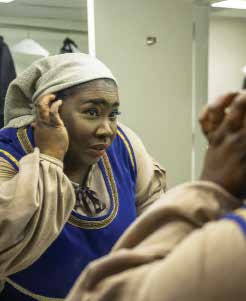
When director, musician and playwright Sherri Raeford was invited to dramatize the struggles “of courageous and resolute women of North Carolina to obtain equal rights” she was struck by the diversity of the those who pioneered the right to vote for women in the state. Many of the stories were Asian, Black, Jewish, Native American, Immigrant Irish and white Americans, she learned.

American Association of University Women North Carolina (AAUW NC) president Cheryl Wheaton envisioned a 2020 performance to be given in Raleigh at the Governor’s Mansion for a special centennial. Raeford, who thrives on group projects, was elated that the diverse group of women she pulled into the project were loving it, too — so much that they agreed to even be cast members. The writers included Jalila A. Bowie, Sheryl Davis, Patsy Hawkins, Ruan Walker, Lennie Singer, Chappell Upper and, of course, Raeford.

“The original idea was to envision women at the Governor’s Mansion on the 100th anniversary of women’s suffrage,” she says. Raeford is owner of Shared Radiance Performing Arts Company, which she founded after years directing the North Carolina Shakespeare Festival.

Underwritten by a grant award from the AAUW and later supplemented by High Point nonprofit Women in Motion, or WIM, the original work, Sisters of Mine; Hear the Voices, will finally come to the stage at two Triad locations on August 24 and 29 after COVID disrupted that original production.

Raeford has spent years researching and dramatizing events surrounding the passage of the 19th amendment. Ratified on August 26, 1920, the centennial observation — four years after the fact — will serve to mark Women’s Equality Day.

She held developmental meetings in her Pleasant Garden studio.

“A lot of the women who contributed [to suffrage] were women of color, and I didn’t want to write other people’s stories.”

That was then.

“When [the project] began,” she recalls, it was exhilarating. “There was a lot of momentum.” Raeford sighs. “Then COVID hit.” 

With the pandemic raging, the group attempted collaborating on Zoom rather than in person. That proved difficult, Raeford admits. The production lost steam as the pandemic ground on. Eventually, the project stalled.

Raeford grieved a bit, then “let it lie for a few years.” She regrouped as best she could during the pandemic, staging open air company productions in the interim. Best known for bringing classical and original works to students and into the general community, Raeford’s company, Shared Radiance, is a member of the North Carolina Theatre Conference and the Shakespeare Theatre Association.

Shared Radiance productions frequently use outdoor locations, including parks and public space, where the audience follows the actors from scene to scene. So, using the outdoors as the stage was nothing new to her.

Open air performance, as it turned out, was a godsend during the pandemic.

Shared Radiance board member Martha Yarborough had learned about the developing production during those COVID-era Zoom meetings. Almost immediately, she grasped that the theme of women’s equality was a fit with another organization, WIM, a leadership initiative founded in 2015. She felt WIM would instantly see the production was “about finding a voice.”

Yet Sisters of Mine might never have found its voice, Raeford stresses, if not for renewed interest from AAUW NC. “The AAUW Greensboro branch recommissioned the production to highlight today’s equity issues for women,” the organization explained recently in a release.

With AAUW’s renewed interest, Raeford was further buoyed when WIM sought a second performance in High Point for their organization. 

As a result, Sisters of Mine could stage two Triad performances bookending Women’s Equality Day on August 26.

Linking two of her passions, theater and leadership, Yarborough is delighted that Sisters of Mine reemerged following a dramatic five-year disruption.

“Since 2000,” says Raeford, “Martha has been my muse.” A former educator, Yarborough played a supportive role for a former student, this time by calling Sisters of Mine to the attention of WIM’s director, Pam Baldwin, and fellow board members.

WIM decided to use Sisters of Mine to announce 2024 grant winners in conjunction with the performance and “use it as a special platform for an annual event as well,” says Baldwin. She explains that the organization serves to elevate and support women in achieving professional goals, which seemed a natural fit for the premise of the play.

“The play speaks to the importance of using your voice and being empowered. One way you can exercise your voice is by voting . . . which these women [suffragettes] fought for.” And there is a dramatic tie-in with WIM.

“Half of our organization’s member dues go into a giving pool,” she says, in discussing WIM’s grant process. Each year the membership votes on allocation of monies raised.

“Obviously, because the women in our organization get to vote on all grants,” the production’s theme of voting rights suited their purpose.

“So, tying all that in and making the celebration of the grant [awards] just elevates it. We’re coming together, talking about our mission, who we are and what we do, and also have a program that they can enjoy as well. It came about organically.”

She adds, “We want them to come, to learn about us, and see where their money would go as a member.” She liked the idea of free admission, following the lead of the AAUW’s premiere in Greensboro.

“Rather than charging as a fundraiser, we want to flip the script a little [by offering free admission].”

Their hope? That mothers and daughters, women from all walks of life, will attend the play.

Yarborough agrees with Baldwin, envisioning that a performance about the rights of women “will illustrate Women in Motion’s collaboration with other groups.” 

Today, Sisters of Mine is not the traditional play it began as. While the original premise of the suffragette-themed work has morphed into a performance piece with original music, it still cleaves closely to the original concept — reflecting “women of diverse histories” seeking equality, according to playwright Raeford.

She is pleased that the handpicked collaborators authentically reflect the varied background of the original suffragettes, calling it a “performance collage.”

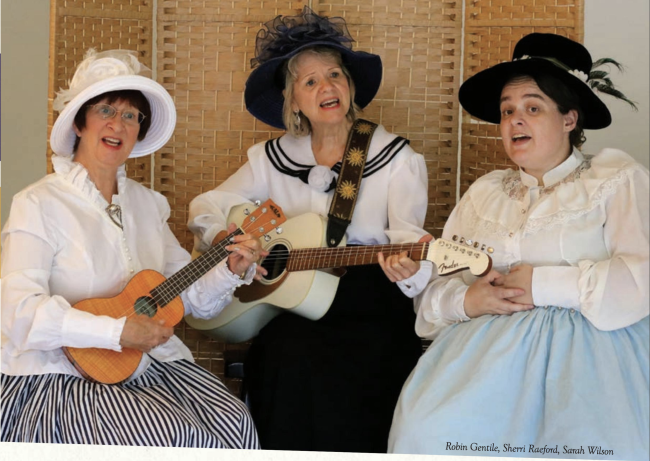
Raeford, who is an avid musician and composer, wrote an original song for the play based on the poem “Sisters of Mine” by North Carolina poet Barbara Henderson, who “had written poems about the suffragette movement.” After composing the music, Raeford asked musician Robin Gentile to help arrange the song, and to perform it on flute and guitar.

With five years elapsed, the core group changed. Their post-pandemic life circumstances altered. One of the original writers moved away.

Again, Raeford regrouped, assembling a “multi-generational cast,” some in their 20s and others in their 70s. The Sisters of Mine cast includes original writers and cast as well as new cast members Jamila Curry, Robin Gentile, Cynthia Reichelson and Sarah Wilson.  Understudies Camille Christina, Candace Hescock, Grace Kanoy and Kelly Kerr will be waiting in the wings. Sarah Wilson is the stage manager.

“The beauty of the generations is also the beauty of women . . . all taking care of each other,” explains Raeford.

“This is what this is all about,” adds Yarborough, connecting the struggle for parity in the workplace and as individuals. “Fighting for our rights. Using your voice.

The Wyndham Way

THE WYNDHAM WAY

The Wyndham Way 1 OH 082024

The Wyndham Way

After 85 years, Greensboro’s beloved PGA event is still making history 

By Jim Dodson

One morning 25 years ago, while working with Arnold Palmer on his memoir, A Golfer’s Life, I asked the King of Golf if there was one tournament in his illustrious career that he regretted never winning.  

I was sure he was going to say the PGA Championship, the only missing major.

Arnold was sitting at his workshop desk, putting a new leather grip on his driver. But he paused and gave me what I’d come to think of as “The Look,” a cross between a constipated eagle and a very disapproving school master. 

Really, Shakespeare?” he growled. “You really have to ask? You of all people should know the answer. After all, you grew up there!”

He meant, of course, my hometown Greater Greensboro Open, which I attended almost every year of my life growing up in the Gate City, including the year after I went off to college, when Arnold had his best chance ever to win the tournament. He led the final round until a triple bogey on the par-three 70th hole allowed lanky George Archer to win at the wire. 

“I never quite got over that,” he admitted with characteristic candor. “I had so many friends in the gallery from Greensboro and Winston-Salem, plus my connections with Wake Forest [University]. It still chews at me. That tournament was so much fun and meant a great deal to me. I just never got the job done.”

The King may have regretted failing to win the GGO, as it was affectionately called, in front of  the homefolk faithful, but the tournament known today as the Wyndham Championship has never forgotten Arnold Palmer.

Yes, that tournament: in its 85th year, set to begin Thursday, Aug. 8, and continuing until Sunday, Aug. 11. All eyes, as usual, will be on the Wyndham because it determines which 70 PGA Tour golfers will advance into the FedExCup Playoffs.

Several years ago, his grandson Sam Saunders watched as Wyndham officials installed a plaque dedicated to Palmer on the Wall of Champions behind the ninth green at Sedgefield Country Club. The plaque reads: “Widely considered the most important figure in golf and one of the most influential players in Wyndham Championship history, Arnold Palmer had five top-five finishes in 13 appearances at Sedgefield.” 

From its modest beginning as the seventh oldest golf event on the PGA Tour, won by Sam Snead in 1938, the Wyndham’s legacy of winning champions who made their mark on American golf can be matched by few PGA events. The list includes legends such as Ben Hogan, Byron Nelson, Sam Snead (who won the GGO a record eight times), Gary Player, Billy Casper, Larry Nelson, Raymond Floyd and a dashing young Spaniard named Seve Ballesteros, who won his first tournament at Greensboro in 1978 en route to superstardom. 

The last nine decades have seen at least three different sponsor name changes before Wyndham Hotels & Resorts became the tournament’s stalwart title sponsor in 2007. All that time, the Triad’s beloved golf tournament — North Carolina’s first professional event — retained its unique personality and important place in the world of professional golf.

“It’s essentially unique for a variety of reasons,” says Executive Tournament Director Mark Brazil, who started with the tournament in 2003. “You can begin, of course, with its almost incomparable history, which rivals the majors in terms of legends who won here. But its evolution under Wyndham has made the tournament even more special in several ways.”

One notable way, he points out, is the strong emphasis the Wyndham places on being a premier fan-friendly event, a five-time winner of the PGA’s top hospitality award for fan accessibility and friendliness.

“Most tournaments actually focus most of their attention on the players, going out of their way to provide luxury accommodations and services, anything they can to make the players feel welcome. We do the same thing, of course, but the key to our  hospitality focus has always been the fan experience, the paying customer who might come out for a day or the entire week in the heat of summer to watch the greatest players in golf.” 

Brazil points out that at a time when fan bleachers are disappearing from the grounds of some tournament venues, the Wyndham features numerous bleachers, enhanced spectator viewing areas and much-lauded cooling areas all over the Sedgefield property. The Wyndham’s popular Margaritaville tent, Truist fan pavilion, Sunbrella Sun Deck and Wyndham Rewards areas have become hallmarks of the its laid-back, hometown family feel.

That’s just the Wyndham way.

Another facet of the tournament’s appeal is the opportunity to watch younger players on the rise who may someday become the next Seve Ballesteros. The likes of British Open Champ Sandy Lyle, a young Davis Love III and Webb Simpson have won the Wyndham on their way to stardom. In more recent times, even older players such as Sergio Garcia and Tiger Woods joined the field, hoping to claim some Wyndham magic and the tournament’s Sam Snead trophy. Garcia made himself relevant on the PGA circuit by winning the tournament in 2013. A recovering Tiger Woods gave fans a thrill and left a good impression on fans by comparing Sedgefield and its history-rich Donald Ross golf course to baseball’s historic Wrigley Field. 

At a time when professional golf is in flux, perhaps the Wyndham’s biggest recurring storyline is its coveted position as the last regular season event where players can make a run at finishing in the Tour’s Top 70 rankings, thus qualifying for the FedExCup Playoffs that begin the following week in Memphis. The tournament also helps determine the top 50 players who qualify for the next season’s “signature events” that sport $20 million purses after reaching the second FedExCup Playoffs event. Sweetening the attraction, there’s also the $40 million Comcast Business Tour Top 10, rewarding the top-10 finishers in the PGA Tour regular season.

Finally, players who find themselves potential “captain’s picks” for the President’s Cup and Ryder Cup, have a final opportunity to make a big impression. In 2023, both Ryder Cup captains Zach Johnson and Luke Donald played in the Wyndham Championship for this very reason.

“This explains why we generally leave the players alone,” Brazil notes. “They have important business on their minds when they get here. There is so much riding on their performances. In many cases, the Wyndham becomes the last opportunity of the year to advance their careers. As we like to say,” he adds, “the finale is really the beginning.”

Aside from its strong community outreach programs, including longtime support of the First Tee—Central Carolina, each year seems to bring a nice, new wrinkle in terms of the tournament’s service to the Triad.

Earlier this year, partnering with First Tee, the Wyndham put out a nationwide call for artists to create an outdoor wall mural honoring the civil rights pioneers the “Gillespie Six” at the Gillespie Golf Course, to be commissioned by Wyndham Rewards and overseen by the City of Greensboro. 

With Gillespie’s continued revival in mind, a panel of key community figures and organizations selected a trio of finalists from more than 50 artists across the nation to design an outdoor memorial that will honor the Greensboro Six at Gillespie Golf Course. The mural is commissioned by the Wyndham Rewards Program.

In mid-June, Vincent Ballentine was announced as the artist who will paint the Greensboro Six mural on the First Tee—Central Carolina building at Gillespie Golf Course. An artist’s rendering of the mural was unveiled at the time, honoring the course’s history with a depiction of the six pioneers as well as a vibrant nod to the diverse future of golf.

Ballentine hails from Brooklyn, New York, and is a multidisciplined visual artist known for large-scale outdoor murals commissioned by the likes of MTV, the NCAA and BET. At the June announcement, First Tee—Central Carolina CEO Ryan Wilson praised Ballentine’s mural plan, saying it “captures our vision of bringing the community together through the power of golf and will serve as an everyday reminder of our storied past and — because of that — our beautiful future.”

Ballentine also addressed the crowd: “The Gillespie mural honors courageous men who overcame deep-rooted racial challenges to inspire incredible change.” His hope? That his creation will generate thoughtful conversations about the importance of inclusivity while paying homage to the Greensboro Six.

The mural will be publicly unveiled during the Wyndham Championship Jr. Golf Clinic on August 5, 2024, kicking off the Wyndham Championship.

The latest example of the Wyndham Way.   OH

Tumbleweed

TUMBLEWEED

Tumbleweed OH 082024

Tumbleweed

Fiction by Shelia Moses     Illustration by Raman Bhardwaj

My man is like a tumbleweed. He just rolls around and catches everything that crosses his path — every woman that is. I am telling you he’s just like a tumbleweed. That is the reason I did not want to come to this one-horse town to live. But Hogwood, North Carolina, is my Tumbleweed’s home, and he wanted to come back to be near his dying daddy. That was four years ago. His daddy, Mr. Pop, is still alive. So why are we still here?

I knew Tumbleweed would start rolling with the gals that used to love him as soon as the train stopped in Weldon to let us off in 1952. We was only here one day before we ran into one of his old gals, Missy, in the grocery store. That was the beginning of Tumbleweed going back to his old ways. First he told me that Missy was his cousin. Then I looked at that boy of hers, Boone, and I knew Tumbleweed was lying. I knew he was the daddy. Look more like Tumbleweed than Tumbleweed look like himself.

“Come on Sweet Ida,” he said to me.

“Come on nothing, Tumbleweed. You lied to me again. You know good and well Missy ain’t your cousin. You know that boy is your boy.”

“Na’ll Ida, Boonie ain’t no boy of mine. I only got six boys and two girls. You know that.” He say that mess like he proud that he left a baby in every town between Wildwood, New Jersey, and Hogwood. He ain’t never had no wife, so what he bragging for?

Missy ain’t saying a word. She just smiling and turning from side to side like she can’t stand still around my Tumbleweed. That boy Boonie ain’t got good sense. He don’t even know what we talking about. Guess we better leave before he eat up all the candy in the grocery store that Missy ain’t even offered to pay for. He definitely Tumbleweed’s boy because he always want something for nothing.

Can’t be too crazy, now can he?

“Oh stop looking for reasons not to love me gal.” Then Tumbleweed pulled me in his arms in the store that was filled with people. The store always filled with people from Rich Square, Jackson, and Hogwood on a Friday evening. It’s payday, even for the field hands. The womenfolks was looking when Tumbleweed pulled me closer. I forgot all about that boy that looked just like my man. I remembered all the reasons I love myself some Tumbleweed.

I love him for the same reason all these North Carolina womenfolks love him.

He a man! A real man! My man!

He ain’t all fine or nothing. He just a man that you gots to have.

Come that Monday morning we was back working in the ’bacco field. I was hanging ’bacco in the hot barn loft while Tumbleweed drove the truck for Mr. Willie who own all this land and ’bacco. Right now he ain’t driving. Tumbleweed just sitting and waiting to take us home. I think Mr. Willie had extra folks in the field that day. Extra women to prime this ’bacco. Extra women to look at my Tumbleweed.

They can’t fool me. That old Bessie was there shaking her big behind all over the place. She the only woman I know that wear tight skirts in the ’bacco barn. I can’t believe I left my job waiting tables at that rich country club in Wildwood to come here to prime ’bacco. Tumbleweed claimed it is a good way to make a living.

Look at him sitting over there looking at me up here in the loft and all the other women that love him out in the field.

“You want some water?” Bessie yelled to my Tumbleweed when it was time for us to knock off for lunch.

He did not answer her.

He better not!

“Anything Tumbleweed want, I can get for him,” I said, climbing down the hot barn loft for lunch.

“Fine,” Bessie said as she laughed like she knew something that I did not know. “I can get Tumbleweed some water later tonight,” she whispered and walked over to the tree to eat her pork and beans and crackers.

“Say it again,” I said as I ran up behind her. Bessie turned around in slow motion. She must have eyes in the back of her head.

I did not get far when them sisters of hers all jumped up from the ground at the same time.

“Where you going city girl?” her oldest sister Pennie Ann asked as she rolled up the sleeves on her shirt while kicking her can of beans out of the way.

I will fight anybody, anywhere for my Tumbleweed, I thought to myself.

I tried to roll up my sleeves too.

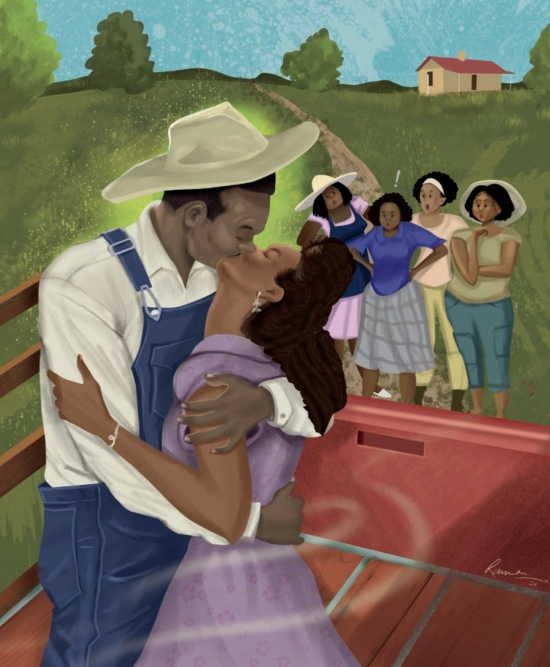
That is all I remember. The next thing I know I am lying in the back of Tumbleweed’s truck and he’s looking down at me.

“How many fights you going to have girl?” he said like he was almost sad.

“How many women you gonna love Tumbleweed?” I said as I reached for my head that was really hurting now. The knot on it felt mighty big.

Tumbleweed leaned over me and kissed me real hard with his big black lips.

All the womenfolks looked at us. They wished they was me. 

An Afternoon, No Wind

AN AFTERNOON, NO WIND

An Afternoon, No Wind

Fiction by David Rowell     Illustration by Keith Borshak

A striking, big-boned woman runs back and forth trying to fly a kite. She is surprisingly eager, considering there is no wind today. There is not enough of a breeze to sail the gum wrapper off the bench I’m sitting on. She darts tirelessly across the park as the kite drags behind her like a little dog. Every so often the kite lifts off the ground, though no higher than her head, and that’s only because she is a fast runner. This goes on for an hour.

I’m supposed to be helping my ex-girlfriend move her tanning bed into the spare room. But when the woman with the kite throws her arms up in an almost vaudevillian show of disgust, I get up, stiff from the wooden slats, and walk over to her. She isn’t aware of me until I am close enough to touch her.

“Tough day for kites,” I say.

We look at each other, and for a few seconds neither of us seems sure what to do. I back up a step or two. I am suddenly confused and can’t remember if I have spoken yet or just thought about what I might say. Tough day for kites?

“Je ne comprends absolument pas ce que vous dites.” I know it’s French, but I don’t speak a word of it. Watching her earlier, it didn’t occur to me that she wasn’t American, but up close I can see the faint olive glow of her skin, the slightly pouty curl of her lips. I consider turning around, leaving her alone, but there is something helpless about her and her shiny but now damaged triangular kite. I point to the kite, then to the sky. I blow a deep breath and shake my head no.

“No wind,” I say slowly, so slowly that I am keenly aware of how my lips feel when they move. “There is no wind.”

We stand another moment in silence, as the strangled cry of taxi horns and someone’s high-pitched laughter and the rusty churn of a nearby bicycle chain play off each other like jazz musicians. Behind the woman a mass of clouds forms a penguin, then a penguin on skates. She says something — something abrupt, like an order — and points to the kite. She points at me, then to the kite again. I reach down to pick it up.

“Oui,” she says.

I raise the kite slowly over my head, arching my brow to say, Is this OK? Is this what you want? She doesn’t indicate one way or another. Out of the corner of my eye I notice that two older women who are dressed for the tundra have stopped to watch.

She backs up and lets some string out, all the while staring into my eyes so intensely that I am afraid to look away. She nods her head once, the way mob bosses in movies indicate their willingness to listen first, before killing. Then she turns and starts sprinting, divots of grass spraying from her heels. The kite jerks out of my hand and immediately sinks, not quite hitting the ground because, as I say, she’s fast. Her ponytail thrashes behind her like a fish pulled into a boat.

She goes probably thirty yards before she looks up at the speckled sky, where she expects the kite to be. Her sturdy legs slow to a gallop, which causes the kite to touch down with feathery impact. The sad sight provokes her to grunt from the diaphragm and kick at the ground with such force that she nearly falls over. Her large frame heaves in and out. She yells something at either me or the kite (the literal translation might be, “What a piece of crap are you!”). I point up at the sky again and shake my head.

When she finishes winding up the string, she puts the kite back in my hands. I notice two small but distinct moles above her right eye. She catches me looking and balls up her face like a fist. She gives me an earful about something, to which I shrug and smile, though not with my teeth.

All afternoon we do this. And every time we try, I can tell that she expects it to go differently. Sometimes I shake my head in mock disbelief. Other times I grab a handful of grass and launch it into the air, as if that might tell us something. Once I try to hand the kite back to her and reach for the string, thinking she might appreciate the break. But she shakes her head in a frenzy, the way monkeys do in TV commercials, and holds the string behind her back. She tries running harder and for longer. If I hold the kite up with my arms even slightly bent, she refuses to start running. When yet another attempt fails, she violently reels the kite in. As we get ready again, she sucks some air into her locomotive lungs, then gives me the signal to release.

By now the sun has melted to the bottom of the sky, leaving behind a fiery red glaze. People walk by with their necks turned at awkward angles, their mouths agape with wonder. My French companion is still for the first time all day. We stand there awhile, just a few feet apart, but it’s hard to believe we’ve spent the entire afternoon together. If I ran over the hill and brought back two sno-cones, I wonder if she would even recognize me.

The man at the pretzel cart is folding down his umbrella. I imagine a big wind suddenly sweeping through the park and lifting the umbrella up over the trees, the man kicking wildly in the air as he tries to hang on. When I look over again at my partner in aeronautics, it takes me a moment to realize that she is tearing up the kite. She grips it in her muscular arms and splits it down the middle. She yanks out the sticks of the frame, fumbling with them until she snaps them over her knee. Then, with lips moving but making no sound, she grabs the tail with both hands and tries to twist it off, but she loses patience with it and is content to leave it a thin, raggedy string. Her hands are a frenzied blur of methodical destruction, though her face has an even, almost serene expression. When she is finally satisfied, she bundles up the remains and hands them to me. Instinctively I reach out to cradle the wreckage.

She lumbers toward the wrought iron entrance of the park, past the statue of George Washington on his horse, past a little boy trying to step on his balloon, which keeps darting out from under his foot. She steps directly in front of a stretch limousine so that it has to slam on brakes; still, the driver senses enough not to honk. She mows through the streets with an elephantine grace and does not fade from view until well after the darkness settles in.

I COULD GO OVER THIS AGAIN, say at what point this, then that, but it would more or less come out the same. And yet there is something that I can’t account for, even now: In my arms the kite felt like a bouquet of flowers.

The Music Lover

THE MUSIC LOVER

The Music Lover OH 082024

The Music Lover

Fiction by Katherine Min
Illustration by Jesse White

Gordon Spires lived across the courtyard from Leonard Hillman, concert master of the M         Symphony, and his lover, Kyoung Wha Jun, the second violinist. Leonard and Kyoung Wha often practiced together outside in the courtyard, under the brim of a large oak tree. The neighbors would hear them playing Debussy or Brahms and sometimes something contemporary that they wouldn’t recognize.

Gordon liked to listen to them. He was in love with Kyoung Wha, who was slender and lovely, and he believed that she secretly returned his affection but could only reveal it through her music. So when she played Mozart, it was because he was Gordon’s favorite, and when she played Bach, it meant that she was biding her time, and when she played Tchaikovsky, it was surely a sign that she was ready to run off. For it was well known that Leonard beat Kyoung Wha when he was drunk, that he cheated on her with the first violist, and that he had not quit smoking like he told Kyoung Wha he would, but snuck cigarettes after matinee performances. At least these things were well known to Gordon, who was sickly and often home during the day.

One Sunday afternoon in late autumn, Kyoung Wha and Leonard played Beethoven. From his bedroom window, Gordon could see them, Kyoung Wha in a pleated blue skirt with prim white blouse, her long bangs swinging in her face as she swept her bow across the strings of her violin; Leonard, his narrow face impassive, eyes closed, chin tilted up at an unpleasant angle. Gordon could distinguish the rich, vibrant tones of Kyoung Wha’s playing from the darker, ruminative vibrations of Leonard’s, and he attributed the mistakes — rushed tempo, inconsistent meter, mawkish drawing out of notes — to Leonard, who was, in Gordon’s opinion, the inferior of the two musicians.

Taking careful aim, Gordon threw a Monopoly piece — a silver top hat — at the rounded, balding place at the back of Leonard’s head. Leonard did not stop. Gordon threw the wheelbarrow, the thimble, and the Scottish terrier. He used more force.

“What the — ?”

Beethoven came to a halt. Gordon peeked to see Leonard rubbing his bald patch, looking up at the oak tree, then down to the ground. Leonard shrugged at Kyoung Wha, who shrugged back. They resumed playing.

The next day, Gordon lobbed a satsuma, just grazing Leonard’s left temple. Leonard leapt from his chair. Kyoung Wha seemed to look straight at Gordon then, smiling sadly. Even crouched below his bedroom window, he could feel her smile penetrate his heart like the most tender of arrows.

A few days passed before they played outside again, Leonard setting up in what had formerly been Kyoung Wha’s spot, farthest from Gordon’s window, Kyoung Wha moving farther from Leonard, into a sunny patch that did not get much shade. Her face in sunlight looked faded to Gordon, wan, and when she played — Mendelssohn this time — he heard the silent suffering as separate notes from the ones that overlapped with Leonard’s, inhabiting the spaces between. She was even more beautiful in her despair, black hair against pale complexion, in an autumnal ensemble of mauves and rusts.

Gordon heaved a bottle of multivitamins, but it overshot its mark, landing, with a muffled plop, in a giant hosta.

It rained for several days after that, the afternoons overhung with mist. Gordon saw Kyoung Wha come into the courtyard in a yellow rain slicker. He thought her green rain boots splendid, as were the orange bill and bubble eyes on her hood, which were meant to make her look like a duck.

On the first clear day, Leonard appeared without Kyoung Wha. He began to play Mahler, his feet planted like andirons before a hearth. Gordon disliked the implication that music could simply go on without her. He wondered where she was, what Leonard had done to her. The lights were off in their apartment. He could see the white fringe of an afghan against the window, resting on the back of a blood red sofa.

Gordon palmed a large rock shaped like a dinosaur egg, with a rough, pock-marked surface. He raised the window and hurled it. The rock rainbowed up and out, hitting Leonard squarely on top of the head and bouncing off. The strings of the violin made a distressed, bleating sound as Leonard slumped sideways out of his chair, then fell face first against the brick walkway.

Time passed. The lights went on. Gordon saw Kyoung Wha come out, heard her call Leonard’s name. Approaching his body, she kneeled, bent to retrieve his violin by its broken neck, got up, and stumbled back inside. The lights went out.

Gordon listened, but all he heard was the sound of distant traffic.

Softly, he closed the window.