
Possibilities at Pearman’s
Possibilities at Pearman’s
A dream is brewing in a once-beloved Bethany community hub
By Cynthia Adams
Photographs By Betsy Blake
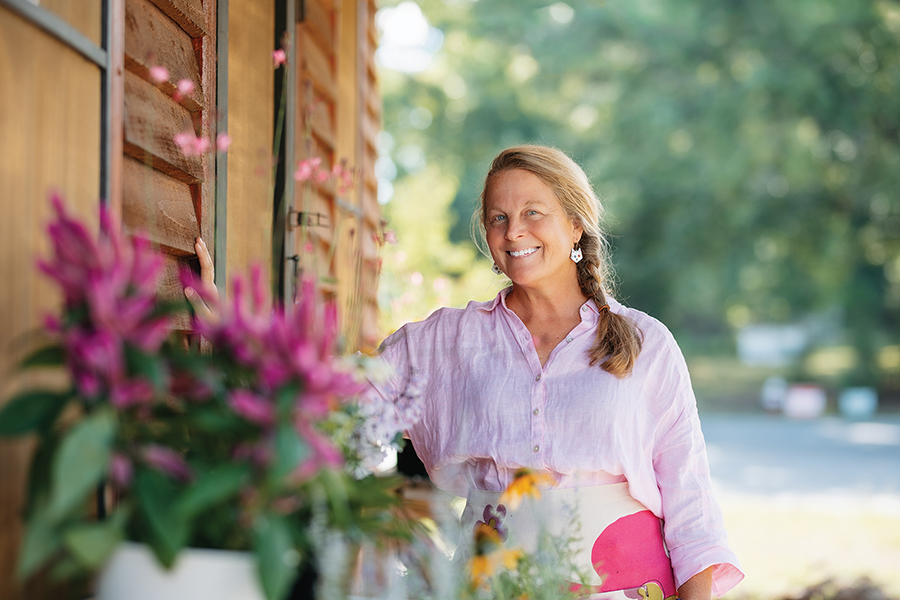
Farm-loving renovator Margie Benbow turned her attention to a new project: the historic Pearman’s Store, inspired by the possibilities of a country store and its place in the tiny Bethany community.
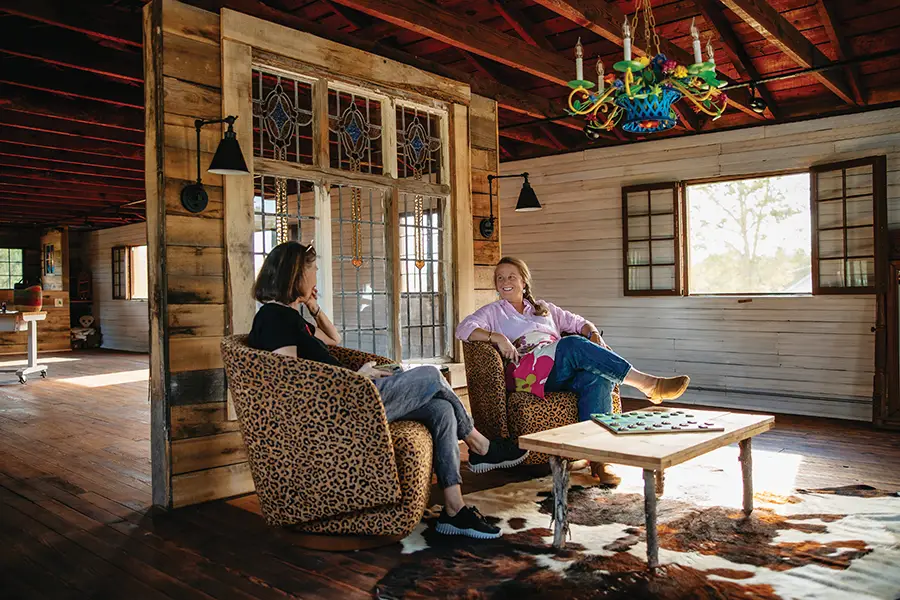
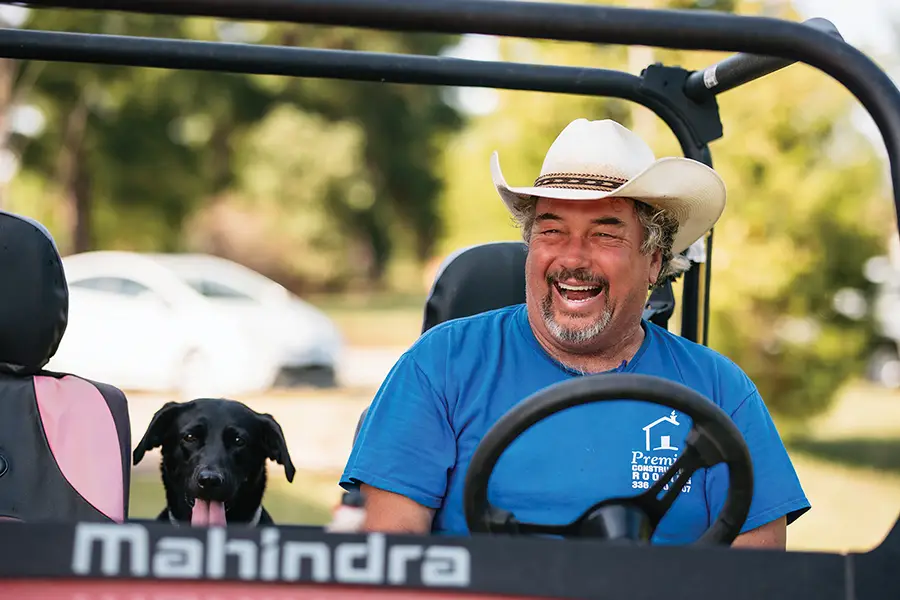
Margie Benbow is an admitted dreamer. Kenny Mackovic, her contractor and right-hand man, is a realist. She compares them to the bickering duo John Wayne and Katherine Hepburn in Rooster Cogburn. In truth, they’re long-time friends who met in high school in Winston-Salem.
While Benbow is naturally enthusiastic, Mackovic balances that inclination with pragmatism. Both like a challenge, whether a down-on-its-luck barn, ramshackle log cabin, or farmhouse, all of which they’ve tackled.
A long-vacant country store, the most public-facing part of a property Benbow bought six years ago, needed attention. Not quite derelict, but declining.
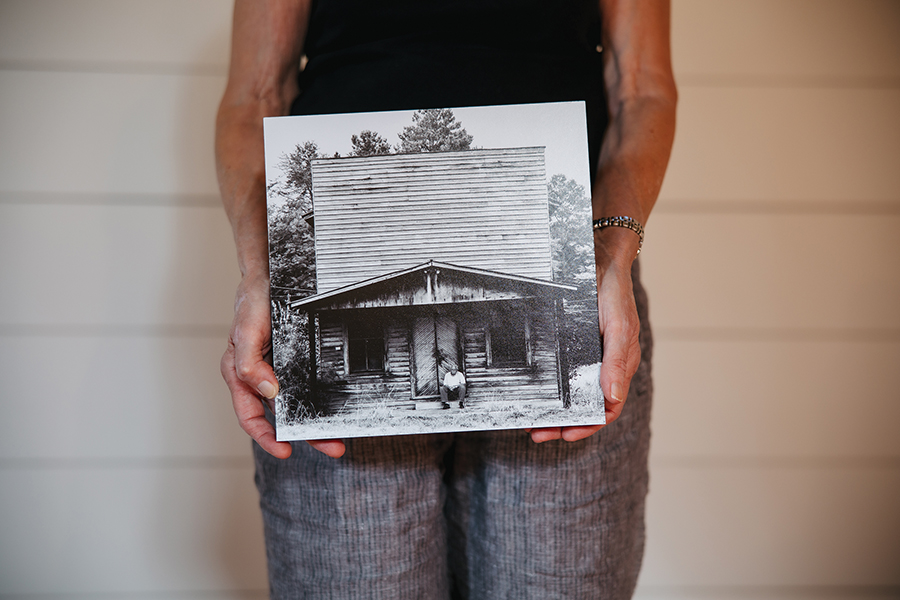
Originally the Baynes Store, it was known as the Pearman Store. Prominently located inside a highly visible, elbow-sharp curve at U.S. Highway 65 and Bethany Road, the store closed in the 1960s.
Purportedly dating to 1917, the two-story, weatherbeaten building with a covered stoop had rough-hewn Southern vernacular appeal. The store’s double front doors, distressed surfaces, original floors and shelving, and atmospheric rusticity appealed to Benbow. She grew to envision the former store as a private studio space, a place to make art, as that pursuit has taken a larger place in her life.
“I fell in love with the look. I thought it was the cutest thing I’ve ever seen in my life,” she recalls. “One thing I’ve always been able to do is see possibilities.”
Long left unpainted, the walls bore the ghostly imprint of commercial signs.
“In its prime, it was painted a light color, with dark trim and adorned with many advertisements, including Coca-Cola, Gulf and Super Cola,” says Benbow. Somehow, it was miraculously dry inside, despite a precarious roof. And to her, the parapet wall above the entrance recalled stores in old TV westerns.
She envisioned a dusty farm truck pulling in for a fill-up, and the countless work boots that had crossed the stone threshold.
Inside, the wooden floor and shelf-lined walls whispered of the past, when farmers lingered around a potbelly stove for gossip and checkers.
It stood, despite benign neglect. “I fell in love with the building,” she says, with the helpless shrug of a romantic.
That is classic Benbow.
Benbow is a polymath — a scientist, educator, lawyer and farmer. Add artist to the list. She nears completion of an art degree at Guilford College while approaching the age when many look longingly at retirement. She continuously challenges herself to learn new skills — sometimes for a project, sometimes just for fun — including welding, sculpting, stained glass making and pottery. When fly fishing piqued her interest, she learned to make ties.
Along the way, she attended auctioneering school, becoming licensed. This led her to serious temptation, especially in October 2020 when a 50-acre Bethany farm appeared on an auction site.
The property on offer featured a lake and four remaining buildings. The showstopper, for Benbow, was the iconic store. “I looked at it like a blank canvas. Wouldn’t this be fun?”
Although known as Pearman’s Store, local historians later told her that Jonathan Baynes was the original owner, and the store predated 1917. Recently, Baynes’s descendants unearthed a record for the purchase of the store’s safe dating 1904.
The store was subsequently acquired by the Pearman family. John David Pearman, who died in 1946, and his son, John William Sr. (aka J.W.), and then his son, John William Jr., succeeded him as owners, as well as that of adjacent lands.
Benbow’s best estimate is that the store remained permanently closed in the 1990s. In the years the store operated, it carved a big place in the small community’s history.
By November 2020, both the farm and store were Benbow’s. Before the closing, a storm destroyed the pond dam, meaning costly repairs. A house and some outbuildings had previously been burned by vandals.
Afterward, she and Mackovic were lunching at Three Sisters Café in Reidsville when a man named Chester Comer approached. “He asked if we were going to fix up the store,” she recalls.
“By the time I paid the check and walked next door to the filling station, three more people said they’d heard I was restoring the store.” Given Bethany’s tiny population, their interest struck her. “That’s pressure,” she laughed.
Later, Benbow found a photo of Comer with J. W. Pearman at the old store. Comer was a Pearman cousin and store employee “when he was a lad.” Like his cousin, he became “a community champion.”
But the ever-practical Mackovic pointed out that if she intended to save it, the store needed a new roof. Benbow acted. “Even though I wanted to preserve my cash flow, he called in a crew and put on a fresh roof.” The walls needed stabilizing, too, so he replaced them with cypress.
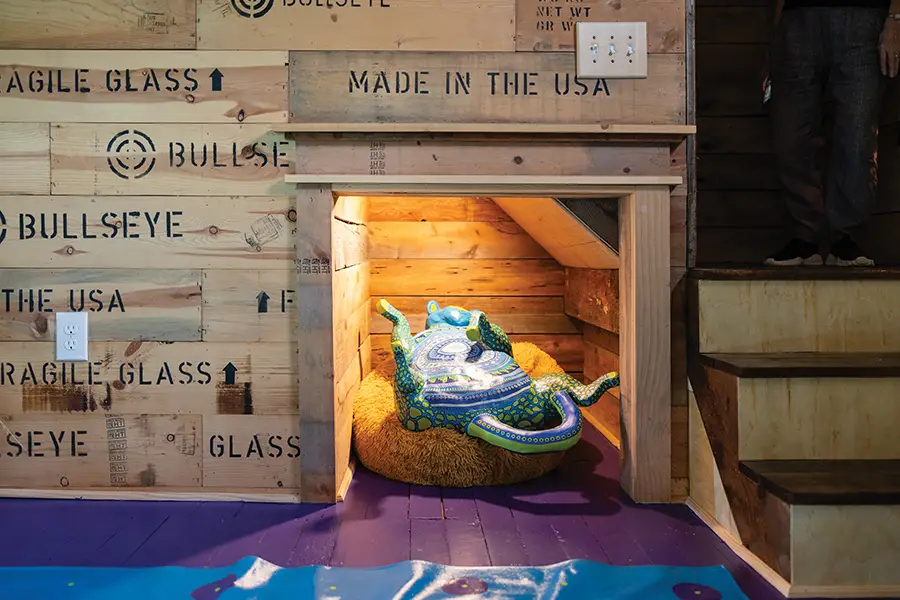
The interior held truckloads of debris. While helping empty the worst of it, she studied the contours of the building. She imagined a wall at the rear of the store once demarcating a speakeasy, as rumor held. It squared with the store’s earlier life, with Prohibition dating from 1920–1933. Behind the wall was a stairway, also out of view. She nicknamed the area “the rat hole,” given it held dirt and detritus, rather than bootlegged whiskey.
“The whole back ‘speakeasy’ was filled with old tires.” Tires in the rear and moldering canned goods in the front.



After the store closed in the 1950s, over 200 jars of green beans had sat, forming a noxious brew. “As they threw them onto a truck, they smelled like something between roadkill, burning tires and a toilet.” Benbow laughs helplessly. Then she recalls a genuinely funny moment.
“The Pearmans used to raise horses,” she shares, setting the scene. “When cleaning out the store, I found these little thermoses about this big” — she says, indicating the size. “I said, ‘Oh, these will be perfect for soup and things.’” A bubble of laughter erupts before she can continue.
“The city slicker that I am, I offered it to another person who told me, ‘That’s for artificial insemination!’”
Benbow took time considering a creative reinvention for the store. In the meantime, she resumed work at a Charlotte law practice, where she worked on site a day or two weekly after COVID “forced all work online.”
With the store spared from further decline, other projects began, with Mackovic building a horse barn. But Benbow always planned to devote attention to the store’s full restoration.
While working on the store as time allowed, the curious routinely appeared, often claiming to be Pearman relatives. Regardless, they hungered for the renewal of a gathering place, once central to a rural community. Like Comer, others shared stories, remembering when the store was a source of treats for schoolchildren and where adults mulled over local happenings.
Humorist Rick Bragg writes that he bought everything from Orange Crush sodas to Converse tennis shoes at such a store near his Alabama home. He praises such places, where men gathered to talk about “dogs, Black Angus cattle, snakes, or rain.”
Country stores provided more than staples. They were cultural anchors. They served as community centers, “where decisions were made, judgments rendered, and local needs discussed . . . a place for news, a local treasure, and a small business that rarely made money but offered much in outreach, social interaction, and community spirit,” according to Farm Press.
The corporate-owned gas stations that replaced them were not the same.
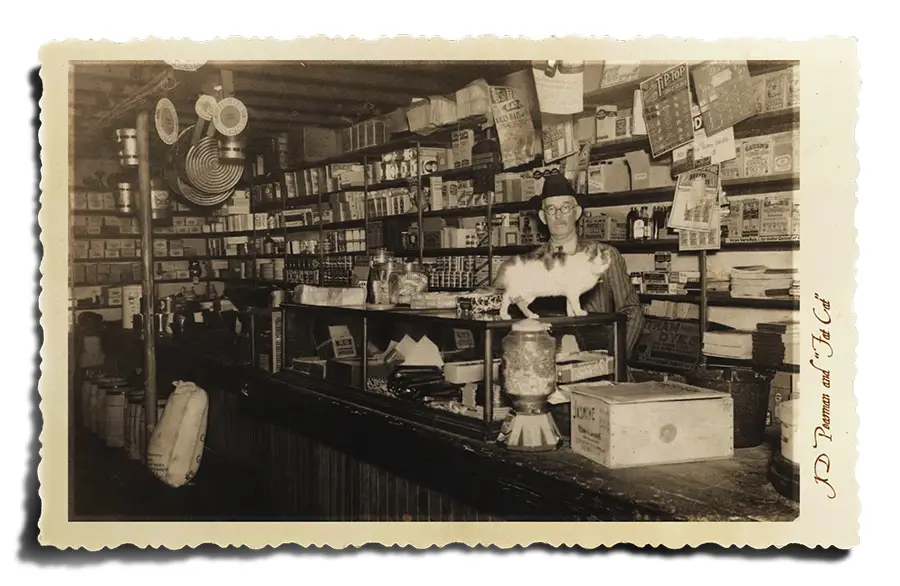
Applying to the North Carolina historic preservation office for potential inclusion on the National Register of Historic Places, Benbow wrote that the store was central to 20th-century Bethany life. She pored over photos that surfaced. One showed J.D. Pearman behind the store counter with a well-fed Calico feline nicknamed “Fat Cat” standing atop a glass case, amusing Benbow, who rescued cats on both her farms.
The blurry outlines of the store’s inventive past slowly took form.
“J.W. Pearman used to put sand outside for volleyball,” Benbow learned. “His daddy, J. D., was a genius. He hosted vaccinations for Rockingham County, so people would get kids vaccinated there and get a piece of candy.”
Rumor held that “J. D. bought the first television in Rockingham County,” she says, and invited the community to watch his small black-and-white set. A Facebook post by his nephew, Harold Pearman, confirmed the rumor. He described Thursday nights at 7 p.m., perched on a nail keg in his uncle’s store, enjoying The Lone Ranger.
Harold correctly recalled the show’s sponsor, Merita Bread. It was just as Benbow imagined.
During this past summer, she hand-sanded and refinished the original floors in brutal heat, discovering hand-forged nails as she worked. It was dirty, hot work, which Discovery Channel’s Mike Rowe would appreciate. As August sweltered, she oiled the floors with three successive coats of linseed, often working alone.
“There’s a tide of reasons pushing me to do this,” she says. “And every time I do something, I don’t get discouraged; I get energized.”
With renovations completed, she now envisions the fun part-her vision of a private studio for artmaking and crafting.
Benbow plans to paint and putter upstairs. She created a partial stained-glass wall to break the long expanse, adding exterior windows for better light. She will invite friends to create art projects downstairs, like a group of six (playfully called The Hookers) who hook rugs together. Eventually, she may invite others, in the community spirit of the Pearmans.
“My dream as an artist is to do community art projects. It’s a “pie-in-the-sky dream,” she acknowledges.
The curious predictably continued to show up during the building’s renovation.
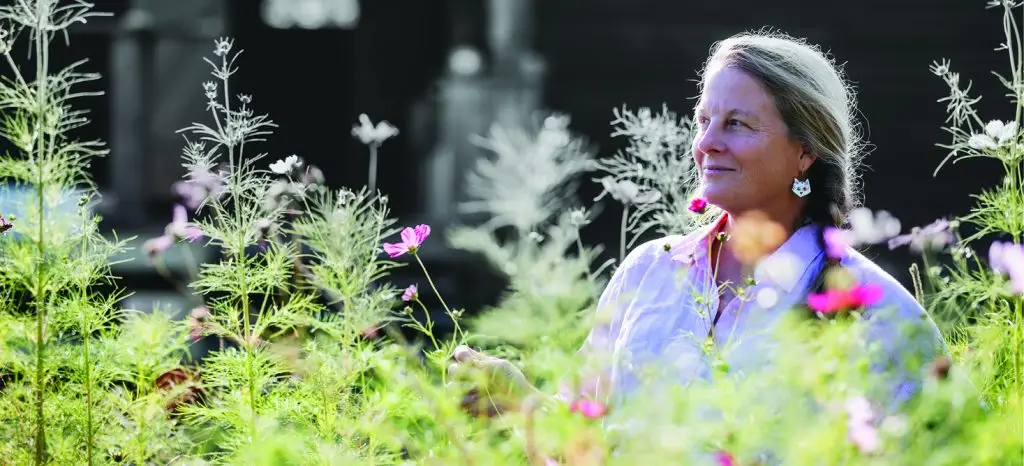
Benbow had planted the field beside the store in wildflowers. One day she saw someone in the middle of the field. She approached the woman and asked, “May I help you?” with Southern politesse, polite but firm.
The contrite woman pointed out the butterflies in the field. Her best friend had recently died, and she had stopped, viewing the beauty of it all as symbolic. “Her mother and the best friend’s mother were [waiting] in the car,” Benbow says. They stood together amid the flowers. Benbow, widowed in 2013, understood grief. She gave her a handful of seeds to plant and a bouquet of wildflowers to take home.
Yet another woman told her, ‘If everybody planted flowers in the front yard, we wouldn’t want to kill anybody. We’d be kinder to one another.’”
When a Bethany resident died, Benbow was inspired to dedicate a field of flowers to her memory. “Flowers heal,” she says. “There are so many illustrations of why planting those flowers is my largest artistic statement.”
With only a couple of credits to go before completing an art degree, Benbow somehow carved out hours in a studio at Guilford College. After cutting hundreds of pounds of clay into tiles for a mosaic installation for the store, she hand-paints and fires each. She hesitates to estimate how many finished tiles will comprise her design, called “It’s Raining Cats and Dogs.”
Pearman’s Fat Cat naturally comes to mind.
With the store’s renovation just about complete, other projects are underway, including restoring three log cabins on the Bethany farm.
As for Mackovic, he remains counterweight to Benbow, the conceptual thinker and idealist. Their good-natured bickering and collaborations continue.
He jokingly accused her of being “100 pounds of feathers,” she says, admitting that he “is 100 pounds of lead.” Benbow points out that he is the one who gave her a plaque with the Walt Disney quote: “It’s kind of fun to do the impossible.”
“Maybe he is feathers, too,” she muses. OH