
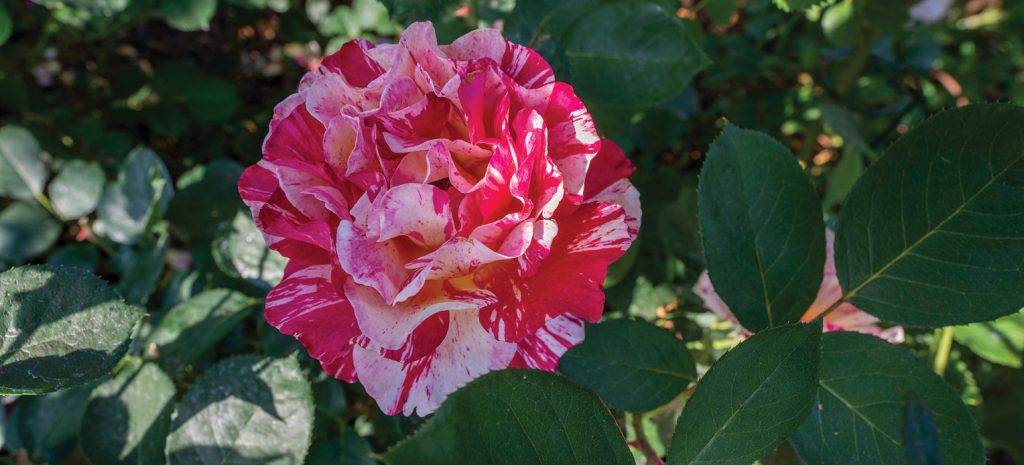
Queen of the Flowers
For this gardener from Kazakhstan, roses reign supreme
By Ross Howell Jr.
Photographs by Lynn Donovan
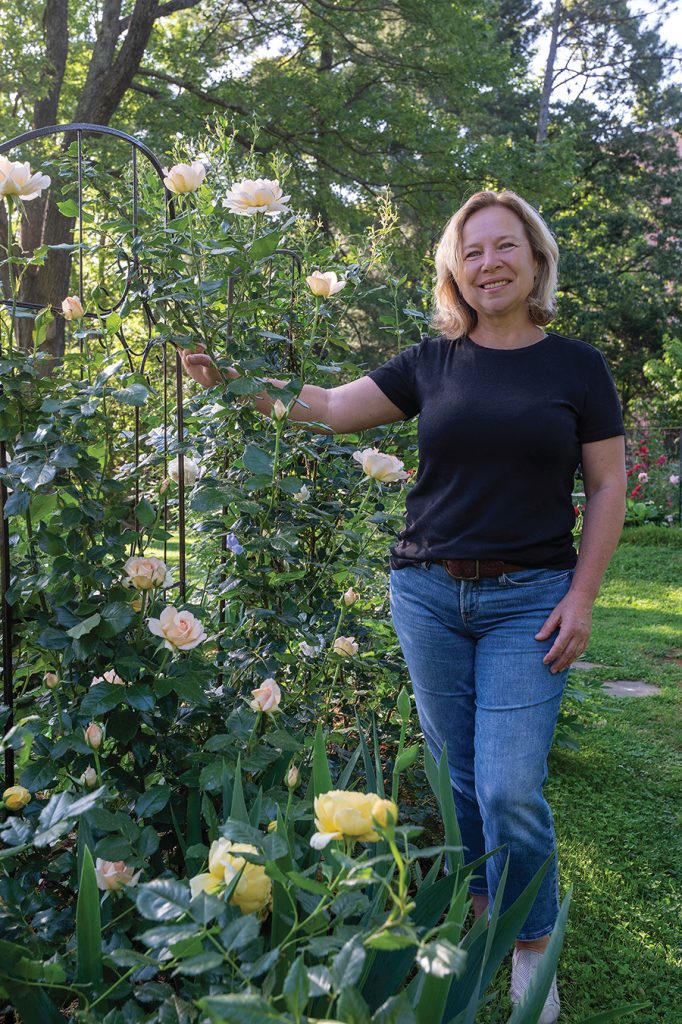
Before Yelena Belyayeva and her husband, Randall Bean, moved to Greensboro from Trinity, she tended lilies in her garden.
But roses were always on her mind.
“I grew a lot of lilies — they were so easy!” she says with a laugh. “At that time, I would think, ‘Oh, the rose, queen of the flowers, she is too much effort.’”
“But, in gardening, I want people not to be afraid,” she continues, “because roses are not as hard as people think.”
Yelena grew up in Temirtau, a city on the steppe of central Kazakhstan — still part of the Soviet Union until she was a young woman.
“My father was Russian and my mother was Ukrainian,” Yelena says. Though they lived in an apartment, her mom “was very, very passionate about gardening.”
Outside the city, they had what is called a “summer house.”
Along with a vegetable garden and fruit trees, she remembers her mother growing irises, daisies, peonies, lilies, lilacs and snowbush. But the plains of Kazakhstan were harsh.
“My mom had a few roses, but we had to cover them,” Yelena says, noting that they didn’t fare well in the cold or snow.
“To tell you the truth, I didn’t like the garden work as a kid,” she confesses, smiling, “but I enjoyed the beauty, not just of the flowers, but of everything in nature.”
After high school, she attended Moscow State Forest University, where she dreamed of becoming a forest ranger.
“I wanted to be among the animals and woods,” Yelena says.
Since no forestry positions were available when she graduated, she returned to her hometown to take a job with the Temirtau Winter Garden, a public botanical garden conservatory of tropical and subtropical plants in a very cold place.
“Most of the work was indoors, but it appealed to my passion,” Yelena says.
Eventually, a close friend in Kazakhstan who had met and married an American, suggested that she knew someone who would be a perfect match for Yelena — her husband’s best friend, Randall.
But communication between the two was a challenge.
“I studied English when I was in school but I was not so good,” she explains. “My teacher said, ‘Yelena, you will never learn English.’” She smiles and shakes her head.
“But Randall bought one of these portable electronic translators and that is how we corresponded at first,” Yelena continues.
Following a two-year courtship, the couple married in Kazakhstan and moved stateside to Trinity in 2006 with Yelena’s 10-year-old son. (He went on to attend N.C. State and lives in Raleigh now.)
When Randall’s father, who had been living in the same Greensboro house since 1955, decided to move into assisted living, Yelena and Randall relocated to his old residence.
The house sits on a lot that’s nearly an acre in size. Randall’s father grew vegetables for years after his wife passed away, though he had neglected the vestiges of her flower garden.
“Mama Sarah had azaleas, camellias and big boxwoods,” Yelena says.
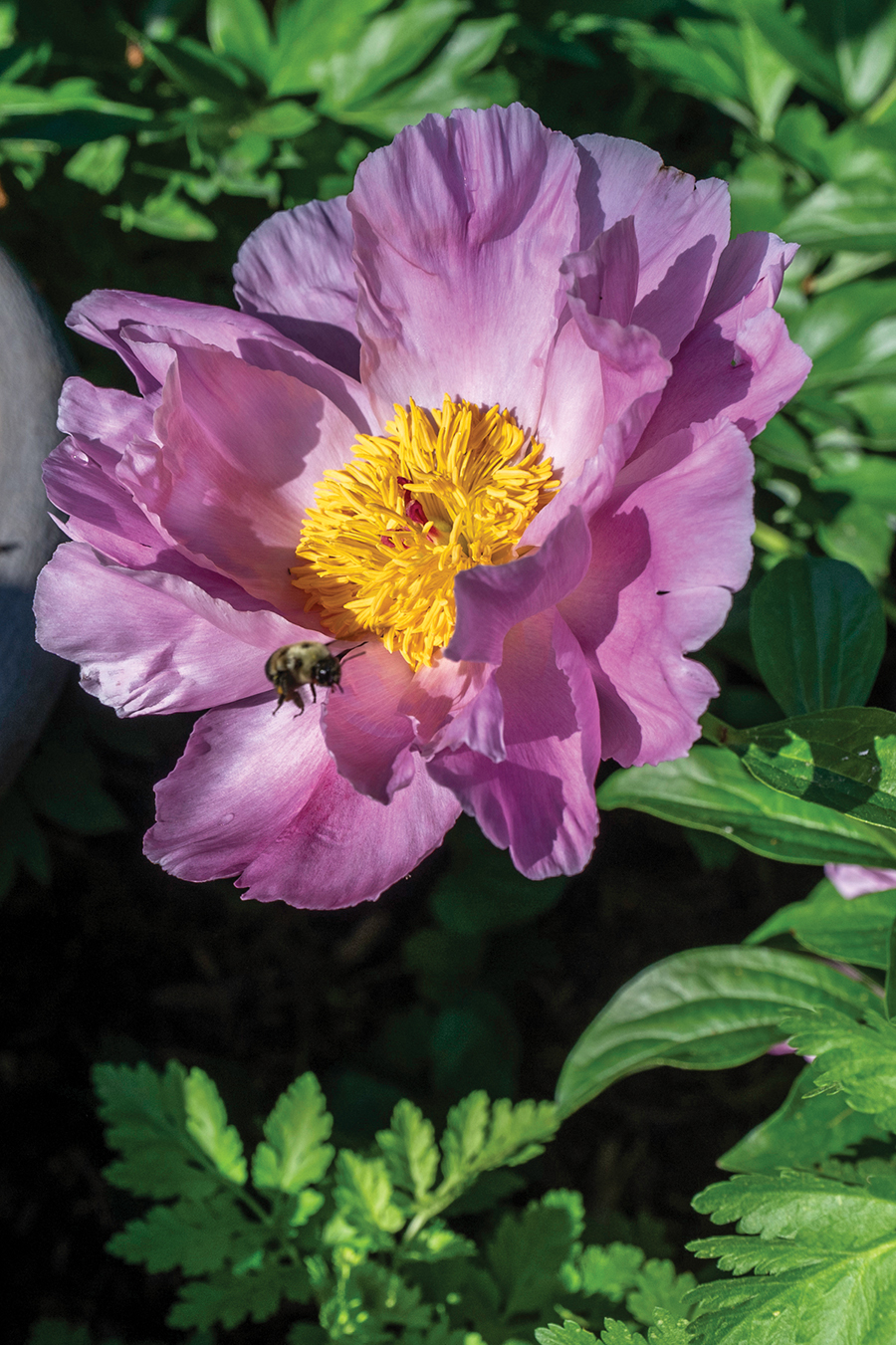
She also found remnants of candytuft and a row of peonies that she estimates are around 40 years old. And, while Randall remembers his mother growing roses, none of them were still living when Yelena began tending the garden.
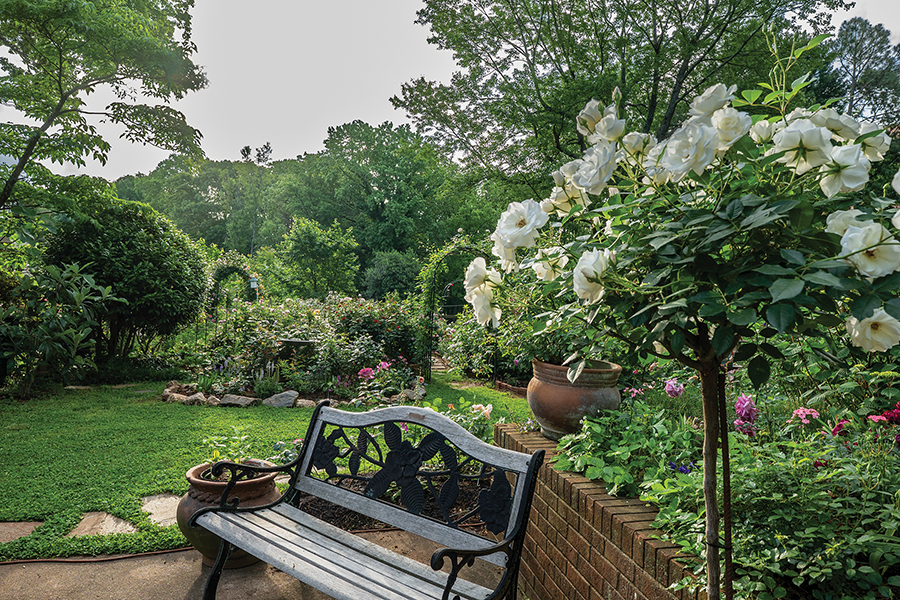
“So all 200 of the roses are mine!” she quips. “I have been collecting them for more than 10 years.”
Starting with the original flower beds, Yelena kept “extending, extending, extending” — and digging holes to plant her roses. The work was difficult because of the heavy clay soil and the big roots of old trees.
“Randall even bought an augur, but that did not work so well,” she says.
And for several years, she was working full time.
Now that she is retired and the garden is established, Yelena finds that she still spends at least six hours a day in the garden for 11 months of the year.
“With our seasons, there is no break for gardeners,” Yelena explains. “We just finished raking leaves from these huge oak trees in January and in February. I’m already planting my first roses again.”
She smiles.
“But I love it,” she muses.
Yelena prefers planting roses with bare roots. And while she put in her newest roses this February, she believes the best time planting time for Greensboro is the first week of March.
“You can find all kinds of information about when and how to do it,” she says.
A source Yelena especially recommends is Witherspoon Rose Culture in Durham (www.witherspoonrose.com).
“I have several roses from them,” she says. “They give you everything you need.”
For the first year after planting, Yelena concentrates on keeping the new rose well watered. Depending upon the type of rose, she may use a systemic treatment to help prevent disease.

The greatest potential cause of disease in our area?
“It’s the humidity,” Yelena responds.
To promote blooming, she will fertilize her roses two or three times during the growing season, though she doesn’t like putting fertilizer in the ground. She prefers fertilizers she can spray onto the foliage.
“It’s easier for me and the plants absorb it faster,” Yelena explains.
To counter Japanese beetles, destructive pests that usually appear in June to feast on rosebuds and flowers, she has discovered a commonsense solution.
“This is what I learned from an Instagram friend in Japan,” Yelena says. (The friend grows 1,500 varieties of roses in her garden!)
After the first wave of blossoms in May, Yelena pinches back the new buds as they appear for at least two weeks and closer to a full month.
“Every morning, I go out watering and I pinch the buds,” Yelena continues. “If you have five bushes, it’s not a big deal, but for me? Well, it’s a lot!”
So, when the Japanese beetles appear, their salad bar is closed, as it were. They move on for the most part, leaving Yelena with healthier roses. The downside is that a wave of blooms is lost, but she assures me she can still count on two or three more waves in a typical season.
I ask Yelena about which types — tea rose, grandiflora, floribunda, climbers, ramblers — seem to be best suited to her garden.
“You know, it’s more about, who is the father of the roses?” she replies. “Oh, what is the word?”
Yelena consults her phone to translate.
“The breeder!” she says, nodding happily. “Kordes in Germany is my favorite. They breed very healthy roses.”
As we walk about, Yelena shows me the abundance of plants in her garden.
“I have 80 peonies,” she says proudly.
I spot tulips, hydrangeas, creeping phlox, cone flowers, azaleas, hostas, zinnias, columbines and ferns. She shows me a robust vegetable garden along with cherry trees, crabapple trees and pawpaws.
“I don’t plant peaches anymore,” Yelena says. “We have so many squirrels, I just gave up.”
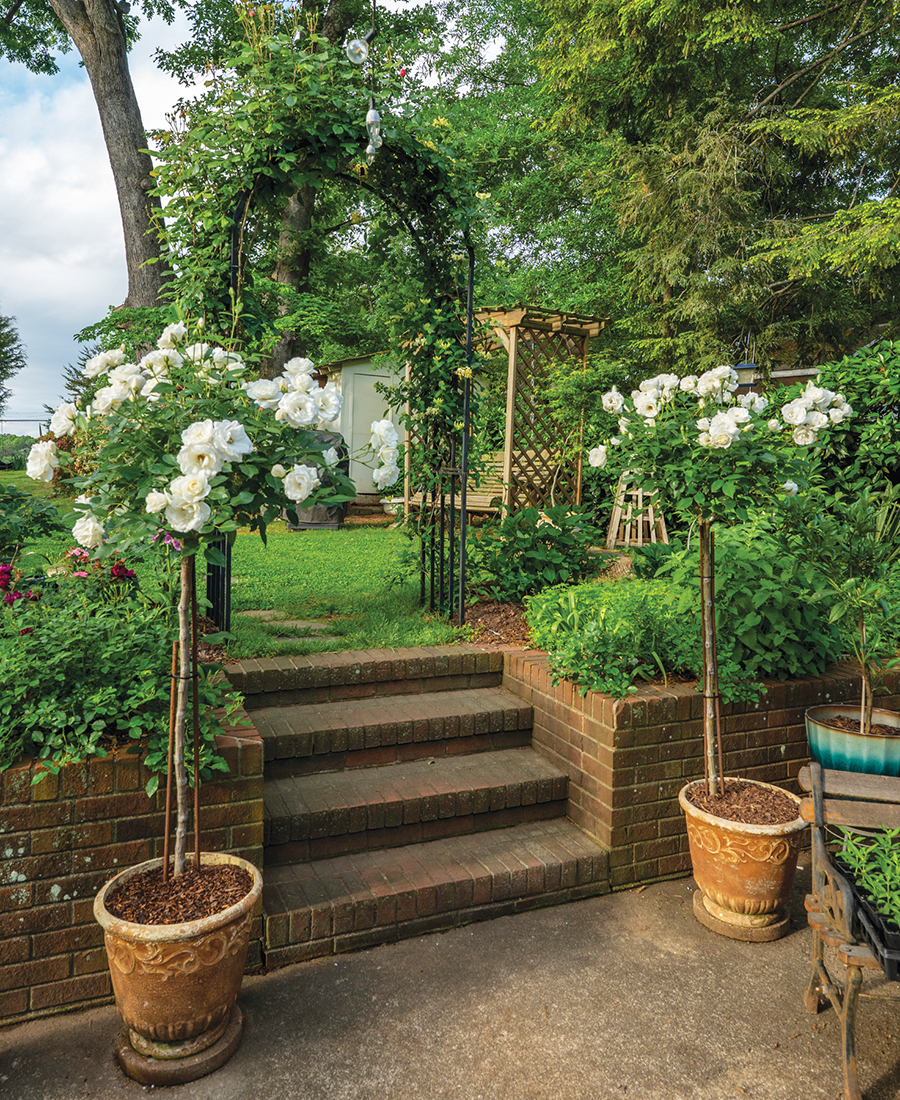
And, as you’d expect, there are roses everywhere, many cascading over trellises that Randall installed for her.
“This is a rambler called Peggy Martin,” Yelena says, pointing out an enormous rose bush. “She is absolutely gorgeous when she’s blooming.” The thornless rose variety is named after an avid gardener in Louisiana whose property stood under seawater for two weeks after Hurricane Katrina. The rambler was one of the few plants in her garden that lived.
“I guess because she is a survivor, she can grow crazy big!” Yelena says, laughing.
She points out two more roses that cascade from a trellis.
“This one is a climbing rose called White Lady Banks and you see next to her the yellow, also a climber.” I comment on the clusters of smaller flowers.
“Yes, the flowers are smaller than Peggy Martin,” she replies. “But the big difference between the ramblers and the climbers is that the climbers keep blooming all through the summer — the ramblers only bloom one time a season.”
But that one time? “It is spectacular!” Yelena adds.
She shows me how she prunes the ends of the roses to increase the cascading effect as they grow.
“There is a woman on Instagram from Italy,” Yelena continues. “She plants her climbers and ramblers close to her trees so they grow all the way over them!”
When I ask her if she has irrigation for the plants, she answers that it wouldn’t be economical to use city water, since she has so many roses and the beds are so spread out. Recently, she added three barrels to collect rainwater. She also carefully mulches her roses with pine bark nuggets to help them hold moisture. If the summer is very dry, she waters her roses by hand.
“But roses are hardy,” Yelena says. “You must choose the right variety from the right breeder, but once they are established, roses are very strong!”
“The beauty, the joy to see them and smell their flowers,” she muses. “Every year, I plant more and I think, ‘OK, it’s enough.’ But it’s never enough!”
Once again, Yelena smiles, surveying her garden. OH
Ross Howell Jr. is a contributing writer.
You can follow Yelena Belyayeva on Facebook and on Instagram @belyayevayelena.