Concerts, Canoes, and Community

Concerts, Canoes, and Community
Concerts, Canoes, and Community
Passion and perseverance after Saxapahaw’s storm of the century
By Danielle Rotella Guerrieri
Photographs by Bert VanderVeen
Last July, Tropical Storm Chantal wreaked havoc across central North Carolina, causing $500 million in storm damage. Perched above the Haw River’s east bank in a quiet corner of Alamance County, Saxapahaw was ground zero for some of the worst flooding and property damage in the state, with nearly 12 inches of rain falling in 24 hours. Since its revitalization in the late 1990s, the former mill village has been a hip and vibrant destination, drawing visitors with its rich history, Southern cuisine, bespoke artwork, specialty craft ales and bohemian counterculture. On a recent cloudy Thursday morning, my dad, Pete Rotella, and I decided to see how Saxapahaw was faring after the flood.
We start our visit chatting with the Saxapahaw Museum director, Jane Cairnes, and the man behind the town’s revitalization, entrepreneur John M. Jordan Sr., son of the late U.S. Senator B. Everett Jordan. Jordan and his sons, Mac and Carter, purchased many mill houses and the abandoned spinning mill and dye house in 1995, and renovated them into 75 apartments. They also turned the upper dye house into commercial space and a home for The Hawbridge School, a public charter school with an emphasis on community engagement, environmental stewardship and the arts. “We were competing with Chapel Hill, Durham and Raleigh real estate,” Jordan says. I had people living in 60 houses who needed a place to buy gas and bread, and I provided it.” Over the years, the sleepy little town evolved into a lively and progressive home for lovers of music, arts and the outdoors.
Just down the hill from the museum is the Saxapahaw General Store. After filling our bellies with a good ol’ Southern breakfast, we learn how owners Jeff Barney and Cameron Ratliff turned a modest gas station and country store into a community hub beginning in 2008. Look for gourmet grub with an emphasis on comfort food, a staggering selection of beer and wine, locally grown produce and area crafts. Thankfully, their establishment was not damaged by the storm. Just two days after Chantal passed, they announced on Instagram: “We have electricity, Wi-Fi, A/C, and our full menu available.”
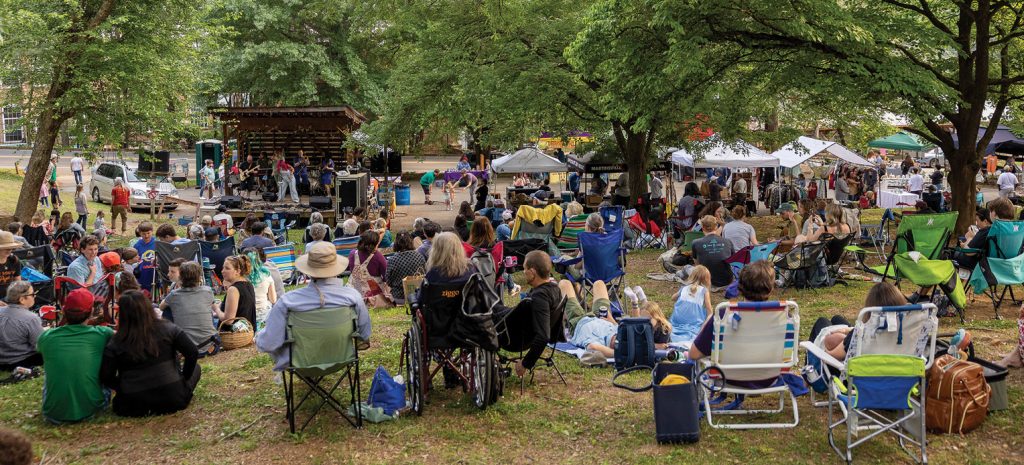
Cup 22 is our next stop, an open, two-story space with black industrial railings and massive windows that welcomed neighbors and volunteers after the storm with bottomless coffees and free Wi-FI. Heather and Tom LaGarde own both the café and the adjacent Haw River Ballroom, one of North Carolina’s premier musical destinations. Known for hosting nationally and internationally renowned bands, the Ballroom has also held film screenings, workshops and private events since 2011, thanks to its large, 750 capacity that maintains an intimate vibe. Due to its location in the mill’s upper dye house, the Ballroom was left unscathed, making it an ideal hub for storm relief efforts. Saturday in Saxapahaw is another LaGarde creation, a family-friendly outdoor concert and farmers market held weekly from the first Saturday of May through late August from 6-8 pm. Held in a grassy hillside near the Ballroom, “Swan Buckets” and a Swan Venmo account collect donations that pay operating costs. The LaGardes were also instrumental in organizing widespread relief efforts last July.
Next door to the Ballroom is Haw River Farmhouse Ales, a quaint, eclectic pub with cozy outdoor seating, owned by Ben Woodward and Dawnya Bohager, who use locally grown ginger, barley, rye and other ingredients in their small-batch customer favorites, such as Odds & Ends IPA and Saxtoberfest.
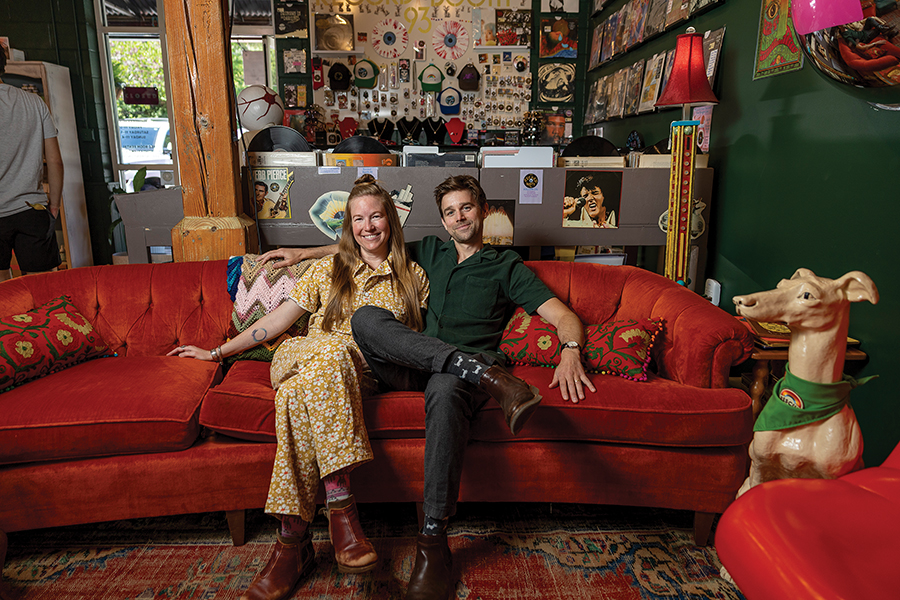
Excited to explore Saxapahaw’s art scene, we walk to Riverside Collective, where we’re greeted by contemporary oil painter Katie Pape, one of the five female artists who opened the shared studio space in 2004. When the bike shop next door moved, Katie and her husband, Ian, opened an adjacent store, Saxy A GoGo. Inside, Saxy, a vintage shop, a nonalcoholic bar, a lounge and a recording studio are all connected, creating a funky, urban vibe. Along with their wide variety of art, Riverside Collective offers classes in weaving, watercolor and leatherwork, and a Monday Open Studio Night where fellow creatives can connect. (While their shops didn’t sustain flood damage, the Papes’ daughter’s preschool, Saxapahaw Village Kids, inside Saxapahaw United Methodist Church, was completely submerged. “One of my favorite stories from the flood was how Holly, the preschool’s pet chinchilla, was gallantly rescued by volunteers after the storm,” Katie says.)
With our new art carefully packaged, we mosey past more upper mill spots that dodged storm damage — Deipnon Studio, a custom tattoo shop, and The Hawbridge Lower School — before entering Leftbank Butchery. Owner Ross Flynn opened the whole-animal butchery in 2014 to provide a local outlet for area farmers who want to process and sell their meat, such as beef cows from Alamance County farms and chicken from Little Way Farm in Siler City. Before leaving, we look into Flynn’s Seam Butchery Class, which teaches ways to cut and use every part of an animal, and the Basics of Cooking Meat Workshop, an excellent way to learn techniques for braising, roasting and pan-frying cuts of beef.
With a pound of tienda chorizo in hand, we climb up a steep staircase before opening a ginormously heavy oak door to enter The Eddy Pub, a European-style gastropub serving farm-to-table food and known as “Saxapahaw’s Living Room.” With old steam valves as beer taps, a rustic wood ceiling set against expansive windows overlooking a patio and the Haw, the pub partners with local farms for their meat and vegetables and serves North Carolina-brewed beers and wines from smaller, family-owned vineyards. On the second level of the mill complex, the pub remained unscathed by the flooding. General manager and co-owner Paul Neubauer and his staff were some of the first to volunteer after the storm.
After bowls of hearty chicken chili with fresh sourdough bread, we walk up the road to StudioSax, a multicultural, creative café and vintage store opened last year by Deborah and Robert “Robo” Jones, the talented trombonist from the 90s jazzy, pop-rock band The Sex Police. Deborah proudly shares that it’s the only Black-owned storefront in Saxapahaw as she finishes setting up paints and brushes for the night’s dot-painting event. Jones then gives us a tour of the outside courtyard, which she explains was “completely filled up with water when it flooded.” Sand and dirt still line the cement courtyard, which adjoins a nearby hillside, where folks gather to hear live music and many come for sound baths, a meditative, immersive audio experience that induces relaxation.
As my dad and I leave Saxapahaw, we’re both struck by everyone’s love for the dynamic, free-spirited river community. There are still small, visible signs of Chantal’s passage, but those are nothing compared to the stories of generosity and the survival of a magical place that refuses to be washed away. OH





 Dear Diego: Elementary school plays a key role in a child’s development, but for shy and reserved Joi, who found it hard to make genuine friends, she spent most of it by herself. That was until I met Diego. “Joi, could you please stop that!” yells Mrs. Perkins, my fourth-grade teacher, during our class walk to the playground. I’m near the back of the line and have, unknowingly, slipped into a daydream, humming a tune the entire walk back — loud enough for her to hear me from the front of the line. A little embarrassed now that my classmates are staring at me, I walk the rest of the way back with my head down. “I thought it sounded good,” says a voice behind me. Diego. He has a Go, Diego, Go! backpack — fitting, isn’t it? — and light-up Skechers he wears everyday. From that moment on, Diego and I are two peas in a pod, never leaving the other’s side. He becomes my first best friend and later evolves into a crush. I am fascinated by his ability to climb the monkey bars just as he is fascinated by my swift running skills — so much so that he brags to all his male friends that I could beat them in a one-on-one race if they dared to challenge me. Sadly, a year later, his father, who is in the military, is stationed overseas, which means Diego has to leave. Now as an adult, I appreciate the love Diego showed little Joi when she needed it the most. I hope he has grown up to impact other people as much as he impacted me. And who knows? Maybe we’ll meet again one day. Until then, I’ll keep an eye out for light-up Skechers.
 “Once I started doing film acting at the studio, I just fell in love with it,” exclaims Emi Curia — a Winston-Salem native and actress. A year after graduating from UNCG, Emi’s career continues to rise. At 22, she’s already a veteran of the hit TV series
  Father’s Day is right around the corner and we’re bracing ourselves for a day where we hold back the eye rolling as the corniest puns ever, aka dad jokes, exit the mouths of our fathers. They’re a comical and fun play on words, but, if your father is like most, he probably feels unashamed when blurting out the same joke over again and again — on repeat forever and ever. And, if you’re not careful