In The Spirit

Spa Water with a Kick

A flavored gem from Durham Distillery

By Tony Cross

In the past, I’ve complained about North Carolina ABC stores rolling out the red carpet for copious bottles of flavored vodkas. Though I still find this to be the case, there are exceptions. Full disclosure: I’ve tried a friend or date’s cocktail — you’re sharing a sip if we’re hanging out together — that tasted quite delicious, only to find out that the base spirit was a flavored vodka. It didn’t happen often, but it happened. However, the only time I was completely wowed by a flavored vodka straight was the first time I kicked back a sample of Durham Distillery’s Cucumber Vodka.

On an early spring day last year, my father accompanied me to a meeting in Durham. “Just please don’t say anything,” I pleaded. I inherited the gift of gab from him, so I know that when he gets going, it’s hard to stop. Pops riding along ended up being a good idea. He’s in shape, has a silver handlebar mustache, wears dark shades, black clothing, and looks like a badass. Actually, he is a badass; he served 20 years in Special Forces. So, with my dad standing 6 feet behind me while I made my pitch, it looked like I had a bodyguard. Ka-ching. As soon as the meeting was over, we stepped outside, high-fived, and made our way down the street to Durham Distillery.

We were greeted by co-owner Melissa Katrincic. Her husband, Lee, the head distiller and co-owner, joined us. They gave us the grand tour, explaining how their Conniption gin is distilled. The Katrincics are both scientists, and that’s how they approach their distilling. My dad doesn’t drink gin, but he’ll try anything once, and if he likes it, he’ll have it again. Melissa is chatting away with Pops, while Lee is answering my questions. Before I know it, samples of their American Dry and Navy Strength gins are being offered, and oblige them we did. The gin seemed to immediately “get good” to Pops, and all I could do was smile and revel in how quickly he can go from 0-to-60 in storytelling mode. In the midst of his explaining one of his past adventures, I noticed Melissa starting to pour a different liquid into a taster glass.

My dad’s story stopped dead in its tracks and he asked, “All right! What’s next?” Lee and Melissa explained that this was their cucumber vodka. They had used it in the past as a component in some of their gins but had decided they were going to bottle it on its own in North Carolina. One sip, and we were both blown away. On our way back to Southern Pines, the conversation kept circling back around to, “My God, I can’t wait until they release that vodka.”

Later I reached out to Lee, asking him to explain how he’s able to capture the pure essence of the cucumbers in each batch of vodka. Unlike other flavored vodkas, which are basically just a distilled vodka with an extract added, Durham Distillery’s tastes like fresh cucumber slices have completely filled up the bottle. It’s no wonder Lee and Melissa say it’s like “spa water with a kick.”

“The cucumber vodka is the only cucumber vodka on the market distilled under vacuum (no heat applied) with no artificial flavors or added sugar. Most others you see will be extract-based. With ours, only alcohol and fresh sliced cucumbers are used to make it,” Lee says. They handpick their cucumbers, which are peeled and sliced, then put in a pot on their vacuum still. “Our corn-base ethanol is added to the pot and the still is sealed. The vacuum still only has a 5-gallon capacity, so it’s made in very small batches. A vacuum pump removes all the air from the still. Under the reduced pressure, the ethanol boils around room temperature. So, all that great cucumber flavor is being extracted and subsequently distilled without any heat. The cucumber distillate we get off the vacuum still is around 185-proof, so we add our deionized water to cut it down to 80-proof for bottling.” Did you get all of that? In short: hand-picked, small-batch, science, alcohol, delicious.

Last year I wrote an article praising Durham Distillery’s Conniption gins, and pleading for them to get a spot on our ABC shelves. In addition to their gins and vodka, they also make excellent chocolate, coffee and mocha liqueurs.

Durham Distillery’s gin is also sold in London. London. Melissa and Lee were inducted into the United Kingdom Gin Guild. Lee says that the guild is 300 years old, and he and his wife are only the fourth and fifth U.S. distillers ever inducted and the only ones from the South. We’re lucky to have such an amazing distillery, producing top-notch spirits. Once you get your hands on their cucumber vodka, try this easy spin on a Moscow Mule I whipped up:

Cuke Mule

2 ounces Durham Distillery Cucumber Vodka

4-5 ounces ginger beer

4 dashes Angostura

Candied ginger and cucumber slices (garnish)

Pour vodka into a rocks glass, add ice and ginger beer. Top with bitters. Garnish with candied ginger and cucumber slices.   OH

Tony Cross is a bartender who runs cocktail catering company Reverie Cocktails in Southern Pines.

Birdwatch

Summertime Blues

Late summer brings the arrival of the little blue heron

By Susan Campbell

Late summer can be an especially exciting time for those of us who are birders. We need not travel far to find unexpected visitors, especially when tropical weather blows birds off track and they show up as close as our backyards. 

Often these strays are here for only hours. Other times, they stick around in response to environmental conditions that bring them our way.

One late summer visitor to look for is the little blue heron, only don’t expect it to be blue. That’s because young blue herons, which these inland wanderers almost always are, are covered with white feathers — except for the very tips of their wings. And for those with really sharp eyes, the bill of these small herons is pinkish or grayish and the legs are greenish unlike the bright yellow legs of the great or snowy egret, which also may turn up in the Piedmont or Sandhills at this time of year.

These beautiful white waders are best spotted in shallow wet habitats: streams, small ponds, water hazards, retention areas or other places with standing water. Little blue herons may be seen all by themselves or mixed with other long-legged waders. You may even spot them standing alongside the much larger great blue heron. Little blues can be identified by their more upright foraging posture and slow, deliberate movements. And watch for their downward angled bills as they stalk prey. Unlike other small waders, they will hunt in deeper water, often all the way up to their bellies. Little blues hunt not only small fish but frogs, crawfish and large aquatic insects.  It is thought that their coloration allows them to blend in inconspicuously with similar white species, which offers the juveniles protection. Foraging alongside great egrets also seems to afford little blue herons an advantage as these larger birds stir up the water, flushing up a meal for nearby little blues.

It takes little blue herons at least a year to develop adult plumage — not unlike white ibis that can also be found breeding along our coast. (By contrast, great blue herons sport dark plumage their first summer and fall.) Adult little blue herons may have a pied appearance for a time in late winter or early spring. But by April they will turn a slaty, blue-gray all over, with a handsome bluish bill. Unlike other wading birds, they lack showy head or neck plumes. They are also unique in having projections on their middle toes that form a comb, which is used as an aid when grooming.

Unfortunately this species has experienced an alarming drop in population numbers over the past half century across North America. Loss of coastal wetland habitat, continued declines in water quality, as well as being shot as a nuisance in fish hatcheries all are thought to be contributing to the decline. So be sure to stop and appreciate these stately, though smaller birds should you come across one — wherever you happen to be. OH

Susan would love to receive your wildlife sightings and photos.  She can be contacted by email at susan@ncaves.com.

Simple Life

Last Days of the Yard King

A final summer of innocence is shelter from the storm

By Jim Dodson

That July I owned the neighborhood. Or at least my block.

It was 1968. I was 15, towing a wheezing Lawn-Boy push mower behind a well-traveled Schwinn Deluxe Racer with chrome-plated fenders and dual side baskets. My mother called me Jimmy the Yard King.

Actually, I had three jobs that summer. One was mowing half a dozen lawns in the neighborhood at a time before lawn crews were commonplace and customers could phone your parents if they didn’t like the job you did.

The second was a weekend job as an usher at the newly opened Terrace Theatre, where I was required to wear a snazzy tangerine orange, double-knit sports jacket with a black, clip-on bow tie. The jacket matched the theater’s innovative “rocking chair” seats. My job was to keep kids from violently rocking their brains out and disturbing other customers by banging their knees. This often resulted in my giving chase to truants hopped up on candy.

That summer I also had my first job teaching guitar two mornings a week at Mr. Weinstein’s music shop — for five dollars an hour, no less.

Given my combined income, my mom joked that she might have to someday ask me for a loan. I was saving up for either an Alvarez guitar or a Camaro, which ever came first.

The year 1968 has been called “The Year that Shattered America.”

Looking back, it was the year we both began to lose our innocence.

Being a son of the newspaper world, I paid close attention to the news, read the paper daily and never missed Uncle Walter on his evening broadcast.

That year, for the first time, the Tet Offensive by the Viet Cong brought the horrors of the war in Southeast Asia home to 56 million American TV sets. On my birthday that February, I saw the iconic photograph of a South Vietnamese general publically executing a Viet Cong prisoner. The picture shocked Americans, stoked the anti-war movement and turned millions of Americans against the war. One month later, the My Lai massacre that killed more than 500 civilians but wasn’t revealed and investigated for another year — all but finished off public support for the war.

That spring I taught myself how to play every song on the Beatles’ Sgt. Pepper’s Lonely Hearts Club Band and started performing around town with my buddy Craig Corry who lived two doors away on Dogwood Drive. We wound up placing third in the city’s teenage talent show that next fall and made an appearance on Lee Kinard’s Good Morning Show, our first and last TV appearance.

On a breezy afternoon that April, I was playing golf with my dad when we heard that Martin Luther King Jr. had been assassinated in Memphis, Tennessee. We watched riots break out in Detroit and the Poor People’s March on Washington, D.C. happen on TV. Commentators wondered if America was coming apart at the seams, heading for revolution in the streets.

I was more interested that the Broadway smash musical, Hair, featured live and fully naked people on stage. I couldn’t fathom it but sure wished I could see it.

On the plus side that summer that America was going to hell in a hand basket, as Mr. Huff down the street always grumbled when I showed up to collect my $8 for mowing his lawn, I took Ginny Silkworth to the Cinema Theater to see Franco Zeffirelli’s Romeo and Juliet. It was great. I fell in love with Shakespeare and, in a way, Ginny Silkworth. She was my first date ever. We grew up attending the same church group. Unfortunately my dad had to drive us to the theater, under strict orders not to say anything embarrassing.

After the movie, Ginny, a deep thinker with a warm and horsy laugh, wondered what I planned to do with my life. I told her I planned to write books, probably travel the world, play my guitar, mow lawns and maybe move to England. She punched me on the arm and laughed adorably. Ginny and I stayed in touch for decades. She went on to become a gifted schoolteacher in Philadelphia and passed away from breast cancer many years ago. I miss her still, especially her wonderful laugh. 

Earlier that summer, Robert Kennedy was gunned down after winning the California Democratic primary. My mother really liked Bobby Kennedy. We watched his funeral train together and she actually cried. My dad was a half-hearted Nixon guy. My mom used to joke that she did her patriotic duty by cancelling out his vote in the voting booth.

By July I was deep into my lawn-mowing life, guitar-playing, trying to forget what was going on in America. I hated the usher job at the Terrace so much I handed in my elegant orange usher’s jacket in early August, blaming my family’s annual beach trip to the Hanover Seaside Club at Wrightsville Beach.

We went there every year for at least half a dozen years, though this would be the final time. I loved the Seaside’s unfancy dining room, its cool wooden floors and big porches where I could sit for hours in a real rocking chair and read. I read Graham Greene’s The Heart of the Matter and The End of the Affair that summer, getting hopelessly addicted to his storytelling. I also finished John LeCarré’s The Spy Who Came in from the Cold, picturing myself mowing a lawn in some far-flung, sun-mused outpost of the British Empire, a spy in short pants, enjoying a gin and tonic with some sultry blond who looked like Tuesday Weld.

That week a family from southern Ohio was visiting the Seaside Club. A pretty girl named Sandy was reading Edward Abbey’s Desert Solitaire, bare feet tucked up in the rocker just down the porch. We struck up a conversation and took a walk on Johnny Mercer’s Pier. Sandy told me that we humans were destroying the world, killing the oceans with our garbage and fighting an unwinnable war. She told me she was going to become an “environmental activist” like her aunt who was attending the Democratic National Convention in Chicago as a delegate from Ohio. The Seaside Club didn’t have a TV set, so there was no way to see what was happening in Chicago. We heard, however, that there were police riots and lots of injuries at the convention when Chicago’s mayor turned the police loose on Yippies and the Students for a Democratic Society who tried to crash the party.

For the rest of the week we were pretty much inseparable. Sandy was a year older and half a head taller than me. She was no Tuesday Weld but I liked her a lot. Like me, she was crazy about books and movies.

The Graduate was playing at the Crest Theater in Wrightsville Beach. She suggested we go see it. That year the Motion Picture Association of America instituted its film rating service, serving as a guideline for parents anxious about a movie’s content. I was worried about getting in. You were supposed to be at least 16 but the lady working the box office took one look at Sandy, then me, and let us in for a buck and a quarter each. Sandy didn’t care for the movie but I loved it.

The night before her family headed home to Ohio, we talked until midnight while seated on a stack of canvas rafts stacked beneath the Seaside Club. My family was staying through the Labor Day weekend, our final days there. The next night, I gigged a huge flounder in the tidal flats off Bald Head Island and wondered if I would ever hear from Sandy again. She actually wrote me a couple of times and I wrote her back. In 1974, a F5 tornado flattened her hometown of Xenia, Ohio, killing something like 100 people and leaving 10,000 homeless. I never heard from Sandy again. I like to think she’s somewhere in the world saving the planet.

Back home, with school starting, I still had a few weeks of decent lawn-mowing income to count on, plus teaching guitar for Mr. Weinstein. I knew all the dogs in the neighborhood, those which were friendly and those that weren’t. I knew the better-looking moms, too. When you’re 15 and King of Yards, you notice such things.

Looking back from half a century, life seems deceptively simpler then, so far away from the anti-war protests, the burning cities, the murder of visionary leaders, the riots, the raised fists at the summer Olympics, Nixon winning the White House, O.J. winning the Heisman.

“And stones in the road/Flew out beneath our bicycle tires. . . ” as my favorite singer Mary Chapin Carpenter remembers in her beautiful anthem to that moment in America’s life. “Worlds removed from all those fires/ As we raced each other home. . . ”

I rode my bike everywhere that summer, pretty much for the last time.

I mowed lawns, ate my first Big Mac, kissed Ginny Silkworth and had part of me awakened by a spirited girl named Sandy. I taught myself to play every song on Revolver. I went to Scout camp for the final time, did the Mile Swim twice, finished off my Life Scout award, built a nature walk at my elementary school for my Eagle project. My Yard King days came to an end.

Fifty years later, I can remember these things like they happened yesterday, and wonder what a 15-year-old in America thinks about in 2018.

History, I’ve learned, may not repeat itself, but it certainly rhymes like a Mary Chapin song.

“And the stones in the road/Leave a mark from whence they came/A thousand points of light or shame/Baby, I don’t know.”  OH

Contact Editor Jim Dodson at jim@thepilot.com.

Poem: August 2018

Buttercups

Let loose in the pasture, bays, chestnuts, grays,

and paints graze beneath blue skies, their coats

shining like copper pots. And scattered around

their feet, creeping buttercups, yellow as freshly

grated lemon zest — each petal clustered around

the center, creating a corolla of color so dazzling,

they rival the sun’s golden light. And it is quiet

here, the way a room is quiet but not silent, with

the sporadic whinnies and wickers of contented

horses, the buzzing of bees, the croaking of frogs

in a nearby creek — a low hum of pleasing sounds.

But it is mostly about the light, this idyllic scene,

how bright it shines on a horse’s satiny skin, how

all the flowers cup their yellow palms to catch it.

— Terri Kirby Erickson

Doodad

Remembering the 1960s

Jerry Bledsoe was there – and has his say in a fun new memoir

Jerry Bledsoeís new memoir, Do-Good Boy: An Unlikely Writer Confronts the ‘60s and Other Indignities, describes how the fledgling writer — who would go on to become a celebrated reporter, columnist and author — brushed against some of the most significant events of the era: the Cold War and the gathering storm in Vietnam, the space race, and the civil rights movement.

He also witnessed firsthand the emergence of rock legend Jimi Hendrix, who appeared with his band, The Jimi Hendrix Experience, as the opening act for The Monkees at a July 12, 1967 concert at the Greensboro Coliseum. In the following excerpt, Bledsoe details the showmanship of Hendrix, who was dressed in tight black velvet bell-bottoms, long love beads, heavy ornamental rings and a bandana tucked into his Afro. He kicked off the set with “Purple Haze” and closed it with a cover of “Wild Thing,” which he’d played the month before at the Monterey Pop Festival before setting his guitar on fire.

On this night he swept through the tune playing the guitar in every way it could be manipulated, switching early on from his left hand to his teeth, creating sounds I didn’t know a guitar could make and causing me to wonder how many teeth he still could call his own. Shifting from his teeth, he played his abused Fender Stratocaster upside-down and backwards, over his head, behind his back, between his legs. He even got down on the floor and plucked it with his toes. At one point, back on his feet, he appeared to be having sex with it. As he neared climax, he began swinging his instrument in the air, slammed it to the floor and jumped up and down on it. He seemed upset that he wasn’t inflicting enough damage, and as his fellow band members continued playing furiously, he picked up the guitar by its neck, swung it around knocking down microphone stands and began beating it on the floor until pieces started flying. He didn’t set it on fire, perhaps because it might have gotten him arrested in Greensboro because flames weren’t allowed in Coliseum performances.

Hendrix strutted off stage sweating profusely. The audience seemed stunned, uncertain how to respond. As he passed our group of applauding and smiling admirers, he muttered, “Let ’em ****in’ little Monkees top that!”  OH
Maria Johnson    

Story of a House

Rooms with a View

Dennis Howard’s high-tech, front-row seat to the Wyndham Championship

By Maria Johnson     Photographs by Amy Freeman

Talk about efficient.

Dennis Howard’s new home packs value on several fronts, one of which happens to be in the back: a verdant view of Sedgefield Country Club’s golf course, home of this month’s Wyndham Championship, a home-stretch tourney for PGA players who are trying to amass enough points to qualify for the upcoming FedExCup playoffs.
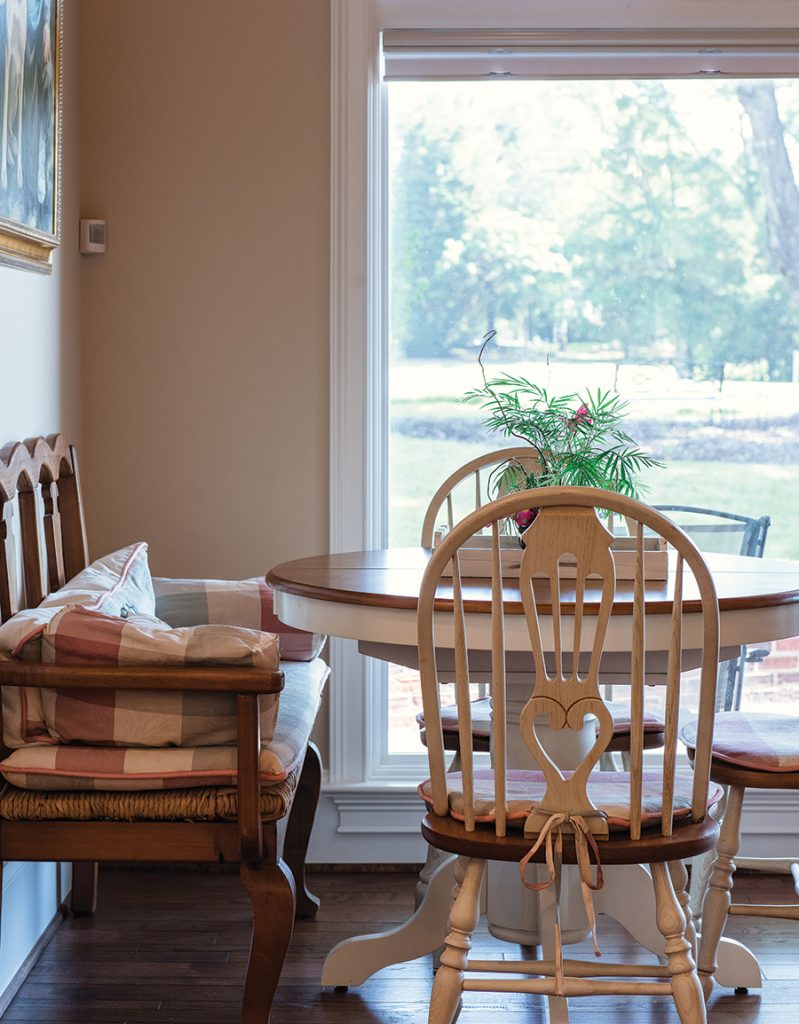
Howard, a commercial builder and passionate duffer, moved to the new home last summer, just before the Wyndham teed off. He didn’t unpack in time to entertain, but this year, he plans to invite friends and family to check out his new digs — and the waves of golfers and galleries washing through the first green and second tee, a segue bracketed by his panoramic view.

Howard lives here thanks to his late wife and college sweetheart, Cynthia, who died in 2015. A couple of years before that, she told him about a golf-course lot that was for sale on Gaston Road about 2 miles from where they lived on Old Onslow Road, overlooking Hole 14. Cynthia, a real estate agent, was eager to buy the lot on the first hole.

“We didn’t know what we were going to do with it,” says Howard. “We bought it because it was such a good lot. She said, ‘We need to hang onto that; it’s a nice piece of property.’ “

Howard, who builds office-warehouse spaces, snapped up the lot and held it while he devoted himself to caring for Cynthia, who was fighting cancer. He regrets nothing about their final years together.

“We were closer than we’d ever been,” he says. “We spent so much time together.”

After Cynthia passed, Howard decided to build on the vacant lot and sell the two-story home they’d shared for 28 of their 48 years together.

“There were just a lot of memories,” he says. “It’s not like I wanted to forget about her, but it was kind of overwhelming.”

He took his longtime friend, architect Carl Myatt, to lunch and told him about the lot. After lunch, they toured the site, which slopes sharply to the street. Howard wanted his house to sit on the high side, not only for the golf-course view, but also to avoid the creek at the base of the hill. He wanted the home to be one-story so he could age without worrying about stairs. He wanted all doors to be wide enough to accommodate a wheelchair. He wanted four bedrooms, enough space for his four grandchildren to visit. He wanted a three-car garage with room for a golf cart (read: grandchild taxi). He wanted a home office. He wanted an open, airy design with 10-foot ceilings and 8-foot doors scaled to the ceiling. He wanted energy efficiency.

Above all, he wanted to showcase the prize view and create plenty of inviting spots to watch golfers and nature.

Myatt obliged by drawing a plan that maximizes the vantage point and minimizes the energy costs.

“It’s probably the best home for energy control that I’ve ever done,” says Myatt.

The bricks-and-mortar result, built by D. Stone Builders, is a 3,400-square-foot model of comfort, utility and scenic oomph.

The heart of the U-shaped home parallels the golf course, with views from every vital room: The master suite; the great room, which is topped with a tongue-in-groove fir ceiling; the cozy den, which is linked to the great room by a see-through fireplace; and a vanilla-hued kitchen decked with chocolate-chip granite. A russet streak in the granite flows like a river across the island and countertops. A screened porch off the kitchen allows for bug-free dining and leads to an open porch hemmed by a knee wall.

Teresa Garrett, a designer for builder Stone, helped Howard with myriad cosmetic decisions. She picked the cabinets and hardware, as well as the granites and tiles, including the iridescent tile that was used to create a waterfall wall in the glass-enclosed master shower.

More glass wraps a sun porch off the master suite — “It’s a good place to watch it rain, too,” Howard says.

The bedroom also sprouts a home office with a golf-course view; Myatt fit the office into a narrow space by using kitchen-style cabinets and countertops to maximize the work surface and storage.

“It’s well laid-out, thanks to Carl,” says Howard.

Myatt also heeded his client’s wishes by creating an easy flow of traffic and sight lines in the long axis of the house.

“If you’re in the kitchen, you’re able to look in the great room, through the fireplace and into the den. You can see the master-suite door, and you can see who’s coming and going through the front door,” says Myatt.

He tucked a guest room against the main corridor so visitors would wade into the flow instantly. He recessed one wall of the guest room to accommodate a bank of built-in closets and cabinets on the other side, in what would have been a blank wall in a side hallway.

Score another point for efficiency, a reflection of Howard’s priorities.

“Any good architect can take the pieces and come up with a solution,” says Myatt. “But you have to capture the personality of the person with the siting and with the arrangement of spaces to suit his needs.”

Howard, who took an engineering degree from N.C. State and served in the U.S. Air Force before coming to Greensboro to sell heating and air conditioning systems, knew exactly what he wanted in terms of the home’s technical features.

He worked with Frank Marrara, Stone’s director of construction, to pick materials for a maintenance-free exterior (see brick, vinyl and metal surfaces). To conserve energy, a heat shield made from a lightweight film developed by the U.S. space program, lies between the studs and the sheetrock, enveloping the house. During construction, Howard said, “It looked like the whole thing was wrapped in aluminum foil.”

Crews paid close attention to taping seams in the heat shield, especially around outlets and ducts, and to friction-fitting rolls of insulation between the studs.

“The installation of material is critical in energy design,” says architect Myatt. “Not everybody can do it. You can’t have the person who was a plumber last week do the installation this week.”

Installers also taped and caulked generously around doublepaned, argon gas-filled doors and windows made by high-end manufacturer Sun.

“The windows are more energy efficient than the walls,” says Howard.

No-mullion glass in every portal provides unobstructed views, and triple locks on the doors mean extra security and tight seals to keep air from leaking in or out. An air lock at the front door — two sets of doors separated by a short foyer — does the same.

“The crawl space is encapsulated,” says Howard. “Instead of insulating under the floor, they insulated the walls of the crawl space and put down a vapor barrier on the ground,” he says.

His friend Harry Boody at Scientific Environmental Design mapped out a heating and cooling system that filters the air more than most home systems do.

“It’s almost hospital-quality air,” says Howard.

He estimates that all of the high-tech, energy-sipping features added 20 percent to the price tag of his new home, but it’s el-cheapo to maintain.

“I’m averaging, with heating and cooling together, for the first year, $74 a month,” he says. “When the bill comes in, I look at it and smile.”

He also grins at the changing vista behind his home. Spring ushers in birds and blossoms; summer brings a palette of greens, fall paints the landscape with toasty colors; and winter outlines the boughs of a distant evergreen in frost and snow.

“It makes a nice Christmas scene,” he says.

The home also gives him enough to-dos — up next is an outdoor fireplace — to put some plans on his horizon.

“This is the best thing I’ve done for myself in a long time,” he says.   OH

Maria Johnson is a contributing editor of O.Henry magazine.

Life of Jane

Garden of Plenty

Reading, rereading and speed-reading children’s classics suspends time

By Jane Borden

I often wonder if the writers of children’s books would approve of how I abridge their works as my toddler speed-turns the pages. She was most aggressive about it between 18 months and 2 years. I think she had confused reading with the act of flipping paper.

She isn’t wrong. With a book, function is form. And there certainly are endless tomes to flip through, so let’s not delay. Besides, she quotes the books to me, so our pace can’t be diminishing comprehension much. I suppose every generation consumes content faster and with more discretion than the previous cohort. She may have been born to speed-read.

Although I appreciate the convenience of a truncated bedtime routine, her haste sometimes leads to a role reversal, in which I request we slow down. This especially happens when we read a book from my own youth. The Very Hungry Caterpillar remains as charming and beautiful as it ever was, as does A Color of His Own, their staying power a result of their stories’ simplicity. A caterpillar prepares for and undergoes a transition — it’s an inexhaustible metaphor. The chameleon feels different until it finds another like itself — a fundamental shared human experience. Did I understand these meanings as a child? Does Louisa now?

Mom remembers me begging for books. Dad says he often fell asleep at my side before I did while reading to me. I don’t remember. One privilege of parenthood is the opportunity to glimpse back at your own childhood — the way you understood the world before you started making memories of it — through the eyes and experiences of a child. By studying my daughter’s engagement, I can touch myself through time.

Eager to facilitate such time-traveling experiments, I ordered a copy of Robert Louis Stevenson’s A Child’s Garden of Verses. The collection of poems, first published in 1885, was a staple of my early years, as well as of my parents’ childhoods. My mother’s mother, Lou Tucker — known to us as Nana and for whom my daughter is named — often quoted “Time to Rise” on mornings when we slept at her house on West Newlyn Street. 

A birdie with a yellow bill

Hopped upon the windowsill,

Cocked his shining eye and said:

“Ain’t you ’shamed, you sleepyhead!”

My dad had forgotten the poem’s origin and thought he knew it from her. Later, when he read A Child’s Garden of Verses to my sisters and me, he rediscovered the poem in the book, to his delight. Now my sister Tucker quotes “Time to Rise” to her boys. The first time I read it to Louisa, she asked, “What’s he name?”

Louisa wants every illustrated character to be accounted for by moniker. If a story doesn’t specify a name for a pictured character, she’ll ask, “What’s she name?”

Sometimes I reply, “I don’t know. What do you think her name is?”

“Ellie.”

“Ellie sounds right,” I agree, and continue reading. Other times, when she asks, I spit forth whatever name pops into my head, without breaking stride. Either way, if ever she stops me from turning a page, I know that somewhere on that spread is a character in need of appellation. Presumably, as a child, I also saw people that way, as incomplete — or at least inscrutable — until they were named. Perhaps this is the root of the story in Genesis, when Adam names the animals, to illustrate something fundamental in our brain development.

What I admire most about A Child’s Garden of Verses is how effectively Stevenson conjures the perspectives of children. The poems are often reveries, similar to play itself, exploring a moment or image, developing without purpose or direction. What a child describes to readers in “The Swing” is governed by the cycle of the swing itself. “Up in the air and over the wall,” there are “rivers and trees and cattle and all.” On the way back down, there is the “garden green”— until the child hurtles upward again. It is only three stanzas long, chronicling two repetitions of motion, yet it evokes in the reader the feeling of rushing up and down ad infinitum, seeing new lands only to have them disappear and be discovered again.

In “From a Railway Carriage,” a child literally just describes whatever appears in the train’s window as it rolls along, and then whatever appears next. It’s the poetry version of object permanence.

“The Land of Counterpane” is my favorite. Reading it to Louisa, when the book first arrived, it summoned such powerful sense memories that I suspect I memorized the poem for some school assignment or another. I paused upon finishing it, trying to pull shadows from my brain. She tugged at the page to turn it. I obliged and moved on, just as I did, presumably, after whatever prior reading since lost.

The narrator of the poem recalls being sick in bed and spreading his toys — leaden soldiers, ships, trees, and houses — over his bedsheet. He was the giant, he says, watching over the land of counterpane. It’s a simple and wholly pleasant image, as most of Stevenson’s are, and somehow is also nostalgic and melancholic.

This is Stevenson’s sleight of hand. A child plainly depicts an experience and it’s like he’s plunked a baited fishing line into your brain, catching and plucking out the same memory from your own childhood. I wonder if adults love the book more than children do — and which of the two he meant it for.

If the bulk of the book’s poems are indirectly nostalgic, a section of dedications at the end more overtly yearns. The author addresses family members and childhood playmates, calling on “time which none can bind.”

The last poem, “To Any Reader,” invites us to see other children “through the windows of this book” — children who are also playing in a garden or reading. But then Stevenson reveals the child to be a mirage, “For, long ago, the truth to say, / He has grown up and gone away, / And it is but a child of air / That lingers in the garden there.”

I’m not a Stevenson scholar, but I suspect this mirage child is the reader herself. For those of us prone to nostalgia, it is a comfort to be told I can’t reach her because it gives me permission to leave her alone. What’s she name? I can’t recall.

However, Stevenson does not seem to suggest that the impossibility of success should stem one’s efforts. And so I search for clues by watching Louisa, and I meanwhile enjoy the data she provides. Currently, she is the child of air she’ll never know, but whom I can.

My own mother says I made her pause on every page before letting her turn it, and that I caught her every time she tried to flip more than one at a time.  OH

As she currently speed-reads her way through Tolstoy’s War and Peace, Jane Borden finds it difficult to remember what he and she names are.

Life’s Funny

Classically Gassed

Just a Note on Music Appreciation

By Maria Johnson

Once in a while, like most columnists, I like to dip into the ole email bag.

So this month, I’ll address a totally legit, 100 percent genuine plea from a reader.

“Dear Maria: I hope you can help with my totally legit, 100 percent genuine plea. As you know, because you are such a worldly person, we are on the threshold of the social season, which means I’ll be getting invitations to symphony concerts. Here’s the problem: Unless I’ve heard a piece of classical music in a Bugs Bunny cartoon, I am at a loss. I feel extremely guilty about this. Not really. But I’d appreciate your advice on how I can get more out of classical music. Yours truly, Khilda Wabbit.”

Thanks for writing, Khilda.

First of all, please know that you are not alone. In fact, you’re never going to believe this, but I have the exact same problem, which is exacerbated by the fact that my husband luvvvvvvvvs classical music, which often leads to the following, exchange in our home.

Him: Hey, there’s a great concert coming up with music by (insert the name a of long-dead, white dude with Farrah Fawcett hair). Want to go?

Me: (Insert scream of anguish)

Him: We could go to dinner at (insert the name of a restaurant I really like.)

Me: OK.

It wasn’t always this way.

In fact, our relationship with classical music started off smoothly. I think it was our second date when he asked if I wanted to go to a symphony concert.

At the time, I was more of a Prince fan, but I was like, “OK, sure,” because, you know, I’m not a total rube.

Heck, back in the olden days when I was a kid, my mom listened to classical music on public radio before public radio was a big thing.

We had a big vinyl record of Peter and the Wolf, so I was familiar with the fact that flutes were members of the bird section and that wolves played French horns.

My best friend’s mom was the music teacher at our elementary school, and she dragged, I mean treated, us to young people’s concerts by the local symphony orchestra.

Furthermore, I excelled at the mandatory trilling of spit-filled plastic recorders in the fourth grade, and my brother and I spent scores of Saturday mornings mesmerized by Warner Bros. cartoons, which were peppered with classical selections thanks to the genius and thrift of Carl Stalling, who knew that most classical music was in the public domain, i.e. free of licensing fees.

All of which is to say, I was very well prepared for this second date.

So the concert starts, and we’re soaking up some pretty music by — I dunno, someone — and Jeff’s getting into it, and I’m liking it, too, because I recognize the music. And I think, Now would be a good time to impress him, so I lean over and say: “This is from Bugs Bunny.”

And he nods and smiles. So I hit him with some deeper knowledge: “It’s from the scene where the sheep dog and the wolf are clocking into work with their lunch pails.”

And he nods. So I continue.

“And they say, “Mornin’, Ralph,’ “Mornin’, Sam,’ ”

And Jeff nods and goes, “Peer Gynt.”

And I’m thinking, “Wow, he even remembers who their friends were.”

If you’d asked me at the time, I’d have given classical music two thumbs up.

Then came our second concert. That’s when it hit me: Not every classical concert contains selections from Bugs Bunny.

Here’s what that concert sounded like to me:

U8r9ybe8fu3xyhikhktvbhv;xpr9j0tff

Kjc;.ihcoeuihihuicbufibcerlcue

‘of;kbvmo3tijoirhefubhouidbw8wuhl

Plus, I committed the cardinal sin, which is to say that I clapped between movements. You’d have thought I refused to pass the Grey Poupon.

Also, I might have whistled in there somewhere. It’s all a blur.

The upshot is this, Khilda: When you’re at a symphony concert, don’t clap until everyone else does. And just to be safe, don’t whistle.

Or draw in the margins of your program.

Or think that no one will notice if you hold your phone beside your leg and play Words with Friends.

Or calculate how many new episodes of Arrested Development you could be watching on Netflix in these two hours.

Noooo, Khilda, just calm yourself and focus on the music. Perhaps you, too, will come to understand that classical music enriches our lives. It’s all around us, especially in fancy grocery stores, where it is a sign that you are about to pay way too much for tomatoes. Also, it can be found in many movies and TV commercials.

You might know my favorite Richard Strauss piece, the one called Thus Spach Zarathustra, which he did for an Oreo Thins commercial a few years ago. Oh wait. I’m wrong. He wrote it a long time before that — for that scene in the film 2001: A Space Odyssey, when the monkey figures out he can use an animal bone to bust up other animal bones.

Sorry about that.

It’s important to be accurate.

That’s why I’ll give you the full name of another beautiful piece — Fantasie Impromptu in C-Sharp Minor, Op. 66. — that Frederick Chopin wrote to accompany an awesome slow-motion skateboard jump in a recent Mountain Dew commercial.

Also, I am blown away by the ditty George Gershwin wrote for that United Airlines commercial. Rhapsody in Blue, I think he called it. Get it? Blue sky?

The point, Khilda, is that it takes effort to learn. On both sides. Orchestras are trying, too. Their audiences are shrinking (literally, because the average age of a concertgoer is approximately 204), so they’re trying to appeal to younger folks by stirring in multimedia accents (PIKSHURS! YAY!)

Finally, I’ll leave you with this hopeful note: If a concert ends early enough, there’s still time to catch dessert and coffee.   OH

Maria Johnson can be reached at ohenrymaria@gmail.com.

Wine Country

Summer’s Perfect Pairs

Taking advantage of August’s garden treasures

By Angela Sanchez

Summer is an abundant time, especially in the Sandhills. There’s an abundance of sun, heat, humidity and yummy produce. How amazing is it to eat a fresh, vine-ripened tomato in season? Heat-loving basil and oregano grow so rapidly you can’t pick them fast enough before they bolt. There’s sweet corn on the cob, lots and lots of zucchini, and yellow squash growing like weeds. Don’t forget the beautiful peaches so sweet and juicy we have to race the bugs for them. One of my personal favorites, the cucumber, is perfect this time of year, picked just before it gets too big and loses its sweetness. I love the way it protects itself from the blistering sun by hiding under its broad leaves and prickly vines.

My love of delicious, local summer produce is only equaled by my love of great wine and beer. So, naturally, I try to pair them as often and as well as possible. The following are some of my favorites, made with the goods we haul off our family farm, and using the cheeses and wines we love. They are simple and easily prepared without cooking. Let’s face it, who really wants to stand in the kitchen with an oven set at 450 or over a blistering outdoor grill when it’s already 95 and the humidity is 80 percent?

The summer tomato is one of nature’s most perfect fruits. Full of sweet, juicy flesh with a bright acidity, it needs a rich cheese like burrata, a fresh mozzarella with whole milk cream added. The rich and creamy fattiness of the cheese is a complement to the bright bite of the tomato. Slice the tomatoes and cheese thick and stack them or slice the tomato into pieces and set it alongside the burrata whole. Drizzle the best olive oil you can find over it. I suggest an herbal-infused or arbequina from Spain, with a pinch of sea salt like the solar-evaporated Sea Love Sea Salt from Wrightsville Beach. Add a crack or two of fresh ground black pepper. You can also use a flavored salt like smoked pepper or a citrus blend. The finishing touch is fresh basil and oregano cut and sprinkled to lend freshness and a peppery earthiness to the dish. Although not growing in season right now, you can toss in some of my favorite olives like the buttery green Castlevaltrano from Sicily to add a meaty richness. The accompanying wine needs to be clean, crisp and light. Gavi di Gavi of Italy has some weight and an almost oily mouthfeel along with a backbone of acidity. Some bright lemon and citrus notes make it a perfect pairing.

Zucchini can seem boring, but it can make a beautiful summer salad. Get it fresh and of the right size — at least the length of your hand and about 3/4 to 1 inch in diameter. A sharp vegetable peeler is all you need to make long slices, the more uneven the better. Lay them out on a large platter and drizzle with the same great Spanish olive oil, sprinkle with salt and pepper and top with basil and oregano. I like thyme here also. Shave Parmigiano-Reggiano over it, the more the better. Use Italian Parmigiano, not an imitation. A cheese planer is the easiest tool but grated is another option. For a wine pairing I prefer rosé. French or Italian is always good, but for this I like a Spanish rosé with a bit more weight, like Mas Donis. It is a blend of grenache and tempranillo, rose-violet in color, fruity and herbal but clean. It holds up nicely to the richness and saltiness of the Parmigiano-Reggiano, but it’s not too heavy to overpower the delicate zucchini.

Last but not least, the cucumber cannot be denied when it is at its peak in season. You could pickle it, but why not try it with feta and a great marinade? Slice into 1/4-inch slices and toss in an olive oil marinade with garlic, salt, pepper and herbs. You can make the marinade in a jar and shake to mix. Pour it over the cucumbers and let them sit for 30 minutes to an hour. The feta should be top quality like the goat’s milk feta from Paradox Farm. It can be cut into cubes and marinated the same way, tossing them together. If you prefer, switch out the cucumbers for ripe peaches. No need to marinate them. With the cucumber and feta I prefer a light, easy drinking beer like Duck Hook from Southern Pines Brewery. With either version — cucumber or peach — a delicate and balanced sparkling wine such as 1928 Prosecco from Italy with just a hint of sweet fruit and a dry finish is just right. If you want something a bit drier, the 100 percent pinot noir, Jean-Baptiste Adam Cremant Sparkling Rosé from the Alsace region of France is yeasty and vibrant and tastes like summer, with strawberry and peach notes.

As we meander our way through August’s heat, be sure to enjoy its abundant produce and try something new while doing it. Drink well and think about keeping it light and refreshing, but stylish enough to add to the flavors of the season.  OH

Angela Sanchez owns Southern Whey, a cheese-centric specialty food store in Southern Pines, with her husband, Chris Abbey. She was in the wine industry for 20 years and was lucky enough to travel the world drinking wine and eating cheese.