Life’s Funny

LIFE'S FUNNY

Cloak & Wagger

Halloween costumes have gone to the dogs . . . and cats . . . and hamsters . . . and ferrets . . . and bearded dragons

By Maria Johnson

Two years ago, Millie was a ladybug for Halloween.

She wore a smart red-and-black velour jacket, cinched at the waist, with a shawl collar that pooled elegantly around her neck.

OK, it wasn’t really a shawl collar. It was a ladybug hood with antennae that Millie, a petite hound, kept shaking off because she can’t stand things on her ears.

The point is, red is Millie’s color, and she was quite fetching when I took her to the annual dog-o-ween parade in my mom’s townhouse community, which is not officially a retirement village, but is, shall we say, very silver.

As a result, small dogs are plentiful. So one Sunday afternoon before Halloween, residents gussy up their pups and take a lap around the neighborhood, stopping at homes where the few non-dog-owners sit outside with treats.

The dogs gobble as they go. They remind me of the chunky trick-or-treater who once came to my childhood home.

“Where’s your bag?” my dad asked as he doled out candy bars.

“Right here,” the kid said, slapping his belly with both hands.

Unlike the belly slapper, who snarfed his Baby Ruth as he walked away, the dogs at dog-o-ween usually inhale their first treats on the spot then stare down the giver, implying that a second, third or  — why not? — fourth treat is customary.

Sometimes, the furry beggars get downright aggressive, snouting their way into a bag of Beggin’ Strips that’s held too close.

If a small human tried this with, say, a bag of fun-size Snickers, he would end up in a doorbell video on social media the next morning with the plea, “DOES ANYONE KNOW THIS CHILD?”

For dogs, though, people respond with a grace reserved for four-legged animals.

“Ha-ha-ha,” they say. “You scamp!”

This kind of cheerful generosity is more in line with the origins of dressing up at Halloween, which some historians trace back to the 19th-century Scottish practice of “guising,” or putting on costumes and performing in exchange for food and drink.

Over in Germany, they played a similar game, “Belsnickeling,” which called for children to don masks and costumes at Christmastime. If no one guessed their true identities, the tykes were rewarded with food.

Going back even further in time, the ancient Celts — who lived across what’s now Great Britain — observed an autumn festival called Samhain (pronounced SAH-win).

These pagan partygoers dressed as ghouls to blend in with the mischievous ghosts they believed roamed the earth during harvest time, when the veil between living and dead was the thinnest.

The locals lit bonfires and left food, drink, crops and other offerings to appease the spirits.

You could draw a couple of conclusions from these traditions.

One: There wasn’t a whole heck of lot going on in Western Europe back in the day.

Two: People are happy to play dress-up if there’s an immediate payoff, such as food, drink or not getting swept off to the netherworld.

The same reward system goes for dogs. Because Millie associates wearing a Halloween costume with getting food, she doesn’t seem to mind being dolled up.

Last year, she wore a simple jester’s collar, partly because of the ear sensitivity issue and partly because I didn’t make enough time to shop for a proper costume. This year, I started early.

There are so many choices.

For several years, pet owners were limited to dog costumes and only a smattering of cat costumes, which makes sense. Dogs will work for food, even if it means wearing a wonky costume. Cats, not so much.

If I see you on Halloween, bloodied and dressed in tatters, I will not assume that you’re headed to a party dressed as a zombie. I will assume you tried to dress your cat as a Minion.

Nevertheless, the selection of get-ups for cats and dogs has mushroomed to hundreds, enough to break into subcategories. One pet supply website has costume tabs for “Trending” (stegosaurus, happy cow, granny); “TV and movie” (Buzz Lightyear, R2D2, Cookie Monster): “Funny” (snail, werewolf, hula girl, skunk); and “Career” (mail carrier, UPS driver, chef).

Many are so-called front-walking costumes featuring pants that make a dog’s front legs look like human legs, along with stuffed arms that stick out and hold a prop.

So if you squint your eyes and pretend you don’t see the other 95 percent of your neighbor’s Bichon frisé, you could believe that a 1-foot-tall UPS driver in dire need of facial waxing is delivering a tiny package to your door.

Believable, given the current hiring situation.

On the other hand, it’s highly unlikely that this delivery “person” would be focused on anything other than ripping open the box and gnawing off its own arms.

If your dog is small enough, you might try a variation of the front-walking costume: the no-walking costume.

I give you the winner of last year’s Fort Greene Park dog costume contest in Brooklyn, N.Y., a chihuahua mix that rode in a pet carrier draped with a small pale suit and white button-down shirt. It helped that the dog, which lent only its head to the ensemble, bore an uncanny resemblance to Talking Heads singer David Byrne.

The crowd roared its approval.

Basically, no creature is safe from human merriment. These days, websites offer costumes for multiple species. The fashionable guinea pig or ferret might show up for Halloween — though God knows where — dressed as a bumblebee, butterfly or leprechaun.

A bearded dragon, meanwhile, could turn out as a small lobster, a cowboy, a unicorn or, cruelly, a cricket.

I’m not sure who thought that one up. Probably the same sadist who decided it would be funny to make a dog costume with stuffed squirrels frolicking on the back, while the dog wears an acorn cap.

Ha-ha-ha, said no dog, ever.

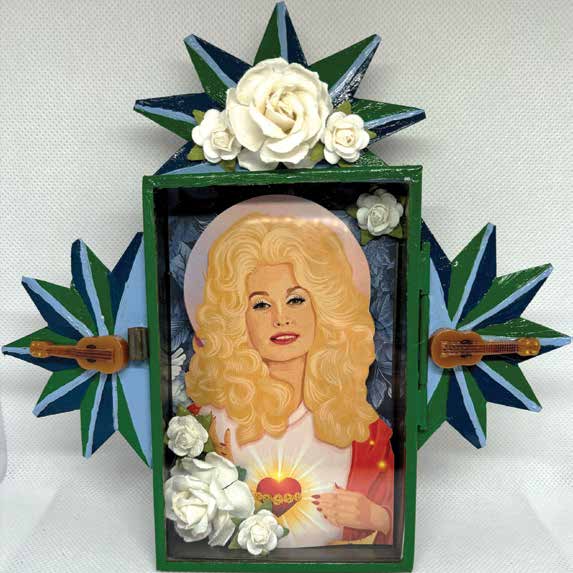
Thank goodness, none of the front-walking costumes are in play for Millie, though I truly wish she would tolerate a wig with a red bandana, long braided pigtails and guitar-holding arms.

Then she could be Millie Nelson.

After much consideration, though, I’ve ordered her a tennis dress. Like her mama, she’s obsessed with chasing tennis balls, and after all, who wouldn’t want to be recognized as the great Millie Jean King?. 

Clubhouse Rules

CLUBHOUSE RULES

Clubhouse Rules

You can have anything you want, as long as it’s salad

By Maria Johnson     Photographs by Bert VanderVeen

Gracious hostess that she is, my neighbor, Olivia Bonino, ushers me into her kitchen, the birthplace of many meals that she serves to guests who frequent the airy abode she shares with her younger brother, Connor.

Connor doesn’t cook much, but he does add a certain dinosaur-fueled pizzazz to the place.

Sitting at her plywood island, Olivia continues on the subject of food.

“This is where we prep it. Then they eat it. Some of it,” she says, explaining that her specialty is salad made from store-bought fruit such as blueberries, blackberries and grapes, along with “cucamelon,” a small hybrid cucumber that grows in her yard, plus a “secret ingredient.”

With that, she reaches out, grabs a branch of a scraggly plant growing at the edge of her kitchen, and pulls it closer to indicate that this is the good stuff.

“What is it?” I ask.

“Not sure,” Olivia says, adding that a guest once tasted it, and “he did not throw up or get sick,” so it has been a staple of her salads ever since.

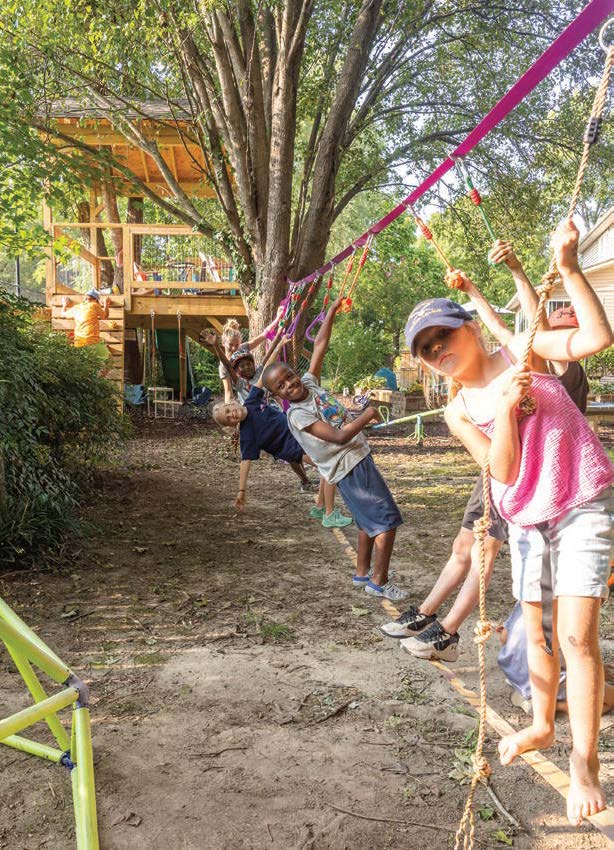
A first-grader, Olivia saunters out of the kitchen to show off more features of her domicile, which she breezily calls a “clubhouse.” Others might call it a playhouse. Or a tree fort.

Call it what you will. It is her home away from home — like, 40 feet away from her official home — but it’s as much a refuge as any home, anywhere, at any price point.

The tour proceeds.

Here on the south side of the house, she explains, we have the climbing wall.

Here, on the north side, we have the wavy slide. She grabs a cord that dangles above the slide and demonstrates how, after descending, one might pull oneself back up the slide for another go, or, if she took a notion, rappel down the slide backward.

“That’s my favorite thing to do: walk backward,” she says.

We ascend the stairs to the second level, part the beaded curtains made from recycled ball-pit balls, and step into the 9-by-11-foot great room.

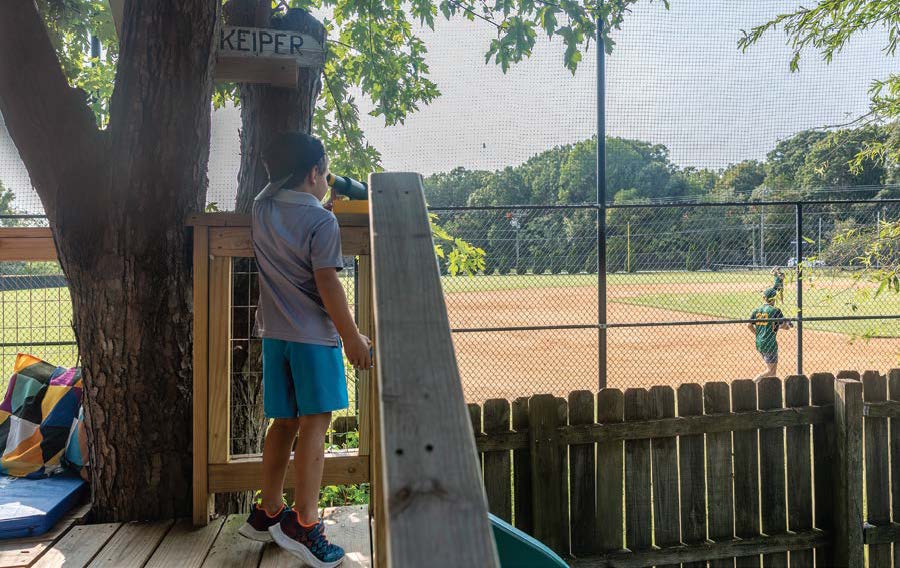
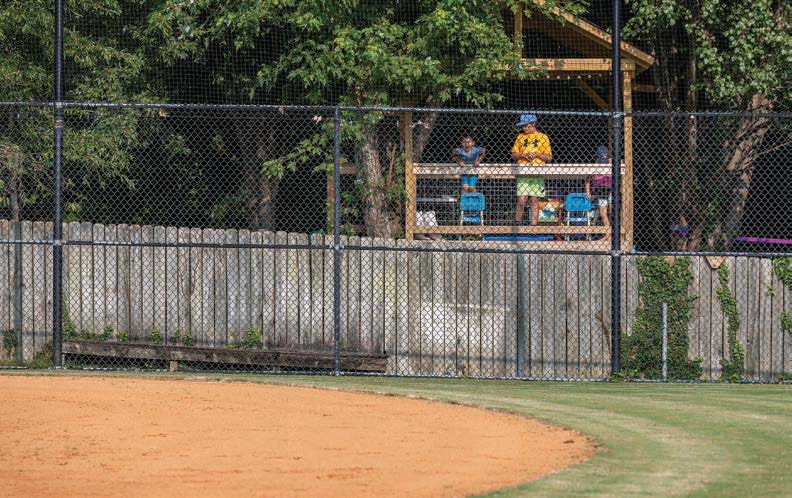
The view is stunning, taking in the emerald green outfield and part of the red clay infield of Greensboro Day School’s baseball diamond.

This was the home-run view that the builders — Olivia’s parents, Dominic Bonino of Greensboro’s Bonino Construction and his wife, Laura — wanted to highlight when they started making Olivia and Connor’s rustic haven in the fall of 2022, two years after moving into their home off Lake Brandt Road.

Olivia was 2 when the family relocated and Connor was not yet born, but Laura already had designs on a backyard getaway for the kids — and, occasionally, for the adults.

She was tickled to live next to a baseball field, given her family history. Her grandfather on her father’s side, Ken Keiper, was a well-known player, coach and scout in Western Pennsylvania. He was inducted into the University of Pittsburgh-Johnstown’s sports hall of fame in 2014. Laura remembers attending games as a child.

Moving in next to a baseball field as an adult, she was excited about watching games with her own young family. A couple of years after Connor was born, she pitched her idea to Dominic.

He had a blueprint in his head. It called for a deck, lofted and braced on three corners. The fourth corner would be bolted to a mature maple tree. Floating 6 feet above ground — high enough to see over the privacy fence — the deck would feature proper stairs, double-framed railings inset with welded wire and a gabled roof pierced by one of the maple’s limbs.

In the span of four months, mostly on fair-weather weekends, Dominic roughed in the perch. He asked his roofing subcontractor to send over a crew to shingle the gable and make it watertight around the branch. He asked several times.

“I think he was wondering if it was some kind of janky thing that wouldn’t support their weight,” says Dominic, who finally sent pictures of his craftsmanship.

“If I’m gonna do it, I’m gonna do it right,” he says. “I wanted it to be sound enough to where, if we wanted to get 10 adults up there, we could.”

Convinced, the roofer dispatched a crew. They gave the clubhouse a proper roof and used a vent boot and flashing tape to seal the hole around the tree branch, giving the maple room to sway and grow.

Soon, a wavy slide and climbing wall sprouted at the sides of the clubhouse. Laura gathered furniture and accessories, picking up pieces from family, dollar stores and the local Buy Nothing Project, an app that promotes member giveaways.

So far, her haul includes colorful handholds and footholds for the climbing wall.

Small plastic tables and chairs.

A couple of pillows that say “Relax.”

A thermometer that promises “Butterfly Kisses and Rose Petal Wishes.”

A plastic mirror salvaged from a baby’s crib.

A string of star-shaped lights, solar powered.

A dinner bell.

An eight-note xylophone for a doorbell.

A pouch-style mailbox.

A couple of John Deere license plates from her grandparents’ farm.

And a set of gymnastics mats, which Olivia, Connor and their friends pitch as an A-frame hut used chiefly for spying, Olivia says.

“By the way,” she says, nodding toward my yard. “Your bird feeder looks pretty low on food.”

When Olivia, her brother, and a constantly rising and falling tide of neighborhood kids are not spying and serving salads, they are often sitting at small tables, working on art projects. Sometimes, their creativity spills over to the deck railings, which are decorated with rainbows, illustrated menu items and other childhood hieroglyphics rendered in crayon and colored pencil.

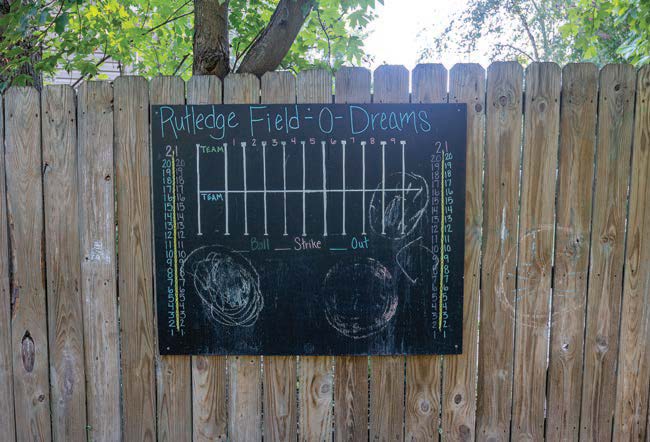
And, oh, they watch baseball games.

They pull for the home team, the Bengals, during their spring season.

“Ben-GALS, Ben-GALS, Ben-GALS,” the pint-sized fans chant.

Once in a rare while, if they like the opposing team’s uniforms, they’ll allow a cheer for the visitors.

But they’re a heavily partisan group. If the Bengals are down, they have been known to heckle the other side.

“Your pitcher has a big butt,” they taunt.

Occasionally, Laura and Dominic call down their charges.

But that rarely happens because of the house rules, which Olivia distills to their essence:

1. No jumping or name-calling from the platform.

2. No ratting out people who break Rule 1.

Seated in tiny Adirondack chairs approximately 4 inches off the ground— I’ll worry about how to stand up later — Olivia and I take in the extraordinary view from her living area late one summer afternoon.

Cumulus clouds climb in the distance.

Traffic swishes by on a nearby road.

A breeze sighs through the leaves, casting a filigree of shadows on the pressure treated boards before our feet.

Does Olivia wish for more in her home?

Of course.

An elevator would be nice, she says.

And refrigerator.

And a bathroom.

And a zip line.

Still, these 99 square feet —198 if you count the ground-floor kitchen — give her what she needs.

A place to rest.

A place to create.

A place to wonder.

“It’s my mini-home,” she says.

Glorious Restoration

GLORIOUS RESTORATION

Glorious Restoration

A remade Reynolda landmark is beautiful to behold

By Ross Howell Jr.     Photographs by Amy Freeman

On a steamy August day, I’m driving along leafy Silas Creek Parkway in Winston-Salem, headed for Reynolda, the storied estate that is now part of Wake Forest University.

I’ve been invited to have a look at the top-to-bottom restoration of Reynolda’s gleaming, glass conservatory — the very first structure built on the property — before it opens to the public in October.

I turn at the entrance and pass the retail shops and eateries of Reynolda Village. Facing the parking area is a big sign that announces the impending opening of the “Brown Family Conservatory and Reynolda Welcome Center.” Just beyond the sign, I glimpse the glittering top of the structure formerly known as the palm house and greenhouse.

Work on the restoration has been going on for nearly a year, all made possible by a gift from longtime Reynolda supporters, Malcolm and Patricia Brown, who have three generations of family living in Winston-Salem.

I continue along a narrow drive, past walkers and joggers, and pull into a parking lot near the Reynolda House Museum of American Art. Completed in 1917 as the home of the R.J. Reynolds family, the museum now houses a permanent collection of three centuries of American art and sculpture, along with special rotating exhibitions and extensive online galleries.

I’m greeted at the museum entrance by Brittany Norton, director of marketing and communications. With Norton is the director of archives and library, Bari Helms. Prior to coming to Reynolda, she was an archivist at the Library of Virginia in Richmond. Finally, there’s Phil Archer, deputy director of Reynolda House. A native of Pennsylvania, he attended Wake Forest University for both undergrad and grad school, and has been with Reynolda for more than 20 years.

Helms has put together some materials, so we head for the archives. There, she directs our attention to a large rendering produced by Lord and Burnham, the premier builder of glasshouses in America during the mid-19th and early 20th century.

Helms slides the rendering toward Archer.

“Have you ever seen this?” she asks. “I found it in some boxes.”

Archer shakes his head, touching a finger to the edge of the drawing.

“I don’t think so,” he says. “Not with those perpendicular wings.”

“A little too ‘Versailles’ for Katharine, isn’t it?” Archer asks. He, Helms and Norton exchange knowing smiles.

Helms shows us a letter from a certain “Katharine” to Lord and Burnham, dated May 27, 1912. In it, Katharine details what she wants the conservatory to include — a palm room, a “good-sized” grapery, a tomato section, a large vegetable section, a propagating room and a “nice workroom.”

When Lord and Burnham responded with their plans and perspectives, and their quote for $7,147, Katharine wrote back that it was too much money. The greenhouse additions in the rendering were removed.

“In all her correspondence, you get a sense of how direct, hands-on and detail-oriented Katharine was,” Helms says. I don’t want to show my ignorance by wondering aloud who Katharine is, so I let them go on.

In December 1912, Helms resumes, Katharine wrote a letter to Lord and Burnham, complaining that the workers they’d promised had not yet arrived on site. In January 1913, she wrote again, noting that parts of the conservatory were not being built to her specifications.

“Katharine was very polite about it,” Helms says. “But insisted that she was making Lord and Burnham aware of the issue so they would fix it.”

No doubt they did.

And here I am, still wondering, “Who was Katharine?”

Those of you who know Reynolda just muttered, “Well, bless his heart.”

In my two decades living in Greensboro, until my visit today, I’d been to the estate only once, bumbling around Monkee’s of the Village, a boutique, while my wife, Mary Leigh, picked out a pair of Tory Burch boots.

So, for those of you as benighted as I was, here’s a quick study.

Born in Mount Airy in 1880, Katharine Smith Reynolds was a daughter of America’s Gilded Age and a wife in the Progressive Era of the industrialized New South. In the period photographs at Reynolda, she’s the young woman in the gorgeous outfits who doesn’t seem to be looking at the camera, but, rather, directly into your soul.

To this day, her spirit and determination inform every aspect of Reynolda.

Leaving her home in Mount Airy in 1897 to attend the State Normal and Industrial School — now UNCG — she later withdrew because of a typhoid epidemic and finished her studies at Sullins College in Bristol, Virginia. In 1902, Katharine joined the R.J. Reynolds Tobacco Company in Winston-Salem, where she served as personal secretary to the owner, R.J., a distant cousin who was 30 years her senior. In 1905, Katharine and R.J. married.

Between 1906 and 1911, Katharine gave birth to four children — at grave personal risk, according to her physicians, since she had been plagued with heart problems that started in childhood.

By all accounts, the Reynolds marriage was a happy one, and R.J. was confident in his young wife’s abilities, often consulting her on business matters.

Backed by her husband’s increasing wealth, Katharine began to purchase tracts of land near Winston-Salem. She would eventually acquire more than 1,000 acres, each parcel deeded in her name alone. Her idea was a Progressive one — to create a self-sufficient estate that included a country house, a farm utilizing the latest in technology and agricultural practices, a dairy, recreational facilities and a school.

The Reynolda conservatory was an integral part of Katharine’s design.

OK, class dismissed.

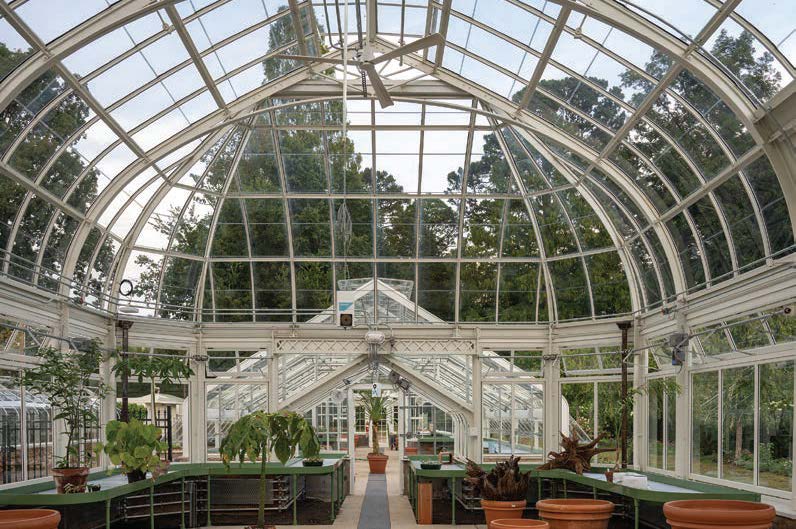
Archer and I leave the archives and head outside. As we approach the conservatory, he points out details — the iron skeleton of the structure, though all the glass and aluminum fittings are new; the foundations, built from fieldstones found on the property; the locations where the electrical lines are buried, hidden, just as they were when the village was being built.

“Katherine wanted the estate to look and feel like an old English hamlet,” Archer says.

“Burying utilities was high-tech for Katharine’s time,” he adds. “But that’s what she wanted.”

At the conservatory, I’m greeted by Jon Roethling, the director of Reynolda Gardens. He joined the estate in 2018, after serving as curator of grounds for the Mariana H. Qubein Botanical Gardens at High Point University. He has served in public horticulture and landscaping for more than 30 years.

Roethling’s been leading the restoration project.

He tells me that the work has been done by Cincinnati-based Rough Brothers (pronounced rauh), now a subsidiary of Prospiant.

“Rough Brothers has access to actual Lord and Burnham plans and molds,” Roethling says.

So, for the Reynolda restoration, the company could use templates on hand, extruding aluminum pieces to match the originals.

The tinted glass needed for the restoration was made by another company. Since it’s so specialized, the company only manufactures it twice a year. That was a big setback to Roethling’s schedule and delayed completion by months.

But the wait was worth it because the unsightly aluminum shutters added to the palm house and greenhouses in a previous renovation could be removed. Moreover, the manufacturer had the equipment to produce curved glass. This meant that the elegant shape of the original architecture — supplanted by the use of flat glass panes in a previous renovation — could be restored.

“When I walk into the palm house now, the architecture just sings,” Roethling says.

And there were the challenges of heating and ventilation — critical to a conservatory.

“We stayed with the original concept of radiant heat,” Roethling explains, “though the new system is very sophisticated.”

Ventilation was a trickier issue, since the conservatory is vented throughout — foundations, walls and roof. From the time the conservatory was built until this restoration, these many vents had to be cranked open or shut by hand.

“You have to strike this balance of having architecture that reflects 1913, but also having the convenience and efficiency of systems that are modern-day,” Roethling says.

“Knowing Katharine, one of the most progressive women of her time, I was sure there was no way she would want us to be hand cranking vents in this day and age,” Roethling continues. “So we made the jump to automated.”

The new system automatically responds to wind flow, wind speed and precipitation, adjusting ventilation as needed. Adjustments can also be made remotely, using Wi-Fi.

Recently, when Roethling noticed a thunderstorm developing nearby, he went to the conservatory to see how the system would respond.

“As the wind rose and the storm started rolling through, I watched the vents immediately close a bit,” he says. “When the wind grew stronger, the vents shut completely, protecting the greenhouses.”

We take a quick look at the welcome center, which is adjacent to the conservatory. It will be the orientation point for the facility. There are cabinet doors still to be hung and counters to be finished. In the future it will include plants, Reynolda-branded merchandise and historical information.

Leaving the welcome center, we step into the high-ceilinged palm room. The new tinted glass is working. While the area is warm, it’s not nearly as hot as I thought it would be on this sweltering summer day.

Walking outdoors to the open area in front of the conservatory, we have a full view of the central structure and greenhouses flanking it. The span, end-to-end, is more than 300 feet.

Sod has been laid the entire length. This will be a walking path for visitors. Between the edge of the sod and the foundations of the greenhouses are newly prepared planting beds, about 8 feet wide.

Roethling tells me that Reynolda has long been recognized for its peonies.

“The problem is, once the peonies bloomed out, that was pretty much it, visually,” he says.

With the restoration ongoing, Roethling wanted to do something significant about the peony beds.

“I needed someone who could do something amazing,” he says.

Roethling reached out to Jenks Farmer, a plantsman in Columbia, S.C. A published horticultural writer, Farmer served as director of Riverbanks Botanical Garden in West Columbia and was the founding horticulturist of Moore Farms Botanical Gardens in Lake City, both in South Carolina.

Farmer created a design for the peony beds incorporating other perennials that will provide visual interest throughout the growing season.

“Jenks is great,” Roethling says. “He loves balancing history with what’s relevant today. When he gets up here in a few days, we’ll lay out the beds and throw a team at them to get all the plants in the ground.”

Roethling smiles.

“It’s been a little bit like a three-ring circus,” he says. “I’ll breathe a sigh of relief when we open in October.”

Now he directs my attention to the conservatory.

“Each bay will have a different theme,” Roethling says. “This first bay will be in the spirit of an orangerie, which represents the birth of greenhouses.” (For the uninitiated, an “orangerie” is just what it sounds like, a greenhouse where orange trees are grown).  He explains that it will be filled with citrus trees, much like the original 17th-century orangeries in England and throughout Europe. The bay will also feature olive trees and other fruiting plants and will be used to illustrate a narrative history of the development of greenhouse structures over the centuries.

The next bay will be an arid greenhouse, featuring the five Mediterranean climates of the world — Southern California, the Mediterranean Basin, South Australia, South Africa’s cape area and central Chile.

“This will be a fun thing to educate kids,” Roethling says. “To explore with them how the plant palette changes, how the plants adapt.”

The central palm house will be elegant in its features. In big containers, there will be sealing wax palms with their deep red canes and tall Bismarck palms with their silver fronds.

“There will be a lot of texture — greens, whites and silvers,” Roethling adds. Visitors will be able to compare the broad texture of a palm frond to, say, the fine texture of a fern.

The next greenhouse bay will feature bromeliads, orchids and other flora that thrive in the tropics. And it will be about color — abundant, dramatic color. Listening to Roethling talk about this greenhouse, you hear his self-professed “plant geek” revealed.

“In here, I want to have freaky things that visitors walk up to and ask, ‘What is that?’” He smiles broadly.

The final bay will serve as a holding house for orchids that are resting. The plants will be organized by types, with interpretative signage.

“Even though the orchids won’t be in bloom there,” Roethling says, “that greenhouse will still be beautiful and educational.”

Just as Katharine would have expected.

Sazerac

SAZERAC

Sage Gardener

My introduction to kimchi was via M*A*S*H, when Frank Burns boasts about catching some Korean peasants burying a land mine — which turns out to be a vat of kimchi. Upon excavation, Hawkeye takes his own dig at Burns, saying “You’ve struck coleslaw!”

Actually, it’s rather surprising that the usually wellinformed M*A*S*H writers should mention slaw. Fermented and aged (traditionally underground to control the temperature) for a month or more, kimchi doesn’t vaguely resemble coleslaw. Think of a nostril-bending flavor bomb made with fermented cabbage, spiked with chilies, ginger and garlic.

My next encounter with kimchi was on the end of a fork in Cocoa, Florida, where I was writing about the space shuttle’s efforts to escape Earth’s gravity. An editor who had hitchhiked across Asia served it with warm sake one night — love at first bite. I was soon fermenting my own, filling the house with a thick aroma. Another reporter and I would get up at daybreak and catch a mess of mullet, which my wife, Anne, would fry and serve with grits and kimchi. The reporter and I still say it’s the best breakfast we ever had.

Since pickling vegetables is an ideal method of extending their lifespan, kimchi making in Korea dates back to well before the Christian Era. But forget the chilies. Chili peppers, native to the Americas, didn’t make it to Korea until the 1600s.

Most of the kimchi available in America is made from Napa cabbage and scallions, sometimes with added fish sauce. Authentic Korean kimchi often contains salted shrimp or croaker — or other finny prey, including anchovies and salted cod gills.

I’ve found that kimchi tends to appeal to people who relish the strongest of flavors. A friend who obsessively made beer for a while, transitioned to kimchi, observing that he became “fascinated by the alchemy of salt turning bland vegetables into hot, sour yumminess.” Plus, he hoped it “would nurture my gut and cure what age and various vices had inflicted on me.” Like other fermented foods, kimchi’s teeming bacteria is purportedly good for your intestinal microbiome. But people eat kimchi because they love how it triggers endorphins, generally appealing to the same people who fall in love with tonguenumbing hot sauces, hopcrazy IPA’s, mind-bending mescals and peaty, smoky Isla scotch.

Making kimchi is as easy as making sauerkraut and there are a plethora of recipes on the internet. As the days grow colder, consider starting a batch, especially if you have cabbage in your garden. There’s something magical about having a batch of kimchi bubbling away in a dark room, getting a little more sour with each passing day, a little hotter and a little more redolent. Get started now and it will make a great gift under the tree — festively green and red — and mask that annoying evergreen scent.

— David Claude Bailey

Letters

To Cassie Bustamante in response to her June 2024 column, “Curb Alert”

As I sit here in my yard chair relaxing after a morning of delayed yard work, I am enjoying the June edition of O.Henry magazine.

Your article brings back memories. Christmas 2003, my son received his first car as a present. It was a 1998 Jeep Cherokee.

The thought being, it would help in having another driver, helping with errands, stopping his mother and I being his chauffeur. Wrong!

However, that’s not the story at hand.

I remember that Christmas Day going out for a drive with my son Nick at the helm. He decided that a ride on the highway I-40 would be a good idea to test out his new ride.

I have never been so scared sh&$less in my entire life. All I could do was pray and hope to get home in one piece.

Finally he pulled into the driveway and, forgetting to put the Jeep in park, he hit the rear bumper of my wife’s Mercury.

We did have a happy ending though. The Mercury was a tank, no visible damage to either vehicle.

Reading your article brought back this now humorous incident to mind.

Our kids, no matter what they do, leave us with memories. Hopefully, good ones.

— David Ruden

The Passed Baton

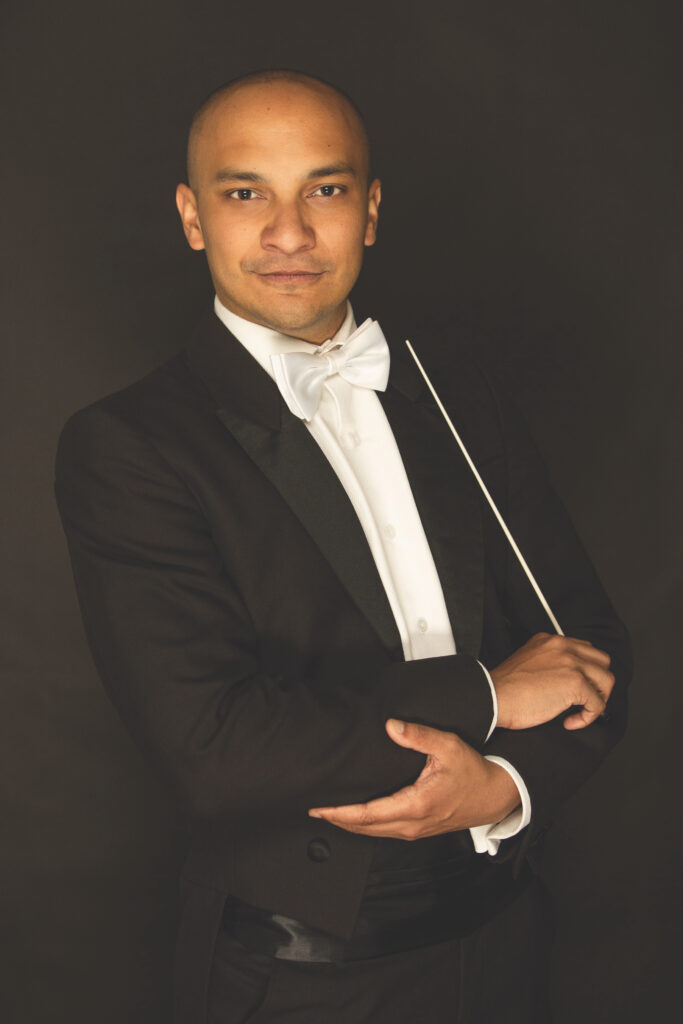
“You Should Be Dancing,” the Greensboro Symphony Orchestra has decided — and with a new Aussie conductor as your dance master. Christopher Dragon will take the baton on September 14 to lead the symphony in a POPS Concert featuring The Australian Bee Gees Show, a tribute to the legendary group, at the Tanger Center. Bellbottoms optional.

During its last season, dubbed “Season of the Seven,” seven candidates auditioned — each having an opportunity to lead the symphony. Dragon won out. Hailing from Perth, Australia, Christopher Dragon began his career in his home country with the West Australia Symphony Orchestra. Since then, he’s led the Colorado Symphony as well as the Wyoming Symphony, and worked with orchestras the world over. Plus, not to name drop — but, just for you music aficionados, we’re going to — he’s collaborated with the likes of Cynthia Erivo, Joshua Bell, the Wu-Tang Clan and Cypress Hill. And he’s stoked to bring his flair to the Gate City while creating “unforgettable symphonic experiences to inspire the next generation of music lovers.”

But wait — there’s more! While there can only be one conductor on the podium at a time, sometimes there’s room for two at the top. Chelsea Tipton, fellow “Season of the Seven” candidate, has been named principal guest conductor. A native of Greensboro, Tipton currently serves as music director of the Symphony of Southeast Texas and principal pops conductor of the New Haven Symphony Orchestra. “Returning to my hometown in this capacity is a dream come true,” he says.

Unsolicited Advice

Did you know that September is National Italian Cheese Month? Grate-est news ever grazie! We support any observance that involves feasting on that melt-in-your-mouth (or on your sandwich) delight, any way you slice it. But preferably with carbs and wine, per favore. Stock up on Lactaid and get ready to dazzle your palate with some of our magnifico varieties!

Gorgonzola: Sounds like an evil character from a 1980s cartoon featuring little blue creatures, but is actually the Italian answer to blue — or, shall we say bleu — cheese. Crumbles easily, just like us.

Mozzarella: Quite possibly the most popular pizza topping due to its meltability. Frankly, we’d eat it as a topper to the cardboard circle frozen pizza comes on in its ooey-gooeiest state. By the way, mozzarella is not related to Cinderella, who is actually French.

Parmigiano-Reggiano: Two first names? Must be from Southern Italy.

Mascarpone: Any cheese that can masca-rade as dessert is a winner in our books. If pizza pie isn’t your thing, how ‘bout a pumpkin-mascarpone pie?

Ricotta: Rick oughta make us his famous lasagne soon. And tell him to use the good stuff — none of that cottage cheese.

Provolone: Between two slices of crusty Italian bread slathered with butter, this one makes a delicious and simple grilled cheese. Ready, set, ciao!

O.Henry Ending

O.HENRY ENDING

Southern Idioms Live On

You can’t understand us, we know it, but we just can’t help it

By Cynthia Adams

Personally, I’m tickled that YouTubers — such as former art teacher Landon Bryant — can make a living doing pure T nothing. (There’s a Southernism for you, Landon.) That is, nothing but talking, then explaining whatever was said.

This native son breaks down such terms as “mash” (as in the brake, button, alarm or gas pedal) versus “press.” He explains “liked to” (as in “liked to die” or “liked to have gone to meet my Maker”) to those beyond his hometown, Laurel, Mississippi — population 17,000.

Southerners have our own linguistic mashup. For example, I married a ferner, Southern for anybody who isn’t a native. Technically, a ferner could be from, say, Yonkers.

A primer: Yes’m is a contraction for “Yes Ma’am”

Bob wahr is just “barbed wire.”

Tin cints is just a dime. Except when “putting your tin cints worth in,” meaning offering your opinion. (Tin cints is about what most opinions are worth.)

There are directional Southernisms, too. “Over yonder” and “right cheer,” for example. In this context, cheer means here.

In another context, cheer means a seat.

“Why dontcha take a cheer?” doesn’t mean you are being offered a chair as a party favor. It means sit a spell.

Slang also perplexes. Nabs. Not the verb, as in “help me nab the bank robber.” Originally, short for a Nabisco snack, anybody who knows Sheetz from Shinola knows we’re talking about Toast Chee, a homegrown Lance snack.

Perversely, Southernisms aren’t always shorthand but sometimes longer. A form of linguistic face saving. Example: “I might coulda done things your way, but it warn’t up to me.” (A roundabout admission of messing up while passing the buck.)

Oftentimes, just more colorful. My grandmother was driven to distraction — meaning infuriated — by a neighbor who was “careless with the truth.” She declared he’d rather “climb a roof to tell a lie than stand on the ground and tell the truth.” Such deceit nearly caused a “conniption fit.” A conniption fit exceeds being driven to distraction.

Euphemisms exacerbate and blunt truths: A chronic screw up is “a day late and a dollar short,” or “a brick short of a load.”

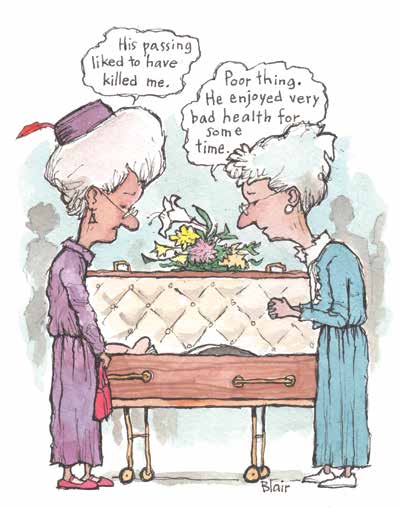
Southerners especially evade mortality, finding death unnatural. “Elmer died” seems callow. Softening the blow: “Elmer went to his reward.” “Was called home.” “Met his Maker.” Or, “Elmer passed.” Just try to find a Southern obituary containing the word “died.” If you do, show me.

“Who’s laid out at the funeral parlor?” translates thusly: “Whose death requires paying our respects?” (An open casket not only invites but demands it. Custom dictates praise: to wit, “I can’t believe he/she looks so natural.”)

Thanks to “extreme embalming,” socialite Mickey Easterling presided unnaturally over a New Orleans wake, cocktail and ciggie in hand. Mourners “held up” well.

In the South, our favorite sons and daughters linger longer, thanks to TV. Singer Jimmy Dean, DOD 2010, still pitches sausage that is just as smoky as his voice.

Memphian Leslie Jordan’s YouTube soliloquies considered all things Southern from sweet tea to mullets. Jordan died in 2022, yet his videos? Never.

Dearly departed Julia Reed (2020) gaily mined Southern speak and culture. My friend, John, and I delight over Reed’s bon mots.

Over a stack of her books — But Mama Always Put Vodka in her Sangria on top — we recently raised a glass. We took her passing hard.

That death? Well, it liked to have killed us.

Almanac

ALMANAC

September

By Ashley Walshe

September rouses you from the gentle spell of summer.

One day, between the blackberry harvest and the mighty swell of crickets, the charm took hold. Languid and blissful, you sprawled beneath the dappled shade, eyes heavy, honeysuckle on your tongue.

Rest now, summer cooed. It’s much too hot to fuss.

And, just like that, you were under. Swaddled in sticky-sweetness. Wanting for nothing. Enchanted by the lazy lull of summer.

Until now.

Something has shifted. It’s a feeling, both subtle and seismic. At once, you’re wide awake.

The air is crisper, cooler, lighter. Colors are more vibrant. Even the birds have changed their tune.

Wake up, a skein of geese clamors overhead. There’s little time to waste!

Their frequency is a code. An ancient language. A precious remembering.

Everything will change.

The light. The trees. The pulse of the season.

Look to the maple tree, the honeybee, the frenzied gray squirrel. Life is racing toward some dark unknown. Put your ear to the warm earth and listen.

This is the threshold, the quickening, the no-going-back. The final kiss of summer.

And so, you feast with all your senses. You savor the fragrance of ginger lilies, the taste of wild muscadines, the spirit of goldenrod at magic hour. You kiss summer back.

A single leaf descends with a singing wind.

Stay open to the beauty of this moment. Stay open to the knowing that everything will change.

Harvest Moon Magic

Your eyes aren’t playing tricks. When the full harvest moon rises on the evening of Tuesday, Sept. 17, it will appear larger and brighter because it is, in fact, as close to Earth as it can be. What makes this supermoon even more spectacular is the partial lunar eclipse that will reach maximum coverage around 10:44 p.m. While only a small portion of the moon’s surface will be obscured by Earth’s shadow, this partial eclipse marks the beginning of an eclipse season. An annular solar eclipse will occur on Oct. 2. Although its “ring of fire” won’t be visible from North America, don’t be surprised if you feel its powerful energetic effects.

Seeing Stars

Look! The asters are blooming. Derived from the Latin astrum, meaning star, September’s birth flower transforms the late summer landscape with jubilant constellations of white, pink, blue or purple blossoms. Often mistaken for daisies, the aster is actually related to the sunflower. (Study its bright yellow center, composed of tiny florets, and see for yourself.)

According to one Greek myth, asters sprouted from the tears of a virgin goddess named Astraea, who wished for more stars in the sky. Instead, the brilliant “stars” began spilling across the quiet earth, as they’ve done every autumn since. Magic for the eyes. Magnets for the late-season butterflies.

The Gathering Barn

THE GATHERING BARN

The Gathering Barn

A family creates a haven for togetherness and healing

By Cassie Bustamante • Photographs by Amy Freeman

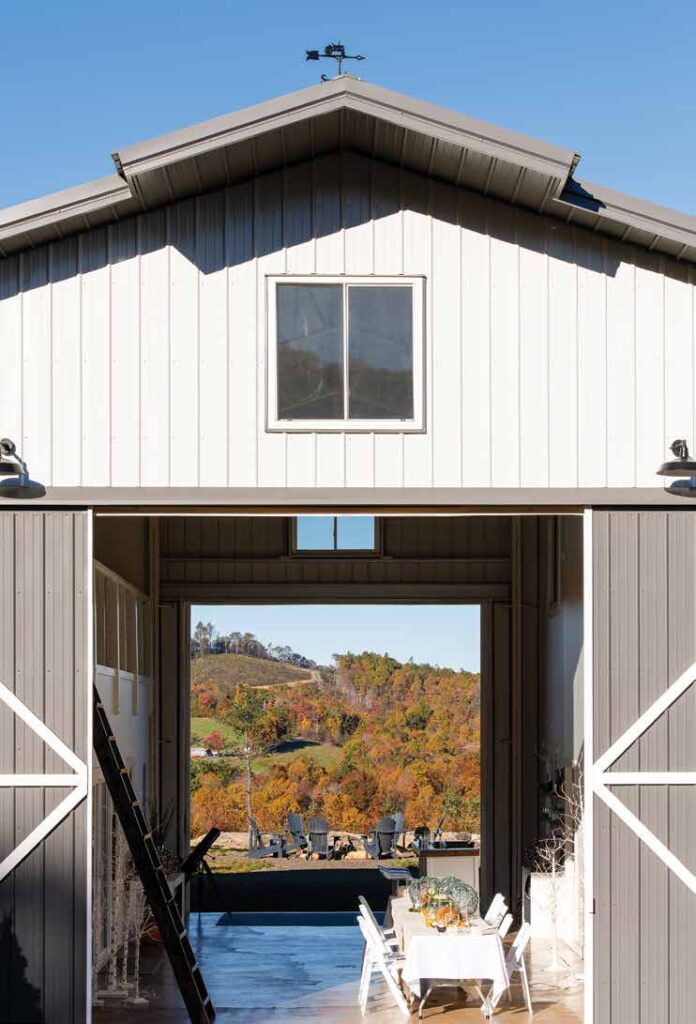
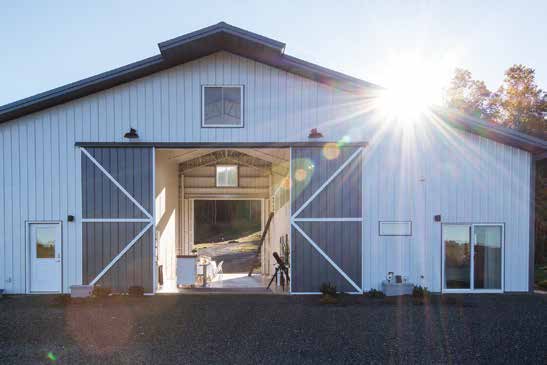
On a 100-acre woodland in Meadows of Dan, Virginia, a newly constructed barn sits in an open field, nestled against the edge of the Blue Ridge Mountains. While on the outside it appears to be a standard barn, beyond its sliding doors sits the makings of an apartment, a sleeping loft, a garage and a breezeway made for entertaining. Rayhaven, as Greensboro residents David and Allison Ray have dubbed it, is a place they’ve built for gathering and healing, both for their family and others.

In 2020, amidst a global pandemic, Allison and David recognized that their 16-year-old daughter, Savanna, a competitive rower, was showing symptoms of a heart condition. How did they know? A pulse oximeter.

Because Savana’s grandparents are getting on in years and live nearby, they’d purchased one to check their own readings before visits to protect everyone against COVID. One day, they thought it would be fun to see just how low Savanna’s resting heart rate would be as an elite athlete. The result? “Her pulse was around 110,” recalls Allison. Dumbfounded, they went around the circle — Allison, David, younger son Luke (now 16), then back to Savannah. Again, 110 beats per minute. Plus, Allison says, Savanna had been experiencing some dizziness, which they attributed to the extremity of her sport: “In rowing it’s very intense. Kids row and puke in a bucket and keep rowing. Grit is kind of a thing!”

A visit to her doctor confirmed that there were some unusual things happening in Savanna’s body. Her doctor immediately ordered an echocardiogram and, from there, she was sent to get an MRI. The results did not provide the Rays the answers they desperately needed.

“There was a lot of mystery surrounding it,” says Allison. “And the only thing you can really do is just wait.” That wait would be three to four months filled with uncertainty. “As a parent, there’s nothing worse.”

Almost overwhelmed by the magnitude of what she had just learned, she turned to something that had helped her so often before: the solace and solitude that, in the past, a stroll around Country Park had offered. There, surrounded by nature, she allowed herself time to weep and collect her thoughts.

“I was getting so caught up in work and superficial things,” she admits. While much of the world’s workforce had found their jobs coming to a halt, as a busy CPA, Allison was still tackling spreadsheets, no end in sight. “OK, if this is a lesson for me,” she recalls saying to the powers that be, “don’t use her to teach me . . . If this is my wake-up call, I am awake.”

Determined not to overthink or overreact, she stepped away from the computer, tuned out the noise of the world around her and leaned into what her heart told her to do. “I just remember thinking, well, either my daughter is dying and I have to be the best version of myself because this is precious time. Or we’re going to be fine and I need to — in gratitude — be the best version of myself.” Either way, she says, “the answer was the same.”

For Allison, that meant slowing down and shifting her focus to “what matters — it’s family and love.”

She needed exactly what Country Park offered her that day — nature and a place to hike without people all around her. But as so many people sought a safe escape from home in the early pandemic days, trails became overloaded. And, with potentially two mystery illnesses on their hands — COVID and whatever was attacking Savanna’s heart — the Ray family decided to find a property where they could walk their own trails and spend time together.

With Allison’s ability to crunch the numbers financially and David’s work in residential real estate — everything from brokerage to rental property ownership — the idea of owning another property didn’t scare them. The couple spent months looking, which helped them really hone in on what was precious to them. Not only that, but their road trips to look for land offered a distraction from a potentially grim reality.

David says, it helped “to be looking to the future” — one that included their family wading in rivers, encountering woodland critters and stargazing beside a fire pit.

After looking as far as West Virginia, the couple realized they wanted something closer that they could easily get to for even something so short as a day trip. In Meadows of Dan, only 76 miles from Greensboro, they discovered a listing for 40 acres.

With the help of their Realtor, Karen Wilson of Five Star Mountain Realty, who knew the land and each parcel’s owners, the Rays were able to purchase several pieces around that original property, acquiring a total of 100 acres. “Our most premium piece was landlocked,” recalls David. “And we unlocked it by combining it with the things around it.” Now they have unfettered right of way and one mile of river frontage.

“The Dan River is known particularly for turning and this is a particularly tight turn, which is why we have so much frontage,” says David. Plus, he adds, another border features a tributary creek.

“It really came together nicely,” says David of the total property.

“It felt kind of heaven sent,” Allison chimes in.

And right around the time they closed on their new property, they received what David calls their “first not bad news.” Savanna’s heart did not seem to be failing. She was making progress in the right direction.

“It was a very optimistic day,” says Allison. “But in all of this, nothing is definitive.” They’d have to await a second positive report before the doctors would definitively say that she had really improved.

They found that family trips to the land, including with their Brittany spaniel, Winter, brought them much needed joy.

David sits on the sofa of their New Irving Park home, Winter’s copper-and-white head lazily resting in his lap. “You want to see this lump on the couch turn into a real dog,” he says, “all you gotta do is take her up there.”

“She’s kind of a mini-human in Greensboro,” adds Allison. “And at Rayhaven, Winter is a dog.” Generally shy of lakes and pools, the family pet jumps gleefully into the Dan River, her exhilaration contagious.

“We would just all laugh,” Allison says about watching their beloved dog come into her intrinsic nature. “And we needed to laugh.”

What appealed to Winter the most was also what appealed to them — the freedom to roam riverside. And in the river — waders on or barefooted. While the property had once been owned by a logger who’d forged many paths, they needed cleaning up. “I have a chainsaw now!” Allison says proudly.

“Clearing trails,” she adds, “there’s a meditation in it.”

Once, the couple rode their ATV along a trail to continue clearing work, turned a corner and discovered that a large tree had fallen. Standing there, looking at the huge tree that blocked their path, they suddenly began to draw parallels with what their family was facing. “It’s not your plan,” says Allison, “but you lean into it and pace yourself.”

Of course, they knew that finding a builder in a small moun tainside community to create a rough barn-style home would be another challenge. Again, their solution seemingly came through divine intervention.

“We’re walking in the meadow on our property and our neighbor comes out and we start talking,” Allison recalls.

“And when we say neighbor, you can’t see his house,” adds David. “He comes through the woods because he’s wondering who’s trouping through the woods next to his house.”

That neighbor was Bonssi Vincenti, a commercial and residential builder who’d actually worked with Greensboro’s Landmark Construction for years and now ran his own business in Meadows of Dan. Just like that, they had their builder.

“He commuted in his tractor!” David says with a chuckle.

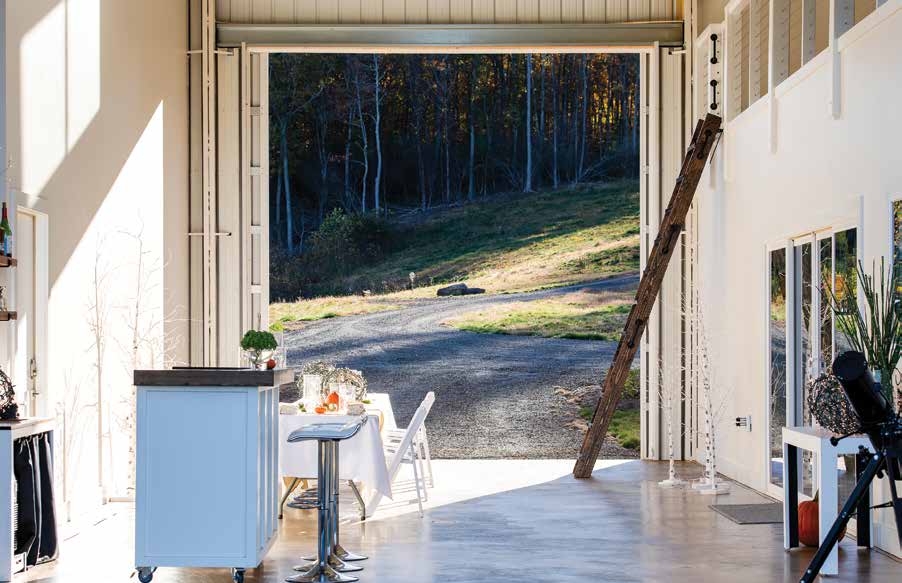
The Rays put a lot of thought into planning their barn, which they’d dubbed “The Gathering Barn.” Almost like a mud room, the entire structure had concrete floors throughout that accommodated wheelchairs and were dog-friendly. Rough sleeping accommodation were provided for stay-over family and friends and there’s even a sink for cleaning fish: “Purpose-built for gathering,” says Allison.

“For us, financially this was a big leap of faith,” says David, adding that the couple decided to occasionally rent it, but mainly use it for themselves.

“A friend brought her youth group and they did their retreat up there,” says Allison. And, on Easter weekend this past spring, a young couple booked the property to tie the knot. Allison’s chocolate eyes sparkle at thoughts of her own daughter’s future. “Savanna said, ‘Maybe one day I will have my wedding or rehearsal dinner there.’”

Overall, the barn is approximately 60 feet wide and 40 feet deep, divvied up into 20-foot-wide segments. On one side, tucked away behind sliding glass doors off the breezeway, sits much more than one would expect, essentially the makings of an apartment: two bedrooms, two bathrooms, a living room, kitchen, laundry and even an office space. “We worked so hard on engineering every inch of that space to have maximum usage,” says Allison.

On the other side is a largely open space they’re now using as a garage for their ATV. It also has the rough bunk space that sleeps seven to eight. Downstairs in the bunk side is where you’ll find the industrial sink and another large bathroom — including a big shower to hose off the dog.

In between both, the breezeway holds a table and chairs for playing games or enjoying cocktails from the rolling bar Allison had Vincenti build from plans she drew on a napkin.

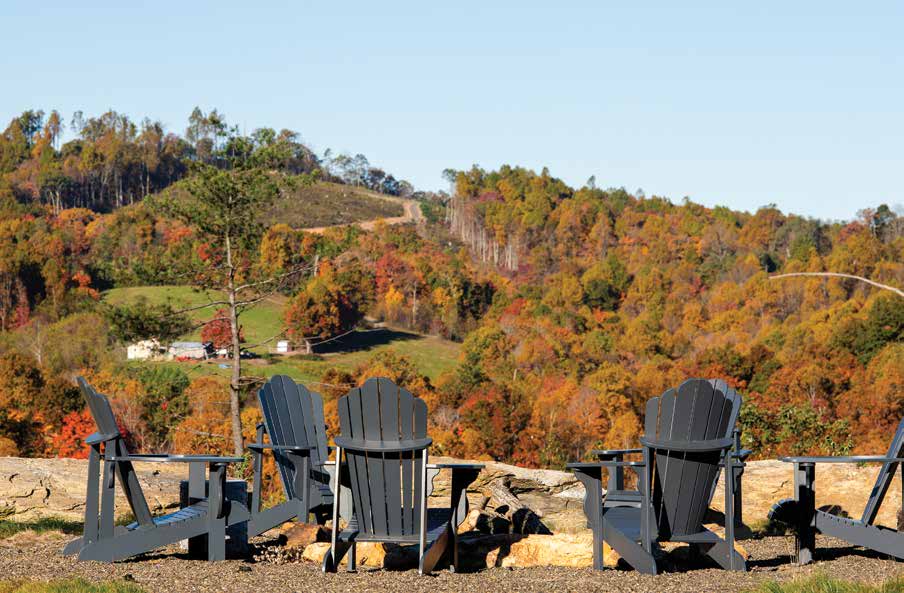
But the real heart of the home-away-from-home is the fire pit just beyond the barn’s back door. Whether it’s in the morning with a cup of coffee or with a glass of wine looking up at the evening sky, the family can often be found relaxing in the seats surrounding it.

In fact, Allison recalls seeing several shooting stars, which she calls “angel winks,” when they were first scoping out the property. Because there’s such little light pollution, they can even see the Milky Way from the comfort of their Adirondack chairs.

While the Rays managed to eke every possible intended use out of their barn and forge new paths on the land, they relied on beloved friend and interior designer, Lee Miller, owner of Luckenbach Designs — named after her maiden name— to make it feel like a home. Allison met Lee years ago and hired her to help with their New Irving Park residence. Quickly, the two became close — kindred spirits, according to Lee.

Before planning the design, Lee took a trip to see the property with the Rays, specifically the spot where the barn would sit. “The minute I saw it,” she says of the view from there, “I just got tingly.”

Soon, Lee was on a roll, accumulating pieces in the Rays’ Greensboro garage — everything from art to furniture, even bedding.

“She’s got a great eye,” says Allison of her friend, whom she refers to as a “Red Collection maniac.”

“Every time I am going up, I am carrying a trailer full of stuff,” David recalls with a laugh. That “stuff” would be placed in a shipping container intended for construction supplies.

But Lee understood the needs of her friends and knew just how to marry practicality with aesthetics while sticking to a budget. After all, this property was “a financial leap of faith,” according to David.

As it turns out, The Gathering Barn ended up being a place of purpose for Lee, too. “But it’s her story to tell,” Allison says.

Meanwhile, Savanna’s health also kept moving in the right direction, though the Rays still didn’t have a diagnosis. And tragically, her pediatric cardiologist passed away suddenly. Savanna had just turned 18 — officially an adult.

Thanks to a friend’s referral, the Rays found Savanna a cardiologist, Dr. Steven Klein, who saw her rather quickly. “I call him Saint Steve,” says Allison. As it turns out, Dr. Klein was also a rower and the first medical professional to really grasp Savanna’s feelings toward her sport throughout this process, asking her if she’d grieved for what was lost.

“She was one of the rowers that was being considered at college level and she was doing it with a bad heart,” says David. “And so it was like, it was a double whammy because she’s like, ‘How good could I have been?’”

At that moment, “Savanna just burst into tears and sobbed,” says Alison. “And it was super healing for her — and for me to see that healing in her.”

Dr. Klein was able to finally offer them a medical diagnosis: myocarditis, an inflammation of the heart muscle that is usually caused by a viral infection. While it can lead to sudden death — especially with athletes — it usually will resolve itself over time.

And has Savanna’s cleared up? “She has some autonomic body regulatory things that can still cause some dizziness,” says Allison. “But we did, just a handful of months ago, get a definitive — and her best — MRI of her heart functioning, where she’s squarely in normal zones.”

These days, 20-year-old Savanna is enrolled at UNC Chapel Hill, where she’s studying public policy. At the time of this writing, she was off on a European adventure, studying abroad. Over the summer, Luke, who Allison says was “very endearing to her throughout all of this,” joined her to travel Prague, Munich, Salzburg, Switzerland and Italy. “The two of them are bebopping around.”

The kids still head up to the barn with their family, but often enjoy time spent with their own friends there. And sometimes a family member will reach out and ask David and Allison if they can head up for a day because they just need a moment to recharge, a place to reset.

“A mountain breeze and the sound of water,” says David, “those are just healing things.”

“And so it was that in its origin story and it continues to be that,” says Allison. “That’s the family legacy.”

Rayhaven, indeed, helped the Ray family through one of the hardest moments of their lives. And now, when Allison starts to feel the weight of the world on her shoulders, she goes back to the moment the seed was planted.

“I can see it, I can taste it, I can touch it. I remember exactly where I was on the loop at Country Park, and it is like a reset for me. And then I know what I need to do. I head up to the mountains.”

Collection and Collaboration

COLLECTION AND COLLABORATION

The Griffith Fine Art Museum at Red Oak Brewery

By Cynthia Adams

One day, Bill Sherrill said, ‘I need you here tomorrow at 1:30 on the dot.’ Was he firing me?” wondered Red Oak’s Anne Griffith. Due to illness, she had worked remotely even prior to COVID.

But now she was worried.

She found him “sitting at the sidewalk waiting for us to drive up.” A group stood outside the Lager Haus entrance where a large tarp concealed a sign.

With Griffith watching, fellow employee Joe Rickman stepped up, pulling the tarp away. She was shocked into speechlessness.

The sign proclaimed the future home of the Griffith Fine Art Museum.

The new museum was a testament to many things, including a collaboration between long-time friends.

“Bill had refused to put his name on it,” Griffith recalls thinking. “I didn’t deserve it. He did. He had purchased it. It’s his collection. I feel like I didn’t do anything.” While she insists Sherrill had spent far longer collecting, even before knowing her, he argues that she shaped and refined his focus.

Sherrill is adamant. “Bullshit. I couldn’t have done it without her.” As his long-time art advisor, Griffith, who began working with Sherrill 30 years ago, was due the honor. Working in tandem, Griffith and Sherrill sourced more than 500 works of art, excluding sculptures displayed in the biergarten between the two buildings.

She says the true genesis of the museum and event center at the Red Oak campus began much earlier. The museum itself was five long years under construction — but decades more in amassing the collection still being inventoried at this writing.

Griffith shares a revealing anecdote about Sherrill from his youth. When he was in his twenties, journeying to Texas to purchase a motorcycle, he returned with artwork instead.

Watercolors by artist Bogomir Bogdanovic in a Dallas, Texas, gallery caught his eye. Sherrill returned home with the artwork rather than the bike, having owned Indian, Honda and BMW bikes.

He kept the art, but not the motorcycles.

The two formally met in the 1990s when Griffith was eating at Spring Garden Bar and Grill at UNCG, one of Sherrill’s former brewpubs.

During lunch, Griffith openly admired the art on the restaurant’s wall, recognizing the work of her favorite North Carolina artist.

“I knew Jack Ketner and recognized the art as I had staged a show for him at Alamance County Firehouse Galleries,” she remembers. As early as the late ’80s and ’90s, Sherrill began collecting Ketner’s work.

Perhaps during her time as head of the Alamance Art Council, she had “almost certainly met Sherrill” during a Ketner opening. (Something which Sherrill confirms later.)

“I thought, ‘This is a man I want to get to know because he thinks like I do about art. A man who has good taste in art,’” she says. “He started talking to me about his life, and his history with artists and art.”

They came to better know one another in subsequent years, frequently comparing art tastes. At the time, she had left art administration and worked as a graphic artist. Her partner, Jimmy Allred, had begun working at Red Oak after losing a high-level state role, a political casualty, Sherrill explains.

“He came out to wash dishes at Franklin’s Off Friendly in a three-piece suit,” Sherrill recalls. “Of course, we put him to work, but not washing dishes.”

“Jimmy actually delivered the first keg of Red Oak beer!” explains Griffith, adding, “Bill kept telling me I was working myself to death . . . and that I should work for him.” She laughs at this, saying she jumped from the frying pan straight into the fire.

In 2005, Griffith was persuaded to come work at Red Oak after only one week’s retirement.

Initially, Sherrill installed a desk in a back room with the brewers, where she was immersed in the daily business of Red Oak, the inner workings and logistics of the brewery. Griffith recalls trading six boxes of beer for a better desk and a better office.

“I learned the business from the bottom up,” she says, observing the daily workings of what was fast becoming the state’s pre-eminent brewery, assisting with graphics for the bustling business.

In turn, Griffith shared her art training, education and important art associations, including her close friend Ben Williams, the first curator of the North Carolina Museum of Art (NCMA). It was an auspicious connection as Williams was charged with creating the NCMA collection.

“When Kerr Scott was governor, he got a million dollars to build a museum of art, and Ben Williams was then in Paris,” Griffith explains. “He called Ben and told him to come home to build the collection.”

“When Kerr Scott was governor, he got a million dollars to build a museum of art, and Ben Williams was then in Paris,”

Griffith explains. “He called Ben and told him to come home to build the collection.”

Sherrill visited Williams’ home in nearby Yanceyville and admired his personal collection. “He had a couple of Francis Speight paintings, which I grew really interested in,” he recalls.

“He seriously collected Speight later,” Griffith adds. “Bill and I both gravitate to those paintings.”

Together, Sherrill and Griffith logged untold hours visiting galleries, shows and museums while spending weekends searching auctioned works.

They made a pact to only buy what both liked.

As Griffith terms it, the collaborators were “hunting” for artworks. “We actually taught each other,” she says. Sherrill “was serious before I began hunting with him.”

“He would go to artworks and shows. He noticed art for sale in galleries when he traveled,” she says.

Flushing out their quarry, especially works by North Carolina artists, intensified.

The relationship between Griffith, an artist, and Sherrill, a hungry collector since young adulthood, grew familial.

Griffith cast a wide net via national auction houses, as well as longtime mainstay Leland Little in Hillsborough.

“We had Shannon’s in Connecticut, Swann Galleries in New York, Freeman’s, Gratz, Pook & Pook and Rago auction house” says Sherrill.

“Doyle, Brunk, Neil and Hindman,” she adds. Initially he relied upon art magazines to find works.

“Bill wasn’t much of a computer person,” she adds. “He’s become more of one in recent years. It’s something I mainly did.”

The art duo created a shorthand when scanning online art auctions, Griffith explains. “We finish each other’s sentences when discussing whether to buy or not to buy. It’s like talking to myself.”

“He’s right brain/left brain. Creating beer, creating flavors, is creative. But he has the right brain activity with the business side. Buying art uses his creative side, too.”

She believes “it’s rare to run into a right brain/left brain person . . . usually one side is much more dominant. Bill is a DaVincitype man.”

As the collection expanded into hundreds of artworks, sculptures and collectibles, it outgrew not only Sherrill’s home but even spilled into a tack room. It covered all available brewery walls and offices at Red Oak and even the gift shop.

The sprawling private collection had finally “morphed into adding a museum,” says Griffith, who kept copious notes while cataloguing when not designing graphics.

Sherrill visited museums in the North and Southeast and out West seeking ideas on display and storage.

In 2019, with Boyd Chatman as lead contractor, Red Oak broke ground on a 12,000-square-foot building adjacent to theLager Haus. (Sherrill unreservedly praises Chatman, who has been involved with most of his buildings in the past decade. “He is one of the finest men I ever met.”)

Hampered by the pandemic, the new building proceeded slowly.

Months later, Griffith is still ambivalent about accepting the honor of museum naming.

“I was telling Jimmy that it has taken blood, sweat and tears — and fright — to put this collection together,” she finally concedes, collecting her thoughts during interviews before the opening night.

“Blood? Yes! We’ve both had splinters from 19th-century canvas stretchers. Sweat? We both have sweated moving that collection from place to place to place.”

There were occasional tears, too, such as when a rare painting from a California gallery arrived damaged beyond repair. They gasped; the actual work was as beautiful as they had hoped, but ruined.

Despite such disappointments, the collection was honed, steadily incorporating works from the South and northward, acquiring artists from Bucks County and the Hudson River Valley.

For most of his life, Sherrill had long found artwork irresistible.

The Winston-Salem native bought his first piece of art in Old Salem while a college student—a watercolor he has kept.

Sherrill says the spark to understand and collect artwork was first lit by another Anne, Anne Joyes (now Mondon) when she was a young French au pair working in Virginia, and he was in the Coast Guard during the Vietnam War. He dated Joyes “10–15 years,” frequently visiting her in Giverny, France.

A 50-year friendship endures. He ticks off what he has realized through friendship with Joyes, whose sister Claire was married to Jean-Marie Toulgouat, grandson of American impressionist Theodore Butler. (Toulgouat was also Claude Monet’s great-grandson by marriage, and grew up at Giverny, where he painted.)

Both of the Toulgouats “were on the board of the Monet house at different times. It really got me into art, because Jean-Marie had a number of Monets and his grandfather’s paintings.”

“One thing I learned from Anne and trips to France is I loved Impressionist paintings.” Another thing he picked up is that “art is much more interesting if there are people in the paintings — if they tell a story.”

Now, there are three Theodore Butler works in Sherrill’s museum’s collection. One is of Toulgouat’s house.

Sherrill’s second art acquisition was by Toronto artist Wolfgang Schilbach. He still owns the picture of a house on the prairie, which hung in his bedroom.

After eventually going on to earn a graduate degree in hotel administration from Cornell University, he “spent all my nickels on things I liked.”

And he liked art. In a world teeming with unusual art museums combining unlikely things, a personal favorite is the German Museum of Bread and Art in Ulm. The Museum Brot und Kunst, as it’s called, houses Rembrandts and Picassos as well as fundamentals of bread making.

Now, Red Oak Brewery, just off I-40/85 in Whitsett may be the first of its kind, too, pairing fine art — in the newly opened Griffith Fine Art Museum— with fine beer.

Red Oak has steadily expanded its footprint since opening the expansive Lager Haus in 2018. The two-story-high, sleekly modern facility incorporates Museum space and an event center. Combined with the existing Lager Haus, that equals 24,000 square feet for the two public buildings — excluding separate offices and Red Oak’s brewery operations, which opened on the 12-acre site in 2008.

Sharing an entrance with the museum, which opened on April 25, the Lager Haus patrons, as Sherrill envisions, can experience an array of art after enjoying his signature Bavarian-style lagers, which draw appreciative fans.

His vision is similar to that of late Napa Valley winemaker and art collector Donald Hess, who created the Hess Persson Estates winery and museum complex, operating adjacent to the winery operations and tasting room. (Sherrill visited several years ago while building his museum.)

The two eclectic collections and museums — that of Hess and Sherrill — also invite other comparisons.

At Red Oak, the admission is free and the soaring Museum spaces are exceptional. Also, the respective museums showcase their founders’ private art collections, while operating a thriving, spirited business.

If it seems intentional, it was. Sherrill believes that art should be shared with the public.

As soon as he graduated from Cornell, he put his degree to work, creating and operating restaurants. His first, a fine-dining establishment called Franklin’s Off Friendly, April 27, 1979.

Memorably, the upscale Guilford College restaurant was run by a crack staff (Dennis and Nancy Quaintance met at Franklin’s when Nancy worked there during a Christmas break.) Restaurant reviews were praising. Despite winning repeated acclaim fromcritics (Franklins’ wine list won top praise from no less than Wine Spectator magazine), Sherrill felt unfulfilled and stressed.

Friend Nancy Willis, a Reiki practitioner, gave a salient warning.

Absent change, Sherrill would die young.

“I tried too hard,” he explains. He shut Franklin’ s down in 1989, reconfiguring it into a brewpub.

Beer making emerged as Sherrill’s chief focus. He took a new tack, selling beers to others as well as his own bars and grills, all made in the style of Bavarian lagers.

“We’ve only used one lager yeast strain for 34 years,” he says, also hewing almost religiously to the laws of purity that originated in Bavaria in 1516.

Meantime, Griffith explains her friend and colleague was simultaneously “loving art and dreaming of a museum.” A longtime idea, Sherrill admits.

Sherrill sought out art at auction and during travels. Works spilled over onto every inch of available wall space in his home and businesses. Initially unsuccessful in trademarking the name of one of his early beers, “Oak Ridge Amber,” he noticed Big Oak Drive-In on a mountain trek. That inspired the name “Red Oak” for his expanding lager-making operation.

Red Oak Brewery is now the oldest still-active brewery in the state.

Soon, too, a museum wasn’t merely a desire — it was a practical necessity for a robust collector whose drive to acquire art was on par with his ambitions for beer and lager making.

What is it like when a dream — an audacious dream at that — to build your own museum comes to life?

“I’m never looking back,” Sherrill answers after a pause. “I’m always looking forward.

He pauses again. “I’ve got a couple of projects coming up.”

“Try not to believe your own bullshit,” he comments drily.

Possibly influenced by his Moravian upbringing, Sherrill is known as private and self-effacing. He bats away compliments. “I am so much luckier than someone who grew up in poverty.”

He points out all the advantages of his birth: a good education and middle-class upbringing.

“I started at the 30-yard line,” he repeats frequently, making it clear he takes none of it for granted.

But on the night of the Museum’s soft opening in April, Sherrill’s mood was bittersweet.

He moved amongst 100 guests, including Leland Little, sculptor Billy Lee, writers, bankers, an art restorer, art framers, Red Oak staff and assorted friends, such as Dr. Neville Gates and Nicole Shelton. Wearing a white Nehru-collared shirt and jacket with jeans, he was affable yet subdued.

Notably absent that night was Anne Griffith, Sherrill’s longtime friend and collaborator — and the Museum’s namesake. Too ill to appear, he felt her absence.

As people experienced the sleek Museum for the first time, Sherrill mentioned that much of the museum’s realization was owed to Griffith. Nearby, a pianist played a baby grand installed on the first floor for the occasion.

“The museum?” Sherrill repeated in clarification, “I credit much of this happening to her.”

Pointing proudly to his friend’s portrait hanging on a museum wall, his eyes welled.

“Doesn’t Anne look like a movie star?”

Shelton understood that Griffith was among his most important friends. She noted quietly that it visibly pained Sherrill that she couldn’t share in the moment they had both worked towards.

Having said a “a well-run business is a boring business,” Sherrill says the business of art is also about putting in the hours.

If done well, it grows rote.

The inaugural show, “Southern Artists,” was curated by the museum’s first director, Susan Harrell, who has appeared in these pages, and features many of the collection’s early acquisitions.

“The first show is all Carolina-based artists,” says Sherrill.

Apart from blood, sweat and tears, Griffith believes Sherrill’s creative drive willed the museum into existence.

Those closest to the colorful businessman also describe a creative defiance of convention that allowed him to beat the odds. If one does whatever it is you love, Sherrill frequently insists, “then you never have to work another day.”

The entrepreneur loves art in equal measure to his lagers. Now a private museum, namesake of a valued friend and art guide, proves the point beyond any doubt.

Nights of the Opera

NIGHTS OF THE OPERA

Nights of the Opera

Director David Holley tells timeless stories on the stage

By Ross Howell Jr.

Photographs by Lynn Donovan

What happens in the Greensboro Opera Company’s production of Gian Carlo Menotti’s Amahl and the Night Visitors is magical. But it doesn’t happen by magic.

When David Holley, general and artistic director of the company and director of opera at UNCG, invited me to rehearsals last November, I jumped at the chance. After all — I hadn’t attended a rehearsal since playing clarinet in high school band practice!

So there I sit, in UNCG’s beautifully renovated and modernized auditorium, on a Tuesday night after Thanksgiving. The company is just two weeks from opening at the Pauline Theatre, located in High Point University’s Hayworth Fine Arts Center. 

The scene at the rehearsal seems anything but magical: Individuals dressed in casual clothes are milling about the auditorium and on stage, chatting and laughing. I notice that the singer who plays Amahl’s mother is wearing knee pads. The stage lighting seems harsh, casting shadows and washing out colors.

An accompanist at a piano on stage is talking with a boy who’s  leaning on a crutch, a wooden flute slung over his shoulder. That’s Amahl, of course, aka Thomas Burns, the 10-year-old soprano from the Burlington Boys Choir who’s playing the part.

For a few moments I speak with Greensboro native, John Warrick, a performer in the chorus. He tells me he received his musical part via PDF, learning it on his own long before rehearsals began.

Then, at a table next to the orchestra pit, a young woman seated with her back to the audience rises and turns. She has raven black hair that hangs down her back.

This is Hanna Atkinson, the stage manager. Hers is not a role that immediately comes to mind when you think of the opera, but you soon realize she’s indispensable. Opera has lots of moving parts.

“Rehearsal is open,” she announces. “Chorus should come to the stage. Kings should come to the bench.” She gestures to the row of four metal chairs upstage representing the “bench.”

Warrick heads off to join his colleagues.

The director and cast run through several scenes, and soon Irealize why Amahl’s mother is wearing knee pads. There’s a lot of lying down and getting up from “bed” before the kings arrive. But there are no beds, only the bare stage floor taped to indicate them, so the actors kneel or recline.

After a humorous singing exchange where Amahl tells his incredulous mother that he sees one . . . then two . . . then three kings knocking at their “door,” the kings make their entrance oneby- one and sit down on the “bench.”

The character Amahl is disabled, so through all the scenes rehearsed, Thomas must hobble about the stage on his crutch, dragging a foot.

“Thomas, your timing was perfect,” Holley says. “You brought them in perfectly.”

The kings are about to sing. Holley nods to the pianist, then raises his baton.

“Thomas?” Holley asks, craning his head around to look downstage. “Where are you going?”

Thomas is carrying his crutch in one hand, a sneaker in the other. He walks to the edge of the stage, drops the sneaker into the darkness, then hobbles back on the crutch to take his mark near the kings, having realized it’s easier to drag his foot in a sock across the stage instead of in a rubber-soled sneaker.

Holley nods and I smile. Too bad the grownups didn’t think of that.

The rehearsal continues. There’s a glitch when the kings enter from the back of the auditorium and miss the row they’re supposed to turn on to access the stage. The procession has to regroup and start all over again.

“Remember as you come in to watch my beat,” Holley says. “Don’t listen for it — watch, or you’ll fall behind the tempo.”

“And hit your marks,” he adds. “Otherwise, you’ll get all bunched up.”

The rehearsal lasts about two hours.

All the while, director Holley coaches, cajoles, encourages, praises. He reminds his singers to tell their choirs, church groups and friends to attend the performances. He reminds the kings that they’ll meet the following evening for practice.

Then stage manager Atkinson announces the rehearsal is closed. I feel as though I’ve been watching a documentary. And in my heart of hearts, I’m wondering, Will this turn out OK?

After very successful performances at High Point University, the company has returned for a final dress rehearsal at UNCG Auditorium, where they’ll present their closing performances of the season.

Even outside the building, there’s a completely different vibe. Lots of case-carrying orchestra musicians are making their way toward the auditorium, for one thing.

Lynn Donovan, the photographer for this story, lets me in the front door, along with a young cellist who’s unfamiliar with the cast entrance location at the side of the building. Donovan takes off to finish setting up her gear as the musician hurries across the lobby.

As I’m crossing the lobby, I see Thomas Burns emerging from a dressing room in full costume. A woman holds a crutch and wooden flute by the door. Turns out to be a happy surprise.

I recognize her — Patti Burns, lecturer of French at Elon University. We’d met, because I shared an office with her husband, Dan Burns, assistant professor of English, back when I taught part-time at Elon.

When I ask her about being a stage mother, we both laugh, and Thomas looks doubtful.

“Do I know you?” he asks.

“No,” I say. “But I was working with your father the year you were born.”

Thomas gives me a wary look and takes his mother’s hand. They head for the stage, and I find a seat in the audience, settling in for another night at the opera.

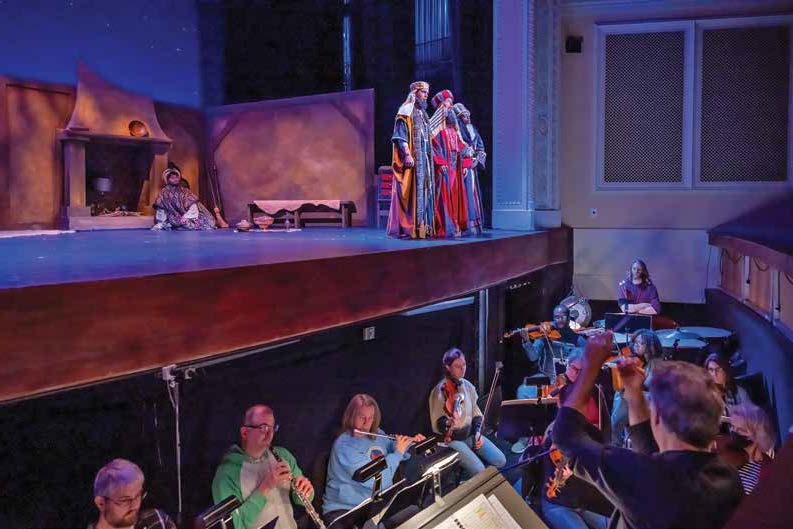
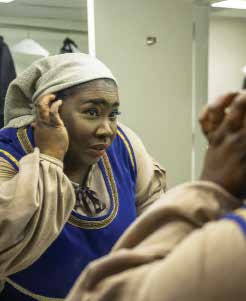
A few members of the cast have not yet retreated behind the curtain. I can hardly recognize their faces, since they’re in full makeup and costume. The kings have beards and flowing robes. The faux jewels in their costumes glitter.

The orchestra is invisible, though I can hear them in the pit warming up. I caught a glimpse of Holley as I walked in, but he too is now invisible.

A single trumpet player runs through scales. The strings are tuning. I can hear the strains of a harp, the muffled thumps of percussion. The violin flourishes run faster and faster. The brass and woodwinds grow louder. Then, suddenly, there’s silence.

At 7:01 p.m., the house lights go dark. Immediately, I hear Holley’s voice.

“One of the spotlights isn’t working,” he calls. I hear a voice in the wings respond, then watch as a big man ascends a ladder until he is out of sight.

I hear a clink, and the light comes on.

There’s a scattering of applause and laughter in the orchestra pit, and then, Holley’s voice.

“Let’s hear it for Scott Garrison!” he says. Garrison is the auditorium’s technical director.

There’s louder clapping, flourishes from the violins. The curtain rises.

The empty, garishly lit stage I saw at my first rehearsal is transformed, bathed in the deep blues and purples of night. There is a wall, a door, a bench. Rough-hewn pallets for sleeping. The set is bathed in warm, yellow light. A single star, the star the kings are following, shines brightly in the midnight blue firmament.

“Thomas, give me a G,” Holley says. He wants to make certain the boy has the right pitch for the Amahl solo they’re about to rehearse.

Thomas sounds the note and the music begins.

There’s still tweaking. Sound amplification for the first violins section is improved. Additional adjustments are made to the stage lighting. There are corrections in tempo, pitch and spoken lines. It’s a rehearsal, after all.

When the kings make their entrance from the rear of the auditorium — honestly — it’s thrilling. Voices booming, perfect tempo, perfect spacing. I hold my breath as they ascend steps to reach the ramp onto the stage, but no one trips on those long, beautiful robes.

Thomas’s soprano voice nicely resonates with the eagerness and purity of youth. The arias Amahl’s mother sings are beautiful and moving. And a pair of dancers, choreographed by Holley’s colleague in the UNCG school of dance, Michael Job, enhance the chorus’s welcoming celebration for the kings.

Later, Holley calls individual performers downstage, almost like a curtain call. Some musicians in the orchestra play short solos. The mood is celebratory. Then, rehearsal is over.

Holley tells me Amahl and the Night Visitors is the ideal opera to introduce people to the art form.

“It’s short, it’s in English, it’s got beautiful singing, it’s got a wonderful orchestra, it’s got stunning visual arts, it’s got dance, it’s got choral music,” he says. “It’s the perfect opera in miniature form.”

And it’s magical.

While I know that you’re just as excited as I am to see Greensboro Opera Company’s next performance of “Amahl and the Night Visitors”, you’ll have to wait until a new production is scheduled.

Still, in October, you can take advantage of a very special opportunity. The company is presenting “Don Giovanni”, with music by Wolfgang Amadeus Mozart and libretto by Lorenzo Da Ponte.

Holley tells me the production will be a “semistaged concert version,” meaning the orchestra performs on stage, rather than being hidden in the pit. The singers, in full costume, perform the opera downstage, right in front of the audience.

For those of you whose command of the Italian language is like mine, never fear — an English translation of the lyrics will display above the stage during the performance.

Based on the Don Juan legend of a Spanish nobleman who takes pride in his ruthless ability to seduce women, the opera premiered in 1787 in the city of Prague, with Mozart himself conducting. Sources describe the audience response as “rapturous and jubilant.” Some critics call “Don Giovanni” Mozart’s “opera of operas,” one of three masterpieces he created with librettist Da Ponte.

“It’s a very exciting production,” says Holley. “The story of “Don Juan” is timeless,” he adds. “You find versions of it in many cultures.”

Here’s the lineup of performers.

Sidney Outlaw returns to the Greensboro Opera to sing the title role of Don Giovanni after playing Jake in “Porgy and Bess”. Outlaw holds a B.A. in music performance from UNCG and a master’s from The Julliard School. He has performed internationally and is on the Manhattan School of Music faculty.

With a master’s of music from UNCG, Melinda Whittingon will sing the part of Donna Anna, a role she’s also performed with her home company, Opera Carolina, in Charlotte. She has sung with many operas, including The Metropolitan Opera in New York, and is an adjunct professor of voice at Davidson College.

Singing the role of Donna Elvira is Samantha Anselmo, who is pursuing doctoral studies in vocal performance and pedagogy at UNCG. Previously, she taught music and voice classes at the University of Southern Alabama. She has performed in two Mozart operas, “Così fan tutte” and “The Magic Flute”.

With a master’s degree of music in vocal performance from UNCG, Amber Rose plays the part of Zerlina in “Don Giovanni”. She performed recently in Opera Carolina’s production of “Madame Butterfly” and was the soprano soloist in Mozart’s Coronation Mass with the Masterworks Chorus of the Palm Beaches.

Another UNCG alum, Christian Blackburn, holds a master’s degree of music performance and is singing the role of Masetto, which he has previously performed with the North Carolina Opera in Raleigh. He has taken a step back from fulltime performing and runs a financial planning and advisory practice in Greensboro.

Donald Hartmann plays the role of Commendatore. He is both a UNCG alum and a colleague of Holley’s, earning his bachelor’s and master’s degrees of music, and serving as professor of voice in the college of visual and performing arts. He has performed more than 75 operatic roles in Europe, Canada and the U.S.

Holley is especially pleased that so many of his former students are returning to Greensboro to perform.

“That’s the beauty of the jobs I have,” he continues. “I wear these two hats — one as director of opera at UNCG; the other as general and artistic director of the Greensboro Opera Company.” In these roles, Holley not only trains young people who aspire to careers as singers, but also hires professionals to perform with the Greensboro Opera.

“Almost all the singers who are doing “Don Giovanni” in October came through my program or are colleagues,” Holley says. “I would say the UNCG College of Visual and Performing Arts is the flagship institution of music in North Carolina.”

Holley muses for a moment.

“You know, opera in this country has a stereotype of not being accessible,” he continues. “People think of it being the fat lady with the spear and the horns and that’s not what it is.”

“Opera is the greatest storytelling on stage,” Holley says. “That’s what we do. We tell stories. We just happen to put it in a context that uses beautiful music, and music speaks to your soul in a way that words by themselves cannot.”

Meet the Makers

MEET THE MAKERS

Meet the Makers

After a five-year hiatus, Westerwood’s art walk and studio tour returns

By Cassie Bustamante

Twenty years ago, ceramicist Ann Lynch moved into the neighborhood of Westerwood and began working as the director of development for the United Arts Council of Greensboro. While in her job, she noticed something within the organization’s artist database: Westerwood was chock full of ’em. When Lynch, as she puts it, “luckily got to stop working in 2008,” like clay in her hands, an idea took shape in her mind: the city’s first and only meet-the-artists-in-theirstudios walking tour.

Lynch approached her Fairmont street neighbors, fiber artist Paige Cox and reduction linoleum printmaker Marianna Williams, who became instrumental in making the vision a reality. In mid-June of 2009, they held a meeting to gauge interest on launching an art walk and studio tour the first weekend of October, only a few months away. Thanks to an enthusiastic response, “We pulled it together very quickly,” says Lynch, adding that she recalls Paige saying, “Who says artists can’t be organized?”

Of course, a catchy name was a must. In a fit of giggles, Lynch and Cox recall a fellow artist suggesting “Bomb Diggity.” After all, it was the 2000s. “We tossed that out,” says Lynch. On a walk in the mountains, Lynch’s husband, Russ, said to her, “We should call it Art & Sole, S-O-L-E.”

For the next 10 years on the first Saturday of October, art lovers would stroll through the charming neighborhood, visiting 20 or so Westerwood studios, and to the delight of the artists, purchasing tons of art. But in 2020, as the world shut down due to COVID, Art & Sole reached what Lynch calls “a natural death.”

This year, thanks to two Atlanta transplants, it’s being revived.

Chandra Young, an “appreciator of art,” says she and husband Ed, a participating artist, moved to Westerwood in 2013 because of Art & Sole. Acrylic painter and photographer Parlee Noonan and her husband, Patrick, had been friends with the Youngs for two decades. Ready for a change, they sought small-city living within drivable distance to their second home in Boone. After visiting the Youngs, they found themselves comparing everything else to Westerwood — and nothing measured up. Last year, they said goodbye to Atlanta and hello to Greensboro.

Before she even moved into their new Westerwood home, Noonan recalls with a laugh how Young said to her, “We have to get Art & Sole going again!”

With Noonan at the helm and Young by her side, Art & Sole has once again found footing. And the aim is to keep Lynch’s original vision alive, celebrating the creative community of Westerwood. This year, you can lace up and log your steps while visiting 31 artists from 10 a.m.–5 p.m., Saturday, October 5.

“We all feel like we are living in a really special place and it’s nice to be able to show it off,” says Young.