Home Grown

HOME GROWN

You Can’t Drive Miss Daisy Crazy

An AI granny has all the time in the world, dear

By Cynthia Adams

Deliberating between pillows on Etsy that read “Monday. Ce N’est Pas Mon Day” (“Monday. That’s not my day”) versus “Ce n’est pas mon jour de chance, j’imagine” (“Not my lucky day, I guess”), a radio segment put an end to my shopping.

The NPR segment was not about Mondays, the descending chill, nor the brooding mood of our nation. None of that. Certainly nothing about feathering the nest with needlepoint.

It was a tale about Daisy, the geriatric British robot.

Meet Daisy, an “AI granny” and clever creation of Virgin Media O2. With a voice imbued with grandmotherly kindness — and loneliness — she is designed to drive phone scammers insane. 

The creative project headed by Sir Richard Branson’s company comes to the aid of an estimated seven in 10 Brits victimized by elaborate and costly scams. To the delight of the citizens of the Realm, Daisy also wreaks satisfying revenge. 

Wearing sweaters and pearls (and the occasional rubber glove with a homey kitchen behind her), Daisy has a deceitful purpose, posing as “an AI pensioner specifically designed to waste the scammer’s time so we don’t have to.” 

Virgin Media’s logic? While scammers are entangled in Daisy’s good-natured, seemingly dimwitted patter, they cannot simultaneously scam innocents. She is a perfect diversion.

The grandmotherly image — of a woman in her 80s — addresses scammers, saying with a smile, “I’m your worst nightmare.” One exasperated scammer huffs, “I think your profession is trying to bother people,” to which Daisy sweetly replies, “I’m just trying to have a little chat.” 

To another who shouts that she has wasted “nearly an hour!” (her record for tying a would-be scammer in knots is 40-plus minutes), Daisy replies affably, “Gosh, how time flies!”

She spends it prattling on, pretending not to understand the scammer’s questions and instead speaking fondly of Fluffy, her cat. When an indignant scammer drops any pretense of goodwill and says, “Stop calling me ‘dear,’ you stupid &**#,” an unflappable Daisy responds, “Got it, dear.”

The AI pensioner possesses inhuman patience and can wear her opponent down. “Let’s face it, dears, I’ve got all the time in the world.”

Daisy is a technological wonder who arrived too late to help my Mama. At 85, Mama was scammed by a young man posing as her much-loved grandson, a mountain-climbing, river-rafting, adventure-seeking fella. The scammer purportedly called from a Mexican jail, where he posed as my nephew. He claimed to have been set up along with his young fellow travelers, falsely accused of marijuana possession. 

Without a word to anyone, Mama drove straight to Walmart with intentions to wire a contact $1,200 in bail money. As she completed the forms, a kindly Western Union clerk gently counseled her to reconsider and first call his family to confirm what she had been told. 

Naturally, the scammer had warned her not to tell anyone, or there would be retaliation. “But how would they know?” the clerk gently asked.

Mama was so undone she wept, but agreed to phone her daughter-in-law and have a conversation. Immediately, she learned it was a scam. She had been duped. Her grandson was not in Mexico, nor had he been. He was safely at home. 

Afterward, Mama was devastated at her gullibility. I made a point of returning to thank the Western Union clerk. She said it played out so frequently it was predictable. 

Come to think of it, Mama’s phone scam played out on a Monday before a kindly intervention stopped the scammer cold. Proving Monday was Mama’s lucky day after all! Shaking my head at the memory I returned to Etsy, placing the pillow in my cart.

Now if only a clever someone would offer a needlepoint of deliciously duplicitous Daisy . . .

Wandering Billy

WANDERING BILLY

Tales of a true Hill Billy

By Billy Ingram

I rang up my sister to wish her a happy birthday the other day and found her on the other end excitedly basking in a sentimental glow. It so happened she was visiting a friend who lives in the house where we grew up on Hill Street. When she told me this was a possibility at lunch earlier in the week, I suggested she ask if I could join them, reasoning I could cobble together a column for O.Henry out of what is a highly unusual experience. But when she brought up to her friend the possibility of my tagging along, the response was a resounding no. “We’ve read what your brother has written about our house.” Well . . . I never!

Or maybe I did, you decide.

I have nothing but fond memories of roaming the two blocks of Hill Street north of Wendover in Latham Park (Irving Park adjacent, in modern parlance) as a carefree youngster. I’d tromp along searching for adventure (existing solely in our imaginations) with my brother, sister and the neighborhood youths who all seemed to move away after a short two or three years. In a Mayberry-like cliche, it wasn’t until I was a teenager and we had moved into Irving Park proper that my father had a key made for the front door on Hill — just to pass on to its new owner. We’d never had one before, the place remaining unlocked even when we were away on two-week vacations.

Our Mema, as we called my father’s mother, resided on the corner of Hill and Northwood in a charming Tudor-inspired cottage. Almost daily, she would stroll from her place to ours, cradling a wicker basket filled with cakes, pies or silver dollar country ham biscuits, a gingham cloth covering those baked goods. The stuff of Norman Rockwell paintings.

I wondered, how could I have offended my sister’s friend with my quaint remembrances shared in an article written nine years ago? Surely not when I told readers about what was referred to as “The Snake Pit” located at the end of our driveway. Folks loved my gregarious parents who, until I was born and torpedoed the party, actually drove around in a school bus they had retrofitted into a rolling nightclub. On Hill Street, around sundown on warm nights, about a dozen young adults, many of whom I suspect should have been home with their babies, would congregate, guzzling Old Grand Dad or downing beers, laughing hysterically at heaven knows what, while upstairs we were attempting to sleep. Witnessing this spectacle, one Irving Park socialite remarked, “I don’t know who wrote Tobacco Road, but I know where he was standing when he thought it up!” Pull tabs yanked and discarded from Miller High Life cans littered the driveway each morning, so many I once made a chain mail vest out of them.

Was my faux pas revealing that our 70-year-old next-door neighbor was fond of sunbathing in the nude? Daphne Lewis left this realm ages ago, so that shouldn’t be a thorny issue today. Then again . . . maybe it is. Mrs. Lewis harangued her husband so loudly at night, we heard every word clearly inside our home. One imagines his death was a welcome reprieve when it mercifully came. When Mrs. Lewis passed away a few years later, I helped her sister clear out the house while, the entire time, random objects fell off of shelves in rooms we weren’t in. For all I know, Daphne’s restless spirit may still be tossing tchotchkes to the floor in that residence.

Was it the story of brazen Mrs. Bunn, living directly across the street, that was so distasteful? Forty-something and attractive, I spent hours sitting on her front steps while Mrs. Bunn chain smoked, bitching about married life. Like Bette Davis in The Letter, from her porch perched above, Mrs. Bunn emptied a .22 snubnose into her husband one steamy September evening around dusk. He fell dead in the middle of the road between our homes. My first instinct was to rush across the street to see if she was okay, which my dad and I did after waiting a respectable few minutes. Wish I could find the Polaroids I took of my siblings posing inside the chalk outline of the body that police left sketched on the pavement — relatively tasteful pics, I’m certain. After exercising her Second Amendment right to a speedy divorce, Mrs. Bunn moved to the Sunshine State with her son and a boyfriend who had appeared on the scene before the proverbial gun smoke cleared.

Further up the block, a businessman shot and killed a perceived peeping Tom perched outside the couple’s bedroom window. We were told he was an unfortunate teenager who managed to stagger back toward his nearby home before expiring.

As kids, we wandered in and out of everyone’s backyards without any consideration for boundaries or property lines. Almost every house had two-story garages that served as our clubhouses, whether homeowners were aware of it or not. The side yard removed from 1102 Hill Street when Wendover was widened in the mid-1960s was a jungle-like wooded area we dubbed “Tarzanland” for the interwoven vines we swung from, descending from ivy-covered trees. You can still see the weathered remnants today. Across the street was a backyard shrine with an ornate bird bath, crowned with a statue of Christ, that we called “Jesusland,” where we’d linger a bit and pray. For Pixie Stix and Wacky Packages, no doubt.

Northwood, traversing downward from Grayland Street, past Hill, then Briarcliff Road leading into Latham Park, was one the city’s greatest sledding spots whenever the city experienced its numerous major snow and ice events. Back then, that was just about every winter. On those corners, teenagers, all but obscured under unrelenting, swirling, nighttime whiteouts, stood around metal trash cans — every home was required to have one — serving as bonfire bins, swigging potables possibly purloined from Pop’s liquor cabinet. The city didn’t bother plowing neighborhood streets then, creating a children’s paradise whenever a few inches of snowfall shut down the town. There was so much frozen precipitation when I was younger, my father would equip one of the cars with snow tires from November until March.

Heartstring-tugging tales, all of them. I’m astonished anyone presently living on Hill Street would be offended. Even with sidestepping the occasional corpse, this was a wonderful neighborhood to grow up in, inhabited with kind and loving neighbors, family and folks who became lifelong friends. An idyllic place to live to this day, one imagines.

Heck, I’m not the sentimental type. I was mostly curious if that deep hole I dug tunneling to China was still behind the garage and whether any misshapen mole creatures ever crawled out of it. As I’m writing this, I related some of these childhood stories to a good friend, who quipped dismissively, “No wonder you go around in life acting like the rules don’t apply to you.”With much trepidation, Billy Ingram wishes everyone a very happy new year. To paraphrase the aforementioned Bette Davis, “Fasten your seat belts, it’s going to be a bumpy ride!” 

Birdwatch

BIRDWATCH

Oh, Canada

The goose who came to dinner

By Susan Campbell

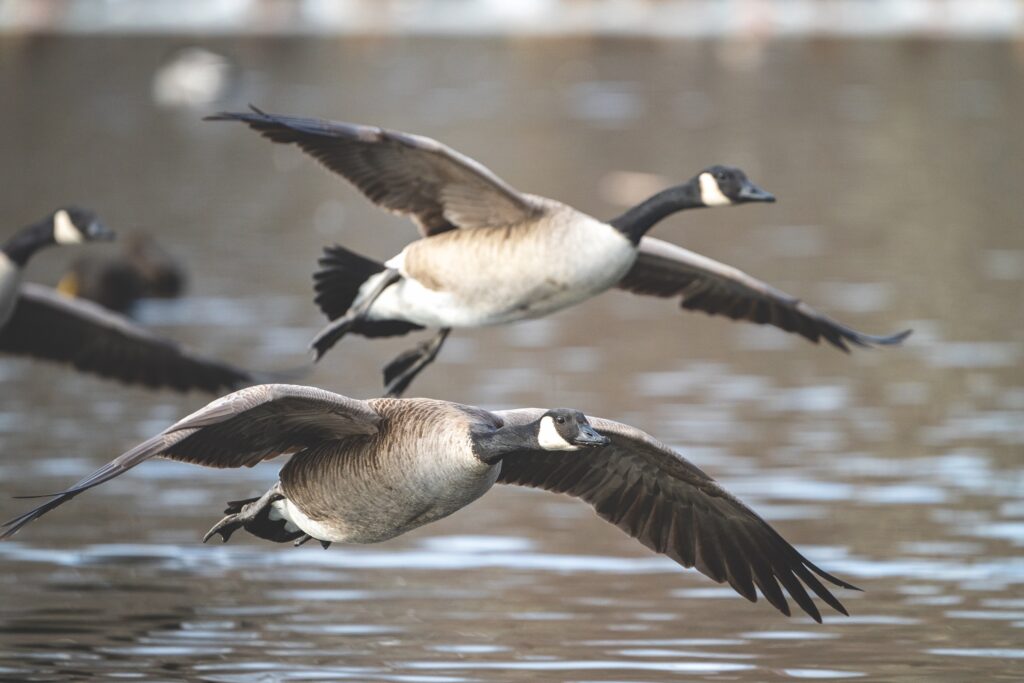
That unmistakable honk — we have all heard it. Especially near golf courses, public parks or bodies of water. Canada geese can be found just about anywhere in our state. Their tan bodies, long black necks and heads with the characteristic white “chin strap” are unmistakable. Males, or ganders, are a bit larger than the females, referred to as geese, but other than that, the sexes appear identical. Pairs do remain together for life. However, if need be, they will seek a new mate in late winter. These handsome birds are vegetarians and well adapted to a variety of wet habitats.

At this time of year, aggregations of Canadas can number from hundreds into thousands of birds. Sadly, however, most of the birds are not wild individuals. The geese you are most likely to encounter are the descendants of farm-raised Canadas that were introduced for hunting during the first half of the last century. With no parents to show them where to migrate to and from, they immediately became sedentary, hence our ability to encounter these large waterbirds on any day of the year.

For many years, Canada geese were the most abundant of the larger migratory waterfowl wintering on our Coastal Plain. Tundra swans and snow geese were in the minority. Then as food became more abundant to the north — specifically as a result of agricultural practices around the Chesapeake Bay — the birds began short-stopping in the 1980s.

Concurrently, the number of snow geese has increased. There is greater availability of food on the tundra during the breeding season, with a decreasing snowpack as temperatures have increased. And in the winter, there is less in the way of competition from Canadas. Snow geese are leerier of hunters and not so easily fooled by decoys as they were 30 years ago. Swans, too, are far more challenging to hunt. Therefore, the number of birds surviving to breed come spring has boosted population numbers.

If you know where to go, you can encounter wild Canada geese in North Carolina, though the locations are restricted to our coast. The larger wildlife refuges, such as Pungo, Mattamuskeet and Alligator River, host birds from up north each winter. These birds are as skittish as our local birds are tame. Although there is waterfowl hunting on these properties, the U.S. Fish and Wildlife Service is careful to limit both the days and the areas where hunting occurs. The majority of the acreage of these federal lands is truly a refuge for these and other species of waterfowl during the winter months.

Habitat on the refuges, as well as much of the adjacent state and private property, is managed to attract wintering swans and ducks in addition to geese. Cover crops such as corn, millet and a variety of native perennials are carefully fostered during the growing season as food sources for the visiting birds. Fields are flooded right before the flocks arrive to provide safety from terrestrial predators, such as bobcats, coyotes and even red wolves. These impounded areas have dikes with water-control devices that maintain the desired depth. Additionally, public access is controlled to reduce human disturbance.

Should you go in search of wild geese, there is plenty of access for viewing. There is a long history of bird and wildlife-watching on our federal refuges. Birdwatching and photography are very popular activities — especially in winter when the number of birds is nothing short of spectacular. There are good maps of the walking trails and roads open for driving. Thousands of people flock to marvel at the phenomenon each year. Some of us head east to ogle waterfowl multiple times during the season.

Regardless of where you encounter Canada geese in the winter, be aware that other waterfowl may mix in to gain what we think of as the “safety-in-numbers” strategy. A lone snow goose, Ross’s goose or white-fronted goose may hang out with the Canadas for a few days or even a few weeks. This could be the case with the flock in your neighborhood. So the next time you pass a group of Canadas, it might be worth stopping to see if an unusual individual has joined the party.