Murals, Music, Museums

MURALS, MUSIC, MUSEUMS

Murals, Music, Museums

Exploring Elkin,one of North Carolina’s underrated destinations

By Danielle Rotella Adams

Winding down the sloped, two-lane road into downtown Elkin, the Blue Ridge Mountain majesty emerges as an unexpected backdrop. On a clear, sunny Friday, my husband, Tom, and I travel past grand, centuries-old Victorian homes that line the streets. Sprinkled among them are charming, 100-year-old Craftsman-style bungalows with intricate stained-glass doors and wide, red brick columns. It’s easy to imagine neighbors visiting each other’s porches, drinking fresh-brewed sweet tea on blistering summer days.

Just 65 miles from Greensboro, Elkin offers a slower pace where history and creativity are a way of life.

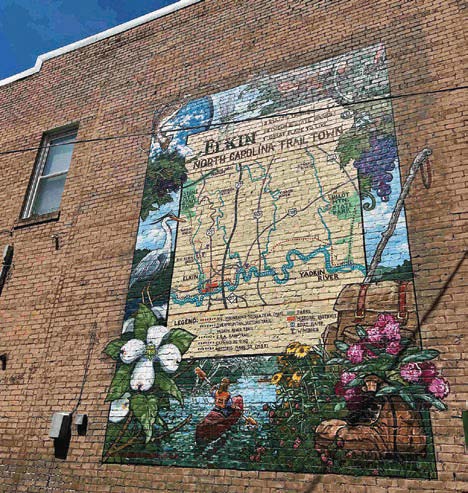
As we slow down to park, an enormous mural serves as a sort of welcome sign. Chapel Hill artist Michael Brown, whose work can be found locally at the Greensboro Public Library’s rotunda, has painted a landscape of perfectly lined grape vines set against Stone Mountain and a cloudy, Carolina-blue sky in the background. Business owners in Elkin have been adding their own murals to the blank sides of their buildings since 2012 as part of the Mural Grant Program, bringing a bit of whimsy to the “Best Little Town in North Carolina,” a slogan dating back at least 100 years.

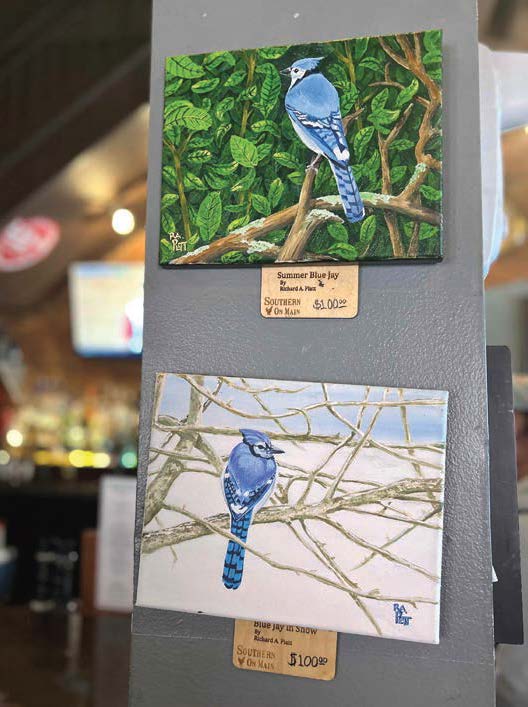
Arriving at lunchtime finds us ducking into a scrumptious farm-to-table feast at Southern on Main, a hometown favorite that proudly displays art for sale. Vibrant bluejay canvases pop against the wood-beamed walls.

Marvin Gaye’s “Take This Heart of Mine” plays faintly in the background as our cheery waiter, Dennis, reaches our corner patio table, holding a tray of starters — hot bubbling Gouda mac-and-cheese, tangy, crisped-to-perfection Brussels sprouts, and creamy deviled eggs. His eyebrows inch up when we decide to pile on the enticing blackened catfish and chicken pot pie. Our bellies filled with Chef Marla Egger’s seasonal, Southern fare, we set off to see what else Elkin offers.

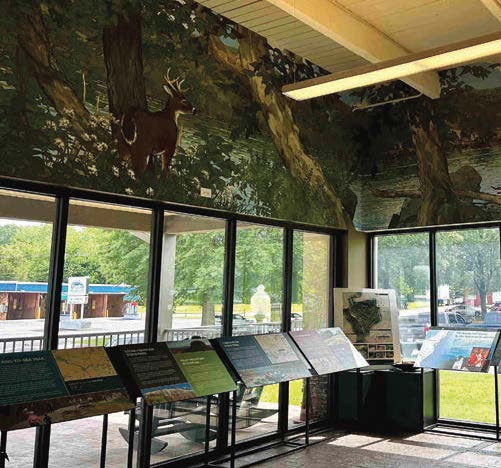
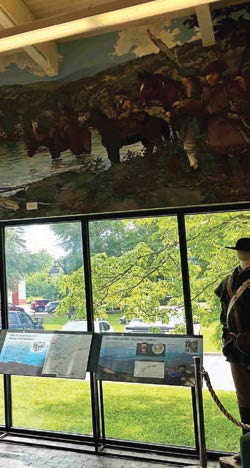
Walking past an old train car, we soon arrive at the Yadkin Valley Heritage & Trails Visitor Center at 257 Standard St. Another massive Michael Brown work highlights the story of the Revolutionary War’s Overmountain Men, who crossed the Yadkin River on their way to King’s Mountain, S.C. Inside, we learn how far back Elkin’s history goes, back to when Sioux Indians settled along the Yadkin River as early as 500 B.C.

Next, we trudge up steep Church Street to admire the quaint Richard Gwyn Museum at 139 Church St., built in 1850 by Gwyn himself, Elkin’s founder. Although closed, we peek inside the tiny, wooden one-room schoolhouse, where a single teacher educated children of all ages and grades together.

Gwyn established the town’s first and most influential industries — a gristmill and a cotton mill, later sold to the Chatham family. The Chatham Manufacturing Company started producing wool Civil War uniforms, blankets for soldiers in World Wars I and II, and, later, car upholstery.

History, check. Next up? Shopping! We head back to Main Street, where flowering perennials and annuals spill out of the tops of oak barrels carefully placed on street corners, featuring handwritten directional signposts to help visitors find local spots. Suddenly, we realize that we’re trekking down the Mountains-to-Sea Trail (MST), a small segment of the footpath that stretches almost 1,200 miles across North Carolina.

Walking into Wildflower DIY Bar makes me smile. Owner Laura Wood sits at a large table surrounded by assorted paints, probably studying her next project. She opened Wildflower more than 10 years ago and migrated to different locations before landing at her 111 W. Main St. spot, where she teaches classes, hosts parties and sells local paintings, beading, and handmade whimsical creations. A self-taught artist, Wood grew up in Elkin and worked in mental health, where she found that her students with disabilities discovered their inner beauty through art. She now helps others find their creativity in a myriad of ways.

“There’s a lot of art, culture and history in Elkin,” Wood shares. “Everyone knows everyone, too, and if you need something, someone will help you out.”

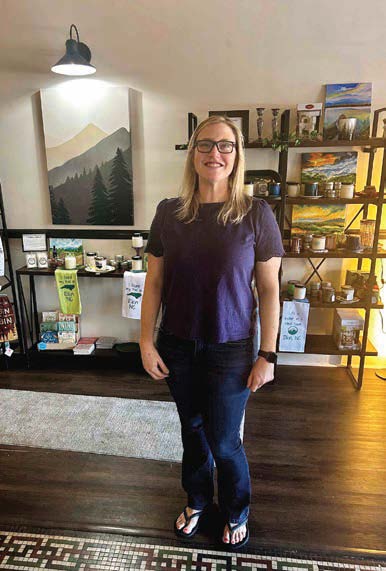
Continuing down the main drag, we pass Michelle’s Consignments and Yadkin Valley Fiber Center, before stepping into Candles Etc. As indulgent, floral fragrances fill my nostrils, owner Kerri Ramsey greets us near the door, sharing how her Earth-friendly, soy candles are all hand-poured on site. She opened her shop in 2024, but sold candles before then at nearby wineries, where she also offers onsite candle-making classes. No way I’m leaving empty-handed. I load up with an Elkin Rainstorm candle, glass matchstick holder, and “Take a Hike!”-etched candles. Ramsey then shows me her favorite seasonal selection, so I pile on Holly Jolly Gingerbread and Cranberry Spice candles. Fall is just around the corner, after all.

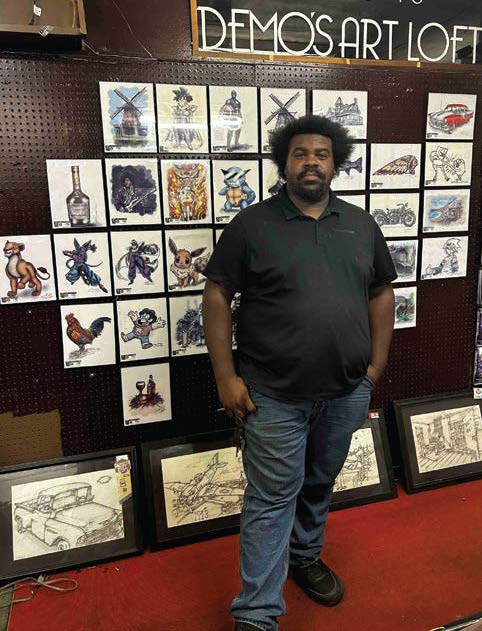
On the other side of Main Street, we tour Demo’s Art Loft, located inside Kennedy Auto Antique Shop. Walking into the antique shop feels like stepping back in time, merchandise stretching as far as the eye can see, possibly from all the decades the shop has existed — seven, to be exact. After meeting Maggie May, the owner’s long-haired dachshund and obviously the store’s security detail, I walk upstairs to meet artist Geoffrey Walker and leave Tom downstairs to see if there are any nostalgic relics he can’t live without. 

Walker, who opened his store in 2017, uses different mixed media, from graphite, ink and watercolor to 2D and 3D printing and woodworking. He has a knack for landscapes, portraits and unique anime creations. After I buy three of his framed prints, he asks, “Do you want to see the phonographs downstairs?” Meeting Tom back at the main level, the three of us venture to the basement, where a treasure trove of beautiful, ornate, hand-cranked phonographs from the early 1900s awaits. Their intricate oak and mahogany cabinets are etched, some with decorative red roses and green vines.

“I learned by seeing what they do, trial and error, and talking with other people,” Walker happily remarks. “The spring,” he notes, “is the main thing that needs repair — it has fatigue over the years. Sometimes it’s a simple fix.”

Speaking of “fix,” the smell of freshly roasted coffee beans lures us into Milk & Honey Coffee Company on West Main Street for a subtle jolt of post-shopping caffeine. Opened in 2025 by baker Faith Stone and her coffee aficionado husband, Sam Stone, the shop’s ornate chalkboard menu offerings scratch our itch. More caffeinated specialties can be found at Garden Route Coffee, owned by Tina and Rod Poplin, former missionaries in South Africa who fell in love with local, high-quality coffee. After sipping on a delightfully creamy Honeybee Latte and noshing on a buttery, homemade Berry Pop Tart, we follow our ears to the downtown music scene.

We just so happen to stumble upon Friday Night Live at Reeves Theater, which brings live music to different spots downtown, April through October. Tonight, Couldn’t Be Happiers and Catastrophe Journal, both from Winston-Salem, fill the Art-Deco style movie house with indie-folk and indie-pop sounds. We order glasses of Shelton Vineyards Bin 17 Chardonnay from the theater bar and tap our feet to high-energy originals.

Opened in 1941, the 250-seat theater underwent several iterations before three devoted Elkin residents, Chris Groner, Debbie Carson and Erik Dahlager, turned it into a live music venue in 2013. Free Music Wednesday is offered year-round. The Martha Bassett Show records live every other Thursday, and ongoing jams can be enjoyed by The Reeves House Band.

Finally, our tummies are rumbling again, and we venture to Angry Troll Brewing, the town’s homegrown local microbrewery and restaurant. A renovated textile warehouse with tall, wood-beamed ceilings, exposed brick, and numerous TVs, we opt for a steaming-hot sausage pizza and garlic buffalo wings, washed down with Orange Goblin Ales. Despite its name, which is derived from the storybook troll whose bridge was demolished, Angry Troll has a warm, welcoming vibe. We can’t help but sing along with the ’90s tunes.

Not ready to tap out quite yet, we visit Embers Eclectic Pub, another popular watering hole on West Main Street. The pub name is inspired by an Irish proverb about finding lasting love, which seems to have been attained by owners and marriage partners Dylan Hayward and Alexis Usko, who moved to Elkin in 2016 and opened their locally adored spot six years later.

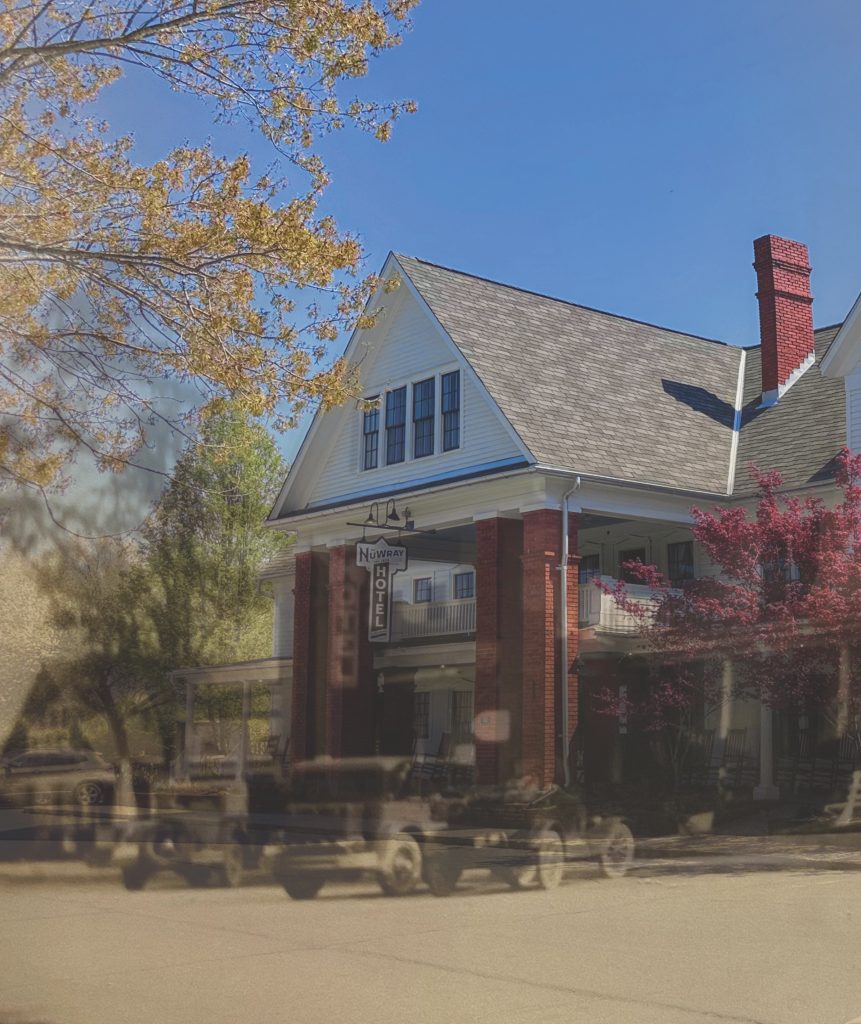
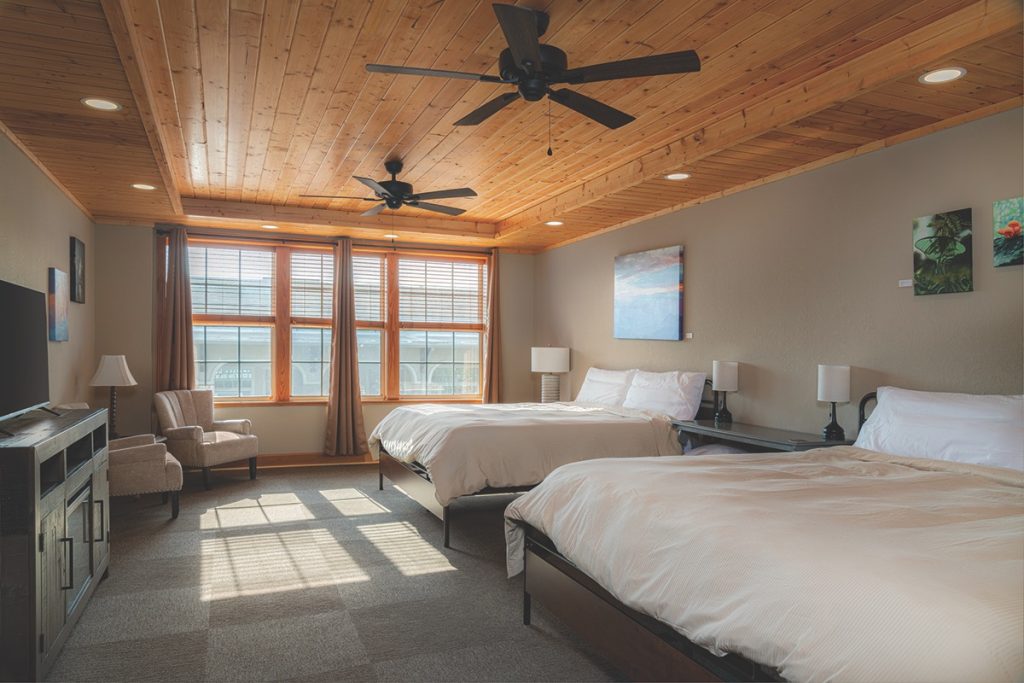
After a full day, we’re asleep as soon as our heads hit the pillow at Three Trails Boutique Hotel, a renovated historic building with studios, one-, two-, and three-bedroom units, several accessible options, and a stunning rooftop patio overlooking downtown.

After grabbing a quick breakfast the next morning at the Elkin Farmers Market, we buckle up and begin our short drive back home, the grape tree mural fading in our rearview mirror. But it’s not goodbye for long — I’ve already marked my calendar for next month’s Yadkin Valley Pumpkin Festival.

Drawing Room

DRAWING ROOM

Greensboro cartoonist Tim Rickard reflects on two decades of Brewster Rockit

By Maria Johnson

Photograph by Bert VanderVeen

Someone sets a cup of coffee on the roof of their car.

They get distracted.

They drive off, cup still on top of the car.

This all-too-human scenario tickles cartoonist Tim Rickard as he picks up his stylus and starts doodling.

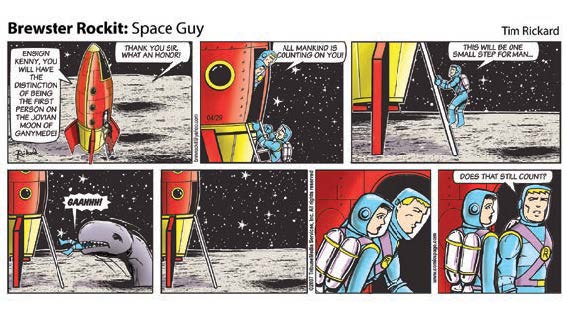
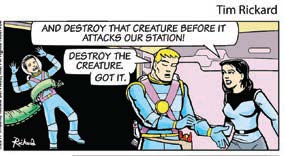
What tickles him more is the possibility of this uh-oh moment happening in outer space, specifically in the world he has created for his syndicated comic strip, Brewster Rockit: Space Guy!, which is named for its protagonist, the strikingly handsome and equally clueless commander of the space station R.U. Sirius.

In the 21 years since Brewster and his crew of cosmo-nuts first appeared in publications around the country, Rickard has blasted them into deep-space silliness thousands of times. He draws six strips a week: one for every weekday, plus a standalone for Sunday.

The strip appears in the funny pages of major publications, including The Washington Post, the Chicago Tribune and the Atlanta Journal-Constitution.

While Brewster is a tyke compared to some longstanding cartoons — Rickard’s broker, Tribune Content Agency, also represents stalwarts Dick Tracy, Broom-Hilda, Gasoline Alley and Annie — the commander’s longevity is a stellar achievement in the universe of syndicated strips, where the average feature lasts 10 to 15 years.

One key to Brewster’s endurance: a fan base that includes the professionally spaced-out.

“I love the way he manages to be informative and funny,” says Marc Rayman, the chief engineer for mission operations and science at NASA’s Jet Propulsion Laboratory in Pasadena, CA.

He’s talking about Rickard, whom he credits with otherworldly talent.

Brewster is another story.

“Brewster never intends to be funny,” adds Rayman. “He’s not smart enough to be funny. But I admire his biceps and his jaw.”

Where would the ill-fated coffee cup be? Rickard wonders how to transport the commuter gag into Brewster’s world.

He sits at a desk in his home office, where he has worked since 2020, when he was laid off by Greensboro’s News & Record newspaper after 27 years as a staff artist.

He slides a stylus across a graphics tablet.

Lines appear on the 24-inch screen in front of him.

He roughs out the R.U. Sirius and places a coffee cup on top of the space station.

Nah, he decides. The cup is too small relative to the station.

Rickard, who resembles a salt-and-pepper version of the boyish Brewster, deletes the scene and starts over.

He draws a pointy-nosed rocket zipping sideways through space and outlines a coffee cup on top.

Nope. Still not right. Delete.

His mind and his hand keep moving.

He was a scribbler.

You know the one: The kid who draws on every napkin. Every flyleaf. Every sidewalk.

Rickard’s dad liked to tell the story of going into an Owensboro, Ky., cafe in the wintertime and watching his son, then 4 or 5, draw with his finger on the steamy windows.

Rickard, 66, who has been a member of MENSA, the high-IQ club, for about 40 years, looks back on his younger self with a mixture of humor and compassion.

Several years ago, he says, he realized that he’s probably on the high-functioning end of the autism spectrum, along with many others who excel in the visual arts.

As a youngster, he was plenty smart intellectually, but talking with people face-to-face was challenging. Communicating with pictures — with the chance to draw in solitude, erase and redo — was much easier.

He went to Kentucky Wesleyan College to study art, with an eye toward advertising. A couple of internships and freelance jobs later, he decided that working for a newspaper, on the editorial side, would offer more variety and freedom.

He joined his hometown paper, the Owensboro Messenger-Inquirer. A couple of years later, seeking a bigger paycheck, he signed on with the News & Record. His portfolio expanded to include courtroom sketches, editorial cartoons and illustrations for stories that did not lend themselves to photographs.

He also started a weekly comic called Joke’s on You, a single-frame feature that showed characters in situations with no dialogue. Readers competed to provide the winning captions.

Summerfield veterinarian Tim Tribbett won 32 contests, more than anyone. One of Tribbett’s favorites showed a mama bear and baby bear gazing at a bearskin rug on the floor of their home.
“Couldn’t we just keep a photo on the mantle?” the cub asks in Tribbett’s caption.

Every week, Rickard sent the winner a signed, printed copy of their entry along with a note of congratulations. The strip provided a community for participants.

“We never met, but we felt like we knew Tim, and we knew each other a little bit,” says Tribbett.

When Rickard left the newspaper during COVID, about 20 faithful contestants threw him a party at a local park. They brought a cake topped with an edible image of Rickard’s work.

“The contest meant a lot to us,” Tribbett says.

Rickard is still pondering where to put the coffee cup.

Atop a small flying saucer?

That would be comparable to a car.

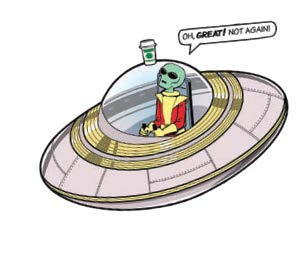
He sketches a small, sporty saucer with a clear dome. The coffee cup appears on top.

Bingo.

More questions blossom in his head: Who is inside the saucer? How many characters?

Is there dialogue between them?

Two aliens appear inside the bubble.

“You left your coffee on the roof again?” one says to the other.

Rickard studies the scene.

It’s OK.

But just OK.

Drawing a strip that appeared in funny pages nationwide — that was the goal.

Rickard started submitting ideas to syndicates when he was in high school.

Rejections piled up, but some contained a grain of encouragement.

“Not bad.”

“You’re a good gag writer.”

It was enough to keep him going.

He knew his ideas were derivative, hewing too closely to existing strips. He needed something fresh.

Long a fan of Star Trek, Star Wars, the Marvel catalog and monster movies, he was at home in fantasy worlds. But Earthly wisdom held that space-based comics didn’t fly, and Rickard was loath to try sci-funny until rejection pushed him to give it a whirl.

“I figured if I was gonna fail, I might as well fail doing something I want to do,” he says.

That’s when Brewster came to visit. Rickard was in his early 40s.

Drawing late at night while his family slept, he invited the hapless captain into his head to play. Soon, Brewster showed up with other characters, including Brewster’s very competent wife, Pamela Mae Snap; Dr. Mel Practice, the station’s crazed chief scientist, whose inventions include the Procrastination Ray; and Dirk Raider, a former member of Brewster’s Goodguy Knights who had crossed over to the sinister Microsith corporation.

Rickard drew his characters in a realistic style reminiscent of soapy comic strips Steve Canyon, Mary Worth and Rex Morgan M.D.

His concept — that Brewster and his goofy sidekicks protected the Earth from evil— was funny on its face, and it provided a lot of room for storylines.

In early 2003, Rickard sent samples of Brewster to three syndicates. Two replied with nays. The third did not respond. Rickard assumed that meant “no.” He let go of his dream.

A couple of months later, the third syndicate replied. They wanted to see more.

Rickard sharpened his strip according to the editors’ suggestions, and Brewster joined the fleet of Tribune comics in July 2004.

NASA’s Rayman saw the strip in the Los Angeles Times soon after it launched.

Brewster’s mix of scientific literacy and everyday nincompoopery impressed him and his real-world rocket scientist colleagues.

“Many of Tim’s comics — in fact, most of them — don’t have anything specifically to do with space,” Rayman says. “Like any creative artist, he uses the context he has created to cover many different subjects.”

Still, Rayman admits, he’s thrilled whenever Brewster mentions a mission that Rayman is actually working on, as happened in 2007, when the strip referred to DAWN, a probe that investigated the asteroid belt between Mars and Jupiter.

Rayman contacted Rickard to suggest, in jest, that he should ask Brewster and crew for advice. Rickard was game. He incorporated Rayman and a legit question into a strip. Several characters offered lame words of wisdom.

Rickard and Rayman have been collaborating ever since. Rayman fact-checks some of the weekday strips, and they share responsibility for Rocket Science Sunday, an occasional educational version of Brewster.

“He’s extremely open to my comments and feedback,” says Rayman. “There’s no ego to hold back the quality.”

Or the buffoonery.

In Brewster’s world, Earthlings can escape gravity but not their foibles.

“The strip never feels like it’s talking down to anybody because the characters are so flawed and stupid and lazy,” Rickard says. “The reader is always in on the joke.”

Ideas come from all directions: news, science, popular culture.

Sometimes, Rickard’s own life seeps into the frames. After he had his first colonoscopy, so did the character named OldBot.

Once, an enemy storm trooper asked his daughter for help with his phone — a copy and paste of Rickard asking his own daughters for technical assistance.

Also, Brewster made a list when Pam asked him to complete more than one task.

“That was literally a conversation with my wife and me,” Rickard says.

In 2010, he and his syndicators traveled to Hollywood to pitch an animated movie based on Brewster, who appeared in 150 markets at the time.

Nothing came of the meetings, but the comic kept cruising.

Last year, The GreenHill Center for NC Art included more than a dozen Brewster pieces in a show of science fiction works by artists statewide.

Rickard relished the sight of Brewster on the walls of the tony gallery.

“He seemed totally out of place,” he says, chuckling.

Where might Brewster materialize next?

Rickard shrugs. He’d like to do another best-of book. A 2007 paperback collection subtitled Closer Encounters of the Worst Kind is out of print but fetches healthy resale prices.

As for the daily offerings, Rickard repeats his industry’s biggest non-secret: newspapers and other traditional customers are dwindling. The News & Record dropped the strip after they laid off Rickard.

One day in the not-so-distant future, Rickard says, Brewster might cease to dwell on paper, his original home, and live only online. Already, the strip appears at gocomics.com, an internet-only repository of cartoons past and present.

In a way, a total shift to cyberspace would make cosmic — and comic — sense.

Rickard says Brewster and his creator are ready to adapt.

“It’s always been a forward-looking type of strip, so the fact that that would be the inevitable home for him would seem appropriate,” Rickard says.

He deletes one of the aliens in the flying saucer.

The one-liner, “You left your coffee on the roof again?” disappears, too.

Only the driver of the saucer remains.

Rickard re-draws the alien’s head. Now he looks up at the cup through the clear roof of the craft.

A thought bubble appears.

“Oh, no. Not again.”

Rickard sits back and puts his stylus down.

That works.

The Gentlewoman and Happy Farmer

THE GENTLEWOMAN AND HAPPY FARMER

The Gentlewoman and Happy Farmer

Margie Benbow bought the farm

By Cynthia Adams     Photographs by John Gessner

Margie Benbow did not grow up on a farm. But the easygoing former urbanite says, “I wanted to be a ‘country’ Benbow.”

And so she is, living contentedly in a traditional, white clapboard farmhouse nearing a century old. One with generous porches and a wide-open view to acreage planted in fescue and flowers. 

Wearing a denim dress with overall straps, Crocs sandals and a red bandana holding back her blond hair, you might guess she has known nothing but life on a Summerfield farm. But you’d be wrong. She is a scientist, lawyer, auctioneer and artist — now farmer — joining the ranks of 24,160 women farmers in North Carolina, where the percentage of women jumped 90% in recent decades. 

She’s downright Jeffersonian in her wide-ranging ambitions, not only practicing law while farming, but simultaneously making a serious run at political life last year. No matter that she lost her race for the North Carolina House of Representatives; Benbow maintains a natural sunniness, a goodwill that makes even her losses look like wins.

This is decidedly her super power. 

If any of her dreams were easy, she probably wouldn’t even have found them very interesting. 

Nine years ago, Benbow said goodbye to the din of traffic and all that comes with it, having lost her physician husband, Dr. Hector Henry, to cancer. Court dockets no longer ruled her calendar — just before the pandemic, she had settled into a rural rhythm largely dictated by Mother Nature.

She acquired not one, but two farms — another is a leafy drive away in the tiny community of Bethany, population 362. 

Summerfield, by comparison, is practically a bustling suburb of over 11,000 residents. This, she laughs, is her city residence.

Wandering into the kitchen to prepare a ginger tea, Benbow appraises the space, which is open and oriented to the farmland behind the house. Even inside, she can keep watch on her crops from the dining room table.

She came of age in a pleasant Winston-Salem neighborhood as a “city” Benbow, with three sisters and a brother, relishing visits with the family’s “country” kin. She confides having always envied the life of her counterparts.

She ruminates about the reasons she is smitten with being far from the maddening horde.

“They had a pond. Since I was 4, I’ve wanted this life,” she declares.

Now she, too, has a pond of her own at the Bethany farm near a log cabin where restoration is underway. As further proof of self-reliance, Benbow has tasked herself with learning to make a split-bamboo fly rod — should she ever want to cast off. Online tutorials are daunting. But, then, that probably just whetted her appetite to learn.

In Summerfield, she has created a sunny, happy haven, the rooms dominated by whimsical, colorful art. 

“This is my city house,” she teases, nary a neighboring house in sight.  “My country house is 4 miles down the road.”  She first bought the Summerfield house and 20-acre farm in 2016. The second farm, bought in 2020, sold at auction. Benbow was the top bidder. Land, she explains, is an addiction.

Then, the pandemic struck and a lockdown ensued. She realized she was going to have more than a small amount of isolation, even in what she calls her “city” house because of its proximity to Summerfield. She admittedly binge-watched Netflix and ate popcorn.

But also, she got busy.

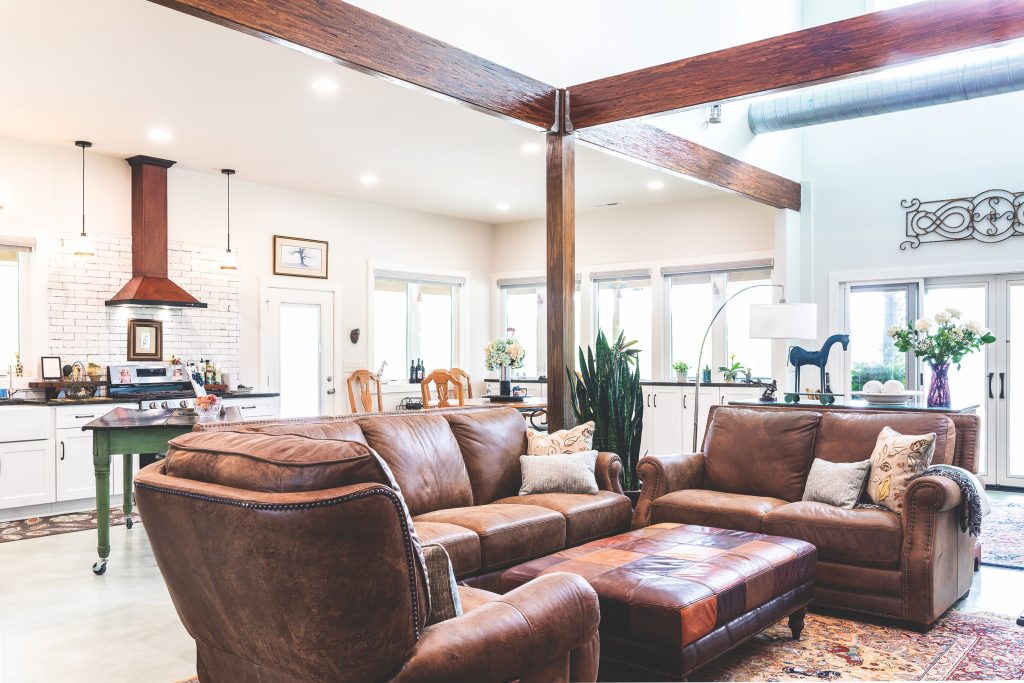
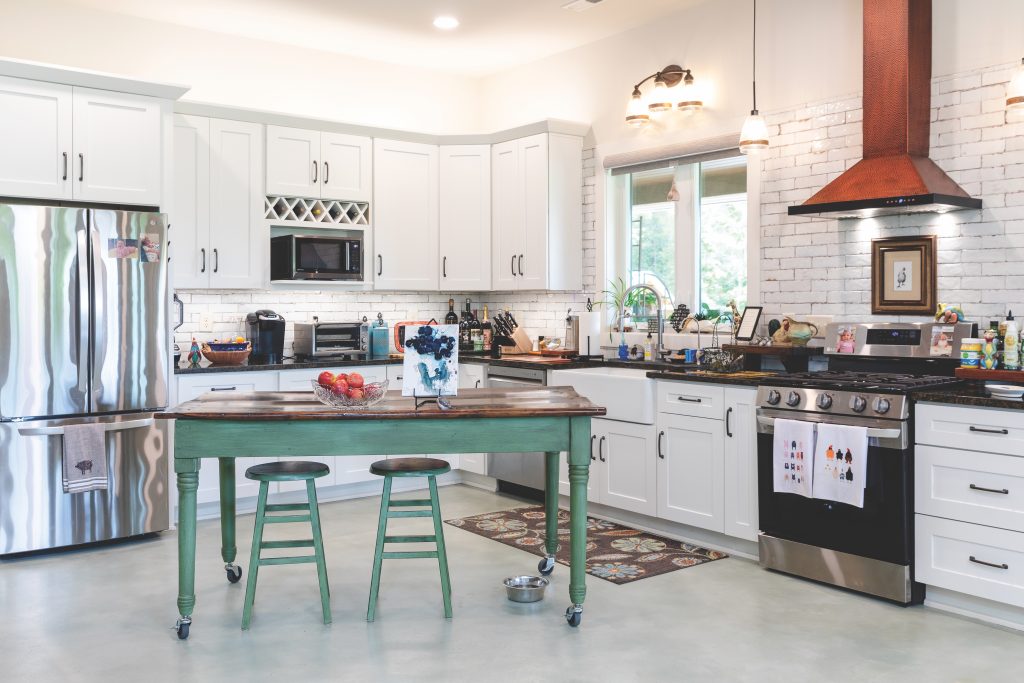
As an avid artist, Benbow weighed the overall aesthetics of the house where she had moved. “It had amazing bones.” The kitchen, centrally located and serviceable, made sense to leave much as she found it, preserving the existing layout. The space includes four sets of doors making it light-struck and airy.

But Benbow explains that the farmhouse was a less daunting project than the restoration of the farmlands whereupon it sits. Much had already been accomplished in the house when she acquired the property, she says. Essentials, like replacing windows. But some things were neglected, like the disintegrating fireplace bricks.

Then she considered ways she could inject her own style. The cosmetics could use some help, she decided. Benbow ripped out the kitchen tile, designing and crafting her own backsplash tile at the Sawtooth Center in Winston-Salem. A hefty butcher’s block, repurposed as an island, required six people to move in as well as joist reinforcement. But once in place, it looked as if had always been there.

The open kitchen, now suitable for a serious cook, features a professional range. But when questioned about cooking, she laughs. “It looks like a cook’s kitchen.” 

Cooking? Not her thing. 

Benbow points out the most-used “fancy” appliances, giving a throaty laugh: a toaster, a popcorn popper, a Ninja juicer and a coffeemaker.

“That’s about it.” Still, she agrees. The range looks great.

As a rule, where Benbow found original farmhouse details, she kept them. But the ugly and unoriginal popcorn ceiling and cheap light fixtures had to go. Mostly, she “just made it pretty. Calmed it down.”

Since moving here, she has accomplished a lot, steadily ridding the surrounding land of tangled overgrowth. In order to grow flowers (focusing upon pollinators, a passion) she tackled clearing the fields of seven years of tree growth. 

Afterward, she used the sawdust from removing all those trees, recognizing it as a compatible medium for planting zinnia. But a storm made short work of her investment in seeds, fertilizer and lime — all laid to waste.

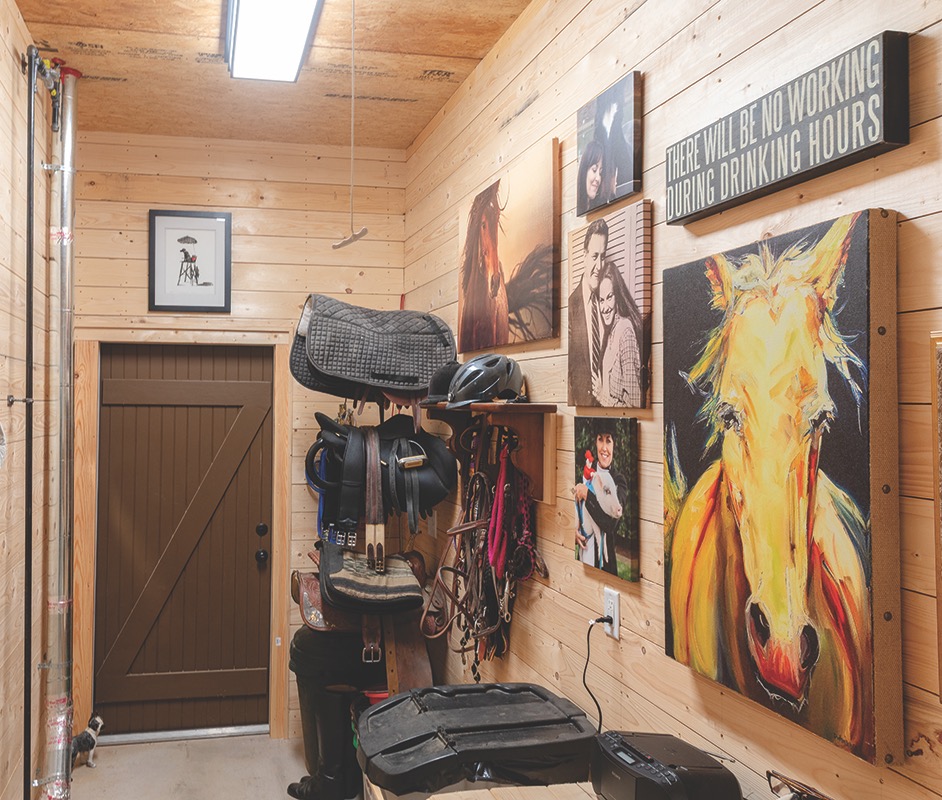
Undaunted, Benbow acquired her second, 50-acre farm using new auctioneering skills from Mendenhall School of Auctioneering. A slew of projects came with the parcel — outbuildings, a log cabin, even a country store. She keeps horses there in a fine new equestrian barn. A mare, she says proudly, recently foaled.

The dream, however, follows a personal tragedy. She and her late husband were birds of a feather. The doctor, medical professor and long-time member of the city council in Concord, was a Colonel in the U.S. Army Reserves Medical Corps. (He made headlines volunteering for multiple Middle East deployments when well past retirement age.)

Benbow reminisces about their meeting at Duke when she was a graduate student working in a lab and he was doing morning rounds as a pediatric urologist. (She nearly went on to medical school.)

Henry had surreptitiously “scoped her out” as she demonstrated to residents how to do cell cultures.

Initially, she was reserved, questioning how he obtained her number when he called her. He thought she might be an ice princess. 

Before dating, she grilled Henry.

Had he ever done drugs? Was there another woman that would mind her having dinner with him? And, out of curiosity, what was his age?

“He answered no to the first two.” The age difference didn’t matter.

Three months later, they were engaged, marrying in 1992. She muses about the fact that only one of her four siblings didn’t pair up with a doctor. 

Seemingly indefatigable, Henry died on Thanksgiving Day in 2014 at age 75 due to complications from a rare blood cancer. Her smile fades. For seven months following, she describes being “spiritually diminished.”

With Henry’s death, Benbow was forced to begin anew. She literally replanted herself.

Behind her Summerfield farmhouse, a colorful vista unfolds in summer. While she isn’t particularly good with flowers, Benbow shrugs. “I just try.”

Benbow has walked each furrow and hillock. 

“Goldfinches, butterflies, all did well,” she muses, pleased that pollinators are appearing — even as she worries about their general decline. She is consumed by the need to support pollinators and began beekeeping, but lost her hives this past winter during severe cold. Still, there are emotional victories. It was a special moment watching deer wading into the sunflowers she had planted.

For someone who was first a scientist, she explains farming, too, is process dependent. 

“You have to get into the process, and pray for the outcome. ‘I hope it works,’” she jokes, but is also serious.

Benbow recalls telling Rotarians just how humbling and uncertain it is.

“If you want to find religion, sit on a tractor thinking about those seeds you just spent $4,000 on,” she says, adjusting herself in her chair as if sitting atop a tractor: “You sit on that thing [hoping]. ‘It’s going to work. It’s going to work.’ And pull in all the good vibes of the universe.” 

Last year, she lost both sunflowers and corn crops to drought. Losses are a piece of the human condition, as she is acutely aware. As for the romantic culture of growing what you eat and farm-to-table fantasies, she also understands how hard it is. Even basic crops like tomatoes, planted in the same place again and again, lead to soil depletion. Crop rotation is essential. She quickly outgrew the first farm — so acquired another. 

With hands thrown up in a gesture of surrender, she laughs about how her best tomatoes are often volunteer plants randomly emerging from the seeds of tossed-out tomatoes. “With no memory of a potential pathogen there,” the science-minded farmer explains. The tenuous balance of earth and farming is a constant seesaw.

If enduring disappointment and difficulty prepare one for the unpredictability of farming, Benbow’s own childhood easily predicted the success of her marriage. Battling adult polio at age 25, her father endured 13 months in an iron lung when his wife was pregnant with their second child. Later, he adapted to walking with leg braces and refused to be a victim. He went on to create the first computing department at R.J. Reynolds.   

He was never self-pitying, Benbow recalls.

Her mother, Jane, was a cartoonist in college yet skilled in math. Her father, William, was a poetry-writing engineer. A single thing didn’t define them.

She inherited both left- and right-brain talents from her polymath parents. And — a happy resilience that seems indomitable.

For a time after Henry’s death, Benbow was adrift, listening for an echo that was no longer there. Coping with not being part of a duet is painful. 

“Much like in The Magic Flute,” she explains, “when the songs echo.” She confesses to “having leaks” when something triggers tears.

Alpha Awareness Training by Wally Minto led to recovering herself.

“It was basically saying, ‘What did you do as a child, and where was your joy?’ If you get back to the child in your past, you’ll find it.” 

In surrendering herself to becoming lost, Benbow reliably found her way back.

Even as she kept her law practice and farmed, she explored further, attending auctioneering school and earning an associate’s degree in visual arts. “I’m a serial learner,” she playfully argues when accused of being a serial degree earner. 

She insists she is a happy person, if a struggling farmer — and “even a happy lawyer.” But Benbow questions if Henry could have thrived here.

The problem was, Henry was a “bug magnet,” she jokes. Sensitive to mosquito bites, he was therefore never as keen on the country life. Plus, she would never have asked him to give up his multidimensional life.

A pensive Benbow looks outside towards the recently planted fields where flowers grew last year. Her mother often quoted a line attributed to Emerson. “The Earth laughs in flowers.”

“We had laughter in the house,” she adds wistfully.

“If you went into Mom’s house, it had a lot of energy,” she says. “Every surface was decorated with something she had made.” Each room of the farmhouse contains some of Benbow’s artwork. Her art is charged with color; exuberant, zestful. 

Suddenly sheepish, she looks around her home, and adds, “This is turning into that!” After a beat, Benbow yelps.

“I’m turning into my mother!” 

Behind her, the cloud cover breaks. Suddenly, sunlight drenches the fields, which seems to undulate, newly golden, where seedlings have barely emerged.

Benbow swivels, orienting her perspective to better see. Tender beginnings, which, if luck holds, will bring vigor, growth and maturity. If temperatures don’t swing madly, if there is rain and not drought, if pestilence stays at bay, there will be harvest and not heartbreak. 

“Flowers are more beautiful,” she murmurs in a low register, her whole face softening into a hopeful smile. 

Of course. She already sees the flowers.

Lessons in Husbandry

LESSONS IN HUSBANDRY

Lessons in Husbandry

In Pleasant Garden, Drew and Lacey Grimm are perpetual students and teachers

By Cassie Bustamante     Photographs by John Gessner

About a half-mile from Hagan-Stone Park sits “The Schoolhouse,” a rustic, tiny home with a vibrant barn quilt hanging above its front door. A vintage roadside marquee sign that has been lettered with “Happy” greets passing cars, its arrow pointing directly to the house. Upon entering, it’s easy to imagine something straight out of Little House on the Prairie — a blackboard at the back and benches where children would sit, lunch pails tucked under the seats. “If you don’t tell people it wasn’t a schoolhouse, they’d think it was,” says Lacey Grimm, who owns the property with her husband Drew.

Keep following the gravel drive past The Schoolhouse and you’ll reach the family homestead, where Drew and Lacey are raising and homeschooling their four children: Naomi, 20; Leviah, 16; Eliza, 14; and Abraham, 9. Drew and Lacey have been the kids’ educators from the start. In fact, when they first moved to Greensboro two decades ago, they began their first farmstead — a small, “urban farm” near Four Seasons Mall, where they had bees, chickens and a yard overtaken by garden. They called that little project “Schoolhouse Farm” because they were homeschooling, but also because Lacey had a blog called “Life Is a Schoolhouse,” where she imparted the lessons they’d learned through homesteading.

In 2012, seeking more land and farming opportunity, the family moved into their Pleasant Garden “foreclosure in the woods,” as Lacey calls it. Plus, she says, their family is Jewish and “a lot of the Jewish tradition is agricultural,” and much of their faith’s ancient approach to husbandry is rooted in sustainability. “You can’t do it if you don’t have a farm,” she notes. So, taking the Schoolhouse Farm name with them to the new place — a 10-acre plot with a ranch that needed a total overhaul — they dug in.

“It’s not what the dream was — the old farmhouse — but now that we have this,” says Lacey, waving her hand around The Schoolhouse, “it sort of scratches that itch.”

But don’t let the name fool you. What the Grimms have hatched is much more than a schoolhouse. And you won’t find reading, writing and arithmetic within these walls. Instead, you’ll find a place that this pair of homegrown, serial entrepreneurs cultivated with care, a hive of free enterprise built around their own fascination in modern homesteading and farming. The Schoolhouse, appropriately, has grown into a community space, where like-minded people congregate to learn about how the Grimm family is embodying the latest in the back-to-the-Earth movement.

“I feel like we’ve got a dream life compared to most people,” says Drew. “A lot of days, we don’t have to leave the homestead. We have everything.”

But this little one-room building on the ’stead wasn’t theirs for the itch-scratching until 2018. When they moved into their house, the 900-square-foot home and its surrounding 5 acres wasn’t on the market and was being rented. As luck would have it, a “For Sale” sign eventually went up. The Grimms imagined what they could do with that added acreage.

“Where are we going to come up with $100,000!” Lacey recalls wondering, their primary income coming from her sales of dōTERRA essential oils and related products. But within two days, the owner came down significantly on the price and, Lacey quips, “It turns out people will give you loans really easily on the internet.” Before they knew it, $50,000 cash was in their hands, enough to make the purchase. And, Drew notes, he’d just sold a business, so they’d be able to pay back the loan almost immediately without worrying about exorbitant interest rates.

As soon as their names were on the deed, the Grimms pushed up their sleeves and got to work. The home had seen better days. “I can’t believe anyone was living here,” says Lacey.

“We took it down to the dirt floors and rebuilt it,” says Drew, a baseball cap resting atop his long, gray-and-brown hair, his full beard a mix of the same. He sits in a wooden cricket chair that echoes the 1940s era of The Schoolhouse.

In the process of gutting the home, they learned a little about its history and ties to the land. Their next-door neighbor, an elderly gentleman well into his 80s now, regaled the couple with tales of the home’s construction. The lumber, he told them, was all sourced from trees on the property itself, and he and his father sawed, hammered and built it from the ground up. Of course, he also claims that when he was a small child, he was lowered down to dig the nearby well. “Like any good country man, I am not sure how much of it is tall tale,” Drew says, chuckling. “But it is kind of cool to have that connection to the house and to the land — and to the old guy!”

Knowing the building’s past, they set their eyes on the future, picturing a place where they could bring people together. “If we are going to have a community space, it’s got to be ‘The Schoolhouse,’” Drew recalls saying.

For Lacey, that meant getting down to the nitty-gritty details. She insisted Drew move the front door over, only about 3 feet, so it would be centered on the facade. The kitchen was rearranged so that the sink sat underneath a window, where sunlight streams in. The ceilings were torn down, exposing the original wood and beams, but a loft was added to create sleeping space.

As for the decor? “She is a thrift master,” Drew says proudly of his wife. Nearby, Lacey, her sandy brown waves cascading past her shoulders, sinks onto a mustard-yellow, vintage velvet sofa. As it turns out, she helped her mom stock a vintage store before her kids were born and has an eye for pieces with history. The kitchen island? It came out of an N.C. State lab. The retro brown refrigerator, “Oh, it was just in our garage,” says Lacey.

Although Lacey claims she was just “hodgepodging together” The Schoolhouse furnishings, the overall look is cohesive and homey. Guests often tell her they feel as if they’ve been here before. “It’s a familiar feeling,” she says.

“I get a little choked up because it’s like, you know, you have a vision and it slowly, over time, becomes more than you could have expected it to,” says Lacey wistfully. “And now we have a schoolhouse.”

What was once barely livable is now a place of gathering, community and education. Lacey points to a painting on the wall. She decoarated the canvas in a recent workshop she cohosted here with artist Rebecca Dudley, who owns Triad Mobile Art Academy. The participants painted flowering medicinal herbs while also learning about them from Lacey and noshing on local wines and cheeses. The Grimms have also hosted a tasting with a local chocolatier as well as a four-course, farm-to-table Valentine’s dining experience led by their friend and chef Steve Hollingsworth.

“For the food club group, we had a trout dinner,” adds Drew, where Ty Walker, owner of Smoke in Chimneys, a sustainable fish hatchery in Southwest Virginia, cooked trout three ways.

Food club? Lacey explains that The Schoolhouse food club, which they call ComFoo for “community food,” is “sort of like a Costco situation.” Members order goods curated by the Grimms from farmers, keeping it as local as possible, including tough-to-find-so-close goods such as Cape Hatteras salt and rice from Wilmington.

Once every other week, food club orders are ready for pickup and The Schoolhouse bustles with life. Their members, Lacey says, have all gotten to know each other. They come for the food, but stay for the conversation and connection. And, each time, the Grimms welcome one or two producers to offer samples and education about their goods.

“We’ve always been passionate about the teaching aspect,” says Drew. Drew, Lacey notes proudly, recently became certified by the Savory Institute as a regenerative agriculture educator. With this under his belt, he’s able to help others make their own pastures more productive while remaining sustainable.

Plus, Lacey notes with a laugh, others can learn by “skipping some expensive mistakes” they’ve made. Mistakes such as goats.

On their original 10 acres, excited to try their hand at livestock, the Grimms brought in goats. Do they still have those goats. “No!” They answer emphatically and in unison. Goats, the Houdini of livestock, often hop fences and escape. Or, notes Lacey, their goats would get stuck in the fence multiple times in one day and they’d spend their time untangling horns and hooves.

They said goodbye to goats and brought in sheep next. “And we didn’t even have a dog, so we were just human herding these sheep,” Lacey says. That, too, got to be too much for them. Step one, she notes, is getting a sheepdog, which they’ve since done. “Maybe we will get more sheep eventually,” she muses.

The Grimms finally landed on cows and own two breeds: Dexter, a small variety, which Lacey feels is safer around kids; and Swiss Linebacker, a heritage dairy breed. Comparing the bovine’s disposition to their previous livestock, Lacey says, “Their vibe is just much slower and more easygoing.” Currently, the couple has five cows “and two on the way, any day now!”

With cows being the endgame livestock for them, Drew is currently in training to become a shochet, a Jewish butcher who has been specially trained and licensed to slaughter animals and birds in accordance with the laws of shechita and can certify kosher meats. His hope? “To be able to provide the Jewish community with sustainable, high-quality food.”

Still, educating others in their ways of life remains their focus. A nursery, says Lacey, “feels like a good idea to me.” Would she sell her plants? Absolutely, but they’d come with a side of education.

“She wants to talk,” adds Drew, grinning widely. “She’s a plant lady.”

“I can’t just sell you a plant,” says Lacey. “Come here and I will tell you all about this plant.”

Her light blue eyes glint as a memory crosses her mind. “Have you ever been to John C. Campbell Folk School?” she wonders aloud. “I went for basket weaving and I just fawn over the catalog every time it comes,” Lacey says. “So I would just love to have a space where that is happening all the time — like classes and workshops.”

As for if and when that will come to fruition? Lacey says that with young ones still at home, she’s in no hurry. “There is space for that down the road,” she says. And she could mean that quite literally.

The Great Wagon Road Odyssey

THE GREAT WAGON ROAD ODYSSEY

THE GREAT WAGON ROAD ODYSSEY

A pilgrimage half a century in the making

By Jim Dodson

Not long ago, during a breakfast talk in a retirement community about my forthcoming book on the Great Wagon Road, I was asked by a woman, “So, looking back, what would you say was the most surprising thing about your journey?”

“Everything,” I answered.

The audience laughed.

The first surprise, I explained, was that it took me more than half a century to find and follow America’s most fabled lost Colonial road that reportedly brought more than 100,000 European settlers to the Southern wilderness during the 18th century. As I point out in the book’s prologue, I first heard about the GWR from my father during a road trip with my older brother in December 1966 to shoot mistletoe out of the ancient white oaks that grew around his great-grandfather’s long-abandoned homeplace off Buckhorn Road, near the Colonial-era town of Hillsborough.

The first of many surprises was the discovery that my father’s grandmother, a natural healer along Buckhorn Road named Emma Tate Dodson, was possibly an American Indian who had been rescued and adopted as an infant by George Washington Tate, my double-great-grandfather, on one of his “Gospel” rides to establish a Methodist church in the western counties of the state.

A second surprise came during the drive home when the old man pulled over by the Haw River to show my brother and me a set of stones submerged in the shallows of the river — purportedly the remains of G.W. Tate’s historic gristmill and furniture shop.

“Boys, long ago, that was your great-great-granddaddy’s gristmill, an important stop on the Great Trading Path that connected to the Great Philadelphia Wagon Road that brought tens of thousands of European settlers to the South in the 18th century, including your Scottish, German and English ancestors.”

This was pure catnip to my lively eighth-grade mind. Owing to a father whose passion for the outdoors was only matched by his love of American history, my brother and I were seasoned explorers of historic Revolutionary and Civil War battlefields.

“Can we go find it?” I said to him.

He smiled. “How about this, Sport. Someday I’ll give you the keys to the Roadmaster, and you can go find the Wagon Road.”

I searched for years but found only the brief occasional mention of the Great Wagon Road in several histories of the South, but nothing about where it ran and what happened along it. The road seemed truly lost to time.

Forty years later, however, the Great Wagon Road found me.

On my first day as writer-in-residence at Hollins University in Virginia in 2006, I took a spin up historic U.S. Highway 11 — the famed Lee-Jackson Highway — and was surprised to come upon a historic roadside marker describing the “Old Carolina Road” that was part of the 18th century’s “Great Philadelphia Wagon Road.”

The sweet hand of providence was clearly at work, for the next day, while browsing shelves at a used bookshop in the Roanoke City Market, I found a well-worn copy of a folksy history called The Great Wagon Road: From Philadelphia to the South, by Williamsburg historian Parke Rouse Jr. I purchased the book (originally published in 1973 and long out of print) and read it in one night, taking notes. I also attempted to track down author Parke Rouse Jr. but discovered he’d been deceased for many years.

Still, the cosmos had cracked open a door, and I began collecting and reading all or parts of every history of America’s Colonial era that I could lay hands on for the next decade, eventually building a personal library of more than 75 books. About that same time, I purchased a 1994 Buick Roadmaster Estate station wagon from an elderly man in Pinehurst, almost identical to the one owned by my late father in the mid-1960s. Pinehurst pals playfully nicknamed it “The Pearl,” which turned out to be among the last true “wagons” built by Detroit before they switched to making SUVs.

I suddenly had my very own wagon. Now all I had to do was find the most traveled road of Colonial America to travel in it. 

Eight years later, thanks to the late North Carolina historian Charles Rodenbough and other history-minded folks, I discovered that I wasn’t alone in my quest — that, in fact, a small army of state archivists and local historians, genealogists, “lost road” experts, various museum curators and ordinary history nuts like me had finally cracked the code on the road’s original path from Philly to Georgia.

By the spring of 2017, I and my traveling pal, Mulligan the dog, were ready to roll when another big surprise — an exploding gallbladder and a baby carrot-sized tumor in my gut — required surgery and a four-month recovery.

Finally, on a steamy late August night, I began my journey (minus Mully, alas, owing to her age and one of the hottest summers on record) at Philadelphia’s historic City Tavern, which claims to be the birthplace of American cuisine. As I enjoyed a pint of Ben Franklin’s own spruce beer recipe and nibbled on cinnamon and pecan biscuits from Thomas Jefferson’s own Monticello cookbook, I eavesdropped like a tavern spy from Robert Louis Stevenson on three couples having a rowdy celebration of matrimony and a game of trivia based on American history that kept going off the rails.

At one point, a young woman called out a question in clear frustration: “Where and what year were the Articles of Confederation, the nation’s first constitution, adopted?”

None of her mates answered.

So, I did. “I believe it was York, Pennsylvania, in November 1777.”

Her name was Gina. She gave me a beaming smile and scooted her chair close to mine. “Correct! How did you know that?”

“Because it happened on the Great Wagon Road.”

What ensued was a delightful conversation about a frontier road that shaped the character and commerce of early America, the historic Colonial road that opened the Southern wilderness and became the nation’s first immigrant highway — the “road that made America,” as my friend Tom Sears, an Old Salem expert on Colonial architecture, described it to me.

Gina was thrilled to learn about it and apologized that she’d never heard its name.

I assured her that she wasn’t alone. Most Americans living today have never heard its name spoken, yet it’s believed that one-fourth of all Americans can trace their ancestral roots to the Great Wagon Road in one way or another.

Charmed and fascinated, Gina wondered how long it would take me to travel the road from Philly to Augusta, Georgia.

I mentioned that settlers took anywhere from two months to several years to reach their destinations depending on the weather and unknown factors like disease, getting lost or encountering hostile native peoples or wild animals.

“I plan to travel the entire road in three or four weeks,” I said. “I’ve spent years researching it.”

Silly me. God laughs, to paraphrase the ancient proverb, when men make plans.

A third big surprise came at the end of my third week on the road. I hadn’t even gotten out of Pennsylvania.

On the plus side, I’d met and interviewed so many fascinating people who were passionate keepers of their own Wagon Road stories, I realized I’d just tapped the surface of the trail’s saga.

Instead of writing an updated history of the Great Wagon Road, as originally planned, I borrowed a strategy from my late hero Studs Terkel and decided that the real story of the Wagon Road lay in the voices of the people living along it today, keeping its stories alive — the flamekeepers, if you will, of the “road that made America.” If it took a full year to complete my travels, so be it.

Instead, subtracting 12 months for COVID, it took six years and counting.

My focus on the storytellers proved to be deeply rewarding, introducing me to a broad array of Americans from every walk of life and political persuasion whose vivid and often untold tales about the development of a winding and once forgotten Colonial road (originally an American Indian hunting path that stretched from Pennsylvania to the Carolinas) carried our ancestors into the Golden West and shaped the America we know today, hence the book’s main title: The Road That Made America. Unexpectedly, their voices and stories ultimately restored my faith in a country where democracy — and civic discourse — was supposedly in short supply.

Looking back, this was the nicest surprise of all. For what began simply as an armchair historian’s quest to find and document America’s most famous lost road ended as nothing less than a powerful, emotional pilgrimage for me.

At the journey’s end, while I was heading home through the winter moonlight on a winding highway believed to be the path Lord Cornwallis took while chasing wily Nathanael Greene to the Dan River, I had a final revelation of the road’s impact on me:

. . . a true pilgrimage is said to be one in which the traveler ultimately learns more about himself than the passing landscape.

Perhaps this is true. But for the time being, it’s enough to think about some of the inspiring people and stories that gave me hope in a nation where democracy is said to be hanging by a thread: an old Ben Franklin and a young Daniel Boone, the Susquehanna Muse, real Yorkers, the candlelight of Antietam, a Gettysburg living legend, an awakening at Belle Grove Plantation, Liberty Man, the passion of Adeela Al-Khalili, good old cousin Steve, a lost Confederate found, a snowy birthday in Staunton, and final road trips with Mully.

Without question, my life and appreciation of my country have both been enriched by the people and stories of the Great Wagon Road.

This was the nicest surprise of all.

For the Love of the Game

FOR THE LOVE OF THE GAME

For the Love of the Game

A baseball academy teaches all the fundamentals - especially character

By Ross Howell Jr.        Photographs by Tibor Nemeth

Scott Bankhead, a former Major League Baseball pitcher and founder of the North Carolina Baseball Academy, threw his first pitch for his Little League baseball team in Mount Olive when he was 7 years old.

“I enjoyed everything about the game,” Bankhead says. “I loved throwing the ball. I loved hitting the ball.”

Back then, there weren’t many professional games broadcast on TV during the summer. And there were hardly any special coaching camps.

But Bankhead was encouraged along by his older cousins, who played for a regional American Legion Baseball amateur team.

Bankhead went on to throw a lot more pitches — first, for his elementary school coaches in Reidsville, where his family moved when he was 9, then for the Reidsville Senior High School baseball team, then as a collegiate player at UNC-Chapel Hill, and finally, pitching for the Kansas City Royals, Seattle Mariners, Cincinnati Reds, Boston Red Sox and New York Yankees during a 10-year professional career.

After his retirement, Bankhead felt a real passion to pass along his knowledge and affection for the game and dedicated his post-professional baseball life to mentoring young players, both on and off the field.

Bankhead saw a need for better instruction at all levels of the game. He wanted to provide a resource for players of all ages and ability levels, a place where he could have a positive influence on them as athletes and as individuals.

The result?

NCBA, established by Bankhead in 1998.

Located near the Piedmont Triad International Airport, the academy’s facilities are impressive. The campus comprises 12 acres and provides students with indoor- and outdoor-training areas for both baseball and softball, an instructional center, a weight room, indoor pitching mounds with retractable batting cages, performance stations, an artificial turf running track, and a pro shop for equipment.

Students even have their hitting and pitching stills analyzed by Rapsodo and Blast Motion, the same technology used by all 30 MLB teams and 1,200 colleges.

“The philosophy here is to teach the fundamentals of the game,” Bankhead says. “That’s what we do day-to-day at the facility.” And then adds, “Our goal, first and foremost, is to enable players to do well in school, so they will be able to get into college.”

While state-of-the-art facilities and technology are important, the character, quality and experience of the academy’s instructors are essential.

And NCBA coaches have strong Greensboro ties.

Jeff Guerrie, assistant director of NCBA, moved from Florida to Greensboro during his senior year and played baseball at West Forsyth High School before playing for Greensboro College. He coached at Page High School before joining the academy and combines traditional coaching with his expert use of modern baseball training technology.

A graduate of High Point Central High School, Colin Smith played college baseball at North Carolina Central University, Southeastern Community College and Guilford College. He served as head coach of the Lexington Flying Pigs in the Old North State League and teaches NCBA students at all skill levels.

Shane Schumaker played baseball at UNCG and professionally in independent leagues. He returned to coach at UNCG, and later coached both baseball and softball in California. He was an associate scout for the Atlanta Braves before joining NCBA, where he teaches baseball and softball skills — including softball pitching.

A former baseball player at Grimsley High School, Winston-Salem State University and Guilford College, where he completed his degree, Saunders Joplin works with players of all ages, specializing in hitting, catching, pitching and basic skills.

Devin Ponton also played his college baseball at Guilford College. He is currently the head junior varsity baseball coach at Southwest Guilford High School in High Point. With years of baseball experience and knowledge, he coaches players in any area of the game.

To all these instructors, Bankhead drives home the point that personal attention is key to the academy’s success.

“We treat each player as an individual,” says Bankhead. “We help them learn to enjoy the game and to understand that hard work in baseball can lead to success in other endeavors.”

Players can sign up for one-on-one lessons with a coach by appointment. These sessions are tailored to the player’s specific needs — including hitting, pitching, catching, fielding and basic skills. 

Coaches also lead training camps throughout the calendar year that offer instruction, drills and practice routines mirroring professional baseball training methods. The goal is to help players gain knowledge, skills and confidence to take them to a higher level.

Finally, there are the NCBA Golden Spikes teams.

The academy’s Golden Spikes program is recognized as one of North Carolina’s premier player development and college prospect initiatives.

Teams are selected through tryouts and bring together the region’s top talent to compete against some of the strongest teams in the nation.

There is a development program for elementary and middle school age players and a college prospect program for high school age players.

“Since the inception of our team program in 2002,” Bankhead says, “we’ve placed more than 100 players at the college or professional level.”

Producing that number of elite players certainly gives Bankhead bragging rights.

But he’ll tell you that’s not the endgame.

Recently, he was out on the golf course and ran into a former NCBA student he remembered well.

This one had gone on to play college baseball and then earned a medical degree.

“Now, he’s a vascular surgeon,” Bankhead says with a smile.

“Sure, we like to see our students reach the highest levels of professional baseball, if that’s what they want,” he adds. “But we’re also a resource for the future doctors of the world.”

It’s Her Churn

IT'S HER CHURN

It's Her Churn

For Shafna Shamsuddin, cardamom is the spice of life

By Cassie Bustamante

Photographs by Bert VanderVeen

Dessert is just a way to tell the stories,” says Shafna Shamsuddin, creator of her own cardamom-infused and globally-inspired ice cream company, Elaka Treats. Even though she’s inspired by the Indian traditions of her childhood, she’ll tell you with a laugh that her own story doesn’t begin there.

“My story started at Williams-Sonoma,” Shamsuddin admits with an easy smile. Born and raised in United Arab Emirates by Indian immigrant parents, Shamsuddin, as well as her siblings, came to America for college. She began her studies at Purdue University in Indiana, studying psychology and Earth science. From the time she was a child, she had her sights set on becoming a psychologist. However, she was matched with her husband during her undergrad years and relocated with him to Gastonia. In the end, she earned her bachelor’s degree from UNC-Charlotte. From there, her plan was to enroll in a clinical psychology graduate program at Duke University. “But due to personal reasons . . .” she trails off, preferring to look forward instead of into the past.

After a moment, she picks back up. Pressure from her community was overwhelming and first loneliness and then restlessness followed. “Everyone advised that I should focus on my marriage,” she says. “I am not Indian enough for Indians because I am not born and raised there,” she says. “And I am not American either, so, it’s like, where do I belong?” So she put her goals on the back burner, “hoping that one day I could pick it up and go back.” But, little by little, she began throwing herself into all sorts of projects: “plumbing, electrical, carpentry — I’ve done all kinds of stuff.” She found herself often wandering through the glimmering displays of kitchen-and-entertaining merchandise at Williams-Sonoma. “The kitchen tools and gadgets really fascinate me,” she says.

But there was one small appliance in particular that she kept coming back to. “I used to see the Cuisinart ice cream maker and that always caught my eye.” However, she says, the price tag was too much for her wallet. After years of gazing at the machine in wonder, she says, “finally, one day, I was like I am going to make the splurge.”

That small and mighty Cuisinart has long since been retired, but it got Shamsuddin’s wheels churning. Her first endeavor with it was kulfi ice cream, a traditional frozen Indian treat flavored with pistachio, cardamom and saffron. While kulfi is generally a no-churn dessert, Shamsuddin gave it a whirl in her ice cream maker.

But all of that tinkering didn’t ease her homesickness. She started dreaming of the anything-but-frozen unnakai, a sweet treat from back home, “especially where my parents are from in India, from their home state of Kerala.” The labor-intensive dessert, according to Shamsuddin, is made of a mashed plantain that’s been stuffed with coconut, cardamom and cashew nuts, then deep-fried. And while the flavors indeed melt in your mouth, it was the ritual around it, tea time, that she was missing.

“I was really craving having that experience of not just having the treat, but the experience of getting together with people and family and relatives, and just sitting and chatting over tea and tea-time snacks,” she says wistfully. But, she adds, “I felt that it was really sad for me to go through that process and eat it alone.”

Shamsuddin wondered how she could take the unnakai flavors and create a frozen dessert that she could enjoy. An idea hit her: Use plantains as the base. “I knew I had something here,” she says.

She began testing out her confections on friends when she’d host dinner parties. The result? “Everyone loved it.” Shamsuddin found gratification in serving others. And watching people savor her creations filled her cup. “It’s something that gives me a lot of pleasure.”

Plus, she says, the Indian tradition she learned from her own mother is that, when you entertain, you make everything from scratch as a way to celebrate your guests’ presence at your table. As her dinner-party pals spooned in bite after bite, they confirmed what she’d suspected — she was indeed onto something.

By the early-2010s, Shamsuddin and her husband had settled in Greensboro and later that decade welcomed their only son, Zahin. But that desire to make her confections into something bigger kept nagging at her. The only problem was she had no idea how to start a business. And she knew that she’d be on her own in this endeavor.

In Greensboro, Shamsuddin began to find her way. She joined a training group at Club Fitness, but she got much more than she expected out of those gym sessions. Her workout comrades and trainer also became her support system, her social circle and her laboratory, allowing her to test samples on them. “My gym buddies, they were really my everything,” Shamsuddin says.

As luck would have it, her trainer coached another client, Lindsay Bisbee, who had launched the homemade pickle brand Kyōōkz. He connected the two women, and Bisbee, in turn, introduced Shamsuddin to the Piedmont Food Processing Center, aka PFAP. The 10,000-square-foot building in Hillsborough offers commercial kitchen space as well as support for food entrepreneurs.

But the biggest thing Shamsuddin picked up at the gym wasn’t the heavy weights, nor was it the connections. It was confidence. Shamsuddin, who describes herself on LinkedIn as a “Rule Breaker,” learned, she says, “I am physically strong and mentally strong, so what is holding me back? Nothing, I can depend on myself.”

With a new-found belief in herself, Shamsuddin began her production in 2019 at PFAP, where executive director L. Eric Hallman provided her with the guidance she’d desperately needed. “It was Eric who kind of gave me that first big missing piece of the puzzle,” she says, laughing about how basic those missing pieces were — business registration, insurance, scheduling inspections.

Registration meant Shamsuddin needed a business name, which was something she hadn’t even considered. Elaka is what people in the Indian state of Kerala call cardamom. Every confection Shamsuddin offers features the exotic flavor — a warm, aromatic spice known for its peppery and piney palate. So, she decided, why not call her business Elaka Treats? Officially in business at PFAP, Shamsuddin learned how to navigate a commercial kitchen, essential in the ice cream business. After months of back and forth between Greensboro and Hillsborough, often hauling Z with her and hiring a babysitter there, she scheduled her Department of Agriculture inspection for March, and, a week later, was due to officially launch at the 2020 RiverRun International Film Festival, held in Winston-Salem each year. “And then COVID hit, cancels the RiverRun International Film Festival, cancels my inspection,” she says, “and I panicked.” In tears, she called her brother, feeling as if she’d brought the pandemic upon herself. “You think the whole world is going through a pandemic because you decided to run a business?” he asked her. She laughs now at the memory, but, at the time, she answered him with a resounding, “Yes.” After her momentary meltdown, Shamsuddin picked herself up off the floor and trudged onward. “I wasn’t ready to give up. I’d barely started.” While inspections were on pause, Shamsuddin says, “I found out that if I can convince the Department of Agriculture that I am going to do everything per code and my product is safe to consume, then they will give me a letter that says . . . it is OK for us to be in business.” She was able to obtain the approval letter and, like many businesses in 2020, made a new plan.

“I started thinking, How did Coke create a market?” Salesmen originally went door-to-door, coming face-to-face with potential customers, she says. And now? “There isn’t a soul on this planet that if you tell them ‘Coke,’ they don’t know what it is.”

Shamsuddin, donning a mask, began peddling her pints at farmers markets, everywhere from Raleigh to Charlotte, and at The People’s Market in Greensboro. She ran pop-up shops, even setting up where it all began — at Friendly Center’s Williams-Sonoma.

Farmers markets opened doors, allowing Shamsuddin to take steps toward her goal of eventually adopting a business-to-business (B2B) model. At the Chapel Hill Farmers’ Market, Vimala Rajendran, owner of Vimala’s Curryblossom Café, introduced herself — and, soon after, Shamsuddin had her first wholesale account.

Since then, she’s grown to having a dozen wholesale accounts. “It’s been a slow build,” she admits. But that pace has given her room to expand her small but mighty part-time teams. She’s also relocated her operations to the much more conveniently located Nussbaum Center for Entrepreneurship, where she rents an office and a warehouse-style storage space, and utilizes the shared-use kitchen, which is managed by Out of the Garden Project, for production.

Her menu has grown, too, including a half-dozen collaborations with local brands. She’s added a variety of cream-based flavors as well as vegan options and says that every flavor has its own story. Z’s lemonade, a flavor her son requested on his fifth birthday, is popular among the kiddos.

Zucchini orange blossom resulted from the purchase of a giant zucchini. “It was really big, more than my whole family needs,” she says, and it was the last remaining piece of produce a young girl had under her People’s Market tent. With no idea of what to do with it — she just wanted that young vendor to have the satisfaction of a sold-out day — she bought it. Zucchini, which she says “doesn’t have much of a flavor,” is popular in Middle Eastern cuisine, as is orange blossom, which tickles the tongue with hints of honey and citrus. Shamsuddin blended a cream base with the two, plus, naturally, her signature cardamom.

And then there’s the time that she added dates to ice cream. Working on a batch of plantain ice cream, Shamsuddin knocked the last of her plantains onto the floor. In an attempt to save the rest of her ingredients, she grabbed some dates to use in their place. “Sometimes it’s accidental!” she quips.

One day, Shamsuddin would like to see Elaka Treats stocked in national grocers’ freezers. In fact, her desserts are under review at Whole Foods currently and she feels hopeful. “It’s a global brand, that’s what the dream is.” And the cherry on top? That would be to see Elaka pods, self-serving freezers, in every cultural space.

“Initially, Elaka was about me. It was about telling my story,” says Shamsuddin. Over the past six years, it’s grown into something else. It’s about community, belonging “and how, through food, you can see how we’re all connected.”

A More Beautiful Greensboro

A MORE BEAUTIFUL GREENSBORO

A More Beautiful Greensboro

The Greensboro Council of Garden Clubs continues planting for the future

By Ross Howell Jr.Photographs by Lynn Donovan

Gail Hill is proud that the Greensboro Council of Garden Clubs, where she now serves as a trustee, has been active in our community for 95 years. Not a bad run for a local civic group.

But because of changing family structure and lifestyles, Hill is concerned about its future.

Soft-spoken as Hill is, you’d probably never predict that she would have one day become president of the Garden Club of North Carolina.

But she did. And she’s played a key role in the GCGC’s longevity.

“I grew up on a tobacco farm in southern Guilford County,” Hill says.

Her grandmother “could poke a stick in the ground and it would grow,” she tells me. And her father inherited his mother’s green thumb.

“Dad was always out working in the garden, propagating some flower or other he’d started from seed,” she says.

While she enjoyed farm life, Hill spent enough time pulling suckers from tobacco plants to know that she didn’t want to marry a farmer.

So she married a businessman — her husband, Wayne, now retired. They moved around a good bit regionally for his career.

And Hill found herself becoming more involved in garden club leadership.

Back in 2005, Hill — along with the council historian and council secretary — compiled an award-winning history of the Greensboro Council of Garden Clubs to commemorate its 75th anniversary.

She was especially drawn to the history of the council, because her father — the man who’d inherited the green thumb — served in the U.S. Army Air Forces in WWII. He had been stationed where the Greensboro Council of Garden Clubs had been very active — the O.R.D. (Overseas Replacement Depot), where troops trained, awaiting orders to ship out to war.

While Hill was working on the council history, she was also serving as council president pro tem and director of District 5, the South Atlantic Region of the National Garden Clubs — comprising Kentucky, North Carolina, South Carolina, Virginia and West Virginia.

She was elected president of the Garden Club of North Carolina in 2015.

“I served two terms as president,” Hill says. “It was a lot of work and travel.”

Hill explains that, as president of the state garden club, she was responsible for eight geographical districts. Her duties included personal visits to each of those districts once a year.

Think of it. Our state comprises 100 counties reaching from the mountains to the sea.

“So I saw a lot of North Carolina,” Hill says with a wry smile. “But everywhere you went, the people were so enthusiastic.”

“It was wonderful,” she adds.

But times change.

In 1930, there were 11 neighborhood garden clubs that met together to create a citywide council with the objective of creating “A More Beautiful Greensboro.” While there are several neighborhood garden clubs today, there are just three clubs that participate in council meetings.

Hill believes that even neighborhood garden club memberships have fallen. The traditional model of afternoon meetings during the work week just isn’t practical. In most young families today, both husband and wife are often working, and if the couple have children, they must devote big chunks of time to their kids’ activities as well.

“We encourage young people just starting garden clubs to have meetings at night, have them on weekends,” Hill says.

These days, there are two types of fundraising programs that are the GCGC’s staples.

First, there are the ever-popular spring garden tours.

This May, the council’s “2025 Garden Tour” included home gardens in Irving Park, Fisher Park, Westerwood, Sunset Hills, Starmount Forest and Hamilton Forest, along with a tour of the hospice garden at Beacon Place on Summit Avenue.

“This fall, we’ll be finalizing our plans for the spring 2026 tour,” Hill says.

The second staple is a day of public educational seminars — one program in fall and one in spring — held at the Greensboro Science Center.

In March, the “Spring Gardening Seminar 2025” was held in the Sail Room at the Greensboro Science Center. Presentations included “Edible Landscapes” by Jeanne Aller, Master Gardener; “Flower Designs for Your Lifestyle” by Clark Goodin, owner and floral designer of Plants & Answers in Greensboro; and “Favorite NC Plants” by horticulturist Mike Trivette of Statesville.

Plans for the “Fall Gardening Seminar 2025” are currently underway.

Hill believes that educational opportunities hosted by the council are essential to the future of garden clubs.

“When we have these seminars, we have lots of young people come,” she says. “We can see that they love to plant and they love to grow flowers,” Hill adds. And often, she tells me, she signs up new members.

She reflects for a moment.

“A lot of us older members are just aging out,” Hill says.

“In the spring, my husband and I like to ride down Dogwood Drive to see the blossoms,” she continues. “And I think about the Greensboro Council and the Jaycees.”

Some of those trees were planted in 1954 during “Operation Dogwood,” a joint effort by the GCGC, the Jaycees and neighborhood garden clubs to plant 10,000 dogwoods throughout the city.

“Now the trees are too old,” Hill says. “We need to plant new seedlings.”

Then she smiles.

“The council is a wonderful organization,” Hill says. “It’s done itself proud.”

Greensboro Council of Garden Clubs

The lovely urban environment we take for granted has been shaped by years of dedication and selfless hours of service by generations of GCGC members. Noted here are a few of the markers in a timeline of achievement. Unmentioned are the sustaining funds provided to landmarks like Blandwood and the Greensboro Science Center; gifts to parks, gardens, schools and museums; and scholarships and community programs for young gardeners and gardeners who are young at heart.

1930 GCGC founded, Mrs. Charles (Anne) Hagan named president

1930-1932 First civic planting, Japanese cherry trees on E. Bessemer Avenue

1934-1935 Assisted development of Latham Park

1942 Called for “adequately housed farm produce market,” 12,000 people petition city

1943-1944 Gift to Red Cross for blood plasma at O.R.D. (overseas replacement depot)

1945 Planted 8,000 pansies on O.R.D. hospital grounds

1950 First home and garden tour

1954 “Operation Dogwood,” 10,000 dogwood seedlings planted in neighborhoods

1955 Planted 12 acres, Lindley Park Anniversary Garden (now Greensboro Arboretum)

1960 Planted Coliseum Memorial Court and purchased fountain

1967 Began sustained funding for City Beautiful (now Greensboro Beautiful)

1968 One of the founding sponsors of Greensboro Beautiful

1971 First Christmas tree display at Friendly Center auditorium

1971-1972 500 rose bushes planted in Anniversary Garden

1974 Major gift for creation of Bicentennial Garden

1980 Purchased sundial for Bicentennial Garden

1983 Major gift to Greensboro Beautiful for arboretum landscaping plans

2001 Construction and landscaping completed for GCGC building, Lawndale Drive

From “The Greenboro Council of Garden Clubs, Inc. History 1930-2005,” Gail Hill, president and Inez Ryals, historian.

Long Gone Avalon

LONG GONE AVALON

Long Gone Avalon

A what-if of what once was

By David Claude Bailey

In 1977 while I was working at the Winston-Salem Journal as a cub reporter, Ola Maie Foushee sent a signed, self-published book to my dad: Avalon, a Pictorial and Sentimental Journey. The book joyfully heralded the happy, idyllic days of the now-abandoned mill town 2 miles from Mayodan. And there, on page 14 of the introduction, was my father: “Claude Bailey, a little boy next door, was my constant companion. We . . . made mud pies from dirt we mixed with water.” But sometimes there were no hand pumps or mud puddles to get water from, and my dad, Claude Colonelue Bailey, being a resourceful lad, had an idea. Ola Maie recalls, “When I needed water in a hurry, I considered him my most convenient source.” But not without consequences. “My father looked out the window just as Claude performed his favor,” she says, “And I was called home and given a good switching.” Ola Maie made no mention of my dad’s punishment, although, remembering my grandfather, Walter Fletcher Bailey, a no-nonsense, stern overseer at the cotton mill and a pillar in the Moravian Church, I suspect my father ate standing up for a few days.

The picture Ola Maie painted of Avalon, as she emphasizes in the title, is sentimental — to a fault. “Avalon was truly a fairyland,” she writes. “Spread over an apron-like bluff on 100.33 acres of rising land, it overlooked the winding Mayo River, the Norfolk and Western railroad, and the new cotton mill — its raison d’être.”

Ola Maie fondly remembers free-range children and chickens roaming up and down the streets among the 62 newly built houses, many of which had picket fences with roses and morning glories climbing them. She shares her memories of Easter egg hunts at the company-built Moravian Church, Sunday afternoons with the Avalon baseball team at play, summer picnics where watermelons cooled under the tables as cakes, pies and country ham biscuits spread out on tablecloths, boys swinging from grapevines into the river while couples courted along its banks. She tells of families cooking meals over the hearth in their company mill houses (provided at a rent significantly lower than in Mayodan or Madison), of out-of-towners coming to visit in the 11-room company hotel, of bowling and roller skating upstairs at the country store, and of town folk square dancing as old-time music echoed off the four-story-high cotton mill. At its peak, 400–500 people lived in the village.

I remember my family and relatives poring over Ola Maie’s book, finding a photo of dad looking like a young 5-year-old ruffian; another of my granddad grimly posing as a foreman on the factory floor with the workers he oversaw; and a picture of the Bailey house, where my dad was born, sitting proudly next to the hotel. Although my father’s fame as Avalon’s most infamous mud-pie maker was short-lived, it inevitably came up at Bailey family reunions.

Avalon Mills was incorporated in 1899 by tobacco tycoons R.J. Reynolds and B.N. Duke. Leading the charge was a relatively young upstart, Colonel Francis Fries, who, by the age of 45, had already helped establish the Roanoke & Southern Railway, of which he was the first president, as well as Mayo Mill in Mayodan. When Avalon Mills went into operation in 1900, it was not only a “modern,” state-of-the-art operation, but the largest textile mill in the state. By 1910, the mill employed 250 workers, a quarter of them under the age of 16 and some even younger than 12. To her credit, Ola Maie does not gloss over the issue of child labor in the mill, along with low wages, but I’ll get to that later.

Spoiler alert. On June 15, 1911, 11 years after the mill opened, John Richardson was overseeing some spinning frames on the mill’s fourth floor. It’s worth pointing out that all the mill’s machinery was driven by leather belts that ran all the way down, floor-to-floor, to the mill’s river-driven turbine, so all the floors of the mill were open to one another. It was around 6 p.m., quitting time, when John smelled, and then saw, smoke. A bucket of water he threw on the fire proved to be too little, too late. Layers of machine oil, lint and dust covered almost every surface, and with the wind blowing through open windows, flames soon engulfed the fourth floor. In minutes, the flames spread to lower floors via the leather belt system. Although two teenage brothers ran down the stairs, screaming “FIRE” at the top of their lungs, workers heading for supper and home decided it was a prank. By dusk, all that remained of the mill was a ghostly shell, with a hulking six-story tower looming over the ruins. Miraculously, no one died, although several of the mill’s overseers had to be rescued via fire ladder. A state-of-the-art sprinkling system never activated because a bearing in the 1,000-gallon-a-minute pump failed.

Initially, the mill’s owners talked about rebuilding, but, in the end, families lost both their jobs and their homes. The houses they had once rented were rolled atop logs by horses and mules to Mayodan, where some still stand, including the house my dad was born in. Even the church was disassembled and sold off piece by piece.

“Like bands of gypsies or displaced persons, Avalon families trudged along the road with their possessions,” Ola Maie laments. “None of us wanted to go. We were like one big family.” Many of the workers took jobs at other mills operated by Fries or found work in the plethora of mills that had sprung up along the Piedmont’s rivers. Inexplicably, my grandfather decided to go back to farming tobacco. Why, I’ve always wondered, did Walter Fletcher Bailey, in the prime of life at age 35 with five children, choose to go back to the unpredictable and back-breaking occupation of dirt farming? A foreman in the mill before it burned down and a chairman of the board of the Moravian Church, surely he would have been offered a job. My aunts and uncles had no clue.

I think maybe I do.

As someone who covered business working for O.Henry’s sister pub, Business North Carolina, I have, by choice and occupation, become something of a student of what mill life was like in the South. An excellent website, Avalon: Documenting the Rise and Fall of a Cotton Mill Village, provided me with a keener insight into the town and mill. But my eyes were really opened when I read Like a Family: The Making of a Southern Cotton Mill World, UNC Press’ landmark compilation of oral histories gathered from mill workers all across the state. BNC’s publisher at the time, David Kinney, whose mom worked in a mill, required every new hire to read the book. While many remembered a community that was, in fact, like a family, it was definitely a dysfunctional family, with an often overbearing and often heartless “father.” While former workers, like Ola Maie, waxed nostalgic about church and baseball teams and close-knit neighborhoods and picnics, mill workers interviewed for Like a Family were quick to paint a picture of life in the mill as harsh, dangerous and monotonous.

The hours at Avalon were from 6 a.m. in the morning until 6 at night, five days a week, plus nine more hours on Saturday. Lint and dust filled the air, and the atmosphere inside the mill was often almost unbearably hot and humid. The pace of work was unrelenting and overtime was common. Pay at Avalon reflected what was generally paid statewide in 1911. It ranged from $1 a day to $2.50 a day for the highest paid workers ($37–93 in today’s money). Workers who showed up minutes late could be docked from a quarter day’s work up to a full day. Children, who made up a quarter of the workforce at Avalon, were often tasked, because of their size, to crawl atop the machines or into their inner working to fix snags and snafus. They were paid $.20–.30 cents a day ($7.31–11.27). Unskilled women were paid the second-lowest wages, $.30–.75 ($11.27–28.18). So wages ranged from about $44 for a six-day week to $558 a week for the highest paid employees.

Admittedly, housing was provided at a very reasonable rate, but if you lost your job, you lost your home, encouraging workers to go with the flow. Injuries, like losing a finger, hand or arm, often meant both unemployment and homelessness. The houses, though newly built, were 600 square feet, with some accommodating four families. Plumbing was outdoors, of course, and the houses didn’t have electricity, though the mill did. Cooking happened over hearths, with no cook stoves.

Of course, life on a farm in that era was, arguably, even more grueling — harsh, dangerous and unpredictable. Crops failed and prices went unpredictably up and down. The hours were just as long as, if not longer than, in the mill, and you worked outdoors in the blazing summer sun or freezing winter weather, unlike mill work. And anyone who’s ever worked on a farm will tell you that child-labor laws don’t extend to farm families.

My father and my aunts and uncles painted a sometimes grim picture of life on the farm, but they also had warm and loving memories of rural living. I found it interesting that none of the five boys turned to mill work, with all of them distinguishing themselves by following other successful careers. My granddad was his own boss and with, eventually (God bless my grandmother), nine children, he had a captive workforce. He didn’t get rich, but made a good living and, from my memory, they sure ate well, with country ham, fried chicken and biscuits aplenty.

Over the years and little by little, I came to appreciate why — I imagine —  my grandfather decided to go back to farming.

If my father had worked in the Avalon mill as a child, I’m certain he would have told me, along with the many stories he spun about the mischief he and his brothers got up to on the farm, all about mill work. And maybe the course of history, in Avalon at least, might have been altered if he had. What if, on that fateful day, he had worked on the fourth floor and had been standing by with his “most convenient source” of water?