October Almanac

By Ash Alder


On mornings such as this — brisk, charged — the mourning doves that line the city wires suddenly take to the air, 50 or more of them in pastel twilight, swirling in wide, graceful circles as if stirred by some unseen hand, the sky some vast, invisible cauldron.

The sight is both delightful and haunting, and you feel as though you are witnessing some kind of living spell, a sacred ritual performed by Earth and her sentient beings.

This spell is called October. Perhaps you know it well?

Red and golden apples

Red and golden leaves

Ashes from the burn pile

Honey from the bees

Three caws from the raven

An acorn from the squirrel

A whisker from the black cat

Aster from a girl

Pansies from the garden

Barley, wheat, and rye

and what’s an incantation without

Grandma’s pumpkin pie


Bats in the Eaves

Spiders spin their webs in the rafters year-round, yet as Halloween approaches, neighbors deck their yards and porches with fake webs and creepy-crawlers, and supernatural beings sure to scare the trick-or-treaters.

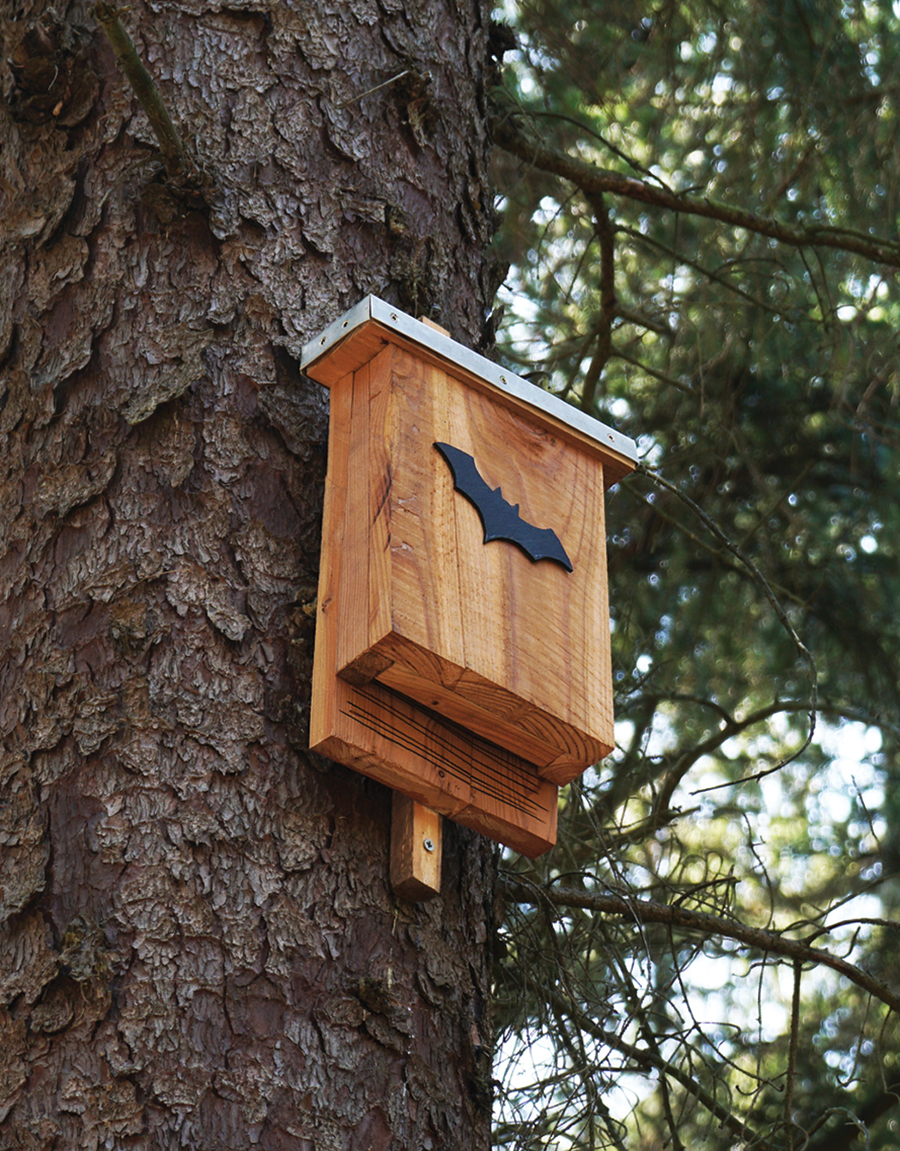
But a word on the plastic bats: Why not welcome the real deal instead? Aside from being adorable — they’re like winged squirrels with tiny fox-meets-bear-meets-pig-like faces — bats play a key role in natural pest control.

Consider installing a bat box in the eaves of your house and witness the mosquito population decline come next summer. If you build it, they will (hopefully) come. Especially if you plant night-scented flowers that attract moths and other night-flyers. Best if there’s a nearby water source. And please, for the sake of the bats, no fake webs. Check out the Bat Conservation International website for information and resources: www.batcon.org/resources/getting-involved/bat-houses.


Before the Frost . . .

Dig up summer bulbs and the last sweet potatoes, compost fallen leaves, and in this transient season of light and shadow, plant, plant, plant for spring.

Daffodils, tulips, crocus and hyacinths.

Radishes, carrots and leafy greens.

And to color your autumn garden spectacular, blanket the earth with pansies.


Battle of the Pies

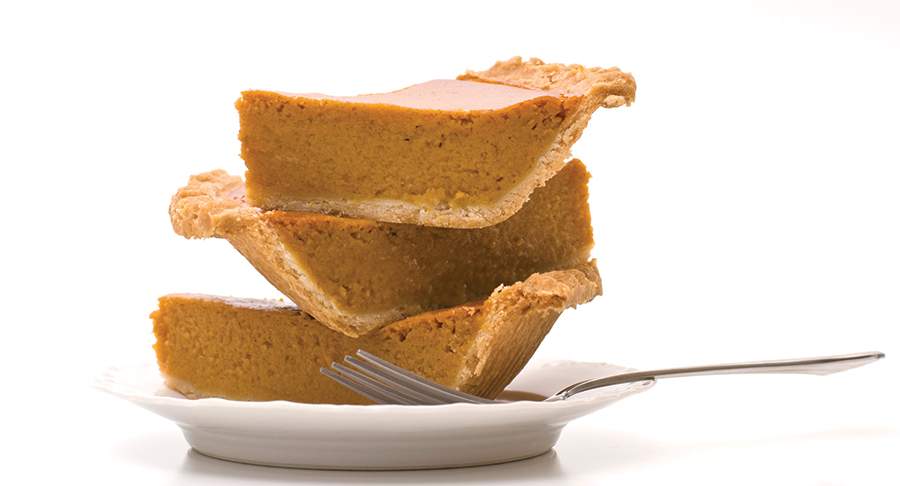
Let’s get right to it: pumpkin or sweet potato? Since my mother never baked either one (or any pie, come to think of it), naturally I love them both. (Yes, I’ll have another slice of that orange whatchamacallit.) But ask me to choose one pie over the other and watch my eyebrows do a funny dance.

I couldn’t begin to describe the differences.

Turns out there are many, and that this infamous Battle of the Pies has caused many a great divide at many a Thanksgiving table.

It’s pie, folks.

But I did a little sleuthing:

Pumpkin pie is spicier, denser, less caloric, decidedly Northern.

True Southerners cry for sweet potato, the sweeter, airier, more nutritious of the pies.

Except, apparently, for my maternal great-grandmother, who reportedly baked two pies at a time, both pumpkin — one for the table, one for my uncle.

“Tommy could eat an entire pie in one sitting,” says my mom of her younger brother. “Nothing made my Grandmother Barlowe happier than the joy in his eyes when he saw her pumpkin pies.”

“Unfortunately,” Mom added, “I just don’t care for them.”

The long and the short of it, in this season of pumpkin-spiced everything, I can’t help but wonder why sweet potato latte isn’t such a buzzword.

(Wo)man’s Search for Happiness

Oh, the lengths we’ll go to find — and keep it — for a little while

By Cynthia Adams

I’ve been on a quest about happiness for a long time. Not a project, not a preamble, just a working definition that would illuminate the good life. When it comes to capturing what Psychology Today deemed “that elusive state,” and Thomas Jefferson declared the inalienable right (!) I’ve discovered some detours on the road to happiness.

I even met a guru named Gaura.

Thank Jefferson for my obsession. And ad man Charles Saatchi for declaring he was more interested in the happiness of pursuit.

Here’s a roadmap.

1. Avoid the Unpleasant

Live long enough, and you’ll learn a few things. Here is what I am certain does not make you happy:

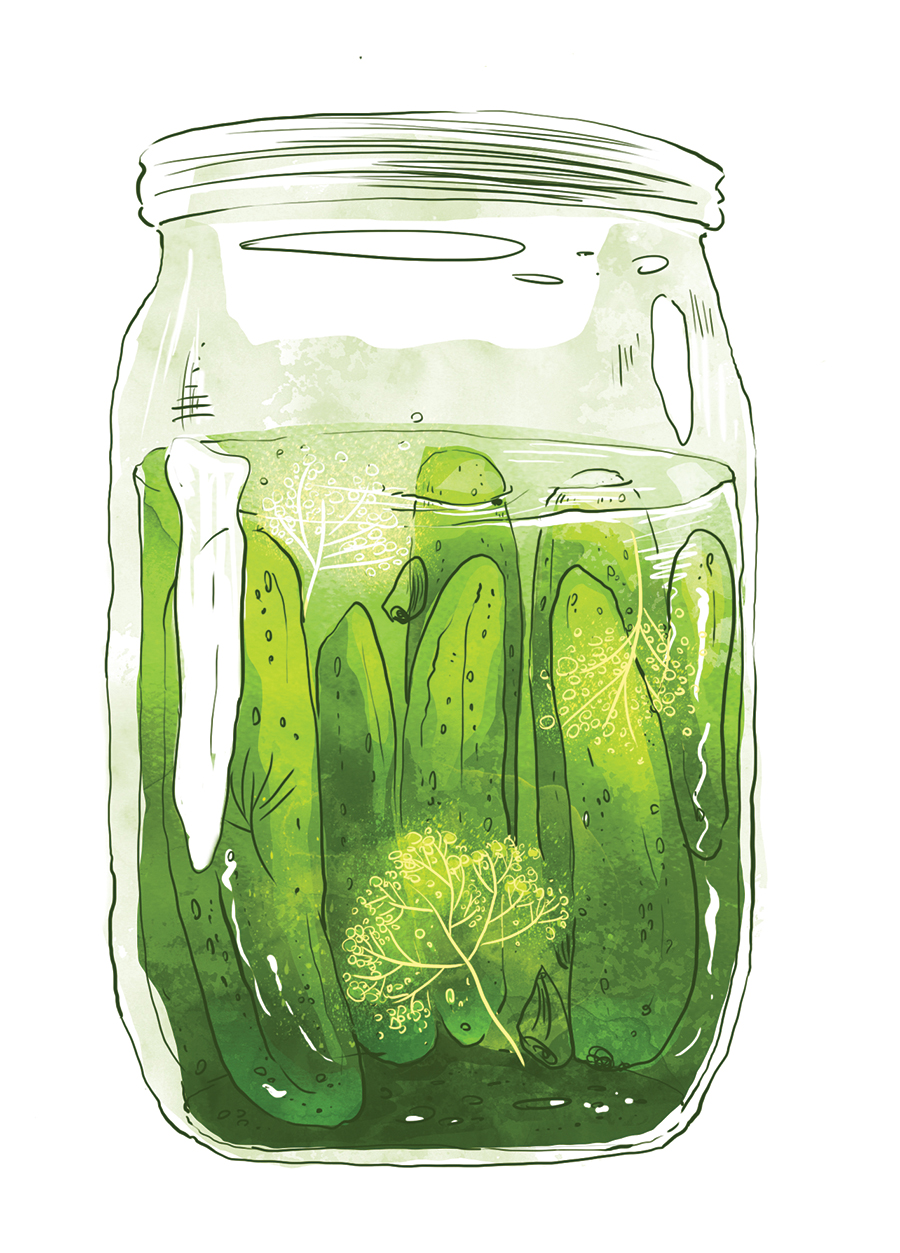
• Drinking pickle juice. (I did this to promote my gut biome.)

• Investing in a new nose unless it is a red clown nose. (Surgery for a deviated septum left me admittedly improved, but the Bob Hope-like ski slope nose did not leave me sniffing the sweet smell of success like Hope.)

• Impulsive experimentation with hair styles and color. (I did this during a winter funk. It deepened my funk.)

• Shopping sprees — unless it is to buy various brands of ice cream. (More on that later.)

• Mediums in the road. A Montgomery County farmer gave me directions admonishing me to strictly avoid “that thar medium in the road.” He probably meant median, but I skirt them thereafter nonetheless.

2. Party in an Envelope

Happiness comes in tiny pieces. I had only to stroll through my neighborhood of Latham Park (chalking up two scientifically proven methods toward claiming happiness — walks in the park and sunshine) that led me to a eureka moment, inspired by a neighbor, Kimberly Lewis and her birthday cards.

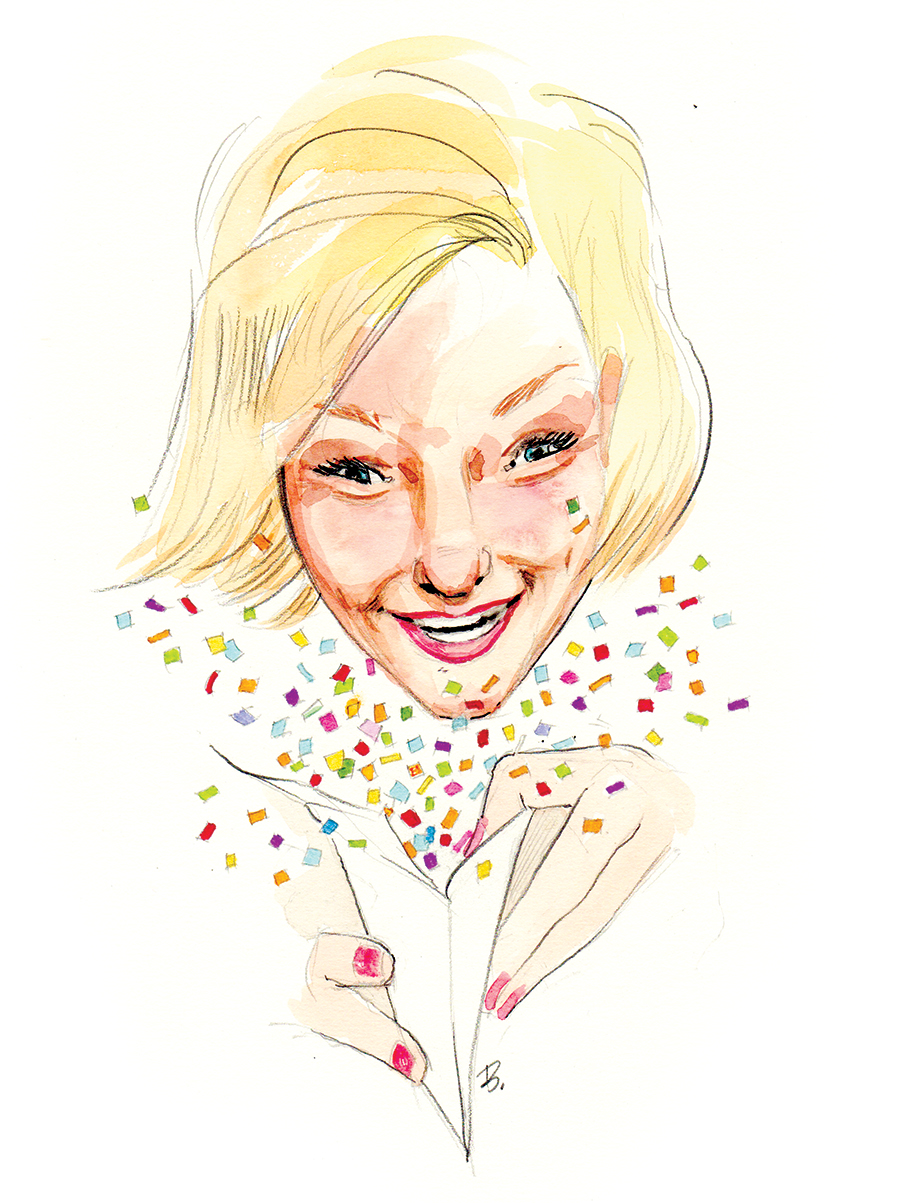
A candy-making, dog-loving, genuinely happy person, Lewis makes a signature candy and leaves it at the doorstep during the holidays, works with animal rescue and is always the first onto a dance floor. When her friends’ birthdays roll around, she sends them cards stuffed with sparkling confetti.

I think of the confetti as a ‘party in an envelope!’” says Lewis. Think of the bright bits of colored paper, the exuberant stuff of New Year’s Eve and the very hallmark of celebrations, as the B-12 of happiness. (The English word “confetti” — borrowed, by the way, from Italian — is the plural of “confetto.” It is derived from the Latin confectum and was a sweet confection thrown out to crowds during carnival. That’s a tiny shot of happiness expressly for wordsmiths.)

According to a designer named Ingrid Fetell Lee, Lewis is onto something. In a recent Ted Talk, Lee explains that confetti makes us happy. Incorporating its bright primary colors and shapes into institutional places — hospitals and schools, for example — jollies things up. No more gunmetal gray or sickly sea green.

3. Embracing a Medium in the Road

On another saunter in Latham Park, I encountered Gaura, a Hare Krishna devotee, as he was seeking a mulberry tree. Gaura had been feasting on mulberries along the park path. “A superfood,” he declared. As we directed him to Smith Street and cracked jokes, he grew serious. “You must be wise to be witty,” he said, and thanked us profusely for being “gurus on my path.”

4. Ben Franklin

The self-help section of any bookstore reveals to see how obsessed — and conflicted — we are with happiness.

When my sister’s house was being cleared following her sudden death last winter, I was surprised to discover one of the books on her bedside table was Gretchen Rubin’s The Happiness Project. Opening it, I found my sister’s favorite pewter Celtic bookmark inside along with some scribbled notes.

The find puzzled me. We both enjoyed humorists like Rick Bragg — and I also found some of his works she’d recently read. But the mystery was, what to make of my sister’s seeming happiness? She had the kind of robust laugh that fills a room. I was eager to know what the book contained.

It was a dreary read. Rubin road-mapped a self-flagellating flog to become happier. Among Rubin’s recommendations were to nag less, which her husband acknowledged helped his own happiness, work out more and keep the house shipshape and organized. It was obvious she had a number of compulsions to be perfect. By the end of the book, I wanted to send Rubin’s much-nagged husband a sympathy card.

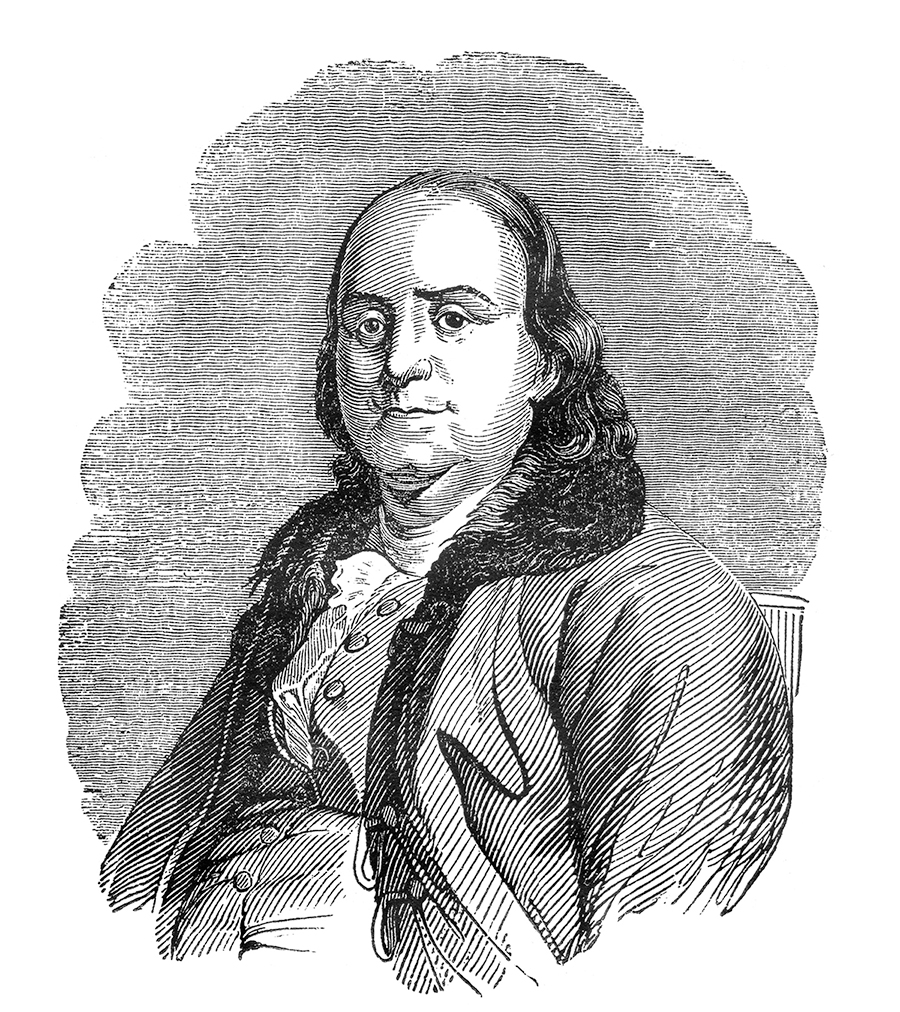
If self-improvement is, in fact, the road to happiness, then I’ll put my money on Ben Franklin’s 13 virtues. To recap, they were: temperance, silence, order, resolution, frugality, industry, sincerity, justice, moderation, cleanliness, tranquility, chastity and humility. In a dogged pursuit, Franklin charted and recorded his efforts to happiness. (An editor comments “Knowing Poor Richard, no doubt temperance and chastity had their share of marks.”) But the view was worth the climb. In later years, Franklin admitted he’d fallen short of his ambition “yet I was, by the endeavour, a better and a happier man than I otherwise should have been if I had not attempted it.”

5. Warts and All

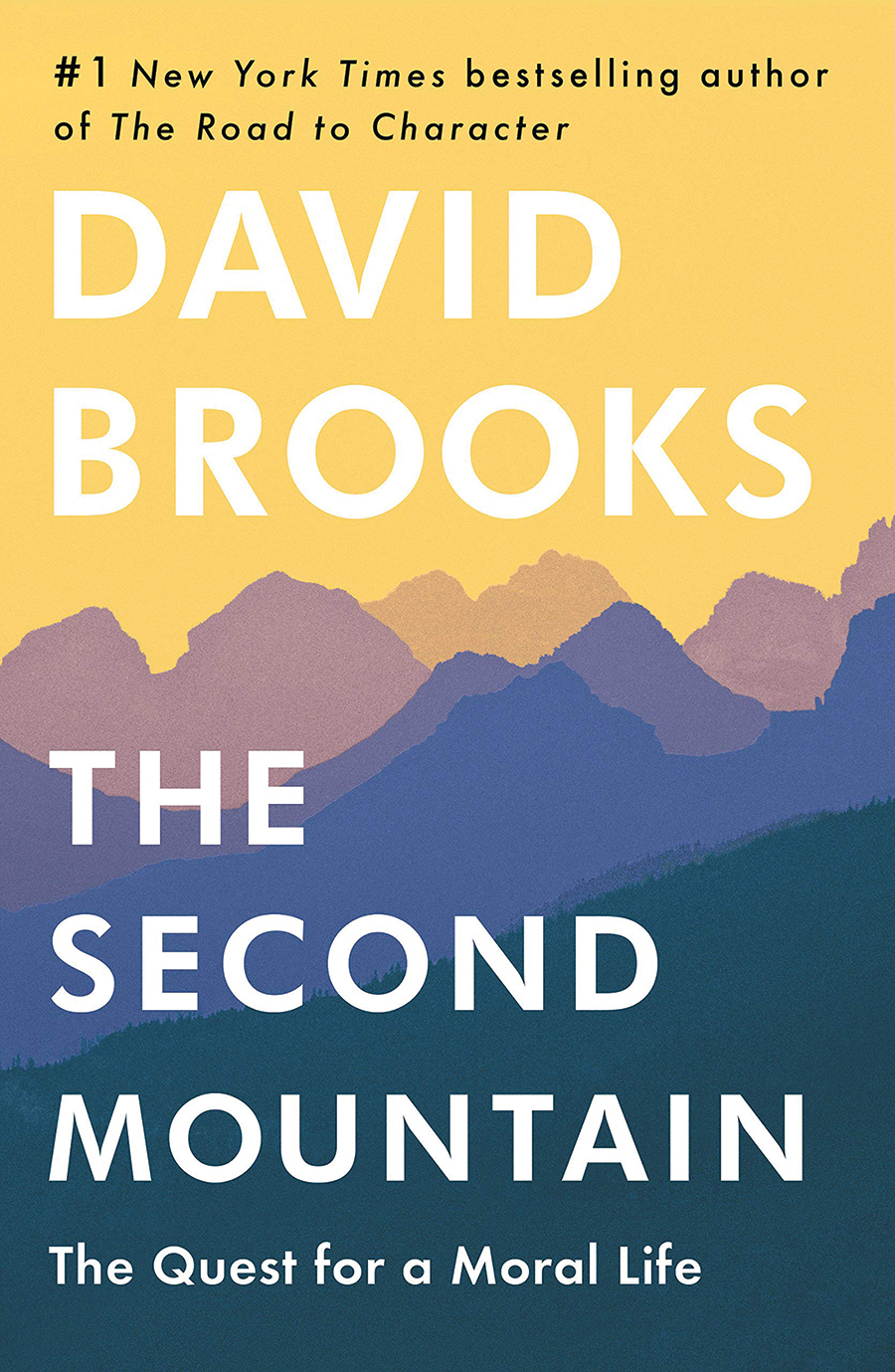
In a recent editorial meeting, O.Henry editor Jim Dodson mentioned a title on his reading list, The Second Mountain by David Brooks. “He explains the difference between joy and happiness,” says Dodson. “Joy is better.” He advises not to confuse the two.

If the consensus is that joy is longer lasting, perhaps Franklin was onto something, reconciling the good and bad, the inevitable failing in the attempt to be perfect. He had out-Rubined dour Rubin, charting his successes and failures on the way to finding virtue. And he found time for nude “air baths!”

6. Happy Hour

Most days, I’m happy. Admittedly, I’m not a zippity-do-dah morning person, but a let’s-talk-after coffee sort. If my happiness was a car, it would be a trusty diesel — once jollied up, fully fueled and caffeinated, I’m pretty damn happy till Happy Hour.

Oh, Happy Hour! It’s wrapped in the clichés of blinking neon martini glasses, bottomless pitchers and mounds of tortilla chips.

But literary types know it is as old as writing itself. It seems that the idea of a happy hour is Shakespearean — straight out of Henry V! “Therefore, my lords, omit no happy hour . . .”

Here again are two more scientifically proven methods to happiness: a glass of wine, or better yet, sharing a glass of wine and enjoying pals. Ben Franklin offered that wine is a “constant proof that God loves us, and loves to see us happy.” Tippling a little among those whose company you enjoy can lead to a few laughs. Which brings me to. . .

7. Laughter

I became a Certified Laughter Leader after a chance airport encounter with Dr. Patch Adams. (Remember the 1998 biopic starring Robin Williams as Dr. Hunter Doherty “Patch” Adams?) Though he was on his way to minister to the sick in some of the world’s most cheerless, impoverished hospitals, the good doctor truly believed that laughter was the best medicine and invited me to take his laughter training course.

He and fellow volunteers (and you can add volunteering to yet another scientifically proven step to happiness) dress as clowns “to bring humor to orphans, patients and other people.” He calls his program, “clown care.”

Dr. Adams is also the inspiration for our dog’s name, Patch Adams, a pup who is eternally happy, my husband says.

I took the laughter training. The thing is, deep laughter promotes deep breathing, which may not transport you to happiness but it does promote less . . . unhappiness.

8. A Warm Puppy

And though it was Peanuts gang creator Charles Schulz who coined this one, I had only to look to Jane Gibson, a much-loved Hospice and Palliative Care Center staffer, to put it in context. She copes with seriously sad issues on a relentless basis. But she is invariably able to find a silver lining in the darkest cloud. For Gibson, the key to her happiness is humor.

“I always find talking to someone with a good sense of humor gets me back up,” she offers. Her husband, Paul Gibson, is known as a master of the witty comeback and wry observation. Just ask Jane: He suggested naming their new puppy Kayak upon registering Jane’s shock one Christmas morning. “It was the same bewildered look I gave him when he gave me a kayak another Christmas,” she laughs.

9. Catch a Sense of Humor

This goes beyond Paul Gibson’s quip or Patch Adams’ panacea, laughter, but the spark that engenders both.

This is what Gaura was talking about.

But where does it come from?

Get your catcher’s mitt out and be ready. For it is “caught, not taught,” I learned from found Helen Canaday, a beloved UNCG professor who directed the successful on-campus Nursery Program while teaching about child development. Psychologists would often observe the toddlers in her charge, determining and analyzing aspects of personality. Canaday believed humor was vital to a healthy adulthood and meaningful life. One needed to be in possession of one’s wits, she reminded me. She was of a generation who still described someone dull as a “half-wit.”

She personally was a full wit, possessed of a wonderful, ready laugh. If anyone would know what was funny, Canaday would, having made a lifelong study of children. 

And she always made me laugh with her observations about the foibles of adults.

Then she commenced to answer my question, but with difficulty, which was unusual. She started with the dictionary.

“I do have what Mr. Webster has,” she said finally, “which is, ‘the mental quality or faculty of experiencing or appreciating the ludicrous or absurdly incongruous;’ something designed to be comical, amusing or witty.”

I pressed that I wanted to know what she — not Webster — thought.

“Well, I was trying to, and I haven’t finished working up a definition,” she faltered. “I do think that humor is caught not taught . . I think it is learned vicariously.”

She offered something fascinating. “You can teach children to be respectful, to be friendly, to love. You can teach children all the other aspects of the personality, but I don’t think you can teach them humor.”

Then, the good professor observed that certain humor is innate, saying “even babies will laugh.”

Canaday added something I underscored in my notes. “I know people who never, ever enjoy humor,” she said ruefully. “I think they participate, but they don’t have a feel for it.”

A feel for it.

Having a feel for humor — is that it? Do we feel our way towards happiness? Uh oh. Scratch that. It sounds lascivious, just writing it, but you know what I mean, and (bonus!) it did make me giggle.

10. If All Else Fails — Ice Cream

If you do a Google-search of good humor, the first 10 entries all concern ice cream brands. (Remember Good Humor?) I once attempted to eat my way to good humor-fueled happiness in the third grade by saving all my lunch money up for ice cream. And my husband took the factory tour of T. Wall and Sons Ice Cream (once the largest manufacturer of ice cream in the world) so many times when he was a boy (probably eight times) that they finally waved him through for the complimentary ice cream at the end. Day after day.

A child of any age can be forgiven for believing ice cream is a path to happiness. Whether your choice is chocolate, vanilla, strawberry, Rocky Road or Cherry Garcia, it sort of is. Even the writers at Psychology Today concede this much: “small indulgences” are potential happiness boosters. Not to mention the sugar high.

11. Natural Highs — and Lows

All those scientific researchers must be pretty damn happy with their lists of other proven recipes for happiness that include making your bed, rumpuses (think: fun) and travel — unless you’re waylaid by TSA agents or your flight is cancelled. And for millennia, circles. (It’s a 40,000-year fixation; Manuel Lima explains the reasons we are attracted “to curvilinear shapes” over angular ones. Which brings me full circle to Psychology Today that beat Second Mountain-eer Brooks to the punch. They had already summited. Happiness “is not the result of bouncing from one joy to the next; researchers find that achieving happiness typically involves times of considerable discomfort.”

Was I just one pickle juice swig away from a good gut and all-encompassing happiness? Did I, as Canaday said, have a feel for it?

I felt something, I truly did! A smile tickled up from the corners of my mouth as pickle juice trickled out and I contemplated me, white water and a new kayak.  OH

Cynthia Adams is fascinated that Happy Hour is illegal in Kansas. It is also illegal for Kansans to serve wine in teacups, which automatically makes her happier.

For Love of Past Lives

For Steve Lynch, history is an everyday pleasure and privilege

By Jim Dodson     Photographs by John Koob Gessner

Not long ago, on a tip from a local historian, I called on a man named Steve Lynch who lives in a pretty, middle-class neighborhood off Alamance Road, a few miles north of the pre-Revolutionary-era (1771) battlefield of the same name.

I’d been led to believe that Lynch might be able to tell me something about a celebrated relative of mine named George Washington Tate, a surveyor, grist mill owner, furniture maker and prominent citizen of the county in the 19th century.

My great grandmother, Emma Tate Dodson, had been his daughter, and according to family lore, she was supposedly a Native American, an infant when Tate brought her home from one of his “gospel rides” out west to help establish Methodist churches in the wilderness of the Blue Ridge hill country.

All I really knew about her papa, old George Tate, was that he was famous for his furniture-making and owned one of the most important grist mills on the historic Haw River. It was a fording spot of the ancient east-west Trading Path used by Indian tribes and settlers in the 18th century — including my own immigrant Scottish and English forebears who came down the Great Wagon Road to the region in the 1750s. Greensboro’s Tate Street is reportedly named for this rural Carolina polymath.

My hope was that Steve Lynch could fill in a few blanks and maybe answer a question or two about my respected ancestor.

What I found instead was another polymath in the tradition of Tate himself, a patriotic native son of Mebane, a Vietnam combat vet, 33rd degree Mason, former police detective and history nut extraordinaire for whom the past is not only alive and kicking, but also a source of daily happiness. He enthusiastically shares it with visiting groups and individuals who find their way to perhaps the most charming personal museum in the state.

It’s housed inside “Lynch Lodge,” a pair of Amish-built sheds their owner artfully fused together in his backyard some years back. He added a pretty front porch where Lynch and bride, Betsy, can sit and admire the handsomely landscaped approach through a leafy garden that features a full-scale flag pole and live boxwood shrubs rooted from Thomas Jefferson’s Poplar Forest, George Washington’s Mount Vernon and the governor’s palace at Williamsburg.

That was the first of many of nice surprises, each one more interesting than the last, when I called on him on a quiet summer afternoon.
Stepping into the Lodge, my eye went straight to an opposing wall where there was a beautiful portrait of George Washington hanging in a large gilt frame.

“Let me show you something,” Lynch said with a chuckle. The framed portrait had a nifty trick. It was set on hinges inside a larger matching frame, rather like a hidden safe.

“Here’s why.”

Attached to a linen binding on the back of the original framed painting, which dated from 1789, was the actual obituary of George Washington from a Philadelphia newspaper.

“I bought it at an auction in Mebane and got tired of having to pick it up off an easel to show people what’s on back,” he genially explained. “So I took it to a cabinet maker who came up with a clever solution.”

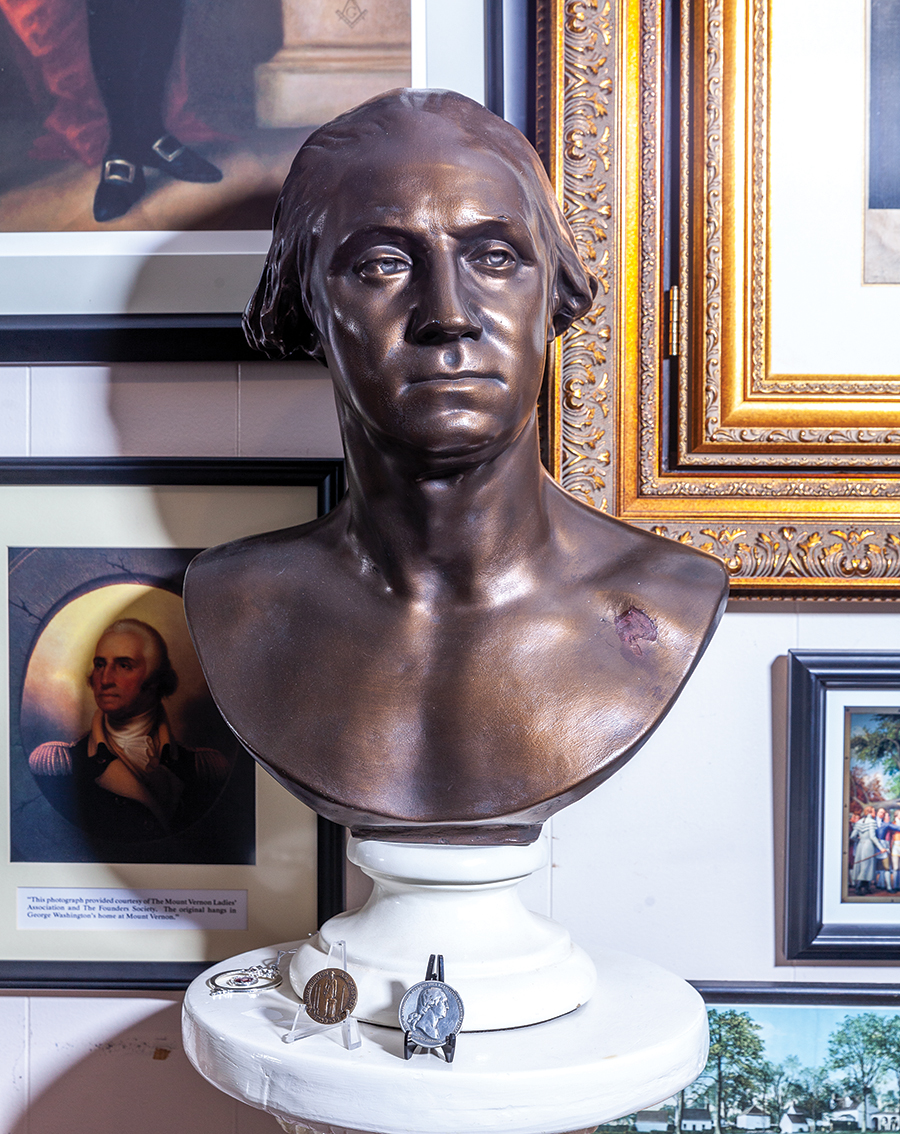
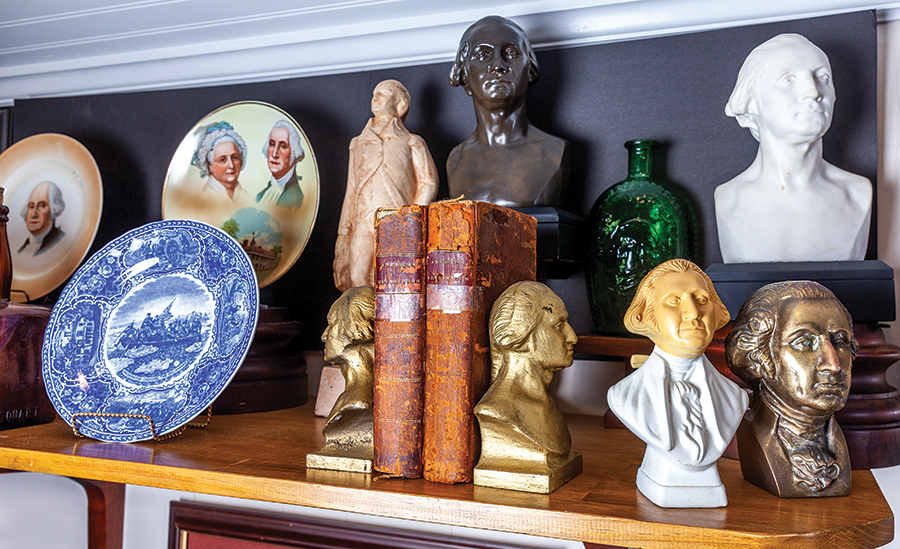
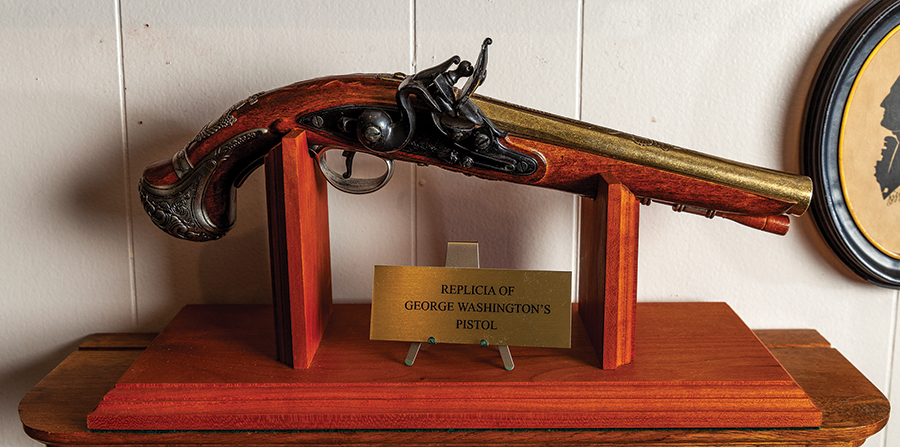
“You seem to have a thing for the name George Washington,” I commented, noting that the entire wall surrounding the portrait was covered with various paintings and antique pen and ink sketches of the nation’s first president. Lots of other Washington memorabilia was on displayed, too — antique tins of George Washington pipe tobacco, whiskey bottles and liquor decanters bearing the great man’s likeness, china plates with portraits of Mount Vernon and Martha Washington, an 1819 twin-volume History of the America Revolution featuring the writing of our founding president, at least a dozen statue heads, including a brass bank. Standing on the floor was a copy of Gilbert Stuart’s famous unfinished portrait of Washington.

“A fella I visited who owned a plantation house down in Little Washington gave that to me — just took it off the wall and sent it home with me,” Lynch offered, shaking his silver-topped head wonderingly.

Further along the wall, Lynch showed me an ancient pen-and-ink drawing of General Washington that was given to him by another friend that infected him with the collecting bug, setting him on the road to building his museum to house his growing and expanding collections.
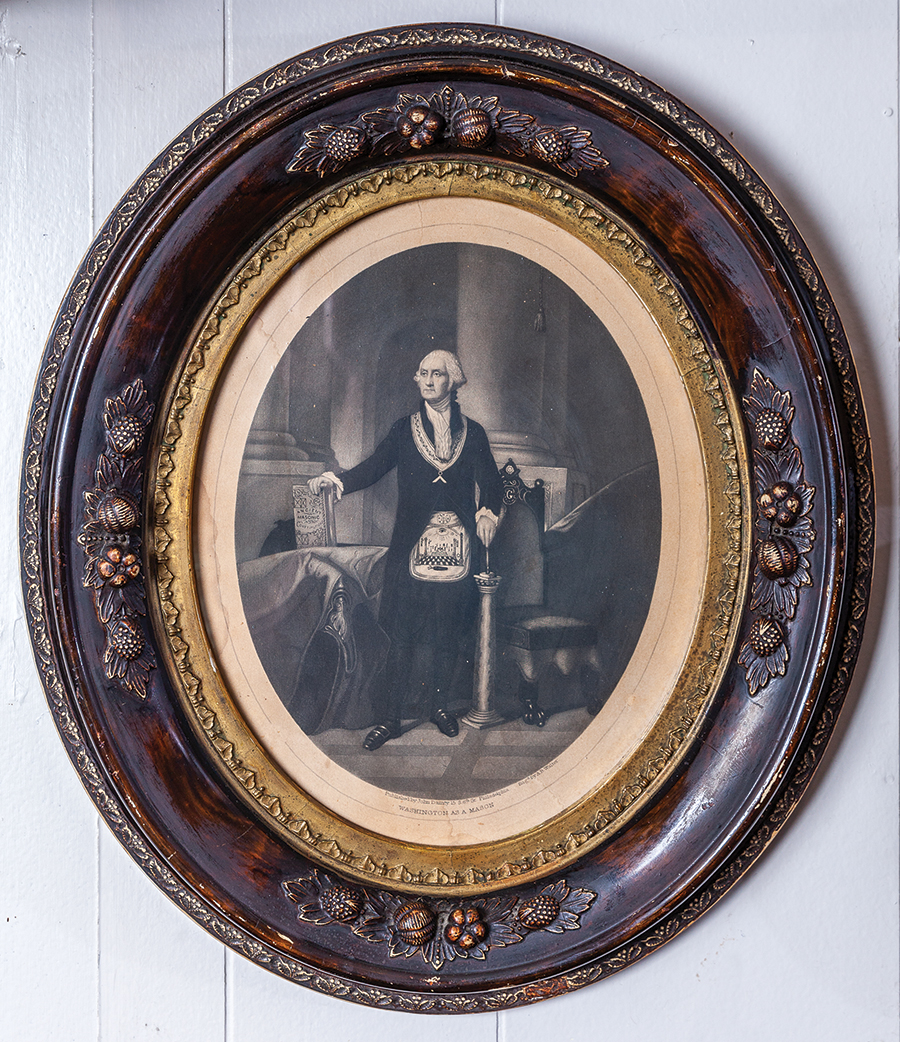
“I do love George Washington,” Lynch said, stating the obvious.” Sure, he as our first president, but he’s also “someone everyone admires and should emulate in the way he lived. It’s also because I’m rather partial to the name,” my host explained.

With that, he showed me the first photograph I’d seen of my illustrious ancestor, G.W. Tate, whom I learned was his great-great-grandfather, as well. “Emma Tate’s sister was my great-grandmother, which makes us cousins,” he announced with a wide country grin.

He showed me two other Tate artifacts that left me momentarily speechless — and answered a lot of questions in an instant. One was a framed U.S. Patent certificate for a grain threshing machine that improved the famous one invented by Cyrus McCormick in the early 1800s.

The other items were Tate’s pocket watch, mess kit and solid brass telescope from his service in the Confederate States Army, given to Lynch by his grandfather. On the spot, I learned that Tate had served as a full colonel in the North Carolina 11th regiment.

Finally, he showed me a 19th-century map of Guilford and Alamance counties that revealed that Tate’s mill wasn’t where I’d always thought it was — and had visited near the I-85/40 bridge over the Haw, first as a boy and more recently, a few years ago when I began research on the Great Wagon Road.

“Tate’s Mill was nearby, though — actually on Haw Creek,” Lynch informed me. “I know a man who can take you to see where it was located.
I believe some parts of it may even be visible.”

The tour continued to the opposite end of the room to the “Franklin Corner” where lots of similar artifacts and memorabilia of Benjamin Franklin were on view.

That area led to a section filled with items gathered from Lynch’s distinguished 40-year career in law enforcement, including his 30 years as a detective for the Burlington Police Department and 11 more working as chief investigator for the Alamance District Attorney’s office. Displayed in this area were handcuffs (“They were on some pretty colorful people”) and a small pistol that a subject fired at Lynch during his first day on the job.

On the opposite side of the far end of the room was his “military corner” that displayed various uniforms, gear and items from the Vietnam era, including his year in combat for the 501 Infantry division of the 101st Airborne in 1969, one of the toughest years of the unpopular war.
“Just had four college boys from N.C. State and a veteran of Special Forces come by the other day to have a look at these things,” Lynch reflects, staring at the wall with visible emotion. “They all thanked me.”

At this point of the museum tour, I asked him to pause and sit for a spell so I could learn more about where his love of country and passion for history came from. This was the day after the Memorial Day weekend. The flag outside Lynch Lodge was still at half-mast.

Steve Lynch, I learned, was born on Clay Street in Mebane in 1949. Upon graduating from Eastern Alamance High School in the spring of 1967, he wrote a letter to J. Edgar Hoover and found a job working for a year in the fingerprint lab at FBI headquarters, before a romance lured him back home to Burlington.

“About that time, I got an official letter from President Johnson and soon found myself on the way to Vietnam. I was happy to serve.”

He was 19 years old. Within days of arrival, he was choppered to a unit fighting along the Ho Chi Minh Trail deep in the jungles of the A Shau Valley, west of the coastal city of Huế near the border with Laos, a key infiltration spot for the Vietcong and scene of some of the war’s fiercest fighting.

That year, American personnel fighting in Vietnam reached its peak of 543,000. Back home in America, antiwar protests also reached an early peak, filling the streets of America.

Steve Lynch grew quiet, speaking solemnly, rapidly blinking his eyes. “The nice guy that flew over there with me in the helicopter died the first day in action. We were new recruits. These were hardened soldiers. It was an unwritten rule among the guys who’d been in combat that nobody spoke to you in case you didn’t survive the next firefight.”

Steve Lynch survived the next firefight and many other major ones, including one in which his unit was overrun by the enemy. When his right hand got a serious infection that came close to becoming gangrene, he was airlifted out and treated before being sent back into the fray.

By that point he was an accepted brother in arms. From his first to last day in country, Lynch carried a small family Bible he kept wrapped in plastic. “Whenever we had a quiet moment, the others would ask me to read from the testament.”

The guys in his unit gave him a nickname. He was called “Preacher.” After serving his year, earning the respected Combat Infantryman Badge, Steve Lynch was sent home, only to be diagnosed with severe Post Traumatic Stress Syndrome. A brigadier general he met at the Pentagon changed his orders to allow him to spend the rest of his military service under his first sergeant from Vietnam, assigned to Fort Stewart in Georgia. “He was one of my best friends. We’d been through a lot together. That meant a great deal to me.”

Lynch blinked for a few more seconds, his mind back somewhere in a war America tried hard to forget but he never has. Then he looked at me and smiled.

“You know, just a few weeks back I flew out to Missouri to see the chaplain I served with over there. He retired as a full bird colonel with a Silver Star. We had a wonderful visit,” he recalled. “As I told him, looking back, serving my country over there was the thing I’m proudest of in my life. You see the same thing in all the fellas and women who were there. It’s a bond, a love for each other that’s unbreakable.”
When his chaplain was driving him back to the airport for his flight home, Lynch added, they stopped by a patch of woods and sat for a while talking and actually holding hands and praying.

“When you see veterans at the wall in Washington,” he explained, “that’s what you’re seeing — real gratitude for loving friendship and memories of those who didn’t make it back.”

He nodded to a pair of well-worn Army boots on the floor beside me. There were dog tags attached to the boots’ laces.

“That was done so the army could identify your body if part of it was blown away,” he explained.

Lynch showed me a photograph of himself taken five years ago when the Pentagon called up out of the blue inviting him to lay a wreath on the tomb of the Unknown Soldier.

“I have no idea why they chose me,” he said. “Except for the fact that I was over there and survived. It was a big honor.”

On a happier note, we moved along to a big wooden desk, above which were a series of framed photographs from his years of service in the police. Among his duties, he often was asked to escort dignitaries when they passed through the county. The dignitaries included Prime Minister Margaret Thatcher, President George Herbert Walker Bush, President Bill Clinton and local luminaries including former Senator Elizabeth Dole and former North Carolina Congressman Howard Coble.

“I even liked president Clinton,” he allowed wryly. “People back then said we looked like each other. I suppose we did. That always struck me as kind of funny.”

The next section contained some beautiful spiritual artifacts — a framed page from the Isaac Collins Bible of 1791, the first family Bible printed in America, and an original page from the Geneva Bible of 1560.

Lynch made local news some years ago when he gave his family’s O’Kelly Bible to Elon University. James O’Kelly was a fiery preacher and one of America’s earliest proponents of religious liberty — also, I was not surprised to learn, an ancestor of Steve Lynch.

Therefore, I shouldn’t have been surprised to learn, moments later, that he was also a direct descendent of Thomas Lynch Jr., signer of the Declaration of Independence from South Carolina. Lynch and his father, were the only father and son to serve in the Continental Congress.
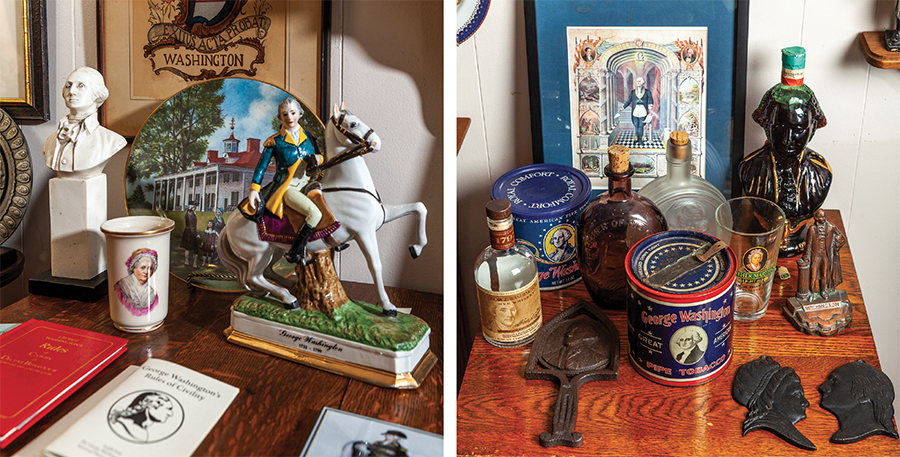
The tour of Lynch Lodge ended where it began, at a nook by the front door that was designated for great Masons in history — a wall of portraits, artifacts and figurines in the likenesses of Beethoven and Robert Burns; Generals Jimmy Doolittle, Douglas MacArthur and John J. Pershing; Roy Rogers and Mozart and Harry S. Truman.

Just days before I showed up on his porch, Steve Lynch filled the place with dozens of 33rd degree mason and grand masters from all over North Carolina. He even had a special glass engraved to give to each of the participants. Steve Lynch belongs to the same Eagle Lodge in Hillsborough where George Washington Tate — the man where my inquiry began — was initiated in 1857.

As I left, I asked Steve Lynch what is it about showcasing American history that gives him such satisfaction.

“You know,” he replied, “that’s a little hard to explain. History is personal to people. I have groups and people come look at this little museum and always seem to find something that connects them to their history. It’s the story of where we all came from, after all. It makes me very happy to be part of that.”

As we shook hands, he placed something into mine.

It was a well-worn belt buckle from the Confederate Army.

“I thought you might like to have that, considering what you learned about our relative George Washington Tate today.”

He was right about that.  OH

July Almanac 2019

Snapshots from July are salt-laced and dreamy.

Children skipping through sprinklers on the front lawn.

Baskets of ripe peaches, still warm from the sun.

Tree houses and tackle boxes.

Tangles of wild blackberry.

Brown paper bags filled with just-picked sweet corn.

Last summer, gathered in celebration of July 4, we made a game of shucking sweet corn on my grandmother’s front porch. Two points for each clean ear, a bonus per earworm, yet as husks and corn silk began to carpet the ground beneath us, joy and laughter were all that counted.

And now, memories.

Like Papa’s pickles, made with the cukes from his own garden.

Speaking of Papa . . . something tells me he would have loved watching us turn a chore into a simple pleasure, perhaps the secret of any seasoned gardener.

The Art of Shade-Dwelling

In the sticky July heat our state is known for, not just the flowers are wilting.

Advice from a fern: seek shade and thrive.

Yes, you.

Bring a hammock, summer reading, refreshments, pen and journal.

Daydream beneath the lush canopy. Bathe in the filtered light. Indulge in the summery soundscape. Cloud gaze.

And if you’re looking for a spot by the water, follow the spiraling dragonfly. She will always lead you there.

The dandelions and buttercups gild all the lawn: the drowsy bee stumbles among the clover tops, and summer sweetens all to me. — James Russell Lowell

Fresh from the Garden

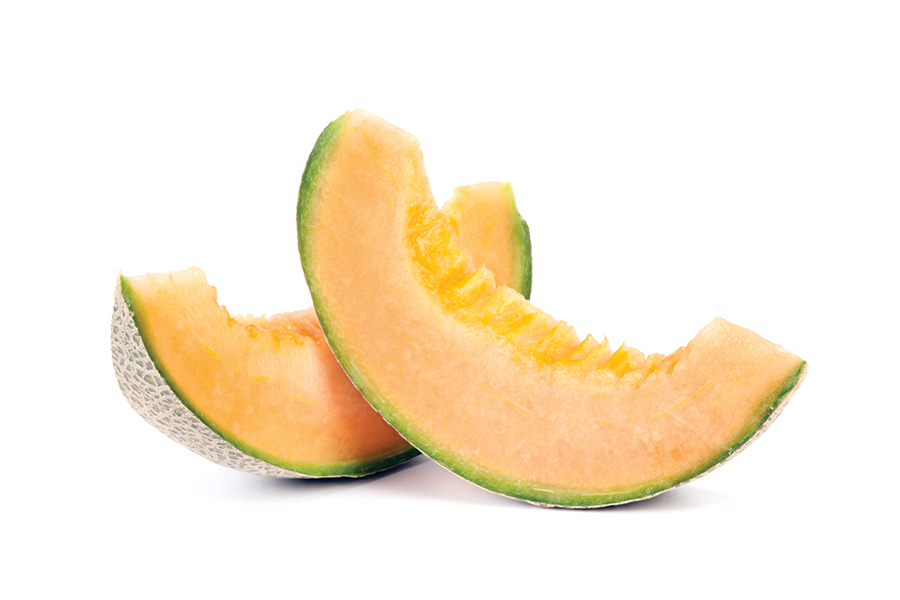
Eggplant, snap beans, green beans, summer squash. Plump tomatoes are spilling from the vine, but there are two words on my mind: melon season.

In one word: cantaloupe.

And while it’s fresh and abundant, consider some new ways to enjoy it.

Blend it with club soda and honey.

Salt and spice it with crushed peppercorn and sumac.

Toss it with arugula, fennel and oregano.

Make cool melon soup, or sweet-and-salty jam.

Nothing spells refreshing like chilled cubes of it after a hot day in the sun, but if you’re looking for savory, check out the below recipe from Epicurious.

Cantaloupe and Cucumber Salad

(Makes 4 servings)

Ingredients

1/2 cup olive oil

1/4 cup Champagne vinegar or white wine vinegar

1 teaspoon ground coriander

1 teaspoon kosher salt

1/4 teaspoon freshly ground black pepper

1/8 teaspoon ground cardamom

1/2 large cantaloupe, rind and seeds removed, flesh cut into 1-inch pieces

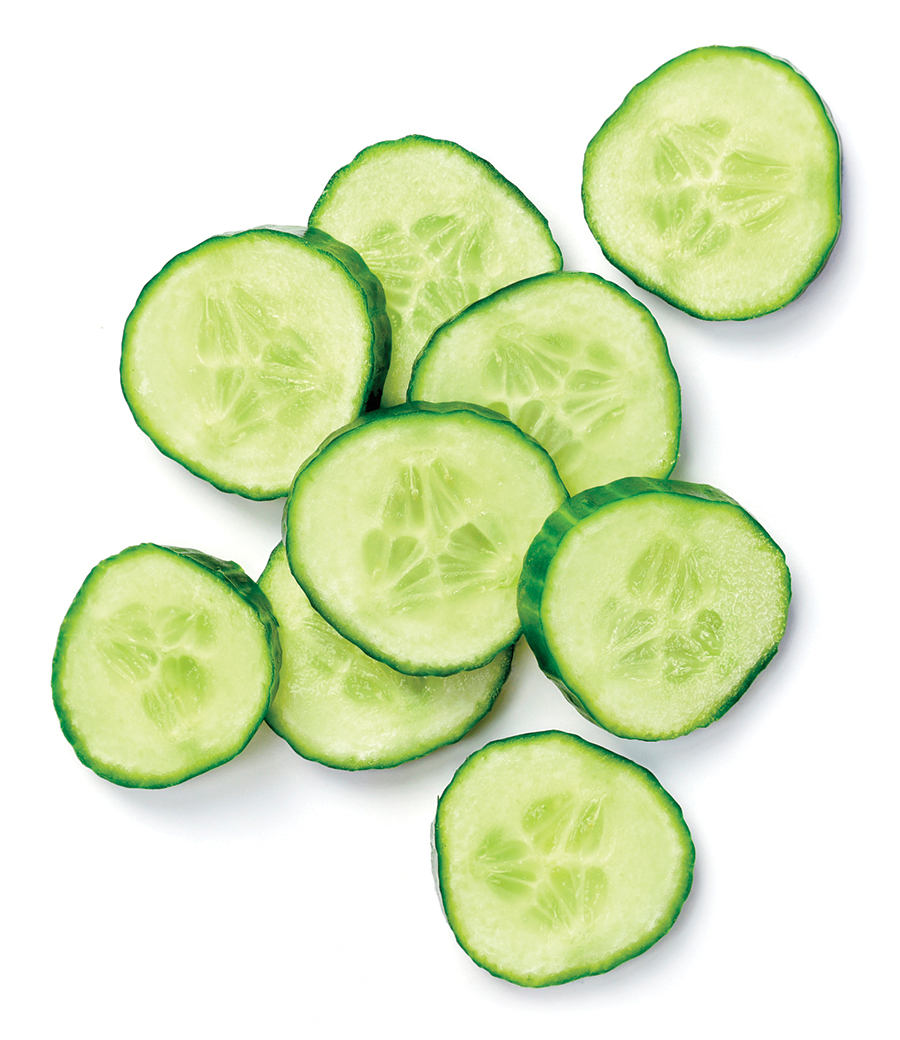
1 large English hothouse cucumber, sliced on a diagonal ½-inch thick

2 Fresno chiles, thinly sliced

1/2 cup unsalted, roasted pumpkin seeds (pepitas)

1/4 cup chopped cilantro

1/4 cup chopped mint

Sumac (for serving)

Ingredient Info

Sumac is a tart, citrusy spice generally sold in ground form. It can be found at Middle Eastern markets, specialty foods stores and online.

Preparation

Whisk oil, vinegar, coriander, salt, pepper and cardamom in a large bowl. Add cantaloupe, cucumber and chiles, and toss to coat in dressing. Let sit, uncovered, 15 minutes.

To serve, add pumpkin seeds, cilantro and mint to salad and toss gently to combine. Top with sumac.

Lazy Days of Summer

The full buck moon rises on Tuesday, July 16, which, according to The Old Farmer’s Almanac, is a good day for pruning, mowing and weeding. But if R&R is more your speed, below are a few obscure holidays you might add to the calendar.

July 10: Pick Blueberries Day

July 17: Peach Ice Cream Day

July 20: Ice Cream Soda Day

July 22: Hammock Day

Happy Independence Day, friends. Happy, happy hot July.  OH

Fantasy Island

Local designer Terry Allred brings a tropical flair to an iconic North Carolina beach destination

By Nancy Oakley     Photographs by Andrew Sherman

Vacation, all I ever wanted/Vacation, had to get away . . .” The Go-Gos’ high-pitched chorus of their jaunty 1982 pop hit, “Vacation” rolls around in your mind, if not on the car stereo, as you accelerate with abandon down I-40 toward the beach. Good-bye alarm clock! Good-bye over-air conditioned office with blinding fluorescent lights! Good-bye deadlines! Good-bye broiling Battleground Avenue, clogged honking traffic and the acrid smell of tar! You’re going on vacation! Happy! Happy! Joy! Joy! You can’t wait to get your “toes in the water, ass in the sand,” as another travelin’ troubadour, Zac Brown puts it. Your happy place of choice? The Blockade Runner Beach Resort in Wrightsville Beach.

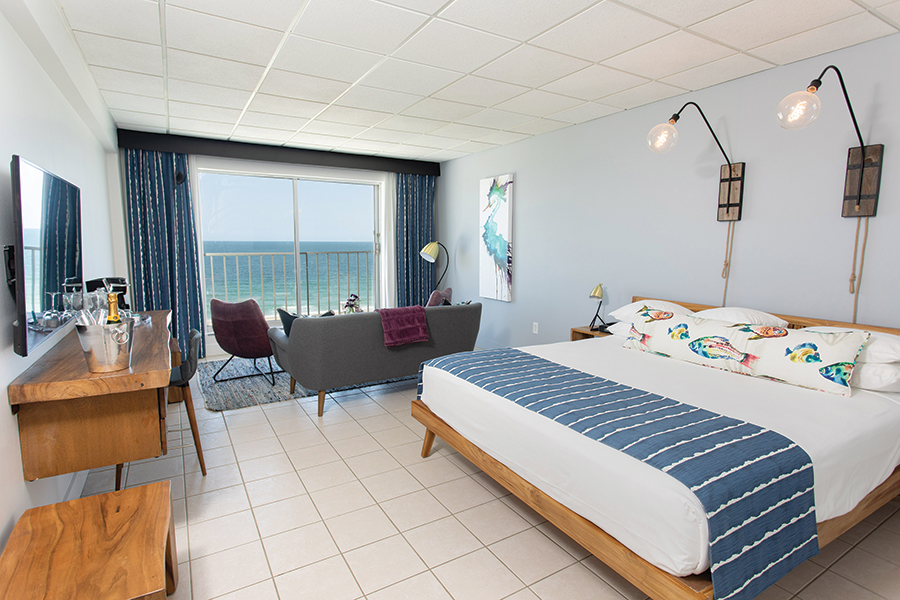
Impossible not to notice before you even set foot inside the door is a colorful sculpture that takes up the entire front window — a wire frame filled with foam flowers, as it turns out — resembling a sea anemone, the handiwork of interior designer Terry Allred. She understands all too well that for the generations of North Carolinians who have regularly vacationed there, the Blockade Runner is an institution, their “own special place,” to borrow from yet another song, “Bali Hai.” So why not create a similar paradise? “Wrightsville Beach is an island. Let’s make them think they’ve come to an island, a really funky island. A fun island,” she recalls suggesting to the hotel’s owners, Bill Baggett and his sister Mary Baggett Martin, when the décor was due for an upgrade.

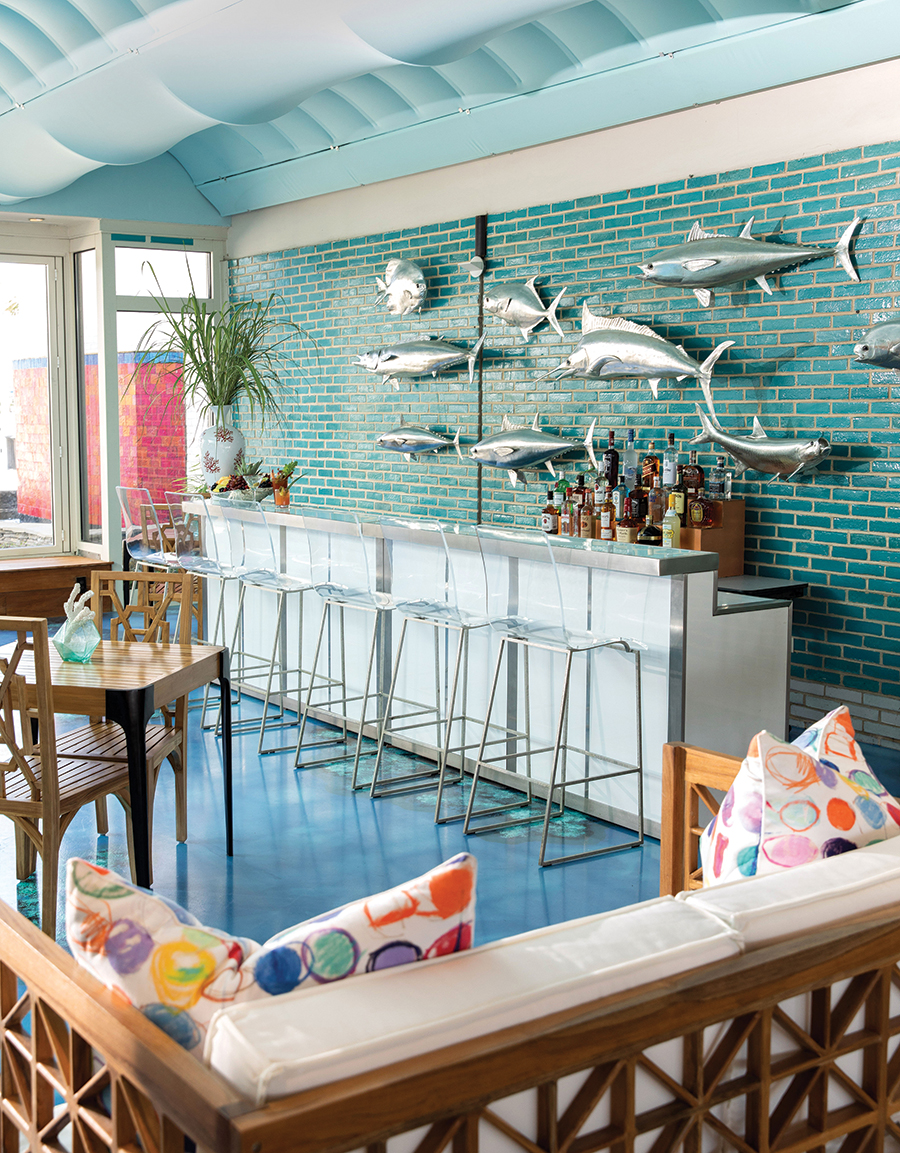
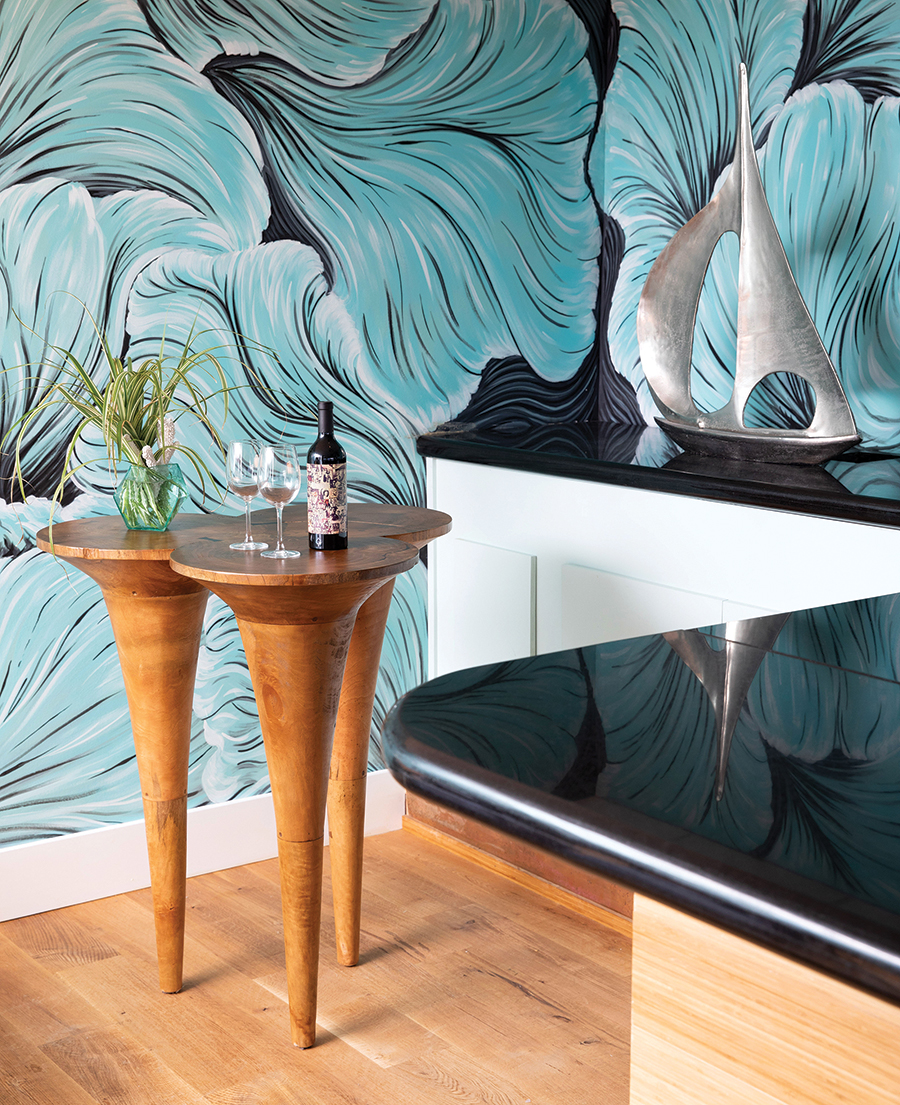
The tropical fantasy envelops you as you enter the lobby, where, covering the floor, a bright blue mural by Winston-Salem artist Angelina Taddeucci recalls the blue holes in the Bahamas, though Allred says her inspiration were the overwater bungalows so popular in Polynesian resorts. Overhead, a ripple of aqua-colored, stretchy fabric spans the ceiling — waves, as it were; the far wall, original to the hotel, is also painted bright blue and mounted with various kinds of fish (a vestige of a prior renovation, Allred notes); wooden slats replicating a boardwalk punctuate other walls, another foam flower sculpture in the shape of a seahorse is suspended from the ceiling. “I wanted people to feel like they were walking on water,” Allred explains. “When you walk in, you’re supposed to be absorbing water. There’s water everywhere.” Even in the elevator where a single drop seems to splash off the walls. “Why do you come to the beach? You come for the water, right?”

She and her husband, John, came to the beach 26 years ago. Gate City born and bred, Allred had built a successful design business in her hometown in the 1980s with a high-end consignment store named — what else? — Terry Allred. “It was on North Elm Street where Fishers Grille is,” the designer remembers (she would later relocate it to West Market). “I loved to do vignettes. I’m a designer! C’mon!” she says. The tableaux were her creative outlet, since 98 percent of her clientele were other designers. “Why would I be a stupid idiot and compete with people who were coming in and buying from me all the time?” she posits, adding that occasionally she would hire her compatriots to help with the store, if for nothing else than the camaraderie. “My customers were my life!” she says wistfully.

She was not, therefore “a happy trooper” on that day in 1991 when John Allred announced that his job as an engineer for Wilmington Machinery was taking the two to the Port City. With a heavy heart, Terry Allred the designer sold Terry Allred the store, before she and John embarked for the coast.

But as she notes, Greensboro and Wilmington have long been inextricably linked, and it was a Greensboro connection who made the Allreds’ transition to Wilmington a little easier. “Jane Moffitt [now Jane Moffitt Beeker, owner of JM Designs] was a really, really great customer of mine. Incredible customer,” Allred says. She goes on to explain that she’d helped Moffitt with some installations at the Wilmington community of Landfall, which in the early ’90s was smaller than it is today, “maybe 300 people,” Allred estimates. Being new in town, it was a good place for the couple to start out and meet people, and where Allred could establish her professional reputation. She maintained ties with the Triad, buying antiques for Henredon Furniture’s 11,000 square-foot showroom at High Point Market, and ultimately for Ralph Lauren, which was using Henredon furniture in its galleries nationwide. She and John would eventually move to a house “on the prettiest, cleanest creek on the Intracoastal,” with a “gorgeous” yard they loved to work in, but Allred kept her connections to Landfall, doing interiors for some of its residents. One of them introduced her to the woman who would play a huge part in the designer’s life and career, Blockade Runner’s Mary Baggett Martin.

The hotel had been sold to a developer who had plans to convert the lodging into a condominium development. But before it was inked, the deal fell through, leaving the Baggetts with a hotel that suddenly had no advance bookings. Mary desperately needed to refresh the rooms. Which is how, in October of 2006, Allred became Blockade Runner’s in-house interior designer.

“Mary and I hit it off,” Allred says, recalling how the two went to the High Point Market that October, and later, a show in Atlanta. Her new gig was unique in many respects. “This is a family-owned hotel. This is not Marriott — Marriott tells you what to buy,” Allred offers. She was responsible for selecting everything, down to the tiniest detail. “I was picking toilet paper, salt and pepper shakers . . . nothing came into that hotel that I didn’t put my hands on,” Allred says. Initially, each of the hotel’s 150 rooms had its own unique design. “We would buy throws for the beds, pillows for the beds. We can’t have the same tissue holder for every bathroom, if every room’s different,” Allred says. Housekeeping would often get confused as to which throws belonged in which rooms. And, as she would discover over the course of 12 years, a hotel designer’s work is constantly in progress. For one, it takes months for the furnishings ordered in bulk at Market to arrive in containers. Since the Blockade Runner is almost always fully rented, new furnishings and accents have to be implemented in piecemeal fashion. Guests often rearrange pieces designated for specific spaces. “That doesn’t happen in residential [projects],” Allred notes. Then there’s the wear and tear, requiring most lodgings to refresh their interiors every five years or so. But a beach hotel? “It’s unmerciful,” says Allred, citing the sand and unrelenting humidity.

And yet, for all of the challenges, she was having fun. Allred’s eyes light up at the latest redesign as she scrolls through her iPhone flashing photographs of pillows purchased at Market, some with a Mexican folkloric vibe consisting of a rough weave of deep blue thread on a cream background (“Is this not fun?”); others in bright florals seen in Rifle Paper Company’s stationery, all the rage among the younger set (“Is that not the funnest thing?”). She pauses at another image of flooring in a floral design similar to Moroccan tile (“It’s vinyl; isn’t it cool?”) and another image of a bar that appears to be studded with beachcombers’ finds. (“It’s for the lobby, from Phillips Collection. I thought it looked like quartz and pebbles, see?”).

She had Taddeucci paint big splashy murals of palm fronds and blue coral on the walls of the dining areas, used teak furniture and bright colors for the upholstery. Outside, the landscaped lawn shows more evidence of Allred’s ingenuity: an Easter Island head here (you’re on an island, remember?), a fountain there (Allred laughs about the time she accidentally fell into it), elegant hammocks where one can laze and gaze at the roiling Atlantic; across from the pool area, a set of bright blue wicker pod chairs resembling dolphin fins. Nearby stands an accent wall, its bricks painted in glossy red hues — meant to reflect and amplify the sun’s setting rays beaming from the opposite direction. 

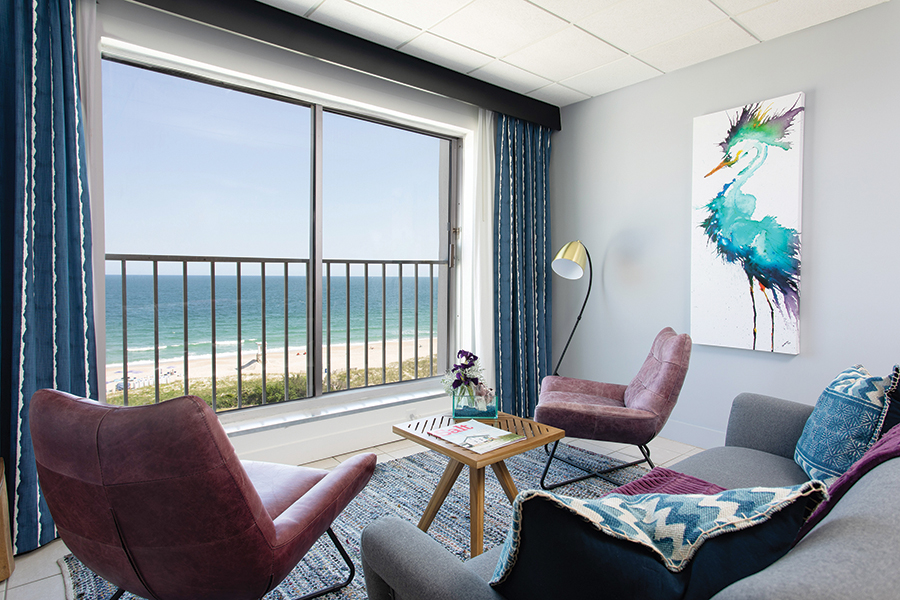
Allred credits Mary’s generosity for letting her creative spirit run loose. “Mary spoiled me,” she says of their many showroom jaunts over the years. “She’s taught me a lot. She leaves no stone unturned.” When Allred’s muse strikes and she immediately wants to purchase items that catch her eye, it is Mary who pulls in the reins with a gentle, “Are you sure about that?” or “Let’s go look some more.” Allred has persuaded her friend and employer to rethink things, too, coaxing her away from 150 unique rooms and offering seven distinct floors, instead, the idea being that each visit to the Blockade Runner can be different from the last. On a nautical-themed floor lined with porthole mirrors, sailing enthusiasts will appreciate the sailcloth shower curtains, not to mention the view of watercraft cruising the sound. There is a Rifle floor, using the aforementioned accents of the Rifle Paper Company, and Allred’s favorite, a Bohemian floor whose design was inspired by an elegant dresser she calls “Emma.”

It was love at first sight when she spotted the piece at Market. “I sat down on the floor in front of Emma. And I said, ‘I’m doing a floor with this dresser.’” She likes to think her creative impulsivity has rubbed off. When, at another showroom Mary and younger Brother Ben Baggett gasped in unison at the sight of an enormous Lucite Guildmaster table supported by an enormous driftwood base, Allred immediately ordered the piece, despite Ben’s questioning where in the hotel it would go. Her response? “What difference does it make? “We’ll find a home for something that takes your breath away.” That, after all, part of creating an escape for vacationers. The table, as it happens, now has a place of pride in the stunning, water-themed lobby.

Another pearl of wisdom Allred hopes she has imparted to Mary is the importance of establishing consistent relationships with vendors. She has particular praise for High Point–based Phillips Collection, “because they’re so easy, they’ll do anything for you,” Allred says. For the same reason, she speaks admiringly of BELFOR, the property restoration company that stepped in after the Blockade Runner was saturated with water during Hurricane Florence last fall. “They were fabulous,” Allred says, mentioning that BELFOR had to rebuild the entire balcony section of the hotel, whose roof was ripped off during the storm. Allred was “back in the saddle” in the storm’s wake, going to the High Point and Atlanta shows to purchase furniture, art and accessories and overseeing all the myriad moving parts integral to the hotel’s refurbishment. She says BELFOR was particularly helpful with to replacing carpets, flooring or wallpaper. “They do it. They get it for me, which cuts out some of my hassle.” Having lived through 17 hurricanes, she is all too familiar with the hassle of recovery — the demand for contractors and inspections alone — that many inland dwellers simply do not understand.


But Terry and John Allred will always understand what it means to be waterlogged, even though they themselves are once again inland dwellers. The pull of home was just too strong. They sold their house on the Intracoastal Waterway exactly one week before Florence struck. “I told my husband we should have bought lottery tickets that week,” Allred quips, as she stands before another Taddeucci mural consisting of green leaves on a black background. It is a bold statement in their high-rise, as is the expansive view of downtown Greensboro.

“We love our new life,” Allred sighs contentedly, mentioning the nearby restaurants, Carolina Theater, Triad Stage and the live music from the N.C. Folk Festival readily available from their perch. “I can sit right here, have a glass of wine and watch it all!” the designer enthuses. She likes to walk in Fisher Park, and come winter, make snow angels in City Center Park. “We’re not the beach people we used to be,” she reflects. In fact, she and John have turned their gaze to the west. For when they’re not enjoying the Gate City’s downtown scene, the Allreds take delight in the cool mountain breezes of Meadows of Dan, Virginia, where they frequently socialize with an enclave of fellow Greensborians, visit wineries such as Chateau Morrisette and Villa Appalaccia, dine at the posh mountaintop resort, Primland, and work in a new garden — this one rich in the red clay they’ve missed all these years.

The couple chanced upon a small condominium community while visiting another Baggett family property, Meadows of Dan Campground that includes some log cabins, which, yes, Allred refurbished for her dear friend Mary. The Baggetts, she says, “are family.” And though she officially retired from her post at the Blockade Runner, Allred was still overseeing the post-Forence design work and putting some finishing touches on the lobby — oversized wicker fan chairs, metal palm trees — for its grand unveiling last month before the start of high season. She’ll likely return in October when the property celebrates its 55th anniversary, lending her special magic to the decorations and festivities as she has for every holiday — Thanksgiving, Christmas, Fourth of July — making the hotel a happy place for all who enter its dreamlike watery world. Then she’ll head west again to where she is happiest: “digging in the dirt . . . and visiting wineries.”  OH

By the time you read this, Nancy Oakley will be kickin’ back, Zac Brown–style.

Poem July 2019

Pulling Up the Wild Blackberry Bushes

seems ungrateful but they’re too plentiful

crowding the precious patch of sun

meant for the Heritage Red Raspberry

that cost $16.

So it’s a matter of hubris that we jerk up

those lesser cousins before they bloom

drag them over nubile grass and

toss their torn briars into fire.

Yet when I get to the last bush, I stop

remember how in August I needed

more fruit to nestle around the scant

peaches in my cobbler.

The berries were small but their juice

tasted of mulled wine, piquant but

not too tart, the grace note of a last-minute

potluck, others cooed for the recipe.

So I lay aside the shovel, knowing that

this last bush, cane too tender for thorns,

might one day be our savior

if the raspberry turns to dust.

— Ashley Memory

Anchors Aweigh!

Frank Slate Brooks and Brad Newton are always ready to set sail for adventure  from the comfort of their nautical-themed home in historic Lindley Park

By Billy Ingram     Photographs by John Koob Gessner

Frank Slate Brooks and Brad Newton have chosen to cruise through life, moored but not anchored to their spectacular Lindley Park home, a retro-pop sanctuary where elegance and eccentricity collide.

Frank was raised in High Point, Brad in Burlington. They’ll have been a couple for 23 years this August. “We found out a couple of years into our relationship that our grandparents had been best friends,” Frank tells me. “We don’t know if we met each other as kids or not, but it was meant to be somehow.”

If their names sound familiar, it may be due to a blizzard of publicity that erupted in 2014 after they became the first gay couple to marry in Guilford County. “I didn’t realize that the media might be there,” Frank recalls. With that in mind, their first thought was — would their parents be OK with this being public? “My father is very conservative,” Frank says. “My mother had already passed and my dad was out at River Landing. Someone had left him a copy of the newspaper next to his bed and wrote ‘Congratulations’ on it. I walked in and Dad said, ‘So what have you been up to?’ He was all good.”

And so was the community at large. “We really thought there would be some kind of backlash or something nasty but it was the opposite,” Brad says. “At the baseball stadium the Saturday after, there was a chili cookout thing going on and people of all ages were coming up to us giving us hugs, it was just great.” Frank Slate Brooks, now with Tyler Redhead & McAlister Real Estate, has sold well over 100 homes in and around Lindley Park since 2006. “In 2001, I started out flipping homes with my then partner [interior designer] Laurie Lanier,” Frank tells me. “She staged a house for me and it sold in less than half a day. We did about 12 houses here in Lindley Park before we priced ourselves out of the market because when we started, Lindley Park was not what it is today. Everything that we sold raised the prices for all the properties around them.”

After his experience flipping houses, Frank realized he needed to get his real estate license, “I really think we [Stephanie and I] were responsible for the renaissance of Lindley Park.”

Graced with tree-lined streets, eclectic architecture and neighborhood schools, Lindley Park was ripe for a revival once people began moving in from the suburbs. It was originally the site of an amusement park designed by the Greensboro Electric Company in 1902 to generate interest in the city’s new trolley line. That 3-mile trolley ride down Spring Garden from the center of town took around an hour and a half. (You could walk in half the time, but the muddy terrain wasn’t exactly pedestrian-friendly.)

Named for J. Van Lindley, whose 1,130-acre nursery and Pomona Terra Cotta Company were situated nearby, the 26-acre park opened on the Fourth of July. The pavilion featured refreshment booths, a Fairyland Casino for dancing and bowling alleys. Nearby was a manmade lake for swimming and boating in the summer, ice skating in the winter, along with a miniature railroad and a 1,000-seat theater for touring vaudeville acts, as well as some sort of local monkey act. The park’s 20 x 25–foot bathhouse still stands behind the residence at 2812 Masonic Drive.

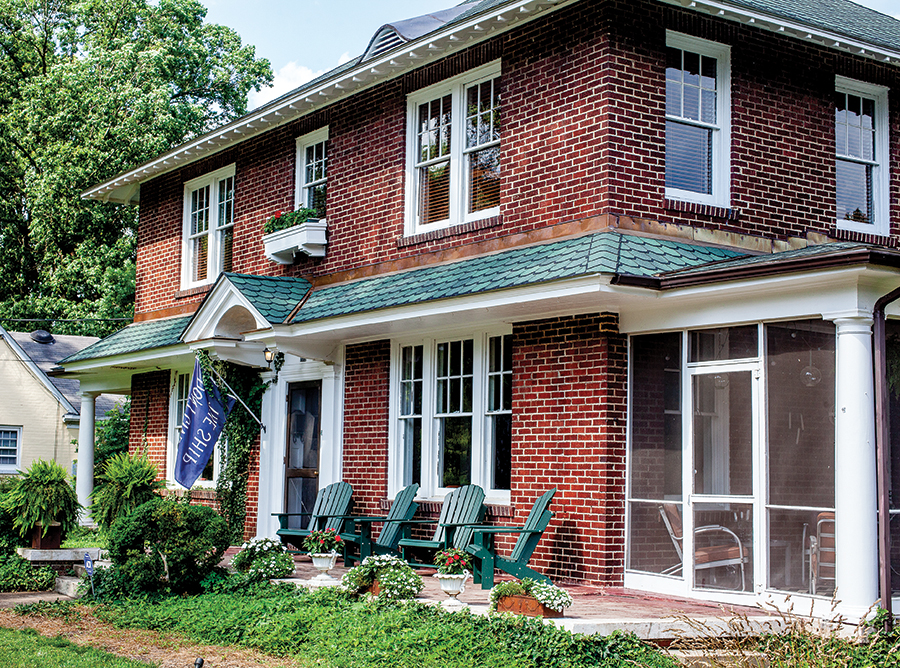
Frank and Brad’s two-story, Colonial Revival–style home on Northridge Street was built during the first wave of swank homes developed for the Lindley Park neighborhood in 1922 after the amusement park had closed. Its construction is somewhat unusual, consisting of a brick exterior with 16 inches of insulation between the walls, the majority being more brick that keep rooms naturally warm in winter and cool in the summer. “They knew how to build houses back then,” Brad says.

At the start of the 1920s, the heart of Lindley Park was the corner of Walker and Elam and it remains so today. The first collection of unrelated businesses outside downtown was most likely Sunset Hills Shopping Center, established around 1925 on the northeast and northwest corners of the intersection, with two shops and a service station where Sticks and Stones is today. The retail area expanded in the 1930s to include a Piggly Wiggly in the space Suds & Duds currently occupies.

The Pickwick Soda Shop (now Walker’s) opened around 1943, at some point in the 1960s becoming The Pickwick bar and grill where, in the evening, newspaper folks downed Blatz on tap with college students that included Jim Clark, future Director of UNCG’s MFA Creative Writing Program. Sealing its street cred as a hippie hangout in the ’60s and ’70s, The Allman Brothers played there. As the district became more bohemian with the expansion of UNCG in the 1980s, large portions of Lindley Park began to go to seed.

In 1999, Frank had been living on Mayflower Drive for around seven years when, as he recalls, “My parents said, ‘You need to get a bigger house because we’re giving you a lot of furniture’ and I thought, ‘OK . . .’” Visiting a friend who lived on Northridge Street, “We were out on her deck,” Frank remembers. “And she said, ‘These people next door are getting ready to transfer and they’re selling their home,’ and I said, ‘What house?’ We had been over there many times and never noticed this house.”

That may be because the manse is somewhat hidden behind a canopy of shade trees even older than the home itself. Frank ventured over, knocked on the door, “A woman named Mary lived here,” he says. “She showed me the house and the backyard and I said, ‘Sold!’”

A few minutes later, “Frank called me at work,” Brad recalls. “He said ‘I found a house, we’re signing the papers tonight’ and I said, ‘Whoa, slow down.’ I’ve not even seen this house! I came over after work and kinda did the same thing: ‘Sold!’”

Frank describes the surroundings in 1999, “The Filling Station [restaurant] was still a filling station with stacks of rusty cars in front of it.” Fishbones on the corner, he says “was part of The Blind Tiger next door; they closed that off and it just sat there. Now it’s the reverse.”

“Bestway was owned by two old men,” Brad remarks. “After they sold it, it became very much like a glorified Stop & Rob, not at all what it is now. There was very little activity at the corner of Walker and Elam, I think Wild Magnolia closed right as we were moving in.”

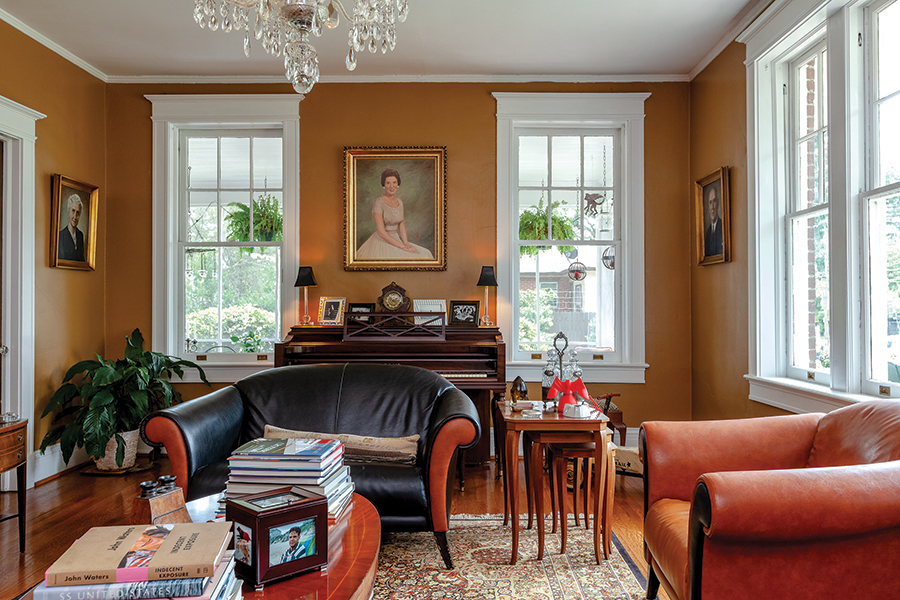
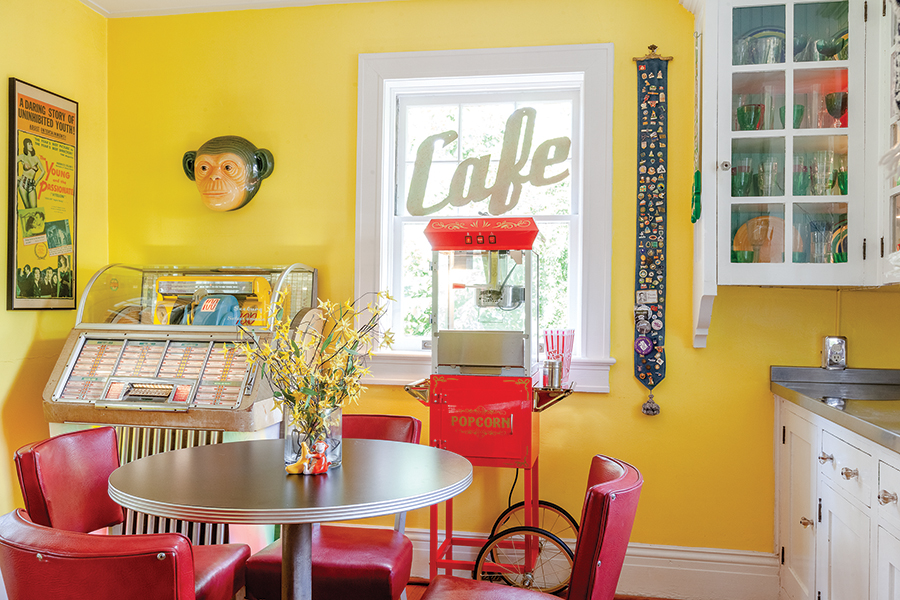
Since then, they’ve been furnishing their home in 20th-century whimsy, a Technicolor dreamscape. For instance, in an otherwise sedate living room, a Chain Drive Irish Mail push/pull pedal cart from the 1960s adorns one corner. In the breakfast room, a papier-mâché monkey mask by Mexican artist Sergio Bustamante hangs above a pristine 1952 Seeburg Select-O-Matic 100 jukebox. “We had it restored,” Frank says. Surprisingly, filling it full of hit records was easy, he adds. “I had a listing where the owner had left hundreds of 45s behind so we switch it out all the time.” They even found a place online that prints those distinctive crimson-striped labels for the jukebox’s song selections.

Brad is a big Don Knotts fan, so a poster from The Ghost and Mr. Chicken holds a prominent spot in the kitchen, as does a collection of pins acquired by Frank’s father from the many countries he’d traveled to. It continues to grow with the couple’s own additions. “This kitchen has seen so many transformations,” Frank says. “We recently did the countertops, the upper cabinets are from Preservation Greensboro.” Just off the kitchen is another equally impressive collection: of model ships he assembled as a teenager.

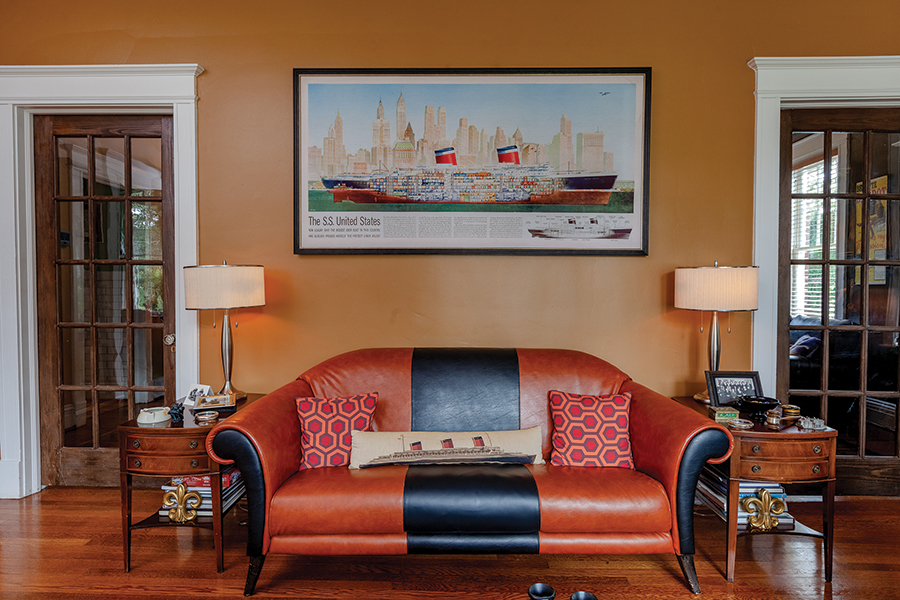
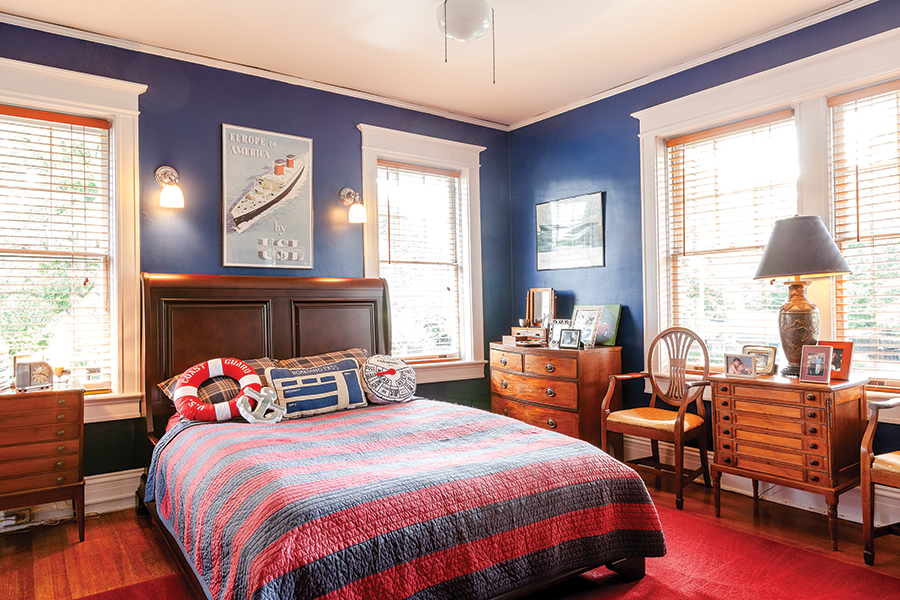
But what really makes their home one-of-a-kind is an unmistakable nautical theme. Both Frank and Brad (or “Frankenbrad” as their friends fondly refer to them) share a fascination with ocean liners and enjoy luxuriating on transatlantic cruises aboard vessels like the SS Norway and RMS Queen Mary 2. Part of the allure? “I love the ability to unpack once and have everything taken care of,” Frank says. “In a lot of ways, we’re very old-fashioned,” Brad explains. “On cruise ships you still have to dress for dinner, I do enjoy that. On the Queen Mary 2, they will stop people from entering the dining room in a T-shirt and shorts.”

A Carnival Cruise won’t float their boat. “We prefer the old-school, luxury Cunard ships and Celebrity Cruises,” Frank insists. “They always have lectures and more interesting things to do than your Caribbean cruises. The spa . . . high tea is very nice, the British ships are big on trivia contests. And the disco is fun for maybe one night.”

“Frank made friends with the actress Celia Imrie (of the Bridget Jones movies) on our first Queen Mary crossing,” Brad says. “We were invited to a gay wedding on board, officiated by the Captain, and she was involved in that.” Even choppy waters won’t spoil the good times for these two. “We got chased by Hurricane Mitch last year on the [Celebrity Cruise ship] Mercury,” Frank tells me. “We dodged it the first time but then it reformed in the Atlantic and they were calling it ‘Son of a Mitch.’ The waves got so bad, everyone was tossed and thrown everywhere so all drinks were free for a day or two. We have our sea legs so it didn’t bother us; we thought it was fun.”

At an early age, Frank became infatuated with America’s Flagship, the SS United States. Now he’s North Carolina co-chairman of the SS United States Conservancy, an attempt to repurpose what was once the most elegant ship on the high seas, attracting U.S. Presidents and Hollywood stars alike from the moment of her maiden voyage in 1952. A full 100 feet longer than the RMS Titanic, the SS United States still holds the record as the fastest ocean liner to cross the Atlantic. The ship was retired in 1969.

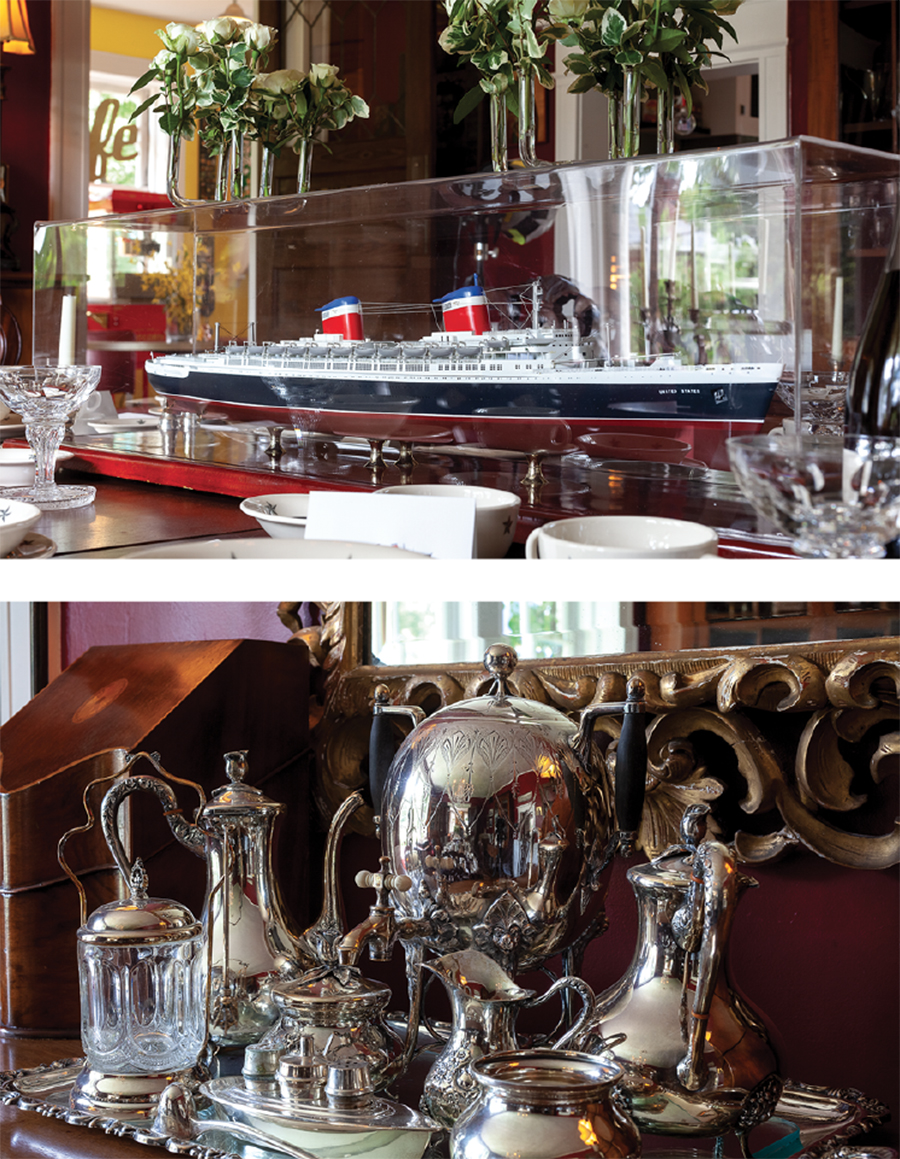
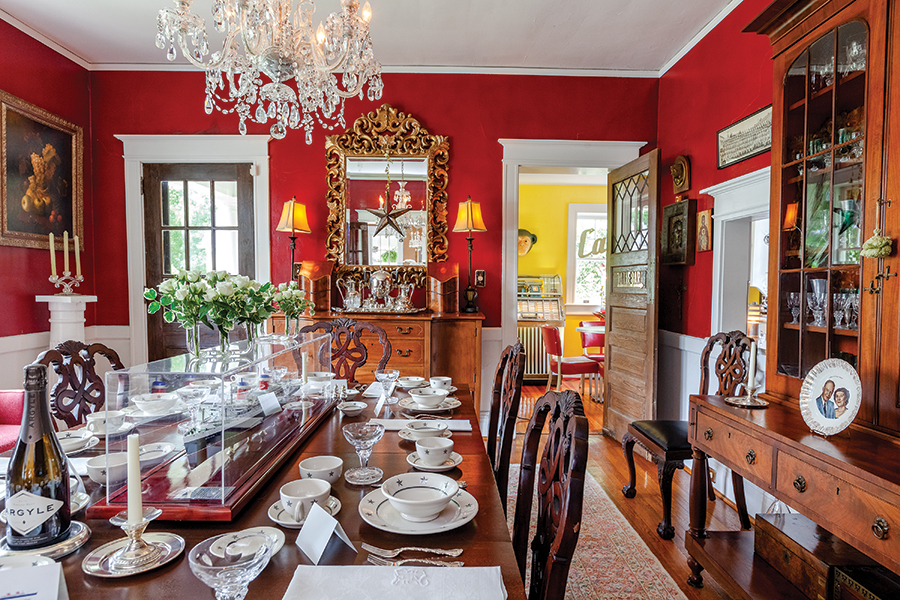
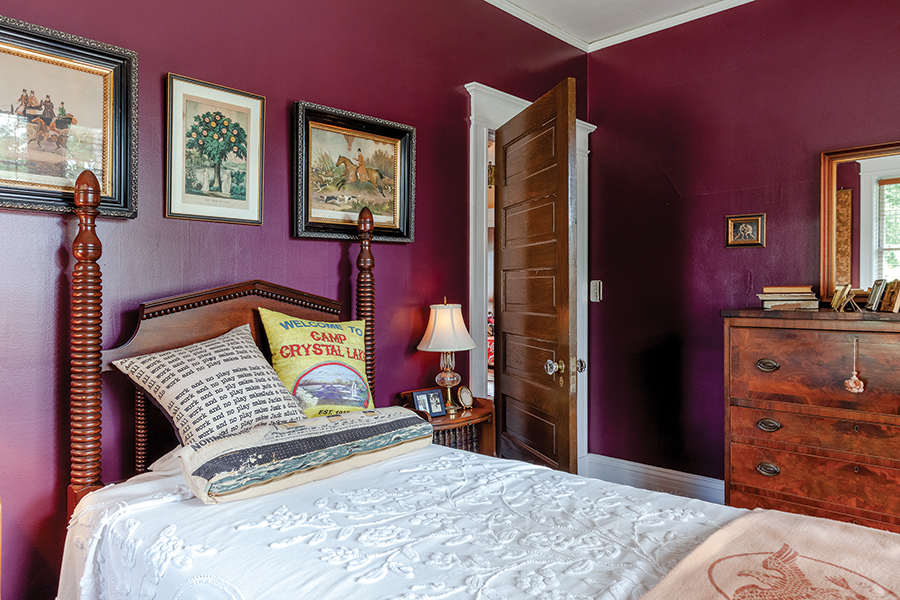
All around the home are mementos and sumptuous details salvaged from the SS United States: ashtrays, aluminum cabin keys, towels, travel posters, its “Swimming Pool” sign in the mudroom above the back door, even blankets on the beds bear the ship’s insignia.

In the dining room are several chairs, a table lamp, and fine china place settings that also originated from the ocean liner; a scale model of the ship serves as the formal table’s centerpiece. Nearby, a grandfather clock from the 1800s chimes the hour while, mounted on another wall, is a metal sculpture of Jesus wearing a crown of thorns by Felix de Weldon who famously sculpted the Iwo Jima Memorial. “It’s bolted to the wall,” Brad says. “It’s very heavy. If it ever falls off, it’ll end up in our basement.”

Recently, FrankenBrad hosted a kick-off party here for Preservation Greensboro’s tour of Lindley Park homes. “We had a great turnout,” Brad says. “Our house was going to be on the tour, but we were out of town.”

Brad, who’s worked in marketing for Replacements, Ltd. for the past 23 years, has a love for Hollywood movies, as evidenced by the dramatic framed three-sheet posters for such cult classics as Beyond the Valley of the Dolls and Stanley Kramer’s The 5,000 Fingers of Dr. T., both of them three times larger than your typical one-sheet movie poster. “They didn’t make a whole lot of three-sheets,” Brad notes. “In fact, they are always numbered.” Pointing to an etching in the bottom left hand corner of the 5,000 Fingers poster, he says, “There were only a total of 53 of these made and this is No. 8.” A poster for Roman Polanski’s 1965 thriller Repulsion is mounted above their bed because, as Brad says, “Everyone wants to see a psychotic Catherine Deneuve whenever they walk into the bedroom, right?”

If this home reminds one of Stately Wayne Manor it shouldn’t be surprising that, just like the ’66 Batman TV show, in the den next to a red rotary telephone is a bust of William Shakespeare. Pulling back The Bard’s head reveals a switch that triggers a bookcase to slide to one side, exposing the Batpole leading down to the Batcave (sliding bookcase, Batpole and Batcave not included).

Another fitting nostalgic touch? Their screened porch, which hasn’t been glassed-in as so many are nowadays. There’s something quaint about a screened porch, especially this one with four 1950s era barbershop waiting room chairs to lounge on. Very Mayberry.

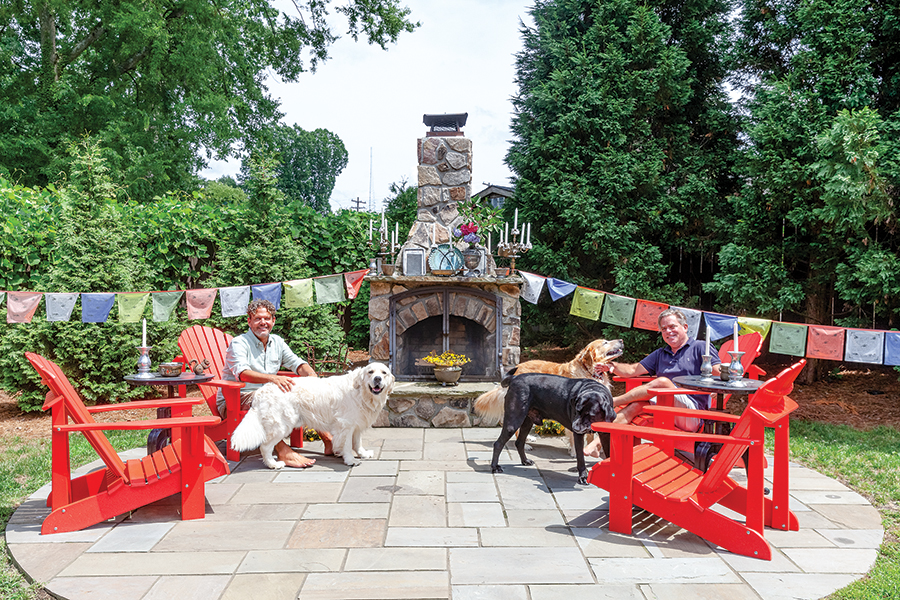
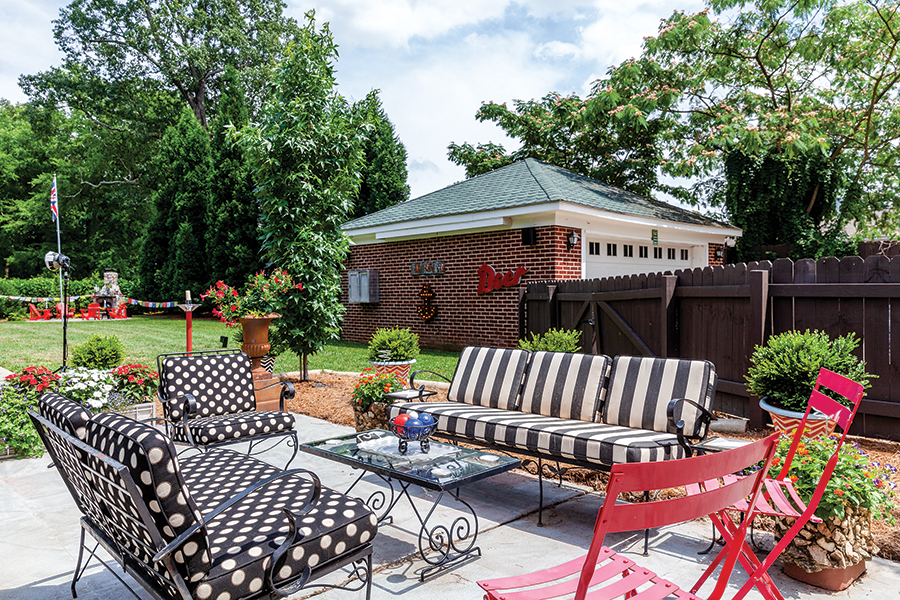
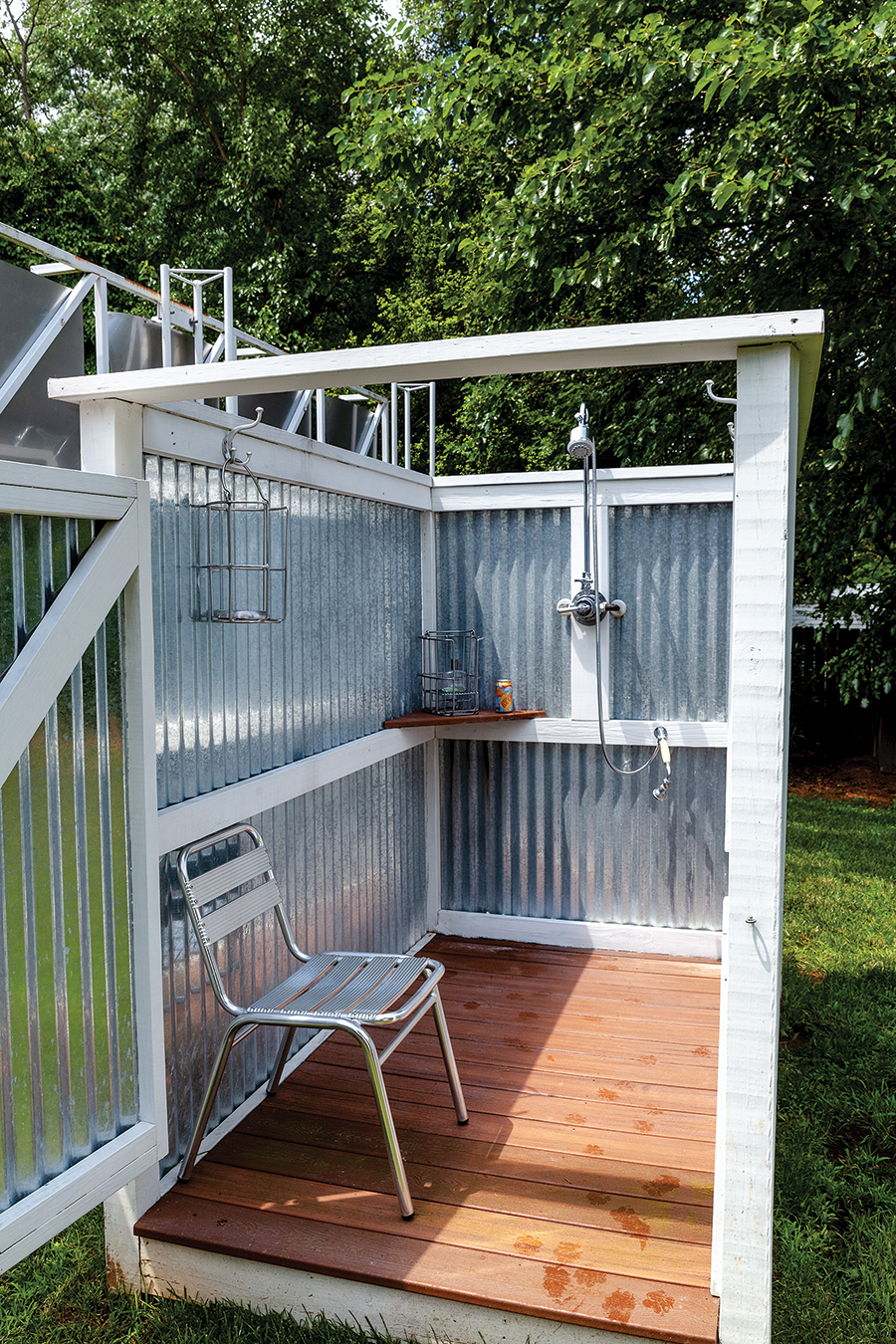
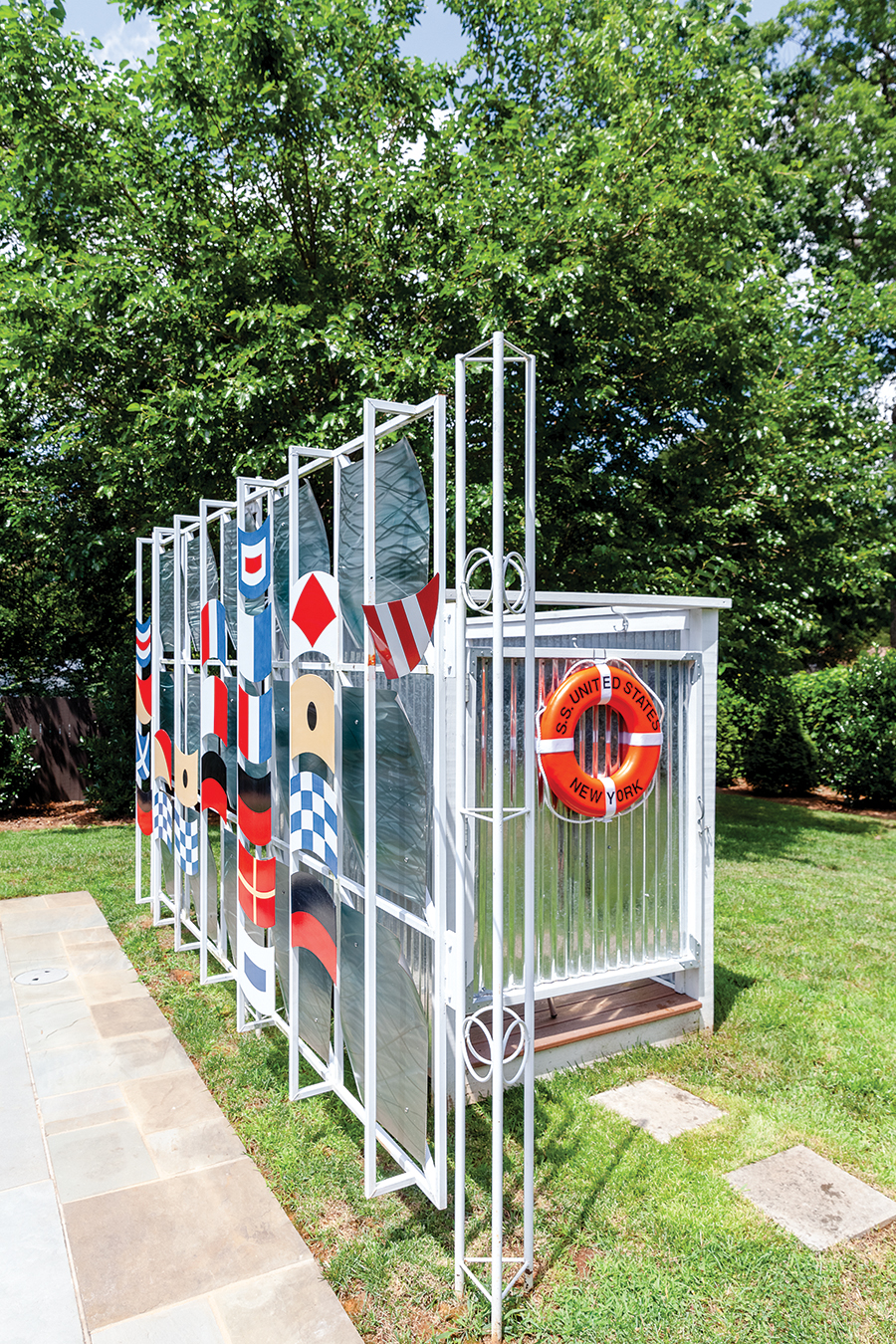
Entering their backyard, dominated by a 60-foot long pool, is a bit like walking onto the deck of a cruise ship, but considerably greener. “These silver planters are from the First Class Dining Room in the SS United States,” Frank says. A wall of nautical flags, nearly an exact replica of the one situated at the end of that fabled ocean liner’s indoor pool, spells out, ‘Come on in the water’s fine!’ The outdoor shower and deck chairs also originate from the United States.

As we relaxed on the terrace, accompanied by a symphony of chirping birds, I half expected Admiral Halsey to come floating down from the sky.

“There was a time when we were talking about buying a beach house,” Brad explains. “We thought about the upkeep, the insurance, worrying every time a storm came through, so we decided we’d turn our house into a vacation property. We love to get up on Saturday mornings, put on our bathing suits [“Or not,” Frank interjects] and it’s like we’re on vacation in our own neighborhood.”

It’s safe to say the couple’s three dogs — Rex, a 6-year-old black Lab; Dios, a 9-year old golden retriever; and Ripley, a 2-year old English Cream — enjoy the pool almost as much their owners do. Frank laughs, “When we go on vacation we have a dog sitter who is always like, ‘Oh yeah!’”

Chip Callaway did the landscaping, lining the fence line with magnolias and upright skip laurel. “Chip told us, ’The first year they sleep,’” Frank explains. “‘The second year they creep and the third year they leap.’ And that’s where we are now, the leaping stage.” A pull-down motion picture screen along an exterior wall of the garage allows for cozy movie nights. No wonder they have no intention of moving or even one day downsizing. “We’re here to stay,” Frank insists. “We love it here.”

Sold!  OH

Billy Ingram is a former Hollywood movie poster artist who now enjoys exploring Greensboro’s rich history.

She’s Got Game

Joy resounds in the crack of a bat for Grasshoppers superfan Priscilla Tuttle

By Maria Johnson     Photographs by Sam Froelich

Priscilla Tuttle raises her fists, but not in anger.

She puts up her dukes to bolster her beloved Grasshoppers when they need it — as they do now, in the opening act of a daylight double header against the Lakewood BlueClaws, who’ve scuttled down from New Jersey.

It’s the bottom of the first, and the Hoppers, Greensboro’s minor league baseball team, are at-bat, down 1-nothing.

The BlueClaws pitcher unfurls a fastball that reverses sharply with a flash of ash. CRACK! A shooting star of hide arcs over the infield and lands in the grass. The Hoppers batter in bright white churns to first.

“Go-go-go-go-go-yeah-yeah-yeah-yeah-yeah-wooooooooo,” Tuttle croons from her usual seat in the first row behind the Hoppers dugout. She shakes her fists like baby rattles, though she’s far from the cradle.

At 78, she’s one of those women who subtracts years by answering the age question quickly.

She’s not afraid of stepping up to the plate.

Or guarding it, like she did when she was coming up in the textile town of Eden.

Her daddy worked at Fieldcrest Mills’ Draper blanket plant; he played catcher and shortstop for the mill team. Young Priscilla and her family watched the games at close range.

“Mama said my first black eye I got by a baseball when I was 3,” she says.

As a teenager in the 1950s, Priscilla followed the Dodgers — the Brooklyn Dodgers — on TV. She played catcher for her high school softball team. She used her daddy’s mitt, a hard brown doughnut made buttery in the middle by balls that numbed her left hand.

She threw right-handed, batted left, was a fair-to-good hitter and a scrappy defender who planted her featherweight frame over home plate whenever a girl rounded third.

“I tried to keep ’em from getting across that base. I got rocked a lot. That was in the old days,” she says.

Later in life, after she and her husband, Gray, had four sons, she and the boys played on occasional Sunday afternoons with a co-ed bunch from her Methodist church. Priscilla played catcher, again. She didn’t get bowled over nearly as much — thank you, Jesus, for Christians and small children at home plate— but she got charley horses from not warming up.

Dirt-and-fescue diamonds are rarely a girl’s best friend into middle age.

She quit the plate and exercised by chasing her boys and minding the family store  — The Barn Bait & Tackle — in an old tobacco barn on N.C. Highway 135 between Eden and Stoneville. That’s where she was working when a friend of the family — who was also a booster of the Greensboro Hornets, a predecessor of the Hoppers — walked in with some players in T-shirts and jeans.

It was 1991.

The booster-friend had worked it out with Gray’s uncle to let the players fish in the uncle’s pond. They stopped at the store for rods and reels and worms.

Priscilla fixed them up. That’s how it started, her long walk home to baseball.

She’d set up the players with bait and tackle, they’d talk, and naturally, they got to be friends. She invited them over to the house for supper.

She made regular food. Salisbury steak. Meat loaf. Green beans. Crowder peas. Creamed potatoes. Cornbread.

“They ate it all,” she says. “Lord have mercy.”

One day, one of the players asked Priscilla if she’d ever been to one of their games?

No, she said.

Why not? he asked.

She shrugged.

If I got you some tickets, would you go?

Sure, she said.

In 1993, she became a regular at War Memorial Stadium. Gray would go, too, when he could get away from farming tobacco and getting up hay.

Priscilla studied the game. She learned the fine points that had never dawned on her in high school: how hitters hit to certain locations in certain situations; how defenders shift on the field depending on who is at-bat; how every throw from the field is calculated to minimize damage.

Like most games, baseball was simple on the surface, complex underneath.

“It’s a finesse game,” she says. “I enjoy seeing ’em work it.”

It was more fun because she knew the players. She took their pictures, had double prints made at Winn-Dixie, laid out photo albums for herself and gave extra prints to the players to share with their families.

Somewhere, she knew, those players — most of whom were single and in their late teens or early 20s — had parents who worried about them. Priscilla wore out her Instamatic camera letting the unseen families know she was watching out for their sons.

She got new cameras, new lenses.

She made the transition from film to digital.

She grew and changed with the team, with the seasons.

She joined the booster club and pitched in to provide the players with picnics, household goods, and goody bags for road trips.

She adapted to the name changes — from Hornets to Bats in 1994, and from Bats to Grasshoppers in 2005, when the team moved to what’s now First National Bank Field.

She rolled with changing affiliations to major-league clubs.

She and Gray traveled to spring training in Tampa, Florida, when the team was aligned with the New York Yankees. They visited Jupiter during the reign of the Miami Marlins.

Just this season, the Hoppers divorced the Marlins and took up with the Pittsburgh Pirates, who eat grapefruit in Bradenton, Florida.

Priscilla was sorry to see the split. Marlin’s CEO Derek Jeter had played for the Greensboro Hornets in 1992 and ’93 before going onto stardom with the Yankees, and Priscilla was impressed by him and his parents. Good people.

But Jeter’s visit to Greensboro last season did not bode well, she says. He stayed in a skybox and did not acknowledge the fans.

“It looks like he would have come out of the box to meet the people,” she says. “There are a lot of people here who remember the old days.”

Maybe, she says, it was time for a change after all. The Marlins’ brass didn’t like the dog crates in the clubhouse. The bat-fetching pooches of Hoppers owner Donald Moore are longtime darlings of local fans, including Tuttle.

Soooo . . . fair thee well, Marlins.

“We like the Pirates,” says Priscilla, who has served as the president of the Hoppers booster club for, as she says, forever.  “We like the Pirates just fine.”

It’s time for “Y.M.C.A.”

Youngsters in shorts mount the dugout roof in front of Tuttle. She moves her canvas tote bag to give them more room as they commence to making Village People of the crowd.

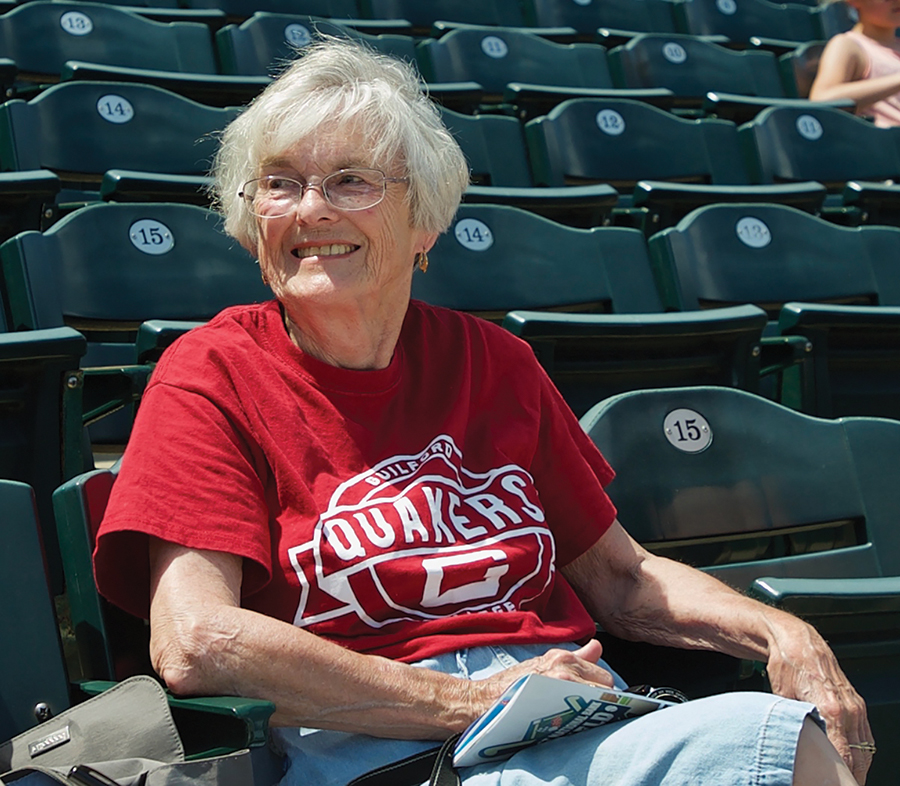
Tuttle, whose short blond hair yields easily to gray, stays seated, sings along and makes the letters with her arms. In her elastic-waist jeans and slip-on sneakers, she looks every bit the elementary-school substitute teacher that she once was — and the reading tutor that she still is.

Her red T-shirt advertises the Fighting Quakers of Guilford College. Her grandson, Dylan Tuttle, pitches and plays right field for the Quakers. He gets it — why his grandmother keeps baseball cards, baseball programs, baseball books and signed baseballs in clear plastic boxes.

He gets her poster of Yankees slugger Don “Hit Man” Mattingly, who, incidentally, also played in Greensboro, in 1980, on his way to the Show.

If anything happens to me, Priscilla has told Dylan, don’t let them throw this stuff away. You know what it means. Not that she plans on going anywhere anytime soon, she points out, other than to a Hoppers game.

“A lot of things make me happy, but with this, I enjoy sitting and watching the plays. You sit here, and the cares of the day . . . it’s a way of focusing on something else,” she says.

“You can stay at home, in your little cluster, and never branch out, or you can go out someplace like this and meet people, and have a community. It’s just a joy. Except when we’re losing.”

We’re losing.

Have been since the error-filled fourth inning.

Now, it’s bottom on the seventh, the final inning of the foreshortened doubleheader.

Priscilla locks her blue-green eyes on the game. Her bifocal lenses are clear — not rose-colored — but her wire frames are rosy-gold. Hopeful around the edges.

We’re down 4-7 when the rally starts.

Siri doubles. Sanchez walks.

Men on first and second.

Macias singles, driving home Siri and advancing Sanchez.

Men on first and third.

“Oh! Go-go-go-go-go! Woooooooo.”

Priscilla’s fists are up.

The score is 5-7 when the first baseman Martin comes to bat. His mother might call him Mason, but to Priscilla, he’s Martin. She calls them by their last names. This is baseball.

Martin’s a lefty. Out of Washington state, Priscilla thinks. She’s still getting to know this Pirates team, making them her own.

“Let’s go, Hoppers! Let’s goooo,” she urges.

Four-hundred-and-eleven feet. That’s how far Martin pulls the ball. It sails over the ad-plastered fence and clonks off a building under construction on the other side of Eugene Street.

Martin knows it’s gone when he hits it. His slow trot around the bases gives time for everything to rise: The noise. The fans. The delirium of seeing the long shot made real.

Game over.

Hoppers win 8-7.

Priscilla Tuttle is on her feet, bouncing in her Skechers, yelling to be heard over the swell.

“Now, that’s what you call a baseball game.”  OH

Maria Johnson is a contributing editor of O.Henry. Her email is ohenrymaria@gmail.com.