The Art Of The Farm

The Art Of The Farm

Aubrey Cupit embraces an ancestral call of the land with 21st-century know-how

By Maria Johnson     Photographs by Brandi Swarms

Like any good Millennial, 31-year-old Aubrey Cupit appears to be biologically attached to his cell phone.

He has an Instagram account and a Keurig coffee maker.

He favors long-sleeve T-shirts, and his short auburn hair descends to a rusty mustache and beard.
You could envision him loping down the streets of Charlotte or New York City, as many of his former high school and college classmates do.

But you probably won’t see that — unless he’s visiting — because Aubrey Cupit is a farmer.

A small-time, independent, one-man-show farmer.

A get-up-with-the-sun farmer.

A ground-hog-cussing, weather-watching, dusty-jeans-wearing, worn-out-by-Saturday-night-and-ready-to-sleep-in-until-8-on-Sunday-morning farmer.

He owns 9 acres in northwest Guilford County and works two of those acres to make salad, essentially. He raises leafy greens, tomatoes, herbs, carrots and a smattering of other vegetables.

At the moment, he’s heavy into broccolini, that leggy, small-headed cousin of broccoli. Also, he’s getting into cauliflower, which is trending now. Kale is dead. You heard it here first.

He sells to local restaurants and to the general public at the Greensboro Farmers Curb Market. He also peddles produce from a roadside stand at the mouth of the gravel driveway to his land.

Gate City Harvest, that’s his place on Pleasant Ridge Road in Summerfield. As the crow flies — which it actually does out here — it’s very close to where Cupit grew up, in The Cardinal, a 1980s neighborhood molded around a golf course, swimming pool and tennis courts. In other ways, it’s oh-so-far away from the childhood of a guy who chose to go back to the land he never had.
Aubrey Cupit (rhymes with Muppet) was a typical suburban kid. He kicked soccer balls and slugged baseballs on well-groomed fields. He played first-generation Xbox video games. He loved Taco Bell Cinnamon Twists. In middle school, he jettisoned sports for art and photography. He painted watercolors to give to his mom on Mother’s Day. He drew every one of North Carolina’s seven lighthouses.

“My brothers had bigger personalities than I did,” says Cupit, who was a fraternal triplet and one of four boys growing up. “I was more introspective.” No one grew vegetables at home, but Cupit’s mom, Sharian, was an avid landscape gardener. She tended a beautiful yard.

Cupit didn’t notice.

He went to UNCG to study art. His junior year, he needed an elective. He took one that sounded interesting and relatively easy: “Religious Traditions and Care of the Earth.” The lecturer was Charlie Headington, an expert on permaculture and sustainable gardening. Headington talked about how religions viewed the Earth differently — some as a thing to be ruled, some as a thing to be revered — and how that played out.
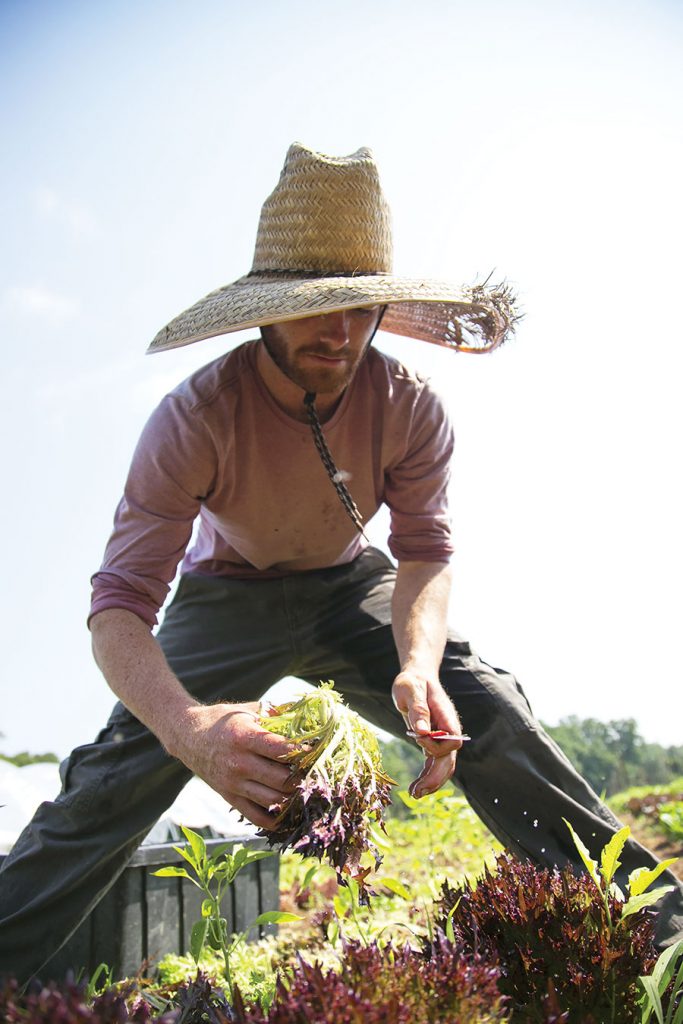
The ideas fell on fertile soil in the mind of the young artist, who threw himself into writing papers for the class. The essays jumped out because they went beyond the minimal requirements. “You can tell people’s comfort levels with ideas by how closely they stick to the guidelines,” Headington says. “Aubrey’s a person who feels comfortable with intellectual discussion.”

Cupit supported his arguments with ideas he’d read about elsewhere. “That’s what a teacher really enjoys — having a person with an original mind. I think that really comes from his art background,” says Headington. Before the semester was up, he suggested that Cupit intern in the gardens at Greensboro Montessori School, which Headington designed and maintained.

Cupit appreciated the offer but let it slide.

That summer, Headington ran into Cupit in the store where Cupit worked, Video Review on Battleground Avenue, a now-defunct touchstone for local movie buffs.

Headington pitched the internship again. “Aubrey was taking my money, and I said, ‘Well, hey, how about it? Are you interested?’” Headington remembers. It wasn’t much, that second offer, but it was enough to nudge Cupit’s life down another track.
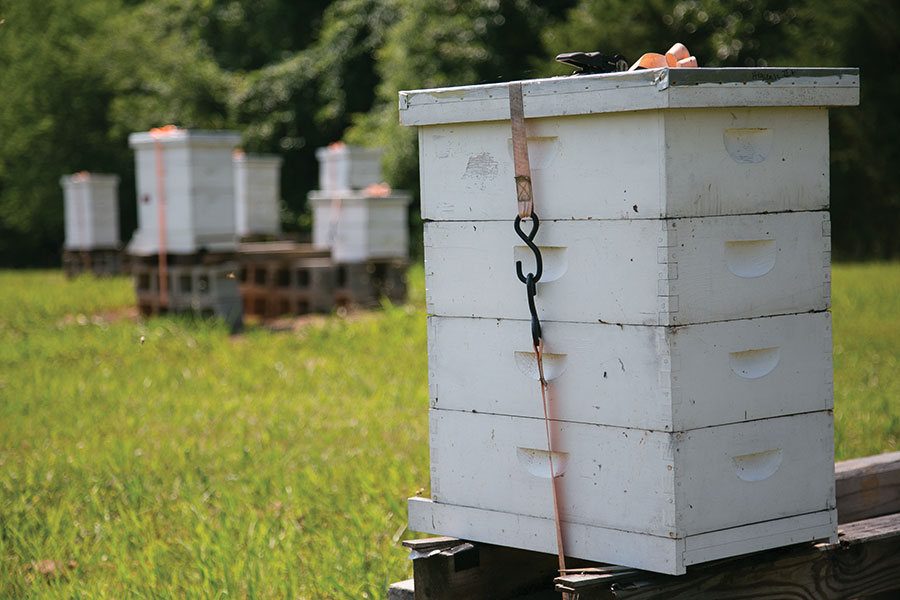
He didn’t become a farmer overnight. First, he wandered in the desert. Correction: tomato patch. He put in sweaty hours at the Montessori gardens, digging out tangles of Bermuda grass, a maddening chore. He didn’t mind. “It felt good to be a part of something bigger,” he says.

He progressed to planting. He learned the underpinnings of permaculture, a way of growing that mimics nature and minimizes human intervention. When it works well, Cupit says, permaculture yields food that is healthier and cheaper than food that comes from high-input agriculture.

Cupit took a degree in fine art, but he kept his hands in the dirt at Montessori — where he still manages the garden and teaches part time — and he signed on at Whitaker Farms in Climax, a large grower of strawberries and greenhouse tomatoes.

Under the tutelage of Faylene and Richard Whitaker, he toiled in the greenhouses and worked their stall at the Piedmont Triad Farmers Market on Sandy Ridge Road. Faylene schooled him on the psychology of the market.

“She would always say, ‘Pile ‘em high, and watch ‘em fly.’ If you have a few tomatoes at the end of the day, you’ll never sell them. People will not buy the last ones. Psychologically, we respond to copious amounts, not skimpy stuff,” says Cupit.

He gleaned more from Daniel Woodham of Greensboro’s NIMBY (Naturally in My Backyard) Gardens. Cupit watched Woodham woo customers by waving bouquets of fragrant herbs at the Greensboro Farmers Curb Market. “He’d be like, “Hey! You know you want some of this basil!’” Cupit recalls. “You couldn’t help but talk to him. He’s a very charismatic guy. He kind of helped to bring me out more.”

Cupit, who describes himself as a “book farmer,” supplemented his education by reading. He digested The Market Gardener, by Jean-Martin Fortier, and two volumes by Eliot Coleman: The New Organic Grower: A Master’s Manual of Tools and Techniques for the Home and Market Gardener, and Four Season Harvest: Organic Vegetables from Your Home Garden All Year Long.

Cupit loved the conviction that saturated those pages: that you don’t have to farm big to be successful. Small, well-managed, Earth-friendly farming could work. It was working. The practitioners weren’t getting rich, but they had comfortable lives. They could support families. They had enough.

And that would be enough for Cupit. It was a long germination, but at the end of five years, he was ready to be transplanted to the field.

For generations, farmers have come into land by inheritance. But, as family-owned acreage has dwindled, the farmers of Aubrey Cupit’s generation have come into land by other means, namely Zillow and Trulia. Starting at about age 25, Cupit combed real estate websites, looking for a few acres where he might start his own farm.
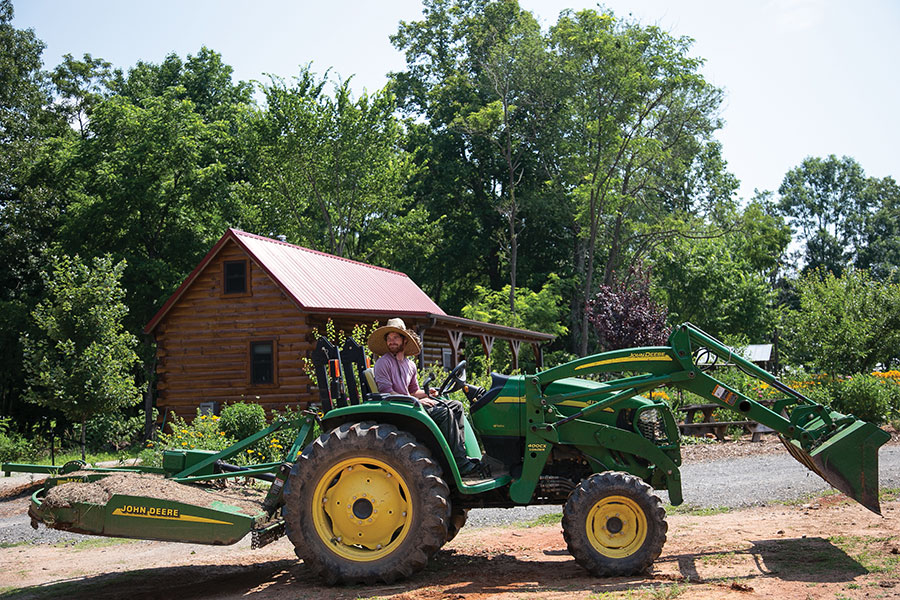
“I was just dreaming, but I knew that it would happen,” he says. He looked into a couple of listings, but nothing seemed right. Then, his grandmother, J’Nell Hofstetter, answered her landline. “I understand your grandson is looking to farm,” the caller said. It was Elaine Pegram, a former neighbor on Pleasant Ridge Road, where Hofstetter had grown up on a farm. The Pegrams had a few acres to spare. They could sell to developers anytime they wanted to — but they didn’t want to.

Hofstetter alerted Cupit, whose mother and father helped him to secure a loan. Thanks to family, Cupit was in business, right across the blacktop from where his great-grandfather, Clyde Huff, had raised tobacco, corn and hogs. Cupit never knew Huff, but his mother tells him that Huff fished the Pegram pond behind Cupit’s house. He spent time in the barn that now belongs to Cupit. “I think about it a lot. Where did I get it from? How did it all come about, this passion? My mom always tells me I remind her of her Pawpaw Huff,” says Cupit. “I don’t know how I feel about religion, but it does make me think sometimes that there is some kind of art to this — something out of our control.”

Because Cupit’s operation is small, so is most of the equipment he uses day to day: a hand tractor, which is basically a motor with wheels and a place to attach implements; a wheel hoe, and a broad fork, which Cupit grabs at the cross bar, stabs into the dirt and rocks back and forth to loosen the soil before planting.

Since the initial preparation of his land, he has avoided tilling, a costly procedure that stirs up weed seeds and aerates microorganisms, causing them to gobble nutrients and deplete the soil. Cupit brags that he can turn over a shovel of dirt in his field and find earthworms, a sign of healthy soil.
He doctors the dirt sparingly. His fertilizers and soil conditioners are composted horse manure, mineral dust, green sand, feather meal and bone meal.  For pesticides, he uses neem oil, chrysanthemum oil and bacillus thuringiensis.

Cupit, the farmer, is still very much the artist. You can see it in his insistence on quality materials and in his devotion to scale, He started out small, putting into production only two of his 9 acres. He spent the first year preparing the soil, an oasis of well-drained sandy loam in a region heavy with clay. The ground, once home to strawberries, wheat and tobacco, had lain fallow for 20 years, the perfect prescription for soil to rest and rejuvenate.

Cupit plowed, disc-harrowed and then seeded with clover and rye. He watched as a fresh, green blanket covered the ground. He plowed it under and disc-harrowed again. He planted his first crops in the fall of 2014. “It was profitable from the beginning,” he says, noting that farmers generally sink their profits into improvements, which he has.

Last year, he added a vegetable-washing station and a walk-in cooler to an old barn beside his new 350-square-foot log cabin. A crew of Amish builders raised the one-room shell and topped it with a red tin roof. Cupit plumbed and wired the cabin by himself.  “I’m kind of a YouTube carpenter and electrician,” he says. “It was what the budget required, and I knew I didn’t want to live big. I wanted to be simple.”

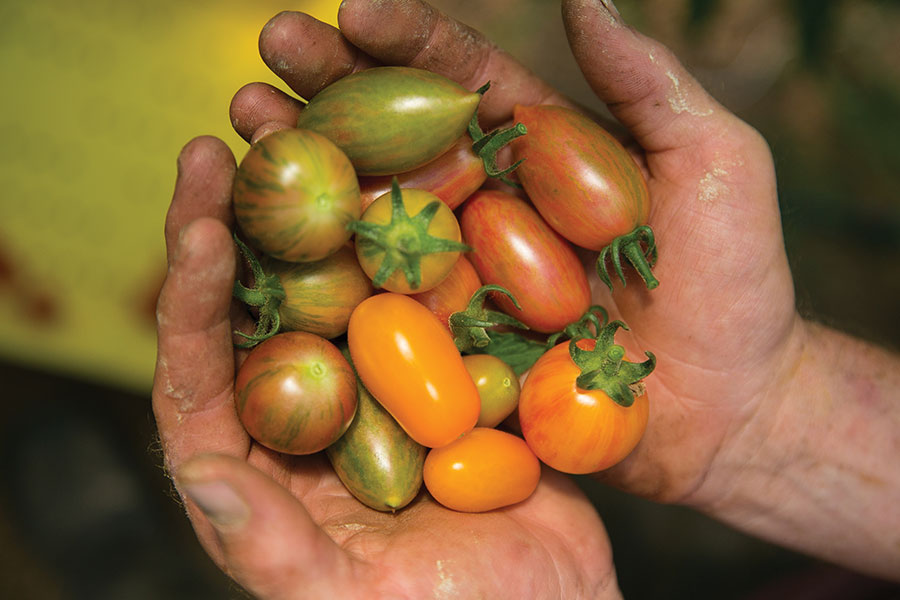
Within view of his front porch, the ground bristles with rows of vegetables that change, like garments, on a seasonal wheel. Beets, collards, kale, radishes, lettuces, broccolini and carrots — sweet, warm-colored darts that thrive in the sandy soil — emerge in the sweatshirt weather of spring and fall. Yellow squash, cucumbers, tomatoes, onions, green beans, peppers and eggplant flourish in the sleeveless heat of summer. Sweet potatoes, winter squash and cauliflower store sunlight as hats and gloves appear again.

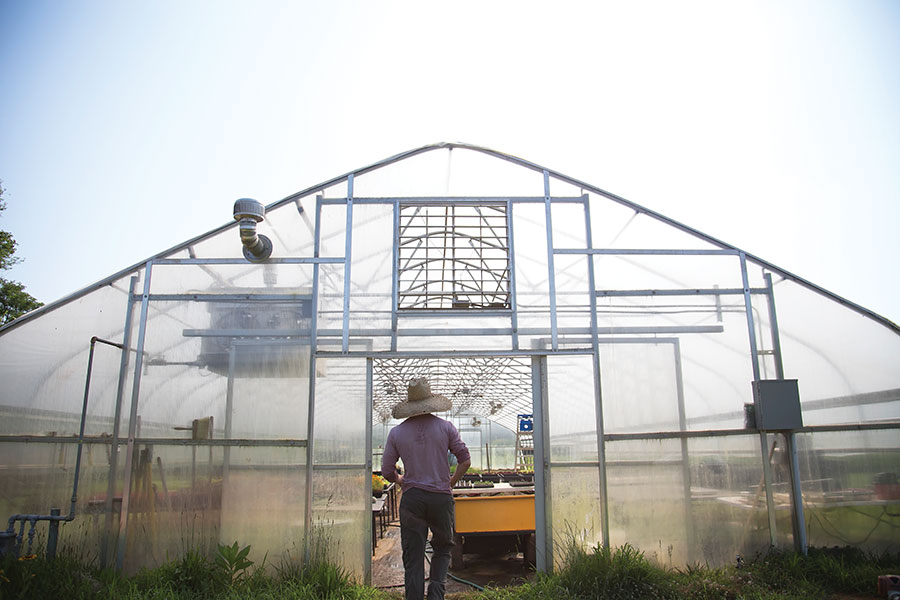
Cupit extends the growing seasons of his bestsellers with two heated greenhouses and two moveable caterpillar tunnels.

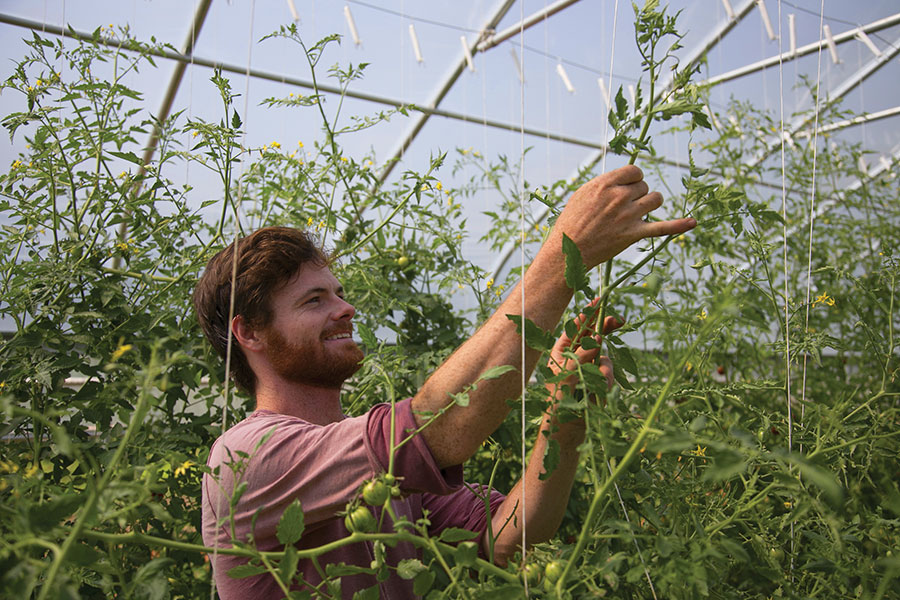
“We push lettuce, tomatoes and cukes as much as we can — at least 10 months,” he says. “You make more money when you’re the only one who has them.” Many of his tomatoes will spend their lives in a greenhouse, growing on twine trellises in the “lower and lean” method that he learned at Whitaker Farms. The practice allows vines to stretch 10 feet or more from one spot in the ground.  As each vine grows, Cupit lets out the twine from an overhead spool and slides the spool along a wire. The diagonal curtain makes the fruit easier to pick.

Cupit might be a throwback to old-timey truck farmers, but he embraces current science, technology and ag-fashion, if there is such a thing. He owns a shiny green John Deere 4120, which he uses to mow and move manure, but you won’t find this farmer advertising tractors with a baseball cap. Instead, he wards off skin cancer by wearing the kind of broad-brimmed straw hats favored by West Coast lifeguards. He buys the sloping hats on Amazon. He slips his feet into Mucksters, low-cut rubber garden boots, not brogans. His Levis bear the telltale outline of a cell phone carried in his front pocket. He consults it often.

Someday, he’d love to use his iPhone to control irrigation and move his greenhouse walls for optimum heat and light. Controlled growing environments will become more important, he believes, as global warming causes more extremes in weather.

He expects that, one day soon, phone apps will allow people to order local produce and schedule pick-up or delivery. All of this would increase the margin of error in farming, which is especially important for small operations like Cupit’s. His labor pool consists of him and his mom, who is retired from Burlington Industries and visits the farm almost daily. She mows, washes and packs produce, and minds the roadside vegetable stand. “She wants to see me succeed, and she loves farmwork,” says Cupit. “I think she’s proud to see the evolution of the business.”

Cupit’s commercial customers are happy with the results. Jody Morphis, who with his wife, Anne Marsh, owns Blue Denim, a Cajun-Creole restaurant on South Elm Street in Greensboro, has been buying produce from Cupit since they met a year ago at a Greensboro Farmers Curb Market fundraiser featuring locally sourced bacon-lettuce-and-tomato sandwiches. “I think his tomatoes won Favorite Tomato,” says Morphis, who buys nearly all of his produce from Cupit now.

“He’s definitely my favorite farmer to deal with, first of all because he’s growing great stuff, and he has a great personality. Most farmers aren’t able to go out and shoot the breeze with people. A lot of the older farmers are men of few words.”

Cupit’s prices don’t hurt. “Aubrey’s prices are better than anybody’s,” says Morphis.

Cupit’s other restaurant customers include White and Wood, Cafe Europa, Table 16 and Jerusalem Market in Greensboro, as well as Michelle’s Kitchen & Table in Burlington.

Twice a week, Cupit delivers produce to them in his 1998 Ford pickup. Twice a week, he carries his produce to the Yanceyville Street curb market. Most weekdays, he works in the gardens and classrooms of the Montessori school. That’s when he’s not tending his own farm.

His early-to-bed, early-to-rise lifestyle exacts a cost: limited opportunities to socialize.

“I have to say ‘No’ a lot,” the young bachelor says with a rueful smile. Many people his age have no clue about the gritty realties of farm life, which Cupit is quick to list. “It’s dirty. It’s hard. It’s hot. You’re in the sun. You’re always cutting yourself. About once a month, you want to quit, but you just have to wait until the next day,” he says.

He finds solace in online communities of other Millennial farmers. They might be as rare as hen’s teeth, but they find each other on Facebook and Instagram. They share advice and photos of what they’re growing.

Cupit’s generational peers run Fair Share Farm in Pfafftown; Pine Trough Branch Farm in Reidsville; Mighty Tendril Farm north of Hillsborough; and Sugar Hill Produce, also north of Hillsborough.

While they’re eager to scratch out a living, Cupit says, he and his young agrarian friends believe there’s more to life than accumulating titles and dollars for themselves. They want meaningful work, he says, and they’re finding it in the ground beneath their feet.

“There’s something about taking care of this dirt we have,” he says. “If you have the itch and the passion, it’s worth it.”  OH

For more information, go to gatecityharvest.com;  @gatecityharvest on Instagram; or facebook.com/gatecityharvest/.

Comforts of Home Cooking

Soup’s On!

Mythos Grill’s cure for whatever ails you

By Cynthia Adams

Photograph by Mark Wagoner

Even the pernicketybadboy chef Anthony Bourdain ’fesses up to hoovering down mac and cheese when he’s in want of comfort. But not me. Whenever I’m puny, feverish, chilled, stressed, cranky, gassy or sniffly — the seven dwarves of bleccch  — I know the cure.

I need avgolemono, aka Greek penicillin. 

Pronounced Ahv-yo-Lemon-o with a silent g, it translates simply into egg and lemon. Mythos Grill (Taste of Greece: Fresh, Healthy, Delicious is their mantra) starts the stock, which is the basis of this classic Greek dish, every morning and afternoon except Sunday, when the restaurant is closed.

Into the pot go simple ingredients (chicken, broth, egg, lemon, rice) that are stirred, simmered and stewed into creamy subtlety. It is more than the sum of its parts.

As the spoon nears my mouth, a rich, meaty bouquet greets my nose. And on the palate, don’t look for fireworks: It’s comfort food incarnate, as only chicken soup can be — silky and round, with just a hint of sour from the lemon and richness from the egg. The rice gives it a creamy texture. As it heads toward my stomach, my pulse slows, sinuses open, headache eases and eyes clear. (I check my compact mirror, and by God, I even look better.)  Healing by avgolemono has begun.

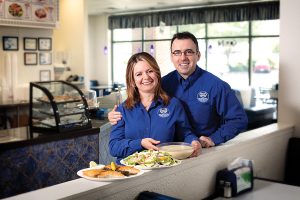
“It has a fan club,” admits Mythos owner Eddie Balla. Eddie and his wife, Miranda Balla, run the Market Street location and sell their soup by cup, bowl, or quart, made by the gallons, rain or shine, cold days or hot.

How did Eddie master the perfect consistency of his avgolemono? He had years of practice, having worked in Athens, Greece, at age 20. When he opened Mythos Grill in 2005, Eddie called it “Greek fast-food, but cooked to order and fresh.”

Another family member, Samir, runs the Mythos Battleground location. Samir says the soup at both grills is made faithfully from Eddie Balla’s recipe. 

Eddie says modestly, “It’s a very famous Greek soup — I didn’t invent it.” 

As much as 20 gallons are sold between the two restaurants six days a week. After a cold spring, the soup-making — and — sales continued into late April although production dropped–to about 6 gallons made twice daily at Market Street alone. During the summer months, the Ballases discovered they sold less, yet a steady customer demand continued.

The classic dish has origins in Mediterranean sauces and soups created with egg yolk and lemon. “You can make it with orzo or rice,” Eddie explains. “In the northern part of Greece where I am from, we use rice . . . We make the broth out of chicken, which we use later.” 

Eddie adds rice to the broth near the end of the preparations. “At that point, we add the chicken in it, and on the side, we have the egg ready.  We only use the yolks; you can use the egg white, but we don’t.” 

He whips egg yolk with lemon juice in a separate dish, while in another, he mixes butter and a small quantity of flour, which is added to the simmering rice and broth at the end. 

Before that final step, Eddie extracts a bit of broth, which is whisked into the frothed egg and lemon juice. This goes into the pot about five minutes as the soup is thickening during the final minute of cooking.

“The time when we add that is very important,” Eddie cautions. “If you put it in too late, it won’t give the smoothness of it. Too early . . .” he frowns. 

“You must put it in the right time for the creamy texture!”

“We were keeping it only for wintertime, but a lot of people ask for it,” says Eddie. “We’re not going to give up on it if it makes customers happy.”  Patting his slender waist, he adds, “For some reason, when you have an upset stomach, it is soothing. It is a comfort food.”

The House that Jack Built

Jack’s Corner is a hub for Mediterranean food and good conversation

By Ross Howell Jr.

Photograph by Mark Wagoner

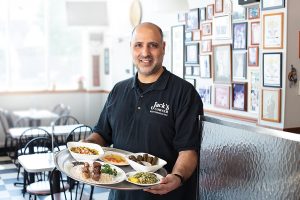
At the intersection of South Aycock and Spring Garden streets — in the shadow of the water tower painted with the brawny UNCG Spartan — stands Jack’s Corner, a Mediterranean deli that’s been serving Mediterranean fare located here for 26 years. The building has a curved façade and big windows — reminiscent of 1960s roadside diners.

Inside I’m greeted by Jacob (Jack) Bishara, a tall man as strong-jawed as the Spartan on the water tower. His face breaks into an easy, broad smile as we sit at a table.

“I was the family’s baby boy,” Bishara says. “I was a little spoiled, you know? When I was about 16, I said to Mom and Dad, ‘I have no interest in going to college.’”

His parents asked what he thought he would do to earn a living. He didn’t have an answer.

So the Bisharas set out on a family trip, first to Michigan, then to Texas. Bishara had uncles in the restaurant business at both places.

“They said to my Dad, ‘Don’t you own property right by the college? Why don’t you open a restaurant?’”

But neither Bishara nor his parents had any experience.

His grandfather, James Bishara, came to the states from Ramallah, Palestine, in 1934. During the Depression, he’d made a living selling linens door-to-door. When he returned to Ramallah for a visit, he convinced his son, Essa — Jack’s father — to emigrate in 1956.

Essa settled in Tennessee and worked in real estate. When he returned to Ramallah for a visit, he noticed an attractive young woman at a party thrown by two brothers who were his boyhood friends.

“Why, that’s little Najwah!” the brothers exclaimed. The attractive young woman was their sister, whom Essa hadn’t seen since she was a girl.

In time they were married. Najwah came to the United States with Essa in 1962.

“Mom and Dad were living in Knoxville,” Bishara says, “when they drove to Greensboro to visit her two brothers.”

His father was struck with how beautiful the city was, and decided Greensboro was the place to raise a family.

“So they moved here,” Bishara says. “This is where I was born.”

Since his mother had grown up in Ramallah helping cook for a family of 10, she had recipes for Mediterranean dishes going back generations. Bishara’s father thought she was the obvious partner for his son’s venture.

Bishara pauses, gazing at a wall of framed photos. There are mustachioed men with fezzes and women in flowing dresses gathered with their children. There’s Najwah in her gown and Essa in a suit on their wedding day. There’s a bearded priest in the robes of the Antiochian Orthodox Christian Church — Najwah’s grandfather, who married the couple.

“One day my Mom and I were talking business,” Bishara continues, “and she looked at me and said, ‘I think we can do this.’”

And they did. In what had been a curb market catering to college students, Bishara and his mother opened a sandwich shop — with hamburgers, subs, hot dogs, potato chips, and so on.

“We thought it best to stay mainstream,” he says. “But we also had hummus on the menu. Falafel. And tabbouleh.” But this was 1992, and there wasn’t a lot of talk in Greensboro about healthy ethnic foods at the time.

The first couple of years were “a real struggle,” Bishara says.

Then something happened.

Grunge music — in the person of Kurt Cobain and Nirvana — exploded on the popular scene.

“All of a sudden,” Bishara says, “these young people were coming in, looking for vegetarian food.”

So Bishara expanded the Mediterranean portion of the menu — easy to do, with all his mother’s home recipes. Today, ethnic specialties comprise 85 percent of the items on the menu.

Some customer go-tos?

“The Mediterranean platter — with falafel, hummus, tabbouleh, pita, and baba ghanouj,” Bishara says. “And the double gyro platter—that’s always popular.”

Other favorites are the chicken kabob platter, the lamb shawarma, the chicken souvlaki and gyros. With a nod to its early days, the deli offers a falafel dog and a falafel burger. I haven’t even mentioned the sandwiches, salads and children’s menu.

When I ask about the future, Bishara tells me he and his wife have three children — aged 17, 16, and 12.

“When the kids were little, I’d bring them into work with me,” Bishara says. “They really liked hanging out. But my wife — because she knew how much time the restaurant took — would say, ‘Jack, you don’t want them to love it too much.’”

None of the children are interested in the business now, Bishara tells me.

Then he smiles.

“But they’re young,” he says. “Who knows what will happen?”


The Soul of Fellowship

United House of Prayer For All People serves a heaping helping of love, seven days a week

By Jim Dodson

Photograph by Mark Wagoner

For better than 75 years, as part of its social outreach ministry, the United House of Prayer For All People has served great home-cooked food to those in need or those simply with a hearty appetite starting first on East Market Street and these days, at the cafeteria in the basement of its handsome Dudley Street sanctuary.

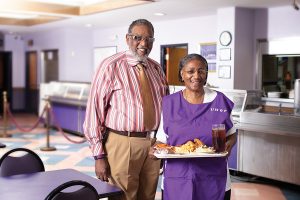
Long regarded as one of the best-kept secrets in Greensboro’s crowded dining scene, we checked in with a noontime crowd and discovered the church is still dishing up the best in classic soul food — Southern fried chicken, smothered pork chops, deep-fried fish on Fridays and weekly specials sided with soulful staples that include savory seasoned collards, slow-cooked green beans, home-style mac and cheese and always a generous piece of cornbread. Wednesday is baked spaghetti and Thursday is the church’s much-anticipated and famous meatloaf day. If you’re lucky, most any day you can sit down to chicken and dumplings, and there’s always at least a couple kinds of cake that will make you miss church picnics.

Every dish is fresh and made from scratch by the loving hands by three principal cooks and a staff of half a dozen workers who volunteer their time and talents to the church’s community outreach. A typical lunch (after which you may need a nap) runs less than $10.

“The cornerstone of our success is our volunteers,” says senior pastor Hubert Swaringer. He emphasizes that one of the prime missions of  the church’s nondenominational parishes nationwide (there are more than 135, including sister churches in Charlotte and Durham), is to operate a kitchen — open to anyone and everyone — “fresh, wholesome food at a reasonable price they can afford. Our founder’s philosophy was that if you feed a hungry man, you can also feed his soul.”

Students from neighboring N.C. A&T State University, just across the street, are frequent diners during the school year, and so are soul-food fanatics who happen to know about the kitchen through word of mouth. Every penny the cafeteria generates goes into the budget of the church, but nary a penny is spent on advertising.

“We do a pretty good job with word of mouth,” notes kitchen coordinator Denise Gray. “We cook it with love, they hear about it and come.”

When the tornado ripped through east Greensboro in April, the cafeteria  provided meals to many victims and emergency workers and recently held a marathon fish fry to generate money for its scholarship fund to help A&T students.

“I worked at A&T for 32 years and retired in 2012,” Denise Gray adds. “I came over here to help out and have been here almost every day since. The people here love cooking and serving others. That’s what serving the Lord is all about.”

A perfect description of Soul Food, we think.


Pizza as it Should Be

Family-style is the hallmark of Cugino Forno

One might easily forgive loyal patrons of Cugino Forno pizzeria in Revolution Mill for assuming its owners Joseph Ozbey and Yilmaz Guver are Italian brothers who happen to make the closest thing to authentic Neapolitan pizza.

In fact, they are Turkish cousins (as is their third partner Adam Aksoy) who fell in love with the simple cheese pizza served at iconic L’Antica Pizzeria da Michele in Naples and brought the recipe and know-how for the “world’s greatest pizza” with them to America. After all, by some accounts this internationally beloved foodstuff was birthed in Naples when fishermen began dousing day-old bread with tomato sauce and layering on the cheese.

The pizza know-how was supplied by Joseph, an engaging 26-year-old who, following college at Georgia Tech and traveling extensively through Europe, wrangled a job mopping floors at the famous Naples pizzeria “just to learn everything I could about how to make their amazing pizza.”

Progressing from mop to pizza-prep took more than eight months of hard work that included plenty of 5 a.m. mornings and late nights. “They make pizza in a very Old World way,” says Joseph. “I watched and learned every aspect of how they did it and got to know the guys there. We remain friends to this day. We’ve incorporated everything they do here; down to the smallest detail.”

That includes the three massive Italian-made 7,000-pound wood-fired ovens made from Mount Vesuvius sand and shipped to the Port of Wilmington via freighter just before the restaurant opened its doors just over a year ago. “They barely fit through the doors,” Joseph says, laughing at the memory of the tight squeeze.

With an equal mix of hickory and oak, the mighty ovens produce upwards of 1,000-degree heat that can cook a pizza in less than 90 seconds, but the real secret of their Old World taste is the double-ought (“00”), extra-fine pizza flour imported directly from Naples, same San Marzano tomato sauce and a delicious double Bufala Mozzarella that “was in Naples yesterday.”

Flour, sea salt, yeast and a bottled water constitute the simple family recipe that makes Cugino Forono — the name means “ovens of cousins” — pizza so beguilingly different. Following a search that took Joseph on a two-month car odyssey around the state, the cousins learned about a great open space at Revolution Mill and soon knew they’d found home. They outfitted the airy space with large communal tables to encourage conversation, developed a menu with a dozen authentic variations of the famous original, fired up the ovens and started making genuine Napoli pizza. Robust  and imaginative salads, real Italian wines, fresh cannoli and a state-of-the-art rotating gelato cooler — made by Ferrari, no less — filled with gelato that arrives from the Old Country almost daily completes the simple but spectacular offerings. Italian flags and European soccer jerseys hang everywhere and a special “Spice Bar” allows customers to jazz up their pizza, if so desired. Puccini’s opera arias, or the familiar theme to The Godfather, play in the background.

The topping on the cousins’ pizza may be the warm reception they have found with the Gate City diners. “Authenticity to the smallest detail is our key,” says Joseph. “But quite honestly, we weren’t at all certain this kind of simple pizza would go over well in America. The community, however, has embraced our home-style approach to pizza. We have customers who come every week to dine with other families, couples and children, old and young, people enjoying the experience of being together.”

Great pizza, he says, will do that. “It’s been a great journey for us to come so far and find a home in Greensboro. We hope to be serving families for a very long time.”

Almanac JUNE

By Ash Alder

Hand painted sketch of pink rose flower with buds, stem and leaves, watercolor illustration isolated on white background. Watercolor sketch illustration of pink rose flower on white background

June evening fades in such a way you wonder if it’s all a dream.

We let go of spring, our palms now cupped to receive the first blackberries, scuppernongs, Cherokee Purples warm from the sun.

Plump strawberries slowly vanish from the patch, and when the fireflies come out to dance, out, too, comes the homemade mead. 

This year, summer solstice falls on Thursday, June 21. We celebrate the longest day of the year with bare feet, new intentions, sacred fire and dance. Now until Dec. 21, the days are getting shorter.

Savor the fragrant amalgam of honeysuckle and wild rose. Feel the hum of heavy hives, porch fans and crickets. And as cicadas serenade you into dreamy oblivion, sip slowly the sweetness of this golden season.


Whistling for More

I can’t see “Butter Beans” hand-painted on a roadside sign without hearing the Little Jimmy Dickens tune my grandpa used to sing or hum or whistle to himself on quiet Sunday drives:

Just a bowl of butter beans
Pass the cornbread if you please
I don’t want no collard greens
All I want is a bowl of butter beans.

Red-eye gravy is all right
Turnip sandwich a delight
But my children all still scream
For another bowl of butter beans.

When they lay my bones to rest
Place no roses upon my chest
Plant no blooming evergreens
All I want is a bowl of butter beans.

The Carolina Chocolate Drops sing a much sultrier song about this summer staple, but both tunes suggest that, in the South, the lima is the darling of beans.

Good for the heart (this sparks another ditty but we won’t go there), butter beans are rich in dietary fiber, protein, minerals and antioxidant compounds.

Slow cook them or toss them in a cold summer salad. Regardless of how you choose to eat them, best to get them fresh while you can. 


Gifts for Papa

Father’s Day falls on Sunday, June 17. I think of my papa’s old fishing hat, how it would slide down my brow and, eventually, past my eyelids, then remember his hearty laugh. A few seeds of inspiration for the beloved patriarch in your life:

A khaki brown Boonie hat or sun hat on a white background with copy space

A new feather for the old cap.

Homemade bread for mater sandwiches.

Pickled okra — local and with a kick!

Homemade mead.

Seeds for the fall garden: lettuce, cabbage, cauliflower,
collards, pumpkin. 


On this June day, the buds in my garden are almost as enchanting as the open flowers. Things in bud bring, in the heat of a June noontide, the recollection of the loveliest days of the year — those days of May when all is suggested, nothing yet fulfilled.

– Francis King


Magic, Mighty Oak   

When the sun sets on Saturday, June 23, bonfires will crackle in the spirit of Saint John’s Eve. On this night, the ancient Celts would powder their eyelids with fern spores in hopes of seeing wee nature spirits dancing on the threshold between worlds.

Old tree vector illustration

The Celts sure loved their nature spirits. According to Celtic tree astrology, those born from June 10 — July 7 resonate with the sacred oak, a tree said to embody cosmic wisdom and regal power within its expansive roots, trunk and branches. Strong and nurturing, oak types radiate easy confidence. They’re most compatible with ash (Jan. 22 — Feb. 18) and reed (Oct. 28 — Nov. 24) and ivy (Sept. 30 — Oct. 27).

If you find yourself in the company of an ancient oak on a dreamy summer evening, do be on the lookout for playful flashes of light. 

A World Beneath One Roof

Super G Mart is an international bazaar for local foodies

By Billy Ingram
Photographs by Sam Froelich

In the past 50 years, our city has undergone a culinary transformation, from an international food desert to a genuine hub for haute cuisine from every corner of the globe. Laotian, Vietnamese, African, Egyptian, Thai, Yemeni, Indian, Tex-Mex — Greensboro has a global, palate-pleasing smorgasbord.

Imagine how difficult it would be sourcing all the myriad exotic ingredients those diverse ethnic undertakings require were it not for Super G Mart, located on West Market west of Spring Garden. If you haven’t experienced this cultural mashup, you must. Wandering among its stalls is like opening a Russian nesting doll; the deeper you dive the more there is to discover.

Stare wide-eyed at towering aisles stacked with 20 varieties of Udon noodles, hundreds of aromatic spices, Japanese green teas and coffees, Vietnamese meatballs, Korean dried licorice, Indian curry paste, juices and extracts from just about every conceivable fruit and vegetable. Plus, this great big grocery superstore boasts a full-service meat and fish market, alongside a produce selection that features an encyclopedic array of fruits and vegetables — cranberry beans, aloe vera leaves, green coconuts, kumquats, whole tropical jackfruit, seven pears of assorted origins, a dozen cultivars of bananas, vivid red and green habaneros, and a vast array of indigenous roots. Everything you never knew someone, somewhere needed, all under one roof.

In the meat section, recognizable drumsticks, steaks, chops and other traditional cuts of meat are on display alongside tails, feet, belly meat, shanks, jowls, not to mention a variety of gizzards, intestines, stomach, liver. Multi-pound packs of fatback will keep that Fry Baby you borrowed from the neighbor bubbling for months. Look for conveniently cubed goat heads, pig ears, beef lips, black-skinned chickens dressed for healthful chicken soup, ox and turkey tails (turkeys have tails?!?), and pre-packed chicken feet. Even if you’re no wannabe Top Chef, this is a one-stop shop for ancient incantations, spells, and curses.

Over in the seafood market, squid, catfish, kingfish, red drum, black sea bass, yellow croaker, and pink snapper lay upon a bed of chipped ice. Seasonally you can buy live tilapia, lobsters and blue crabs. There’s also salmon heads for fans of fish-head curry. One caveat, these fishmongers are sometimes overwhelmed meeting the requests of demanding customers. You’ll want to be patient and jostle for your place in line. Plus, the best way to see the store is by slowly browsing, because it’s difficult to take in everything on the first visit.

A favorite of caterers and fine dining chefs for years, Super G is a well-oiled operation, requiring constant restocking and inventory control due to the sheer number of neatly arranged products they carry. The place is a maze of shelves and alcoves stocked deep with canned whelk and baby conch, rice vinegars, dried mushrooms, ginger powders, crated duck eggs. . .  there’s an entire refrigerated case reserved for European breads and cheeses. 

Know what else you’ll find? Almost anything else you’d look for at a standard grocery store; Dole fruit cups, Peter Pan peanut butter, Southern Pride pimento loaf, grape Juicy Juice, Lucky Charms.

And prices lower than a snake’s belly which, surprisingly, I didn’t find in the coolers.

At the entrance to Super G is a colorful European-style marketplace with mom-and-pop fashion, knick-knack, and jewelry boutiques, professional services, and my favorite the Used Shoe Store, where you can literally walk in someone else’s moccasins.

On the way home, you might want to stop off for some Vietnamese coffee at the Asian Kitchen, a funky fresh eatery just inside Super G’s front door. Vietnamese Pho is their specialty but I’m especially fond of the beef in peanut sauce. For dessert, Suman rice cakes are a Filipino treat, sweet sticky rice cooked in coconut milk, wrapped in banana leaves, steamed then sprinkled with sugar. Or maybe you want to wash it all down with a Honeydew Tea, one of many refreshing flavors Asian Kitchen brews.

Super G anchors the FantaCity International Mall where families from far-away nations gather daily to create culinary experiences unlike any other. Perhaps I’m over-romanticizing, but I believe an intimacy is established, consciously or not, when folks prepare meals from handed-down recipes.

Tampopo Ramen & Hibachi is Greensboro’s first honest-to-goodness Japanese noodle shop. Ramen-ya actually, a store primarily serving ramen with a few other options to bulk out the menu. Their sumptuous broths are prepared over the course of several hours, in the traditional style. Reflecting Sun Ja Lim’s passion, she of Sushi Republic fame, I can attest to Tampopo’s delectable authenticity, noodles and hearty ingredients.

Tongues are not only delighted but wagging about Sana’a’s home-style Middle Eastern entrees, savory kabob platters, lamb mandi, chicken tawook, fish salta, vegetarian specialties and freshly baked saluf. Judging from friends’ and published rave reviews, this newly opened corner space is nothing short of sensational. Stroll around FantaCity and you’ll also find Chinese, Korean, and Kimchi-to-go restaurants.

I doubt old-timers weaving ladies’ lingerie on this spot for decades beginning in 1950 would recognize FantaCity as Guilford Mills’ first permanent finishing plant. In the early 2000s, that brick albatross was transformed into this international shopping center but, unlike Cotton Mill Square in the ’80s, they did so without regard to preserving the original architectural integrity.

Just as well, fitting actually. FantaCity thrives on gritty optimism, no need for unnecessary hindrances from the extinction. Within these walls a palatable entrepreneurial spirit manifests itself around every corner, hard-working individuals engaged in the pursuit of that exalted All-American dream. Providing the public with an experience like no other.  OH

Poem

Peaches

are what she wanted in the end

said they reminded her of South

Carolina that summer she was

fifteen, living  with her Auntie

Josephine in a white clapboard

house at the end of a dirt road. 

They’d pick cotton during the day,

eat peaches for lunch, her fingers

sticky the rest of the afternoon. 

There was a boy who worked the farm,

Jerri, who kissed her one July afternoon

and then never returned to work.

There were thunderstorms, she said

so quick and fierce, all you could do

was lay in the fields and let the rain

wash your dirty face, your hair,

pray you didn’t get struck by lightning.

And dogs would appear, follow behind

you for an hour or two  then disappear. 

Her aunt would walk out into the field

with a wicker basket of peaches, smiling,

saying take two, take three and she took

all she could stomach. In this nursing

home, now, I don’t have anything to give her

except my time, my ears for her stories, so

on my next visit I bring her a peach and while

she can no longer chew it, still she lifts it

to her nose, smells the sweetness beneath

the surface, rubs it against her cheek,

a scene so private I have to look away.

— Steve Cushman

An Open Hearth for Open Hearts

In the Ganem family, hospitality is the language of love

By Nancy Oakley     Photographs by Amy Freeman


Lisa Ganem animatedly recalls the moment she and her husband, Sam, knew they’d found the perfect house in which to spend their twilight years. “We’d been looking, looking, looking,” she says. “I showed him this house, and he said, ‘This is it. I can tell by the smile on your face.’” The humble ranch house on a quiet street in the middle of Irving Park was the kind of place anyone would overlook driving by it — anyone except the bright-eyed and imaginative Lisa, who had redone a similar rancher when she and Sam and their three children lived in Salisbury years ago.

“I didn’t have the vision,” Sam Ganem allows, admitting that he couldn’t see beyond the dwelling’s age, with its small rooms, cork floor, knotty-pine kitchen and overgrown shrubs. But where he saw darkness, Lisa saw light. “She just goes, ‘Oh, this is great! We could do this, and this and this,’” Sam remembers fondly.  “And I said, ‘OK, fine. Just give me an outdoor kitchen.’”

As a gastroenterologist for Eagle Physicians, his days are “filled with all sorts of commotion,” as they are for Lisa, owner of Certicode, a company that collects, analyzes and reports diagnosis and treatment data on cancer patients, and offers accreditation support to cancer programs, with the goal of improving patient care. “Cooking is relaxing,” says Sam, explaining that his interest in it developed in childhood. Coming from a large Lebanese family, he’d watch his aunts and uncles putter around the kitchen. “I’d pick up ideas here and there, put them in things I would like to do,” he says. After he and Lisa met (in the ER of the hospital in her small hometown in Tennessee, where she was working as a med-tech), cooking became a shared pastime. “We loved to cook,” says Lisa. “It was our calming thing.” They explained as much to each of his aunts, “the one that made the best tabbouleh, the one that made the best grape leaves, and we wrote down the recipes and learned to make them,” Lisa recalls. “And now it’s a big thing at Christmastime — his birthday’s on Christmas Eve — and we make a big Lebanese feast.”

With Sam working and her staying at home to rear three small children — Paige, John and Frances — Lisa had assumed the family’s culinary responsibilities. In 2004, after 10 years in Salisbury, they began looking for larger environs — but not too large — and moved to Greensboro, settling into a shaded house on Dover Road. As the kids grew older, Sam started firing up the oven again, branching out beyond the Lebanese delicacies he grew up with. Italian, Mexican and Asian fare became part of his repertoire. “I’ll go into a restaurant and say, ‘This is good.’ And I’ll talk to the waiter and I’ll say, ‘What’s in this? And they’ll kind of tell me what’s in it. And I’ll go, “I can make this,” he says with quiet certitude. A trip to New Orleans might result in a gumbo once he’s back home. “He thinks about things,” Lisa says admiringly, adding that Sam, also a musician who played guitar for a rock band in his teenage years, has the same remarkable ability to strum any tune he hears.

And then, of course, there’s grilling, which he’s so fond of — and which necessitated that outdoor kitchen in their new abode that Lisa dubbed “The Nest” after they bought it in the fall of 2016.

“I knew what it could be,” she says. “It could never be grand, it could never be palatial.” But it could easily become a home. So Lisa enlisted the help of local designer and draftsman Jim Weisman, whom she describes as “a joy” to work with. Over a six-month period, she says, “We went back and forth, back and forth” until they agreed on a plan that would open up those dark nooks and crannies and small rooms that Sam had found so off-putting. By mid-April of 2017, builder Kevin Otey and his crew broke ground and began the transformation that would last another six months.

They added a small front porch with narrow, rectangular columns, and dormers, encased in copper, which help shed water and give the house more definition, as do the bronze gutters.

Inside, a new front door, molding and millwork, such as the graceful curvilinear design on the dining room ceiling and the partially coffered den ceiling, lend an elegant touch to the more open spaces, thanks in part to widened doorways to the dining room, den and former living room. Now Lisa’s office, it overlooks the front yard, owing to a large picture window (a friend’s suggestion) that replaced what had been a blank wall flanked by two standard-size windows. “You can just sit in here and do your thing,” Lisa says, adding that the leafy view — and visiting squirrels outside — is a favorite of their three cats: Yanna, a Craigslist find, Parker, so-named because the Ganems rescued him from a parking deck, and Fillip, an orange striped fellow, whose name derives from the Chick-fil-A parking lot where Lisa and Sam found him half-frozen.

And who wouldn’t want to hang out here, among the soft palette of cream and grays? Particularly striking is a statement wall covered in grasscloth, behind the office bookshelves, a suggestion of interior designer Lauren Tilley. “My builder and I were like, ‘grasscloth, are you kidding me?!’” Lisa says of the material that is seeing a sudden resurgence since its heyday in the 1950s. But she concedes, “It really did set off those walls.”

The cream-colored walls create a sense of airiness throughout the rest of the house, which now has a seamless flow: a new hallway separates the living area from the master; in a finished attic, Sam can retreat among framed Beatles album covers, books and memorabilia from his rock band days; while extra bedrooms can accommodate visiting family members. There are no plans as yet for the finished basement, but with its newly whitewashed brick hearth, the work of the appropriately named Nathan Wainscott, the room holds the promise of a space for relaxing or merrymaking.

Anchoring the house is the den and indoor kitchen, where, flanking a vented fireplace, are a set of bookshelves and a built-in aquarium, a “bucket list” feature for Lisa. “The cabinet guy — he’d never done this before — he was like a deer in the headlights,” she says, as colorful angelfish, platys and goldfish, among others, glide through the backlit tank filled with greenery. With help from Triad Reef Critters, which had seen freestanding aquariums before, they found a builder with a template that would accommodate the tank and all its accouterments.

It’s a complement to the sea green and cream colors of the den, from the sofa and recovered recliners to the exposed wood chairs, which Lisa “adores,” in part because they were gifts from Sam’s mother when she moved to Abbotswood. Almost everything in the house is bestowed with meaning: the portraits of their children in the dining room, its chandelier (another cast-off from Sam’s mother), its table, a piece by the now-defunct custom furniture makers Councill Craftsmen in Denton. “They don’t make the hardwood anymore,” Lisa says wistfully. Her sparkle returns when pointing out a piece of artwork in the den, an abstract of pink and bluish green and cream by local painter, Amy Gordon. “She had just had a show at Tyler White [O’Brien],” Lisa explains, “And they called [her] and said, ‘Lisa just wants one of your pieces.’ And she said, ‘Well I’m wiped out, but I’ve done a couple of things in blue, so I’ll just bring ’em over.’” Lisa and Sam were astounded when they saw the painting, titled The Clearing, not only for its hues, so similar to the ones they favored, but also because it seemed destined for the empty wall by the new hallway leading to the master . . . especially when they discovered the artist’s subtle written message in the canvas: “Making space for new memories.”

It’s the perfect companion to the Zen-like aquarium, the soft candles and orchids scattered about. Nearby is a framed print of a dictionary definition of “nest” which reads: ‘noun. 1. A snug, comfortable or cozy residence or situation; a retreat, or place of habitual resort.” Lisa laughs at the popularity of the print among visiting guests who ask where she acquired it. “TJ Maxx?” she suggests, with a shrug.

If coziness is synonymous with the concept of a nest, it is essential to any kitchen. And certainly, the indoor kitchen, with its spacious granite-topped island and crisp cream cabinets, bookended by a laundry room and mudroom, is just that. But the true pièce de résistance is the outdoor kitchen that Sam requested and the adjacent patio, overlooking the backyard, the focus of which is a saltwater pool.

Originally, the backyard consisted of grass, trees and a profusion of boxwoods that the house’s previous owner had acquired from Mount Vernon. There had been a sunroom in the den area, (now extended to a wall of windows), but otherwise, no direct access to the yard. The back of the house simply dropped off from a fairly high level. But now? A spacious patio with table and chairs leads to steps flanked by wrought-iron railing (a nod to the original wrought-iron work, the only adornment in the front of the house) and terraced landscaping. “It was definitely a vision that Jim Weisman thought over,” Lisa says. “I wanted to get in that yard. It was so high up, I just wanted to get down there.”

They cleared out the boxwoods, leaving enough, along with some camellias and hollies, to line the periphery of the yard, the center of which is taken up with the pool. “I love it, love it,” Lisa enthuses. “It’s so calming. It has fountains you can turn on. All kinds of uplighting, landscape lighting so it’s nice at night.” Even the next-door neighbors are appreciative of the view.

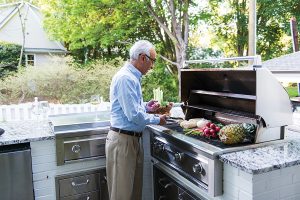
And certainly, of the aromas of steaks, burgers and Sam’s specialties, lamb chops and honey-lime chicken, wafting from his impressive stainless-steel grill. He especially appreciates a flat surface designated for searing meat, (essential to successful grilling, to seal in the flavors) and a feature for inserting a spit, for roasting. And he is never without his digital thermometer, another must-have. “Some people have those fancy thermometers where they put the probe in, and they can see [the temperature] on their telephone,” Sam notes. “That’s a bunch of baloney! I just watch ’em, because that’s part of the fun, too. Watching them. Have a sip of wine. Put the thermometer in and say, ‘Yeah. It’s ready.’ Great satisfaction.” Beside the grill is a mini-refrigerator and griddle where, he says, “I can do a couple of pounds of bacon, pancakes.” When he isn’t cooking breakfast, he’s out on the patio most mornings, according to Lisa. “The sky is orange and the sun just comes in beautifully. He’ll come out here with his coffee. It’s like his quiet moment when the sun comes up.”

Otherwise, the outdoor area is a gathering place for family and entertaining. A mere month after the Ganems moved into The Nest last October, they hosted their annual oyster roast, a tradition started by some friends who used to frequent the oyster bar at Green’s Supper Club every Thanksgiving. “We had three bushels of oysters; had ’em raw, cooked, steamed. Brunswick stew,” says Sam. “Everybody was out here in their coats,” Lisa chimes in. No matter. Just bring out the portable heater to keep guests warm. “Definitely my love language and one of his love languages is hospitality,” she reflects. Since the oyster roast, the Ganems have hosted a gathering at Easter, a bridal shower and family dinner of Indian kabobs for eldest child Paige. As a newly minted medical school grad, she’ll follow in Dad’s footsteps by pursuing a path in internal medicine, and with husband-to-be, Mark Aderholdt, will settle in Greenville, S.C. Son John starts law school in Tennessee in the fall and the youngest, Frances, will return to Chapel Hill. There will be more dinners and parties, and reasons to celebrate — the Christmas feast and Sam’s birthday, for one. “We’re really close,” says Lisa. “The kids — we wanted a place they wanted to come to.” For now, she and Sam enjoy the company of Yanna, curled up on one the sea-green recliners in the den, Parker, who’s likely retreated to the basement, and a sleepy, contended Fillip, who stretches the rug in the den. Far from empty, The Nest, for all who live here, is decidedly best.   OH

Nancy Oakley is the senior editor of O.Henry

Where’s the Beef?

The Cheapskate’s Guide to Cheap Steaks

By David Claude Bailey

Let’s just get this out of the way. I am an expert on steaks, having served a weekly apprenticeship that spanned almost two decades at the University of Steakology in Reidsville. In my youth, grill master extraordinaire Claude Colonelue Bailey presided over a smoking-hot seminar every single Saturday night. Sometimes he lectured on the uses and benefits of fresh garlic, A-1 sauce and even homemade rubs, but his lessons always employed lots of salt and ground pepper and a Weber that almost glowed under its burden of white-hot charcoal. I have eaten, by my scientific calculations, more than 4,000 T-bones, sirloins, filet mignons, porterhouses, New York strips and other delectable cuts of beef in my lifetime. I’m a glutton for homework.

His teaching assistant, my mother, turned out the extraordinary complements to our weekly lessons. She always peeled and hand-cut potatoes and double fried them. She’d pre-rub her salad bowl with cloves of garlic, and we’d usually have hand-beaten biscuits or, on special occasions, her cloverleaf rolls.

Inevitably after Dad remarked about how God is great, God is good, and had thanked Him for our food, mother would say, as if we hadn’t heard it a thousand times, “You could drive all the way to Greensboro and not get a steak dinner this good.”

My sister, Betty, and I would roll our eyes. And then, almost ritually, before the meal was over, Dad would wonder aloud why anyone would pay for a steak in a restaurant when you could cook a better steak at home. More sibling eye-rolling ensued.

Since then, I was fortunate to have been a restaurant critic for more than a decade and have tried steaks in dozens of restaurants, some of them Prime, aged steaks, seared at 800 degrees. Let me say that I certainly appreciate the difference between USDA, aged Prime meat and what’s available in the grocery store and at most restaurants. But being someone of Scots-Irish ancestry, it has always been with the utmost reluctance that I readily cough up $50-plus for a T-Bone steak. Especially, if I’m not on expense account.

So I have always been on the lookout for what I call The Cheapskate’s Cheap Steaks. Believe me, they’re out there, though I’ve wrestled with many gristly and fat pieces of meat to find them, at the best and the worst of restaurants. In fact, I’ve learned Dad’s lesson: At most restaurants, you’re better off ordering something other than steak.

However, over my years in Greensboro, I’ve found some notable exceptions to Dad’s rule. But it’s not just any steak that I’m after. To be a good cheapskate’s cheap steak, the meal should be a special experience. I’m always looking for a complete steak dinner — the meat, French fries, a fresh garden salad and a first-rate serving of bread. Plus, the ambiance of the place, in combination with the food, ought to provide more than the sum of the parts. What I’ve tried to do here is spotlight steaks and venues that are, above all else, places that present extraordinary cuts of beef, seared to perfection, in an ambiance that provides, for at least an hour or so, something you simply can’t reproduce at home. And all this at a price not a lot more than it costs me to grill a steak at home, just as my dad did. 


Café Europa

200 N. Davie St., (336) 389-1010, facebook.com/europagso

The Meat of the Matter (How the steak, itself, rates) hhh (3 out of five stars). 6-ounce sirloin steak-&-frites, “lunch-sized (available at supper on request). Grilled — tender, juicy and not overly seasoned — Europa’s steak is a tad thin, though this is in the tradition of steaks I’ve had abroad. Larger 8-ounce “dinner” steak available for $18.

The Tab (For a steak dinner  — with the price per ounce of steak calculated based on the total tab)  $13 ($2.17 per ounce of steak). Served without bread or salad — steak & frites means just that.

Ambiance, service and measure of difference This lively, downtown brasserie has a stylish, Continental interior, featuring distinctive hardwood paneling. The vibe is urbane, almost clubby with attentive service. It’s hard to choose between the bustling bar and the popular patio. Measure of difference: Hippest spot in town to eat steak & frites.

Sides and Extras The fries are cut as shoestrings and best eaten before they cool. I enjoyed the cabernet butter, but ask for it on the side so it doesn’t overpower the steak. A salad is $2.50 extra, and I think Europa’s Caesar is well worth the price.

The Bottom Line With intimate corners and booths, plus sidewalk dining, Europa’s Continental “chic” nicely complements its reasonably priced and hearty fare — prepared with élan. And I highly recommend the mussels.


Lucky 32

1421 Westover Terrace, (336) 370-0707, lucky32.com

The Meat of the Matter hhhhh (5 out of five stars). 10-ounce, Black Angus salt-and-pepper ribeye available at lunch only. I found this easily the best “cheap” steak in terms of taste, preparation and quality. Unlike some other ribeyes, the meat was marbled and rich, with excellent texture.

The Tab $16 ($1.60 per ounce of steak). Served with bread and one side. No salad.

Ambiance, service and measure of difference My advice? Eat in the bar with its rich, hardwood accents and intimate, high-back tufted booths. It’s, at the same time, both atmospheric and airy. I’ve always found the service attentive and obliging. Measure of difference: For us, Lucky 32 rates as a special-occasion destination.

Sides and Extras The Texas Pete-fried onions atop the steak were a fun addition. And I could almost make a meal off Lucky’s excellent bread. The fries are hand-cut, double-fried and first-rate. I, however, find it hard to resist Lucky’s collards, sassy and tangled with side meat. Salad is $3.25 extra.

The Bottom Line Lucky 32 is always like an old friend to me, welcoming, cozy and totally predictable. Yes, the lunch-priced ribeye costs a couple bucks more than other steaks, but the total package of food, service and ambiance is hard to beat.


Oakcrest Family Restaurant

2435 Battleground Ave., (336) 288-7585,
oakcrestfamilyrestaurant.com

The Meat of the Matter hhh (3 out of five stars). Two 5-ounce ribeyes. It’s hard to imagine getting more meat for your money. Marinated, liberally seasoned with garlic and griddled, here’s a classic, cafe steak — in fact, two of them for the price of one.

The Tab $9.99  ($1.11 per ounce of steak). Served with Texas toast, salad and fries.

Ambiance, service and measure of difference I love Oakcrest’s emphasis on family dining. Don’t expect fawning service, white tablecloths or atmospheric flourishes. Instead, look for a spanking clean, well-lit interior that screams  ’50s diner chic, with pine booths, retro furnishings. Come twice and your waitress will know you by name. Measure of difference: Incredible bang for the buck.

Sides and Extras The service is family-friendly and the servings are humongous. And I’m a total sap for the garlicky, griddled Texas toast. Ask for the house-made Greek dressing atop the large iceberg-based salad. I found the rough-cut, skin-on fries, though probably frozen, some of the best in town.  

The Bottom Line Unless I’m missing it, this is one of the best meat-and-potato deals in town. And sometimes a no-frills, expedient diner experience is just what you’re looking for.


Tripps Restaurant

1605 Highwoods Blvd., (336) 292-0226,
trippsrestaurants.com

The Meat of the Matter hhhh (4 out of five stars). 7-ounce, center-cut “petite” sirloin. Lightly seasoned and nicely seared with grill marks on the exterior, yet rare on the interior.

The Tab $14.79 ($2.11 per ounce of steak). Served with bread, fries, steamed zucchini and a salad.

Ambiance, service and measure of difference With an inviting steakhouse/fern-bar décor, accented with hardwood and exposed brick, I like Tripps for its inviting, casually-elegant ambiance that feels nothing like a chain. Measure of difference: Here’s the total steak-dinner package — bread, salad, fries, vegetable and the steak itself — at an almost unbelievable price.

Sides and Extras Our meal started with a small, freshly baked loaf of bread, a nice way to begin the dining experience. The fries came sizzling hot, and the salad was fresh and generous, with almonds, bacon and garlicky croquettes. The combination was, all around, a notch above what I expect from a chain — or from anyone else for the price.

The Bottom Line Steaks are a specialty at Tripps, a Greensboro-based chain, but it was the entire experience that combined to deliver exceptional value — polite service, generous sides, a decent selection of wine and beer, plus a grilled sirloin thick enough to still be rare.


The Pavilion Restaurant

2010 West Vandalia Road, (336) 852-1272,
pavilionrestaurant.com

The Meat of the Matter hhhh (4 out of five stars). 5-ounce Petite Sirloin. In spite of the really low price, this was an outstanding steak, thick and juicy, well-seasoned and perfectly cooked rare, as ordered. No, it’s not a huge cut, but excellent, as are Pavilion’s other steak offerings.

The Tab $12.95 ($2.59 per ounce of steak). Served with Texas toast, fries and salad.

Ambiance, service and measure of difference I love the vintage, fine-dining décor of this venerable eatery, with its exposed brick walls, frosted-and-cut-glass panels between booths and découpaged tables featuring magazine covers from yesteryear. Measure of difference: Pavilion’s food is carefully prepared and, above all else, value-priced — in a setting that bespeaks a tradition of fine dining.

Sides and Extras The service is attentive, friendly and personable. The generous iceberg salad was fresh — the dressing, homemade. The crunchy, lightly battered fries came sizzling. And I inhaled my two slices of buttery, Texas toast.

The Bottom Line Going to The Pavilion is like stepping back into a more gracious and leisurely era. It is definitely an institution. But it’s kept pace with the times and, in my opinion, is one of Greensboro’s best- kept fine-dining secrets.


Chez Anne

My house, by invitation only — and don’t hold your breath.

The Meat of the Matter hhhhhhh (seven out of five stars). 8-ounce, Angus top sirloin from Harris Teeter VIC-priced. Grilled rare to perfection on a Weber by a Kansas City Certified Barbecue Judge — me! Dusted with asada seasoning.

The Tab $10 ($1.25 per ounce). With Chef Anne’s pommes Lyonnaise, a salad featuring home-grown mesclun, along with her handmade, buttery biscuits, here’s a meal that’s hard to beat.

Ambiance, service and measure of difference Farmhouse shabby décor, complemented by eclectic furnishings, mismatched tableware but incredible, tableside service from the chef herself, Chez Anne is my favorite venue. Al fresco dining available. Staggering selection of beer, wine and single-malt Scotch. Measure of difference: No need for a designated driver.

Sides and Extras An incredible meal, cooked to order with the one added ingredient no one else can deliver — true love. I will definitely be eating here again.

The Bottom Line My dad was right. The best value on a steak dinner is the one you cook yourself, provided you have an excellent sous chef who will accept as a tip — and the highest compliment of her culinary skill — a hug and a kiss.  OH

Light & Life


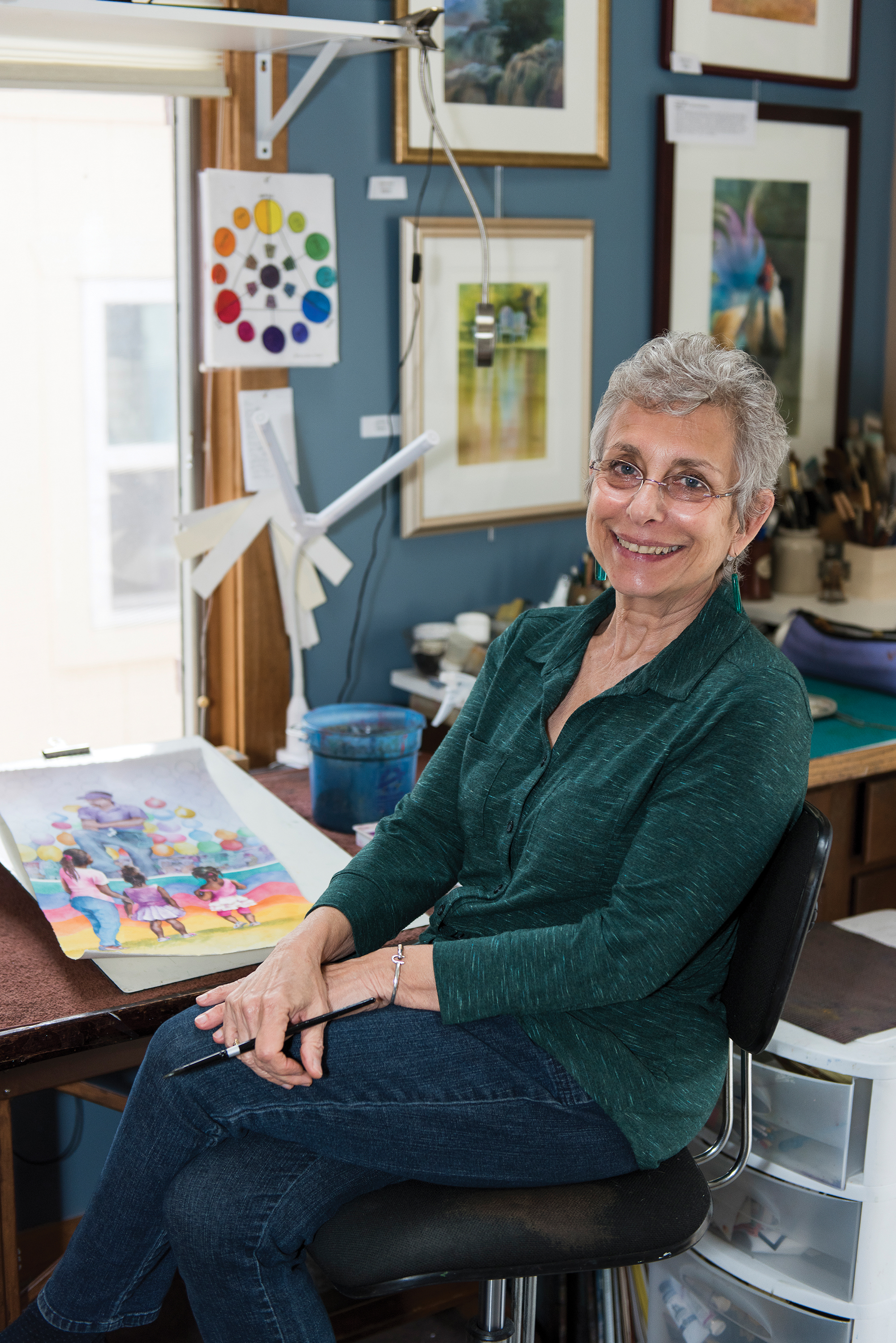
Midway through her junior year at University of Maryland, where she was studying microbiology, Alexis Lavine decided to hang up her lab coat and pick up a paintbrush. Though she had long nurtured a dual interest in science and art — her father was a scientist and she had taken art classes from the time she was a child — she opted for the “lofty” ambition of becoming an artist. “Microbiology was practical,” Lavine says, “and I didn’t want to spend the rest of my life in a lab, surrounded by Petri dishes.” But a career in art? Most would deem it impractical . . . unless there were a way to combine the two. That’s exactly what Lavine did, by earning a Master’s in medical illustration from Johns Hopkins University.



In those days, the late 1970s, long before the digital revolution, medical illustration was done largely in pen and ink, and occasionally watercolor. “It’s clean and it dries fast,” Lavine explains. Her profession nurtured her talent in the “unforgiving” medium, and, she adds, “it taught me how to draw, and draw anatomical forms. (She typically begins a painting by sketching it out first.) Medical illustration also called for artists to work on-site — a disadvantage when Lavine’s husband, Phil, was transferred to the small town of Cumberland in the western part of Maryland. Nonetheless, it was a beautiful place, “like Boone without App State,” as Lavine describes the burg set in the Appalachian Mountains, conducive to raising children . . . and painting en plein air — a technique of painting outdoors that became popular in the 19th century and preceded Impressionism. For the next several years, Lavine applied her artistic talent and training to mountain landscapes, forests, rolling rivers, learning how to paint fast, so as to capture the sun’s light as it moves across the sky. “Plein air forces you to decide quickly and make decisions with confidence,” Lavine says. And indeed, you can see her strokes, both bold and splashy, and precise, capturing light shimmering on the surface of a lake, or filtering through the branches of trees.

After she and her husband moved to Greensboro in 2002, Lavine continued to paint outdoor subjects — waterfalls at the Bog Garden, a stone bridge in Fisher Park — until about 10 years ago, when she decided to shift her focus to studio work. One of her goals was to get into exhibitions. “I needed to be in the studio to take time to make it my absolute best,” she says of her art. She knew that studio time would force her to “slow my brush down and think a lot more about what I wanted to say in a painting.” A trip to India gave her an unexpected nudge, when she noticed the hand gestures among a group of women clad in colorful saris, their arms adorned with gold bangle bracelets. Rendering just their arms and hands in a painting she titled Sisters, Lavine says, “It was a turning point for me.”

A 180-degree turning point, as it turns out, for the artist started painting figures. Photographing people when she’s out and about — a long-haired bearded fellow at a jazz festival, a couple eating on a boardwalk, baseball fans enjoying a Grasshoppers game — depicting in precise detail the small moments of what it means to be alive: the joy of hearing music, of tucking into a good meal, the boredom of waiting, the tenderness of a touch, the wonderment in observing the natural world.

Lavine’s new artistic direction has helped her reach her goal of gaining much-deserved attention. She exhibits her work at The Art Shop, at Hampton House Gallery and Blissful Studios and Gallery in Winston Salem, and from May 3–29, a solo show of her paintings, All Watercolor II, will appear at The Artery Gallery on Spring Garden Street. Her summery nod to Grasshoppers season, Toppa the Eighth, will travel to Qingdao, China as a part of a joint exhibition between the Missouri Watercolor Society and the Qingdao Laoshan Museum. Meanwhile, as a member of myriad watercolor societies and associations, Lavine teaches classes, sometimes in far-away locales, such as Charleston, S.C., and two days a week at her home studio in northwest Greensboro. She is excited about a newly installed overhead camera that helps her students observe her more closely as she deftly dabs her brush into a pallet and creates a scene — be it a windowsill on a quiet morning or a wry still life of Chinese takeout. Otherwise, she’ll be out in public, observing the flow of humanity, awaiting the next muse to fire her imagination. “I started painting people from the inside out,” Lavine reflects. “Ten years ago, I started painting people from the outside in.”
Info: alexislavineartist.com; arterygallery.com. 
OH

Nancy Oakley is the senior editor of O.Henry.

Putt ’er There, Ma!

A Mother’s Day putting green for Donna Joyce

By Cynthia Adams     Photographs by Amy Freeman

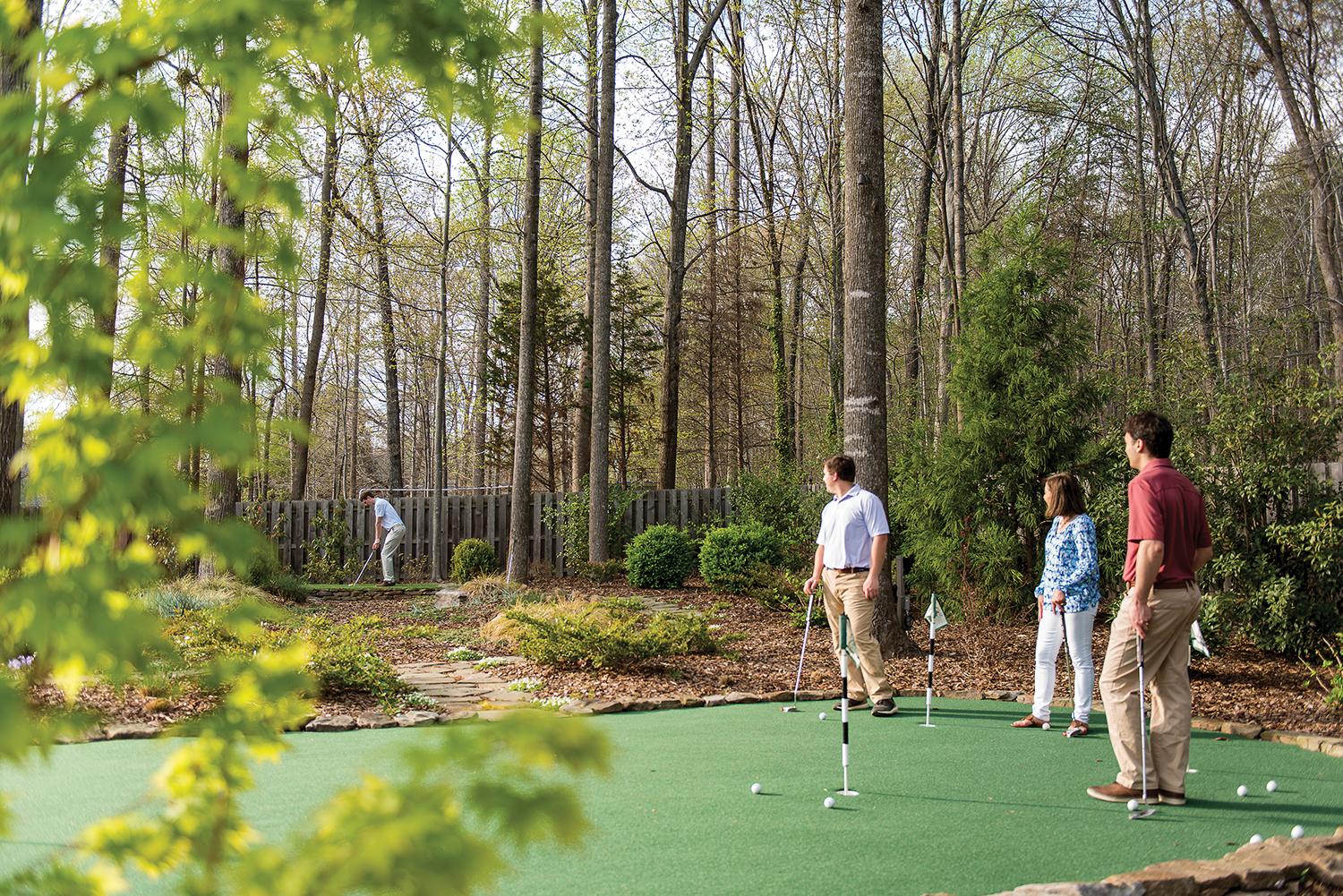
Some moms get a card and flowers — maybe a box of chocolates or brunch — on Mother’s Day. Unless you’re Donna Joyce, who got her own putting green and golf hazard from her three sons a few years ago.

“The boys used to make ceramic things, or give me cologne, or a gift certificate,” she says, perched in her kitchen, (chronicled among this magazine’s pages two months ago), having a cup of orange tea.

That all changed in May of 2015. “Will this be topped?” Donna asks, gesturing to the backyard and shaking her head. “No, that was the pinnacle. This was way over-the-top for Mother’s Day.”

At the back of Don and Donna Joyce’s Irving Park yard the gift is one Donna can admire from the kitchen, dining area and the den — created by her husband, Don Joyce, and sons, Donny, Dillon and Ben. 

Over two weekends in May her guys labored to create something unique in a yard that had morphed over time as the boys grew into manhood. The newest iteration of the family’s backyard neatly coincided with Donna having taken up golf. The Joyces’ family excursions often included golfing destinations like Carlsbad, California, where the sons met golfer Sergio Garcia. 

The addition allows the golf neophyte to work on her game.

“My putting?” Donna laughs, wide-eyed, “I’m getting there. Rather than having to be the best at this, I can be a part of this.” Then she grins. “You know they say you drive for show and you putt for dough.”

Over the years, the area has hosted, among other things, a sandbox, a zipline and a treehouse, which were there in 1993 when the family first moved to the neighborhood. They removed the treehouse as the boys outgrew it. Then the sandbox was banished. In their place followed a lacrosse playing field with gravel and nets in 2000. 

The two older boys left for college; the youngest one was soon to leave. Then both Donny and Dillon migrated back home briefly when they entered graduate school.   

Other than an occasional place to play fetch with the family Lab, the lacrosse field, meanwhile, languished.

“Then Don mentioned that we should do something with the backyard,” says Donna.

She recalls seeing a picture of a perfectly manicured green mound, complete with hole and pin. “I asked my husband; ‘do you think we could feasibly put a putting green back there?’”

And the idea was set into motion. “They brought in some sand, built it up, put in some artificial turf from a home box store, and also had the idea for the chipping area,” Donna says. They rented a compactor to pack the sand and added decorative stone.  “This took a couple of weekends.”

She explains it didn’t hurt that her husband is the owner of Pomona Pipe, Inc., and in the business of designing and building roads and bridges. Plus, he had three sons to provide free labor.

“My husband is a civil engineer, so he knows how to do layout and design and execute the work. He’s also a lifelong golfer, so he knew what he wanted to create, along with the picture I’d already pulled,” Donna says. “He pretty much supervised and told my sons what to do and how to implement his plan.” 

The family plunged right in with gusto. “The boys supported it. There’s always a project in the making. We don’t shy away from projects.” She laughs. “What is my role?  Well, I’m the visionary with the Honey-Do list.” 

Now do they have a mini Augusta National in the making perhaps? 

“Well, I wouldn’t go quite that far, but it’s kind of a neat story,” Donna says.  However, the Joyces do hold their own Master’s party when the boys come home to visit. 

The putting green and chipping area, landscaped with rhododendron, various grasses and accents of stacked stone, is where the Joyce men — and Donna — now gather to hone their game and cook out. “We had a small barbecue and clinked drinks to dedicate it,” she recalls.

The newest golfer in the pack says nostalgically, “The backyard is where we’ve had many fond memories, even though it’s not in some exotic place. When I play with my sons, I relax and enjoy it.”

And it keeps evolving. To prevent the yard from looking overly links-y, the couple have a few more plans in store as do-it-yourself family projects. Next, the hot tub currently situated on the side of the yard will be deep-sixed to make way for a fountain, says Donna. “Then we will put in some boxwoods and herbs.” 

Meantime, she works at her game intermittently, sometimes with a girlfriend. “We’re just trying to get to bogey golf,” Donna jokes, her self-deprecating comment a testament to the difficulty, if not impossibility, of mastering the royal and ancient game.

“It’s not intuitive,” Donna affirms. So, she practices in the backyard with her guys, hoping to putt for dough. But that, too, has its challenges. Giving an appreciative look at their well-loved backyard as the family Lab traipses towards the green, she jokingly cautions: “Look out for hazards!”  OH

Cindy Adams gave her sister her golf clubs, shoes, glove and balls after a few miserable attempts at the game.