O.Henry Ending

O.Henry Ending

Halfway And Home

“Making a life around here”

By John Adamcik

“He ain’t from around here,” my new friend said as she introduced me to others.  Although it’s been over 10 years, I remember her smiling just enough to inform me that she was joking. Mostly. After all, I had failed the shibboleth by mispronouncing her town of Sophia (I still couldn’t tell you how to pronounce it). And, in her favor, remnants of my Michigan accent told the tale plainly to everyone I met. Still, I was trying to endear myself to these people.

A few months later I revisit the topic with her. “When will I be here long enough to be from around here?” I ask.

“Never,” she says. She points to her husband. “He’s been here over 40 years, he still ain’t from around here.”

He nods. “It’s true,” he says, nonplussed. 

Around here.

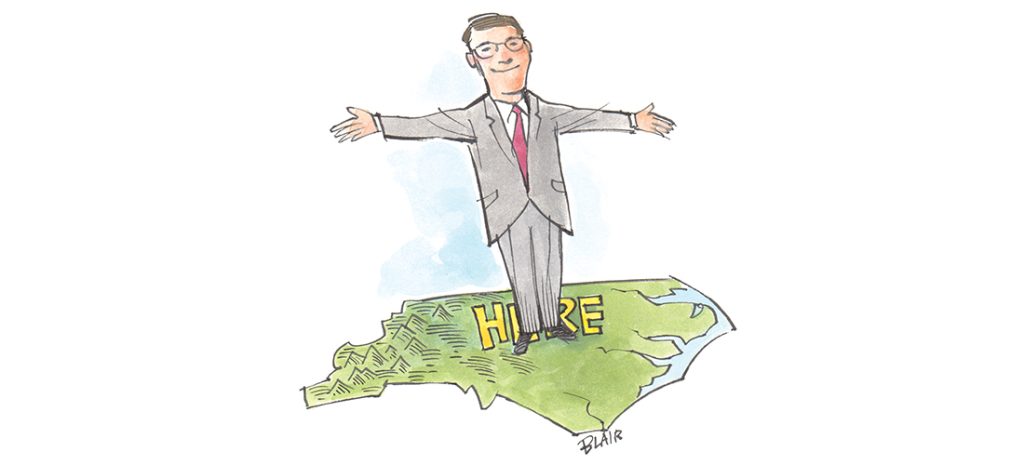
Approaching our 20th anniversary of making the Piedmont Triad our home, my family still ponders whether we qualify as being part of “around here.” Admittedly, we’ve been welcomed by the community and engaged in the community. We’ve done our part to strengthen the community. We feel at home.

Our children attended grade school through high school around here. They played sports, joined scouts and made lifelong friends. They worshipped God around here. As our children move forward to new places and new careers, my wife and I reflect on how blessed we have been by all the people “around here” who call this their home and have made us feel welcome.

When we moved here, family and friends asked us where we had planted roots.

“Halfway,” we answered.

It was true. Halfway between family and friends in Michigan and Florida. Halfway between the mountains and the coast. Halfway between the southern and northern borders of our adopted state. Here in southwest Guilford County, we were even halfway between many of the places we frequented in Greensboro, High Point and Winston-Salem. Halfway between closing on our home and our actual move-in date, a memorable ice storm hit the area and knocked down several trees in our new yard, splitting the Bradford Pear in half.

We were halfway in elevation and in weather patterns (according to our observations and at least one reputable seed catalog). We were also halfway in the biblical tracking of a, “three score and ten years” lifespan.

Reflecting on this milestone, I’m reminded that we hadn’t been here long when we realized this community is not at all halfway. Rather, we are at the center. The center of land and space and culture and dreams and life. The center of the hope of growth and of resolute determination.

Like us, thousands upon thousands will be coming to make new homes “around here” as the legacies left by generations of textile, furniture and agricultural pioneers pave the way for a future of new industry. I look forward to helping others plant roots around here.

My family and I are privileged to be around here and to have invested our time in this community. We have grown in ways we could not have imagined. We will celebrate with neighbors, with friends and with family that we are not halfway. We are home.   OH

John Adamcik and his wife Jeanneen live with their family in High Point. John enjoys his role in human resources with a Triad-based nonprofit human services religious organization. In addition to ministry, writing, speaking, and hosting his podcast (Fore Yore Lore), he can be found accompanying Jeanneen to craft shows as public relations for her vintage craft jewelry business.

O.Henry Ending

O.Henry Ending
Waffling Over Keto

Too much of everything might result in something edible

By David Claude Bailey

When my Pennsylvania Dutch mother went into the kitchen, forget about “a little of this and a little of that.” Salt was plunked into the pot using three fingers and her thumb. When she seasoned her iconic chicken’n’dumplings with black pepper, you could smell it two rooms away. A pinch was something I got for saying the wrong thing at the wrong time. And yet she was a marvelous and adventuresome cook. And I, the apple of her eye, landed not far from the tree.

After marrying my high school sweetheart at 19, I learned to cook because Anne, my bride, had an 11 o’clock class. By the time she got home, the house would be redolent with my inimitable Sicilian spaghetti sauce. (The secret was too much of everything but ground beef, which we couldn’t afford.) “Garlic is a flavoring,” she’d say, “not a vegetable.” Or, “Tabasco is not your — or my — best friend.” It was much later in life that I actually became a reliable cook.

Having lost my job in 2009, I got on as, first, a dishwasher, and then a backline chef, at Print Works Bistro. There, I learned some restraint and how to follow a recipe. Nowadays, I, in fact, do the lion’s share of cooking, with Anne, by far the superior chef, often putting me to shame. Maybe that’s because I haven’t lost my who-needs-a-recipe spirit and, like Mom, still think exact measuring is for sissies.

Carb-conscious, we go on and off the Keto diet — the one where, counterintuitively, you lose weight eating butter, heavy cream, eggs, bacon, cheese and anything else loaded with protein and saturated fat. Meanwhile, we bid adieu to our old friends, sugar, wheat flour and potatoes — which allegedly trigger weight gain and speed the onset of diabetes.

Whatever. Any diet that embraces pork rinds and favors whiskey over beer is fine with me.

Still, we missed the comforting carbs of waffles, pancakes and biscuits for breakfast. So one Sunday morning while Anne slept in, I decided to surprise her with Keto-compliant crêpes. After browsing a dozen or so gluten-free recipes online, all requiring exotic ingredients (tapioca, millet, sorghum flour, potato starch and what the hell is teff?), I started rummaging around in our pantry. Anne had bought some almond flour and coconut flour that she baked into marvelous cakes, so into a bowl went a quarter cup each. I found some brown rice flour and white rice flour, so two more quarter cups were tossed into the mix. I had no idea what xanthan gum was, but had seen it online and we had plenty, so in went several heaping tablespoons. After beating eggs and milk and butter together, I added the ersatz-flour concoction and ZAP!

The result was a thick slurry that I could have picked up with the immersion blender and carried to the compost heap. And that’s probably what I should have done. Worried that my little handheld appliance might short out or be absorbed by the blob, I poured in more milk, some cream, water. RRRrrrrr. RRRrrrrr. RRRrrrrr.

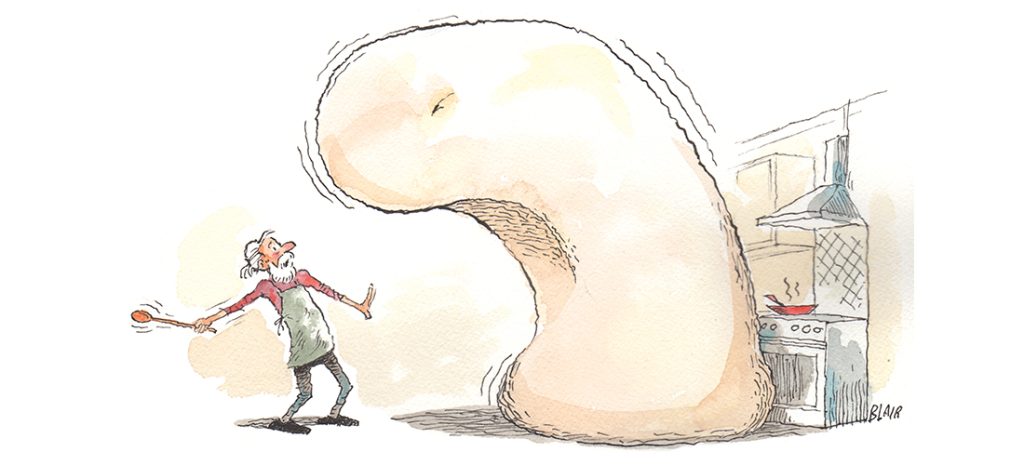
But the blob simply grew and started wiggling threateningly.

I dumped it into a bigger bowl and took a wire whip to it with the idea of beating it into submission. I doused it with more and more liquid until the blob loosened up, no longer adhering to what I was whipping it with. I extracted a hunk from the quivering mass and tossed it in the frying pan. Even after flipping it, the gelatinous glob refused to flatten. When I pressed down on it, the blob squirted a gob of creamy stuff at me.

Not yet willing to give up, I cranked up the waffle iron, thinking of it as a submission chamber. The blob hissed. It sizzled. And made fairly decent waffles! Especially when served with ice cream and chocolate syrup.

Mom would have been proud.  OH

O.Henry’s contributing editor, David Claude Bailey, is known for his kimchi milkshakes. 

O.Henry Ending

Dreaming of a White Dog Christmas

Learning a lesson in holiday expectations

By Cassie Bustamante

I’ve heard it said that the key to happiness is to lower your expectations. No one knows that better than a parent who has carefully plotted a Big Christmas Surprise.

Christmas morning of 1988, dressed in my ruffled flannel nightgown, I bounded down the stairs, making a sharp left turn into the living room, where our tree glistened with presents underneath. And there, like a beacon of light, I spied the gift I’d wanted with my whole 10-year-old heart.

My mother stood behind me, her permed curls askew from sleep and her excitement about the brand new 10-speed Santa had delivered written on her face. I ran towards the bike and quickly snatched Fievel, the squishy, behatted, floppy-eared mouse from An American Tail, off the seat and swung him in my arms with a squeal. I hadn’t even noticed the bike.

Now, as a mother of three, I fully understand the disappointment my parents must have felt, anxiously awaiting my thrill over the “big gift” they’d saved up to purchase, only to have it trumped by a seemingly silly object. Because it’s happened to me.

As all life-changing events in our household, it began with a conversation with my husband, Chris.

“This might be the last Christmas Emmy believes!” I insisted. “Just picture how magical it will be when she comes down the stairs to see a puppy of her own under the tree.”

“But we already have two dogs,” he reminded me.

“Well, what’s one more?”

It’s rare that Chris tells me no, especially when it comes to his only daughter.

A couple of months later, I crawled out of bed at 4:45 a.m. on Christmas morning to sneak away to a friend’s house a half hour away, where, as a favor to me, she was fostering the rescue I’d chosen for Emmy. The puppy was mostly white, a calico miniature schnoodle — a “designer” cross between a miniature schnauzer and a miniature poodle, a really prized breed. However, because this fancy little mutt was born deaf, the breeder had rejected her.

As I raced home to beat the kiddos’ inevitably early wakeup, the curly-eared pup snuggled in my lap, blissfully unaware of the stress — and utter excitement — I was feeling.

With about 10 minutes to spare, I made it. We set the puppy’s small carrier in the living room next to our tree and put her inside while we anxiously awaited the pitter-patter of footsteps from above. Meanwhile, the puppy had found her voice, sounding the rise-and-shine alarm throughout the house.

Soon enough, Emmy’s face appeared in the doorway as I beamed, hands clasped at my heart. It was finally here: the moment I’d been picturing for months!

“A sled!” She shrieked, dashing to the tree where the cheapest orange plastic saucer Walmart sold sat. “Santa got me the sled I wanted!!!”

Despite the high-pitched yelps and commotion, she hadn’t noticed the puppy. 

The moment wasn’t at all what I’d imagined. While I was initially disappointed, perhaps in the end we got something better. Just like my own parents, we now have a story we retell — and laugh about — each Christmas as a reminder that the kids will be happy, no matter how big or small the gifts. And we, as parents, will, in fact, discover that holiday magic if we just let go of our expectations.

As for Snowball, the fluffy white pup, she just turned 7, and our family’s love for her has long outlasted that traffic-cone orange sled. And while she can’t hear it, the bell still rings for the rest of us, as it does for all who truly believe in Christmas magic.  OH

Cassie Bustamante is managing editor of O.Henry magazine.

O.Henry Ending

Call me when you get there

A mother’s mantra leaves tire tracks on the heart

By Cynthia Adams

I confess to missing it — something that once made my eyes roll into my head. Mama’s constant comment upon parting: “Call me when you get there.”

Mama first started when I was a new driver at 16, chugging to high school in a periwinkle blue Corvair — named Perry, of course. Perry was aging badly; he had a leak in the oil pan. 

The Corvair was the infamous unsafe-at-any-speed car that made Ralph Nader a household name. Perry expired too soon, after consuming lethal quantities of oil that puddled in the high school parking lot. 

Actually, Mama’s request seemed very reasonable in retrospect, given Nader’s view that the car was prone to spinning around in the middle of the road with a steering wheel shaft likely to impale drivers in a crash.

Two years later, heading off to college in a second-hand British racing-green Austin Healy Sprite, it was questionable if Perry’s replacement was any safer. The tiny convertible was darling and nimble, but so lightweight that passing semis blew me like a leaf. 

Mama’s view that my driving was unsafe at any speed didn’t help things.

Time trudged onward, yet there was no aging out of Mama’s cautious farewells. She repeated the “call me when you get there” just as urgently when I was 24 and drove a caution-flag-yellow Honda Civic — which no one with working eyes could possibly miss.

Mama repeated the same thing when I reached 30 and was driving a fast BMW 3 Series, newly single and facing the open road. 

She knew there were plenty of potholes that could potentially swallow up my naive self.

When I headed into a new marriage, Mama still repeated the old saw upon each parting, even though I had graduated to a safe, staid Volvo.

Her admonition remained a given, even when I reached age 40. Pulling away from her in a third-hand diesel Mercedes, her hand flapped at me as I watched her mouthing the words. That car alone was definitely too heavy for the semis to whipsaw around on I-85.

The safety of the car, the situation, nor my age, mattered not at all to her. I was to call. When. There.

Easing my Honda Accord out of Presbyterian Hospital’s parking deck four years later, I left Mama scared and freshly scarred, recovering from heart surgery. Her standard words, raspingly delivered, rang in my head as I ached for her; call me when you get there.

A newlywed at 75, Mama stood with a bouquet, waving us off, comically urging us to call when we got there. We were flying home. She was hitting the high seas to honeymoon.

The cruise ship bearing her and her sweet-faced groom, Jim, age 81, pulled up anchor and departed Miami. 

Eleven years later with Jim’s passing, we moved her to an adult community in Cornelius. Here she stood at the door, leaning on a walker, ever watchful each time I pulled away in my Honda hybrid. 

Dark eyes burned brightly in Mama’s pale, thin face. 

Once, I noticed her lips moving, so I circled back. She repeated hoarsely, “Call me when you get there,” wanly waving and blowing a kiss.

On another evening, the walker stood at her bedside. 

Mama’s lids were heavy. The effort of speech and wakefulness too much. For the first — and only — time, I left to silence.

Making my way due north on I-77, I heard the echoes of the worn phrase, one she used with all five of her charges, plus her grandchildren, her great-grandchildren and, now, too, her caregivers.

Silence tugged at me, weighing heavily, as I navigated the darkness.

This time, it was she who was leaving.

My tires slapped the tarmac in a lulling rhythm: Call me/ when you/ get there.  OH

Cynthia Adams is a contributing editor of O.Henry magazine.

O.Henry Ending

Good and Dead

And totally down-to-earth

Story and Photograph by Ashley Walshe

Our neighbors are the best. They’re very quiet, very private — I’ve never actually seen them. But I should mention that they’re also quite dead.

Last spring, my husband and I, newlyweds, moved into an RV near Lake James as sort of a romantic venture. We live at the end of a private drive shared with other RVers (mostly weekend warriors) and a few retirees with swanky prefabs and sweeping views of the Blue Ridge Mountains.

Our view is a little different. Just beyond the camper’s east-facing windows — and I do mean just beyond them — 11 white crosses are staggered among windswept pines, a sparse fringe of mountain laurel and a dusting of vibrant moss. Most of the crosses are wooden, one is broken; a handful are PVC replicas. Two actual headstones, weatherworn as the crooked trees, blend in with the rugged landscape.

The site is decidedly understated. No fencing; no benches; no fancy signage. Propped against the base of a lichen-laced pine, a wooden plank marks “Dobson Cemetery” in hand-painted lettering.

I make it a point to greet the Dobsons each day, same as I would any neighbors. There’s Alexander (d. 1876), who lived to be 83; and Cora J. (obviously dead but stone illegible); and about a dozen others. Lord knows how many bones rest six feet below. But I find comfort in the Dobsons’ quiet presence. So far as I can tell, they don’t seem to mind ours.

My fascination with cemeteries began six years ago while visiting my great aunt in Eau Claire, Wisconsin. Shirley was dying of bone cancer, and I was there to help her sort through her worldly possessions. It was a tender time.

While Shirley was facing her mortality in a literal sense, I was navigating a different kind of loss: a heart-wrenching breakup. After supper, I’d venture down the street for a stroll through one of the city’s oldest burial grounds, Lakeview Cemetery. There, perhaps for obvious reasons, my grief felt welcome. Yet so did my dreams of a full and happy life. As I wove among the ancient trees and motley gravestones — the living and the dead — my perspective shifted. We’re not here for long. What will we do with the time we’ve got?

Which brings me back to our camper with a view.

We see our share of white-tailed deer. Birds come and go. But you can imagine we don’t get a ton of human foot traffic back here. We’d had none, in fact, until the other morning.

We were dining on the back deck when our neighbor — a live one from a few lots down — appeared like an apparition amidst the wooden crosses. Our startled dog went ballistic.

“Sorry to disrupt your brunch,” Dave chimed as he tromped heavily through the lot. Despite having lived here for over two years, he’d never felt inclined to visit the cemetery until hearing that the Dobsons “may or may not” be related to Daniel Boone.

He came. He saw. He seemed utterly unimpressed. We returned to our peaceful graveside picnic.

That our dead neighbors might be kin to an American trailblazer certainly intrigued me, but after a bit of fruitless digging — online, mind you — I gladly surrendered the search. The way I see it, they’ve all crossed the veil into that good night. They’re all pioneers. Besides, it’s often the mystery that keeps life interesting. 

On that note, dear neighbors, I’m really glad you’re here. I hope you won’t mind if I keep saying hi. But it’s really OK if you don’t answer.  OH

Ashley Walshe is a former editor of O.Henry magazine and a longtime contributor of PineStraw.

O.Henry Ending

Embracing Juno

The tarot reading — and tattoo — that changed my life

By Corrinne Rosquillo

In 2018, I visited New Orleans for the first time. It’s a magical city, full of history and an old energy that cannot be described, only felt. It was where I received my first tarot reading — not from some Creole witch (missed opportunity, I know), but from an elderly white man with a calming presence.

I don’t remember his name now. I wish I did. I’m sure it was something like John or Mark. Ordinary, simple — fitting. He did a standard reading with twelve cards. The first eleven of them are a blur, but the final card — the card meant to represent me — still appears in my mind’s eye with crystal clarity: Juno, Queen of the Gods, a force to be reckoned with. That, and the reader’s parting words: “You are your own worst enemy. You can accomplish anything if you get out of your own way.”

I cried because I knew it was true. His words resonated, touching something deep within me that had been there all along, a continuing theme throughout my life. That’s what tarot does — it doesn’t tell you your future or some hidden secret of the universe. It points out what’s right in front of you that you’ve been too busy, too distracted to notice.

At the time, I struggled with anxiety and depression. I still do; I probably always will. But I got the message loud and clear.

I paid him via Venmo and left.

Fast forward to 2019, when a knee surgery plunged me into the deepest depression of my life, a depression that almost killed me. Key word: almost. I’m still here, winning battles against myself.

Those words, spoken to me years ago, still resonate. I knew in 2019 that I wanted to create a permanent reminder for when my depression would inevitably rear its ugly head again. This year, I finished that reminder with the help of Gene Cash at Seven Sagas Tattoo Studio.

I took a look at the classic Roman Juno and made her mine. I have a woodblock-style crane on my right shoulder that represents my first triumph over depression, so I thought, why not a Japanese Juno? Some of her classic symbols are still there: the peacock feathers, the spear, the moon, the lotus. The words beside her, written in Japanese, are a constant reminder to me: “watashi no kataki wa jibun.” My enemy is me.

But my favorite element of the whole piece? If you look carefully, the top line of the moon isn’t finished. It’s intentional, an aesthetic called “wabi sabi” in Japanese. It’s about appreciating beauty that is “imperfect, impermanent and incomplete” in nature. Fitting.

Juno is on my right arm to remind me that I am a goddess, capable of overcoming anything. So long as I believe it, I know I will.

To that tarot reader, wherever you are, thank you for awakening the divine in me.  OH

A goddess with a gorgeous tattoo of Juno on her arm, Corrinne Rosquillo is a regular contributor to O.Henry.

O.Henry Ending

The Sunfish

It was too small to keep. Or maybe it wasn’t.

By Ashley Walshe

This isn’t a big fish story. Quite the opposite, actually. And it starts right here on Lake James, the massive hundred-year-old reservoir lapping the eastern edge of our state’s Blue Ridge Mountains.

It’s the pinnacle of summer. High on a red-clay ridge, the whippoorwill, whose incessant chanting often stretches well into the balmy morning, has gone silent. The red dog is weaving among windswept pines, and I am sitting on the wooden deck of a Coachmen RV, a sparkling sliver of lake visible one half-mile in the distance.

My grandparents used to live here. Not in this 32-foot travel trailer, home to my husband, the dog and me for a warm and watery season. But on down the meandering shoreline, in the brick-and-stucco home with the vaulted ceiling, lakeside gazebo and sweeping view of Shortoff Mountain.

Papaw kept his pontoon at a nearby marina. If I close my eyes, I can almost see two kids swinging their legs at the edge of his boat slip. I’m the little girl with the auburn curls and wild swath of freckles. My younger brother, all blue-eyes-and-dimples, is perched beside me. Neither of us have fished before.

On this day, Papaw is cradling a box of live crickets, and Dad is showing us to how to hook them. The black-and-silver schnauzer, whose feet and beard are permanently stained from the red earth, is barking at the wake as a neighboring boat glides up to dock.

Once we cover the basics (don’t snag your sibling or grandpa), we cast a few lines, jiggling the rod to make our crickets dance.

Papaw watches from the captain’s chair as Dad teaches us a ditty from his own childhood. The song changes based on who’s singing it. Mine goes like this:

Fishy, fishy in the lake, won’t you swim to Ashley’s bait?

I sing incessantly. And guess what? In no time, I feel the coveted tug of what must be a whopper at the end of my line.

I squeal. I reel. And up shimmies the smallest sunfish you’ve ever seen. A bluegill, I think. No bigger than my tiny, freckled hand.

“Can we keep it?” I ask, twitching with excitement. 

“If he’s long enough,” says Papaw. Gripping my whopper in his leathery hands, he gently slides out the hook then slips the fish into a shallow bucket of water. “We’ll measure him later.” 

My brother and I cast several more lines — first at the boat slip, then out in a quiet cove on the water. Although the song appears to have lost its magic, that doesn’t deter us from our fervent chanting. We sing until the crickets are spent, my sunfish our singular catch of the day.

I know now, 25 years later, that we had no business keeping that tiny sunfish. But it was never about the fish for Papaw.

Peering down into the bucket, my grandpa announces that the bluegill is “just big enough,” then gives me one of his signature winks. I wink back from my seat outside the camper, smiling through time at a proud little girl and her very first fish.

That night, while the rest of the family ate crappie from a previous haul, I savored every bite of my pan-fried sunfish. It didn’t look like much on the plate, but the memory has fed me for a lifetime.   OH

Ashley Walshe is a former editor of O.Henry magazine and a longtime contributor of PineStraw.

O.Henry Ending

All That Glitters Is Not Gold

An unexpected visitor leaves a lasting impression

By Barbara Rosson Davis

Illustration By Harry Blair

Dogwoods and Azaleas were in full bloom. Robins tweaked worms from my just-tilled garden plot. As my son hurried off to school, I heard him yell, “Mom! Heads up — there’s a big goose in the bathroom!” I thought he was joking. We didn’t have a pet goose and this wasn’t some kind of secret “emergency-code.” I went inside to investigate the situation. We had previously dealt with a black snake in the toilet bowl, a bat in the fireplace and a rabbit in the carport, but a goose in the bathroom?

As I opened our guest bathroom door, I discovered not the Golden Goose, but a large Canada goose, staring into the toilet bowl. I decided he must have gotten in through the slit in the patio-screen, wandered through the open kitchen door and, curiously, ended up in the bathroom, where Matt, as boys will do, had left the toilet seat up.

I wanted to lure this wild fowl out of the house, but our “guest goose” was fierce and attacked me with each attempt. After a tumultuous evening of Mr. Goose’s distress signals coming from the bathroom, Matt tried feeding him couscous. I feebly attempted coaxing our feathered guest out of the bathroom with my ridiculous imitation goose calls. No luck. Flustered and terrified, the goose continued squawking, honking and flapping. The next day, we noticed that “guest goose” grew agitated at certain times — near dusk and in the early morning.

I thought about calling animal rescue, but the sounds of geese flying over the house gave me a better idea. I noticed that local geese flew early in the morning from their nesting area to feed at Sedgefield golf course, returning to their roost at the end of the day, after grazing. I thought: Just maybe, Mr. Goose wants to rejoin his flock. If I could get him outside at those times, he might then join his fellow geese. The following morning, before sunrise, and protected by Matt’s trusty Lacrosse helmet, arm-guards and gloves, I managed to open the bathroom window from the outside. I peered in. The goose seemed calm.

I went back inside the house to find “guest goose” had instantly transformed itself into a boisterous beast, flapping and crashing around the bathroom, seeking escape through the open window. After several attempts, he finally launched his feathered frame airborne, honking loudly as he flew off in pursuit of the flock.

Free at last! His victory was not without consequences for us earthbound mortals. I entered the bathroom to find total chaos: a sprawling, stinking mess! The bathtub was littered with grain, feathers, shampoo and the foulest greenish “goose-goo,” as was the tile floor, counter, sink, and toilet. Where to start?? I held my nose and considered replacing the entire bathtub.

Jars of creams, bottles of cologne, mouthwash and the contents of a spray can of glitter were everywhere. The toilet seat, shower curtain, tub and tile floor sparkled with glitter. Too exhausted after two days of dealing with this rambunctious and uninvited guest, I couldn’t begin to fathom the clean-up campaign for this fowl’s foul-aftermath.

Later that evening, returning from playing golf, my neighbor told me about the most extraordinary phenomenon he had witnessed on the golf course: “I saw this glittering goose grazing the greens, shimmering in the sunlight! Amazing!” OH

Barbara Rosson Davis is a freelance writer, living in Greensboro.

O.Henry Ending

A Shot of the Dark

A Brief History of an Espresso Obsessive

By David Claude Bailey

It was at Friendly Shopping Center’s Potpourri gift shop that I purchased the shining brass apparatus that turned my yen for European espresso into an obsession. It was a flip-drip, Neapolitan coffee maker that I fueled with Medalgia D’Oro, which always smells ever so slightly — and invitingly — of burnt anchovies.

A gruff Frenchman pulled my first cup of espresso in a bar in Cherbourg, where the rising sun fell on dock workers throwing back shots of espresso and something vile in tiny, little glasses. Hitchhiking across Europe at 16, the intensity of Europe’s café experience and the potent black jets of java rocked my world.

But my mother had prepared me for espresso in my hometown of Reidsville by keeping a percolator on our stove reheating and re-perking coffee. As the day progressed, a dark slurry coalesced so potent it triggered endorphins before I knew I had them.

Since then, I’ve led a coffee-centric life, preparing gallons of the stuff in a succession espresso machines and pots, one of which I backpacked into the Grand Canyon. I remember in the ’60s and ’70s when espresso in fancy American restaurants was accompanied by a lemon peel and cube of sugar that you dipped into your brew. I had espresso in Greenwich Village and Pike Place Market before Starbucks existed. I spent a week in Trieste at Illy’s Università del Caffè learning barista skills for an article for Delta’s in-flight magazine, Sky. Later, Dennis Quaintance kindly did not fire me after an enthusiastic coffee consultant and I recalibrated the machines at Green Valley Grill, triggering a fire storm of complaints from regulars whose coffee was suddenly kicked up several notches. I’ve had inexpressibly bad espressos traveling in Peru, Malaysia, Greece, and, yes, even in Italy, France and Spain, from self-serve machines in gas stations.

But the oddest cup of espresso I’ve ever had was in Reidsville. A few years ago, I’d discovered that McDonald’s has decent espresso for $1.38 if you can coach the cashier to find it on the computer screen. For the longest time, the manager had to be called over to make it, but nowadays, most of the burger flippers are sufficiently cross-trained to realize all you have to do is hit the right button.

So one day on the way home from taking my sister hiking at Hanging Rock I informed her I was stopping at the Lucky City’s McDonald’s to have an espresso. “This is Reidsville,” she said. “They won’t know how to make it.” I countered, “If they serve coffee, which they do, they’ll have it.” She gave me that look that said, “you’ve always been bull-headed.”

I was able to help the cashier put in the order and got my endorphin receptors ready — as I waited and waited and waited. I noticed a gaggle of employees around the coffee machine. Finally, the manager came over to say that they were working on my order. After an eternity, a chagrined clerk came forward with my espresso. “Something’s wrong with our machine,” he said. “It took forever to get your cup full, but here it is.” It was luke-warm and instead of an ounce and a half of java, the cup brimmed with at least ten espresso shots pulled one after another.

You can go home again, but you might not get a decent cup of espresso.  OH

Contributing Editor David Claude Bailey concedes that you can get an excellent cup of espresso in downtown Reidsville at Sip Coffee House.

O.Henry Ending

Splash or not Splash?

A risk taken to prove a point

By Mary Best

As the youngest of five dangerously independent — and always mischievous — children of a couple of educators in the Greensboro school system, I weathered many storms as a toddler. Don’t get me wrong: I grew up in a loving home with devoted parents. But being the runt of the litter, I suffered a disadvantage — the last to receive nourishment at mealtime, endless ribbing about my clothes and toys, relentless teasing about being “sweet.” Why were my three brothers so different from me? They didn’t play with dolls, for heaven’s sake. Who doesn’t play with dolls? And don’t even get me started about Barbie.

When I wanted to play with the “big kids,” I sometimes bit off more than I could chew. For example, my family belonged to Lawndale pool, and for hours I would watch my brothers climb to the top of the high dive and plunge into the deep end. Effortlessly. Joyfully. Thoughtlessly.

So, when I was about 3 or so — younger than I could count my years on one hand — I decided to follow in their footsteps and jump off the high diving board. I had watched them master it many times. If they could do it, I thought, how hard could it be?

Fearlessly, I climbed the ladder to the top of the diving board. As I neared the end of the board, lifeguards, pool members and my poor parents froze and watched as a kid who couldn’t recite the alphabet was about to take a death-defying leap.

Up until then, my greatest adventure had been getting lost in Meyer’s downtown. Oh, and that misadventure in Franklin Drugs, when I had to go to the restroom but couldn’t read the signs on the door. Yikes, I chose the wrong door.

But I digress. Back to the pool.

My father quietly ascended the ladder, and when he reached the top, he gently, calmly, called my name. “Mary Frances,” he nearly whispered, “I’d like for you to come to me. I have something I want to tell you.”

I frowned. “But I want to show my brothers I’m as tough as they are.”

“They know, Sweetheart,” he replied. “I was the youngest too. And I endured my share of teasing.”

I never thought about other kids being teased. I had assumed it was some unique, degenerative condition from which only my brothers suffered. I had no idea their ceaseless mocking could be a sign of a pandemic, an epidemic or — even worse — ubiquitous.

The pool crowd silenced. Swimmers, sunbathers and hungry patrons in line at the concession stand held their breath as my father coaxed me toward him.

“Can you make them stop picking on me?” I pleaded. Why the hell not? I wasn’t exactly a prosecutor or defense attorney, but I felt pretty darn powerful for someone who only recently had mastered 4 + 4 = 7, right?

“I can’t promise you that,” my dad said. “But I can promise this: I will never let anyone hurt you. I know your brothers don’t show it because they are knuckleheads, but they love you, and they will always be there for you.”

Convincing. Plus, the water seemed much farther away than it did a few minutes ago.

As my father shepherded my descent from the ladder, I saw my brothers surrounding the area around the foot of the diving board. As sentinels. At that point, I knew they loved me — as protectors, friends, brothers. The teasing didn’t stop, but I knew that day at the pool they loved me.  OH

Mary Best is a freelance writer living in Greensboro. Contact her at marybest04@gmail.com.