Pleasures of Life

PLEASURES OF LIFE

Changing the World

One poem at a time

By Josephus III

There I was, nervous, excited, dressed in a Carolina-blue, sheer top, looking like the African Tooth Fairy. My first hours in Nairobi and I’m already on stage, closing a dance performance at the 10th Annual Kenya International Theatre Festival with a choreographer from London. How did I get there? Community is the short answer. And poetry, because, for me, Poetry is Life and it continues to open doors into rooms that were too big for me to even fathom.

You see, 20 years ago I worked on a project with the Community Theatre of Greensboro, which, at the time, was being run by Mitchel Sommers. Together, we fused hip hop and poetry into Schoolhouse Rock, remixed some classics and toured Guilford County Schools with a little “Conjunction, Junction, what’s your function.”

Fast forward several years and Mitchel is retired, vacationing in Nairobi, where he happens to connect with people who run this festival. So, when they mention they are looking for a U.S. poet, guess who he recommends? You guessed it, me! Josephus III, Greensboro’s first poet laureate and the author of Poetry is Life, my book about how poetry is all around us, permeating everyday life, from hip hop and R&B to the rhythmic pattern of what comes out of our mouths.

I jump at the chance to share my art on a global stage.

The plan is for Poetry is Life to be performed as a one-man show. Plus, I’ll teach a master class on “The Beautiful Struggle” and perform at closing ceremonies.

As I move from day one to day two, still in transit, the idea of Nairobi keeps me on my toes; anticipation keeps my mind and body tingling like I have Spidey senses. Finally, I touch down, grab my bag and as my prearranged transportation makes its way to the hotel, the streets are alive with people — hugging, smiling, living. There is a cow in the median. I take it all in, my senses vibrant. I am in awe — poetry continues to provide and prove to me its power.

By the time I arrive, the festival has been drumming for a week, like heartbeats and Sasquatch feet, and I am the new kid on the block. I breakfast with thespians and creatives from Botswana, Zimbabwe, France, Switzerland and all over the planet — a community a world away. Plate full of sausages, potatoes and an omelet, plus a glass of mango juice in my hand, I “Greensboro Grub,” code for how I meet, greet and eat my way through this Olympic village for art and culture.

The first person I meet, Michael from London, invites me to have a seat at his table. Conversation, like poetry, flows and I learn that the dance show he’s been choreographing, Trickster, is happening that very evening. His eyes light up when he hears I am a poet. “There is a poem in the end of our piece,” he says. “We were going to project it on the screen to close the show, but we would love if you could read it.” I’ve only known him for 10 minutes and now he wants me to help close a show that he’s been prepping for a week? When in Rome — or shall I say Nairobi . . .

So here I stand in my blue, see-through top, looking like an African Tooth Fairy adorned with tribal face paint and purpose and passion and, above all else, poetry, surrounded by community filled with a feeling of fellowship with others, cultivating creativity and culture for a common cause on a stage in Nairobi, Kenya, changing the world one poem at a time.

And as the dance comes to an end and the stage lights fade, these are the words I speak:

So here’s the moral for the rich and the poor

For the ones who search and for those hearts that have already found the truth

The trickster never sleeps, he watches every move

He’s wicked and he’s strong

He’s magical and fast

But spirits from the ancestors may gather from the past to free your soul

And gently guide you back into your own

Have faith and courage friend,

You are not alone.

Pleasures of Life

PLEASURES OF LIFE

Greensboro’s Perfect Pastry

The apple fritter at Donut World can love you back

By Brian Clarey

Gigi Williams knows exactly what she wants.

She breezes right through the front the door of Donut World’s Battlegrounds Avenue location, past dozens and dozens of donuts — twisted ones, rolled ones, the standard one-hole punch — and beelines to a particular spot in the long, glass case.

“May I have an apple fritter, please,” she says, gesturing to the dozen fritters behind the glass, arranged in a glistening grid on a parchment-papered baking tray.

“Make it two,” her partner jumps in, peering into the display cases. “And a cup of coffee.”

Behind the counter, Luz Martinez gathers the order. The couple hunches over their fritters at a corner table before a day of shopping. But the real reason they made the drive into Greensboro from Oak Ridge this morning is in their hands: It’s the fritter.

“I’m shopping,” Williams says, “but I can’t do it without this.”

After culinary school, she spent decades working in high-end kitchens around the country before settling in Oak Ridge with her partner. And of all the dishes she’s tried from kitchens all over the world, this simple one keeps her coming back.

“She started asking for an apple fritter yesterday,” her partner reveals.

Martinez confirms. Indeed, the apple fritter is the most popular item on the Donut World menu, which should come as no surprise to the thousands of Gate City residents who have already discovered it on their own or through the advice of a trusted palate. The day began with about 10 dozen of them; now, at the noon hour, she is halfway through her inventory.

This apple fritter stands alone among the offerings at Donut World: cake and rise donuts, buttermilk bars, filled donuts, twisted donuts, little donut holes topped with glaze, Jimmies, crystalline sugar, fruity cereal, chopped peanuts, shaved coconut, crumbled Oreos and straight-up chocolate chips, all of which are uniformly excellent. But the fritter? It is a near-perfect example of the form, elegant in its simplicity, impeccably portioned, faultlessly prepared and highly accessible — you can get one in your hands at either the Battleground Avenue or West Market Street location for a couple of bucks.

There is nothing fancy about a fritter. It’s nothing but a bit of dough or batter, folded with an ingredient or two and then deep-fried. You can fritter just about anything, savory or sweet. There are corn fritters, blueberry fritters, conch fritters, pumpkin fritters, chicken fritters, banana fritters, cheese fritters, with variations around the globe. You could arguably label croquettes as a type of fritter, along with tempura and pakora.

The apple fritter is perhaps the lowest common denominator of fritter, available at every donut shop across the nation, in the packaged pastry section of the grocery, even inside the occasional vending machine.

But a first encounter with the Donut World apple fritter might leave the customer wondering if they had ever truly eaten a fritter before.

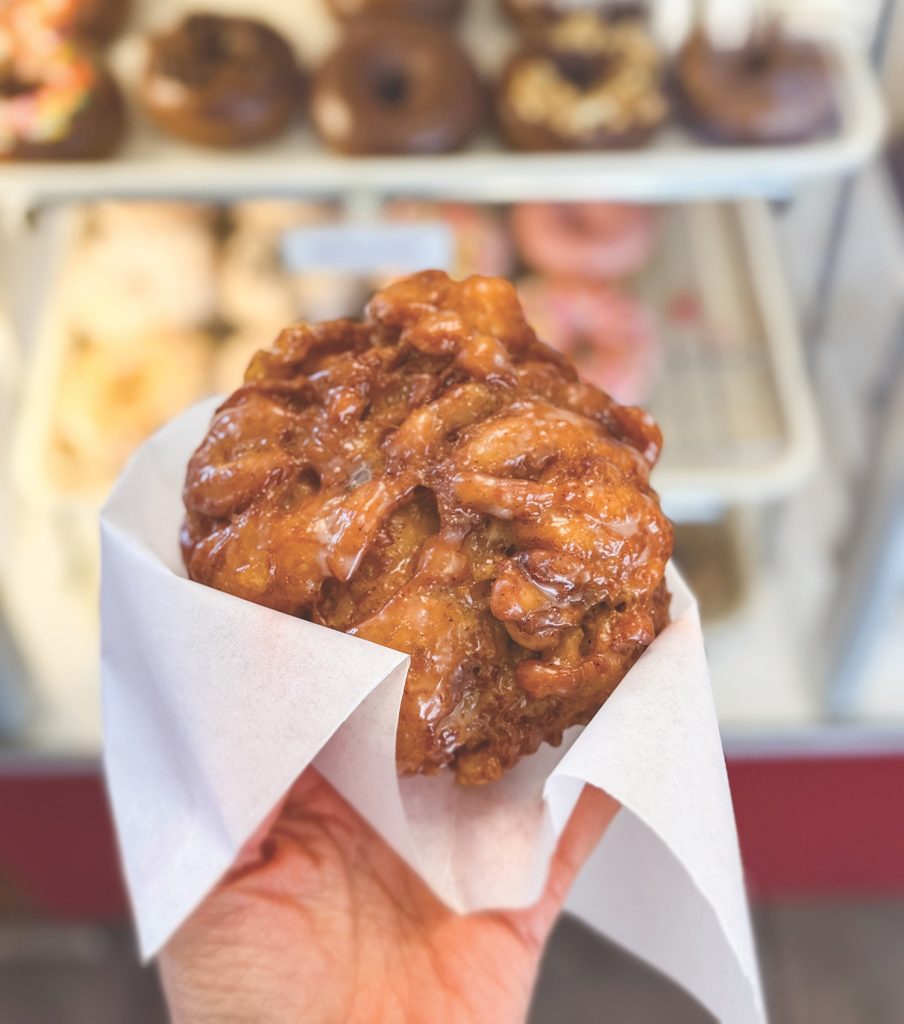
Its soft, light interior is encased in a toasty, brown bark formed when the crenellations in the dough succumb to the deep fry, its crunch intensified by a thin layer of glaze icing. The ratio of apple filling to dough is practically Fibonaccian — enough so that you get some in . . . almost . . . every bite, but not so much as to turn the whole thing into a mashed-up jelly donut.

“I just love pulling it apart,” says Williams, tearing into her fritter. “That first bite, you can tell it’s handmade, not machine-made.”

Shop owner Lean Ly brought the recipe with her when she and her family moved to Greensboro from San Luis Obispo, Calif. She comes from a long line of donut-makers — her family owns the Sunrise Donuts chain in Southern California — but she wasn’t thinking about donuts when she first got here. They came across the country for her husband’s job, and Ly wasn’t sure how she would contribute to the family finances. The answer quickly became clear.

“We did not see any family-owned donut shops in Greensboro like we had in California,” she says, “so I bring one into the area.”

The first shop, on West Market Street, is where the apple fritter began to make a name for itself in Greensboro. It quickly became the flagship store’s best-selling item.

The reason for the pastry’s popularity is simple as pie: “People love them very much,” she says.

The recipe is extraordinarily simple, with just three ingredients: dough (not batter), apple filling and cinnamon.

“You mix them together, you let them rise, fry until golden brown and then pour glaze all over them,” she says. Just like everywhere else. “The difference is the care and love we put into them.”

I suspect the “care and love” translates into the perfect fry time — just long enough to develop that magnificent, crunchy bark but not so long that the fritter becomes drenched with oil, first one side and then a practiced flip to brown the other.

“That’s just technique,” Ly says. “When you do something for so long and with so much love, you know exactly how long to fry them, and exactly when to spin them.”

Back in the donut shop, Williams has finished her apple fritter and is ready to begin her shopping. But before she does, she has a request on this day for a reporter working the pastry beat.

“Please,” she says, “do not share this secret. Not everyone needs to know. I want to be able to get my fritters.”

Sorry, GiGi — that’s not how we do things around here. Something this delectable needs to be shared.

Pleasures of Life

PLEASURES OF LIFE

Bat Girl

A summer of darkness to spread my wings

By Sarah Ross Thompson

It’s May 2002, and I make my way up the stairs of Winston Hall at Wake Forest University to meet up with Nick, the graduate student in charge of the bat lab — or The Batman, as I come to call him. He uses his key card, leading me through a labyrinth of locked doors and staircases that end in a dark basement room — a bat cave, if you will. You see, I’ve taken a summer position as an undergraduate research assistant studying bat echolocation. As an eager biology major, I’m ready to get started on this dream job, rabies vaccinations and all. In my first week, we insulate the cave with foam pads to make it fully soundproof for recording bat calls. Nick and I work side-by-side for several days, listening to The Best of Sade CD on repeat while he tells me about his home country, Bulgaria, and his dog, Max. By week’s end we finish the room, and I’m gifted a container of fresh feta cheese, a surprising but welcome gesture. The Batman continues to pay me in feta all summer as I hurry along by his side, carrying stacks of notebooks and tools. Just call me Robin.

Our next mission involves collecting bats from the field. And by “field,” I mean anywhere a colony of bats may be living. During the first expedition, I find myself stabilizing a ladder in the dark while The Batman climbs underneath bleachers at a local high school, using gloved hands to carefully scoop bats and bring them down one-by-one to a carrying case. The next week, an exterminator tips us off that a woman wants bats removed from her attic. We speed over in our bat mobile (an ’80s hatchback), crawl into the hot, clammy attic space, and secure the bats.

Once the great migration of bats to the bat cave is complete, I’m tasked with cleaning their cages and providing them with daily food and water. Simple enough, except that, believe it or not, I don’t particularly like bats. In fact, years of media villainization have left me terrified of them — especially that they’ll somehow get caught in my hair. As I peek inside a cage, psyching myself up to clean, I see a cauldron of bats hanging upside down, their beady eyes glistening in the red light of my headlamp, and I draw back with a gasp. In another cage, a bat is gripping the wire door, so when I open it, he swings open to greet me. The stuff of nightmares. Only after some serious self-negotiation am I able to squeeze my hand through the smallest crack in each door. Mission accomplished.

Finally, what we’ve been waiting for — we begin our experiments with bats and moths in the lab. It turns out that moths can emit a buzzing sound to “jam” a bat signal and avoid being eaten. We want to capture the sound waves of that particular moment of survival. Nick turns on the sound recording device, we turn off our headlamps and crouch down, waiting in the darkness, as Hercules (our favorite bat – yes, we name them all) starts to circle the cave. In his quest for food he repeatedly flies within inches of my face, close enough to feel the wind from his wings tickle my skin. Each time he swoops by he slows just enough to get a look at me, and I at him. I surprise myself by not being afraid, but instead feel a tingle of exhilaration each time he passes.

Mere weeks later, I’m now feeding the bats by hand (Holy Toledo, Batman!) and spending hours alone in the bat cave running experiments. There’s a tranquility found in that room, the bats whirring around me again and again, and I grow to enjoy the dark. “I am darkness, I am the night.”

We also raise baby bats in the lab, and I find I am falling all over myself to help. Wrapped up in tiny bundles, the babies greedily accept formula we feed them through droppers. Just like with human babies, we wake to feed them in the middle of the night. I leave a summer party at 2 a.m., announcing that I must go feed baby bats (surprisingly, no one questions this). In the stillness of the lab, my ears still ringing from the blaring music of the party, I drop milk into their little mouths.

When the babies are older, I take them out one-by-one and walk around the bat cave while each bat hangs upside down from my finger. As they feel the air under their wings, they begin to open them, eventually extending them fully to push off and take their first flight. I sit in awe. I’ve just taught baby bats to fly.

Throughout my summer in the bat cave, I meet other bat lovers. Led by The Batman, we’re a motley crew all of us used to spending hours alone in darkn ess. One has a bat tattoo, another a bat navel ring. We have cookouts and gatherings. We give each other bat-themed gifts (the children’s book, Stellaluna, being one). As the summer ends, I sign up to work in the bat lab during the next academic year and again the following summer, having found my place in Gotham City.

These days, I no longer study bats, but I sometimes wish I did. In those quiet moments in the lab, I experienced a peace that I’ve never quite been able to replicate. One that comes from watching, from listening and from being still in the dark. A few years ago, I met up with The Batman, who now is an internationally recognized professor. We enjoyed a glass of wine and discussed the research that we each do. As a lifelong Robin, I’m hopeful that we can work together again one day. I’ll await the bat signal.