The Greener Way

THE GREENER WAY
The Greener Way
The Downtown Greenway paves the way for pedestrians, pedalers, plant lovers and pollinators
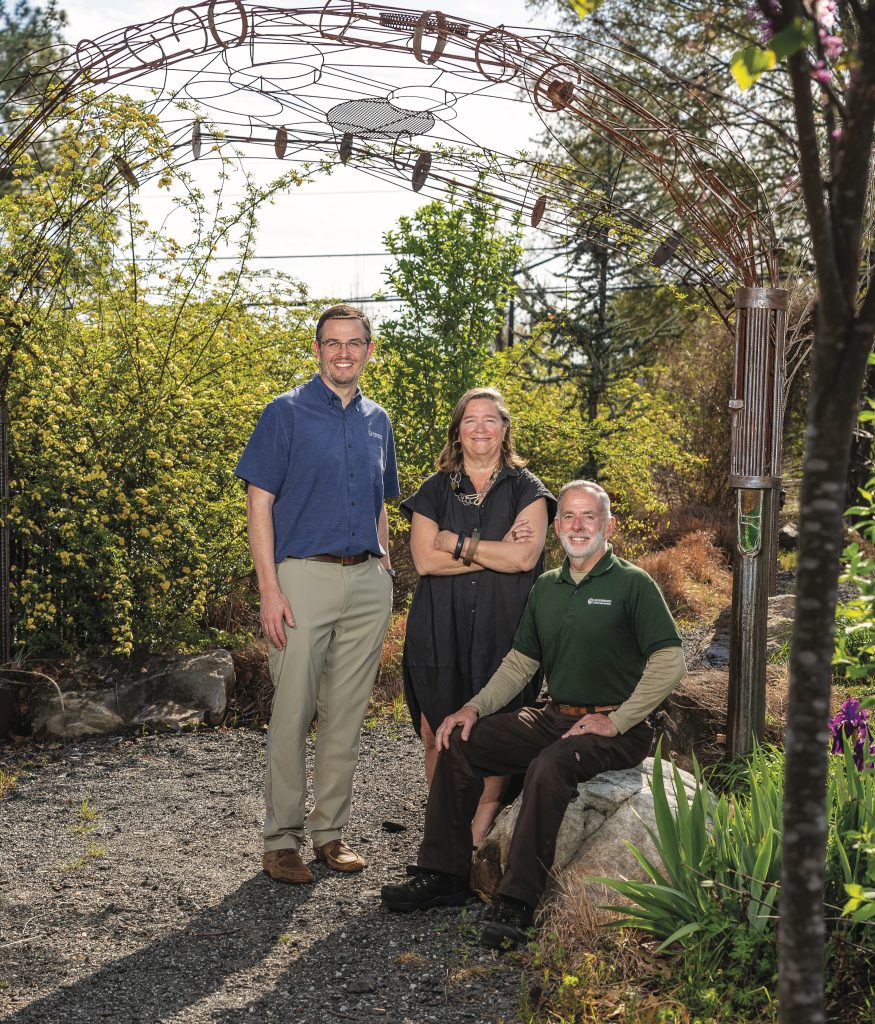
By Cassie Bustamante • Portrait Photograph by Bert Vanderveen
Greensboro’s Downtown Greenway is coming full circle this month. Literally. After a quarter century of planning, meetings, compromises, digging, planting and construction, Trip Brown is thrilled that his exercise-fanatic wife, Christine, can finally hike the completed, long-awaited, 4-mile trail that loops around Greensboro’s center city, reflecting that what goes around comes around: “One time, one of our major supporters said, ‘Look, what are you all waiting on? Just put the asphalt down and be done with it.’” But that wasn’t good enough for Brown, who spearheaded the Greenway volunteer committee, and others involved who wanted so much more.
“Well, guess what?” he continues. “The asphalt is almost like a minor part of it. Now you get the beautiful green and all the planting and everything.”
For the board chair of Brown Investment Properties, “everything” ultimately included more than 35 public art installations that explore Greensboro’s culture and history, from textiles to civil rights. Plus, a please-pick-the-fruit orchard, 187 bio retention cells and gabion baskets (more about them later), restored stream beds, and countless features that, together, are a thoughtful invitation to move your body while engaging in a thriving, sustainable ecosystem that squarely puts the “green” in both this innovative greenway and Greensboro.
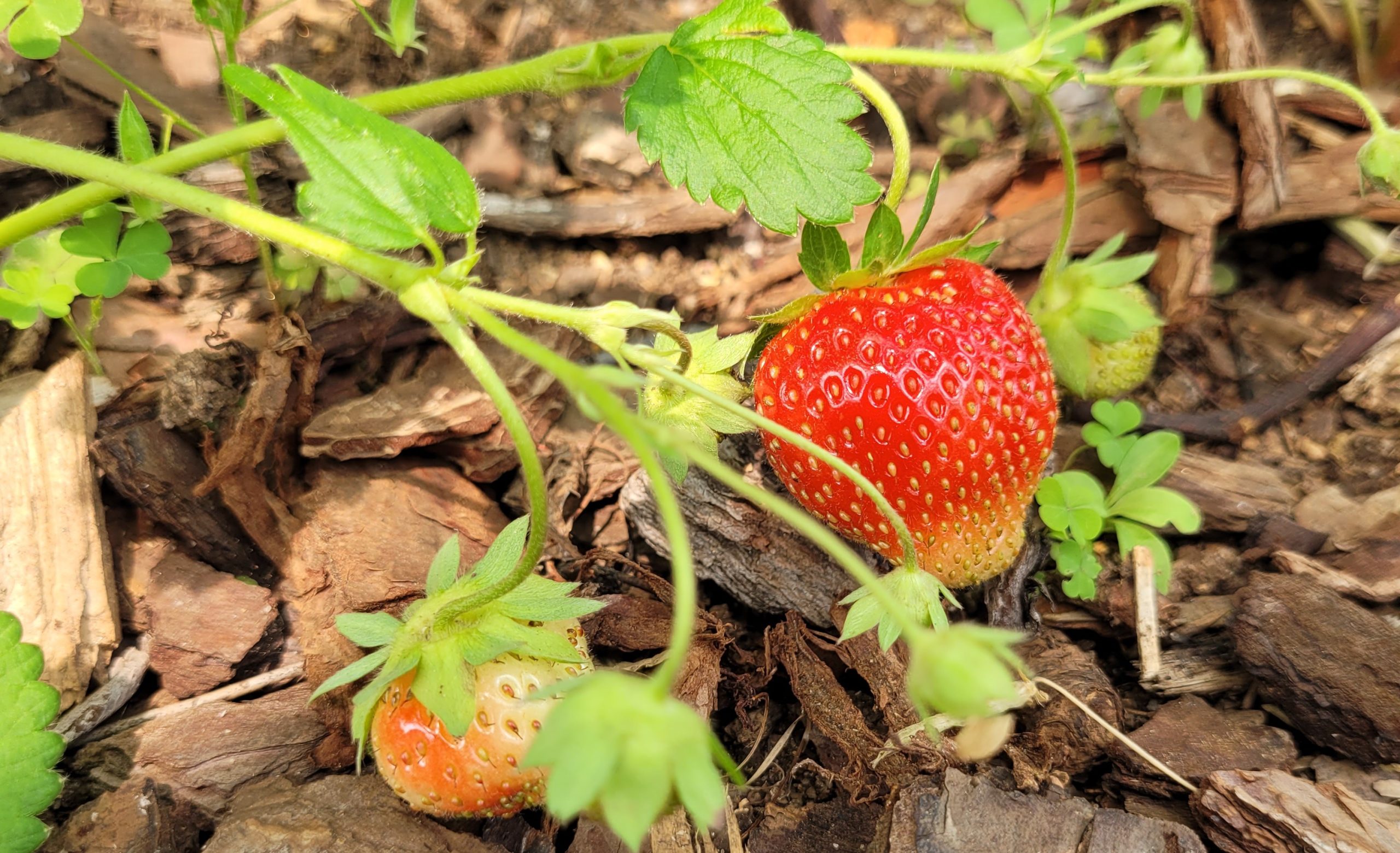
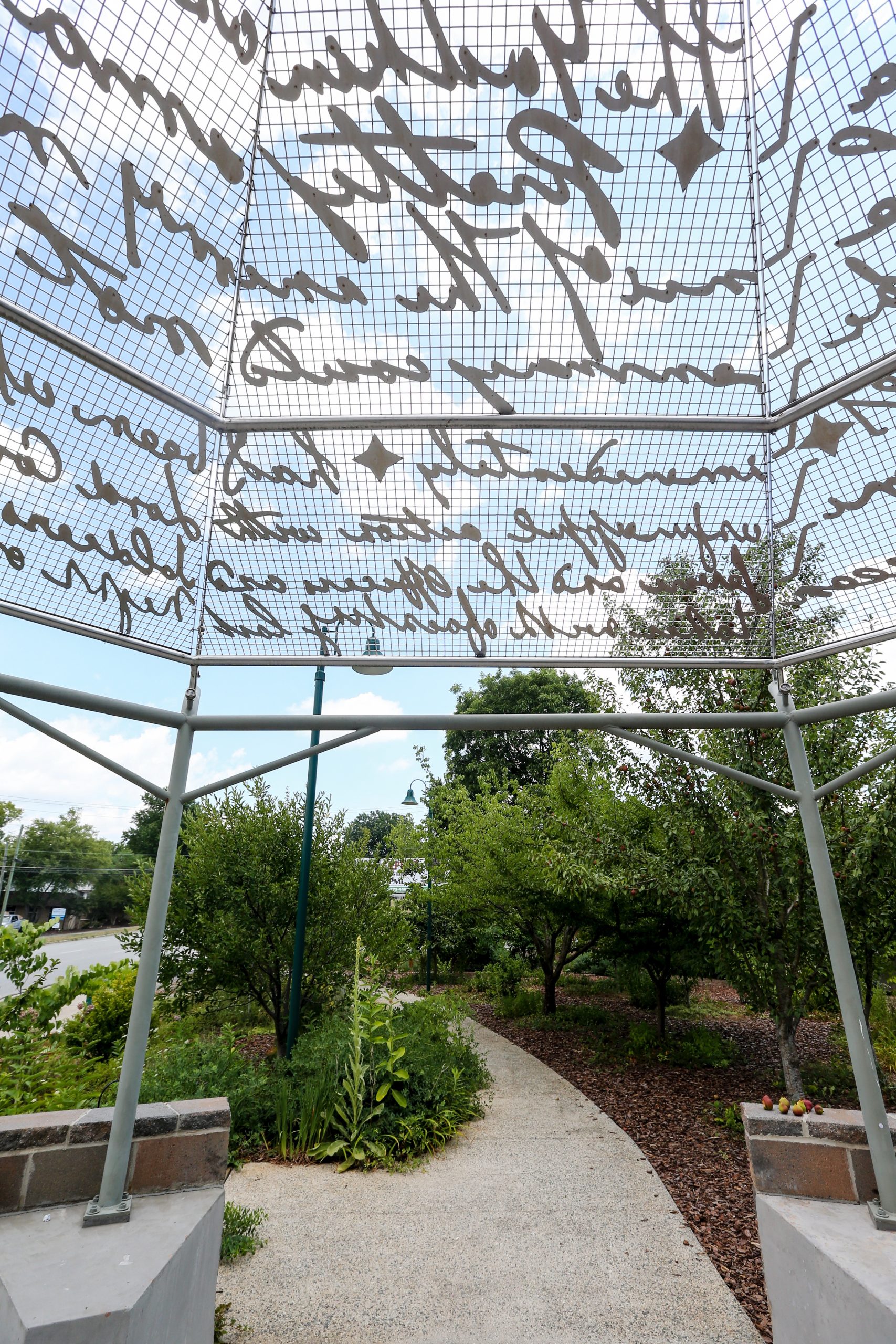
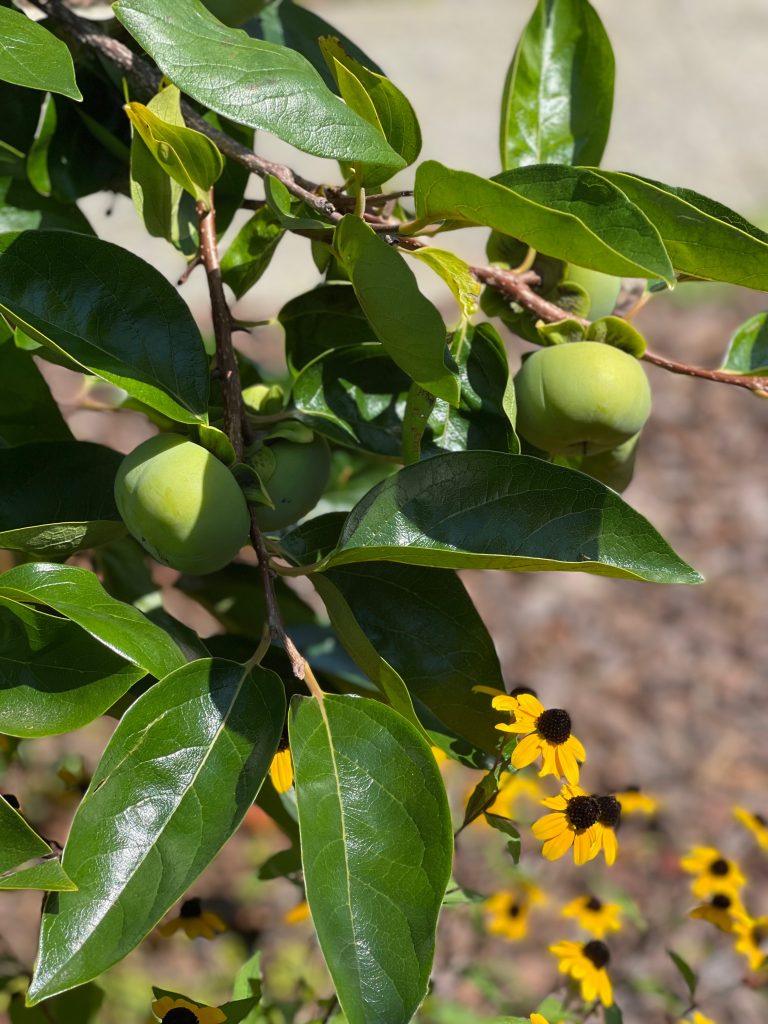
I begin my walk around on an early spring day at Greenway’s Meeting Place, one of many public art installations found along the trail. Hints of pink are emerging on early blueberry bush blooms. Nearby, fig and other fruit trees are just starting to come back to life after their winter’s nap. Soon, strawberries will be shooting up from the earth. If, later in the year, you’re out on a stroll and pass by this orchard, you’re welcome to help yourself to the plump, juicy figs beckoning from easy-to-reach branches. “You’ve got to come early though,” says Franklin Bowman, Downtown Greenway’s crew supervisor and one of my guides, “or they’ll be gone.”
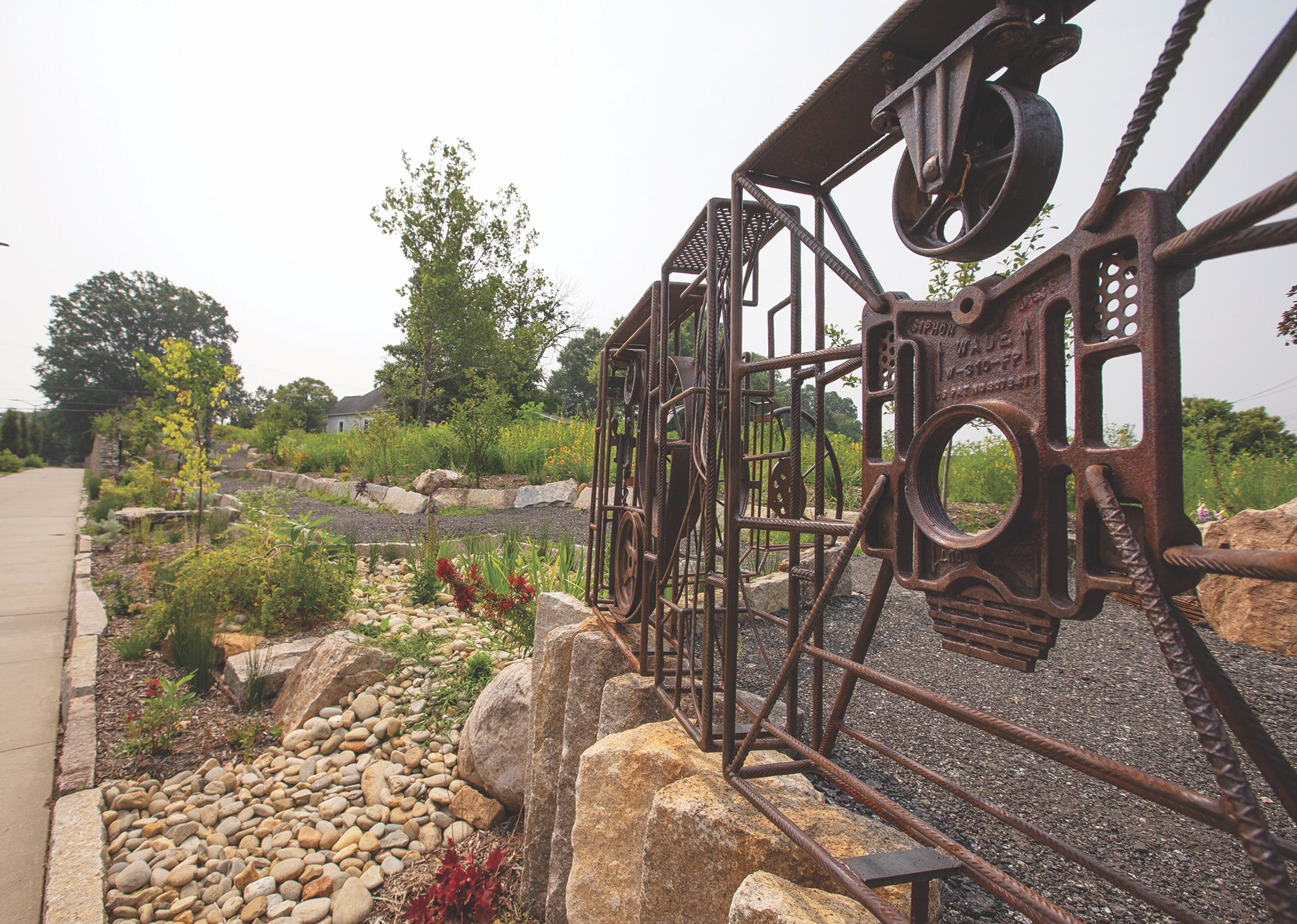
“We recommend, you know, save some for others,” chimes in Matt Hicks, the City of Greensboro’s botanical gardens superintendent, who oversees the crews that maintain the city’s four botanical gardens, four municipal cemeteries, landscaped areas of LeBauer and Center City parks, and, of course, the Downtown Greenway. The orchard is just one of many ways the Greenway aims to foster sustainability. I continue walking just a few yards away to High Grove and discover sculptural works that artist Allie Crawford created from found metal pieces, such as a pulley, plus asphalt-milling paths bordered by granite curbing taken from the city’s former guttering system.
Hicks, who graduated with a degree in horticultural science from N.C. State, points out just how rare it is for a city’s downtown to have so much lush green compared to concrete gray. “[The Greenway is] preserving those natural areas that aren’t often seen in an urban environment.”
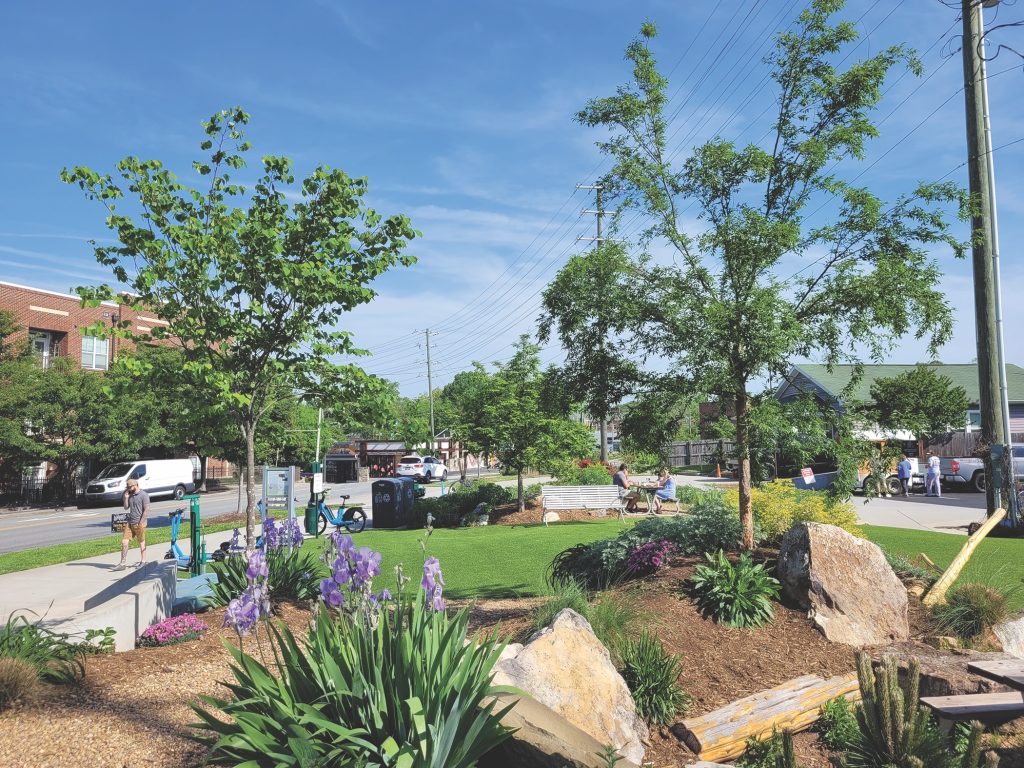
When High Grove is in full bloom come late spring and summer, its pollinators and herbs will be a feast for the senses, lush with greens, reds, pinks, purples and yellows — every color of the rainbow, says Bowman. Take a deep breath in as you jog by and you might just catch the scent of rosemary. Perhaps you’ll stop and grab a sprig for that potato salad you’re bringing to your neighbor’s cookout.
On the opposite side of the sidewalk, several “rectangular gardens” line Smith Street. What, exactly, are those?
“I’ve been waiting for four years for someone to ask me that,” quips Bowman.
He explains how these shallow, landscaping depressions, aka bioretention cells, work. Each cell is planted with trees and plants and, when storm water rushes in from the street, “Mother Nature takes control,” filtering the water back into the ground and turning contaminated and often polluted storm water into water almost clean enough to drink.
“That’s a big deal,” he adds. “And I hope you put a little thing in your magazine about that because Greensboro should be really proud of that in my opinion.”
In total, there are 187 bioretention cells filtering water for our city’s inhabitants and, according to Downtown Greenway project manager Dabney Sanders, they are “the maintenance crew’s worst nightmare — so high maintenance, but so important environmentally.” Because storm water often carries with it debris, the bio cells often need attention.
Picking up a cup here, a cigarette butt there, Bowman says, “We spend a couple hours, three hours every day, picking up litter.” His small but mighty team consists of three full-timers and two rosters. He side-eyes Hicks, quipping, “I’m hoping my supervisor will give me three more rosters. I want that on record, please.”
Hicks, without missing a beat, says, “We’re looking at actually looking for volunteers.” Between gardening and trash cleanup, there’s always plenty of work to be found.
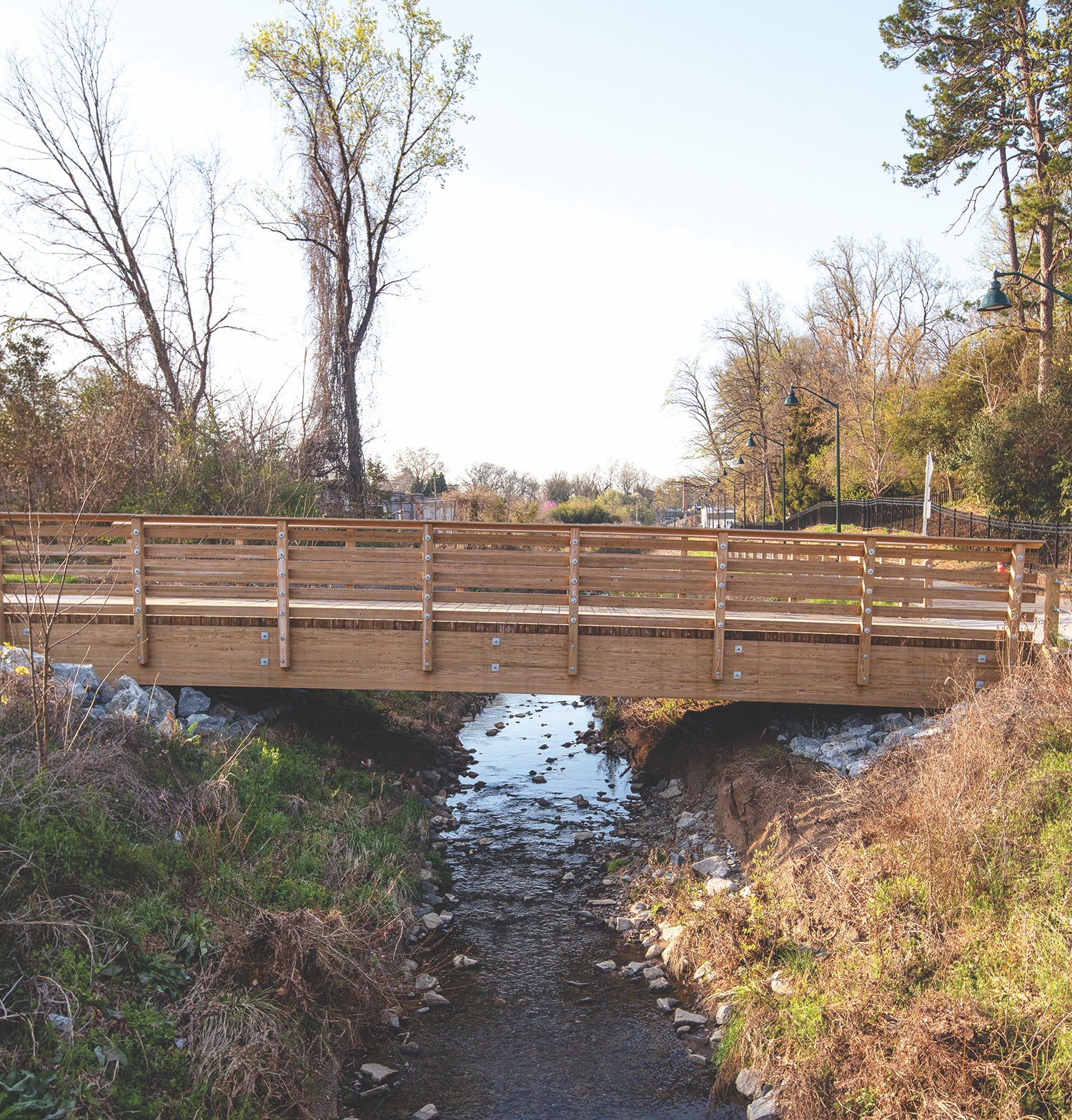
Heading south along the Western Branch towards Market Street from Smith, we pass the College Branch Stream, where volunteers often work to keep the water and its surrounding banks clean. Plus, crews have worked doggedly to restore it structurally, returning the water to its natural flow — so flora and fauna in the stream bed aren’t flushed away — and eliminating further erosion. Grasses blow in the cool spring breeze and young, freshly-planted trees will soon mature and offer shade. “There’s been a great blue heron hanging out there,” notes Sanders about her last four visits to the Western Branch. “It’s really neat to see that.”
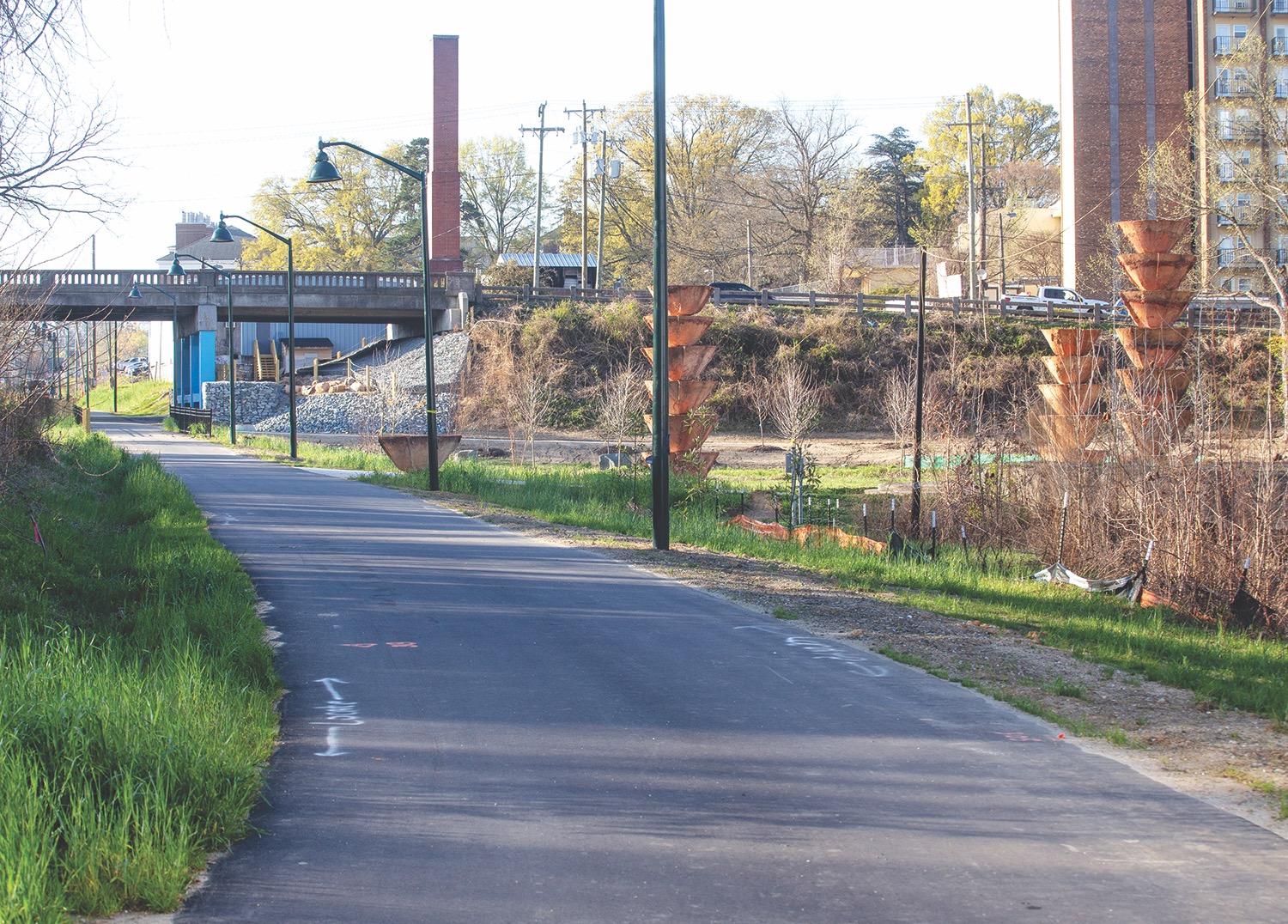
An art installation nearby, created by UNC alumni Thomas Sayre, pays homage to the stream. Cairn’s Course, as it’s called, was created by using earth cast molds dug into the land adjacent to the stream, forming “stones” that were stacked like cairns often spotted on wooded hiking trails. Terrazzo stepping stones in that area depict the types of aquatic life you might find in the College Branch Stream.
Continuing south, the Friendly Avenue underpass becomes more visible. Bowman mentions that he put the bottles up. What bottles? “Wine bottles, and messages in the bottles.”
Sure enough, embedded in the underpass wall are gabion baskets — durable, wire-mesh structures, often filled with rocks and used as retaining walls — housing numerous bottles. Hicks says it was a way for the Greenway to honor donors who gave a certain dollar amount. They “had the opportunity to put a message on a metal tag that went in a wine bottle” and now the bottles collectively front the pass-through. What is it they say? One man’s empty is another man’s art.
“You ever been to Morehead at Five Points?” Bowman asks. Just after crossing Spring Garden is the garden that is Sanders’ personal favorite, according to Bowman, and it’s a bit off the beaten path, full of trees and vegetation. “It makes you think you ought to be somewhere else. Not just a hop, skip to downtown.”
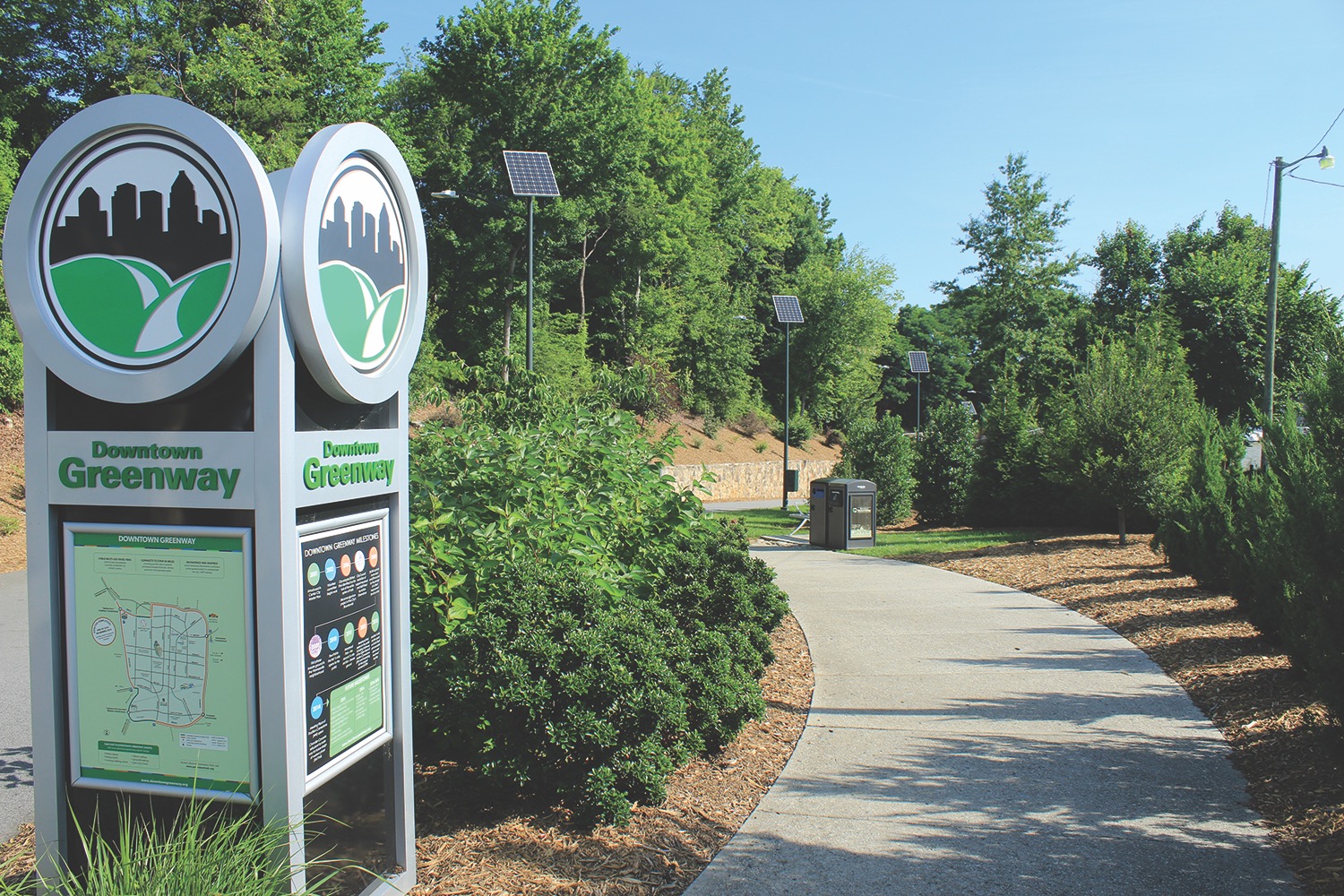
Also along the Morehead stretch, you’ll find the Greenway’s first sustainability-minded project, solar-powered lighting. You might say it was a light bulb moment, turned on by a 2011 Federal Energy Block Grant. “It was the first solar-powered lighting the city had ever done,” says Sanders. Those initial lights were replaced two years ago with new, improved technology and functionality. Now, the lights have a bit of sensitivity to them; while they’re usually pretty dim, as foot traffic approaches, their light brightens.
Not only do solar-powered lights conserve energy, but they do less harm to the animal kingdom as well. The City of Greensboro annually partners with the T. Gilbert Pearson Audubon Society’s “Lights Out for Birds” program in both spring and fall. The initiative requests that residents turn off nonessential lights that can disorient migrating birds. You get the added bonuses of energy conservation and less light pollution.
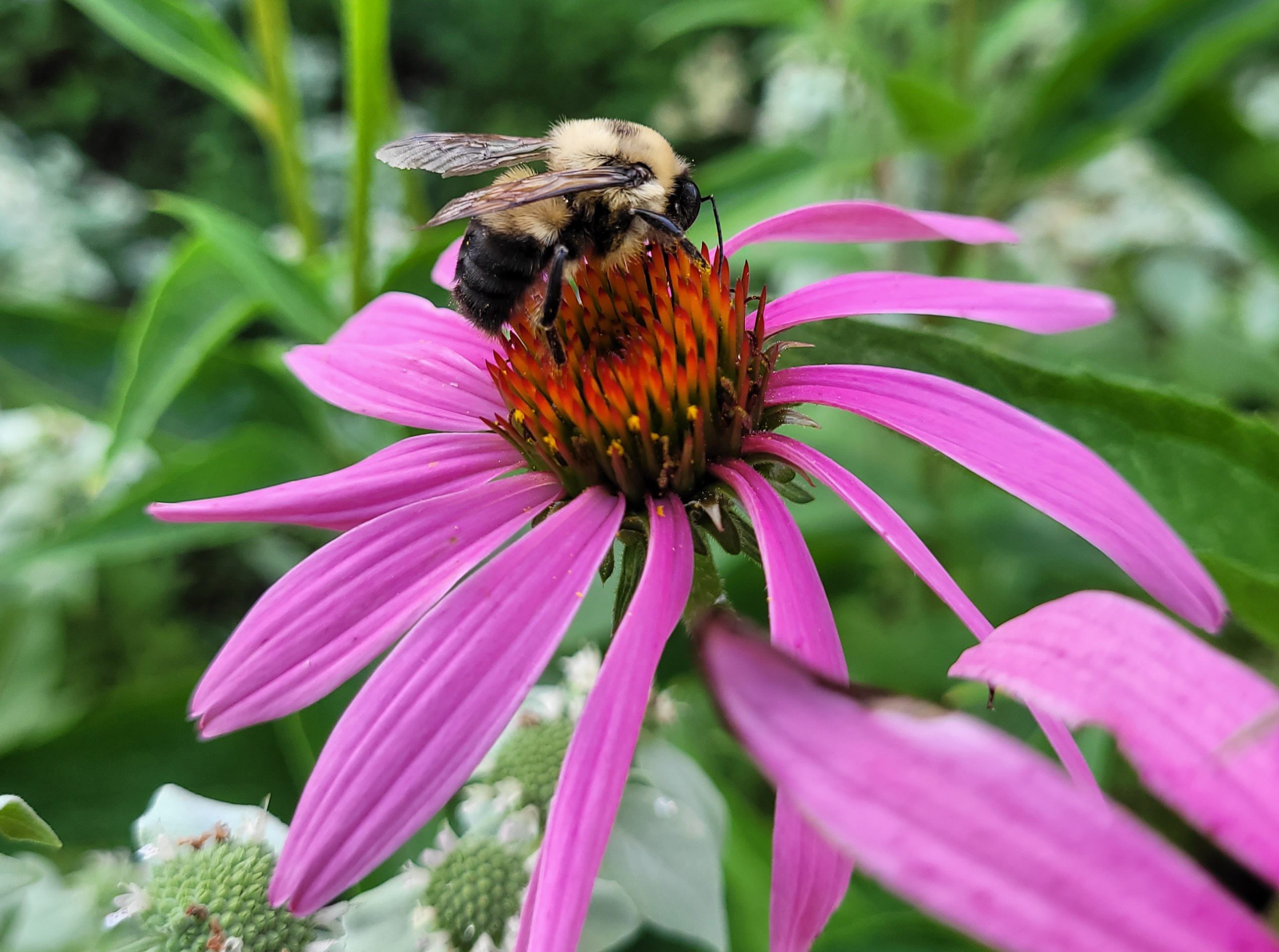
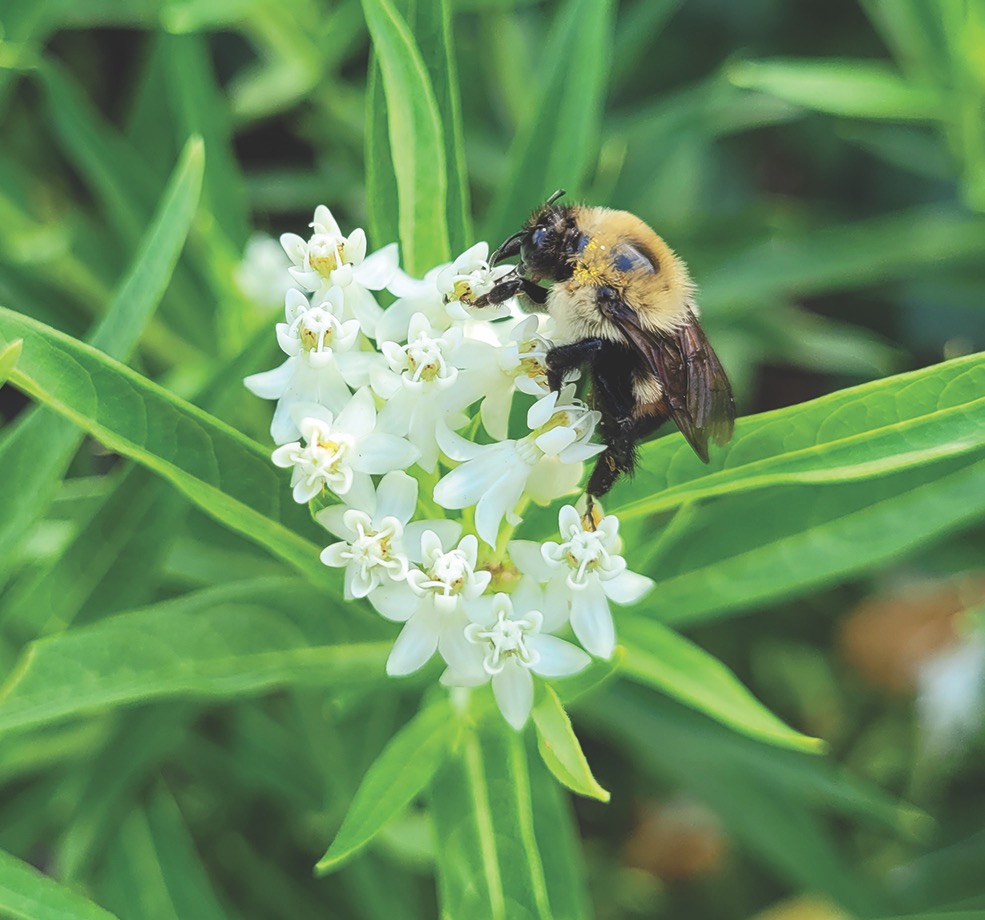
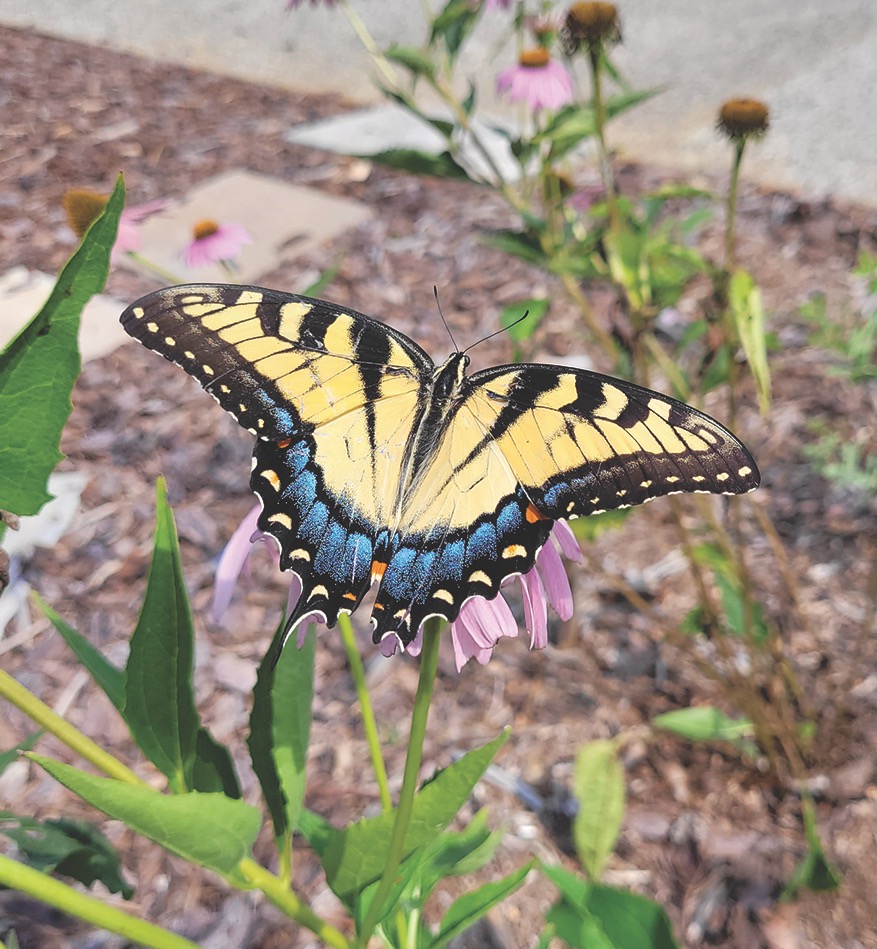
As the loop wraps around the south side of the city and turns north along Eastern Way, the Greenway’s pollinator garden comes into view. On this early spring day, it’s quiet, green shoots just emerging from hibernation. This garden, planted in Woven Works Park, uses the environmentally-friendly method of sheet mulching, where layers upon layers of leaf mulch and organic material kill unwanted weeds and grasses without damaging soil quality.
Soon, it will be buzzing with activity as bees and butterflies flutter through. “I did see monarchs last year,” notes Bowman. “And that’s a big deal if you keep up with that.” Monarch butterfly populations have been on the decline for several years but, in 2025, experienced a bit of a rebound. “I hope they come back,” he adds.
In the last of the gardens, LoFi park, permaculture gardeners David Mudd and Justin Vettel, who also designed High Grove, once again took a sustainable approach with their planting style and materials. “That’s kind of in their DNA,” says Hicks.
Of course, as it sits right in front of local brewery Joymongers, he quips, “It has become essentially Joymongers’ front yard.” With kids often running amok while nearby parents sip craft beer, the grass they’d originally planted took a beating. But never mind. Now, it’s all turf and planted beds.
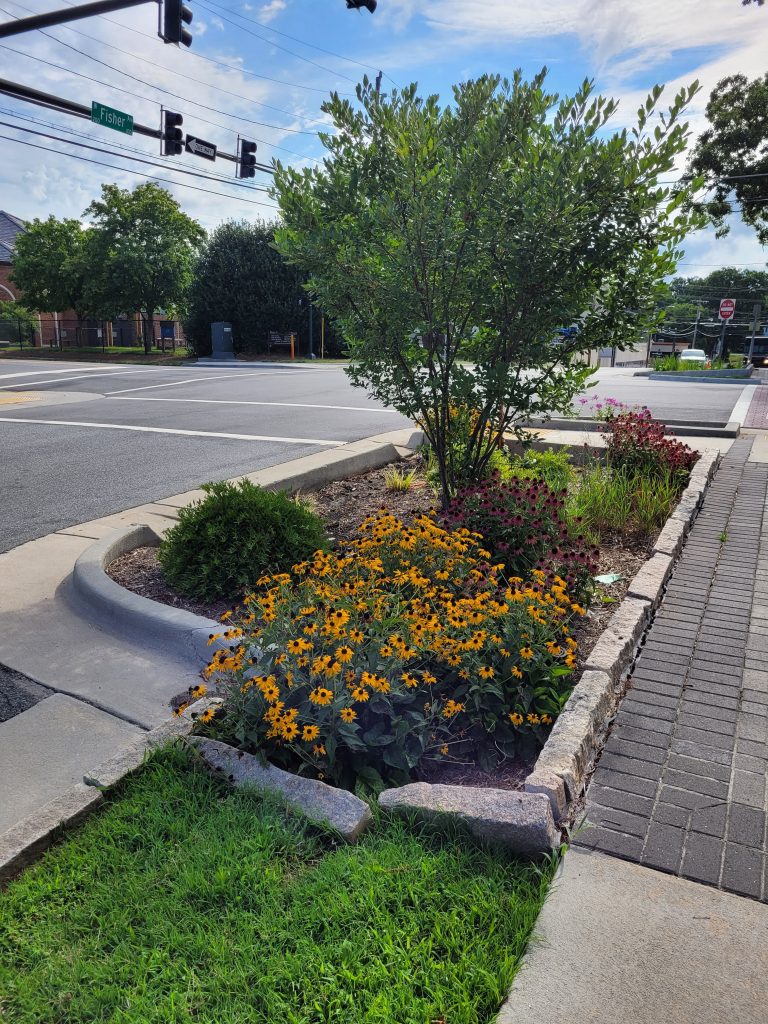
Sanders would love to see even more gardens pop up because they’ve really resonated with nearby residents and greenway walkers alike and provided the Downtown Greenway plentiful opportunities for the community to learn and work together. “It’s just a real nice way to physically get people engaged with it.”
In fact, on May 4, you can attend a pollinator gardening workshop at Woven Works, perhaps drawing monarchs to your own yard. (This is one of numerous programs the Downtown Greenway offers for free.) Through both visibility and education, Sanders says that she wants the Greenway to serve as an example of what’s possible for the environment. “You don’t really see those actual environmental benefits in the short term. It’s super long term.”
Finally, you can get a taste of what’s been thoughtfully cultivated over the last 25 years. So, go ahead, venture out and enjoy the fruits of the city’s labor. After all, berry season is near.

Paving the Way
When Action Greensboro, a nonprofit that serves as the city’s primary economic and community development group, was formed in 2001 and Susan Schwartz was named executive director, the Greenway wasn’t even yet on the organization’s radar. “We had five or six areas that we were focused on,” recalls Schwartz, who now serves as executive director of the Cemala Foundation, “and one was Center City revitalization.” (The Cemala Foundation was founded in 1986 by Martha and Ceasar Cone II, former Cone Mills president and chairman, as a means to continue supporting their community long after their own deaths.)
Action Greensboro enlisted Cooper Carry, an Atlanta-based architecture firm “with a focus on connecting people to place,” to come up with a master plan — a grand plan that included the creation of Center City Park and relocating the home base of the city’s minor league baseball team, the Greensboro Grasshoppers, from Yanceyville Street to Bellemeade.
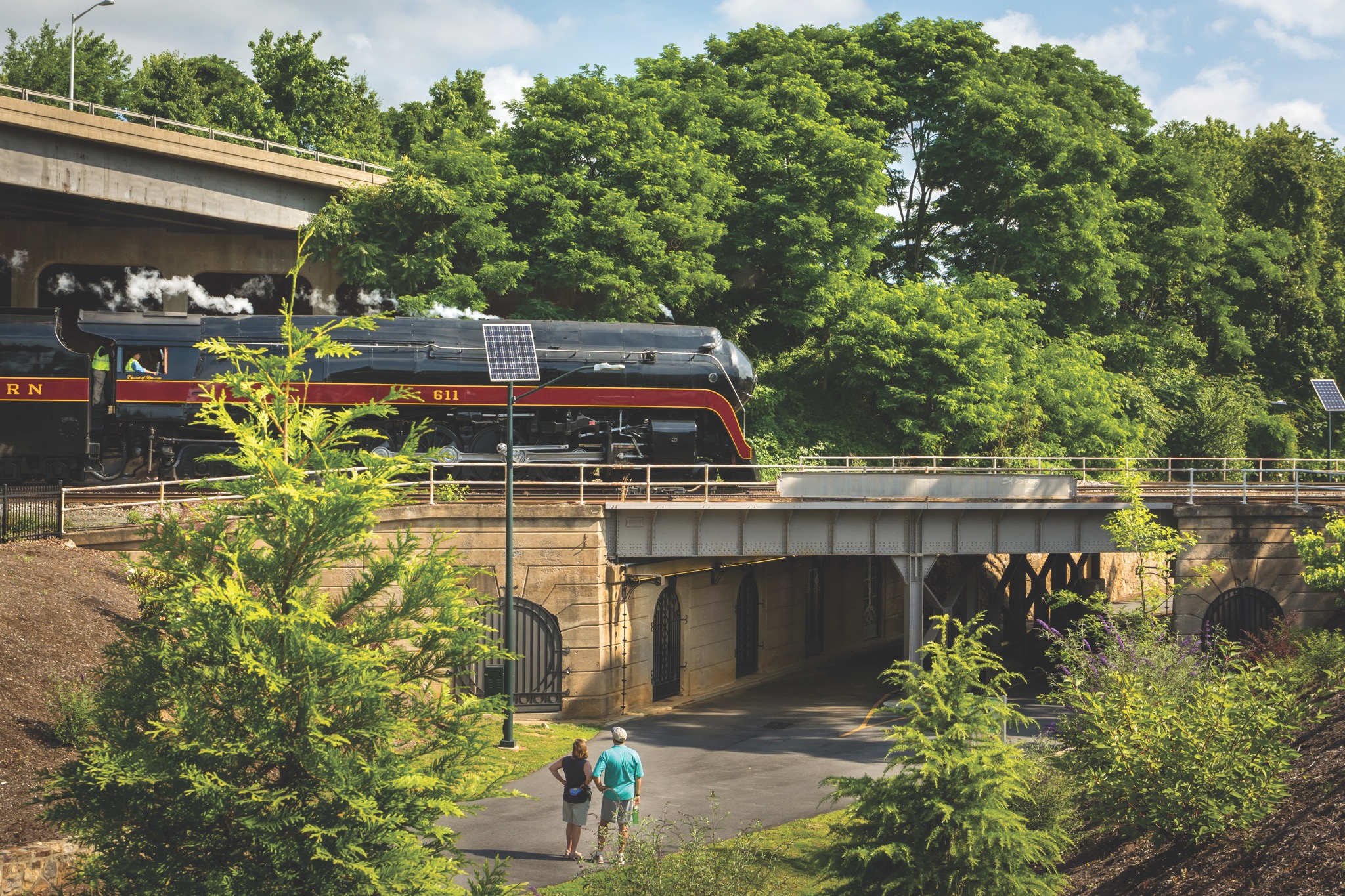
On a visit to Greensboro, former firm principal Richard Flierl toured downtown with city employees, who, Schwartz says, just happened to know about an old, overgrown, hidden underpass and bridge, where a road had once ended. They showed it to Flierl. A seed was planted in his mind and he envisioned what could grow into a connective, biped loop encircling the city’s downtown. Businesses would swarm and the path itself would connect it to hundreds of miles of trail, making Greensboro a central hub.
Flierl left Cooper Carry during the project, but, Schwartz says, “He really did give us a great foundation for how we could be telling Greensboro’s story and, at the same time, adding the public art.”
Still, it took a while for that little seed to germinate. Action Greensboro formed a volunteer committee, spearheaded by Brown Investment Properties board chair Trip Brown. In 2003, Brown, with community leaders Walker Sanders, president of the Community Foundation of Greater Greensboro, and Skip Moore, then president of the Weaver Foundation, traveled to Norfolk Southern Railroad headquarters in Roanoke. There, they initiated a railroad corridor negotiation that would end up taking 16 years.
Then, in 2004, the Cone Health Foundation pledged $500,000 to fertilize that fledgling seed. Soon, a preliminary design was revealed to the public and the city council adopted it.
Roots firmly taking shape in the ground, the Downtown Greenway brought on Dabney Sanders as its project manager in 2007. She’d previously been working as an Action Greensboro special projects consultant.
“She had this interest in plants and trees . . . and both of us like public art,” recalls Schwartz. “It’s just a little marriage made in heaven.”
In 2008, The Cemala Foundation pledged the Downtown Greenway its first significant gift: $1.5 million. Three more pledges, each at $1 million, rolled in from the Bryan Foundation, the Weaver foundation and the Cone Health Foundation.
Finally, eight years after its inception, that little seed broke ground in 2009.
Of course, all along, organizers knew a nice side effect could be eliminating some automobile emissions as people used it to walk to work. In fact, Brown recalls being interviewed for a local news station when the first phase was just about to open. He touted it to the reporter as “an alternate means of transportation for work.” Lo and behold, a man came walking the path toward the camera crew. “In a couple minutes, he was there,” recalls Brown, “so they went over and asked him what he was doing on the Greenway, and he said, ‘Well, I’m walking to work.’”
Brown lets out a chuckle. “I am still wondering if somebody set that up,” he quips. “It was too perfect.”
But, somewhere in that planning, as Sanders and her team worked with consultants on the design details, the idea of sustainability blossomed. “It quickly rose to the top as a real opportunity we had here in this very urban environment,” she says.
“We think about that a lot now,” she adds.
“It came on early enough that we could really think about it the whole way through,” says Schwartz.
There’s no doubt that the Downtown Greenway contributed to the center-city momentum that drew new businesses to downtown, especially those adjacent to the Greenway, including The Greenway at Fisher Park and The Greenway at Stadium Park luxury apartment buildings, Joymongers Brewing and restaurants such as Machete and Sage Mule. Deep Roots Market relocated to its current spot on North Eugene, adjacent to the Greenway. Plans are underway to connect the Greenway to the Atlantic & Yadkin Greenway, with an expected completion by Summer 2029.
But, in the end, the Downtown Greenway grew into something more than anyone could have imagined.
Of course, Sanders quips, “We gotta quit saying it’s the end. It’s really the beginning.” OH