
Unsung Heroes?

UNSUNG HEROES?
Unsung Heroes?
Searching for valiant ancestry at the Battle of Guilford Courthouse
By Billy Ingram • Illustration by Harry Blair
Looking back on the “Spirit of ’76,” it’s important to consider how, almost five years later, the outcome of the Revolutionary War was ultimately decided following a cataclysmic clash of opposing foes “fighting like demons” in a hail of bullets and thrusting bayonets at the Battle of Guilford Courthouse.
This year we recognize our nation’s Semiquincentennial and, while the celebration isn’t bombarding us with the patriotic fervor that accompanied the 1976 Bicentennial two-year bacchanalia of red, white and blue infecting every corner of society, we can take pride that this region played a seminal role in securing our independence from the King of England.
On a Saturday morning in March 2026, Revolutionary War buffs packed into a theater located inside Guilford Courthouse National Military Park’s visitors center. They’ve gathered for the First Annual Descendants of Battle of Guilford Courthouse Veterans Symposium, where ancestors of that conflagration take to the stage, regaling the audience with examples of their forefathers’ acts of bravery. One speaker, John Forbis, a former mayor of Greensboro, proudly traces his lineage back to Captain Arthur Forbis of the Carolina Militia, mortally wounded after refusing to relent to the enemy. A stone monument was dedicated to his heroism at the Military Park in 1887. Eric Wilson shares the valorous record of his maternal fourth great grandfather, who fought courageously here as a member of the Virginia militia
Kevin Graham, former president of the Lower Cape Fear chapter of the Sons of the American Revolution, speaks of his ancestor, Zachariah Jacobs, a free-born person of color (indigenous and African American) who also fought gallantly at Guilford and exhibited outstanding combat prowess years earlier at the Battle of Brier Creek and other consequential confrontations. Jacobs was one of an estimated 44 Black men and women who took up arms against British tyranny at Guilford Courthouse.
Yes, oftentimes, wives, with children in tow, followed along after their husbands and furnished crucial behind-the-lines support. Their fortitude under fire can’t easily be dismissed.
A little further into the park, with a massive granite obelisk dedicated in 1910 to Peter Francisco for a backdrop, a ceremony brimming with dignitaries honors the man known alternatively as “Francisco the Giant” and the Revolution’s “One Man Army.” A 6-foot-6 hulk of a man whose legend is Bunyanesque, almost Asgardian in Yank mythology. He is remembered as a fearsome warlord who swung his mighty 5-foot broadsword (gifted to him by General George Washington, natch), carving his way through walls of human flesh. A movie is in the works where Hollywood will undoubtedly portray Francisco extracting that sword from a stone.
Still, who would want to contest, as Francisco descendant Travis Bowman states succinctly to the assembled on that Saturday, that “250 years later, every American continues to benefit from his sacrifice and we owe a lasting debt of gratitude for the freedom secured through his bravery.”
Honestly, I never found the history behind our nation’s founding to be all that inspiring, nothing more than, at least for me, pointless memorization of a litany of names and dates that perpetually pushed my snooze button. However, hearing these heartfelt testimonials from proud Americans with such courageous kinfolk piqued my interest.
I’m attending these tributes with my brother Hank and his lovely wife, Hope, she being authentic DAR (Daughters of the American Revolution). Hank has become something of an amateur genealogist lately and I am totally impressed that he has actually uncovered the names of two bloodline associations of our own to the Battle of Guilford Courthouse that I am certain will burnish our family’s long tradition of military service. Fighting on both sides of the Civil War, in both World Wars, up to and including a recently retired Naval officer, many of their formal military portraits as cadets and commanders are hanging prominently around my home. I’m imagining the possibility of being invited to speak at next year’s gathering of patriots.
I spend the remainder of the day at nearby Country Park, where reenactors have pitched neatly packed rows of white linen tents and teepees made from hemp. Throughout the camp, simply-clothed reenactors spend waking hours outside toiling at various tasks then sleeping inside at night. The scent of rice bread baking in a clay oven wafts through the air, served piping hot with marmalade schmears. Campfires billow under boiling caldrons while lines are being cast for catfish. The dedication to period correctness and determination on the part of the participants for recreating life precisely as it was in 1781 is impressive, their time tunneling lasting an entire weekend, as if perfectly content to live out the rest of their lives in the modest manner of their humble ancestors. I shudder to think.
Following an Earth-and-ear shattering battlefield recreation animated by cannon blasts and powder flumes, I return to the 21st century and delve into my relatives’ activity surrounding March 15, 1781, the Battle of Guilford Courthouse. Within minutes, I realize there will be no hereditary accolades, no patriotic prawn or bragging rights; potential speaking engagements are clearly out of the question.
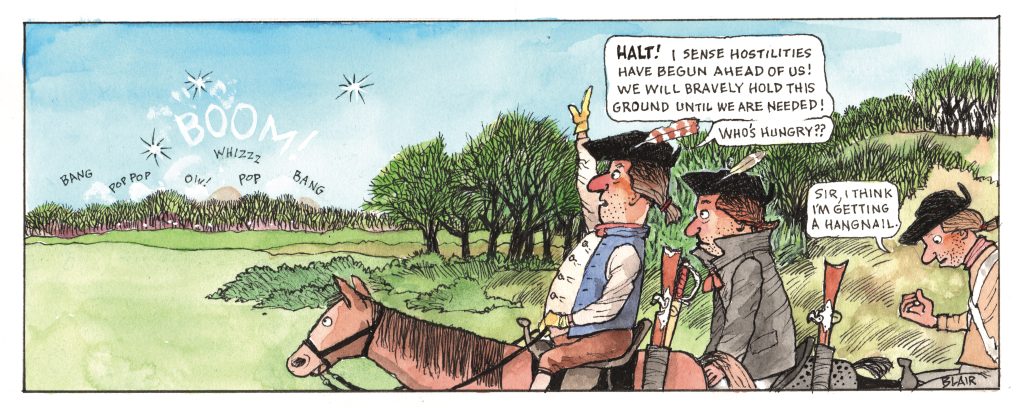
Under orders on that fateful date, Great Grandfather four times over on Dad’s side, 31-year-old Lt. Colonel William Goldston, and some 150 North Carolina militiamen were dispatched on horseback. Traveling from Chatham County toward Guilford Courthouse, they were to deliver critical firepower for Continental forces. Arriving at Holt’s Mill in Orange County, the detachment detected reverberations of cannon fire echoing from their destination some miles ahead. Who knows what went through their heads, but they didn’t run toward the cannons.
In fact, Goldston’s garrison swung into (in)action, pitching tents and camping in place for a few days. Maybe fishing for largemouth bass, bagging a buck or two, who knows, but those fairweather warriors were well away by the time Cornwallis and his ragtag regiment came marching unopposed towards Chatham. No record exists of any resistance or subsequent sabotage on old Grandad’s behalf to impede the Redcoats’ furtherance.
It gets far worse.
Days later on March 23, Cornwallis’ troops trudged into Chatham County for a few days respite at Ramsey’s Mill while the general retired to the home of Major Mial Scurlock, where my mother’s great-great-great-great granny, Sarah Scurlock, curtsied deeply, practically prostrate, one imagines, welcoming the British Lord to his new temporary headquarters. There, in my ancestors’ home, he most certainly formulated plans for annihilating rebellious rabble after resupplying in Wilmington.
Hardly paragons of American patriotism as I had anticipated, at least where Guilford Courthouse was concerned. In all fairness, Granddad Goldston did distinguish himself in a number of earlier skirmishes and successfully routed Redcoats from Raft Swamp in September of 1781, North Carolina’s last battle of the war. And Scurlock’s namesake, Mial Scurlock, an uncle many times removed (somewhat of a scourge according to recollections), fought and died at the Alamo in 1836. Alongside John Wayne, one supposes. So there’s that.
Perhaps Grandad Goldston and his civilian militia were wise in surmising, with another 20 miles ahead to Guilford Courthouse, they were too late to be of much help. Or not.
Directly after the battle ceased, the rain began and wouldn’t stop for casualties or the mortally wounded. Both forces dispersed, shivering in the cold, damp days of late winter. Granted, small details stayed behind, tasked with burying the 180 or so dead — but could do nothing for the estimated 600 wounded Colonists and British Loyalists alike left littering a war-ravaged, damp and dreary landscape. No bandages, medicines or shelter for those felled by 3/4-inch lead musket balls that grew larger passing through the human body before pancaking and spinning, creating gaping exit wounds. A smallpox outbreak vastly worsened conditions. Over the ensuing weeks, huddled haphazardly across the adjacent Hoskins Farmstead for what scant comfort could be extended by overwhelmed and ill-equipped Quakers, everyone watched helplessly as lifelong friends perished in the worst weather conditions possible, lifeless legionaries sinking inexorably into wet, red, Carolina clay.
Not long ago, I found myself waiting for the green at the intersection of New Garden and Battleground. On the southeast corner (the wooded area) rests the restored living quarters of the aforementioned Hoskins Farmstead, precisely where it stood in 1781, overtaken by Lord Cornwallis for choreographing his opening salvos in the Battle of Guilford Courthouse. The clapboard cabin sits alongside a less-traveled but spirituous spur of the Great Wagon Road, where, in 1778, Scotch-Irish Presbyterians Joseph and Hannah Hoskins settled, seeking a peaceful existence away from the horrors of war waging in the north. Just three years later, they’d find themselves in a literal crossfire of clashing cultures, left burdened with an immeasurable number of casualties and scores of corpses being consumed by deforested beasts foraging for food.
Standing on the very patch of land where blood, sweat and torrents of tears watered our tenacious tree of liberty, where war’s inevitable carnage and catastrophic consequences became mournfully necessary for the precarious establishment of our nation, I’m in awe of those fearless men and women of yesteryear who made it possible. Although my ancestors regrettably failed to contribute to this great cause on that fateful day, we salute those who fought, as well as those who sacrificed everything, so that 13 former colonies could emerge as united states.
The Lost Battle That Won the War
As our nation celebrates 250 years since John Hancock swept his John Hancock across the Declaration of Independence in 1776, what better time to remind ourselves that declaration and realization arrive on different tracks, aspiration and actualization on divergent timetables. The momentary exuberance of ’76 was followed by five years of merciless bloodletting, the Revolutionary War being a civil war pitting neighbor against neighbor, brother against brother. North Carolina, in particular, had one of the highest concentrations of Loyalists who sided with the British. Revolutionaries were a distinct minority here.
For insight into how the war affected the Piedmont region, I turned to Robert Bemis, heritage trades interpretive specialist for the State of North Carolina, an immersive historian with a wealth of local knowledge about the Revolutionary War. Year round, Bemis and his team are deployed to our state’s many historic sites to demonstrate skills — blacksmithing, woodworking, brickmaking — that 17th- through 19th-century settlers mastered for surviving. “I do it all,” he says. “The joke in the family is, Joe takes great photographs, I do everything else.” (Robert’s brother, Joe, is a well-respected wartime history photo-illustrator you may recall reading about in O.Henry.)
The Battle of Guilford Courthouse is the very definition of a pyrrhic victory (for the Brits), a winning battle that can result in losing the war. I asked Robert Bemis if the Revolutionary War was mostly a series of losses for the Colonists that ultimately led to victory? “Sort of. The war was a series of defeats. You can make almost a direct correlation between the American Revolution and the French in the Iberian Peninsula during the Napoleonic Wars.” Goldurn, I’m in the intellectual weeds already . . .
“To put it in modern parlance with a great analogy,” Bemis references Red Dawn, the 1984 Patrick Swayze movie where Russians invade a small Colorado town — now I’m in familiar territory. Wolverines! “Very similar situation, where you have an overwhelming force of much better troops, but they’re fighting on somebody’s home territory. It’s a matter of logistics and supply lines.” While the English were well-rooted with bases in major cities, Lt. General Charles Cornwallis’ army, “was 2,100 dudes out in the middle of North Carolina prior to significant roadways. These were professional soldiers, but they’re concerned with basic survival. Where am I going to procure food? What do I need to cut down as far as firewood? How am I going to make the brush into shelter?”
On the Colonists’ side, Major General Nathanael Greene’s Continental Army was growing in strength and numbers while circuitously cat-and-mousing Cornwallis across the state in 1781, finally amassing around a decade old settlement known as Guilford County. “Guilford County had a literal courthouse,” Bemis says, explaining how the battle gained its name. “It was the seat of the county, a fairly small building. Whenever there was any kind of legal issue, [folks] would go to Guilford Courthouse.” Having scouted the area during an earlier stopover, Greene reasoned the untamed, hilly thickets could prove a strategic advantage, provided he could lure Cornwallis in.
On the afternoon of March 15, 1781, the British swept towards Greene’s three-tiered defensive position, spread out over highest ground alongside New Garden Road, where his militia rained volleys of musket fire down on the Redcoats. “The 23rd Welsh Fusliers,” Bemis remarks about Cornwallis’ superior conscripts attacking an entrenched army twice its size, “these were crème de la crème-quality troops who had been battle tested before. They were excellent fighters.” The first line of militiamen disintegrated quickly, many fleeing back to their homes rather than counter such an onslaught. Redcoats let out cheers advancing, victory seemingly in their white gloved grasp.
The second line of skirmish had gunmen positioned behind the ranks to discourage desertion. They were far more effective. The tide turned decisively for the Continentals after William Washington’s cavalry launched an unanticipated assault from the right flank, fronted by the dreaded Peter Francisco, this being the site of arguably the warrior’s most fabled feat. With one leg bayoneted to a horse, Francisco brought down his fearsome broadsword on an attacker so forcefully, so swiftly, that the Brit got split lengthwise from his crown on down.
When it became apparent that the Patriots would apparently prevail, swarming ever closer to capturing Cornwallis and his officers, the British general did the unthinkable. He wheeled forward heavy artillery cannons loaded with grapeshot, ordering gunners to train their muzzles on the center of the melee where soldiers on both sides were engaged in ferocious close combat. In firing so indiscriminately, Cornwallis slaughtered his own men along with opposing forces, winning the field of battle after two-and-a-half grueling hours but suffering devastating consequences.
British forces never fully recovered from the ruinous butchering wrought upon them on that fateful afternoon at Guilford, leading to Cornwallis surrendering at Yorktown in the fall, less than seven months later. It’s why, 250 years later, the memory of Guilford Courthouse Battleground, the scene where an estimated 80 Patriots died and 185 were wounded, is now a national landmark.