Wandering Billy

Child Star

Brody Bett’s ascent to fame began
— you guessed — in Greensboro

By Billy Eye

In 2016, when Brody Bett accepted the role of the Grand Duke in the Community Theatre of Greensboro’s production of Cinderella Kids, he had no way of knowing it would set him on a path where, a couple of years later at the ripe old age of 8, he would be circling the nation singing and dancing his chili pepper heart out as the star of two big time Broadway-touring musicals. Oh, and he has a supporting role in one of the most highly anticipated motion picture thrillers of the year, at least for moviegoers here in the Gate City.

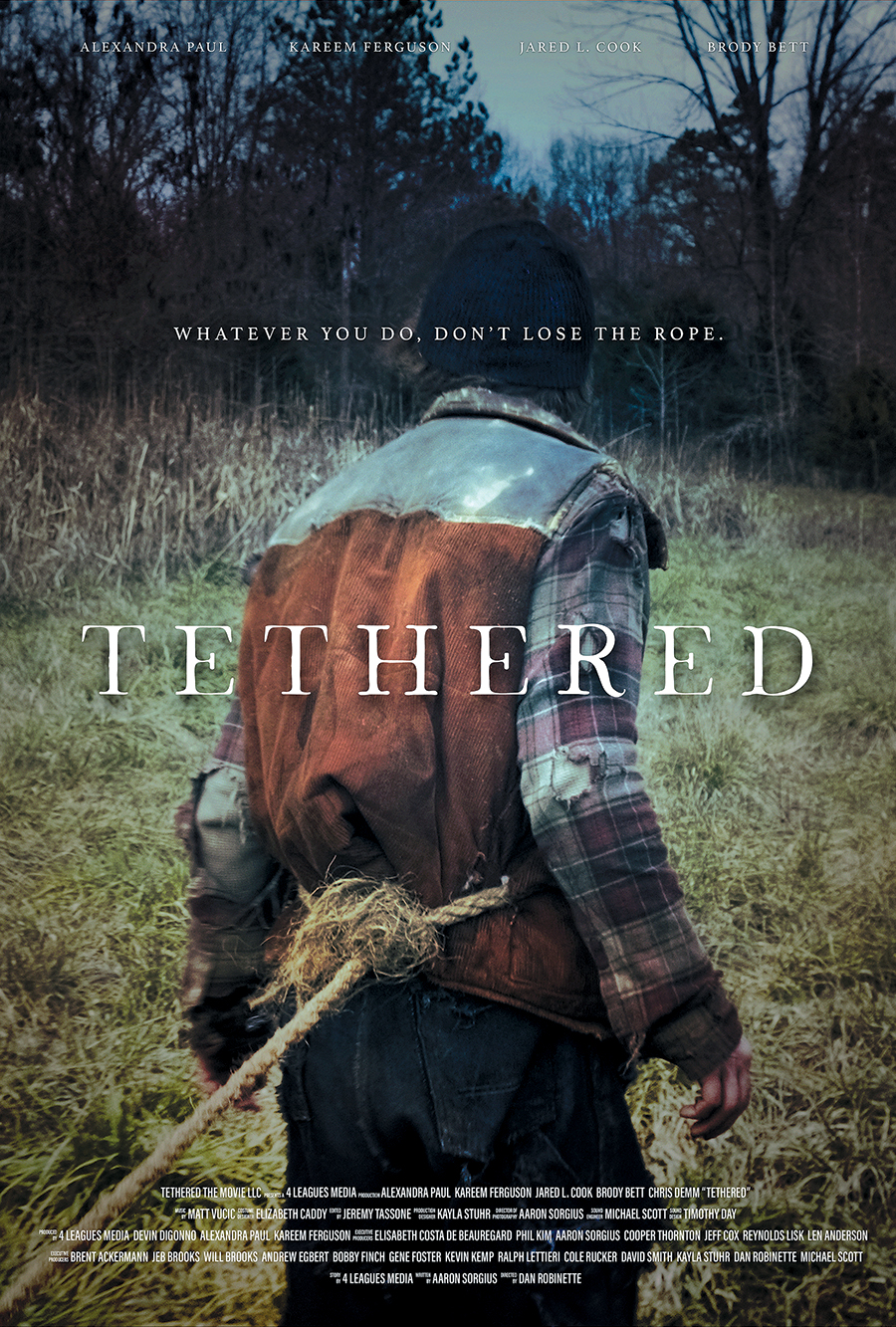
The film is Tethered, a dark, psychological thriller produced by Greensboro-based 4 Leagues Media, a consortium of local filmmakers, writers and technicians who’ve banded together to produce nine short films since 2014 and, this year, their first full-length feature.

“We always had aspirations to shoot a full-feature film,” producer/writer Jeff Cox says. Tethered is based on 4 Leagues Media’s 2017 short film of the same name. “So, by the time we began shooting Tethered, we had learned a lot about production, funding and all of that kind of thing along the way,” he says.

Directed by 4 Leagues partner Daniel Robinette, Tethered was shot at Red Wing Farm, a 400-acre hunting refuge and equestrian facility outside of Thomasville — where nary a car nor airplane could be heard. “We feel like we’ve created a little world that wasn’t like anything you’ve seen on film,” Cox says, “which is tough to do with a limited budget.” This means they can’t do the sort of computer      generated imagery or special effects available in Hollywood. “We had SAG [the Screen Actors Guild] involved so we had their regulations we had to follow, which was fine.”

The producers sought out advice from other creatives around the country who’d made feature films that ultimately found an audience. “We kept hearing we needed a name actor attached to it before distributors would even look at it,” Cox says. “One of our executive producers knew Alexandra Paul [Lt. Stephanie Holden on Baywatch] and sent her the script. She was game and signed on with us.”

Without having seen the film before press time, I can’t vouch for it, but the poster and the trailer are spot on; they got that right. It’s telling also that North American theatrical and streaming rights were immediately snatched up by Gravitas Ventures, a major distributor whose current release is the Pierce Brosnan film, The King’s Daughter. As a result of that hookup, Tethered debuted in select theaters on March 18 with video on demand via iTunes and Amazon before heading to one of the streaming platforms, according to news sources.

That’s an astonishing feat when you consider this is a low-budget indie shot in pastures and woods. But honestly, nothing terrifies me more than the idea of being isolated in the hinterlands — the trees have eyes!

In the leading role is Walkertown native Jared Laufree, who portrays Solomon, a tormented, sightless youth at the mercy of some mysterious entity lurking beyond the nearby tree line. By all accounts, Laufree’s performance is riveting. “In high school, I joined an acting class called Actors Group in Winston-Salem,” he says of his previous experience. “And I did that for four years. Since then, it’s kind of been snowballing.” Asked to describe his character, “The first word that popped in my head was lonely but then I also wanna say he’s strong too. Very strong, very brave, courageous.”

Jared Laufree also was the lead actor in the short film Tethered. “He did such a great job and got so much praise,” Cox says.  “Alexandra Paul saw the short and suggested that Jared play the lead in the feature. He did an outstanding job.”

It’s a demanding role, “because I’m so angsty myself,” Laufree says. “I liked the opportunity to get all that out.” As for continuing to pursue acting roles, “I really want to be a screenwriter. I feel like that fulfills me more right now, at least in my life, than acting.”

Playing Young Solomon in Tethered is the aforementioned Brody Bett. Thinking back to that initial role in the Community Theatre production of Cinderella as a first grader, “I loved it so much that I actually did six shows in a year,” he says. “I did five more with Community Theatre of Greensboro and one for Triad Stage.”

As an 8 year old, he commandeered one of the leading children roles (Jack/Michael) in the Broadway national tour of Finding Neverland, a high-flying musical attraction whisking him and his mom across 43 states, touching down in 102 cities in a 10-month period. Bett is what they refer to in show business as a “triple-threat” — that rare entertainer who can act, sing and dance
. . . all at once if need be. Come to think of it, considering he’s mastered five instruments — keyboard, ukulele, drums, organ and guitar — Brody’s a quadruple-threat, a potential Sammy Davis Jr., this kid.

“After Finding Neverland I got an agent out of New York, then another Broadway national tour playing the leading role ‘Charlie’ in Charlie in the Chocolate Factory,” Bell tells me. When the shutdown happened in March of 2020, he and his mom were dispatched home.

How to channel all of that energy, enough to light up an audience of thousands of theater-goers night after night? “My agent asked me if I wanted to do voice-over tryouts, so we set up this amazing recording studio in our house.” For the last couple of years, Bett’s been laying down tracks for Disney and Netflix, and he’s the singing voice of Gil in Nickelodeon’s effervescent preschooler Bubble Guppies.

It was during this period that Bett was cast as Young Solomon in Tethered, which began filming in January 2021. “My character is a sweet young boy who always tries to please his mom,” Bett says about his part, the younger version of the lead. He was paired with Alexandra Paul, who played his mother. “I can’t say enough nice things about her. It was such an honor to work with her.”

Stage and film acting are separate crafts, similarities notwithstanding. “I think I enjoyed film acting a little bit more than stage acting,” Bett says. “I got to meet so many new people and be in front of the camera, which is something I always love to do.” Having trod more boards, in short pants mind you, than actors three or four times his age, seeing himself on the big screen, “was pretty surreal, I have to say. Yeah.”

Asked to return to Charlie and the Chocolate Factory last year, Bett declined, preferring to remain home, concentrating on his burgeoning voice-over career, which is proving very lucrative for this now 12 year old. “Maybe, if I do anything with film,” Bett imagines, “I’m probably going to be a composer or the score writer.” Nothing’s stoppin’ this kid!

Producer Jeff Cox is optimistic about the future of local filmmaking. “We’re just a little niche company that’s trying, long-term, to bring back filmmaking to North Carolina,” he says. “A lot of that activity moved to the Atlanta area because the state got rid of the [financial] incentives and tax breaks. The more prevalent it is, the more incentive for the state to bring some of that back. We thought this movie turned out really well and obviously Gravitas Ventures thought so too.”  OH

Billy Eye is a former Hollywood movie poster artist. Most recently, he featured prominently in the upcoming 2022 European documentary Devil on Wheels, which chronicles Steven Spielberg’s first motion picture Duel.

Wandering Billy

Blast from the Past

When Blockbuster and Netflix fell short, Video Review had it all

By Billy Eye

The VCR is to the American film producer and the American public as the Boston Strangler is to the woman home alone. — Jack Valenti

It’s been a decade since one of my favorite places in Greensboro, Video Review on Westover Terrace, closed its doors. You can’t possibly understand my grief. That place was responsible in no small part for one of the most successful network television experiences of my life. Seriously.

I stumbled into a television “career” in 2002 when VH1 asked me to write for and appear on a brand-new series called SuperSecret TV Formulas, which would be a companion to the network’s popular I Love the ’80s docu-series. Since I had a book out at the time, I figured why not? Besides, I had a gnawing hunger to prove (mostly to myself) that I could excel at something I’d never attempted before.

SuperSecret became the highest-rated program on VH1 that fall.

Figuring that was a one-and-done situation, I was surprised to find myself involved with the same kind of gig for the Bravo network, filming in L.A. and New York just a few short months later. In 2004, the latest iteration of that Bravo series became 100 Funniest Movies, a “talking head” countdown-type of show. Basically, I’d been given a list of one hundred movies that would require my snarky commentary. I was familiar with most of them but, in dozens of cases, hadn’t watched these films in several years.

Needless to say, I had homework to do.

I was disappointed but hardly surprised to discover that Blockbuster was well stocked with the latest DVD releases — but not so much the ’60s and ’70s-era comedies I was searching for. Netflix fell short as well. But after commiserating with my pal Michael Scott (not the guy from Dunder Mifflin), my world opened up.

“Go to Video Review,” Michael replied casually.

“Where?”

I must have passed that spot a thousand times — never gave it a thought.

Wandering through the doors for the first time, my heart leapt upon seeing row after row of shelves packed with DVDs and, more importantly, a staggering inventory of films on VHS tucked alongside them. They had every single motion picture on my list.

I recently caught up with Jason Laws, son of Jim Laws, who was the owner/proprietor of Video Review. Jason and his brother, Michael, were working the counter when I was furiously renting the maximum number of videos for weeks on end.

“I mean, I was born into this,” says Jason, who started shelving movies at the store when he was 12 or 13. “I actually started working the counter at around 15 or 16. When you’re in a family business, that’s kind of normal.”

Jason’s father, accountant Jim Laws, entered the video rental biz in 1983, two years before the first Blockbuster store in Texas debuted and many more before that chain became ubiquitous. “He and my mom looked at various opportunities,” Jason says. “At one point, they considered a wine and cheese store.”

In 1983, the Laws bought into a fledgling franchise, Video Connection. They opened with an inventory of 125 titles — just about everything out there that wasn’t X-rated.

“Video stores sold more equipment then,” Jason says of a time when video cassette recorders were retailing for around $1,000 ($2,640 in 2021 currency). “It was high-dollar stuff. My father would actually go into people’s homes to set up their VCRs.”

The Video Connection chain unraveled in 1985, just as the price of VCRs dropped below $300. Before long, VCRs were cheap and readily available. Rebranding the business as Video Review, Jim Laws was determined to go it alone, despite video rentals being an alien concept to the general public. “People would come into the store and think it was an arcade,” Jason says. “They had no clue what video was. We were really in on the ground floor, but that was a good thing because it became a rapidly growing industry.”

After six years at Caldwell Square, Video Review moved south next to Outback on Westover Terrace in 1990. For the next 21 years, that place served as a cultural lighthouse for those seeking refuge from reality. Foot traffic was so brisk that the Laws opened a second location at Adams Farm.

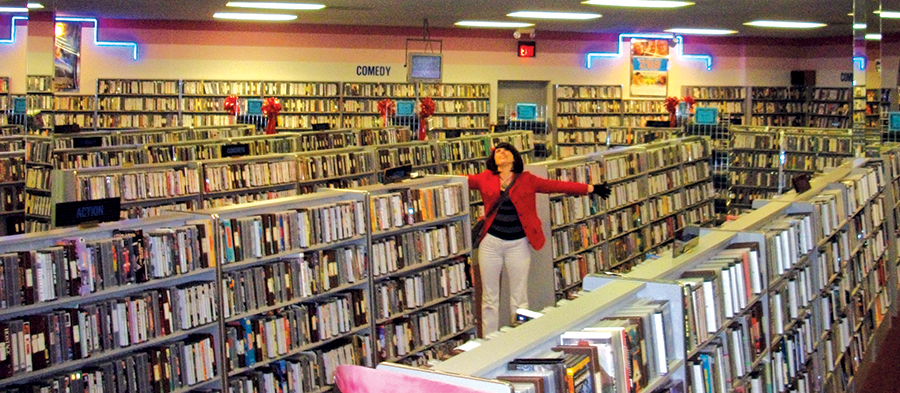
In the early-2000s, strolling the copious aisles at Video Review to select a suitable flick for date night was a genuine bonding experience. Entire families were inexorably drawn by the gravitational pull of a 7,000-square-foot showroom displaying well over 150 thousand titles. “That’s probably the main thing people miss: the tactile experience of seeing everything laid out,” Jason says. “And I think about all the people with their kids that grew up in the store. Later, some of those kids would come to work for us.”

New videos arrived every Friday but wouldn’t hit the “New Releases” wall until Tuesday. One nice clerk perk? “You could take new videos home and watch them over the weekend,” Jason says. “That way you’re ahead of everybody. We can say, ‘Hey, no, you don’t want to watch that.’”

As the 21st century unfolded, Netflix’s signature red envelopes began peeking out of just about everybody’s mailbox. If, as the song goes, video killed the radio star, then streaming snuffed out the video store. The Adams Farm branch closed in 2008. Then, after 27 years of business, the Westover Terrace megastore shuttered in 2011.

“Video Review was a library of culture and film,” says Greensboro’s chanteuse extraordinaire Jessica Mashburn (pictured left doing her best Dolly Levi impression). “A place a nerdy artist like myself could go and discuss the latest releases and exchange one-liners with the staff. I always left there feeling joyful and connected to people like me. It was a constant of my childhood here in Greensboro, and I was present for the final hour of its existence.”

What does Jason miss most about those days? Quality time with his dad, he says.

Bravo was thrilled with the ratings for 100 Funniest Movies, which must have made an impression in the Big Apple because, in 2005, VH1 summoned me back to work on 100 Greatest Kid Stars. I asked the producer, “Who’s going to be No. 1? Shirley Temple, Spanky McFarland or Stymie Beard?” None of them, she replied. “It’s Gary Coleman.”

I thought, “You’ve got to be kidding me!” and begged off the project. As much as I came to enjoy the process and the people involved, I didn’t have any desire to be on television in the first place.  OH

Billy Eye returned to his hometown (yep, Greensboro) in 1994 after 16 years of working as a writer and artist for the entertainment industry in LA. Oh, and Bravo’s No. 1 funniest movie? Animal House.

Wandering Billy

Old School

This year’s fall semester will be a far cry from what it used to be

By Billy Eye

“What we need now is some new, fresh clichés.” — Samuel Goldwyn

When I was young, August signaled the beginning of the end of summer, with school rapidly approaching, one chapter closing while another opened. That started me thinking of going-back-to-school rituals — a trip to Blumenthal’s (aka “the Store with a Heart”) for new jeans and Converse Chucks, Straughan’s bookstore downtown for notebooks and pens — and how young people today are liable to experience something drastically different from what any of us ever expected on the first day of school.

I thought it might be nice to reminisce with a couple of former schoolmates, like me Page High class of ’74 grads, about what school life was like in decades past before preapproved standardized lesson plans and teaching for mandatory testing.

Adelaide Fortune and I attended school together from first grade at Irving Park through middle school at Mendenhall, and on to graduating from Page. Today she owns a, whoops, corner-copia of classy kitsch on Spring Garden, Adelaide’s Vintage Home & Garden.

“My store tends to be more cottage-style furniture,” Adelaide tells me. “We specialize in painted pieces, mid-century and small goods that I recycle and repurpose.” While she sells one-of-a-kind furnishings for vacation homes and the like, “Mostly I sell to couples who are starting off their homes, accumulating dressers, dining room tables and chairs, they’re one of my biggest customers. A lot of our furniture is 1920s, 1930s,” Adelaide notes. “Furniture in need of an uplift that I paint. So I don’t always look for something that’s in pristine shape. I think by painting furniture, you give it a more contemporary feel.”

It’s one of the demands of her market, driven by yet more generational differences between our generation and those that came after. I remarked that the trend for young people today seems to be Rooms To Go, where customers can select an entire suite of furnishings at once. “Also, a lot of people have their passed-down parents’ furniture and they’re not really liking it,” Adelaide says. “It’s brown, boring, but when they see it painted they’re like, ‘Oh, maybe I should paint more of these pieces.’ Because it’s a whole new look.”

Her business acumen is an indication of Adelaide’s academic record. Besides being one of our brighter students, she was a member of the Homecoming Court at Page. “In high school there’s such a social structure,” she observes. “We had service clubs, you went to football games, homecoming, pep rallies, art classes, band practice . . . it’s such a shame if kids are not able to have that. At least there’s social media now so they can Skype and FaceTime one other.”

They’re also missing out on the community of teachers and administrators who keep the show running, and the group participation we enjoyed at Page, “We liked our principal, Mr. [Robert] Clendenin, very much. You could just casually walk into his office and talk with him,” Adelaide recalls. “Mrs. [Luvenia] Chavis, my chemistry teacher, I loved her. Mrs. Newman was an English teacher. She would dress up in some costume depending on what we were studying; we would stand up in class and recite The Canterbury Tales and Shakespeare. She was, by far, one of my favorite teachers. Those are the two that really stand out to me, they were so creative in the way they taught.”

Another aspect of student life for many of us was an after-school job. “My parents said, ‘If you want money to put in your car you gotta go get a job,’” Adelaide says, word for word what my father told me. “So I worked at Mayberry one summer. We had to wear those ridiculous outfits, those pink and white striped dresses, then all your friends would show up and you had to face them. I also worked at Roy Rogers where we had to wear those little cowboy hats and greet customers with, ‘Howdy partner, can I take your order?’  Even when friends from school showed up, they expected you to say that.”

Senior year she worked at Brown-Gardiner. “Everyone bought everything on credit,” Adelaide says. “They’d say, ‘Charge this on my account’ and you’d fill out a form for them.” Instant credit checks weren’t possible back then, “How many drugstores do that anymore?”

Hard to believe but as long as you were at least 16 years old, male or female, and you possessed a driver’s license, then passed written and driving tests, you were qualified to drive a school bus. All city school buses were piloted by students. Paid good money as I recall.

Page, Mendenhall and Claxton Elementary drivers were all “Road Runners,” a Junior Woodchucks version of Hells Angels, more Quisp than Crip. They wore jean jackets with the words “Puro Carajo” (Pure Fornicators in polite conversation) stitched around the shoulders in Old English font (all caps naturally, so as to be nearly unreadable), with similarly stitched “Road Runners” below, circling a crude rendition of the elusive bird harnessing a lightning bolt. Road Runners were always out in force protecting the pirate ship from Whirlies sabotage on the week before the Page-Grimsley football games, often in vain.

Another Page alumna, Trisha Costello, owns Carriage House in the Golden Gate Shopping Center. “We are a home décor and accessories store,” Trisha says. “I’ve been in furniture sales for 20 years now after I met Wally Freemon who said, ‘I’m opening a store, do you want to run it for me?’ and I said, ‘OK’ and then ended up taking over the business.”

Carriage House specializes in unique items for beach houses, mountain homes, a little bit of everything for everybody’s domicile. “We love antiques and look for quality, scouring estate sales and stores all over the country. Chinoiserie items are always a big seller, it’s a Chinese look, very popular. Also English, Italian and some American pieces.”

Looking back on school days, “I was a Catholic girl so I went to St. Pius instead of Irving Park but I attended Mendenhall and Page,” Trisha says. “At Page there was an English teacher, African-American, Tony Bryant, I had him for homeroom, he was the greatest. I loved Mrs. [Margaret] Garrett, she taught English lit. And Mrs. Newman, she taught literature and creative writing, little short lady. She might have been my biggest influence. She taught me to think for myself.”

Not at all odd that Adelaide, Trisha and I were all profoundly affected by Mrs. [Jean Davis] Newman’s tutorage. She inspired me to pursue the goal of becoming a writer. Before coming to Page in 1971, she was frequently voted Teacher of the Year at Grimsley. One wonders how many hundreds, thousands, of others she inspired over her 30-plus-year career.

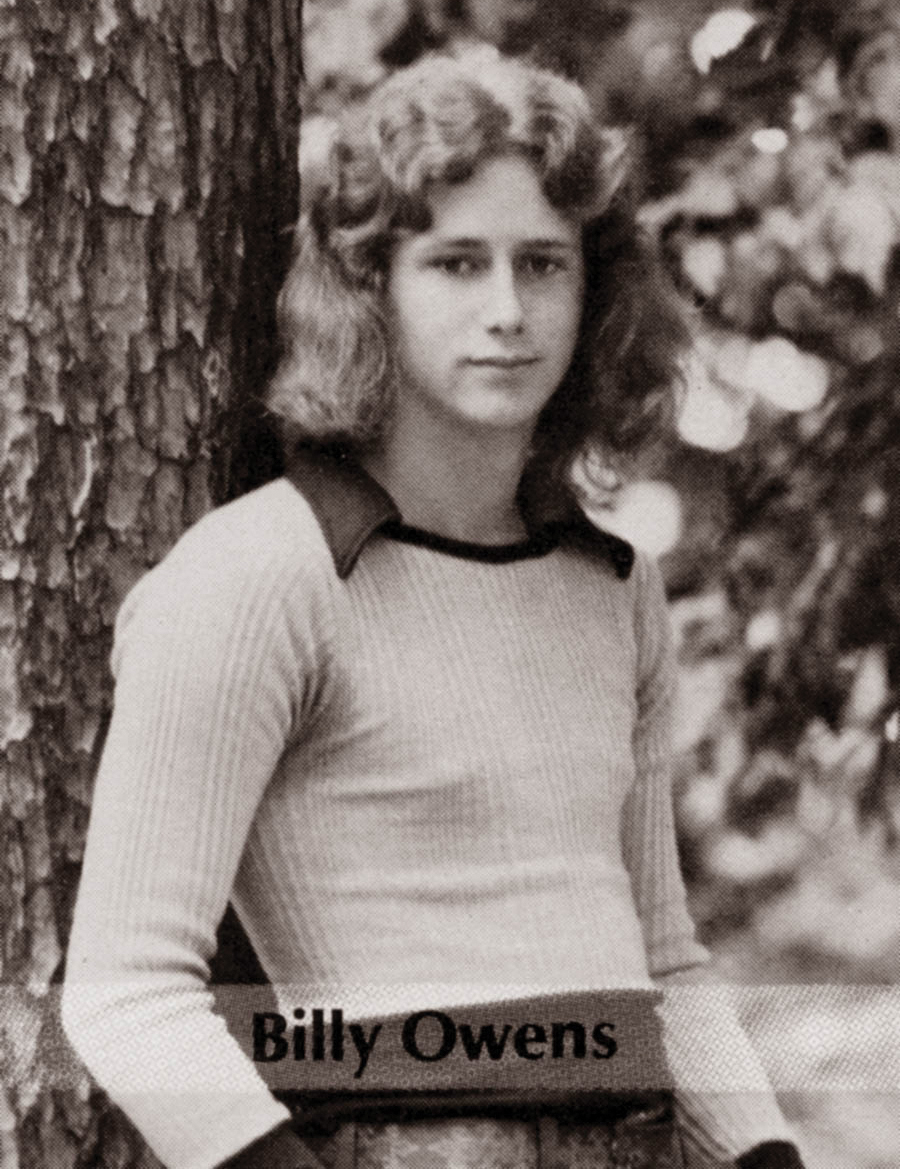
Just before our get-together, Trisha and I received the devastating news that Billy Owens, my cousin and her lifelong friend, had died of a heart attack. Just 65 years old and beginning his retirement after 45 years working at Ensco Supply, Billy received his first Social Security check days before passing.

“I met Billy when I was about 10 years old, out at Sherwood,” Trisha recalls. “He and my brother Kevin were good friends so he was at our house a lot. We always consider him to be our fifth brother.” Billy, known by the nickname ‘Brother’ in our family, “Always looked dapper,” Trisha says.

A perpetually upbeat guy with an underlying sarcastic wit, I can’t remember any occasion when Billy Owens wasn’t smiling. One friend of his noted that the only time he ever saw Billy lose his cool was in defense of the Tar Heels’ basketball team. Upon hearing the news of his death I was, for once, glad my mother wasn’t alive. It would have been too devastating.

For the rest of us, at future gatherings, reunions and over holidays, comes the painful reminder that there’s one less Brother in all of our lives.  OH

Billy Eye wonders if you would allow a random 16-year-old to drive your first grader to school.

Wandering Billy

Mex ’n’ Match

No less than four new restaurants expand Downtown’s dining scene

By Billy Eye

“How can a nation be called great if its bread tastes like Kleenex?” ― Julia Child

This month Eye offer up a Bento Box of brand-new places to dine and shop downtown that you may not have discovered yet.

Los Chico’s

Despite an oddly placed apostrophe, Los Chico’s brings great-tasting Mexican fare back to downtown for those who still yearn for the days of Tijuana Fats. Located in the old Meyer’s building at South Elm and February One, Tex-Mex lunch fajitas at Los Chico’s are a pleasing combination of carne asada strips and multicolored peppers wrapped in freshly made tortillas. I especially enjoyed the rich flavor of their frijoles. Street tacos, sopes, gorditas and tortas (Mexican sandwiches) are authentically prepared and taste muy deliciosos, as is does the menudo and caldo de res (traditional beef soup with potatoes, corn on the cob, squash and cabbage) available on weekends only.

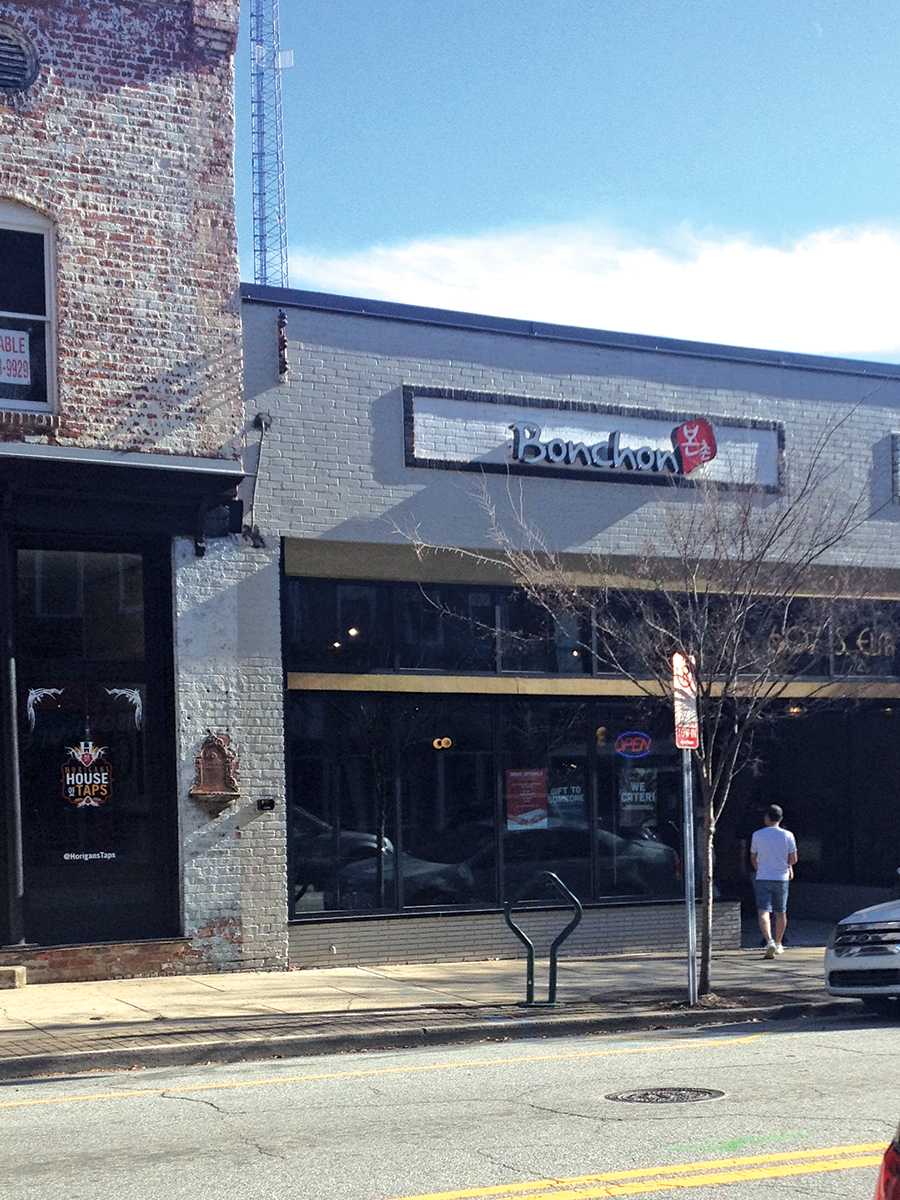
Come to think of it, the last time I ate at Los Chico’s I didn’t eat there at all. No harm, no foul — the waiter took my order, that was handled efficiently enough, only my food never arrived so I tossed a few bucks on the table for the salsa and water then wandered farther down South Elm to dine at one of my fave new places, Bonchon. But I’ll be back!

***

Bonchon

A few doors north of Mellow Mushroom, Bonchon is an international Asian Fusion chain best known for their Korean fried chicken. To tell the truth, there are so many other delicious dishes on the menu, I haven’t sampled Bonchon’s signature dish yet. I savored their sesame-ginger salad topped with a crispy cooked serving of salmon. Another time I gorged on delicious bulgogi (thinly sliced marinated ribeye sautéed with mushrooms, scallions, and onions served with rice). Their Bibimbap was rated No. 40 in the 50 most delicious foods according to a CNN Travel reader’s poll. Bonchon’s menu is extensive; finally, a place downtown that serves a proper Udon noodle soup capped with sesame oil, nori and toasted sesame seeds. I particularly like the seafood version with shrimp, calamari and scallops that’ll warm you up from the inside out.


***

Smohk’d

Located where Ganache once was, more recently LaRue Elm, I’m captivated with this restaurant even though I’m not a fan of smoked meats generally. The flavor profile can at times be overwhelmingly artificial but not at Smohk’d. Their brisket, St. Louis ribs, pastrami, pork shoulder and chicken wings are seasoned with a pleasing combination of garlic and herbs then smoked for about four hours for a well balanced taste. There’s even an “impossible” meatloaf for our meatless friends.

Order à la carte or assemble a plate consisting of your choice of protein, sauces, two sides and bread for around $12. I heartily recommend the Texas brisket with a side of homemade horseradish sauce, baked beans, collards, and sweet-and-spicy cornbread. Booths are wide, easily accommodating six to eight diners each with long, hardwood community tables for larger parties, as well as a private dining area upstairs for more intimate affairs.

One recent Sunday, our party lucked out when the chef was experimenting with prime rib, which may be added to the menu by the time you read this. If so, ask for the prime rib sandwich consisting of four large chunks of perfectly roasted beef wrapped in a hoagie roll with mayo, lettuce and tomato. Heavenly!

***

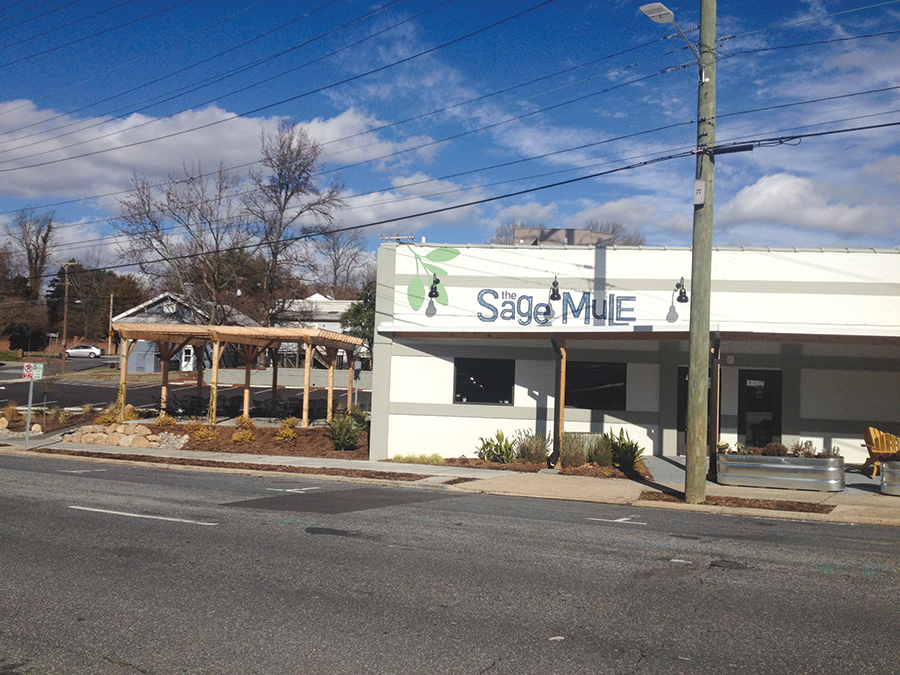
The Sage Mule

Restaurants can typically take months to build a following, if they’re lucky enough to survive at all. Not so with The Sage Mule, only open a few weeks, this comfy bakery and bistro has been buzzing with excited, hungry patrons from the very start.

Forming a triumvirate on Battleground, along with Preyer Brewery and Machete (where Crafted — The Art of Street Food used to be), The Sage Mule is open for breakfast and lunch beginning at 6 a.m. — although I doubt many of you are up that early to milk the chickens or whatever one does at such an ungodly hour.

It’s a casual atmosphere, you order at the counter then find a seat inside or on the large outdoor patio. How could you possibly go wrong starting the day with a simple Blue Plate Special, perhaps a breakfast cassoulet (white bean and stout ragout, Carolina chopped pork, fried eggs on focaccia), or avocado toast with poached egg? For lunch a friend and I truly enjoyed the Salmon Niçoise Sammie and old-fashioned flat top burger. Fresh breads and baked goods are also on the menu.

***

In addition to these new eateries, downtown is now home to four barber shops (at Rock’s Hair Shop you can enjoy a cold brew as you get a close shave) while work is nearing completion on a six-lane bowling alley/bar on the corner of East Lewis and South Elm, where that Hoarders-like junk shop had been doing business since at least the 1980s.

There’s also an ethically sourced clothing store, Mindful Supply Co., on the only strip of storefronts that survived the devastating 1980s fires that decimated South Davie Street (I can almost hear Old Photo Specialist Bill Heroy saying, “Why is Billy Eye so obsessed with those fires?!?”).

A UNC-TV documentary described Mindful’s supply chain as, “Dirt to shirt.” Co-owner David Grubbs tells me, “We offer completely sustainable goods, 100 percent North Carolina Cotton. The message is sustainability, traceability, knowing where your products come from.” Not only is the cotton grown in state, it’s ginned, dyed, and printed locally as well. David Grubbs and partner Derek Glass even design their retro-activewear on the premises at 335 South Davie, including T-shirts that celebrate The Boro. You have to check this place out. There’s something for the entire family.

***

Local party band Grand Ole Uproar will be performing at The Crown above the Carolina Theater on February 9th, opening for Nashville’s The Southern Gothic, who were named “Artist on the Verge” in Billboard’s Best Bets after debuting at No. 1 on its Heat Seekers List.

Grand Ole Uproar describes their style as a musical gumbo conjuring up, “the Texas twang of Waylon Jennings and Doug Sahm, the electric carnival of Dylan, the improvisational impulses of the Grateful Dead, and the laid-back swampy sound of JJ Cale.” This promises to be a terrific night of original music.  OH

Billy Eye is a major contributor to a 600-plus page oral history just published by Mikey Bean entitled Phantoms: The Rise of Deathrock from the LA Punk Scene that details the emergence of the Goth scene in America. Go figure. . .

Wandering Billy

The Boys Of Summer

Meet the chairmen of the boards of Greensboro’s skate parks and beyond

By Billy Eye

Photograph by Bry Seyez

“A smile is the shortest distance between people.”
— Victor Borge

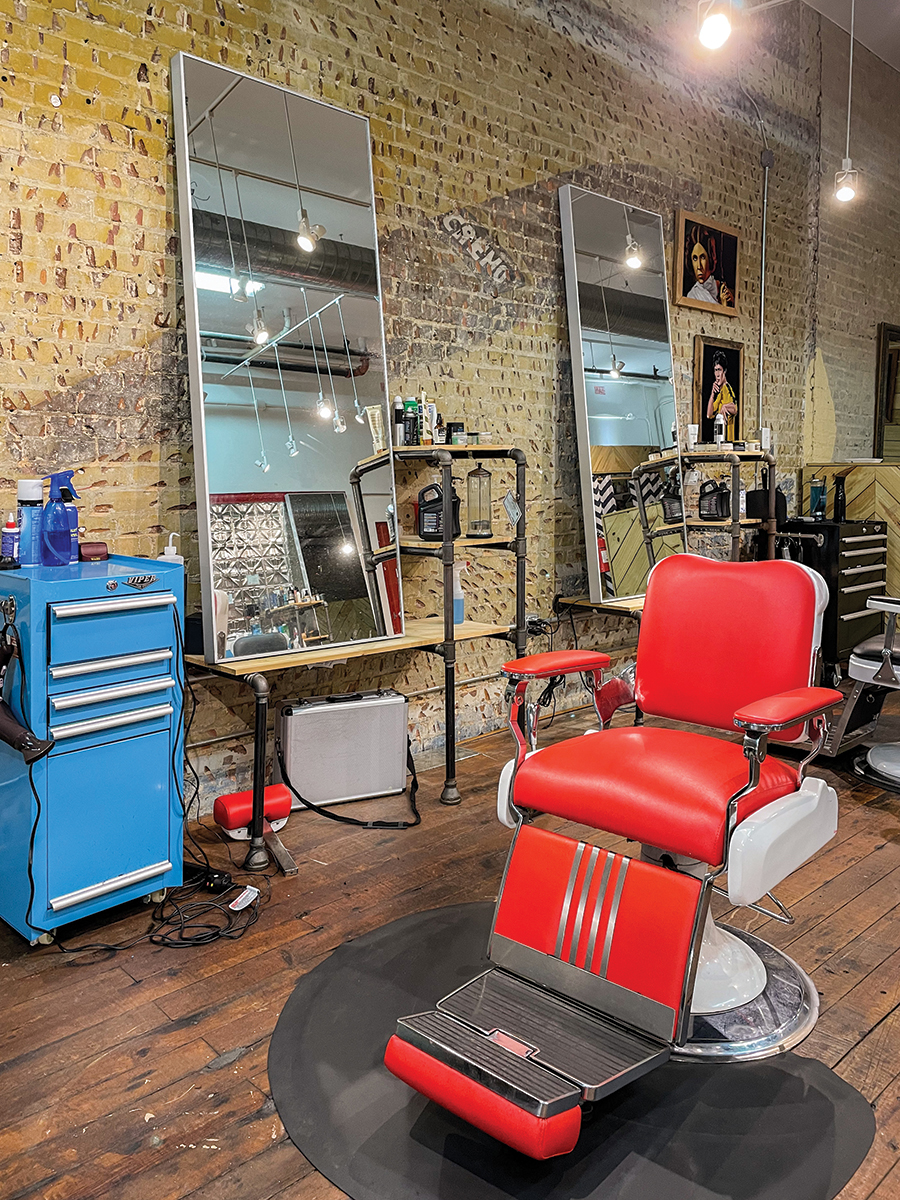
Every time I run into Chris Roberts — and it’s quite frequently — besides an engaging grin, he almost always sports a different hairstyle. Not too long ago, his head was shaved. Today he’s coiffed in a green bowl cut pointing skyward. That’s not all that unusual when you consider he’s studying to be a barber.

Chris is a 25-year old Greensboro native, working full-time while attending school in Winston-Salem. He’s an impressive young man possessing unmistakable leadership skills with a passion for sidewalk surfing. Good thing, a skateboard is his main means of conveyance. Many times I’ve witnessed him whizzing by, neatly dressed, passing cars while perched on his board, left foot forward, riding to work. He’s one of perhaps hundreds of similarly inclined city dwellers gravitating from place to place primarily via wheels of urethane.

I wondered when Chris received his first skateboard. “It was a hand-me-down from my dad,” he replies. “I was probably about 3 or 4. At that point I would just scoot around on it on my knee. I couldn’t really stand up on it.”

He received his first “sick board” at 10 or 11. (The slang word “sick,” in the same way that “bad” really means “good,” indicates the board is anything but feeble.) “A World Industries [model], I got it at Board Paradise,” he recalls. “My dad took me there, it was one of the only times I’d ever been to a skate shop.” What impressed him was the art on the World Industries’ boards: “As I’m older, I realize that there are different shapes and sizes and different reasons for riding different boards. But for me, World Industries had the coolest art on the bottom, with this cartoon-style water droplet and fire droplet battling each other.”

Chris felt an affinity for the lifestyle right away. “About that same time I went to my first skatepark, 915. It was run by Cricket Hooks at the time. I met life-long friends there.” Established in 1999 on West Lee Street, 915 Skate Park and Skate Shop’s retail store were located in a former Guilford Dairy Bar. (They even preserved Guilford Dairy’s signage along the top of the building.)

“It doesn’t matter who you are, what you look like, where you come from,” Chris says. “If you see someone with a skateboard, you just automatically have this connection.” For the longest time, he says, skateboarding was looked on as something juvenile or criminal even. Not at 915. “So kids have a sense of community because we know we have each other to look out for. A lot of people walking down the street, they don’t see it, it’s kind of secret and kind of cool.”

Skateboard culture has evolved dramatically since the board’s invention in the late 1940s, originally marketed to bored California surfers when flat conditions forced them to seek thrills elsewhere, onto sidewalks lining the beaches, even if it meant wiping out on considerably harder surfaces.   

Eye received a primitive skateboard as a youngster in the 1960s, a lacquered wood plank on clay wheels that would catch in a crack in the sidewalk, lock up, then send the rider flying. It served the neighborhood well; however, getting nailed to the bottom of orange crates and refrigerator boxes, or whatever we wanted to transform into some makeshift, Little Rascals–type vehicle. That was when we were living two blocks north of what would become Greensboro’s new skate park on Hill Street.

“That skate park has brought a lot of outside revenue to Greensboro,” Chris says. “So many people are traveling here because it’s such a great layout.” Centrally located, “That gives an opportunity for young kids who only have a skateboard, not even a nice one necessarily, they can come to this place and focus on something that’s positive with positive people around them.”

Chris’ thoughts are echoed by his friend John Pearce. Originally from Fuquay-Varina, John is a 21-year-old vocal performance major at UNCG who grew up skating around downtown Raleigh and the skate park in Apex.

“I was about 8 years old,” John tells me about his first rig. “It was brand-new, my dad got it for me for Christmas. He was big into skating when he was younger. He got me a whole complete deck, it was awesome. Spitfire [wheels] with Royal [trucks] and a Birdhouse board.” John turns his board around to show us the underside. “It’s kinda funny, I still have the same trucks from when I was 8 years old.” (Trucks are the front and rear axle assemblies.)

With the rigors of full-time studies and part-time employment, skating is more than mere recreation. “Music used to be my outlet in high school,” John says. “Music and skating. Now that I’m in school, music kinda stresses me out so I skate to get rid of the stress. I never get sick of skating, you can always go to the skate park and learn new stuff.”

For 21-year-old Josh Acosta, who hails from Palm Springs, California, but relocated five years ago to Greensboro after his parents retired here, “Skateboarding is so much bigger in Southern California so I’ve been skating since I don’t even remember, on one of my older brothers’ boards probably.”

Skaters often talk about entering a state of bliss, not unlike an actor immersing himself in a role. That’s true for Josh, “It’s the sense of freedom of being on your board,” he explains. “It’s such an overwhelmingly calming thing. It’s weird to say ‘overwhelmingly calm,’ being overwhelmed is one thing but being overwhelmed by calmness is bliss, very relaxing.”

Not that this sport is without hazards, automotive collisions for one are being somewhat inevitable. “It hurts,” Josh replies nonchalantly. “You just get up and walk away, not much you can do.”

Chris Roberts has experienced more than a few scrapes and bruises over the years. “From top to bottom,” is how he characterizes his past injuries. “Both collar bones, both wrists, my left elbow four or five times, my right patella, my right ankle, and few toes here and there. I think that’s it.”

Regardless, or perhaps due to those occasional mishaps, skateboarding provides an excellent vehicle for teaching youngsters critical life skills. “It’s hard,” Chris notes. “You keep trying over and over again. It teaches you perseverance and also courage because it’s scary. It’s healthy, you’re outside, you’re not staring at a screen.” That’s why he’ll continue skating: “Until I can’t stand up on it anymore.”

***

As I was preparing to submit this article, I received devastating news that Taylor Bays had passed away. He was 34. Taylor was a towering presence in our underground music scene, a gifted collaborator, solo performer and lead singer for a number of bands including his own, Taylor Bays and The Laser Rays. He was consistently present in the audience whenever and wherever other local bands were gigging or when cult faves like Green Jellÿ came to town.

Could anyone ever get over losing a friend like Taylor Bays? Not grief whoring, just a simple statement of fact. One of the smartest, wittiest, most talented individuals I’ve ever met, whose death blows a gaping hole in our arts community and in our hearts; a mercurial singer/songwriter whose coat of many colors was woven from the thousands of people he inspired, supported, influenced, and loved. Whenever I spent time with Taylor, we were like kids catching minnows in a creek. Now I’m gasping for air. OH

Billy Eye will be summering this year in a large icebox.

Wandering Billy

Old School

Ballinger Academy, downtown Eye candy and an ode to Dear Old Dad

By Billy Eye

“True terror is to wake up one morning and discover that your high school class is running the country.” — Kurt Vonnegut

Just weeks ago, I lost a very dear friend of mine. After a long and protracted battle, he finally succumbed to his wife’s demand that he not hang out with that bum Billy Eye anymore.

Perhaps as conciliation, my pal Caleb Gross, knowing how much I love a mystery, pulled up a Google satellite image of a large, manufacturing plant–sized building at the end of a winding, unpaved trail off Friendway Road near West Market Street. Caleb’s dad had lived in the Westwind Area neighborhood years ago, and that elephantine structure sequestered behind a row of mid-century homes had always fascinated him, being so completely out of place and long ago abandoned.

It has no discernible address, doesn’t seem to appear on any map, nor is the property listed on Zillow. Eye became intrigued as well, so we went urban excavating, motoring past the “No Trespassing: Violators Will Be Prosecuted” signs to steal a closer look. Caleb, by the way, is the drummer for our region’s banging-est punk band, Basement Life, whose latest album Devour is one of my all-time favorites. In addition to being a ferocious skin beater, Caleb’s a devoted father and hard-working professional.

What we discovered at the end of that dirt trail was a low-slung, one-story building fronting a Georgian Colonial-–inspired, four-story structure, a bit disheveled but totally intact, with unusually high ceilings. The windows weren’t broken — imagine that — but all entrances and lower floor windows have been boarded up to prevent egress. My first thought was, what a great event space this would make.

Surrounded by five acres of slightly overgrown lawn, there is no signage or anything identifying the property, but an adjacent athletic field suggested that this may have been a school of some sort. Sure enough, after asking around, it was Lady Katei Cranford who informed me that this was once Ballinger Preparatory Academy, also known as The Little Red Schoolhouse.

Attorney Max Ballinger and his wife Patsy bought this former preschool not far from their 100-acre Guilford College farmstead. After 12 years teaching at Sternberger Elementary, this was a dream come true for Patsy Ballinger, to be headmistress of her own academic enterprise.

Beginning in 1971, students attended kindergarten through 8th grade at Ballinger Prep, with class sizes ranging from 10–12 students. Under Patsy’s tutelage, pupils were immersed in a curriculum emphasizing geography, science, social studies, government, history, mathematics, as well as gaining fluency in French. Each day, students attended classes in the arts — music, drama, painting and creative writing.

It wasn’t unusual for Ballinger attendees to win the national Geography Bee. Students were encouraged to write books, many of which were published and achieved acclaim. Ballinger’s motto: “You don’t have to do it, You get to do it!”

First to arrive each morning and last to leave, Patsy directed and often times composed two dramatic or musical productions each term, insuring every child had a chance to participate in some way. Field trips afforded older students an opportunity to experience a variety of distant locales such as the Outer Banks, Williamsburg, Cape Canaveral, our nation’s capital, even white water-rafting down the New River.

When Ballinger Prep closed after the 2002 term, enrollment had dropped to just a few dozen, that year’s seventh grade class was just four students.

Caleb and I didn’t go as far as pulling particle board off the windows of the now vacant academy, not my style, but a visitor to this property in 2011 got a good look at the inside and discovered classrooms with desks and chairs in place, graded papers and a pair of glasses resting on a teacher’s desk.

On a related note . . .

Downtown the other day, on the corner of Elm and Washington, waiting for a light to change, I overheard a young man say to his wife, who was strolling their baby, “Look, there’s a candy factory. You want to go check it out?” They were referring to a building across the street from the Depot. “Don’t bother,” I told them. “There’s no candy factory there nor has there ever been.” They were puzzled, “Then why did they paint ‘Gate City Candy Factory’ in large letters on top of that building?” Beats me.

That brick, multilevel structure at 301 South Church Street, is currently home to The Experiential School of Greensboro, where, coincidentally, Caleb is hoping to enroll his 6-year old son this fall. This tuition-free collaborative for K-7 students opened its doors only last year, yet there’s already a waiting list.

The charter’s mission statement declares, “The Experiential School of Greensboro educates creative critically engaged citizens using an experiential curriculum that extends the classroom into the downtown Greensboro community.” That’s why you’ll occasionally witness a gaggle of youngsters taking part in a field trip making their way in a neat little row across downtown sidewalks.

A benefit concert for the school was held in May, “Songs of Peace and Community,” featuring many of the city’s finest singer-songwriters including Rhiannon Giddens, Laurelyn Dossett, Charlie Hunter and Molly McGinn, among others.

Meanwhile, talk about taking it back to old school, Caleb Gross and Basement Life have a show on June 8th at The Blind Tiger on Spring Garden, Eye’ll see you there?

***

I often wax nostalgic about members of the well-named Greatest Generation. Something about living through The Depression, World War II, the economic boom of the 1950s and ’60s, gave them an almost singular perspective, embodying the American Dream that subsequent generations squandered.

I was unexpectedly reminded of two friends of my parents, Tom and Leenette Wimbish (Wimbish Insurance) both departed, she just last year. Pulling a book from my library, an 8 x 7 pamphlet I’d never seen before dropped into my hands, a collection of poetry self-published by Tom Wimbish.

The final verse in his booklet, one entitled “My Dad,” is a clear-eyed portrait of the quintessential Depression-era Southern gentleman:

Standing straight and tall in the worldly wind,

Rigid in his beliefs, to the very end.

Arbitrate, not he; and need we ask,

An unwavering devotion to every task.

Love, he showed in a particular fashion,

Patience, he had as if on ration.

But, good he was in every pore,

His memory engraved forever more.

And, thus these lines thought somewhat sad,

Do honor and glory, my Dear Ole Dad. OH

Billy Eye is O.G. — Original Greensboro.

Wandering Billy

Hamming it Up

Going Hollywood, a birthday bash and new life for urban spaces

By Billy Eye

“I never worry about diets. The only carrots that interest me are the number you get in a diamond.” — Mae West

This summer marks my 50th year in show business. No, almost really.

It all began back when I was 12 years old, after I noticed that the back porch at 1200 Hill Street looked an awful lot like a stage. So I rounded up the neighborhood kids, including Trudy and Ann Warren who lived there, and put on a play using a parody of Dragnet from Cracked magazine for a script. Within days, we were invited out to channel 48’s studio off Wendover to videotape our sophomoric shenanigans for a segment on that station’s afternoon cartoon-fest, The Kiddie Scene with Mr. Green, introduced as “The Hill Street Moppets.” The only thing I remember about the program was they played the song “Yakety Sax” incessantly and broadcast those dreadful Mighty Hercules animated shorts (“Herc! Herc!”).

Actually, I got my start a few years earlier, when I wrote and starred in the fifth grade play at Irving Park Elementary. I was “The Flying Nut.” But, TV baby, that was the big time, with our skit screened at least a dozen times on Channel 48. Later this year, you can catch me portraying a sleazy music company executive in a motion picture shot here in Greensboro, directed by Maurice Hicks, entitled Rap & Rhyme. I’ve seen a rough cut and, if I say so myself it’s amazing . . . stay tuned.

***

Attended a gala luncheon at the Greensboro Country Club celebrating recently retired businesswoman and lumber magnate Marion Hubbard’s 90th birthday thrown by her daughters Libby and Ada. There must have been at least 150 of her closest friends there, if the fire marshall had shown up they’d have shut the place down.

The food was wonderful, the cake divine. I’m guessing half the residents of Well-Spring were present. I saw a lot of familiar faces and was lucky to be introduced to a few new folks, as well. By coincidence, I sat next to a couple I’d never met, Joel Funderburk and his lovely wife Norma.

“Funderburk,” I said shaking hands. “That name sounds really familiar!” Duh, that’s because our February 2018 issue featured the ultramodern home on Cornwallis that Joel designed and built in the 1970s, adjacent to Medford Lake, where the couple lived for 40 years. I had just read Nancy Oakley’s story literally the night before, while researching another subject, but I never made the connection (typical!). Not only that, O.Henry magazine scribe Susan Kelly’s mother was also at the table.

Joel and I traded stories about Old Greensboro, about Otto Zenke and why there are log cabins in Pinecroft, but when Norma asked if young people today know what Hamburger Square is, I was very excited to tell her about the meeting I attended the day before.

You see, big changes are afoot around Hamburger Square.

For the uninitiated, the corner of South Elm and McGee earned the moniker “Hamburger Square” back in the 1930s when there were diners on three of the four corners — California Sandwich, where Natty Greene’s is today; Jim’s Lunch, now Two Brothers Brewing; and Sunrise Lunch, currently home to Just Be. Within steps there were a half dozen other restaurants, including New York Lunch, the Hotel Clegg’s Coffee Shop in the newly remodeled Christman-Cascade Building  alongside the tracks on South Elm. While they all served hamburgers, California Sandwich and Jim’s (both remained in business for more than 40 years) were distinguished for their longstanding rivalry over who made the best hot dogs, which admittedly doesn’t shed a lot of clarity about why the area was called “Hamburger Square.” Nevertheless, the corner has remained remarkably intact for nearly a century now, and in my not-so-humble opinion, downtown’s crown jewel.

The renovation of Hamburger Square is Greensboro Beautiful’s 50th anniversary project, spearheaded by April Harris, David Craft and Randall Romie. Kitty Robinson was in attendance, Greensboro Beautiful’s first coordinator, back when the group was formalized in 1968. Before that, Kitty and her compadres had been undertaking beautification projects around town under the name City Beautiful, for example the green space along Cone Boulevard and dogwood trails. “Before, the money had to go through the Parks and Recreation department of the city,” Kitty tells me about those early days. “We incorporated as Greensboro Beautiful because we wanted our money to go directly into our projects.”

First up for Hamburger Square’s facelift will be a colorful new coat of paint for that weathered trestle above Davie Street, transforming what is now a drab and uninteresting view. “We’ve had lots of community input,” April explains about the next step, to brighten up the pedestrian and car thoroughfare underneath the trestle. “A lighting person came and showed us ways to have swatches of light to achieve different effects. You can set these LED lights to gradually change colors or be static.” The lights will be mounted up high to shine down.

Future enhancements will include a train-viewing area and as a complement to the existing 100-year-old shade trees, additional plantings to create greener spaces. Also in the works is some paving designed to increase pedestrian safety.

Everything new is old again!

***

Half a block north of Hamburger Square, specifically that alley between the Biltmore Hotel and the shops on South Elm and Washington, there’s an ambitious undertaking meant to revamp this dreary back street, where workers take cigarette breaks and stray cats mate. Ryan Saunders of Create Greensboro is behind it, “In 2018, I was living on the third story above Scuppernong Books which backs up into that alley. So I was using that alley on a daily basis.” He was struck by the wasted potential this corridor possessed.

For years, Ryan has been infusing life into dead spaces, both here and in High Point, “Obviously, there are a lot of hurdles to jump over to make this happen,” he admits. “But we want to create an alley that has that open, street-square feeling, where there’s landscaping and seating, so cars, bikes and people can share it,” he says. At night, he muses, “Gates would close so you could buy coffee from the coffee shop, you could buy a beer, get food and hang out. There’s an entertainment stage we envision for concerts.”

The first step is paving the alley, which is underway, but this grand scheme will rely on ingenuity, adaptability and a bit of providence. “If you take the first step today, the rest will follow,” is Ryan’s philosophy. Currently there are two large storefronts on the 300 block that have been vacant since the 1980s. “Those are really deep buildings, very old buildings,” Ryan points out. “From a real estate standpoint, the owners are going to have to invest a lot of money, really do a lot of improvements to get a tenant in there.”

Create Greensboro’s concept would accommodate a subdivision of those 3,000-square-foot former furniture stores into micro-shops, with an entrance facing the alley. “Because you have a smaller space, you’re paying less rent,” Ryan says. “So it’s more approachable for an entrepreneur. Washington Alley is not just a beautification process, this is basically an incubator for small businesses. That’s really what incremental development is all about.”

Relatively small projects like these have a huge impact on day-to-day life for those of us who live and work downtown, and help foster an environment that may encourage young creatives to stick around and not leave town at the first opportunity. Like I did.”

***

Traverse a few blocks down South Elm to find my fave noshery, Chez Genèse. Not that they need the publicity, this charming bistro is nearly always at capacity and will be even more so, I suspect, when Centric Brands relocates its headquarters into the former Blue Bell plant next door.

No matter how packed this comfy corner cafe can get, one is always able to enjoy a quiet conversation, and Eye was pleased to discover potato leek soup on the menu on my last visit, one of my go-to dishes. Don’t know if it’s still on the board but it was the best I’ve ever tasted, richly creamy with miniature wedges of potato to make it hearty enough for a meal. I also recommend the quiche of the morning — tall, silky smooth.

Anyone lunching or breakfasting with me at Chez Genèse becomes an instant fan. You will too.  OH

Billy Eye is always at a loss as to what to write here, how can anyone encapsulate that much fabulousness into mere words?

Wandering Billy

Goys and Dills

Remembrance of jobs past, a new New York–style deli and fresh flicks

By Billy Eye

“Choose a job you love and you’ll never have to work a day in your life.” — Confucius

One warm evening recently I found myself standing outside Rioja! A Wine Bar with some much younger friends, reminiscing about my first two jobs that were located just steps away. You know how the young’uns love it when we old-timers start pontificating!

Anyone reading this knows the difference between a job and a profession. I’ve been fortunate to have blundered into several amazing professional careers but can’t recall any satisfying J-O-Bs I’ve suffered through.

As a busy 16-year old, I resented the idea of having to venture out into the workforce to begin with. After school, I could be found up in my room writing and drawing, or acting in stage productions at Page High and First Presbyterian. During the summer, there were hours poolside at Greensboro Country Club, swimming being the best exercise after all, not to mention that a guy has an obligation to maintain his tan. Additionally, there was the labor-intensive hunting down of that week’s comic books — with such a whirlwind existence, where was there any time for a job, I ask you?

My father, on the other hand, felt it unseemly that a teenage son of his wasn’t working — having lived through the Depression, walking 12 miles back and forth, uphill both ways, to school, the two weeks he drove a diaper truck, blah, blah, blah — so Dad resorted to blackmail. No job, no car. That my father didn’t appreciate my artistic gifts was one thing, but to resort to such cruelty?!?

My one major vice at the time was eating ice cream sodas (very few people know what those are today) from the Baskin-Robbins where Northwood and Battleground intersect, so I ended up getting hired on there. Boy, would that place get swarmed on weekends when movies let out at the Janus Theatre. It was a short-lived affair, fired just a few months later after I slipped Brian Lachlen a free ice cream cone and one of my co-workers ratted me out.

Despite being coldly spat out of the capitalist machinery on my first outing, dear ol’ Dad put his foot down again, I still needed to be earning.

Driving around one afternoon in that sweet ’68 Cutlass V8 convertible Mom and I shared, I made up my mind to seek employment at the next place I heard mentioned over WCOG radio. Tragically, up popped the jingle “Hurry on down to Hardee’s, where the burgers are charcoal broiled. . .”

Hardee’s, in 1972, was right across the street from my former employer, next door to Krispy Kreme, which stood where Rioja! is today. It was an awful experience, the atmosphere set by a married manager who attracted the kind of women you’d see leaning over second floor balconies at cheap motels. I was so embarrassed about working there I devised a way, if anyone I recognized walked through the door, to cook and deliver a burger without my face being seen.

The only other job I had as a teenager in Greensboro was a short stint at Ellman’s jewelry store at Carolina Circle Mall where I beat the lie detector test required for employment. Not that I had anything to hide, I didn’t, I just wanted to see if I could. It wasn’t long before I began making a pretty decent living as an actor, determined not to be so capricious about how I made a living in the future.

***

Longtime readers of this column won’t under any circumstances recall, but I am on a never-ending quest for the perfect roast beef sandwich. Sadly, the eateries I’ve recommended in past columns are both closed now. 

That’s why I was so excited to try Greenfield’s N.Y. Deli and Bagels at Battlefield Shopping Center on New Garden Road, just west of North Elm. An honest-to-goodness kosher deli with homemade chopped liver, bagels, crispy fried knishes, reuben and pastrami sandwiches folks are raving about. Everyone in the place seemed genuinely excited about their meals when I dipped in.

I spoke briefly with Tom Cassano who, with his father Anthony, opened Greenfield’s last September, partly because they felt the New York deli experience was missing in Greensboro. “I grew up on this type of food, especially the desserts and baked goods,” Tom tells me. “Don’t get me wrong, we’ve got great places, but nothing like up North.” While father Anthony is a Philly native, Tom was born here in the Gate City.

“Bagels are like our babies,” Tom points out. “Our everything bagel, cheese bagel, we have a Black Russian which is like a pumpernickel with an onion seed on it. Sandwiches, that’s a key thing too.” Curb Your Enthusiasm fans may want to dive into their Larry David special, constructed with Nova and Whitefish on a bagel with lettuce, tomato capers, and cream cheese. Wash it down with a Dr. Brown’s soda, natch.

Eye’ll be returning shortly for that truly superior roast beef sandwich I enjoyed, garnished simply with thin layers of lettuce, tomato and onion on a Kaiser roll (the way I prefer, customize away). I recommend the quarter-pound version, I don’t know how anyone could wrap their lips around a half-pounder but apparently it’s possible. And I thought I had a big mouth!

Take my word for it? Immediately after lunch, entirely by happenstance, I bumped into my old pal, Brooklyn-bred Pete “The Greek” Arata, who was equally effusive about Greenfield’s authentically New York fare.

***

If you have a Greensboro Public Library card there’s a free Netflix-like subscription movie service, Kanopy, I’ll bet you didn’t know is at your fingertips.

Kanopy is heavily into documentaries, you get 10 flicks a month (resetting back to 10 on the first of every month) but one of the best parts is a documentary series like Eyes On the Prize, which runs 14 episodes, only counts as one play.

Other great docs and motion pictures you can access: Billy Wilder Speaks, Los Angeles Plays Itself, She’s the Best Thing In It: Portrait of a Character Actress, Can We Take a Joke?, The Last Movie Star (Burt Reynolds’ last movie and it’s quite tragic-funny), Bombshell: The Hedy Lamarr Story, Trumbo, Save the Tiger, Dick Cavett’s Watergate, I Am Chris Farley, Girls in the Band, Mickey Mouse Monopoly, Drunk Stoned Brilliant Dead: The story of the National Lampoon; you can even learn a foreign language.

It’s easy. Go to Kanopy.com, enter your library card number, create a password, begin binge-watching.  OH

Mr. O.G. — Original Greensboro — aka Billy Eye would love to hear from you. Email billy@tvparty.com.

Wandering Billy

Caps ’n’ Taps

A different kind of brewing company serves up a sip of the past alongside current faves

By Billy Eye

“Everybody’s got to believe in something. I believe I’ll have another beer.” — W.C. Fields

I had the pleasure one afternoon of meeting with Jan Oden at the site of one of the most exciting resurrections of architectural relics since the Revolution Mill project.

Jan and her husband, Bill, are forging a brewery, beer garden and entertainment complex at the southern edge of the College Hill neighborhood, crafted out of a handsome two-story brick manufacturing plant flanked on both sides by four Craftsman-style bungalows built around the turn of the last century. The imposing rustic building at the center of this facility, most recently a metal finishing business, was erected in 1940 for the Good Luck Bottling Company.

Greensboro is known for many things. Dolley Madison’s stitches, Wrangler britches, Vaporub for itches, the South’s sassiest (that next word didn’t get past my editor). It may surprise you to know our fair city was also a soda pop fountainhead for the Southeast.

North Carolina’s very first Coca-Cola bottler began filling 5-cent bottles on South Elm in 1902. Soon after, Pepsi-Cola was brewing on nearby Lewis Street. By the 1940s, Nehi was bubbling up on Battleground, 7up over on Walker, Orange Crush on Westover Terrace, Canada Dry Ginger Ale on West Market, and Dr Pepper (“Drink a Bite to Eat at 10, 2, and 4 o’clock”) on Lee Street. At one time or another, we’ve been home to Chero-Cola, Lime-Cola, Gin-Gera (“It Gingers You Up”), Pal Ade, Nesbitt’s Orange, Mint Cola, Big Frosty, Necto, and Tru-Ade. Greensboro was selected for the world’s most modern Pepsi bottling plant in 1957 where no less a superstar than motion picture dominatrix Joan Crawford herself stilettoed into position on Spring Garden near Holden to cut the ribbon, flanked on either side by WWII ack-ack guns and the combined Army, Navy and Marine Corps Color Guards.

Lesser known but just as effervescent was Greensboro’s own Good Luck Bottling from the mid-1930s into the 1950s. Founded by William Lafayette Oden, more informally known as “Fate” (if you saw his portrait you might imagine why), Good Luck began operations on Davie Street with 3 Centa cola. With every other bottle of pop selling for a nickel, 3 Centa had a 40 percent price advantage. In 1940, Oden expanded his operations to include a spicy ginger ale originating out of Birmingham. It wasn’t happenstance that he chose to build his larger plant on Lee Street (now Gate City Boulevard) near Tate. “He did some research,” Jan says of her great-grandfather. “And found this spot had the best water possible, so he had a deep well dug.” The water was so pure, Oden was bottling spring water here with the slogan, “Feel better, live longer.”

Around the same time, that spicy ’Bama ginger ale was renamed Buffalo Rock. Was it because of our own Buffalo Creek? “That’s one of the things I’m trying to figure out,” Jan tells me. “Exactly what my great-grandfather’s involvement was.”

Jan is so dedicated to this exciting endeavor she relocated her family here from Wilmington in the fall of 2017. As we tour one of the charming houses serving as her makeshift office, filled with shabby chic antiquities, she tells me of her commitment to preserving these historic properties: “We want to keep everything close to the way they are built. The Avett Brothers’ ‘Salvation Song,’ that’s our theme song.”

For years serving as college student rentals, these four homes will be integrated into the overall complex, each remarkably intact, cozy and true to its roots. “We could have a restaurant in here with seating inside,” Jan remarks about her office. “While food could be served out of the back window to the beer garden.” When I visited, one of the homes had just been moved to the side, opening up the rear of the property for parking and an expansive open-air patio with a stage for local bands.

As someone residing in the area, known to tip a glass or 10, I for one can’t wait to see — and taste — the results when this ambitious undertaking is completed in late summer. The brewmaster for what will be christened Oden Brewing Company, Brian Carter, late of Natty Greene’s, will have 15 taps flowing. “There are a lot of places taking ‘creative’ way beyond where I think it needs to be,” he says. “We’ll have a good variety, so that there is something for the beer nerds who want that new crazy thing, but if somebody just wants a damn beer, they’ll have something to drink too. The whole first year will be figuring out what people are clamoring for.”

There’ll be more than brewskis on draft. The plan is to make kombucha in-house and, Brian promises, “Once we figure out how to carbonate the water, some craft sodas,” A spicy ginger ale, natch, along with other flavors. “Just like the beer rotation,” he says. “When that batch runs out, we’ll replace it with something else.”

This area was undisturbed for so long it remains encircled by towering oaks and leafy shrubs, an idyllic environment for a friendly neighborhood brewpub filling the gap between coffeehouses and corner bars. “There’s nothing else like it here,” Jan points out. “People want that walking distance spot, a place where the family can eat and hang out and bring the kids.”

Billy Eye is O.G. — Original Greensboro.

Wandering Billy

Where Everybody Knows Your Name — and Game

How Jake’s Billiards and Freeman’s Grub & Pub defied conventional wisdom and beat the odds

By Billy Eye

“Once you’ve started for the end of the rainbow, you can’t very well turn back.” — Cecil Beaton

I’m sharing
a table at Freeman’s Grub & Pub with proprietor Jessie Kirkman, perhaps the most successful restaurateur you’ve never heard of, talking about what it takes to make it in an environment where most ventures fail in the first year. “There’ll always be people with a dollar and a dream,” she tells me somewhat wistfully. “But they have no idea what they’re getting themselves into.”

Freeman’s is a relatively recent but highly successful culinary detour for Jessie, the guiding force behind Jake’s Billiards, a Greensboro institution where, if everybody doesn’t know your name they certainly know your game. The only place I know where aging hippies and glorified hipsters party harmoniously alongside students, day laborers, architects, musicians, salespeople, you name it. An alchemic mix of disparates drawn inexorably, though not entirely by accident, to Jake’s Billiards.

Originally known as Rack’m Pub & Billiards, a joint located on Battleground perpetually behind the eightball with (so the story goes) numerous Alcoholic Law Enforcement violations back in 1991, a smoky establishment rechristened “Jake’s” four years later after regular customer Jacob Segal acquired the place.

Jake’s Billiards banked off of at least three different locations before finding its permanent side pocket on Spring Garden in 2002. “I was a server at a few places around town and, of course, everyone hung out at Jake’s,” Jessie tells me. “I fell in love with their bartender, Josh. He’s now my husband.” By that point, Jake’s had earned a reputation for their solid menu at an unbelievably low cost. “That’s actually why I started going there,” she confesses. “I was vegetarian and it was the only place to get quality good food.”

Jacob passed away in 2004, that’s when Jessie and Josh purchased the business. “It was really rough for a while,” Jessie remembers. With a graduate degree in economics she hammered out the paperwork that was in utter disarray, bringing the operation into alignment when, as if on cue, a bartender didn’t show up for his shift one day. “Well . . .” she reasoned, “I know how to ring everything in and I know how to bartend so I just sort of took over the place and quit all my other jobs.”

Refusing to fall prey to conventional wisdom suggesting that Jake’s Billiards needed gimmicky promotions, karaoke nights, beauty contests, or punk bands thrashing against one wall to attract crowds, “I wanted it to be word of mouth,” Jessie insists. “The people that like us will tell their friends [and so on].” Food was a key element and margins were incredibly tight at first. “I remember going to Sam’s Club to buy $300 in food and we’d do $300 in sales. Then I had to go out and get $300 more food.”

The pub side may not have been generating a profit but burgers, wings, quesadillas and top-flight bartenders kept customers hanging out, playing pool, buying drinks. “My husband ran the kitchen and I ran the front of house.” Skillful execution not high concept, Jessie believed, would grow the business. “For the longest time, Josh and I survived on tips because we took very good care of our employees,” she says. “We offered insurance way before we had to.” Of those early years she says, “It took everything from us to be able to do that but it kept employees there and feeling valuable. They don’t teach you that.”

Around 2011, Jake’s Billiards expanded to fill the enormous building they had been leasing only half of. The couple had to spend hours clearing away dust and debris each morning but, even during construction, “We were still open,” Jessie remembers. “I’d reach over the bar to grab somebody a Miller Lite while they’re tearing down the wall between the two places.”

After the expansion Jessie was equipped with a proper kitchen, able to prepare more adventuresome fare like Spicy Wontons (jalapeño, cream cheese, corn and grilled chicken), Angus Mushroom Swiss Burgers, Baja Tacos ($2 on Tuesday) and my persona fave, Cobb Salad (for less than 5 bucks). You know how hard it is to find an authentic Cobb Salad at any price?

“We had a chef who was very creative,” she recalls. “The next thing you know we’ve got avocado aioli and mangos in here for mango salsa.” Just about everything, right down to the dips and sauces, is made from scratch in-house. It’s not uncommon for NFL athletes or touring musicians from the nearby Coliseum to blend in late night at Jake’s. I can’t think of anyone who doesn’t feel at home there and it all works precisely because of that peer-to-peer business model.

Not to mention, pool is that rare pastime attracting devotees both serious and casual from across all nations. “You’ll have a table with people from India, from Germany, people just get together,” Jessie has noticed. “This rich retired man and a plumber on his lunch break, you’d never think they’d talk to each other. The next thing you know they’re playing pool together. It’s a spider web of beautifulness.”

Growing from eight employees to 75, with 69 taps and almost 200 varieties of beer alongside an arsenal of liquor, Jake’s became the No. 1 ABC account in North Carolina outside of Grove Park Inn and the Charlotte Douglas International Airport. Every aspect of the business is thriving as Jessie points out. “After the smoking ban, our food sales were 10 times what they were.”

When a former mom-and-pop grocery store built in the 1920s became available in 2014 just a couple of blocks west from Jake’s near the corner of Elam and Spring Garden (then serving as home to Sessions coffeehouse), the Kirkmans purchased it. They did so with no intention of opening a restaurant. “We closed on the building December 31st,” Jessie tells me. That was the day after being told Sessions wouldn’t be renewing their lease. “So we sat on it for about a month.” Because the property wasn’t zoned for a bar, Jessie realized, “We had to do a restaurant and it would have to open within a year to be grandfathered in for handicap issues and the parking lot, things like that.”

From the beginning, Freeman’s (named after that aforementioned grocery store) has been garnering the sort of reviews a restaurateur dreams of, diners raving about their mojo pork Cubans, braised collards, chopped sirloin Banh Mi, and fried chicken you’d slap Aunt Frannie for. “For the first year I shoveled money down here from Jake’s,” Jessie says. “But I don’t buy anything that’s not quality, I won’t sacrifice anything to make a dollar.”

She had the luxury of staffing Freeman’s with the best and brightest from Jake’s. “I needed a dream team down here.” While we were talking, I glanced into the kitchen as the staff was prepping for the lunch crowd, the crew smiling, laughing, clearly having a good time. “Restaurant people in general, we’re a different type of people,” Jessie says. “It’s in our blood and we’re not going to be happy at a desk. We thrive on chaos.”

This is all quite an accomplishment when you consider what else she has on her plate: “My husband and I adopted two children when we opened Freeman’s. They didn’t die so we decided to have our own,” she quips. “They’ve really changed the dynamic of our lives. It showed me that there’s more to life than a restaurant.”

Meanwhile, Jake’s Billiards never closes. Neither snow nor rain nor blackouts nor holidays will keep their loyal players from their appointed rounds of pool. And Super Bowl Sunday — fuhgeddaboudit. No need for Bar Rescue here. Jessie could teach Jake Tapper a thing or two. “I cannot watch that show without having extreme anxiety because I can’t jump into the TV and fix things!”  OH

Billy Eye can be found at the bar.