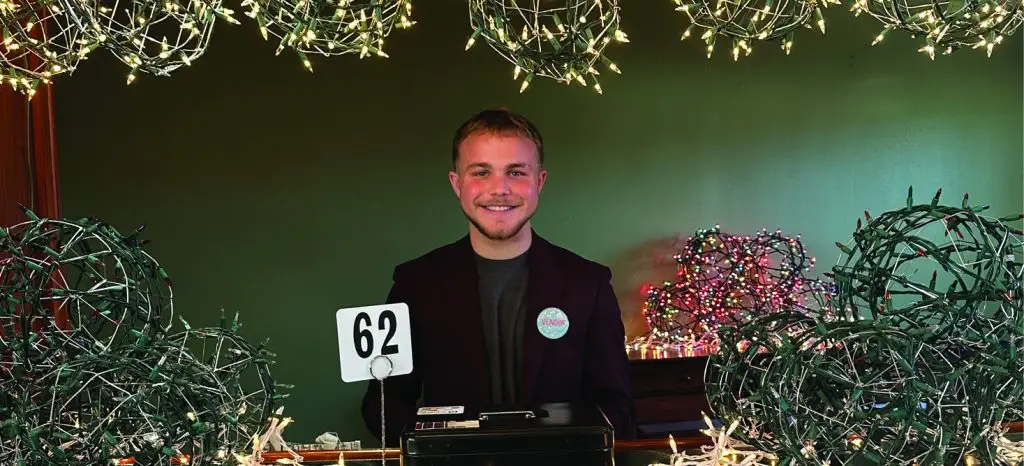
“I’m gonna have arthritis later in life because of this,” says a grinning 18-year-old Cooper Dunning as he snips and twists a length of wire mesh into an orb that soon will be a lighted Christmas ball glowing in a tree.
“I bet you could do that without looking,” I say, half-joshing.
Sitting at his family’s kitchen table, Cooper picks up the challenge, looks away from his hands and continues wire-rasslin’ without missing a beat, showing off the muscle memory that underpinned the success of his homespun business, Cooper’s Christmas Balls.
The enterprise, which Cooper started when he was only 11, took off, thanks largely to an annual spectacle one neighborhood over from Cooper’s Lindley Park home: a galaxy of glowing balls suspended in the trees over Sunset Hills at Christmastime.
Over seven years, Cooper made and sold 5,500 light-wrapped balls at about $20 a pop. He gave 15% of his profit to local charities.
You do the win-win math.
Here’s where the story gets twistier than a piece of wire mesh in Cooper’s well-worn hands.
Back in August, Cooper went off to college to study — what else? — business.
Yay.
But physically, emotionally and practically, he was done with the balls.
Wah.
But the making of Christmas balls will continue as a workforce development program of another homegrown success story, BackPack Beginnings.
Yay.
“We hope we do it justice,” says BackPack Beginnings founder Parker White. “If things go well this year, we’re hoping to make it way bigger next year.”
The hand-off happened in an unforeseen way.
Last year, Parker walked by Cooper’s ball-laden table at Merry Merry Market, an annual holiday fair at Revolution Mill.
Parker’s daughter, Avery, and Cooper are good friends, and Parker knew the ball-making operation had been a hit.
She asked Cooper what would happen to his venture when he went to college. He said he planned to let it go.
Parker posed a hypothetical: What if BackPack Beginnings took over the business and used it for workforce development?
“I love a ‘what-if,’” says Cooper. “It was an aha moment for both of us.”
Cooper went home and told his mom, Sarah.
“She said, ‘Whatever you say, Cooper,’ as she does for a lot of things,” he recalls. “She’s supportive but hands-off, which is the best kind of supportive in my opinion.”
Sarah knew all about Cooper’s entrepreneurial zeal.
She had watched him, at age 6, dress up as the Mayor of Munchkinland and go door-to-door to raise money for the Community Theatre of Greensboro. The top fund-raisers would get to be flying monkeys in that year’s production of The Wizard of Oz.
“He was motivated by winning,” says Sarah.
Cooper raised $1,200, and his father, Matt, hoisted him aloft as a flying monkey suspended by cables and wires. A year later, Cooper opened a booth at The Corner Farmers Market, a Saturday-morning bazaar then located at the corner of Elam and Walker avenues.
Cooper’s homemade wares included dog treats, chew toys and bow-ties for the well-dressed canine. He also hawked lemonade and hand-crafted coasters that possessed, as he puts it, “very little aesthetic appeal.”
Four years later, a customer asked if he could make Christmas balls like the ones that glowed in the trees around Sunset Hills every year.
Cooper went home, found some wire in the family’s garage, and got to work. He made 100 balls that year and sold all of them.
Each year for the next six years, he capped production at 1,000 balls — except for last year, when he made a record 1,100 — so he would have time for student council, swimming, junior marshals and singing in Grimsley’s celebrated choral group, the Madrigals.
He refined his methods over time.
Each year, he started ball production in July, after swimming season ended. Using a 50-foot roll of wire, he made exactly 42 forms while sitting on the floor of his family’s living room, streaming TV and movie serials.
He stuffed the family’s basement, shed and attic with the bare spheres.
Because he used dog wire — a heavier gauge than chicken wire — Cooper’s balls stood up to storage, unlike the handiwork of a certain columnist, who once made lighted Christmas balls from chicken wire, just as she had seen demonstrated on a TV morning show.
After a couple of seasons in the attic, the deformed balls looked like the electrified tears of some very sad trees in her front yard, and she threw them away in a fit of un-elf-like disgust.
But she digresses.
By the end of September, Cooper was wrapping the balls with strings of 100-count incandescent mini-lights. LED lights were more expensive and gave off a cooler light than Cooper wanted.
“Bad for my brand,” he says flatly.
Cooper made each of the balls himself. Once, Matt tried to help him, but he did not meet Cooper’s quality-control standards.
Matt made up for it, however, by building a cart that Cooper hitched to his bike, loaded with balls and pulled to The Corner Farmers Market.
Later, after the market relocated to the corner of West Market Street and Kensington Road, Matt helped Cooper build a deluxe ball stall on a trailer that Cooper towed behind a car.
Cooper handed a healthy slice of his market profits to Green for Greens, a Corner Farmers Market initiative that matches SNAP benefits — federally-funded food-buying credits — up to $50.
During last fall’s government shut-down, the bonus helped many families stretch their food dollars.
“It’s a wonderful program that was sorely needed,” says Cooper.
He feels the same way about BackPack Beginnings, which Parker started in 2010, sending backpacks full of nonperishable food home to a few dozen needy students each weekend.
Since then, the nonprofit has expanded to serve more than 30,000 local families with a diaper bank; a family market; comfort backpacks stuffed with toiletries, books and toys for children living through trauma; and a life-coaching service called Beyond the Basics.
The Christmas balls will be a pilot program under that umbrella. Participants will be trained in the Cooper Way of ball construction, hired by BackPack Beginnings as seasonal workers, and paid minimum wage plus a per-ball premium.
Most of the trainees will be women who find it difficult to work in traditional jobs because of health, childcare or transportation issues.
Cooper will be standing by in case advice is needed from afar.
“I’m gonna be a second-dimensional figure now,” he says. “I’m letting my baby go.”
He isn’t the only one.
His parents — and the family of his friend Avery — know the feeling. Both youngsters have shipped out to UNC Chapel Hill to study business.
Their families, meanwhile, are adjusting to life without the lights that graced their homes for 18 years. It’s a transition that sparks a flurry of emotions: a twinge of loneliness, a touch of worry and a tide of pride at seeing your child shine.
“Trust is a big thing,” says Cooper, reflecting on the handoff of his creation, which he nurtured for so long. “It’s giving me a little peace knowing that it’ll continue to grow and become something bigger than myself.”
And all of the parents said, “Amen.” OH
Maria Johnson is a contributing editor of O.Henry. Email her at ohenrymaria@gmail.com.


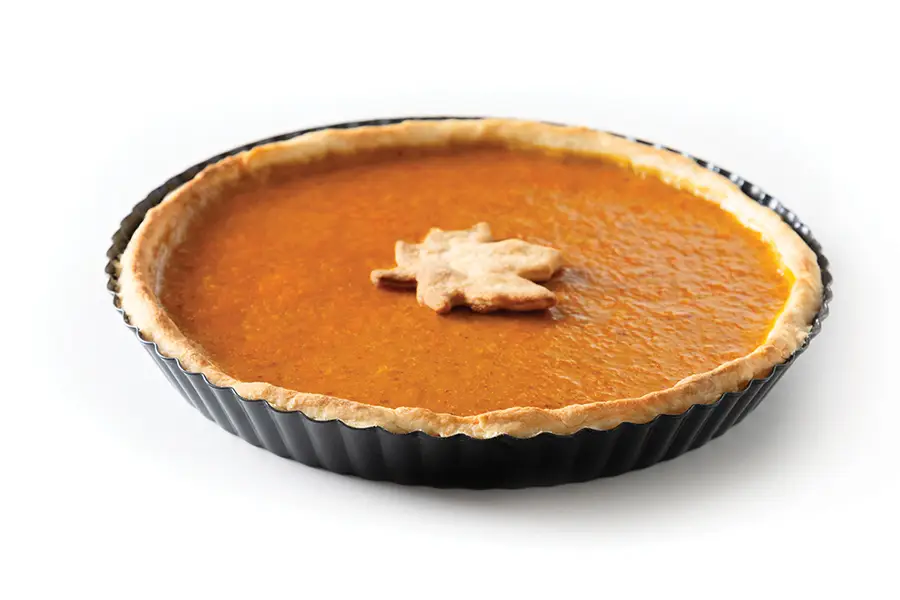 November says come to the table, come hungry, come as you are.