Art of the State

ART OF THE STATE

Pete Sack’s Second Act

Taking a turn as community leader

By Liza Roberts

A successful painter for nearly 30 years, Pete Sack has work featured in several corporate collections, including SAS Institute and Duke University Hospital. His resume includes dozens of prominent solo and group exhibitions and he’s currently got a waiting list for commissions.

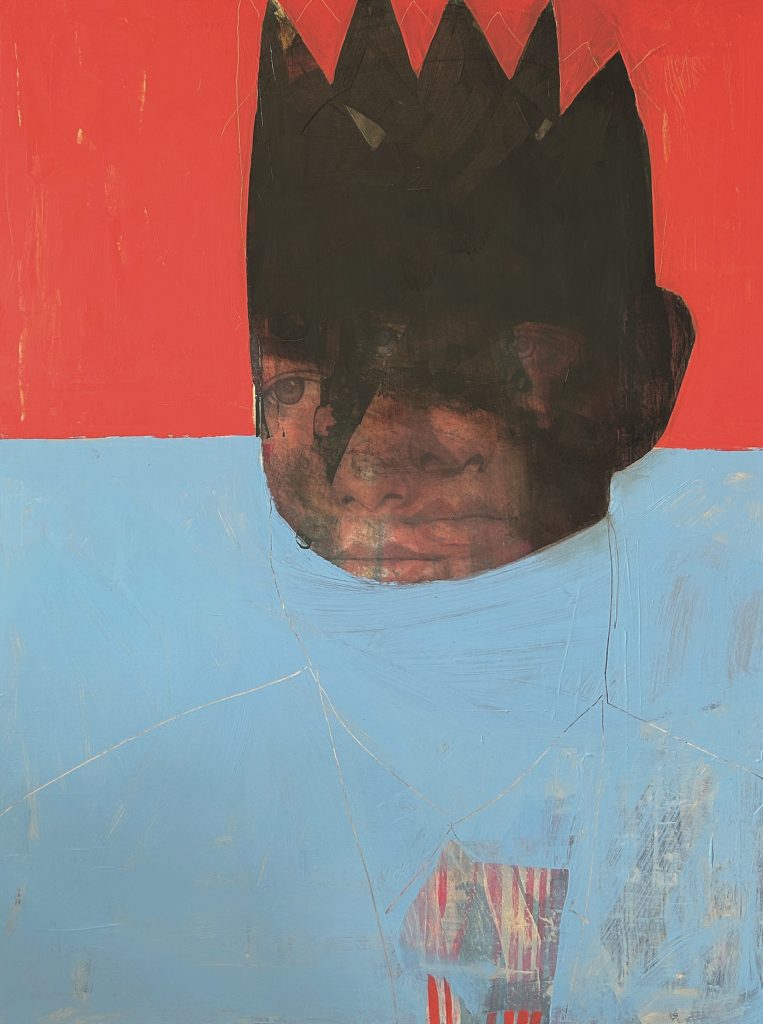
Known for paintings that feature finely nuanced portraiture through an abstracted lens, Sack often obstructs faces with shapes and colors, combining pencil drawings with watercolor and, finally, oil paint. Sometimes two or three portraits of the same person are layered on top of each other, just enough expertly wrought detail to recognize who it is.

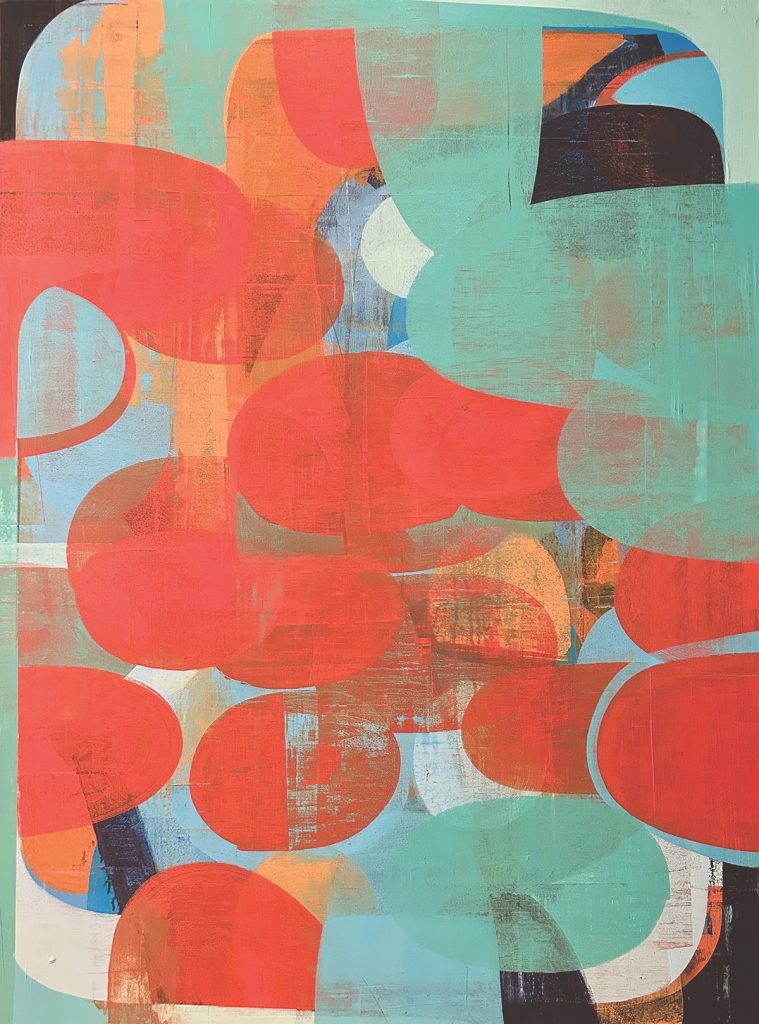
His completely abstract paintings are no less contemplative. Thought Patterns is a series “created with the premise that we begin every day as a new person,” he says. Depicted as layers of spheres and ovals of various hue, some are cool and moody, others buoyant, a few bright and jangled. The resulting paintings reflect the moods and thoughts of the days he made them. “Each day we are reacting to fresh thoughts, actions and environments,” he says. With a limited palette and the self-imposed requirement that he complete each piece within a single day, the works are “fully representative of a particular moment in time and take into account the deeply layered experience each individual has with the present moment.”

Sack’s path began at the Visual Art Exchange — a nonprofit hub for nurturing, connecting and showcasing artists — when he landed in Raleigh in 1988 after earning his Bachelor of Fine Arts degree at East Carolina University. “When I moved here, the VAE was where you learned how to be an artist in this area,” Sack says. It’s also where he and many others had their art exhibited publicly for the first time. “It was where you got your pieces on the wall.” 

An emerging artist residency at Artspace and a full-time studio there followed, which further engaged him with the downtown art community. When the creative space Anchorlight opened on S. Bloodworth Street, he moved his practice there. Then he spent nearly five years as an artist in residence at SAS Institute in Cary, where he made as many as 150 works of art for the growing software company’s walls. These days, Sack has a studio on Hargett Street and a dedicated roster of collectors.
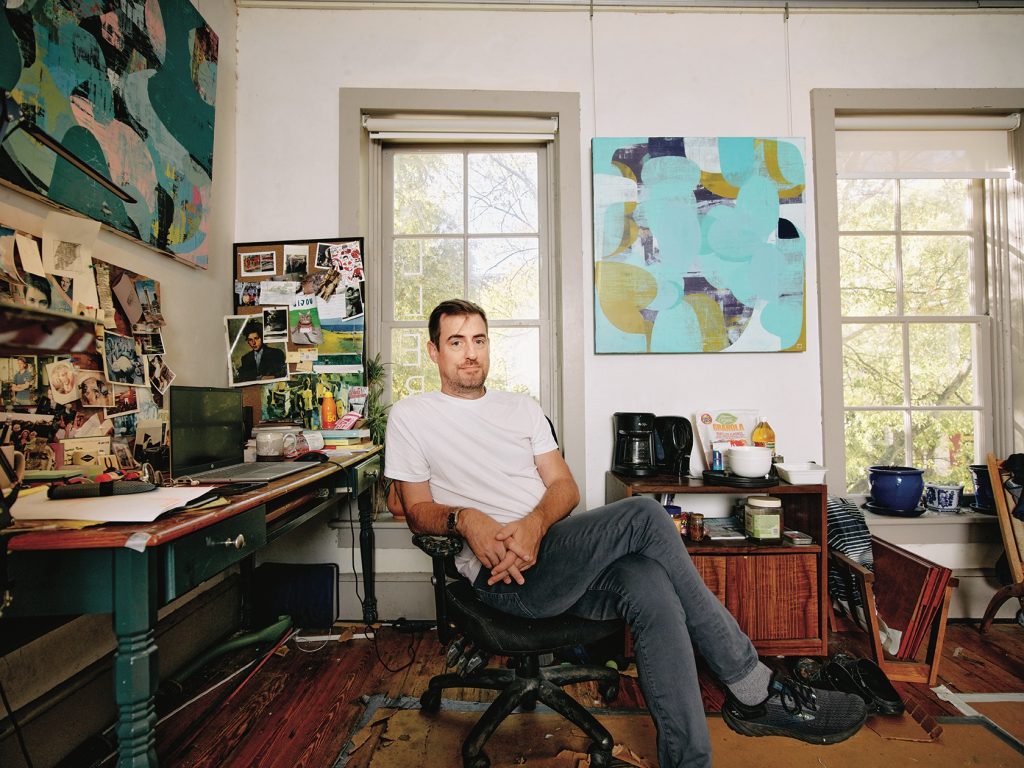
None of it happened by sitting back and waiting for things to come to him. For years, Sack worked to create opportunities for himself, finding creative ways to get his work seen outside the gallery system, including working with real estate developers and interior designers making art that he could be proud of while still suiting their purposes.

The spirit of those efforts expanded to the wider community in 2023 when he and three other established Raleigh artists, Jean Gray Mohs, Lamar Whidbee and Daniel Kelly, began convening groups of fellow artists to discuss the declining number of exhibition opportunities and spaces to gather and experiment downtown. The result was the creation of The Grid Project, an art collective focused on mounting pop-up exhibitions. With the long-term loan by ceramic artist Mike Cindric of his former studio (now called Birdland), The Grid Project has mounted 10 shows in the last two years, exhibiting work by 25 artists. Those exhibits spawned the creation of what Sack and Mohs call the Boylan Arts District.

The calling on everything Sack’s learned over the last 27 years about what it means to be an artist in his community.

In an unexpected turn of events, Sack was tapped last spring to co-direct the Visual Art Exchange with Mohs. The two aim to revive the 45-year-old institution, bringing it back to its roots as a resource for artists, a place for them to learn the practical business of being an artist, connect with other artists, and show their work.

A rebirth is in order, because among other challenges, the pandemic hit the VAE hard. By one estimate cited by Sack, the nonprofit gave out as much as $300,000 in funds directly to support artists during that time. The financial hit proved significant, and the organization moved out of its brick-and-mortar home in late April as a cost-saving measure. Sack and Mohs were recruited by the board and took the reins in June.

“As we move into this new chapter, our immediate focus will be on strengthening the internal structure of the organization,” the co-directors said in an October email to stakeholders. At the time, they were full-time volunteers; the VAE had just $7,000 in the bank. They have since held a series of listening sessions to gather input about the organization’s future direction.

“We need to temper expectations,” Sack says, “and let people know that this is the reality. But we aren’t going anywhere. We’re going to see this through.”

In the meantime, they’re doing what they can, where they are, with what they’ve got. In October, they filled the empty windows of the former CVS at the corner of Hargett and Fayetteville streets with art by Renzo Ortega and Lee Nisbet, working with Empire Properties to turn what was a dark corner into an art beacon. VAE is providing small stipends for the artists and calling the effort “StreetFrame.” Sack says they hope to replicate it in other empty downtown storefronts.

In October, under the VAE banner, the duo opened Echoes of Modernism, an exhibition examining how modernist architecture shapes our political, social and economic lives. Curated by artist Sam van Strein, it included work by Amba Sayal-Bennett, Daniel Rich, Frances Lightbound and van Strein.

Meanwhile, Sack’s art has its own demands. Last year, he had back-to-back shows for six months at a stretch and worried about “saturating” the market.

The demands of his work with VAE have given him time to “take a step back, to recalibrate” his art, and to think about where to take it next. “My sketchbook is filling up, I am building up the reserves, and I’m excited to see where the work goes,” he says. “Toggling between the figurative and the abstract is still something that I’m pushing. At the end of the day, I’m always going to be an artist. I’m building up to something bigger.”

And despite the obvious challenges, that same spirit is fueling his work with VAE. Sack says he’s determined to make it indispensable to the next generation of Raleigh artists.

“Years ago, I would never have thought I’d be in this position, just because it’s not something I ever wanted to do,” he says. “But the writing is on the wall that nobody’s coming to save us. We have to save ourselves.” 
Chaos Theory

CHAOS THEORY

Predictably Perfect

A Hallmark moment to remember forever

By Cassie Bustamante

Let’s face it, the market of cheesy holiday romance films — à la Hallmark — is oversaturated. But I recall when just one or two would be released each year, and you had to pay attention to when they aired, even if you recorded them with TiVo. My daughter, Emmy, and I would dive under the plush, down cover of my cozy bed and snuggle together as a string of lights twinkled on the wall above my headboard and a Christmas tree glimmered in the corner of the room. Emmy’s interest in watching holiday films while cuddling with her mom has inevitably declined. Anyhow, this year, she’s away at her first year of college, leaving me on my own while Netflix drops a barrage of Hallmark-adjacent films. And while I know within the first five minutes of viewing how the next 90 or so will unfold, I still adore these movies. The plot line is as comforting as my morning cup of coffee, filling me with a familiar, nostalgic warmth.

Each one goes something like this: Big-city lawyer Holly ventures to a small, snowy town named Hope Falls — with a gazebo in its town center, of course — to visit her newly widowed father for the holidays. There, she inevitably saves the local Christmas tree farm, owned by a flannel-wearing stud named Nick, by setting up a pop-up bake sale where she sells cookies using her late mom’s cherished, handwritten recipe. Naturally, Holly and Nick fall in love and open a bakery named “Pining for Sweets” on the farm property and live happily ever after, selling Christmas trees and confections.

And while Emmy’s no longer into the yearly ritual, last Thanksgiving I discovered that I need not watch the 32 Hallmark “Countdown-to-Christmas” films all by my lonesome self.

And so it was that one late November evening, we arrive home from my parents’ house, stuffed and sleepy. Our oldest, Sawyer, heads immediately to his lair to play video games. Emmy retreats to the warmth of her own bed. My husband, Chris, turns the family-room television on to whatever college football game is being played. Our youngest, 6-year-old Wilder, builds a Pokémon puzzle on the coffee table with Chris. Taking inventory of the situation, I decide I could use a quiet, little lie-down myself.

I turn on the Christmas lights already strung over my bed (confession — we keep them up year round because I love their glow), flop myself down and grab the remote. Netflix tells me that Lindsay Lohan’s latest, Our Little Secret, is today’s top film. I love a good comeback story and applaud Lohan for finding her way back to the screen in a healthy, wholesome manner. And, to be fair, this movie is a level up from Hallmark. Kristin Chenoweth, Tim Meadows and Ian Harding, the dude who played Ezra Fitz in Pretty Little Liars, a show that Emmy and I watched together in its entirety? Yes, please.

With 30 minutes left in the movie, Wilder, wearing his Super Mario pajamas and Santa hat that he hasn’t taken off all day, wanders in to ask if I’d like to watch a Peanuts movie with him and Dad.

“Of course, I’d love to,” I say. “But lemme just finish watching this first. OK?”

He peers curiously at the screen and spies glimmering Christmas decorations adorning a large, twinkling, light-covered home. Instead of leaving, he hops on the bed and nestles into me. While the movie is rated PG-13, I decide it’s tame enough for him to stay. Plus, a lot of the inappropriate content will fly right over his Santa-capped head.

As the ending draws close and the love interest makes his grand, sweeping gesture to finally win over Lohan, Wilder says, “This is making me feel like I am going to cry.”

After a moment, Lohan and her beau embrace and seal it with a kiss. “See,” I say to Wilder, “It’s a happy ending.”

He hugs me tighter as he says, “Yes, but it’s just so beautiful that I want to cry.”

So, this year, I’m ready. The lights are twinkling above the bed. Soon I’ll be cuddling up with my new romance-loving partner in crime. And when Emmy comes home for her Christmas break, we’ll just squeeze in tighter and make room for her, too. That is, if she wants to join us.

O.Henry Ending

O.HENRY ENDING

The Light That Binds Brightly

Reflections on traditions

By Ivan Saul Cutler

With warm, fond memories, I cherish my youth, especially those sweet middle childhood years in Compton, the vibrant working-class suburb of L.A. My family, the Cutlers, was the only Jewish family on McDivitt Avenue. We lived happily among many wonderful neighbors and friends.

Religious differences — Catholics, Protestants and Latter Day Saints — made no difference because Jimmy McAuley, Jimmy Hoffman, Craig Lee and Wayne Stiglbauer were my friends, my buddies. Yes, in those halcyon days of my youth, all of us guys were typical boys, doing what boys did together — playing sports, having newspaper routes, riding bikes, goofing off.

On one late-1950s, sunny, Southern California Christmas Day, I arose early. Of course, I knew what day it was. Even though no gift-bearing Santa Claus ever visited my home, my vicarious thrill to see and share their gifts was real, and my friends knew it.

Yes, I couldn’t wait to see what gifts they’d received and join in playing with their new toys and games, while righteously dismissing clothes as a real present.

Just as I was ready to dash out the door, Dad gestured gently with his hand to stop. “Son,” he said in his thick Lithuanian accent, “today is a special holiday for our Christian friends. Your buddies need to be with their families now.”

He was right. Thanks, Dad, for forever imprinting that lesson on my heart that’s been guiding me in life. Respect and honor are the Cutler holiday traditions and best gifts instilled by my immigrant father, Harry.

Now, almost 70 years later, Dad’s no longer here, but I’ve embraced those enduring values and then some. Back then as the Jewish kid in the neighborhood, I could rejoice in the distinct year-end holiday differences of Hanukah and Christmas, yet savor the exhilarating similarities of the radiating light of my heirloom Menorah (an eight-branch candelabra my Grandfather Meyer Cutler handmade in 1936 for my father and his two brothers) and my friends’ glowing Christmas trees, which I helped decorate every year.

My father’s respect-honor ethos teaching remains bright, illuminating and enhancing my diverse relationships with all people I encounter. It’s my father’s enduring gift of wisdom — the presents of presence — that keeps on giving all year.  

Hanukah (dedication in Hebrew), the bright eight-day Jewish Festival of Lights, commemorates the rededication of the Jerusalem Temple in 165 B.C.E. (before the common era) by the Maccabees after its desecration by the Syrian Greeks.

Hanukah’s brightness usually occurs in late November or December, depending on its coincidence on the Hebrew lunar calendar, 25 Kislev, corresponding this year to December 15 to 22, with the first candle kindled on December 14.

Although Hanukah is a post-Hebrew-Bible (Torah) holiday, the metaphor of bright light in the year’s shortest days warrants sharing and receiving its fortified reflection in Christmas brightness. For years, a joy of the season has been kindling the Hanukah candles with non-Jewish friends, especially when the leader candle (Shamash) and all eight candles are burning brightly on the eighth night. The glow from everyone’s eyes confirms the warmth of engaged humanity.

Again, this Hanukah, I happily return to that Christmas Day on McDivitt Avenue, when I couldn’t wait to check out the new toys under my friends’ trees. I can still hear Dad’s voice echoing clearly in my mind, even though he’s been gone for more than 46 years: “Wait until this afternoon or tomorrow to be with your friends. You have plenty of time.”

I did then and will continue to. 

Wild Wonders

WILD WONDERS

Making Magic

Thomas Dambo’s installation of seven giant trolls across North Carolina is the biggest in the United States

By Ayn-Monique Klahre

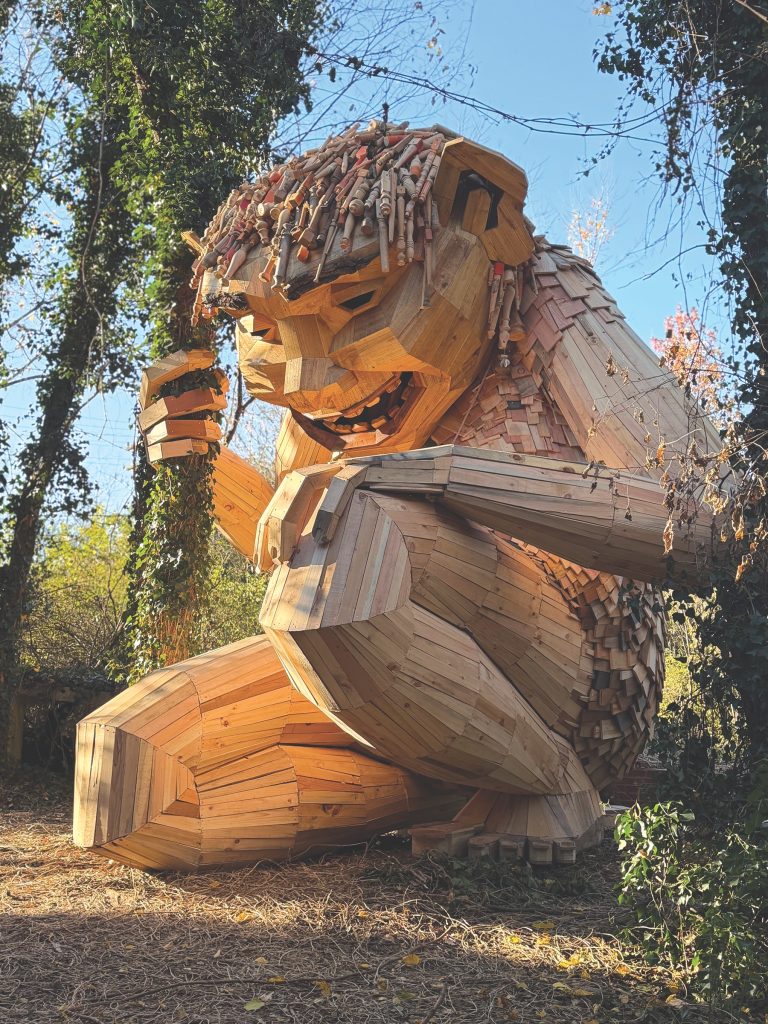
At the edge of the woods, the troll peeks out: a baby by the standards of her kind, but, at over 12 feet tall, she’s giant to most of us humans. In one hand, she’s holding onto her mother’s tail, which winds deep into the trees — all the way to the hidden spot where Mom sleeps with one eye open, attentive to her children. This baby troll’s siblings have gone further afield to play, and their father is foraging nearby.

These trolls are not alive, of course, but a multifigure sculpture called The Grandmother Tree from Danish artist Thomas Dambo. There are five of these trolls in Raleigh’s Dorothea Dix Park, one in the Southwest Mill District of High Point and another at the Crescent Communities River District Community in Charlotte. Taken together, The Grandmother Tree is the largest permanent installation of Dambo’s trolls in the United States.

The idea to bring the trolls to North Carolina came when Dix Park Conservancy Art Task Force chair Marjorie Hodges and her husband, Carlton Midyette, visited the Coastal Maine Botanical Gardens in Boothbay. There, they came across a Dambo troll installation called Guardians of the Seeds. “We saw the trolls and it took us 30 seconds to say, We need these for the park,” says Midyette. He worked with philanthropist Tom Gipson to lead a campaign to finance a project of that scale for Raleigh. Visit High Point spearheaded bringing its troll, Little Sally, to the area, working with the David R. Hayworth Foundation and DRIVE High Point Foundation for fundraising, with the Southwest Renewal Foundation facilitating the site selection. In Charlotte, developer Crescent Communities saw its troll, named Pete with the Big Feet, as a natural extension for its vision of the River District, which is in a mixed-use town center called Westrow, bordering the Airline Bike Park. “Big Pete is more than just a striking public art piece,” says Rainer Ficken, senior managing director of The River District. “He’s an invitation for Charlotte and its visitors to engage with the land in a new way, to explore our public trails and to reflect on the impact each of us has on the environment.”

Part of what attracted Dambo to this project was the way his installations would be part of reinventing and reengaging with these urban spaces. The 308-acre Dix Park, for example, was a longtime site of a state psychiatric hospital. “I loved the story about how this park used to be something else,” he says. “It’s a land of reinvention and restoration,” says Kate Pearce, executive director of Dix Park for the City of Raleigh.

For each of his installations, Dambo crafts a narrative around the trolls that offers a sustainability lesson and a little mystery, too. In his telling, the North Carolina trolls are all protecting the Grandmother Tree, the oldest and wisest tree in the forest, who is hidden in another forest in the area, disguised as a regular tree. Each of the seven trolls wears a medallion around its neck that contains pieces of the same heritage tree. Taken together, they share the location of the Grandmother Tree. (We’ve been told it’s in Raleigh, but that’s as much of a hint as we got.) The medallions were made by Billy Keck and Melody Ray of Raleigh Reclaimed, a company that makes furniture using salvaged woods. 

In part of the poem that tells this story, Dambo says:

But one species, all trolls, has learned to fear through evolution 

Invasive, a pollution, you must never trust a human 

A human seeks the oldest trees, to kill and cut them down 

and chop it up in tiny pieces, haul it, burn it in their town 

And so the trolls have cast a spell, enchanted the grandmother tree 

So no human can find her; now she looks like any other tree 

But every time the moon is dark, the red wolves howl and bark 

This is the sign that sparks the start, the trolls to search the park 


Each of the trolls came together through a robust community effort. Dambo and his team of professional troll-makers designed the creatures and built the frames, then used local volunteers to build the trolls on site. In Raleigh, Habitat for Humanity Wake County used a mix of staff and skilled volunteers, plus a wider volunteer effort to do the rest. When the signup to volunteers opened, there was so much interest that the server crashed. (“It was like buying a Taylor Swift ticket,” laughs Midyette.) “We rotated our entire construction staff to work on the project,” says Patricia Burch, CEO of Habitat Wake. “It was unique, exciting and a lot of fun — so cool to have a hand in building them.” In Charlotte, Crescent Communities solicited volunteers from their own staff, as well as nonprofit partners including Daniel Stowe Conservancy, Catawba Lands Conservancy, Sustain Charlotte and the Tarheel Trailblazers.

Dambo’s team also worked with local organizations to source the reclaimed materials to build the trolls. In High Point, materials were provided by Wise Living, Reliance Timber, Triad Timber & Millworks, Hood Distribution and Southwest Renewal Foundation. In Charlotte, Crescent Communities used its own construction waste, as well as recycled material donations from D.H. Griffin and She Built This City. In Raleigh, Habitat Wake and its ReStores donated much of the material, as did Raleigh Reclaimed, which sourced rot-resistant woods such as cedar, oak and locust for the project. “We use materials that otherwise would go into landfills or the waste stream, so we had a built-in process for collecting these materials,” says Ray. “It just made sense to partner on the project.” Additionally, Kentucky Bourbon Barrel chipped in 17 tons of old bourbon barrels (most of which went into making Raleigh’s mama troll’s 620-foot tail), and Midyette donated the remains of a fallen-down barn and about a mile of old fencing he had on his property. 

In Raleigh, it took about 400 volunteers and three weeks to build the five trolls (not including work Dambo and team had done in Denmark ahead of time). “Every single stave was put in by a volunteer,” says Midyette. A lot of volunteer work went into the making of the more than 300 sections of the mother’s tail, for which the bourbon barrels were completely disassembled and reassembled to fit the landscape. “This was great for the community volunteers, since it was safer than being up on scaffolding,” says Dambo. “The trolls are not meant to be perfect — I always like to see the dents and cracks — because when you zoom out, you don’t see the imperfection.” In the end, it took more than 24 tons of lumber and 50,000 screws to make those five trolls.

The goal with The Grandmother Tree is to draw visitors to these natural areas — and for these visitors to experience the same sense of magic and wonder as Dambo did going into the forest as a child, he says. “Bringing Little Sally to life reinforces our focus to create experiences that blend creativity, sustainability and community pride,” says Melody Burnett, president of Visit High Point. Agrees Pearce: “It’s about bringing magic back into spaces.”

Almanac December 2025

ALMANAC

Almanac December

By Ashley Walshe

December is a skein of yarn, a simmering stockpot, a cat curled by the fire. Cast on. Breathe in the warming spices. Listen to the wisdom of gently crackling oak.

Wood and wool hold memories of winters past: silver storms; frost-laced mornings graced by tender sunbeams; resplendently starry nights.

You study your hands, slightly dry, recalling all they have held this year; all they have released. They tucked seeds into dark earth, plucked wildflowers, cupped sun-ripened berries, healed wounds, watered plants, wiped tears, prepared meals, gathered kindling.

Knit one, purl one; repeat.

When the fire pops, the cat unfurls like a spring fern, stretches out its toes, then drifts again into dream world.

Knit one, purl one; repeat.

As the cat stalks summer crickets and field mice behind closed eyes, you lay down your craft, stoke the fire, head for the stovetop. Lifting the lid, you unlock memories of winters past, mashing the now-soft apples as you inhale the spicy-sweet amalgam.

Back at the fire, you cradle a mug of homemade cider, watching the steam dance as whiffs of cinnamon and allspice ignite your senses. You look at your hands again, marvel at how they’ve been shaped by nature and time; at their wisdom, softness and resilience; at what they might yet hold. 

The cat yawns. You set down the cider, pick up the yarn. Knit one, purl one; repeat.

Winter’s Deep Sleep

For the natural world, life is slowing down.

Honeybees are clustered in their hives. Box turtles are burrowed in shallow soil. And black bears — over 20,000 of them in our mountain and coastal regions — amble to their dens, where cubs will be birthed in the heart of winter, during mama’s deep, long sleep.

When life feels busy, lean into the wisdom of our animal kin. Slow down. Get cozy. Remember that rest is a gift you can give yourself.

Homemade with Love

The holidays are upon us. Flickering candles and flashing lights spell Hanukkah, Kwanzaa, Christmas and Yule. But what of the lesser-known holidays? The weird and downright wacky ones?

Take Pretend to Be a Time Traveler Day, for instance, celebrated on Dec. 8. National Cat Herders Day (Dec. 15). Or National Ugly Sweater Day (the third Friday of December).

There’s a day for roasting chestnuts (Dec. 14), regifting (Dec. 18) and swapping homemade cookies (Dec. 22). 

And here’s one that might prove fun and fruitful: Make a Gift Day, on Dec. 3. Get creative. Let go of perfectionist tendencies. Pure and simple is part of the charm.

Life’s Funny

LIFE'S FUNNY

A Pause with Mrs. Claus

A kitchen-table convo with her local ally, Mebane Ham

By Maria Johnson

It’s 80 degrees in September when Mebane Ham answers the door in full red-velvet regalia.

Her floor-length smock is cinched in back with a bow.

Her cuffs are trimmed in white fur.

Her cap, edged in lace.

Her ears, evergreen, dripping with Christmas tree earrings.

Her face is flushed and radiant.

Or maybe she’s just burning up.

“Here, this is for you,” she says, handing me a candy cane adorned with a ribbon while begging me to take extras back to the office. “You can’t buy just one these things.”

Sometimes, it’s hard to tell where Mebane Ham ends and Mrs. Claus, as in spouse o’ Santa, begins.

Twinkly blue eyes?

That’s 71-year-old Mebane, especially post-cataract surgery.

Same goes for Mrs. Claus, who is also 71, give or take a few centuries.

Rosy face and ready laugh? That’s Mebane, once the extra blush is applied. It’s also Mrs. Claus, considering the windburn that comes from living at the North Pole.

A propensity to hug people? That’s Mrs. Claus. And most definitely Mebane.

A fondness for telling it like it is, sparing no adjectives?

That’s Mebane, for sure, when she’s off the elfin clock.

But no way is that her Mrs. Claus, who’s a safe haven for children, a protector of young ears and hearts.

“That’s how I portray her,” Mebane says with a steel thread in her voice.

She — Mebane, that is — first believed in Santa when she was a kid growing up on St. Andrews Road, which was then a dirt road, in Greensboro’s Irving Park.

Her mother was a stay-at-home mom. Her dad was a salesman. Every December, the family went downtown to take in the department store windows that were dressed for the holidays.

Somewhere in her home in the Dunleath Historic District, Mebane has a picture of her and her siblings with Santa.

“As the youngest of four kids, I learned real quick that the longer you believed, the longer you got stuff,” she says with a hearty heh-heh-heh.

She grew up believing in Santa, without paying much mind to Mrs. Claus, who was a minor character, at best, in the Christmas stories she heard.

It wasn’t until she’d moved away then came back home to help care for a mom with dementia that she got the idea that she could be Mrs. Claus, or at least find the Mrs. C in herself.

It helped that her friend, Eloise Hassell, asked in the early aughts if Mebane would take her place as a seasonal Mrs. Claus at the Barnes & Noble bookstore in Friendly Center, where she told stories during a weekly children’s hour.

At first, Mebane winged it, conflating the story of Little Red Riding Hood with the fairy tale of Goldilocks and the Three Bears — and adding a Christmas twist.

“The parents looked at me like, ‘What kind of drugs are you on?!’”

The next time, Mebane read from a new Christmas book for children. It went much better. After the story time, the kids asked questions. Mrs. C was quick on her clogs.

“What’s your first name?” they asked.

Merry, of course.

“Why are you wearing a wig?”

You should see what riding in a sleigh does to your hair.

“What do you do at the North Pole?”

Who do you think teaches the reindeer to fly? Or shows Santa how to use the GPS?

“How long have you and Santa been married?”

Hundreds of years. Or at least it feels like that sometimes.

“Why aren’t you wearing a wedding ring?”

Oh, my gosh! I took it off to bake cookies with the elves last night and forgot to put it back on.

Later, Mebane recounted the ringless story to a friend who then donated her deceased mom’s gold wedding band to the cause.

“She would love knowing that you’re wearing it for this reason,” the friend said.

After a while, word got around about the married lady who dressed in red and could be hired by the hour.

Mebane — who by then ran her own business devoted to helping small businesses and nonprofits do media and community relations — booked more gigs as Mrs. C.

As opposed to Renaissance or a Victorian figure, she fancied herself a 20th-century character, like the ruddy Santa who appeared in Coca-Cola ad campaigns from 1931 to 1964.

She took her jolly self to Christmas parades in Greensboro and Charlotte, where she rode on floats with the Mister.

She popped into office parties.

She strolled the sidewalks, doling out candy canes at the Festival of Lights in Greensboro. If a kid dropped a candy cane and it broke, Mrs. C. asked for it back and replaced it with a new stick. Cracked candy canes, she said, made excellent reindeer chow.

If a child started stomping candy canes in the name of reindeer nutrition, Merry/Mebane made it clear the reindeer had enough food — so cut it out, kiddo.

Mama Christmas don’t play. But she does have a soft heart.

At retirement homes, Merry/Mebane started Christmas carols for the residents, whose memories were in various stages of repair. They took over after a couple of verses. Some had not spoken in months.

She built gingerbread houses at country-club family events. 

In Winston-Salem, she held small audiences with children with auditory issues. Santa, with his booming voice, could overwhelm them.

Mrs. Claus was softer, more approachable. They came to her.

“By the end, we were down on the floor, reading and playing. They were making eye contact with me. To do that, and see the difference you can make . . . ”

Merry/Mebane’s voice trails off.

Like the seasons themselves, Christmas has changed, and Mrs. Claus has changed with them.

Budget cuts prompted a health-care agency to nix her visits to retirement homes.

Ditto the chain bookstore.

But Merry/Mebane, who also volunteers at the front desk of Holy Trinity Episcopal Church, keeps popping up, at an hourly rate much cheaper than that of a typical Santa. Pay equity, it seems, has not reached the North Pole.

“I don’t make thousands of dollars doing this,” says Merry/Mebane. “I do this because I like it. I get my warm jollies out of this.”

She makes 10 to 20 appearances a year.

She still does parades.

And office celebrations.

And the Festival of Lights, where kids literally come running for her.

She still visits the kids with special needs in Winston-Salem.

Last year, she volunteered at a children’s home in Crossnore, which had been hit by flooding from Hurricane Helene.

Benefactors paid a locally owned bookstore, Scuppernong, to supply wrapped, hardcover Christmas books for the kids. Merry/Mebane delivered Where’s Waldo? to the children, read with them, encouraged them to be good people.

Here, at her kitchen table, within view of a quote tile that says “If you’re not a bad influence, I’m afraid we can’t be friends,” she allows that Mrs. Claus is another side of worldly, wise-cracking Mebane.

“Mebane Ham cares, is concerned and worries,” she says, her blue eyes growing dewy under frosty curls.

“This is something I can do about it. It’s kindness.” 

Almanac November 2025

ALMANAC

Almanac

By Ashley Walshe

November is the mother of quiet wonders.

Rainbows in spider silk. Wood ducks, migrating by moonlight. The slow-beating heart of a box turtle in brumation.

She gives and gives, offering her final mild days, her cool-season greens, the last of her berries, nuts and seeds. 

“Eat up,” she says to the wild ones. “There’s plenty here to go around.”

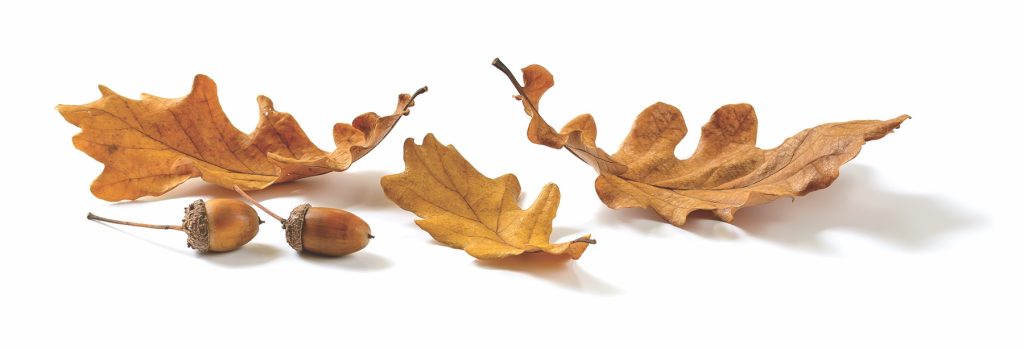
Bird and squirrel delight in her sweet and earthy fruit. Fox and deer, too. A feathery frost gilds mottled oak leaves on the first frigid morning.

When weary spider spins her silken sac, a cradle for a thousand eggs, the mother leans in close.

“Go now,” she whispers to the weaver. “Your work is done. Your babes shall know the tender kiss of spring.”

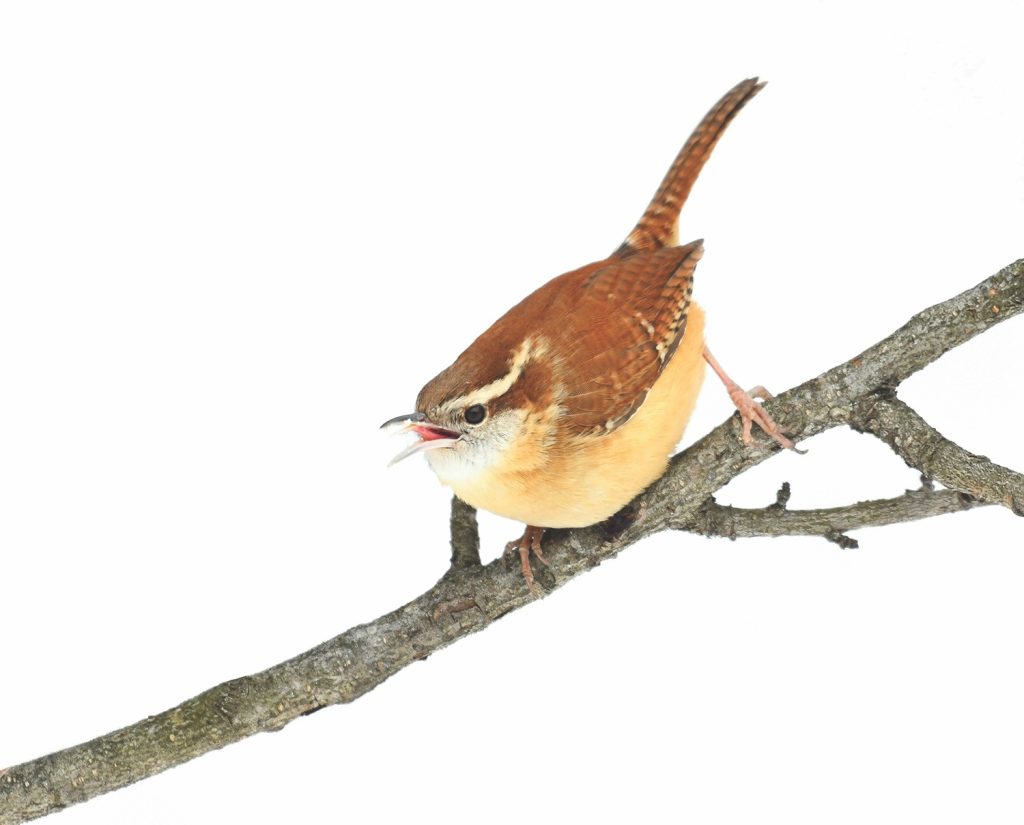
Wren song rings through chilly air. The last colored leaves gleam like stained glass in a light-filled cathedral. The altar remains blessed with beautyberries, acorns, persimmons and rosehips.

“Nourish yourself well,” the mother commands, folding moldy fruit and spoiled nuts into her womb-dark soil, where even the dead leaves are precious.

“I can use this,” she murmurs of what’s gone to rot. “Nothing will be wasted.”

Deciduous trees drift toward dormancy. Black snakes seek out burrows. Wood frogs prepare to freeze solid.

By and by, the great mother readies herself for winter’s deep, long sleep.

Surrendering her beauty back to the hard, damp earth, she strips away all she has to give: a humble banquet for the wild ones; what precious light remains; a bouquet of blessings in the name of quiet wonder.

But there is always a November space after the leaves have fallen when she felt it was almost indecent to intrude on the woods . . .     
— L.M. Montgomery,
Anne of the Windy Poplars

Inner Peace Casserole

A no-fuss recipe you’ll return to again and again. Simple, nourishing and gentle on the system, this soothing side dish is an unexpected crowd-pleaser at the most dynamic of family gatherings — and a treat the day after, too.

Prep and cook time: n/a

Yield: immeasurable

Ingredients

6 bushels of gratitude

3 pecks of grace

1 heaping cup of humor

4 dollops of kindness

1 pinch of forgiveness

1 dash of compassion

A dusting of birdsong

A breath of fresh air

Sunshine (if available)

Directions

Combine all ingredients. Stir and breathe slowly. Break for a kitchen dance party. Repeat.

Note: Modify ingredients to your taste. Sprinkle in some new ones. Leave out what doesn’t serve you. Make this recipe your own.

Do the Mashed Potato

If one plans to mash potatoes for the Thanksgiving masses, one knows they must double the batch. But does one have a plan for that whopping load of leftovers?

Three words: mashed potato pancakes.

If you haven’t tried them (there are several recipes available online), do yourself a favor and whip out the skillet. This isn’t a maple syrup-type situation. Think sour cream and chives. Think breakfast, lunch or dinner. Think no further.

You’ll thank yourself for mashing the extra mile. Especially if the fam is still visiting.

Chaos Theory

CHAOS THEORY

Just You Wait

From social to print media

By Cassie Bustamante

As I sit at my dining room table waiting for my Zoom call to begin, I wonder whether it was such a good idea to have planted myself in front of the giant, whimsical sun I painted on the wall behind me. It’s the fall of 2020 and I am interviewing for a job. It’s a local position, but with COVID lingering in the air, most interviews are being conducted online. Ashe Walshe, then editor of O.Henry magazine, pops up on my screen. Even though I can only see the digital manifestation of her, it’s enough to pick up on her earthy, bohemian vibes.

“Why do you want this job?” she asks me, her hazel eyes genuinely curious. The role in question is that of digital content creator. If I land it, I’ll be writing the O.Hey Greensboro email newsletter and handling social media.

“Well, I really feel like the universe pointed me here,” I blurt out without thinking, a usual habit of mine. Immediately, my mind starts whirling: Why did I say that? There’s no way they’re hiring you now! You sound insane!

But when I see Ashe’s face on my screen, something about the tilt of her head, the slight upturn of the corner of her mouth and the bob of her chin-length, dark curls tells me that she’s absolutely tickled by my response.

A few days later, I’m trudging up a big hill in our neighborhood, panting and pushing my 2-year-old, Wilder, in a stroller, when my phone rings.

“Is now a good time?” Ashe asks, hearing my breathiness across the line.

As a mom to a toddler, is there ever really a “good time” for anything? “Yes!” I say with false confidence.

And just like that, a week later in mid-November, I mask up and head to the O.Henry magazine office to meet my new boss and start training, diving headfirst into the weeks of O.Hey’s gift guide, already mapped out. Though I’m now juggling a busier schedule, working when Wilder is at the Childhood Enrichment Center a few mornings a week, something sparks in me. I find complete and utter joy in learning to write in the pun-filled, playful O.Hey voice.

Months into the job, once I’ve gotten to know Ashe better — and I’ve discovered that our spirituality is aligned — I divulge the truth behind my answer that day on Zoom, about how the universe pointed my arrow toward O.Henry.

I had been writing a home decor and DIY blog for over 10 years, eventually creating social media content in order to stay relevant and to drive website traffic. But I’d grown tired of it — the delight it once brought me was gone. Instagram had lost its appeal as a place to connect and instead became a place to keep up. Ready for something new — but what, I did not know — I hired a coach, Chandra Kennett, who I’d actually “met” through Instagram. She asked me what it was that I really wanted to do, deep down.

“Well, I actually love writing Instagram captions, silly poems and personal essays. And I know that I want to make genuine connections with my local Greensboro community,” I answered. “But I don’t even know what I could possibly do with that.”

“You wait,” Chandra responded. She’d done my human design, a holistic, self-knowledge practice that is, admittedly, very woo-woo. “You’re a manifesting generator and your strategy is to respond, so for now, you just wait for what shows up.”

Wait? Anyone who knows me knows that patience is not one of my strong points. If it is even one of my points at all. But I trusted her and I painstakingly waited. In the meantime, I’d sit on my porch in the dark of the morning and pray: Show me what’s next on the path. I do not need to see the destination, but show me the next step and I will take it.

A month later, as I was out walking my dogs at 5:30 in the morning, I crossed paths with a neighbor I hadn’t yet met: the one and only Jim Dodson.

He stopped me and introduced himself, explaining that he was founding editor of O.Henry magazine. We’d only lived here for a year-and-a-half and I had a little one, a teen and a tween at home. In all honesty, I hadn’t heard of it. But I nodded my head along, pretending I knew all about it.

“We’re thinking of doing a story on children’s pandemic art and I noticed your daughter has done several chalk drawings in your driveway. She’s quite talented. Do you think she’d talk to us?”

Emmy is not the extrovert that I am, so I got his email address and told him I’d look into it as my dogs yanked me along, raring to go.

A few days later, I sent along some photos of Emmy’s handiwork — Baloo from Jungle Book, Homer Simpson, Rapunzel, to name a few — as well as a link to a post on my website, where I’d featured a colorful, cheery piece she’d painted for our pandemic porch. Shortly after that, Jim called me. “I have a job that I think you might be perfect for.”

And that, I tell Ashe, is how I came to be on that Zoom interview with her.

“Well,” she says, “that’s some kind of magic. However it happened, I’m glad you found your way here.”

“Me, too,” I say. Five years later, Ashe and I remain good friends, even though she’s answered the call of the mountains. I no longer write O.Hey — Christi Mackey has seamlessly taken over — but now sit in the editor’s seat of O.Henry, still just as grateful to be here. And, if you asked me now why it is that I want this job still today, I’d tell you that I found everything I was waiting for right here.

Omnivorous Reader

OMNIVOROUS READER

From Poetry to Prose

Creating a finely crafted debut novel

By Stephen E. Smith

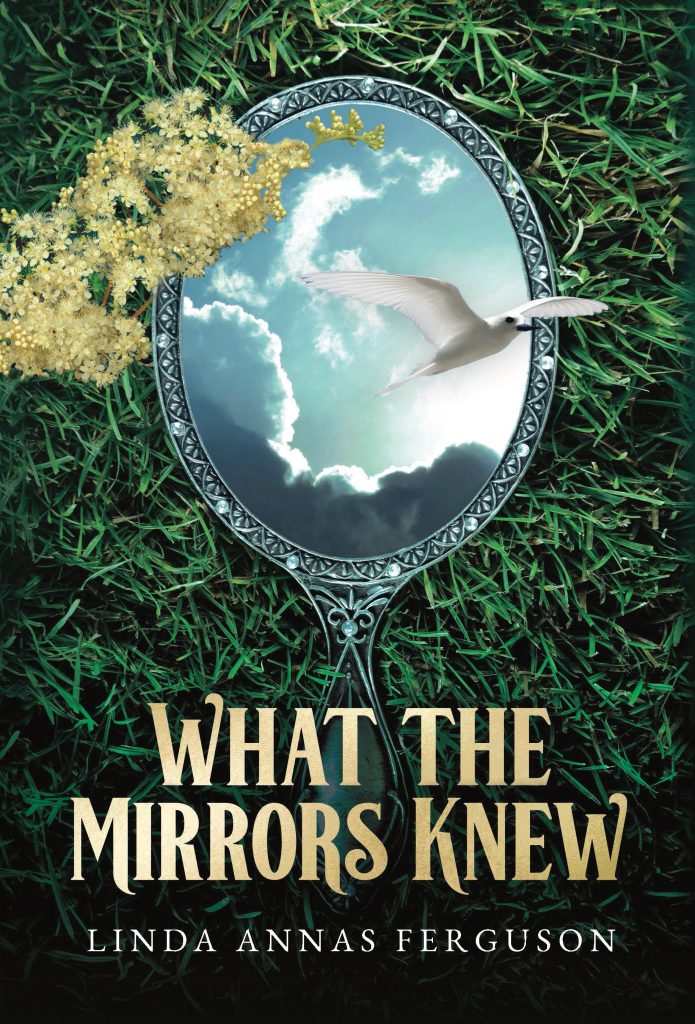
On an unseasonably cool August night in Charleston, South Carolina, I’m sitting in Kaminsky’s Dessert Café with Linda Annas Ferguson, whose first novel, What the Mirrors Knew, arrived that day in the form of 500 paperback and hardcover books. (The official release date was Sept. 21.) She’s glowing with that nervous anticipation felt by every author of a freshly published work — she’s proud, exuberant, anxious and pleasantly overwhelmed by her achievement. She’s seen the germ of an idea to completion, and the fruits of her labor are contained in a beautifully designed novel of almost 400 pages that pleads to be read by appreciative readers.

This isn’t Ferguson’s first book. She began her writing career as a poet and has successfully published and marketed five books of poetry. Her poem “On the Way Home” appeared in our September issue.

Still, I am keenly aware that writing poetry can, oddly enough, be an encumbrance. When a writer proficient in one genre tests his or her talent in a different form — a novelist writes poems, a playwright turns to poetry, etc. — we’re often skeptical, wondering how much professional skill will carry over. Who can recite one of the poems from Hemingway’s first book, Ten Poems? How many of us have read Faulkner’s The Marble Faun? So here’s the question: Will the accomplished poet become the clumsy apprentice to the novel?

Turns out that narrative poetry was Ferguson’s training ground, so she experienced a natural transition to prose. Upon reading her novel — having escaped the shadow of Kaminsky’s Tollhouse Bourbon Pecan Pie to delve into the haunting darkness of What the Mirrors Knew — it’s apparent that her poetic skills are readily transferable.

“My writing life began with telling stories through poetry,” Ferguson says. “Unlike many writers who were influenced at a young age, I only started writing seriously when I was around 30 years old. I scribbled my family stories in journals which eventually became poems.”

Ferguson’s novel is a lyrical blend of spirituality and philosophy, featuring sharply drawn characters who emerge as wholly believable. Her use of dialogue is sharp and sparse, and the narrative is enriched by an energized prose style that propels the reader ever forward. Stir in a touch of philosophy, spirituality, mystery and romance, and you’ve got a first-class novel that reads like the work of a seasoned professional. More importantly, the narrative embodies a strong sense of resonance, a lingering afterglow that will leave the reader pondering the moment.

“In some ways my novel is similar to a long poem, with one particular chapter in it serving as a volta, a turning point, as in a sonnet. I haven’t written a great deal of sonnets, but many poems, even free verse and especially narrative ones, have a turning point about two-thirds of the way through.”

Ferguson is also influenced by film, conceiving her chapters as scenes from a movie. “I visualize it all in my mind as if I am present in each scene,” she says. “I’ve always enjoyed the transition from scene to scene in films. At the end of one chapter I have a bee beating its wings against a glass window, and the next chapter begins with a friend rapping on the back door glass. Because of what film has instilled in me, transitions seem to come without much conscious plotting.”

Leaving Charleston’s blessedly cool weather behind, the question that occurs to me in the moment is what strategy Ferguson has contrived to promote her novel. She’s had experience running a small bookstore and obviously has “a business head,” but the marketplace for books is highly competitive. Chain and local bookstores have partnered with major publishers to feature readings by their new authors. The competition is keen for time and space to make appearances, often squeezing out small, independent presses. Moreover, online platforms featuring books can place another barrier between the writer and consumer. Unless you’re John Grisham, Stephen King or James Patterson, your books aren’t likely to fly off the shelves without some vigorous umph from a promotional entity.

But Ferguson has a plan. “Creating good content on social media is critical in this environment of cyberspace interaction,” she says. “My first step was to expand my presence to two Facebook accounts, two Instagram accounts (one personal and one professional), and one LinkedIn account. I have quite a few followers on Facebook, but I don’t just create posts. I build friendships as I congratulate other writers on their accomplishments, and they connect with what I am doing. I join groups where we can share our successes and issues and support each other.”

Initially, Ferguson vacillated about creating a video trailer for the book, but she’s glad she did. It includes a narrator, music, quotes from the novel and a beautiful video of Ireland. Besides posting it on social media, she can upload it to a personal YouTube platform.

“And one thing I would add, which readers will find prevalent in my writing, is that I take stock in how the universe seems to help those who have a dedication to their path, regardless of where they are on it. ‘Intention, attention, and commitment’ are good promises to make to yourself. Keep writing and publishing!”

Which is precisely what Linda Annas Ferguson has done. She’s liberated her imagination, pressed the power button on her computer and written a novel. She’s done something that anyone who’s determined to write a book can do — if they have the skill, nerve and determination to do it. The big job, the hard work of putting it in the hands of readers, lies ahead.

Home Grown

HOME GROWN

Dressed to Depress

A fit about ‘fits

By Cynthia Adams

I’m all for casual wear. Blue jeans outnumber all else in my closet. 

My grandmothers would roll over in their graves — probably still in girdles in the afterlife — if they saw me wearing a T-shirt and jeans to a work meeting. Like their friends, they wore dresses daily, unless, say, gardening and sometimes even then. And beneath their simple frocks, torturous girdles held everything firmly in place. 

Certainly, until my Mama starved herself to her goal, she wore a girdle anytime she gussied up. Which was almost all the time — because Mama, as she often made clear, had dreams. She dressed for the life she aspired to, a glamorous life like that of the film and soap opera stars she adored.

And she swore up and down they wore girdles.

“Shape wear” is what such undergarments are called now, rebranded as such by reality show celebrities. “Girdle” is an outmoded expression that might just puzzle younger folk. Defined by Merriam-Webster: a woman’s close-fitting undergarment often boned and usually elasticized that extends from the waist to below the hips. A girdle, I will stress, by any other name, be it the cutesy “Spanx” or “Skims,” is still an instrument of torture — and I never intend to wear one. 

(Round is a perfect shape, by the way.)

Comfort, certainly among my Southern kin, had no place. 

My grandmothers wore hats, too, when they dressed up, which meant no part of their body, not even their head, was comfortable. These were not boho bucket hats. They were as bizarrely shaped as the fascinators beloved by the Brits. Often, they were placed on a perilous angle requiring actual hat pins to hold in place. Getting a flu shot or a root canal might exempt them from hat wearing, but, even then they wore their Sunday best, strictly necessitating girdles, hose and heels. 

Flats were for invalids and old age pensioners, I was taught. Suitable only for shuffling to and fro when reduced to shuffling only.

Of course, the world changed. Girdles (excepting Spanx, or on those recovering from back surgery or suffering from hernias) grew rare. Even fewer folk wore hats. Or dressed up for anything but an occasion, such as a wedding or funeral. 

Even a funeral isn’t a sure thing when it comes to graveside mourners kitted out in veils, hose and heels, looking like prime suspects in a British whodunnit. 

It’s disappointing, frankly, that funerals don’t merit sartorial suffering anymore.

As far as root canals or any other medical procedure goes, patients no longer put as much effort — if any — into their appearance as my grandmothers once did. I learned this on morning walks, winding through a medical park, where multitudes arrive for medical appointments. 

The scrubs-clad staff arrive dressed for business. 

But the patients? They check in wearing jeans, shorts, T-shirts, flip-flops or sneakers — basically, whatever they might wear to wash the dog.

Or less.

One morning, a young woman exiting a suite of eye specialists stepped into view, wearing what appeared to be a skimpy two-piece swimsuit. As in an actual bikini. 

What an eye test!

I gawped. Speaking of dogs, when did Southerners decide to just let themselves go?

Mama never went to a doctor’s appointment, the DMV or the A&P without hair and makeup done. Her outfit — heels, purse and, always, clip-on “ear bobs” — carefully chosen. None of it was chosen for comfort. The heels made her bunions throb, and the clip-ons made her ear lobes pulse with pain. But, like Clairee in Steel Magnolias, Mama firmly believed “the only thing that separates us from the animals is our ability to accessorize.”

As I tugged a garbage can to the street Sunday afternoon, a woman and her daughter walked past with a Collie. The middle-aged mother wore a skimpy nylon sports bra and even skimpier shorts. No top.

The dog was the most modestly dressed of the three. 

Mama wouldn’t have gone to her own back porch wearing her underwear with a pair of shorts. Not even if the only creatures in sight were raccoons.

My mind screamed. “God’s nightgown! That woman’s walking down the street in a bra!”

Comfort is a peculiar thing. I get comfort, especially when it comes to shoes, I truly do. And, dear readers, I get body positivity. That mother is comfortable with herself in a way I can never be. 

Having never understood Madonna’s embrace of underwear as outwear, bralettes as tops or lacy, colorful bra straps deliberately revealed, it seems I have officially entered the Age of Concealment. 

I personally prefer to have all my bits fully covered as my age accelerates past all legal speed limits. 

That makes me comfortable.

But to the consternation of my elders, I, too, once rebelled against being trussed up like a Thanksgiving turkey in underwire bras and infuriating pantyhose. 

“But, Honey,” my Daddy would say as he frowned at my low-slung bell bottoms. “Look at your Mama. Dress like you own the bank, not like you need a loan.”

He groaned as I strutted away on Pee-wee Herman-style platforms: “What on God’s Earth have we come to?”