O.Henry Ending

O.HENRY ENDING

Food, Actually

If you look for it, I’ve got a sneaky feeling you’ll find that love actually is all around the table

By David Claude Bailey

This is a love story. It began 60 years ago.

Our new Boy Scout executive, Wofford Malphrus, is explaining how we’ll have more guns, more bows and arrows, more everything at summer camp. As he’s leaving, he pulls a photo from his wallet and says, “This is my daughter and some of you will be going to school with her next year.”

I am stunned. She is without doubt the most beautiful woman on the planet. At the same moment, I realize I have zero chances of ever dating her. In fact, at age 15 — shy, one-eyed, gawky, a beatnik wanna-be — I’m yet to have my first date.

Fast-forward two years and my best friend, Spencer, tells me that Anne Malphrus has seen my ’45 Ford army surplus heap of a Jeep and wants to ride in it.

And she does. Double dating with my cousin, Bill, and Anne’s best friend, Mary, we picnic at my uncle’s farm. My mother packs leftover roast duck and blue cheese, while Bill’s mom sends deviled eggs and savory lemon bars. It’s love at first bite as two foodies feast away. In sprinkling rain on the way back to the car, our first kiss comes as we huddle under the picnic blanket.

We remain an item through Anne’s freshman year at UNCG, when we elope and get married under our Greek professor’s whispering pines. A year later, we take a sabbatical from school and hitchhike all over Europe, mostly in Spain and Greece where we can afford to stay in a hotel instead of a youth hostel. We discover heady gazpacho, goat cheese and succulent melon served with paper-thin slices of Iberian ham. Hello, rabo de toro (bull’s tail stew), calamari and bacalao (salt cod with tomato sauce).

Time passes and we’re still together — me, a reporter covering the earliest days of the Space Shuttle; Anne, an artist and food columnist. On our 13th anniversary, Anne tells me no more excuses, no more delays, it’s time to have a child.

We do, first Sarah and then Alice. And so begins the most magical years of our lives, reliving youth through our children’s eyes, building villages out of twigs and rocks for Terabithians, reading them the same fairy tales our mothers read us. Our girls learn to ride bikes, swim, make and keep friends, drive cars. We blink and they’re off to college.

A few years later, Sarah announces she’s moving to Spain. She does and loves it. Over the next 20 years, she manages to acquire a husband, a horse and an apartment in Europe’s equivalent to Myrtle Beach, Mallorca. Gaining Spanish residency, she works in a digital job we barely understand. A cordial divorce follows.

She moves to Málaga and falls for Toni Mayo, a landscape designer, serial entrepreneur and Airbnb owner. After spending Christmas with his family in La Higuera, way up in the mountains, she becomes part of a loving Spanish family, who adopt her without reservation.

Finally, at age 43, Sarah figures out how to have children and presents us with a perfect grandchild, Jeva.

It’s Christmas Eve. As a fire crackles in the hearth, Toni’s mother’s house fills with Jeva’s aunts, uncles, her great grandmother and the world’s dumbest Labrador. Anne and I are on the floor with Jeva, who is now, surprise, a bossy 2-year-old. She is sitting very contentedly in my lap as I read to her, for the 40th time this season, the adventures of Santa Bear. Soon, we sit down to shrimp croquettes, gazpachuelo (a rich fish soup creamy with mayonnaise), antequerano (cod with oranges) and an array of other traditional holiday dishes, washed down with sparkling Spanish cava. Standing up, I propose a toast to love and to family, a family that has adopted me and my loved ones — heart, soul and stomach.

I’ll Show You

I'LL SHOW YOU

I'll Show You

The magical aspect — and real-life pressures — of live entertainment

By Cynthia Adams     Portraits by Liz Nemeth

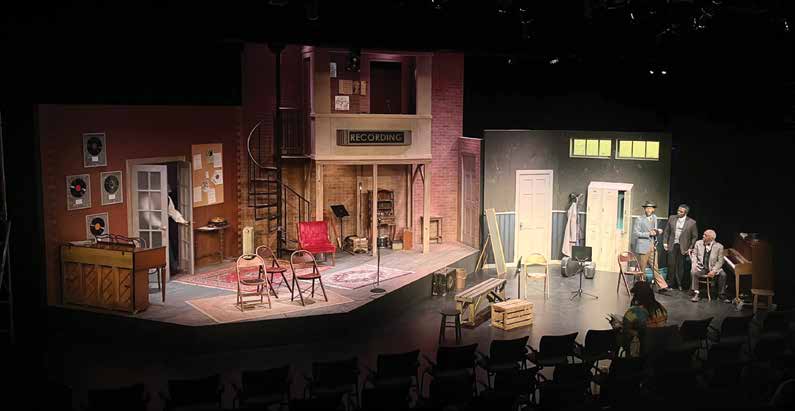
Ma Raineys Black Bottom, which opened at the Little Theatre of Winston-Salem February of last year, is where set designer Fatima Njie discovered how much fun it was to be involved in a process she calls “world building.” She made a checklist and pinned it to a vision board, filling in the details to complete Ma Rainey’s world. 

Sometimes Njie’s best ideas come at 2 a.m. — which is exactly what happened when, as an undergrad at UNCG, she worked on Dontrell, Who Kissed the Sea. “At 1:46 a.m., while at the computer,” she says. “Suddenly, I thought, ah, this.” 

And sometimes inspiration finds her while she settles in with a coffee, observing, “being around people going about their day.” Often, that’s at Camino Bakery in Winston-Salem, “where I can people-watch in peace.”

Odd moments inspire her, so Njie (pronounced “Jie” with a silent “N”) keeps a notepad handy. 

In fact, such random moments influenced her work last spring on a bare-bones-budget, teen production of Twelfth Night for Creative Greensboro and Shared Radiance.

Under creative director Chappell Upper, she had creative carte blanche, which thrilled her.

The vision for her set designs occurred last spring during a fly-on-the-wall moment. 

Sitting beside two women lost in conversation, “I was eavesdropping,” she admits. “One of them had just gotten engaged. I got to hear all her wedding plans. She was really happy. How she met him — it was all so great.” Njie, meantime, flashed to Twelfth Night, naturally, a play “in which everyone gets married.” 

Inspired, she set to work designing heart-shaped walls (staged at the Hyers Theater). “A house over here, and a house over there,” Njie describes. “One of the houses looked like a broken heart. Another house was a full heart.”

Taking artistic license, she reimagined Shakespeare’s play through the pop-art lens of modern romantic comedy.

“Especially with Olivia, who has lost her brother and her heart is broken,” Njie explains. “I depicted her home/set as incomplete.” All of which, she confesses, grew from eavesdropping on strangers.

If you’re young, ambitious and making theater your life’s work, which Njie is, you must rise to the moment, no matter what — and quickly — using every single resource to create a convincing world.

Sometimes, armed with little more than fabric, a glue gun, some paint, wood, nails and her imagination, Njie needed to manifest the best possible set. Regardless of the budget or project, her vision had to support the plot and the characters. To Njie, it was just another challenge posed by working offstage instead of onstage. Having consciously chosen behind-the-scenes work over acting and modeling, Njie realized that working in tech and design was just as creatively appealing as acting but also practical. “It not only paid more, but it was in more demand.”

No auditions and less uncertainty, too.

Today, Njie is a working designer for sets and lighting at Creative Greensboro (which calls itself Greensboro’s “office for arts and culture”) and assistant technical director for lighting and sound at Temple Theatre in Sanford. She is a calm, collected and resourceful 20-something who dresses like the model she once was. 

Wearing her hair down in loose curls with a black ensemble, including a long duster/coat and high-heeled boots, she easily looks the part of a posh character herself, ready to walk onstage.

In fact, she is a sometimes actor, but she is an aesthete who has proven her skills wielding an array of creative tools. While her work won’t be celebrated at curtain call, Njie invests weeks before opening night working with props and the various tools of stagecraft and artifice that conspire to make a production believable. 

For Twelfth Night, she transformed a sad-looking chaise. “I made a chair to go with it . . . it wasn’t that good,” she insists. But it worked and was used in later productions. 

These are early days for her budding career, but Njie is one to watch, according to Sherri Raeford, head of performing arts company Shared Radiance, who has worked with Njie on at least five productions. 

“She’s one of the most versatile theater artists you could meet,” praises Raeford. “I’ve worked with her as an actor, a hair designer, a stylist — in so many capacities — and she always does quality work.”

While a teen in Durham, Njie first tried on the nickname “Jewels,” a name she ditched by the time she entered college, adopting Fatima, a version of her given name Fatou (a popular West African name derived from Fatimah).

For good measure, Njie exchanged her middle name, “Secka,” for “Venus.”

Njie is unashamedly ambitious for her future, having earned a degree in media studies and theater from UNCG in 2022. 

Raeford mentions Njie’s 2024 nomination for a Broadway-World Charlotte Award for set design. As for which production, Njie had to think, given she easily creates six or seven in a single year. 

“It was for Then There Were None, the Agatha Christie work.” 

But now, Njie still thinks her best work so far was seen in Ma Rainey’s Black Bottom, a 2025 production of the Little Theatre of Winston-Salem directed by Tomeka Allen.

“I think that was my best work since Dontrell, Who Kissed the Sea.” 

Each set differs vastly. Her work on Romeo and Juliet at the Stephen D. Hyers Theatre in the Greensboro Cultural Center required sets to be minimal, heavily relying upon Njie’s lighting skills.

“With Ma Rainey, there was a much bigger space.” Her designs reflected that.

A fondness for painting and skills in photography and video editing add to her versatility. After all, she’d always possessed the creativity required for that work. “I liked painting, and had been painting since I was 2 years old.”

Before she was born, Njie’s family immigrated from The Gambia, a place where her mother’s own ambitions were tamped down and she became a stay-at-home mom. Born near Atlanta in Fulton County, Ga., her family moved to North Carolina, living first in Farmville and then Wilson. By sixth grade, Njie was completely taken with the world of drama.

Her mother wanted her “to be successful, because . . . she did have dreams and goals, but never went after them.” But Njie had defined goals which her mother nurtured, moving so that her daughter could attend better schools, ultimately to Durham. “Durham has a big theater, an arts community. A lot bigger than Wilson would have had.” 

“Man, I really liked being on stage and making people laugh and smile — and, you know, making an impact. Live entertainment has some sort of magical aspect to me.” 

By high school she began modeling, already imagining an acting career.

She found work at the Durham Performance Arts Center and a second job at a diner nearby but was laid off from both during the pandemic. “I loved that job [at the diner], too,” she recalls wistfully.

“I didn’t love modeling,” she says flatly. She was appalled by the “ridiculous standards to keep up with and how dangerous it can be.”

Nowadays she might miss a meal or two during a theatrical deadline — but not to meet an agent’s demands to be skinnier, Njie stresses.

Njie moved from the Triangle to study theater at UNCG. 

“Nobody knew what was going to happen to live entertainment,” she says. She chose to concentrate her energies upon the technical aspects of drama and media studies.

It was a practical decision that allowed her to use her various talents.

At UNCG, freelance designer Tab May became Njie’s mentor after seeing her work in September 2022 for Dontrell, Who Kissed the Sea. “He saw the set and said, ‘Wow, this is gorgeous!’” Njie beams. She felt pride in what she had done, posting on Facebook, “The curtain closes on Dontrell, Who Kissed the Sea. I can say with confidence this was the best set design I’ve ever done, because it’s the first.”

“I didn’t eat for 26 hours trying to finish everything on time. I worked hard,” she says, putting every skill she had into bringing the story to life.

Later, May supported Njie’s interest in filling his old job at Creative Greensboro when he left to work in technical design in Winston-Salem, introducing her to Todd Fisher, performing arts coordinator at Creative Greensboro.

“I never had an interview,” recalls Njie. “I sent Tab my cover letter. A week later, I learned I was welcomed to the team.” May’s endorsement, it turns out, was enough.

The role at Creative Greensboro became Njie’s first “official” job in set designing. 

Young enough to understand the difficulty in getting a professional footing, Njie keeps close to other young theater hopefuls. She volunteers as a lead practitioner on workshops for teens interested in the arts, a joint project of Shared Radiance, which adapts and stages Shakespearian dramas for youth productions, and Creative Greensboro

“Pop art is fun,” Njie says. 

For many theater goers, the set itself becomes a leading character. She lights up at the idea. “That is a compliment!” 

At Temple, where she enjoys working with technical director Austin Hendrick, she’s gearing up for a spring show. “My next design will be Bright Star . . . kind of close to my heart. It made me cry and I’m not a crier,” she says. 

As always, Njie “will live and breathe that show until it is over. Theater is just like that.”

Each show teaches her something new, a trick, hack, or something they don’t tell you in school. Valuable information from “being in the real world, as they say.” 

As for her dreams, funnily, “they change a lot.” When “young-young,” Njie wanted to join a touring company. Or Saturday Night Live, but she decided she wasn’t funny enough.

“But now, I think I’m in the place where I have my support system. There’s something for me here,” she says happily. “Companies and people I like working with.”   

And she has added a new dream, “a grand dream of restoring Creative Greensboro to its former glory . . . pre-COVID.” Not single-handedly, she adds, but she wants to play a supportive part in a huge comeback. 

Meanwhile, Bright Star, written by Steve Martin and Edie Brickell, will open at the Temple in April.   

“The story is about family — and that is a subject that is close to my heart — set in two time periods. A woman having a child out of wedlock is looked down upon,” Njie continues. As with her other productions, Njie’s honing her craft. Her goal with this one — and with every subsequent show? “I want to not just be good, but be the best.” 

I’ll show you, which is kind of how I approach it,” Njie says, rising up from her chair with a former model’s poise. 

Who would doubt her

Simple Life

SIMPLE LIFE

The Man in the Mirror

And the power of a slow and careful shave

By Jim Dodson

A couple months ago, somewhat out of the blue, I had a small awakening.

I decided to shave the way my father did on every morning of his life — a slow and careful ritual performed at the bathroom sink, facing himself in the mirror.

Sounds a bit silly, I know. But rather than shave quickly in the shower with a disposable razor as I’d done since college, purely in the interest of saving time and getting on to work, life and whatever else the day held, it occurred to me that my dad might have been on to something important.

As a little kid in the late 1950s, you see, I sometimes sat on the closed toilet seat chatting with him as he performed his morning shaving routine. I have no memory of things we talked about, but do remember how he sometimes hummed (badly, I must note — the result of a natural tin ear) and once recited a ditty I recall to this day.

“Between the cradle and the grave, Jimmy, lies but a haircut and a shave.”

For years, I thought this bit of mortal whimsy was original with him, an adman with a poet’s heart, only to learn that it was really something he picked up from an old Burgess Meredith film.

No matter. His shaving routine utterly enthralled me. He began by filling the sink with steaming hot water and washing his face, holding a hot cloth against his skin. Next, he would pat his face dry with a towel and apply shaving cream in a slow, circular motion with a soft-bristled brush from a mug of soap he’d worked into a lather. I can still hear the faint swipe of his razor as it did its job.

As he aged, he abandoned the brush and mug in favor of an aerosol can of shaving cream, simply for convenience. But he never gave up his old-style “safety” razor that he used till the end of his days.

Watching him shave almost felt like observing a holy act. And maybe to him, it was.

During our final trip to England and Scotland in 1995, we had nine wonderful days of golf and intimate conversations. My dad’s cancer had returned, and he didn’t have long to live, but to look at him go at that moment you never would have guessed it.

During one of our last evenings in St Andrews, I remarked how curious it was that he still used his old-fashioned “safety” razor.

He smiled and explained, “With this kind of razor you must take your time. I always found shaving a good moment to look at the old fellow in the mirror and ask myself, so who are you? And what small thing can you do today for someone in this big and troubled world?”

I wasn’t the least bit surprised to hear him say this. My nickname for my dad — as I’ve mentioned before — was “Opti the Mystic,” owing to his knack for doing small acts of kindness for strangers. With several mates from the Sunday School class he moderated for a couple decades, for example, he helped establish a feeding ministry that is going strong to this day. 

Another time, as I recounted in my book Final Rounds, he picked me up from guitar practice with a depressed and drunken Santa in his car. He’d found the poor man wandering around his office’s empty parking lot, threatening to shoot himself during the holidays. We took him to a local diner and fed him a good meal so he could sober up a bit. Then, we drove him home to his tiny house on the east side of town. As he got out of our car, Opti discreetly slipped him a $50 bill and suggested that he buy his wife something nice for Christmas. The man thanked my dad, looked at me and growled, “You’re [effing] lucky, kid, to have an old man like this, a real Southern gentleman. Merry Christmas.” 

I was indeed. But frankly, it wasn’t always easy having a dad who cheerfully spoke to everyone he met and never seemed to lose his cool in any situation. Another time, I came home from college to find that my mom had impulsively given 10 grand out of their savings to a “needy young woman” at the Colonial grocery store. I was incredulous and wondered why she did this, pointing out that the woman was probably just a con artist.

“Because your father would have done the same thing,” she calmly answered.

“True,” Opti chipped with a wry smile. “Just not that much.”

As we sipped an expensive brandy Winston Churchill had reportedly preferred during the war on that distant night in Scotland, I reminded him of the famous Colonial store giveaway and the good laugh we shared over it for years. 

The story brought home to me how much I was going to miss this very good man. He then told me something that raised a big lump to my throat.

“When your granddad was dying, he asked me to give him a proper shave so he would look presentable when he met his maker.”

My late grandfather — whose name, Walter, I share — was a simple working man of the outdoors who probably only darkened the doorway of a church a few times in his life. Yet he wanted to meet his maker clean-shaven. 

“So, I gave him a nice, slow shave. He even asked for a bit of spice aftershave. It made him happy. He died peacefully a day or so later.”

We sipped our brandy in silence. “Maybe someday,” Opti remarked, almost as a second thought, “you can do the same for me.”

By this point, I could barely speak. I simply nodded.

Five months later, on a sleety March night, I did just that.

Which may explain why, as I approach the age Opti was when we made our journey together, the idea of carefully shaving in front of the bathroom mirror suddenly seemed like a good thing to do in these days of such social turmoil and chaos.

And so, for my birthday this month, I gave myself a new chrome Harry’s razor and took up the slow shaving ritual I’ve known about since I was knee-high to a bathroom sink.

Most mornings, I now find myself facing the man in the mirror, asking what small thing can I do today to makes someone’s life a little better?

It’s only a start. I’m nowhere near Opti’s level of grace yet. But I find myself frequently smiling in the grocery store and offering kind words to complete strangers. I’m even driving with greater courtesy in traffic.

Someday, hopefully many years from now, I may need to ask my son or daughter to give me a slow, final shave before I meet my maker.

Or maybe I’ll ask my brand-new granddaughter to handle the job when she’s grown up a bit. 

Whoever it is, the man in the mirror will be deeply, and forever, grateful. 

Life’s Funny

LIFE'S FUNNY

Phone Home?

No problem — if I can find it

By Maria Johnson

Because my husband, Jeff, and I are happily in a phase of life when we’re done with climbing ladders — both the corporate and the gutter-cleaning kinds — people will sometimes ask us, “How do spend your time?”

That’s easy: We look for our cell phones.

A lot.

So much so that we’re considering getting a landline again just so we can call our misplaced mobile phones.

Either that, or I’m gonna tape an oversized silk flower to my phone, like they do with pens at a bank.

Side note: If you still enjoy walking into a bank, pouring a jar of pennies into a coin-counting machine and feeling rich when you walk out with $12 in paper money, we could be friends.

More on this later. Back to the phone story.

Thank goodness, Jeff and I usually lose our cell phones one at a time, often while the other person is home.

Take the other day.

There we were, sitting in his upstairs office, sipping coffee and talking about our plans for the day, which, at that idyllic point, did not include spending a good chunk of the morning looking for my phone.

Mainly because I was holding my phone, glancing at my texts.

Then I decided to be more “present.”

Sigh.

See, we sometimes get on each other’s nerves by looking at our phones while the other one is talking. I know. It sucks. Especially when you’re the one who’s doing the talking.

Not so much when you’re “listening.”

Anyway, I realized that I was paying more attention to my friend’s text recommending a podcast called Dogs of Chernobyl than to what Jeff was saying, so I set my phone aside to focus on his words.

“Mmmm-hmmm,” I affirmed.

“I seeeee,” I validated.

“Gotcha,” I mirrored.

The next thing I know, I’m getting ready for the day, and I can’t find my phone.

Here, I would like to say that I don’t spend anywhere near the amount of time that the average American woman my age spends on her phone, which is . . . standby while I look this up on my (spoiler alert) phone … five hours and 17 minutes a week.

My weekly screen time is . . . hold on while I look this up, too.

Hmm.

Never mind. Not important.

What’s important is that I had a busy day ahead of me, but I couldn’t tell exactly how I was going to be busy without consulting the calendar on my phone.

Plus, how was I going to listen to Dogs of Chernobyl in the gym?

So, I did the most common-sense thing: I remembered the last time I had my phone — in Jeff’s office — and I returned to the scene.

Jeff was sitting at his desk, calmly working away, as if no crisis were unfolding.

I looked at the couch. No phone.

I felt between the cushions.

No phone.

I crawled around on the floor, looking under the couch.

No phone.

“Have you seen my phone?” I asked.

“No,” he said.

I retraced my steps. Office to bedroom to bathroom.

Bathroom to bedroom to office.

I closed the loop.

No phone.

“I’ll call it,” Jeff offered.

I appreciated his help, but I knew it wouldn’t do any good. My ringer was turned off, mainly because during the daytime I’m swamped with audio alerts from my Mom’s indoor security cameras.

In case you don’t know, these wireless contraptions are truly miraculous, and very helpful in keeping aging parents safe. But they tend to overshare. The cameras, that is.

Hence the silent phone.

But no worries. We had a backup plan for my phone.

“Could you use your Find My app to look it up?” I asked Jeff.

He did.

Twice before, this feature — which allows you to track another device — had helped us locate my phone, which I had dropped while hiking in the woods.

Fact: It’s fairly easy to spot a large lavender phone lying on top of leaves beside a trail.

But this time, on Find My, the gray dot representing my phone covered half the outline of our house.

Which meant a lot more potential hiding places.

For the sake of space, I will condense the next hour of our lives into a cartoon. You know the Family Circle comic where the mom asks Billy to go next door to tell Dolly it’s time for dinner, and the next frame shows Billy’s footprints all over the neighborhood, through swing sets and see-saws and hopscotch grids, before landing at the neighbor’s house?

Well, that was us.

Like tourists in a big city, following GPS “walking directions” by turning this way and that, waiting for the satellite to catch up and move their arrow in the right direction, we wandered through the house, delicately holding Jeff’s phone in front of us, following it like a magical beacon.

“I feel like a water witch with a divining rod,” Jeff said.

“Shhh!” I whispered, as if my iPhone might hear us and scurry away. “Look! We’re moving.”

My phone’s gray dot hovered near a wall that separated two rooms.

We searched both rooms.

Even though I was fairly certain I had not gone downstairs, we searched there, too, because the gray dot did not indicate which floor it was on.

Times like this, you realize how far you will go, trying to make a story make sense.

I found myself looking in my sock drawer.

In my nightstand.

In the laundry basket.

Inside the flippin’ dog food bin, for gawd sakes.

“Well, I don’t remember stirring the salmon and rice kibble with my iPhone, but you never know. I mean, the dot says you’re right here.”

Finally, I gave up and announced that I was going to the gym without my phone.

“If you find it . . . don’t call me,” I said, forlorn. “I’ll be in the gym, watching Stephen A. Smith with no sound.”

Side note: Watching ESPN’s First Take commentator Stephen A. Smith with no sound is almost as much fun as watching him with sound. Almost.

While I was out, I announced, I would run a few errands, including picking up some brackets to mount a wall hanging. I walked into a bedroom at the other end of the house to double-check the size of the wall hanging.

Yep.

There it was.

On the bed.

Next to the wall hanging.

My iPhone.

Obviously I had gone in there, at some point, after talking to Jeff that morning. I probably needed to lie down because I was so exhausted from being “present.”

Anyway, that’s my story, and I’m sticking to it.

“AHA!” I shouted from our older son’s childhood room. “Found it!”

“Where?” Jeff called from his office.

“In John’s room,” I hollered.

A few seconds passed. I knew Jeff was calculating.

“That app is not accurate inside of 30 or 40 feet,” he said.

“Mmm-hmmm,” I said absentmindedly, following my friend’s link to Dogs of Chernobyl.

A few more seconds ticked by.

Any second, I thought, he would walk into the room with his iPhone to test his theory.

Instead, I heard a plea.

“Do me a favor?” he said.

“Sure,” I replied.

“Call my iPhone?”