Birdwatch

BIRDWATCH

Surprise Sightings

The rarest of hummingbirds

By Susan Campbell

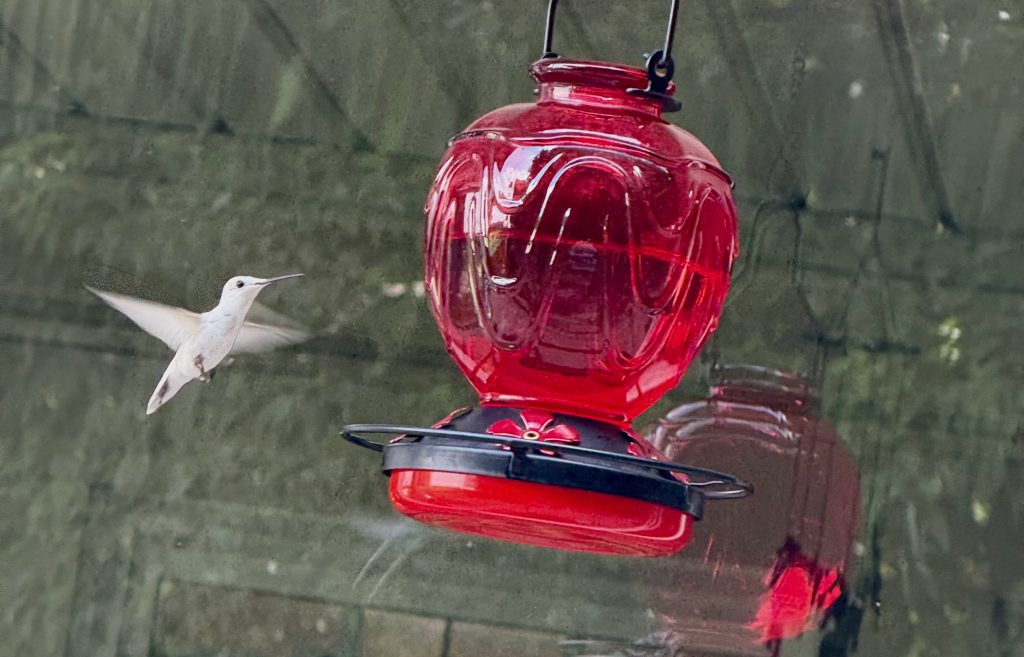
If you happen to look out the window and see a flash of white at your hummingbird feeder or flowers, you may not be imagining things. Typically, late summer is when I receive a report or two from hosts who have glimpsed a rare pale-colored hummingbird. Birds in unusual plumage tend to be noticed and, given the network of bird enthusiasts I am familiar with, reports of unusual hummingbirds find their way to my phone or computer pretty quickly.

White hummingbirds include both leucistic (pale individuals) as well as true albinos (completely lacking pigment). Gray or tan hummers are more likely than full albinos. Light-colored individuals have normal, dark-colored soft parts such as dark eyes, feet and bills. Albinos, on the other hand, are very rare. These snow-white birds sport pink eyes, feet and bills, and have been documented fewer than 10 times in North Carolina. To date, only three have been banded and studied closely in our state.

It isn’t unusual for people to think they are seeing a moth rather than a hummingbird when they encounter a white individual, not realizing that these beautiful creatures are even possible. In fact, we know very little about white hummingbirds. Opportunities to study these unique individuals are few and far between. What we do know is that they tend to appear in July or August as young of the year and do not survive into their second season. White feathers are very brittle and likely cannot withstand the stress of rapid wing beats and long-distance migration. Another very curious characteristic is that all these eye-catching birds have been females. So, it’s likely that this trait is genetically sex linked.

The first white hummer I managed to band was a creamy bird in Taylortown, near Pinehurst, over 20 years ago. She was an aggressive individual that roamed the neighborhood terrorizing the other ruby-throateds. The first true albino I documented was in Apex, and that individual was even more aggressive; chasing all the other birds that made the mistake of entering her airspace. To have a chance of studying a white hummer, I must get word of it quickly before the bird heads out on fall migration. I have missed more than one by less than a day.

Just recently I heard about a white hummer in the Triangle area. Excited, I followed up and received permission to try to band the bird. She was mixed in with dozens of other hummingbirds using feeders and flowers on a rural property outside Chapel Hill. Although it took two tries, I was able to get her in-hand. This beautiful hummer was very pale, but had some gray in the tail as well as some tan marbling on the back. Her eyes, bill and feet were still the expected black color.

I hope to hear about another of these tiny marvels before all of the hummingbirds in central North Carolina have headed south. Each one is so unique.

Life’s Funny

LIFE'S FUNNY

A New Lens on Life

The case of the masked bandit and his five-finger discount

By Maria Johnson

Years ago, when our sons were little, they gave me a Mother’s Day gift.

Their eyes gleamed as I peeled away the wrapping paper.

“Oh,” I said, aware of the tender hearts in front of me. “A LEGO set. How . . . cool!”

“Look, Mom!” they bubbled as they grabbed the box from me, flipped it over and pointed to pictures of all of the things that could be made with the multicolored bricks. “Isn’t it great?”

“It is great,” I said.

And I meant it. Because I knew how they meant it. Inside that box were hours — OK, maybe minutes, considering my impatience and their facility with LEGOs — of a shared experience, of making something together.

They knew I would be down, as in down on the floor, with anything they wanted to do. That was a compliment that I treasured. And, honestly, whenever I went with their flow, I experienced the joy of knowing them more deeply, of learning something new and, often, of cracking up at the result of our collaboration.

Fast forward to the moment when I unwrapped a gift from my husband, Jeff, on our recent anniversary.

“Oh,” I said. “A solar-powered . . . Bluetooth-enabled . . . motion-activated . . . bird-cam-feeder . . . equipped with AI identification . . . and a voice alarm. How . . . cool.”

His eyes were gleaming. Once installed, the bird-cam-feeder would be easily the most technologically advanced device in our home. OK, just outside our home.

I realized that the gift represented something we could do together, even though he’s way more into birds than I am. Plus, I had to admit his choice made sense, given the events of the past year. To wit:

I did ask for, he did give me, and I did love reading Amy Tan’s nonfiction work, The Backyard Bird Chronicles, a beautifully illustrated book about how Tan survived COVID by becoming an intense observer, and sketcher, of birds.

I do luvvvvvv watching, and re-watching, the adventures of avid birder and ace Detective Cordelia Cupp in the brilliantly absurd Netflix series, The Residence. (Seriously, Netflix execs, what are you thinking by not renewing that show?)

I did express enthusiasm, in a polite way, when a friend described his bird-cam-feeder equipped with AI identification.

Also tangentially true: I have been known to commit aspirational gifting. Consider the pickleball paddles I gave Jeff a couple of birthdays ago. (“Look, honey! Aren’t they great?!” I said, rising from the table to demonstrate my dinking technique.)

But back to our fine feathered friends: Basically, I like watching birders more than birds, which is why I enjoyed watching Jeff carefully determine the best location for the bird-cam-feeder, in front of our garden Buddha, who understandably wears a slight smile.

He — Jeff, not Buddha — spent many hours figuring out how to mount the bird-cam-feeder (atop a black metal pole); how to make the couplings aesthetically pleasing to me (no radiator clamps allowed); and how to use the app that would notify us whenever the camera spotted a creature.

The first sightings, I must say, were of some truly scary specimens: The Sweaty-Headed Sucker Pluckers.

That’s right. Us. The camera picked us up every time we walked by, headed to the garden to pinch the suckers from our tomato plants.

Jeff tweaked the phone-based app settings to detect only creatures that alighted on the feeder. At first, I was amazed at the different birds that stopped in for a beak full.

There was our friend, the cardinal.

And a purple finch.

And a house sparrow.

And a Carolina wren.

And a thrush.

And a titmouse.

And another titmouse.

And, OK, another titmouse.

And then came the crows.

Oh. Em. Gee.

The crows.

Here, I would like to make a prediction: When the world as we know it comes to an end, it will not become the the planet of the apes. No. It will become the planet of the crows, an obviously superior species that knows how to work together for mutual benefit.

I say “obviously” because once they discovered the bird-cam-feeder, it was a nonstop milo-millet-cracked-corn-and-sunflower-seed hoedown in our side yard.

You know how revelers toss beads from floats in Mardi Gras parades in New Orleans?

Like that. Only instead of throwing beads, the captain of the Crow Krewe would hop up on the perch, bob side to side, and sling seed to all of his crow buds on the ground until, voila, no more beads.

I mean seeds.

This happened over and over again, until Jeff went into the app and figured out how to sound the alarm to scare off unwanted diners.

BZZZZZZ! Gone.

We were satisfied. For a minute. Then we noticed that the feeder would be full of seed at sunset and empty in the morning.

Hmm. Most birds around here, owls notwithstanding, do not feed at night.

Further, the camera recorded no birds overnight.

But something was triggering the camera to record blurs.

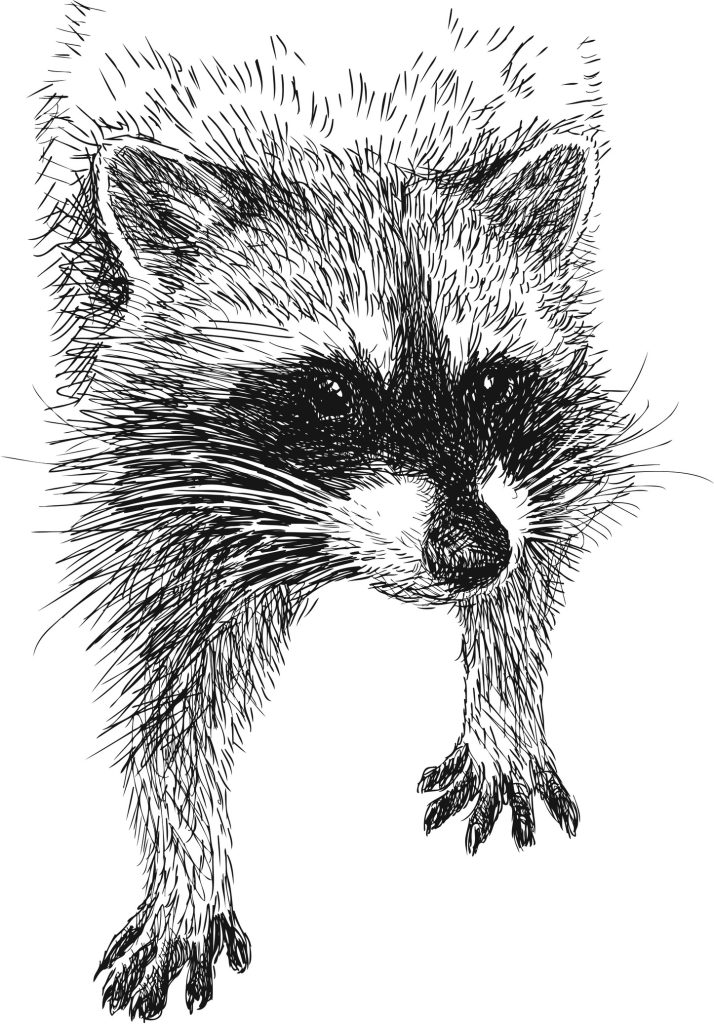
We went into Cordelia Cupp mode, zooming in on the fuzzy photos frame by frame until we spotted a hand. But not just any hand. A hand worthy of a 1950s horror flick. A small, gnarly, five-fingered black hand surrounded by a cloud of fur.

“Barnacle goose,” AI declared.

Huh?

A few frames later, we observed a closeup of sharp little teeth.

“Bonin petrel,” said AI, suggesting a seabird that nests on Pacific islands.

A few frames later, we made out a bushy tail.

“Mute swan,” AI ventured.

A few pics hence, we saw a pointy snout with a sliver of a dark mask.

We didn’t care what the AI bird brain said.

It was a raccoon.

We looked at each other. But how?

We dived into the literature and found out that raccoons have thumbs, which means they can grasp things, like aesthetically pleasing black iron poles, and climb said poles, hand-over-hand, past dome-shaped baffles, to arrive at sunflower seed jackpots.

Nom-nom-nom.

Suddenly, we were aware of a pattern, not that it mattered.

About this time last summer, we were engaged in the War of the Chipmunks, a dramedy that pitted us, the innocent homeowners, against the rally-striped varmints who maintain a thriving chip-o-polis around our home.

This year’s instant classic was the Battle of the Birdseed, starring that insidious urban bandit, the raccoon, which, in truth, I would have been tempted to think of as cute, if not for the fact that it was cleaning out my bird-cam-feeder, which I was suddenly very possessive of.

Ask any politician about the unifying emotions of people who feel they are threatened by “others,” even if the others are, you know, raccoons.

The fortification began.

Problem solver that he is, Jeff hopped on the internet to search “raccoon baffles.” He found one model, a wide-mouth, metal pipe that no raccoon could get a grip on, for $60.

His Scottish heritage — best paraphrased as, “By God, I’ll not pay $60 for a two-foot length of stove pipe”— prompted him to drive to a rural hardware store to buy . . . wait for it . . . a two-foot length of stove pipe for $20.

Which meant that very night I hit “Place Your Order” on the $40 skin cream I’d been dithering about for weeks.

It’s yet another way that we balance each other.

But I digress.

The point is, after many more hours at his workbench, Jeff installed the homemade raccoon baffle, and now we are now the proud owners of a maximum-security bird-cam-feeder, which is highly effective.

How do we know?

The morning after installation, there was plenty of seed for the morning feeders.

And, upon closer inspection, we saw that the stove pipe was covered with muddy, five-fingered handprints that appeared to be sliding downward.

(Insert sound of raccoon fingernails scraping black stove pipe, followed by sharp-toothed expletives.)

We looked at each other and cracked up.

Sazerac September 2025

SAZERAC

September 2025

Sage Gardener

With the end of summer comes the inevitable garden turnover, and the Sage Gardener is thinking about what he can grow without even stepping foot outdoors. You can get a kit delivered right to your front door, from $20 for a 10-piece ensemble found on Amazon all the way to an $899, smart technology, hydroponic, LED-lit, automatically-watered unit (remote camera extra) from Gardyn.com. But a quick survey of my friends suggests you don’t have to break the bank to bring the outdoors in. “I buy basil and parsley at the local Harris Teeter and torture them until they wither,” says an artist friend. “I’ve begun to notice that when I go by the baby plants in the produce aisle, they’ve started recoiling at me.”

Another friend fills her kitchen with herbs from Trader Joe’s, popping the ones that don’t thrive from the pot into the frying pan. Her partner has labeled the sunny little corner of their kitchen, “The Rainforest.” She’s found that mint in particular thrives like kudzu until Derby Day, when it tends to disappear.

Another friend restricts his indoor gardening to chives, which he snips and puts on salads and baked potatoes. My wife and I have found that “mowable” plants are the best bet for our window garden: herbs or leaf lettuce, spinach, endive and Swiss chard. We also grow root veggies for their edible greens. Think beets, turnips, mustard greens and radishes.

A friend in New York City warns that you need the right angle of sun for certain plants to thrive: “The growing season on our south-facing back deck lacks the early spring warmth of North Carolina, but my reliable winter-overs are lovage, chives and sage. This year’s sage plants are almost teenagers.”

A hiking buddy who actually harvested tomatoes from her potted plants says, “I’m no expert but I’ve learned the importance of light, food and water. The key lies in figuring out how much of each, when, and then adjusting the ratio to fit their needs.”

O.Henry colleague Maria Johnson takes her struggling plants to “the urgent plant-care clinic at Plants & Answers on Spring Garden Drive for a quick diagnosis.” If declared fatally wilted on arrival, “there are plenty of healthy replacements to choose from.”

If you’re really serious about all this, I suggest that you google “indoor garden links by Guilford County Master Gardeners.” Or check out a primer written by an extension agent in Person County, who, among many other tips, suggests using equal portions of peat and vermiculite for your soil; fertilizing your plants with a water soluble 15-30-15 formula; and choosing the right window or spot on the patio so that fruiting plants get at least 12 hours of bright light a day. Finally, remember, says the gardening-in-the-kitchen magician, that, except for root and leaf plants such as carrots and lettuce, “vegetables must be artificially pollinated for fruit development. Pollination can be accomplished by taking the powdery pollen from the bead-like anthers with a camel’s hair brush and placing it upon the stalk-like pistil.” And by now we all know plants respond well to music, so may I suggest you set the mood with your Marvin Gaye album? Because it’s time for your plants to get it on.

Just One Thing

Harriet Tubman, Mohandas Gandhi, Frederick Douglas and, seen here, Marian Anderson are just some of the familiar figures artist William H. Johnson (1901–1970) painted in his mid-1930s Fighters for Freedom series. Born to a poor African American family in Florence, S.C., in 1901, Johnson left his hometown behind at the age of 17, following his dreams of being an artist to the Big Apple. There, he worked a variety of odd jobs, saving money to put himself through the National Academy of Design and later serving as general handyman at the Cape Cod School of Art in Provincetown, Mass., where he studied with painter Charles Webster Hawthorne. It was Hawthorne who influenced Johnson’s bold use of color, seen throughout this series, which was created to honor African American activists. Featured were scientists, teachers and performers, as well as international heads of state who were valiantly working toward peace. Among his Fighters stands Marian Anderson, mouth open in song. A contralto, she was the first Black soloist to perform at both the Metropolitan Opera and the White House. In 1939, just a few years before Johnson painted this series, the head of the Daughters of the American Revolution denied Anderson permission to perform at the DAR Constitution Hall because of the color of her skin. Subsequently, First Lady Eleanor Roosevelt resigned from DAR and, just a couple months later,  presented Anderson with the Spingarn Medal, which recognizes outstanding achievement by an African American. Anderson died in 1993 at the age of 96. You can admire her vibrant, colorful portrait, along with several Fighters for Freedom, at Weatherspoon Art Museum’s exhibit, Sept. 6–Nov. 29. Info: weatherspoonart.org/exhibitions_list/fighters-for-freedom-william-h-johnson-picturing-justice.

Window on the Past

Among the vast vinyl collection of the Greensboro History Museum, one shines brightly — the 1976 Rick Dees gold record of the satyrical novelty song “Disco Duck.” Dees, who graduated from Grimsley decades ago, is still rocking a smashing radio broadcasting career. You can tune in to his voice on his syndicated Rick Dees Weekly Top 40 Countdown, and, if you’re a really lucky duck, you might catch him going quack-quack, quack-quack.

Unsolicited Advice

You’ve seen them already, the early signs of fall. No, we’re not talking about foliage — this is North Carolina, folks. But Starbucks released its seasonal menu late last month, so don’t be surprised to catch a whiff of pumpkin spice on someone’s breath. Get used to it. How about some ideas to get into the spirit of the season, Southern style?

Haul out the flannel shirt! But rip off the sleeves for a look that says, “I love fall!” Or, “Wanna hop on my hog?” Either way, we’re into it. And you can repurpose the sleeve by filling it with maize to use as a door draft stopper for when the fall breezes actually start blowing.

Forget the steaming cup of mulled cider. Since we’re in Piedmont North Carolina and it’s still September, cool off with a chilled cider slushy. Sugar, spice and loads of crushed ice. And a dash of brandy for the 21+ crowd.

Crank up the oven for fall baking. Think chocolate-chip pumpkin bread, homemade cider donuts or apple spice cake, the cozy scent of cinnamon and nutmeg wafting throughout your home. Just don’t forget to also crank up the AC, or hints of perspiration will also be in the air.

Take a leaf-peeping road trip. According to Google Maps, it’s only about 17 1/2 hours to Maine’s Mount Katahdin.

And if there’s one thing no other region can top, it’s college football season. Where else is it warm enough to go shirtless and paint your entire torso for game day? Take it from us and spring for the sweatproof paint or you’ll be a puddle of school colors by halftime.

Off the Record

OFF THE RECORD

Off the Record

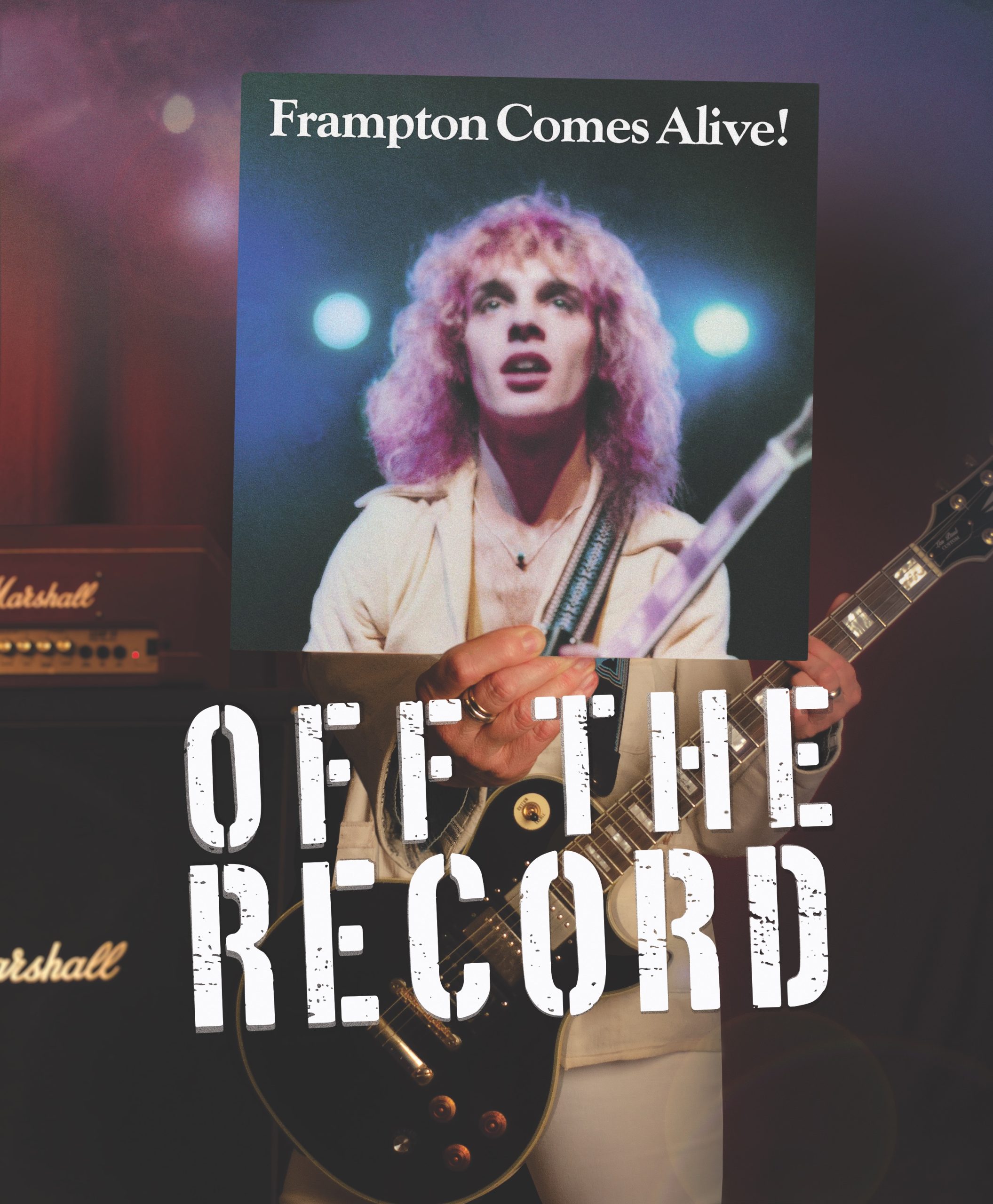
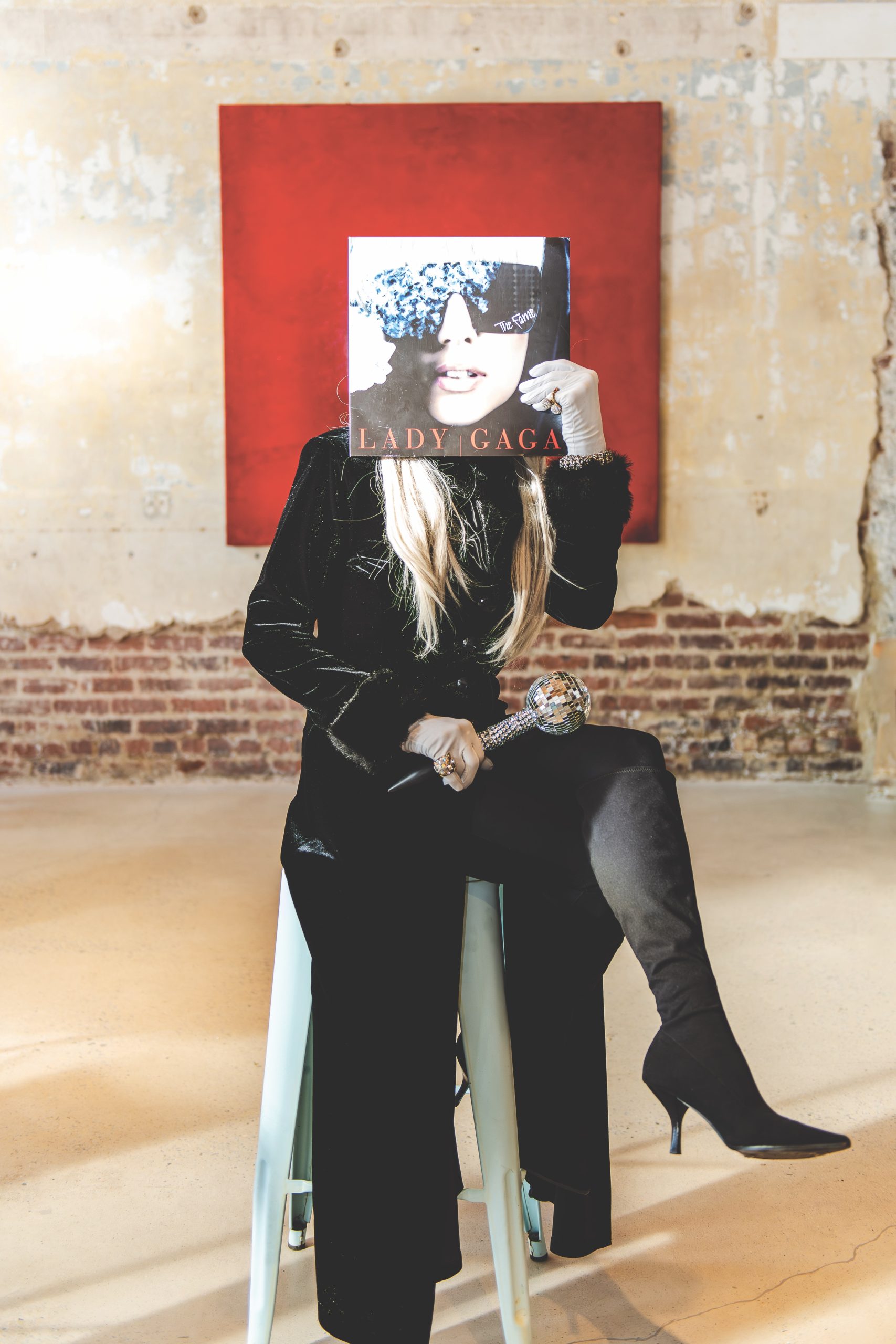
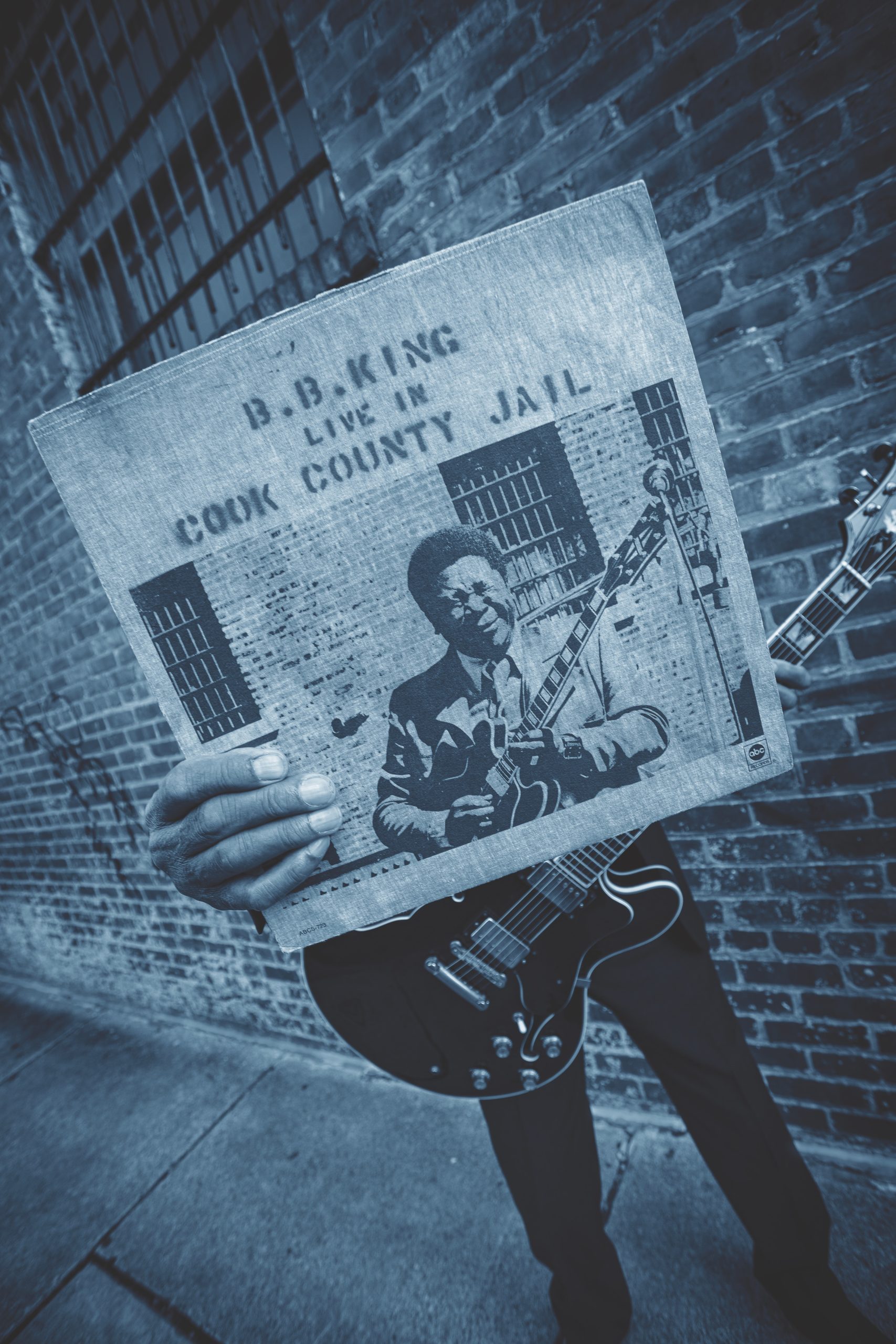
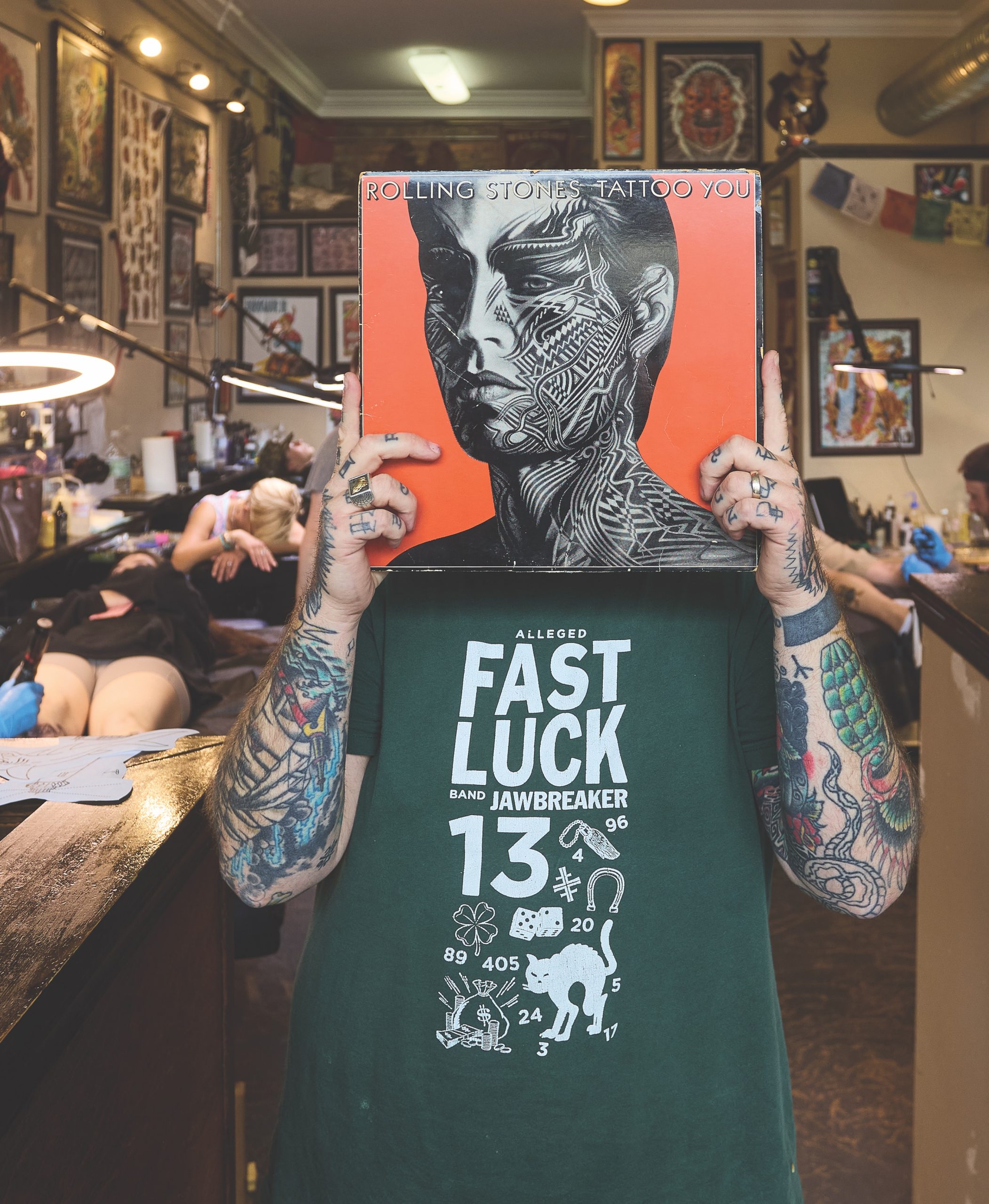
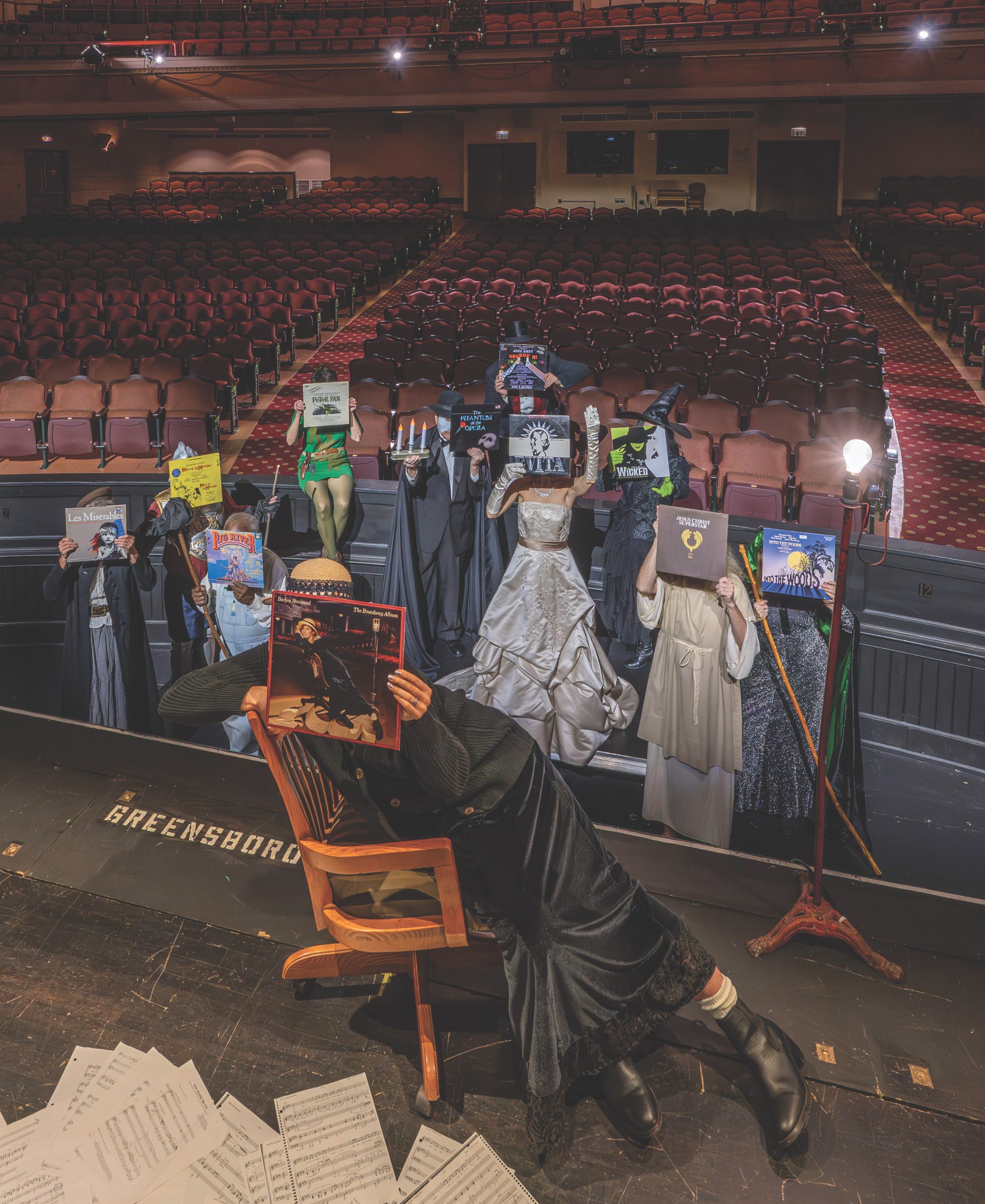
We asked our photographers to think outside the cardboard sleeve. The results? Record setting.

What: Peter Frampton/Frampton comes Alive

Who: Julie Borshak

Where: Keith Borshak’s studio

Photograph: Keith Borshak

What: Lady Gaga/Fame

Who: Leslie Gill

Where: Cohab.Space, High Point

Photograph: Amy Freeman

What: B.B. King/Live in County Cook Jail

Who: Tony Hall - Guitar borrowed from Steward Fortune

Where: Downtown on Washington Street

Photograph: Mark Wagoner

What: Lionel Hampton/Silver Vibes

Who: Byron Grimes

Where: Mark Wagoner’s music studio

Photograph: Mark Wagoner

What: The Rolling Stones/Sticky Fingers

Where: Kontoor Brands World Headquarters

Photograph: Becky VanderVeen

What: The Rolling Stones/Tattoo You

Who: Nathan James Hall

Where: Legacy Irons Tattoo

Photograph:  Bert VanderVeen

What: Barbra Streisand/The Broadway Album

Who: Cassie Bustamante as Barbra Streisand

Eloise McCain Hassell as Éponine, Les Misérables
J.P. Swisher as Don Quixote, Man of La Mancha
Ralph Shaw as Jim, Big River, Mary Ries as Peter, Peter Pan
Lee Kirkman as The Phantom, The Phantom of the Opera
A. Robinson Hassell as George M. Cohan, George M!
Amber Engel as Eva Perón, Evita Pam Wheeler as Elphaba, Wicked
Chip Potter as Jesus, Jesus Christ Superstar
Carole Lindsey-Potter as The Witch, Into the Woods Lighting by Kendall Thompson
Costumes & Props by Winston-Salem Theatre Alliance,
Lynn Donovan & cast
Album covers borrowed from the collections of
Eloise & Robby Hassell, J.P. Swisher, Rachelle Walsh,
Mark & Lynn Wagoner, Brenda Studt,
Carole Lindsey-Potter, Lynn Donovan

Where: Carolina Theatre

Photograph: Lynn Donovan

What: Herb Alpert’s Tijuana Brass/Whipped Cream & Other Delights

Who: Venée Pawlowski

Where: Black Magnolia Southern Patisserie

Photograph: Lynn Donovan

Simple Life

SIMPLE LIFE

Gone East

How a love affair that never happened changed my life

By Jim Dodson

September may be the ultimate month of change.

As summer’s lease runs out, the garden fades, and days become noticeably shorter and sometimes even cooler, hinting at autumn on the doorstep. After Labor Day, summer’s farewell gig, in 39 percent of American households — those with school-age kids — the days bring new schedules and an accelerated pace of life.

Just down the street, a dear neighbor’s firstborn is settling into her dorm at Penn State University. Her mom admits to having tender emotions over this rite of passage.

I know the feeling well. I remember driving both my children to their respective universities in Vermont and North Carolina, sharing stories with their mother on the way about their growing up and marveling how time could possibly have passed so quickly. Without question, dropping my kids off at college was a ritual of parting that stirred both pride and emotion.    

On a funnier note, September’s arrival reminds me of my own unexpected journey to East Carolina University half a century ago. On a blazing afternoon, my folks dropped me off at Aycock dorm, now Legacy Hall, with my bicycle, a new window fan and 50 bucks for the university food plan.

Not surprisingly, my mom hugged and kissed me, and wiped away a tiny tear; my dad merely smiled and wished me good luck. He also looked visibly relieved.

“You made the right decision, son,” he said. “I think you’ll really enjoy it here.” 

The previous winter, you see, I fell hard for a beautiful French exchange student at my high school named Francoise Roux. During the last few weeks before she headed home to France, we had a two-week courtship that included long walks and deep conversations about life, love and the future.

I was too nervous to kiss her. Instead, on the last night before she flew away, sitting together by a lake in a park, I played her a traditional French lullaby on my guitar, an ancient song her father sang to her when she was little. During the drive back to her host’s residence, we even discussed the crazy idea that, when I graduated in the spring, I might forego college in America for the time being in favor of finding a newspaper job in France so we could stay together.

As we said goodbye under the porch light, she leaned forward and gave me our first — and last — kiss. 

It was a sweet but improbable dream. Yet, having won Greensboro’s annual O. Henry Writing Award the previous spring (and consumed far too much Ernest Hemingway for my own good), I decided to skip applying to college and seek a job in Paris. Touting my “major” writing award and one full summer internship at my hometown newspaper, I brazenly applied for a job as a stringer for the International Herald Tribune’s Paris bureau. 

Amazingly, I never heard back from the famous newspaper.

Come middle May, still waiting for a reply, I was having lunch with my dad at his favorite deli when he casually wondered why “we” hadn’t yet heard from the four colleges I’d applied to for admission.

“Actually, Dad,” I said, “I didn’t apply to them. I have a better plan in mind.”

I sketched out my grand scheme to spend a year working in Paris, where I would cover important news stories and gain valuable life experience in the same “City of Lights” that he fell in love with during the last days of World War II. I mentioned that I was waiting for a job offer from the International Herald Tribune.

He listened politely and smiled. At least he didn’t laugh out loud. He was an adman with a poet’s heart. 

“This wouldn’t have anything to do with a certain pretty French girl named Francoise, would it?”

“Not really,” I said. “Well, a little bit.”

He nodded, evidently understanding. “Unfortunately, Bo, you will have to get a draft number this September. And if you get a low number and aren’t in a college somewhere, you might well be drafted. That will break your mother’s heart. How about this idea?”

He suggested that I simply get admitted to a college somewhere — anywhere — until we could see how things panned out with the draft. There were rumors that Nixon might soon end it. Until then, a college deferment would keep me from going to Vietnam.

Reluctantly, I took his advice and applied to several top universities. None had room for me, though UNC-Chapel Hill said I could apply for the spring term. Too late to be of use.

On a lark at the end of May, my buddy Virgil Hudson said he was going down to East Carolina University for an orientation weekend and invited me to tag along. I’d never been east of Raleigh.

On our way into Greenville that beautiful spring afternoon, we passed the Kappa Alpha fraternity house, where a lively keg party was happening on the lawn. I’d never seen more beautiful girls in my life. Young love, as sages warn, is both fickle and fleeting.

“Hey, Virge,” I said, “could you drop me off at the admissions office?”

The office was about to close, but the kind admissions director allowed me to phone my guidance counselor back home and have my transcripts faxed. I filled out the form and paid the $30 admission fee on the spot, leaving me 10 bucks for the weekend.

By some miracle I still can’t fathom, ECU took me in.

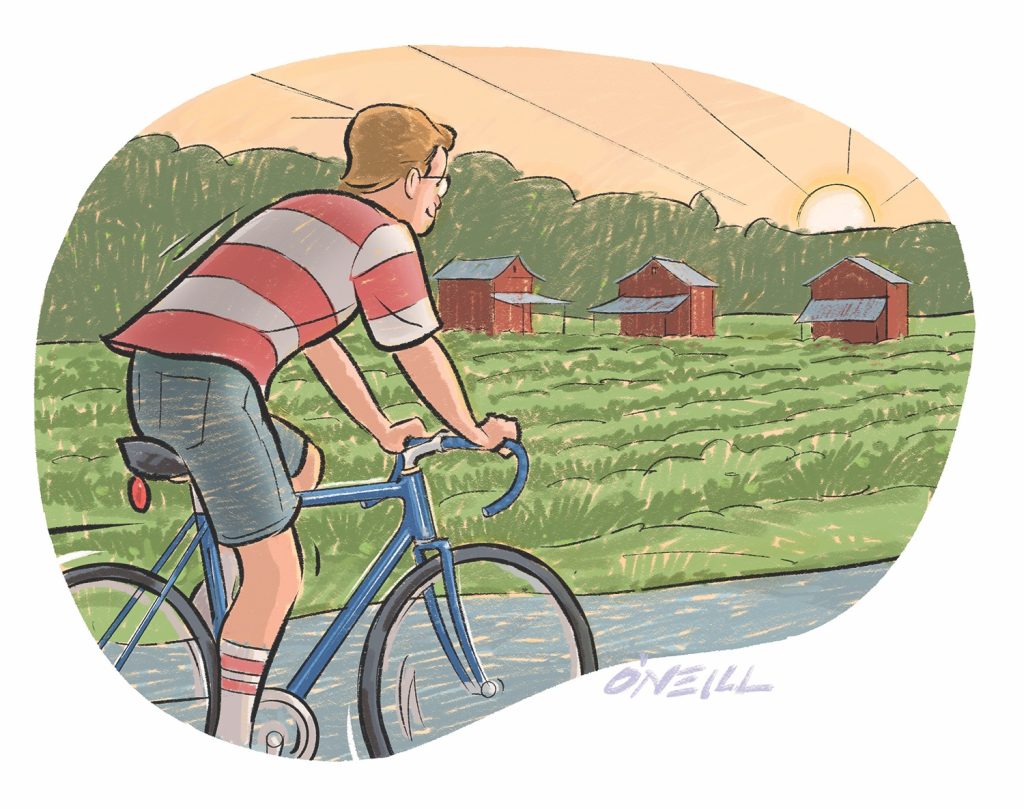
The first thing I did on the September morning before classes got underway was get on my bike and ride due east toward New Bern. As a son of the western hills, I simply wanted to see what this new, green countryside looked like.

The land was flat as a pancake and the old highway wound through beautiful farm fields and dense pine forests. A couple hours later, I stopped at a roadside produce stand to buy a peach and had a nice conversation with an older farming couple who’d been married since the Great Depression. 

I had no idea how far I’d pedaled. “Why, sonny, you only have 10 more miles to New Bern,” the old gent told me with a soft cackle. I got back to my dorm room after dusk — having fallen in a different sort of love.

There was something about this vast, green land with its rich, black soil and friendly people that quietly took hold of my heart.

My freshman year turned out to be a joy. My professors were terrific, and my new friend and future roommate was a lanky country kid from Watts Crossroads, wherever the hell that was. His name was Hugh Kluttz.

We are best friends to this day.

Having “gone east and fallen in love,” as my mother liked to tell her chums at church, I became features editor of the school newspaper — artfully named The Fountainhead — where I wrote a silly column that undoubtedly shaped my writing life.

In 2002, upon being named Outstanding Alumni for my books and journalism career, I confessed to an audience of old friends and university bigwigs that “going east and becoming an accidental Pirate turned out to be the smartest move of my young life — one I indirectly owe to a beautiful French exchange student I never saw again.”

Funny how life surprises us. A few years ago, out of the blue, I received a charming email from Francoise Roux, wondering if I was the same “romantic boy who once played me a lullaby on his guitar?”

We’ve exchanged many emails since then, sharing how our lives have gone along since that first and last kiss under the porch light. Francoise is a devoted grandmother and I’m about to become a first-time grandfather around Christmas. Soon enough, I’ll be playing that old French lullaby to a new baby girl, marveling alongside my daughter and her husband as they embark on their own, uncharted journey. 

Art of the State

ART OF THE STATE

Warp & Weft

The color-jangled painting of Barbara Campbell Thomas

By Liza Roberts

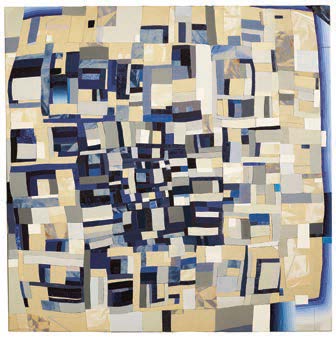
The paintings of Barbara Campbell Thomas are often warped, subtly but unmistakably. Their geometry, the linear shapes and pieces and colors that comprise them, have a slightly distorted quality. Rectangles implied, but some appear to have had a bounce or inhaled a lungful of air. Others seem to have been shaken up or spun around. That’s partly due to the kinetic energy they capture, which seems to indicate recent — even ongoing — movement.

It’s also because they are surprising. Campbell Thomas calls these works paintings, but a careful look makes it clear they are made mostly of pieced fabric. They’re quiltlike, hand-sewn, dimensional. Stretched in unexpected ways. And then painted.

“The pulling and the tension is still an important part of it,” she says. “It’s become even more magical. I spend all of this time in this initial phase, and I kind of have an idea of what it’s going to look like when I finish. Then I put it up, and it’s interesting to see what has been pulled and how the image has come to life in a different way.”

Campbell Thomas is the director of the School of Art at the University of North Carolina Greensboro and has taught there for more than two decades. Her resume is filled with solo and group exhibitions at museums and galleries around the country. Last year alone, her work was shown in solo and two-person exhibitions in Chicago, Illinois; Milwaukee, Wisconsin; Charlottesville, Virginia; and Columbus, Ohio. She has been awarded a number of prestigious residencies including at the Virginia Center for Creative Arts, and has been a recipient of a North Carolina Arts Council fellowship.

When she takes on a new body of work (like the 10 paintings she’s currently preparing for a November exhibition at Charlotte’s Hidell Brooks Gallery), she approaches it with the businesslike, step-by-step planning of a senior academic administrator — but she executes that work with daring and intuition. Campbell Thomas has learned to navigate this duality effectively with time, even as her art has become increasingly complex and her process more fully immersive.

“The piecing and sewing portion has become more complicated and elaborate, involving a lot more small pieces of fabric,” she says. “I’m understanding that layer of the process in a deeper way, so I’m spending more time in that part of the process.”

The stretching of the pieced fabric, which creates its cantilevered quality, comes next.

Once this “ground” of her paintings is set, Campbell Thomas hangs them all around her in her studio. In that way, her physical space can better reflect her “headspace,” she says, “and then the imagery: I understand better what it wants to be.” She can visualize how paint and collage will eventually come together upon these sewn surfaces: “The visual movement of the pieces feels like the big strokes,” she says, “and the collage will be how I refine them, add nuances or cover things that need to be pushed back down. The paintings become more refined. I begin to understand how to contend with the edges.”

Inside and Out

The studio where she does this work, next to her house in rural Climax, North Carolina, is about 14 miles south of Greensboro. It is a color-jangled, layered collage of a space, overflowing with textiles, history, tradition, mysticism, books, paints and threads and fabrics of every imaginable color, pattern, size and shape.

What’s outside — the fields and trees and open expanse of nature — is just as important. “I live out in the country and walking has been very important to me for my whole life. Walking on country roads, being in a beautiful landscape, has always been a touchstone,” she says.

Lately, Campbell Thomas has been trying to create “landscapes” of a different sort. “What would it be to create landscapes that are suggestive of our interior landscape? How do we create spaciousness for ourselves internally? I’ve been thinking about inhabiting a body, and what it means to inhibit a body that feels somehow spacious internally.”

The fractalized nature of her paintings, and the way they often begin in the center and move out to the edges, is her way of representing that phenomenon: “That’s me grappling with that question: how do we inhibit interior spaciousness?’

Fabric as Paint

Navigating dichotomies fuels other types of her work, too. The line where quilting ends and painting begins is one more puzzle to ponder, as is the difference between a painting (or, her version of a painting) and a quilt (a distinct form of art which she also makes).

It’s something she’s often asked about, and something she thinks about a lot. But even as piecing and sewing has become a more comprehensive part of her painting process, she has no doubt that what she makes are paintings. “My orientation as an artist is born in paint, absolutely, and the framework I still operate within has matured and evolved from an understanding of paint as a material,” she says. “That continues to inform everything.”

That dialogue began many years ago with her mother. She’s the one who taught her daughter how to quilt. But it extends through her family tree, to her grandmother and great-grandmothers, makers and stitchers and quilters all. Campbell Thomas has their names listed on her studio wall as inspiration and as a reminder of her heritage. The art journals she carefully keeps are bound with cloth covers made by her mother, who sends her a regular supply.

In these journals, she examines her process and her purpose. Abstraction, she says, allows her to say things she can’t with more literal or figurative types of work. “I’m really fascinated with my sense that there is more to the world than what we can see, and of course that starts to tap into realms of the spirit,” she says. “On the one hand, I’m engaging in this intensely material endeavor, through paint; through fabric. But there’s also this way that this engagement, which is now well over 20 years for me, is a way into spirit.”

Modern Life

MODERN LIFE

Modern Life

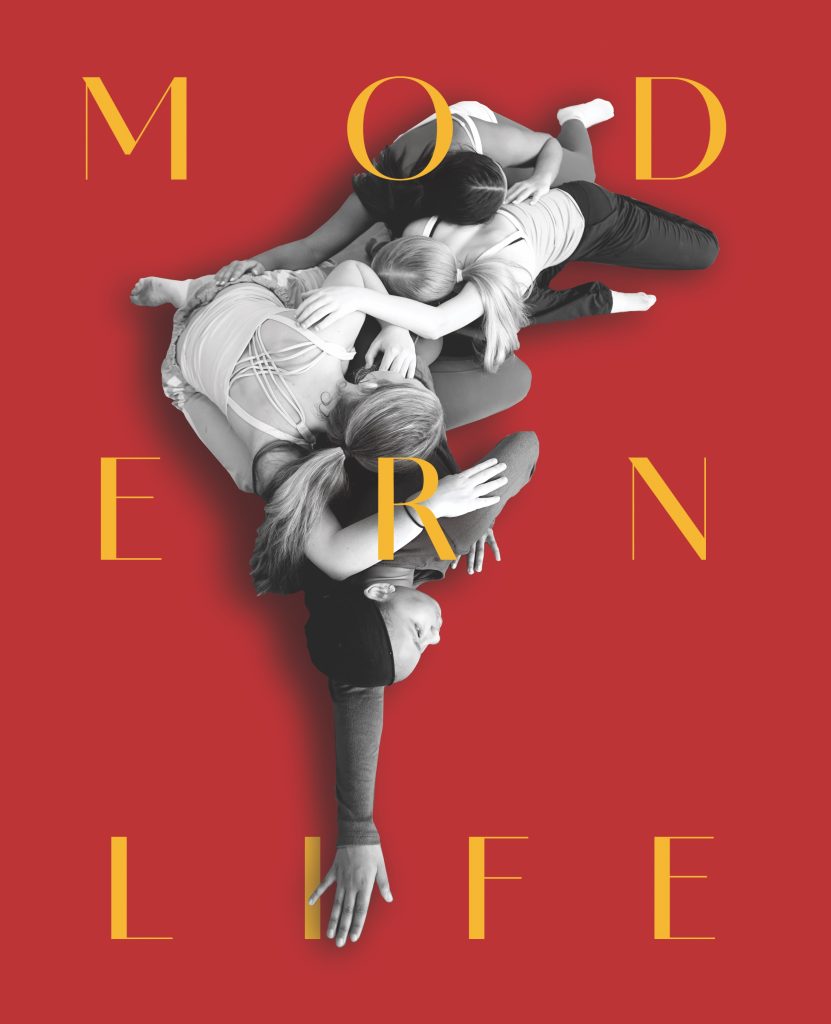
Based in Greensboro, the NC Dance Festival celebrates its 35th anniversary of showcasing the state’s best contemporary dancers

By Maria Johnson    Photographs by Lynn Donovan and Brandi Scott

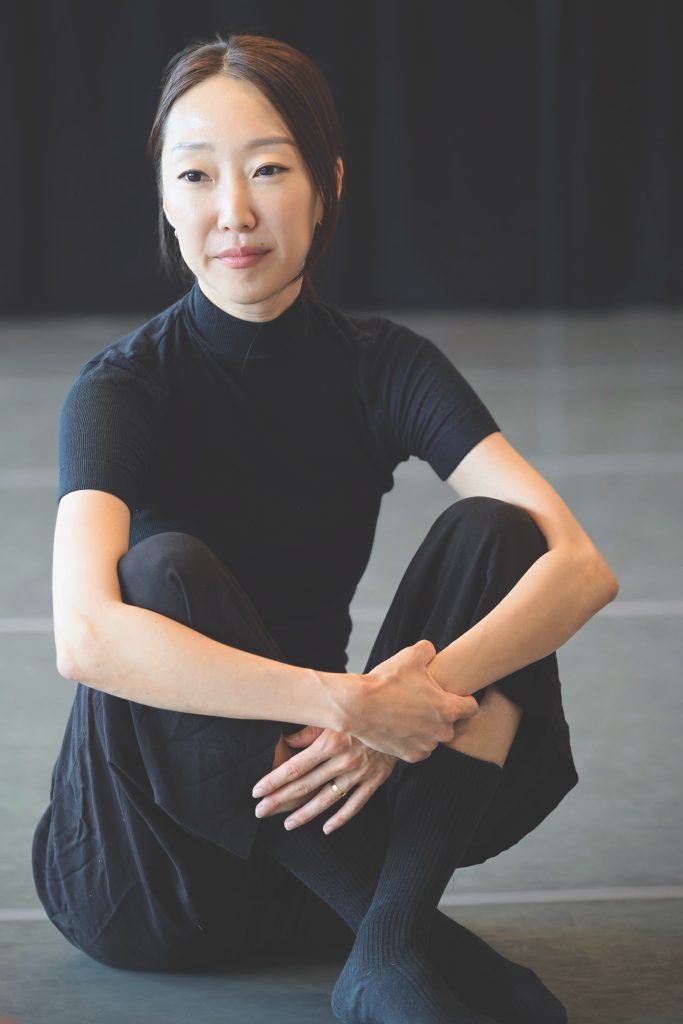
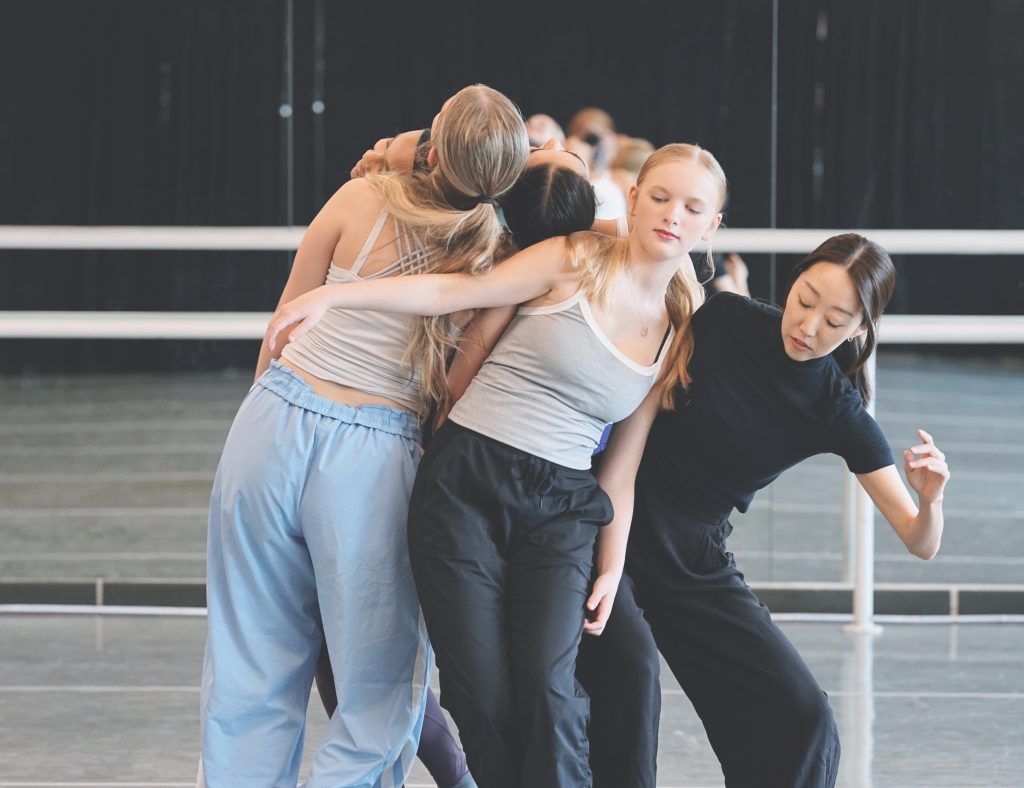
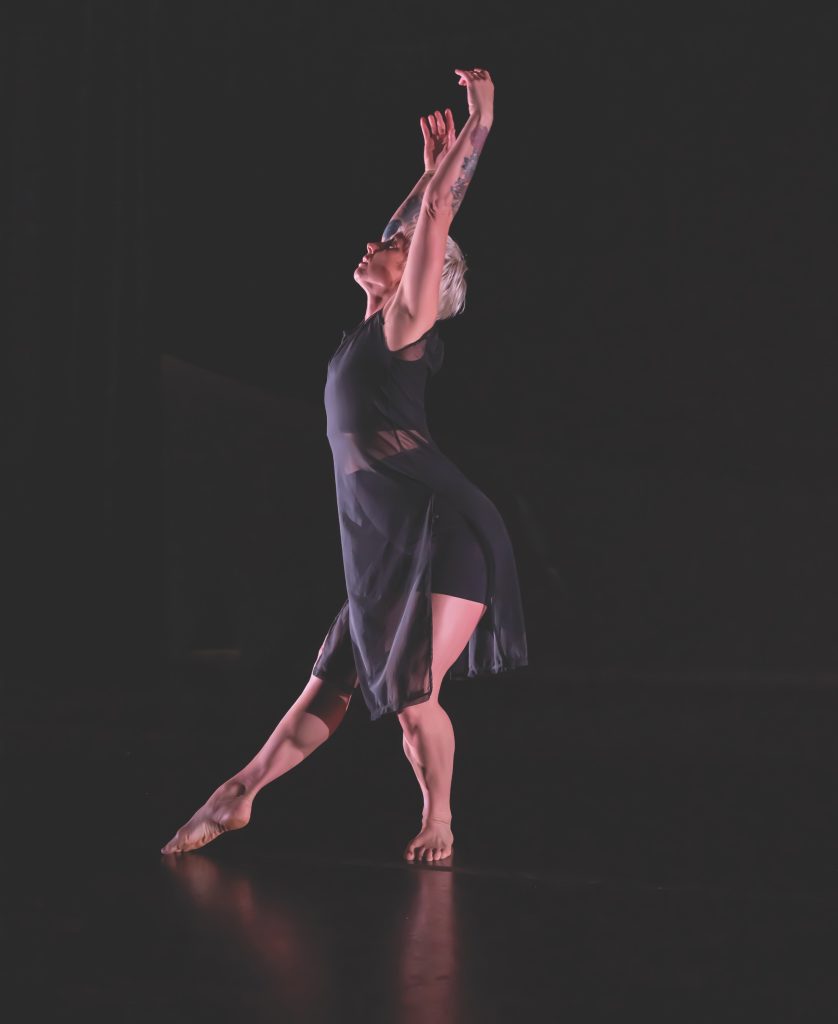
Bathed in fluorescent studio lights and stepping lightly over a cushioned vinyl floor, Jiwon Ha shows her young students how to bolster a fellow dancer who wants to descend gracefully to the ground during a modern piece.

The mechanics are tricky, so Ha, who is remarkably youthful at 40, demonstrates by leaning way over to her right. Dressed head-to-toe in black, she appears as slight and springy as an eyelash.

Her left leg leaves the ground as she reaches the tipping point. She urges her charges to act quickly as gravity does its thing.

“Catch me! Catch me!” she says, hopping on her right foot to stay upright.

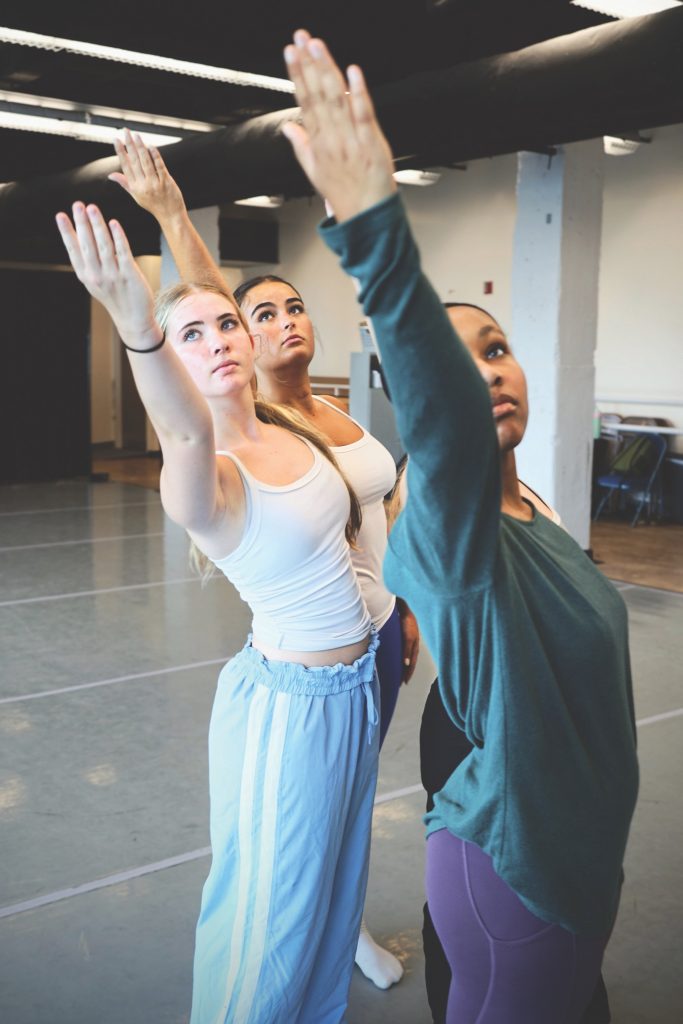
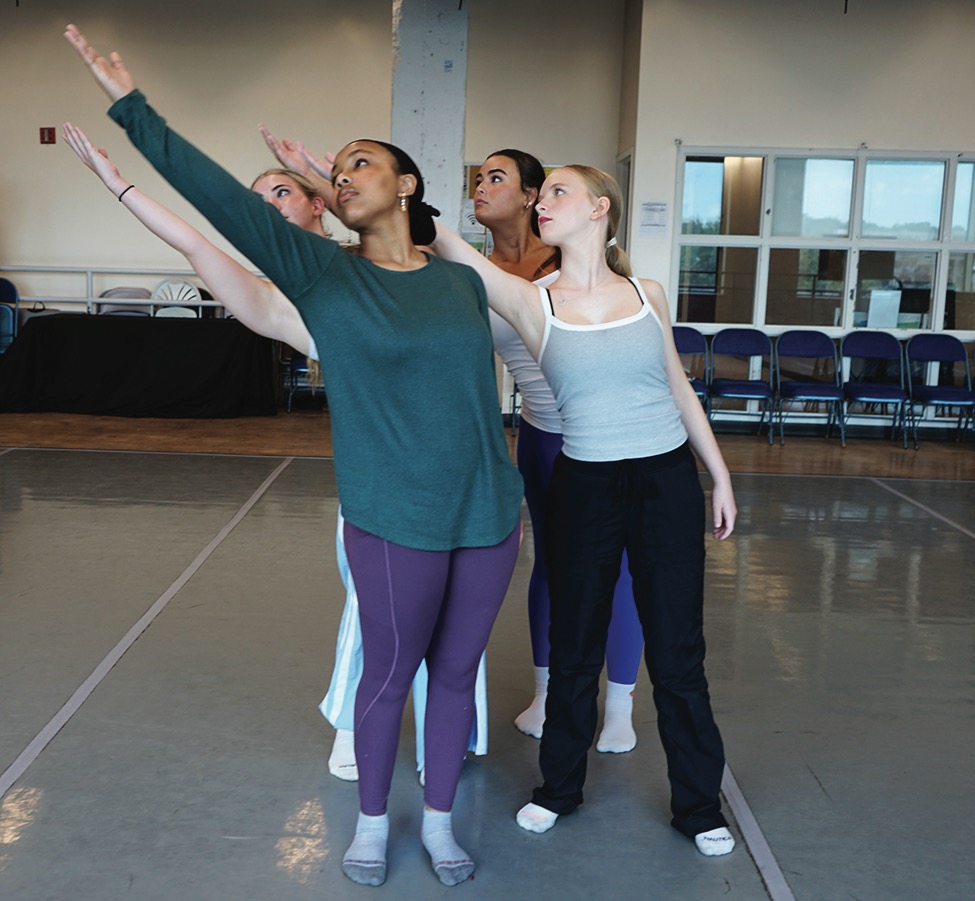
Four teenage girls — all students at Dance Project, a Greensboro-based nonprofit devoted to the art of choreographed movement — rush to grab her by the leg, arm and waist.

Suspended in mid-air, Ha uses the moment to teach: Once the counterweight is right, and the stress is balanced, it’s easy to land softly and rebound again. The underlying structure must be right.

It’s a concrete lesson in the importance of support.

The NC Dance Festival gets it.

On October 18, the annual gathering, which is organized by Dance Project, will mark 35 years as the primary showcase for the state’s modern dancers.

The mainstage program for that day will include some of Ha’s students, who’ll appear as a pre-professional group.

On November 7, the young cast will perform again at a special show for students who have been exposed to dance in local elementary, middle and high schools. Both times, the pre-professional dancers will execute a piece created by Ha, which expresses the emotions of adolescence.

“I want to create a dance piece that will connect with the artists and audience members as well,” Ha says. “I’m super-pumped to be a part of the North Carolina Dance Festival.”

Sure, Durham has the American Dance Festival, which pulls from a nationwide pool of talent, but Greensboro’s celebration is distinct because it focuses solely on modern dancers across the state.

That was the vision of the late Jan Van Dyke, who founded Dance Project as a harbor for her own performing company in 1973. Working with university dance programs around the state, Van Dyke launched the festival almost 20 years later, in 1991, with the goal of growing community support for dance.

The festival traveled from campus to campus for several years. Then came a phase of performing at off-campus venues. Since COVID, the festival has centered mostly on the Greensboro Cultural Center’s cavernous Van Dyke Performance Space, a stage named for the festival’s founder, who died of cancer in 2015.

With Dance Project headquartered a couple of floors above, Van Dyke’s spirit still looms large in the cultural center and in the local dance community 10 years after her passing.

A celebration of her life, co-hosted by Dance Project and UNCG’s School of Dance, will be held on September 28 and will include light refreshments, storytelling and videos of Van Dyke’s work. The event would be a good place for the dance-curious to dip a toe into the festival.

“Some people are a little intimidated by dance — maybe they don’t understand it,” says Anne Morris, executive director of Dance Project and the festival. “We try to open the doors to understanding.”

In crafting the mainstage program for next month’s festival, Morris and her board of adjudicators, who reviewed submissions without knowing who the choreographers were, have tried to assemble a varied menu.

“We work really hard to curate a show that’s a pretty good mix of a lot of things,” says Morris, adding that viewers will see elements of hip-hop, ballet, tap and other genres.

Not charmed by the style of an individual piece?

“Stick around,” Morris urges. “You might find something you like.”

The festival lineup includes an appearance by Stewart/Owen Dance, a well-known company in Asheville. They will perform a work that was commissioned by the American Dance Festival.

“It involves fronts, putting on a mask to be what you think society expects of you,” says Morris. “At times, it has a vaudeville feel.”

Other mainstage artists include:

Alyah Baker, an assistant professor of dance at UNC-Charlotte. Combining dance with feminist activism, she draws on the work of Black poets Nikki Giovanni and Lucille Clifton.

Eric Mullis, choreographer and co-director of the Goodyear Arts space in Charlotte. The multi-talented Mullis is also a Fulbright Scholar and an associate professor of philosophy at Queens University. Fascinated by motion-capture technology, his performance will include video projections of color and movement.

Chania Wilson, a native of Clayton and a 2021 graduate of UNCG’s School of Dance, will present an excerpt from her Duke University master’s thesis performance. The six-person work, called There is a Ladder, deals with documenting the experiences of Black women in dance.

The thought of returning to Greensboro brings back fond memories for the 26-year-old Wilson. She remembers visiting the city to attend a high school dance day at UNCG.

“I was blown away when I got here,” she says. “I loved the energy — how the community and faculty and students engaged. I thought it was the ideal college environment.”

As a student at UNCG, Wilson says, she was tried by circumstances. The university’s main dance studios were under renovation during her freshman year and her classes were scattered to other stages.

“I made a lot of memories sprinting across campus,” she says.

COVID arrived during her junior year, forcing her to attend classes via Zoom. She recalls being in her off-campus apartment on Spring Garden Street, putting a batch of banana bread in the oven, setting her laptop on the breakfast bar, joining an online class, and doing a West African dance in a 4-by-4-foot space she’d cleared by moving her couch aside.

“Doing West African dance on Zoom was interesting because of the drumming. Sometimes, there would be a lag, and I was like, ‘I know I’m not on beat, but I’m trying.’ It was definitely an era,” she says, laughing now about the experience.

“I think every generation has an element of, ‘Oh, we had to work through this to make us stronger.’ For me, I realized that I dance for the sake of being around other people and community.”

Jiwon Ha found similar comfort in the Piedmont’s dance community. She and her husband, John Ford, a software developer from Greensboro, moved here from her native South Korea in 2016.

Ha was wary of relocating because of anti-immigrant sentiment expressed by some Americans during the national election year, but dance allowed her to make connections easily.

“I’m so grateful that dance is a universal thing,” she says. “Once we move the body, we are all the same.”

For a while, she struggled with understanding English, especially English soaked in Southern accents.

“Now I say ‘Y’all’ very naturally, and sweet tea is my new drink,” she says. “I’m grateful that I moved here at that time after all.”

As a dance teacher at Elon University, UNC School of the Arts, and Dance Project, Ha is experienced at guiding young students. She taught teenagers at a dance conservatory in South Korea. There, she says, the teacher-student dynamic is hierarchical. Here, she says, the relationship is more egalitarian, with American students being prone to share ideas with teachers.

“They’re more vocal, which I appreciate,” she says. “It’s a newer generation, and I’m very grateful that I can work with them.”

Her rapport with students is evident in the studio, where she steers them with a keen eye while issuing gentle corrections and ample praise.

“Fall.”

“Rise.”

“Softly walking.”

“Reaching out.”

“Latching arms.”

“Eyes sparkling.”

“Good”

“Nice.”

“Beautiful.”

Ha uses the Graham technique, as in the legendary dancer Martha Graham, which emphasizes the contraction and release of spine. Cupping the hands and spiraling with an open, lifted chest are two hallmarks of the technique.

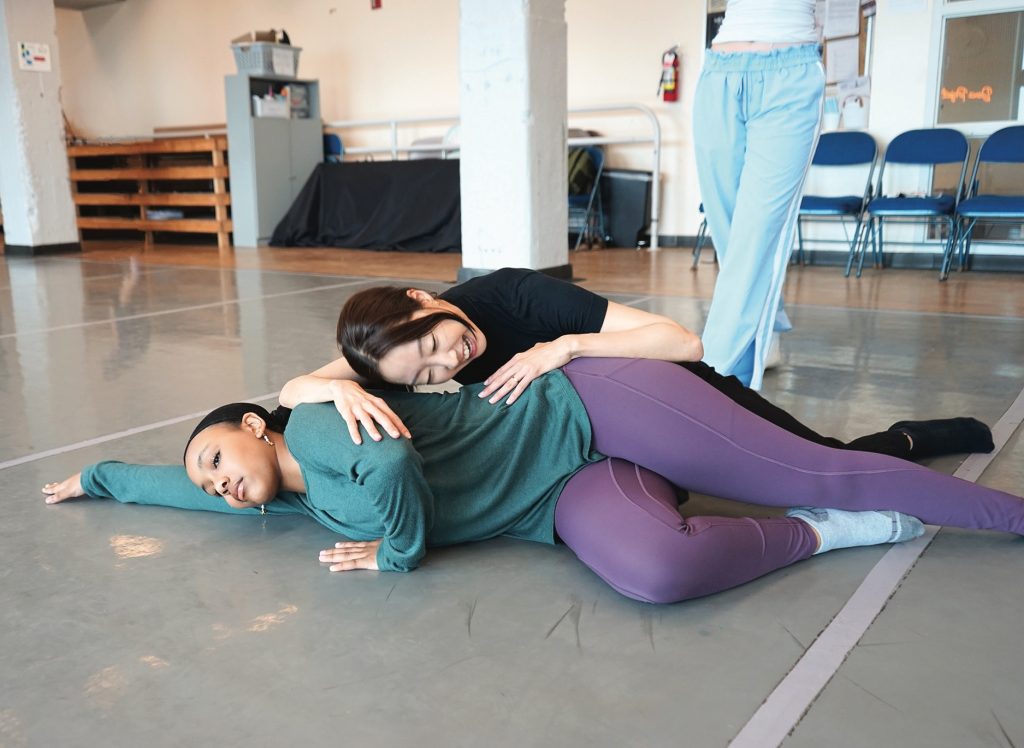
Ha is quick to demonstrate to her students, often dancing beside them. When they veer off course, she nudges them with a light touch to the arm or back. The dancers appreciate her hands-on approach.

“Jiwon is really specific, and I like that because it allows me to work on my technique and choreography while feeling really comfortable,” says 15-year-old Heba Shawgi, a student at The Early College at Guilford.

From dance, she says, she has learned lessons that apply to school and personal relationships as well.

“It’s important to be yourself and realize everybody makes mistakes,” Shawgi continues. “Everybody is going through the same learning process.”

Sitting on the floor, chatting with Ha after their class, the girls share what modern dance has meant to them: a place to build physical strength and skills; a place to find friendship and connection with like-minded people; and a place to grapple with emotions, especially the anxiety that can come from comparing oneself to others, whether in school or in the studio.

“It’s hard not to compare yourself to others,” says Sophie Kohlphenson, 17, a student at Weaver Academy. “You have to constantly remind yourself that you’re not gonna dance like the person next to you. It’s definitely a process I’m still trying to work through.”

The young dancers are quick to offer advice to festival-goers who might not be familiar with modern dance.

“I would just tell them to lean into it,” says Jessica Smith, 14, also a student at Weaver. “You can’t really make much of modern dance if you don’t take it all in.”

Sometimes a dance will provide an obvious story, they say. Other times, the works will be less narrative and more abstract, just as with paintings and other fine art.

“Everyone is going to interpret it differently,” says Sid Dixon, 16, a Grimsley High School student. “Take it how you want it. You don’t have to understand it to watch it.”

Later, Ha expands on their thoughts, providing a few more handholds — or footholds, as the case may be — for new audience members.

“Even if someone doesn’t know much about modern dance, there’s still a lot to enjoy: the physicality; the strength it takes; the emotion in the movement; or simply the satisfaction of watching a group move together as one,” she says.

“There’s also something really beautiful about its in-the-moment nature. It’s here, and then it’s gone, just like life. I hope all audience members can sit back and enjoy without feeling pressure to analyze.”

Home Grown

HOME GROWN

If Life is a Highway, Where’s the Off Ramp?

Tales of peril on the open road

By Cynthia Adams

Recent legislature forbidding distracted driving briefly flickered in the news. Its marketing featured a driver speeding along with a shaggy dog, its head hanging out the window.

Plenty of us recall a time when children or pets could pretty much ride anywhere they would fit inside a vehicle. Heck, even plopped on open-air truck beds. Which is actually still legal for farmers going to and from market.

The 1950s and ’60s ushered in a new era for family travels, and plenty of us couldn’t wait to hit the road. My imaginary friend, Pixie, and I had no trouble squeezing into the family sedan or Dad’s old pickup at any opportunity — I loved riding standing up beside my father with my left arm looped around his neck. There was always room for Pixie beside me, of course.

A nation newly traversed by interstates, thanks to initiatives by President Eisenhower, made a journey a heckuva lot easier. (My Great Uncle Miles regaled us with stories about him and his brother John navigating a trek westward in a “Tin Lizzie,” an atlas their only guide. Upon reaching the Rockies, Uncle Miles said the Model T ended their crossing by rolling backwards down the mountain, having insufficient engine power.

But now the road was open and calling, and rural folk were catching the travel bug.

A friend recalled squeezing above the back seat into the rear window niche of a two-toned, yellow-and-white ’56 Chevy destined for the nation’s capital. (He, too, grew up in a time before children’s safety car seats, seatbelts or any safety constraints.)

“You’d be arrested now,” he chuckled, recalling napping in that window nook as the family vehicle set off. His grandmother, along with his mother, and great uncle and aunt “piled into one car and drove seven hours.” 

He woke as they rolled to a stop when they neared D.C., his aunt seeking directions to the closest dime store. He was ordered to remain in the car with his uncle, forestalling the inevitable begging for a toy. 

His Aunt Nettie huffed back after leaving the dime store, “We’re going home!”

His crestfallen mother entreated, “But why?”

“You can tell all you need to know about a town by the quality of their dime store,” she answered scornfully. “We haven’t lost anything here.”   

His Uncle Elmer turned the Chevy around, driving straight back to Burlington. 

Whatever happened in the dime store was not discussed. Did they fail to stock her favorite snuff? “Aunt Nettie was a closet snuff dipper. Beehive [brand].”

I remembered a misadventure of my own in my aunt’s drab-green, ungainly Plymouth she’d named Zesta.

One summer’s morning, my aunt and my mother packed the car for a husband-free trip to Cherry Grove, a family beach, suitcases strapped to the roof. 

There was ample room for 5-year-old me to stand on the Naugahyde rear seat and watch the road retreating behind us as morning dissolved into afternoon. Pixie, my compact friend who looked exactly like Speedy in the Alka-Seltzer ads, was not along for the adventure.

Suddenly, the green Samsonite cases the two sisters had lashed to the roof broke free and I delightedly watched them bounce along the highway in our wake. Out spilled pajamas, clothing, toiletries and unmentionables. I giggled as motorists did their best to avoid them, veering wildly behind us. 

My mother swiveled around. “What is so funny?”

I pointed to the scene behind us. “Our clothes! In the highway!” 

My mother screamed.

My aunt screeched to the side of the road, Zesta’s white-wall tires kicking up a dust cyclone. 

“What in the world?” my mother shouted at me. “Why didn’t you tell us?”

Our aunt was a striking woman, leggy, tanned and outdoorsy. More than one driver slowed just to get a better look at the blonde wearing beige Bermuda shorts, a halter top and white Keds. I myself couldn’t take my eyes off my aunt as she gathered up our belongings as best she could, darting in and out of traffic. Passing cars tooted. 

My mother, the prissy one, shouted at her older sister to be careful as she stood cautiously by in a sundress, her hair and makeup just so.

My aunt rescued some pieces from the ditches and roadside, all of it soiled. We continued on our way, the sisters sobered and quiet. “I had a brand-new bottle of Tweed cologne,” my aunt sighed. 

“Did ya’ll get new clothes,” asked my friend as we laughed about our road trips gone sideways. 

“Of course not,” I answered. 

Once at Cherry Grove, we would sit in the sand and eat grape popsicles, plus I  rode the surf in an inflatable float.

I still had my blue bathing suit, which I called my “bathing soup.” And my Teddy, too, which I was wise enough to know could not have survived being stuffed into the airless suitcase.

Pixie was away on an Alaskan adventure, which was just as well, I decided. There would be much to tell him when we both returned.

Omnivorous Reader

OMNIVOROUS READER

Horrors at Sea

The sordid tale of the Zorg

By Stephen E. Smith

A few chapters into Siddharth Kara’s The Zorg: A Tale of Greed and Murder That Inspired the Abolition of Slavery, you might consider putting the book aside. After all, we live in a world fraught with grievance. Why burden ourselves with crimes committed 245 years ago?

The answer is obvious: Ancient injustices are the source of contemporary injustices. Cruelty begets cruelty. So you’ll likely continue reading The Zorg, despite the graphic inhumanity it depicts.

Kara is an author and activist who studies modern slavery. He has written several books on slavery and child labor, including the New York Times bestseller and Pulitzer Prize finalist, Cobalt Red, and he has much to tell us in his thoroughly researched and skillfully crafted narrative of the Zorg massacre, which serves as a disturbing yet obligatory lesson for contemporary audiences. 

In late 1780, the Zorg, a Dutch ship, set sail for Africa’s Gold Coast to take on a cargo of Africans to be sold in the New World. Such slaving enterprises were common. It’s estimated that more than 12 million captive human beings were transported on 35,000 voyages between the 16th and mid-19th centuries, so the Zorg was unusual only in the exceptional misfortunes that befell its crew and captive cargo.

After reaching its initial destination in Africa, the Zorg was captured by British privateers, and the ship was loaded with more than 440 enslaved humans, twice the number it was equipped to carry. The British captain, who had little experience commanding a slave ship, and his crew were ill-prepared to make the journey; nevertheless, they set sail for Jamaica. Poor seamanship, faulty navigation, rough seas, and a lack of food and water plagued the enterprise. The Zorg missed Jamaica and had to retrace its journey. The human cargo suffered greatly, sickness took its toll on the crew, and the ship’s water supply ran low. Eventually, the crew had to decide who would live and who would die.

The first to be tossed overboard were the women and children, followed by the weaker male captives. It was a heartless and brutal business, and 140 human beings were sacrificed for the “greater good.”

Such atrocities were not uncommon in the slave trade. Still, Kara’s graphic, novelistic description of these events is compelling without being gratuitous. The massacre of the innocent Black captives will be disturbing for anyone unfamiliar with the horrors of the Middle Passage, and those readers schooled in the inhumanity of the slave trade will find themselves moved to a new level of compassion. Kara’s skills as a writer and his deft storytelling bring history to life, and readers with any sense of empathy will react with genuine horror.

But the story of the Zorg doesn’t end there. When the captain, crew and surviving slaves found their way to Jamaica, the slave trading syndicate that had financed the voyage made a claim against the insurers of the enterprise, hoping to recoup the value of the human cargo that had been jettisoned. A trial followed, and a jury found that the murder of Africans was legal — they were simply a commodity — and the insurers must pay. Each lost slave was valued at $70, about the price of a horse.

Still, the controversy might have faded from memory — what was the loss of a few African captives? — but it was soon learned that the Zorg had arrived in Jamaica with a surplus of fresh water that had been taken aboard during a storm at sea. With the water supply replenished, the crew continued to dispose of the weaker captives so they might obtain more insurance money — in other words, the captain and crew committed insurance fraud. The verdict was appealed, and a protracted legal battle ensued between the insurers and the trading syndicate. The resulting public uproar catapulted the sensational story onto the front pages of England’s most prominent newspapers, transforming what might have been an insignificant controversy into a protracted struggle that would end the English slave trade with the Slave Trade Act of 1807, which in turn ignited the abolitionist movement in the United States. It would take the cataclysmic Civil War to decide the matter in America.

Slavery may be outlawed in every country, but it persists. According to the latest Global Estimates of Modern Slavery (2022) from Walk Free, the International Labour Organization and the International Organization for Migration, 49.6 million people live in modern slavery in forced labor and forced marriage, and roughly a quarter of all victims of modern slavery are children. The concept of slavery — the notion that a dominant culture or race remains superior to a once enslaved race — has not been purged from our hearts and minds.

For readers who aren’t interested in history but are fascinated by horrific tales, The Zorg fits the bill. The Russian writer Maxim Gorky, who knew something about imprisonment and slavery, understood our fascination with the terrible. “I know of genuine horrors, everyday terrors,” he wrote, “and I have the undeniable right to excite you unpleasantly by telling you about them in order that you may know how we live and under what circumstances. A low and unclean life it is, and that is the truth . . . one must not be sentimental, nor hide the grim truth with the motley words of beautiful lies. Let us face life as it is.”

At the very least, Kara’s skillfully crafted narrative will leave readers wondering how future generations will perceive the inequities and struggles of the tragic times we live in.

The Zorg will be available online and in bookstores Oct. 14.

The View Finders

The View Finders

The View Finders

O.Henry photographer Amy Freeman focuses on family

By Cassie Bustamante     Photographs by Amy Freeman

As any photographer knows, life can change in a flash. After years of hunting for a mountain retreat, O.Henry photographer Amy Freeman’s search became more urgent. Her family — husband, Peter, and son, Louis — needed a place where they could escape into nature while spending valuable time together. “It’s been a dream for a long time, a really long time,” she says.

“We’d been looking for years,” agrees Peter. Thirty years, in fact, since Louis was just a small child. They’d perused properties in Brevard, Asheville, Banner Elk, Blowing Rock, you name it, sticking within the borders of North Carolina.

As many others did during the early days of COVID, Amy recalls, the family leaned even more into finding a peaceful getaway. “We decided one random Saturday we would go look up in the Roaring Gap area, but — accidentally — we didn’t get off early enough and we ended up on the Fancy Gap exit instead.” They’d crossed over into Southern Virginia. “And, we were like, this is kind of great.”

Suddenly, they had their sights set in a new direction across the North Carolina border just as a curveball came their way. In October 2020, Louis, then 32, was diagnosed with myotonic dystrophy type 1, a form of muscular dystrophy that leads to progressive weakness of the body’s muscles. For a long time, doctors thought perhaps Louis had Asperger’s Syndrome, a form of autism. Amy and Peter, however, weren’t so certain.

“Nothing ever made sense to me because he’s so smart, but just struggled in certain areas,” says Amy. Louis graduated from High Point University in 2011 with a bachelor of science degree and works at Freeman Kennett Architects, founded and co-owned by none other than his architect father, who’s been in the business for over three decades. But Louis is not just book smart. In fact, Amy says, “You should follow him on TikTok. He’s got some hilarious videos. He has a wicked sense of humor.” (You can find him there at @musculardystrophy88.)

Armed with a diagnosis, their mountain home checklist now had new must-tick boxes. “Travel time,” says Peter. Anything longer than an hour-and-a-half in the car can be a challenge for Louis. “The other consideration, the biggest, was that we didn’t want to find a place where he’d have to go up a lot of steps.”

In order to afford the second home, the family decided Louis could move into a single-level downstairs apartment in Peter and Amy’s townhome and sell his place. He was willing to give it up if it meant they could have a mountain house, but they all still wanted their own spaces. “Architecturally, we were looking for a place that would give us separation under the same roof,” says Peter.

“We all need a break from each other,” he quips. Amy chuckles knowingly.

On Peter’s 60th birthday, just as the family was headed home from a weekend at the beach celebrating, Peter came across a home on Zillow that he thought they needed to see. Back in High Point the very next day, Peter called the listing agent. Right away, the family, including Coco the dog, who travels everywhere with them, hit the road and headed to Hillsville. The home provided every necessity they’d listed, including no steps and adequate separation of space.

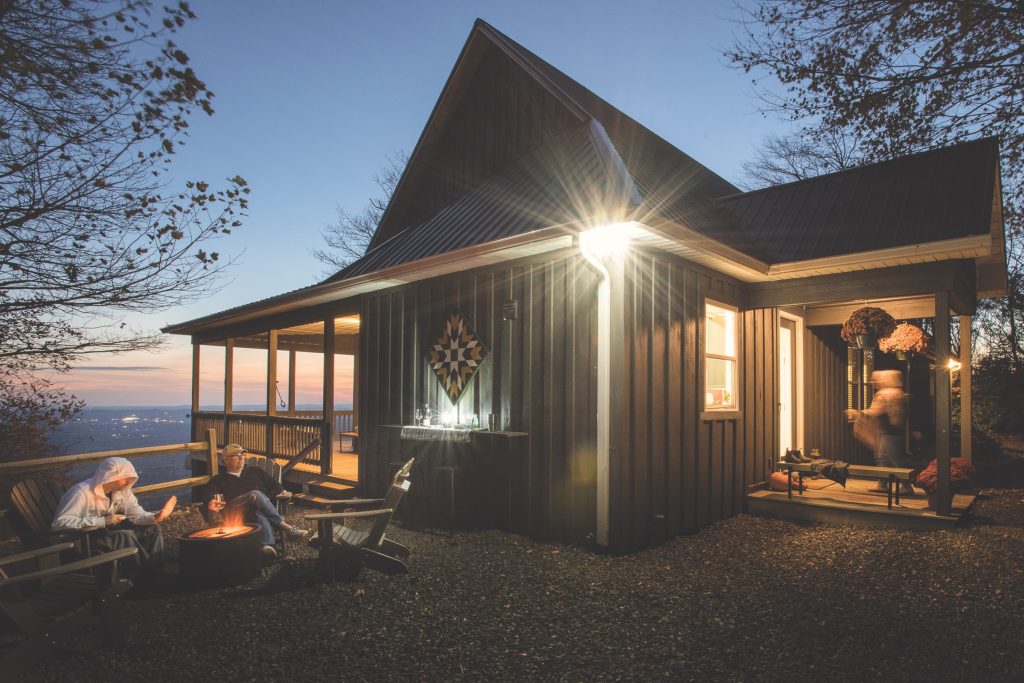
Plus, the home offered even more than they could have imagined. Beetling on a rocky perch just off the Blue Ridge Parkway, the house’s wraparound porch serves as a premium seat to the best show in town — Pilot Mountain amidst an ever-changing kaleidoscope of sky and stars.

“But,” Amy says, “we were like, I don’t think we can afford this.”

“It was super scary,” admits Peter. He consulted with his brother, Trey, who already owned a couple of properties, hoping he could advise them on making it work with their tight budget. 

“Are we crazy?” Peter asked Trey.

Trey came to see the home and saw an opportunity. He offered to go in on the purchase and make the house an Airbnb rental 70% of the time, making the financial leap a lot less scary.

With Trey, the Freemans bought the home and quickly got to work, making basic cosmetic changes to prep it for rental. On the main level, the walls were painted a soft neutral. Amy selected Benjamin Moore’s White Dove. But their painter had the color matched at Sherwin Williams and, Amy says, “it was very different.” When she first saw it, she wept. “But I’ve learned to love it.”

Before, bedrooms were a carnival of color, in chartreuse-green, mustard and poppy-red. The Freemans had everything coated in calming, rental-friendly neutrals. The previous owner left furnishings behind, so they repurposed what they could. An old gun cabinet was transformed into a bookcase. The rest, they cobbled together, bringing bits and pieces from home that had been passed down from their parents and were sitting in storage, like Amy’s father’s red, leather chair and her parents’ oriental rugs. They supplemented with items from Louis’ former condo, such as his sofa.

The once-plain fireplace — “it was just a hole,” says Amy — was decorated with large-scale, charcoal-gray tile grouted in high-contrast white. The tile had been leftover from their own bathroom floor at home. A proper mantel the couple ordered from Wayfair was the icing on the cake. Now, Amy says, visitors often comment on the fireplace. “And I am like, that’s my bathroom floor! I usually walk on that!”

In the kitchen, Amy says, they saved a ton of money by keeping the existing cabinetry and countertops. “We have a problem replacing something that’s perfectly good.”

“That’s our attitude,” agrees Peter. “We’re not cramping the landfill.”

With their inexpensive cosmetic updates, the house was ready to rent out to mountain-seeking vacationers. While the Airbnb share idea enabled the Freemans to purchase the house and they found much success with the rental, Amy says, “We found out very quickly that’s not why we got it.”

“Louis fell in love with it,” says Peter. “He kind of blossoms up there. And I think that made us feel really good, that he was kind of taking to it.”

Unlike Peter, Trey, who owns a house in Athens, Ga., and another in WaterColor, Fla., found he wasn’t able to get to Hillsville often. He wanted to rent the home out even more. Amy and Peter weren’t ready to give up what already little time they spent there. Their wheels started turning.

They were newly invigorated and determined to find a way to buy out Trey. Amy blurts out, “We manifested it!”

Peter chuckles. “Well, we sold our office building.”

“OK, we sold our office building, but, I mean, I manifested it,” Amy says teasingly.

With the house now 100% theirs, the Freemans removed the Airbnb listing and got to work putting their personal stamp on the place.

“We love a project!” says Amy.

Unlike many couples who struggle DIYing together, Amy and Peter have always gotten along incredibly well throughout the process. “It really is amazing that I can almost finish her sentences and she can finish mine,” Peter says of planning designs with his wife.

Inside, they updated the kitchen by painting the cabinets a soft, spruce green and replacing the once brown-hued countertops with white quartz. What brought it all together was the backsplash tile, which came from “a new, cool sample” Peter had gotten in at the architecture firm that happened to match perfectly, Amy recalls.

“It is nice to be in the business,” says Peter.

They began bringing more personal pieces from home. A side table the couple purchased from Pier1 Imports the first year of their marriage features a little upside-down man holding a glass top. Amy recalls thinking that its $60 price tag was too rich for their newlywed blood. “Somehow,” she says, “it survived over the years.” Now, a true conversation starter, it sits next to the living room sofa.
A large Cordial Campari vintage marketing poster print Amy and Peter purchased at Rooster’s on State Street 25 years ago hangs on the kitchen wall. Nearby on a perpendicular wall, a caustic-wax painting that looks like a birch tree anchors a table and two stools. It was a birthday gift to Amy last year from her friend, local artist Dana Holliday. “It’s my most treasured piece of art.”

The biggest change they made was painting the exterior, which is constructed of hardy cypress, a dark shade of charcoal. “Peter walked around the house 1,000 times, considering, and finally decided he wanted to go darker,” says Amy.

“Peter never brags on his design chops,” Amy continues, “but I am here to tell you he imagines things that I typically can’t wrap my brain around.” The Freemans originally thought they’d use a natural wood trim, but, around that time, Amy photographed a July 2023 story for O.Henry, “Beyond the Back Door.” She was inspired by an outbuilding Otto & Moore had renovated and painted a similar charcoal, but its door was a cool shade of blue. In the end, they opted for a “dark, greenish blue,” says Amy, and now the home blends in with the hardwoods that surround it.

While they still have other projects they’d like to slowly chip away at — perhaps an art studio —  they’ve made the Hillsville home all theirs. “Now it doesn’t feel like we’re just going up to our Airbnb for the weekend,” says Amy. “It feels like home.”

Most Fridays, the family hops in the car, with Coco, of course, and heads to the Blue Ridge Mountains for the weekend. “We breathe the minute we get off of 74 and start to rise up the mountain,” says Peter, audibly exhaling.

Able to unplug for a bit, the Freemans spend their days visiting the nearby Floyd Farmers Market, Primland Resort or Chateau Morrisette, which was founded by William Morrisette of Greensboro’s Morrisette Paper Co. Current co-owner Melissa Morrisette, the founder’s daughter-in-law, has become an incredible friend. “We are welcomed like family when we are at the winery.”

And when they don’t feel like venturing out, the 4-acre property and its surrounding area offers plentiful rest and recreation. There’s fishing nearby, which Peter hopes to get into when he retires one day. Just 10 minutes from the house is a very short but beautiful hiking loop Amy loves to trod. But, she quips, even a trip to the mailbox can be a walk through nature’s wonder.

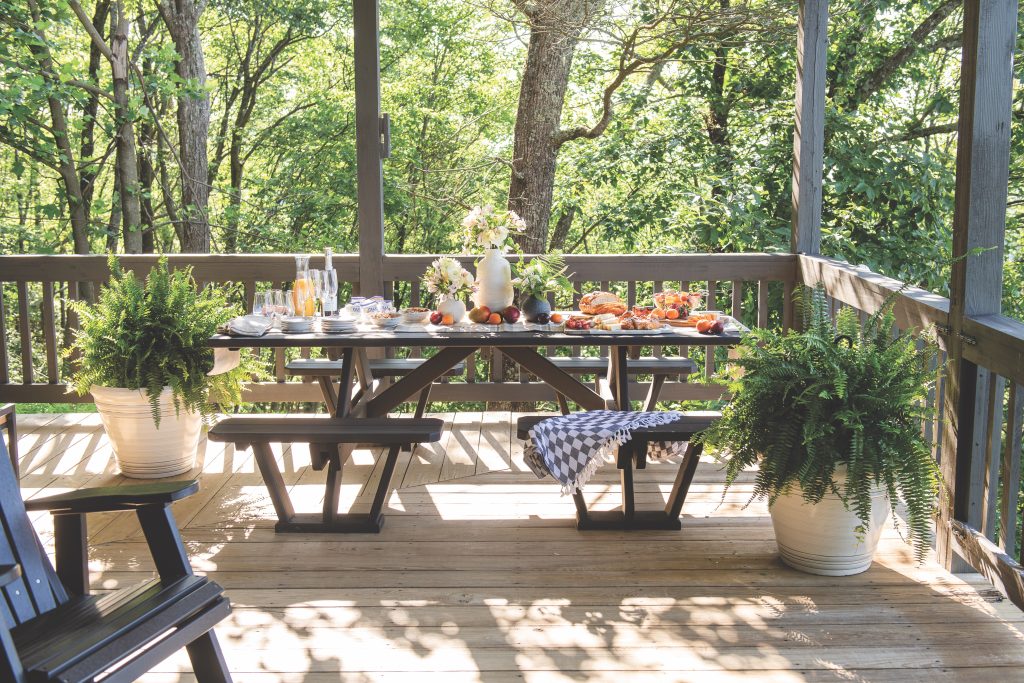
“Porch time, as we like to call it,” Amy says, is a favorite family pastime, and Peter agrees. The first thing he does every morning is step outside onto the expansive porch to take in the view.

“One of the things that Amy said years ago when we first started this process was, ‘I want to go somewhere with big sky,’” recalls Peter. “And that always stuck with me.” Looking out to Pilot Mountain in the distance, the sun setting off to the right in a rainbow of misty blues, golden oranges, all the way to fiery red, there’s no denying her wish was granted here. In fact, you can catch both the sunrise and sunset from this vantage point on the porch — and plenty of “big flyers,” including pileated woodpeckers.

“It just feels like you’re in a treehouse and nothing else in the world exists,” Amy muses.

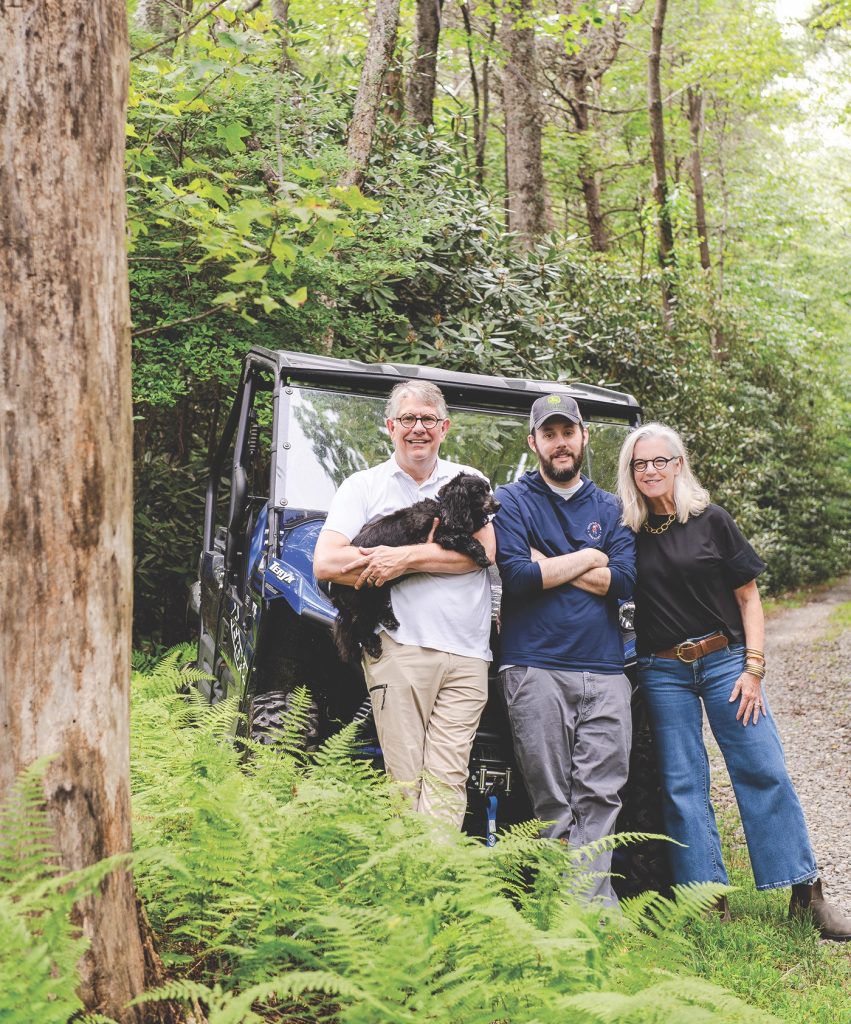
But the biggest blessing this house has bestowed upon the Freemans is the freedom it’s given Louis. Once an avid snowboarder and golfer, Louis is yet again able to adventure outdoors, thanks to a side-by-side — a utility task vehicle (UTV) Amy was totally against at first. A fallen tree that was blocking their driveway, however, changed her mind.

Up at the house by herself, she called her neighbors to see if they could help her clear the small tree. Mariah, who’s around Louis’ age, cruised on over on her side-by-side with a Bear Saw. She cut the tree and then used a winch attached to her side-by-side to pull the tree away. Immediately, Amy says, “I go in the house and call Peter and say, ‘Y’all can go ahead and get that side-by-side. I think we need one.’”

In fact, Amy says, she’s had to reframe her perspective on other things, too. “Nowadays,” she says, “we bring the party to us.” Rather than venturing out to visit friends, they welcome guests to stay at their Hillsville home with them. Two extra en-suite bedrooms, Amy notes, provide lots of privacy.

Life’s given the family unexpected circumstances, “but then you just realize that’s OK,” says Amy. If not for living under the same roof with Louis, “I would never have gotten his humor. I would have never been able to see that part and how strong and courageous he is.”

It’s a privilege, Peter agrees. Most parents, he adds, don’t get to know their children as adults in the way that they’ve been able to know Louis. “We all get so much more connected with the Earth and nature,” he says. And, it seems, to one another.

“We’re the three musketeers,” quips Amy.