True South

Hit the Highway

An ode to the road

By Susan S. Kelly

It’s a universal truth of summer in North Carolina, when the beach and the mountains become our magnetic poles, that sooner or later you’re going to be traveling on Interstate 40. Or “Forty,” as its fans and its haters call it.

I’m a fan.

You can have your backroads. How can a pastoral scene compare with the racetrack of 423.6 miles that (somewhat) horizontally slices the state? Every mile is pure entertainment. Sure, the “Bridge Ices Before Road” signs get boring, but the stuff people are hauling more than compensates. Where else but on I-40 in North Carolina can you find Christmas trees and golf carts and watermelons and boats? Plus, skis, surfboards, bicycles, kayaks, coolers, tobacco, cotton, horses, coonhound cages, Airstreams, and the requisite pickup or two hauling a chest, a mattress, a La-Z-Boy, and a fake tree, tarp a’ flappin’. It must be admitted that when I pass one of those silver-slatted semis, I strain to see if there are hogs inside, just before I avert my eyes and try not to think about their ultimate destination. Same for the vanilla-colored school bus whose sides read “Department of Prisons.” Don’t tell me you haven’t tried to peer into those windows crisscrossed with wire. I grew up with a father who always pointed out the guy with the rifle on his shoulder while inmates worked on the roadsides. Don’t see that much anymore, or those silvery mud flaps sporting silhouettes of naked ladies. Now the rigs are hot pink, for breast cancer. Progress.

I’m not the slightest bit offended if a rig driver honks at me as I pass. If someone still finds my 63-year-old knees attractive, I ain’t complaining.

How does a town get a name like Icard?

I particularly like those lead drivers with flashing head and taillights that warn of “Wide Load.” What a cool job. Like Dorothy Parker, who famously said that she’d never been rich, but thought she’d “be darling at it,” so would I in one of those cars. Think of the books-on-tape you could finish.

The amazing variety of stuff dangling from rearview mirrors — sunglasses, leis, air fresheners, Mardi Gras beads — all give a glimpse into a driver’s personality, like bumper stickers. (Question: How did so many Steelers fans wind up in North Carolina?) And while Virginia holds an unofficial record for vanity tags, I-40 is no slouch in that department, either. PRAZGOD. KNEEDEEP. IAMAJEDI. JETANGEL. Hair seems to be an ongoing tag topic: HAIRLOOM. NOHAIR. And this: SPDGTKT. Seriously, why not just call the cops instead of advertising?

I do not understand convertibles on interstates.

Do not fret yourself over aliens and vampires: If I-40 traffic is any indication, white pickup trucks are far more likely to take over the world.

You can’t fail to notice, while the Athena cantaloupes you bought at the state farmers market are growing more and more fragrant in the backseat, that, let’s face it, the flowers and trees planted in medians around Raleigh are way more attractive than anywhere else in the state. Harrumph. Near Fayetteville, D.C. license tags get more numerous, just as around Asheville, the Tennessee tags multiply, and around Benson, the New Yorks and Floridas proliferate.

Granted, I’d swap a few Bojangles and Cracker Barrel signs for South of the Border and Pedro puns on I-95, but that Mobile Chapel — a permanent trailer in the parking lot of a truck stop near Burlington — never fails to intrigue. As does Tucker Lake, a Johnston County curiosity with a fake beach and so kitted out with rope swings, slides, ski jumps, cables and random docks that you can scarcely see the water. Moreover, a stretch of I-40 around Greensboro has its own ghoulish nickname — “Death Valley” — for its unfortunate statistic of wrecks. And how about those cell towers disguised as pine trees? Come on. The “trees” are so spindly that they look like they belong, well, somewhere near the actual Death Valley.

So much to see from mountains to coast. What you won’t see, though, is the sign where I-40 begins, in Wilmington, that reads “Barstow, California 2,554 miles.” It was stolen so often that the DOT got tired of replacing it. Meanwhile, if you happen to have a list of locations for the elusive Dairy Queens along I-40, please text me. Calories don’t count when you’re a friend of Forty.  OH

Susan Kelly is a blithe spirit, author of several novels, and proud grandmother.

Papadaddy

Changing Customs, Fading Manners

Who is minding what?

By Clyde Edgerton

“Mind your mannersî is a phrase that is probably less heard today than it was 60 years ago. Back then (I was a teenager), I would have no more worn a hat inside a house or building than I would have peed in the street. (I would have peed in the backyard, down toward the woods, and that would not have been considered bad manners where I’m from in rural North Carolina.)

Are we sometimes talking about changing customs, or changing norms, rather than changing manners? Shades of difference move between those three terms: customs, norms, manners. Your mama, or another trusted relative, probably never said to you, “Mind your customs,” or “Mind your norms.” Customs and norms describe habitual stuff out there in a society — descriptive. Manners are more about what happens in smaller group settings — prescriptive, connected to right and wrong.

And sometimes I think (like other older folks) that manners haven’t changed; they have simply disappeared. Well, almost. Perhaps disappeared in other parts of the country, and are hanging by a thin thread in my home section of the country, the South, where people do not have accents unless they are from elsewhere.

Let’s take family reunions — and “eating order.” Family reunions in my childhood were like Christmases. The family planned ahead for, and looked forward to, each family reunion. It was a big deal. We had five of them each year. (It’s down to two now.) When it was time to eat from the big long table with covered dishes (you were likely out of doors), the older folks served themselves first. Had I, as a child, started for the food right after the blessing, my mother would have said, “Mind your manners, Son,” and I would have remembered that children served themselves last, not first. It was a matter of right and wrong, good and bad. Simple good manners.

There were only good and bad manners, no debatable manners, or, for that matter, “politically incorrect” manners. “Politically correct” — for better and/or worse — hadn’t been invented.

My first brush (that I know about) with my own politically incorrect manners happened at a dinner party (among academics) in about 2000. Each of us stood behind our own chair before being seated. When it was time to sit, I reached for the chair beside mine because standing behind that chair was a woman. As I started to pull back her chair for her to sit, she quietly held the chair in its place.

I didn’t get it. I assumed she was looking the other way. I tried again, and then looked into her eyes. The message was clear. She did not like what I was doing. She remained silent. I turned loose of her chair and tended to my own. I was confused, but there was no doubt that she did not like me messing with her chair.

I have since figured out what was perhaps going on. (I have two daughters, and would like to consider myself an intersectional feminist who believes rational feminism can lead to men’s liberation.) I think back on that occasion, on the matter of customs, norms, manners; on the woman beside me at the dinner party; on my mother (not an academic by a long shot) and how she behaved in social situations. I’m pretty sure my mother, had she been a modern-day feminist, would have said, “I’d prefer to pull out my own  chair, but thank you.” She would have said that because she had good manners — innate good manners.  OH

Clyde Edgerton is the author of 10 novels, a memoir and most recently, Papadaddy’s Book for New Fathers. He is the Thomas S. Kenan III Distinguished Professor of Creative Writing at UNCW.

The Art Of The Farm

The Art Of The Farm

Aubrey Cupit embraces an ancestral call of the land with 21st-century know-how

By Maria Johnson   •   Photographs by Brandi Swarms

Like any good Millennial, 31-year-old Aubrey Cupit appears to be biologically attached to his cell phone.

He has an Instagram account and a Keurig coffee maker.

He favors long-sleeve T-shirts, and his short auburn hair descends to a rusty mustache and beard.

You could envision him loping down the streets of Charlotte or New York City, as many of his former high school and college classmates do.

But you probably won’t see that — unless he’s visiting — because Aubrey Cupit is a farmer.

A small-time, independent, one-man-show farmer.

A get-up-with-the-sun farmer.

A ground-hog-cussing, weather-watching, dusty-jeans-wearing, worn-out-by-Saturday-night-and-ready-to-sleep-in-until-8-on-Sunday-morning farmer.

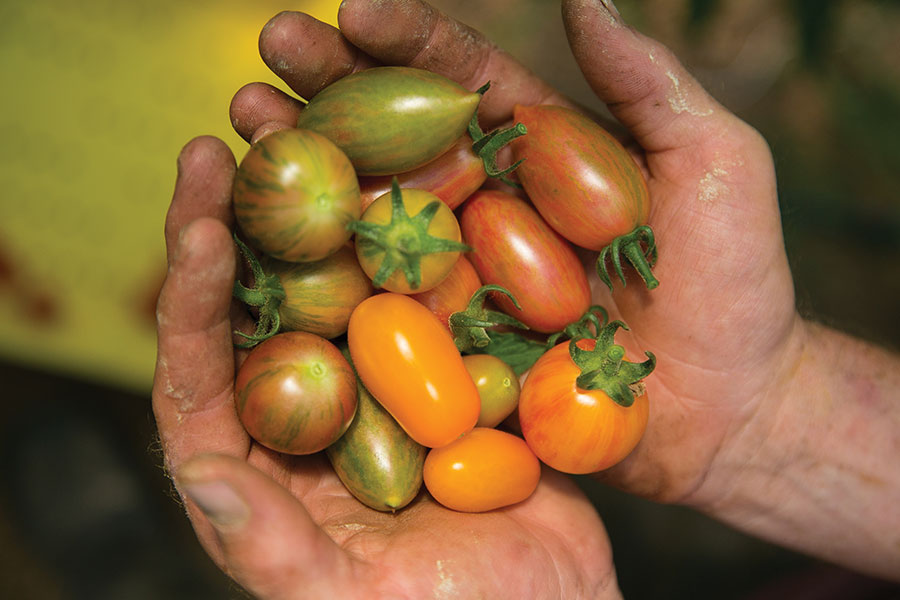
He owns 9 acres in northwest Guilford County and works two of those acres to make salad, essentially. He raises leafy greens, tomatoes, herbs, carrots and a smattering of other vegetables.

At the moment, he’s heavy into broccolini, that leggy, small-headed cousin of broccoli. Also, he’s getting into cauliflower, which is trending now. Kale is dead. You heard it here first.

He sells to local restaurants and to the general public at the Greensboro Farmers Curb Market. He also peddles produce from a roadside stand at the mouth of the gravel driveway to his land.

Gate City Harvest, that’s his place on Pleasant Ridge Road in Summerfield. As the crow flies — which it actually does out here — it’s very close to where Cupit grew up, in The Cardinal, a 1980s neighborhood molded around a golf course, swimming pool and tennis courts. In other ways, it’s oh-so-far away from the childhood of a guy who chose to go back to the land he never had.

Aubrey Cupit (rhymes with Muppet) was a typical suburban kid. He kicked soccer balls and slugged baseballs on well-groomed fields. He played first-generation Xbox video games. He loved Taco Bell Cinnamon Twists. In middle school, he jettisoned sports for art and photography. He painted watercolors to give to his mom on Mother’s Day. He drew every one of North Carolina’s seven lighthouses.

“My brothers had bigger personalities than I did,” says Cupit, who was a fraternal triplet and one of four boys growing up. “I was more introspective.” No one grew vegetables at home, but Cupit’s mom, Sharian, was an avid landscape gardener. She tended a beautiful yard.

Cupit didn’t notice.

He went to UNCG to study art. His junior year, he needed an elective. He took one that sounded interesting and relatively easy: “Religious Traditions and Care of the Earth.” The lecturer was Charlie Headington, an expert on permaculture and sustainable gardening. Headington talked about how religions viewed the Earth differently — some as a thing to be ruled, some as a thing to be revered — and how that played out.

The ideas fell on fertile soil in the mind of the young artist, who threw himself into writing papers for the class. The essays jumped out because they went beyond the minimal requirements. “You can tell people’s comfort levels with ideas by how closely they stick to the guidelines,” Headington says. “Aubrey’s a person who feels comfortable with intellectual discussion.”

Cupit supported his arguments with ideas he’d read about elsewhere. “That’s what a teacher really enjoys — having a person with an original mind. I think that really comes from his art background,” says Headington. Before the semester was up, he suggested that Cupit intern in the gardens at Greensboro Montessori School, which Headington designed and maintained.

Cupit appreciated the offer but let it slide.

That summer, Headington ran into Cupit in the store where Cupit worked, Video Review on Battleground Avenue, a now-defunct touchstone for local movie buffs.

Headington pitched the internship again. “Aubrey was taking my money, and I said, ‘Well, hey, how about it? Are you interested?’” Headington remembers. It wasn’t much, that second offer, but it was enough to nudge Cupit’s life down another track.

He didn’t become a farmer overnight. First, he wandered in the desert. Correction: tomato patch. He put in sweaty hours at the Montessori gardens, digging out tangles of Bermuda grass, a maddening chore. He didn’t mind. “It felt good to be a part of something bigger,” he says.

He progressed to planting. He learned the underpinnings of permaculture, a way of growing that mimics nature and minimizes human intervention. When it works well, Cupit says, permaculture yields food that is healthier and cheaper than food that comes from high-input agriculture.

Cupit took a degree in fine art, but he kept his hands in the dirt at Montessori — where he still manages the garden and teaches part time — and he signed on at Whitaker Farms in Climax, a large grower of strawberries and greenhouse tomatoes.

Under the tutelage of Faylene and Richard Whitaker, he toiled in the greenhouses and worked their stall at the Piedmont Triad Farmers Market on Sandy Ridge Road. Faylene schooled him on the psychology of the market.

“She would always say, ‘Pile ‘em high, and watch ‘em fly.’ If you have a few tomatoes at the end of the day, you’ll never sell them. People will not buy the last ones. Psychologically, we respond to copious amounts, not skimpy stuff,” says Cupit.

He gleaned more from Daniel Woodham of Greensboro’s NIMBY (Naturally in My Backyard) Gardens. Cupit watched Woodham woo customers by waving bouquets of fragrant herbs at the Greensboro Farmers Curb Market. “He’d be like, “Hey! You know you want some of this basil!’” Cupit recalls. “You couldn’t help but talk to him. He’s a very charismatic guy. He kind of helped to bring me out more.”

Cupit, who describes himself as a “book farmer,” supplemented his education by reading. He digested The Market Gardener, by Jean-Martin Fortier, and two volumes by Eliot Coleman: The New Organic Grower: A Master’s Manual of Tools and Techniques for the Home and Market Gardener, and Four Season Harvest: Organic Vegetables from Your Home Garden All Year Long.

Cupit loved the conviction that saturated those pages: that you don’t have to farm big to be successful. Small, well-managed, Earth-friendly farming could work. It was working. The practitioners weren’t getting rich, but they had comfortable lives. They could support families. They had enough.

And that would be enough for Cupit. It was a long germination, but at the end of five years, he was ready to be transplanted to the field.

For generations, farmers have come into land by inheritance. But, as family-owned acreage has dwindled, the farmers of Aubrey Cupit’s generation have come into land by other means, namely Zillow and Trulia. Starting at about age 25, Cupit combed real estate websites, looking for a few acres where he might start his own farm.

“I was just dreaming, but I knew that it would happen,” he says. He looked into a couple of listings, but nothing seemed right. Then, his grandmother, J’Nell Hofstetter, answered her landline. “I understand your grandson is looking to farm,” the caller said. It was Elaine Pegram, a former neighbor on Pleasant Ridge Road, where Hofstetter had grown up on a farm. The Pegrams had a few acres to spare. They could sell to developers anytime they wanted to — but they didn’t want to.

Hofstetter alerted Cupit, whose mother and father helped him to secure a loan. Thanks to family, Cupit was in business, right across the blacktop from where his great-grandfather, Clyde Huff, had raised tobacco, corn and hogs. Cupit never knew Huff, but his mother tells him that Huff fished the Pegram pond behind Cupit’s house. He spent time in the barn that now belongs to Cupit. “I think about it a lot. Where did I get it from? How did it all come about, this passion? My mom always tells me I remind her of her Pawpaw Huff,” says Cupit. “I don’t know how I feel about religion, but it does make me think sometimes that there is some kind of art to this — something out of our control.”

Because Cupit’s operation is small, so is most of the equipment he uses day to day: a hand tractor, which is basically a motor with wheels and a place to attach implements; a wheel hoe, and a broad fork, which Cupit grabs at the cross bar, stabs into the dirt and rocks back and forth to loosen the soil before planting.

Since the initial preparation of his land, he has avoided tilling, a costly procedure that stirs up weed seeds and aerates microorganisms, causing them to gobble nutrients and deplete the soil. Cupit brags that he can turn over a shovel of dirt in his field and find earthworms, a sign of healthy soil.

He doctors the dirt sparingly. His fertilizers and soil conditioners are composted horse manure, mineral dust, green sand, feather meal and bone meal.  For pesticides, he uses neem oil, chrysanthemum oil and bacillus thuringiensis.

Cupit, the farmer, is still very much the artist. You can see it in his insistence on quality materials and in his devotion to scale, He started out small, putting into production only two of his 9 acres. He spent the first year preparing the soil, an oasis of well-drained sandy loam in a region heavy with clay. The ground, once home to strawberries, wheat and tobacco, had lain fallow for 20 years, the perfect prescription for soil to rest and rejuvenate.

Cupit plowed, disc-harrowed and then seeded with clover and rye. He watched as a fresh, green blanket covered the ground. He plowed it under and disc-harrowed again. He planted his first crops in the fall of 2014. “It was profitable from the beginning,” he says, noting that farmers generally sink their profits into improvements, which he has.

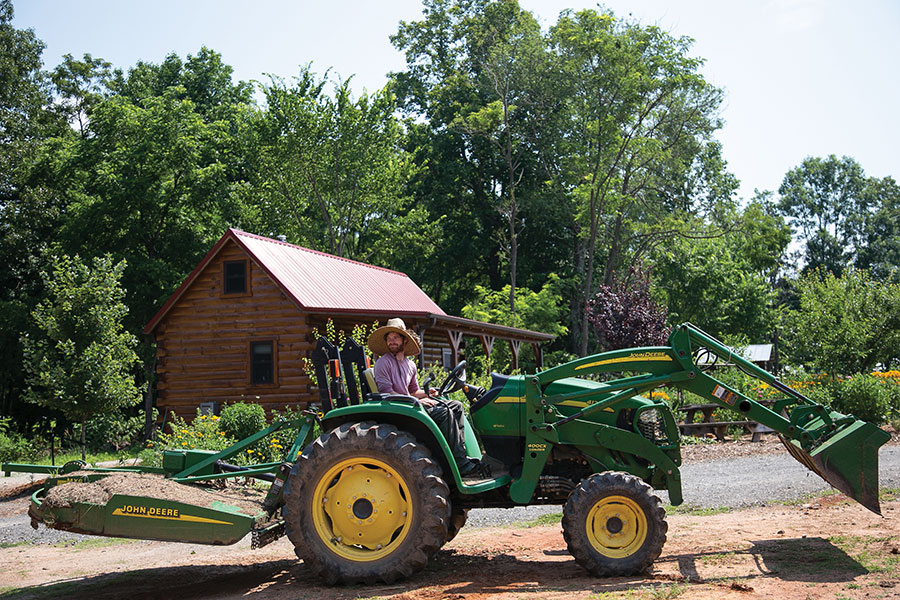
Last year, he added a vegetable-washing station and a walk-in cooler to an old barn beside his new 350-square-foot log cabin. A crew of Amish builders raised the one-room shell and topped it with a red tin roof. Cupit plumbed and wired the cabin by himself.  “I’m kind of a YouTube carpenter and electrician,” he says. “It was what the budget required, and I knew I didn’t want to live big. I wanted to be simple.”

Within view of his front porch, the ground bristles with rows of vegetables that change, like garments, on a seasonal wheel. Beets, collards, kale, radishes, lettuces, broccolini and carrots — sweet, warm-colored darts that thrive in the sandy soil — emerge in the sweatshirt weather of spring and fall. Yellow squash, cucumbers, tomatoes, onions, green beans, peppers and eggplant flourish in the sleeveless heat of summer. Sweet potatoes, winter squash and cauliflower store sunlight as hats and gloves appear again.

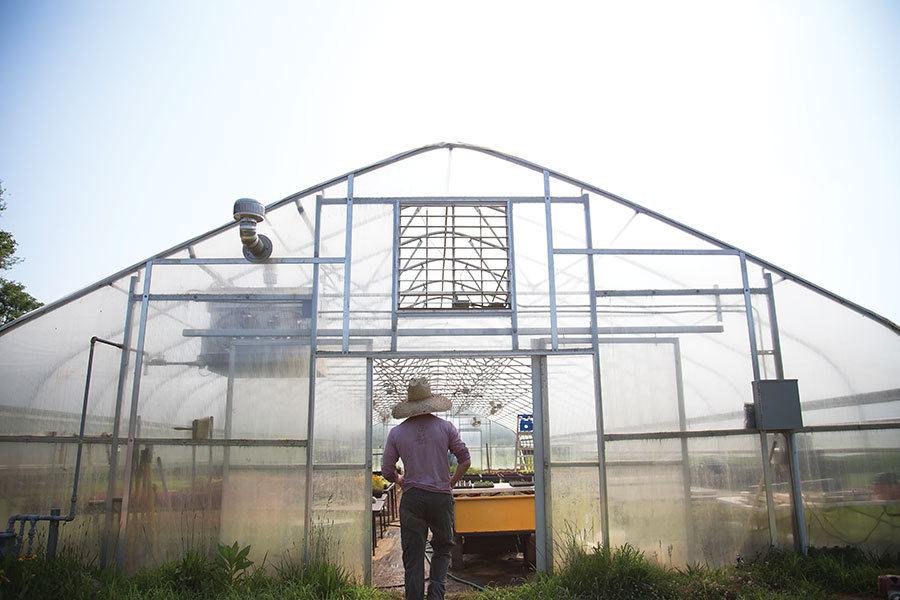
Cupit extends the growing seasons of his bestsellers with two heated greenhouses and two moveable caterpillar tunnels.

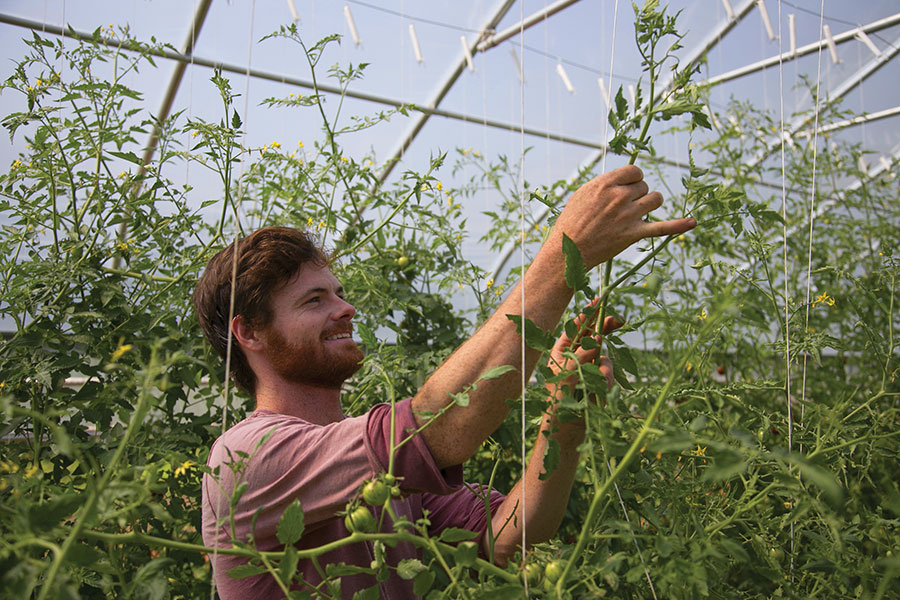
“We push lettuce, tomatoes and cukes as much as we can — at least 10 months,” he says. “You make more money when you’re the only one who has them.” Many of his tomatoes will spend their lives in a greenhouse, growing on twine trellises in the “lower and lean” method that he learned at Whitaker Farms. The practice allows vines to stretch 10 feet or more from one spot in the ground.  As each vine grows, Cupit lets out the twine from an overhead spool and slides the spool along a wire. The diagonal curtain makes the fruit easier to pick.

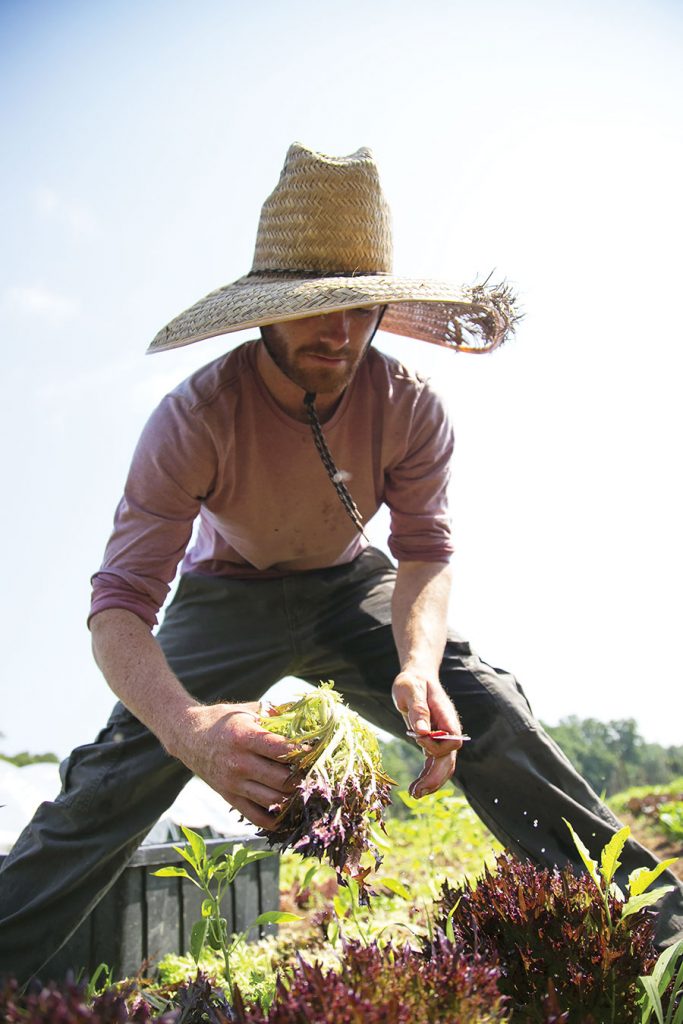
Cupit might be a throwback to old-timey truck farmers, but he embraces current science, technology and ag-fashion, if there is such a thing. He owns a shiny green John Deere 4120, which he uses to mow and move manure, but you won’t find this farmer advertising tractors with a baseball cap. Instead, he wards off skin cancer by wearing the kind of broad-brimmed straw hats favored by West Coast lifeguards. He buys the sloping hats on Amazon. He slips his feet into Mucksters, low-cut rubber garden boots, not brogans. His Levis bear the telltale outline of a cell phone carried in his front pocket. He consults it often.

Someday, he’d love to use his iPhone to control irrigation and move his greenhouse walls for optimum heat and light. Controlled growing environments will become more important, he believes, as global warming causes more extremes in weather.

He expects that, one day soon, phone apps will allow people to order local produce and schedule pick-up or delivery. All of this would increase the margin of error in farming, which is especially important for small operations like Cupit’s. His labor pool consists of him and his mom, who is retired from Burlington Industries and visits the farm almost daily. She mows, washes and packs produce, and minds the roadside vegetable stand. “She wants to see me succeed, and she loves farmwork,” says Cupit. “I think she’s proud to see the evolution of the business.”

Cupit’s commercial customers are happy with the results. Jody Morphis, who with his wife, Anne Marsh, owns Blue Denim, a Cajun-Creole restaurant on South Elm Street in Greensboro, has been buying produce from Cupit since they met a year ago at a Greensboro Farmers Curb Market fundraiser featuring locally sourced bacon-lettuce-and-tomato sandwiches. “I think his tomatoes won Favorite Tomato,” says Morphis, who buys nearly all of his produce from Cupit now.

“He’s definitely my favorite farmer to deal with, first of all because he’s growing great stuff, and he has a great personality. Most farmers aren’t able to go out and shoot the breeze with people. A lot of the older farmers are men of few words.”

Cupit’s prices don’t hurt. “Aubrey’s prices are better than anybody’s,” says Morphis.

Cupit’s other restaurant customers include White and Wood, Cafe Europa, Table 16 and Jerusalem Market in Greensboro, as well as Michelle’s Kitchen & Table in Burlington.

Twice a week, Cupit delivers produce to them in his 1998 Ford pickup. Twice a week, he carries his produce to the Yanceyville Street curb market. Most weekdays, he works in the gardens and classrooms of the Montessori school. That’s when he’s not tending his own farm.

His early-to-bed, early-to-rise lifestyle exacts a cost: limited opportunities to socialize.

“I have to say ‘No’ a lot,” the young bachelor says with a rueful smile. Many people his age have no clue about the gritty realties of farm life, which Cupit is quick to list. “It’s dirty. It’s hard. It’s hot. You’re in the sun. You’re always cutting yourself. About once a month, you want to quit, but you just have to wait until the next day,” he says.

He finds solace in online communities of other Millennial farmers. They might be as rare as hen’s teeth, but they find each other on Facebook and Instagram. They share advice and photos of what they’re growing.

Cupit’s generational peers run Fair Share Farm in Pfafftown; Pine Trough Branch Farm in Reidsville; Mighty Tendril Farm north of Hillsborough; and Sugar Hill Produce, also north of Hillsborough.

While they’re eager to scratch out a living, Cupit says, he and his young agrarian friends believe there’s more to life than accumulating titles and dollars for themselves. They want meaningful work, he says, and they’re finding it in the ground beneath their feet.

“There’s something about taking care of this dirt we have,” he says. “If you have the itch and the passion, it’s worth it.”  OH

For more information, go to gatecityharvest.com;  @gatecityharvest on Instagram; or facebook.com/gatecityharvest/.

The Omnivorous Reader

To Boston and Back

A history of the psychedelic ’60s

By Stephen E. Smith

The stoner who said “If you remember the ’60s, you weren’t really there” got it wrong. Most of us who lived through those times recall what went down, even if we did inhale. But if your memory is less than eidetic, Ryan H. Walsh’s Astral Weeks: A Secret History of 1968 is an engrossing aide-mémoire, a jumbled catchall of social upheavals and artistic convergences that occurred in Boston half a century ago.

Walsh focuses on two narrative threads, one societal and the other musical, that evolved in parallel. The first is the founding of Mel Lyman’s Fort Hill Community, variously identified as a commune, cult or family; and the other is Van Morrison’s mystic stream-of-consciousness song cycle Astral Weeks recorded while the Irish blues rocker was hiding out in Beantown. Both events, although unrelated, had a transmutative effect on a flower-power generation searching for “peace and love” and alternative lifestyles.

Walsh begins with the not-so-secret culture-shifting decision by Bob Dylan to electrify his backup band and crank out a high-decibel version of “Like a Rolling Stone” at the 1965 Newport Folk Festival. Members of the audience still debate whether Dylan was greeted with widespread booing, but Walsh maintains the crowd was exiting in a funk when harmonica player Mel Lyman took the stage and intoned a 20-minute dirge-like rendition of “Rock of Ages.” Lyman was a member of Jim Kweskin’s Jug Band, a Boston group that had achieved modest national success. By 1966, he’d emerged as the charismatic leader of a community that squatted in abandoned houses in the Fort Hill section of Roxbury.

Lyman had drifted from California to North Carolina (he learned to play banjo from Asheville’s Obray Ramsey) and settled in Boston, attracting a coterie of subservient followers. His Fort Hill Community was no run-of-the-mill hippie commune. Daria Halprin and Mark Frechette, the stars of Michelangelo Antonioni’s film Zabriskie Point; Paul Williams, the publisher of Crawdaddy magazine; musician Jim Kweskin; Jessie Benton, the daughter of Thomas Hart Benton; two children of the novelist Kay Boyle; and Owen DeLong, a speechwriter for Robert Kennedy, were all active members of the Fort Hill family.

Lyman asserted complete control over community members and employed LSD trips, astrological readings and physical intimidation to maintain discipline. Members remodeled dilapidated dwellings and distributed the counterculture biweekly newspaper Avatar to support themselves. The cult’s sole purpose was to serve Mel Lyman and his creative enterprises, and in 1973, Frechette and two other members of the family attempted, ostensibly at Lyman’s bidding, to rob a Roxbury bank to fund a film project. One member was killed by police, and Frechette was sentenced to prison, where he died under suspicious circumstances. Walsh delves into the cult’s internal disputes, most of which concerned the content and publication of Avatar, and he details the less seemly workings of the Fort Hill Community, branches of which are still active in Boston, Los Angeles and Kansas. What became of Mel Lyman is a mystery. It was reported that he died in 1978, but no death certificate is known to exist.

The second thread of Walsh’s secret history traces singer-songwriter Van Morrison’s gradual rise to national prominence via his recording of Astral Weeks, a 1968 Warner Brothers release that went unnoticed at the time but has since achieved cult status. Morrison had first emerged on the music scene as the lead singer of the Belfast band Them, who charted with “Gloria” and “Here Comes the Night.” Morrison had a 1967 solo hit with “Brown-Eyed Girl,” but he’d made a bad business decision, signing with Bang Records, a company with mob connections. Warner Brothers had to buy out Morrison’s contract, and the singer moved from New York to Boston with his girlfriend Janet Rigsbee (aka Janet Planet), where he began composing the songs for Astral Weeks and playing rock clubs, high school gyms, roller rinks and amusement parks across New England with a group of local musicians known collectively as the Van Morrison Controversy.

To record Astral Weeks, Morrison traveled from Boston to New York and laid down the tracks backed by jazz pros who’d never heard of the 22-year-old singer-songwriter wailing away in the vocal booth. Morrison never spoke to the studio musicians, but guitarist Jay Berliner, drummer Connie Kay, vibraphonist Warren Smith and bassist Richard Davis (the name of the flutist is lost to history) provided the backing that helped bring Morrison’s lyrics to life. The songs are about childhood, death and rebirth, and in “Madame George,” “Cyprus Avenue,” “Astral Weeks,” “Slim Slow Slider,” “Sweet Thing” and “Beside You,” Morrison’s craggy voice rings with a coarse authenticity. Astral Weeks has survived and sweetened over the years, and Walsh’s thorough investigation of the recording process reveals the inner workings of the musical experience without diminishing the album’s subtle ability to mesmerize listeners.

A slew of pop culture luminaries make brief appearances in Walsh’s history: Lou Reed of the Velvet Underground; Peter Wolf, future front man of the J. Geils Band; bluesman Howlin’ Wolf; singer-songwriter Jonathan Richman; Tufts University Shakespeare scholar David Silver; LSD guru Timothy Leary; and others. Since video and audio recordings of most of the principals exist, readers can access images of the characters and hear the crazy ideas they espoused. Dick Cavett’s painfully uncommunicative interview with Daria Halprin and Mark Frechette can be viewed on YouTube, and the album Astral Weeks is streamable on internet devices, as are numerous recordings of Mel Lyman, including his Newport Folk Festival “Rock of Ages” performance and eerie album cuts featuring Lyman and the Fort Hill Community. Jim Kweskin’s America Co-Starring Mel Lyman and the Lyman Family is available on CD. Fifty years out, a replay of these historic recordings in conjunction with a reading of Walsh’s detailed history will remind readers that the Grateful Dead had it right all along: “What a long strange trip it’s been.”  OH

Stephen E. Smith is a retired professor and the author of seven books of poetry and prose. He’s the recipient of the Poetry Northwest Young Poet’s Prize, the Zoe Kincaid Brockman Prize for poetry and four North Carolina Press awards.

Wine Country

Wine Uncorked

It can be simple, easy and eco-friendly

By Angela Sanchez

Why not drink wine out of a can? Why not drink wine from a bottle with a screw cap or Stelvin closure? Maybe, even a keg? Before all of you confirmed cork devotees get too upset, I’m not talking about grand cru Burgundy or first growth Bordeaux or single vineyard California cabernet from Screaming Eagle. I’m talking about wine that is made to be consumed young — what some people refer to as table wine — without oak or bottle aging. It’s the stuff we everyday folk consume on a regular basis. It’s what we take on boats and road trips and keep chilled for the backyard barbecue and camping in the summer. It’s the wine we have in the fridge and on the rack in the kitchen for when a friend drops by and needs a friendly ear. Nothing serious, just a good bottle we enjoy.

Like a lot of people these days, I want convenience that’s also eco-friendly, but my primary reason for exploring alternative closures and vessels for wine is the cork itself. Harvested from cork trees grown in Portugal and then crafted into fitted closures for wine bottles, the cork contains living organisms that can go bad and “taint” the wine. It can happen as often as one in every 12 bottles. According to thekitchn.com, fungi which naturally reside in cork can come into contact with bleaches and other sterilization products found in wine cellars, tainting the wine and rendering it “corked.” Have you ever opened a bottle of wine that smelled and/or tasted like wet cardboard or gym socks? At home you might suffer through it and never purchase that wine again. At a restaurant you paid double, sometimes triple, the actual cost of the bottle and probably just decided you didn’t like the wine or simply chose the wrong bottle. But, no cork, no taint.

This, of course, doesn’t apply to high-end premium wines, single-sourced or from small, highly acclaimed biodynamic vineyards. I’m talking about that bottle you pick up for under $15. If you’re headed to the beach, boat or backyard this month, you want something that tastes good, fits in a cooler, chills quickly, stays that way, and is easily disposed of and recycled. And since you can’t ask the waiter to bring you another bottle, it helps if it’s not tainted. Convenience, taste and an eco-friendly container can all be achieved from wine with a screw cap, in a can, keg or even a box. Studies show, and I have confirmed through years as a wine professional, that screw caps and Stelvin closures keep wine fresher longer, creating less waste. You might even want to avoid the bottle altogether. No glass on the beach or by the pool, and who wants to dig around for a wine tool? One can of wine is equivalent to a half bottle. Coolers are made for cans and, at the end of the day, cans are recycled at an 80 percent rate compared to 20 percent for glass.

Let’s face it, wine can be snobby. A lot of people don’t even like to drink beer out of a can. To each his own. If nothing but a bottle with a cork will do, fine. But it is summer, so don’t be afraid to try something for fun that’s also convenient and friendly to the environment.

Keep your snacks simple too. Easy wine and summer outdoor activities require cheese with great flavor but not too serious aging or washing. Snacking cheese, not thinking cheese. Try a great aged cheddar like Tickler from England with a bit of crunch from whey protein or a Southern classic like pimento cheese. All Southern cooks have their own recipe, usually a blend of cheddars, pimentos, Duke’s mayonnaise and maybe pickled jalapeños or olives. Easily shared and great with simple crackers or used as a dip with celery, pimento cheese is the perfect summer snack. Whatever you choose, it’s July, summer is here, keep it simple and easy.  OH

Angela Sanchez owns Southern Whey, a cheese-centric specialty food store in Southern Pines, with her husband, Chris Abbey. She was in the wine industry for 20 years and was lucky enough to travel the world drinking wine and eating cheese.

O.Henry Ending

Fraised and Confused

A paean to the waning days of strawberry season


By Brian Faulkner

One of the best things about early June is that it marks the beginning of summer, no matter what the calendar says. Dreams of “School’s out!” float through the minds of children like mid-year sugarplums as we bigger ones begin pining for the beach, the lake or the mountains. One of the worst things about early June, however, is that strawberry time has pretty much spent itself. That always makes me sad, so much so that sometimes I wonder if the greeting card business may have missed a big marketing opportunity by not making note of the season’s passing. Imagine this illustration: a couple of Norman Rockwell kids gazing on a green strawberry field, fruit-stained bucket dangling empty between them. The caption, written in a child’s gentle hand, reads, “Parting is such sweet sorrow . . .”

If America ever got to vote for its favorite fruit (much more fun than voting for politicians), the strawberry should win hands down — case in point: the rate at which strawberries disappeared from a serving table one memorable evening a couple of years ago. The occasion was one of those stand-up cocktail parties, the sort of thing at which a mass of bone-tired people appear willing to exchange their last drops of energy for an hour or two of convivial chatter and some free eats after walking a trade show all day. Whoever catered the event did a fabulous job. The egg rolls were just right — not too soft, not too firm; flaky and perfect. The Asian noodle dishes were shot through with pleasing, subtle flavors. Tiny tomatoes with mozzarella balls on a skewer were surprisingly delectable. The applewood-bacon pizza slices were thin, indescribable and consumed in great quantities. But what most caught my eye were the strawberries fairly shouting from the far end of the room. They were riotous red and succulent, the kind of vision even food photographers would salivate over. There were other fruits for the taking, but they didn’t seem to vanish as fast as the strawberries.

I can’t think of strawberries without my No. 2 grandson coming to mind. His birthday lands smack in the heart of North Carolina’s strawberry season. And since he and I share the same birth date (separated by more years that he probably can count), it has become my custom to surprise him on that day by popping up at some random time and place. I’ve surprised him in a museum and a tourist trap and once just sort of appeared in front of him on a public sidewalk (with the aid of an enormous oak tree to hide behind). The most memorable birthday surprise, however, happened in a strawberry field. My son and his family had arrived early, as planned, and were busily filling their buckets.  I counted on that distraction to ease my car into the parking lot (the kid could identify it at a hundred yards), don my disguise and slip into a nearby row. I got pretty close to them before he got wind that the bent over old dude with the oversized hat and umbrella was his grandpa.

Fun stuff!

This year, I had hoped that strawberry season might hold on a little longer, given the chilly, wet April that we suffered through, but Mother Nature played her cards close and I largely missed out. I considered a family trip to the North Carolina Strawberry Festival down east in Chadbourn (my wife grew up nearby, and they always had a sinful supply of berries and, thanks to a freezer the size of a Volkswagen, feasted on them long into summer). Then I thought about sticking closer to home and checking out the strawberry fields off North O.Henry Boulevard. They’ve been growing strawberries there for something like four generations. It didn’t take much imagination to envision buckets overflowing with crimson goodness as my family joined hundreds of other strawberry lovers around the patch, people who do not hesitate to lick their fingers in public as they fantasize about the sweet treats they’ll create when they get home.

Somehow busy-ness got in the way, and that didn’t happen. Even the vanilla crème strawberry birthday cake I’d envisioned was a no-show, although I did manage to suffer through its chocolate fudge cousin with cream cheese and whipped cream on top. Such are life’s little disappointments.

But take heart, there’s only 11 months to go now till strawberry season!  OH

Brian Faukner will have to settle for snacking on strawberries from Florida this summer, while he dreams of next year’s Carolina crop.

Scents and Sensibility

The loss of smell brings an unexpected gift


By Bridgette A. Lacy

Maybe I should have taken more time to smell the fragrant rosemary in my yard. Or I should have soaked in my almond-scented bubble bath more often. Perhaps, I should have savored the sweetness of my Uncle Jack’s red roses instead of assuming they would always be there for me.

Nineteen years ago, when I lost my sense of smell, my ability to relish those simple pleasures went away. I never thought that at 37 years old, my olfactory nerve would be stolen by a benign brain tumor the size of a tennis ball.

Even when my neurosurgeon told me that losing my ability to smell was one of the side effects of brain surgery, the reality of what that meant didn’t sink in. How could it? After all, I was facing life or death.

Before the tumor — and the surgery that saved, but forever changed — my life, I was a smell-centered person. Smells resonated with me. They had the ability to set my mood or even shape my attitude about ordinary, everyday activities. A soak in that aromatic bath soothed me at the end of a long day.
A sip of orange, cinnamon-flavored tea calmed me in the evening. The sensuous waft of the lavender  growing in my front yard delighted me as I rocked back and forth on the porch. I appreciated the world so much more, in part through my nostrils.

At first, I thought I had survived the surgery with my sense of smell intact. I even complained to a nurse that my ICU room stank. Phantom odors, I guess.

I returned home from the hospital in October 1999 after five-and-a-half hours of surgery. I tried to recover and return to my old routine while also adjusting to the loss of sight in my right eye. It took me awhile to understand why my pot roasts burned to a crisp in the oven. I had always used the aroma floating through the house as a sign the roast was close to done. Sometimes my mother would visit to find a banana or some other fruit rotting on the countertop that I had forgotten about.

I didn’t truly realize I couldn’t smell until I received two gift baskets that included scented candles, a fragrant bubble bath and soap. As I sat in a chair, a friend commented on the wonderful aroma of one of the candles. She said it smelled like an autumn day. I inhaled to find no scent of anything under my nose. Nothing.

I ran into the kitchen and opened a bottle of Lysol. Nothing.

I ran outside and snipped a piece of rosemary. Nothing.

I was crushed as the realization of what this meant pressed upon me like the weight of a barbell.

At first, I hid the gift baskets in a closet. I couldn’t bear to see them and risk being reminded of what I was missing. I shoved them behind the door and tried not to think about them. 

Months later, when my scalp began to heal from the trauma and incisions of surgery, I realized I couldn’t even get my typical natural high from the hints of coconut and honey in my freshly-washed hair. Shampooing my hair had always been a reassuring, sensory delight. Somehow, it just made me feel better. My aunt would often say she knew when I was at my mother’s house visiting because she could smell my shampoo in the air. Now, that was gone too.

After all that had happened to me, I couldn’t even sniff my way through recovery. It was hard knowing I couldn’t smell my own body. I was changed. It was devastating but I knew I had to find ways to cope with the loss.

It took time, but eventually, I finally mustered the courage to retrieve the contents of those gift baskets. I needed the closet space, but also I was determined not to let perfectly good lavender-scented body wash go to waste. Even if I couldn’t enjoy the benefits of their aroma, I still wanted to use them.  I am a practical soul at heart.

I started to remember how much I loved it when people commented on how nice I smelled, whether it was from a scented soap layered with a matching lotion or a tiny dab of White Linen perfume behind my ear. The kind words from others about my personal fragrance became the ultimate compliment. I liked that family, friends and colleagues appreciated that about me even though the same experience was unfortunately lost to me. And so, I happily put the gift scents and soaps to good use as they were originally intended.

The hardest part of moving about the world without a sense of smell is explaining my loss to people. It just doesn’t seem to register to most that such a condition may even exist. In the course of any given week, some unsuspecting person may say: “Smell this. Ooh, that smells good, doesn’t it?” The same people are pretty shocked when I reveal that scent does not register with me. Yes, it is a little awkward. However, my loss of smell has actually forced me to relish and rely on my remaining senses.

I cherish the fact that I can still taste. Bitter, sweet, salt and tart still delight my tongue. My love of good food and my affinity for sharing it with others inspired me to write my first cookbook. Sunday Dinner, a Savor the South Cookbook from UNC Press, published in September 2015, was a triumph for me. It’s been very well-received. (Editor’s note: It was a finalist for the Pat Conroy Cookbook Prize awarded by the Southern Independent Booksellers Alliance.)

I set out to make Sunday Dinner a life-affirming celebration of recipes, as well as a tribute to the value of meals shared and prepared with those you love. It highlights some of my most endearing memories, many of them intricately and lovingly tied to smells and thoughts of home.

The recipes call to mind my time spent in the garden and kitchen with my maternal grandparents. When I was young, I spent many a Sunday afternoon taking in the familiar smell and sizzle of Grandma frying chicken and the sight of Papa’s Nilla Wafer-brown pound cake cooling on the back porch. His cakes always released their own distinct, irresistible aroma that filled the air.

When I’m standing in my own kitchen recreating these time-honored dishes I grew up with, I sometimes think about my sense of smell, or rather the lack of it. As quickly as those thoughts appear, I redirect them to focus on the loved ones who originally created these meals and how much my family continues to influence me in and out of the kitchen.

As the years have passed, every once in a while, I experience a smell memory. It’s a curious thing. Once, in a grocery store, while walking past a display of country ham in sealed vacuum packs, I remembered the smell of country ham frying in a pan. It was so real I could practically taste it. Another time, driving home from a day spent with a male friend and his mother, I suddenly felt like I could smell spring in the air. The car windows were down and I remembered how the scents of that season came rushing in with the crisp smell of freshly-cut grass combined with the sweetness of one of my Tropicana, long-stemmed roses. These smell memories come flooding back with such crystal clarity, I almost feel like I really did smell something.

When that happens, I’m not mad. I’m not upset. I just remind myself that while that part of me is gone, so much more remains. Then, I simply and resolutely smile, take a very deep breath and thank God.

Come ’n’ Get It!

The following dishes are one of many evocative of home and family:

Mama’s Meaty
Crab Cakes

I request my mother’s crab cakes almost every time I return to my childhood home. These meaty crab cakes flavored with Old Bay Seasoning are far better than any I’ve had at a restaurant. They are crunchy on the outside from the cornmeal and moist on the inside. My mother serves them on Martin’s potato rolls with potato salad. There will be no leftovers with these. In fact, get to the table fast. These won’t last.

Makes 8 servings

1 pound fresh jumbo lump or lump crabmeat

1 celery stalk, finely chopped

1⁄2 medium white onion, finely chopped

1⁄2 green bell pepper, finely chopped

2 tablespoons Hellmann’s mayonnaise

1 teaspoon Old Bay Seasoning, or more, to taste

1⁄3 cup Italian-seasoned bread crumbs

Cornmeal for dredging

2 cups vegetable oil (more or less, depending on the size of your skillet)

Place the crabmeat in a large bowl. Remove the cartilage (lump crabmeat doesn’t have much). Add the celery, onion, green pepper, mayonnaise, Old Bay, and bread crumbs and stir together gently with your hands so as not to break up the crab too much. Add more mayonnaise if the mixture looks too dry.

Shape the mixture into eight patties about the size of the palm of your hand. If you are cooking the crab cakes immediately, dredge them in the cornmeal. If not, you can store the crabmeat mixture in a covered container in the refrigerator until ready to cook (up to 2 hours) and dredge them just before cooking.

Heat the oil in a large skillet over medium-high heat until it shimmers. Don’t use too much oil; it should reach only halfway up the side of the crab cakes. Gently place the crab cakes in the pan and fry on one side until browned, about 2–3 minutes. Carefully flip over the crab cakes and fry them on the other side until they are golden brown. Drain the cakes on a paper towel and transfer them to a warm platter. Serve with your preferred sauce.

NOTE * Buy the crabmeat the day of or the day before cooking because fresh crabmeat perishes quickly. Jumbo lump or lump crabmeat makes for the best crab cakes. The meat is pricey, but it’s worth it for this special meal.

Esther’s Summer
Potato Salad

My mother started making potato salad when she was a girl. The oldest of four children, she made it Sunday after church and would make enough to fill the large vegetable compartment at the bottom of the refrigerator. Her father, my beloved Papa, a blue-collar worker, often carried the potato salad in a mayonnaise jar for his lunch. My mother was a Moore, and many Moore family gatherings were marked by this classic summer salad. “My love of potato salad came from watching my aunt Shirley make it and smelling it in my grandmother’s kitchen,” she says.  The scent of fresh-cut celery, onions and pickles drew her closer to the bowl. “We always ate it when it wasn’t ice cold. That’s why I like it today when it’s just made.”

Makes 6-8 servings

6 medium white potatoes

1 cup chopped celery

1 white onion, chopped

1⁄2 cup pimentos

5–6 sweet pickles, chopped

3 hard-boiled eggs, grated

5 tablespoons Hellman’s mayonnaise

2 teaspoons prepared yellow mustard

2 teaspoons cider vinegar

1 teaspoon sugar

Salt and black pepper, to taste

Paprika for garnish

Wash and peel the potatoes and cut them in small, uniform chunks. Put the potatoes in a pot and cover them with water. Boil until fork-tender, about 20–25 minutes. Drain the potatoes in a colander and let cool, about 30 minutes or so. You want them warm but not hot.

Transfer the potatoes to a large bowl and add the celery, onions, pimentos and pickles.

In a separate bowl, combine the grated eggs, mayonnaise, mustard, vinegar, and sugar. Taste it. Adjust the seasonings to your taste.

Gently combine this mixture with the potato salad.  Season with salt and pepper. Sprinkle with paprika and serve.  OH

Recipes from SUNDAY DINNER: a Savor the South Cookbook by Bridgette A. Lacy. Copyright © 2015 by Bridgette A. Lacy. Used by permission of the University of North Carolina Press. www.uncpress.org

Bridgette A. Lacy served as a longtime features and food writer for The News & Observer in Raleigh. She is also a contributor to The Carolina Table: North Carolina Writers on Food.

In The Spirit

TOPO’s Whiskey and Rum

New releases from one of North Carolina’s most inventive distilleries


By Tony Cross

Four years ago, I was in my final couple of hours of wrapping up a Saturday night behind the bar. It was busy and I was slinging drinks and carrying on the type of banter that goes with the territory. Usually after 8 p.m. on a weekend night, most of my guests were relaxed enough to tolerate, maybe even laugh at, my antics. In between the chaos, two gentlemen took seats at the bar. After greeting them, I turned around to grab a bottle of rye and make a drink. “Do you guys carry TOPO spirits?” one of them asked. It had to have been some sort of divine intervention, because my first thought was, “Yeah, but you’re the only person to ask for it.” TOPO vodka was the first local spirit I carried, and I was a little disappointed that guests weren’t flocking to support a local distillery. Another way of putting it is: My feelings got hurt when guests didn’t like what I did. But instead of talking first and thinking later, I said, “Actually, yeah, we carry their vodka. It’s good stuff.” Good job, Tony. Not being a smart-ass paid off for once. I had just met the owners of Top of the Hill Distillery, Scott Maitland and Esteban McMahan.

Since that night, I’ve formed a relationship with TOPO’s spirit guide, McMahan. No one in North Carolina’s distillery game seems busier than him. If you follow TOPO on Instagram (handle: topoorganicspirits), then you know exactly what I mean. If I had to guess, I’d say that he’s doing three to four events a week across the state. The guy is everywhere. And thanks to McMahan’s work ethic, I was able to debut my carbonated cocktails on draught to a ton of people when he asked me to bartend with him at Stoneybrook two years ago. Since then, we’ve collaborated a few times and he always makes a point to let me know when he’s in Moore County. The last time I saw McMahan was in March, when he was finishing up an event at the Carolina Horse Park and wanted to link up so he could turn me on to TOPO’s new whiskey. After having a drink and catching up, he gifted me a bottle of their organic Spiced Rum and Reserve Carolina Straight Wheat Whiskey.

I first got a taste of TOPO’s Spiced Rum last fall during Pepperfest in Carrboro. McMahan had invited my friend and co-worker, Carter, and me to come out and use pepper-infused TOPO vodka with our Reverie strawberry-ginger beer. We had a blast, and our cocktail even took first place. While we were there, we got to see the TOPO crew unveil their newest spirit, the Spiced Rum. A few months prior to Pepperfest, the guys over at the distillery were still tweaking the rum. They’d given me a taste at the time, and it wasn’t bad. When I got to try it at Pepperfest, it was clear they had gotten it just right. On the nose, there’s vanilla, orange, and the slightest whiff of banana. On the palate, orange and vanilla are still present, but I can also taste spices — cinnamon is definitely there, clove is subtle, and allspice seems to round it out. McMahan says their rum is “N.C.’s only USDA Certified Organic rum. It is distilled from organic evaporated cane juice and molasses, and spiced with organic fruit and spices. Unlike most spiced rums, it is not heavily sweetened post-distillation, nor are there artificial colors and flavors.” Heck, the rum was even awarded a bronze medal at the American Distilling Institute Competition this year. I would suspect that rum purists might not go crazy about it, but I think it’s fun to play around with, and goes well in a variety of mixed drinks. You can definitely go the Dark n’ Stormy route, or you can fiddle around with something like I did below:

Kind of Blue

2 ounces TOPO Spiced Rum

3/4 ounce pineapple juice

1/2 ounce lime juice

1/4 ounce simple syrup (2:1)

2 ounces Reverie Ginger Beer

Take all ingredients (sans ginger beer) and pour into a cocktail shaker with ice. Shake like hell, and then pour two ounces of ginger beer into the shaker. Dump everything into a rocks glass. Garnish with fresh grated nutmeg (using a microplane).

As much as I like to stay busy, I can do lazy, too. Case in point: that bottle of TOPO’s Reserve Carolina Straight Wheat Whiskey. I didn’t want to open it until I could take a picture of it for this issue’s column. I’ve had this bottle staring at me from my kitchen counter since March. All I had to do was take a picture of it. Well, I did. Tonight. And I opened it. Tonight. One of my friends has been telling me how good this whiskey is. I’ll be hearing “I told you so” sometime later this week.

I asked McMahan about TOPO’s new whiskey, and he had this to say: “The TOPO Organic Reserve Carolina Straight Wheat Whiskey is N.C.’s first and only locally sourced straight whiskey. It is distilled from a 100 percent wheat mash bill of USDA Certified Organic soft red winter wheat from the Jack H. Winslow Farms in Scotland Neck, N.C. It is distilled below 80 percent ABV, barrel aged in #3 char new American oak barrels two to four years at no more than 125 proof, and then it’s non chill-filtered.” I know, he forgot to tell me how smooth this whiskey is. Congratulations are in order, too. McMahan was just notified that TOPO placed gold in the San Francisco Spirits Competition. No drink recipe for this one, folks. If you must, an old-fashioned. I’ll take mine neat with half an ice cube. Cheers!  OH

Tony Cross is a bartender who runs cocktail catering company Reverie Cocktails in Southern Pines.

Comforts of Home Cooking

Soup’s On!

Mythos Grill’s cure for whatever ails you

By Cynthia Adams

Photograph by Mark Wagoner

Even the pernicketybadboy chef Anthony Bourdain ’fesses up to hoovering down mac and cheese when he’s in want of comfort. But not me. Whenever I’m puny, feverish, chilled, stressed, cranky, gassy or sniffly — the seven dwarves of bleccch  — I know the cure.

I need avgolemono, aka Greek penicillin. 

Pronounced Ahv-yo-Lemon-o with a silent g, it translates simply into egg and lemon. Mythos Grill (Taste of Greece: Fresh, Healthy, Delicious is their mantra) starts the stock, which is the basis of this classic Greek dish, every morning and afternoon except Sunday, when the restaurant is closed.

Into the pot go simple ingredients (chicken, broth, egg, lemon, rice) that are stirred, simmered and stewed into creamy subtlety. It is more than the sum of its parts.
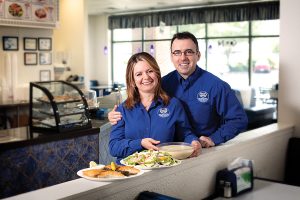
As the spoon nears my mouth, a rich, meaty bouquet greets my nose. And on the palate, don’t look for fireworks: It’s comfort food incarnate, as only chicken soup can be — silky and round, with just a hint of sour from the lemon and richness from the egg. The rice gives it a creamy texture. As it heads toward my stomach, my pulse slows, sinuses open, headache eases and eyes clear. (I check my compact mirror, and by God, I even look better.)  Healing by avgolemono has begun.

“It has a fan club,” admits Mythos owner Eddie Balla. Eddie and his wife, Miranda Balla, run the Market Street location and sell their soup by cup, bowl, or quart, made by the gallons, rain or shine, cold days or hot.

How did Eddie master the perfect consistency of his avgolemono? He had years of practice, having worked in Athens, Greece, at age 20. When he opened Mythos Grill in 2005, Eddie called it “Greek fast-food, but cooked to order and fresh.”

Another family member, Samir, runs the Mythos Battleground location. Samir says the soup at both grills is made faithfully from Eddie Balla’s recipe. 

Eddie says modestly, “It’s a very famous Greek soup — I didn’t invent it.” 

As much as 20 gallons are sold between the two restaurants six days a week. After a cold spring, the soup-making — and — sales continued into late April although production dropped–to about 6 gallons made twice daily at Market Street alone. During the summer months, the Ballases discovered they sold less, yet a steady customer demand continued.

The classic dish has origins in Mediterranean sauces and soups created with egg yolk and lemon. “You can make it with orzo or rice,” Eddie explains. “In the northern part of Greece where I am from, we use rice . . . We make the broth out of chicken, which we use later.” 

Eddie adds rice to the broth near the end of the preparations. “At that point, we add the chicken in it, and on the side, we have the egg ready.  We only use the yolks; you can use the egg white, but we don’t.” 

He whips egg yolk with lemon juice in a separate dish, while in another, he mixes butter and a small quantity of flour, which is added to the simmering rice and broth at the end. 

Before that final step, Eddie extracts a bit of broth, which is whisked into the frothed egg and lemon juice. This goes into the pot about five minutes as the soup is thickening during the final minute of cooking.

“The time when we add that is very important,” Eddie cautions. “If you put it in too late, it won’t give the smoothness of it. Too early . . .” he frowns. 

“You must put it in the right time for the creamy texture!”

“We were keeping it only for wintertime, but a lot of people ask for it,” says Eddie. “We’re not going to give up on it if it makes customers happy.”  Patting his slender waist, he adds, “For some reason, when you have an upset stomach, it is soothing. It is a comfort food.”

The House that Jack Built

Jack’s Corner is a hub for Mediterranean food and good conversation

By Ross Howell Jr.

Photograph by Mark Wagoner

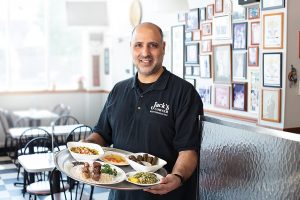
At the intersection of South Aycock and Spring Garden streets — in the shadow of the water tower painted with the brawny UNCG Spartan — stands Jack’s Corner, a Mediterranean deli that’s been serving Mediterranean fare located here for 26 years. The building has a curved façade and big windows — reminiscent of 1960s roadside diners.

Inside I’m greeted by Jacob (Jack) Bishara, a tall man as strong-jawed as the Spartan on the water tower. His face breaks into an easy, broad smile as we sit at a table.

“I was the family’s baby boy,” Bishara says. “I was a little spoiled, you know? When I was about 16, I said to Mom and Dad, ‘I have no interest in going to college.’”

His parents asked what he thought he would do to earn a living. He didn’t have an answer.

So the Bisharas set out on a family trip, first to Michigan, then to Texas. Bishara had uncles in the restaurant business at both places.

“They said to my Dad, ‘Don’t you own property right by the college? Why don’t you open a restaurant?’”
But neither Bishara nor his parents had any experience.

His grandfather, James Bishara, came to the states from Ramallah, Palestine, in 1934. During the Depression, he’d made a living selling linens door-to-door. When he returned to Ramallah for a visit, he convinced his son, Essa — Jack’s father — to emigrate in 1956.

Essa settled in Tennessee and worked in real estate. When he returned to Ramallah for a visit, he noticed an attractive young woman at a party thrown by two brothers who were his boyhood friends.

“Why, that’s little Najwah!” the brothers exclaimed. The attractive young woman was their sister, whom Essa hadn’t seen since she was a girl.

In time they were married. Najwah came to the United States with Essa in 1962.

“Mom and Dad were living in Knoxville,” Bishara says, “when they drove to Greensboro to visit her two brothers.”

His father was struck with how beautiful the city was, and decided Greensboro was the place to raise a family.

“So they moved here,” Bishara says. “This is where I was born.”

Since his mother had grown up in Ramallah helping cook for a family of 10, she had recipes for Mediterranean dishes going back generations. Bishara’s father thought she was the obvious partner for his son’s venture.

Bishara pauses, gazing at a wall of framed photos. There are mustachioed men with fezzes and women in flowing dresses gathered with their children. There’s Najwah in her gown and Essa in a suit on their wedding day. There’s a bearded priest in the robes of the Antiochian Orthodox Christian Church — Najwah’s grandfather, who married the couple.

“One day my Mom and I were talking business,” Bishara continues, “and she looked at me and said, ‘I think we can do this.’”

And they did. In what had been a curb market catering to college students, Bishara and his mother opened a sandwich shop — with hamburgers, subs, hot dogs, potato chips, and so on.

“We thought it best to stay mainstream,” he says. “But we also had hummus on the menu. Falafel. And tabbouleh.” But this was 1992, and there wasn’t a lot of talk in Greensboro about healthy ethnic foods at the time.

The first couple of years were “a real struggle,” Bishara says.

Then something happened.

Grunge music — in the person of Kurt Cobain and Nirvana — exploded on the popular scene.

“All of a sudden,” Bishara says, “these young people were coming in, looking for vegetarian food.”

So Bishara expanded the Mediterranean portion of the menu — easy to do, with all his mother’s home recipes. Today, ethnic specialties comprise 85 percent of the items on the menu.

Some customer go-tos?

“The Mediterranean platter — with falafel, hummus, tabbouleh, pita, and baba ghanouj,” Bishara says. “And the double gyro platter—that’s always popular.”

Other favorites are the chicken kabob platter, the lamb shawarma, the chicken souvlaki and gyros. With a nod to its early days, the deli offers a falafel dog and a falafel burger. I haven’t even mentioned the sandwiches, salads and children’s menu.

When I ask about the future, Bishara tells me he and his wife have three children — aged 17, 16, and 12.

“When the kids were little, I’d bring them into work with me,” Bishara says. “They really liked hanging out. But my wife — because she knew how much time the restaurant took — would say, ‘Jack, you don’t want them to love it too much.’”

None of the children are interested in the business now, Bishara tells me.

Then he smiles.

“But they’re young,” he says. “Who knows what will happen?”


The Soul of Fellowship

United House of Prayer For All People serves a heaping helping of love, seven days a week

By Jim Dodson

Photograph by Mark Wagoner

For better than 75 years, as part of its social outreach ministry, the United House of Prayer For All People has served great home-cooked food to those in need or those simply with a hearty appetite starting first on East Market Street and these days, at the cafeteria in the basement of its handsome Dudley Street sanctuary.

Long regarded as one of the best-kept secrets in Greensboro’s crowded dining scene, we checked in with a noontime crowd and discovered the church is still dishing up the best in classic soul food — Southern fried chicken, smothered pork chops, deep-fried fish on Fridays and weekly specials sided with soulful staples that include savory seasoned collards, slow-cooked green beans, home-style mac and cheese and always a generous piece of cornbread. Wednesday is baked spaghetti and Thursday is the church’s much-anticipated and famous meatloaf day. If you’re lucky, most any day you can sit down to chicken and dumplings, and there’s always at least a couple kinds of cake that will make you miss church picnics.

Every dish is fresh and made from scratch by the loving hands by three principal cooks and a staff of half a dozen workers who volunteer their time and talents to the church’s community outreach. A typical lunch (after which you may need a nap) runs less than $10.

“The cornerstone of our success is our volunteers,” says senior pastor Hubert Swaringer. He emphasizes that one of the prime missions of  the church’s nondenominational parishes nationwide (there are more than 135, including sister churches in Charlotte and Durham), is to operate a kitchen — open to anyone and everyone — “fresh, wholesome food at a reasonable price they can afford. Our founder’s philosophy was that if you feed a hungry man, you can also feed his soul.”

Students from neighboring N.C. A&T State University, just across the street, are frequent diners during the school year, and so are soul-food fanatics who happen to know about the kitchen through word of mouth. Every penny the cafeteria generates goes into the budget of the church, but nary a penny is spent on advertising.

“We do a pretty good job with word of mouth,” notes kitchen coordinator Denise Gray. “We cook it with love, they hear about it and come.”

When the tornado ripped through east Greensboro in April, the cafeteria  provided meals to many victims and emergency workers and recently held a marathon fish fry to generate money for its scholarship fund to help A&T students.

“I worked at A&T for 32 years and retired in 2012,” Denise Gray adds. “I came over here to help out and have been here almost every day since. The people here love cooking and serving others. That’s what serving the Lord is all about.”

A perfect description of Soul Food, we think.


Pizza as it Should Be

Family-style is the hallmark of Cugino Forno

One might easily forgive loyal patrons of Cugino Forno pizzeria in Revolution Mill for assuming its owners Joseph Ozbey and Yilmaz Guver are Italian brothers who happen to make the closest thing to authentic Neapolitan pizza.

In fact, they are Turkish cousins (as is their third partner Adam Aksoy) who fell in love with the simple cheese pizza served at iconic L’Antica Pizzeria da Michele in Naples and brought the recipe and know-how for the “world’s greatest pizza” with them to America. After all, by some accounts this internationally beloved foodstuff was birthed in Naples when fishermen began dousing day-old bread with tomato sauce and layering on the cheese.
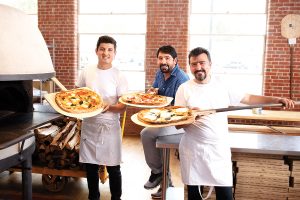
The pizza know-how was supplied by Joseph, an engaging 26-year-old who, following college at Georgia Tech and traveling extensively through Europe, wrangled a job mopping floors at the famous Naples pizzeria “just to learn everything I could about how to make their amazing pizza.”

Progressing from mop to pizza-prep took more than eight months of hard work that included plenty of 5 a.m. mornings and late nights. “They make pizza in a very Old World way,” says Joseph. “I watched and learned every aspect of how they did it and got to know the guys there. We remain friends to this day. We’ve incorporated everything they do here; down to the smallest detail.”

That includes the three massive Italian-made 7,000-pound wood-fired ovens made from Mount Vesuvius sand and shipped to the Port of Wilmington via freighter just before the restaurant opened its doors just over a year ago. “They barely fit through the doors,” Joseph says, laughing at the memory of the tight squeeze.

With an equal mix of hickory and oak, the mighty ovens produce upwards of 1,000-degree heat that can cook a pizza in less than 90 seconds, but the real secret of their Old World taste is the double-ought (“00”), extra-fine pizza flour imported directly from Naples, same San Marzano tomato sauce and a delicious double Bufala Mozzarella that “was in Naples yesterday.”

Flour, sea salt, yeast and a bottled water constitute the simple family recipe that makes Cugino Forono — the name means “ovens of cousins” — pizza so beguilingly different. Following a search that took Joseph on a two-month car odyssey around the state, the cousins learned about a great open space at Revolution Mill and soon knew they’d found home. They outfitted the airy space with large communal tables to encourage conversation, developed a menu with a dozen authentic variations of the famous original, fired up the ovens and started making genuine Napoli pizza. Robust  and imaginative salads, real Italian wines, fresh cannoli and a state-of-the-art rotating gelato cooler — made by Ferrari, no less — filled with gelato that arrives from the Old Country almost daily completes the simple but spectacular offerings. Italian flags and European soccer jerseys hang everywhere and a special “Spice Bar” allows customers to jazz up their pizza, if so desired. Puccini’s opera arias, or the familiar theme to The Godfather, play in the background.

The topping on the cousins’ pizza may be the warm reception they have found with the Gate City diners. “Authenticity to the smallest detail is our key,” says Joseph. “But quite honestly, we weren’t at all certain this kind of simple pizza would go over well in America. The community, however, has embraced our home-style approach to pizza. We have customers who come every week to dine with other families, couples and children, old and young, people enjoying the experience of being together.”

Great pizza, he says, will do that. “It’s been a great journey for us to come so far and find a home in Greensboro. We hope to be serving families for a very long time.”