Birdwatch

Nighthawks

But not the Edward Hopper kind

By Susan Campbell

The common nighthawk is neither “common” nor a “hawk.” Found in the Sandhills and Piedmont of North Carolina, these large birds feed exclusively on insects and actually do so at night. They use their large mouths to catch prey. Beetles and other insects are instantaneously intercepted and ingested by way of the birds’ oversized mouths. Nighthawks are unique in that they literally fly into large insects. Because their weak feet are designed purely for perching, they do not grab at them as true hawks do.

These medium-sized birds are active mainly at dawn and dusk when beetles and other big insects are also most active. Due to their terrific night vision, nighthawks hunt effectively in darkness, though they may even feed during the day, especially when they have young to provide for. In early summer, cicadas, grasshoppers, larger wasps and true bugs are abundant and, given their aerodynamic prowess, nighthawks are very successful predators at any hour.

As one of many survival tactics, common nighthawks spend the day perched horizontally on a pine branch. Invisibility is the goal during daylight hours. Although their vision is not compromised, they have a better advantage when light intensity is low. The mottled black, gray and white feathering is very hard to see regardless of the time of day, but their characteristic low “peee-nt” call and erratic moth-like flight is distinctive.

Common nighthawks’ nests are well camouflaged. Females simply scrape a spot to create a nesting area. Their speckled eggs blend in well with the mineral soil and miscellaneous debris typical of native arid terrain. Females are known to perform a feeble “broken wing” display if they are disturbed. This act is the only defense they have to draw potential predators away from the eggs or young.

More likely, common nighthawks’ presence will be given away by males “booming” in the early morning over high quality open habitat. The unique noise they produce comes from air passing over the wing feathers of breeding males — not vocalizations — as they move through the air.

Amazingly, nighthawks are one of a handful of bird species that will also nest on flat rooftops. As large fields become scarce, common nighthawks are more prone to using large artificial spaces. These birds can easily support a family on the associated abundant flying insects found in open foraging habitat such as agricultural fields or some athletic venues, so it’s not unusual to see or hear nighthawks at summer baseball games or early fall football games throughout the region. They are capitalizing on the abundant prey associated with the evening floodlights at stadiums and other outdoor sites.

The species is found in many open areas in the eastern United States in summer, and so it is no surprise that common nighthawks begin to move south in late summer in large flocks. They migrate long distances to winter destinations in Central America and northern South America. Large numbers can be seen feeding in the evening in August and early September, so there’s plenty of time left to spot a nighthawk before cooler weather sets in.  OH

Susan Campbell would love to receive your wildlife sightings and photographs at susan@ncaves.com. 

Gate City Journal

Wednesday Afternoon Book Club

One of Greensboro’s oldest book clubs is still going strong today

The year 1897 was a pretty big year in America.

Thomas Edison perfected his kinetograph camera, forerunner of the first film projector. William Faulkner and Amelia Earhart were born. Boston opened the first subway system in the nation, and the Library of Congress opened its doors to the public.

Here in Greensboro, a city fast approaching 25,000 in population, a dozen prominent Gate City women with names like Bynum, Mebane, Caldwell and Schenck formed the city’s second “study” club for discussion of literature, history and current events, adopting the practice of circulating timely books among its members with the aim of keeping abreast of the day’s key social issues, including the cause of women’s suffrage.

“Remember ladies,” club founder Mrs. Sterling Jones advised her colleagues, “the club comes first in your lives, and your husbands second, and never the twain shall meet!”

Initially, meeting every fortnight at the home of a member — many of whom, in those fleeting days of the horse and buggy, conveniently resided along North Elm Street — on Wednesday afternoons at 3 p.m., the members soon voted to change its name to the Wednesday Afternoon Book Club.

And so it remains to this day — 125 years after the city’s second book club was born.

“It really has had a remarkable history,” notes longtime club secretary and incoming president, Chris Garton, “attracting women of the city who had a great interest in improving their minds and the quality of life in Greensboro.”

Garton notes that the WABC was one of the early benefactors of the city’s first public library, which opened its doors in 1911, donating research books and other titles from the club’s own library, along with significant funds collected directly from its members.

As the 20th century dawned, membership rose to 16. At that time, member Mrs. Frank Dalton presented the club with a handsome monogram and fitting motto: “Nulla Vestigia Retrorsum” (“No retreat/We never go backwards”). Club members studied in depth the works of Shakespeare and Jonson, and printed their first booklet on the history of North Carolina.

Club members also sponsored popular monthly lectures by prominent speakers at the original downtown O.Henry Hotel and wrote papers on a range of timely subjects — travel, war, literary biography, poetry and local history were major themes — to share with fellow members at their regular Wednesday afternoon gatherings that ran from May to October annually.

“Whatever the topic, these women took a deep dive into their subjects,” says Garton. “It’s amazing what these women lived through. So much was happening in America then — World War I and lots of social change. During the Second World War, club members worked at the Red Cross and presented programs on rationing, a timely subject for everyone.”

Today, the Wednesday Afternoon Book Club presents only four or five programs a year, but the spirit of the organization’s fellowship is very much alive among its 27 active members. During the COVID shutdown, members were forced to meet via Zoom but continued paying dues, which led to a significant donation this past spring to the Greensboro Bound literary festival and a return of in-person readings in honor of the club’s 125th anniversary.

“We like to say that we’re putting the ‘book’ back in book club,” quips Chris Garton. “Because we have refocused on books that speak to the moment and interest of our members. At heart, though, it is really about the friendship we share — along with good books — that matters most.”

“I have belonged to so many organizations in my long lifetime,” early club historian Louise Meyers once wrote. “But none with a sweeter spirit than our club.”  OH

Lavender Field of Dreams

Follow your nose to Red Feather Ranch

By Cynthia Adams     Photographs by Amy Freeman


“Sweat is nearly as wonderful as the smell of lavender,” claims Dianne Reganess, who presides over Red Feather Ranch, a 24-acre property on Ritter’s Farm Road.

“I love hard work.”

Clad in hard-working clothes, T-shirts and jeans, Dianne proves the point, steering a Polaris Ranger utility vehicle — with ample space for flower buckets — inspecting orderly rows. She eyes a second planting of 400 organically-grown lavender plants in green formation. (Current number of lavender plants? Almost 1,000.)

Dianne’s blue-gray eyes approximate the colors of the Sweet Melissa Lilac, Grosso, Grosso Blue, Riverina Thomas and Provence varietals she finds best suited and most productive in her USDA Plant Hardiness Zone, 7-B.

Although she is a member of the United States Lavender Growers Association, managing a farm and cut flowers business, Dianne once wore a snappy Air Force uniform, which she eventually exchanged for business suits when later joining the financial world.  At First Union Securities, where she met husband Jonathan, a financial manager, she worked as a cage operator, responsible for placing orders for stocks and the ticker tape that would print out.

“A complicated job,” she says. “I also was the cashier, documenting checks coming in and going out. Compliance manager . . . etc.”

In time, Dianne joined an estimated 40,000 women in farming and agri-businesses throughout the North Carolina Piedmont. 

Growing lavender is a challenging endeavor, she says: “You have to trick it, and make it think it’s somewhere it’s not.” Jonathan helps when his work allows. But all of the maintenance and work of growing a fickle herb and an expanding variety of flowers, are her own. 

Daily labors she does joyfully.


“I built every bed out there by myself. I did all the irrigation by myself.  It’s hard work, but it’s very rewarding,” Dianne says. 

She jumps back into the small vehicle, proudly pointing out the new “high tunnel” — grower lingo for a large commercial greenhouse.

As with all farmers, the day starts early. At 7 a.m. during growing season, Dianne has completed picking and harvesting, plus hitting the office mid-morning to deal with online orders. “By 1 p.m., most of the work is done. Flowers don’t like heat.”

With Dianne working mostly alone, apart from an occasional volunteer, the one-woman, great lavender experiment has blossomed into a visually stunning, yet all-consuming, endeavor. 

And it couldn’t be more ironic, she jokes.

“I’m a terrible gardener,” Dianne confides darkly. “I cannot grow a thing for my house. But flower farming is so very different.” The mindset is different, she says, and the strategy is different.

The running joke in her family, she shares, is “do not give Dianne a houseplant. She’ll kill it.” 

“So here I am, with all this going — all out there,” she says, waving toward the fields. At this point, she giggles.

Some of her family still cannot believe she created this field of lavender dreams. Her mother, an avid gardener, always knew she had it in her.

“My mom said, ‘Welcome to the other side! You’re finally recognizing what we always knew was there!’” 
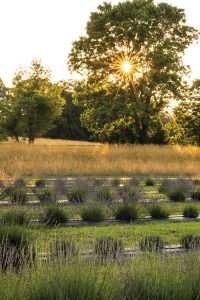
    

“All this” commenced in 2016, a year after Dianne and Jonathan found a long-pursued farm listed on Zillow, promptly scheduling a look-see.  “And I came over the top of the hill, and I said, ‘This is it!’ I just knew, seeing the land, that pond, the house. This was it!

Here was ample room for an outsized dream Dianne had been nursing.  As for the name? Red Feather Ranch was carved in stone at the gated entrance.

“I kind of took it as a sign since my favorite bird is the cardinal. When we pulled onto the property that very first time and I saw that, I thought to myself — that’s kind of neat!” says Dianne.

The partially-wooded 24 acres included a barn, outbuildings, a spring-fed pond, creek and a white pine, custom log home at the center.  Redolent of the Ponderosa on the Western Bonanza, it would have been the deal maker for many, but Dianne was equally star struck by the land itself.

“All woods. Creek. Great for our three children,” Dianne says. Her eldest, Samantha, was 19 at the time.

Daughter Mackenzie, now 15, was 9; son Alex, 17, was 11.

“I would have never thought [we would buy a] log home, though we loved a rustic look,” she says. The house would serve their needs well. 

“It’s a spacious house. There were [then] five of us here. Plus, three dogs. Three cats.” 

It was a farm in theory. However, six years ago, there were no fields. No commercial greenhouse either.

At the time, Samantha, now in Asheville, worked with American Conservation Experience on habitat restoration. Her knowledge concerning invasive species removal, planting and more proved a strong resource as the farm developed. 

Dianne’s mother, who had relocated to the Triad from the West Coast “is an amazing gardener. Grew up in California. She can grow anything.”

But not so for Dianne, whose abilities held few hints of what was to come. 

“I went into the Air Force straight out of high school. My father was in the military.” 

Posted abroad for nine years, she trained as a graphic artist, creating images and visuals used in briefings for military brass. “To Generals,” she clarifies. “It was classified information. Top secret.”

Stationed near the southwest border of France, her final years were in Ramstein, Germany, near stunning fields. 

“When I was in Europe, you would be driving along and pass rows and rows of lavender and sunflowers — it was the simplicity of it really that was so breathtaking. No frilly houses or structures . . . just the plants,”

Dianne left the military at age 27. Reentering civilian life, she met Jonathan while both worked at First Union Securities.

In 2003, they wed at the home of friends Andrew and Hilary Clement, a fortuitous sign given the Clements now own the Finch House, a Thomasville wedding venue. “Maybe we were practice,” jokes Dianne. (See the February 2021 issue of O. Henry magazine’s “Labor of Love.”)

They honeymooned north of Edinburgh, Scotland, “where my family originally is from,” she says. Jonathan’s family’s Swiss.

For years, Dianne flashed back to striking fields of color. She imagined herself growing sunflowers, a notion Jonathan endorsed.

Dianne eventually left the financial world, where Jonathan remained, and refocused upon their growing family and . . . growing plants.  The family lived in Summerfield while seeking a small farm.

Then, the aforementioned Zillow listing appeared.
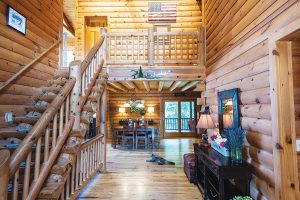
Driving over the rise the day she first approached the house, “I had a vision of sunflowers,” she says. 

The expansive log home seemed perfect. It was everything the family hoped for, but Dianne was even more excited by what lay outside. 

Arable land!

Early on, they tilled the front section in preparation for Dianne’s venture.  “I was planning to have sunflowers.”

Then, reality. “I planted about 4,000 seeds by hand. Maybe, maybe, 50 of them grew. I was so disheartened!” The land, accustomed to growing something else, won out. The grass, she says, “completely took over my sunflowers. I have a picture of one scrawny little row.” Dianne sighs.

“I went in very green, knowing little,” she puns. That first failure caused her to “dive deep.”

“It forced me to educate myself on how to make it work. What did I need to do that I didn’t do? I was up at night studying. I love a good challenge. And I was going to make it work.”

Dianne persisted. “The second year, a little more successful.  The third year, a lot more successful.” 

Sunflowers were simply not quite enough. “But what else could we do?”

Dianne had more hands-in-the-dirt dreams.

Jonathan followed his bliss, too, leaving his corporate job and starting a wealth management business last April. 

She pondered the next agro steps. With some prodding from Jonathan, she realized lavender was the right complement. 

“Of course,” Dianne laughs. “I had talked about sunflowers and lavenders in France.”

Here, too, was another learning curve. Rather than plunging in without exploring risks, she did research. “Time. Money. How realistic? Is it going to grow in this area?” Growing conditions in the Triad’s microclimate, 7-B, are tricky. The air is more turbulent; therefore, storms are more violent. 

In 2016, she took an entire year off to figure out the best supplier and grower before Red Feather Ranch launched as a commercial grower.

Suppliers are crucial.

“A lot of varietals are patented,” she explains. This prevents commercial growers from propagating their own plants.

She attended a lavender grower’s conference in Charleston, S.C., to better educate herself. “I was asking questions. Took notes and listened. I came back thinking, ‘We can do it. But it’s going to take a lot of work.’ Because lavender is a very tricky plant. In the French Provence area where it grows well, they get 14 inches of rain a year. We get 44 plus.”

How not to drown lavender? 

She learned the answer. “You have to have it raised. Drainage is key.”

Dianne experimented with a mix of dirt and pea gravel, having met a Virginia grower who only used pea gravel and no dirt. Then she grew braver. “I last planted them only in pea gravel.” 

Paydirt! She finally “figured out the drainage thing.”

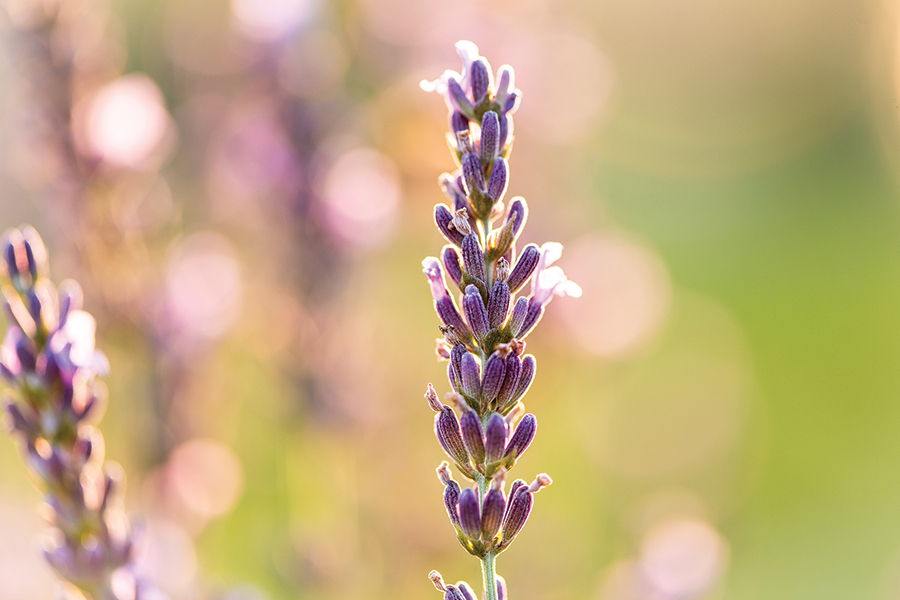
“The more you neglect it the better it is. The plant life of lavender is about 15 years. Get them out of a pot,” she advises, and give them room. “At full maturity it can get about five feet from side to side!”

Dianne learned what growing practices “are good for lavender.” As a cool weather plant, she knows to set stock in October. 

Lavender varietals differed by camphor content, Dianne explains.

“Lavender has the compound in it that is called camphor,” she adds. “That camphor chemical makes you kind of go oof . . . it’s really in your face. The other lilac plants that they use for culinary have a much lower chemical compound.”

Sweet Melissa Lilac and Provence lavenders are for culinary use. For infusions, teas and baking, she employs these, even adding a teaspoon of lavender buds into muffin batter or beverages. “I make lavender lemonade and cocktails! I’m old school.”

It’s savory, too. Whenever cooks use herbs de Provence, “there’s lavender in there,” she points out.

Sunset is her favorite time.  She and Jonathan can enjoy bird-watching. Or take in bumblebees, drunk from the soporific lavender, nodding off on the stalks. Felines, too. The family cat, Chanel, curled up to nap inside a lavender wreath as Dianne was crafting it.

She still loves sunflowers, where the goldfinches feast away on the drooping heads. 

And the butterflies! They thrill Dianne. “I don’t spray,” she says, adding, “lady bugs eat the aphids on my sweet peas.”

There is something beyond what nurtures plants. There are benefits for humans, too.

In fact, she wishes more people would come out, breathe the intoxicating and relaxing smell of lavender, and enjoy the rejuvenating air, while walking the picturesque farm.

“People can come here. People need to get back out in nature. Take off your mask and breathe some fresh air! Walk the rows even if you don’t buy anything.” 

Sometimes people come solely for photo opportunities, she says. Dianne is a shutterbug, who enjoys snapping pictures of each unfolding season, posting online at https://www.redfeatherranch.shop/blog.

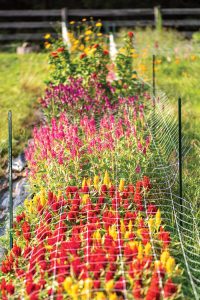
After lavender peaks, other blooms follow, including, of course, sunflowers, a perennial favorite. Sunflowers have a longer season, growing thru October. 

Red Feather Ranch offers subscription options, a community supported agriculture program, and cut-flower delivery throughout Greensboro. The farm sells lavender through mid-July, and sunflowers June–October, adding a new program called U- Pick. 

After the growing season ends, Dianne harvests the dried lavender and stitches up sachets and other projects for both home and kitchen. 

She makes linen spray, body mist, lip balm, sugar scrub — all from organic, dried lavender.

Farming is relentless, as anyone who ever wielded a hoe knows. It’s an all-the-time lifestyle choice, but it happens to agree with Dianne, who determinedly battles weather and wildlife. 

“All is well here… hot, hot, hot, but well,” the exasperated farmer writes in June. “Deer ate ALL my sunflowers.  Makes me so mad!”

Still, the work seems to dial the clock back. Dianne swears it rejuvenates her. An unhurried manner and easy laugh underlie this. All of which — especially a lack of vanity — proves her point. 

Sweat of the brow is a point of pride. 

A feather in her cap.

Cynthia Adams is a contributing editor to O.Henry magazine.

Fast Facts about Lavender from Dianne Reganess:

Fact: Zone 7-B is a microclimate. “What works in Raleigh won’t necessarily work here. We’re in a zone where the air can be more turbulent. It is definitely humid. Severe storms.” (https://planthardiness.ars.usda.gov/)

Fact: It’s illegal to propagate lavender varietals, which are patented, without a license. It took Dianne a year to find the right commercial grower. Like roses, many lavender varietals are patented. “I cannot take a clipping and grow my own plants without breaking the law. So, I go back to the same woman grower. I know the plants I get from her. They are healthy and survive, and this is key.”

Fact: “It takes the lavender plants three years to reach maturity.” 

Fact: “Lavender is organic. No chemicals are needed. Also, deer and rabbit don’t bother it.” Also, she warns against potting soils or bark mulch, which hold excess moisture, causing disease.

Fact: Dianne recommends Munstead, Provence and Sweet Melissa, lavenders more commonly found at “big box” stores.  OH

Romantic Fever

Fiction by Lee Smith     Illustrations by Matthew Shipley

The house I grew up in was one of a row of houses strung along a narrow river bottom like a string of beads. We were not allowed to play in the river because they washed coal in it, upstream. Its water ran deep and black between the mountains, which rose like walls on either side of us, rocky and thick with trees.

My mother came from the flat exotic eastern shore of Virginia, and swore that the mountains gave her migraine headaches. Mama was always lying down on the sofa, all dressed up. But there was no question that she loved my father, a mountain man she had chosen over the well-bred Arthur Banks of Richmond, “a fellow who went to the University of Virginia and never got over it,” according to Daddy. Mama suffered from ideas of aristocracy herself. Every night she would fix a nice supper for Daddy and me, then bathe and put on a fresh dress and high heels and her bright red lipstick, named “Fire and Ice,” and then sit in anxious dismay while the hour grew later and later, until Daddy finally left his dime-store and came home.

By that time the food had dried out to something crunchy and unrecognizable, so Mama would cry when she opened the oven door, but then Daddy would eat it all anyway, swearing it was the most delicious food he’d ever put in his mouth, staring hard at Mama all the while. Frequently my parents would then leave the table abruptly, feigning huge yawns and leaving me to turn out all the lights. I’d stomp around the house and do this resentfully, both horrified and thrilled at the thought of them upstairs behind their closed door.

I myself was in love with my best friend’s father, three houses down the road. Mr. Owens had huge dark soulful eyes, thick black hair, a mustache that dropped down on either side of his mouth, and the prettiest singing voice available. Every night after supper, he’d sit out in his garden by the river and play his guitar and sing for us and every other kid in the neighborhood, who’d gather around to listen.

Mr. Owens played songs like “Wayfaring Stranger” and “The Alabama Waltz.” He died the year we were thirteen, from an illness described as “romantic fever.” Though later I would learn that the first word was actually “rheumatic,” in my own mind it remained “romantic fever,” an illness I associated with those long summer evenings when my beloved Mr. Owens played the old sad songs while lightning bugs rose like stars from the misty weeds along the black river and right down the road — three houses away — my own parents were kissing like crazy as night came on.

II

The link between love and death intensified when my MYF group (that’s Methodist Youth Fellowship) went to Myrtle Beach, where we encountered many exotic things such as pizza pie and Northern boys smoking cigarettes on the boardwalk. Our youth leader, who was majoring in drama at a church school, threw our cigarettes into the surf and led us back up onto the sandy porch of Mrs. Fickling’s Boardinghouse for an emergency lecture on Petting.

“A nice girl,” she said dramatically, “does not Pet. It is cruel to the boy to allow him to Pet, because he has no control over himself. He is just a boy. It is all up to the girl. If she allows the boy to Pet her, then he will become excited, and if he cannot find relief, then the poison will all back up into his organs causing pain — and sometimes — death!” She spat out the words.

We drew back in horror and fascination.

III

Of course it wasn’t long before I found myself in the place where I’d been headed all along: the front seat of a rusty old pickup, heading up a mountain on a dark gravel road with a wild older boy — let’s call him Wayne — whom I scarcely knew but had secretly adored for months. This was not the nice boy I’d been dating, the football star/student government leader who’d carried my books around from class to class all year and held my hand in study hall. My friends were all jealous of me for attracting such a nice boyfriend; even my mother approved. But, though he dutifully pressed his body against mine at dances in the gym whenever they played “The Twelfth of Never,” our song, it just wasn’t happening. That fiery hand did not clasp my vitals as it did in Jane Eyre whenever she encountered Mr. Rochester.

So I had seized my chance when Wayne asked me if I’d like to ride around sometime. “You bet!” I’d said so fast it startled him. “I’d love to!” Wayne was a big, slow-talking boy with long black hair that fell down into his handsome, sullen face. He wore a ring of keys on his belt and a pack of cigarettes rolled up in the sleeve of his T-shirt. He did not play sports. I admired his style as much as I admired his family — or lack of family, I should say, for he lived with his uncle in a trailer out near the county line. Wayne smoked, drank, and played in a band with grown-up men. He was always on the Absentee Hot List, and soon he’d be gone for good, headed off to Nashville with a shoebox full of songs. 

We jolted up the rutted road through dense black woods. My mother would have died if she’d known where I was. But she didn’t. Nobody did.

I was determined to Pet with Wayne even if it killed him.

Finally we emerged onto a kind of dark, windy plateau, an abandoned strip mine set on top of the mountain. He drove right up to the edge, a sheer drop. I caught my breath. On the mountainside below us were a hundred coke ovens sending their fiery blasts like giant candles straight up into the sky. It was like the pit of hell itself, but beautiful. It was the most beautiful thing I’d ever seen. For some reason I started crying.

“Aw,” he said. He screwed the top off a mason jar and gave me a drink, which burned all the way down. “You know what?” He pulled me over toward him. He smelled like smoke, like alcohol, like the woods.

“What?” I said into the sleeve of his blue jean jacket

“They was a boy killed in one of them ovens last month — fell in, or throwed himself in, nobody ever did know which.”

“Was there?” I scooted closer.

“Yep, it was a boy from over on Paw Paw, had a wife and two little babies. Gone in the twinkling of a eye, just like it says in the Bible.” He snapped his fingers. “Right down there,” he said into my hair.

“That’s awful.” I shuddered, turning up my face for his kiss, while below us the coke ovens burned like a hundred red fountains of death and I felt the fiery hand clutch my vitals for good.

Finally, I thought.

Romantic fever.  OH
Summer Reading Issue 2022

William Faulkner invented Yoknapatawpha County as a place for his imagination to live, and every Southern writer knew where it was, even if it wasn’t on any map. Ernest Hemingway loaded his readers onto a double-decker bus and transported them to a fiesta in Pamplona, Spain, with its wine skins and dusty plaza de toros. Allan Gurganus created the fictional small town of Falls, North Carolina. In the hands of a fine craftsman, a sense of place in a piece of fiction can be so compelling it almost becomes its own character in the narrative. In our Summer Reading Issue three of North Carolina’s greatest writers deliver on this promise, taking us to West Virginia coal country, the Smoky Mountains of North Carolina, and the bottom of a freshly dug grave. Our guides for these adventures are Lee Smith, Ron Rash and Clyde Edgerton.

— Jim Moriarty

Lee Smith is the author of 14 novels, including Fair and Tender Ladies, Oral History, Saving Grace and Guests on Earth, as well as four collections of short stories.  Her novel The Last Girls was a New York Times bestseller as well as co-winner of the Southern Book Critics Circle Award. A retired professor of English at North Carolina State University, she has received an Academy Award in Fiction from the American Academy of Arts and Letters, the North Carolina Award for Literature,  and the Weatherford Award for Appalachian Literature. Her latest book, Silver Alert, will be available in the spring of 2023.


Ron Rash is the author of seven novels, seven collections of short stories and four volumes of poetry. He has been honored with The Sherwood Anderson Prize and was a finalist for the PEN/Faulkner Award for Fiction for his collection Chemistry and Other Stories, and for his New York Times bestselling novel Serena. His other novels include Saints at the River, Above the Waterfall and The Risen. He is the Parris Distinguished Professor in Appalachian Cultural Studies at Western Carolina University, where he teaches poetry and fiction writing.


Clyde Edgerton is the author of 10 novels and two books of non-fiction. His novels include Raney, Walking Across Egypt, The Floatplane Notebooks, Killer Diller and Lunch at the Piccadilly. Both Walking Across Egypt and Killer Diller were adapted for the screen. He has been the recipient of a Guggenheim Fellowship and has also received the North Carolina Award for Literature. He is the Thomas S. Kenan III Distinguished Professor of Creative Writing at the University of North Carolina Wilmington.

Art of the State

Into Being

Painter Herb Jackson creates meticulous, vibrant abstracts

By Liza Roberts

Deep Dive

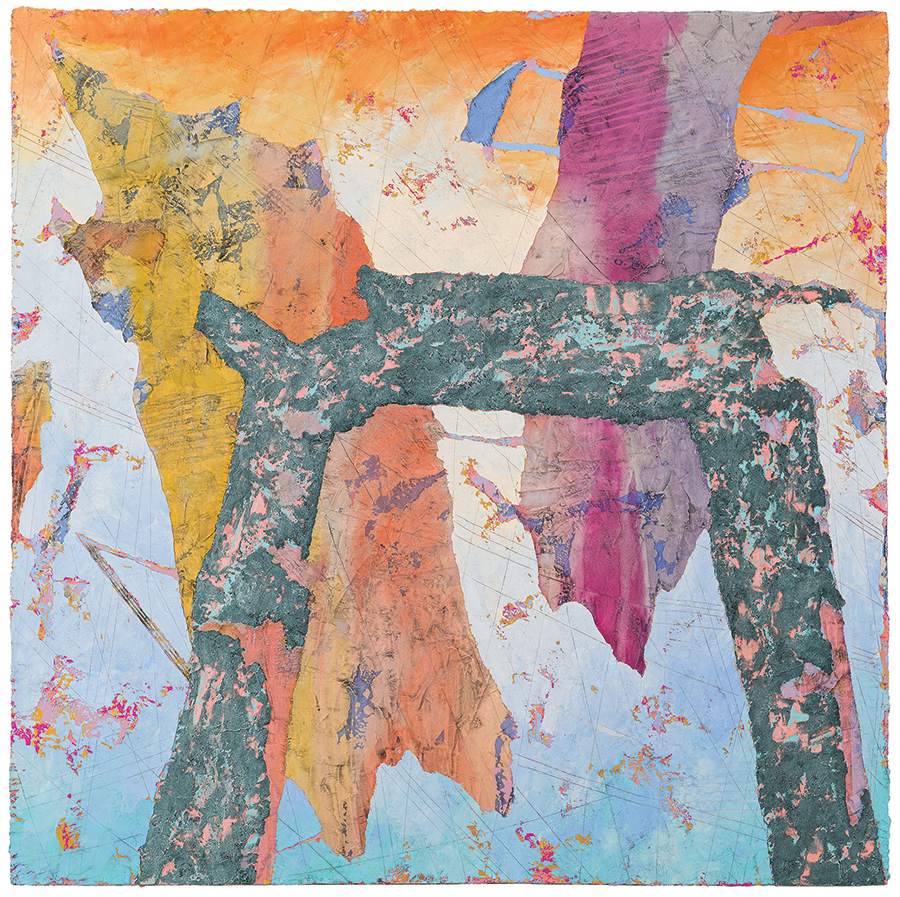
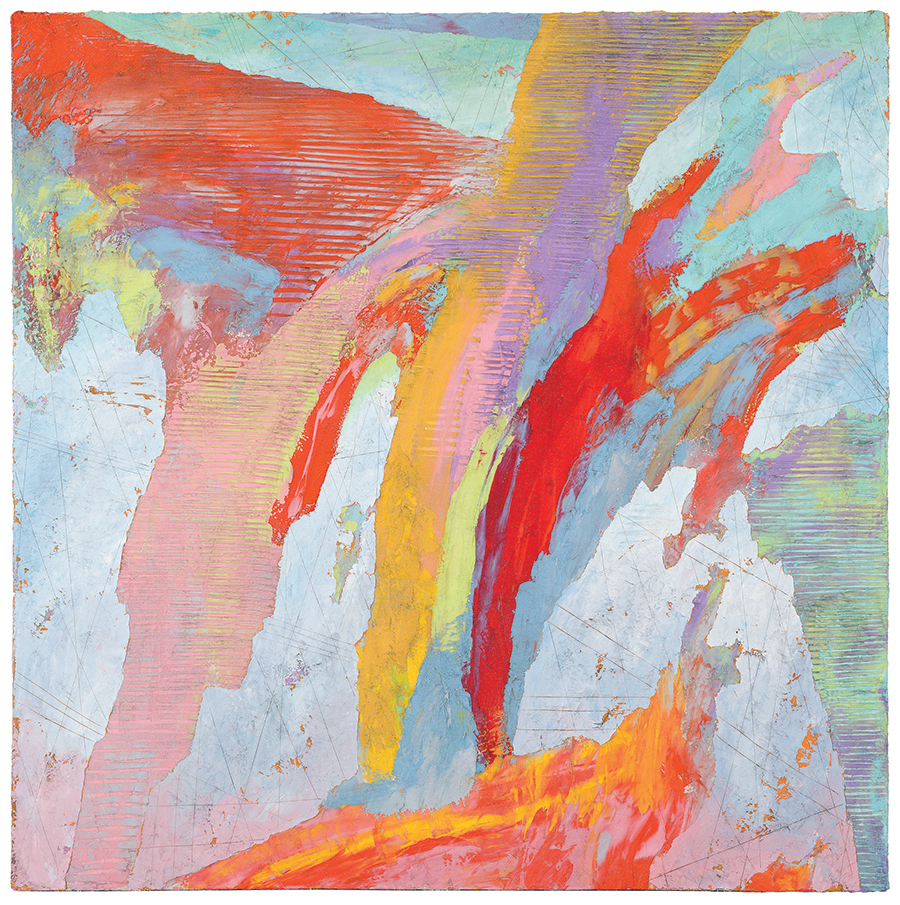
“I don’t want you to know how I work unless I tell you, because I want it to seem spontaneous,” says Herb Jackson. He’s in his Davidson studio, surrounded by the unmistakable works that have made his name; the vibrant, abstract paintings that convey energy and light and appear to have been made with swift, gestural strokes. But in reality, he notes, holding two fingers up in a narrow pinch, “I’m working about that much at a time.”

“The tricky thing is to make it not look like that,” Jackson says. “It’s a little archaeological. There’s a lot of drawing that goes on. I can work for hours on an area, and the next day completely cover it.” These palette-knifed layers accumulate, day by day, sometimes into the triple digits; many he scrapes away or sands with pumice. “If it’s not up to what I want it to be, then I just keep working,” he says. Light and shape and color and texture shift and morph, disappear and re-emerge. About two-thirds of the way through, a painting “will begin to assert itself,” and when they’re finished, “they tell me,” he explains.

Art has been communicating with Jackson since he was a child. He won his first art award when he was still a teenager as part of a juried exhibition at the North Carolina Museum of Art; his work has now been collected by more than 100 museums, including London’s British Museum, has been shown in more than 150 solo exhibitions around the world and has won him North Carolina’s highest civilian honor. After college at Davidson College and an MFA at the University of North Carolina at Chapel Hill, Jackson returned to this college town to teach, eventually serving as chair of the art department at Davidson College for 16 years.

Along the way, Jackson created a prolific and ongoing series he calls Veronica’s Veils, all of the same size (60 by 48 inches) and format. The name refers to the historic Christian relic thought to have received an image of the face of Jesus when Saint Veronica used it to wipe his face at the sixth Station of the Cross. Jackson says these works “have nothing to do with Jesus, but have a lot to do with Veronica and her luck, being at the right place at the right time.” When one of his paintings “comes into being,” Jackson says, “that’s basically my Veronica moment.”

Jester’s Retreat

That moment coheres not any particular concept, but the confluence of everything he’s ever experienced, “which is much bigger than any one idea.” All of that can take some wrangling. “Occasionally, they’ll go beyond what I expected as far as challenging me, and I’ll put them up there and stare at them for several days, to just be absolutely sure,” he explains. “Because once I decide you’re finished, then I don’t go back in.” To do so, he says, would violate a painting’s integrity. “There are paintings from 18 years ago where I spot something I would have done differently — but I was a different artist then.”

For the last 50 years, Jackson has had two or three solo exhibitions of his paintings a year, but has recently decided to curtail those to focus on what matters most: painting for its own sake. “Committing to exhibitions became confining,” he says. “I just want to make my work.”

The Raleigh native has been drawing every day since he was a young child and selling paintings since he was 12, time enough to be many different artists. He’s still amazed by the experience and the process: “Where a painting comes from and how it comes together for me is still mystical, and has been for 60 years.” He credits his subconscious, but assumes some of his inspiration must come from art and travel and nature, from exploring the woods and creek and digging in the earth near his childhood home near the old Lassiter Mill. Some also must come, he says, from the pre-Renaissance and Byzantine paintings of the Kress Collection, which formed the foundational basis of the North Carolina Museum of Art in its original downtown home — works he regularly took the bus to go see.

“Those paintings were so formative for me. If there hadn’t been the North Carolina Museum of Art, I don’t know what would have happened to me.”  OH
This is an excerpt from the forthcoming book Art of the State: Celebrating the Art of North Carolina, to be published by UNC Press this fall.

Wild Women

A watery excursion, a strawberry moon and a seed of growth

By Maria Johnson     Photographs by Jo Proia

If we’re lucky, we’ll get to see a strawberry moon tonight.

“Does anybody know why it’s called a strawberry moon?” Jo Proia asks the half dozen women assembled at lake’s edge.

No one ventures a guess.

“They call it a strawberry moon because this is the time of year that strawberries ripen,” she explains.

Six of us — suited up in life-vests, bug spray and quick-drying clothes — nod thoughtfully.

So much for the image of a pink, berry-shaped moon in my mind.

Proia continues her primer on what to expect during the full-moon paddle, a two-hour kayak trip that she’ll lead through the dusky waters of Belews Lake and up one of the creeks that feed it near Stokesdale.

First, she says, we’ll paddle to the other side of the cove, skirt the bank, slip through a narrow channel marked by an old bridge abutment and glide up the creek that runs nearly all the way to Kernersville.

We won’t go that far tonight, she says.

But we will stay on the water long enough to feel nature. In real time. With no filters and no distractions. That’s why she’s adamant that everyone needs to mute and stash her phone. Even for pictures.

“I’ve been known to throw phones in the water,” she says. She’s joking, but we don’t know that.

She assures us that she carries a phone for emergencies, and she’ll use a waterproof camera to take pictures and videos, which she’ll post later on the Facebook page of her business, Outdoor Women by Jo Proia.

We’ll stop periodically, she says, to check in with each other.

We’ll also pause for a moment of meditation and some on-board yoga.

“Who can do a headstand in their kayak?” Proia asks with a straight face.

Pulses quicken.

“NO ONE CAN!” Proia says, lowering expectations back into the human zone. “We’re not gonna do that.”

Smiles break out.

It’s time to paddle into the darkness to see what we can see.

She was a cloud watcher as a kid.

She loved to lie in the grass and pick out shapes in the puffs of vapor that drifted over her family’s farm in Oxford.

The youngest child in her family by five years, she rode an Appaloosa pony, her best friend, through the pastures and woods for hours.

In the summers, she picked prickly cucumbers and tied up sticky tobacco leaves until her palms turned black.

The blistering work stamped her with resolve. She would leave the farm. She would graduate from a four-year college. She would make a different life.

In essence, she would heed the advice of a poster taped to the wall of her father’s Air Force recruiting office: “Aim High.”

Her parents helped her land scholarships — one academic, one for being first runner-up in the Miss Henderson pageant of 1989 — that covered part of the cost of attending Vance-Granville Community College in Henderson. Proia bridged the money gap with baby-sitting and mall jobs. After two years, one class stood between her and graduation. Her adviser said she’d have to wait a couple of semesters until the class was offered again.

“I can’t wait,” Proia told her.

“You need to finish your associate’s degree,” the adviser said. “You’ll never graduate from a university.”

Raised to be a polite Southern woman, Proia bit her tongue and doubled-down. She walked to another office and started calling four-year schools. Most had stopped admitting students for the coming fall. UNCG was closing registration that day.

“What do I need to do?” Proia asked.

“You need to show up,” the registrar said.

Proia hung up the phone and called her older sister.

“Let’s go,” her sister said. “I’ll ride shotgun.”

An hour and a half later, Proia was standing in a long line at UNCG. When she made it to the front, she spilled her story to the woman who reviewed her transcript.“I’ll be the first in my family to graduate from a four-year college, and I will graduate if you give me a chance,” Proia said.

The woman held her gaze for a moment.

“Welcome to UNCG,” she said.

Thirty years later, Proia — who packs a bachelor’s degree, along with a passel of certifications and licenses for her work — can see that woman’s face in her mind.

“I wish I knew her name,” Proia says. “That was a pivotal moment in my life, for sure. She held my future in her hands is the way I looked at it. I was so glad it was a woman.”

“Does anyone know the name of that tree,” Proia says, pointing her paddle to a tree laden with fuzzy pink tassels.

“Mimosa,” someone says.

“I wish I had a mimosa,” says another, referring to the champagne-and-orange-juice drink.

We’re 15 minutes into the paddle and well into getting to know each other.

There’s Juanita from Winston-Salem.

Debbie from Greensboro.

Susan from High Point.

Candice from Wentworth.

And Candice’s friend Brandy from Charleston, S.C.

Brandy and her husband are thinking about moving to Greensboro to be closer to family.

An avid birder, she’s excited to learn that fish hawks live around here.

“You have ospreys?! I told my husband that I was going to miss ospreys if we moved away.”

We stop paddling for a round of guided stretching. Proia calls it “kye-yoga”. Sun salutations. Seated twists. Gentle back bends. Shoulder rolls. Toe flexes.

“Reach up high. Now let your hands float down by your sides, into the water if you’re comfortable with that,” Proia guides. “Let the tension melt into the water.”

A wonderful son. A wonderful husband. A wonderful home. A wonderful faith. A wonderful job.

Proia, who proved to be an ace at selling everything from pagers to Mary Kay cosmetics, seemed to have it all.

Why then, did she feel something was missing?

And why didn’t she know what it was?

She figured it out when she accompanied a friend on a kayak-and-camp trip to Cape Lookout on the Outer Banks.

Their guide was a former Marine. He expected his charges to tackle physical challenges with gusto. Proia hated it.

“I remember screaming, ‘I’m a housewife!’” she recalls. “I said a lot of bad words that day.”

The next morning, she stepped out of the tent and looked across the water.

She saw wild horses running on an island.

“Whatever was broken inside me was fixed,” she says. “I said to the little Marine, ‘We’re paddling over there.’ He said, ‘I thought you were done with kayaking.’ I said, ‘We’re paddling over there.’”

She drove back home knowing that she could not return to life as she’d known it. She arrived after dark and woke up her husband.

“I said, ‘Things are gonna change around here. I’m gonna get a kayak, and I’m gonna get a horse.’”

Later, her husband John, a financial adviser, joked about that night:

“If we’d only known all she needed was a horse and some water.”

Proia started riding again. She taught herself the finer points of kayaking. Then she taught her female friends how to kayak. Then a bell dinged in her brain.

Maybe this kind of work — helping other women uncover their braver natures by experiencing adventures in nature — was her calling.

“Women need other women,” Proia says. “We’re not anti-male… But a lot of women would not come to what I offer —  traditionally male pursuits — if it was coed. When there’s an opportunity to try something new, some women will step back if men are around.”

For more than eight years, Proia ran kayaking and camping programs for a local outfitter.

In 2020, during the COVID lockdown, she launched her own brand and expanded her scope to include whitewater and flat-water kayaking; stand-up paddle boarding; camping; hiking; backpacking; shooting; archery; rock-climbing; survival skills; horseback riding or horse-handling for those who aren’t ready to giddy up.

Proia leads most of the sessions. In some cases, she hires female contractors who are more expert than she is. In both cases, Proia expects clients to digest lengthy emails on what to expect.

“What I’m really teaching women is, ‘Don’t follow. Lead yourself,’” she says.

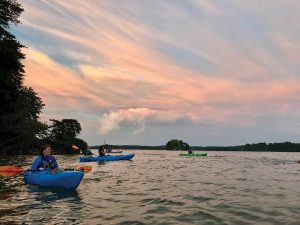
We fall into a single-file line, threading our way up the shallow creek as the sinking sun washes the horizon in pink. There’s no sign of the moon, but the night is coaxing the woods and the water to life.

A barn owl issues a rusty, scraping call.

A belted kingfisher, looking punky with its feathery mohawk and dagger-like beak, scuds across the sky.

Frogs begin their evening chant. Meep-meep-meep.

Fish breach the water with a flash of silver.

Beavers slap their tails against the water, protesting visitors.

The sky overhead deepens to smoky blue. The only light comes from neon glow sticks tied to the kayaks and from the million-dollar homes that hug the lake.

Proia halts the paddle and passes out slices of watermelon. Candice is ecstatic. She’s undergoing a series of dental surgeries and this is the first fruit she’s been able to eat in weeks.

“This is soooo good,” she says.

We smile juicy smiles with her.

Juanita, from Winston-Salem, is happy for another reason. She’s not tippy tonight.

“Tipsy?” Someone teases. A stickler for safety, Proia allows no alcohol on the water.

“Tippy,” Juanita repeats with a grin.

She used to wobble in the water, she says, but the more she kayaks — she’s a regular on Proia’s excursions — the better she gets.

Growth is a common theme among Proia’s regulars.

Kayaking has helped Debbie, from Greensboro, overcome a fear of water.

Susan, from High Point, took up paddling for stress relief after her mother suffered a couple of heart attacks and her husband was stricken with a debilitating disease.

“It was life-changing. I was able to connect with nature and totally let go,” says Susan, who went on to start Triad Water Stewards, a group that cleans up area lakes. “I am a kayaker in my blood now. This thing with Jo has expanded my life.”

Proia stops the group shy of the boat ramp, where motorboats drip dry on trailers. She nods toward a flickering light on shore.

“See that big screen TV up in that house?” Proia says. “There’s nothing wrong with that. We all like to get on the couch and watch TV sometimes. But give yourselves credit. Y’all came out here tonight, in the dark, and went up a creek . . . ”

“With a paddle,” adds Juanita.

The mood is light. We’ve been on the water for three hours, subsisting on water and watermelon, but no one seems tired.

Proia looks back in the direction we’ve come from.

“There’s the moon!” she says.

Paddles churn in reverse as we spin our boats around to see a smudgy yellow orb rising to the south.“Look at the shape.”

“Look at the corona.”

“Look at the reflection on the water.”

A beam of white light fractures and wiggles across the inky water as Sister Moon, creator of tides, exerts her pull on Mother Earth.

And us.

Silence wraps our bobbing boats.

There’s no internet out here, but the connection is strong.  OH
Maria Johnson is a contributing editor of O.Henry magazine. Contact her at ohenrymaria@gmail.com.

There’s a Book Club for That

Even better than reading a book is reading a book with friends

By Ross Howell Jr.     Photograph by Bert VanderVeen

Want to find a local book club? A great resource is the Greensboro Public Library.

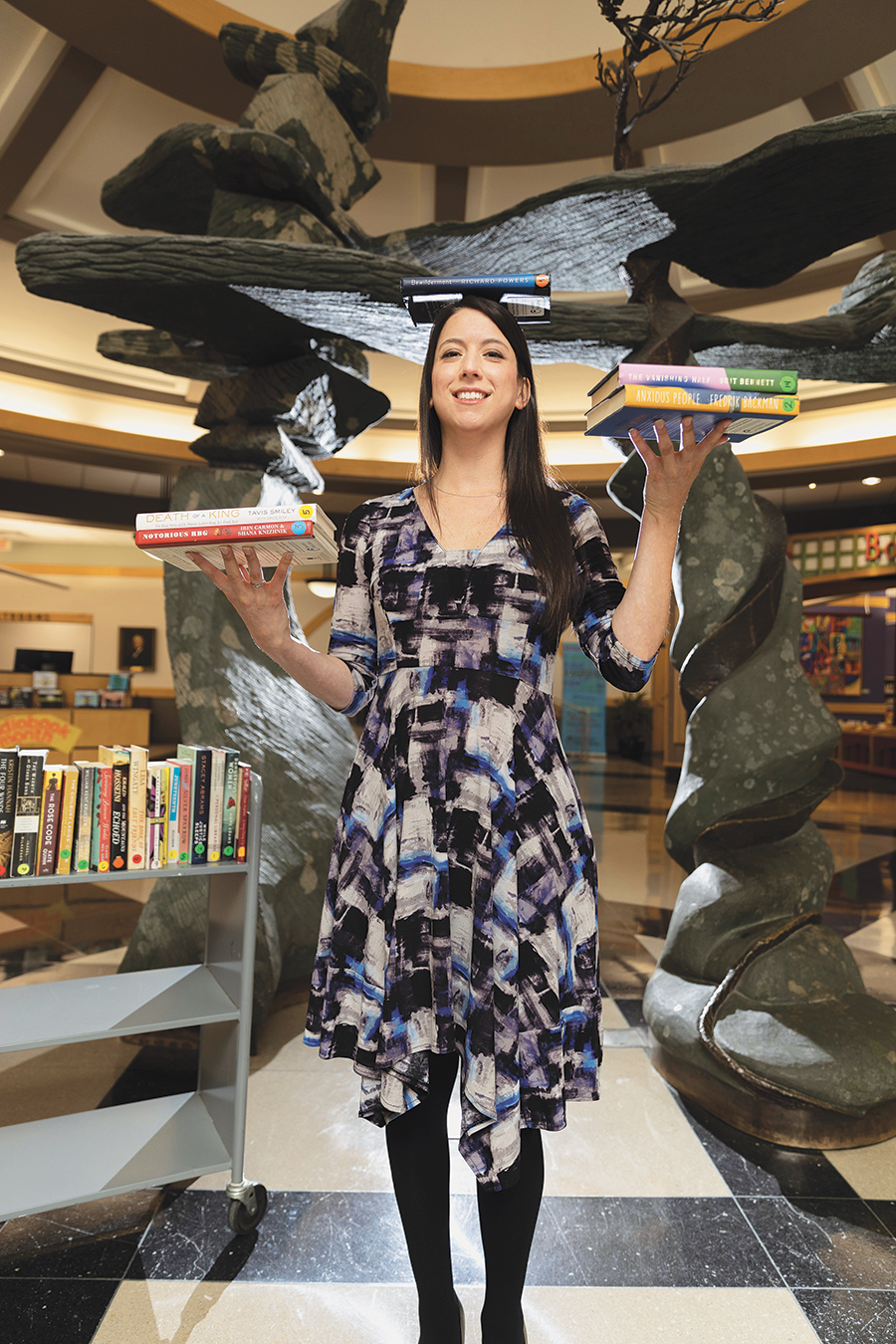
I did my snooping at the downtown Central Library, where I met Amy Bacon, 30-something library associate, book lover and avid reader.

“Book club participants, by nature, are voracious readers,” Bacon says.

“I’ll read a couple books a month, maybe three or four, maybe five in a good month,” Bacon continues. “But there are people in the clubs who read a book every day or so!”

Bacon acquired her reading appetite from her mother, Michelle Masters, an English teacher at Mendenhall Middle School.

“She encouraged reading early on,” Bacon says. “She wouldn’t say, ‘Now you have to read for 30 minutes.’ She’d say, ‘Now you get to read for 30 minutes.’”

J. K. Rowling was also a big influence. Given Bacon’s age when the Harry Potter novels were published and the fact that her mom was teaching in middle school, the books really resonated.

“When they did the midnight releases,” Bacon says, “there we’d be at Barnes & Noble bookstore, waiting. Mom always bought two copies, because neither of us could wait to read!”

Bacon’s a proud advocate for libraries and book clubs.

“Every time I meet someone new, I ask if they have a library card,” she laughs.

Bacon earned her bachelor’s degree at Appalachian State University in psychology, and her master’s degree in library and information science at UNCG. Shortly after she became a full-time librarian in 2018, Bacon was put in charge of the book club collection, curating it with two other staff librarians.

It’s a big job.

For starters, there’s the plethora of new releases each year.

Bacon consults places such as Oprah’s Book Club selections, reviews and lists in The New York Times, or Goodreads for new books. Sometimes the leaders of local clubs will email her about forthcoming titles in their particular focus areas.

And the library always tries
to spotlight local and North Carolina authors.

It’s not an exact science.

“Sometimes we have titles that get really popular out of nowhere,” Bacon says. When the novel Where the Crawdads Sing by Delia Owens was released, it checked several book club boxes — good summer read, North Carolina setting, nature, coming of age.

“I thought it would do well, but I didn’t anticipate its fantastic popularity,” Bacon says.

The library ended up ordering six book club sets of 12–15 copies per set, and they’re still circulating widely.

Then there’s the matter of branch locations.

There are book clubs that meet not only at the Central Library, but also at the Blanche S. Benjamin branch, the Glenn McNairy branch, the Glenwood branch, the Hemphill branch, the Kathleen Clay Edwards Family branch, the McGirt-Horton branch and the Vance H. Chavis Lifelong Learning branch.

There are about 20 library-sponsored book clubs with a branch library staff person facilitating meetings scattered among these locations. And there are dozens of independent book clubs that also need support, some through retirement homes and senior services, and many through neighborhood and church groups.

Bacon estimates that there are more than 250 book clubs using Greensboro Public Library collections. That’s a lot of serious readers!

“When someone requests a title for a book club set, staff members and I have to consider if other clubs might use it,” Bacon says. “We don’t want to order 15 copies of a book that might only be used once.” She passes along her buy list based on requests and recommendations, along with her own research and experience. The final decision, of course, is made based on consensus with library colleagues and budget allocations.

Library volunteers play a key role in getting book club sets out to readers.

“I don’t know what we’d do without our volunteers,” Bacon says.

Since the pandemic, Bacon has seen a rise in book club participation. While most clubs still meet in person, the library also developed a Zoom hybrid meeting format.

“We’re seeing a lot of people participating now who weren’t before,” Bacon says.

“Because we have such a diverse collection,” she adds, “there’s a book club for anybody.”

Bacon herself recently joined a new sci-fi/fantasy reading club. Other clubs focus on mystery, nature and environment, books by or about women, international, African American literature and history, young adult, literary fiction and more.

“And if there’s not a book club you want to join, you can start your own,” Bacon says. “I can help you either way.”  OH

For more information, visit www.library.greensboro-nc.gov/books-media/book-clubs or contact Amy Bacon, phone 336-373-7878, email Amy.Bacon@greensboro-nc.gov.

Ross Howell Jr. is a contributing writer. Email ross.howell1@gmail.com.

Almanac

By Ashley Walshe

The month of August had turned into a griddle where the days just lay there and sizzled.

— Sue Monk Kidd, The Secret Life of Bees


August is equal parts ecstasy and agony.

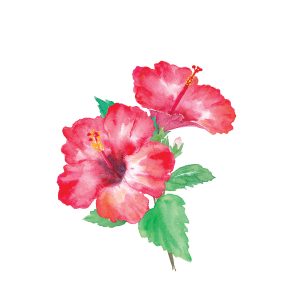
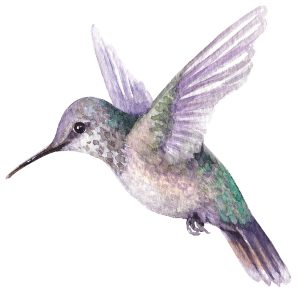
At dawn, a shimmer of hummingbirds dips and weaves among cascades of morning glories and a sweeping sea of hibiscus. In one day, the nectar of one thousand flowers will have sweetened their bellies and tongues. In one month, when the blossoms fade, the tiny birds will disappear, taking summer with them.

The honeybees have multiplied. They drift in dizzying circles, supping joe-pye weed and purple coneflower as if the future of the hive depends on it. And it does. The bees know that the season is slipping with each precious sip. They know not to waste it.

Swallowtails orbit goldenrod and lemon balm, ring around the butterfly bush, float like dreams from blossom to fragrant blossom. Soon they, too, will vanish.

Yet — for now — all is lush and dreamy. All is warm and sticky-sweet. Never mind that each kiss between bee and flower could be the last. The golden season always dims to black.

And so, you savor the last glorious slice of it. Absorb it with your whole body like the water snake sunning on the rock. Cradle it like a sipping spirit; inhale deeply, drink slowly, let the textures and flavors roll around on your tongue.

Sprawl out across the summer grass. Float from flower to flower. Drink the nectar of one thousand blossoms.

Harvest the fruits of the garden. Sink your teeth into them. At night, dance among the fireflies, here for a glittering moment, and then gone.

The cicadas know. As they scream out in rapturous longing — ecstasy and agony and nothing in-between — you soak up the sweetness of summer as if the future depends on it. As if it will carry you through the darkest days of winter. 

Sweet Morning Glory Late Summer Harvest

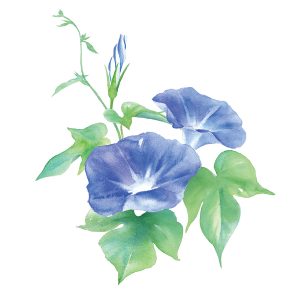
The morning glories have run wild. Twining vines with heart-shaped leaves and fragrant, tubular flowers, these late summer bloomers are hummingbird magnets. They thrive in full sun and, given a trellis or fence, will climb up to 20 feet.

Among the most common varieties are Heavenly Blue (sky-blue with white-and-yellow throats), Grandpa Ott (a royal purple heirloom from Germany), Fieldgrown (an amalgam of white, pink and purple blossoms) and Crimson Ramblers (a hummingbird favorite).

True to its name, the blossoms open in the morning, each lasting for just one glorious day.

Late Summer Harvest

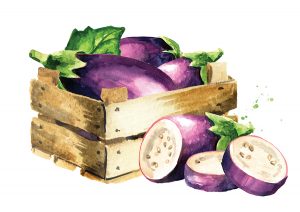
The garden gives and gives. August offers eggplant, green beans and peppers. The last of the sweet corn. The earliest apples, pears and figs. And — oh, yes — an endless stream of plump tomatoes.

But what to do with them?

The ’Mater Sammich never fails (make mine with Cherokee Purple, balsamic glaze and pesto mayo — I’m no purist). Cook them down into sauces. Dice them for pico de gallo. Make bruschetta, pasta salad and summer quiche.

Better yet, pluck them straight off the vine, sprinkle with salt and enjoy.  PS