Sazerac February 2025

SAZERAC

Unsolicited Advice

This February, we’re shooing away Cupid because we are already fully committed. And before you go and shack up with someone, it might be wise to take inventory of the little habits that follow your potential mate as surely as his or her shadow. Because, no, you can’t change them — really, you can’t. The question you should be asking yourself: Can you live with them? Or without him or her? Here is a short list of deal-or-no-deal habits to consider:

1. Close talking, as in nose-to-nose. At first, it’s like, “Oh wow, they just can’t get close enough to me!” But that can escalate into “I can’t breathe.”

2. Leaving the toilet seat up — or down, depending on how you found it. Not a big deal until you get up at 3 a.m. to use the bathroom and either baptize the seat or fall into the cold basin water. Try getting back to sleep after that.

3. Talking with a mouthful of food. They’re so excited to talk to you! How sweet. Or perhaps Mama never taught them manners. Either way, bolus — aka chewed up food — upon your brow? Eeew. 

4. Passing gas at the dinner table. Actually, no question about it — deal breaker. Run.

Come to think of it, we might recommend sticking with the single life.

Seen & Heard
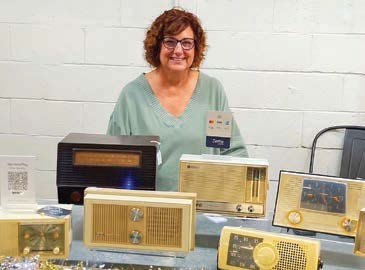
I happened across Taja Mahaffey while she was standing behind her booth at the Greensboro Farmers Curb Market, surrounded by Zenith, General Electric, Westinghouse and Sylvania solid-state radios from the 1960s and earlier. As these appliances harken from an era even before stereo broadcasting, I had to ask, “Why?” 

“I was in a thrift shop one day and bought a vintage radio. I just thought how neat it would be to bring it back to life,” she explains. “I found a Bluetooth speaker kit that I could insert into it, tried it and it worked.” 

That was around nine months ago and Mahaffey, who resides in Summerfield but lived in Greensboro most of her life, has been scouring estate sales and flea markets ever since. She searches high and low for those vanishing examples of mid-century American ingenuity, often colorful, futuristically designed, with molded-plastic packaging.

“I’ve probably adapted 50 or more,” she says. “It just depends on when I can find what I’m looking for in good shape and at a good price.” Mahaffey, under the name Songbird Designs, also offers her groovy gadgets for sale at Main Street Market & Gallery in Randleman, where these whimsical looking Bluetooth receivers come with a USB chord for recharging. 

I’m especially enamored with her idea of taking those modular clock radios your (great-) grandmother had bedside or on the kitchen counter, then reimagining them as devices tuned in to your tunes today — not to mention the convenience of a built-in timepiece for the few of us remaining who remember how to read an analog clock! 

Just One Thing
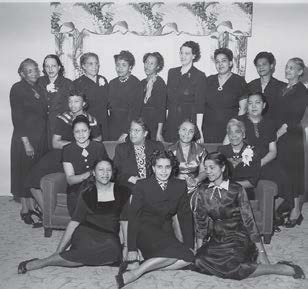
What a range of age among the members gathered in the 1950s meeting of the Alpha Art Club, the Triad’s oldest-known African American women’s club. One hundred years later, the club is still going strong, celebrating their centennial with a photo exhibit at the High Point Museum, including an hour-long video of members’ sharing their time in the club. Rishaunda Moses, immediate past president, reflected recently that the club’s founding members initially “would get together to socialize, have tea, make doilies or just chat.” She went on to tell  The High Point Enterprise that the club transitioned in the mid- to late-1920s to promote civic betterment. The club has persevered through the Great Depression, World War II, the Civil Rights Movement and a global pandemic and will continue moving forward with its mission: “lifting others up.” Today, that work comes in the form of supporting the NAACP, offering a mentoring program called the Legacy Foundation and providing scholarships. Info: highpointmuseum.org.

Piano Man
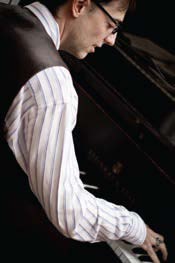
Musician Mark Hartman is in the air so often his Facebook persona is “Mark on a Plane.”

The New York-based pianist and composer conducts, arranges and composes for theater and concerts worldwide.

“I have to say, I love tiny airports. They make me so happy!” Hartman’s award-winning career spans both on and off-Broadway hits, and international theater as well.

When he taxis into our little PTI, however, he’s probably thinking about things he’s missed about home. Having grown up in Arcadia, between Lexington and Winston-Salem, his stomach is often rumbling at the thought of ‘cue.

Specifically, “Speedy’s in Lexington.”

Even in the air, you’ll likely see Hartman with a pencil in hand. Pencils are a talisman.

“I am oddly superstitious about pencils. If I start a musical marking in my score with a specific pencil, I will keep it and use it all the way through opening.”

To the delight of his friends — and strangers alike — he made a rare Triad appearance recently. At the invitation of the Anne Griffith Fine Art Museum at Red Oak Brewery (before stops in Saratoga, N.Y., and then to Guthrie Theater in Minneapolis), Hartman chatted to the crowd as he played from memory, hardly glancing at the keyboard. Few realized he had only recently laid his father, Wayne, to rest, who was a catalyst for his musical awakening. During childhood, Hartman “plunked around on musical toys,” including a toy piano at his grandparents’ house, where he discovered early on he could repeat melodies and songs he had heard by Elvis Presley, Nat King Cole and Helen Reddy. 

As a youngster, he performed in various churches, encouraged by his minister father. By high school, Hartman was already playing for musicals and theater productions. His favorite North Davidson High School teacher, Sherri Raeford, took him to his first college theater performance (Chicago at Catawba College).

“I got into musical theater originally because it appealed to my love of music, lyrics and storytelling.” But, as his career has propelled forward, he says, “The thing I love most is connecting with another artist — in hopefully great material — to make something personal and individual and more satisfying than either of us could do on our own.” 

He lists Leonard Bernstein, Fats Waller, Joni Mitchell, Stephen Sondheim and Leonard Cohen as a few of his influences. Throughout his own career he has appeared with cabaret greats such as Lorna Luft, Chita Rivera and Jennifer Holliday.

“Many things set Mark aside as a high school student,” says Raeford. “One was that he was a walking encyclopedia when it came to his knowledge of musicals and musical theater.” But for the intimate gathering of art and music lovers at a museum in Whitsett, Hartman slipped into what he loves, after weeks of coping with the loss of a parent. 

Launching into a musical reverie over three hours long, teasing out 40 or more songs, he wove them together in a casual, cabaret style.

He smiles gently at the mention of Cohen’s “Hallelujah,” insisting “it is not a sad song.” In Hartman’s hands, it was reinvented, the plaintive words inexplicably transformed.

Those present received a master class in the power of music to extend beyond entertainment, to heal.

Sage Gardener

Although I don’t currently brew beer, I’ve had experience in beer making since my dad donned a yellow rain suit and a Nor’wester rain hat to uncap the bottles of home-brew that were exploding in our basement, which, by the way, sent a wonderful aroma up through our heating vents. I made beer in college when it was more exciting because it was a federal offense, using canned Blue Ribbon malt and, I shudder to think of it — bread yeast to get things going. (Let’s not bring up the subject of yeast infections some females blamed on my beer.) Later, in grad school, an English-beer-loving friend and I graduated to ordering malt extract and hops extract, both imported from the U.K. It was with the extract, which turned the beer into the equivalent of IPA, that my love affair with hops began.

Fast forward a half-century later and I’m finally contemplating planting hops in my garden this spring. The always helpful N.C. State Extension Service had a good piece stating that 80 small farms were growing hops successfully in the state. If they can do it, I decided, so can I. I’ve been wanting to grow hops since I learned the  species name, Humulus lupus, meaning “small wolf,” referring to the plant’s tendency to strangle other plants as a wolf does a sheep. In other interesting tidbits, I learned that hops grow on “bines,” not vines. (A bine twists around something, and always in a clockwise direction, whereas a vine grows in tendrils, in various directions.) I was told I could expect growth of  up to 12 inches a day. It went on to mention how hops will grow up almost anything, reaching heights of up to 25 feet. While sipping on a mug of Old Speckled Hen, I envisioned a tangle of hops that would give the wisteria at the back of my property some competition.


Stephanie Montell writes on the morebeer.com platform that “Growing hops at home is easy if you know the tricks of the trade.” She points out that it’s the female flower (like another plant I know) that are all-important. It seems that only the female plant is able to produce the actual hop “cones.” She went on to warn gardeners not to plant hops near electrical power lines to avoid what I’ll term kudzuification.

Loamy, well-drained soil. Check. Lots of manure. Check. One hundred and twenty frost-free days. Check. Plant in early spring, no later than May. Can’t wait and probably won’t.

Hops grow from rhizomes, which I need to mail order. N.C. State suggests which varieties will thrive most anywhere in the state. First year? Not much growth while the plant establishes its room system. “Instead, look forward to the second year when hops are full grown and produce healthy crops of fragrant flowers,” she says.

But here’s what’s going to be tough. Beginners, she says, “have a tendency of letting every shoot grow and climb. Although this is understandable, leave only selected shoots and trim the weaker ones at ground level . . . to force the strength of the root into the hardier shoots.” Whatever. My wife does something similar with our tomato plants and it drives me nuts. But a side-by-side experiment demonstrated she knew what she was talking about.

Finally I learn that all but 4% of hops are grown in the Pacific Northwest, where, I am told, one acre can produce enough dried hop cones for 135 to 800 barrels of beer. I have a quarter-acre under cultivation, so that means I need to limit my annual brewing to between 34 and 200 barrels. I can hoppily manage that.

Wandering Billy

WANDERING BILLY

The Belle of the Wrecking Ball

The corner of Bellemeade and Elm faces demolition again

By Billy Ingram

“To put it rather bluntly, I am not the type who wants to go back to the land; I am the type who wants to go back to the hotel.” — Fran Lebowitz

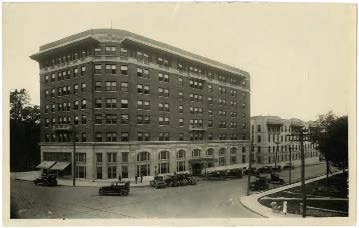
Could it be that, twice in one lifetime, I’ll be there to witness the destruction of a massive structure on the southwest corner of North Elm and Bellemeade? The city plans to soon demolish the seven-story parking deck erected there in 1989. It’s worth noting that 70 years before that date, on this very spot in 1919, one of the most distinguished establishments in the Southeast debuted to tremendous fanfare: the O.Henry Hotel, which, for decades, exemplified Greensboro’s exacting sense of luxury and refinement, distinguished by its cosmopolitan vision for the future.

Greensboro has a long history of hospitality going back to stagecoach days when, 200 years ago, George Albright kept an inn on East Market Street with plenty of hay in the barn for the horses. Nor was the hair those nags shed wasted since it was stuffed right into the inn’s mattresses.

The city’s first upscale hotel was the Benbow House, originally located where the Woolworth’s/International Civil Rights Center & Museum is today. In May of 1871, it was declared to be the finest in North Carolina by its first lodger, Governor Zebulon B. Vance. Demand led to other rooms for rent on South Elm: McAdoo House, Hotel Huffine, Guilford Hotel and the Hotel Clegg, all richly appointed and refined architecturally in full view of the train station with a tendency towards inopportune tinderboxing.

The landscape changed dramatically in 1919 with the debut of the thoroughly modern, eight-story O.Henry Hotel, the largest in the state. Its construction and completion was funded through community stock subscriptions. Designed to be a full-service facility that rivaled any in New York City, it featured 200 luxurious rooms with private baths (another 100 were added later), plus a pharmacy, newsstand, gift shop, ballroom, beauty salon, Merle Norman Studio, and formal dining room, all encircling a striking two-story lobby with a cascade of a dozen or more columns adorned in dark oak paneling with marble footings rising upward then rounding at the ceiling in dramatic fashion. Under foot, an enormous expanse of mosaic tile flooring was accented with sumptuous carpeting, everything warmly lit from above by sleek, minimalistic, blown-glass chandeliers.

Homages to the hotel’s namesake abounded, including a library devoted to O.Henry and illustrations from his stories decorating hallways where guests could leave their shoes outside the door for shining or clothing for overnight dry cleaning. Valet parking was available and, because liquor was illegal to purchase in Greensboro until 1952, a bellhop named “Snag” was happy to procure someone’s preferred libations. 

The immediate success of the stately O.Henry led to the 1927 construction of a much taller, world-class hotel a few blocks away. Standing statuesquely on the corner of Davie and East Market streets, the 13-story King Cotton Hotel was the height of Art Deco splendor. First Lady Eleanor Roosevelt whistle-stopped there in 1942 and it’s where movie star Joan Crawford glammed up in 1957 before christening a local Pepsi bottling plant.

The O.Henry lost no luster, remaining the preferred place to play and stay during the 1930s and ’40s for celebrities such as F. Scott and Zelda Fitzgerald, as well as Big Band stars Guy Lombardo and Benny Goodman. Local radio legends Bob Poole and Willie began broadcasting their WBIG morning show in the mid-1950s from a studio tucked under the hotel’s main floor, which was part of a mall with a barber shop, cigarette stand and coffee shop. The sub-floor was also home to the Merchants and Manufacturers (M&M) Club, basically a glorified pool hall, card room and day-drinking barroom for local businessmen.

I was a frequent visitor to the O.Henry on Saturday mornings in the late-1960s, searching for the latest comic books from its newsstand, positioned to the left of the Elm Street entrance. Selecting a four-color DC from the comic rack, I’d march over to the front desk to pay. Even under diminished circumstances, I could appreciate the hotel’s impressive atmosphere, a grande dame retaining an air of sophistication rapidly vanishing from the world outside her doors.

By the late-1960s, winos and degenerates were populating the nearby King Cotton Hotel, drunkenly tossing their empties out of windows, glass shattering on the sidewalk below or atop unsuspecting pedestrians. In 1971, I was among the throng of thousands who gathered on an unseasonably warm October Sunday morning to witness the King Cotton’s erasure from the skyline by way of a newly refined controlled demolition method that is now commonplace — dethroned by a series of carefully choreographed explosions that, in mere moments, leveled the building into its own footprint.

Around that same time, the O.Henry was purchased and was being operated (unsuccessfully) by a hotel chain out of Tulsa, Okla., who, in the spring of 1975, shut it down. But, a few months later, the chain allowed it to be converted into a residential complex populated by recently divorced men and, in the absence of any such institutions, a sort of assisted living facility, without any staffing to support even a small influx of displaced senior citizens.

Inevitable, perhaps, that one of those elderly residents would doze off with a lit cigarette, igniting an early morning blaze on January 15, 1976, sending thick, black smoke bellowing down the fifth floor hallway, creating zero visibility conditions for disoriented tenants needing to be rescued by firefighters. One hysterical man clinging to a minute window ledge outside his room was yanked to safety via ladder truck. All 56 occupants were displaced after the Fire Department declared the building unsafe.

Repairs were made, but the O.Henry Hotel never fully recovered; a nearly deserted downtown Greensboro was no longer a desirable destination.

Photos taken while awaiting the executioner in 1979 highlight the stripped, bare lobby and a dining room with plaster peeling away and draperies hanging resolutely crisp and neat alongside windows gleaming in the sunlight. The lobby’s geometrically playful tile flooring remained as vivid as when it welcomed the first guests eight decades hence with the marble front counter and elaborate light fixtures still intact. It was the sinking of a Titanic.

With so little going on in the area during that time, a parking lot of that size in that spot was totally unnecessary. But eventually it became essential, especially after the Steven Tanger Center for the Performing Arts appeared across the street. Was it theater-goers’ extra wear and tear that wore and tore this concrete structure to such an extent that it will now cost millions to remove and replace? That sound you hear is your taxes going up.

Expecting an O.Henry ending? If you insist. On Tuesday afternoons I work — more like hang out — in a comic shop. Affixed to one wall is the O.Henry Hotel’s actual comic book rack, likely installed in the 1940s, featuring a header illustrated with cowboys and funny animal characters, and lettering proclaiming, “DELL comics are GOOD comics.” The very metal frame I pulled 12-centers from as a preteen more than half a century ago.

With a nod to the late Paul Harvey, “And now you know . . . the rest of the story.” And how old I am. 

Simple Life

SIMPLE LIFE

The Pleasures of a Good Old Age

Miracles can come true, it can happen to you

By Jim Dodson

Not long ago, I heard an elderly gentleman in a coffee shop comment to a younger friend, “Someday, when you’re as old as I am, you will look back on your life and realize that everything is a miracle.”

His words brought to my mind Albert Einstein’s famous quote on the subject: “There are only two ways to live your life. One is as though nothing is a miracle. The other is as though everything is a miracle.”

Though it varies slightly from country to country, age 72 is the global median lifespan of most people on the planet — the statistical onset of “old age.”

This month, I turn 72.

Am I worried? Not so much. True, I walk more slowly and with more care these days due to a pair of arthritic knees, the painful legacy of 40- to 50-year-old sports injuries and having probably walked too many golf courses for one duffer’s life. By the time you read this, however, I hope to have a new left knee replacement for the new year with a second one on the way. Talk about a miracle.

Like many older folks my age, I’ve also survived cancer once and am winding up a second waltz with the dreaded disease, reportedly doing quite well, thanks to my brilliant young doctors and the miracles of modern medicine.

Despite these physical challenges, I’ve never felt happier or more productive. This seems to be a common trait among active elders who find the arrival of so-called old age to be a liberating force and an opportunity to experience life on a new and more meaningful level. A true case of attitude is altitude, as the saying goes.

One of the rarely mentioned gifts of being old is realizing what you no longer need or care about.

Two years ago, I donated half of my home library, roughly 300 books, to a pair of charities. This year, I plan to give another 200 away, leaving me approximately a hundred books I cherish and will continue to read again and again until my light in this world permanently dims.

At my pragmatic wife’s suggestion, I also went through my clothes closet and sent a large donkey cart’s worth of fine clothing I haven’t worn in more than two decades to a wonderful thrift shop owned by Freedom House, a local organization that provides drug rehabilitation programs to women. I hope whoever purchases the two fine custom suits, five Brooks Brothers blazers, nine crested-wool golf sweaters, eight pairs of worsted-wool slacks and 19 golf shirts will enjoy them with my blessing. Seriously, who needs 21 solid white golf shirts anyway?

Speaking of gratitude — and something of a miracle — I’ve reached an age where watching sports of any sort feels like a colossal waste of time. I’d rather take a long walk with the dogs, read a new book or watch seasonal birds at the feeder.

This is no small change. Once upon a time, now fading fast into memory, I was the original sports-mad kid who played every game in every season and died a little death anytime my favorite golfers and favorite professional sports teams lost. A decade ago, as my passion for all sports mysteriously began to wane, I wondered if this was because I’d changed — or if the games themselves had?

The answer is probably both. The sports teams I once worshipped, college and professional alike, were generally true hometown affairs where you could name (and root for) every player on the roster. This made the games feel much more personal and relevant. Today, almost all sports are shaped by staggering amounts of money flowing through their ranks. Not long ago, I heard about a local high school junior who recently signed with a major college program and pocketed $50,000 in NIL money. Add legalized sports betting to the state of our games and you may have a fast road to ruin for millions of fans who care less about the games than their payoff.    

The real beauty of aging, I long ago realized, is the light that comes from the soul. Reaching statistical old age brings with it freedom to do your own thing along with the opportunity to forge new paths and adventures.

“A good old age can be the crown of all our life’s experiences,” wrote Helen Nearing, “the masterwork of a lifetime.” Considerably late in life, Nearing and her husband, Scott, became world famous advocates of simple living and pioneers of the organic farming movement in America. Helen lived to be 91. Scott, 100.     

As Helen points out in her lovely book, Light on Aging and Dying, Socrates learned to play the lyre — and wrote his most famous poems — in his dotage. Thomas Edison was still inventing at age 92; Michelangelo did some of his finest work past 80; and Frank Lloyd Wright, at age 90, was considered the most creative architect in the world.

Likewise, numerous poets and artists proved to be at their creative best in their good old age. Thomas Hardy, Robert Frost and Carl Sandburg did some of their best work past 80. Ditto artists Goya, Titian, Manet, Matisse and Chagall. Shortly before his death at 91, Picasso said, “Age only matters when one is aging. Now that I have arrived at a great age, I might just as well be 20.”

Almost every day, we read about some octogenarian who still runs marathons or a septuagenarian who just climbed Mount Everest — for a second time. The list goes on and on.

“I am so busy being old,” wrote author and playwright Florida Scott-Maxwell in her 90s, “that I dread interruptions.”

As for this relatively new septuagenarian, one who will soon have new knees but no interest in running marathons or climbing mountains, I find the simple beauty of the natural world, a deepening spiritual life, a love of dogs and friends, plus an unquenchable passion for writing books reason enough to celebrate arriving at the ripe old age of 72.

The truth is, I’ve always enjoyed being with older people. And now that I’m one of them, I have no intention of slowing down.

That’s proof that everything really is a miracle.

Almanac

ALMANAC

Almanac February

By Ashley Walshe

February is a vision quest, a serenade, a love note in the wide open wood.

On this day, though winter’s grip seems only to have tightened, the cloudless sky is otherworldly-blue. The vibrancy of color hones your senses. At once, a dreary world is clear and bright.

Follow your breath toward the luminous yonder. Above, a red-tailed hawk settles in a web of silver branches. Below, dead leaves perform their unbecoming, spilling into humus at the speed of dirt. What more is there to know?

Wander noiseless as a doe. Can you fathom the vastness of sky, the medicine of silence, the wisdom of barren earth? Can you grasp the full potential of this frozen pause?

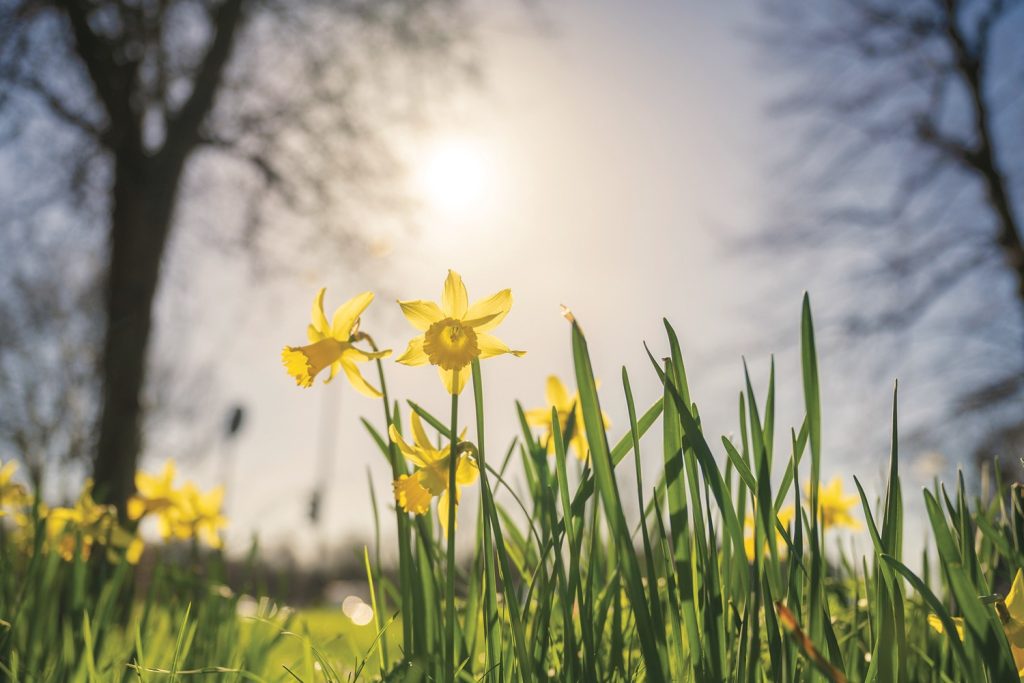
As the cold air stings your face and lungs, a shock of yellow rises from the forest floor. Daffodil buds, swollen with promise. Look closely. Do you see your own reflection? Do you feel the inner workings of your own becoming?

Walk gently. Feel the sun caress your back and shoulders. Listen to the whisperings of trees.

The deeper you drift, the more you can sense your own emptiness and fullness. The days begin to stretch. Ensembles of daffodils open. A cardinal sings a song of spring.

Winter has changed you. Prepared you for your own luminous unfurling. There was no other way but through.

Give thanks to this frozen pause, the sting of cold, the promise that was always here. Even when you couldn’t yet see it.

Year of the Snake

The Chinese Lunar New Year, which began on Wednesday, January 29, culminates with the Lantern Festival on the Full Snow Moon (February 12). Cue the paper puppets for the Year of the Wood Snake. Ancient myth tells that 12 animals raced to the Jade Emperor’s party to determine which order they would appear in the zodiac. Sneaking a ride round the hoof of swift-and-mighty horse, snake was sixth to complete the great race, crossing the finish line before horse, ram, monkey, rooster, dog and pig. Those born in the Year of the Wood Snake are known to be highly perceptive, intuitive and adaptable. How will the wood snake shape your destiny? The Times of India predicts a year of profound transformation and growth. If you’re searching for direction, you’ll find it within.

Love Songs

Perhaps nothing says spring is nigh so clearly as the sudden swell of chorus frogs screaming from the wetlands and darkening woods. Spring peepers, whose hypnotic high-pitched calls stretch throughout the night, have but one objective. The louder and faster they peep, the better their chances of attracting a mate. Do you hear that? Love is in the air indeed.

Almanac

ALMANAC

Almanac January

By Ashley Walshe

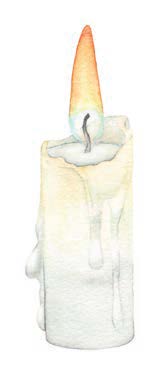
January is a flickering candle, a blanket of starlight, a question blurted in the dark.

Before the day breaks, the quiet morning lures you into its luscious chamber. Outside, whispers of ancient myths illuminate the inky sky. You light a candle, watch the flame perform its sacred dance.

Quivering in perceived stillness, the fire speaks in a language raw and primal. What but the ecstasy of darkness could make the light act as a howling
dervish? What but the silent tongue can taste the
succulence of nothing?

Deep in the forest, a barred owl dances like a candle, wings raised as he bobs and sways in naked branches.

Who cooks for you? he cries into the silken void. Who cooks for you-all?

The quiet cradles every note.

Who cooks for you? he blurts again, urgent and steady.

The candle shivers. The silence deepens. The mystery bellows back.

Soon, the brightest stars will fade into the tender blush of dawn. Flickers of a hidden world will vanish. The everything of silence will be gone.

Sop up the rapturous blackness of this pregnant morning. Be as the trembling candle — danced by an unseen song. Let the silence deepen, let the darkness sweeten, let the mystery make itself known.

Winter Bloomers

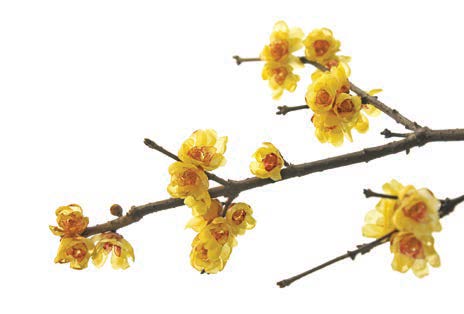
Bless what blooms in this barren season: Christmas roses, early crocus, daffodils, snowdrops, clematis and — what heavenly fragrance! — aromatic wintersweet.

Translucent yellow flowers adorn the bare branches of this deciduous shrub, perfuming the air with lemony sweetness. Native to China, this woody ornamental thrives in full sun and moist, well-drained soil. Nothing like a dainty olfactory delight to greet us at the dawn of this bright new year. What’s best? The deer can’t stand it.

Out With the Old

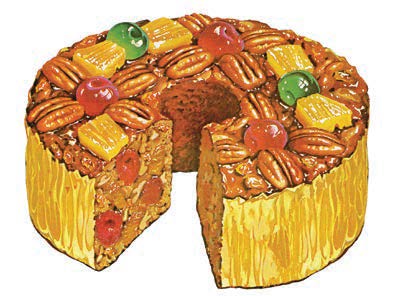
Nothing lasts forever. But the mail-order fruitcake comes pretty darn close.

Dig into the history of this notable loaf and you may find yourself down the nut-studded rabbit hole. Ancient Egyptians buried their pharaohs with it. In ancient Rome, the dense cake sustained soldiers in battle. And in the early 18th century, “plum cake” was outlawed throughout Continental Europe on account of its “sinfully rich” ingredients.

What was once a symbol of grand indulgence became a cheap-and-easy Christmas gift when department stores began stocking their shelves with the commercially made wonders we all know and, well, know. Some love it, some loathe it, and — on January 3 — some hurl this Yuletide offering into the great blue yonder.

National Fruitcake Toss Day started in Manitou Springs, Colorado, in the 1990s. Their annual event, called the Great Fruitcake Toss, features various competitions in which participants launch the brick-like loaves by hand, slingshot or cannon. Fruitcake remains are donated to local farms for animal feed or compost. A gift that keeps giving indeed.

NC Surround Around

NC SURROUND AROUND

Making Music in the Woods

And putting money in artists’ pockets

By Tom Maxwell

There’s a 63-acre compound on Borland Road, out in the rolling Orange County countryside near Hillsborough. On it is situated a log cabin, a barn and several other outbuildings stuffed with the kind of gear that only true believers would collect: a Neve 88R mixing desk originally commissioned by New York’s Electric Lady Studios; a live reverb chamber; several isolation booths; and, aurally immersive Dolby Atmos mixing capabilities. This particular compound goes by the name of Sonark Media, and it’s a thoroughly modern complex offering recording, performance and streaming capabilities.

Sonark is the brainchild of Steven Raets, a Belgian-born polymath. Up until 2012, Raets had been working for the “big three” investment firms: Goldman Sachs, Morgan Stanley and JPMorgan Chase. That all changed the following year, when he retired.

“Then basically the question was, what was gonna be the rest of my life?” Raets says. “I’ve always had a big passion for music. I’ve played in all kinds of bands since I was 12 — party bands, original bands, when I lived in Belgium and London. I’ve always been involved in music; that’s always been my destiny. I just happened to be really good at mathematics and statistics, so I ended up in a trading role, but I knew I was going to go back to music. That moment happened in 2013.”

Raets built a home studio in the basement of his Chapel Hill home — he’s married to a UNC professor — and started producing records. Once the kids were out of the house, the couple decided to scale down. They bought a farm not far from where they lived and began fixing up the old log cabin on the property. But Raets wanted to move up, literally, from the basement.

“I said to my wife, ‘You know, I want to keep doing music,’” Raets says. “‘So, if we’re moving from this house, then you have to allow me to build a proper studio.’ And she said, ‘Yeah.’”

Raets’ idea of what constitutes a “proper” studio might differ a little from most industry entrepreneurs. For one thing, he and his partners run three full recording studios on the Sonark property: Studio A, with a huge live room, high ceiling and three isolation booths; the smaller Studio B; and a renovated barn dedicated to rehearsals, live performances and streaming. The rooms sound amazing, and the gear is impeccable. If this was all the Sonark gang did, it would be more than enough. But these people are true believers.

“I think we’re uniquely set up to help the music industry rethink how music should be made, distributed, enjoyed and monetized,” Raets says, “and that is basically what keeps us awake every day. How can we help our musicians make more money in this world where music has become worthless? That’s our mission at Sonark.”

The fact that this question is even being articulated is refreshing. Without getting too technical about it, many of the fundamental revenue streams for musicians have dried up over the last few decades. Unless you’ve established a national touring base, it’s tough to make enough money at each gig to put gas in the van to get to the next town. Vinyl records have made a comeback, but they’re considered merchandise, to be sold along with band T-shirts, posters and hoodies — and many clubs take a percentage of this money. Merch is welcome supplemental income, but it will hardly keep body and soul together. That leaves digital streaming.

In the past year and a half, Spotify’s CEO Daniel Ek has made over $345 million, with his top executives coming in a close second, leaving megastars like Ed Sheeran and Taylor Swift in the dust. This is because a generous calculation of Spotify’s payout is about $0.003 per stream, and that’s allowing for the artist having complete control over their intellectual property, which is seldom the case. So even Swift — the most streamed artist on the platform — has yet to earn the kind of dough Ek has made.

Raets and his colleagues have spent a lot of time on the issue of putting money into musicians’ pockets, and they’ve come up with PIE TV, a subscription platform that allows users to stream Sonark-produced live performances on demand.

“It is inevitable that, as our technology advances and becomes more sophisticated, and as the bandwidth of our wireless devices increases, music will be viewed as well as listened to,” Raets says. “For years, I’ve been thinking of how to do that in a way that could be packaged and make sense for both the artists and those who help produce it. We finally came up with this idea where we would start producing intimate shows with bands but produce them as if you are in the PNC Arena, except with maybe 150 people there. We give the band a very controlled environment with enormous amounts of production value.”

Sonark performances are shot on at least a half-dozen high-definition digital cameras, while the audio is sent to Studio A for mixing. Edited audio and video are then synced and sent out for broadcast on the PIE TV app. Artists are paid guarantees for their performance, and they own part of the intellectual property of the broadcast and so are entitled to an ongoing royalty share from future streaming.

Compare this to the hugely popular YouTube live performances where none of the revenue generated from those videos goes to the artist. Admittedly, this is no different than live television performances in days of yore. “If you were going to play Jimmy Kimmel or Saturday Night Live or Austin City Limits, you would have to do it for cost,” Raets says. “You get very little out of it as a band except for a huge platform and promotional value. But the monetization goes entirely to the network.”

PBS NC has taken note, broadcasting a season of Sonark Sessions: Live from the Barn featuring 10 North Carolina-based artists. As far as Raets is concerned, there’s no reason to stop there. “North Carolina is an incredibly fertile ground for talent,” he says. “But we really don’t have an industry. There’s not a lot of jobs around. I want to create awareness of the fact that the music industry is not a hobby; it’s a valid center of revenue. You have only to look at Austin, Texas, to see how that worked out for them. Twenty-five years ago, it didn’t exist. Now, the music industry contributes hundreds of millions of dollars in tax revenues to the city. My dream is to do something similar to that for North Carolina. There’s a lot of potential here and you can feel it bubbling everywhere.”

In Good Taste

IN GOOD TASTE

What's for Dinner?

This zesty one-pan chicken-and-orzo dish, that’s what

Story and Photograph by Jasmine Comer

We’ve all faced the dreaded dinner dilemma: You know the one, where no one can agree on what to eat. Before I could even reach the counter, lured by the wafting smells tickling my nose and colorful palate of veggies, I was curious about what my mom was cooking in the kitchen — and always had a strong opinion on whether it would be one of my favorite dishes. When I was in middle school, Mom would always have a warm, home-cooked meal waiting for me after school or basketball practice. Back in my early 20s when I was living with my parents, I graduated to becoming the designated decision-maker when we were faced with the dinner dilemma. That’s because I had gained my family’s respect from my love for cooking. But I was just following in my mom’s footsteps, and she never prepared a bad meal.

During the week, I crave simplicity in the kitchen. No one wants to clean up a mountain of dishes and pots after a long day of work. A one-pan meal is a perfect solution for the dinner dilemma, allowing you to maximize flavor while minimizing time at the kitchen sink and dishpan hands.

Lemon garlic parmesan chicken and orzo to the rescue. The first layer of flavor starts with a buttery base of aromatic shallots and garlic. White wine and lemon juice then harmonize with the richness of the butter, creating perfect balance. It all comes together with tender chicken and flavorful broth, with a perfect touch of saltiness from parmesan cheese. Lastly, fresh parsley brightens up the dish, making it a sensory smash. With so much flavor, no one will even guess you only spent 30 minutes in the kitchen. Dinner dilemma solved — easy peezy, lemon squeezy.

Lemon Garlic Parmesan Chicken and Orzo

Ingredients

1/2 teaspoon kosher salt 

1 teaspoon oregano

1 teaspoon garlic powder

1/4 teaspoon ground black pepper

1 pound boneless, skinless chicken thighs

2 tablespoons olive oil

4 tablespoons butter

1/2 small shallot, diced

2 garlic cloves, minced 1/4 cup white wine

1/4 cup freshly squeezed lemon juice

2 1/4 cups chicken broth

1 1/4 cups orzo

1/4 cup grated parmesan

Chopped parsley for garnishing 

Directions   

1. Preheat oven to 350F. In a small bowl, mix together salt, oregano, garlic powder and pepper. Season both sides of the chicken.

2. Heat the olive oil in a large, oven-safe skillet over medium heat. Sear the chicken on both sides until brown, about 3–4 minutes per side. Once the chicken is browned, remove it from the skillet.


3. Reduce the heat to low and add the butter, shallots and garlic cloves. Sauté for 1–2 minutes. 

4. Deglaze the skillet with the white wine, making sure to scrape the brown bits from the bottom. Simmer for 5 minutes or until the wine is reduced by half. 

5. Add the lemon juice, chicken broth and orzo to the skillet. Stir to combine. Then stir in the grated parmesan.

6. Add the chicken thighs back into the skillet. Cover and bake for 30 minutes or until the orzo has absorbed most of the broth. Uncover during the last 10 minutes of baking.

O.Henry Ending

O.HENRY ENDING

Badassery Baldashery

Take our word for it

By Cynthia Adams

Surprising myself, an anachronistic Southernism popped out of my mouth. “Well, I Suwannee,” I murmured, before promptly clapping a hand over my mouth.

I Suwanee — once a euphemism for “I swear” in polite company — sounded positively silly, mincing and antiquated. 

But by the afternoon, I learned just how antiquated it was, given Merriam-Webster’s pronouncement. Among “new” words (are they ever exactly new?) just added into the dictionary’s lexicon was “badassery.”

B-b-but badassery?

Which just demands you jump up, find a dictionary and go straight to the letter “B,” forefinger tracing the page. (Remember when a dictionary and a thesaurus were on every writer’s desk?) No need. There it was online, the first usage given as “the state or condition of being a badass: a badass quality or character.” The second usage referenced “actions or behaviors characteristic of a badass.”

Did we need this broken down for us?

As for actions or behaviors,“badassery” is not a word I would have dared use in front of my mannerly Southern Mama.

Seems K. Nunn, a California born novelist/surfer who may or may not live Down Under at this writing, may have coined the word in 1992 — beating sex advice columnist Jen Sincero to the punch. 

Fast forward to 2013.

That year, Sincero’s self-help book, You Are a Badass, published with flabbergasting hoopla.

This begs the question, what was happening in 2013? Was no one publishing that year? Actually, quite a lot of hits come to mind, including Gone Girl, Fifty Shades of Gray and a Dan Brown blockbuster. 

But Sincero’s slim volume of nothing-new-here badassery went on to sell 5 million copies, scaling to the top of The New York Times bestseller list — making her a Badass for the Ages, having sold 27 rather uninspired micro chapters heavy on graphics. The school bus yellow cover even made it into the gift book section of Grandma-friendly retailers (such as Soft Surroundings) and spawned a slew of novelties. 

Badass novelties included a paperweight-sized button that literally says “You Are a Badass” and affirmation cards. (Badass rhymes with dumbass, which is also in Merriam-Webster.)

Life is not all farts and giggles (the title of an actual podcast, which probably made another sex advice columnist rich), so let’s not dwell on the details of badassery. So, be forewarned; the title is a spoiler, giving away the gist of Sincero’s message: You (the astute reader) Are a Badass (discerning enough to buy said slender book.)

Job done! 

The author has since become a life coach, dispensing badass guidance to one and all.

Yet the day held more surprises. Sincero’s reach was far and, frankly, impressive.

Before quitting time, an attention-getting item slid into my inbox from the scientific blog Nature Briefing, a nerdy digest of scientific breakthroughs. 

Molecular biologist Gary Ruvkun gave his favorite nematode a shoutout as “badass.” Seems a lowly, yet much-studied “badass” worm inspired four (potentially more) Nobel Prizes.

“No one ever thought to use that term for a worm,” he mused wonderingly. Not before Ruvkun!

He not only asserted the worm’s badassery; he did so — and I quote — “before the Nobel-stinking-Prize.”

Nobel-stinking-Prize? That Ruvkun made sure the worm, the first animal to have its genome deciphered by geneticists, got its due when he clenched the medal. Oh, dear readers, if only to have heard Ruvkun’s acceptance speech!

I returned to Merriam-Webster, seeking inspiration for future Nobel-stinking-Prizes. 

Yawningly familiar terms like “true crime” or “beach read” hardly seemed worthy.

And “nepo baby,” a newly admitted term, is at least as old as Rupert Murdoch, Goldie Hawn’s kids, the Kardashian clan and fictional nepo babies in Succession.

But, embedded in metaphorical weeds, there were some MW surprises. 

“Touch grass” referenced interacting with the real-versus virtual -world. Ditto for “shadow ban”_another social media reference synonymous with “stealth banning” or “ghost banning,” which might quicken the pulse of a Russian troller.

But my eyelid twitched at “dungeon crawler.” You won’t catch me using that one! Nor “shadow ban.” And assuredly not “badassery.”

Even if it costs me a Nobel-stinking-Prize.

I Suwannee.

Look to the Skies

LOOK TO THE SKIES

Look to the Skies

Shooting stars, sunrises and celestial wonder

Photographs and Story by Lynn Donovan

Lynn Donovan has been shooting for O.Henry magazine since its 2011 launch. A Greensboro native, she loves to travel the world with her faithful companions — her husband, Dan, and her cameras — capturing wildlife, landscapes and everything in between. In addition to O.Henry shoots, she adds concerts, theatre events, festivals and other happenings to her repertoire. Capturing life through her lens and sharing the images with others is what makes her click!

Above us there is a huge ever-changing canvas of sky. If you look

up you may be rewarded with phenomenal sights. Here are some of my observations over the years of gazing upward with my camera.

The sun greets me every morning with its light and warmth, and, as a photographer, an endless number of stunning possibilities. Even on cloudy days, the filtered light creates a dreamy softness to everything it falls on. I love watching the daybreak. No two sunrises are the same, but all fill my lenses with vivid colors and intensity, creating magic.

Lightning over the Ararat Valley, V.A.
A double rainbow in Waterton Lakes National Park, Canada

Without rainstorms, the sun would not be able to dazzle us with those radiant arcs of color across the sky, aka rainbows. Storms offer an opportunity to catch unique clouds filled with rain that replenishes the Earth. Clouds, storms and lightning can make the skies a photographer’s dream. When conditions are right, entire clouds glow with an eerie internal light or throw out bolts of lightning that can set the entire sky ablaze.

At the end of each day, the sun dips below the horizon and the golden hour — beloved among photographers for its soft diffused light — begins. For a brief period, the skies and clouds reflect the dying day’s warm colors and the entire sky glows. Many of my suppers have gone cold or been eaten late while standing outside, basking in the dusk.

Full moon
Total solar eclipse corona 2017, Andrews, NC

The sun and moon take turns eclipsing each other. From partial to total, they are something to watch as they attempt to block each other’s light. During a solar eclipse, the moon passes between the sun and Earth, casting a shadow on Earth, partially or totally blocking the sunlight. For a total solar eclipse, the sun’s corona is briefly visible. At totality, an eerie, dusky darkness occurs — the temperature drops, birds stop singing and crickets chirp. A lunar eclipse occurs when the Earth passes between the moon, in its full phase, and the sun, dimming the light falling on the moon, sometimes giving it a red glow. 

It’s often hard for me to stay indoors after dark given the incredible displays revealed long after the sun has set. The skies are filled with wonder that begs to be observed. The largest object visible from Earth is our moon, waxing and waning, filling the sky with its almost constant glow. Full, crescent, new and everywhere in between, the moon can even be observed during daylight. It also can create moonbows, which are just like rainbows, but created by the light of the moon through water mists. Our lives are filled with poetry, song and prose dedicated to this beautiful rock.

Moonbow at Iguazú Falls, Brazil
Aurora in Norway
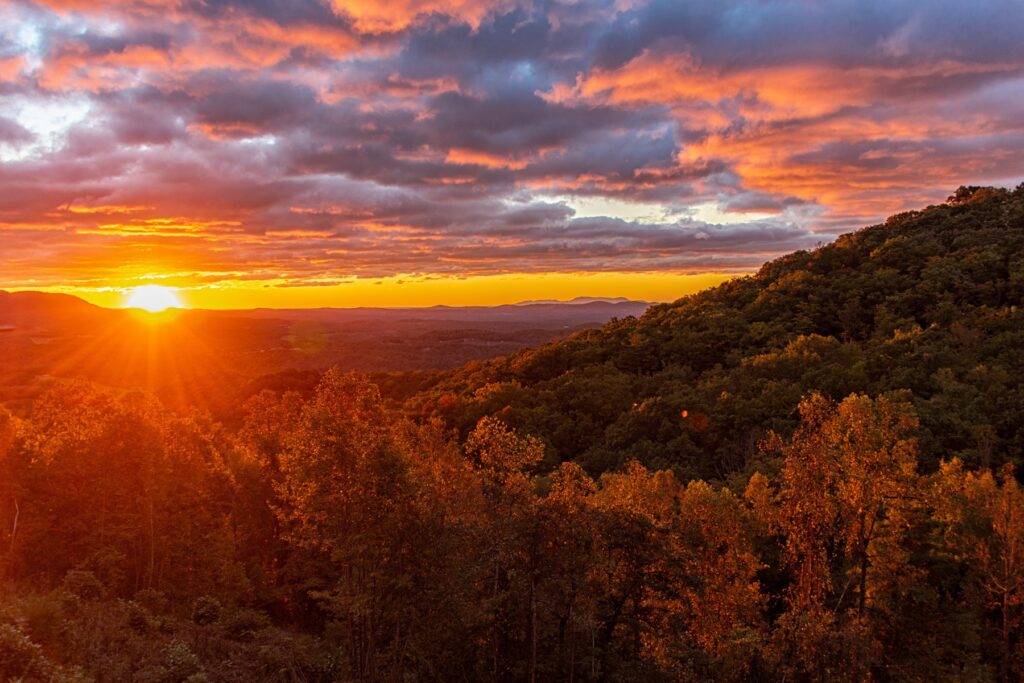
Sunrise at Fancy Gap, V.A.

The moon is hung upon a blanket of stars. If you leave the lights of the city behind, you will be able to see an entire canopy of twinkling stars above your head. And if you stay in the dark long enough, just like a camera’s long exposure, your eyes will adapt to witness the magnitude of starry light. Really dark skies reward observers with the Milky Way, stretching across the sky, reminding us of what a small part we each play in this magnificent universe.

If you are lucky and extremely patient, the way photographers have to learn to be, you will be rewarded with meteors streaking across the star field. Every year, several meteor showers rain across the sky. And if you are really lucky and observant, you may catch a comet. Over the last few decades, several bright comets have streaked through the heavens, many visible to the naked eye. Maybe one day I will graduate to shooting through a telescope!

One of the most elusive light shows happens when the Earth’s magnetosphere is disturbed by the sun’s solar wind, causing aurora borealis, or northern lights. They range from a faint glow to arcs across the sky to dancing curtains in colors of red, green, blue to yellow and pink. While I’ve traveled all the way to Alaska, Iceland and Norway to experience their splashy shows of color, the solar flares are sometimes so strong that we can catch them as far south as North Carolina — which happened twice in 2024.  Sometimes, all you have to do is step into your own backyard, look up and focus!