The Disheveled Prepster

THE DISHEVELED PREPSTER

The Disheveled Prepster

A Page High School alumni moonlights as a fashion designer

By Cassie Bustamante    Photographs By Anna Peeples

By day, Greensboro native Matt Healy works in HR for Ecolab, a global player in water treatment and other technologies aimed at protecting people. After work, he can be found hauling his kids to baseball games or basketball practice with his wife, Sarah, or coaching their soccer team. But when the office has been locked up for the day and the two boys tucked into bed, visions of bold, patterned dresses dance in his head.

Even as a preschooler in the early-’80s, Healy colored liberally on his clothes. His parents, worrying that something might be wrong, took him to see a child psychologist. The diagnosis? Their healthy, young child was simply telling them, “I have my own style.”

“My personal style has been pretty bold,” Healy says, then  looks down at his black polo shirt and gray twill pants and chuckles. “This was just a very-exhausted-on-Monday look.”

By contrast, his brand’s instagram feed (@augustus_roark)features images of models wearing colorful bohemian skirts paired with vintage-style T-shirts — or patterned patchwork dresses — bringing to mind vintage vinyl album covers.

“I’ve always described the Augustus Roark brand, the look of it, as like a prep-school Deadhead or like the guy who listens to Joy Division at a fraternity party,” says Healy. “You’re in the scene, but you’re pushing it a little bit.”

While music inspires the Augustus Roark aesthetic, the company’s name was drawn from literature. “Augustus” pulls from the Lonesome Dove character, Augustus McCrae, and “Roark” from Howard Roark, the protagonist in Ayn Rand’s philosophical novel, The Fountainhead. These two characters, says Healy, were both individualistic but heroic and went against the societal grain. “It sort of symbolizes, ‘Be an individual. Be who you want to be. Follow your own North Star.’”


Inspiration wasn’t far afield. His own father, though in finance, has always stretched the boundaries of the latest fashion. “He is always way better dressed than me,” says Healy. “He’s pretty bold.”

Of course, he’s quick to add that his mother, who “sold clothes for a time with her sister,” has also been an influence. “I don’t want to discredit my mom — she’s very fashionable,” he says, “but my dad is kind of the one that really has an eye for it.”

Though you might say that Healy’s fashion design career began with those original scribbles on his childhood garments, he admits that he didn’t take the leap into it until his mid-20s, a few years after earning a degree in history from UNC Chapel Hill.

While his mind is always swirling with designs, he started simply — with T-shirts. “The T-shirt was always just an entry point for me.”

But the T-shirt business has remained strong and steady. Some of his pieces can be found in shops across the Carolinas, California, Colorado, Texas, Tennessee and D.C. In fact, if you attended the 2024 N.C. Folk Festival, you perhaps perused or even purchased one of Healy’s designs — a bold graphic in red, purple, pink and blue with white block lettering on a navy background. With music often serving up style inspiration, Healy says it was “a natural fit.”

From his bootstrap and T-shirt beginnings, Healy segued into collared shirts and hats, followed by rugby shirts, and officially launched Augustus Roark in 2007.

His rugby shirt designs caught the eye of fellow UNC Tar Heel Alexander Julian, whose own father, Maurice S. Julian, opened Chapel Hill boutique Julian’s in 1942. Julian, known for designing the teal-and-purple Charlotte Hornets’ uniforms as well as Carolina argyle, met Healy as “kind of a mentor, kind of a family friend.”

Julian saw something special in Healy’s designs and asked him about creating rugby shirts for his own brand at the time. “I am so naive, I didn’t even realize he was asking me that until later!” Healy recalls with a laugh.
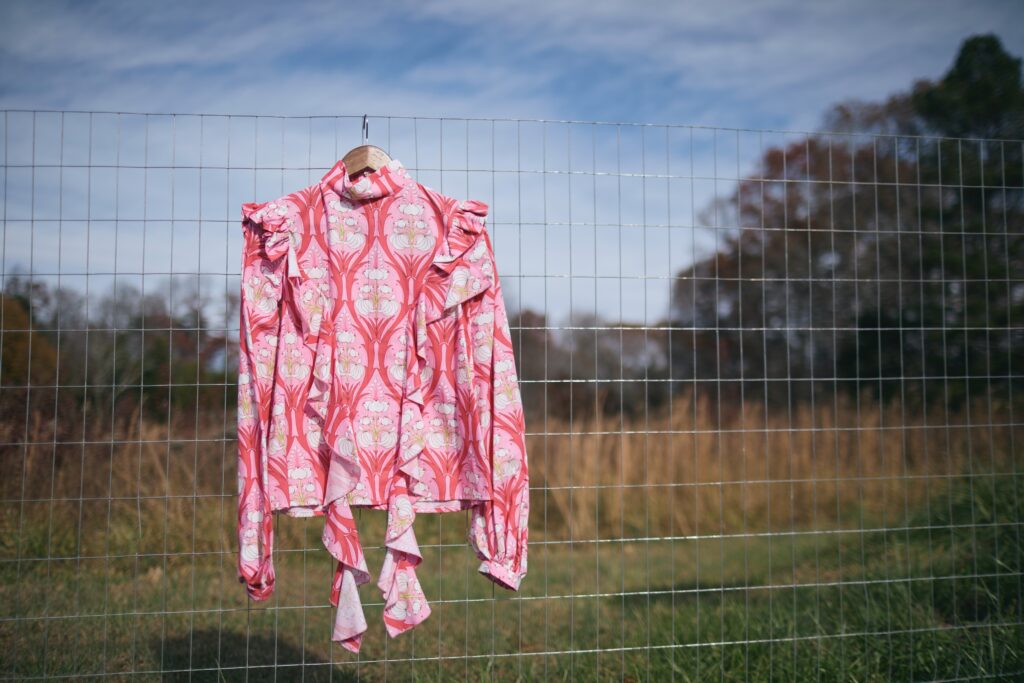

While Julian’s style might be described as preppy, akin to Ralph Lauren and Tommy Hilfiger, “disheveled preppy” is the look Healy portrays. He also seems heavily influenced, especially in his women’s designs, by the hippie movement. Think flowing shifts, Indian and near-Eastern fabrics, often sheer, and plunging necklines.

“People say I remind them of James Spader all the time, especially when I was younger and trimmer,” he says. “The Brat Pack, you can’t beat that.” Healy wasn’t even born until 1980 and was just a child when Emilio Estevez, Andrew McCarthy, Molly Ringwald and their crew graced movie screens across America.

Yet, he’s a self-described old soul whose style icons include several from the 1950s through 1980s: Robert Redford, Paul Newman, Brigitte Bardot and “maybe a dash of River Phoenix.”

After four years of peddling tees, Healy was finally ready to make the leap into women’s fashion. “It took so long to figure out how to get fabric,” says Healy, who sources a lot of his textiles from India, Italy, Peru and Mexico. “And how to find a pattern maker.”

For a couple of years, Healy searched the world over for a pattern maker, and — lo and behold — she was in his backyard all along, right here in Greensboro. Cassidy Burel, who has her own line of couture gowns, freelances for Augustus Roark as both pattern maker and model. While both are designers, each comes at it from different angles. Healy’s jumping off point is always the bold fabric. “I am very driven by color combinations.”

And Cassidy? “She is the total opposite,” he says. “She comes at it from a shape. She likes very minimalistic — white or one color.” While their aesthetic is completely different, their working relationship produces bold results. Often, after completing a piece for Augustus Roark, “She will say, ‘I never thought this would work, but it does.’”
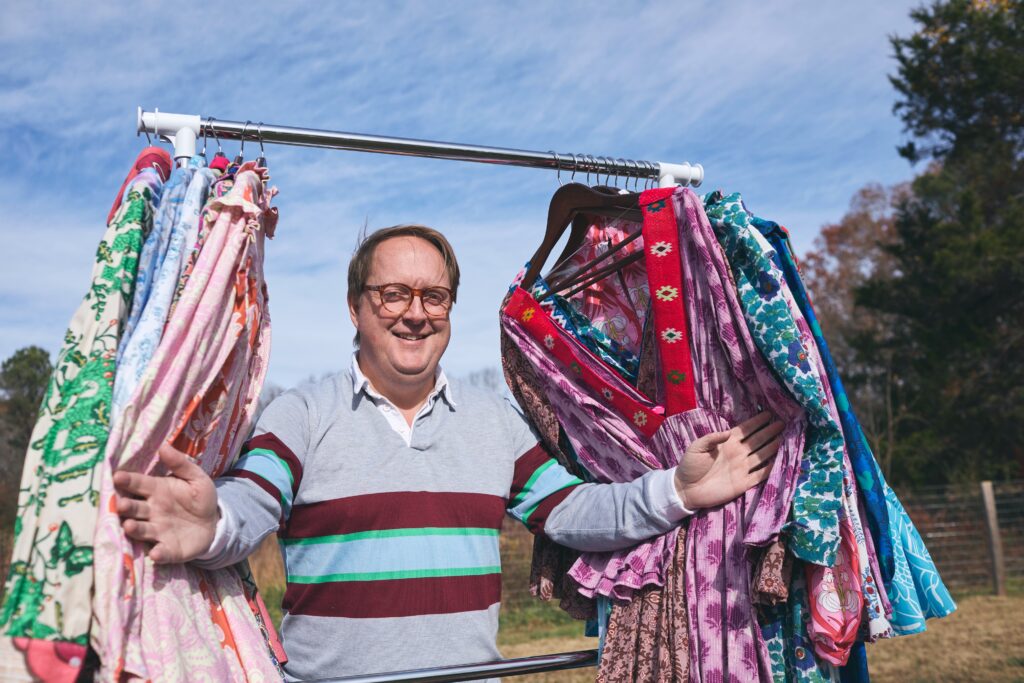
The first dress ever designed by Healy was named “the Sarah,” a maxi-dress with ruffled shoulders, a wide V-neckline and a long side slit in a white fabric that features emerald-green dragons, butterflies, birds and vines with pink berries. Healy insists that it was “absolutely 100 percent” designed with his greatest supporter and influence in mind, his wife. Sarah, who works as the director of strategic marketing and communications at Canterbury School, met Healy right around the time Augustus Roark was officially launching and can often be found wearing her husband’s creations. Born and raised in Western Massachusetts, Sarah’s New England “hipster prepster” vibes echo throughout his designs.

Currently, most Augustus Roark dresses are one-offs or come in a single size run, which Healy says is “cool” because, if you own one, you’ve got a unique piece. But his goal is to be able to sell a fully running women’s line. Healy recalls his mentor, Julian, telling him that designing woman’s fashion was more fun because you could be really innovative. “He always wanted to do it, but he never took the leap,” he adds.

Healy hopes, like Julian’s own father did for him, to leave somewhat of a legacy for his two sons, just 9 and 12 now. “Gucci didn’t become Gucci until 40 years into Gucci,” he says, explaining that the brand didn’t explode into the iconic company it is today until generations later. Healy chuckles, “I am in no way, shape or form suggesting that I am like these brands,” but he’d love to see his kids run with it into the future one day. But for now, while Augustus Roark is still in his hands, he says, “I still have so much I want to do.”

At present, this full-time employee, dad and husband is happy with what he’s been able to accomplish as a simple fashion-designing moonlighter. “I created something out of nothing and that is what I am most proud of. And I am proud that it still exists.”

Of course, it wouldn’t hurt if someone like, say, Gwyneth Paltrow, would don one of his dresses. Rob Lowe, he adds, would be incredible, too. And who knows? You might even spy an Augustus Roark booth — or his T-shirt designs — at the 2025 N.C. Folk Fest.

“You’ll always look back and regret it if you didn’t try,” says Healy. “That’s what Augustus Roark symbolizes — be who you want to be.”

Simple Life

SIMPLE LIFE

The Island Baby

A tale of the most perfect storm

By Jim Dodson

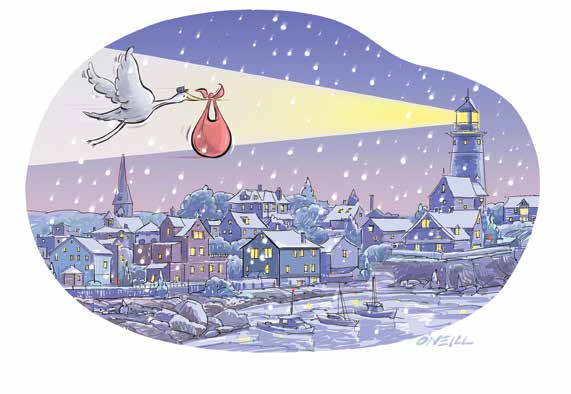
January is a special month in our family. That’s because three members of our scattered tribe are January babies. It could have been four if I hadn’t missed my due date by two days and wound up being a February groundhog.

My late father’s birthday is the 18th and my mother’s the 24th. But our oldest child’s birthday on the 28th holds the true winter magic.

Back in September 1990, as we lay in bed looking up at the stars through the skylight on our first night in the house on Bailey Island, my first wife, Alison, said quietly, “Let me have your hand.”

She placed it on her belly, and, sure enough, for the first time ever, I felt something flutter, soft as a hummingbird.

“That’s him,” I whispered in awe.

“Or her,” she said.

Friends were concerned when we told them we planned to move to an island off the Maine coast for the winter while beginning construction of our house on the mainland.

In good weather, they pointed out, the hospital was a good 45-minute drive away — across two adjoining islands, over three narrow bridges and through three tiny villages. In bad winter weather, the trip had been known to take hours.

From Labor Day to June, only about 300 souls inhabited the durable rock island where we set up housekeeping in a fine cottage, which provided us with a 20-mile view of the coast. Within days of our arrival — news spreads fast on a small island — we’d met the folks who ran the community store, the postmistress, several lobstermen and a chatty gentleman named Bob, sort of the island’s de facto mayor and charge d’affaires of information and snowplowing.

“When the snow flies, the drifts can get pretty wicked out here,” he explained, and turned pale when we mentioned we were in the family way — due in early February. “I’m awfully glad you told me,” he said seriously. “We’ll keep an eye on you.”

A few days later, a lady at the store slipped me a scrap of paper with a phone number and said, “I heard about your situation. Call anytime if you need to — Herman’s got four-wheel drive.” Not long after that, one of the local lobsterman pulled me aside and said, “I’ve got a boat that’ll chew through anything. Just give a holler.”

Such nice folks, those island souls.

While we settled in to wait for the baby, they prepared for winter snow, fixing drafts, hooking up plows, topping up the woodpile and getting buckets of sand ready. I realized how much the mariners loved the drama of winter storms. Hard weather makes good timber, as they say in the north country.

There was a dusting of snow two days before Christmas, followed by wind, arctic cold and nothing more. While the islanders scanned the skies for telltale flakes, we scanned a baby book for boy names. Everyone — I mean everyone — was certain we were going to have a boy, including yours truly.

“How about Herman,” I suggested.

Alison laughed. “You mean after the four-wheel guy?”

“More as in Melville, the great white-whale guy.”

Given our location, I suggested other strong nautical names, including Noah, Davy Jones, Billy Budd and Horatio Hornblower — “Hank” for short.

Alison merely smiled and shook her head. Other family members chipped in several male family names.

As the winter deepened and the delivery day approached, only my wife and my dad believed the baby would be a girl.

In the meantime, the islanders grew visibly tense from the absence of snow. Snowplows sat idle; the boys around the stove grumbled over their morning coffee at the community store.

It turned out, in fact, to be the unsnowiest winter on the island in a century. Just our luck. Poor islanders. By early January you could feel their desperation to push snow and fling sand. A few days before the month’s end, Alison joked that our baby would arrive with a snowstorm.

Her mouth to God’s ear.

That Friday night, as we were dining at our favorite restaurant in town, it began to snow like mad. Mainers live for the winter’s first good snow. You could see the relief in their faces. “Better late than never,” our waitress cheerfully declared as she delivered dessert. “Hate to waste my new snow tires!”

Moments later, Alison’s water broke. We left our dessert behind and went straight to the hospital down the block.

The delivery doctor said we still had several hours to go. So, as mother and baby settled in, I drove out to the island to get some clothes and feed the dog. By the time I got there, a blizzard was in full force and even my four-wheel Blazer had difficulty navigating our unplowed lane.

It took another two hours to get off the island, over the bridges and back to the hospital. By the time I climbed the final hill into town, the snow had stopped and a brilliant sunrise bathed a silent white world in golden light. It was a sight I’ll never forget.

I got to my wife’s side 10 minutes before the baby arrived.

The next afternoon, we brought our newborn home, bundled up like an Eskimo baby. The snow was so deep, we had to park at the community store and slide down the hill on our rumps to our cottage doorstep.

Stamping around, folks on the island were downright giddy. Bob was deeply relieved. Snowplows roared and news of the birth quickly spread.

Everyone who peeked at our new arrival wanted to know what we named our sweet island lad.

“Margaret Sinclair,” I proudly told them.“Maggie for short — after both of her grandmothers.”

Omnivorous Reader

OMNIVOROUS READER

Endless Fascination

The troubled life of F. Scott Fitzgerald

By Stephen E. Smith

In his 1971 memoir, Upstate, literary critic Edmond Wilson grouses about college kids knocking at the door of his “Old Stone House” in Talcottville, New York. “They want to know about Scott Fitzgerald and that’s all,” he writes. Wilson was Fitzgerald’s classmate at Princeton University, and he edited Fitzgerald’s The Crack-Up and the unfinished novel, The Last Tycoon.

If you’re a reader of literary biographies, you can understand Wilson’s peevishness. Bookstore and library shelves are lined with Scott and Zelda Fitzgerald bios. Matthew Bruccoli’s Some Sort of Epic Grandeur is the definitive work. Still, there are many other bios — at least 30 — that are worth considering: Scott Donaldson’s Fool For Love, Arthur Krystal’s Some Unfinished Chaos, Niklas Salmose and David Rennie’s F. Scott Fitzgerald: A Composite Biography, among others.

Robert Garnett’s recent Taking Things Hard: The Trials of F. Scott Fitzgerald contributes significantly to the material available on the Jazz Age author and will be of particular interest to Fitzgerald aficionados with a North Carolina connection.

Garnett, a professor emeritus of English at Gettysburg College, is best known for his biography, Charles Dickens in Love. His Fitzgerald study is less inclusive than his work on Dickens, covering the final 20 years of Fitzgerald’s life, but his research is meticulous and reveals aspects of Fitzgerald’s personality that other biographers have ignored or overlooked.

During his most prolific years — 1924-1935 — Fitzgerald’s primary source of income was his short fiction (he published 65 stories in The Saturday Evening Post alone), and he was paid between $1,500-$5,000 per story when a Depression-era income for a high-wage earner was $1,000 a year. Garnett focuses on the better-known stories — “The Ice Palace,” “A Diamond as Big as the Ritz,” “The Intimate Strangers,” “Babylon Revisited,” “One Trip Abroad,” etc. — to explicate the romantic themes and ineffable mysteries that defined Fitzgerald’s checkered life.

The story “Last of the Belles,” written in 1927, exemplifies Fitzgerald’s return to the familiar theme of romantic infatuation and lost love. It closely parallels Fitzgerald’s time in Montgomery, Alabama, where he served as a young lieutenant during World War I. He incorporates his courtship of his future wife, Zelda Sayre, into the narrative and transforms her into the character of Ailie Calhoun, “the top girl” in town. The narrator, identified only as Andy, is smitten by Ailie, but she becomes enamored of Earl Schoen, a former streetcar conductor disguised in an officer’s uniform.

“The Last of the Belles” plays off Fitzgerald’s strong sense of class, his longing to recapture youthful romance, and his grieving “for that vanished world and vanished mood, Montgomery in 1918 . . . a living poetry of youth, warmth, charming girls, and romance.” “The Last of the Belles” is Fitzgerald’s final attempt to recapture the South of his youth and its alluring women.

A close reading of the stories opens a window into Fitzgerald’s thematic preoccupations, allowing the readers to glimpse aspects of his thinking that are not readily apparent in his less spontaneous, more ambitious novels. But it also presents the reader with a challenge. Garnett provides a synopsis of the stories he cites, but to fully comprehend his explications, it is necessary to read the stories in their entirety, an undertaking that casual readers might find laborious.

Fitzgerald’s North Carolina sojourn is at the heart of Taking Things Hard. In the Fitzgerald papers at Princeton’s Firestone Library, a personal journal kept by Laura Guthrie, a palm reader at Asheville’s Grove Park Inn, draws an intimate, none-too-flattering portrait of Fitzgerald during his saddest period. “The 150-page single-spaced typescript follows him closely, day by day, often hour by hour,” Garnett writes. “Most Fitzgerald scholars are aware of it; few have read it through, fewer still have mined it.” Garnett believes Guthrie’s journal “is the most valuable single source for any period of his (Fitzgerald’s) life.”

In the early spring of 1935, Fitzgerald fled Baltimore for Asheville. He rented adjoining rooms at The Grove Park Inn, where he wrote a series of historical stories for Redbook. Garnett describes these stories as “wooden, simplistic, puerile, awash in cliché and banality, with ninth-century colloquial rendered in a hodgepodge of cowboy-movie, hillbilly, and detective novel.” These amateurish stories were the low point of Fitzgerald’s writing career.

Guthrie became Fitzgerald’s confidant, constant companion and caregiver. He and Guthrie were not physically intimate, but she was enamored. Of their first dinner together, she wrote, “He drank his ale and loved me with his eyes, and then with his lips for he said, ‘I love you, Laura,’ and insisted, ‘I do love you, Laura, and I have only said that to three women in my life.’”

The story Guthrie tells is anything but inspirational. Fitzgerald was intoxicated most of the time — she recorded that he drank as many as 37 bottles of beer a day — and he insisted that she remain at his beck and call. “He is extremely dictatorial,” she wrote, “and expects to be obeyed at once — and well.” As the summer progressed, his drinking grew worse, and he eventually turned to gin “with the idea,” Guthrie noted, “that he had to finish the story and that he could not do it on beer, even if he took 30 or so cans a day, and so he would have to have strong help — first whiskey and then gin.”

In June, Fitzgerald headed to Baltimore and detrained briefly in Southern Pines to visit with James and Katharine Boyd. His conduct while visiting with the Boyds was such that he felt compelled to write a letter of apology when he arrived in Baltimore.

In late 1935, Fitzgerald took a room in Hendersonville, North Carolina, and wrote his self-deprecatingly “Crack-Up” articles. Published in Esquire in 1936, these revealing essays marked the end of his career as a popular novelist and short story writer. He would eventually move to Hollywood, spending the remainder of his days toiling for the dream factories and outlining a novel he would never complete. He died there in relative obscurity in 1940 at the age of 44.

A century after its publication, The Great Gatsby remains a mainstay of the American literary canon, and critics and scholars continue re-evaluating Fitzgerald’s life. No matter how many times they retell the story, it will never have a happy ending.

Pleasures of Life

PLEASURES OF LIFE

A Falconer Goes Home

And discovers what, exactly, is in a name

By Woody Faulkner

I can scarcely believe that I am here, standing on my ancestral ground with a majestic gold eagle on my arm.

Her massive talons grip my gloved arm. A bit heavy at 7 pounds, her feathered, muscular torso, noble head and sharp talons are all on display as if to say, “Watch yourself!”  Out of all the raptors used in falconry, the eagle is the largest. Emitting loud squawks, she lets me know that I need to pay strict attention to her. She is 50 years old, which is very old for an eagle. In the wild, they live to a max of around 35 years. On this gorgeous golden girl’s upcoming birthday, Barry, our Scottish falconer, is going to present her with a whole rabbit “. . . in pless of eh berrrrth-dey kehk!”      

I long imagined re-enacting the regal hunting sport that gave my family its surname, Falconer/Faulkner. So, in July, John, my spouse, and I set out for Edinburgh ( or “Edinbruh,” as the Scots say), Scotland and Dalhousie Castle, where Falconry Scotland’s Ultimate Experience is located. Barry and son Jackson introduce us to numerous birds of prey on site, including owls, hawks, falcons, eagles, a raven and a crow. We even meet the sister of the owl known for playing Hedwig, of Harry Potter fame! Taking turns with other guests, we “fly” the owls and hawks. Duke is a large owl so named because he swaggers like John Wayne when he walks. Bojangles is a hawk who wears a bell, and Lizzie is a small, white, talkative owl. Each flies from a perch at the falconer’s signal to our arm, lured by fresh chunks of chicken. Just before each one of these birds lights upon my left arm, its broad wings open widely, it tucks its tail down, while its talons thrust forward to grasp its perch. Then it gracefully folds its wings. I can barely feel little Lizzie landing, but Duke and Bojangles land with a goodly thud that makes my arm dip a bit. Their close proximity to me doesn’t invoke fear, rather admiration and oneness with the bird. The leather gauntlet provides protection from the otherwise deadly talons. After eating the raw chicken greedily, the bird sits patiently on my arm waiting for a command from Barry. Finally, we get to hold a bird of our choice. My pick? The large golden eagle.  

Growing up in rural Vance County, N.C., surrounded by other Faulkner families, I was vaguely aware that our surname derives from the Medieval practice of falconry, but my interest was piqued when I seriously began to research my family name. Finding a wealth of information about my 9th great-grandfather and his family’s arrival in 1665 at Hog Pen Neck, a British colony of Maryland, aboard the ship Agreement, I was able to trace our line of Faulkners as far back as 13th-century Scotland.  

The first forebears of our name was Ranulphus of Lunkyir, who was appointed Scottish Falconer in 1211 by the third king of Scotland, William the Lion (1165-1214). Lunkyir then changed his name to Ranulphus le Falconer.  And so it was that we found ourselves on an unusually sunny day in Scotland traveling north from Edinburgh into the foothill region in which Scottish Kings and their falconers hunted. Hiring a driver for the day, we set out to visit an ancestral seat of the Falconer/Keith clan called Inglismaldie Castle (a small estate on a large tract of land). No longer occupied, the house had been the seat of the Lairds of Halkerton (Hawk-town and the Falconer/Keiths) from 1636 to the 1960s.

Arriving at the castle, I walk up to the front door and boldly knock three times with the round iron knocker as if to say to the ghosts within, “Open up, a Faulkner is here.” Alas, no answer.

Gazing up at the crest above the door, its motto catches my attention, “Quae Amissa Salva,” (“What is lost, has been saved”). After some quick googling of the phrase, we ultimately discover that this refers to Clan Keith (our relatives by marriage) and the Scottish Crown Jewels they saved from Cromwell’s armies in 1652.     

On the way back from Inglismaldie, we make several stops to take in the spectacular coastal scenery perfect for falconry. Arriving at the ruin of Arbroath Abbey, founded by William I in 1178 and dedicated to his friend Thomas Becket, we first explore the visitor center. There, I read that King William is buried among the ruins — an unexpected jackpot! Walking down what would have been the nave of the cathedral, leading to the high altar, there on the bare ground, I spy a large, red, flat stone: the tomb of William I! Here lies the monarch who granted a long line of Falconers their family name 900 years earlier! 

Experiencing falconry in the land that gave me my name was immensely enjoyable and satiated my curiosity, leaving me full of gratitude. In Scotland, I found a safe — and sacred — place to explore what gave my family the wings to soar.

Sazerac January 2025

SAZERAC

Letters

In response to our August 2024 Unsolicited Advice regarding handwriting, Elaine Schenot penned this letter:

Window on the Past

We’re not just blowing smoke out of the stacks, the O.Henry office has moved to Revolution Mill, seen here in the late-’40s.

Sage Gardener

Visiting my daughter in Spain, standing in a market surrounded by gloriously red peppers and the ripest of tomatoes, I suddenly saw “a dirty, knobby, alien-looking root,” as one food writer describes it: Apium graveolens var. rapaceum, aka celeriac. A cousin of celery, fennel, carrots and parsnips, this bulbous, bumpy orb is my wife’s absolute favorite root vegetable, although I’ve often pointed out to her that celeriac is not a root but a hypocotyl. She counters, “Say that three times.” 

The hypocotyl, according to my dictionary, is that part of the stem beneath the stalks of the leaves and directly above the root. So, on that balmy Spanish evening we had hypocotyl remoulade, a classic French dish that Anne first discovered in a Paris automat. She chose what she thought was slaw; instead, she discovered something sublime. Since then, she’s been on a long journey — completely unsuccessful — of trying to grow celeriac.  “One English gardener says ‘Celeriac is easy to grow,’” I tell her.“‘Hardier and more disease-resistant than celery.’” Says Anne, “You’ll recall that we’ve never been able to grow celery.”

Over the years, she’s told everyone who’ll listen about ordering the seeds and putting them into grow pots, only to have not a single one come up. The next year, she decided our wood stove-heated house was too cold, so she invested in a grow mat; voila, that spring she coached three spindly seedlings out of the pots! Nursed  like the first borns they were, one of them survived transplanting. Thus, we harvested our treasured, first celeriac, a hypocotyl feast about the size of a black walnut. The following year was no better, so nowadays Anne resignedly buys them wherever she can get them, most reliably at Super G Mart on Market.

Among the oldest of “root” vegetables, celeriac was painstakingly cultivated, not for its stalks like celery, but for that unshapely, but oh-so-tasty bulb between the stem and the squiggly, anemic roots.

References date back to Mycenean Linear B. Homer mentions “selinon” (the Greek word for celeriac) in both the Iliad and Odyssey. Romans and Egyptians prized celeriac for its medicinal benefits, and one writer suggests the root was also used in religious ceremonies, though, for the life of me, I can’t imagine how. By 1623, the French, naturellement, were eating them. Soon, Europeans all over the continent were julienning, grating and slicing them. Americans, not so much.

Nevertheless, one of Martha Stewart’s acolytes proclaims that “celeriac is having a moment,” and points out that market forecasts for 2024 suggested a 42 percent increase in sales year to year. (No hoarding, please.) She quotes various celebrity chefs enthusing over the ugly bulb, celeriac puree in particular. If you like carrots, parsnips, fennel or turnips, especially combined with a comforting and slightly earthy note, you’ll likely like celeriac. Now that we’ve transitioned from our wood stove to central air, I’m hoping my favorite gardener will get out the grow mat, hatch a plethora of wee sprouts and nurse them into transplants that will, with any luck, grow into the ugliest vegetables in our garden — and on the planet.    — David Claude Bailey

Winner, Winner, Chicken Dinner

Thank you to all who entered our 2024 O.Henry Essay Contest, with the theme, “Furry, Feathered and Ferocious.” We put out the call — of the wild — and your stories had us laughing, crying and snuggling with our own animals a little more tightly. With so many delightful entries, our task was beastly, but we’re pleased to have chosen three engaging essays that will appear in our pages throughout this year. Without further ado, your 2024 winners:

First Place: Eric Schaefer, “Harriet”
Second Place: Karen Watts, “The Mummification of Leapy the Lizard”
Third Place: Dianne Hayter, “Questers”

Thank you to all who entered our 2024 O.Henry Essay Contest, with the theme, “Furry, Feathered and Ferocious.” We put out the call — of the wild — and your stories had us laughing, crying and snuggling with our own animals a little more tightly. With so many delightful entries, our task was beastly, but we’re pleased to have chosen three engaging essays that will appear in our pages throughout this year. Without further ado, your 2024 winners:

Unsolicited Advice

A new year is a great opportunity to take stock of the many blessings in your life and let go of the things that aren’t serving you — yes, we’re talking about your refrigerator. That cranberry relish your dad brought over to pair with your Thanksgiving turkey during the Obama administration? Toss it. The high-protein yogurt you just bought to ring in 2025 as the best version of yourself ever? Keep it. At least for now, while you’re still full of hope. But those 17 jars of mustard alone? Pare ’em down. Here’s our list of the five essential mustards every house needs. The rest can go.

1. American yellow: She’s basic. Her fav shirt reads, “Go sports!” But she’s reliable and hasn’t met a hot dog she can’t improve.

2. Dijon: She rides around in limos and speaks with an elegant British accent. Her fav show is Bridgerton, but she’s also a fan of the 1995 Pride and Prejudice miniseries that starred Colin Firth. It’s unAmerican not to use Grey Poupon, si’l vous plaît.

3. Whole grain: This one screams, “I’ve got grit,” and hangs out in your local deli with Kosher pickles. She’s too hardworking to care if there’s anything stuck in her teeth.

4. Honey: She’s sweet and tangy. When invited to a potluck dinner, she brings warm, gooey sticky buns.

5. Spicy brown: She’s the Spice Girl (Mustard Spice, duh) that was cut from the group for being too bold and standing out. Sadly, her solo career went nowhere because she’s better when mixed with others.

Tea Leaf Astrologer

TEA LEAF ASTROLOGER

Capricorn

(December 22 – January 19)

Write down these words and revisit them often: Just because you can, doesn’t mean you should. We all know you’re capable of scaling treacherous heights. But at what cost? Your life force is precious. When Venus enters your sign toward the end of the month, things look seriously dreamy in the romance department (rock-steady commitment paired with the warm-and-fuzzies). Here’s the catch: You’re going to have to wreck your own heart wall.

Tea leaf “fortunes” for the rest of you:

Aquarius (January 20 – February 18)

Dare you to read just for pleasure.

Pisces (February 19 – March 20)

Try googling power pose.

Aries (March 21 – April 19) 

Don’t forget: A seed can lay dormant for years.

Taurus (April 20 – May 20)

Refine your spice cabinet.

Gemini (May 21 – June 20)

The system needs a reboot.

Cancer (June 21 – July 22)

Delete the app.

Leo (July 23 – August 22)

The last sip is the sweetest.

Virgo (August 23 – September 22)

It’s time to dust off the old you-know-what.

Libra (September 23 – October 22)

Conditions are ripe for cuddling.

Scorpio (October 23 – November 21)

Release what wants to go.

Sagittarius (November 22 – December 21)

Consider swapping out that lamp.

Life’s Funny

LIFE'S FUNNY

Lovin’ Spoonfuls

How a well-known Greensboro chef changed his menu and his life

By Maria Johnson

January is a good time to talk about John Drees for a couple of reasons.

A freshly unwrapped year is all about new beginnings, which Drees, 60, knows something about.

Also, January is National Soup Month (sorry, Souptober), and that points to Drees in his latest incarnation as Chef Soup, boss of a small-batch business that sells frozen quarts of savory spoonfuls from The Corner Farmers Market, the open-air bazaar where, most Saturday mornings, Drees pitches his canopy in the parking lot of St. Andrews Episcopal Church in Greensboro.

If you had a really good arm, you could throw a rock from here and hit the vacant single-story building where Drees first made a name for himself in the Gate City 40 years ago. Many people fondly recall the scrumptious meals he dished out at Southern Lights Bistro on Smyres Place in Sunset Hills.

“I have a whole different perspective now,” says Drees, who looks to be permanently flushed from decades of stovetop steam baths. Surrounded by the coffee-sipping, fleece-and-jeans crowd at the market, it’s notable that he does not look pretentious in a white apron and black skull cap. He looks relaxed and well practiced. He ought to.

“I was the fool that worked seven days a week for 35 years,” he says. “You weren’t gonna outwork me. I didn’t know better at the time.”

A native of Greensboro, Drees popped up at Southern Lights as a cook in 1985. Soon, he bought into the business, which flourished with stylish farm-fresh food, a chummy chalk-board atmosphere and reasonable prices.

Chef J.B.D. had a hot hand.

He was a regular on WFMY-TV’s morning-show cooking segment with the late Lee Kinard.

He played a part in launching Prizzi’s, an Italian cafe in Quaker Village; The Edge, a Tate Street bar; Nico’s, a fine Italian place downtown; and 1618 West Seafood Grille, which still reels in diners on Friendly Avenue. He also spun off a satellite of Southern Lights in Winston-Salem.

In time, Drees clung only to Southern Lights in Greensboro, which he moved to a Lawndale Drive shopping center in 2010. Business was skinny but sustainable until COVID body-slammed restaurants in the spring of 2020. Drees closed his doors to diners and snapped off the lights for good that summer, ending a remarkable 35-year run.

The hard stop did him good. He was surprised at how much he enjoyed taking long walks and having time to chat about topics unrelated to business.

“I didn’t realize until the pandemic that there was so much more to life than working,” he says. “I was having flashbacks to when the kids were little, and I had Sundays off.”

He took a year to stir the question of what to do next. With three adult children, he didn’t need as much income as before, but he needed to beef up his retirement account.

He’d lived long enough to watch friends and family die sooner than expected, so he knew that time was his most precious commodity. But he wanted to spend some of it working. Nobody needed to tell him that he was really good at what he did.

He thought about opening a soup-salad-and-sandwich shop downtown in 2021, but foot traffic still lagged, and reliable employees were hard to come by.

He pared down his idea.

“I wanted soup to be the star of the show,” he says.

He explored the idea of selling soup to retirement homes, and that’s when he learned that most of the seniors’ soups were bought frozen and warmed to life again.

“A light went off,” he says.

He whipped up 80 quarts of soup — six flavors led by his signature tomato basil — poured them into cardboard take-out cups, stuck them in a freezer and carted the frosty blocks to the Corner Market in February of 2022.

He sold 60 of them.

“I said, ‘OK, this is a thing,’” he recalls.

Six months later, he added online ordering and home delivery. Today, internet sales have almost caught up with face-to-face sales, thanks to a social media presence driven by his fianccée, Nancy Cunningham, who handles marketing for Grandover Resort.

Orders spike when she teases “Souper Tuesday” — buy three quarts, get a fourth free — on Facebook and Instagram.

Drees will keep his market table for the revenue and in-person feedback, but he’s keen to grow the delivery side.

“I think [Amazon founder] Jeff Bezos was on to something, starting with, I get paid before I even pull out of the driveway,” he says. “I’m modernizing myself, but keeping it as basic and simple as I can.”

Relishing his elastic schedule, Drees cooks and delivers three to four days a week, more or less if needed. He hovers over every batch with help from two part-timers at Short Street Gastro Lab, a shared kitchen space in Kernersville. 

With a repertoire of 80 recipes, he offers eight to 12 flavors at the market every week. He posts four online. Standing over a tilt skillet, basically a flat-top grill with straight sides and a crank to tip the bed, Drees makes cooking for the masses look easy. Ten gallons of cheesy potato-and-ham soup coming up.

He fires up the skillet and slicks it with glugs of olive oil. In goes a bag of bacon bits; anyone who eats ham isn’t going to fuss about bacon. Next up: chopped cooked ham, onions, celery and carrots, which Drees flips and scrapes with a giant spatula until both the meat and veggies wear a shiny brown crust. He douses the sizzle with water to deglaze the pan.

A fragrant, hissing fog rises. Dried dill comes to life. Pails of quartered red potatoes simmer to softness. A blend of cheeses  — cheddar, Monterrey Jack, American and cream — relaxes into a velvety matrix.

With both hands, Drees grasps a 2-foot-long immersion blender — it looks more like a gardening tool than kitchen utensil — and starts rowing. The cheese and potato lighten the mixture as he churns. Finally, he dips a spoon and closes his eyes so that he can read the taste and texture with his mouth, not his eyes.

“Needs more water,” he says.

Thinned to his satisfaction, Drees hands off the vat to a helper while he leaves to make a delivery nearby.

Four days later, at market, the rib-sticking soup goes for $13 a quart.

Drees’ youngest child, Jonas, rings up customers on an iPad.

Standing behind Jonas, Drees is fenced by a ring of ice chests holding his wares. He faces in the direction of the original Southern Lights. It’s hard to believe so much time has passed since he started there, he says. It was like another lifetime.

What would he tell his younger self, knowing what he knows now?

“Don’t take yourself so seriously,” he says, pressing his lips into a Mona Lisa smile. “Life is too short to worry about work and making money all the time. Work will take care of itself.”

Poem January 2025

POEM JANUARY 2025

Still Life

Entering that gallery so many years ago,
I spotted a gem, the perfect fit
for the remaining blank space
on one wall in my living room.

It’s a small piece, really,
to dominate such a large room —
two slender pale yellow vases,
each graced with a modest bouquet
of brilliant orange hibiscus blooms,
set off within an ornate gold frame,
which glistens whether bathed
by the afternoon sun or more simply,
in the reflected light of a nearby lamp.

When I return to my apartment
after dinner, I sometimes amuse myself
by spinning a backstory for the painting:
a peace offering from a contrite beau
who’s wounded his sweetheart,
a birthday gift from a loving daughter
to honor her hard-working single mother.
But always it welcomes me home,
and reminds me I’m still here.

—Martha Golensky

Chaos Theory

CHAOS THEORY

Going for Baroque

And finding the audacity to do it

By Cassie Bustamante

While I think that the best guiding light in life is trusting your own intuition, I’m always looking to others to show me what’s possible. When I was a child, Miss Piggy was my idol. Strong, ambitious, witty, fashionable and — though some may say it was just lipstick on a pig — she was beautiful. My mom even stitched an image of her that adorned my bedroom wall and read, “My beauty is my curse.” No, she wasn’t a traditional looker, but she held her own with confidence.

When I started dipping my brush into the DIY world, I discovered designer Dorothy Draper. And I might be the first person to compare her to a Muppet, but Draper seemed to march with certainty to her own beat, too. Though Draper died in 1969, five years before Miss Piggy’s snout ever graced American television sets, I am sure she’d have been a fan. They’re both what kids today would call “extra.”

Born into wealth in 1889 New York, Draper drew from a world of historic design styles that she had at her fingertips and unapologetically made her own. Her iconic style, which she coined “Modern Baroque,” features bold color, audacious mixing of loud patterns and plaster architectural flourishes rarely repeated today. Everything was over the top — and yet it worked.

Draper once pronounced, “I believe in doing the thing you feel is right. If it looks right, it is right.” Her trademark aesthetic prevailed because she trusted her intuition. Blazing a trail for others, she became the very first commercial interior designer. Her work can still be appreciated today at some elaborate and expansive hotels that remain almost exactly as she designed them.

Last year, I was invited as a media guest — among a couple hundred attendees total — to the Dorothy Draper Design Weekend held annually at The Greenbrier, the iconic resort in White Sulphur Springs, West Virginia, just a few hours north of Greensboro. Draper took on the design of The Greenbrier in 1946. And, in the late 1950s, “Mr. Color,” Carleton Varney, joined her company, became her protegé and eventually bought Dorothy Draper Design Co. in the late ’60s. He passed away in 2022, but his sons, Sebastian and Nicholas, are keeping the brand’s — and their father’s — legacy alive. In fact, the company celebrates its centennial anniversary this year.

As someone who had long admired Draper’s work, especially her iconic España chest, I was thrilled to take in her daring design with my own two eyes.

My guest room enveloped me in greens: minty walls, a tonal checkered carpet, a green-and-pink quilt featuring roses and — my favorite part — emerald Francie & Grover fabric, named after Carleton Varney’s dogs.

For the first official weekend event, I hopped on a shuttle over to the on-site upholstery workshop, where seamstresses and upholsterers worked on vintage hotel furnishings and whipped up draperies. Bolts upon bolts of fabric lined large tables as well as the walls, organized by color. High upon a shelf, I spied a tattered Easter Bunny head, once part of a costume. I asked one of the upholsterers about it and he said it had come to the shop years ago for repairs, but a new costume was ordered instead. So instead of ending up at the local dump, there sat the shell of a rabbit head, staring blankly at the workers. Draper did once say, “I always love a controversial item. It makes people talk.”

The rest of the weekend was a whirl of creative, hands-on activity. Rudy Saunders, the company’s design director, led a session on pattern mixing. The hotel’s florist taught an arrangement workshop. We toured the entire property. As someone who actually prefers warm neutrals, I was in awe of the on-site chapel, an archaic structure of white with rustic wooden beams, flooring and pews. Its spartan features allowed the vibrant stained-glass windows to, well, shine. Second to that, I was floored by — wait for it — the Victorian writing room. Dark, moody walls paired with a vibrant red carpet, a convex Federal mirror above an elaborately carved marble fireplace? A girl could write in there.

And North Carolina author Joy Callaway agrees. In fact, she was inspired by the hotel itself to pen The Grand Design, a historical-fictional novel about Draper’s life and work at The Greenbrier. Callaway, who has written several novels, both romance and historical fiction, gave a talk over the weekend about her book and what fuels her creativity. Like Draper did for so many decorators, Callaway did for me — I could catch a glimmer of my own future in her.

I don’t have a crystal ball to know what lies ahead, of course. But I can look to the trailblazers who have climbed to the summit, turned around and shone their torch on the path ahead for me and others. And I know, with certainty, that I can trust my inner voice. Like Draper — and with the confidence of a certain refined swine — I will keep doing the thing that I feel is right. 

A Cottage by the College

A COTTAGE BY THE COLLEGE

A Cottage by the College

Jane Green, neighborhood happiness broker

By Cynthia Adams     Photographs by Amy Freeman

I was outside yesterday working in the yard, and a young girl came by and said, ‘I love your house so much! I stop and look at it every day. I hope one day to have a house just like this,’” says Jane Green, who squeezed a small house on an incredibly tiny lot in the historic College Hill neighborhood. She also squeezed in an inordinate amount of happiness in the process.

“I have met so many nice young people living here. I felt, ‘Wow. That’s such a nice thing to say,’” she says, smiling widely as her eyes fill. 

With a well-trafficked sidewalk bustling with passing UNCG students, Jane frequently enjoys porch time, befriending neighbors — even those happening by whom she may never know.

During the summer, a bubble machine installed on the front yard telegraphs Jane’s contagious happiness. A riot of flowers tumbles from planters and tin buckets; pale lavender petunias, lavender and herbs prevail.

By fall, pansies replace petunias, planted in abundance and the porch, an outdoor living room complete with hanging lanterns, table and chairs, rocker and cheerful swing, is dressed according to the season. It is Jane’s favorite place to be.

She has triumphantly brokered joy into her life.  Like the pansies she admires, Jane blooms where she is planted. Resilient little pansies recover “even when frozen in a block of ice. Don’t give up on them!” 

She sometimes looks back as she is leaving home, to reassure herself it is all real. 

“That it’s still there,” Jane says wonderingly.

The best stories often start with serendipity. In the Greens’ case, unseen hands helped them along the way from the time they relocated to Greensboro from New Jersey in order to be closer to their adult children and their growing families.

Yet a shadow eclipsed the Greens’ sunny home last year when Richard succumbed to a debilitating illness four year after creating their pared-to-perfection cottage. Long married, Jane has spent the past year recalibrating, adjusting to life on her own. 

As a couple, meals were a communal time. She missed that deeply when freshly bereaved. It was over dinners that the Greens processed the events of their lives.

“You talk about the day. The kids. You’re there.”

Naturally slender, she forced herself to eat after losing her husband.

“You know, the first time I had to sit and eat alone, that was hard for me. I’d never thought about that. That took a lot of getting used to,” acknowledges Jane. 

“So, I ate outside [on the porch] and it made me feel better. For several weeks I did that. Kids were going by, they knew me, and I was able to get over that.” 

There is a wistful pause. Even so, Jane remains the optimist on the block, a consequence of a close-knit family and actively cultivating a sense of belonging. More than a few longevity experts say such a sense of community is an essential ingredient of a healthful life.

“Your friends are important.” But so are neighbors, she explains.

Instinctually, Jane grins. “I like it just where I am,” she says, gesturing towards the front yard as students pass a white picket fence, part of the house’s charm initiative.

“The only part that bothers me is that they move on . . .” she adds wistfully. “But you get new ones,” she reminds herself. Despite loss, Jane persists, offsetting what might have been consuming loneliness.

Such boundless enthusiasm has made Jane a self-appointed booster for College Hill, downtown Greensboro, the Tanger Center, the City of Greensboro (especially City planner Mike Cowhig) and the students at UNCG.   

Notably, too, her positive thinking seems to manifest good things.

Long before the Greens built their dream house, Jane kept a picture of a cottage torn from a Montgomery Ward catalog for future reference. She loved the simple, vintage charm. To her mind, it appeared cozy, friendly and welcoming.

Longing eventually inspired Jane and Richard to build their future Greensboro home in a historic district, where the lots were smaller and better suited to the cottage proportions. 

They considered rehabbing other properties. But the Greens ultimately hoped to find an economical, buildable lot within Greensboro. 

A lot that had been donated to the College Hill Neighborhood Association languished. College Hill resident Dan Curry, a member of its board and with long experience with Housing and Community Development, thought it could be viable. It was largely viewed as unbuildable, he acknowledges.

Even some city officials doubted it was sufficiently large enough to build. Yet Curry thought it could be done.

Empty and littered with refuse, 3,500-square-feet of land was once the entrance to a foundry. It had slowly devolved into an eyesore. 

Curry and Cowhig, who worked with historic districts, arrived at a solution that would check several boxes and pacify residents who complained about the problematic lot. It would require coordinating a new build with various factions.

Both men believed the right project could be slipped onto the lot (called “infill”) and restore the 1800s historic streetscape to a more congruent, appropriate reality. “They [the Greens] had to overcome so many obstacles to make it happen,” says Cowhig, and it took two years to resolve. 

But it would have to be just the right-sized house. 

Not too big, not too small — a Goldilocks fit.

Yet even the Greens’ first look at the lot was singularly unfavorable. 

Jane says bluntly, “It was a garbage pit.” But the Greens understood that the lot might be just large enough for their downsized house, minus a private driveway. (Egress would be via an existing driveway to a UNCG-owned building behind the lot used by the drama department for prop building.)

Long accustomed to 2,500 square feet, the Greens planned a 950-square-foot build. Jane stresses that it was less than 1,000 square feet of living space “without the porch.” The porch, which they insisted upon, was crucial to expanding their living space and the desired cottage look. 

“I love a front porch,” Jane repeats, adding a happy sigh. With additional guidance from Summerfield contractor Gary Silverstein, the newbie build would appear right at home among historic homes more than a century older. 

Cowhig assured all involved the cottage would meet local standards and fit with neighboring homes.

While the Greens rented a home for 10 months in High Point, their daughter, Nicole, who lived in nearby Sunset Hills, helped them strategize and downsize in anticipation of the new cottage. 

They spent months going through a lifetime of stored possessions they had brought to North Carolina. Nudged by Nicole, they winnowed out extraneous possessions, and she arranged a tag sale. (The $600 proceeds would eventually pay for a small shed behind the new house.)

Silverstein had to work under less-than-ideal circumstances. The lot was on a busy street, close to UNCG. Construction workers had limited street parking as they ferried materials to the tiny site.

He went the extra mile, attending the planning board meetings before he even knew he had the job, Jane adds. Silverstein also took care of the cumbersome permitting requirements.

With tight building parameters, he had to improvise, using a crane in order to raise the roof rafters, reassuring watchful neighbors that their adjacent homes would be unscathed.

There was no room for error.

“He was wonderful, here working all the time.”

Silverstein completed the Greens’ new home on October 31, 2018. 

A beaming Jane adds, “He was on budget!”

Naturally, budget mattered to the active retirees, who opted to work part time jobs.  Richard worked nights as a security guard downtown, freeing days to pursue his lifelong passion for black-and-white street photography. Jane was hired by Our Lady of Grace, working with young school children. Both thrived. 

Six years later, much has changed at the Greens’ residence.

O.Henry photographer Bert VanderVeen, whose studio is nearby, had befriended Richard, admiring his striking black-and-white photography. 

He proposed having Richard’s first posthumous show and a reception in his honor at the studio, selling prints to benefit charity. 

The reception filled with college-age young people who knew Richard and Jane. The students bought almost all of Richard’s works and paid homage to their friend, who was a generation apart — or more — in age.

With the new year, Jane takes stock. While she admits there have been some difficulties without her partner of oh-so-many years, her much loved neighborhood has helped Jane remain contentedly in the home she and Richard built together.

Their mutual adaptability became a key factor in coping with transition and the inevitability of change.

“As you grow older, I think you have to choose a place where there’s activity,” she advises over a coffee on Tate Street, an easy walking distance from her cottage.

“Sure, you hear the fire engines, but after a while, you don’t even notice that stuff. I like being in a city. And I love being in a college town,” says Jane. “One day, I won’t be able to drive, but I can walk!”

She adds that as wonderful as she finds being in a lively place with access to downtown, being stuck “in a tiny house in the middle of nowhere” would have held little appeal.

“You need to be around people, especially now that I’m by myself.”

***

Furthering her commitment to the neighborhood, Jane maintains a Little Free Library. The replica of her cottage is stocked with books for anyone wandering by. Which reminds her: It presently needs restocking. “When I get really low, my daughter gets online and gets donations.” 

The library box serves as another way to meet people, she says, brightening. “They come to put books in and they talk to me.”  During the pandemic, she filled the box with canned goods rather than books to help financially strapped students. They profusely thanked her, Jane says, her eyes welling with tears.

With her coffee cup drained, Jane glances at her watch. She’s going apple picking with her grandchildren and daughter in law. Flats of multicolored pansies await on the porch. 

Pansies, she says admiringly, are cheerful flowers, who lift their faces to the sun.

Jane plants them every year; this year will be no different.

With that done, she’s planning for gingerbread trim below the eaves to punch up the cottage’s curb appeal. “Don’t you think that will look nice?” she asks. 

While attending a San Francisco wedding last summer, she and Nicole visited the landmark “painted ladies” for the first time and were charmed by the row of colorful historic homes.

Jane returned to College Hill, energized, ready to punch things up. “More yellow? Or more purple?” she asks, scrutinizing the two colors painted onto sample trim. 

Tweaking her already effusive, exceedingly happy home once again, Jane is happily absorbed.

“Do you like the yellow?” she asks hopefully. “I do.”