The Disheveled Prepster

THE DISHEVELED PREPSTER

The Disheveled Prepster

A Page High School alumni moonlights as a fashion designer

By Cassie Bustamante    Photographs By Anna Peeples

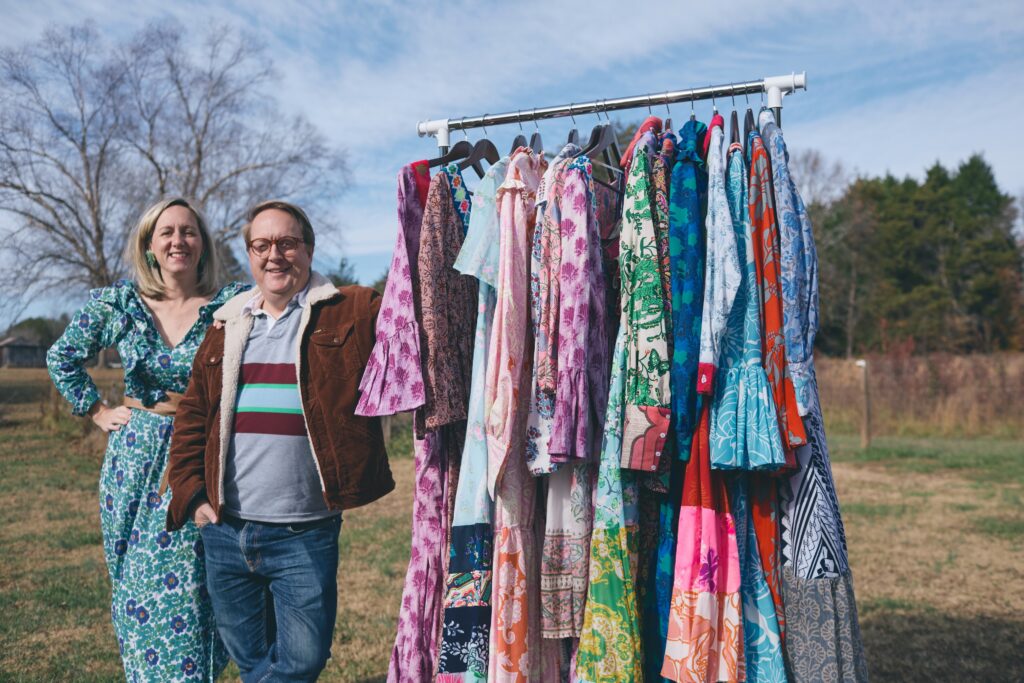
By day, Greensboro native Matt Healy works in HR for Ecolab, a global player in water treatment and other technologies aimed at protecting people. After work, he can be found hauling his kids to baseball games or basketball practice with his wife, Sarah, or coaching their soccer team. But when the office has been locked up for the day and the two boys tucked into bed, visions of bold, patterned dresses dance in his head.

Even as a preschooler in the early-’80s, Healy colored liberally on his clothes. His parents, worrying that something might be wrong, took him to see a child psychologist. The diagnosis? Their healthy, young child was simply telling them, “I have my own style.”

“My personal style has been pretty bold,” Healy says, then  looks down at his black polo shirt and gray twill pants and chuckles. “This was just a very-exhausted-on-Monday look.”

By contrast, his brand’s instagram feed (@augustus_roark)features images of models wearing colorful bohemian skirts paired with vintage-style T-shirts — or patterned patchwork dresses — bringing to mind vintage vinyl album covers.

“I’ve always described the Augustus Roark brand, the look of it, as like a prep-school Deadhead or like the guy who listens to Joy Division at a fraternity party,” says Healy. “You’re in the scene, but you’re pushing it a little bit.”

While music inspires the Augustus Roark aesthetic, the company’s name was drawn from literature. “Augustus” pulls from the Lonesome Dove character, Augustus McCrae, and “Roark” from Howard Roark, the protagonist in Ayn Rand’s philosophical novel, The Fountainhead. These two characters, says Healy, were both individualistic but heroic and went against the societal grain. “It sort of symbolizes, ‘Be an individual. Be who you want to be. Follow your own North Star.’”
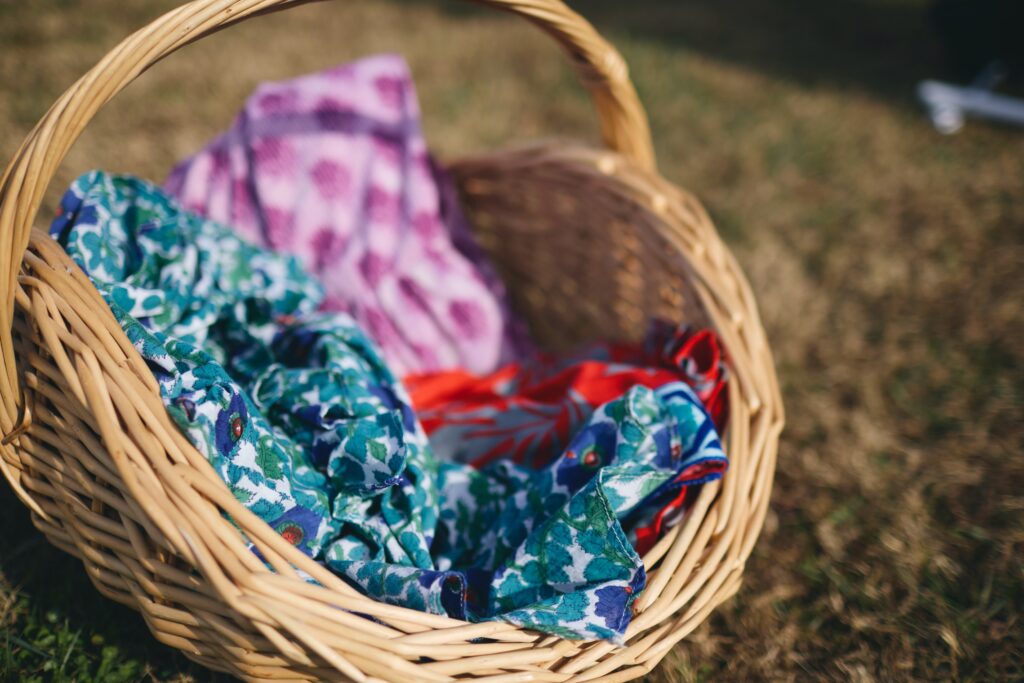
Inspiration wasn’t far afield. His own father, though in finance, has always stretched the boundaries of the latest fashion. “He is always way better dressed than me,” says Healy. “He’s pretty bold.”

Of course, he’s quick to add that his mother, who “sold clothes for a time with her sister,” has also been an influence. “I don’t want to discredit my mom — she’s very fashionable,” he says, “but my dad is kind of the one that really has an eye for it.”

Though you might say that Healy’s fashion design career began with those original scribbles on his childhood garments, he admits that he didn’t take the leap into it until his mid-20s, a few years after earning a degree in history from UNC Chapel Hill.

While his mind is always swirling with designs, he started simply — with T-shirts. “The T-shirt was always just an entry point for me.”

But the T-shirt business has remained strong and steady. Some of his pieces can be found in shops across the Carolinas, California, Colorado, Texas, Tennessee and D.C. In fact, if you attended the 2024 N.C. Folk Festival, you perhaps perused or even purchased one of Healy’s designs — a bold graphic in red, purple, pink and blue with white block lettering on a navy background. With music often serving up style inspiration, Healy says it was “a natural fit.”

From his bootstrap and T-shirt beginnings, Healy segued into collared shirts and hats, followed by rugby shirts, and officially launched Augustus Roark in 2007.

His rugby shirt designs caught the eye of fellow UNC Tar Heel Alexander Julian, whose own father, Maurice S. Julian, opened Chapel Hill boutique Julian’s in 1942. Julian, known for designing the teal-and-purple Charlotte Hornets’ uniforms as well as Carolina argyle, met Healy as “kind of a mentor, kind of a family friend.”

Julian saw something special in Healy’s designs and asked him about creating rugby shirts for his own brand at the time. “I am so naive, I didn’t even realize he was asking me that until later!” Healy recalls with a laugh.
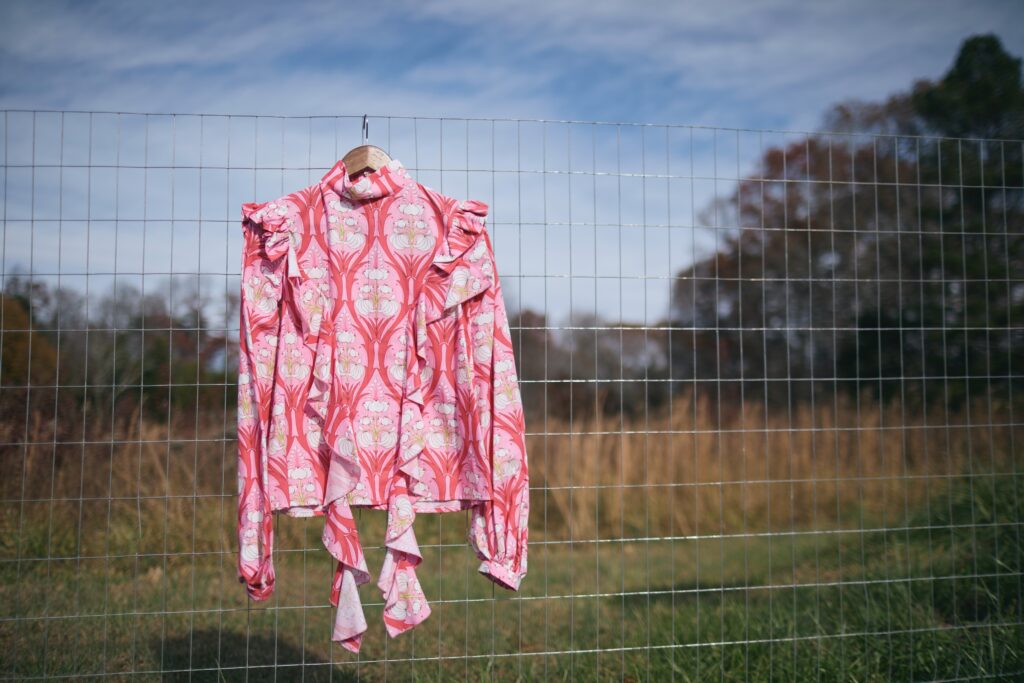

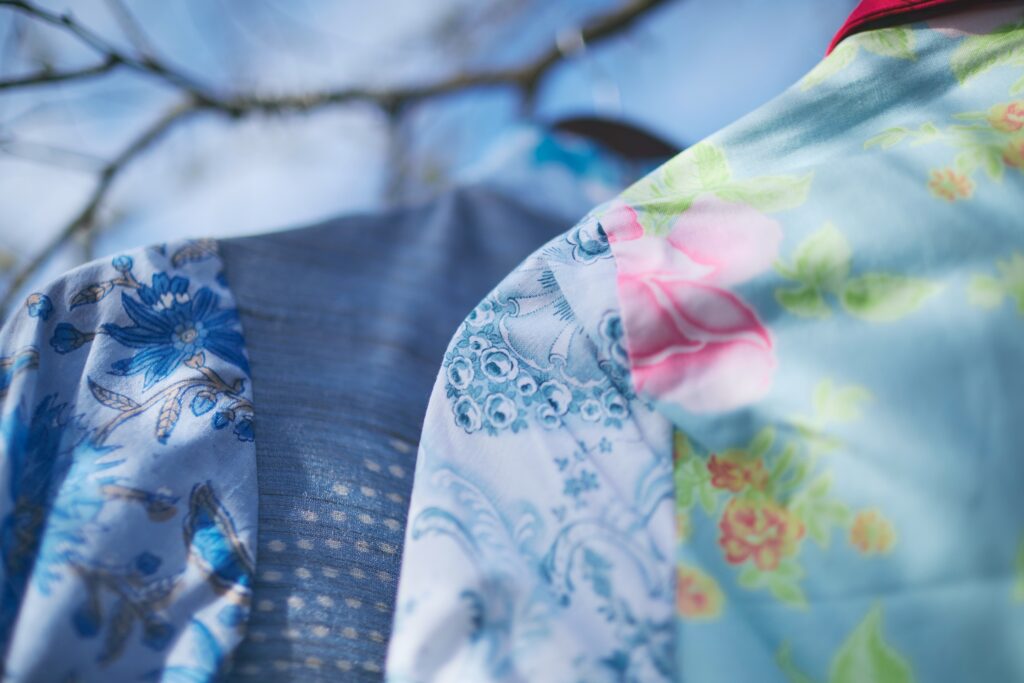
While Julian’s style might be described as preppy, akin to Ralph Lauren and Tommy Hilfiger, “disheveled preppy” is the look Healy portrays. He also seems heavily influenced, especially in his women’s designs, by the hippie movement. Think flowing shifts, Indian and near-Eastern fabrics, often sheer, and plunging necklines.

“People say I remind them of James Spader all the time, especially when I was younger and trimmer,” he says. “The Brat Pack, you can’t beat that.” Healy wasn’t even born until 1980 and was just a child when Emilio Estevez, Andrew McCarthy, Molly Ringwald and their crew graced movie screens across America.

Yet, he’s a self-described old soul whose style icons include several from the 1950s through 1980s: Robert Redford, Paul Newman, Brigitte Bardot and “maybe a dash of River Phoenix.”

After four years of peddling tees, Healy was finally ready to make the leap into women’s fashion. “It took so long to figure out how to get fabric,” says Healy, who sources a lot of his textiles from India, Italy, Peru and Mexico. “And how to find a pattern maker.”

For a couple of years, Healy searched the world over for a pattern maker, and — lo and behold — she was in his backyard all along, right here in Greensboro. Cassidy Burel, who has her own line of couture gowns, freelances for Augustus Roark as both pattern maker and model. While both are designers, each comes at it from different angles. Healy’s jumping off point is always the bold fabric. “I am very driven by color combinations.”

And Cassidy? “She is the total opposite,” he says. “She comes at it from a shape. She likes very minimalistic — white or one color.” While their aesthetic is completely different, their working relationship produces bold results. Often, after completing a piece for Augustus Roark, “She will say, ‘I never thought this would work, but it does.’”
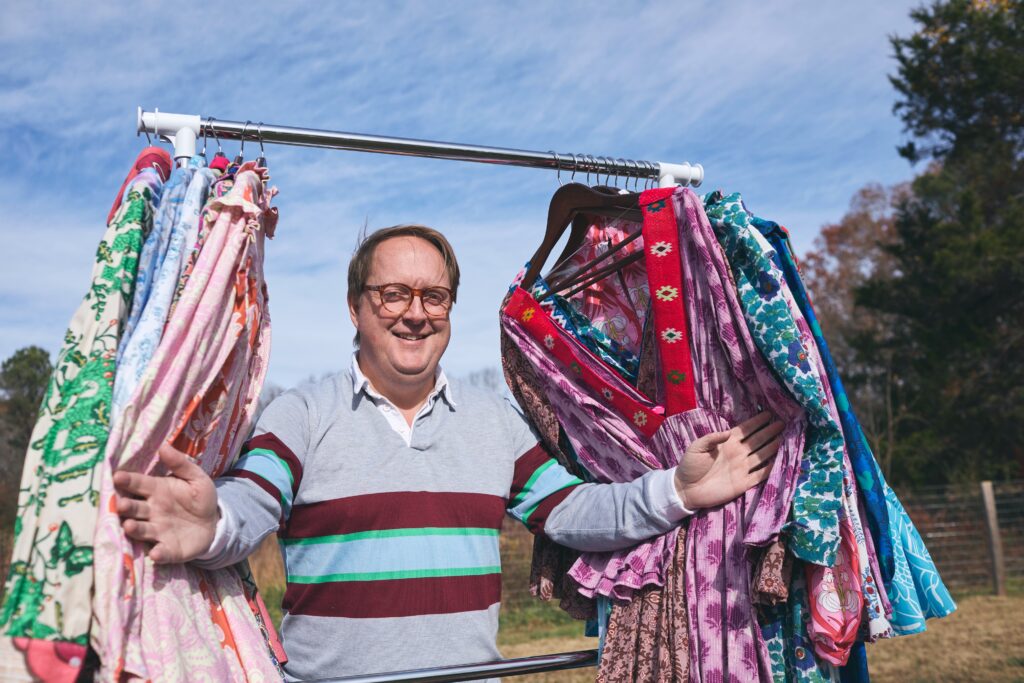
The first dress ever designed by Healy was named “the Sarah,” a maxi-dress with ruffled shoulders, a wide V-neckline and a long side slit in a white fabric that features emerald-green dragons, butterflies, birds and vines with pink berries. Healy insists that it was “absolutely 100 percent” designed with his greatest supporter and influence in mind, his wife. Sarah, who works as the director of strategic marketing and communications at Canterbury School, met Healy right around the time Augustus Roark was officially launching and can often be found wearing her husband’s creations. Born and raised in Western Massachusetts, Sarah’s New England “hipster prepster” vibes echo throughout his designs.

Currently, most Augustus Roark dresses are one-offs or come in a single size run, which Healy says is “cool” because, if you own one, you’ve got a unique piece. But his goal is to be able to sell a fully running women’s line. Healy recalls his mentor, Julian, telling him that designing woman’s fashion was more fun because you could be really innovative. “He always wanted to do it, but he never took the leap,” he adds.

Healy hopes, like Julian’s own father did for him, to leave somewhat of a legacy for his two sons, just 9 and 12 now. “Gucci didn’t become Gucci until 40 years into Gucci,” he says, explaining that the brand didn’t explode into the iconic company it is today until generations later. Healy chuckles, “I am in no way, shape or form suggesting that I am like these brands,” but he’d love to see his kids run with it into the future one day. But for now, while Augustus Roark is still in his hands, he says, “I still have so much I want to do.”

At present, this full-time employee, dad and husband is happy with what he’s been able to accomplish as a simple fashion-designing moonlighter. “I created something out of nothing and that is what I am most proud of. And I am proud that it still exists.”

Of course, it wouldn’t hurt if someone like, say, Gwyneth Paltrow, would don one of his dresses. Rob Lowe, he adds, would be incredible, too. And who knows? You might even spy an Augustus Roark booth — or his T-shirt designs — at the 2025 N.C. Folk Fest.

“You’ll always look back and regret it if you didn’t try,” says Healy. “That’s what Augustus Roark symbolizes — be who you want to be.”


A Cottage by the College

A COTTAGE BY THE COLLEGE

A Cottage by the College

Jane Green, neighborhood happiness broker

By Cynthia Adams     Photographs by Amy Freeman

I was outside yesterday working in the yard, and a young girl came by and said, ‘I love your house so much! I stop and look at it every day. I hope one day to have a house just like this,’” says Jane Green, who squeezed a small house on an incredibly tiny lot in the historic College Hill neighborhood. She also squeezed in an inordinate amount of happiness in the process.

“I have met so many nice young people living here. I felt, ‘Wow. That’s such a nice thing to say,’” she says, smiling widely as her eyes fill. 

With a well-trafficked sidewalk bustling with passing UNCG students, Jane frequently enjoys porch time, befriending neighbors — even those happening by whom she may never know.

During the summer, a bubble machine installed on the front yard telegraphs Jane’s contagious happiness. A riot of flowers tumbles from planters and tin buckets; pale lavender petunias, lavender and herbs prevail.

By fall, pansies replace petunias, planted in abundance and the porch, an outdoor living room complete with hanging lanterns, table and chairs, rocker and cheerful swing, is dressed according to the season. It is Jane’s favorite place to be.

She has triumphantly brokered joy into her life.  Like the pansies she admires, Jane blooms where she is planted. Resilient little pansies recover “even when frozen in a block of ice. Don’t give up on them!” 

She sometimes looks back as she is leaving home, to reassure herself it is all real. 

“That it’s still there,” Jane says wonderingly.

The best stories often start with serendipity. In the Greens’ case, unseen hands helped them along the way from the time they relocated to Greensboro from New Jersey in order to be closer to their adult children and their growing families.

Yet a shadow eclipsed the Greens’ sunny home last year when Richard succumbed to a debilitating illness four year after creating their pared-to-perfection cottage. Long married, Jane has spent the past year recalibrating, adjusting to life on her own. 

As a couple, meals were a communal time. She missed that deeply when freshly bereaved. It was over dinners that the Greens processed the events of their lives.

“You talk about the day. The kids. You’re there.”

Naturally slender, she forced herself to eat after losing her husband.

“You know, the first time I had to sit and eat alone, that was hard for me. I’d never thought about that. That took a lot of getting used to,” acknowledges Jane. 

“So, I ate outside [on the porch] and it made me feel better. For several weeks I did that. Kids were going by, they knew me, and I was able to get over that.” 

There is a wistful pause. Even so, Jane remains the optimist on the block, a consequence of a close-knit family and actively cultivating a sense of belonging. More than a few longevity experts say such a sense of community is an essential ingredient of a healthful life.

“Your friends are important.” But so are neighbors, she explains.

Instinctually, Jane grins. “I like it just where I am,” she says, gesturing towards the front yard as students pass a white picket fence, part of the house’s charm initiative.

“The only part that bothers me is that they move on . . .” she adds wistfully. “But you get new ones,” she reminds herself. Despite loss, Jane persists, offsetting what might have been consuming loneliness.

Such boundless enthusiasm has made Jane a self-appointed booster for College Hill, downtown Greensboro, the Tanger Center, the City of Greensboro (especially City planner Mike Cowhig) and the students at UNCG.   

Notably, too, her positive thinking seems to manifest good things.

Long before the Greens built their dream house, Jane kept a picture of a cottage torn from a Montgomery Ward catalog for future reference. She loved the simple, vintage charm. To her mind, it appeared cozy, friendly and welcoming.

Longing eventually inspired Jane and Richard to build their future Greensboro home in a historic district, where the lots were smaller and better suited to the cottage proportions. 

They considered rehabbing other properties. But the Greens ultimately hoped to find an economical, buildable lot within Greensboro. 

A lot that had been donated to the College Hill Neighborhood Association languished. College Hill resident Dan Curry, a member of its board and with long experience with Housing and Community Development, thought it could be viable. It was largely viewed as unbuildable, he acknowledges.

Even some city officials doubted it was sufficiently large enough to build. Yet Curry thought it could be done.

Empty and littered with refuse, 3,500-square-feet of land was once the entrance to a foundry. It had slowly devolved into an eyesore. 

Curry and Cowhig, who worked with historic districts, arrived at a solution that would check several boxes and pacify residents who complained about the problematic lot. It would require coordinating a new build with various factions.

Both men believed the right project could be slipped onto the lot (called “infill”) and restore the 1800s historic streetscape to a more congruent, appropriate reality. “They [the Greens] had to overcome so many obstacles to make it happen,” says Cowhig, and it took two years to resolve. 

But it would have to be just the right-sized house. 

Not too big, not too small — a Goldilocks fit.

Yet even the Greens’ first look at the lot was singularly unfavorable. 

Jane says bluntly, “It was a garbage pit.” But the Greens understood that the lot might be just large enough for their downsized house, minus a private driveway. (Egress would be via an existing driveway to a UNCG-owned building behind the lot used by the drama department for prop building.)

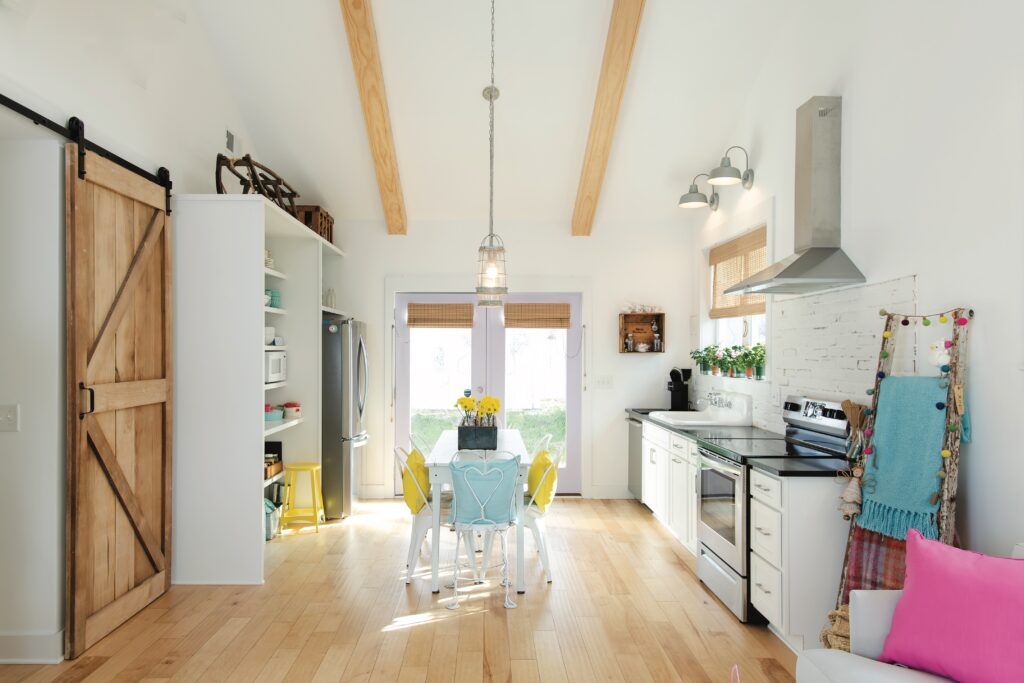
Long accustomed to 2,500 square feet, the Greens planned a 950-square-foot build. Jane stresses that it was less than 1,000 square feet of living space “without the porch.” The porch, which they insisted upon, was crucial to expanding their living space and the desired cottage look. 

“I love a front porch,” Jane repeats, adding a happy sigh. With additional guidance from Summerfield contractor Gary Silverstein, the newbie build would appear right at home among historic homes more than a century older. 

Cowhig assured all involved the cottage would meet local standards and fit with neighboring homes.

While the Greens rented a home for 10 months in High Point, their daughter, Nicole, who lived in nearby Sunset Hills, helped them strategize and downsize in anticipation of the new cottage. 

They spent months going through a lifetime of stored possessions they had brought to North Carolina. Nudged by Nicole, they winnowed out extraneous possessions, and she arranged a tag sale. (The $600 proceeds would eventually pay for a small shed behind the new house.)

Silverstein had to work under less-than-ideal circumstances. The lot was on a busy street, close to UNCG. Construction workers had limited street parking as they ferried materials to the tiny site.

He went the extra mile, attending the planning board meetings before he even knew he had the job, Jane adds. Silverstein also took care of the cumbersome permitting requirements.

With tight building parameters, he had to improvise, using a crane in order to raise the roof rafters, reassuring watchful neighbors that their adjacent homes would be unscathed.

There was no room for error.

“He was wonderful, here working all the time.”

Silverstein completed the Greens’ new home on October 31, 2018. 

A beaming Jane adds, “He was on budget!”

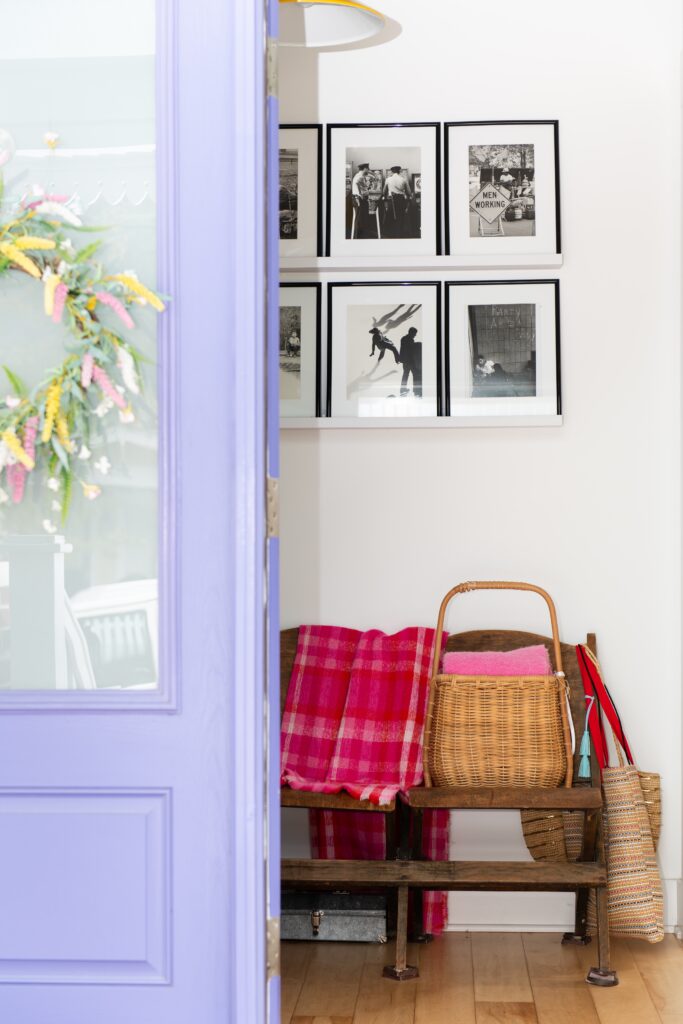
Naturally, budget mattered to the active retirees, who opted to work part time jobs.  Richard worked nights as a security guard downtown, freeing days to pursue his lifelong passion for black-and-white street photography. Jane was hired by Our Lady of Grace, working with young school children. Both thrived. 

Six years later, much has changed at the Greens’ residence.

O.Henry photographer Bert VanderVeen, whose studio is nearby, had befriended Richard, admiring his striking black-and-white photography. 

He proposed having Richard’s first posthumous show and a reception in his honor at the studio, selling prints to benefit charity. 

The reception filled with college-age young people who knew Richard and Jane. The students bought almost all of Richard’s works and paid homage to their friend, who was a generation apart — or more — in age.

With the new year, Jane takes stock. While she admits there have been some difficulties without her partner of oh-so-many years, her much loved neighborhood has helped Jane remain contentedly in the home she and Richard built together.

Their mutual adaptability became a key factor in coping with transition and the inevitability of change.

“As you grow older, I think you have to choose a place where there’s activity,” she advises over a coffee on Tate Street, an easy walking distance from her cottage.

“Sure, you hear the fire engines, but after a while, you don’t even notice that stuff. I like being in a city. And I love being in a college town,” says Jane. “One day, I won’t be able to drive, but I can walk!”

She adds that as wonderful as she finds being in a lively place with access to downtown, being stuck “in a tiny house in the middle of nowhere” would have held little appeal.

“You need to be around people, especially now that I’m by myself.”

***

Furthering her commitment to the neighborhood, Jane maintains a Little Free Library. The replica of her cottage is stocked with books for anyone wandering by. Which reminds her: It presently needs restocking. “When I get really low, my daughter gets online and gets donations.” 

The library box serves as another way to meet people, she says, brightening. “They come to put books in and they talk to me.”  During the pandemic, she filled the box with canned goods rather than books to help financially strapped students. They profusely thanked her, Jane says, her eyes welling with tears.

With her coffee cup drained, Jane glances at her watch. She’s going apple picking with her grandchildren and daughter in law. Flats of multicolored pansies await on the porch. 

Pansies, she says admiringly, are cheerful flowers, who lift their faces to the sun.

Jane plants them every year; this year will be no different.

With that done, she’s planning for gingerbread trim below the eaves to punch up the cottage’s curb appeal. “Don’t you think that will look nice?” she asks. 

While attending a San Francisco wedding last summer, she and Nicole visited the landmark “painted ladies” for the first time and were charmed by the row of colorful historic homes.

Jane returned to College Hill, energized, ready to punch things up. “More yellow? Or more purple?” she asks, scrutinizing the two colors painted onto sample trim. 

Tweaking her already effusive, exceedingly happy home once again, Jane is happily absorbed.

“Do you like the yellow?” she asks hopefully. “I do.”

Gimme Some Sugar!

GIMME SOME SUGAR!

Gimme Some Sugar!

Sweet holiday treats to swap or gift

Photos and recipes by Jasmine Comer

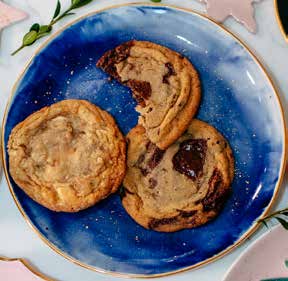
’Tis the season for merry-baking! We asked our resident food columnist, Jasmine Comer, to whip up a few culinary cookie delights suitable for gifting neighbors or swapping with friends. Inside our little box o’ goodies, you’ll find three delectable treats.

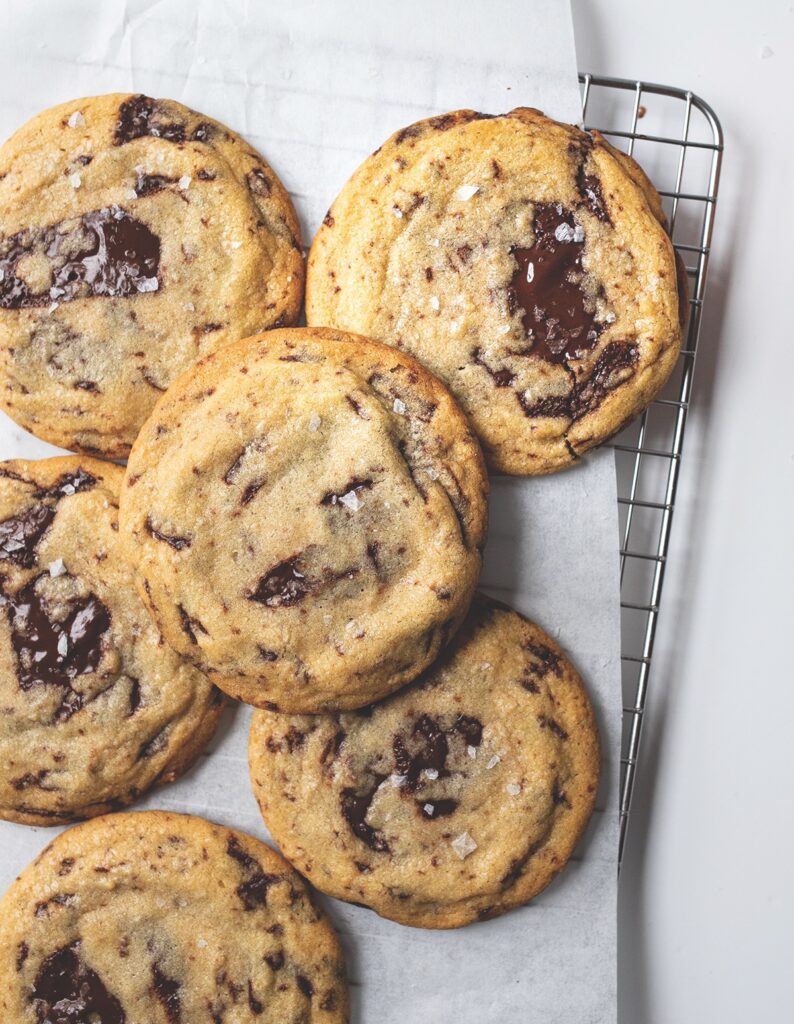
Chocolate chip cookies are for basic bakers. Kick yours up a notch by making brown butter chocolate chunk cookies. No one needs to know about the pound of butter you burned on your way to achieving toasted-golden perfection.

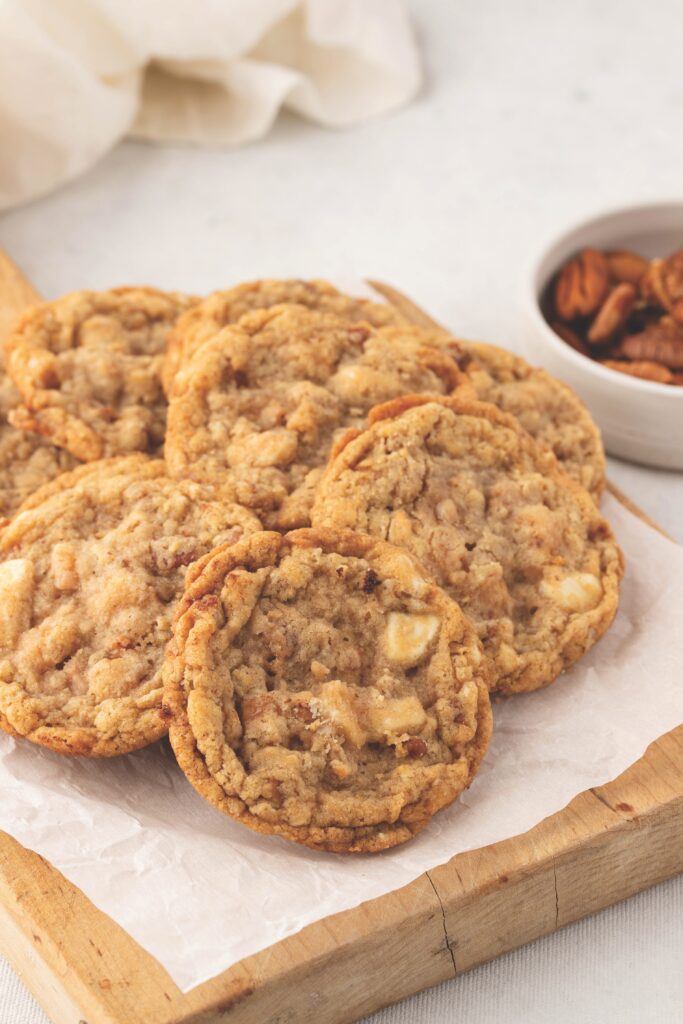
Sweet, spicy and nutty. Could be a charming dating app profile. Could be white chocolate pecan cinnamon cookies.

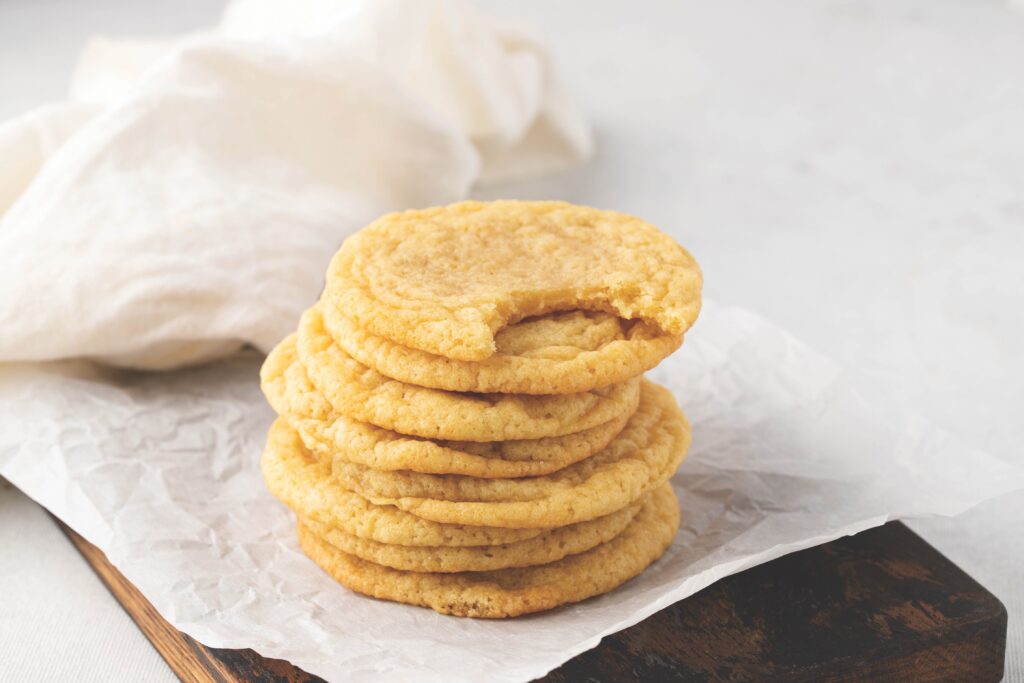
American novelist Henry Miller once said, “Every man with a bellyful of the classics is an enemy to the human race.” He clearly hadn’t had one of these classic sugar cookies. A bellyful of these will have you caroling and spreading good cheer in no time.

And — just for you — we volunteered as taste-tester and can assure you these cookies are so good that you’ll wanna keep ‘em for yourself.

Brown Butter Chocolate Chunk

Makes 12-13 cookies

Ingredients

1/2 cup plus 2 tablespoons salted butter, divided

1/2 cup brown sugar

1/3 cup cane sugar

1 egg

1 teaspoon vanilla extract

1 cup plus 1 tablespoon unbleached all purpose flour

1/4 teaspoon baking powder

1/4 teaspoon baking soda

1 teaspoon cornstarch

5 ounces dark chocolate, chopped

Directions

Brown the butter: place the half cup of butter in a small saucepan over medium heat. After the butter melts, stir it continuously, over the heat. After about 5 minutes, the butter will start foaming and browning in the bottom of the saucepan. At this point it should smell nutty and fragrant. Continue to stir until the butter reaches a dark, golden brown color, being careful not to burn it. Burnt brown butter tastes bitter.

Transfer the butter to a bowl and stir in the remaining 2 tablespoons of butter. This adds some of the moisture back into the butter that evaporated while browning it. Let the butter cool completely.

Whisk in the brown sugar and cane sugar until combined. Then whisk in the egg and vanilla.

In a separate bowl, whisk together the flour, baking powder, baking soda and cornstarch. Fold this mixture into the butter and sugar mixture, followed by the chopped chocolate.

Scoop dough into balls (about 2 tablespoons) and refrigerate overnight or up to 48 hours.

When ready to bake: Preheat oven to 350F. Line a baking sheet with parchment paper. Place the cookies on the sheet 2-3 inches apart. Bake for 11-12 minutes or until golden brown around the edges. Let the cookies cool on the baking sheet for about 10 minutes before transferring to a wire rack to cool.

Classic Sugar

Makes 10-11 cookies

Ingredients

1/2 cup salted butter, melted and cooled

3/4 cup cane sugar

1 egg

1 teaspoon vanilla extract

1 cup plus 2 tablespoons flour

1/4 teaspoon baking soda

1/4 teaspoon baking powder

1 teaspoon cornstarch

Directions

In a large bowl, mix the melted butter and sugar until combined. Whisk in the egg and vanilla extract.

In a separate bowl, whisk together the flour, baking soda, baking powder and cornstarch.

Fold the flour mixture into the sugar and butter mixture.

Scoop dough into balls (about 2 tablespoons) and refrigerate overnight or up to 48 hours.

When ready to bake: Preheat oven to 350F. Line a baking sheet with parchment paper. Place the cookies on the sheet 2-3 inches apart. Bake for 11-12 minutes or until golden brown around the edges. Let the cookies cool on the baking sheet for about 10 minutes before transferring to a wire rack to cool.

Pro Tip:

Flour brands make a difference. I use King Arthur All Purpose Flour. Using a different flour brand may yield different results due to how flours are milled. When measuring your flour, make sure it is loosely packed. Scoop it from the bag or container and level it off gently with the back of a butter knife. Do not pack the flour down. Too much flour makes cookies dry and fluffy. These cookies should be tender and moist.    

White Chocolate Pecan Cinnamon

Makes 13-14 cookies

Ingredients

1/2 cup cold salted butter, cubed

1/2 cup brown sugar

1/3 cup cane sugar

1 egg

1 teaspoon vanilla extract

1 cup plus 1 tablespoon unbleached all purpose flour

1/4 teaspoon baking soda

1/4 teaspoon baking powder

1 teaspoon cornstarch

1/4 teaspoon cinnamon

1/3 cup oats

1/4 cup toffee

1/3 cup pecans

3.5 ounces white chocolate, chopped

Directions

Using a stand mixer or hand mixer, blend the butter, brown sugar and cane sugar until combined. This may take about 7-8 minutes. Stop and scrape down the sides of the bowl every 2-3 minutes.

Blend in the egg and vanilla extract.

In a separate bowl, whisk together the flour, baking soda, baking powder, cornstarch and cinnamon.

Add the flour mixture to the butter and sugar mixture and blend just until combined, stopping to scrape down the sides of the bowl as needed.

Blend in the oats, toffee, pecans and white chocolate just until combined.

Scoop dough into balls (about 2 tablespoons) and refrigerate overnight or up to 48 hours.

When ready to bake: Preheat oven to 350F. Line a baking sheet with parchment paper. Place the cookies on the sheet 2-3 inches apart. Bake for 11-12 minutes or until golden brown around the edges. Let the cookies cool on the baking sheet for about 10 minutes before transferring to a wire rack to cool.

The Sweet Life of Lindsay Emery

THE SWEET LIFE OF LINDSAY EMERY

The Sweet Life of Lindsay Emery

On Suite One Studio and hand-making a life full of everyday beauty

By Cynthia Adams

At 38, Lindsay Emery has managed enviable successes, despite a once-in-a-century pandemic and all which that entailed for a small business. Above all, she learned to pivot and nimbly found her mark.

When Emery first launched Suite One Studio in 2009, her delicately embellished, airily romantic, handmade ceramics swiftly gained national press: Bon Appètit, Elle Decor, Food & Wine, and Coastal Living. She made the September 2014 cover of Better Homes & Gardens and, in 2015, House Beautiful spotlighted the “soft, irregular” porcelains. 

“Bowls are thrown on a potter’s wheel, and platters and plates are rolled out by hand,” House Beautiful wrote. “Emery washes each in colors that fire into watery glazes” sold as one-off pieces online.

That year, Better Homes & Gardens named Emery a “Rising Stylemaker,” before she ranked 34th among Country Living’s 100 most creative people three years later (hailing her work as “the next wave of pottery.”)

You might guess — wrongly — that the brand’s name was drawn from an address. Suite One Studio was inspired by Emery’s student waitressing days, when a favorite customer dubbed her “sweet one.” 

Which made her smile. And Emery smiles easily and often, especially now when discussing her spouse, Kim Cannan, their nearly 2-year-old toddler, Lydia — or Suite One, which she calls her “first baby.”

“The day before she was born, I was loading a glaze firing.”  Heavily pregnant, she kept to her work amidst their pre-holiday busy season. “Twenty-six hours later, baby!”

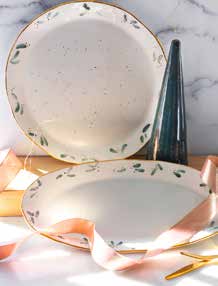
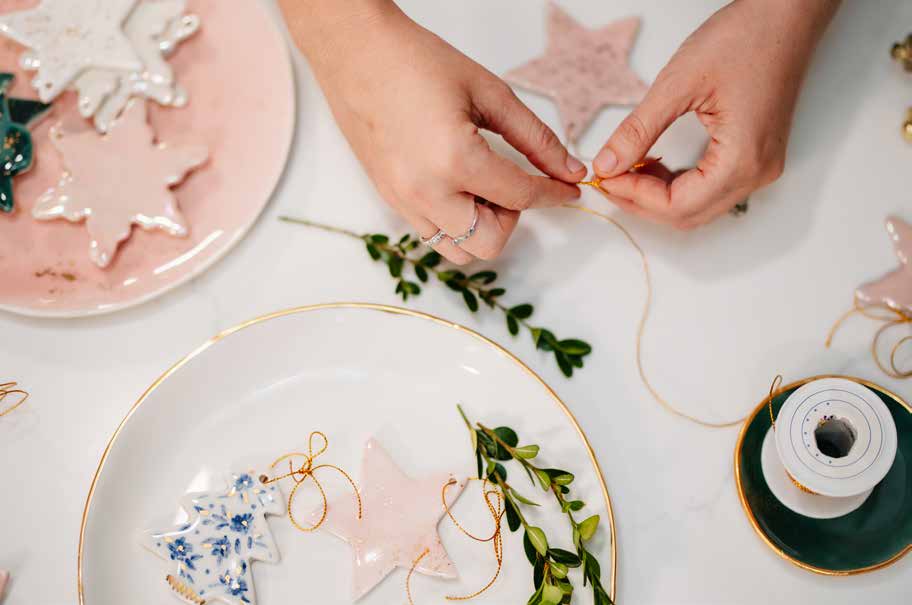
Whereas most North Carolina pottery is primarily utilitarian, Suite One Studio’s wares differ from the familiar. They are painterly — Emery was first a painter — possessing a delicate softness, punctuated by pastel shades and light touches of gold, a contrast to the earth-toned sturdiness of most Seagrove pottery. 

“I love florals, and the blue-and-white, traditional palette for porcelain done in a modern way.” Emery’s designs echo a nostalgic beauty that works well with heirloom pieces, she says.

She describes a “near reverence” gathering around her great-grandmother and great-aunt’s table. “They spent hours cooking and then serving everything ‘just so.’”

Those family meals felt intentional and important. “When I design and create tableware, I’m reaching for a similar feeling.”

Her theme, “time at the table,” whether with pottery or, now, painting, signifies the underrated, “small moments of everyday beauty.” 

Her creative odyssey took a surprise turn when she was a student at Guilford College, where she met Cannan, who was also studying psychology and art. 

“Ceramics was not my intended path. I planned to paint, and then I planned to do art history.” 

Adapting to Guilford College’s offerings, Emery fell in love with pottery, making more pots than she knew what to do with. “I started gifting them to friends and family, and then I started selling them online on Etsy.”

Surprised by sales of a “squat little mug set,” she added trays and platters to her Etsy shop.

“People were getting more comfortable buying online. Etsy was doing more advertising. I started to get exposure in areas I would never have gotten exposure.”

Food bloggers “found my work on Etsy and started buying plates, platters and bowls. It gave me a sense of what people were attracted to . . . I was finding my way.” 

Not a techie by nature, Emery’s strength is in recognizing trends. “I think that served me really well.” Soon able to live comfortably from online sales, Cannan joined the company, coordinating operations. 

By 2011, Instagram offered yet another social media avenue. Emery jumped in as an early adopter, developing more extensive relationships with food bloggers and up-and-coming influencers, allowing her business to spread via digital word of mouth. Collaborations came with online retailers Chairish and Anthropologie. Working with Chairish, she styled her feminine pastel pieces with vintage tableware to help collector’s “rethink vintage pieces.”

“Platters, trays, serving bowls are almost always accent pieces mixed with items they [customers] inherited,” Emery says.

She designed wine glasses for her website, having studied glass blowing earlier in Norfolk, Va. Working with glassblowers in Star, N.C., “I was able to bring ideas in glass to life,” later featured in magazines and at Chairish. 

When Anthropologie dispatched a team of stylists and photographers to Greensboro, Emery had only just moved. The creatives were somewhat surprised by her modest garage studio.

She designed a series of mugs for Anthropologie (laughing at the irony, given she dislikes making mugs), with the retailer handling mass production. A “watercolor-inspired” collection, Mimra, was sold at selected Nordstrom stores in partnership with Anthropologie Home.

Pressures mounted along with success.

Bon Appètit commissioned an oversized platter for a photo shoot in its December 2018–January 2019 issue, with only six days to produce. “Which meant freehand carving the form,” she says. Emery managed.

Eventually, British stores carried Suite One Studio housewares. Commercial success demanded more staff producing hundreds of pieces monthly. By 2018, Suite One Studio moved into a 1,200-square-foot studio with two huge kilns. Running high production, Cannan handled the back side of the studio and the couple eyed expansion. 

Emery’s relationship with Anthropologie continued for a few years, leading to other possibilities. What seemed like success on the outside, Emery says, didn’t feel like it. Social media had created a hungry beast, even throughout COVID. Keeping up with the demand “felt like a really hard pivot.”

Potters. Weavers. Printmakers. All face an endless demand to produce, Emery says. “You want more. The more you can make, the more you can market and sell. And streamline. And the more orders you can fill.”

Ultimately, Emery decided against creating a small factory, sticking with small-batch production.

“I had to close [my studio]”, she adds. “I changed the trajectory of my business from being focused on volume and production to being focused on self-fulfillment, creativity.”

“I wanted to do less and love the work more. That’s when I made the shift. For things that look successful now, there were things I had to give up,” says Emery. 

Anthropologie was surprised by how small her business was versus her large brand recognition.

“How are you making this work?” its team members asked.

She spun off complementary businesses, consulting and teaching fellow artists the art of social media.

During 2018, Emery and fellow artist Allie Dattilio cofounded The Studio Source. Their online program taught artists “how to build their dream online art careers.”

“We ran it for six years. It has been a place for online learning for artists, who are starting to grow their online services. Support, training, everything they needed to know. Photography, marketing, collection releases,” she says.

Over 1,100 artists went through The Studio Source. Many left unfulfilling work places to start six-figure creative businesses. Then, Emery stopped doing that, too.

“I don’t like feeling stuck.”

She loved working one-on-one with artists. And being a painter working on actual canvases, something she had stepped away from due to her work with ceramics. She missed it. And having a child was life-changing. So, she pivoted again.

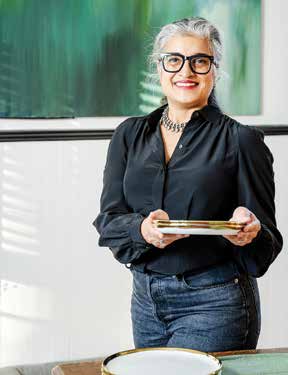
On a late summer morning, Emery stands among metal racks in her home studio stacked with various pieces awaiting painting, glazing and firing.

All of which, from the raw clay to those final, shimmery plates, platters, vases, pitchers and vessels, are created and finished by hand.

What does Emery’s family eat on daily? 

“My plates,” she answers. “I like basics. A lot of the stuff I kept for myself is simple, white porcelain. I have some pink. Sometimes with a gold rim, but usually just plain.” She likes the heft of her plates — their conformation. “I find them comfortable in the hand,” she says. “They feel nice.” 

Not too heavy, not too thin.

Just white.

Lydia, playing on the floor, calls, “Mama.”

For nine years, Cannan worked alongside Emery as “the one behind the scenes — keeping things organized and on track.” 

Cannan was also Lydia’s primary caregiver during the day until recently accepting a position with the City of Greensboro.

There are still adjustments to their new dynamic. “Slowing down my business and closing my other business has been a huge decision, but I can feel in my gut there’ll be other opportunity to hit the gas.”

She smiles. Lydia is at the core of that decision. The secret to her success, she reflects, “is I had a great support system behind the scene,” meaning Cannan.

Lydia swings a broom among the stacks of porcelains, but her mom never flinches.

“This is what I want to be doing,” she says, “and it’s such a short time that she is little.” Emery wants to model running a business to her daughter too.

“I had the banana bread going, and my baby was napping, and an interview going,” she says happily, “and I like that! That’s what I’ve always wanted with my business, for it to fit into my life.” 

The business has been adapted to fit her life, she adds proudly. 

Lydia cries, “Draw . . . draw!”

Emery finds paper and pencil. Her daughter happily draws.

She tells a story about a friend relocating to the Triad after years of being apart. Helping her unpack, Emery spotted items she had made. In that moment, she understood how, despite years of separation, she was a part of her friend’s dinner parties and memories, “through pieces I made, objects we take for granted.”

When she sees her friends using sometimes completely forgotten work, she is moved. “But they remember, and I think, ‘Ah, I made that!’”

From a young age, Emery’s own parents supported her love of art, which she wants to do for her child. “The human condition, I think we’re wired to create things, but fear gets in the way, and insecurity.”

A plane goes over. Lydia pauses. Watches, then speaks. 

Emery interprets her daughter’s baby-talk as saying “art.”

“I love now having someone mentor me,” Emery says, standing near an easel.

Having spent 15 years working three-dimensionally, Emery worried her painting skills “had gone dormant.” Putting brush to ceramics is not the same as painting on canvas.

Before Lydia’s birth, she signed up for a painting class with artist and teacher Kelly Oakes throughout the 2021 COVID surge. Now, the two artists share a studio in a former factory, now the Eno Arts Mill in Hillsborough. A vaulted ceiling, pale walls and a tall window provide light, even on a gray day. 

Artworks line the walls and Emery’s still lifes wait on an easel.

Figs. Peaches. Soft colors and vivid fruits find their way into Emery’s feminine, color-saturated works. Occasionally, her ceramics are part of the composition.

Even the fruits have a story. Mango was Lydia’s first solid food. “At 9 months, Lydia decided they were her favorite food.”

Looking back on leaving with a friend to attend a 2023 Better Homes & Gardens influencer event, Emery winces at the memory of leaving 10-month-old Lydia at home for the first time. While away, she noticed a piece of blue fabric.

It symbolically figures into a painting. Interestingly, their studio is in a former cloth factory, she mentions.

The red fabric in another painting is an apron specifically worn for a Southern Living feature at an editor’s request. 

“I was the first artist to get a studio here,” says Oakes about the industrial building, “and then less than a week later COVID hit.” Until pandemic restrictions relaxed, she could only use the studio if isolating alone. She values Emery’s creative company. 

“Kelly has been so supportive of my motherhood dream, too,” she says, as the toddler plays at their feet on the polished wooden floor. 

Katie Murray, executive director of the Orange County Arts Commission, has since opened offices there, too. During First Friday events each month, artists open their studios to the public. 

“It has become a real known event since we first started,” says Oakes, who teaches classes, accepts art commissions and does portraiture since retiring from art education.

“I do think if you’re doing anything creative, you have to think if you want to monetize it; you have to develop a plan for that. If you don’t want to, and are just learning about it to deepen your own creative life, then that is fine,” Emery says as Oakes offers Lydia a toy. “But find a mentor if you can.”

“She has this exceptional brain,” Oakes says about Emery, adding that she is equally left- and right-brain, a rarity.

As Cannan pursues her new career, Emery occasionally brings Lydia with her to Hillsborough.

You work toward having art fit into your life.

“You don’t stretch your life to fit your art,” Emery repeats. Her art now conforms to fit her life.

It is her mantra; a wife, mother and artist’s North Star.

***

Keep up with Lindsay on her new substack, Courage & Creativity (Lindsayemery.substack.com). Thanks to the Thompson family for allowing us to shoot in their bright and beautiful kitchen, recently remodeled by Triad Flooring & Bath (triadflooringandbath.com).

From Borough to Boro

FROM BOROUGH TO BORO

From Borough to Boro

 . . . And back again

By Cassie Bustamante

Photographs by Amy Freeman

When Brooklynites Alec Pollak and Swati Argade took haven in her parents’ Greensboro home in May 2020, they thought they’d just perch there for a short time. After all, Argade’s mother and father were stuck in India, unable to travel back to the United States due to COVID restrictions, but they’d be returning. 

Argade, who had grown up just a block away, had sworn she’d never move back to Greensboro. Home, to her, was in Brooklyn, with her husband and their then 9-year-old daughter, Indie. Plus, she had opened a storefront called Bhoomki in 2012, “a Brooklyn-based responsible textile-obsessed brand & laboratory.” (She closed the physical storefront in 2022, but maintains an e-commerce site.) And Pollak, who works in marketing, is a born-and-raised New Yorker. Having grown up in a household that was both Catholic and Jewish, he had never lived anywhere other than Manhattan, Queens and Brooklyn — all boroughs of New York City. 

But as the pandemic pressed on, it became clear that a return to Brooklyn was not going to happen as soon as they hoped. The borough they called home had become “an atmosphere of fear and the unknown, and it was just tripping us all out,” says Pollak. “Not to mention, just knowing there were these outdoor morgues that they were setting up.”

Four years later, they’re back in Brooklyn, reflecting via Zoom on how they not only warmed up to Greensboro, but, in fact, bought a fixer-upper and found themselves becoming part of a community that, over the decades, seemed not only accepting but welcoming to newcomers. In turn, Argade organized a book club with new — and old — Greensboro friends where the focus was diversity. Women from various backgrounds read works by authors of color every other month. It became, Argade recalls, “this place where we could have conversations around what is it like to be Jewish? What is it like to be Hindu? What is it like to celebrate Christ, you know?” 

And though the couple ultimately moved back to their beloved New York City, the experience offered Argade healing from her own past. “I didn’t ever feel accepted growing up in Greensboro,” she says, recalling classmates who ridiculed her and her identical twin sister, Jyoti — the only two young Indian women at Page High School that she can recall. “I was told that I was ugly every single day of my life growing up.”

“It was more shocking that you moved to Greensboro than that Indie and I did,” muses Pollak.

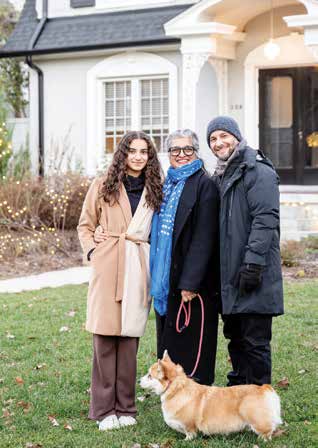
Snuggling on their sofa with their tan-and-white Corgi nestled on Argade’s lap, the two of them look back on their experience in Greensboro — and reflect on to how it changed them and maybe some of the people in Greensboro they left behind. 

While sheltering at her folks’ place, Argade’s childhood friend, Soumya Iyer — who remembers teenage Argade babysitting her — planted a seed, suggesting a Starmount Forest home her friend was putting on the market. “‘I know that you don’t want to move here,’” Argade recalls her pal saying, “‘but why don’t you just come and see the house?’”

With the guidance of Realtor Melissa Greer, the couple toured the home on a lark, and, as it turns out, fell in love with it. “It was beautifully done and had this massive backyard, which was a big draw,” says Pollak.

They knew how competitive the real estate market could be. In fact, they’d just gone through the process in Brooklyn and, after putting in 12 offers, were under contract with a place there. (Thanks to COVID, Pollak and Argade were able to break it.) They went full-bore on the Starmount home, putting together a strong offer they were sure would make the home theirs.

“We didn’t get the house,” says Argade.

But, says Pollak, “it triggered something in us.” What else could be out there? they wondered. And what they knew for certain was that they were not ready to go back to apartment living just yet, especially after a few months in the Gate City that he calls “such a breath of literal fresh air.”

The couple quickly went from considering the possibility to urgently wanting a Greensboro home.

“That’s exactly what happened,” says Argade with a laugh.

Plus, they knew investing in a home was wiser than renting in the long run. “A friend once told us, ‘Don’t think of it as spending money. Think of it has a house-shaped bank,’” quips Pollak.

Greer took them to see a couple other homes, including a circa 1927 house on Chapman in her own Sunset Hills neighborhood.

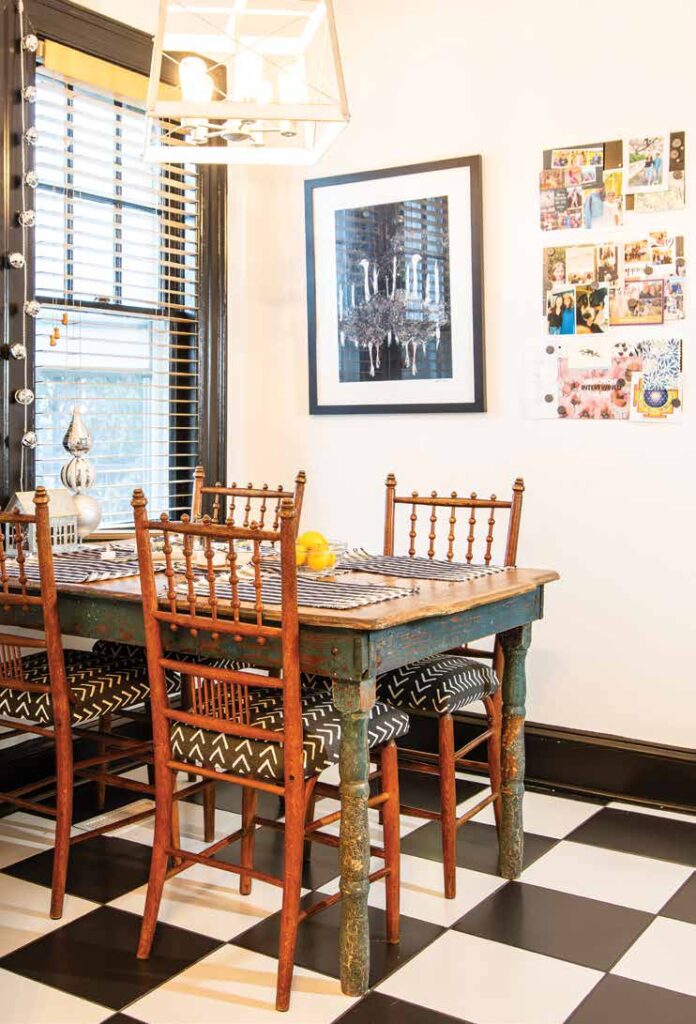
With its penny tile and existing color scheme — blues, grays, blacks and white — “It felt like old-time New York spaces,” says Argade, something she was sure would appeal to her “dyed-in-the-wool New Yorker” husband.

“We saw it at 3 in the afternoon,” says Pollak, “and we were under contract by midnight.”

Curled up together on the family sofa, Argade and Indie are known to often watch the HGTV show of No Demo Reno, which features homes redone beautifully with zero demolition. “And constantly during the show,” says Pollak, “Indie is like, ‘Mama, you could totally do that.’”

He agrees and adds that his wife has always had the ability to design, whether it’s been for friends or in her store, “but never had a full canvas to express it.”

Paintbrushes in hand, the couple got to work and continued the theme of blues — “an homage to denim and indigo,” Swati says, inspired by both Greensboro’s rich fabric history and her own background in sustainable textiles. Farrow & Ball’s Hague Blue now covers the walls in the living room, trimmed by the same shade in a high gloss. In the kitchen, the cabinetry was already blue, paired with a black-and-white checkerboard floor, but the couple painted the walls white with black trim. And on the library walls? “Bell Bottom Blue.” But there was a major problem they soon discovered after moving in that no amount of paint could remedy. “That fall, October and November of 2020, I think it was the highest rainfall on record for those months,” Argade recalls. Their backyard flooded and became “like quicksand.”  But that’s not all. The basement filled up with water, too. “We also discovered there was a 2-foot-by-2-foot hole in the brick wall of the basement that was covered up with plywood — and that’s where all the water was coming in.”

Plus, the water flow through the yard created a trench, one that Swati fell in and “pretty much got a concussion.” The couple worried about safety, especially when it came to hosting Argade’s aging parents, who, amidst a full-blown pandemic, would not enter their home, but were happy to spend time in their daughter’s backyard.

Before anything else design-show-worthy could happen, they decided to invest in the landscaping while making the necessary reparations to prevent future water damage.

“It’s a solid house now!” Pollak says proudly.

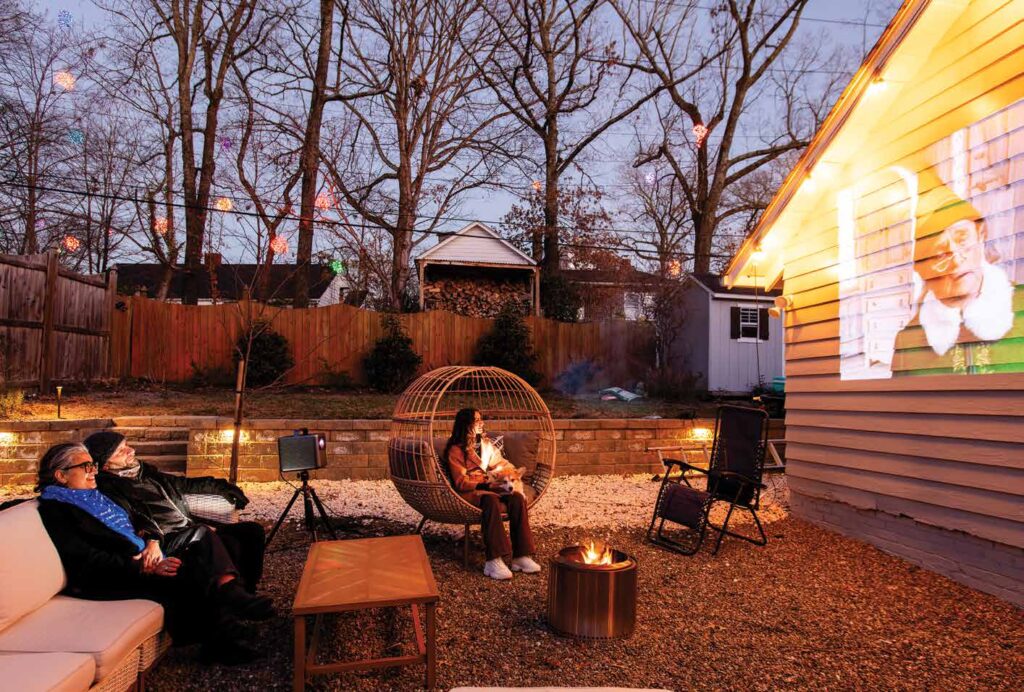
The silver lining? The backyard was transformed into a dream space where they could watch movies with Indie — including their holiday family favorite, Elf — gather with friends, and plant new gardens, which include Argade’s beloved indigo plants.

When she took that tumble, she serendipitously discovered an old, unused feature: an old-fashioned subterranean garbage receptacle. “I was lying on the ground going, ‘Oh that’s where I could put my indigo vats!’” She laughs about it now.

The intrinsic blue theme of the house even carried into the famous Sunset Hills lighted Christmas balls that conveyed with the sale of the house. “It was funny because so many of the balls that were left behind were Hanukkah blue. Do you remember that?” Argade asks her husband.

Pollak smiles and nods pensively. He had always celebrated both Hanukkah and Christmas. Now, married to a first generation Indian American, he’s added Diwali to his holiday festivities and Argade has adopted his traditions as well. When it comes to their daughter, Pollak says, “We’ve put forward those family traditions.”

In fact, he adds, “We always want her to have a big world or to acknowledge that she has a big world and it is hers to experience.” Together, they provide their daughter with an abundance of cultural celebrations.

The holiday season, for the Argade-Pollak crew, “kicks off with Halloween,” says Argade. Before they even met, they each went all out for Halloween. Then, they were married on Halloween. It’s only natural that Indie embraces All Hallow’s Eve, too.

Shortly after that falls Diwali. Then comes “Thanksgiving, Hanukkah, Christmas, New Year’s,” says Argade, “so it’s almost like a trickle of holidays through those last two months of the year.” Actually, she says, “We would put up our balls earlier than a lot of people in the neighborhood as we were celebrating Diwali because Diwali is also a festival of lights in the same way that Hanukah is a festival of lights and Christmas itself is a festival of lights.”

Often, the family hosted holiday celebrations in their home so that friends could enjoy what Argade calls this “magical experience every holiday” created by her Sunset Hills neighborhood. It was important to her, as a person of color, to open her doors to people who had perhaps not yet had the opportunity to be invited into a holiday gathering there.

Argade notes that the original deed to the house, which they have, reads “no coloreds allowed, white only.” Now, she says, “there’s a Jew and an Indian that own the house and it’s become this multicultural gathering place in Sunset Hills — it’s a very full circle moment.”

Determined to make a difference in Greensboro, which she calls “kind of my revenge,” Argade both found and created her own community. “You started to integrate yourself into Greensboro society and culture,” says Pollak. It’s true. Argade served on the board of GreenHill Center for NC Art and was involved with the Community Foundation’s developing committee. She returned to the Indian community of her childhood. She started the book club focused on diversity.

Argade was able to “touch and get a handle on” so much in the four years the family spent in Greensboro. “But,” she adds, “my mom was also really amazing at being part of the community and teaching me a lot of those skills. Like, how do you talk about the Indian community? How do you bring people together?”

While her mother cultivated those skills, the house allowed Argade room to build a bigger table and open up space for these kinds of discussions. “Having that amount of space . . . it really activates community in a way that it’s not activated in the same way here,” she says, waving a hand around the family’s current Brooklyn abode.

Pollak, too, got in on giving back to Greensboro. When Sunset Hills sent out a request to the neighborhood for a logo to celebrate its centennial, Pollak, who had graphic design experience, volunteered the chosen design, inspired by his own home’s original windows; he’d noted that they were shaped to look like a sun setting behind hills.

And yet, in June of 2024, the family loaded up and headed back to the Big Apple. “We are kind of interwoven as our tight-knit three-person — well, you count too — three-and-a-half-person family” Pollak says, scratching Viv behind the ears, “that so much is about, well, where is Indie going to go to high school and what does that mean for where we should be.” Ultimately, they felt that Brooklyn was that place.

But, this time, there’s no more swearing she’ll never return. Between her community and house, Argade feels a newfound sense of home in the Gate City. “Leaving Greensboro this time, I felt a huge amount of love and acceptance,” she says with a smile. She currently makes a trip back every six weeks to visit friends and family and check in on their Sunset Hills home.

“We’re perched here for now in the apartment,” says Pollak, “but we’re still very much like, OK, we’re ready for anything. We’re ready to jump, to dive.” Who knows where life will take them next?
Wherever it is, says Argade, “Alec and I always say to each other, ‘Well, you know, my home is wherever you are.’”

Gag Gifts

12 DAYS OF CHRISTMAS

Tales of the weirdest, wildest and worst gifts ever

Is it, as they say, better to give than to receive? There are situations when that age-old bromide can be answered with a resounding YES! Especially on those occasions when you’re presented with a gift so puzzling, so bizarre — so wrong — that you find yourself asking, what was that person thinking?!?

Early one Saturday morning, O.Henry magazine dispatched editor Cassie Bustamante and a bleary-eyed Billy Ingram out to the Corner Farmers Market to ask passersby about the strangest, oddest or most unwelcome gift they’d ever received. The answers may surprise you.

Take from me my lace

“Worst gift ever? One year, my mom forgot my birthday but she said, ‘Oh, I have a gift for you.’ It was a pair of lacy underwear. I was a married woman, 40-years-old, and these panties were two sizes too small, which meant they were her size. She gave me panties she had bought for herself, but they were way too sexy for me so I know they were too sexy for my mama. She didn’t have a husband. They weren’t in a pack or a bag or anything. They were on a little raggedy hanger from the store and they still had the Walmart ticket on them.”

                                                   — Queen C

Beauty is in the eye of the ugly sweater giver

“Every year the girls in the family get the ugliest sweaters from my aunt. She loves them, but we would never wear those things. Years go by and we just keep hiding them at her house. They are so ugly. Like hot pink and cropped and not our size. Last year she gave us all matching beanies . . . and they matched the ugly sweaters! It keeps getting worse.”
— Barbara Strickland

Happy Mother’s Day! Now go away

“For Mother’s Day, my husband gave me a trip away for that weekend, by myself, anywhere I wanted to go. And I thought that didn’t really honor me for being a mother too much. Where did I go? I didn’t go. I rejected the gift.”
— Christy Douglas

Lost in translation

“I was dating this fellow from Israel, and English was his second language. After a night of passion, he left a note on my pillow that read: ‘Good morning, sweaty, kisses all over your body, love Avi.’ I told him when he got home, ‘I think you meant sweetie!’” — Susan Grant

Once bitten, twice shy

“Someone gave me a box of chocolates with several of them half bitten into — all the ones that she didn’t want. She’d bitten into them, decided she didn’t want that, and she packaged it all up in a pretty little heart-shaped box and gave them to me. Now that’s a weird gift!” — Mari Rufo

It’s the thought, or lack thereof, that counts

Someone gave me a big pencil that says ‘Souvenir of Hawaii.’ I was like, of all the things you could have brought me back from Hawaii, you bring me the big pencil? Or it will be a plate or a T-shirt that says ‘Souvenir of . . . .’; the stuff you buy at the last minute in the airport, like that Seinfeld episode. Now, when I travel, sometimes just for fun, I’ll get my children a big pencil that says ‘Souvenir of . . .’ on it.” — Anonymous

Dads not a Duke fan, honest

“The kids gave me A Touch of Gray hair color when I was starting to go gray, but I wouldn’t use it because my father had tried to dye his hair one time and it turned blue. This was right before the N.C. State basketball playoffs with Duke. I knew he was going to be there with us and I told him, ‘I don’t want you there with blue hair!’”

                   — John Kelly

What, the elves ran out of Cabbage Patch Kids?

“When I was a little girl, Santa gave me a pirate ship. I was very upset about it because I thought Santa thought I was a boy. It was a pirate ship, so it doesn’t need to be gender specific, but for some reason I was upset. But now I love that pirate ship!”
— Caroline Forman

Lived to tell the story

“On my 50th birthday, my wife surprised me with a parachute jump. It was scary, and it was not something I ever thought about doing. The company provides someone for you to jump with — you’re attached to them — so they tell you what to do and it worked out fine. It was a delightful experience, I enjoyed it enough that I would do it again although my body’s getting to the point where I have to be careful what I subject it to.”
— Steve Warshaw

On the flip side

“I was 3,000 miles from home a few weeks before Thanksgiving in the 1990s. Some distant relatives in California I’d never met invited me to their home for turkey dinner. I needed to bring something, as you do, so my new co-workers suggested Mrs. See’s candies. ‘You can’t go wrong,’ they told me. When I handed the box of chocolates to my host at Thanksgiving, she tossed it aside: ‘We don’t eat this junk in our household, but I’ll give it to the mailman for Christmas.’ The way I was raised, that was considered rude, but her husband was an admiral in the Navy, so what did I know?” — Buddy Rogers

Christmas for Dummies

“A middle-aged, female family member gave me a copy of Calculus For Dummies. She knew I was taking a calculus course at the university and may or may not have known I was doing very, very poorly in the class. It didn’t help that I had a professor whose Russian accent was so thick that virtually all of the students in the class couldn’t understand him!

“I also didn’t appreciate the intimation of the word ‘dummy.’ I went to law school and showed her!! To add injury to insult, when I opened the book, I saw lots of passages which were underlined — she had given me a USED book — a horrible book and it wasn’t even new!” — Renee Skudra

Christmas Summer’s Eve

“At our house, stocking gifts are wrapped and we go around the circle taking turns opening them and showing them off. One Christmas — after I was separated, but before I was divorced — my ex-husband’s mother wrapped up and put in my stocking Summer’s Eve wipes. So I had to unwrap them and show them off in front of the whole family.” — Anonymous

Drive it into the ground

“This was in France when I was living there, and my ex thought it would be an amazing idea to give me a gift of a thumb drive for my birthday. We had been together for 2 1/2 years. We’re not together anymore.” — Sadaf Fardanesh

Gone to the dogs

“She’ll wrap our gifts in newspapers from years ago, but then she gives us magazines from the ’70s and ’80s. One of the strangest gifts I’ve gotten from her recently was an anniversary gift — a can of dog-grooming mist for our dog, mmm-hmmm. It worked really well for the dog though!” — Anonymous

In hot water

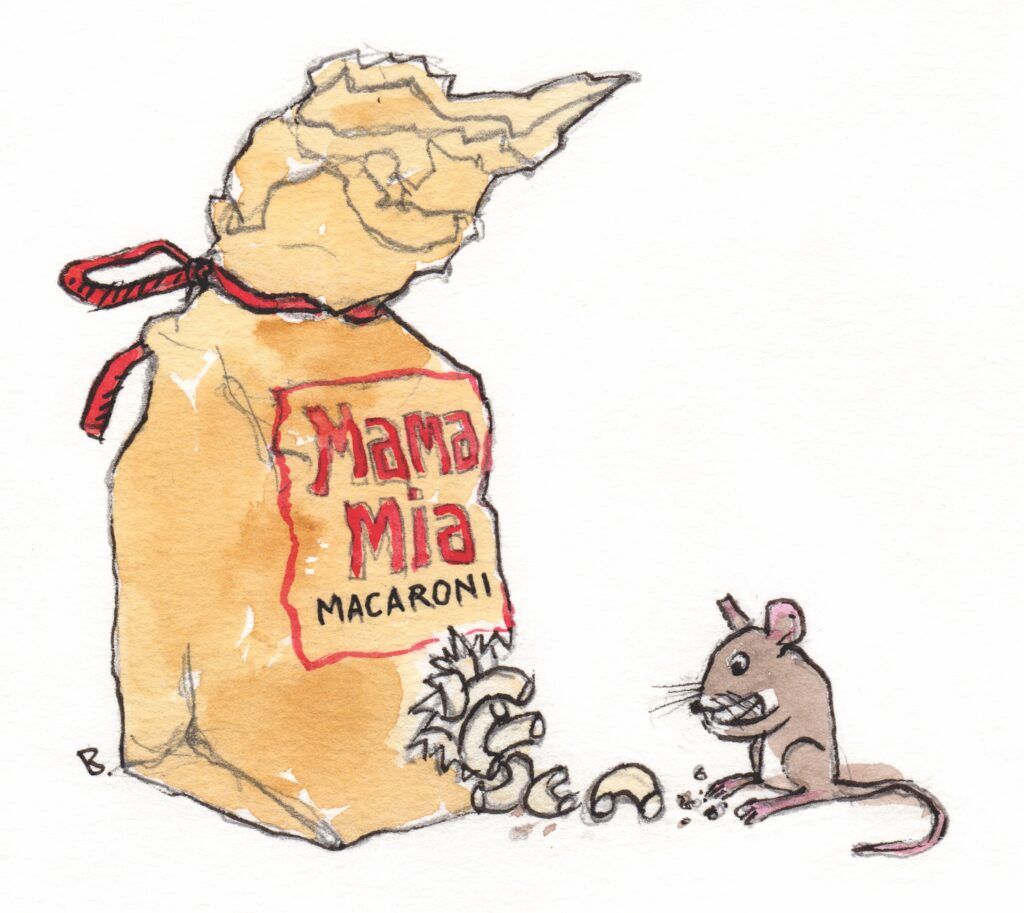
“I think my mother-in-law forgot to get me a present, so she wrapped up a bag of pasta. It was old pasta, too, not even new pasta. We never cooked it.”

                                 — Mark Plott

Chugga-chugga-chocolate

“For one of my birthdays when I was much younger, my father made a train made out of cake — locomotive, railroad car, caboose. And I love chocolate — the locomotive was chocolate. The others were other flavors. So we get ready to eat the cake and my father says, ‘No, no, no, no! We gotta save the locomotive!’ So he puts it in the freezer and I get it the next year with two other cars. Again, my father says, ‘No, we gotta save the locomotive!’ For the third year in a row, I get the same chocolate locomotive and two other cakes. And nobody wanted the chocolate that year so we finally threw it away.”  OH

                                                  — David Lozano

Christmas With Dylan

CHRISTMAS WITH DYLAN

Christmas With Dylan

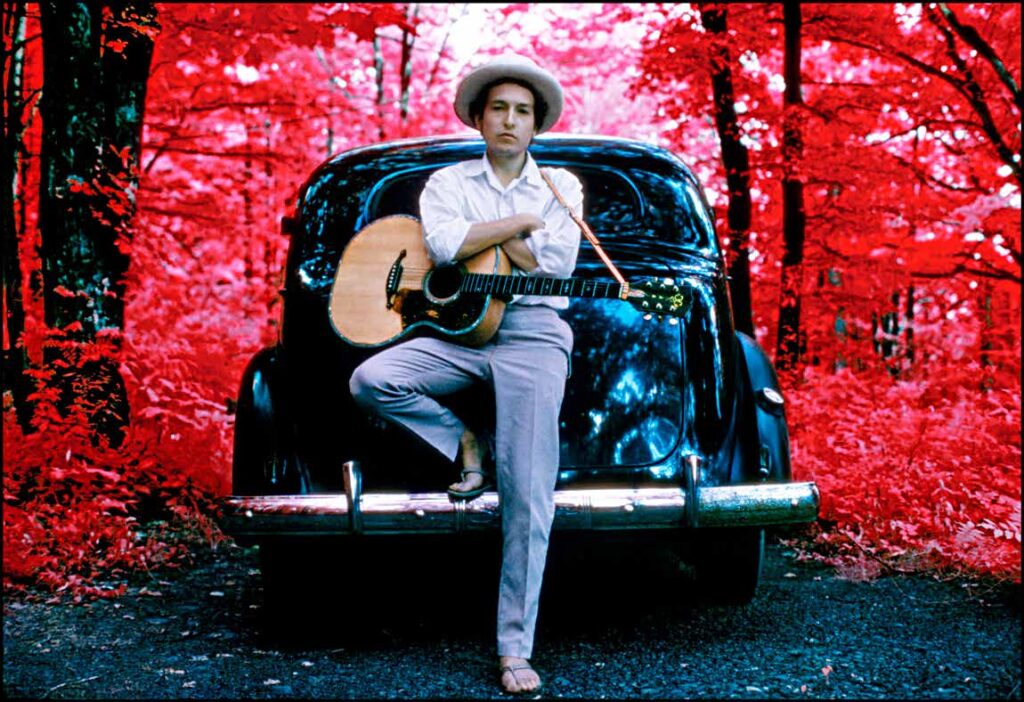
By Bland Simpson • Photograph by Elliott Landy

“A little more to the left.”

“No. It’s fuller around to the right.”

“Just try it my way and you’ll see.”

“Now the stand’s leaking.”

“Somebody’s liable to get electrocuted.”

“I swear you’ve got the best side to the wall.”

“I thought we’d be through by now.”

“You’re right — it was better back to the left.”

“Oh, God. I’ve already gone and tied it to the wall sconce.”

It was a few days before Christmas, 1968, and my family had gathered. The living room was filled with the intense, clean, resinous smell of the tree. Once we had it hoisted into place, we set about the bristly business of decorating. I was 20, and my mind was full of music. Withdrawing to the sofa, I thought: Bob Dylan wouldn’t be caught dead doing this.

“The angel’s crooked.”

“Let’s not have the angel this year.”

“Not have the angel?!”

I decided to make a pilgrimage to Woodstock, N.Y., to see Dylan. It didn’t slow me down a bit that I had little to tell the man except that I was inspired by his songwriting. To shake Dylan’s hand, that would be Christmas enough.

The next afternoon, with no more than 50 dollars, I set out. I was catching a ride north with two friends from UNC, paying my share of all the 26, cents per gallon gas we’d burn, and coming back south by thumb. Fifty dollars would be plenty.

This was really my second pilgrimage to Dylan and Woodstock. The first I had undertaken several weeks before, during Thanksgiving, and had abandoned outside of East Stroudsburg, Pennsylvania. I got cold and lost my nerve on a little-traveled high-ridge country road there, and I turned back. On the way home I caught a ride with a Black schoolteacher, who carried me all the way down 81 through the Shenandoah Valley night. We drank a beer together the last hour before he let me out, and agreed that things might be getting better between the races, or at least we hoped they were.

Then a trucker hauled me from Hillsville down the Blue Ridge Mountains. When we stopped at a Mount Airy diner and I didn’t order anything, he thought I was broke and made me let him buy me a cup of coffee and a chance on a punchboard. Back in the semi, he gave me some liquor, which I drank from a 6-ounce hillbilly souvenir jug he’d stashed under the seat. He let me off at 52 and 40 in Winston-Salem about 4 in the morning.

Immediately a hunter with an enormous buck strapped to the top of his Impala picked me up. A couple minutes later, he said: “Look, I hope this don’t bother you none but I got to hear some music.” He popped an eight-track of Johnny Horton’s Greatest Hits into the tape player, and the car was full of the songs I’d learned to sing by: “Battle of New Orleans” and “Sink The Bismarck!” and “North to Alaska.” The teacher and the trucker and the Horton-loving hunter made me think better of the pilgrimage business. I forgot the Stroudsburg cold and knew I’d try again.

It was several weeks later, the evening of December 10th, when we piled into my friend’s ’65 Rambler and went roaring up the three-laned U.S. 1, which is these days a ghost road just south of the Petersburg Turnpike. On and on, all night, the first of many deep and dreamless long-haul trips up and down the Eastern Seaboard. I was astounded at the size and magnificence of the great bridge at Wilmington, aghast at the dazzling lunar landscape, gas flares and chemical air of north Jersey. One of my more worldly companions gazed upon the scene and remarked with a combination of pride and disgust: “America flexing her muscles!”

From the George Washington Bridge, we looked out over the vast glare of Manhattan. In less than a year it would be my home, but that night it made me feel thoroughly out of place, for a few moments sorry I had even come. Soon it was past, and we were in the dark Connecticut country, and it was snowing lightly. I recovered my spirits; after all, I was on a mission.

They were driving me towards Storrs, Conn., to see the Hickey family, late of Chapel Hill, and coincidentally to perform a flanking maneuver to approach Woodstock from the north and east. The plan had been to leave me in New Haven where the big roads fork, but at the last minute my compatriots, who were bound for Boston, found it in themselves to veer off to the north and take me right into Storrs.

They left me at a gas station at first light, a gray dawning, 6 or 8 inches of snow on the ground and more still coming down. I showed up oafish and unannounced at the Hickeys’ home between 8 and 9 in the morning, four days before Christmas. They masked whatever annoyance they might have felt and greeted me affectionately.

All four daughters in the Hickey family were home for Christmas except the one who drew me there. She wasn’t expected for another 24 hours or so. No matter. The other three were going ice-skating that day, and so, now, was I. Most folks don’t forget their first time on ice-skates, and with good reason.

Sue did finally come home, and we had a lovely New England time that next day. It was brisk, and the sun was bright on the unmelting snow. She got over the surprise of my presence, commiserated with me about the Tower-of-Babel Christmas tree back home, and wondered what I would say to Bob Dylan, himself, when we met. After breakfast the next morning, she drove me out to the highway, and I was soon up at the Massachusetts Turnpike in the company of a Goddard student driving a Volkswagen with skis strapped to the back.

He was on intersession, he told me. He was going somewhere to ski for six or eight weeks, for which he would get academic credit. We drove west towards New York and the Hudson, and, before he left me off at the Saugerties exit, I had seen groves of chalk-white paper birches for the first time.

A couple of artists, a man and a woman, in a dingy old Pontiac, drove me from Saugerties to Woodstock. They said they were friends of Bob’s, and suddenly everything felt very chummy. The artists called themselves Group Two-One-Two, after the route number of the Saugerties-Woodstock road. A few years later, when I was living on the Upper West Side in New York, I would see a notice in the Village Voice about a show they were having down in SoHo and meant to ramble down and take a look. But the notice would stay taped up on the refrigerator until well past the closing of their show, and I would never make the trip.

Group Two-One-Two’s explanation of where exactly Bob Dylan lived was so convoluted that I stepped into a shop in downtown Woodstock, a bakery, and asked them. In moments I was tromping on out of town through a wood and up a hill towards something called “The Old Opera House.” Dylan’s driveway, the bakers said, was right across from it.

It was about 18 or 20 degrees in the middle of the afternoon, and I wasn’t used to such cold. I didn’t feel dressed for it, but I certainly looked like I was. I had on a Marine greatcoat from a surplus store south of Wake Forest, a slouch hat from a surplus store on Granby Street in Norfolk that I’d bought on my way to see Cool Hand Luke with my Virginia cousins, and a pair of snakeproof boots from Rawlins, Wyo., that I’d bought on my way to be a cowboy in eastern Montana. (You, or your beneficiary, said the card in the boot box, got a thousand dollars if you died of snakebite while wearing the boots, providing the snake bit you through the boots.) All this was practical and, back home in North Carolina, warm winter wear, though my mother lamented that I looked like something from the Ninemiles — a remote swamp in Onslow County down east. It hardly mattered here. In Woodstock, everyone looked like something from the Ninemiles.

Without my even thumbing for it, someone offered me a ride, and there I was at The Old Opera House. There turned out to be six or eight driveways next to and across from the place, no names on mailboxes, certainly no sign that said: “This way to Bob Dylan’s house.” I waited. About 20 minutes went by before a thin man in his 30s came striding up the paved road. He would have walked right past me, but I spoke up: “Excuse me, do you know which one of these driveways goes to Bob Dylan’s house?”

“This one.” He pointed at the one he was starting down.

“Thanks.” I fell in beside him, and we walked fifty yards or so before either of us spoke again.

“Is Bob, uh, expecting you?”

“No.”

“Hunh. I don’t know if it’ll be cool for you to just . . . go up to his house.”

This was discouraging, but what could I do? Go back to the bakery and telephone for an appointment? “I’ve come from North Carolina,” I announced.

“Oh.” He gave up, and we kept walking. A few hundred yards into the woods, the road forked, and he pointed towards a long low building of dark logs that looked like a lodge. “That’s Bob’s house.” Then he disappeared down the other fork.

In the driveway at Bob’s house were a ’66 powder blue Mustang and a boxy 1940 something-or-other with the hood up. Two men, one of them small and weedy, the other bulky and bearded, were working on the engine. I stomped up in my snakeproof boots, but neither of them looked up. After a minute or two of staring over their shoulders at the old engine, I finally said, quite familiarly, “Bob around?” The weedy man didn’t respond, but the big fellow gave a head-point at the log lodge and said, “Yeah.”

Sara Dylan answered the door, gave me a blank look, and closed the door. About two minutes later Bob Dylan himself appeared and stepped out onto the small porched entry. He wore blue jeans, a white shirt buttoned all the way up and a black leather vest, and he was very friendly and relaxed.

“Bland. What kind of name is that?”

A family name, I said. Then just to make sure he’d hear me right, he asked me to spell it.

“Bland. Well, I sure won’t forget that.” He talked in person just like he sounded on record in “The Ballad of Frankie Lee And Judas Priest.”

“North Carolina, that’s a long way.”

I agreed, but I wanted to meet him, shake his hand, tell him I admired his work, that I wanted to write songs myself.

“What did you want to do before you got this idea about writing songs?”

“I was going to go to law school.”

“Well,” he said, more serious than not, “country’s gonna need a lot of good lawyers. Maybe you ought to keep thinking ’bout that.”

This wasn’t what I had traveled hundreds of miles to hear. I started asking questions. Did he live in Woodstock all the time? Most of the time, he said, but he was thinking about moving to New Orleans. When would he have a new record out? In the spring — “I’m real happy with this one.” He was talking about “Nashville Skyline,” which he had just finished. I asked about a song of his the Byrds had recorded, a song I’d heard out in Wyoming the summer before. “Yeah, I know the one you mean, but I can’t call the name of it right now — it’s in there somewhere.” The song was the riddle-round “You Ain’t Going Nowhere.”

We talked along like that for almost 45 minutes, during which time I felt the cold acutely. Dylan was dressed in shirtsleeves, but he didn’t seem to notice the cold at all. He must have known my head was full of hero-worship, and he was kind enough to let my time with him be unhurried. The moment of my mission played out as naturally as the tide. I was immensely grateful, am grateful yet.

The pilgrim was ready to go home. I pulled my map out, unfolded it, and while we talked about what the best way to head back south was, the bulky fellow lumbered over from the old car where he and the weedy man had been working all the time. The mechanic ignored me, and I ignored him right back, which was easy enough: I had the entire eastern United States spread out in front of me. My mind was on the road, but I did want one last word or two with Bob Dylan. He gave Dylan a report on all the things that weren’t wrong with car, then said: “I think we can get it started if we hook it up to the battery charger.”

“Okay,” Dylan said. “It’s in the garage.”

“I got it already, and tried to hook it up, but even with that long cord it won’t reach. We need another extension cord.”

“Extension cord,” Dylan said, and looked past the big man at the old car. He thought about the request a few moments, then shook his head.

“Gee, Doug,” he said, “I’m afraid we just used the last extension cord on the kids’ Christmas tree.”

Evergreen and Ever-Evolving

EVERGREEN AND EVER-EVOLVING

Evergreen and Ever-Evolving

Toms Creek Nursery in Denton celebrates 20 years of wreath workshops

By Cassie Bustamante     Photographs by John Gessner

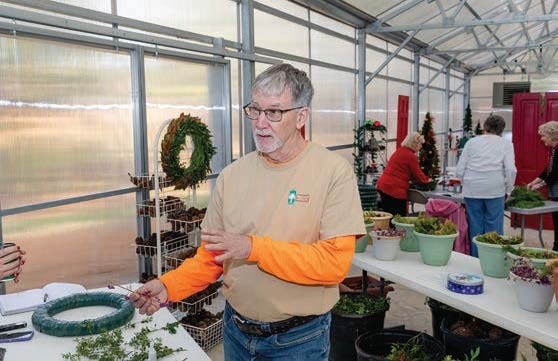
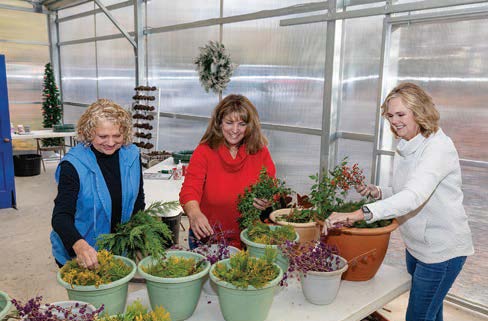
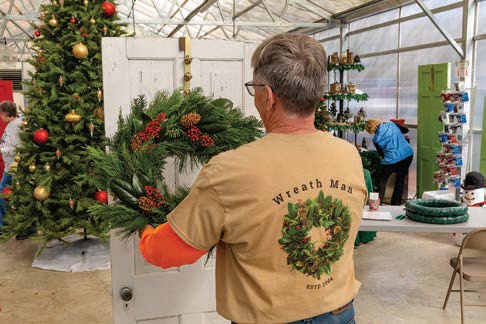
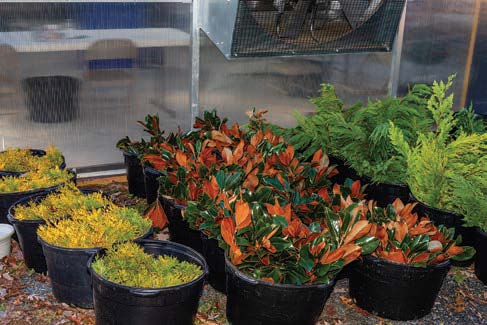
Down a winding gravel drive, just past the ducks and several greenhouses on the 400-acre Toms Creek Nursery property, a large, heated greenhouse awaits. Inside, straw wreath forms wrapped in dark green plastic sit two at a table with small tins of greening pins plus pairs of clippers. A few stations throughout the building are loaded with overflowing buckets of greenery and berries in scarlet and plum. And, of course, there’s hot cocoa, coffee and cookies. The only thing you need to bring to this hidden Denton treasure? Yourself and a little spark of holiday spirit.

“The first year, there were probably 10 people,” says horticulturist Jim Carraher, whose idea it was to start these wreath-making workshops, which began 20 years ago in unheated smaller greenhouses. “I’d been to a garden center that was up in Greensboro and they were selling greenery that you could take home and make into wreaths and, I thought, we’ve got hundreds of acres of plant material here.”

Now, in the greenhouse, over 40 people mill about planning their designs for their own wreaths. And that’s just one of many sessions available over a two-and-a-half-week period that begins the day after Thanksgiving. In 2023, the workshop broke 1,000 total attendees. Former nursery manager Brittany Andersen said at the time that their max capacity in a season is around 2,000, a number that depends not only on space but greenery available. The farm has trees that are specifically grown for this workshop. “But,” Andersen, had noted, “we need more trees to have enough greenery.”

This nearly century-old farm did not begin its life as a lush and idyllic setting that would draw mostly well-heeled urbanites for continuing education. But this nursery’s line of owners knows something about growth opportunities.

In 1934, single mother Ovie Henson purchased the property with her own money. Her husband, who’d been older than her and already passed his wealth on to his older children from previous marriages, died early in their marriage, leaving her with a son and not much else.

But Ovie was “tough people,” according to granddaughter Melinda Vaughan, the 70-year-old third-generation proprietress of Toms Creek Nursery. How did Ovie, a single woman with a baby during The Great Depression, manage to purchase the farm she named after its creek? With money she earned from her job as a teacher in a one-room schoolhouse that she’d wisely invested in a little mill close to what would eventually become the N.C. Zoo. She traded off her stake in the mill for the first 200 acres.

“One of the old neighbors was a big farmer,” says Vaughan, “saying, ‘I am going to get that land for nothing because that little lady — she is going to go under.’”

Vaughan, whose blue eyes sparkle as she speaks of her Granny, holds herself proudly, her shining silver hair grazing her shoulders. “She proved him wrong though.” With sheep and chickens, Toms Creek got its start, eventually adding cows. But it soon evolved when Ovie discovered she had a green thumb. Money that was earned from the plant portion of her business was fed right back into the community and given to the Quaker church she belonged to. While the dairy no longer runs, Vaughan recalls getting the cows in their loft before catching the bus for school as a youngster and remembers Granny milking them well into her 60s.

Today, Toms Creek Nursery is home to not only acres and acres of plants, but also its own landscaping and design company, run by Brandon Vaughan, one of Melinda’s sons. In addition to being owner, Vaughan is also the designer. In fact, Carraher, wreath workshop innovator, began on the landscaping crew. He met and married a woman from Denton and moved there with her after earning his B.S. in ornamental horticulture from N.C. State. And, as Vaughan plainly states about the Denton area, “There’s only one nursery big enough to hire a person.” So Carraher put down roots at Toms Creek. That was some 30 years ago.

These days, 67-year-old Carraher’s sole focus is the wreath workshop. In 2021, in fact, the farm purchased a special T-shirt for his role. Pictured on the back of it? Why, a wreath, of course, the words “The Wreath Man” surround it.

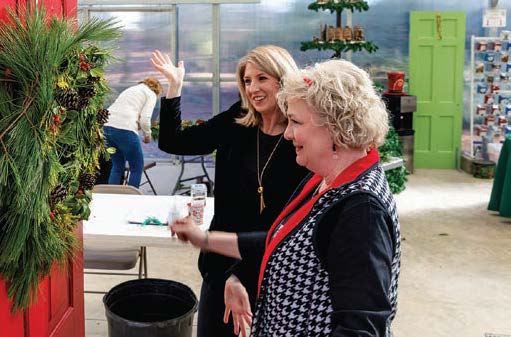
Each workshop session runs two hours and change, during which time Carraher roams the greenhouse, answering questions and offering guidance as needed. Otherwise, it’s a free-for-all when it comes to the creation and design. The tools and materials are all provided. There’s an inspiration binder filled with images of wreaths Carraher and customers have created over the last 20 years. And sprinkled throughout the greenhouse, doors of all colors hold wreath hangers, welcoming customers to test their creations.

“Basically there’s no wrong or right way to do it,” says Carraher. “That’s the beauty of it all.” With several types of greenery and berries — Leyland cypress, American boxwood, D.D. Blanchard magnolia, blue Pfitzer juniper, American beautyberry, Norway spruce, Sunkist arborvitae, heavenly bamboo nandina berries, white pine, multiple yews and multiple holly berries — customers can create their own mix. And over two decades of workshops, Carraher has yet to see it all.

“When you mix up all these textures, even after all these years of doing it . . . some of them are just breathtaking,” he says.

For many, the Toms Creek Nursery wreath workshop has become a holiday tradition. Carraher recalls a group of young moms who hit the workshop as a break from their children. Two of those moms still carve out the time for it each year. “One of the two, she was pregnant the first time she came,” he recalls. “And now her son is 16 years old.”

Sue Shumaker has been coming with her friend, Susan Short, and a varying group of women for about a decade. This time, she showed up with a dozen wreath-makers.

“I first came with Little Gate Garden Club in Asheboro and loved it so much, I invited Sue,” says Short. Since those first years at the workshop together, Short has moved to the Charlotte area. “I spent the night in a hotel last night so I could be here first thing this morning. That’s how much I love it!”

With so much experience under their belts, have their wreath-making skills improved over the years? Absolutely. But, according to Shumaker, there’s never been an ugly wreath that came out of this workshop. “Some are Southern Living-beautiful, but they’re all pretty. Every wreath that walks out the door is beautiful.”

The two friends recall a bittersweet memory during the COVID pandemic when a friend was ill and couldn’t attend. “Jim filled up a bag of goodies for me and I drove it to her house and put it on her porch,” says Shumaker. “That’s just like Sue,” adds Short, gazing at her friend.

Carraher also remembers the pandemic-influenced pivots: Tables were spaced out as they are now, but only one person to a table. During that time, he also offered pick-up of all the wreath-making essentials so customers could recreate the experience safely at home.

But today the workshop bustles with activity, the smell of Christmas pine wafting through the air.

“There is just something about a fresh wreath on the door,” says Vickie Whitaker, who’s attending for the second time. “It really makes you think about Christmas when you were young. Years ago, we didn’t go out and buy wreaths or buy decorations. We made them! I think that is part of it. Don’t you?”

“You’re still young!” her friend, first-timer Linda Powell, responds with a laugh. Powell entered the workshop doubting her creative skills. As the workshop progresses and her lush wreath nears completion, you’d never guess it was her first time.

And therein lies the magic. “It’s always that smile on that person’s face who was convinced they couldn’t do it — and they did,” says Carraher. “That’s what really sticks out the most.”

Time Waits for No One but Pauses for You

TIME WAITS FOR NO ONE BUT PAUSES FOR YOU

The stories within Greensboro History Museum’s stories are seen through an ever-evolving lens

By Billy Ingram     Photographs by Bert VanderVeen

One hundred years ago this month, history buff Mrs. Alice Bell founded the Greensboro Historical Museum, at first a purely aspirational effort seeking to canonize treasures of living memory related to the establishment and rapid growth of this then unassuming small town. That objective surely proved challenging for those who followed in Bell’s footsteps, when the 20th century unfolded and Greensboro became synonymous in the minds of too many Americans as being, all too often, most decidedly, on the wrong side of history.

Coinciding with the seventh anniversary of Armistice Day, the Greensboro Historical Museum’s first public showing in 1925 consisted primarily of war era relics (Revolutionary, Spanish-American, Confederate and WWI), along with examples of evolving women’s fashions. Located in the downtown library’s basement, hundreds of historically significant curios salvaged from attics and closets around town neatly presented in five display cases “all that the museum association had funds for.” Admission for the couple of hundred people in attendance then, as it is now, was free.

In 1930, the museum, an all-volunteer, mostly female effort, took up residence in a former schoolhouse on Cypress Street until 1939, when the public library, with the museum and other civic organizations in tow, was installed in the original First Presbyterian Church building facing Summit Avenue. In 1964, the Greensboro Public Library relocated to North Greene Street, where Elon University School of Law is today, allowing the museum to expand into the entire 17,000-square-foot space, since expanded, it still occupies today.

Carol Ghiorsi Hart, director of the Greensboro History Museum for the last 12 years, and Curator of Community History Glenn Perkins walked me through the challenging yet inspiring task involved in weaving relevant and engrossing narratives around our city for limited-run events while simultaneously nurturing and preserving a sanctuary devoted to Greensboro’s pivotal role in major historical events — the fight for our nation’s independence; the ending of the Civil War, sparking an Industrial Revolution in the South; sitting at the forefront of women’s suffrage; being a major military presence during World War II; and, its decades spent suspended on a razor’s edge during the struggle for civil rights and equality.

The staff must be in harmony with whomever it was that said “history gives answers only to those who know how to ask questions.” A fairly recent acquisition, but one of the oldest American artifacts the museum owns, is a knitted cap from the Revolutionary War. “We’ve done some DNA analysis on what may be a blood stain from that cap.” Awaiting the results, Perkins contends that just possessing a historical item is only the beginning of a journey of discovery, but “If you take good care of these things, they’ll continue to tell stories.”

Because of its affiliation with the Smithsonian Institute, not long ago, an original copy of the Emancipation Proclamation signed by Abraham Lincoln was on loan to our museum. Of course, anyone could find a scan of the document online or purchase a reproduction. “But,” Director Hart says, “the number of people who came to be in the presence of something Lincoln signed, who literally wept seeing it, was such a powerful moment.”

Museums in general are struggling, but the key to survival lies in adapting to an ever-shifting culture, with the focus no longer pointing inward. “Although we do have incredibly talented people, very knowledgeable,” Hart emphasizes, “there’s a recognition that, especially for a history museum, members of our community are authorities as well as we are — that we are all working together not only to document history, but to help shape what history looks like.”

That means taking what some might consider to be small family stories and placing them on equal footing with more well-known names around town. “Greensboro’s history is one of arrival,” Hart says. “There’s a reason we’re called The Gate City and why, when people are drawn here for whatever reason, they bring change and vitality to the city.”

Inside the “This Just In” case greeting visitors on the second floor there’s a collection of hair crimpers, turners and curlers used by entrepreneur Pauline Farrar McCain, who attended Maco Beauty College in the late-1940s. “Maco was a Black-owned hair business,” an institution that trained over 1,000 beauticians between 1935 and 1969, Perkins explains, “established by folks who came to this city, the Londons, to make their own fortune.” After graduating, McCain went to work for Foust Beauty Shoppe (“Where There’s Hair There’s Hope”) on East Market, subsequently purchasing it in 1960.

While hairstyles were being set back at her shop in the ’60s, McCain could often be found just blocks away participating in Civil Rights marches. For the last five decades, Foust Beauty Shoppe was located at 414 E. Market, where Mrs. McCain continued to oversee operations until her passing in 2020. “She was a community hub,” says Director Hart. “Often it’s not just about what we have on display, but how we can build on some of these stories and fill in some gaps.”

There was an exhibit 10 years ago on the Warnersville community that not only brought forth “a lot of oral histories, but also photographs and other things we hadn’t collected previously,” Perkins says. “We had another focusing on second generation Asian Americans, another story that goes way back to the turn of last century, and the different businesses that were owned by Chinese immigrants.”

“Voices of a City” is the main attraction on the second floor, an Aladdin’s cave of life-sized, interactive dioramas arranged in a panoramic maze, each corner and corridor along this veritable time tunnel a snapshot of life from pioneer days forward. At the push of a button, excerpts from oral histories and historical testimonies augment the visuals, which are both exhaustive and stunning in their presentation.

For instance, one exhibit in this hall might seem incongruous, but is actually a clever juxtaposition. A familiar metal-and-neon sign that hung for decades in Blumenthal’s clothing store, enticing customers with a free pack of cigarettes if their receipt matched the numbers listed on the sign, that now hangs above an assortment of early contraptions used in denim manufacturing. Near the railroad tracks on South Elm, Blumenthal’s, from 1926 until 2005, was the young folks’ go-to retailer for Levis and Wranglers, while selling cigarettes manufactured locally at cost, even giving smokes away, to boost denim jeans sales.

There’s an alcove devoted to Army Air Force’s (AAF) Basic Training Center No. 10, later designated ORD (Overseas Replacement Depot). Surrounded by colorful propaganda posters enticing folks to “Buy Bonds” is one of the bunk beds tens of thousands of inductees slept in while being trained in ground and air combat for some of the most decisive battles of World War II. The largest U.S. military base located inside the limits of a city was situated down and around East Bessemer Avenue from 1943 until 1946.

“Most people think a history museum is going to be filled with a lot of dusty old stuff and be sort of boring and be all about dates and places,” Hart points out. “So one of the things we’re trying to do is to shift that perception a little bit.”

Where else could one experience the momentary joy of reconnecting with ripples from a past thought to be lost forever? For me, it was seeing once again the Art Deco neon WBIG Radio sign that hung in its studio, beginning in the 1930s, recently restored at great effort — then, hearing the voice of WBIG’s legendary morning show DJ and family friend Bob Poole. A nod to our city’s rich broadcasting legacy, with tributes to George Perry and Sandra Hughes of WFMY-TV, WGHP sportscaster Charlie Harville, and WEAL’s Alfred G. Richard.

A bone of contention for museums lately has been an inadvertent stockpiling of culturally significant items appropriated by amateur archeologists or gathered up unthinkingly on foreign shores as souvenirs. “We sent back a number of things that were treasures of war during World War II that came into the museum.” Consisting of Japanese dog tags, good luck flags and other ephemera that American soldiers brought home with them, Perkins says they realized, “Those don’t belong here. Part of our work is returning things to appropriate places, and that can be part of the inhale-exhale of a museum.”

Making collections more readily accessible to the public is a primary goal moving forward, with transcripts of oral histories and some 15,000 photographs already easily searchable online through UNCG’s Gateway project (gateway.uncg.edu/greensboromuseum).

Bernard Cone’s photo albums from 1900 through the 1910s; The Art Shop owner Charles Farrell’s photographs highlighting the city’s growth from the 1920s into the 1940s; Greensboro Fire Department scrapbooks; maps of Greensboro and Guilford County dating back to the 1870s; documents pertaining to local union organizing; the Abraham H. Peeler Papers, chronicling the evolution of African American education locally; letters, memorabilia and documents belonging to writer William Sydney Porter (O. Henry); these are just an inkling of the museum’s digital footprint.

Greensboro History Museum members receive a twice-a-month digital newsletter, a printed ROAR newsletter, early notice on happenings, plus invitations to members-only gatherings. There are also behind the scenes tours for contributors. “People love to go behind locked doors,” Director Hart says. “We have on the order of 30,000 objects, most are in storage but not in dusty boxes in the basement, they’re well cared for and numbered.”

During one of those “backstage” tours you can view rarities not currently on display or possibly never before seen by the public. Take, for instance, a pristine velvet, silk-lined cloak, embroidered with Indian or Iranian gold stitching from 1805 and gifted to future First Lady Dolley Madison by the first Muslim diplomatic ambassador to visit the United States. This item of clothing is significant for a number of reasons, not the least being that, back in 1789, Morocco was the very first country to recognize the United States as an independent nation, before the Revolutionary War had been won.

Because I have great admiration for our world class GFD, a wooden bucket with a leather strap dated 1828 was brought down from storage for us to photograph, typical of those used by fire brigades long before Greensboro had any form of an organized fire department. Two hundred years ago, first responders (neighbors) would pass one bucketful of water at a time down a line of volunteers, from the well to the flames and back again to refill. Taking great pride in their efforts, those sturdy pails were decorated with the brigade’s logo and other flame-related flourishes.

It’s true, we will never again walk casually through the unencumbered doorways of youth, bathed in the warmth of worlds that long ago ceased revolving. Tipping back into the deepest recesses of memory, connecting even momentarily to people and places associated with what the march of time has mercilessly (or mercifully) bulldozed in its path, is the continuing contribution our Greensboro History Museum offers all of our lives, year in and year out, hopefully for the next 200 years.

A Day at the Museum

A DAY AT THE MUSEUM

A Day at the Museum

Young minds bring exhibits to life

By Billy Ingram     Photographs by Bert VanderVeen

On one otherwise uneventful afternoon, two working moms unleash unleash their three adorable offspring — Owen (6) and Ellie Thompson (3), along with Wilder Bustamante (6) — on the Greensboro History Museum.

We tend to think of museums as being focused on adult interests, so these mothers must wonder if anything they encounter will fully engage with a modern child’s iPad-oriented attention span.

In a stuffy old museum?!?

Wilder and Owen are excited about what discoveries await them. “Some museums have dinosaur bones,” Wilder exclaims. Do the boys secretly hope that, somewhere up ahead, dinosaur skeletons will spring to life at any moment?

By design perhaps, a young mind will instantly recognize museums as safe spaces where imagination flourishes, fueled by their innate curiosity and sense of wonder. Plus, this place has multiple stages for play acting.

“I’ll get it!!!” little miss Ellie shouts as the family telephone rings. It’s Ellie’s new beau calling, asking her out to the Carolina Theatre to see Clara Bow’s latest moving picture. Ellie exclaims, “That’s the cat’s meow!”

Following the picture show, they’ll stroll a few blocks to lean dreamingly over the soda fountain at Fordham’s Drug Store downtown, sharing a lavender malted milkshake — two straws, of course.

They grow up so quickly, don’t they?

Tumbling into another room, our three adventurers happen upon an early mobile fire-fighting vehicle used by our own fire department. Owen informs everyone, “Those fire engines are so old, they must be from the 1980s.” Owen’s mom is actually from the 1980s and lets out a laugh!

At the dawning of the 20th century, this Greensboro fire truck, the General Greene, was yanked into action by a horse named Prince, the most photographed and talked about equine of that time.

Why was that? Because, after dousing the flames, firefighters would get the horse drunk on the most expensive whiskey available. But there’s no reason for these young’uns to know anything about that!

Wilder may be pointing out the many ways these kids are lucky to be living in modern times and not in the days before any form of entertainment they are familiar with was ever even imagined in the wildest science fiction stories.

For a passing moment, a mid-century living room captures their attention, back when the TV set was furniture you couldn’t sit too close to. Why did everything from lounge chairs to refrigerators come in shades of lime green? To this day, no one knows.

Like squaresville, man.

A lone child standing alongside an actual covered wagon from the 1750s accentuates the enormous undertaking pioneer families were faced with, all of their belongings bundled inside, making their way South down the Great Wagon Road in search of a better life.

This road wagon was first class travel for those traversing an untamed wilderness before the advent of railroads.

Li’l sluggers Owen and Wilder enjoy attending games at the nearby baseball stadium, so they’re staring in awe at uniforms and equipment used by both the Greensboro Bats and Grasshoppers. “It looks like toys,” Wilder says about the display they both agree is their favorite in all of the museum.

A simple encapsulation, yet they returned repeatedly because it’s history that relates to their life experience.

Owen positions himself in front of a keyboard, ready to type out tall tales of knights in shining armor slaying fire-breathing dragons, damsels in distress being rescued from watery ponds, or, perhaps, the thrill of hitting a World Series-winning home run?

The possibilities are endless, but, while the letters and numbers on the keys all look familiar, the battery appears to be dead . . . and where did they hide the “send” button?

Kiddos are naturally inquisitive and curious. These boys are just now learning to read, but that’s no hurdle with information at their fingertips. But how would modern kids know which end of the receiver to put to their ears? It’s evolutionary, my dear Watson!

Not all superheroes wear capes. Back in 1957, Josephine Boyd was hassled and bullied constantly in high school, but served as an inspiration to millions of young people by bravely being the first to attend a school where she was unwelcome simply because she was Black. She graduated with honors.

Today, the road in front of that high school is named Josephine Boyd Street.

Wilder instinctively runs toward the Woolworth’s sit-in exhibit. Is it a fascination with the shiny chromed seats and lunch counter accents or the voices of societal change he’s tuned into?

Wilder and Owen went running back into the Voices of a City exhibit to experience what went unnoticed the first time through. They are found, fascinated by broadcast technology from more than 50 years ago, watching George (Old Rebel) Perry, who entertained local kiddies for 25 years on WFMY.

In the ‘60s and ’70s, George Perry would carpool kids from the Hayes-Taylor YMCA to appear in the audience so that viewers at home would see how diverse our community was . . . and still is.

“Time to go!”

Mrs. Thompson calls out. But where are those boys?

All good things must end but these indefatigable imps demand a return visit, despite encountering exactly zero dinosaurs stomping around the grounds.

On the way out, our two moms drop a few dollars into the donation box. “Anything keeping our Energizer bunnies entertained for an hour or two gets a big tip from us!”