The Family Meal

THE FAMILY MEAL

The Family Meal

Gather ’round the table and serve up one of Greensboro’s global chefs’ favorite dishes

By Cassie Bustamante     Photographs by Amy Freeman

In the spirit of celebratory feasts, we asked four local chefs — whose roots lie elsewhere around the world — to share a dish that’s a favorite around their own family tables. With so much to be grateful for in the Gate City, our bellies are especially thankful for the rich diversity of world-class hospitality and global fare available without having to travel far.

Jorge Castillo and daughter Jennifer, Embur Fire Fusion

“Food is a symphony,” says Embur chef-owner Jorge Castillo. “Everything that is in the dish, you have to put together in order to feel that.” Castillo, who trained at the Culinary Institute of America’s New York campus, originally hails from the Peruvian coast, where fresh seafood is abundant. “You ever sit with Peruvian people?” he asks. “They eat!” And much of what they eat is a Japanese-Peruvian fusion cuisine known as Nikkei. His youngest daughter, Jennifer, who is working with her father until she attends law school next year, notes that Peru is home to a large number of Japanese immigrants who have influenced the culture. This dish, homemade Peruvian Nikkei-style fish, is a blend of veggies — snow peas, zucchini, peppers, Napa cabbage and bean sprouts — paired with fish and rice. When the smell of Castillo’s homemade sweet-and-sour sauce bristling with fresh spices tickles her nose, Jennifer says, “Oh, there’s about to be a big ol’ feast here!”

Homemade Peruvian
Nikkei-Style Fish for Two

12-ounces white fish fillet
(Chef Jorge recommends grouper) 

3/4–1 cup broccoli, chopped

1/2 cup cauliflower, chopped

1/2 cup green beans (cut into thirds) 

1/2 cup snow peas

1 green bell pepper, chopped

1 red bell pepper, chopped

2 cups Napa cabbage, chopped into small pieces

1 handful of bean sprouts

1 teaspoon fresh minced ginger, divided

1 teaspoon minced garlic, divided 

1 tablespoon oyster sauce, plus more for drizzling

1/2 tablespoon soy sauce, plus more for drizzling

1–1 1/2 tablespoons olive oil, plus more for drizzling

1 teaspoon sweet and sour sauce 

1 teaspoon sesame oil 

Salt and pepper, to taste 

Red chili flakes, to taste

1 cup any choice of cooked rice (white rice preferably), divided into two servings

Directions: 

Preheat the oven to 375 degrees Fahrenheit. 

Bring a large pot of lightly salted water to a boil. Once the water has started boiling, add the broccoli and cauliflower and cook for about two minutes. (If using green beans instead of snow peas, boil them now as well). Then remove the broccoli and cauliflower, place into an ice water bath and set aside. After a few minutes, drain the water. Cut the 12-ounce fish fillet into two pieces. Place in a bowl and add salt, pepper, 1/2 teaspoon of minced ginger and 1/2 teaspoon of garlic. Drizzle equal parts of soy sauce and oyster sauce, and then add olive oil. 

Heat a large nonstick pan over medium heat. Place the seasoned fish on the pan. Cook until lightly golden-brown on one side, about two minutes. Turn the fish over and repeat to the other side. Place the fish in a baking dish or keep in oven-safe pan.

In the preheated oven, bake the fish in the oven for about five minutes. (Time can vary depending on fish used, but the internal temperature should be 135 degrees Fahrenheit). 

Meanwhile, in a separate pan, heat about 1–1 1/2 tablespoons of olive oil in a large pan over high heat. Add the bell peppers and snow peas (or prepared green beans if used). Sauté for 30–45 seconds and then add 1/2 teaspoon of minced garlic. 

Once the garlic is lightly golden, add the cauliflower, broccoli, Napa cabbage and bean sprouts to the pan with the bell peppers and snow peas/greens beans. Sauté for another minute.

Add 1 tablespoon oyster sauce and 1/2 tablespoon soy sauce to the vegetables and toss together. 

Remove the pan from heat. Add sweet and sour sauce, sesame oil and red chili flakes. Toss and set aside. 

Divide fish among two plates, top it with the vegetables and serve with choice of rice.

Ginah & Mike Soufia, Wallstreet Deli & Catering

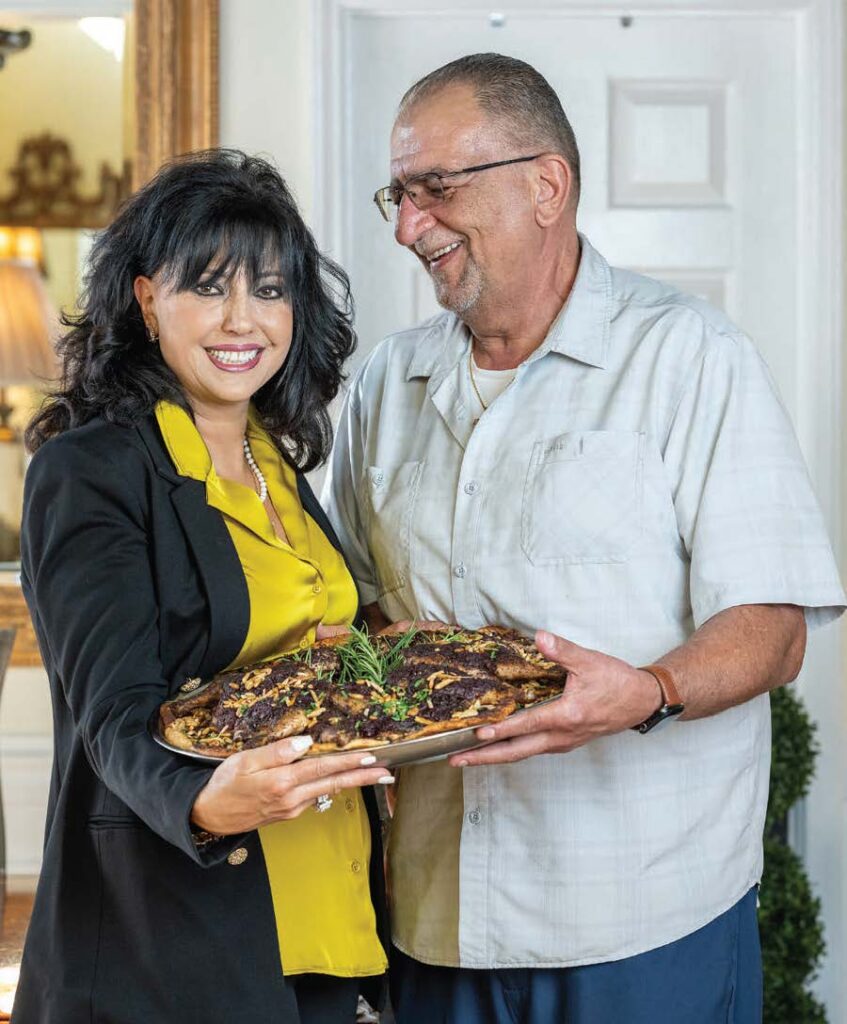
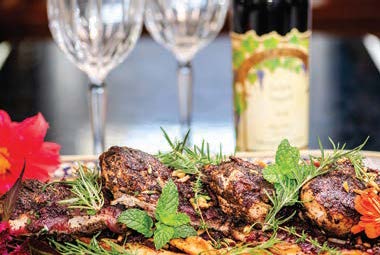
“My sister-in-law, who is American, calls this purple chicken,” says Ginah Soufia. A first-generation Palestinian American, Gina has owned Wallstreet Deli & Catering for 26 years with her Palestinian-born husband, Mike. “The aroma . . .  it takes me back to my childhood,” she says, recalling the scent of sizzling, sumac-infused onions and golden-toasted pine nuts that drifted through the modest three-bedroom home. The table was always loaded with food and family — three generations living under one roof. To this day, she believes in setting a longer table to make room for others. “The great thing about the Palestinian culture is our hospitality — it is unmatched.” Musakhan, the national dish of Palestine, is often prepared at home by Ginah, with Mike — “the baker” — making the flatbread, Taboon, which sops up the flavor. What tradition does she hope to pass on to her own three grown children? “I want my kids to know that no matter what, your family will be there for you,” she says. “No matter what, your family is your family.”

Musakhan

Without chicken:

8 large red onions, medium-chopped

2 cups extra virgin olive oil

Chicken bouillon powder, to taste

1/3 cup good-quality sumac (a bright-red spice made from ground dried sumac berries), plus more for sprinkling

6 Taboon or plain naan bread pieces

Pine nuts, fried or roasted

With chicken (same as above, plus):

3 small chickens

1/4 cup olive oil

1 tablespoon sumac

1 tablespoon seven spices

1 tablespoon ground coriander

1 tablespoon garlic powder

2 tablespoons salt

Without chicken:

Heat olive oil over low heat. Add onions to pan and sauté. Keep mixing until the onions become soft, have a bright pink color to them and have released all their water.

Continue to mix and add bouillon powder and sumac.

Spread onion mixture on each piece of bread and sprinkle with pine nuts and a little more sumac. Repeat and layer as you go, creating a stack.

With chicken:

Preheat oven to 450 degrees Fahrenheit.

Cut each chicken into either two halves or four pieces. Pat dry with paper towel.

Mix the olive oil and spices in a small bowl then brush on chicken from all sides. Place on a baking sheet lined with parchment paper, allowing room between each piece of chicken.

Cover with aluminum foil and bake for about one hour, then uncover and bake an additional 5–10 minutes until the skin is crispy and golden-brown.

Follow steps 1–3 from the vegetarian version above. Layer as many pieces of bread and onion mixture as you’d like, followed by a piece of chicken on top. For a single serving, one piece of bread topped with onions and one piece of chicken is recommended.

Joseph Ozbey, Cugino Forno

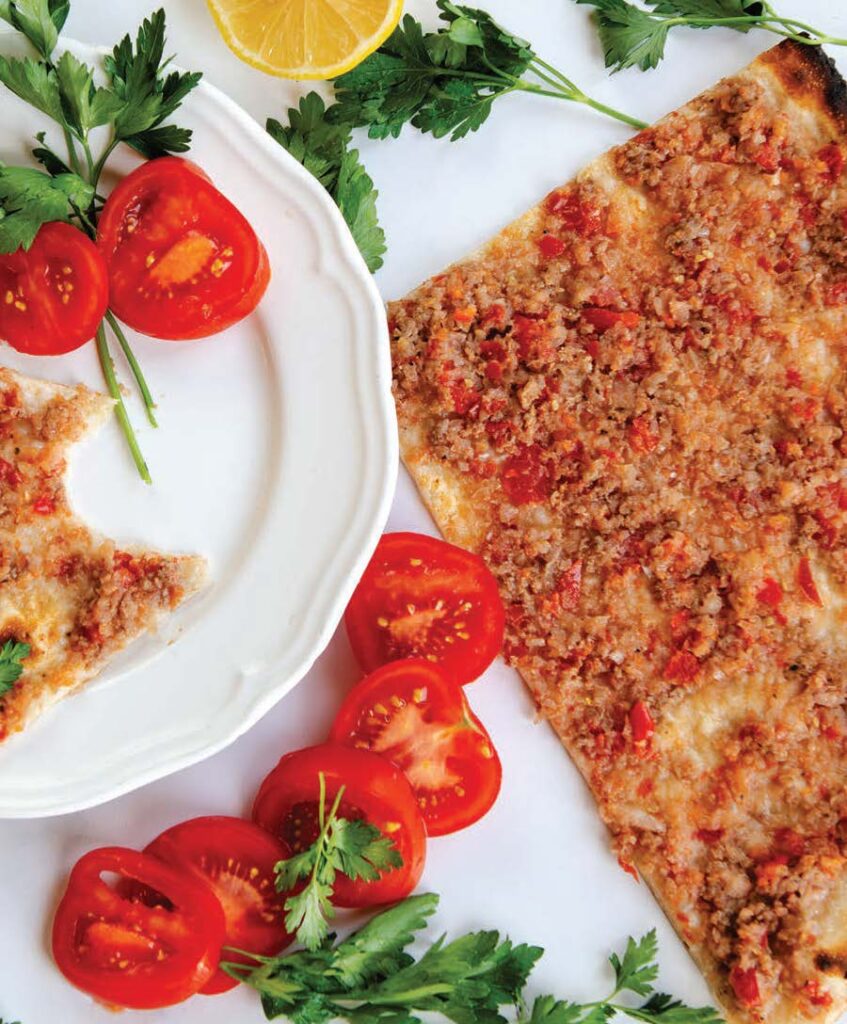
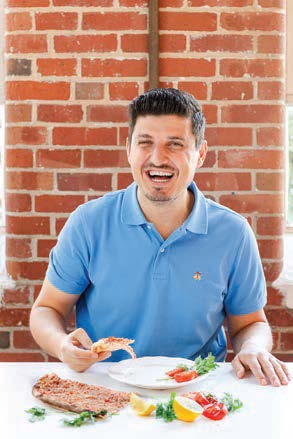
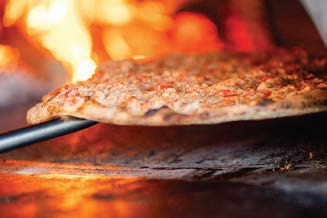
Born and raised in Turkey, Cugino Forno Pizzeria co-owner Joseph Ozbey has fond recollections of family meals centered around Lahmacun, aka Turkish pizza. “Every time I have this dish, it reminds me of our Sundays when I was a little kid.” Armed with the toppings his mother had prepared and some pocket change, Ozbey would go to the local baker, who would put the topping on crusts and bake. When Ozbey returned home with the fragrant, steaming Lahmacun, the table would be prepared — with salads, herbs, tomatoes, yogurt drinks — and the family would eat together. Soon, God willing, he will have a few of his own little ones sitting around the family table and he can share the rich history of his Turkish heritage. “Even a simple dish,” he says, “reminds you of your culture, reminds you of your roots.”

Lahmacun (Turkish Pizza)

Makes six 10-inch pizzas

For the crust:

2 cups all-purpose flour

2 teaspoons kosher salt

1 1/2 teaspoons cane sugar

2 teaspoons dried instant yeast

1 2/3 cups water

For the topping:

1/3 cup small red bell pepper

1/2 cup onion

1/3 cup parsley

2 cloves garlic

1 teaspoon dried oregano

1/2 teaspoon dried mint

1 teaspoon cumin

1/4 teaspoon black pepper

2 tablespoons Turkish red pepper paste (can substitute tomato paste with a dash of hot sauce)

1/2 pound ground beef

For the crust:

Combine all of the dry ingredients in a large mixing bowl. Whisk together.

Add the water and fold and mix until a ball of dough forms. Allow to rise for about one hour.

Transfer the dough to a floured surface. Cut the dough into six even pieces. Shape each piece by hand and then use a rolling pin to create a thin circular shape. (Add additional flour to the surface, to your hands and to the rolling pin when necessary.)

For the topping:

Fine-dice the red peppers and onion, mince the garlic and finely chop the parsley. Aim for tiny pieces of everything — the tinier, the better. Add the chopped and minced ingredients, the rest of the seasonings and the red pepper paste to the ground beef. Massage and mix with your hands for no less than five minutes,

Evenly spread the meat mixture on your prepared crusts. Bake for 20–25 minutes in an oven preheated to 350 degrees Fahrenheit.

Aurelio Ruiz and daughter Alondra Ruiz Fowler,
Kiosco Mexican Grill

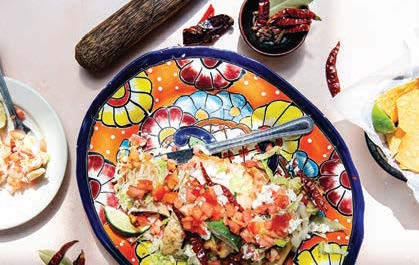
“Every tamale is different,” says 25-year-old Alondra Ruiz Fowler, eldest daughter of Kiosco owner and chef Aurelio Ruiz. “Every family makes them differently.” Her own grandmother, who lived with them when Fowler was a child, still, to this day, insists on thoroughly mixing the masa dough by hand. “I am never fast enough to do it,” Fowler admits. As for the accompanying chili sauce, she says that Mexicans make their own by burning the chilis, releasing a come-hither-if-you-like-spicy aroma throughout the home. “The worse my throat hurts, the hotter it’s going to be,” she says with a laugh. This dish, a tradition at big get-togethers, is one that Fowler hopes to keep alive for future generations. As for the restaurant, her dad talks about one day passing that on, too. “But he’s a workaholic, so he’s going to be here until he can’t walk anymore!” Either way, Fowler says she can’t ever imagine the 35-year-old restaurant not being there. Just another part of the family legacy..

Tamales

Corn

1 pack of corn husks 

Masa

1 cup manteca (lard)

1 teaspoon baking powder 

Salt to taste 

5-pounds “masa para tamales” (pre-packaged dough found at local Mexican markets)

1 cup of broth from cooked meat 

Chicken 

1 1/2 pound chicken breast, cut into cubes 

1/2 white onion, peeled

2 1/2 cloves garlic, peeled 

1 teaspoon ground cumin 

1 teaspoon kosher salt 

1 teaspoon chicken bouillon 

1/4 teaspoon ground black pepper 

Chile Sauce 

3 ancho chiles* 

3 guajillo chiles* 

2 tablespoons plus 1 teaspoon manteca

2 1/2 cloves garlic, peeled 

1/2 teaspoon kosher salt 

1 teaspoon chicken bouillon 

1/2 teaspoon ground cumin 

1/4 teaspoon black pepper 

*Remove chile seeds to tone down the spiciness

Directions

Husks: Soak husks in a large bowl with hot water while cooking, ensuring they stay completely immersed for about 75 minutes. Dry thoroughly after soaking.

Chicken: Place chicken in a pot of water to boil. Add white onion, garlic, ground cumin, kosher salt, chicken bouillon and ground black pepper. Allow the pot to boil, then simmer for 75 minutes. Throughout this process, remove the foam that rises to the top of the pot. Once the chicken is cool, shred it all and place in a bowl, removing the bones. Reserve one cup of broth for Masa step. If using a different part of the chicken, shred and remove all the bones prior to assembling tamale. 

Chile Sauce: In a pan, fry the chile and garlic in 2 tablespoons manteca for about three minutes. Once fried, add chiles to a pot of 1 1/2 cups of boiling water. Allow the chiles to boil for about 10–15 minutes. After 15 minutes, remove chiles plus a cup of the boiling water used and add to a blender. Add seasonings and blend until mixture reaches a paste consistency. Fry mixture in a pan with 1 teaspoon of manteca over medium heat. Add about 1 cup of water and allow it to simmer for about 20 minutes until thick. Be careful not to burn the sauce during this step. Once thick, add to the bowl of shredded chicken and combine. 

Masa: In a large, clean, open counter space, mix the manteca and baking powder together. Once mixed, add half of the amount of salt. As you are consistently kneading the mix, add your Masa. Do not add Masa all at once. Add it in parts. Continuously kneading the mixture, work in the one cup of chicken broth. Add remaining salt and mix. Taste Masa and add salt if needed at this step. 

Assemble Tamales: Using a dry corn husk, spread about 3–4 tablespoons of the masa on the smooth part of the husk. You want to make about a 3 x 3 inch square that leaves about 1/2 of an inch at the bottom of the husk. Once your masa is spread on husk, put about 2–3 spoonfuls of the chicken and sauce mixture in the middle of the masa. Fold one long side of the corn husk, then fold the other long side over top. Finally, fold the bottom of the corn husk upward. You can secure the tamale by placing the folding side of the tamale downwards in the steaming pot in the next step or you can shred an unused corn husk into pieces to use as string, tying a knot over the tamale. 

Cooking Tamales: Using a stockpot with water in it and a steamer on top, distribute the tamales evenly and upright. The water should be low enough where the steamer basket can be inserted without touching the water. You want to place your tamales in the steamer basket upright where the tamale is exposed. Once you have evenly spread the tamales in the steamer basket, cover the pot and let it steam on medium for about 75 to 90 minutes. Water may need to be added periodically, depending on the depth; always make sure it is not touching the steamer basket. Once you can see that the corn husks are easily removed, your tamales are fully cooked. 

Serving: Remove the corn husk from cooked tamale and place on a plate. Garnish with shredded lettuce, chopped tomato, sour cream and a crumble of queso fresco. Take a bite and enjoy a delicious taste of a traditional Mexican meal! 

From High Fashion to Home Furnishings

FROM HIGH FASHION TO HOME FURNISHINGS

From High Fashion to Home Furnishings

A passage to India leads to design inspiration

By Cynthia Adams  
Photographs by Amy Freeman

Elizabeth Wicker’s home renovation is a living laboratory, where she tinkers with sophisticated, restrained design, luxe wallpapers and sparkling touches. And yet there is a disciplined approach, and no clutter.

In her dining room/home office, she recently created a credenza in her role as a Chelsea House designer. The piece, newly arrived, could be popped between the two new bookcases of her design, or be used elsewhere, she says. A small, blown-glass bull on the shelf was purchased at Modern 214 in High Point, however, redolent of her time in Spain, and is not her design. She holds it in her hand, thoughtfully weighing it.

An ethereal Douglas Freeman painting hangs between the two bookcases.

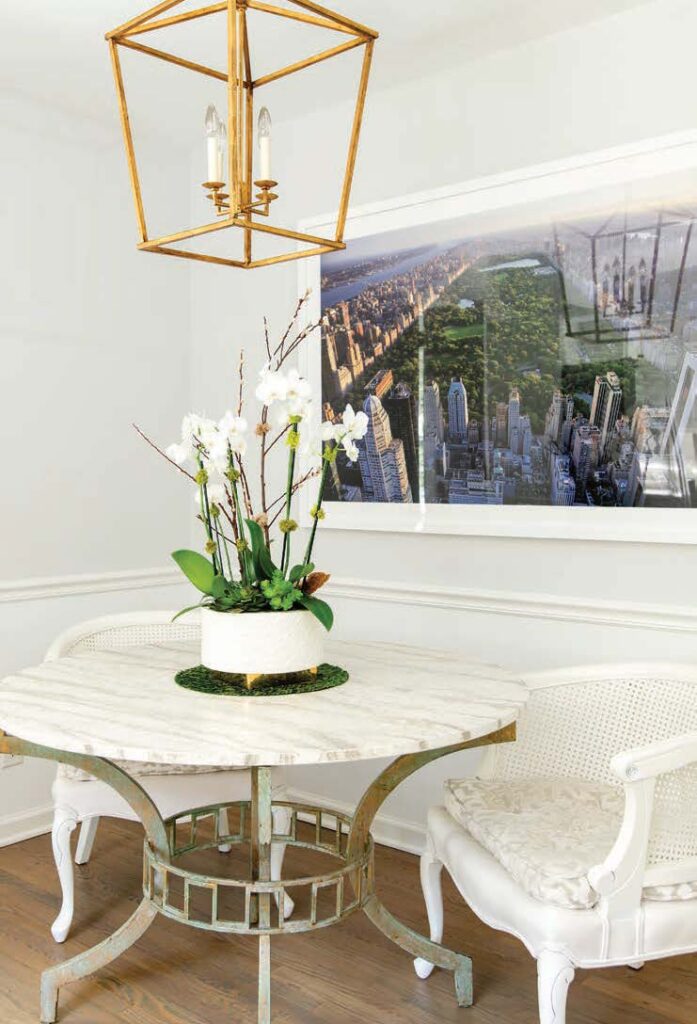
The dining table, doing double duty as her work table, is a glamorous Hollywood Regency style also found at Modern 214. “It’s the first place I go when I get to market.” 

The wall color used throughout much of the upstairs is a pale Benjamin Moore gray, number 1611, a favorite, trimmed with Decorator’s White in high gloss — a serene backdrop to art and furnishings. If it reads too blue with different light, she tweaks the tint.

“This is my house. My passion project.”

The graphic wallpapers Wicker chose 10 years ago when she first moved in still work. 

Cranes wallpaper by Cole & Son in the foyer is a favorite. Her older brother walked in as the house was being renovated and stopped. “Beeb” (her nickname), she recalls him saying, “this wallpaper reminds me of something from our house growing up.” She laughs and shrugs. (But privately, she’d wondered, had something in her past inspired the choice?)

Wicker’s home, however beautiful, is equally spotless. 

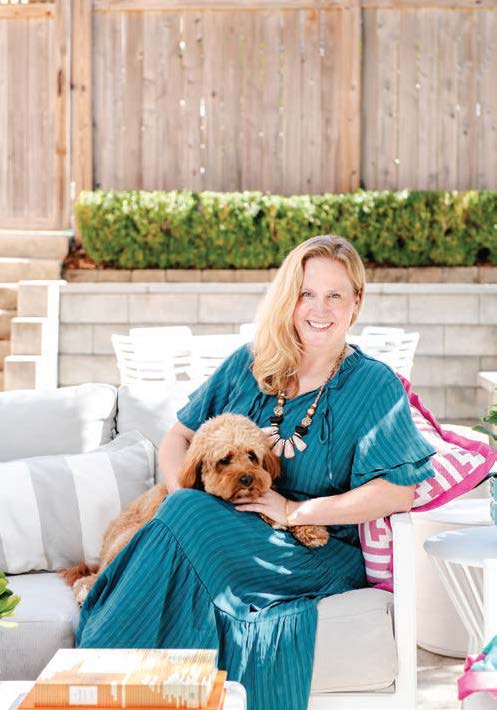
She enthusiastically describes snuggling on the neutral living room sofa with her poodle-Cavalier King Charles mix, Sienna Rose. (The settees and sofas are all custom-sized to fit each niche and space, a benefit of working in the industry.) “Only if she has her blanket,” Wicker qualifies. 

She sheepishly continues.

“I’m a little OCD about cleanliness.” Her friends tease her with a barrage of questions: “Do I have shoes for her to wear if it gets really muddy?” Yes. “Do I make her wear them all the time?” No. “But did I try when she was a puppy?” Yes.

“Sienna Rose has been the best thing for me.”

Wicker moves through her home, picking up objects to illustrate her design style. A line of mother-of-pearl boxes are personal favorites. Sales reps told her they were a little pricey, but she stood her ground. 

“Well,” she told them, “Let’s see if you can do it!” The boxes wound up being a best seller, she says proudly. But that is not always the case. Home furnishings sales are mercurial, with variables such as bad weather, poor market attendance or poor buyer traffic at any given market. A white cachepot of her design has remained a best seller for Chelsea House. She has another one out, and two new trays are styled on kitchen counters, one using mother-of-pearl. 

Among the 100 or so pieces she designs each year are personal favorites that don’t make it into production. If this disappoints her, Wicker doesn’t complain. Rarely, too, is she disappointed by a design’s execution in manufacturing.

Wicker pauses before a large Art Deco-style mirror template she taped to the wall behind her desk. She studies the physical pattern a moment while scrutinizing the computerized version on one of two work screens. Details consume her and must be exact.

“This is the reason I bought the house,” she says, leading downstairs, shot with abundant natural light and luxuriant space. 

The basement level is a revelation. Equally restrained, it is also light, youthful and fun, designed for comfort and also further design experimentation. Wicker camouflaged an unfortunately placed fireplace with antique mirrors and reconfigured the large space, where she formerly worked. 

She points out Chelsea House designs used in the decor here.

“Down here is a bestselling cocktail table, lacquered, originally detailed in gold leaf.” Wicker personally favors small cocktail tables with heft, which she says are useful when entertaining, substantial enough to not tip over.

A side table in crisp white with brass accent is a signature Wicker design.

The glamorous basement powder room featuring a graphic wallpaper and a “Material Girl”-era Madonna photograph is much appreciated by her close friend, lawyer Andrew Spainhour. He teases Wicker, saying, “Pardon me, I’m going to go visit Madonna.” 

He has dubbed Wicker’s downstairs her “Genie room.”

“Like I dream of I Dream of Jennie, where she went to the bottom of her genie bottle?” Wicker explains. She’s piled cushy pillows around the sectional sofa. 

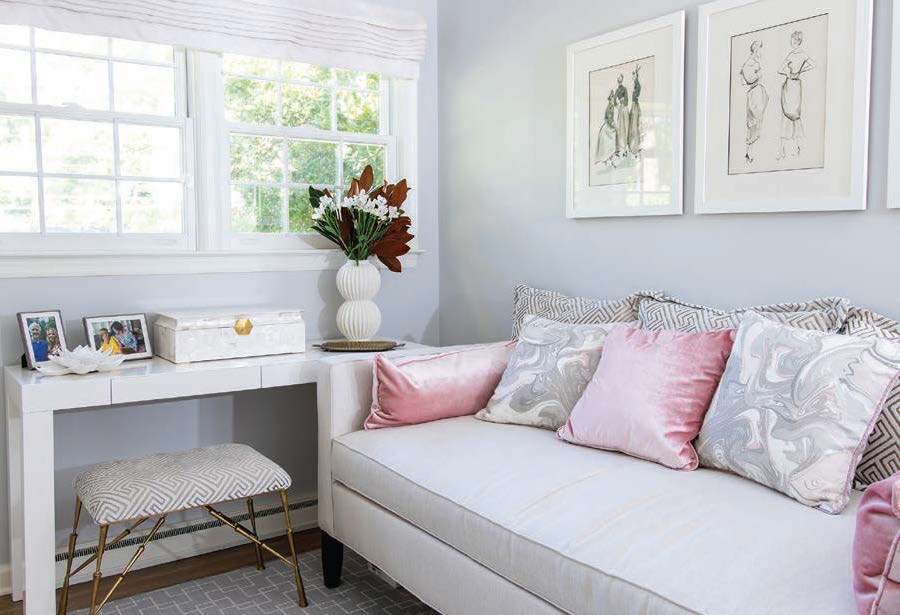
A framed collection of vintage Vogue illustrations is a nod to Wicker’s fashion background. 

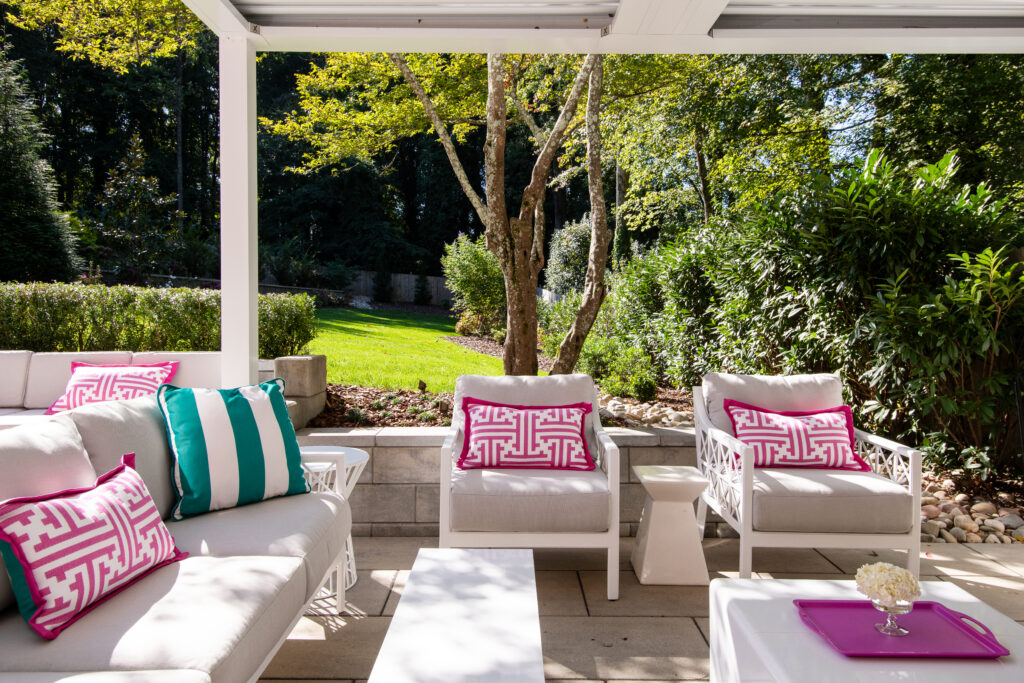
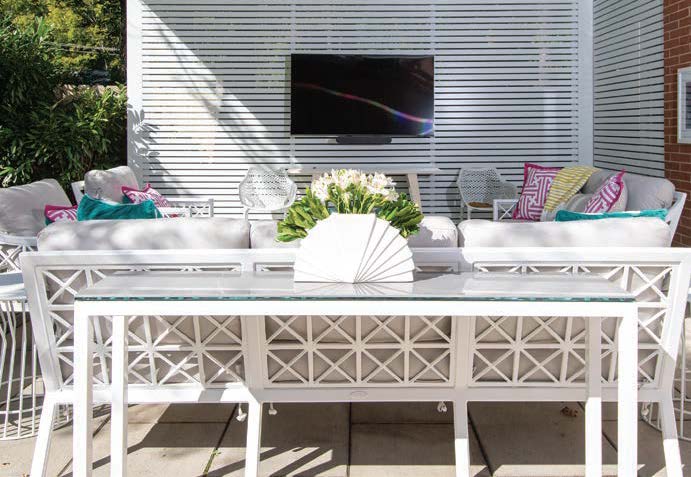
The basement opens onto a covered outdoor entertaining area with a louvered privacy wall of her design that includes a hidden jib door. There’s ample space for Sienna Rose to run, she adds, nodding towards the large yard. Here, too, Wicker’s neatnik nature is on full display. Dog toys are neatly stacked as her pooch visits Wicker’s parents.

“I sit at the end of that step,” she shares, clearly besotted by her pet. “Sienna Rose gets to the fourth step and tends to look back to be sure I’m still there.”

Upstairs, she describes having revamped bathrooms, then transforming spaces by hanging papers selectively for graphic punch. By claiming much of the primary bedroom’s closet, Wicker expanded a formerly cramped en suite bath. 

Striking details, like the impressive brass pulls on custom bathroom cabinetry, reveal a little more genie-style magic. 

“They’re actually tie-backs,” Wicker says.

An antique French settee in her bedroom fits her maxim: You “must mix the old with the new.” Wicker lacquered a vintage credenza to make it read more of the moment.

The artwork she acquired fits with elegant restraint. Nothing competes with anything else. She mentions two favorites — eye-catching, large canvases. One hangs directly in front of her work table.

Both are by Freeman, an admired artist and her friend.

“When he brought this over, he said he wanted this in the hallway.” Wicker was hesitant as workmen were still on site; she didn’t want it harmed. Freeman was insistent, hanging it where it remains today. It is all the more meaningful to her as he subsequently died.

She smiles wistfully; it is a grace note.

“It’s my little labor of love, and I love my home,” she repeats, then flashes an enormous smile.

When Elizabeth Wicker was profiled as a Triad boomeranger — those ultimately returning home — it still surprised even her. She never expected a return to Greensboro after a career-making move to the Big Apple, where she worked for fashion maven Nanette Lepore. 

Today, she sees a beautiful symmetry to her trajectory and believes here is exactly where she is meant to be.

“I’m a boomerang and I’m all down for it,” Wicker says. “Cecelia Thomspon [executive director of Action Greensboro] is one of my best friends here.” Thompson conceived the very idea of Boomerang Greensboro, which promotes those who formerly lived here returning.

Initially, a series of unfortunate events brought Wicker back in 2014.

A creative pivot from fashion to furnishings design was unexpectedly easy for Wicker. 

Years perfecting dressmaker finishes and finer details for haute couture lent itself to the granular detail she now applies when designing for home furnishings giant Chelsea House. At 44, she is enjoying a challenging career working with home appointments versus high fashion. 

Wicker is among 10 designers working independently for Chelsea House, which celebrates its 50th anniversary this year. 

How her reset unfolded is one part fairy tale and ten parts hard work. Her design evolution also involved a revelatory business trip to India. When Wicker returned to Greensboro, those parts meshed in a transformative way.

She was always an independent, free spirit, remembers friend Sara Jane Gibson, who has known Wicker “since we were in diapers in the same play group. I tuned into this in high school.” She noticed her friend’s unique dress style and eye for design. Wicker’s bedroom was pasted with a collage of varied photographs from ceiling to floor—anything that she fancied. “She had stickers on the interior roof of her car.”

It presaged her home, which became a personal design laboratory.

In her early years, Wicker was influenced by family travels. She observed how her grandmother “sewed everything,” and soon grew passionate about sewing and creating, even as a teenager. 

Wicker pursued fashion design at N.C. State after graduating from Page High School and studied abroad in Spain. Still in college, she produced handbags and clutches under her own brand, Isabaya by Elizabeth Wicker. “I didn’t keep up with the trademark,” she says.

When the televised design competition Project Runway began its popular run, watching the pace stressed her out, she recalls. Then a student, she couldn’t believe the show’s contestants made designs so quickly. 

Despite all that, Wicker confesses imagining she’d eventually study law and follow her father, Robert Wicker, in becoming an attorney.   

Yet design opportunity opened. She won an internship with Lepore in New York, where she remained for six years. This led to Lepore employing Wicker as a liaison between design and production. 

“Lepore was known for her details, embellishments,” Wicker says with admiration. “Intricate designs. Nothing was just basic.” The free-spirited designer matched Wicker’s own enthusiasms — “a little gypsy” spirit. “I loved working with her; it was so much fun, and living in New York was fantastic.” 

But a series of setbacks for the design house hit. (The designer no longer owns the brand and has since shuttered her studio.) Then Wicker’s rent escalation forced her to give up her apartment in March 2008. 

Yet she hadn’t contemplated returning to her hometown. “I’d had all these great experiences — it felt; ah, am I ready for that?” Then her parents ran into her former soccer coach, who works in the textiles industry.  He relayed a message to Wicker: “Tell her to send me her resume.”

She relocated to Greensboro and joined underwear-and-hosiery manufacturer Kayser-Roth. After a year, she met and joined Triad designer Bradshaw Orrell, partner of the late Freeman, and began working with his clients and, ultimately, managing the business. 

Orrell was already designing for Chelsea House. In the process of the firm working on their High Point showroom, Wicker had begun ghost-designing for Chelsea House, too, “which isn’t odd at all in the design world.” 

Then, a misadventure changed her career once again. 

Orrell asked Wicker to join him on a business junket visiting 26 India manufacturers for Chelsea House. She only knew they would be “seeing their capabilities and seeing products that were already in the works that we had designed.” 

Arriving in New Delhi in January of 2020, Wicker quickly cleared customs. Orrell did not. She watched helplessly through a glass panel with mounting alarm as he was turned back by customs officials. 

“They sent him back that night because his visa was not up to date . . . and I’m just his sidekick going on this trip!” Although she was familiar with the process of how furniture pieces are made, “I had never been in India, and didn’t know exactly what Chelsea House wanted and what we were to do.”

Wicker didn’t even know any contact names of those they were meeting.

Their prearranged agent, Parik, met her at the airport with knowledge of the itinerary. She realized she had to go to four appointments the next day, unsure of what was expected, nor how to navigate expectations. 

Gibson, who lives in Charlotte, called Wicker five times when she learned her friend was there alone.    

“I just knew she was going with her boss . . . she’s savvy and could have navigated, but I was just worried about her.” Gibson adds, “She’s always had a big personality . . . She’s a leader and a woman on a mission.” 

“It was mind blowing. Amazing. But I got so sick,” Wicker recalls. She had packed basics for stomach upsets and headaches that did little for her symptoms. Her whole body ached. 

“My throat closed up. It wasn’t until about six months later that I realized it was COVID.”

Wicker isn’t an adventurous eater at best, and now she had no sense of taste nor smell. Parik diplomatically told everyone she only “ate dry food.” She munched on crackers and granola bars. And kept going. Wicker never smelled the rich curries and spices that are the stars of Indian cuisine.

After that first day in India, she thought, “I can do this!” She had moved from “I have to do this” to “I can do it!” At night, she would collapse in bed, sweating and ill. She lost her voice and could barely communicate. But she soldiered on.

Factory managers would ask Wicker whether she liked things they presented, carefully waiting for her to speak. “I wasn’t supposed to be the main person, but they wanted to show me what they could do. Everyone was so respectful.” She could absorb the sensory richness — textiles and architecture — of India if not the foods and aromas. “The colors! I loved it all!”

With Parik’s help, Wicker completed the entire 12-day agenda on her own. 

“I loved it,” she repeats.  And her creativity ignited.

She had feverishly “designed about 75 pieces while in India in collaboration with the people at the factories.” 

She flew back on a Sunday, her health improving. By Tuesday morning she was back at work, sending out new designs.

Wicker was exhausted. Elated. And changed.

She also turned 40 that summer, celebrating with a group of friends who have long been in her life. Wicker walks over to a bookshelf and picks up a magnifying glass she designed for friends as a party favor. It echoed her love of some of the nostalgic family items she values.

After returning from India, Chelsea House’s executives called Wicker to express support. By November, their new president contacted her about creating another line of furniture — in two weeks. She managed while still working full-time with Orrell.  She continued both until 2022.

“I learned so much there,” she says of her 12 instructive years with Orrell.

But India had changed “my thinking and career . . . It was the turning point.” 

Her designs are also plucked from personal references and life experiences. An alabaster apple she designed from one of the reeded-front bookshelves literally reflects her time in New York, the real Big Apple.

This includes both furniture and “the jewelry” — her term for the accessories she designs, such as trays and cachepots.

“I put pressure on myself to give as many details as possible.” 

What is the narrative thread in Elizabeth Wicker’s design life? 

“Outside influences,” she answers. She went out into the world, like a design explorer, and brought it all back to her studio. New York City, Spain and then India became touchstone places.

Her Instagram page describes her as “chasing everything creative.” 

“It’s a matter of letting yourself go. You may not be great at something — but you find your way. Your mind, your heart, everything will tell you where to go. It will lead you, for sure. That happened to me.”

Random, even mundane things, can mean an epiphany.

“I found packaging — this piece of cardboard! The way it was cut out and folded, I opened it and thought, hmmm. This would be a great body of the lamp. A base!”

Or, while eating out West on vacation: “There was the coolest design on the end of the fork. Something I’d never seen before.” Her fellow diners were amazed she noticed.

“It’s definitely not one-two-three” she says. The design process is different every time. But she firmly believes in routines.

Up at 7, she religiously makes her bed and jumps in the shower. “I do things for myself. Alone time. Get up and moving, and Sienna Rose sometimes goes to doggie daycare or stays here with me.” Wicker is, failing calamity, working by 9:30.

“You’ve got to get in a routine, and I learned that long before COVID.”

There are long hours, too, she admits, “when you ask ‘What did I even get done?’”

Two weeks earlier, Wicker was on a getaway with girlfriends in Darien, Connecticut. While browsing the shops, she spotted one of her designs and had a moment. “This has never happened to me,” she insists. “The girls started saying, in high-pitched voices, ‘Oh my gosh!’”

The store owner asked Wicker’s name. “I turned beet red.” They requested a photograph of her with the piece. “It was a really cool experience. Then I looked over and spotted another of my pieces.” Her heart lifted.

What feeds her? Her parents were “guiding light people,” she praises. They gave her tools of self-reliance.

“They gave me the freedom to explore my creative side and to travel. No limitations set on me in the sense, I never remember their saying stop doing that.”

So she hasn’t.

Rituals for enhancing creativity? Noticing things. It may not inspire a new product idea. But perhaps the texture of a leaf, or the undulation of packing material, the mundane, pricks the subconscious inspiring a new finish. 

Sometimes just walking along a path does the trick. 

“Get a dog,” she winks.

The Modern Day Evolution of the Industrial Revolution

THE MODERN DAY EVOLUTION OF THE INDUSTRIAL REVOLUTION

The Modern Day Evolution of the Industrial Revolution

Heavy metal makes a comeback

By Billy Ingram

Covered in rust, covered in scale grease — no one wants that in their home.” That’s Chris Lutzweiler describing the Industrial Age metallic mastodons he scours the country for. Lurking under the surface of this Jurassic junk is what he sees as unimaginable beauty. Hidden for decades, fallowing in forgotten warehouses or lying flat in furrowed fields, there’s an unmistakable allure that is, as he puts it, “all hiding underneath.”

Hiding in plain sight to him, yet, to the untrained eye, nothing more than the detritus of a bygone era, unwanted, dilapidated tatterdemalions transform when, conducting business as The Rustic Factory, this metallurgical magician performs his extraordinary act of restoration prestidigitation.

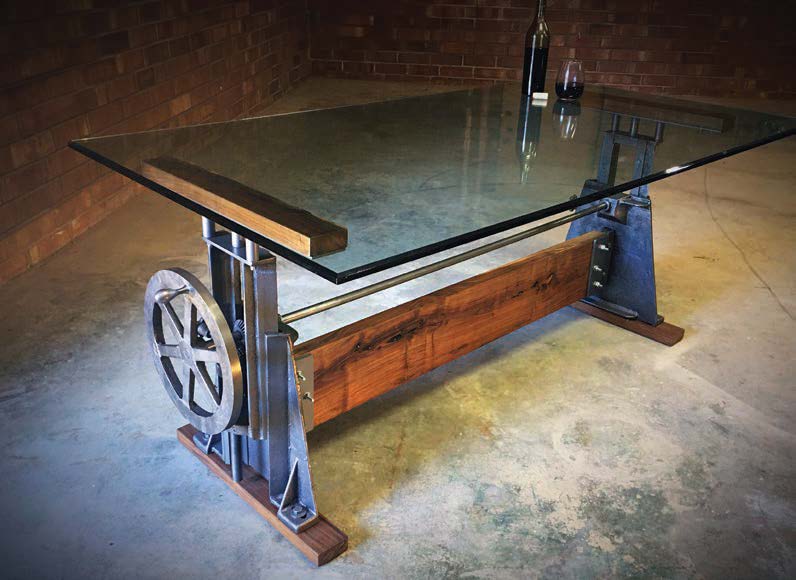
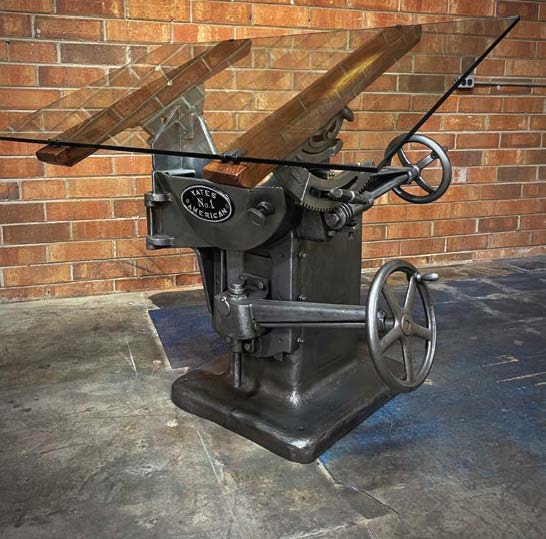
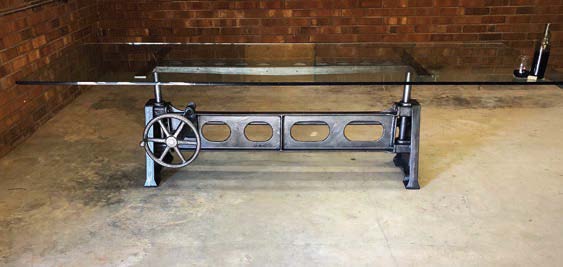
A heavy-duty table saw dated 1930 has been converted into an impressive 30-by-50-inch drafting table featuring a new glass surface, easily adjustable both up and down, and vertical to horizontal. In a similar vein is a commanding boardroom table, spanning approximately 14-by-14-foot with an 8-foot base, topped with a $5,000 glass surface weighing over a quarter- ton. “You can literally crank it higher or lower with just one hand.”

Fashioning furniture from outmoded heavy machinery was a shabby — not- so-chic — concept embraced in the 1960s and ’70s, when lofts carved out of shuttered manufacturing plants were leased to bohemian artists and musician-types. These creative free spirits mounted tabletops over abandoned hulking monstrosities that weighed hundreds or thousands of pounds and were forevermore bolted into hardwood floors, thereby rendering the intractable practical.

Somewhere along the line, that forward thinking, backward-leaning sensibility tilted from hippie to Haut. High-end lifestyle purveyors like RHA and Restoration Hardware began marketing vaguely reminiscent specimens of industrial-looking home and office furnishings.

There are entire lines of steampunk-inspired executive desks and home furnishings scattered about the marketplace today, pleasing enough to the eye. But these too-cleverly designed pieces betray an overly-labored approach at approximating some fictitious exactness, so overwrought that any minor adjustment requires motorization. Mere superficial “reproductions,” they lack any genuineness or authenticity that made the genre appealing to begin with. Researching this stylistic phenomenon, Chris Lutzweiler realized that most of these ersatz thingamabobs-cum-household-accoutrements actually originate overseas. “I still loved the look,” he insists, “but I wondered what inspired that style? Where’s the real deal?” What he discovered is that those real deals “are egregiously expensive, shockingly so, and incredibly difficult to source.”

Born in Chaska, Minnesota, but raised in Greensboro, Lutzweiler never envisioned pursuing a career crafting one-of-a-kind furniture from sidelined tool-and-die contraptions resurrected from the turn of the last century. And yet, the attraction came naturally. “I’ve always been fascinated by the mechanical nature of machines,” he explains. “Any kind of machinery, any kind of engine, moving parts, anything like that.”

After about a year with little clue as to what he was actually doing, he says, “I spent a small fortune, but got started with a couple of authentic pieces.” Lutzweiler began retooling and simplifying complex machinery that could be employed as resolute office desks, dining room tables and the like from discarded dinosaurs of the industrial age.

No matter the source material, this is a labor-intensive undertaking. “There are people that like this style but can’t really go for the authentic thing because there’s a cost to it,” Lutzweiler says. “It’s not cheap, but a lot of people who reach out to me want the real thing.”

The first step is bathing any moving mechanical parts in a strong, penetrating oil — hardware, bolts, pulleys or anything else that will need to be extracted.

After allowing the oil to penetrate over several days, the original piece is carefully and painstakingly disassembled and cataloged for reassembly. “At this point, larger components are glass blasted with heavy industrial equipment outside of my facility,” Lutzweiler explains. “Smaller and more manageable components are done myself by hand.” After a century’s worth of rust, paint, scales, grease, and dirt are eradicated, only the cast iron or underlying steel remains. “This is a critical time as bare iron or steel will actually ‘flash rust’ within minutes.” The next step is mission critical, Lutzweiler insists, and if not performed immediately, the time- consuming blasting process will have to be repeated. “Freshly blasted metal is usually a dull gray or white, and full of residue and salts,” so removing that corrosive patina and achieving a desired, cast iron finish requires hours of high-speed polishing and wire brushing. “This is the longest and most intense portion of the process that brings out the beautiful, natural color of the metal.”

The clock begins ticking again, buffed metal needs sealing as quickly as possible before any rust can form. “Each individual component is sprayed with clear coating, then the entire piece reassembled and clear-coated again several times over, ensuring that natural finish is protected.” Lutzweiler once spent an entire workday preserving a single fastener: “Nearly eight hours to save the original bolt, where a new one would have sufficed. However, the customer wanted it as original as possible.”

When it comes to maintaining the structural and period-perfect integrity of these armored antiquities, Lutzweiler occasionally needs a capability beyond his capacity. With those unusually hard cases, he has turned to Scott Cain at GFC Machine in High Point, an automotive machine shop specializing in race car chassis construction, repairs and custom fabrication.

Cain recalls when this wannabe furniture-maker (prior to Lutzweiler even entertaining such a thought) first entered his shop: “It was years ago, when he was at GTCC’s automotive program.” For college credits while still in high school, Lutzweiler attended GTCC’s middle college, where, one afternoon, an instructor guided students through GFC’s workplace, offering some insight into what machine shops are capable of.

“I’m going to say, maybe five years ago, Chris started coming here to get me to do little odds and ends for him,” Cain recalls. Those “little odds and ends” often entailed work-arounds that would likely stretch the capabilities of the most accomplished machinist. “His stuff is extremely old and just a little problematic to get what he wants done with it, to get pieces to break loose without damaging the parts.”

“Scott is a great guy — he shakes his head every time I come in the door,” Lutzweiler remarks with a grin. “I have to give him a lot of credit because the man is a genius with anything metal and I want things to be authentic. If that’s how it was originally done, I want to do it that way; I don’t want to improvise. And he just wants to shake me sometimes.” It’s a fortuitous match.

“Any time there is a customer-facing welding spot, I’ll ask Scott to do ‘NASCAR-style’ welds that are cleaner and more rhythmic,” says Lutzweiler.

“Honestly, it’s all in a day’s work,” is Cain’s response. Recalling a particularly complex collaboration, he adds, “One of his tables had a set of gears that had four individual Acme thread posts that would elevate the tabletop. Yeah, that one was difficult. When it worked right, it kinda made me feel good because it was such a challenge.”

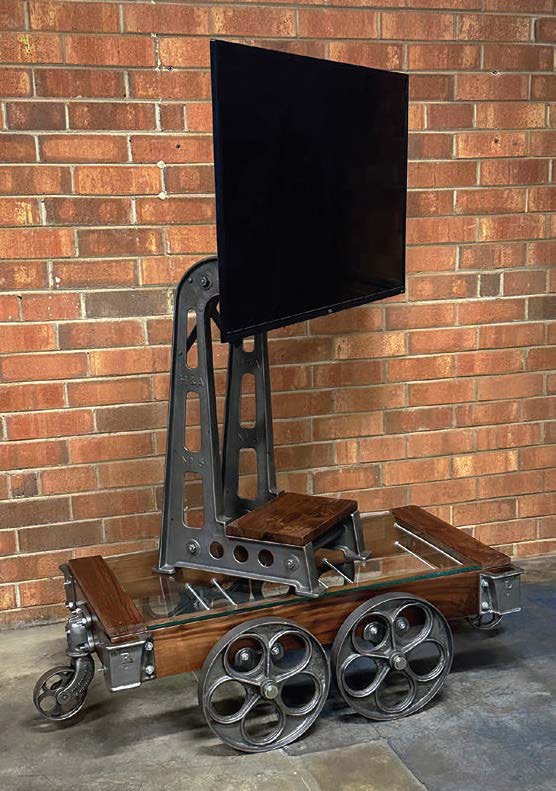
That particular item, a Portelvator adjustable hand-crank cart made by The Hamilton Tool Co. circa 1890–1930, was sitting, nonfunctional, in the lobby of a high-end fitness studio in Detroit, presently enjoying new life as a deceptively simple bar cart. “What made the whole thing tricky was every component had to be precisely in sync or the gears would lock up,” Lutzweiler explains, down to the threaded rods, sun gears, worm gears, pins and chains.

Lutzweiler’s venture has him traversing across East Coast byways, exploring the Rust Belt’s every loop, in pursuit of technologically primitive behemoths originally manufactured for carving out cabinets, window frames, dining room tables and the like; those machines that once made the furniture, in turn, will become furnishings. “Ohio and Pennsylvania are a treasure trove of authentic turn-of-the-century pieces.”

Of particular interest, many of the most desirable mechanical manifestations of Industrial Revolution ingenuity were forged right here in Greensboro. Lutzweiler describes one of those transformations as “a Wysong & Miles crank table for a molding sander that can now be a dining room table or an office desk. You can turn the hand wheel and it will raise and lower.”

Augmented with a glass top weighing in at 300 pounds, “you can adjust it with two fingers, it’s so smooth. It even says ‘Greensboro, North Carolina’ right there on it.” Wysong (sans Miles) has significantly downsized, but is still doing business locally.

A hefty Wysong & Miles Co. belt sander currently serves as the base for an executive desk, where floor-level hand-wheels turn with incredible ease to lift the 150-pound glass top effortlessly. “I actually polished each individual chain link by hand,” says Lutzweiler. While he can’t be sure of the exact date, he notes, “the machine had a patent number on it dating to 1896.”

In most cases the fossilized relics he’s uncovering were one-offs, built at great expense to specifications for specialized tasks. Inevitably, they ended up discarded by the companies that utilized them after an ignominious descent into uselessness, shoved into cobwebbed corners or piled outside into junk-heaped islands of misfit toys. Take, for example, a Pennsylvania casket factory crank table Lutzweiler unearthed. “It had been sitting there since it was purchased, according to the fourth-generation owner; they’d never used it in his lifetime.”

Although these aging bulls no longer emit whatever pitch they once played — one can imagine cacophonies of sense-dulling grinding, scraping, jangling — in silent repose, they elicit an instantly recognizable, weighty vibe. Native to hardwood floors, these pillars of grand austerity can’t help but add momentously to the vocabulary of any room, in particular lending an unmistakable sense of architectural symmetry when situated in an equally distinctive environment.

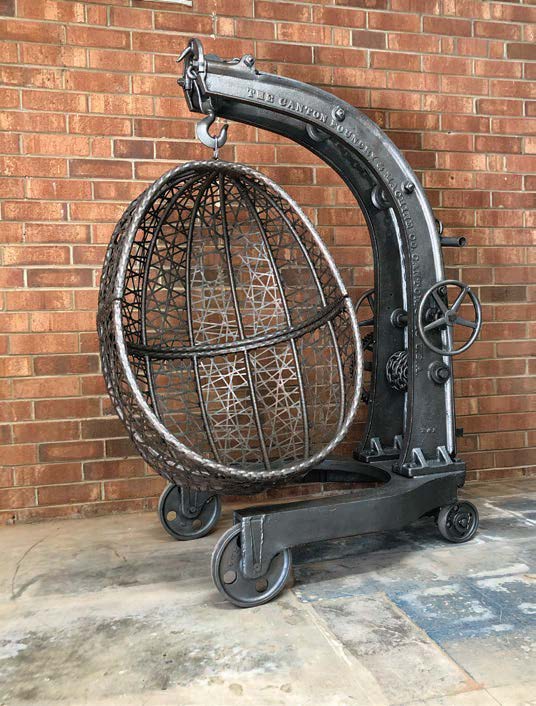
A celebration of hardware pre-software, there’s timeless beauty in a hanging throne, fit for royalty, improbably adapted out of a rusting artifact resembling something rightfully left behind on Skull Island. These theatric lounge chairs are constructed around pre-World War II engine cranes and elephantine factory winches once used to maneuver heavy equipment. “You can literally sit in there, take a nap, read a book, fall asleep, watch TV,” Lutzweiler says. And they’ve proved popular.

Although his company has a web site (therusticfactory.com), if mid-century Mad Men taught us anything, it’s that word-of-mouth advertising is the only sure-fire campaign — can’t fake that. “Clients will have somebody over for dinner,” Lutzweiler points out, “and somebody will say, ‘I want that for my boardroom, or a beach house — where do I get a table like this?’ And they’ll put them in contact with me.” Repeat business is something he’s become accustomed to. One gentleman, who’d previously acquired creations from The Rustic Factory, “asked if I could repurpose the wooden trusses of a vintage pre-World War I airplane into a chandelier with wings on either side. It’s all wood and completely encased in glass with run lights throughout it. This thing is probably 30 feet long.” Lutzweiler explains, “The wing lowers when he wants more light, raises when he wants it to spread out more, and it’s just a few turns of a handle. It was such a massive project, GTCC’s aviation program was kind enough to let me use their facilities to assemble it.”

For the same client, Lutzweiler painstakingly restored then assembled four Lineberry carts sourced locally from North Wilkesboro — and “usually fairly gross” to begin with — into a train to fabricate a TV stand. “It goes in a long, long pattern and it’s got a handle at the end. What I love about this is, it’s so ridiculously heavy — egregiously heavy — but we figured out how to make it so anyone can move them.” That handle consists of a pivot with a pin. “You just pick it up with literally two fingers and you’re moving a thousand pound train. It’s insane how effortlessly these things move.” Typically in that instance, artisans will take the existing wooden top, sand it down then scuff it up a bit. “However, I don’t want to do what everybody else does. I actually installed black walnut to achieve a book-match effect.” As much as Chris Lutzweiler is in the groove right now, there’s an inherent finality to the direction his life has taken. “These are depleting assets,” he says. “There’s only so many of them left.” It’s become something akin to a treasure hunt, rooting out what few oxidizing dinosaurs may be remaining, yet to be revealed. “People that know what these are in the industry, they all go for them at once, and it’s who can get there first and fastest. Sad part is, eventually I’ll have to change business models or do something different, which is fine — when the authentic pieces do dry up.”

Poem

POEM

October 2024

The Doorman at the Washington Hilton

Regal in his red cap and Nehru tunic,

he summons with a silver whistle,

depended from a silver tassel

around his neck,

a taxi for Jacob,

our first-born –

mere minutes to make his train

to Philadelphia, then another

to New York, and the plane

to Dubai, then Zambia.

How can it be that you raise children

for the world and they rush off to it,

places and people you’ll never see.

Is that your son, the doorman asks.

When I am unable to answer,

he tells me of his son, in Iraq,

his fear of the telephone

he can’t bear to answer.

All week, this man has held doors for me,

hailed cabs,

smiled as if he did not have such a son.

    — Joseph Bathanti

Worth the Wait

12 DAYS OF CHRISTMAS

Worth the Wait

A designer and a contractor pair up and push the envelope

By Cassie Bustamante  
Photographs by Amy Freeman

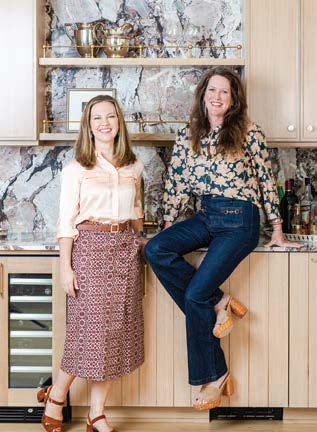
When it comes to communicating exactly what she wants, longtime pal Erica Worth hasn’t been the easiest client interior designer Kara Cox has worked with. For instance, when it came to the design of the Figure Eight family beach house, Erica simply told her, “I want the house to look like linen feels.”

Erica straightens up in her seat and tosses her friend a side-eye, the corners of her mouth turning up: “I wanna make Kara work for her money.”

Kara continues to needle her friend, whose Irving Park house project the two have just wrapped up. The inspiration this time around? Erica presented Kara with one solitary item: a throw blanket she’d brought home from Ireland.

“Seriously?” Kara recalls saying. “A throw — that’s it?”

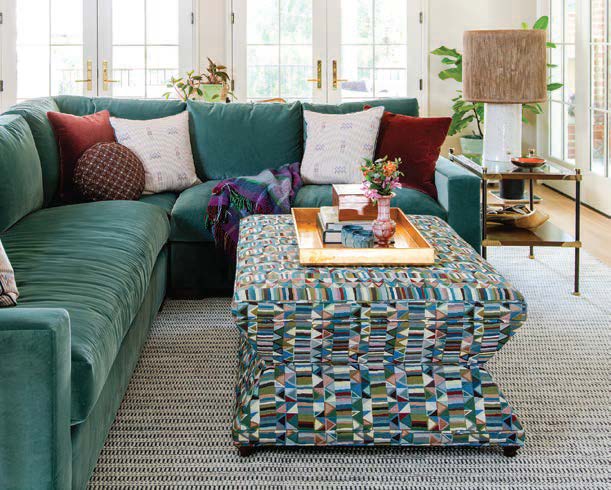
Her order was simple: “Make it look good in every room.” The wool plaid throw — in shades of plum, tan, gray and green — currently rests on the back of their family room sectional, just visible as you enter through the home’s front door.

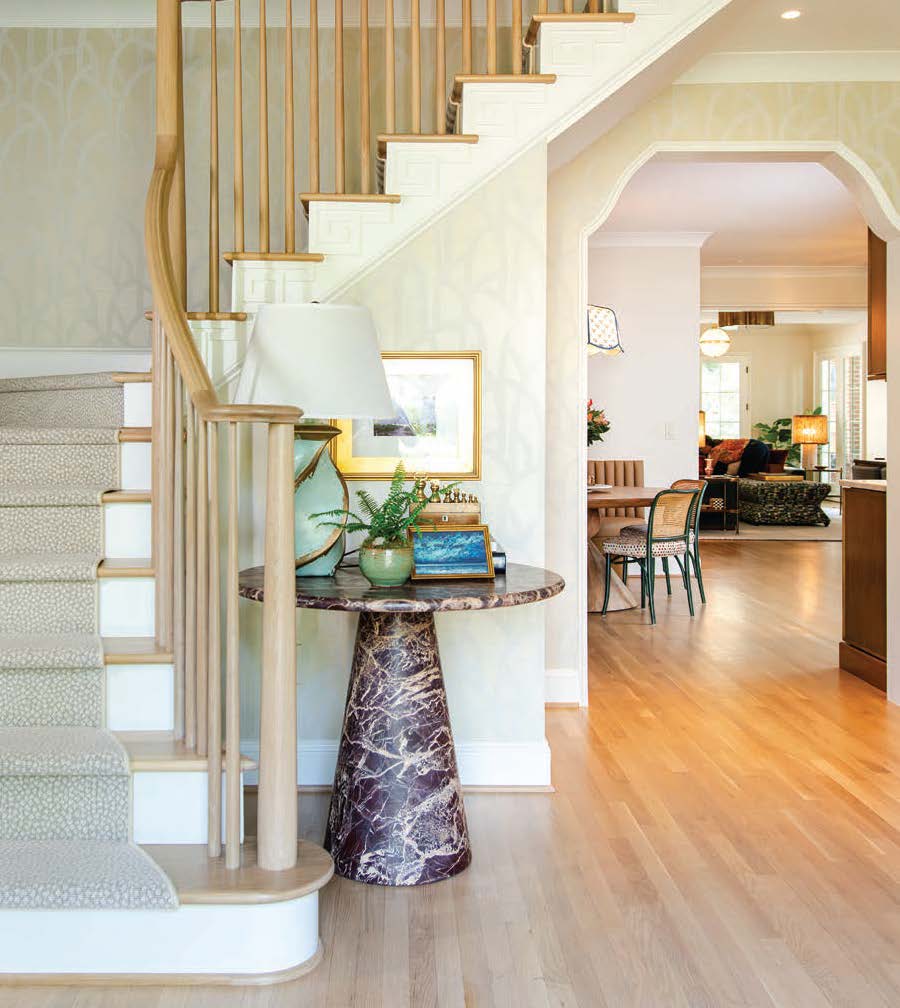
The door itself is a work of art, expressly designed with a circular space intended for a large-scale, brass lion-head knocker reminiscent of Narnia, original to the 1996 home. “A labor of love,” according to Erica, it’s a custom-built, glass-paneled beauty that allows plenty of light to shine on the newly remodeled foyer and interiors, making it easy to see that the mission was indeed accomplished.

“In every house that I build, I try to put something that was there originally, whether it’s a light fixture or a door knocker or a piece of ironwork or something that belonged to that house,” says Erica. Serving as her own general contractor, she ended up taking the entire first floor of the two-story brick home down to the studs.

She hasn’t always been a contractor, though. In fact, Erica says, “I am fairly new in my industry,” having earned her contractor’s license in 2018 and subsequently establishing her LLC, Worth Builders. While the construction business was in her blood — her own father owned a lumber business and worked in real estate — by trade, Erica had been a practicing accountant for most of her career.

Originally from Elizabethtown, Erica moved to Greensboro in 2003 to work as an accountant for VF Corporation. Soon after, she was introduced to her husband, David, who grew up around the corner from their current home and is now CEO of Worth Industries, “a family of businesses,” including Innisbrook, Shamrock, Lewis Logistics and Capitol Medals. While the two had crossed paths at UNC-Chapel Hill, it wasn’t until they were both living in the Gate City that they really got to know one another.

“It was love at first sight,” says Erica, seated on a blue channel-back chair and wearing a knee-length chambray dress, her brown hair pulled back casually in a loose bun. With a laugh, she adds, “He didn’t know it, but I did.”

Eventually, the couple married, bought a house in Kirkwood, and started a family. With little ones at home, Elsa (now 17) and Percy (now 15), Erica left her full-time job, but, in order to keep some skin in the accounting game, sought a part-time role.

Through mutual friends and activities, Erica became acquainted with Kara Cox, who had just launched Kara Cox Interiors. The two even had daughters in preschool together and their second children, both boys, were just a year apart. They each understood the demands of being working mothers.

“I was looking for a bookkeeper and part-time office manager,” says Kara. “My office was so small we could not work there at the same time!”

“I was picking up paperwork and bringing it back to my house,” adds Erica.

The business growth exceeded Kara’s expectations, who assumed she’d work part-time while raising her own children. “Then it just snowballed and it got to the point where I was like, this is getting bigger than I thought it would.” Her office would move from the closet-sized space at Revolution Mill to a larger site on Banking Street and finally to its current location on State Street.

With that rapid growth came a greater workload for Erica. “Too much,” she says. “And Kara needed more out of me.” In 2016, after working for Kara Cox interiors for five years, Erica decided to leave.

Plus, in the meantime, Erica’s family — and its needs — had grown with the birth of her last baby, Percy, now 12. In early 2014, the Worth family moved into their current Irving Park home.

While no longer employee-employer, the two women remained friends and have collaborated on a handful of projects, adding a new relationship to the mix: contractor-designer. Now, Kara says, “We don’t really remember not knowing each other.”

But that time working for Kara opened Erica’s eyes. She left knowing two things for certain: One, like Kara, she wanted to work for herself; and two, she wanted to be a part of the construction and real estate world. “If I hadn’t gone to work for Kara,” she says, “I probably wouldn’t have been as inspired.”

Newly invigorated, she began snatching up and rehabbing rental properties not far from home, maintaining a part-time schedule and working within a 2-mile radius. But she and David had always said that when their youngest, Percy, headed into second grade, it would be time for Erica to go back to full-time work. Her solution? Become a licensed contractor. That way, she could make her own hours. These days, she plans her projects to run September through May, allowing her to be flexible for her family’s needs while also making time for the things that feed her soul — tennis, yoga, the beach and her beloved mahjong matches.

Green in her industry, she called up Kathy Cross of Southern Cross Homes, a general contractor with over two decades of experience under her tool belt, and asked her to meet for coffee. They traded pleasantries, Erica recalls, “And then finally she’s like, ‘What do you want from me?’”

“I want you to be my mentor,” Erica told her. Since then, she and Kathy have partnered on projects, including some brand-new builds. “She’s been able to show me the ropes.”

Shortly after Erica earned her license, she and Kara once again entered a working relationship when the Worths hired Kara Cox Interiors to design the family beach house in Figure Eight, damaged by a hurricane and in need of a revamp.

“Erica hired a contractor who really didn’t — ,” Kara starts.“ — pan out,” Erica finishes. She hadn’t anticipated taking over the job that far away from home, but she stepped up to get it done.

“Basically, during that process, she ended up becoming the contractor,” adds Kara. And that project became their first collaboration, followed soon by an addition on Kara’s Greensboro home, a client project on Dover Road and, most recently, the Worths’ own Irving Park home.

When the Worth family moved in 10 years ago, they knew they would eventually renovate. What they didn’t know was how long they’d wait to do it. “We thought it would be in the five-year time period and then time just keeps slipping by,” says Erica. “And so here we are.”

But that wait served them well, because now Erica was able to take on the role of general contractor on her own home. And, when it came to construction, she had lots of ideas stirring around in her mind.

However, when it came to the design aspect, she knew she wanted to once again hire Kara Cox Interiors for the job from the get-go.

“I learned a lot when I worked with Kara and I just know that bringing the team together from the beginning creates the best result in the end,” says Erica. So before construction even began, she worked on the building plans, bringing Kara along at that early stage in the game.

Together, the two women picked out cabinetry, floor stains, hardware, a new marble mantel for the living room. When it came to all of the finishes, “it was collaborative,” says Kara.

“For sure,” echoes Erica.

And, together, they enjoy trying new things, challenging subcontractors to tackle projects they’ve never before tried. “The only way to really change the trajectory of architecture and design in a city is to push the envelope a little bit,” quips Kara. Both women wanted to experiment with new ideas in this home.

Case in point? The cabinetmaker told Erica he’d never created the style of cabinetry she and Kara had selected for this project. Her response? “Good, I’m glad that you’re getting a challenge.” In the end, she says, he was thrilled with the result — streamlined, flat-front cabinetry with beveled edges lending to a classically modern aesthetic.

Were there challenges that came with working together? Of course. “We’re strong women,” says Kara. “We have opinions. I think that’s what makes us great friends. We appreciate that in each other.”

With a plan in place, the Worth family moved out in June 2023 and construction on their home began the following month. David’s brother, Jon, a bachelor, lives a couple streets over and welcomed the family into his home for the time being. Fitz and Percy lived in the main house with Jon, while Elsa stayed on the ground floor of the garage, David and Erica just above her.

While it was a little chaotic, Erica notes that their relationship with Jon grew stronger and her kids know him so much better than before. With a hint of sarcasm, she adds, “He probably misses the rowdiness.”

“He probably misses you cooking for him!” adds Kara.

“That, too,” Erica agrees.

On May 6 of this year, the Worths left their temporary quarters behind and headed for home,  ready to be in their own space once again.

There’s a moment in every big project, says Kara, where the clients are exhausted and just want to be done. “They have decision fatigue, budget fatigue. They just want to get back in their house.”

She likens a renovation to childbirth “because the moment is so painful, but when it’s finished, you’re like, ‘Oh, I can’t wait to do that again!’”

Standing in the newly renovated front entry, the year-long renovation feels well worth the disruption.

Before, you could barely even see the rest of the main floor beyond the ’90s-style foyer. And behind that? “A maze of hallways,” says Erica, resulting in an awkward flow and tight quarters. Everything felt choppy and discombobulated. To get to the kitchen, you had to walk through the dining room. And to make that happen, the dining room table had to be off center to allow for a walkthrough.

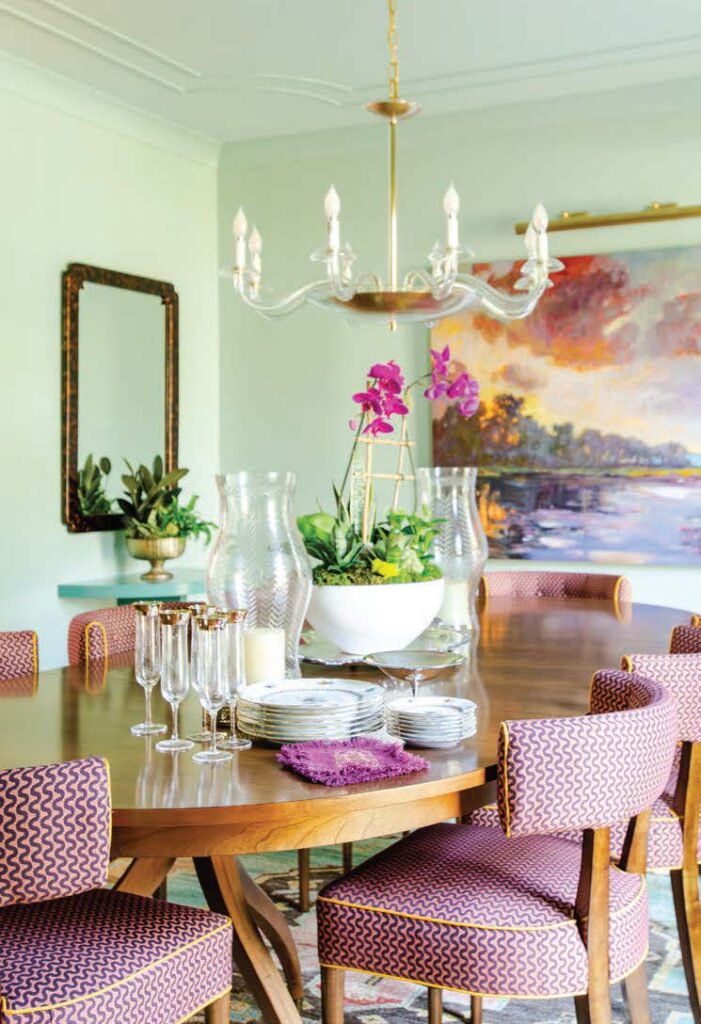
Now, the dining room features a new, warm-wood table Kara calls “modern classic” — centered, of course — surrounded by Klismos chairs. On the wall, flanking the newly installed almost floor-to-ceiling windows, drapes pick up on the purply-red tones in the Irish throw, the vibrant fabric popping off the cool green-gray walls. The pièce de résistance? Under a gold gallery light, a large landscape painting that looks like it was made for this room.

“When we did the presentation, we had all the colors and things selected,” says Kara. That day, Erica pulled out the painting, which had previously hung in David’s mother’s home. Kara couldn’t believe her eyes — it was perfect.

In the entry itself, Erica re-oriented the entire staircase, taking the foyer from two-story to one and adding a second laundry room upstairs — a huge plus for a family of five, including active, sweaty teenagers.

“We made a proper foyer and you aren’t confused about where you’re going,” says Erica. Plus, she points out three seamless doors that are practically hidden to the naked eye, wallpapered and disappearing right into the walls.

The wallpaper pattern is a simple tan-and-cream, large-scale, modern print. It took her some time to settle on that choice, she admits. “Kara was about to give up on me!”

“I was like, ‘We’ve seen every wallpaper there is!’” Kara chimes in.

In a “ta-da” manner, Erica waves her arms at the walls with a smile on her face. “Finally!”

With neutral walls, an entry rug features colors that unify the adjacent dining room and living room. “That’s all Kara,” says Erica.

The feature Erica is proudest of in the entry is a small architectural detail some may overlook — a brand new arched doorway that connects to the heart of the home. It’s a classic detail designed to give the house — not yet 30 years in age — a feeling of permanence.

“It was purposeful to make it feel older than it was,” notes Erica. Plus, she says, “I really do prefer classical architecture.”

“It didn’t feel like an old house before the renovation,” adds Kara.

As in an older home, that arched detail was carried throughout the main floor, repeated several times: in the trim on the dining room ceiling, in the family room fireplace surround, on the marble built-in bench in the en suite bathroom’s shower — off of a brand-new primary bedroom addition — and, lastly, in the tray ceiling created over the family room extension off the back.

They both pause and admire the new ceiling shape. “We’re the only people who will probably ever notice that this matches,” muses Kara.

“But I do think that women in general have a higher attention to detail than men do,” says Erica. “So when it comes to Kara being on a job site and me being on a job site, the details are in the project.”

On the far side of the addition, a built-in wet bar features light, modern cabinetry. But the standout? The aubergine-and-cream countertop and backsplash. While shopping for another client project in Charlotte, Kara spied this slab and immediately recalled Erica’s throw blanket.

“I sent her a picture of this slab and I was like, ‘Erica, this is it. This is to die for,’” recalls Kara.

Indeed, the details are in this project.

Beyond the back doors of the newly enlarged family room, the Worths added a large porch with a living space and outdoor kitchen. Eventually a patio with a grill will be added below, but, for now, the outdoor kitchen gets loads of use with its griddle, which Erica calls “a blessing.” Why? Because David loves to use it and often cooks the family dinner now.

While the interior kitchen remained where it was originally, the walls surrounding it were opened up and a larger window was installed. Surrounding the new window is a marble casing that matches the countertops. “Kara suggested that,” says Erica.

“That’s where I felt like we had a good time,” Kara adds, referring to the kitchen. Anchoring the space, a large oval island with fluted panels is topped by a dark gray-black marble. Opposite the side with stools is what Erica calls “the turkey oven,” because it’s large enough to roast the family’s Thanksgiving main course.

Another double oven is tucked away in the pantry. “Percy’s oven,” quips Erica, noting that the narrower capacity makes it perfect for baking pizza or chicken tenders. The pantry floors are classic, old-world black-and-white marble tiles. French doors inside are mirrored to create the illusion of more light and space. And on the counter reflected in those mirrored doors is the family pet, a cobalt beta, Le Bleu, named after Le Bleu water because “we own the Le Bleu distributorships around here.”

“What made you get a fish?” asks Kara.

“We’re not getting a dog,” says Erica with a laugh. Le Bleu swims peacefully, peering out from his glass bowl. Erica leaves the pantry light on for him.

Just around the corner from the pantry is a new custom-built, channel-back banquette, ideal for cozying around the table for family meals. A fabric pendant light hangs, adding a touch of color and shapely drama over the neutral table, chairs and upholstery. Too much drama? The baby of the family, Percy, seems to thinks so.

“There needs to be a crib underneath it,” he said when his mom showed it to the family before installation.

“A what?” she asked, certain she’d misunderstood.

“A crib.”

“Well, let’s just hang it and we can change it if it’s not what y’all are feeling,” Eric replied, ending the conversation.

Standing in the kitchen now, Kara rubs her hands together. “Oh, it’s so good!”

Plus, she defends her choice: “It needs that cool pop of color.”

It seems she’s a fan of the colors in the custom-made pendant shade. The dress she’s wearing features Grecian urns and she suddenly realizes it’s as if she meant to match the house’s color scheme.

“Oh, did I?” Kara says, looking down at her frock. “That’s funny!”

“She usually does match her projects,” notes Erica.

While this project is just nearing its end after a little over a year, Kara notes that she likes to “leave room for things to evolve,” even after a client moves back into their space.

“Take it slow,” she continues. “There’s a beauty to collecting and finding the perfect little odd or end and layering that in.”

What’s next for these two? Erica would love to do a custom build with Kara, starting from the ground up. “That would be fun,” Kara agrees. And though Kara is about to celebrate 15 years in business, she admits that she’s feeling inspired by the schedule and life Erica’s built for herself. Her own two kids are close to college-age — she’ll be an empty-nester at just 48 — and she wants more flexibility, too. “I am ready to take fewer projects and have more free time,” she says.

“I may be the only person in Greensboro who doesn’t play mahjong . . . because I have to work!” Kara says.

“I can teach you,” says Erica.

Clubhouse Rules

CLUBHOUSE RULES

Clubhouse Rules

You can have anything you want, as long as it’s salad

By Maria Johnson     Photographs by Bert VanderVeen

Gracious hostess that she is, my neighbor, Olivia Bonino, ushers me into her kitchen, the birthplace of many meals that she serves to guests who frequent the airy abode she shares with her younger brother, Connor.

Connor doesn’t cook much, but he does add a certain dinosaur-fueled pizzazz to the place.

Sitting at her plywood island, Olivia continues on the subject of food.

“This is where we prep it. Then they eat it. Some of it,” she says, explaining that her specialty is salad made from store-bought fruit such as blueberries, blackberries and grapes, along with “cucamelon,” a small hybrid cucumber that grows in her yard, plus a “secret ingredient.”

With that, she reaches out, grabs a branch of a scraggly plant growing at the edge of her kitchen, and pulls it closer to indicate that this is the good stuff.

“What is it?” I ask.

“Not sure,” Olivia says, adding that a guest once tasted it, and “he did not throw up or get sick,” so it has been a staple of her salads ever since.

A first-grader, Olivia saunters out of the kitchen to show off more features of her domicile, which she breezily calls a “clubhouse.” Others might call it a playhouse. Or a tree fort.

Call it what you will. It is her home away from home — like, 40 feet away from her official home — but it’s as much a refuge as any home, anywhere, at any price point.

The tour proceeds.

Here on the south side of the house, she explains, we have the climbing wall.

Here, on the north side, we have the wavy slide. She grabs a cord that dangles above the slide and demonstrates how, after descending, one might pull oneself back up the slide for another go, or, if she took a notion, rappel down the slide backward.

“That’s my favorite thing to do: walk backward,” she says.

We ascend the stairs to the second level, part the beaded curtains made from recycled ball-pit balls, and step into the 9-by-11-foot great room.

The view is stunning, taking in the emerald green outfield and part of the red clay infield of Greensboro Day School’s baseball diamond.

This was the home-run view that the builders — Olivia’s parents, Dominic Bonino of Greensboro’s Bonino Construction and his wife, Laura — wanted to highlight when they started making Olivia and Connor’s rustic haven in the fall of 2022, two years after moving into their home off Lake Brandt Road.

Olivia was 2 when the family relocated and Connor was not yet born, but Laura already had designs on a backyard getaway for the kids — and, occasionally, for the adults.

She was tickled to live next to a baseball field, given her family history. Her grandfather on her father’s side, Ken Keiper, was a well-known player, coach and scout in Western Pennsylvania. He was inducted into the University of Pittsburgh-Johnstown’s sports hall of fame in 2014. Laura remembers attending games as a child.

Moving in next to a baseball field as an adult, she was excited about watching games with her own young family. A couple of years after Connor was born, she pitched her idea to Dominic.

He had a blueprint in his head. It called for a deck, lofted and braced on three corners. The fourth corner would be bolted to a mature maple tree. Floating 6 feet above ground — high enough to see over the privacy fence — the deck would feature proper stairs, double-framed railings inset with welded wire and a gabled roof pierced by one of the maple’s limbs.

In the span of four months, mostly on fair-weather weekends, Dominic roughed in the perch. He asked his roofing subcontractor to send over a crew to shingle the gable and make it watertight around the branch. He asked several times.

“I think he was wondering if it was some kind of janky thing that wouldn’t support their weight,” says Dominic, who finally sent pictures of his craftsmanship.

“If I’m gonna do it, I’m gonna do it right,” he says. “I wanted it to be sound enough to where, if we wanted to get 10 adults up there, we could.”

Convinced, the roofer dispatched a crew. They gave the clubhouse a proper roof and used a vent boot and flashing tape to seal the hole around the tree branch, giving the maple room to sway and grow.

Soon, a wavy slide and climbing wall sprouted at the sides of the clubhouse. Laura gathered furniture and accessories, picking up pieces from family, dollar stores and the local Buy Nothing Project, an app that promotes member giveaways.

So far, her haul includes colorful handholds and footholds for the climbing wall.

Small plastic tables and chairs.

A couple of pillows that say “Relax.”

A thermometer that promises “Butterfly Kisses and Rose Petal Wishes.”

A plastic mirror salvaged from a baby’s crib.

A string of star-shaped lights, solar powered.

A dinner bell.

An eight-note xylophone for a doorbell.

A pouch-style mailbox.

A couple of John Deere license plates from her grandparents’ farm.

And a set of gymnastics mats, which Olivia, Connor and their friends pitch as an A-frame hut used chiefly for spying, Olivia says.

“By the way,” she says, nodding toward my yard. “Your bird feeder looks pretty low on food.”

When Olivia, her brother, and a constantly rising and falling tide of neighborhood kids are not spying and serving salads, they are often sitting at small tables, working on art projects. Sometimes, their creativity spills over to the deck railings, which are decorated with rainbows, illustrated menu items and other childhood hieroglyphics rendered in crayon and colored pencil.

And, oh, they watch baseball games.

They pull for the home team, the Bengals, during their spring season.

“Ben-GALS, Ben-GALS, Ben-GALS,” the pint-sized fans chant.

Once in a rare while, if they like the opposing team’s uniforms, they’ll allow a cheer for the visitors.

But they’re a heavily partisan group. If the Bengals are down, they have been known to heckle the other side.

“Your pitcher has a big butt,” they taunt.

Occasionally, Laura and Dominic call down their charges.

But that rarely happens because of the house rules, which Olivia distills to their essence:

1. No jumping or name-calling from the platform.

2. No ratting out people who break Rule 1.

Seated in tiny Adirondack chairs approximately 4 inches off the ground— I’ll worry about how to stand up later — Olivia and I take in the extraordinary view from her living area late one summer afternoon.

Cumulus clouds climb in the distance.

Traffic swishes by on a nearby road.

A breeze sighs through the leaves, casting a filigree of shadows on the pressure treated boards before our feet.

Does Olivia wish for more in her home?

Of course.

An elevator would be nice, she says.

And refrigerator.

And a bathroom.

And a zip line.

Still, these 99 square feet —198 if you count the ground-floor kitchen — give her what she needs.

A place to rest.

A place to create.

A place to wonder.

“It’s my mini-home,” she says.

Glorious Restoration

GLORIOUS RESTORATION

Glorious Restoration

A remade Reynolda landmark is beautiful to behold

By Ross Howell Jr.     Photographs by Amy Freeman

On a steamy August day, I’m driving along leafy Silas Creek Parkway in Winston-Salem, headed for Reynolda, the storied estate that is now part of Wake Forest University.

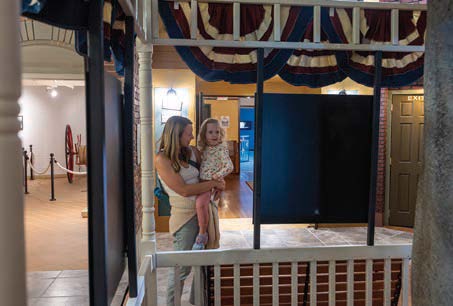
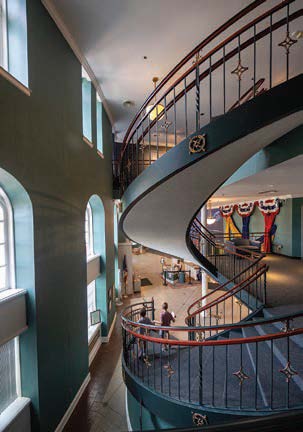
I’ve been invited to have a look at the top-to-bottom restoration of Reynolda’s gleaming, glass conservatory — the very first structure built on the property — before it opens to the public in October.

I turn at the entrance and pass the retail shops and eateries of Reynolda Village. Facing the parking area is a big sign that announces the impending opening of the “Brown Family Conservatory and Reynolda Welcome Center.” Just beyond the sign, I glimpse the glittering top of the structure formerly known as the palm house and greenhouse.

Work on the restoration has been going on for nearly a year, all made possible by a gift from longtime Reynolda supporters, Malcolm and Patricia Brown, who have three generations of family living in Winston-Salem.

I continue along a narrow drive, past walkers and joggers, and pull into a parking lot near the Reynolda House Museum of American Art. Completed in 1917 as the home of the R.J. Reynolds family, the museum now houses a permanent collection of three centuries of American art and sculpture, along with special rotating exhibitions and extensive online galleries.

I’m greeted at the museum entrance by Brittany Norton, director of marketing and communications. With Norton is the director of archives and library, Bari Helms. Prior to coming to Reynolda, she was an archivist at the Library of Virginia in Richmond. Finally, there’s Phil Archer, deputy director of Reynolda House. A native of Pennsylvania, he attended Wake Forest University for both undergrad and grad school, and has been with Reynolda for more than 20 years.

Helms has put together some materials, so we head for the archives. There, she directs our attention to a large rendering produced by Lord and Burnham, the premier builder of glasshouses in America during the mid-19th and early 20th century.

Helms slides the rendering toward Archer.

“Have you ever seen this?” she asks. “I found it in some boxes.”

Archer shakes his head, touching a finger to the edge of the drawing.

“I don’t think so,” he says. “Not with those perpendicular wings.”

“A little too ‘Versailles’ for Katharine, isn’t it?” Archer asks. He, Helms and Norton exchange knowing smiles.

Helms shows us a letter from a certain “Katharine” to Lord and Burnham, dated May 27, 1912. In it, Katharine details what she wants the conservatory to include — a palm room, a “good-sized” grapery, a tomato section, a large vegetable section, a propagating room and a “nice workroom.”

When Lord and Burnham responded with their plans and perspectives, and their quote for $7,147, Katharine wrote back that it was too much money. The greenhouse additions in the rendering were removed.

“In all her correspondence, you get a sense of how direct, hands-on and detail-oriented Katharine was,” Helms says. I don’t want to show my ignorance by wondering aloud who Katharine is, so I let them go on.

In December 1912, Helms resumes, Katharine wrote a letter to Lord and Burnham, complaining that the workers they’d promised had not yet arrived on site. In January 1913, she wrote again, noting that parts of the conservatory were not being built to her specifications.

“Katharine was very polite about it,” Helms says. “But insisted that she was making Lord and Burnham aware of the issue so they would fix it.”

No doubt they did.

And here I am, still wondering, “Who was Katharine?”

Those of you who know Reynolda just muttered, “Well, bless his heart.”

In my two decades living in Greensboro, until my visit today, I’d been to the estate only once, bumbling around Monkee’s of the Village, a boutique, while my wife, Mary Leigh, picked out a pair of Tory Burch boots.

So, for those of you as benighted as I was, here’s a quick study.

Born in Mount Airy in 1880, Katharine Smith Reynolds was a daughter of America’s Gilded Age and a wife in the Progressive Era of the industrialized New South. In the period photographs at Reynolda, she’s the young woman in the gorgeous outfits who doesn’t seem to be looking at the camera, but, rather, directly into your soul.

To this day, her spirit and determination inform every aspect of Reynolda.

Leaving her home in Mount Airy in 1897 to attend the State Normal and Industrial School — now UNCG — she later withdrew because of a typhoid epidemic and finished her studies at Sullins College in Bristol, Virginia. In 1902, Katharine joined the R.J. Reynolds Tobacco Company in Winston-Salem, where she served as personal secretary to the owner, R.J., a distant cousin who was 30 years her senior. In 1905, Katharine and R.J. married.

Between 1906 and 1911, Katharine gave birth to four children — at grave personal risk, according to her physicians, since she had been plagued with heart problems that started in childhood.

By all accounts, the Reynolds marriage was a happy one, and R.J. was confident in his young wife’s abilities, often consulting her on business matters.

Backed by her husband’s increasing wealth, Katharine began to purchase tracts of land near Winston-Salem. She would eventually acquire more than 1,000 acres, each parcel deeded in her name alone. Her idea was a Progressive one — to create a self-sufficient estate that included a country house, a farm utilizing the latest in technology and agricultural practices, a dairy, recreational facilities and a school.

The Reynolda conservatory was an integral part of Katharine’s design.

OK, class dismissed.

Archer and I leave the archives and head outside. As we approach the conservatory, he points out details — the iron skeleton of the structure, though all the glass and aluminum fittings are new; the foundations, built from fieldstones found on the property; the locations where the electrical lines are buried, hidden, just as they were when the village was being built.

“Katherine wanted the estate to look and feel like an old English hamlet,” Archer says.

“Burying utilities was high-tech for Katharine’s time,” he adds. “But that’s what she wanted.”

At the conservatory, I’m greeted by Jon Roethling, the director of Reynolda Gardens. He joined the estate in 2018, after serving as curator of grounds for the Mariana H. Qubein Botanical Gardens at High Point University. He has served in public horticulture and landscaping for more than 30 years.

Roethling’s been leading the restoration project.

He tells me that the work has been done by Cincinnati-based Rough Brothers (pronounced rauh), now a subsidiary of Prospiant.

“Rough Brothers has access to actual Lord and Burnham plans and molds,” Roethling says.

So, for the Reynolda restoration, the company could use templates on hand, extruding aluminum pieces to match the originals.

The tinted glass needed for the restoration was made by another company. Since it’s so specialized, the company only manufactures it twice a year. That was a big setback to Roethling’s schedule and delayed completion by months.

But the wait was worth it because the unsightly aluminum shutters added to the palm house and greenhouses in a previous renovation could be removed. Moreover, the manufacturer had the equipment to produce curved glass. This meant that the elegant shape of the original architecture — supplanted by the use of flat glass panes in a previous renovation — could be restored.

“When I walk into the palm house now, the architecture just sings,” Roethling says.

And there were the challenges of heating and ventilation — critical to a conservatory.

“We stayed with the original concept of radiant heat,” Roethling explains, “though the new system is very sophisticated.”

Ventilation was a trickier issue, since the conservatory is vented throughout — foundations, walls and roof. From the time the conservatory was built until this restoration, these many vents had to be cranked open or shut by hand.

“You have to strike this balance of having architecture that reflects 1913, but also having the convenience and efficiency of systems that are modern-day,” Roethling says.

“Knowing Katharine, one of the most progressive women of her time, I was sure there was no way she would want us to be hand cranking vents in this day and age,” Roethling continues. “So we made the jump to automated.”

The new system automatically responds to wind flow, wind speed and precipitation, adjusting ventilation as needed. Adjustments can also be made remotely, using Wi-Fi.

Recently, when Roethling noticed a thunderstorm developing nearby, he went to the conservatory to see how the system would respond.

“As the wind rose and the storm started rolling through, I watched the vents immediately close a bit,” he says. “When the wind grew stronger, the vents shut completely, protecting the greenhouses.”

We take a quick look at the welcome center, which is adjacent to the conservatory. It will be the orientation point for the facility. There are cabinet doors still to be hung and counters to be finished. In the future it will include plants, Reynolda-branded merchandise and historical information.

Leaving the welcome center, we step into the high-ceilinged palm room. The new tinted glass is working. While the area is warm, it’s not nearly as hot as I thought it would be on this sweltering summer day.

Walking outdoors to the open area in front of the conservatory, we have a full view of the central structure and greenhouses flanking it. The span, end-to-end, is more than 300 feet.

Sod has been laid the entire length. This will be a walking path for visitors. Between the edge of the sod and the foundations of the greenhouses are newly prepared planting beds, about 8 feet wide.

Roethling tells me that Reynolda has long been recognized for its peonies.

“The problem is, once the peonies bloomed out, that was pretty much it, visually,” he says.

With the restoration ongoing, Roethling wanted to do something significant about the peony beds.

“I needed someone who could do something amazing,” he says.

Roethling reached out to Jenks Farmer, a plantsman in Columbia, S.C. A published horticultural writer, Farmer served as director of Riverbanks Botanical Garden in West Columbia and was the founding horticulturist of Moore Farms Botanical Gardens in Lake City, both in South Carolina.

Farmer created a design for the peony beds incorporating other perennials that will provide visual interest throughout the growing season.

“Jenks is great,” Roethling says. “He loves balancing history with what’s relevant today. When he gets up here in a few days, we’ll lay out the beds and throw a team at them to get all the plants in the ground.”

Roethling smiles.

“It’s been a little bit like a three-ring circus,” he says. “I’ll breathe a sigh of relief when we open in October.”

Now he directs my attention to the conservatory.

“Each bay will have a different theme,” Roethling says. “This first bay will be in the spirit of an orangerie, which represents the birth of greenhouses.” (For the uninitiated, an “orangerie” is just what it sounds like, a greenhouse where orange trees are grown).  He explains that it will be filled with citrus trees, much like the original 17th-century orangeries in England and throughout Europe. The bay will also feature olive trees and other fruiting plants and will be used to illustrate a narrative history of the development of greenhouse structures over the centuries.

The next bay will be an arid greenhouse, featuring the five Mediterranean climates of the world — Southern California, the Mediterranean Basin, South Australia, South Africa’s cape area and central Chile.

“This will be a fun thing to educate kids,” Roethling says. “To explore with them how the plant palette changes, how the plants adapt.”

The central palm house will be elegant in its features. In big containers, there will be sealing wax palms with their deep red canes and tall Bismarck palms with their silver fronds.

“There will be a lot of texture — greens, whites and silvers,” Roethling adds. Visitors will be able to compare the broad texture of a palm frond to, say, the fine texture of a fern.

The next greenhouse bay will feature bromeliads, orchids and other flora that thrive in the tropics. And it will be about color — abundant, dramatic color. Listening to Roethling talk about this greenhouse, you hear his self-professed “plant geek” revealed.

“In here, I want to have freaky things that visitors walk up to and ask, ‘What is that?’” He smiles broadly.

The final bay will serve as a holding house for orchids that are resting. The plants will be organized by types, with interpretative signage.

“Even though the orchids won’t be in bloom there,” Roethling says, “that greenhouse will still be beautiful and educational.”

Just as Katharine would have expected.

The Gathering Barn

THE GATHERING BARN

The Gathering Barn

A family creates a haven for togetherness and healing

By Cassie Bustamante • Photographs by Amy Freeman

On a 100-acre woodland in Meadows of Dan, Virginia, a newly constructed barn sits in an open field, nestled against the edge of the Blue Ridge Mountains. While on the outside it appears to be a standard barn, beyond its sliding doors sits the makings of an apartment, a sleeping loft, a garage and a breezeway made for entertaining. Rayhaven, as Greensboro residents David and Allison Ray have dubbed it, is a place they’ve built for gathering and healing, both for their family and others.

In 2020, amidst a global pandemic, Allison and David recognized that their 16-year-old daughter, Savanna, a competitive rower, was showing symptoms of a heart condition. How did they know? A pulse oximeter.

Because Savana’s grandparents are getting on in years and live nearby, they’d purchased one to check their own readings before visits to protect everyone against COVID. One day, they thought it would be fun to see just how low Savanna’s resting heart rate would be as an elite athlete. The result? “Her pulse was around 110,” recalls Allison. Dumbfounded, they went around the circle — Allison, David, younger son Luke (now 16), then back to Savannah. Again, 110 beats per minute. Plus, Allison says, Savanna had been experiencing some dizziness, which they attributed to the extremity of her sport: “In rowing it’s very intense. Kids row and puke in a bucket and keep rowing. Grit is kind of a thing!”

A visit to her doctor confirmed that there were some unusual things happening in Savanna’s body. Her doctor immediately ordered an echocardiogram and, from there, she was sent to get an MRI. The results did not provide the Rays the answers they desperately needed.

“There was a lot of mystery surrounding it,” says Allison. “And the only thing you can really do is just wait.” That wait would be three to four months filled with uncertainty. “As a parent, there’s nothing worse.”

Almost overwhelmed by the magnitude of what she had just learned, she turned to something that had helped her so often before: the solace and solitude that, in the past, a stroll around Country Park had offered. There, surrounded by nature, she allowed herself time to weep and collect her thoughts.

“I was getting so caught up in work and superficial things,” she admits. While much of the world’s workforce had found their jobs coming to a halt, as a busy CPA, Allison was still tackling spreadsheets, no end in sight. “OK, if this is a lesson for me,” she recalls saying to the powers that be, “don’t use her to teach me . . . If this is my wake-up call, I am awake.”

Determined not to overthink or overreact, she stepped away from the computer, tuned out the noise of the world around her and leaned into what her heart told her to do. “I just remember thinking, well, either my daughter is dying and I have to be the best version of myself because this is precious time. Or we’re going to be fine and I need to — in gratitude — be the best version of myself.” Either way, she says, “the answer was the same.”

For Allison, that meant slowing down and shifting her focus to “what matters — it’s family and love.”

She needed exactly what Country Park offered her that day — nature and a place to hike without people all around her. But as so many people sought a safe escape from home in the early pandemic days, trails became overloaded. And, with potentially two mystery illnesses on their hands — COVID and whatever was attacking Savanna’s heart — the Ray family decided to find a property where they could walk their own trails and spend time together.

With Allison’s ability to crunch the numbers financially and David’s work in residential real estate — everything from brokerage to rental property ownership — the idea of owning another property didn’t scare them. The couple spent months looking, which helped them really hone in on what was precious to them. Not only that, but their road trips to look for land offered a distraction from a potentially grim reality.

David says, it helped “to be looking to the future” — one that included their family wading in rivers, encountering woodland critters and stargazing beside a fire pit.

After looking as far as West Virginia, the couple realized they wanted something closer that they could easily get to for even something so short as a day trip. In Meadows of Dan, only 76 miles from Greensboro, they discovered a listing for 40 acres.

With the help of their Realtor, Karen Wilson of Five Star Mountain Realty, who knew the land and each parcel’s owners, the Rays were able to purchase several pieces around that original property, acquiring a total of 100 acres. “Our most premium piece was landlocked,” recalls David. “And we unlocked it by combining it with the things around it.” Now they have unfettered right of way and one mile of river frontage.

“The Dan River is known particularly for turning and this is a particularly tight turn, which is why we have so much frontage,” says David. Plus, he adds, another border features a tributary creek.

“It really came together nicely,” says David of the total property.

“It felt kind of heaven sent,” Allison chimes in.

And right around the time they closed on their new property, they received what David calls their “first not bad news.” Savanna’s heart did not seem to be failing. She was making progress in the right direction.

“It was a very optimistic day,” says Allison. “But in all of this, nothing is definitive.” They’d have to await a second positive report before the doctors would definitively say that she had really improved.

They found that family trips to the land, including with their Brittany spaniel, Winter, brought them much needed joy.

David sits on the sofa of their New Irving Park home, Winter’s copper-and-white head lazily resting in his lap. “You want to see this lump on the couch turn into a real dog,” he says, “all you gotta do is take her up there.”

“She’s kind of a mini-human in Greensboro,” adds Allison. “And at Rayhaven, Winter is a dog.” Generally shy of lakes and pools, the family pet jumps gleefully into the Dan River, her exhilaration contagious.

“We would just all laugh,” Allison says about watching their beloved dog come into her intrinsic nature. “And we needed to laugh.”

What appealed to Winter the most was also what appealed to them — the freedom to roam riverside. And in the river — waders on or barefooted. While the property had once been owned by a logger who’d forged many paths, they needed cleaning up. “I have a chainsaw now!” Allison says proudly.

“Clearing trails,” she adds, “there’s a meditation in it.”

Once, the couple rode their ATV along a trail to continue clearing work, turned a corner and discovered that a large tree had fallen. Standing there, looking at the huge tree that blocked their path, they suddenly began to draw parallels with what their family was facing. “It’s not your plan,” says Allison, “but you lean into it and pace yourself.”

Of course, they knew that finding a builder in a small moun tainside community to create a rough barn-style home would be another challenge. Again, their solution seemingly came through divine intervention.

“We’re walking in the meadow on our property and our neighbor comes out and we start talking,” Allison recalls.

“And when we say neighbor, you can’t see his house,” adds David. “He comes through the woods because he’s wondering who’s trouping through the woods next to his house.”

That neighbor was Bonssi Vincenti, a commercial and residential builder who’d actually worked with Greensboro’s Landmark Construction for years and now ran his own business in Meadows of Dan. Just like that, they had their builder.

“He commuted in his tractor!” David says with a chuckle.

The Rays put a lot of thought into planning their barn, which they’d dubbed “The Gathering Barn.” Almost like a mud room, the entire structure had concrete floors throughout that accommodated wheelchairs and were dog-friendly. Rough sleeping accommodation were provided for stay-over family and friends and there’s even a sink for cleaning fish: “Purpose-built for gathering,” says Allison.

“For us, financially this was a big leap of faith,” says David, adding that the couple decided to occasionally rent it, but mainly use it for themselves.

“A friend brought her youth group and they did their retreat up there,” says Allison. And, on Easter weekend this past spring, a young couple booked the property to tie the knot. Allison’s chocolate eyes sparkle at thoughts of her own daughter’s future. “Savanna said, ‘Maybe one day I will have my wedding or rehearsal dinner there.’”

Overall, the barn is approximately 60 feet wide and 40 feet deep, divvied up into 20-foot-wide segments. On one side, tucked away behind sliding glass doors off the breezeway, sits much more than one would expect, essentially the makings of an apartment: two bedrooms, two bathrooms, a living room, kitchen, laundry and even an office space. “We worked so hard on engineering every inch of that space to have maximum usage,” says Allison.

On the other side is a largely open space they’re now using as a garage for their ATV. It also has the rough bunk space that sleeps seven to eight. Downstairs in the bunk side is where you’ll find the industrial sink and another large bathroom — including a big shower to hose off the dog.

In between both, the breezeway holds a table and chairs for playing games or enjoying cocktails from the rolling bar Allison had Vincenti build from plans she drew on a napkin.

But the real heart of the home-away-from-home is the fire pit just beyond the barn’s back door. Whether it’s in the morning with a cup of coffee or with a glass of wine looking up at the evening sky, the family can often be found relaxing in the seats surrounding it.

In fact, Allison recalls seeing several shooting stars, which she calls “angel winks,” when they were first scoping out the property. Because there’s such little light pollution, they can even see the Milky Way from the comfort of their Adirondack chairs.

While the Rays managed to eke every possible intended use out of their barn and forge new paths on the land, they relied on beloved friend and interior designer, Lee Miller, owner of Luckenbach Designs — named after her maiden name— to make it feel like a home. Allison met Lee years ago and hired her to help with their New Irving Park residence. Quickly, the two became close — kindred spirits, according to Lee.

Before planning the design, Lee took a trip to see the property with the Rays, specifically the spot where the barn would sit. “The minute I saw it,” she says of the view from there, “I just got tingly.”

Soon, Lee was on a roll, accumulating pieces in the Rays’ Greensboro garage — everything from art to furniture, even bedding.

“She’s got a great eye,” says Allison of her friend, whom she refers to as a “Red Collection maniac.”

“Every time I am going up, I am carrying a trailer full of stuff,” David recalls with a laugh. That “stuff” would be placed in a shipping container intended for construction supplies.

But Lee understood the needs of her friends and knew just how to marry practicality with aesthetics while sticking to a budget. After all, this property was “a financial leap of faith,” according to David.

As it turns out, The Gathering Barn ended up being a place of purpose for Lee, too. “But it’s her story to tell,” Allison says.

Meanwhile, Savanna’s health also kept moving in the right direction, though the Rays still didn’t have a diagnosis. And tragically, her pediatric cardiologist passed away suddenly. Savanna had just turned 18 — officially an adult.

Thanks to a friend’s referral, the Rays found Savanna a cardiologist, Dr. Steven Klein, who saw her rather quickly. “I call him Saint Steve,” says Allison. As it turns out, Dr. Klein was also a rower and the first medical professional to really grasp Savanna’s feelings toward her sport throughout this process, asking her if she’d grieved for what was lost.

“She was one of the rowers that was being considered at college level and she was doing it with a bad heart,” says David. “And so it was like, it was a double whammy because she’s like, ‘How good could I have been?’”

At that moment, “Savanna just burst into tears and sobbed,” says Alison. “And it was super healing for her — and for me to see that healing in her.”

Dr. Klein was able to finally offer them a medical diagnosis: myocarditis, an inflammation of the heart muscle that is usually caused by a viral infection. While it can lead to sudden death — especially with athletes — it usually will resolve itself over time.

And has Savanna’s cleared up? “She has some autonomic body regulatory things that can still cause some dizziness,” says Allison. “But we did, just a handful of months ago, get a definitive — and her best — MRI of her heart functioning, where she’s squarely in normal zones.”

These days, 20-year-old Savanna is enrolled at UNC Chapel Hill, where she’s studying public policy. At the time of this writing, she was off on a European adventure, studying abroad. Over the summer, Luke, who Allison says was “very endearing to her throughout all of this,” joined her to travel Prague, Munich, Salzburg, Switzerland and Italy. “The two of them are bebopping around.”

The kids still head up to the barn with their family, but often enjoy time spent with their own friends there. And sometimes a family member will reach out and ask David and Allison if they can head up for a day because they just need a moment to recharge, a place to reset.

“A mountain breeze and the sound of water,” says David, “those are just healing things.”

“And so it was that in its origin story and it continues to be that,” says Allison. “That’s the family legacy.”

Rayhaven, indeed, helped the Ray family through one of the hardest moments of their lives. And now, when Allison starts to feel the weight of the world on her shoulders, she goes back to the moment the seed was planted.

“I can see it, I can taste it, I can touch it. I remember exactly where I was on the loop at Country Park, and it is like a reset for me. And then I know what I need to do. I head up to the mountains.”

Collection and Collaboration

COLLECTION AND COLLABORATION

The Griffith Fine Art Museum at Red Oak Brewery

By Cynthia Adams

One day, Bill Sherrill said, ‘I need you here tomorrow at 1:30 on the dot.’ Was he firing me?” wondered Red Oak’s Anne Griffith. Due to illness, she had worked remotely even prior to COVID.

But now she was worried.

She found him “sitting at the sidewalk waiting for us to drive up.” A group stood outside the Lager Haus entrance where a large tarp concealed a sign.

With Griffith watching, fellow employee Joe Rickman stepped up, pulling the tarp away. She was shocked into speechlessness.

The sign proclaimed the future home of the Griffith Fine Art Museum.

The new museum was a testament to many things, including a collaboration between long-time friends.

“Bill had refused to put his name on it,” Griffith recalls thinking. “I didn’t deserve it. He did. He had purchased it. It’s his collection. I feel like I didn’t do anything.” While she insists Sherrill had spent far longer collecting, even before knowing her, he argues that she shaped and refined his focus.

Sherrill is adamant. “Bullshit. I couldn’t have done it without her.” As his long-time art advisor, Griffith, who began working with Sherrill 30 years ago, was due the honor. Working in tandem, Griffith and Sherrill sourced more than 500 works of art, excluding sculptures displayed in the biergarten between the two buildings.

She says the true genesis of the museum and event center at the Red Oak campus began much earlier. The museum itself was five long years under construction — but decades more in amassing the collection still being inventoried at this writing.

Griffith shares a revealing anecdote about Sherrill from his youth. When he was in his twenties, journeying to Texas to purchase a motorcycle, he returned with artwork instead.

Watercolors by artist Bogomir Bogdanovic in a Dallas, Texas, gallery caught his eye. Sherrill returned home with the artwork rather than the bike, having owned Indian, Honda and BMW bikes.

He kept the art, but not the motorcycles.

The two formally met in the 1990s when Griffith was eating at Spring Garden Bar and Grill at UNCG, one of Sherrill’s former brewpubs.

During lunch, Griffith openly admired the art on the restaurant’s wall, recognizing the work of her favorite North Carolina artist.

“I knew Jack Ketner and recognized the art as I had staged a show for him at Alamance County Firehouse Galleries,” she remembers. As early as the late ’80s and ’90s, Sherrill began collecting Ketner’s work.

Perhaps during her time as head of the Alamance Art Council, she had “almost certainly met Sherrill” during a Ketner opening. (Something which Sherrill confirms later.)

“I thought, ‘This is a man I want to get to know because he thinks like I do about art. A man who has good taste in art,’” she says. “He started talking to me about his life, and his history with artists and art.”

They came to better know one another in subsequent years, frequently comparing art tastes. At the time, she had left art administration and worked as a graphic artist. Her partner, Jimmy Allred, had begun working at Red Oak after losing a high-level state role, a political casualty, Sherrill explains.

“He came out to wash dishes at Franklin’s Off Friendly in a three-piece suit,” Sherrill recalls. “Of course, we put him to work, but not washing dishes.”

“Jimmy actually delivered the first keg of Red Oak beer!” explains Griffith, adding, “Bill kept telling me I was working myself to death . . . and that I should work for him.” She laughs at this, saying she jumped from the frying pan straight into the fire.

In 2005, Griffith was persuaded to come work at Red Oak after only one week’s retirement.

Initially, Sherrill installed a desk in a back room with the brewers, where she was immersed in the daily business of Red Oak, the inner workings and logistics of the brewery. Griffith recalls trading six boxes of beer for a better desk and a better office.

“I learned the business from the bottom up,” she says, observing the daily workings of what was fast becoming the state’s pre-eminent brewery, assisting with graphics for the bustling business.

In turn, Griffith shared her art training, education and important art associations, including her close friend Ben Williams, the first curator of the North Carolina Museum of Art (NCMA). It was an auspicious connection as Williams was charged with creating the NCMA collection.

“When Kerr Scott was governor, he got a million dollars to build a museum of art, and Ben Williams was then in Paris,” Griffith explains. “He called Ben and told him to come home to build the collection.”

“When Kerr Scott was governor, he got a million dollars to build a museum of art, and Ben Williams was then in Paris,”

Griffith explains. “He called Ben and told him to come home to build the collection.”

Sherrill visited Williams’ home in nearby Yanceyville and admired his personal collection. “He had a couple of Francis Speight paintings, which I grew really interested in,” he recalls.

“He seriously collected Speight later,” Griffith adds. “Bill and I both gravitate to those paintings.”

Together, Sherrill and Griffith logged untold hours visiting galleries, shows and museums while spending weekends searching auctioned works.

They made a pact to only buy what both liked.

As Griffith terms it, the collaborators were “hunting” for artworks. “We actually taught each other,” she says. Sherrill “was serious before I began hunting with him.”

“He would go to artworks and shows. He noticed art for sale in galleries when he traveled,” she says.

Flushing out their quarry, especially works by North Carolina artists, intensified.

The relationship between Griffith, an artist, and Sherrill, a hungry collector since young adulthood, grew familial.

Griffith cast a wide net via national auction houses, as well as longtime mainstay Leland Little in Hillsborough.

“We had Shannon’s in Connecticut, Swann Galleries in New York, Freeman’s, Gratz, Pook & Pook and Rago auction house” says Sherrill.

“Doyle, Brunk, Neil and Hindman,” she adds. Initially he relied upon art magazines to find works.

“Bill wasn’t much of a computer person,” she adds. “He’s become more of one in recent years. It’s something I mainly did.”

The art duo created a shorthand when scanning online art auctions, Griffith explains. “We finish each other’s sentences when discussing whether to buy or not to buy. It’s like talking to myself.”

“He’s right brain/left brain. Creating beer, creating flavors, is creative. But he has the right brain activity with the business side. Buying art uses his creative side, too.”

She believes “it’s rare to run into a right brain/left brain person . . . usually one side is much more dominant. Bill is a DaVincitype man.”

As the collection expanded into hundreds of artworks, sculptures and collectibles, it outgrew not only Sherrill’s home but even spilled into a tack room. It covered all available brewery walls and offices at Red Oak and even the gift shop.

The sprawling private collection had finally “morphed into adding a museum,” says Griffith, who kept copious notes while cataloguing when not designing graphics.

Sherrill visited museums in the North and Southeast and out West seeking ideas on display and storage.

In 2019, with Boyd Chatman as lead contractor, Red Oak broke ground on a 12,000-square-foot building adjacent to theLager Haus. (Sherrill unreservedly praises Chatman, who has been involved with most of his buildings in the past decade. “He is one of the finest men I ever met.”)

Hampered by the pandemic, the new building proceeded slowly.

Months later, Griffith is still ambivalent about accepting the honor of museum naming.

“I was telling Jimmy that it has taken blood, sweat and tears — and fright — to put this collection together,” she finally concedes, collecting her thoughts during interviews before the opening night.

“Blood? Yes! We’ve both had splinters from 19th-century canvas stretchers. Sweat? We both have sweated moving that collection from place to place to place.”

There were occasional tears, too, such as when a rare painting from a California gallery arrived damaged beyond repair. They gasped; the actual work was as beautiful as they had hoped, but ruined.

Despite such disappointments, the collection was honed, steadily incorporating works from the South and northward, acquiring artists from Bucks County and the Hudson River Valley.

For most of his life, Sherrill had long found artwork irresistible.

The Winston-Salem native bought his first piece of art in Old Salem while a college student—a watercolor he has kept.

Sherrill says the spark to understand and collect artwork was first lit by another Anne, Anne Joyes (now Mondon) when she was a young French au pair working in Virginia, and he was in the Coast Guard during the Vietnam War. He dated Joyes “10–15 years,” frequently visiting her in Giverny, France.

A 50-year friendship endures. He ticks off what he has realized through friendship with Joyes, whose sister Claire was married to Jean-Marie Toulgouat, grandson of American impressionist Theodore Butler. (Toulgouat was also Claude Monet’s great-grandson by marriage, and grew up at Giverny, where he painted.)

Both of the Toulgouats “were on the board of the Monet house at different times. It really got me into art, because Jean-Marie had a number of Monets and his grandfather’s paintings.”

“One thing I learned from Anne and trips to France is I loved Impressionist paintings.” Another thing he picked up is that “art is much more interesting if there are people in the paintings — if they tell a story.”

Now, there are three Theodore Butler works in Sherrill’s museum’s collection. One is of Toulgouat’s house.

Sherrill’s second art acquisition was by Toronto artist Wolfgang Schilbach. He still owns the picture of a house on the prairie, which hung in his bedroom.

After eventually going on to earn a graduate degree in hotel administration from Cornell University, he “spent all my nickels on things I liked.”

And he liked art. In a world teeming with unusual art museums combining unlikely things, a personal favorite is the German Museum of Bread and Art in Ulm. The Museum Brot und Kunst, as it’s called, houses Rembrandts and Picassos as well as fundamentals of bread making.

Now, Red Oak Brewery, just off I-40/85 in Whitsett may be the first of its kind, too, pairing fine art — in the newly opened Griffith Fine Art Museum— with fine beer.

Red Oak has steadily expanded its footprint since opening the expansive Lager Haus in 2018. The two-story-high, sleekly modern facility incorporates Museum space and an event center. Combined with the existing Lager Haus, that equals 24,000 square feet for the two public buildings — excluding separate offices and Red Oak’s brewery operations, which opened on the 12-acre site in 2008.

Sharing an entrance with the museum, which opened on April 25, the Lager Haus patrons, as Sherrill envisions, can experience an array of art after enjoying his signature Bavarian-style lagers, which draw appreciative fans.

His vision is similar to that of late Napa Valley winemaker and art collector Donald Hess, who created the Hess Persson Estates winery and museum complex, operating adjacent to the winery operations and tasting room. (Sherrill visited several years ago while building his museum.)

The two eclectic collections and museums — that of Hess and Sherrill — also invite other comparisons.

At Red Oak, the admission is free and the soaring Museum spaces are exceptional. Also, the respective museums showcase their founders’ private art collections, while operating a thriving, spirited business.

If it seems intentional, it was. Sherrill believes that art should be shared with the public.

As soon as he graduated from Cornell, he put his degree to work, creating and operating restaurants. His first, a fine-dining establishment called Franklin’s Off Friendly, April 27, 1979.

Memorably, the upscale Guilford College restaurant was run by a crack staff (Dennis and Nancy Quaintance met at Franklin’s when Nancy worked there during a Christmas break.) Restaurant reviews were praising. Despite winning repeated acclaim fromcritics (Franklins’ wine list won top praise from no less than Wine Spectator magazine), Sherrill felt unfulfilled and stressed.

Friend Nancy Willis, a Reiki practitioner, gave a salient warning.

Absent change, Sherrill would die young.

“I tried too hard,” he explains. He shut Franklin’ s down in 1989, reconfiguring it into a brewpub.

Beer making emerged as Sherrill’s chief focus. He took a new tack, selling beers to others as well as his own bars and grills, all made in the style of Bavarian lagers.

“We’ve only used one lager yeast strain for 34 years,” he says, also hewing almost religiously to the laws of purity that originated in Bavaria in 1516.

Meantime, Griffith explains her friend and colleague was simultaneously “loving art and dreaming of a museum.” A longtime idea, Sherrill admits.

Sherrill sought out art at auction and during travels. Works spilled over onto every inch of available wall space in his home and businesses. Initially unsuccessful in trademarking the name of one of his early beers, “Oak Ridge Amber,” he noticed Big Oak Drive-In on a mountain trek. That inspired the name “Red Oak” for his expanding lager-making operation.

Red Oak Brewery is now the oldest still-active brewery in the state.

Soon, too, a museum wasn’t merely a desire — it was a practical necessity for a robust collector whose drive to acquire art was on par with his ambitions for beer and lager making.

What is it like when a dream — an audacious dream at that — to build your own museum comes to life?

“I’m never looking back,” Sherrill answers after a pause. “I’m always looking forward.

He pauses again. “I’ve got a couple of projects coming up.”

“Try not to believe your own bullshit,” he comments drily.

Possibly influenced by his Moravian upbringing, Sherrill is known as private and self-effacing. He bats away compliments. “I am so much luckier than someone who grew up in poverty.”

He points out all the advantages of his birth: a good education and middle-class upbringing.

“I started at the 30-yard line,” he repeats frequently, making it clear he takes none of it for granted.

But on the night of the Museum’s soft opening in April, Sherrill’s mood was bittersweet.

He moved amongst 100 guests, including Leland Little, sculptor Billy Lee, writers, bankers, an art restorer, art framers, Red Oak staff and assorted friends, such as Dr. Neville Gates and Nicole Shelton. Wearing a white Nehru-collared shirt and jacket with jeans, he was affable yet subdued.

Notably absent that night was Anne Griffith, Sherrill’s longtime friend and collaborator — and the Museum’s namesake. Too ill to appear, he felt her absence.

As people experienced the sleek Museum for the first time, Sherrill mentioned that much of the museum’s realization was owed to Griffith. Nearby, a pianist played a baby grand installed on the first floor for the occasion.

“The museum?” Sherrill repeated in clarification, “I credit much of this happening to her.”

Pointing proudly to his friend’s portrait hanging on a museum wall, his eyes welled.

“Doesn’t Anne look like a movie star?”

Shelton understood that Griffith was among his most important friends. She noted quietly that it visibly pained Sherrill that she couldn’t share in the moment they had both worked towards.

Having said a “a well-run business is a boring business,” Sherrill says the business of art is also about putting in the hours.

If done well, it grows rote.

The inaugural show, “Southern Artists,” was curated by the museum’s first director, Susan Harrell, who has appeared in these pages, and features many of the collection’s early acquisitions.

“The first show is all Carolina-based artists,” says Sherrill.

Apart from blood, sweat and tears, Griffith believes Sherrill’s creative drive willed the museum into existence.

Those closest to the colorful businessman also describe a creative defiance of convention that allowed him to beat the odds. If one does whatever it is you love, Sherrill frequently insists, “then you never have to work another day.”

The entrepreneur loves art in equal measure to his lagers. Now a private museum, namesake of a valued friend and art guide, proves the point beyond any doubt.

Nights of the Opera

NIGHTS OF THE OPERA

Nights of the Opera

Director David Holley tells timeless stories on the stage

By Ross Howell Jr.

Photographs by Lynn Donovan

What happens in the Greensboro Opera Company’s production of Gian Carlo Menotti’s Amahl and the Night Visitors is magical. But it doesn’t happen by magic.

When David Holley, general and artistic director of the company and director of opera at UNCG, invited me to rehearsals last November, I jumped at the chance. After all — I hadn’t attended a rehearsal since playing clarinet in high school band practice!

So there I sit, in UNCG’s beautifully renovated and modernized auditorium, on a Tuesday night after Thanksgiving. The company is just two weeks from opening at the Pauline Theatre, located in High Point University’s Hayworth Fine Arts Center. 

The scene at the rehearsal seems anything but magical: Individuals dressed in casual clothes are milling about the auditorium and on stage, chatting and laughing. I notice that the singer who plays Amahl’s mother is wearing knee pads. The stage lighting seems harsh, casting shadows and washing out colors.

An accompanist at a piano on stage is talking with a boy who’s  leaning on a crutch, a wooden flute slung over his shoulder. That’s Amahl, of course, aka Thomas Burns, the 10-year-old soprano from the Burlington Boys Choir who’s playing the part.

For a few moments I speak with Greensboro native, John Warrick, a performer in the chorus. He tells me he received his musical part via PDF, learning it on his own long before rehearsals began.

Then, at a table next to the orchestra pit, a young woman seated with her back to the audience rises and turns. She has raven black hair that hangs down her back.

This is Hanna Atkinson, the stage manager. Hers is not a role that immediately comes to mind when you think of the opera, but you soon realize she’s indispensable. Opera has lots of moving parts.

“Rehearsal is open,” she announces. “Chorus should come to the stage. Kings should come to the bench.” She gestures to the row of four metal chairs upstage representing the “bench.”

Warrick heads off to join his colleagues.

The director and cast run through several scenes, and soon Irealize why Amahl’s mother is wearing knee pads. There’s a lot of lying down and getting up from “bed” before the kings arrive. But there are no beds, only the bare stage floor taped to indicate them, so the actors kneel or recline.

After a humorous singing exchange where Amahl tells his incredulous mother that he sees one . . . then two . . . then three kings knocking at their “door,” the kings make their entrance oneby- one and sit down on the “bench.”

The character Amahl is disabled, so through all the scenes rehearsed, Thomas must hobble about the stage on his crutch, dragging a foot.

“Thomas, your timing was perfect,” Holley says. “You brought them in perfectly.”

The kings are about to sing. Holley nods to the pianist, then raises his baton.

“Thomas?” Holley asks, craning his head around to look downstage. “Where are you going?”

Thomas is carrying his crutch in one hand, a sneaker in the other. He walks to the edge of the stage, drops the sneaker into the darkness, then hobbles back on the crutch to take his mark near the kings, having realized it’s easier to drag his foot in a sock across the stage instead of in a rubber-soled sneaker.

Holley nods and I smile. Too bad the grownups didn’t think of that.

The rehearsal continues. There’s a glitch when the kings enter from the back of the auditorium and miss the row they’re supposed to turn on to access the stage. The procession has to regroup and start all over again.

“Remember as you come in to watch my beat,” Holley says. “Don’t listen for it — watch, or you’ll fall behind the tempo.”

“And hit your marks,” he adds. “Otherwise, you’ll get all bunched up.”

The rehearsal lasts about two hours.

All the while, director Holley coaches, cajoles, encourages, praises. He reminds his singers to tell their choirs, church groups and friends to attend the performances. He reminds the kings that they’ll meet the following evening for practice.

Then stage manager Atkinson announces the rehearsal is closed. I feel as though I’ve been watching a documentary. And in my heart of hearts, I’m wondering, Will this turn out OK?

After very successful performances at High Point University, the company has returned for a final dress rehearsal at UNCG Auditorium, where they’ll present their closing performances of the season.

Even outside the building, there’s a completely different vibe. Lots of case-carrying orchestra musicians are making their way toward the auditorium, for one thing.

Lynn Donovan, the photographer for this story, lets me in the front door, along with a young cellist who’s unfamiliar with the cast entrance location at the side of the building. Donovan takes off to finish setting up her gear as the musician hurries across the lobby.

As I’m crossing the lobby, I see Thomas Burns emerging from a dressing room in full costume. A woman holds a crutch and wooden flute by the door. Turns out to be a happy surprise.

I recognize her — Patti Burns, lecturer of French at Elon University. We’d met, because I shared an office with her husband, Dan Burns, assistant professor of English, back when I taught part-time at Elon.

When I ask her about being a stage mother, we both laugh, and Thomas looks doubtful.

“Do I know you?” he asks.

“No,” I say. “But I was working with your father the year you were born.”

Thomas gives me a wary look and takes his mother’s hand. They head for the stage, and I find a seat in the audience, settling in for another night at the opera.

A few members of the cast have not yet retreated behind the curtain. I can hardly recognize their faces, since they’re in full makeup and costume. The kings have beards and flowing robes. The faux jewels in their costumes glitter.

The orchestra is invisible, though I can hear them in the pit warming up. I caught a glimpse of Holley as I walked in, but he too is now invisible.

A single trumpet player runs through scales. The strings are tuning. I can hear the strains of a harp, the muffled thumps of percussion. The violin flourishes run faster and faster. The brass and woodwinds grow louder. Then, suddenly, there’s silence.

At 7:01 p.m., the house lights go dark. Immediately, I hear Holley’s voice.

“One of the spotlights isn’t working,” he calls. I hear a voice in the wings respond, then watch as a big man ascends a ladder until he is out of sight.

I hear a clink, and the light comes on.

There’s a scattering of applause and laughter in the orchestra pit, and then, Holley’s voice.

“Let’s hear it for Scott Garrison!” he says. Garrison is the auditorium’s technical director.

There’s louder clapping, flourishes from the violins. The curtain rises.

The empty, garishly lit stage I saw at my first rehearsal is transformed, bathed in the deep blues and purples of night. There is a wall, a door, a bench. Rough-hewn pallets for sleeping. The set is bathed in warm, yellow light. A single star, the star the kings are following, shines brightly in the midnight blue firmament.

“Thomas, give me a G,” Holley says. He wants to make certain the boy has the right pitch for the Amahl solo they’re about to rehearse.

Thomas sounds the note and the music begins.

There’s still tweaking. Sound amplification for the first violins section is improved. Additional adjustments are made to the stage lighting. There are corrections in tempo, pitch and spoken lines. It’s a rehearsal, after all.

When the kings make their entrance from the rear of the auditorium — honestly — it’s thrilling. Voices booming, perfect tempo, perfect spacing. I hold my breath as they ascend steps to reach the ramp onto the stage, but no one trips on those long, beautiful robes.

Thomas’s soprano voice nicely resonates with the eagerness and purity of youth. The arias Amahl’s mother sings are beautiful and moving. And a pair of dancers, choreographed by Holley’s colleague in the UNCG school of dance, Michael Job, enhance the chorus’s welcoming celebration for the kings.

Later, Holley calls individual performers downstage, almost like a curtain call. Some musicians in the orchestra play short solos. The mood is celebratory. Then, rehearsal is over.

Holley tells me Amahl and the Night Visitors is the ideal opera to introduce people to the art form.

“It’s short, it’s in English, it’s got beautiful singing, it’s got a wonderful orchestra, it’s got stunning visual arts, it’s got dance, it’s got choral music,” he says. “It’s the perfect opera in miniature form.”

And it’s magical.

While I know that you’re just as excited as I am to see Greensboro Opera Company’s next performance of “Amahl and the Night Visitors”, you’ll have to wait until a new production is scheduled.

Still, in October, you can take advantage of a very special opportunity. The company is presenting “Don Giovanni”, with music by Wolfgang Amadeus Mozart and libretto by Lorenzo Da Ponte.

Holley tells me the production will be a “semistaged concert version,” meaning the orchestra performs on stage, rather than being hidden in the pit. The singers, in full costume, perform the opera downstage, right in front of the audience.

For those of you whose command of the Italian language is like mine, never fear — an English translation of the lyrics will display above the stage during the performance.

Based on the Don Juan legend of a Spanish nobleman who takes pride in his ruthless ability to seduce women, the opera premiered in 1787 in the city of Prague, with Mozart himself conducting. Sources describe the audience response as “rapturous and jubilant.” Some critics call “Don Giovanni” Mozart’s “opera of operas,” one of three masterpieces he created with librettist Da Ponte.

“It’s a very exciting production,” says Holley. “The story of “Don Juan” is timeless,” he adds. “You find versions of it in many cultures.”

Here’s the lineup of performers.

Sidney Outlaw returns to the Greensboro Opera to sing the title role of Don Giovanni after playing Jake in “Porgy and Bess”. Outlaw holds a B.A. in music performance from UNCG and a master’s from The Julliard School. He has performed internationally and is on the Manhattan School of Music faculty.

With a master’s of music from UNCG, Melinda Whittingon will sing the part of Donna Anna, a role she’s also performed with her home company, Opera Carolina, in Charlotte. She has sung with many operas, including The Metropolitan Opera in New York, and is an adjunct professor of voice at Davidson College.

Singing the role of Donna Elvira is Samantha Anselmo, who is pursuing doctoral studies in vocal performance and pedagogy at UNCG. Previously, she taught music and voice classes at the University of Southern Alabama. She has performed in two Mozart operas, “Così fan tutte” and “The Magic Flute”.

With a master’s degree of music in vocal performance from UNCG, Amber Rose plays the part of Zerlina in “Don Giovanni”. She performed recently in Opera Carolina’s production of “Madame Butterfly” and was the soprano soloist in Mozart’s Coronation Mass with the Masterworks Chorus of the Palm Beaches.

Another UNCG alum, Christian Blackburn, holds a master’s degree of music performance and is singing the role of Masetto, which he has previously performed with the North Carolina Opera in Raleigh. He has taken a step back from fulltime performing and runs a financial planning and advisory practice in Greensboro.

Donald Hartmann plays the role of Commendatore. He is both a UNCG alum and a colleague of Holley’s, earning his bachelor’s and master’s degrees of music, and serving as professor of voice in the college of visual and performing arts. He has performed more than 75 operatic roles in Europe, Canada and the U.S.

Holley is especially pleased that so many of his former students are returning to Greensboro to perform.

“That’s the beauty of the jobs I have,” he continues. “I wear these two hats — one as director of opera at UNCG; the other as general and artistic director of the Greensboro Opera Company.” In these roles, Holley not only trains young people who aspire to careers as singers, but also hires professionals to perform with the Greensboro Opera.

“Almost all the singers who are doing “Don Giovanni” in October came through my program or are colleagues,” Holley says. “I would say the UNCG College of Visual and Performing Arts is the flagship institution of music in North Carolina.”

Holley muses for a moment.

“You know, opera in this country has a stereotype of not being accessible,” he continues. “People think of it being the fat lady with the spear and the horns and that’s not what it is.”

“Opera is the greatest storytelling on stage,” Holley says. “That’s what we do. We tell stories. We just happen to put it in a context that uses beautiful music, and music speaks to your soul in a way that words by themselves cannot.”