When I mentioned my long-held dream of a White Trash Banquet in an O.Henry editorial meeting recently, I got shushed. Shushed! And some fingers actually wagged.
“B-b-b-b—but,” I protested. “I am white trash! I can say it!”
I was shut down by the youngest among us who said, “You will die on that hill.”
As they say in Hell’s Half Acre where I was raised, “It don’t matter.”
Turns out, it don’t matter if I think I can say white trash even though I am white trash. Take my Georgia writing friend Lauretta Hannon, whose moniker is The Cracker Queen. Her beautiful memoir revolves around trailer park life and a mama who liked to buzz past chain gangs as Lauretta threw packs of ciggies out the car window. They may have been regarded as white trash, but they were lovable, thoughtful white trash.
But that was 10 years ago. And the name, “Cracker Queen,” probably won’t fly now either.
When Ernest Matthew Mickler’s White Trash Cooking hit the shelves in 1986, it was a publishing phenomenon. You could argue it was the equal and opposite reaction to the era’s Silver Palate Cookbook, and snooty restaurants that served up tiny portions — for big bucks. Sure, WTC had the support of local arts patrons Charlotte and Philip Hanes, but it wasn’t so much a rebuke as an homage to what most Southerners ate for generations. I had it for years until I lent it to someone. For the record, I want it back.
Garden ’maters on white bread? That’s a “Kitchen Sink Tomato Sandwich.” Who hasn’t bent over a sink with Duke’s mayo and tomato juices streaming down their chin?
One of my favorite observations about a tomato sandwich was when a farmer told me, “A ’mater sammich ain’t nothing but sunshine in your mouth.”
He was proud of his ’maters that year. They were sunshine in the mouth.
Say “white trash cooking” and most Southerners realize it isn’t necessarily a bad thing. It may connote fat ’maters, fatback or lard. But white trash cooking encompasses a world of things that ought not be left behind. Beloved, if lowbrow. (Like Vienna sausages. Pork and beans.Or a fried baloney or livermush sandwich. Nobody actually says bologna, as spelled on the pack. That would be pure-t baloney. And we know Vienna is a place but who doesn’t say VYE-ee-na?)
It is in the eye (and palate) of the beholder. My Mama thought frozen coconut pies were white trash. But she raised a daughter who loves them, along with honey buns and Little Debbie cakes. Little Debbie came of age during the Great Depression. Her oatmeal cream pie is unsurpassed.
I kept brick-sized boxes of Velveeta in the fridge until my Charleston-born friend, Stephen Levkoff, ridiculed me into kicking my “liquid gold” habit. (“Liquid gold” is Kraft’s New South tagline.) I miss it. Velveeta was so handy for a grilled cheese sammich. Don’t believe me? Take a gander at White Trash Cooking’s list of ingredients for “Paper-Thin Grill Cheese.”
Also, Velveeta’s unrivaled shelf life could see you through a bad break up or a pandemic.
And if you think that’s gauche, consider my wealthy white trash friend who threw parties notable for the hors d’oeuvres: aerosol cans of Cheez Whiz served up bare as a baby’s ass with sleeves of Ritz crackers.
Far be it for me to get above my raisin’; I squirted and scarfed with the best of them. For all I know, Cheez Whiz was developed by NASA for the moon probe. It squirts more than whizzes, but like Velveeta, it is good.
So I stuck by my position on white trash vernacular until I read Chris Offutt’s buzz-killing essay in Oxford American, “Trash Food.”
He made the excellent point that people can be hurtfully equated with trash because of what they eat or wear. That just saying white trash food can be hurtful.
Finger-waggers, I do see the point.
I do not intend to die on that hill. Certainly not without Little Debbie or Mrs. Smith right at my side, a good ’mater sammich in my hand.OH
Cynthia Adams is a contributing editor to O.Henry with a perverse attraction topickled eggs and pigs feet bobbing in gallon jars on country store counters. At her white trash banquet, Little Debbie, Frito-Lay, Lance and Cheer Wine would take top-billing.
I vividly remember her hat, a wide-brimmed straw topper with a rounded crown, but what struck me most was its color, which matched her outfit: a soft pinkish-orange shade of peach. It seemed apropos to me that Patty Gordon-Mann should be so colorfully clad for the wedding of her niece and my childhood friend Margaret Frassineti, because I always associated the name Gordon-Mann with Sandhills peaches.
By now, some of my esteemed colleagues in Southern Pines who are reading this may be rolling their eyes at my enthusiasm for their local staple that, to them, must seem so commonplace. Who doesn’t take for granted anything quite literally grown in one’s own backyard? But for me, and I’d wager for anyone else residing in the Triad and points farther north or west, the arrival of local peach season is as big a deal as Christmas morning to a child.
Perhaps because my early childhood was somewhat peach-deprived. The only ones I’d known came out of a Del Monte can, smothered in thick, overly sweet syrup that masked their natural goodness. The stuff of school lunchrooms, they were often served with a scoop of cottage cheese, and sometimes a maraschino cherry as garnish. Hardly anything to write home about.
Until the day my friend Margaret’s mother and my godmother Bet Frassineti — aka “Aunt Bet” — introduced freshly picked and fragrant peaches to my family and me, arriving on our doorstep with a large round bushel basket filled with the plump, rosy fruit sheathed in oh-so-fine fuzz, some with stems and leaves still attached. My first bite of the tender, juicy yellow flesh inside was nothing short of a revelation.
And all the sweeter because Aunt Bet had taken the trouble to drive nearly two hours south and two hours back just to make a peach run for all of her friends. Her supplier was Aumans Orchard, which she had no doubt heard about from her husband, Dano, (short for Giordano and later Anglicized to Jordan), and her mother-in-law, Helen Gordon-Mann.
“Miss Helen,” as my mother called her, was an engaging Philadelphia gal who developed a shipboard romance with a naval officer and Italian noble Guido Frassineti, during a transatlantic crossing. The two married and produced two children, Dano and his sister Danila (named for Count Danilo, a main character in Miss Helen’s favorite opera, The Merry Widow). The family made subsequent trips between the States and Italy, specifically the hills overlooking Florence, home to the Frassineti farm. During another crossing, Guido died unexpectedly. Miss Helen ultimately remarried an expat named Eddie Gordon-Mann. Though a British subject, he was, for all intents and purposes, Italian. I once met Miss Helen and Eddie at a gathering Aunt Bet and Dano hosted at their old house on Round Hill Road, where I’d hang out with Margaret and her brothers Bill and Jeff, when we weren’t swatting tennis balls on the soft courts at Carlson Farms. Miss Helen and Eddie seemed very elegant and stylish to my awkward teenage eyes. She was tall and statuesque. He had white hair, a complement to his sartorial panache consisting of white flannels and navy blazer — complete with pocket-square. He was a cheerful soul with a twinkle in his eye, and he talked my ear off for the better part of the afternoon, though I could barely understand a word of his heavily accented English. Dano, I later learned, had little patience for his stepfather.
But such are family dynamics, especially blended ones frayed by the family’s separation during the war years. For when conflict raged through Europe, Miss Helen, Eddie and their two younger daughters Gaby and the aforementioned Patty, were interned in a concentration camp. Because they were considered Italian citizens, Dano and Danila, with the farm retainers to care for them, were allowed to remain in the basement of the family villa, which was used to quarter the occupying German army.
“My dad never eats chicken,” Margaret Frassineti once told me, explaining that her father had eaten more than his share of fowl, which would often spoil during those uncertain years; he had the unpleasant chore of snapping the birds’ necks. It was a scenario I couldn’t fathom for I only knew the tall, rumpled, laconic charmer with the rapier wit, whom my parents affectionately dubbed “Count Frassineti.” The same fellow grinning and mugging in the home movies of their infamous New Year’s Eve parties seemed a far cry from the boy my friend had described.
When, during the liberation of Italy, a division of the Fifth Army encamped at the farm, Dano was the one to communicate with its officers. One of them expressed admiration for the boy’s fluency in English, prompting Dano to explain that his mother was American. She was interned, he went on to say, and he did not know her whereabouts.
“Who is your mother and where is she from?” the officer asked.
“Her name is Helen Gordon-Mann.”
“I saw her at a cocktail party in Philadelphia before I was shipped overseas. She’s fine!” As coincidental — or implausible — as it all seemed, that’s how the family was reunited, or at least as was related to me a number of times over the years.
Apparently it didn’t take long for Miss Helen to readjust to life stateside. Soon after the family’s arrival in New York with little else but the tattered clothes on their backs, she outfitted Gaby and Patty via a personal shopper at Saks Fifth Avenue. When asked her sartorial preferences, Miss Helen allegedly responded, “Let’s start with a mink coat!”
It’s unclear to me how they settled in a stately stucco house in Southern Pines; Miss Helen may have visited previously and held an affection for the small burg, though it must have seemed tame to Dano and Danila after the upheavals of war. He would go on to Carolina — rooming with one of the Auman brothers — and study law. It was there that he met Aunt Bet, then a graduate student. Danila married and stayed in the Pines; many around town remember her as Dani Devins, noted for her equestrian paintings. Patty and Gaby settled in Philadelphia and Colorado, respectively.
Every summer these stories would come flooding back as my mother would pack my sisters and me into the car for our own daylong pilgrimage to the scorching Aumans Orchard and some of the Seagrove potteries. Before heading back to Greensboro, we would meander through the piney landscape, and she would point out Miss Helen’s house surrounded by hydrangeas that Eddie had cultivated. But by then, we were eager to head home with our loot for we had all developed our individual peach preferences: sliced fruit for my mom, cobbler for my dad. For my sisters and me, the ultimate was peach ice cream, which we’d mix in a manual ice cream maker in the backyard on humid summer evenings, waving away no-see-ums, as we took turns cranking the contraption’s heavy metal handle.
The excursions stopped once we all grew up and flew the nest. As a resident of the Lowcountry, my eldest sister Katherine has become a fan of South Carolina peaches — despite that state’s literal butt of jokes, the Peachoid water tower at Gaffney. S.C., peaches will do in a pinch, which is to say, before North Carolina peach season begins, and I have to admit that on a visit to my sister’s, in which I stopped at a rest center, I did enjoy a paper cup of freshly squeezed peach juice. It was light and refreshing, but not nearly as refreshing as my first Bellini on a trip to Venice.
What a stroke of genius that Giuseppe Cipriani, owner of the original Harry’s Bar, thought to blend peach juice and prosecco? He named it after Renaissance painter Giovanni Bellini, known to use in his canvases pastel shades similar to that of Patty Gordon-Mann’s hat from all those years ago. I toasted old Giuseppe on that trip — and though Florence was his turf, Dano, too.
He’s gone now, as are Miss Helen, Eddie, Danila and my childhood pal Margaret. After 80 years of operating, Aumans Ochard closed five years ago. On a recent chance encounter with Aunt Bet, Bill and Jeff, all a little grayer now, I thought I’d seen Dano’s ghost, for Jeff is the spirit and image of his dad. They’ll be top of mind later this summer when I pull into the Piedmont Triad Farmers Market and make a beeline for my current supplier, Candor-based Johnson’s. Manning the stall is a jovial fellow missing a tooth and a leg. “There’s peaches, and there’s Johnson’s peaches,” he once claimed, before wishing me a blessed day. He’s right. Their flavor heralds for me a new standard of peachdom, perfect for making smoothies — or Bellinis. Maybe I’ll take a cue from my niece, Liz, and try grilling them this year. Or maybe I’ll just slurp them down at the kitchen sink, letting their juices trickle through my fingers, unlocking the stories of many a lifetime with each and every bite. Bellissimo!OH
Nancy Oakley is the senior editor of O.Henry
Improvised Peach Smoothie
1 peach, sliced
1/2 cup of whole fat Greek yogurt, more if you prefer a thicker consistency
A dash of whole milk; more if you prefer a thinner consistency
A few pitted and sliced dark cherries (optional)
A dash of ground flax seeds if you’re a health nut
Place fruit in a blender with yogurt and milk.
Blend until everything is mixed together, no chunks of peach meat.
Drink and ascend to heaven.
Liz Beavers’ Grilled Peaches
4 peaches, halved and pitted
a pinch of cinnamon
Leave the grill on post-steak/burger.
Place the peach halves on the grill until they are golden brown.
Remove and sprinkle with cinnamon.
Serve over vanilla ice cream.
(Recipe also works with apples.)
For a more elaborate recipe, check out Bobby Flay’s Grilled Peaches with Cinnamon Sugar and Butter at foodnetwork.com.
Karen Robbins brings French flair to her Greek and Italian culinary heritage – a portal into a rich multicultural world
By Cynthia Adams
Photographs by Bert VanderVeen
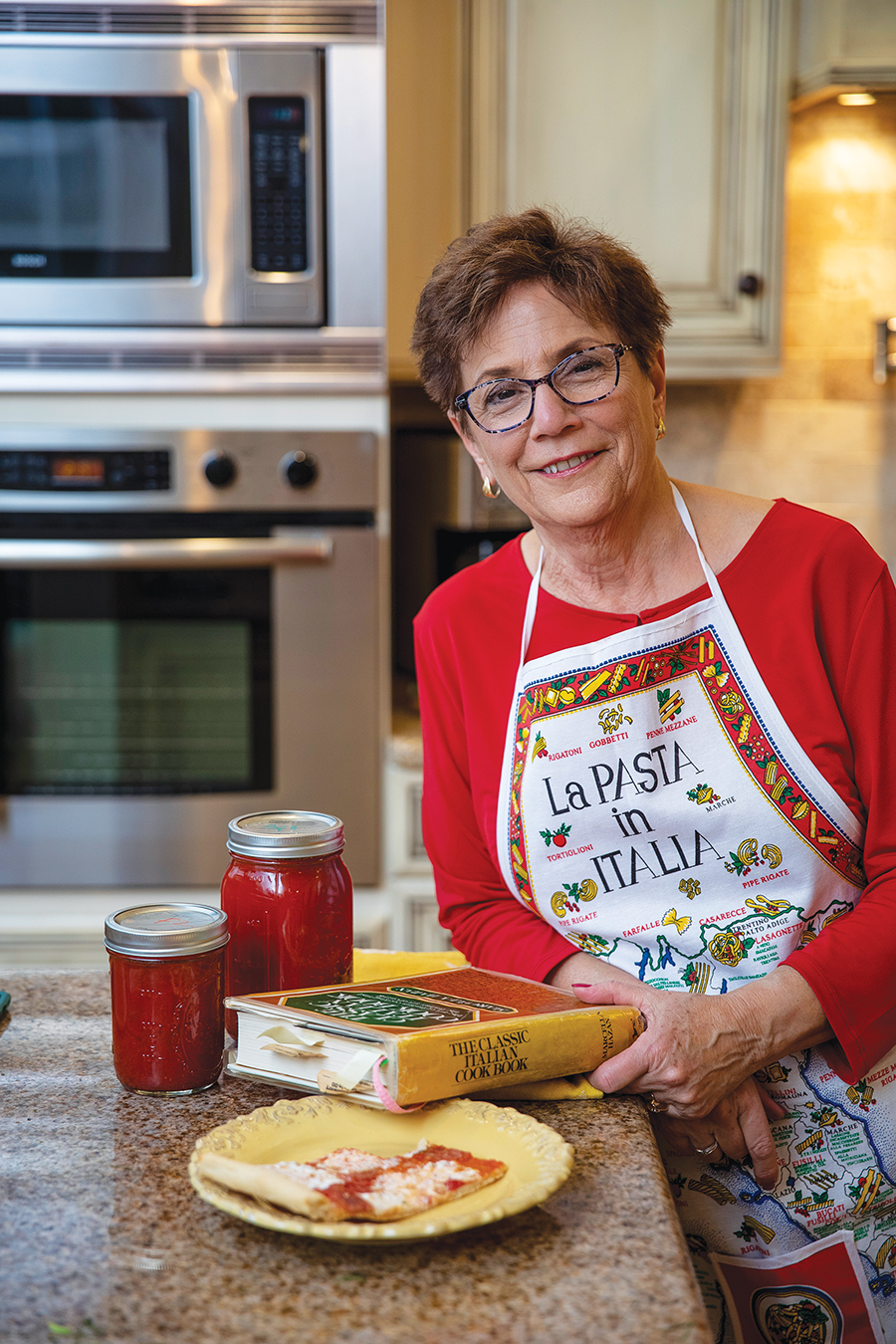
If the dogeared, heavily notated copy of Mastering the Art of French Cooking on Karen Robbins’ quartz counter doesn’t snag your attention, then the wafting aroma of sugar caramelizing with butter will. Knees have buckled at less. Luckily, there is a pot of fortifying coffee and a counter to lean into.
Welcome to Robbins’ kitchen, sporting a recent refresh, with the accent on functionality, which pleases the resident chef — the nifty pot filler addition isn’t just for looks. Neither is the new Wolf range nor the additional wall oven.
Delectable, magical things happen here. And it isn’t yet the holiday. She was baking for her mahjong club, which meets every Thursday evening.
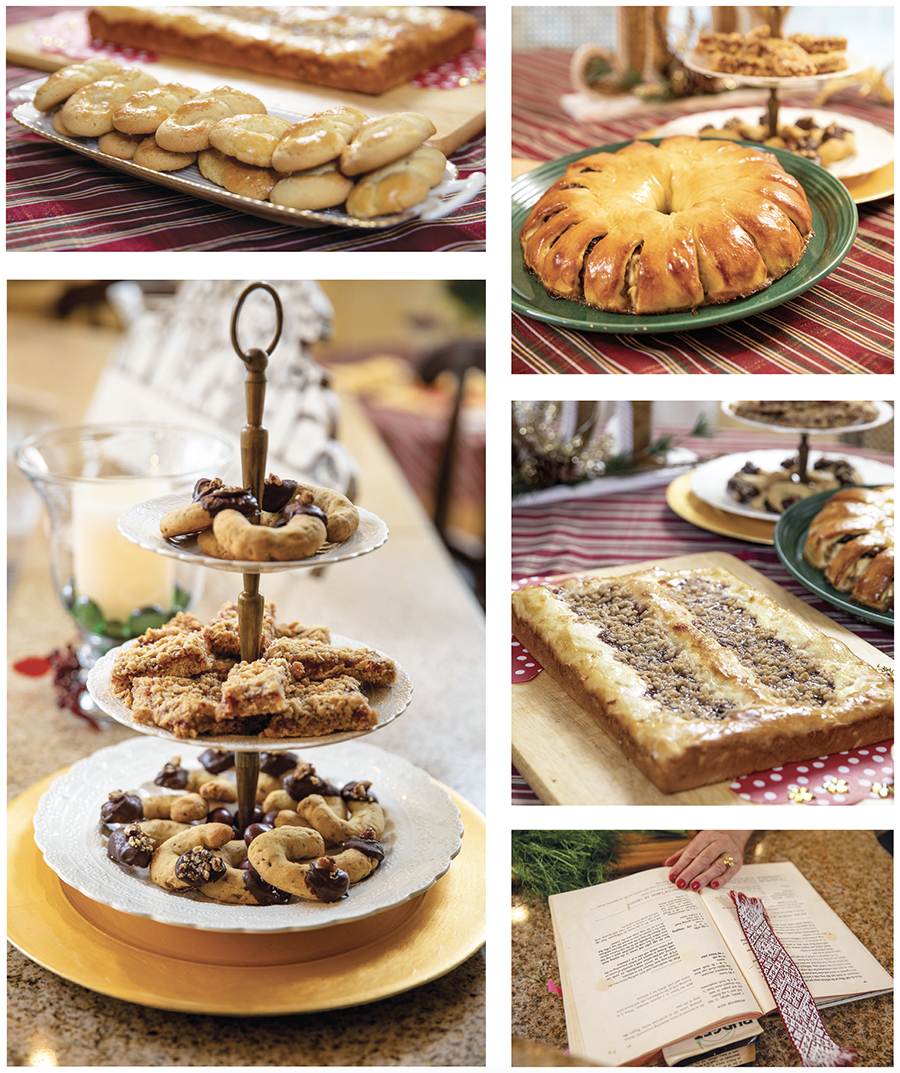
Robbins smiles slyly. The baker and holiday enthusiast slides over a dish of toasty blueberry-and-peach “cutie pies” and plump peach scones. She waits.
Triple yum, I mumble impolitely, dribbling crumbs. Robbins’ eyes dance.
Long before Iron Chef, there was ubiquitous French Chef — Julia Child. Child’s televised programs initiated this Greek-Italian woman into French cooking.
(Robbins calls Child, “the Great One.”)
The two well-used volumes of Mastering the Art of French Cooking, which somebody gave her long ago, are key references.
“The recipes are long but very clear,” she says, thumbing through. There are many scribbles. “Sometimes I slightly alter or tweak Julia’s recipes, but her foundation is usually intact.”
In 2009, Robbins saw the popular film Julie & Julia. She related to the young blogger, Julie, who began cooking Child’s recipes and posting about it.
She recently rewatched the film.
“I loved it as much as I did the first time. Afterward, I got teary. I always liked to cook. But I remembered how much she, Julia, had meant and how I got started.”
She recalls early trials.
“I made her pastries with custard filling.” At the time, it was challenging. Now, “not so hard anymore.”
Robbins moved on to Child’s gigot à l’Anglaise (leg of lamb in red wine). Then the duck à l’orange.
Classics.
“Her lamb recipe has simple ingredients. I marinate and sliver all the pieces,” she explains. For caneton à l’orange, seasoning and trussing a whole duck was a bit more challenging, “but now, you can buy duck breasts versus the entire duck.” She grins.
“Simple ingredients.”
Not so simple a process.
But Robbins is not averse to simplification or improving the Great One’s process. Or variations.
Robbins’ eyes dart toward the window where she keeps basil and rosemary in boxes.
What for dinner?
“Yesterday, I made a filling of spanakopita and pesto and baked it as a crustless dish. Blended two cultures,” she smiles. “People liked it.”
Her husband has a saying whenever he truly loves something. “He says, ‘I’d pay for that,’” she laughs.
Robbins loves baking, saying it’s more exacting. “But cooking can be more creative.”
With the holidays here, Robbins is tickled just contemplating the meals and baking she will turn out of double ovens installed for this very purpose. She much favors the Wolf range’s convection oven for baking.
On this baking day, Robbins is all Zen-like and humming. She moves through her kitchen, her warm brown eyes shining as she runs through the flavor profiles for her holiday preparations.
“I can taste food in my head,” she says. “Not wines, but food.”
When Robbins, a former NYC speech therapist, retired and came South with her husband, Paul, they plunged headlong into retirement. Her husband is out playing golf on a golden morning. Their white Volvo sports the license plate “PAR 3”. She also golfs, but not when she can cook.
Baking, cooking and entertaining, three of her fundamental pleasures, just happened to have made her the hit of the Newcomer’s Club.
She enjoys a large, hydrangea-filled yard that backs up to an open country field. But the kitchen, which opens to a screened porch, is the beating heart of the traditional home.
The Mediterranean aspect traces to her family influences.
The gourmet kitchen already had furniture-style cabinetry but Robbins finally got the pot filler she always wanted, adding the Wolf gas range top and an additional wall oven for good measure. She already had a generously sized walk-in pantry, one that she has filled with canned tomatoes, “put up” herself.
Food has long been important in her family. With an Italian father and a Greek mother, how could food not be central to family life? Her parents, childhood friends, eloped when pressured not to marry outside the faith. Outsiders were called “goombahs” — pejorative slang for Italians. Friends but not family, Robbins clarifies.
Her Catholic father and Greek Orthodox mother had respective, entrenched traditions, especially when it came to food. “My mother learned to cook Italian,” Robbins explains. “What she made, she made well. But she wasn’t experimental.”
But her daughter discovered she was. Baking is an exact science, she stresses. But cooking isn’t.
It relaxed her.
Although Robbins had a serious career, she would look forward to cooking after work. Entertaining became her outlet. She did the whole bit, “from soup to nuts.”
Even the hardest effort was happiness-making. As for what is difficult now, Robbins pauses.
“The more involved things are probably”— and she breaks off to page through her sauce-bespattered French cookbook. “Hmm.”
“Some of the things are just not so hard anymore,” she muses. Duck, for instance: “I remember making it and the stove was billowing with smoke because of all the fat.”
A good friend who lectures on art history and culture aboard the Silversea cruise line invited her along on a cruise that ended in Nice, France. There, Robbins says she had one of the five most memorable meals of her life.
She inquired into a restaurant in walking distance of the hotel. “I went and ordered their duck. It was with peaches,” she says, pausing to conjure up the memory. “Oh my God, it was divine. And so, I got ahold of some duck breast and made my version with peaches, because this is the world of peaches. That was fun.”
In Mykonos, she enjoyed another memorable dish while awaiting the ferry — tomato pancakes cooked over a Bunsen burner. The pancakes “were insanely good.” Robbins worked until she reconstructed the recipe.
With sparkling brown eyes that widen as she recalls the experience, Robbins enthuses about the culinary surprises that travel brings.
“Food opens you to another avenue of the culture.”
In 2017, she and her husband took a week of cooking classes in the medieval Italian village of Castro dei Volsci in a gristmill before a cruise departing from Rome.
“I asked Paul, do you love me? He said, ‘Yes, of course.’ I said, how much in dollars, exactly?” She chuckles. “The cooking classes weren’t cheap.”
She learned to make proper risotto. “Even Paul got into making pizza, appetizers and desserts.”
Robbins views food as a portal into a rich, multicultural world — one she eagerly walks through. But coming South, the holidays required the eager cook to adapt to regional tastes. She was shocked to discover ham on Southern Thanksgiving menus. “It wasn’t something you ate for Thanksgiving in the North. If you didn’t like turkey, you did chicken. You only had ham at Christmas!”
Robbins baked and transported favorites to relatives outside the South. “I used to cook and take the food north,” she recalls. She even mastered a coconut custard pie originally requiring a three-day process. She simplified it to two.
Recently, Robbins adapted a Giada De Laurentiis recipe called “Thanksgiving for two.”
The experimental dish? “Ravioli made with Chinese dim sum stuffed with ground turkey, herbs and cranberry sauce.” It was close enough to pasta to satisfy her Italian taste buds.
“I grew up thinking everybody had pasta as their main meal at Christmas,” she confesses. “My mother made lasagna. Then we had roast beef. But we had fish Christmas Eve.”
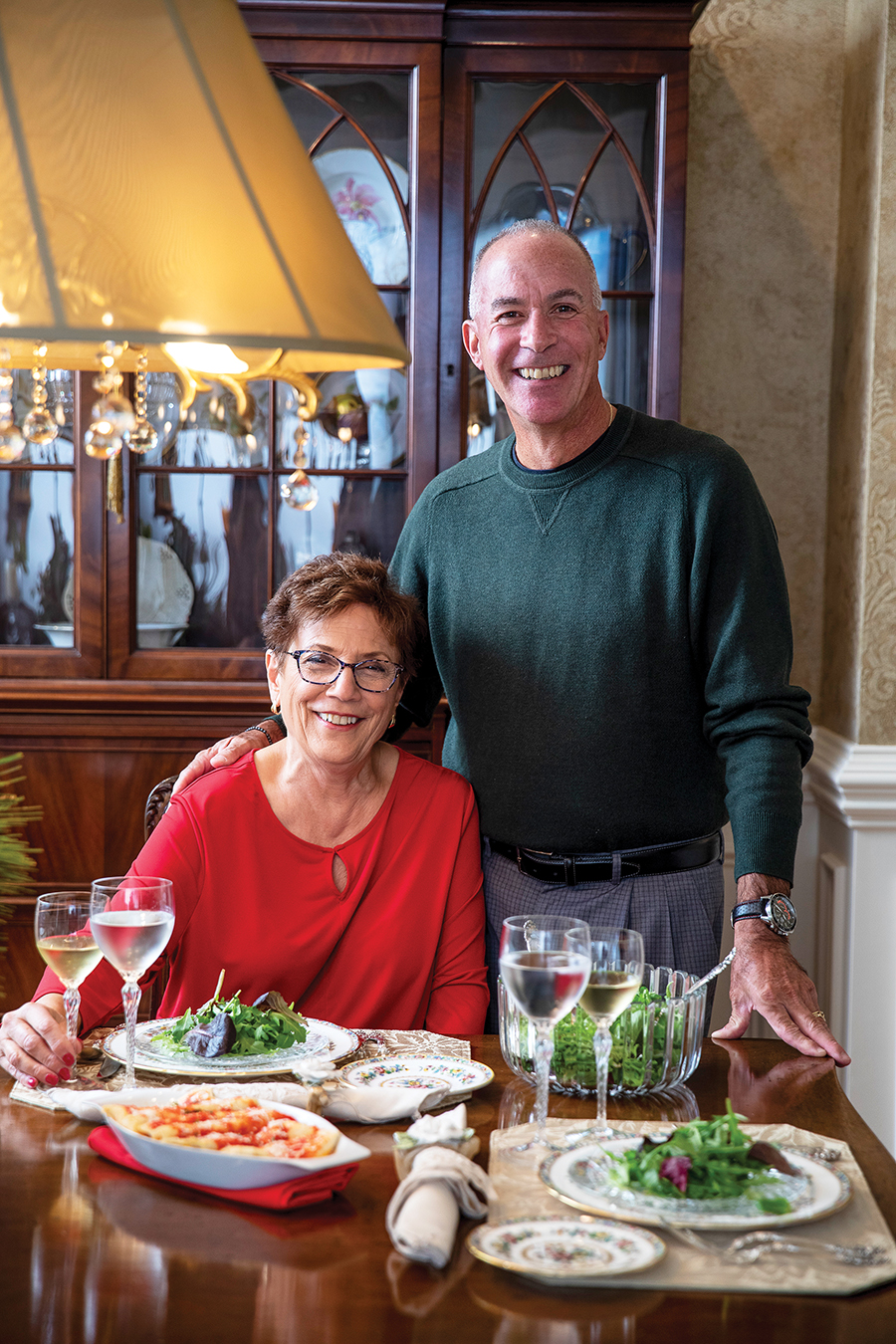
For her Christmas meal, Robbins will make fresh homemade ricotta and manicotti using crepes instead of dried pasta.
For Christmas morning, she will bake a festive wreath cake with cream cheese and jam, adapted from an old Gourmet magazine. The recipe is butter-stained.
“It’s not hard if you’re going to bake — make a dough and roll it out.” She pauses. “It’s not level one,” she admits.
But neither is a Southern staple, she claims.
“I’ve never made a biscuit,” Robbins giggles. “That scares me!”
Yet, she bakes breads, biscotti and every manner of dessert, including pistachio cookies, which are beloved when she serves them to a large circle of friends she made in the Newcomer’s Club.
“All the men wanted the recipe — that I should give it to their wives!”
Some traditions are sacred. But . . . “Christmas almost needs to be tamed,” she notes. “My husband is very helpful. He helps with the gifts. There were a lot of Christmases when we moved here and we had to go up North. I was cooking. Packing. Buying and wrapping. I was so exhausted. It wasn’t fun.”
Their daughter and her family now live in North Carolina. When they arrive in Summerfield on Christmas morning, delectables await.
Robbins mentions shortcuts the Barefoot Contessa advocates, like not making all menu items from scratch.
Some recipes are so dear to her they are nearly perfect.
Others still require innovation; things she makes a lot because “it’s a test kitchen,” she smiles.
Robbins offers to get back to me on her five favorite culinary hits of all time. Things that Paul would pay for, she laughs.
Her brow knits.
And as she plots dinner, staples are at the ready. “I have fresh oregano, basil and thyme,” she says.
And a pantry stocked with freshly canned tomatoes.
For Robbins, with the rapidly approaching holidays, nothing says Christmas more than opening the taps to that pot filler for boiling noodles and revving up the sauce for fabulous, savory pasta-bilities.OH
For Karen Robbins’ recipes, please visit O.Henry magazines facebook page
Sam Howard and Mickey Richey’s traditional Christmas extravagance
By Cynthia Adams • Photographs by Amy Freeman
Neighbors know that by December, Sam Howard and Mickey Richey’s home in Greensboro’s Browntown neighborhood is no place for a Grinch. When it is decked in holiday finery, there’s more good cheer per square inch of their classic ranch-style home than a curmudgeon could take.
Each year, the doors are open to their many friends and neighbors as their spacious home becomes the annual setting for an outrageously over-the-top family extravaganza of Christmas trees, lights, garlands, trim, bows and a bounty of beauty and fun.
“There’s a little bit of Christmas in every room,” Richey says with classic understatement.
Apart from the holidays, the house has enviable good looks that the owners have, over the last seven years, tastefully polished, painted, spruced up and enhanced.
The couple had looked in the area for a home that resonated with them. This house, Richey explains, spoke to them from the start.
It had them at hello — at the foyer, in fact.
“The minute we walked in, Sam said it had good vibes,” Richey recalls. “We immediately liked it . . . and the more we saw, the more we liked it.”
For many years, the Howard-Richeys had entertained a circle of women they affectionately called, “the Girls.”The women of a certain age, as the French express it, knew “Sister” Sherill, an original owner of the home.
“Katherine [Sister] Sherrill lived here with her husband, John,” says Richey, opening the front door into a Hollywood Regency–style foyer featuring Asian accents.
Built in 1959, the house is otherwise mostly traditional. That has suited the couple just fine. In fact, the house seemed somewhat modern to them, given that for years they had lived in nearby Latham Park in a quaint, rambling, 1920s house facing the park. Come the holidays, there was always a large tree, heavy with decorative effects and family keepsakes, prominently placed so it was visible to park goers and passersby.
The tree in the living room was at Howard’s urging, one trimmed in red and gold and a bit more formal.
“Because Sam wanted one on the front of the house.”
The trees are usually up within the first week of December, but the entire decoration takes a bit of time.
They started to deck the halls by late November, to the delight of their son, Cameron.
In the years since the couple first met, Howard had rediscovered the pleasures of the holidays. Richey says he was always nuts about Christmas, and Howard became a convert.
“Sam was never that big on Christmas until we got together. Now he’s even crazier about it than I am.”
First, the front door and windows get decorated. Then exterior lights go up.
Last year, Richey says, “Sam made lighted Christmas trees out of topiary frames.”Howard also put together the dining room and den mantels. Then they decorate the main tree together.
Family, he explains, was the underlying reason for making such a fuss. Raising a son made them both go all-in when the holidays arrived.
“He was 6 months old when Sam and I started living together.”
Eventually, the time had come for the couple to sink down permanent roots after living in northwest Greensboro for years. They narrowed their search in order to remain near to their workplaces, school and friends.
Browntown fit that bill as well.
Browntown assumed its name from Brown Realty during the postwar era. The architectural styles built there were notably more formal, given the residential development was adjacent to Irving Park.
“It may be a Guy Andrews-–built house,” muses Tricia Costello, owner of Carriage House Antiques & Home Decor. “He built a lot of the homes.” Costello was familiar with the Howard-Richey house, having grown up in Browntown.
The couple acquired the dwelling in 2007. Once they moved in, the Howard-Richeys set to work, making an indelible stamp on the house. Of course, that included going all out for their first Christmas.
Although Richey is a longtime interior designer who returned to school after earning his initial degree in order to study design, Howard took charge of the annual Christmas décor. Howard works in finance.
“He’s just a big kid,” laughs Richey.“And he loves to decorate for all holidays.I help, but he just really gets into it.”
Crossing through the foyer, he pauses.
“It used to have a black-and-white foyer floor,” says Richie, “with a compass-like astronomical design.” His voice is heavy with regret. “Unfortunately, that’s probably lying ruined beneath layers of mastic.”
The design was by Otto Zenke.
Years before, the Sherrills had hired Zenke to lend their home special touches. The original owners were, like many affluent residents, in thrall of the designer whose main showroom still stands today near Greensboro’s City Hall. His name became synonymous with elaborate millwork and unmistakable architectural detail.
Zenke decorated the Sherrill residence in the 1960s when his popularity was at its zenith. “He faux painted the den siding and probably installed the [still remaining] trellis in the sun room,” says Richey.
Fast-forward to the Howard-Richeys, who later added their own special effects, intended to complement Zenke’s signature style.
They meticulously hand-painted stripes in the hallway and applied decorative finishes themselves, including a faux Venetian plaster, which is featured in a bathroom.
Richie, now a freelance designer, had honed his craft over the years. He formerly worked as an in-house designer with Furnitureland South. In addition to other clients, he works with Carriage House at Golden Gate Center.
Today, the 60-year-old house reveals the imprints of both Richey’s flair and Zenke’s.
Quickly he moves through the living room, formal dining room and newly redesigned kitchen, refreshed in white, clean finishes, through to the private areas where the family spend much of their time.
But the den, for aficionados of Zenke, Greensboro’s most celebrated designer, is the gem. This is also the room the residents use most.
It is vintage Zenke.
“The den is still painted like Zenke painted it in 1961 or 1962, when he ‘pickled’ it,” explains Richey. Pickling was a popular whitewashing-style painted effect.
“The latticework in the sunroom, and the cornices still hanging in the living and dining room, were all done by him.”
Those finishes are classic Zenke, he says, and will remain untouched and intact.
Yet in December, posh finishes and furnishings are overshadowed by the exuberant Christmas decoration, which bring an entirely different sense of nostalgia and soulfulness. The home’s holiday décor is top-to-bottom festive. Tradition and a bit of nostalgia, as Richey points out, always prevails.
Stockings, ornaments and the works are brought out of storage and Howard sets to work.
“We’ve been collecting Christmas items since the two of us got together in 1982,” says Richey.
“Sam does most of the decoration. It takes a good week to get it all down from the attic and out [on display].Then, we decorate the tree.”
Red and gold rule. The family even used to string popcorn and cranberry garlands on the trees when Cameron was still a child.
“Cameron would count,” Richey laughs, “while stringing one-two-three pieces of popcorn and one cranberry.”
The holidays showcase the owners’ many collections, some specifically displayed solely at Christmas, like antique toys that date back to great-grandparents.
Many of the couple’s favorite decorative items are long-loved and well-used family heirlooms. Cameron, who is now 37 with a family of his own, once played with those heirlooms.
There are antique toy cars, mostly owned by Richey, and many rarities among them.
“They are cars I actually played with,” Richey says. “When we closed out my grandmother’s house, they were in the toy box at her house. There’s a Cadillac, a Corvair, a Plymouth Valiant. And they look like new.”
The family treasure those toys.
“Other toys include a really old toy car that might have been my uncle’s. It says it’s a Falcon, and I would guess it’s from the late 1940s. It’s 2-feet long and we display it on the bookcase in the den.”
A gorgeous nativity scene is one acquired by Richey’s great-grandmother is “still in the box — from Woolworth’s!”
Richey’s great-grandmother’s baby doll crib remains on display year-round in a guest bedroom. It is a true antique. “She was born in 1900,” he explains.
He says he inherited a great deal of the family heirlooms his grandmother “entrusted with me.She knew I valued it.”
She was more valuable than any of her cherished objects, he adds. “She was everything to me.”
When he was a toddler, Richey’s parents would put him on the train from Columbia, South Carolina to the Triad for visits with his grandmother, who worked for Southern Railway. He laughs. “I was too young to remember it.”Railroad employees watched out for their treasured young cargo.
Then there are the Richey-Howard’s nonholiday collections.
The collecting-mad couple displays only a portion of the bar paraphernalia they own. They’ve amassed shot glasses from travels and gifts that they guesstimate number in the hundreds — easily 500. They simply cannot display it all.
“We don’t have it all out at this house,” says Richey. In other words, at least half is left in storage.
A framed collection of foreign tobacco brand labels hangs over the mantel. They bought them because they liked them and wanted to help someone who needed cash. “We bought those from a friend going through a divorce,” Richey explains. Only later did they learn the labels were valuable.
They also collect salt-and-pepper shakers, demitasse cups that were passed down in the family — and holiday items. They cannot resist adding at least one more Christmas ornament each year.
“All of our ornaments are either homemade or we bought them at craft fairs,” Richey says. “We might buy one a year.” After 37 years, Richey admits, “That’s a lot.”
“It meant a lot to the two of us, having our own Christmas, and our own Christmas tradition,” says Richey.“Cameron thinks it’s not Christmas unless we decorate the tree, have eggnog and play Christmas music.”
Traditions are deeply instilled in their son Cameron, who now has a baby girl, Addison. Their first grandchild is now 15 months — too young to fully grasp it all.
“Next year will be amazing,” Howard says. “I can’t wait!”
“Some of Cameron’s toys, including Fozzie Bear from a Happy Meal, have been part of the Christmas tree for 30 years, along with his elementary school art ornaments,” says Richey.
The colorful Fozzie Bear, a Muppet Babies Happy Meal toy from McDonalds in 1986, is stationed upon the ladder that leans against the Christmas tree — this is as it has always been. Even Fozzie, after 24 years, is now a collectible.
The family is blending new traditions into old ones. On Christmas Eve, they still have dinner with Cameron, but now it is a much larger affair, including his wife, child and Cameron’s sister, Alyson, and her family.
After dinner, “a few gifts” are opened.
On Christmas Day, Richey and Howard travel to Lake Norman to spend time with Richey’s extended family, where 28 gather for lunch.
It’s wonderful chaos, Richey laughs. “My grandmother used to say, ‘I love all my grandchildren. Just not all at once.’”
He understands her point. On Christmas night, “we just enjoy the peace and quiet.”OH
Cynthia Adams lives amid wonderful chaos year round.
The extraordinary life of WWII flying ace George E. Preddy Jr.
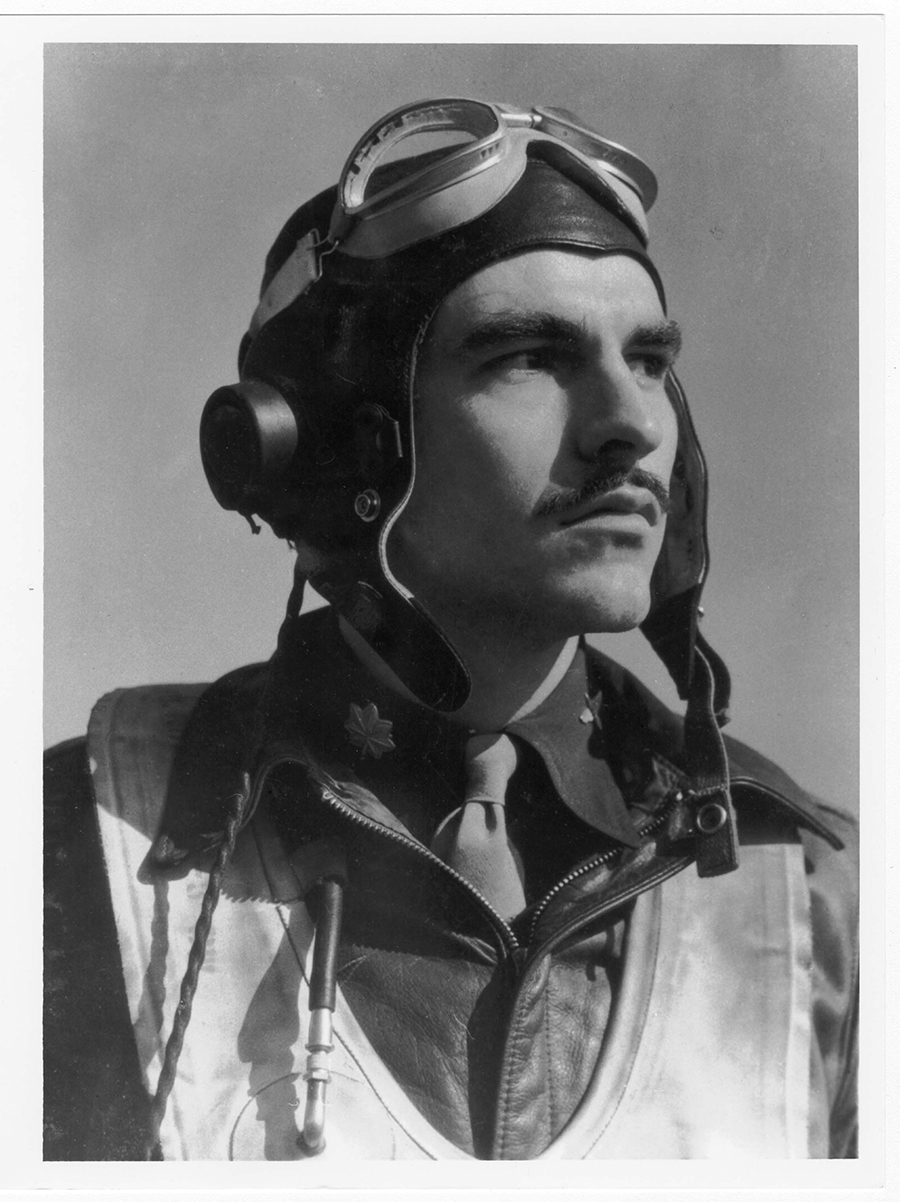
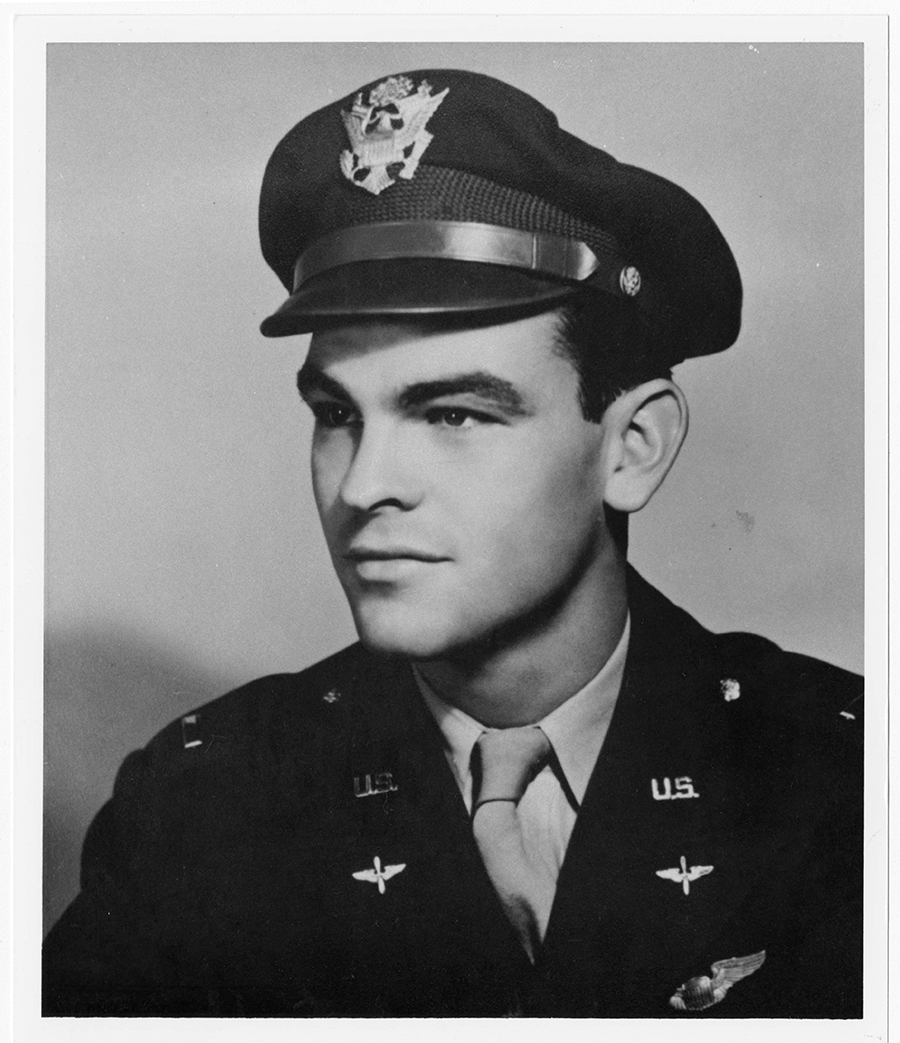
Maj. George E. Preddy Jr.
By Ross Howell Jr.
Let’s start with darkness. Then we’ll look for light.
On Christmas Day, 1944 — 75 years ago — our city’s most famous aviator, George Earl Preddy Jr., was killed. He was 25 years old. Just months later, on April 17, 1945, his baby brother, William Rhodes Preddy, was also killed. Bill was 20.
The two men rest side-by-side — not in Greensboro, where they attended Sunday services as boys at West Market Street United Methodist Church, but in Lorraine American Military Cemetery, Saint-Avold, France.
Both men piloted the P-51 Mustang, perhaps the most famous U.S. fighter of World War II. George was flying in support of the Battle of the Bulge, an enormous German counterattack launched in Belgium after the Allied invasion at Normandy on D-Day. Bill was strafing an enemy airfield near Prague, Czechoslovakia (now the Czech Republic), just days before V-E Day, when Germany unconditionally surrendered to the Allies.
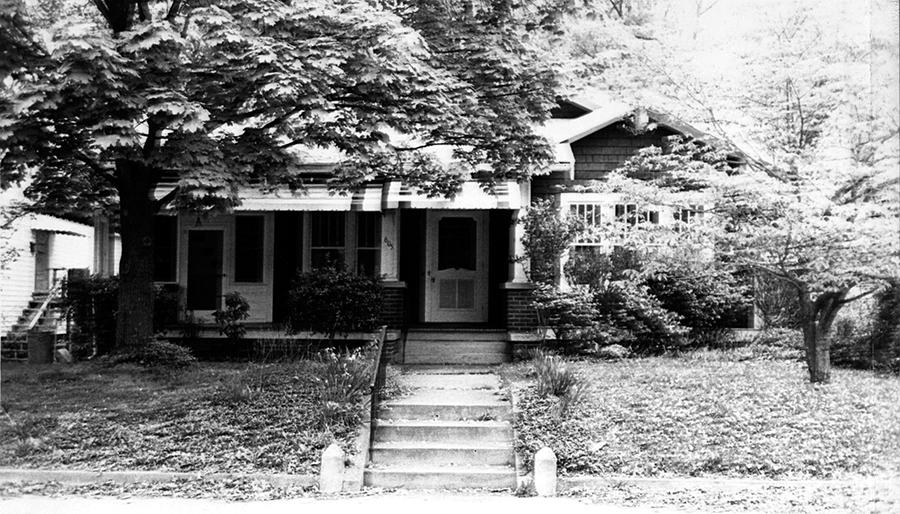
Preddy House, 605 Park Avenue.
George and Bill grew up in a modest, brown-shingled house their father, George Earl Sr. (whom the family called Earl), had built in 1921 at 605 Park Avenue in Aycock (now Dunleath). The household included their mother, Clara Noah Preddy, and sisters, Jonnice (oldest child) and Rachel (born between the boys).
George was small — he stood 5 feet 9 inches tall and weighed 125 pounds as a grown man. And he had big ears. The neighborhood boys nicknamed him “Mouse,” a moniker that stuck till his WWII days, when he was renamed “Ratsy.”
Since the Preddy house was near War Memorial Stadium, George frequently played on the tennis courts there. He was tremendously competitive, and enterprising enough to make money on a soft drink concession he dubbed, “The Mouse Hole.”
George attended Aycock School (now Melvin C. Swann Jr. Middle School) and Greensboro High School (now Grimsley High School). Not big enough to make the high school basketball team, he played hoops at the YMCA, set up a horizontal bar in his backyard to practice gymnastics, and even tried to bulk up his muscles with the popular Charles Atlas bodybuilding method.
He was a serious enough student to double up on courses, graduating from GHS at age 16. While he’s remembered as being cerebral and quiet, he could cut up with the best of them, once convincing his buddies to dangle him by the ankles from a second-story school window in order to prank a teacher on the floor below.
Following graduation, he worked at a cotton mill and attended Guilford College for two years. Then came the experience of a lifetime.
On November 13, 1938, George wrote in his diary: “Had my first real airplane ride today. Hal Foster took me to Danville with him in his little ’33 Aeronca. It took us 30 minutes to make the trip. I see now how great the airplane is. That trip was the most wonderful experience I ever had. I must become an aviator.”
Just months later, after learning his flying skills from Bill Teague, an A&P grocery store manager, George soloed from a grass airfield near Vandalia, six miles south of Greensboro, in Teague’s Waco biplane — named Wanda C, after Bill’s wife.
Teague and George hit it off. After George’s solo, Teague suggested that they each chip in $75 to buy a second Waco. Together, they’d set out barnstorming.
“George was absolutely crazy about an airplane,” his father Earl said in a 1966 interview recorded by then-director of the Greensboro Historical Museum, Bill Moore. “He wanted to fly all the time.” With “headquarters” at a grass airstrip just outside Vandalia, George and Teague would fly to Liberty on Sundays and take passengers up in the plane for “hops.”
“They had this little two-seater,” Earl continued. “I believe they charged a dollar for a five-minute ride.” Earl, who was employed by the railroad “for 49 years and 7 months,” usually worked a freight run to Sanford on Sundays. The tracks ran right alongside the airfield near Liberty.
“I noticed a little gum tree there,” Earl said. “And if George wasn’t up in the air, he’d be standing under that tree in the shade and wave at me. I named the tree, ‘George’s tree.’”
While barnstorming with Teague in 1939, George’s cowling flew up in front of the cockpit, completely blocking his view. Looking from the side of the aircraft, he was able to land in a cornfield with no damage. The cowling latches had not been properly fastened, and the incident underscored for him the importance of a pilot’s thorough walk-around of an aircraft before flight, a lesson that would remain with him through his military service.
On September 1, 1939, Adolph Hitler’s armies raged into Poland, employing a furious tactic called blitzkrieg — “lightning war.”
That fall George boarded a train bound for Pensacola, Florida, and the Naval Air Training Center. He passed all application tests except the physical — the Navy said he had high blood pressure and curvature of the spine.
Back home he did stretching exercises to improve his back. After applying twice more and being rejected, he decided to spend another summer barnstorming with Teague.
The first performance of the 1940 season was at Walnut Cove. With few customers at the airfield, they made three low passes over Main Street and turned out a real crowd.
George and Teague were vagabonds with wings, flying from town to town, sleeping under their aircraft, staying at a YMCA every third night so they could get a shower.
Adventures followed.
There was the time George noticed a police car’s flashing lights out on the field as he landed near Valle Crucis. The officers were carrying the state representative for the district who wanted to get to Asheville in a hurry, rather than take the slow way on curvy mountain roads. George obliged, and was paid handsomely.
And there was the time a mother asked him to fly her 10-year-old daughter to Winston-Salem because the medical help the girl needed wasn’t available in nearby Mount Airy. He refused payment of any kind. At the end of the barnstorming season, he received a letter from the mother, telling him her daughter had successfully recovered from pneumonia.
News of the war in Europe grew more ominous by the day. Holland, Belgium and France were under Nazi control, and the aerial Battle of Britain had begun.
George gave up on the Navy and applied to the U.S. Army Air Corps. He was accepted, and his name added to a long list for cadet class. Then, on September 7, Hermann Goering ordered his Luftwaffe to launch the London Blitz, an all-out bombing campaign to destroy the city. Streams of German aircraft flew missions by day and by night, wreaking havoc below.
Anxious to get in on the fighting, George enlisted with the National Guard at the advice of recruiters. He did his basic training in Fort Moultrie, South Carolina, then was sent to Fort Screven, Georgia. Next he was ordered to Darr Aero Tech, a flying school southwest of Albany, Georgia. By October 1941 he had reported for advanced flying school at Craig Field, Alabama.
The clouds of war were rapidly darkening.
On December 7, the Imperial Japanese Navy struck Pearl Harbor. Five days later, George graduated with his class from flying school at Craig Field. His mother, Clara, rode the train to Alabama and proudly pinned pilot’s wings on her son’s blouse at the ceremony.
Commissioned as second lieutenant, George used a short leave to come home to Greensboro before reporting to West Palm Beach, Florida, to join the 49th Pursuit Group, 9th Pursuit Squadron. Once he checked out in the P-39 Airacobra fighter, he was ordered to ship by train to San Francisco, where he boarded the U.S. Army Transport Mariposa on January 11, 1942, destination unknown.
In February the transport docked near Melbourne, Australia. George’s unit was moved by train from Melbourne to Sydney. It had been six weeks since he’d flown an airplane.
He received scant training in his new aircraft, the P-40 Kittyhawk. George’s unit ferried their fighters north to Brisbane, then set off northwest to a primitive base near Darwin, where he slept on the wing of his aircraft. He was now in a battle zone.
In honor of the Old North State, George dubbed his P-40 Tarheel.
Soon his unit was scrambling to intercept Japanese bombers and fighters. But George was still new to the game. On March 30, 1942, he wrote in his diary: “I had a perfect shot at a Zero [Japanese fighter], but missed by not turning one gun switch on.”
By April, George could lay claim to having damaged two enemy aircraft but still had recorded no aerial victories. Then in July, he nearly lost his life.
On an evening training mission with three other pilots, George and a wingman were flying level, simulating enemy bombers, while two other pilots “bounced” them from above, diving from an altitude of 20,000 feet. On one pass a pilot misjudged and crashed into George’s plane just behind the cockpit.
The first pilot was killed instantly. Badly injured, George was able to bail out before his airplane went down. A tree limb pierced his leg as he parachuted into heavy brush. Fortunately, he was rescued — bleeding badly, but still conscious — before night set in.
What followed was a long, painful transfer by air to the new U.S. Army hospital in Melbourne. He would spend weeks bedridden — and three months in recovery.
But fortune smiled. A young Australian woman named Joan Jackson often visited soldiers at the hospital to cheer them up. Joan made quite an impression on George. When he was finally up on crutches, he’d go on outings with her. Although he saw other women at the time, it seemed that he was smitten.
On September 9, 1942, George wrote in his diary: “Had dinner at Joan’s house this evening. . . . Her Dad is a famous golfer and a very nice fellow. Also her sister is a clever girl and very attractive. I think I could love Joan.”
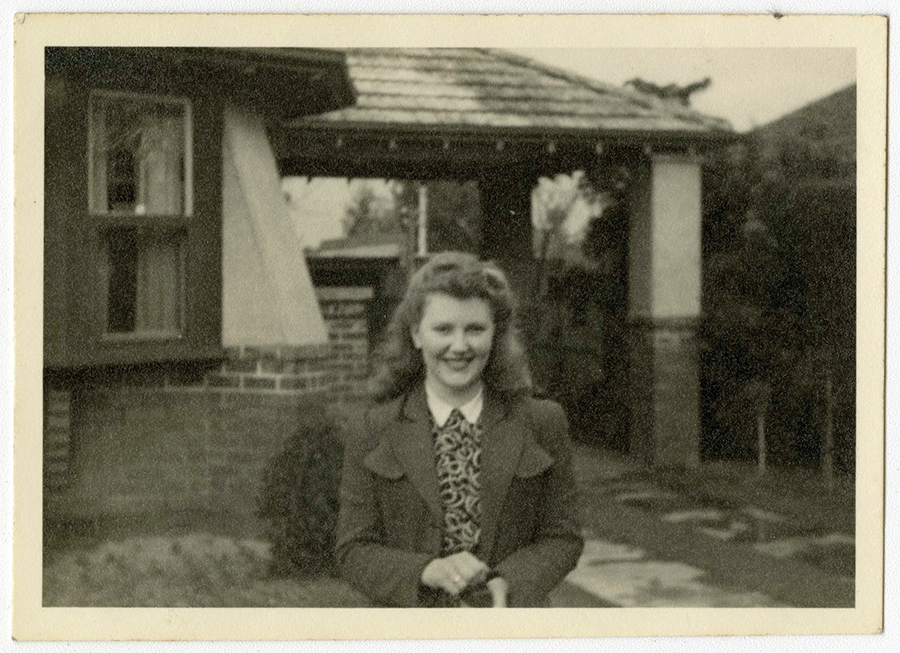
Joan Jackson, George Preddy’s fiancée
There’s a portrait photograph of Joan wearing George’s wings. But the record about her goes silent for a while.
At the end of September, George was ready to report back to Darwin. He made it as far as Brisbane, where he received two sets of orders: one directing him to return to the States, and the other promoting him to first lieutenant.
By way of Fiji, New Caledonia, Canton Island, Honolulu, California, by military transport to Salt Lake City, and then by rail, George journeyed home to North Carolina. He was surprised and happy to see his father Earl board his train in Reidsville. Together, father and son rode south to Greensboro.
George’s nine-day leave was a whirlwind of family and friends. His brother Bill and childhood chum “Bozo” Boaz drove him to Winston-Salem to see Bill and Wanda Teague. During the visit, his old instructor and barnstorming pal flew Bill, Bozo, and George to Charlotte and back in his new Stinson Reliant.
On November 10, George boarded a train for Oakland, California. He had been a combat pilot for nearly two years, and had yet to score an aerial victory.
In Oakland he was introduced to the P-38 Lightning, an elegantly designed, twin-engine fighter. November 19 he wrote in his diary: “Spent the day at the field and checked out in the P-38. Flew it 45 minutes of the most enjoyable flying I ever did. That is a wonderful flying ship and fast as its name. . . .”
Next stops: Orlando, Florida, then back to California, then First Fighter Command in New York. He wrote in his diary on December 31: “Well, here it is the last day of 1942. . . . I am on a train setting out on my sixth crossing of the country since this time a year ago. . . Hope by the end of next year I can have done much more for my country than I have last year.”
From New York George was assigned to the 320th Squadron at Westover Field, Massachusetts, where he checked out in the P-47 Thunderbolt, a thick-fuselage, powerful fighter nicknamed the “Jug.” In January he was transferred to the 34th Squadron of the 352nd Fighter Group in New Haven, Connecticut, a tactical unit training to go overseas.
George was finally preparing to enter battle in one of the most dangerous places on earth — the skies over Europe.
On June 30, George boarded the Queen Elizabeth, bound for England. He had been promoted to captain. Six days later he disembarked at the Firth of Clyde, taking a train to a deserted Royal Air Force airfield in Bodney, 90 miles north of London.
At Bodney George named his P-47, Cripes A’Mighty, a phrase he used for luck when shooting craps. On December 1, he scored his first aerial victory — a German Me 109.
George’s P-47 was hit by enemy antiaircraft fire in January 1944. He was forced to ditch in the icy waters of the English Channel. With rough seas and poor visibility, the amphibious aircraft sent to rescue him ran over him three times before they could fish him out.
“They damn near killed me!” he complained.
Piloting his replacement P-47, Cripes A’Mighty 2nd, George continued to pursue enemy aircraft, both on the ground and in the air. On March 22, 1944, he was promoted to major and named operations officer of the 487th Fighter Squadron. December 22, he achieved a second aerial victory, shooting down a Me 210.
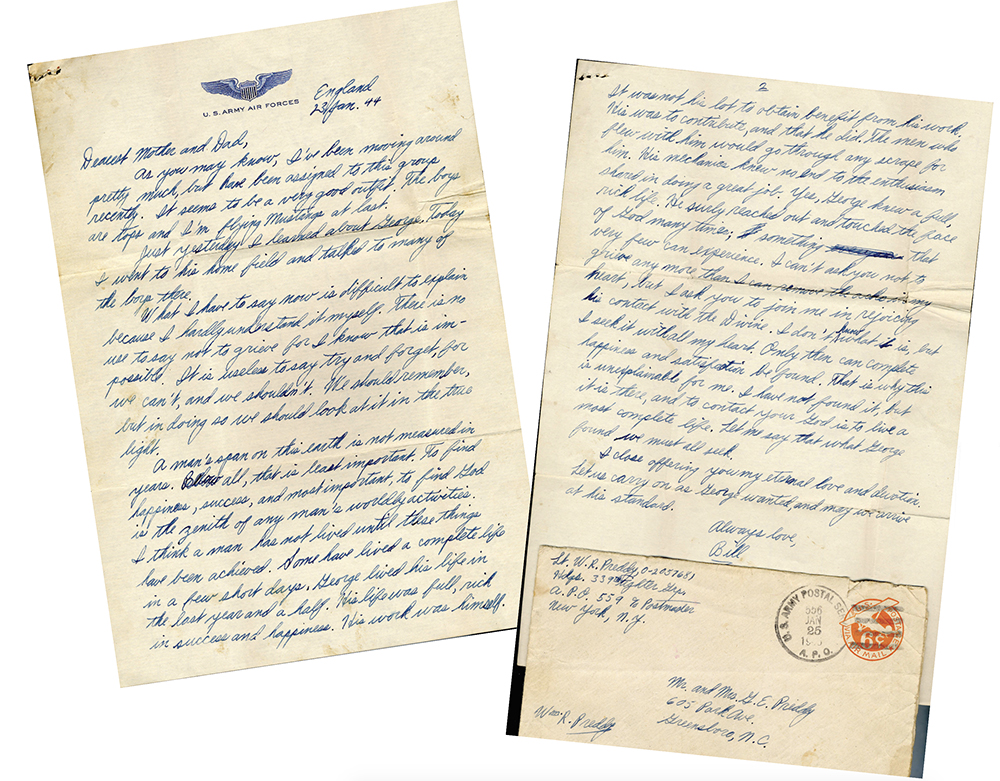
By letter he learned that his brother Bill was making good progress in his military training back in the States.
“You should take advantage of all the instrument time you can get,” George wrote Bill on April 17, “because when you get to our theater of operations you will fly in weather you wouldn’t walk outdoors in at home. . . .”
That same month, George’s outfit, the 352nd Fighter Group, transitioned from the P-47 to the P-51 Mustang. George named his new airplane Cripes A’Mighty 3rd. A nimble, fast fighter, the P-51 with drop tanks had the range to escort U.S. heavy bombers on raids deep into Germany, protecting them from enemy fighters.
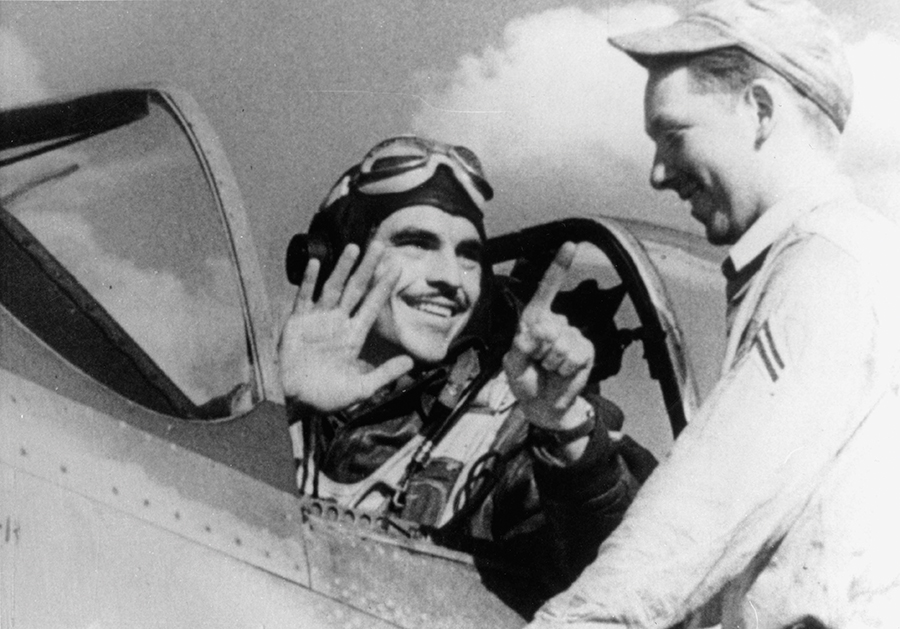
George Preddy with Asst. Chief McVay.”
Flying just such a mission on August 6, 1944, George became a legend.
For two weeks his squadron had seen fierce action, and he personally had accounted for more than six enemy aircraft destroyed. But poor weather was predicted for August 6, so no mission was planned.
George celebrated at the craps table in the officers’ club. Exclaiming “Cripes a’mighty!” with each roll of the dice, he won an astounding $1,200.
Ever the dutiful son, he used his winnings to purchase a war bond and mailed it home to Clara. Greater merriment ensued.
But a mission was called the next morning, and it was George’s turn to lead. Others offered to fill in, but he insisted, still tipsy enough to fall off the table he was standing on to brief the men. Their mission was to escort U.S. bombers to a target east of Berlin.
Breathing pure oxygen got George on the mend, but when he buckled into the cockpit of his P-51, he had a brutal hangover.
That day he shot down six enemy aircraft.
It was a feat unprecedented in the course of the air war in Europe, and though his exploit later was equaled, it was never surpassed.
Photographers, reporters, and correspondents arrived at Bodney to get George’s story.
Three days later, he was interviewed about his exploit for a CBS radio broadcast. The program announcer was the famed head of the CBS European Bureau, Greensboro’s Edward R. Murrow.
As was his wont, George closed the session by acknowledging others: “You just can’t watch your tail and concentrate on your shooting, too. That’s why my wingmen are due as much credit as I am.”
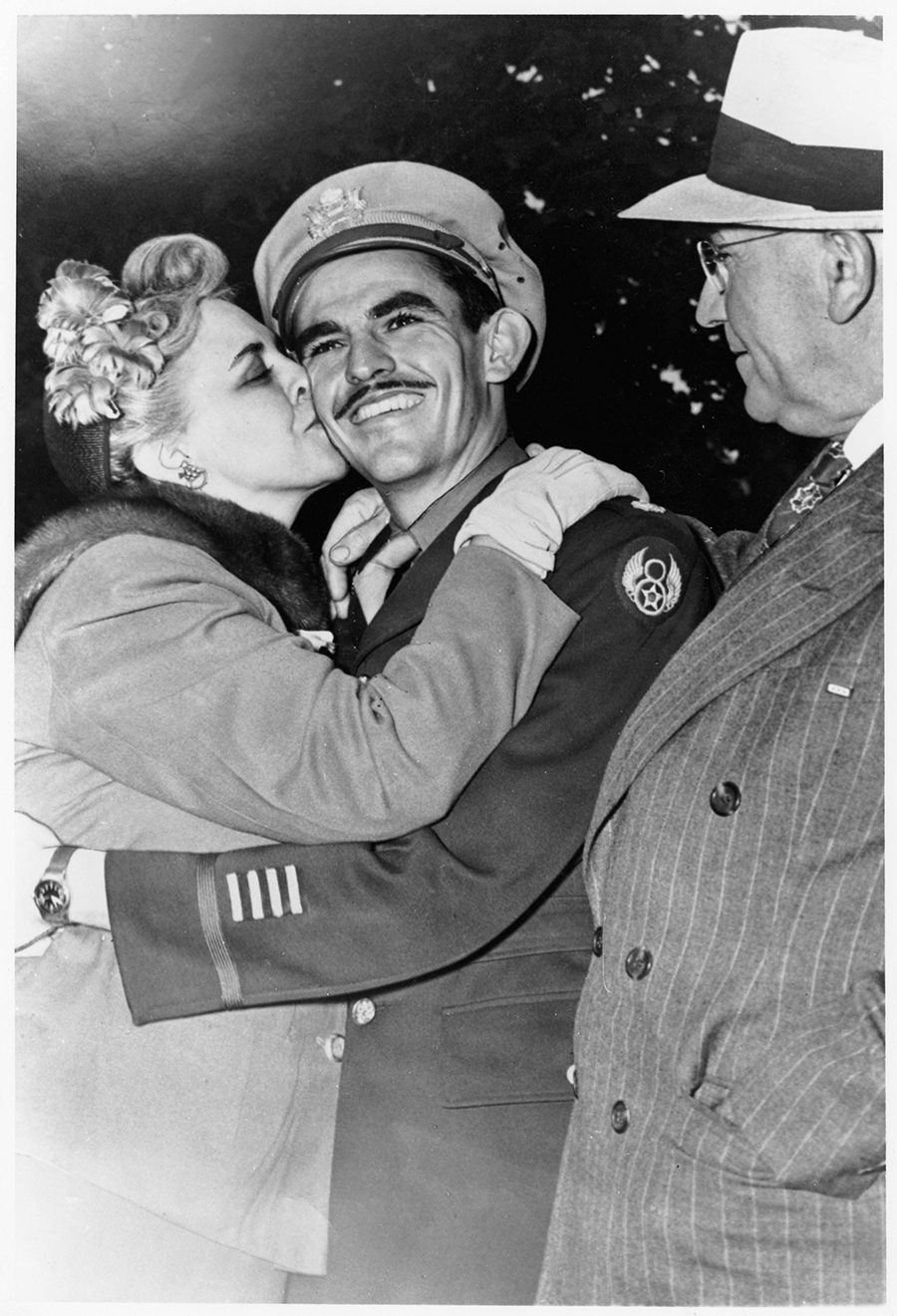
George Preddy and parents
In September George was granted a 30-day leave. It was a glorious homecoming. Clara and Earl met him in Washington, D.C., where he was scheduled for a couple days of publicity interviews, standard fare for an American ace.
Then it was on to Greensboro. George addressed a crowd at a ceremony in War Memorial Stadium, just blocks from where he’d once sold soft drinks from “the Mouse Hole.” He gave speeches to the Boy Scouts, to high school students, to the Chamber of Commerce.
And George announced his engagement to Joan Jackson, the Australian he’d continued to romance by mail. They planned to wed at war’s end.
George then traveled with his family to visit Bill in Venice, Florida, where his brother was in the final phases of air combat training. The two even engaged in a mock dogfight in P-40s, with Bill giving George as good as he got.
Lt. William R. Preddy, 339th Fighter Group, 503rd Fighter Squadron
“Don’t get cocky!” George told his little brother.
Back in Greensboro, he agreed to do a local broadcast radio address. When he was introduced and asked to tell the audience about himself, he spoke instead about Edward R. Murrow.
George spoke about how he and the other officers gathered in the lounge of the Queen Elizabeth — the troop vessel that first carried him to England — listening on the radio to Murrow’s 15-minute news broadcasts, “when he gave the straight dope on the war news of the day.” He spoke about how kind Murrow was to him when he was interviewed for CBS, how they talked about the people they knew back home in Greensboro.
“Ed Murrow knows what he speaks about because he has spent every available moment getting a better insight into the feelings of the war-stricken peoples of Europe,” he said. “Greensboro should be proud of him.”
By the end of September, George was anxious to get back in the fight. His father Earl tried to convince him to stay stateside, since he had flown many more combat missions than were required.
But George was adamant about returning. He felt he had a job to do.
When he returned to the 352nd Fighter Group at Bodney, George was assigned to lead the 328th Fighter Squadron, the group’s goat, with the lowest number of enemy aircraft destroyed. His commanding officer felt that with his leadership and reputation, George could get the squadron on track.
He took over on October 28, 1944, christening his new P-51 simply, Cripes A’Mighty, no number.
George took up where he had left off, destroying enemy aircraft as squadron leader. The overall aggressiveness and effectiveness of his squadron considerably improved.
That fall, Giles “Runt” Teague, Bill Teague’s younger brother, paid George a visit. Runt asked if George could help him transfer from piloting heavy bombers to fighters. George agreed to have his commanding officer write a letter requesting the transfer.
On December 10, 1944, George answered a letter from the Teagues, thanking Wanda for the fruitcake she had sent him. “I have some fine pilots and am proud of the job they are doing,” he added, “particularly on one mission, when we knocked down 24 Jerries to set a new record.”
A week later he posted his final letter home to his parents. He complained about the slow mail service, described the awful weather in London, where he’d been on a 48-hour pass.
“I sure hope Uncle Laurie [his mother Clara’s brother, who’d been badly injured in a rail accident] is better now,” he wrote. “Mail [delivery] from Joan [his fiancée in Australia] is even worse than from you. I don’t expect to hear from her until way after the first of the year. . . Best love always, George.”
In horrendous weather conditions the morning of December 23, Preddy flew with his squadron to Y-29, a primitive air base near Asch, Belgium. Their job was to provide air support for the Battle of the Bulge.
On Christmas Day, George briefed his squadron on their mission, hiked up a pants leg to show the men his bright red “fighting socks,” and said, “Let’s go get ’em!”
And that was it.
After the fighters in his squadron became scattered in a dogfight, George spotted an FW 190 flying at treetop level, and dropped to the deck to pursue the German plane. Cripes A’Mighty was brought down by friendly antiaircraft fire.
Runt Teague’s transfer never came through. He was killed when the B-17 Flying Fortress he was piloting went down over the English Channel on December 30, 1944.
Bill Preddy was killed four months later when his P-51 was destroyed by enemy antiaircraft fire as he and a wingman strafed a flak tower in Czechoslovakia.
George died as the highest-scoring Mustang ace of World War II.
Joseph J. “Red” McVay, the assistant crew chief for whom George always had nothing but praise, commented about his death in a letter to the Greensboro Daily News.
McVay explained that a keg of beer had been purchased to help the enlisted men celebrate the holiday, but when word “came that the Major, our Major, had been killed . . . we emptied our glasses on the ground.
“Christmas will never be the same for me again,” McVay concluded.
Earl Preddy in an interview described George as “just an ordinary American boy.” He described his son Bill the same way. Certainly Earl and Clara’s boys were like many of their buddies. But their love of flying, their love of country, their skill, their determination and the dark realities of war made them heroes.
Their lights burned brief and bright, much like the star that guided searchers to a stable in Bethlehem so long ago. Surely the firmament holds stars for the brothers, and for all their like.
Merry Christmas.OH
To learn more about the Preddys, Ross Howell Jr. recommends Wings God Gave My Soul — the Factual Story of One of America’s Greatest Fighter Pilots of World War II, George E. Preddy Jr. by Joseph W. Noah (1974), George Preddy: Top Mustang Ace, by Joe Noah and Samuel L. Sox Jr. (1991), Carolina Ace, a documentary film, by Shawn Lovette, and the Preddy Memorial Foundation, preddy-foundation.org, and the Preddy exhibit at Piedmont Triad International Airport.
Celtic Pottery’s painstaking art of crystalline pottery
By Maria Johnson • Photographs by Sam Froelich
Mixing everyday elements to create something new and beautiful — that’s the juice that keeps artists going.
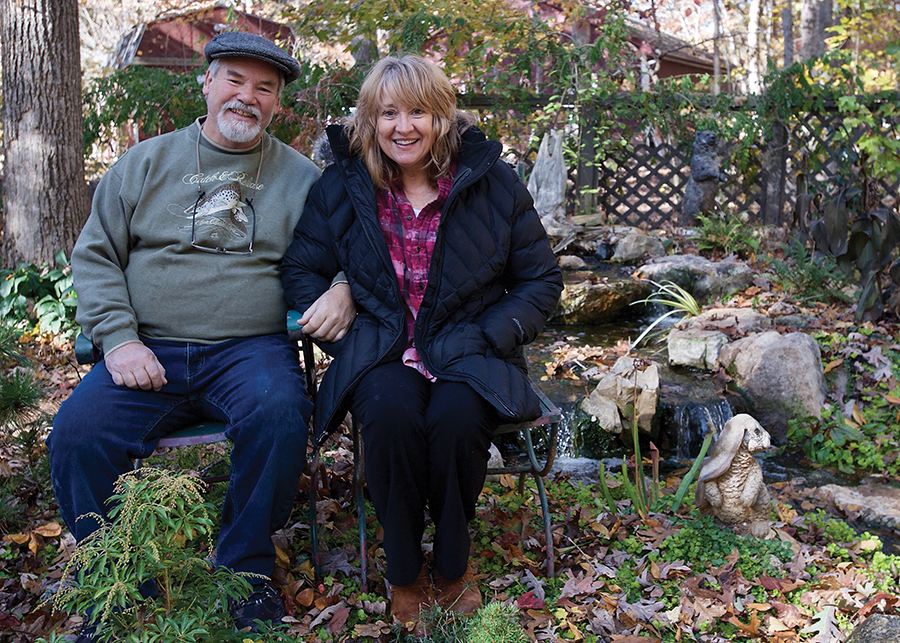
It also could be the theme of Janet Gaddy and Tim Moran’s life together.
In pottery circles, the Browns Summit couple are known as accomplished “crystaleers,” people who finish their pieces with crystalline glazes, shimmering topcoats that blossom with frosty crystals after being fired in super hot kilns.
“This isn’t for the faint of heart,” says Tim, explaining that only one in three pieces survives the process. “There are very few potters who do crystalline — and very few who do it well.”
The couple’s skill with the painstaking craft — and the vividness of their crystals — have landed their pieces in galleries in Raleigh, Wilmington and Black Mountain. More than a third of their business comes from custom orders.
They also pack a trailer and roll off to more than a dozen shows every year.
They’re regulars at the Carolina Pottery Festival, which happens every November in Shelby, N.C., and at the selective Catawba Valley Pottery & Antique Festival in Hickory in March.
“To be in that show is an absolute honor,” Tim says of the Catawba event. “It’s one of those shows you dream about.”
Locally, the pair can be found hovering around their booth at Potters of the Piedmont, a spring and fall show at the Leonard Recreation Center in Greensboro. They keep a few pieces in the gift shop at the Greensboro History Museum downtown.
The rest of their time is spent making the earthen pieces that are literally — because of the capricious nature of crystals — one-of-a-kind works.
“Mother Nature has a lot to do with it,” Tim explains. “When she smiles on you, it’ll send a chill up your spine.”
That’s how he and Janet felt when they met. Tim, who’d just sold a chain of small radio stations, was in the throes of a divorce, the final act of a 28-year union.
Janet, a potter and high school art teacher, was stinging from the dissolution of her 20-year marriage.
Both were wounded and wary when they crossed paths in a weeklong life-coaching workshop in Chapel Hill in 2001. They got to know each other during sessions that required them to divulge their histories and feelings. They had dinner together. At the urging of her counselor, Janet made an announcement to the class at the end of the week.
Tim was the one she’d spend the rest of her life with, she said.
For once, he was speechless.
They hugged.
“I whispered ‘Thank God’ in her ear. I’d prayed about it,” he remembers.
They forged a life together. At first, that involved him driving from Roanoke Rapids, N.C., to Danville, Virginia, Janet’s hometown, to take a pottery class with her. It was a blatant excuse to be together.
“I told him I’d seen kindergarteners who made better pottery,” she says.
Tim cups his hands around an imaginary vessel then splays his fingers wide to mimic throwing a piece of pottery hastily.
“I’d be like, ‘OK — let’s go to dinner,’ “ he says.
Pottery assumed a bigger role after Tim had triple-bypass heart surgery, the byproduct of years of stressful living, he believes.
“He traded a three-piece suit for a potter’s wheel,” Janet says.
“Pottery became my therapy, my obsession,” adds Tim, who now favors denim and flannel. “Anything I do, I do 110 percent.”
For years, Tim had collected art glass, a passion that sent him on frequent trips to glass-blowing centers of the Czech Republic, Austria, Hungary and Poland.
He bought hundreds of museum-quality pieces from the Art Nouveau period of the late 1800s and early 1900s.
As much as he appreciated art, he found there was a difference between collecting and creating.
“I enjoyed taking a lump of dirt and making something beautiful,” he says.
Janet, who’d inherited a hobby kiln from her father, had long known the satisfaction of creating.She studied pottery and sculpture in Cortona, Italy, in 2006, the same year she started teaching art at Greensboro College.
“She’s truly the artist,” says Tim.
Pottery became their thing, a common pursuit and a way to learn and grow together.
In 2004, they took a master potter’s class at Rockingham Community College in Wentworth. The class took a stab at crystalline glazes, a finish that had been around since the ninth century, when it appeared as a mistake in Chinese pottery.
The glaze was revived and refined by a 20th-century English potter named Peter Ilsley.
In North Carolina, which is recognized internationally as a pottery hub, only a few people had reputations for crystalline glazes, among them Phil Morgan and Al McCanless in Seagrove and Sid Oakley in Creedmoor.
The class members in Wentworth didn’t have much luck with the finicky glaze.
Tim, who holds a degree in geochemistry from the University of Georgia, was upset at the group’s failure. He was determined to make the glaze work.
He noodled with the formula — zinc and titanium form the crystals while cobalt, copper, iron and manganese provide the colors — until he fired a few successes. His mentor at RCC, Sally Hayes, encouraged him.
“She said, ‘You need to be showing,’” he says, pausing to wipe away tears. Hayes recently died, and Tim has just returned from the Carolina Pottery Festival, which was the first festival he attended with Hayes. She invited him to tag along and bring a few pieces to sell.
“I sold everything,” he says. “I said, ‘This is pretty cool.’”
He and Janet have concentrated on crystalline glazes ever since.
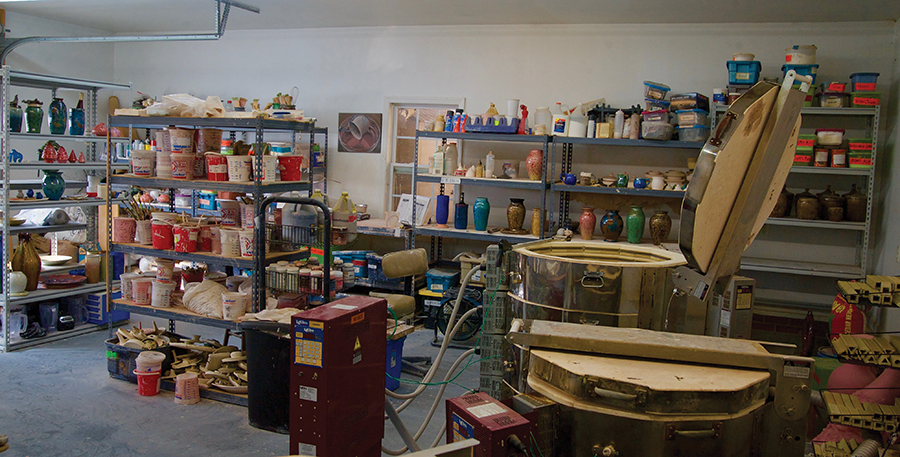
Their studio is a former three-car garage behind their home in the woods.
No longer an art teacher, Janet works daily with Tim on the couple’s business, Celtic Pottery, a name that reflects her Scottish heritage and his Irish roots.
Each of them makes their own pottery — his are more functional pieces such as platters, vases and bowls, and hers are more figurative, incorporating animal and human forms. Currently, she’s selling the heck out of sea turtles that gleam with mottled crystalline glazes.
Often, she mounts them on pieces of driftwood that washed ashore at Kerr Lake or the Outer Banks.
“We like to use things from North Carolina and Virginia, since that’s where most of our shows are,” says Tim.
They mold their works from clay that’s custom made for them by STARworks Center in Star, N.C. The blend combines porcelain and stoneware clays. The soft porcelain clay, used to make fine china, is hard to handle, but it’s extremely durable when fired. It also makes a smooth surface required for the formation of crystals.
“It’s like throwing cream cheese,” Tim says.
After the first firing, their pieces come out of the kiln as bisque, ready to receive the liquid glazes that distinguish the couple’s work. They use a kitchen blender to whirl cocktails of water, powdered chemicals and additives that affect the hardness and shine.
“We’ve gone through several blenders,” Tim says.
Some recipes yield large fan-shaped crystals that resemble the leaves of gingko trees.
Some produce small crystals that interlock like frost on a windshield.
Others crystals arrange themselves in a lattice of shamrocks.
“Our stuff is functional, but there’s a sort of elegance, and people are attracted to that,” Tim says.
Like chefs perfecting new dishes, the duo make detailed notes on every glaze and its complex firing schedule, which can start at between 2,300 and 2,400 degrees Fahrenheit, then dip and rise, at various temperatures, for more than 16 hours.
They use four electric kilns with computerized controls. Because of the energy demand, Duke Power installed a transformer outside the studio just for them.
“They knew they were gonna get their money back,” says Tim.
Once out of the kiln, the pieces must cool under controlled conditions for another 15 hours. Cracks and blowouts are common. Tim lifts a large vase to reveal a jagged hole in the bottom.
“You can’t guarantee anything,” he says.
Their misses are many, but their hits are spectacular.
Multicolored award ribbons cover the bulletin boards in their studio.
A show poster on the wall features several of their red pieces. Red is a difficult color for potters to attain. The pigment burns out easily at high temperatures, and the glaze contains cadmium, which is lead and must be applied in an encapsulated stain before bisque firing.
The two enjoy pushing themselves to learn new formulas and techniques.
They recently returned from a class in Dunedin, Florida, with renowned crystalline potter Ginny Conrow.
“I’m 72, but I’m going to be a student for the rest of my life,” says Tim.
“We work on glazes every day,” says Janet.OH
Celtic Pottery will display work at the Appalachian Potters Market in Marion on December 7. Their work also is part of a crystalline pottery exhibit and sale at the North Carolina Pottery Center in Seagrove until December 14.
The sweet sounds of the Dunleath Porchfest create community
By Ross Howell Jr. • Photographs by Lynn Donovan
For an early June afternoon it’s hot and the air is heavy. Though thick clouds are helping keep the temperature down, their dark, ragged patches threaten a storm.
Despite the heat and humidity, lots of people have come out for the 2019 Dunleath Porchfest. Passerbys smile and nod as my wife, Mary Leigh, and I walk along Percy Street northeast of downtown along Summit Avenue We overhear the murmur of friends talking, their conversations punctuated with laughter.
We stop in front of a porch to enjoy the sweet harmonies of a traditional music group called Turpentine Shine. There are festival T-shirts for sale under a canvas tent. A couple of enterprising elementary schoolers have a lemonade stand set up close by.
Mary Leigh and I saunter on, glancing at the darkening clouds, then turn and start down Fifth Avenue. Just across from Sternberger Park we join a group gathered on the sidewalk in front of a house overlooking the street. Some people have opened their umbrellas for shade.
I speak to a pleasant-looking lady wearing a straw sunbonnet and learn that we’re standing in front of her house. She’s Andi Christensen, who in 2016 moved all the way from Los Angeles, to make her home here. In L.A. she ran a successful dry-cleaning business for 50 years, living in an older neighborhood near Santa Monica Airport that had sprung up with the growth of Hughes Aircraft Company during World War II.
“I’m a native Angeleno, so I love L.A.,” Christensen says. “It’s such an interesting city. But it had become so congested, it was a hard place to live.”
When a niece who lives in Greensboro suggested she relocate here, Christensen decided to have a look. On a quick trip East she found the house on Fifth Avenue, and decided it was the one for her. “With a porch view of the park, the house was so pleasant. I just loved it,” she says.
The year she moved in, a neighbor across the street hosted one of the annual performances that serve as the centerpiece of the neighborhood’s porch festivals. Christensen was interested in participating, so she asked her neighbors how to become involved. The neighbors put her in touch with the organizers.
So here we are. We look up the steps to a porch where a blonde-haired lady sits on a stool with her guitar. She’s musician Denise Ball, who’s traveled from Charlotte to perform. She’s just been introduced to the audience by Greensboro’s mayor, Nancy Vaughan. Ball bends over the guitar body and picks a few notes, listening. Then she smiles.
To tell the truth, she’s manicured and dressed like she just had lunch at the Greensboro Country Club. But when she starts to sing, it ain’t about chicken salad and sparkling water, Baby. This lady’s singing the blues.
Two girls stop arranging their miniature tea set in the front yard to look up and listen. So does the dachshund at the end of his leash snuffling in the flowerbed that borders the sidewalk.
Some background: After public hearings, Greensboro City Council voted unanimously in 2017 to change the name of the Charles B. Aycock Historic District to the Dunleath Historic District. Months earlier the name of the neighborhood middle school had been changed from Aycock to Melvin C. Swann Jr. Middle School, honoring “Mel” Swann, who worked for 36 years in the Greensboro City and Guilford County school districts.
The name change process sometimes provoked discord.
The school and historic neighborhood had been named in honor of Charles B. Aycock (1859–1912) of eastern North Carolina. The problem was this: While serving as governor 1901–1905, Aycock had proved to be a strong friend to education, but as a candidate, he had supported a proposed Jim Crow amendment to the state constitution that stripped African Americans of the right to vote. Many residents were troubled by the racist legacy his name connoted. But UNCG professor and neighborhood resident David Wharton, along with others, had a ready alternative at hand.
In 1857 prominent Greensboro native Robert P. Dick (1823–1898) and his wife, Mary Eloise, decided to build a mansion on their property, which at the time comprised nearly all the boundaries of the area now recognized as the neighborhood historic district. Dick was opposed to Southern secession, even though he was a slave owner. After the Civil War he donated farmland to former slaves and supported passage of the 15th Amendment to the U.S. constitution that guaranteed the right of former slaves to vote.
Robert and Mary Eloise Dick’s mansion was named “Dunleath,” and it stood facing Church Street until its demolition in the 1960s.
With the vote by city council, the matter of the name change was settled. But many residents were concerned that the bonds of the tight-knit community had been damaged. What could be done to strengthen newly named Dunleath?
Resident, archaeologist and musician Shawn Patch had a suggestion. A friend had told him enthusiastically about a porch festival in the Oakhurst neighborhood of Decatur, Georgia.
To Patch that sounded like just the tonic Dunleath needed. For the first porch festival he envisioned a small event with five or six performance locations, perhaps where only neighbors turned out to listen.
“I would consider that a success, just because we want to get people out of their houses and walking around the neighborhood and circulating,” Patch told the Greensboro News & Record three years ago. “Anything above and beyond that is going to be wildly successful, in my opinion.”
Patch’s group, The Radials, was the final act in Sternberger Park that first porch festival.
Fast forward to 2019.
In the course of this afternoon, on the hour from noon till 4 p.m., some 44 individual musicians and bands are performing from 40 porches in 45-minute sessions throughout the Dunleath neighborhood.
There are performers like The Can’t Hardly Playboys, Mistura, Farewell Friend, The Smiling Bees, Momma Molasses, HighStrung Bluegrass Band, Grand Ole Uproar, Headless Chickens, Disaster Recovery Band, The Imperfectionists, Hokum Pokum, Minor Swing Band, Walker Street Fiddlers, and more. Genres include millennial blues, English and American folk, bluegrass, Irish and Celtic, old-time, honky-tonk, jazz, rhythm and blues, Bossa Nova and classic rock.
Also included on the program are a slew of Triad singer/songwriters — among them, Doug Baker, Bigdumbhick (a.k.a. Jeff Wall), Nick Boulet, Dean Driver, Beau James, Tony Low, Bobbie Needham and Casey Noel.
There’s even a “Kids Track” — venues where young musicians Colton Lindfors, 9; Finn Phoenix, 8; and Maggie Yarborough, 16; play 15-minute sessions alongside more seasoned performers.
All the events are free. Stations are available for people to donate canned goods for Triad Health Project’s food pantry.
And in the high noon slot, Shawn Patch plays and sings with the Mason Jar Confessions from the front porch of his and his wife Paula’s big, old house on Cypress Street.
Sometimes it’s necessary to open our umbrella against fat raindrops as the hours pass, but the showers don’t last. Around 4 o’clock everyone gathers at Sternberger Park for the finale, a performance by The Zinc Kings, who play old-time, bluegrass, folk and traditional music. Some families have brought picnic spreads. For those of us who are unprepared, there are food vendors.
The shadows grow longer across the park, and at woods’ edge, we see a firefly or two.
From discord, sweet harmonies. Surely, somebody’s said that.
Anyway, it fits Dunleath neighborhood well.OH
Ross Howell Jr. lives with his wife Mary Leigh and rescue dogs Sam and Lucy in Fisher Park, just across the railroad bridge from Dunleath.
Used to distinguish new sessions and visits. This cookie is set when the GA.js javascript library is loaded and there is no existing __utmb cookie. The cookie is updated every time data is sent to the Google Analytics server.
30 minutes after last activity
__utmc
Used only with old Urchin versions of Google Analytics and not with GA.js. Was used to distinguish between new sessions and visits at the end of a session.
End of session (browser)
__utmz
Contains information about the traffic source or campaign that directed user to the website. The cookie is set when the GA.js javascript is loaded and updated when data is sent to the Google Anaytics server
6 months after last activity
__utmv
Contains custom information set by the web developer via the _setCustomVar method in Google Analytics. This cookie is updated every time new data is sent to the Google Analytics server.
2 years after last activity
__utmx
Used to determine whether a user is included in an A / B or Multivariate test.
18 months
_ga
ID used to identify users
2 years
_gali
Used by Google Analytics to determine which links on a page are being clicked
30 seconds
_ga_
ID used to identify users
2 years
_gid
ID used to identify users for 24 hours after last activity
24 hours
_gat
Used to monitor number of Google Analytics server requests when using Google Tag Manager
1 minute
_gac_
Contains information related to marketing campaigns of the user. These are shared with Google AdWords / Google Ads when the Google Ads and Google Analytics accounts are linked together.
90 days
__utma
ID used to identify users and sessions
2 years after last activity
__utmt
Used to monitor number of Google Analytics server requests
10 minutes
SourceBuster is used by WooCommerce for order attribution based on user source.
Name
Description
Duration
sbjs_migrations
Technical data to help with migrations between different versions of the tracking feature
session
sbjs_session
The number of page views in this session and the current page path
30 minutes
sbjs_udata
Information about the visitor’s user agent, such as IP, the browser, and the device type
session
sbjs_first
Traffic origin information for the visitor’s first visit to your store (only applicable if the visitor returns before the session expires)
session
sbjs_current
Traffic origin information for the visitor’s current visit to your store
session
sbjs_first_add
Timestamp, referring URL, and entry page for your visitor’s first visit to your store (only applicable if the visitor returns before the session expires)
session
sbjs_current_add
Timestamp, referring URL, and entry page for your visitor’s current visit to your store