Almanac September




Over the tracks, the far reaches of downtown are fertile ground
for new beginnings and a day’s perfect ending
By Quinn Dalton • Photographs by Brandi Swarms
Sunrise on the South End district lights the sky over Bennett College and spreads gold across Martin Luther King Boulevard, Arlington Street and South Elm, lengthening down Lewis Street. It’s late summer, the air already warming, and these few blocks, home to some of the city’s most diverse and unique shops, restaurants, galleries, workplaces and homes, are coming alive in ways few here could have imagined possible only a handful of years ago.
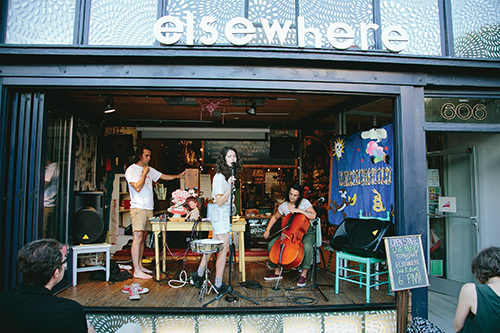
On the corner of South Elm and Bain streets, an armload of freshly baked French bread arrives at Chez Genèse. Storefronts open up, and chalked or printed sandwich signs appear outside to promote the day’s offerings. Elsewhere, the experimental museum where nothing is for sale but anything is possible, will soon open its entire storefront, where board-seat swings hang from the ceiling and beckon kids of all ages. A couple blocks over, the line’s out the door at Dame’s Chicken & Waffles, an anchor of Southside, just up the hill from South End.
South End? Southside?
Yes, there’s a difference, though they sit side by side. South End is Greensboro’s first and oldest downtown neighborhood, in recent years steadily renewed through the determined efforts of community organizers, developers, investors and entrepreneurs.
Bound to the west and north by the Southern Railway tracks as they curve toward the Depot, South End’s eastern border is Arlington Street. And the southern border of South End is pushing farther south all the time, past Gate City Boulevard and beyond.
Southside, right next door, is the new made to appear old — a visionary revitalization project funded by the City of Greensboro and born of extensive community involvement in the planning process. Bound on the north by Southern Railway tracks, on the west by Arlington Street, on the east by Bennett Street, and on the south by Gate City Boulevard, Southside occupies what has been traditionally known as Ol’ Asheboro, Arlington Park, the Asheboro Street neighborhood, and, most plainly, the South Greensboro neighborhood.
Taking cues from its older, funkier South End cousin, Southside’s mixed-use housing features retail or office space on the ground level and residential space above, as well as apartments, townhomes and single-family homes. There’s a mix of architectural influences from the urban south, including New Orleans–style, iron-laced balconies, Charleston-inspired two-level front porches, and historic ambience from warm-lit iron lampposts, smaller lots and sidewalks everywhere.
City funding also fueled renovations of historic homes that had previously suffered neglect. The resulting rebirth of Martin Luther King Boulevard now more properly honors its namesake. Formerly known as Asheboro Road, MLK Boulevard was mansion row in the late 1800s, with Queen Anne and Victorian confections rising to shelter the city’s professional elite — lawyers, bankers, etcetera — who could walk a pleasant few blocks to work in the growing number of tall buildings downtown. Several of these beauties still stand and are on the National Register of Historic Places.
Together Southside and South End comprise what was, and is, Greensboro’s first and only downtown neighborhood. And here’s the best part. You can feel all this time and transition surrounding you, not a line but a layering, like peering through a folded scarf — everything you see is tinged with the past. And there’s so much to see. So put your walking shoes on, people. Early bird gets to learn.
Southern, Charmed
In just a two-block stretch of South Elm, some half a dozen businesses are dedicated to helping you start your day feeling your best.
One of the newest editions, Sonder Mind and Body, opened just over a year ago. Owners Jessika and Veronica Olsen have popularized sensory deprivation tanks in Greensboro and brought together a collection of healing and health practitioners. Services include massage, acupuncture, Rolfing, hypnosis and more. The concept behind Sonder, it turns out, is “the realization that each random passerby is living a life as vivid and complex as your own.” This sounds like the motto for South End.
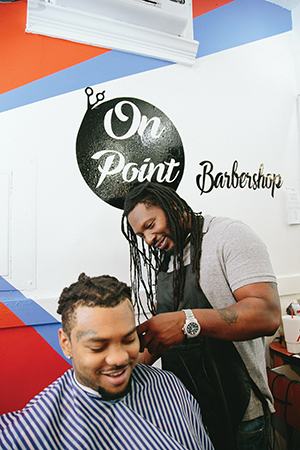
If it’s time to clean up your locks, On Point Barbershop delivers a precision fade. One waiting customer says of Willie Dowd, owner, “He’s the best. I go wherever he goes.” A few doors away, Rocks Hair Shop, promises “classic cuts, close shaves and craft beer.
But if you come in either place on a Friday or a weekend, be prepared to wait. Same is true for Boho Salon, which emphasizes natural products and processes. Or you can learn how to be on the other end of the scissors at Dudley Cosmetology University, which relocated to South End in 2013.
Then visit Vintage to Vogue Boutique, where a carefully curated collection of designer clothing and shoe brands await. Just few feet away you’ll find in Antlers and Astronauts’ handpicked treasures to adorn you and your home.
Founder Alexa Terry Wilde Reidsville native, wanted the store to be more than a place where people bought things. “The way we’ve set it up was very intentional,” she says. “We want people to come in and shop, but we also want them to feel like they can just stop in for a visit.” The couch, coffee table and upholstered chairs in the center of the space provide that very invitation, and, in fact, the entire store feels like a home, with its midcentury and ’70s influences. There are also events such as live music and classes featuring local artists. And the inspiration for the name?
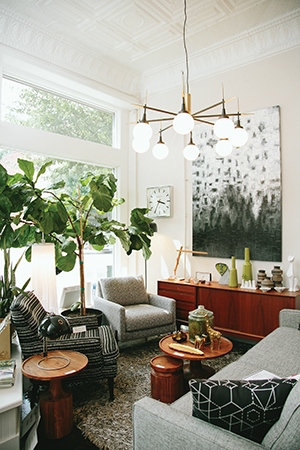
“It’s a reflection of my husband’s and my different sensibilities, combined,” Wilde says. “I’m all about nature, the outdoors, so I’m the antlers. And he’s a science guy — the astronaut.”
As she’s gotten to know her customers, Wilde often sources with them in mind, just like the hand-selling you can expect in the world’s best bookstore, Scuppernong, by people who know books and know you (even if it isn’t on South Elm; it is in spirit).
Social Status has to be the most honestly named store ever. Devoted to all things sneaker, this South End store will hook you up with the latest in street fashion for your feet.
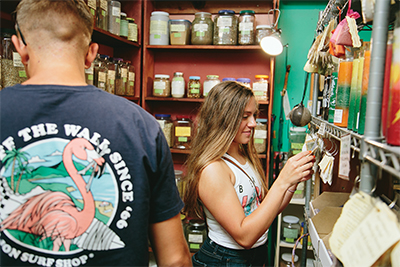
Across the street is Hudson’s Hill, which bills itself as an American general store dedicated to making and selling goods with purpose and meaning. And like everything else in South End, the new draws on the old. The two founders celebrate Made-in-America ethos with their carefully curated collection, focusing in particular on Greensboro’s denimed past. The name comes from Hudson Bros. Grocery, owned in the late 19th century by John Hudson, and the slight rise of land where the store was situated — hence, Hudson’s Hill.
Treasure Tracking
If the railroad tracks that mark the beginning of South End were once the line some really picky folks wouldn’t cross, let that metal border now be the sign that you’ve arrived where most of what you find can’t be found anywhere else.
Like Elsewhere, of the indoor swings, where you can also step inside a rose-lit teepee and inspect rows and rows of artifacts offering a new way of seeing and imagining. Saturday tours will start you on your journey. Or Terra Blue, which will celebrate 20 years in South End this fall, and will double in size with the acquisition of the other half of the building, adding class space for crafts like candle making, a salon and café space for people to gather.
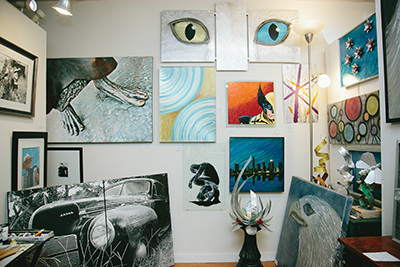
And of course, the artists are here. They’ve been here, waiting for you. For 15 years Artmongerz has provided co-op space for artists to display their work. You’ll find all media, from paintings to photography, even room-sized sculpture. Photographer and co-owner Earl Austin says, “Even only a few years ago, when I told people where we are, their eyebrows would go up. Now we have more foot traffic than I’ve ever seen.”
A few doors away, Ambleside Gallery is also celebrating 15 years with a focus on paintings, drawings and sculpture. Owner Jackson Mayshark has been representing both established and emerging artists from throughout the world for nearly 40 years. Examples of local artists include Alexis Lavine and the late Leigh Rodenbough, who was an attorney for 51 years before turning his attention to painting in oil an pastel; water scenes — beaches, harbors — that make you squint in their sunlight. But Mayshark is also global, and his gallery displays works by British artists Nigel Price, Vicky Cox and Peter Archer, Chinese artist Guan Weixing, considered one of the world’s greatest living watercolorists.
Ambleside Gallery is one of only a few venues nationally that hosts the traveling exhibition of The American Watercolor Society. But the gallery also houses the ceramic works of Brown Summit–based brothers Bryan and Brad Caviness. Each piece, which looks from the outside like a piece of pottery with a crack or hole broken into it, hosts within a meticulously detailed miniature world — a Pueblo Indian settlement, a Moroccan town, a French streetscape. When asked what these treasures are called, Mayshark shrugs and smiles. “There isn’t a name for them. There isn’t anything else like them.”
Well, how about that.
And if you want to make your own treasure, then you need to come to Forge Greensboro Makerspace. Just go to the end of Lewis Street, hang a left, and look for the double doors with the sledgehammer handles. Whether you want to work in metal, clay or fabric, the tools and machinery you need are there. Even more important, there are people and classes to guide you in your creative journey. “We see ourselves as a gym for people who like to make things,” says executive director Joe Rotondi. “It’s not just the work but the creative collision that happens when you bring people together.” Tours are offered daily.
In the Spirit
Tired yet? If you’re ready to cool your heels and your throat, the options in South End keep growing — and just like their neighbor shops, boutiques, galleries and creative spaces, South End’s restaurants and bars each have their own distinctive feel. Mellow Mushroom came to South End a decade ago — and yes it’s a chain, but its success, and the reason it’s a perfect fit in South End, is because each ’Shroom is locally owned with a ton of creative control over the space. This is a cathedral theme, with arched, mushroom-themed stained-glass windows by Winston-Salem artists Veronica and David Bennett.
Across the street is a newer kid on the block, Chez Genèse. Open for breakfast and lunch, Chez Genèse serves up a warm blend of French-inspired comfort food and inclusivity — adults with intellectual or developmental disabilities comprise much of the staff and are paid a fair wage and benefits.
For dessert, why not be a kid yourself — in a candy store, naturally. Gate City Candy Company will take you back to the time when happiness was sugar on your tongue. Try a fresh daily selection of gourmet chocolates, fudges and peanut brittle (well, peanut brittle only if a certain writer doesn’t get there before you).
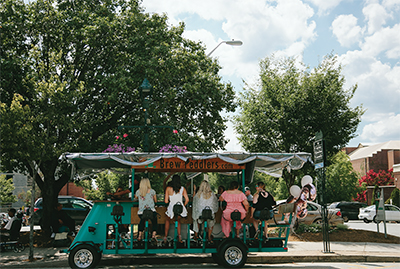
For the grownups, there’s The Bearded Goat, Horigan’s House of Taps, the Greensboro Distilling Company (the first legal distillery in Guilford County since Prohibition) which makes the wildly popular Fainting Goat Spirits, and next door, the SouthEnd Brewing Co. Across Lewis Street, Boxcar Bar + Arcade is family-friendly and very fun.
And then there’s The Hemp Source, which sells CBD products developed in a family business based in Wendell, N.C. Though they won’t get you high, different concentrations of the hemp-based product, in oral and topical forms, can provide pain relief and relaxation.
The Yellow Brick Road Leads to South End
The Community Theatre of Greensboro finally found its forever home in South End in 2012, when the Broach Theatre, named for one-time South End supporter and City Beat founder Allen Broach, became available. CTG is entering its 70th season and will mount its 25th production of The Wizard of Oz in November. Though Oz, its main fundraiser, is performed at Carolina Theatre to provide enough seats for the beloved annual production, the soul of CTG can be found through the red doors on South Elm. CTG is proof of the power of story brought alive on stage to thousands of actors and audiences of all ages, year after year. The Wizard of Oz involves a cast more than 100-strong. Multiply that by all of the families of those actors, and the volunteers, the staff and the audiences, and you can begin to imagine how big a heart CTG has to give to all of us. Just like its South End home.
The Believers
It takes faith to believe in something you can’t see. Maybe it takes even more faith to believe in something you do see, but no one else does.
A self-described Jersey street kid, Andy Zimmerman came to Greensboro in 1978 when his father moved the family furniture business to High Point. The move cut short his rabble rousing and introduced him to a new love — mountain climbing and kayaking North Carolina’s mountains and rivers. He soon found his own path to entrepreneurship with two kayak manufacturing companies, the latter of which he sold to his employees, who later relocated it to Arden, N.C.
In 2010, a friend asked him to look at a building downtown, which is now the home of. Greensboro Distillery and South End Brewery. Back then, it was a hulking shell. His friend asked him what he thought it would take to restore and upfit the building. “A million,” Zimmerman ventured.
“I’m out,” his friend said.
But Zimmerman needed to take on something new. The street-punk-turned-whitewater-thrillseeker was ready for his next challenge. He asked if his friend minded if he bid. Within the day the building was his, the first puzzle piece in what has become his life’s passion — the revitalization of South End. That was the start of Zimmerman’s new company, AZ Development.
His office is in the Lewis Street building that houses HQ Greensboro, a shared workspace with 24/7 access for members. It also features resources available to the public, including conference rooms with flexible layouts and state-of-the art technology, multipurpose rooms, and the ability to network and learn from other people who are starting something new. In just four years, HQ has come to house or support 80 companies and 130 tenants, who avail themselves of 25 private office suites and a well-stocked coffee bar. In time they’ll have company, as Zimmerman’s next project gathers steam: The renovated Gateway Center on the corner of South Elm and Gate City Boulevard, will welcome an estimated 230 employees in the coming months. The scale may be different, but the passion is the same. “I see myself as a place maker, not just a developer,” Zimmerman says. Bearing out his statement is a big deck in back of HQ, overlooking a beautiful secret garden laced with bloom-dotted narrow stone paths.
Executive director Kaitlin Smith says it’s become a thriving neighborhood space. “The folks at Elsewhere, our next-door neighbor, keep a vegetable garden here as well,” she says.
And that’s South End in a nutshell — a progressive workspace cultivating new companies right next to an experimental, nationally known museum born in a thrift shop — its products not things, but human imagination unleashed. OH
Quinn Dalton is the author of two story collections and two novels, most recently Midnight Bowling. She also co-authored The Infinity Of You And Me under the pen name JQ Coyle with fellow UNCG MFA grad Julianna Baggott.

John Mark Hampton’s Moriah Guitars is an acoustic dream come true
By Grant Britt • Photographs by John Koob Gessner
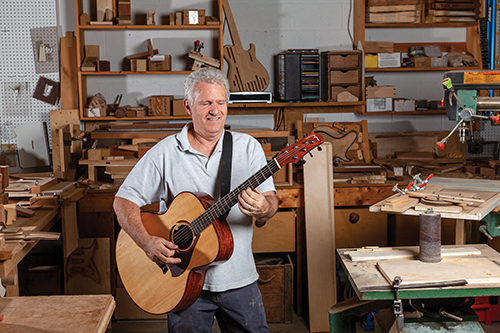
“Let me find somewhere to sit down and kinda blow off the dust,” Moriah Guitars’ proprietor John Mark Hampton says by way of greeting when you enter his space. Hampton has a sawdust nimbus hovering over his head, surrounding him with a slightly fuzzy aura that marks him as a luthier, a hands-on creator of one-of-a-kind stringed instruments.
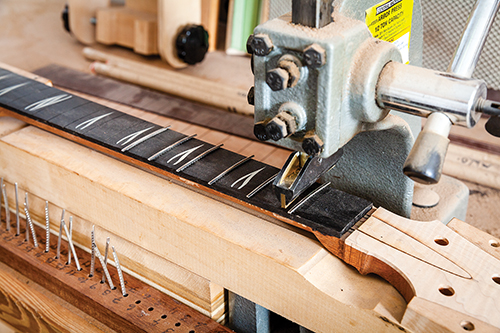
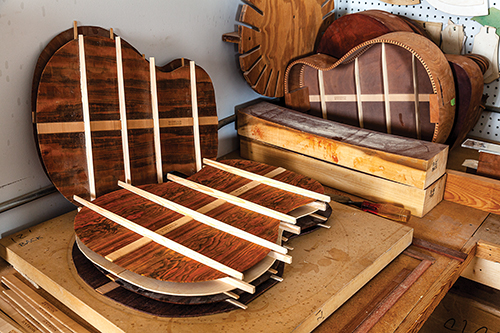
Hampton creates his magic in a warren of rooms tucked away behind a tax and accounting service in a business park near Guilford College. Enter through the tax office lobby and wander through a labyrinth of expanding spaces littered with dismembered guitar body parts and tools like Paul Bunyan’s dentist might use to extract teeth. Lurking in the back of the warehouse-sized space are hulking machines the size of printing presses, resembling cast-iron behemoths lying in wait for prey to devour.
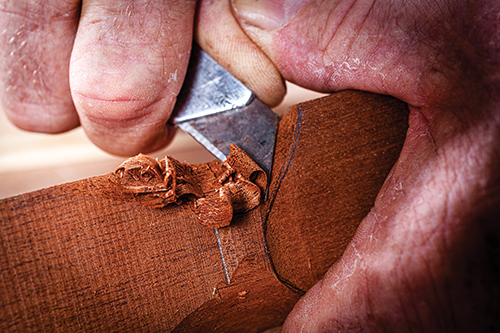
The process here seems to be a marriage of the old and new. “My philosophy is find the best way to do it, and don’t be anti-new,” Hampton says. “There’s lots of great stuff coming out with technology, but there’s also the old way where you have to take a tree and turn it into something, you know? It’s just a lot of processes.”

The Greensboro native kicked off his luthier career while attending Wilmington College in Ohio, taking an independent study at the Guitar Research and Design Center in Vermont in 1979. Returning to Greensboro from summer vacation with some of the guitars he built while in the program, Hampton approached Keith Roscoe, owner of the Guitar Shop, a guitar-building business on Tate Street. Roscoe gave the newly minted luthier an opportunity to build something for him that summer. “He just said, ‘Here — why don’t you just go in yonder and make me some guitars?’” Hampton recalls. “And I went to the drawing board and designed ’em from scratch. I made three electrics and one bass.”
He had been playing guitar since he was 13 and loved the sound and capabilities of the instrument. He also had a knack for woodworking. “When I got up to college, I had the opportunity to do anything I wanted, and I just shot for the moon, and said ‘What can I make?’ Just started like that, kind of like a dream to do it.”
Hampton was working for Roscoe, designing and building guitars when Ken Hoover started working there as well. Within a year, the two had left to start their own company, Zion Guitars, in 1980. “Ken and I just loved working together, and the chemistry was just really there,” Hampton says. “Bear in mind, I’m 62 now, and I was only 22, and Ken looked over at me one day and said, ‘How would you like to start a business?’ And I looked and him and said, ‘Uhhh . . . what do you mean?’ We just started off really from scratch, flying by the seat of our pants,” Hampton says, describing their shoestring operating budget as “nothing,” or next to it. “It was a real miracle,” he says now. “Ken believed in me and we just tried to do the best we could.” Gradually, service jobs and repair work for Triad area clients started to trickle in, and Zion Guitars started to gain a reputation by word of mouth.
The business took a flying leap forward the following year when Hoover and Hampton befriended Seymour Duncan, one of the first custom guitar pickup makers. Duncan invited Zion Guitars to a National Association of Music Merchants show in Atlanta, so the duo packed up one of their early prototypes they called a Tele-Zion Powerglide, a tribute to the Telecaster, and Duncan let them display it in his booth. The NAMM is the big dog of trade shows, attracting artists and dealers from all over the globe. Hampton was strolling around the showroom floor taking in the sights when he bumped into Kansas founder/guitarist/songwriter Kerry Livgren. “He was just looking around and I said, ‘Hey, are you Kerry Livgren?’ He said ‘Yeah.’ I said, ‘You might want to come see what we’re up to,’ and he graciously came over to the booth, saw the guitar we made, and ordered one on the spot,” Hampton remembers. That national artist link was a turning point for the young company. “[It] just of sort of grew little by little,” Hampton says. “We just knew some people, and they knew some people.”
Another giant step for the company occurred when Guitar Player magazine commissioned a guitar to put on the cover. GP editor Tom Wheeler was aware of the work of another Greensboro artist, Wayne Jarrett, who has enjoyed a career custom-painting guitars for the likes of Prince, Alabama, and .38 Special, as well as motorcycles. Wheeler asked him if he could do a custom paint job on a guitar to be featured on the cover of the magazine. “And Wayne, bless his heart, he said, ‘Tom, why don’t you get these local guys here in Greensboro to build the guitar, and I’ll paint it,’ and that’s how it all started,” Hampton recalls.
Seymour Duncan provided the pickups, and bridge makers Floyd Rose had a new tunable locking tremolo that graced Zion-manufactured Silverbird for the cover.
But just when the business was going great guns, Hampton decided to take a leave of absence. He says his heart’s desire “had always been to build acoustic guitars. I was feeling that we got things going pretty good with Zion and Ken was really wanting to take it into the electric zone. I felt like it was time to move on.”
So in ’84, Hampton left — to go to Scotland for what he described as “a worship and mission ministry” to do whatever the church over there needed. “I was going over to be a servant,” he says humbly of his service for New Life Christian Fellowship in Hawick [pronounced “hoyk”], Scotland. “They had a youth group I was helping pastor, leading the worship.” He met his wife, Eileen during his stay from 1985–1990, and when he returned, resumed his friendship with Hoover, who passed away last year from complications due to MS. During their renewed time together, Hampton designed and built the Zion Primera guitar, which attracted the attention of Christian guitarist Phil Keaggy, who signed some early models. Hampton started his own business, Moriah guitars in 2008.
“I had been a builder from 1990 up till 2008,” he reveals during a tour of his shop. “Building houses, and what we would do here, I would acquire tools along the way, kind of like gathering moss along the way, and here are the machines that sort grew little by little.” Then by 2008–’09 he felt like he needed to get back into building guitars again. “And my children were bugging me, they were telling me ‘Daddy, why aren’t you doing that?’ So that’s what started this. We built the shop and I’ve probably moved four or five times in the last 10 years. We’ve been here about four years.”
In one of the back rooms of his cavernous headquarters, Hampton is showing off some of his exotic woods. He pulls out a slab of beautifully grained quilted maple that looks like designs have been etched into the wood, but it’s just the natural grain. Acquiring the materials is a treasure hunt for the luthier. “You’re always looking out for something really beautiful. Sometimes we’ll find a board somewhere, or somebody will find something,” he explains. Like his friend who went on a surf trip down to Costa Rica brought back a board of rain tree wood. “I’ve made a few guitars off that,” Hampton says. “And sometimes we buy wood off suppliers who do make the wood prepared for guitar-building.”
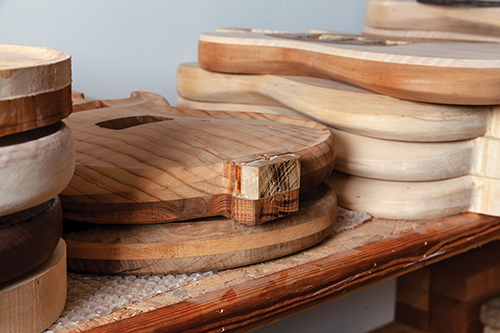
Ironically, you’ll see no completed instruments at Moriah. “We’ve got a few bodies, just got ’em to this stage,” Hampton says of the stack of raw forms on a shelf. “We don’t have a contract on anything, so we leave it at a certain spot and people can come in and put whatever they want on it.”
Most of his builds are custom orders, which is great for business, but leaves no showroom models.
“I’m thinking of building a bunch of them just to have for people to look at. A lot of times people come here, and all the guitars I’ve built are already gone,” he says.
And even though Hampton says he doesn’t have any nationally known people among his clientele, he is building instruments for local friends and people who have known him for years. The commissions keep him busy. He says he’s got about 16 acoustic guitars in process — none of them finished. “But we’re working really hard to get ’em done.”
And Hampton has capitulated to some electric projects. But only a bit. “There’s always been a designing thing going toward the electrics,” he concedes, “but I’ve always wanted it to go to the acoustic. That’s been my dream. That’s what we’ve finally been able to do . . . that’s what Moriah’s about.” OH
Grant Britt peruses his own collection of trashcan-rescued guitars displayed haphazardly against the walls of his tchotchke museum across form the graveyard.

A storied Fisher Park bungalow awaits its next caretakers
By Maria Johnson • Photographs by Amy Freeman
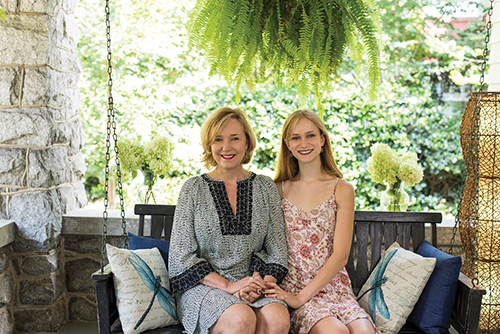
They’re caretakers, one pair in a series.
That’s the way Beth Nilsson and her husband, Carl, look at their 6-year ownership of the C.D. Benbow Jr. House, a broad-shouldered bungalow that perches on a rise overlooking historic Fisher Park.
“We have the best view in the park,” Beth says unequivocally. “You don’t know how many weddings and family pictures we see.”
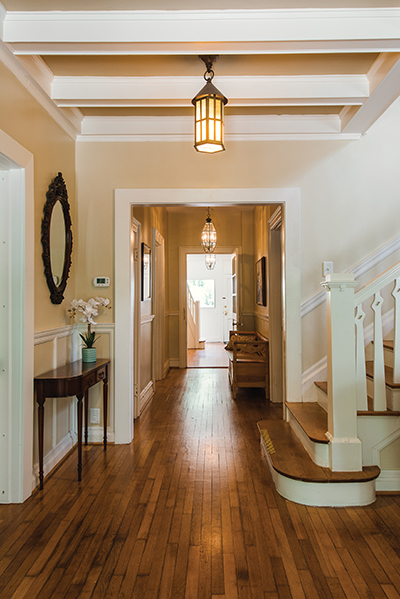
The couple bought the stone-and-shake home in 2013, a hundred years after it was built, and moved in with their blended family of five children — “the Nilsson Olson Brady Bunch” as Beth calls them.
Now that the leading edge of their brood is maturing into adulthood — the kids are 21, 20, 19, 18 and 12 — the Nilssons have decided to sell the 3,400-square-foot Craftsman showplace and downsize to a smaller home. They’re not sure where they’ll end up, but they plan to stick with the eclectic neighborhood on the northern skirt of downtown Greensboro.
“Cookie cutter house? Forget it. We would never leave Fisher Park,” says Beth, who serves on both the neighborhood association board and on the committee that governs the leafy park.

The neighborhood, which took root at the turn of the 20th century, is a platter of architectural styles and contains a National Historic District. Clashes — such as the fray about whether the owners of Hillside, the recently renovated Julian Price House, should be able to operate a bed-and-breakfast with event space — are not surprising, Beth says. “People are passionate about living here.”
Like many homes in the area, the Nilssons’ place comes with a built-in backstory, one reason it landed on Preservation Greensboro’s Tour of Historic Homes & Gardens in 2017.
Beth flips the pages of a scrapbook. A snapshot shows a line of people standing from threshold-to-curb to get a peek inside. As with many old houses, there’s a pool of local people with connections to the house.

Beth has hosted nostalgic visits from a past owner and the granddaughter of another former owner. A herd of Greensboro folk have been friends and schoolmates of the children who’ve lived there over the years.
“Fairly frequently, someone will say, ‘Oh, I know so-and-so who used to play there,’ “Beth says.
The home was first populated by C.D. Benbow Jr. and Marjorie Long Benbow, who moved in soon after marrying.
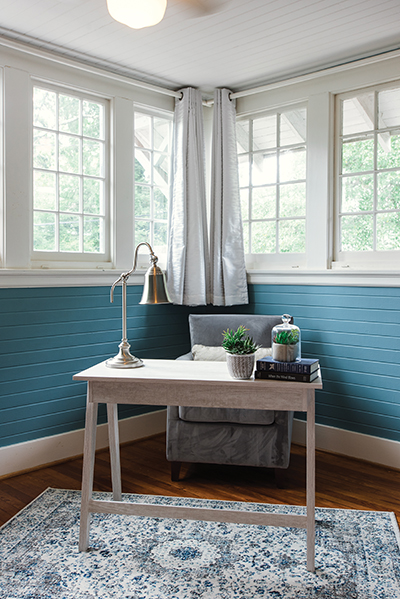
Benbow was a grandson of De Witt Clinton Benbow, a major mover and shaker in Greensboro in the late 1800s. Born a Quaker near the community of Oak Ridge, D.W.C. Benbow was a dentist by training, but he left the tooth-pulling profession for real estate development and civic activism.
He was instrumental in establishing the forerunners of UNCG and N.C. A&T State University, and he saved the precursor of Greensboro College from financial ruin.
He attended the birth of the New Garden Friends Meeting, a Quaker congregation, and the incorporation of the Guilford Battleground Company, which preserved the Revolutionary War battle site, now a national military park.
He also built Benbow House, a four-story hotel at the corner of South Elm Street and what is now February One Place, the site of the International Civil Rights Museum.
When it opened 1871, Benbow House, with its tall, thin French-inspired windows, was lauded as a premium hotel. It hosted a band of northern newspaper editors on a tour of the “upper South” after the Civil War. The first person to sign the guest register was former governor Zebulon Vance.
The hotel burned in 1899. New owners replaced it with The Guilford Benbow Hotel, which was run by Benbow’s son, C.D.
A generation later, C.D.’s son, C.D. Jr., shunned the hotel business — he sold real estate and cars — but knew what fine accommodations looked like. He incorporated a taste for solid construction into his new Fisher Park home.
Famed local stonemason Andrew Leopold Schlosser almost certainly crafted the home’s battered-granite foundation and tapered piers, which are cemented together by Schlosser’s trademark grapevine mortar.
Schlosser’s handiwork distinguishes several Fisher Park homes, as well as the hardscape inside the park. Just across the street from the Nilssons’ home lies the so-called King’s Chair, a fanciful stone throne that was built in the 1930s and relocated to the park in 2014. Schlosser also wrought several of the stone bridges that span a creek in the park.
The Nilssons have spent many hours on their deep front porch gazing into the park and entertaining friends. When they married at Holy Trinity Church, wedding guests had only to walk a couple of blocks to a reception at their home.
When the couple celebrated Carl’s 50th birthday with a James Bond–themed bash, the front porch was given over to casino-style gaming tables.
Day-to-day, the family literally chills on the cool, concrete-floored porch, eating meals there and swinging in a wooden swing that they speculate was original to the house.
Inside, the home is expansive as well, with a wide central hallway flanked by living room, dining room, kitchen, and — a rarity for a Craftsman bungalow of that era — a first-floor master bedroom.
The Nilssons have renovated sparingly to preserve the home’s character.
“You couldn’t build a home like this today,” says Beth. “The amount of labor involved — it’s just not done.”
The Nilssons have left untouched coffered ceilings and pocket doors on the first floor, as well as the hand-sawn balusters that march up the stairs.
They didn’t dare touch the mural on the landing.
Depicting a seaside villa — perhaps on the Mediterranean — the undated mural is painted directly onto the plaster and framed with molding.
“Isn’t it fantastic?” says Beth. “I hope no one ever gets rid of that.”
The couple also kept original tile work where they found it. Brilliant blue geometrics splash across two bathroom floors.
To spotlight more original features, the Nilssons pulled up flooring that concealed hardwoods. In the kitchen, they patched and darkened the boards to conceal an incision across several planks.
Beth shrugs when asked the reason for the line. She doesn’t know or care.
“No one lives in a house like this unless they can stand a little quirkiness,” she says.
In the dining room, the Nilssons converted built-in bookshelves under a triple window to a marble-topped buffet with glass-front doors and glass shelves. Lights inside the cabinet show off a collection of Swiss glass and German porcelain.
Other upgrades include new kitchen cabinets, countertops and appliances, including two dishwashers; a glass-walled shower and fresh cabinetry in the master bath; and a powder room in what was previously a laundry room.
Geared for many inhabitants, the home has three-and-a-half bathrooms and up to seven bedrooms.
Many people would count four bedrooms, but Beth counts up to seven because the upstairs sleeping porch could be used as a bedroom and two of the upstairs bedrooms have walk-in closets big enough to turn into bedrooms, as the family has done.
“It’s really quite an interchangeable house,” she says.
The yard is flexible, too.
The Nilssons refreshed the sloping front yard, leveling and planting a second terrace between porch and street.
The downing of three oaks in the side and backyard in recent years has left room for whatever landscaping the next owners envision.
Ditto for the one-car garage and storage room — formerly a servants’ quarters — accessible by a drive-through port cochère on the right side of the home.
The tall steps leading from side porch to the port cochère speak of another time, when carriages might have wheeled up beside the house and needed a step that was level with a carriage.
Beth took a tumble off that step a few years ago, breaking her back — an injury that required rods and pins to fix — but even that did not dampen her love of the Benbow bungalow.
“I still love this house,” she says. “It brings a strong bond.” OH
Maria Johnson is a contributing editor of O.Henry. She can be reached at ohenrymaria@gmail.com.


The ancient art of bonsai enhances Mendy and John Kearns’ midcentury home
By Cynthia Adams • Photographs by Amy Freeman
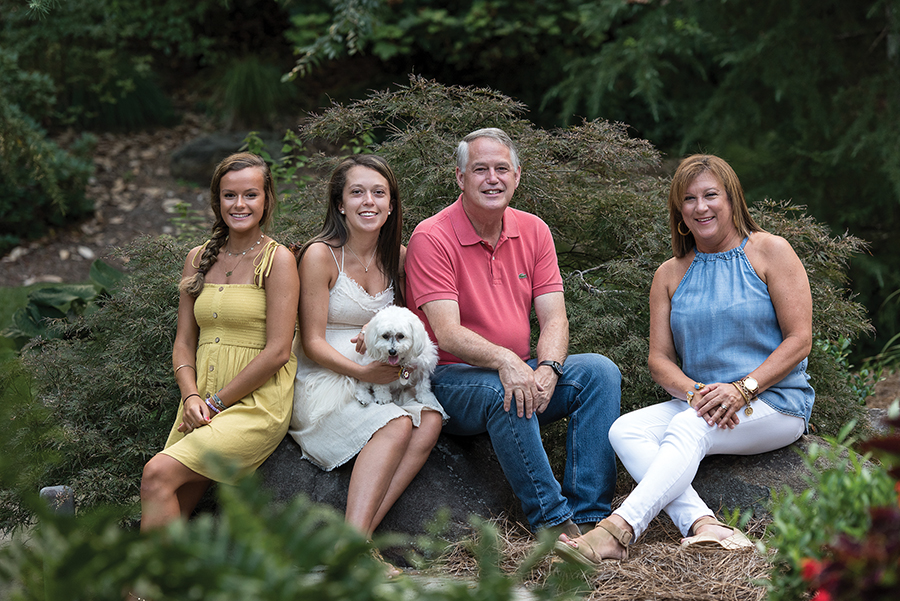 Each home tells a story. It becomes the repository of past and present struggle and triumph, which is certainly the case of the High Point home of John and Mendy Kearns.
In their case, their home is filled with unique expressions, both artifact and the organic.
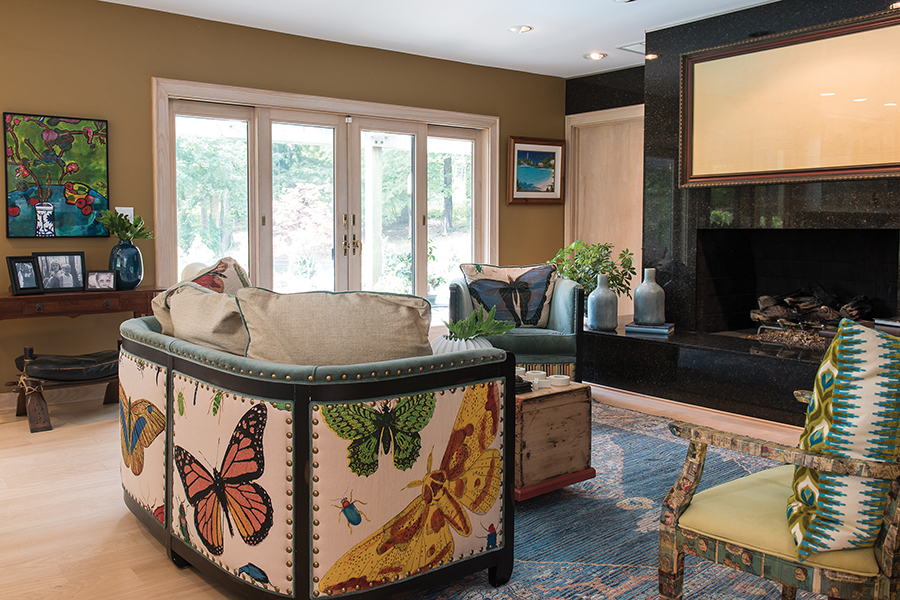
The Kearns’ modern and eclectic home features a most unique interior drawn from three generations of family art history and heirlooms.
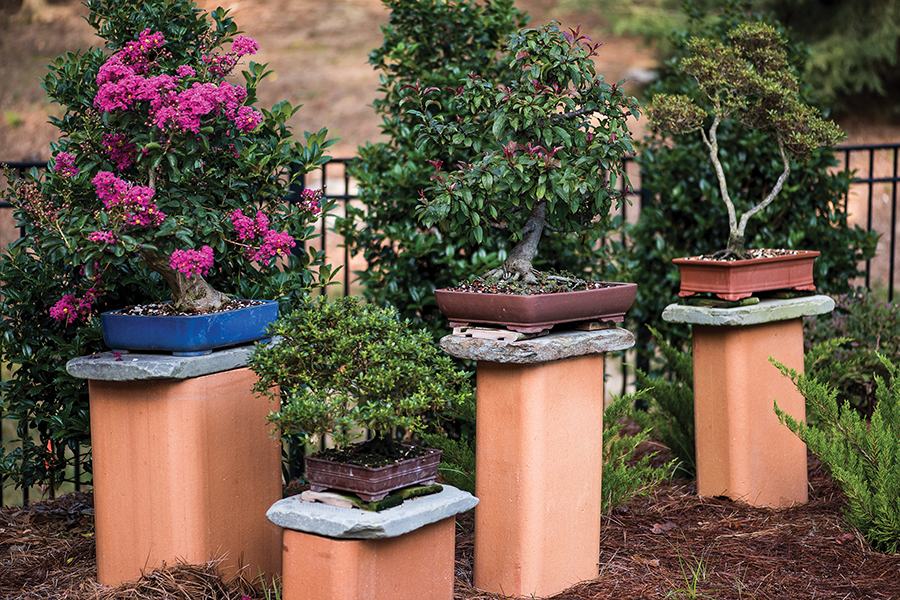
And then there is the unexpected — a living art form, bonsai, deepening and enriching their inner lives and exterior living areas.
Their private residence, surrounded by woods and landscaped grounds, is a sanctuary from the wider world, a space where the people and things they value most are closely kept.
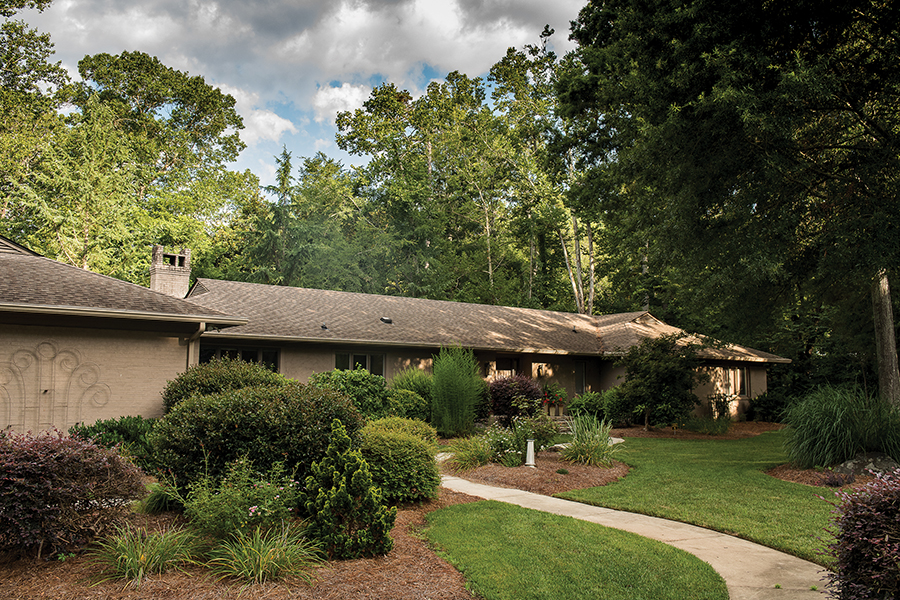
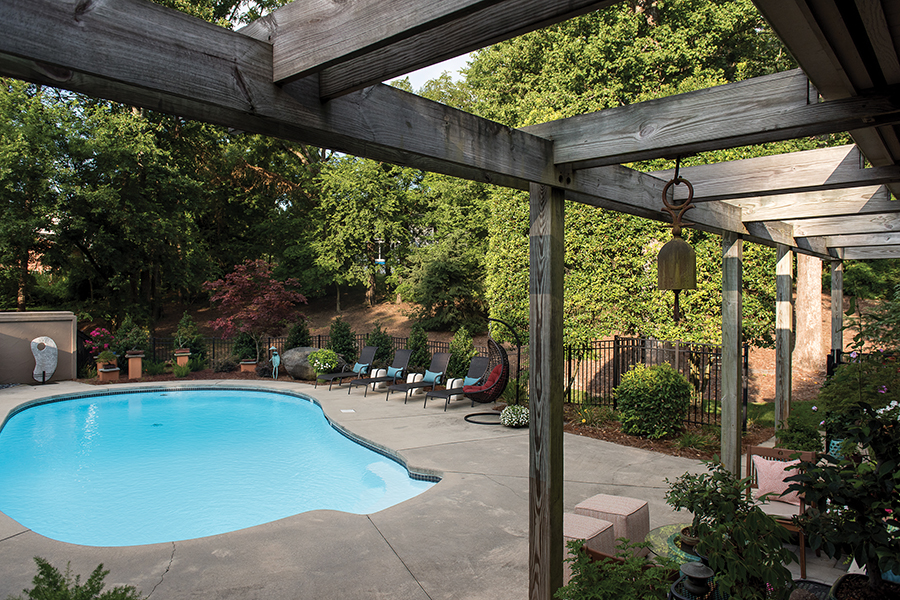
The Kearns home has a modern vibe but dates to 1968. It is handsomely oriented to the back gardens and pool. Coursing behind the house, a small creek winds through landscaped grounds punctuated by Japanese maples that are redolent of bonsai. And, of course, inside the garden wall are a wide variety of potted bonsai almost everywhere you look.
The house belonged to NASCAR-owner Bill Davis before them, says Mendy. It is a pleasant, spacious house, oriented to the private yard with extensive windows off the living room.It is also a living laboratory for John’s passion for the ancient art of bonsai.
Mendy and their two daughters adore the classic pool, which hugs the lines of the midcentury modern home. John adores, and is obsessed with, the scores of bonsai surrounding the pool.
The Kearns’ residence speaks to honoring traditions — one they inherited and others imported from the Far East.
As a descendant of the Kearns family, owners of a once bustling High Point factory, John is steeped in history and a reverence for place.
“My great-grandfather had a hosiery mill, called O.E. Kearns & Sons, on Hamilton Street.” (O.E. was his abbreviated name, Oscar Eugene, says John.) According to the City of High Point’s textiles archives, it was among five significant manufacturers: “Between 1910 and 1920, many well-remembered mills were started: Amos, Melrose, Crown, Triangle and O.E. Kearns. By 1923, High Point boasted 26 textile plants including 14 hosiery mills, and 42 percent of the revenue generated by city industries came from textiles. By 1940, there were two cotton mills, two silk mills, and 27 hosiery mills.”
The High Point Museum maintains examples of Kearns-made white cotton socks with a classic cuff in its collections.
The former mill, which closed in 1963, later housed Hamilton Fabrics, which John’s father, Tom Johnston Kearns, Jr., opened in 1978.
His father died in 2018, active in the business until the end. Now John is the second-generation family member to head Hamilton Fabrics.
John earned an associate’s degree at Lees-McCrae College before entering N.C. State to study horticulture and greenhouse operations. He finished his degree in December 1983 just as his father’s partner had quit. He sent inquiries to nursery businesses. “But it was dead of winter and they responded ‘try us again in April.’”
John’s father suggested he consider the fabric business.
“He said, if it worked fine, if not fine. I discovered the joy of the textiles business too.” Before John knew it, he had a sample case and a sales territory.
“I love the textiles industry; I found the joy in it,” he reflects.
John says while he made textiles his vocation, he found a niche that allowed him to remain in the natural world. It was bonsai, which he had discovered when a boy on the cusp of adulthood. Bonsai took on greater meaning once he accepted a position in the family business, one requiring time indoors and frequent travel.
Bonsai was how he decompressed from an over-stimulated world.
“It’s my therapy,” says John. “Some people play golf; I tried golf when I was little, and all it did was get me frustrated.”
Bonsai, on the other hand, was something one controlled.
It is singularly Asian. The Western mind seeks immediate gratification. Bonsai is not that; it is the very opposite. The cultivation of bonsai required exquisite patience and dedication, exemplified by Mr. Miyagi and his young mentee Daniel in The Karate Kid: “Think only tree,” he says. “Nothing else in the whole world, only tree.”
The art of bonsai becomes a study in self-awareness.
And while there are many devotees, it is hardly mainstream in America.
“There are what they call, ‘finish bonsai,’ on the market,” says John. But buying such a tree is expensive, and drains the joy out of it, he says. “Creating your own tree, watching it grow through the process of training,” is the joy of the experience.
From mid-February to spring, he devotes five to seven hours weekly to his craft. But during summertime, it’s a daily endeavor with frequent watering. In times of intense heat, the roots would dry and wither otherwise.
“Daily,” he stresses. His young daughters Maggie and Liza are sometimes involved in the watering.
Maggie once had her own bonsai tree. However, Liza rolls her eyes at the very suggestion of becoming more involved.
“No. Way.”
John laughs.
As he became a devotee of bonsai he gradually acquired “every book in print on bonsai, probably 75.”
He attends bonsai shows and seminars in and out of state. An Arkansas expert comes each February to give John a hand with the more labor-intensive aspects of bonsai maintenance.
The expert is so knowledgeable, “I probably learn more from him than anything. He used to be head of production at Brussel’s Bonsai in Memphis.” When he returned to his Arkansas roots, he began offering himself to support other enthusiasts. A tradition began, where the two men work together and prepare the bonsai for warmer months.
An annual Chicago-based bonsai show during August is attended by a couple of thousand, says John. He also occasionally attends a Winston-Salem club, and says it is “kind of like a car swap meet. You can take a tree and find out what is happening if you have a problem. Or learn more about what works for one plant versus another when it comes to pruning and watering.”
Mendy quickly says, “I really don’t know much about it,” yet manages to convey with a smile that perhaps she does.
Mendy is a Certified Public Accountant and vice president. Like John, she works in the family business at Hamilton Fabrics.
“I have three coats made from Hamilton Fabrics I wear to markets,” says Mendy. The on-trend coats and skirts were custom- created by a seamstress in High Point to showcase some of their most interesting and au courant products. It worked, says Mendy. “They are eye-catching.”
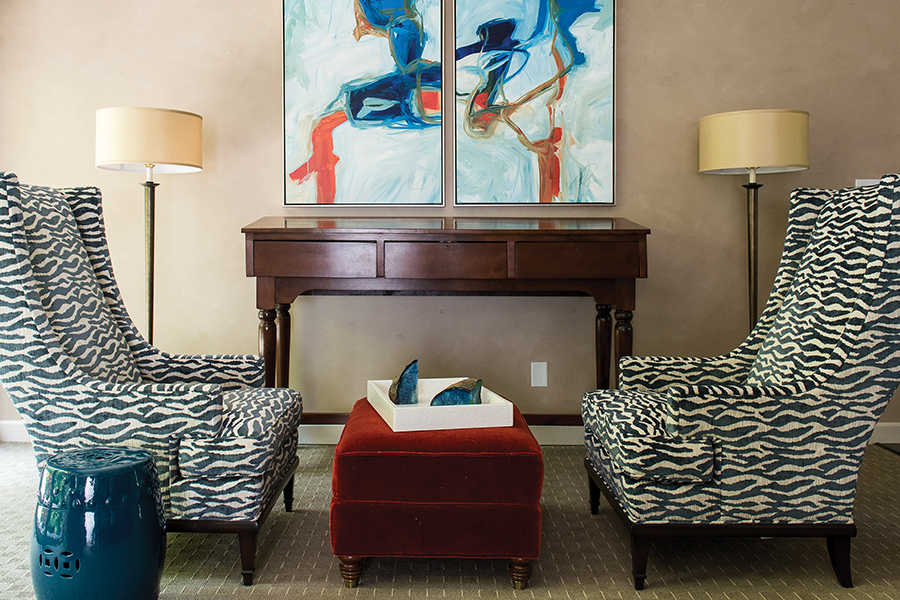
Everything in the living room is covered in Hamilton Fabrics, she adds. “The antiquities are mostly from John’s family.”
However, some of the living room artwork was painted by her mother and grandmother. In the kitchen there’s a colorful display of art created by Maggie and Liza.
The antiques throughout their main living areas have been in the family for several generations, says John with quiet pride.
His great-great grandfather began a furniture company called High Point Mantel and Table, actually in the same block as the family’s now defunct hosiery mill. “They made fireplace mantels, kitchen tables and desks.”
The family own pieces from his great-grandfather’s furniture company, including a library-style table and other table and chairs.
A walnut freight desk in the living room once held bills of lading for outgoing freight in the warehouse of his grandfather’s hosiery mill.
“When I was a kid, it was all beat up,” John says, remembering when it was still in the factory. A functional piece, the joints are intricately joined and dovetailed — no glue.
“They kept the paperwork for freight shipments here,” he explains.
John’s father had the standing desk refinished. It is such a great piece, he kept it in his bedroom and later passed it along to John and Mendy.
The oldest piece in the family’s possession dates back to the colonies. “This chest came over on the Mayflower,” says John, indicating a simple pine chest in front of the den sofa.
“On the family tree (above the sitting room mantel) is an ancestor who was a passenger on the Mayflower. The chest was theirs.” Someone, he laments, had “painted it Pepto-Bismol pink; I had it stripped down.”
His father helped develop the family’s ancestral tree, plotting the genealogical histories. It was he who established the provenance of the Mayflower chest.
In the living room John points out a game table with remarkable, somewhat formal design, intended for chess or checkers, “that has been in the family for generations.”
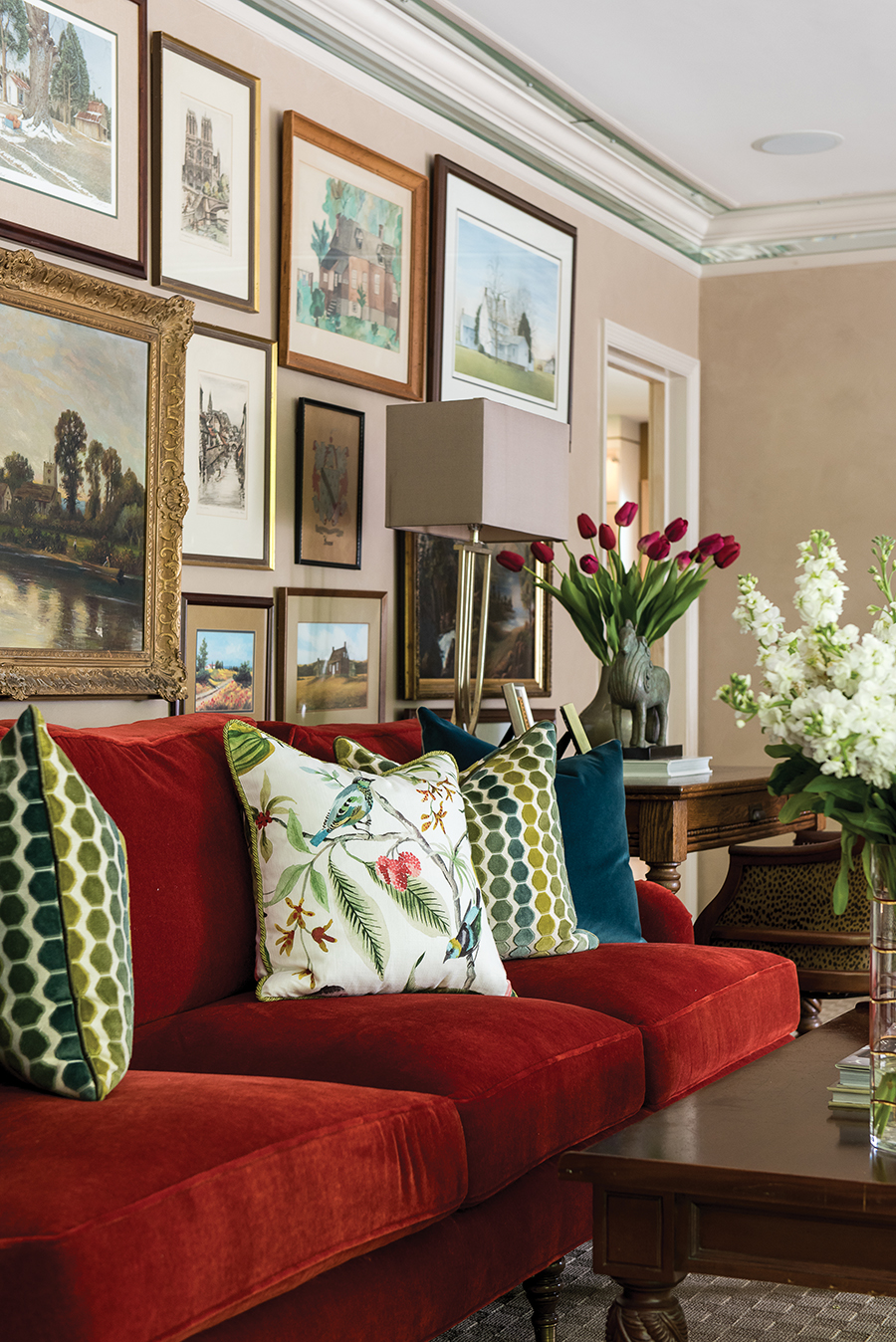
He moves into the dining room, stopping at a mint-condition, wood-encased radio that still works. “It’s been a while since I plugged it in, but this radio was in my great aunt’s house in Charlotte.” (She also left John another treasure and even greater rarity; a camel saddle.)
The library-style glass-front cabinet the radio rests upon was once used in the family hosiery mill and dates to the turn of the 20th century by John’s estimate.
Yet Liza, who is watching as her father gives a tour, “would probably paint it,” John accuses, and gives her an affectionate grin. “I ask her what she would do if she inherited all this stuff? She hates old brown furniture.” He watches closely for a reaction.
Liza good-naturedly shrugs.
Exiting the kitchen, with a brief nod to the camel saddle which looks much like a quirky stool, John returns to his other favorite topic: the great outdoors. “My parents were both avid gardeners. I grew up in the garden,” he says.
He marvels. “You could order a bonsai for $9.99,” he says, standing before a wired bonsai in his collection, which he estimates is 40 years old.
“I pointed out a bonsai, and said ‘I want one of these.’” John was only 13 years old at the time.
“It lived about two weeks, but died, and I kept the container and put another tree in . . . it lived maybe four weeks and it died.” John persevered.
“I finally got the hang of it. One [bonsai] led to a picnic table full of maybe 12–14. By this time, I was probably 17.”
Instead of focusing upon girls or cars, he was admittedly obsessed with care and cultivation of miniature, manicured trees. Then John laughs again. “I liked cars too,” he corrects. “I drive a big Suburban, but it’s more for work, filled with (fabric) sample cases.”
After marriage, he and Mendy acquired a house and a greenhouse,
where John tended a steadily growing bonsai collection numbering more
than 150 trees.
The house, one of unique design by Norman Zimmerman, with
extensive gardens including a waterfall and koi pond, was unsuited
for children. “It wasn’t working for the girls.” The young couple stuck
a for-sale sign out “and sold it the next day.”

There was no choice but to whittle his collection down. After the family decamped to a High Point condo, John had to sell all but five of his beloved trees. “It was fun, but I was ready for a break from it.”
But he had not left bonsai behind. “I kept all my tools.”
John says, “It was a full-time job keeping the bonsai trimmed and sprayed . . . I travel a lot, too, and then came home and spent time in the greenhouse Saturday and Sunday. Maggie, my oldest, had her own tree.”
Most of John’s bonsai are outdoor varieties that he can over-winter in his garage. Only two are tropicals.
One is a Brazilian rain tree that winters indoor, one of only two that he brings inside as temperatures plunge. The other is from the Beautyberry family, native to exotic, warmer climates. John points out hardier bonsai varieties, including flowering quince, crepe myrtle, and a zelkova.
Then John only touches briefly upon the true price of his passion; of what bonsai requires. Bonsai is a jealous mistress of his free hours.
“It’s ideal for retirees, someone with time on their hands,” sighs John.
It is an ongoing process.
“I had a propagation bed where I’d grow cuttings 15 years ago. I gave a friend a small boxwood bonsai. It turned out really nice. When he sold the house, he allowed me to dig it up and replant it.”
Now, John maintains seedlings in a training area. Seedlings of Trident maples will be separated later for a better presentation. If he finds a contorted “reject” tree at a garden center, he buys it. Bonsai does not strive for straight lines but artfully gnarled and twisted profiles. “You do not want perfect and straight.”
There is the perpetual hunt. In a display area is a “grove” of Beech trees John collected in the woods four years ago, as well as a Sweet Gum he found. “I kept them separate containers to let them get established then put them together in a ‘forest’ planting this spring.”
Each year “you have to repot, root prune and maintenance prune. It’s very maintenance intensive. You can skip it maybe one year, but if you don’t do it, they get root bound.”
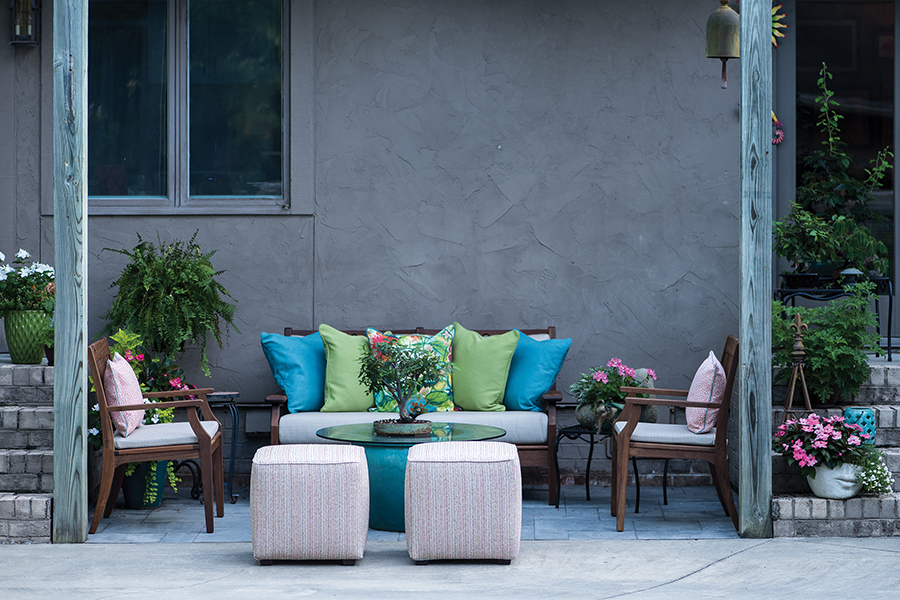
The work requires a fixed routine beyond merely repotting: “Rake the roots off and put them into fresh pots.”
The branches are also wired to follow a beautiful pattern suggesting traditional bonsai. He uses copper wire on the branches to achieve that signature look. “This gives them movement,” he says.
As winter approaches, John loads the bonsai individually onto separate rolling carts and moves the fragile trees under cover in the garage. He rolls them out to water.
Among his collection is a 40-year-old Trident maple from a Mississippi collector. He acquired it from his Arkansas bonsai source.
Yet one of the oldest in John’s present collection is an Elaeagnus, remaining from his bonsai-intensive house.
“The lone survivor,” he says. “Native to China. It is an evergreen. It’s probably 50 years old.”
He had to cut away some of the bark and decay, a mark of bonsai’s transcendence over perfection.
John grows quiet. “It is a beauty.”
He is aware his collection is unusual.
“It is art,” John says. “That’s what it is.” OH
Cynthia Adams is a contributing editor to O.Henry.

The worldly palate of Cameron Klass
By Jim Dodson • Photographs by Amy Freeman
Cameron Klass is a young woman forever on the move.
Hers is the kind of millennial wanderlust that has kept this 26-year-old crossing the globe over the past five years, a personal quest to learn about other cultures and countries from the grass-roots level, resulting in a passport that’s been stamped by at least two dozen different nations on four different continents. Her end game? Discovering food that not only sustains but also elevates the quality of human life.
The latest move from this peripatetic Greensboro native’s determination to help others comes in the form of a lifestyle cookbook filled with favorite recipes gathered from Klass’ world travels, promoting a naturally-sourced, whole-Earth approach to eating that works wonders for both body and soul, not to mention the health of the planet.
To hear her tell it, the 2011 Page High graduate had something of an awakening during her college junior year abroad in Reading, England, fueled by the month she spent at term’s end backpacking across Europe before her return to Ole Miss, where she was a marketing major and a member of the Kappa Kappa Gamma sorority.
Traveling on the cheap, sleeping in train stations and youth hostels, soaking up culture and food styles as she went, Cameron roamed from Barcelona to Florence to Croatia (“with many stops in between”), undergoing an epiphany in the process.
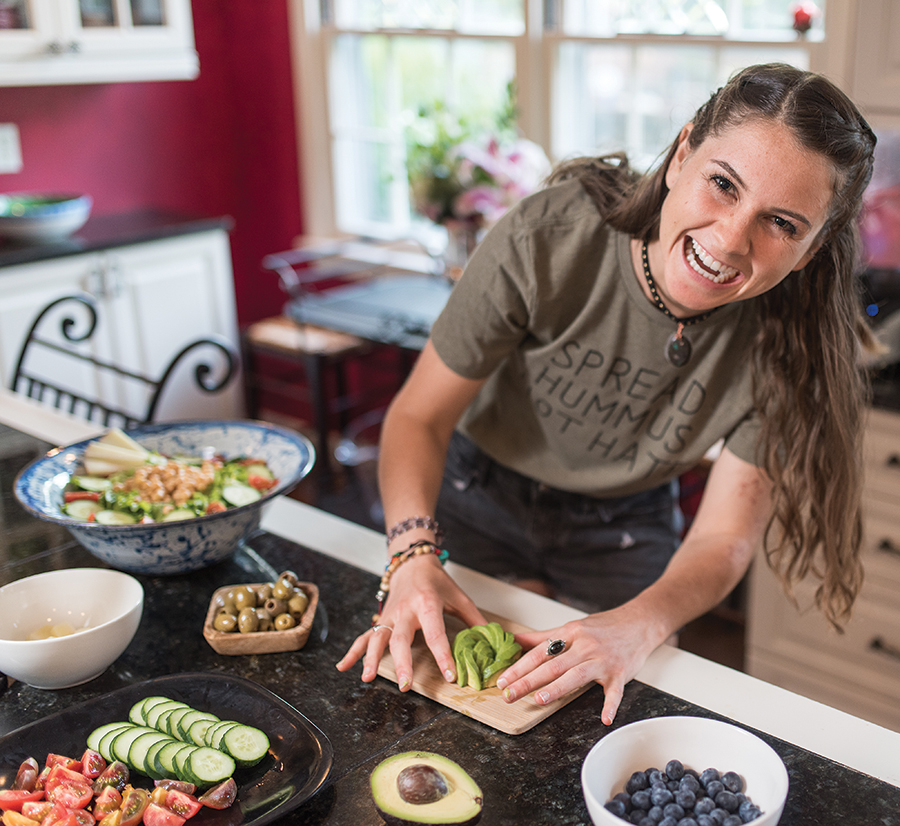
“That trip changed me,” she explains over an afternoon basil tea at Vida Pour Tea on State Street. “I’ve always been an independent person, someone who loved to camp with my family, enjoyed hiking and traveling on my own.” But after meeting so many different people and experiencing other cultures, something larger and more encompassing stirred awake in her. “I went home, resigned from the sorority and decided after graduation that I would travel as much as possible, learning from hands-on experiences.”
It helped to have a roommate, she adds, who was a nutrition major.
Her senior year at Ole Miss was spent deep-diving into food science and natural nutrition, learning the importance of cooking with fresh foods and reading ingredient labels. She also became a serious student of yoga — eventually earning certification as a teacher down the road. “I’d been a vegetarian since my freshman year. But learning more about the healing power of natural foods was eye-opening and exciting,” she reports. “Generally speaking, our convenient fast food culture promotes a very unhealthy and unstable lifestyle of eating. I wanted to be part of the solution to that.”
Eager to keep moving, during the summer of 2014, she landed a gig as an au pair for a family in Istanbul, Turkey. “My favorite times were days off when I went in search of local cuisine, inspired by the family cook, who made the most delicious vegetarian meals. On my own, I got to explore the city and its amazing markets and cultural sites, including mosques, meeting so many different types of people. It all opened my mind and broadened my outlook on life and left me hungry for more.”
Before returning home to Greensboro that Christmas, Cameron extended her travels to Poland, where, among other things, she visited the Auschwitz concentration camp and underwent yet another awakening. “That was such an emotional experience for me,” Klass says. “The lesson I took from that is that life is fragile and everything can change in an instant. The moment is now to change, to make your life better. I knew I had to keep going in my travels — to learn more.”
From there, she did a two-month stint working for a youth hostel in Valencia, Spain, followed by a month in Morocco, where she went on a camel trek across the desert, sleeping beneath the stars and sharing meals with nomadic families and picking up recipes as she went — including how to make Berber pizza by baking it in the sand. “I also discovered that the camel is my spirit animal. We’re both slow but steady and can cover a lot of ground with a smile on our faces. Also,” she adds with a laugh, “we’re both vegetarians.”
Upon her return to Greensboro, she resumed her yoga classes at Radiance Yoga and began teaching a 10-day class in detoxing the body with natural foods, cooking healthy meals for private clients — which funded the next chapter of her educational travels.
Five months in South America followed, beginning with the Galapagos Islands with her younger sister, Julia, before moving on to Ecuador, Peru, Bolivia and Colombia, exploring native cultures, eating in local markets, learning to cook the local dishes, visiting holy places, trekking in the Andes, camping on beaches. In Bolivia, she worked on a farm for two months, cooking, building plots, picking vegetables and harvesting coffee. She finished her time there by helping build a raft with Israeli backpackers and taking it down the Rio Verde River.
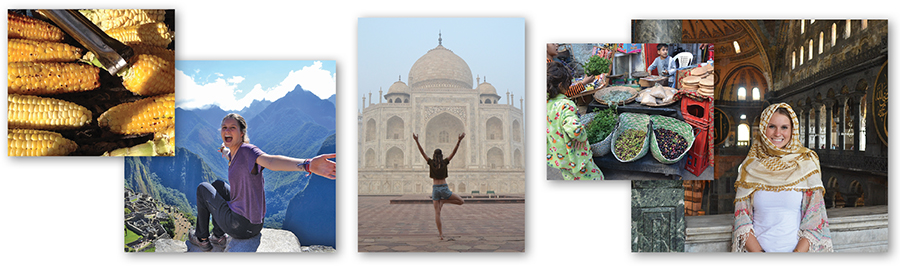
“If you are open to people,” she reflects, “they will open up to you. Everywhere I went I found people who were warm and receptive — eager to share whatever they had, including food and wisdom. It was deeply enriching.”
By the time she got home to Greensboro to do her 10-day detox programs and help out with her sister’s wedding, she knew it was only a matter of time until she returned to South America.
On the road again with her backpack, she worked at a youth hostel in Chile and trekked in the Argentinian high country (“They eat so much meat. I lived on peaches and bread.”) From there it was on to Europe to work at an organic veggie farm in Germany. “I loved that work — every morning in the garden, weeding and watching plants grow and cooking meals from food you have taken straight from the garden. There’s nothing healthier or more delicious than that.”
Her next step was Nepal for three months, where she trekked the Annapurna Circuit through the Himalayas and fell in love with the people and food of Nepal. She also did five days in a Buddhist monastery in Katmandu, a meditation course that further shaped her emerging consciousness. “The deep silence, the simple food — soup, bread — sitting on the floor, being with people who were so genuine and loving. It really did change my world.” A highlight was her visit to Lumbini, the birthplace of the Buddha.
Moving on to India, she took cooking classes and went to Varanasi, explored the Taj Mahal and visited Mathura, the birthplace of Krishna, continuing her pilgrimage to the sacred places where the Buddha became enlightened, first taught the dharma, and eventually died. Her travels took in the famous beach at Goa, the Ajanta caves, the teeming streets of Mumbai and Delhi.
Following another time home in Greensboro to teach cooking and study yoga, she returned to India to attend the International Yoga Festival at Rishikesh and took her yoga teacher training at Bhagsu, a small village where she heard the Dalai Lama speak several times and visited his temple. Upon returning to Bhagsu, where she continued cooking classes and yoga training — learning to make jewelry and dreamcatchers in the process — she began to formulate her own vision of a life of service in which she shared the wisdom of her travels through cooking and yoga.
On her way home, she stopped off in Spain to walk the famous Camino de Santiago, having made up her mind to start a business called Root to Rise. The name is taken from a common term in yoga in which one “grounds down through your feet and extends your arms over your head, lengthening your body and radiating energy.”
The name felt right, she adds, because her plan was to “ground down” after her nomadic travels in a place — Greensboro — where her own roots existed, with the purpose with helping the people of her home town “rise” to live their healthiest and fullest life.
“One important thing I’ve taken from all of my travels to such beautiful and amazing places is how close to the Earth people in those places live — simply and typically without the pressure of material life and a commercial culture that equates happiness with things you buy or own. They know where their food comes from, and that is almost sacred to them, a daily blessing.”
She pauses and smiles. “Basically, I learned that food is medicine for the body and soul. That it nourishes and heals — and affects everything you do in your life.”
And for this reason, Cameron Klass returned home with her mind set to put her worldly wisdom — and recipes — to use by integrating a healthy-living style of cooking, a weekly stall at the Greensboro Farmers Curb Market on Yanceyville Street, and a forthcoming cookbook that will feature recipes from her magical mystery tour of the planet.
Her longtime customers and yoga students are eager to get their hands on her Root to Rise cookbook, a project Klass envisions expanding into an interactive website with daily meditations, wellness information, food investigations, healthy-living news, grocery lists, in-season recipes and even travel tips.
“Everything in life follows a process of growing and learning,” she adds. “That’s why I am excited to share the wonderful things I’ve learned where my roots are.”
And we are glad to rise with her.
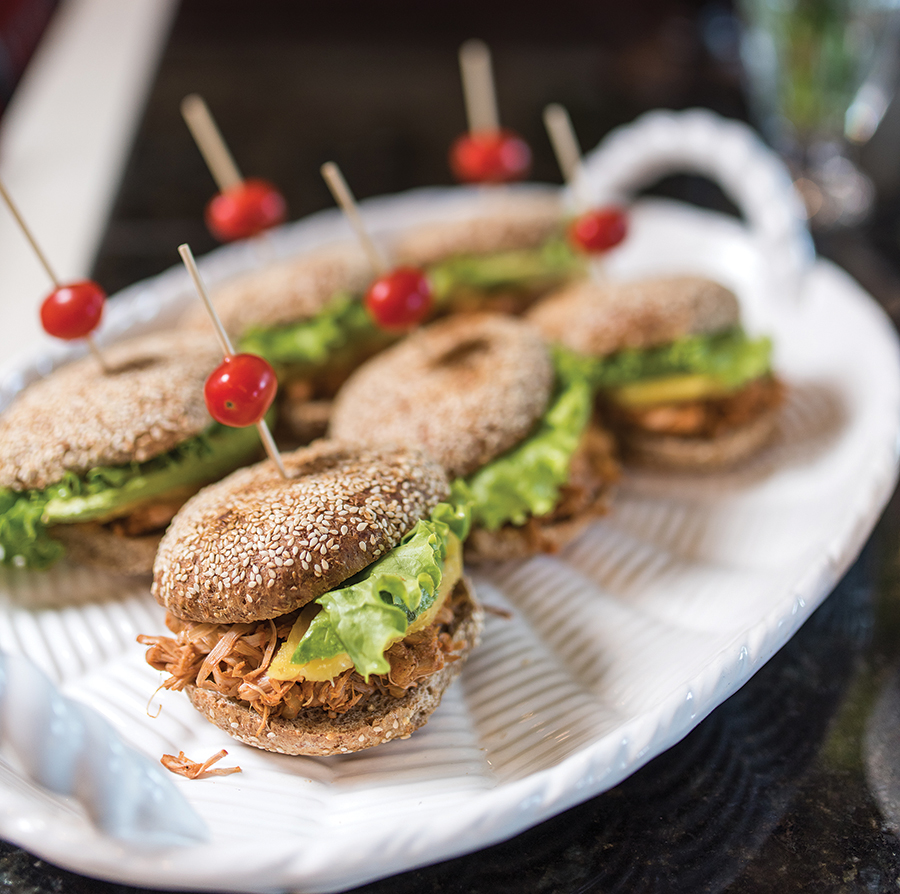
NORTH CAROLINA VEGAN BBQ SANDWICHES
Serves: 6 sandwiches
Time: 25 minutes
2 tbsp. olive oil
1 yellow onion, chopped
2 cloves garlic, minced
2 (14 ounce) cans young jackfruit, rinsed and drained
2 tbsp. apple cider vinegar
2 tbsp. ketchup
1 tbsp. coconut sugar
1 tbsp. white vinegar
1 tbsp. red wine vinegar
1/2 tbsp. Dijon mustard
1/4 cup vegetable broth
1/4 cup water
1 tsp. cumin
1/2 tsp. onion powder
1/2 tsp. paprika
1/2 tsp. chili powder
1/4 tsp. red pepper flakes
1/4 tsp. cayenne pepper
1/2 tsp. salt
Sandwich:
6 Ezikiel burger buns
1/2 pineapple, sliced thinly
2 avocados, sliced
6 lettuce leaves
Heat 2 tbsp. olive oil over medium high heat, until hot but not smoking. Add the onion and garlic, sautéing for 5-7 minutes, until just beginning to brown. Add in the jackfruit, and remaining ingredients. Using a fork or potato masher, break the jackfruit into shreds. Add more water 1 tablespoon at a time if it appears dry. Lower the heat to medium and cook, uncovered, for 12-15 minutes. Stir occasionally to blend flavors.
While the jackfruit is simmering, toast the buns until golden brown. Cut the pineapple and set aside. Wash and pat dry the lettuce leaves. When the BBQ is ready, top on the buns, adding in pineapple slices, lettuce, and avocado slices. Enjoy!
Store leftover BBQ in the fridge for 2-4 days.
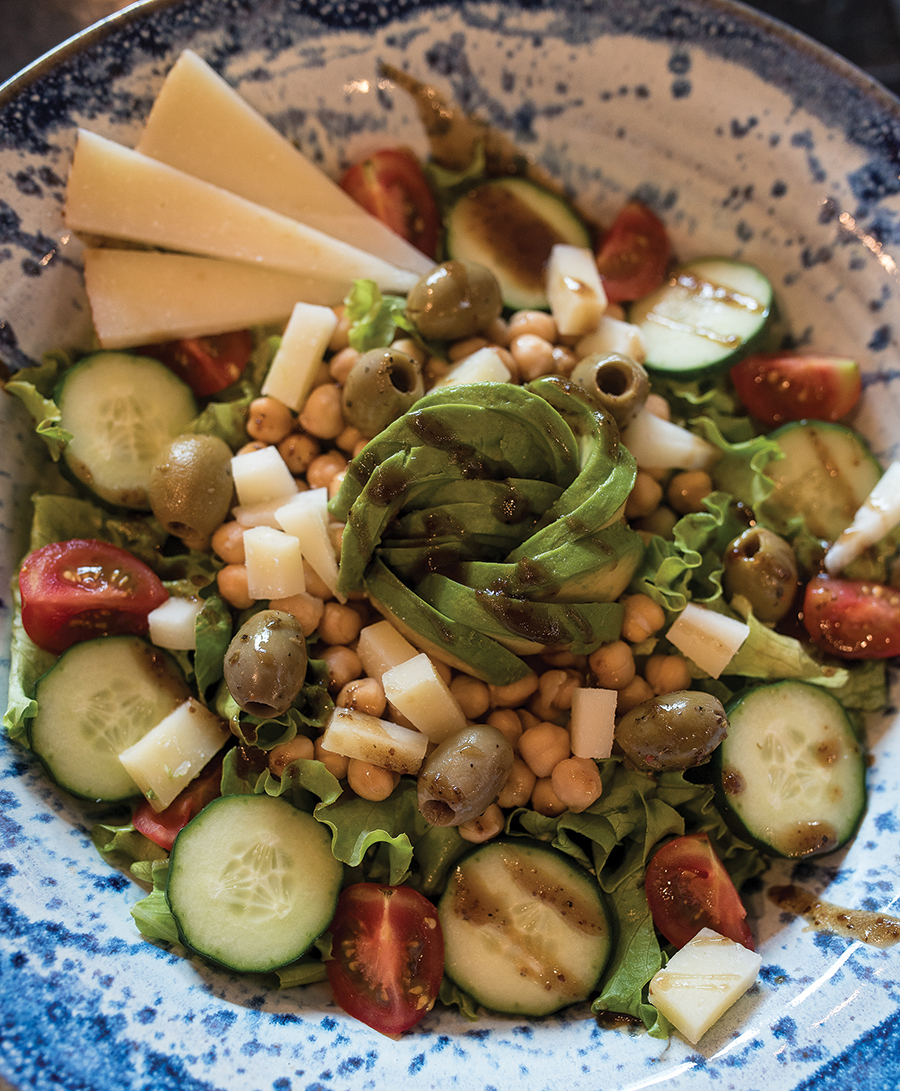
CAMINO SALAD
Serves: 4
Time: 15 minutes
4 large handfuls leafy greens
1 can chick-peas, rinsed and drained
1 cucumber, sliced
2 tomatoes, diced
1 cup green olives
1 avocado, sliced
1 cup organic sheep cheese, cubed
Salt and pepper to taste
4 tbsp. Cam’s Go-To Dressing
Divide the ingredients among four bowls and toss with the dressing. Enjoy!
Health tip: When consuming cheese, sheep and goat cheese is a better alternative for health and environmental purposes than cow cheese. Sheep cheese has high levels of conjugated linoleic acid (CLA), which reduces body fat, maintains muscle, and improves bone health. Goat cheese is more easily digested than other cheeses. And both sheep and goat farms create less of an impact on the Earth than cattle farms. They require less water, produce less waste and methane, and traditionally use more organic farming tactics.
CAM’S GO-TO OIL AND BALSAMIC DRESSING
5/8 cup olive oil
1/4 cup balsamic vinegar
1/8 cup water
1 tsp. dried basil
1 tsp. dried parsley
1/2 tsp. dried oregano
Salt and pepper
Place all ingredients in a jar and shake well. Keeps on the counter for 2 weeks.
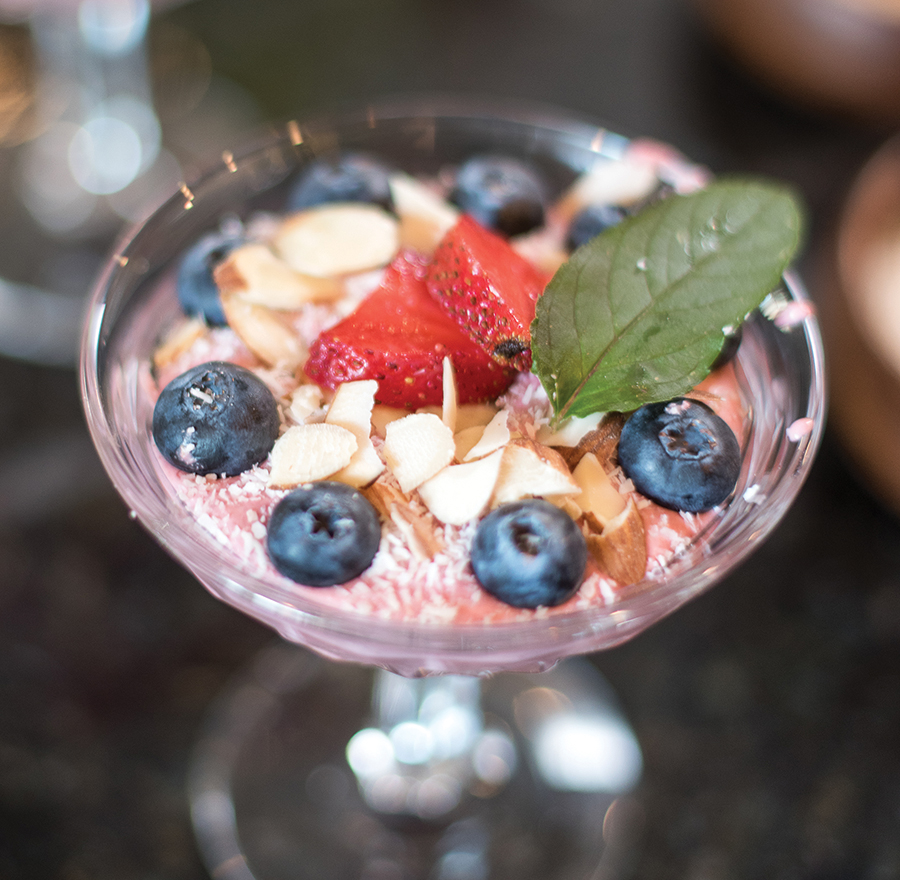
VERY BERRY SUMMER PARFAIT
Serves: 2
Time: 1 hour chill time + 10 minutes
1 (15 ounce) can organic culinary coconut milk, full-fat (refrigerate the can 1 hour or more before opening)
1/2 cup organic frozen strawberries (or berry of choice; if using fresh fruit, add ice)
1 tbsp. ground flaxseed meal
1 tsp. beetroot powder
1/2 tsp. pure vanilla extract
1/2 tsp. cinnamon
Toppings: fresh fruit, organic unsweetened coconut shreds, dash of cinnamon, chopped nuts.
Place the can of coconut milk in the refrigerator 1 hour or more prior to making the parfait.
When you open the can, use a spoon to place the thick white part that has accumulated on the top in a blender. Add 1/4 cup of the liquid from the can of coconut milk to the blender along with all other ingredients.
Blend until smooth, stopping to scrape the sides if needed. To alter the consistency add more ice to thicken or more liquid/water 1 tbsp. at a time to liquify.
Divide among two parfait bowls and add your favorite toppings! OH

One whiff of wild honeysuckle sends me down the bumpy dirt road, down the gravel drive, down to the back paddock, where the bay pony greets me at the gate, alfalfa hay tangled in her thick black mane.
As a child, summer mornings at the farm were sacred to me.
At the earliest light, while the air was still cool, we watered flowerbeds and drinking troughs, then took off bareback down the lush woodland riding trail.
Past the quiet creek, where water moccasins sunned on fallen logs, past the neighboring farm, where an ancient donkey wheezed in exaltation, on past the patch of ripening blackberries, I return to the place I first experienced the taste of wild honeysuckle, a place I return each June, if only in my mind.
This year, summer solstice lands on Friday, June 21.
And yet the sweetness of the season arrives unexpectedly — in an instant, in one delicious whiff, inside a single drop of nectar.

June marks the arrival of the earliest blackberries and scuppernongs. Picking herbs at dawn for midday pesto. Fried squash blossoms and fresh sweet corn. The first ripe fig.
I’ll never forget the Devon Park rental with the young fig tree out back. “It’s never produced fruit,” the landlord had told me.
And yet, one June evening, after scrubbing and filling the concrete birdbath, there it was: a tiny green fruit.
I watched that perfect fig slowly ripen day after day, for weeks.
Just as a caterpillar emerges from cocoon-state completely transformed, one day my darling fig was purple.
Soon, it would be ready to harvest. One more day, I told myself.
But the next day, the birds had beaten me to it.
Take whatever wisdom you wish from this little memory. And as for you birds: I hope the fig was delicious.
In addition to the uplifting aroma of its summer blossoms, the honeysuckle is a plant of many surprising health benefits. (Add honeysuckle oil to the bath, for example, to soothe arthritis or muscle pain.) But what could be sweeter than adding homemade honeysuckle syrup to your favorite summer refreshment (iced tea, lemonade, sorbet, fresh fruit, you-name-it)? The below recipe stores up to one month in the refrigerator. Do make sure to harvest blossoms that are free from pesticides. And, if you make enough syrup, share the sweetness with a friend.
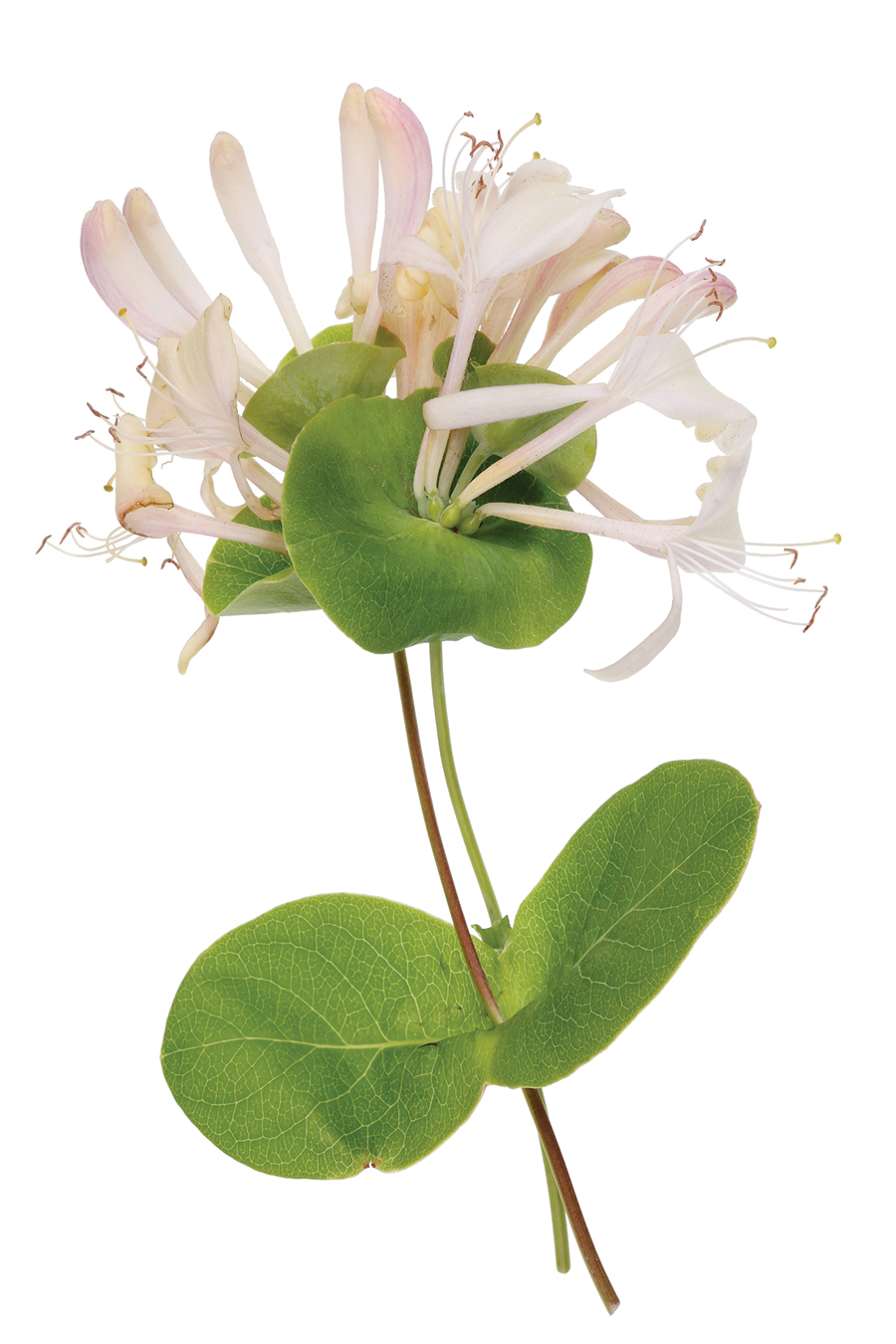
Ingredients
1 cup sugar
1 cup water
50 honeysuckle blossoms
Instructions
In a small saucepan, combine sugar, water and honeysuckle blossoms.
Using medium to high heat, bring to a boil, stirring constantly.
Reduce heat and simmer for 3-4 minutes.
Remove from heat and allow to cool completely.
Strain into a jar; refrigerate.

The Full Strawberry Moon rises on Monday, June 17 — four days before the solstice. Also called the Honey Moon, the Mead Moon and the Full Rose Moon, allow the brilliance of this June wonder to illuminate all the magic and potential of this brand-new season. And if you happen upon ripe wild strawberries for the occasion, don’t forget the honeysuckle blossom syrup in the fridge.

Dolce & Amaro is more than just a pastry shop. It’s the chance of a lifetime
By Nancy Oakley • Photographs by Mark Wagoner
What’ll it be? One of the dainty macarons in shades of pink and yellow or the bluish-purple cloud of cheesecake bearing a crown of fresh blueberries? How about a perfectly rounded puff coated with chocolate so shiny it would look just as at home displayed in a museum? Maybe a savory is the way to go — a salty croissant, whose delicate layers crackle and crumble at first bite. Or, you could answer the siren call of miniature pana cottas — vanilla cream, caramel and chocolate — standing sentry in a tray. Fantastical cakes beckon — one consisting of nutella and Chantilly covered in bright green pistachio icing with maraschino cherries on top, another, the “Marilyn Monroe” topped with bright pink lips. These visions of sugarplums — edible works of art — are staples at Dolce & Amaro Artisan Bakery, (which translates to, you guessed it, “sweet and savory”) tucked inside the Westover Gallery of Shops on Westover Terrace. But to the three men behind it, the operation, which opened last fall, is considerably more than a bakery; it is the culmination of a vision and an expression of their love of community.
“Together we have 75 years’ experience in the industry,” says Mikel Leka, the patisserie’s manager. “We” refers firstly to his cousin, Koco Tamburi, proprietor of nearby Osteria, which since 2013 has sated many an appetite with signature fare of Italy’s northeast Emilia-Romagna region and extensive wine list, and Embur Fire Fusion on Smyres Place, specializing in wood-fired pizzas with a Latin flair.
But what would an artisanal bakery be without a pastry chef? Rounding out the trio is the most recent transplant to the Gate City, Albano Barjami, the creative force behind Dolce & Amaro’s jewel-like confections.

Growing up together in Emilia-Romagna’s famed resort town of Rimini on the Adriatic coast, the three amici worked in various capacities in the food and hospitality industry, putting in long days during the summers. Come winter, when the tourist season slowed to a halt, they dreamed of another life, of opening their own place together.
Little did they expect their dream would take 28 years to achieve.
Tamburi worked around Europe, his last stint being in London, before he struck out for Miami in 2001. Years later, when his wife was offered a job with a local pharmaceutical company, Tamburi was all for a move. At the time, just after the financial crisis of 2008, “the food scene here was not what it is now,” Tamburi recalls. He instinctively sensed opportunity and began encouraging his compatriots to join him.
Leka’s trajectory was similar, with stints in Miami, then in New York and owing to his wife’s career move, Charlotte, where he managed a group of restaurants. “It is good to follow the woman!” Tamburi quips. Barjami, meanwhile, had been honing his chops, working with some of the rock stars among Europe’s pastry chefs — Rossano Vinciarelli, Leonardo di Carlo, Luigi Biasetto, Antonio Guerre— teaching at international exhibitions, and becoming certified in the art of preparing “biologica” pastries.

Loosely translated as “organic,” it carries specific implications that its American counterpart (often a marketer’s catchall phrase) does not. As in, mandatory three years’ training to become a certified “bio” chef, and tightly restricted ingredients. But having jumped through the rigorous culinary hoops in his native country, Barjami is able to whip up sugar- and gluten-free — and utterly delicious — options. The tantalizing macarons, for example, are made with almond flour. Other sweet treats might contain barley malt or rice flour. Glazes are derived from concentrated fruit. He explains that it’s tough to get the proper consistency for the items, some of them taking as long as two weeks to prepare. “It’s a constant balance,” he says to avoid pastries that taste like cardboard. Given their short shelf life, diners with special dietary needs will have to order the pastries in advance (though there are always sugar-free biscotti in one of the bakery’s cases).
But if you’re not among the gluten- or sugar-free crowd, then feel free to indulge without too much guilt, because, as Tamburi allows, “Here, flavor is First Place, not the sugar.” Sure enough, a Pateria Napoletana, a traditional Napolese Easter pastry consisting of wheat, egg, ricotta, orange-flower water, lemon and bits of candied fruit gradually unfolds on the tongue, revealing each component — tasting notes in a symphony, as it were. One reason Barjami’s pastries are so flavorful? “We don’t want to sacrifice integrity for taste,” Tamburi allows. So, they import as many ingredients as possible. “Pistachios . . . the best in the world are from Sicily,” he continues. Butter comes from Normandy. For the chocolate éclairs and other items, only 87 percent cocoa will do. Molina Colombo flour, which isn’t overly processed. “We are what we eat, we believe, and if we eat something valuable, beautiful, approachable . . . definitely, we are going to be a better person,” he says. He also applies his philosophy to the menus of Osteria, giving diners healthier options with imported authentic Italian ingredients.

That sense of community is the beating heart of Dolce & Amaro, where Tamburi hails a couple of customers who’ve stopped in for cappuccino and brioche. Barjami is ever experimenting, blending culinary traditions of his native home with others, from a tiramisù cheesecake containing ricotta and cream cheese, to the French-inspired éclairs and brioches the bakery’s clientele have come to appreciate. Tamburi describes the offerings as “modern,” rather than regional, flashing a series of photos on his smartphone from a recent food expo in Milan to prove his point: The sleek, colorful, sculptural tarts of Sal de Riso, Italy’s top patisserie, look as though they were plucked from Dolce & Amaro’s display cases.
Even so, customers frequently come in, looking for sfogliatella or babà au rhum — not part of the original concept, as Leka discovered when the bakery opened last fall. “They were like, ‘What is an Italian bakery without sfogliatella?’ But pastry evolves like anything else, you know?” He shrugs while casting a glance at the case that contains, yes, the popular signatures of Naples, and a few rows over, some treats made of — what’s this? Peanut butter?
The customer is always right, as Tamburi, who knows Southern palates all too well, acknowledges. “We have to listen,” he says. “That is why a man has two eyes and one mouth.” The better to spread love — sealed with the “kiss” on a Marilyn Monroe cake. OH
Info: dolceamaroartisanbakery.com
Nancy Oakley, the senior editor of O.Henry.

Instagram tastemaker Guyla Lloyd creates a new home and life in Greensboro
By Maria Johnson • Photographs by Amy Freeman
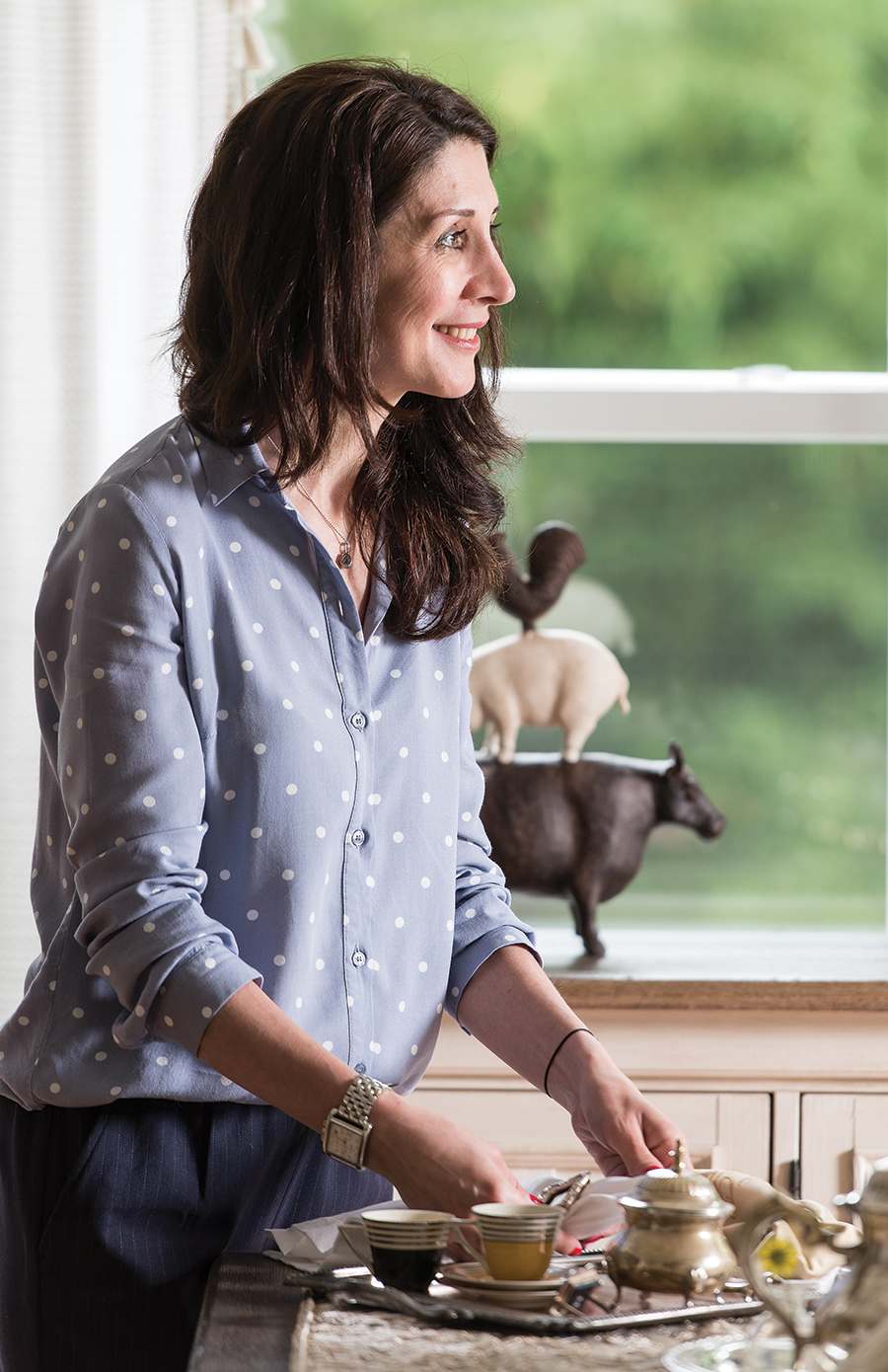
Gulya Lloyd stands at her kitchen counter, swaddled in the sounds of a peaceful spring afternoon. A kettle of water simmers on the stove. A breeze sighs through an open window, nudging the white lace curtains that Gulya made. Her husband, Rob, taps on a laptop nearby. Their rescue dog Sonny pushes kibble around his dish with a soft metallic scrape. Birds trill from a stand of bamboo outside.
“For now, I make pancake,” explains Gulya, who spent her youth in the Russian republic of Dagestan. “Pancake very easy. This is Russian tradition. Every day. Every week.”
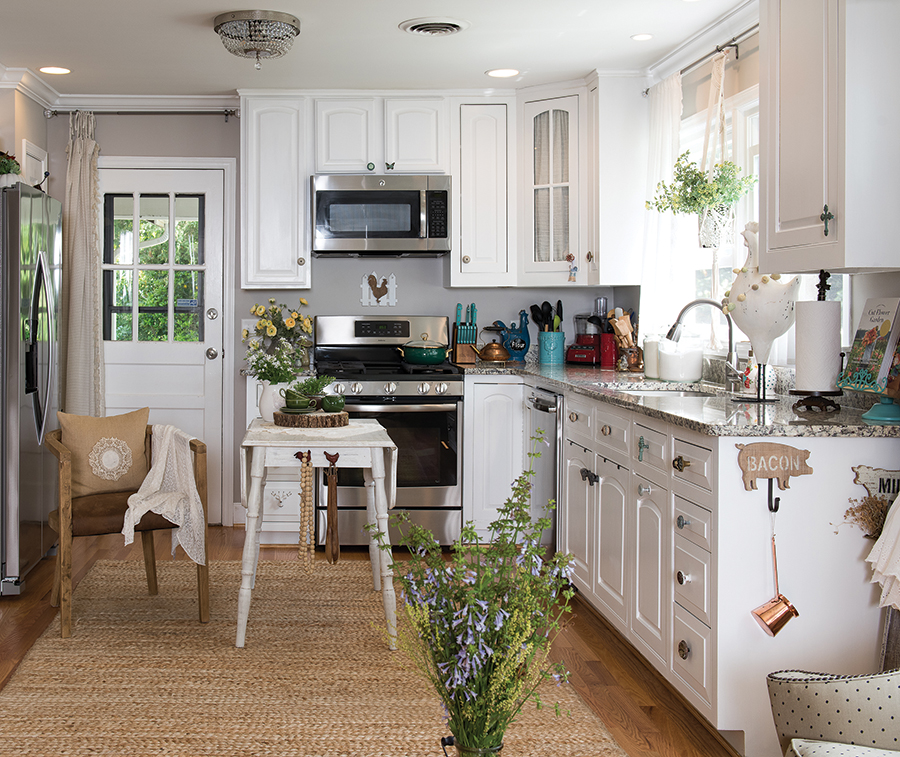
Her Instagram followers, all 15,000 of them, see lots of thin pancakes, stuffed and styled in endless variety on @Gulya_Lloyd, her Instagram page, where she fuses her love of photography, cooking and home design. Her style is distinctive, knitting together cottage and country elements with the Danish idea of hygge (pronounced HUE-guh), which translates to “cozy.”
But Gulya’s home is not a trendy copy lifted from magazines or Pinterest; it’s the ongoing expression of an artistic person who won’t rest until she creates what she sees in her mind and feels in her heart.
Like these dessert pancakes — crepes, basically — which soon will be stuffed with sweetened sour cream and juicy strawberries.
She pours two cups of milk into a glass measuring cup, cracks an egg into the liquid, and dips the tip of a sharp knife into a jar of crystalized vanilla. She extracts a small triangle of white powder.
How much is that?
She shrugs. “My eyes measure.”
A pinch?
“Pinch vanilla,” she agrees.
She pours in a thin ribbon of vegetable oil and whisks the mixture, then reaches for a canister. “Flour, maybe one cup and half,” she says.
She sprinkles a tablespoon of sugar over the cup and reaches for a box of salt. “Pinch salt,” she says, happy to deploy the new word.
She whisks more. “Sometimes people use mixer,” she says, her hand whirling.
By now, Sonny is scratching his own back, wiggling belly-up on the natural-colored jute rug in the middle of the kitchen floor.
Wait a minute. Wasn’t white-washed table on that rug a few days ago?
Gulya nods and points to the table, which is now positioned under a nearby window. Rob, freshly retired from 26 years in the U.S. Army, chimes in from across the room.
“Two weeks ago, the table was this way,” he says, aligning his hands with the short axis of the room. “Now, it’s this way.” His hands pivot 90 degrees. “Two weeks from now, who knows?”
“I’m always change,” says Gulya, her brown eyes smiling.
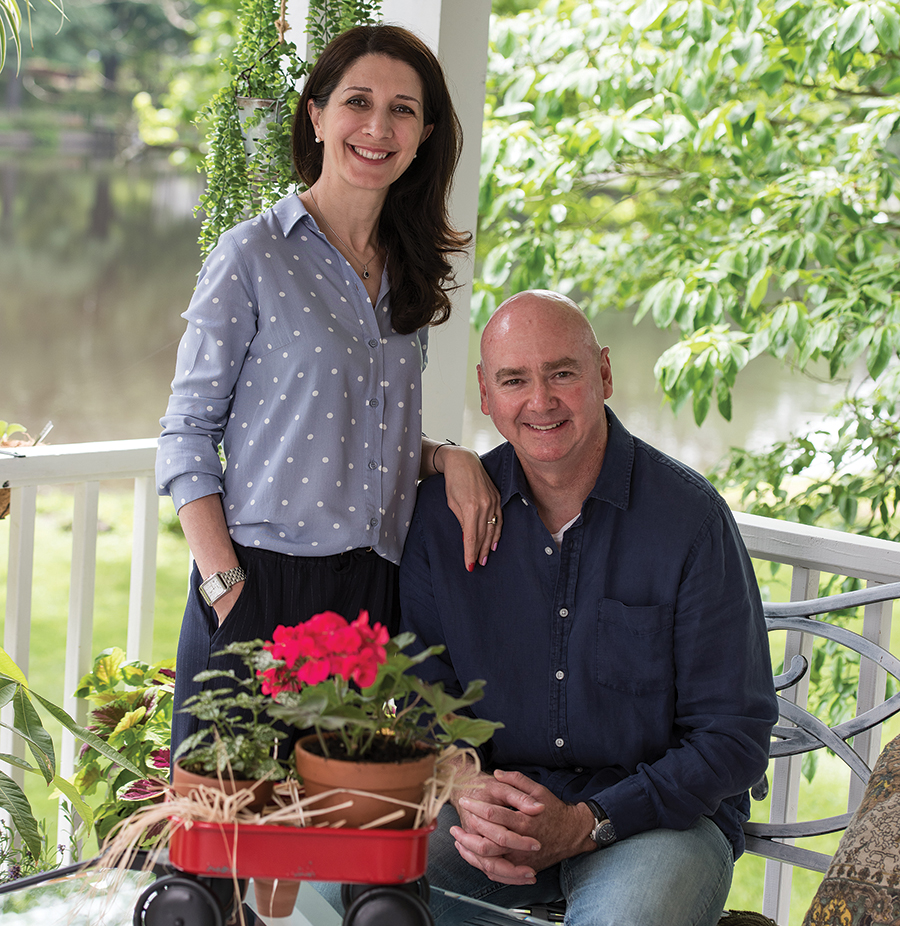
The biggest change in her life happened three years ago, when she married Rob.
They met through family. Rob’s brother, also a U.S. Army officer, is married to a Russian woman, and her mother worked with Gulya in the office of a Moscow construction company.
The mother talked up Rob to Gulya.
The sister-in-law talked up Gulya to Rob.
Neither was very interested. Gulya was 36. Rob was 47. Both were confirmed singles focused on their jobs. They enjoyed traveling and living independently.
They reluctantly agreed to start an email correspondence in February 2014. They wrote in their native languages. It did not go well.
Gulya ran Rob’s emails through a Google translation program. They made no sense to her.
“I say, ‘What you talk about?’” she remembers.
He processed her emails with a military translation program. In one email, Gulya asked Rob about the qualities American men typically like in women.
The military translation: Did Rob like protected sex?
Rob, a native of northwest Texas, was taken aback.
“I was like, ‘Well, maybe. Eventually. But not from the get-go.’”
No, this would never work.
Gulya plucks the kettle from the stove and measures two tablespoons of steaming water.
“Hot water is secret. Hot water makes a little bit of that,” she says, touching the eyelets in the lace curtains.
Air bubbles? She nods.
No baking soda or baking powder in these pancakes?
She grimaces, clenches her teeth and taps her incisors.
Those ingredients set her teeth on edge?
She nods.
They met for the first time in August 2014.
He tacked a side trip to Moscow onto a vacation to Germany.
He and Gulya had a good time, but communication was difficult, and they were always in the company of her friends.
They were alone, for the first time, at Christmas later that year when Gulya visited Rob’s brother and sister-in-law in South Carolina. Gulya gave Rob a book of pictures she’d taken in Moscow.
“From Russia, With Love,” it was titled. The last page bore a message: “To be continued.”
Rob, a civil affairs manager who’d served in Bosnia, Iraq and Afghanistan and was posted to his last assignment at a reserve unit in McLeansville, North Carolina, had resisted Gulya’s invitations to Skype. After the meeting in Charleston, he decided video conferencing would be OK.
“I went to the dang Apple store and bought an iPad,” he says.
Gulya turns up the flame on the gas stove and pours olive oil into a nonstick pan. She ladles in the batter, swirling the pan until the liquid thins to an 8-inch round. Bubbles appear and pop, making eyelets in the pancake.
Gulya points to them with her spatula and smiles. The effect of hot water.
How old was she when she started making pancakes?
Sixteen, she says. That’s when her father threw her, her mother and her brother out. They stayed in Dagestan, she continues, but they had no money, and she was bullied by schoolmates.
“They say, ‘She is not nice girl because her mama and papa divorced,’” she recalls.
Her mother took her and her brother to Moscow.
“She say, ‘We will work. We will be OK,’” Gulya remembers.
Late at night, Gulya baked bread. In the morning, she carried it to a store to sell. When she needed more money, she made honey cakes for weddings and parties.
She baked her way through university, where she took degrees in biology and economics.
The family lived in a series of 11 apartments. Gulya painted and decorated them, but landlords often evicted her family so they could rent the improved properties to others for more money.
Finally, she bought her own apartment.
“It could have been in a magazine,” says Rob, recalling his visit to Moscow.
There, as here, her palette was light and soothing: Whites, creams and beiges, fair woods and fibers, pale silk flowers, small collections of silver, copper, brass and porcelain.
Bold colors and dark lines played second fiddle.
“I say, ‘No dark color!’ I want light, light, light!” she says.
“She’s had some dark areas in her life,” explains Rob.
He proposed one year, to the day, after they began corresponding. They were married by a justice of the peace in Fayetteville in September 2016. The following February, they repeated their vows at a church wedding in Texas. With military precision, the church nuptials occurred precisely two years after their engagement and three years after their first communication — on “17 February,” as Rob puts it.
Their first year together was not as orderly.
Gulya spoke only a few words of English. They communicated with gestures and translation apps on their cellphones. On Gulya’s first morning in this country, Rob went to work and she slept in. When she woke up, she went to the refrigerator to see what she could find for breakfast.
“Zero. Only one bottle beer,” she says.

She went back to bed.
When they went grocery shopping, she asked if he liked grapes. Nope, he said. Yogurt? Nope. He missed what she was trying to tell him.
He cooked what she describes as “crazy food,” like ground beef with chopped bell peppers, ketchup and beer.
She refused to eat. She felt sick and hungry, emotionally and literally.
“We were communicating, but not really communicating,” Rob says.
Gulya called her aunt in Belarus, who advised: “He not understand what you want. You tell him.”
At the same time, Rob followed the counsel of an Army chaplain and his mom, who told him essentially the same thing: ‘‘Boy, don’t screw this up.’’
He started asking Gulya what she wanted.
She longed to cook the foods she liked: fresh bread, homemade yogurt, salmon, soups, couscous, sweet and savory rice, stuffed grape leaves and cabbage leaves, meat and potatoes in pastry pockets, sushi, fresh ravioli and pasta. Gulya had absorbed some recipes on her travels to Thailand, France and Dubai.
Then, of course, there were the desserts that her bakery clients and co-workers had loved in Moscow: layered honey cake, fruit-stuffed pancakes, pies, bundt cakes, fruit-nut-and-caramel bars.
Sometimes, Rob shared her desserts with his co-workers, who joined the chorus: “Boy, don’t screw this up.”
Together, he and Gulya made a budget and saved money. In December 2017, they ditched apartment living and bought a house: a 1960s three-bedroom ranch in Greensboro’s Sedgefield Lakes neighborhood. Empty for a long time, the for-sale-by-owner home had been painted and updated inside and out.
Slowly, Rob and Gulya are transforming the home to a warm and unique place. They shop at their favorite stores — Hobby Lobby, Michaels, The Red Collection, TJ Maxx, Ashley Furniture, and Gulya’s favorite, World Market.
“World Market need pay me!” she teases.
They acquire little by little. When Gulya wanted some colorful Polish dishes at World Market, they bought a few plates, snared a coupon for spending a certain amount, and waited until Rob’s next paycheck to buy more.
“That’s what I really love and respect about her — she understands that life is not a race. It’s a walk, step by step,” he says.
He admits it took him a while to be comfortable buying furniture and accessories that weren’t absolutely necessary. “Initially, I was like, ‘Geez, we have to save our money.’ I grew up with the basics,” he says. “As long as you had a roof over you head, and food, it was good. I was kind of a black-and-white guy.”
Gulya grew up in a spare situation, too, but she could look at a space and see what it could be — in full color. “I say, ‘I see in my head. It will be nice,’ ” she says. “I’m vision person.”
Gradually, she convinced Rob.
“When I saw the outcome, I was like, ‘Oh wow, this is nice,’” he says. “Now, I say, ‘Hey, you know what? If it makes you happy, and it doesn’t break the bank, let’s do it.’ Her vision is a gift I envy.”
Along the way, he has gained confidence in his aesthetic judgment. “Now, I’ll pick up things at the antique store and go, ‘What about this?’” he says.
He admires Gulya’s ability to renovate second-hand items.
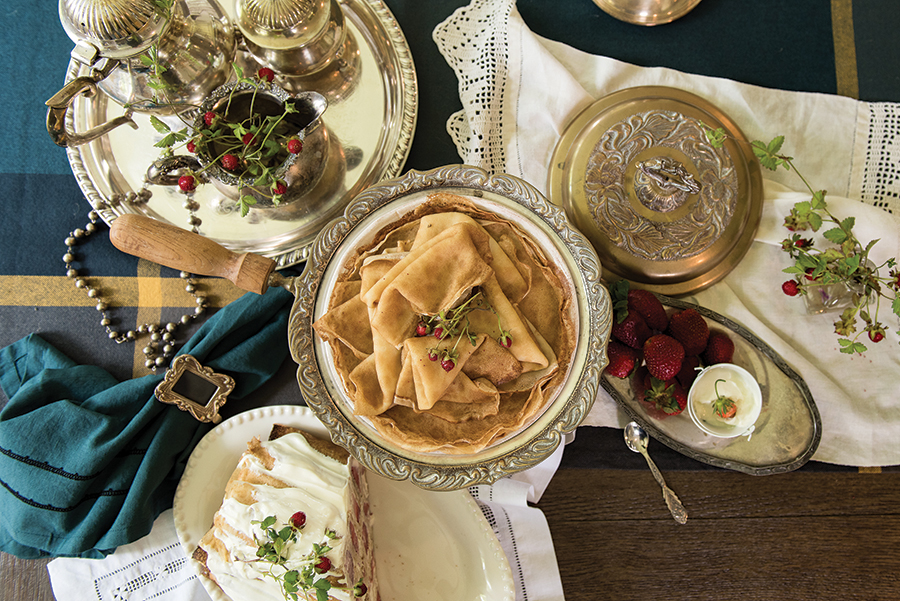
She brushed white paint over a wooden coffee table and grouted the top with blue-and-white tiles, completely changing the tenor of the piece. She polished tarnished silver bowls and pitchers — bought in boxes of odd lots — and arranged them artfully on an étagère. She purchased antique German teacups, glued them to rustic wooden trays from Walmart, and hung them on the kitchen wall for a cheerful display.
After Rob contributed three days of sanding, she lightened his “bachelor brown” bedroom suite to leaven their guest room. She sewed curtains for several rooms. She used fabric scraps to make seasonal decorations.
“I’m start 6 a.m.,” she says. “All day, I’m without stop.”
On their back porch, she cultivates geraniums, coleus and zinnias for color, basil for the table, and a money tree for financial good fortune.
“All the other plants can die, but that one had better survive,” Rob jokes.
For her Instagram page, which she started last year, Gulya uses all of her domestic ammunition — food, flowers, furnishings, tableware. She positions and repositions, shoots and reshoots, styles and restyles with an eye to the right composition and light. She deletes hundreds of pictures that don’t meet her standard.
“Maybe some people like it, but my eyes do not like,” she says.
Many of her Instagram followers live in Russia and other countries.
“I have a lot of messages,” she says. “People send me pictures of their room and say, ‘Gulya, help me!’ I say, ‘In different country it’s hard to help.’ ”
Where is she heading with her skills?
Maybe she’ll conduct classes in baking and design. Maybe she’ll work for a decorator or photographer. Maybe she’ll go to culinary school.
“I’m open,” she says, smiling and shrugging.
Most likely, she’ll do what she has always done — go where life takes her and make it as beautiful as she can.
Twenty paper-thin, brown pancakes — that’s what the recipe made. They’re stacked densely on a small plate. One by one, Gulya peels them off and slathers them with sour cream kissed by powdered sugar. She slices fresh strawberries, stripes the bleeding hearts across sour cream, rolls the pancakes into spirals, and stacks them in a triangle. Many rolls make up the triangle’s base, fewer make the next layer, and so on. She frosts the mountain with the remaining sour cream.
Last year, she visited her mother and brother. Her mother asked her if she missed Russia.
Of course, she said yes.
When she got back to Greensboro, the refrigerator was empty. So was the freezer she’d stocked for Rob. But her creations were still there, and her husband was still there, happy to see her. Gulya felt something she could not tell her mother.
She was home. OH
Maria Johnson is a contributing editor to O.Henry.
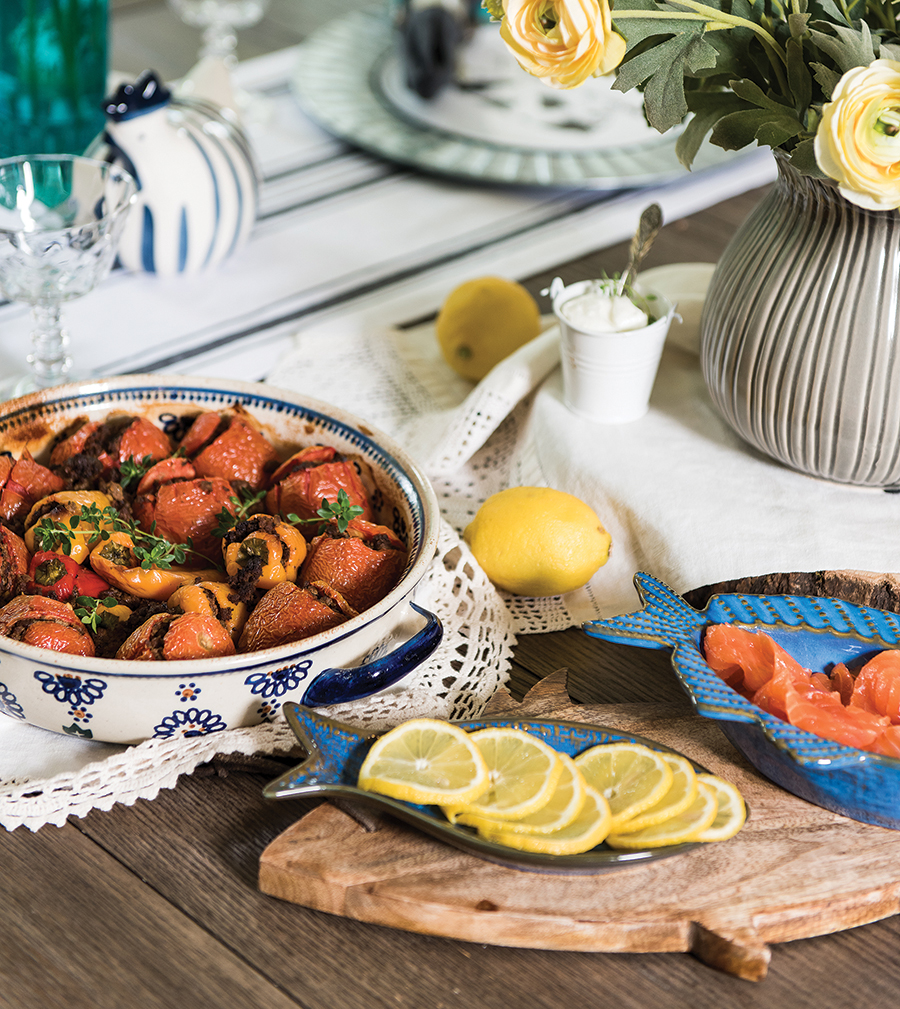
Salted Salmon
Ingredients:
1 pound salmon
1 teaspoon sugar
2 tablespoons coarse-grain sea salt
2 tablespoons bourbon or cognac
2 sprigs fresh dill, chopped
1 tablespoon olive oil
Lemon wedges for serving
Preparation:
Rinse salmon with cold water; pat dry with paper towel. Place salmon in large glass dish.
Mix together sea salt and sugar; sprinkle evenly over top and bottom of salmon.
Pour the bourbon or cognac on top of the salmon; sprinkle with fresh dill.
Tightly cover the dish and refrigerate for 2 days, turning the fish after the first day).
To serve, place the salmon on a cutting board, pat dry with paper towel. Slice the salmon into small, thin pieces. Drizzle with olive oil. (If not serving immediately, transfer slices to glass jar or jars, add the olive oil and refrigerate until ready to serve.)
Serve with lemon wedges, if desired.
Stuffed Tomatoes
Ingredients:
2 tablespoons butter
1 onion, finely chopped
10 small tomatoes
1 pound 85 percent lean ground beef
Salt and pepper to taste
Preparation:
In medium skillet, over medium heat, melt butter. Add onion and sauté until golden, 5-8 minutes.
Stir in beef; cook, stirring, until browned, and liquid mostly evaporates. Season with salt and pepper.
Cut off the top off of the tomatoes and scoop out flesh into an oven-safe dish, leaving a shell for stuffing. Stuff the tomatoes with the meat/onion mixture and place on top of the tomato flesh in the dish.
Cover dish with aluminium foil (do not add water). Bake in preheated 350-degree oven 30 minutes. Remove foil; return dish to oven and cook until the tomatoes are golden color, 10-15 minutes. Serve hot.
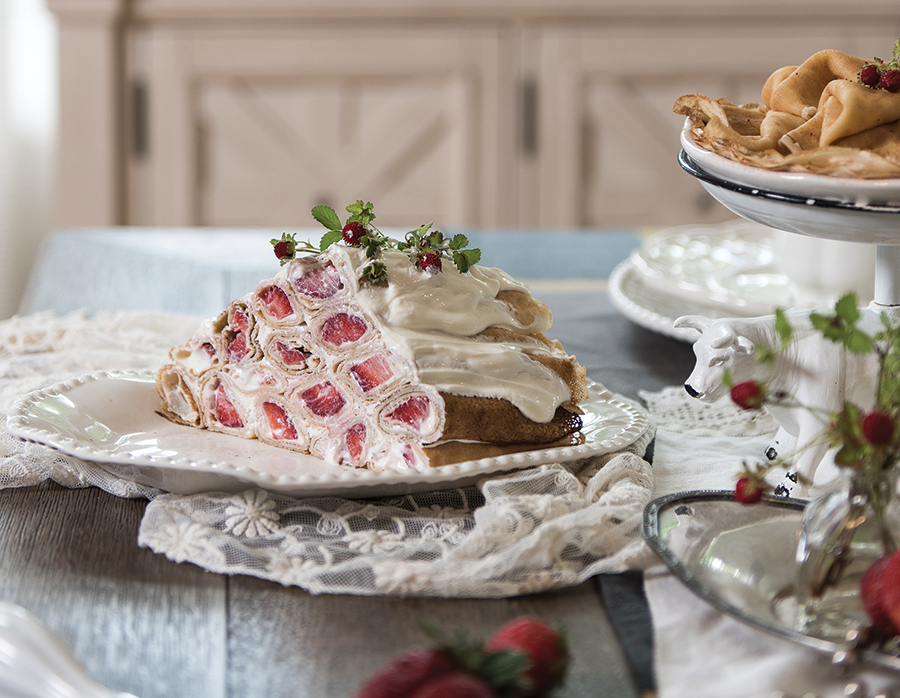
Pancakes with Strawberries
Ingredients:
2 cups whole milk
1 egg
1 tablespoon sugar
Pinch salt
2 tablespoons vegetable oil or olive oil
1 teaspoon vanilla extract
1 cup flour
1/4 cup hot water
2 cups sour cream
Confectioners’ sugar to taste
Chopped fresh strawberries (rinsed first, and patted dry)
Mint sprigs to garnish
To prepare pancakes, using a hand mixer on low speed, combine first 8 ingredients in medium bowl until smooth.
Rub a small skillet lightly with oil and heat over medium heat. When hot, spoon enough batter in pan just to thinly cover entire bottom of pan, rotating skillet to distribute batter evenly. Cook until light brown; flip and cook other side. Repeat with remaining batter. (Entire amount of batter will make 20–24 pancakes.) Let cool.
To assemble pancakes, combine sour cream with about 1/4 cup cofectioner’s sugar (or more if you prefer a sweeter mix). Spread 1 tablespoon of mixed cream down the center of pancake; top cream with some of the chopped strawberries. Roll up pancake. Repeat with remaining pancakes, cream and berries.
To serve, arrange a layer of rolled pancakes on a serving plate; spread thinly with cream. Repeat layering to form a “pyramid” shape. Garnish with fresh mint, if desired.
Note: You can use other fruit as well, such as peaches, apple, pineapple, etc.