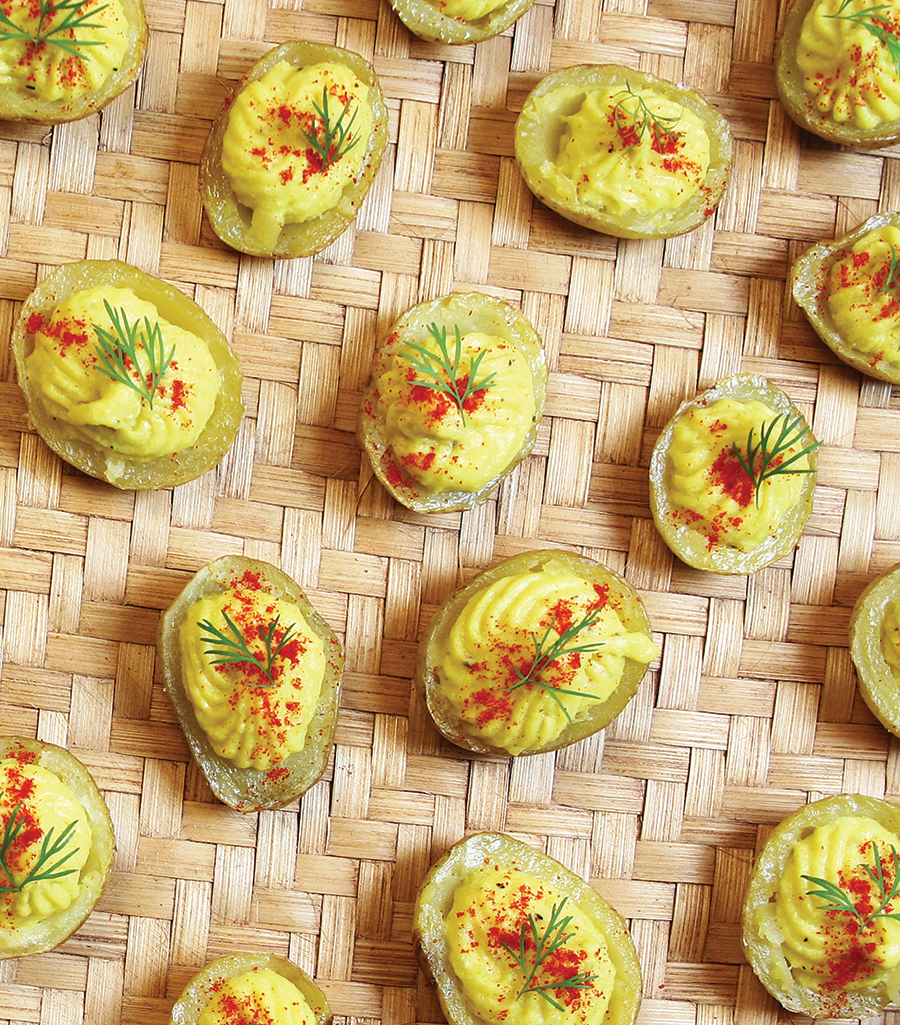
Sidecar Smackdown

Local bartenders mixed it up at a recent competition, producing some top-drawer tipples, according to two judges from O.Henry

By Billy Ingram and Annie Vorys

Dram & Draught has revved up the Greensboro bar scene, quickly becoming the latest hub for downtown drinks and hijinks. This hip little joint, formerly a service station on the corner of Eugene and Gate City Boulevard, has been transformed into a super-comfy upscale hangout that’s hosted movie nights, live music and — if you literally want to take the edge off — hatchet-throwing. But the watering hole is best known for its highbrow seasonal cocktail menus. Wrestling with upholding their newfound rep for pretty pours, they recently called three Triad bartenders to the mat against the home team for the ultimate Sidecar Competition.

When asked to judge the contest on a panel that could well have been described as an awkward dating scene (our compatriots were an administrative assistant, vegan-food vendor and a distiller), Annie’s response was: “Be still, oh beating liver! You’ve spent a lifetime training for this!”

Our bible (one of many), the 1998 volume Atomic Cocktails, likens a sidecar to a daiquiri, but with brandy instead of rum, Cointreau in place of sugar syrup, and the addition of fresh lemon or lime juice (unless you’re the “hardcore” type). The guide goes on to say that the libation was a favorite of no less than Ernest Hemingway’s during his Moveable Feast expat years in Paris. Good enough for Papa, good enough for us!

One by one, the competitors stepped up, describing their version of the classic. Hosted by Hennessy, there was only one rule: Use Hennessy VSOP. Billy was particularly impressed with “the verve the barroom mixmasters exhibited and the preparation involved in their concoctions so everything could be served up quickly.” Lao’s Robert Rhodes charred his orange peel and soaked blackberries in liqueur. Max Barwick of 1618 Midtown educated us on absinthe as he mixed his version. Country girl and Dram & Draught’s own Jordan Harwood brought in her homemade peach-mint tea in a potion she calls Porch Swing. “That personal touch, and her signature orange peel rosette, sold us judges,” declares Annie. Billy concurs, giving props to all the “refreshing” elixirs, particularly Harwood’s. “Makes me want to go down there right now and order one (which I promptly did after writing this!).” As for Annie: “Beat you to it, Buster! Where do you think I found my muse for this piece?”

Life don’t mean a thing till you’ve tried the Porch Swing. For something stiff, go for the Skiff, Max Barwick’s island-y take on the traditional sidecar placing second in this competition. Another one to try? Robert Rhodes’ Blackberry Pie. Mix ’em yourself using the following recipes — and be careful these sidecars don’t knock you sideways.

Jordan Harwood’s Porch Wing

1 oz peach-mint tea simple syrup (see recipe)

2 oz Hennessy VS

3/4 oz fresh lemon juice

1/4 oz Copper & King’s Destillarè Orange Curaçao

3 dashes Angostura Bitters

2 dashes Fee Brothers Peach Bitters

Shake all ingredients over ice; strain and serve up in a coupe.

Peach-mint tea simple syrup: In a medium saucepan, combine 3 cups chopped fresh peach, 1 cup brewed black tea and 1 cup sugar. Bring to a boil and reduce to a simmer, stirring frequently, for about 10 minutes. Remove from heat and add about 40 mint leaves to infuse while cooling. Finely strain when cool.

Max Barwick’s The Skiff

2 oz Hennessey VS

3/4 oz coconut-infused Cointreau

3/4 oz pineapple juice

5 dashes absinthe

Shake all ingredients over ice; strain and serve up in a coupe.

Robert Rhodes’ Blackberry Pie

2 oz Hennessey VS

3/4 oz lemon juice

1/2 oz Solerno Blood Orange Liqueur

3/4 oz blackberry pie syrup (see recipe)

Blackberries and orange peel to garnish

Shake all ingredients over ice; strain and serve up in a coupe.

Blackberry pie syrup: Soak 25–30 blackberries in 16 oz Hennessey VS for 4 hours. In a saucepan, combine blackberries and cognac with 8 oz water, 1 cup sugar, 1 1/2 sticks cinnamon, strip of orange peel and 3 drops of vanilla extract. Bring to a boil; lower heat to simmer and simmer 30 minutes to one hour. Cool and strain.  OH

Billy Ingram and Annie Vorys are happy to continue in their roles as cocktail judges — with or without a competition.

June 19 Poem

Ode to My Backyard Garden

O mighty, O valiant

flowered phalanxes,

patrolling the patio perimeter!

Sharp-pointed hostas flank

two imposing hydrangeas

holding pride of place,

one uniformed in periwinkle,

the other, salmon pink,

their blooms thrusting

purposefully toward the sky.

Snowy-petaled Shasta daisies

with bright lemon centers —

the next line of defense —

gently wave in formation,

gathering intelligence,

heads pressing together

in silent exchanges.

Outermost are the sturdy sentinels,

daylilies hued in saffron and amber,

their ranks constantly replenished,

ever watchful for marauders,

especially Inscrutable Thomas,

the neighbors’ orange tabby,

a stealthy, persistent intruder.

O carry on, carry on,

my intrepid army

of blossoms!

— Martha Golensky

Botanicus

Paw de Deux

Or as we say in the South, “Paw Paw”

By Ross Howell

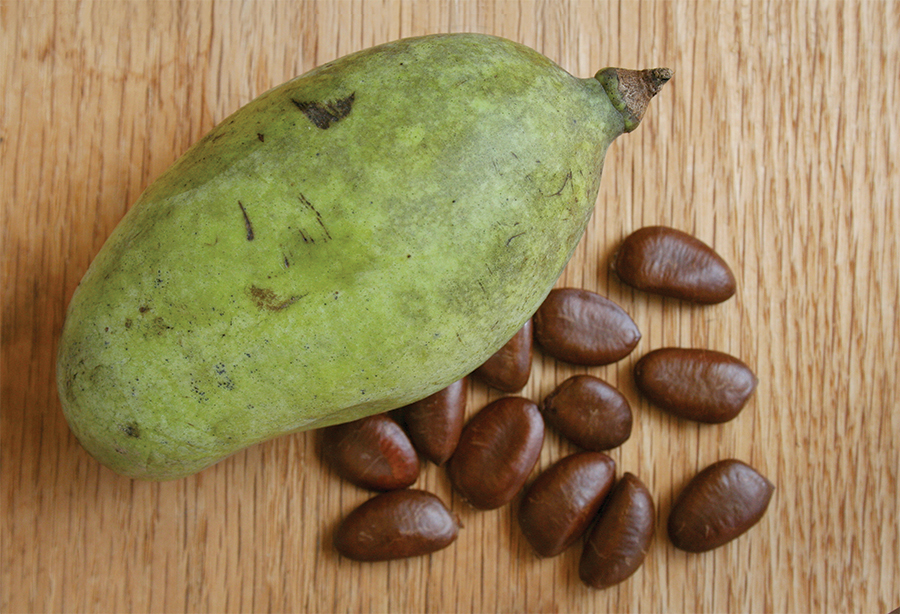
A simina triloba — a.k.a. pawpaw, papaw, paw paw, paw-paw, American custard apple, poor man’s banana, Quaker delight, hillbilly mango, Appalachian banana — is a small, deciduous tree native to the eastern United States and Canada, growing as far west as Nebraska. Mature trees can reach a height of 35 feet, producing maroon-colored flowers and sweet-tasting, aromatic fruit, the largest edible fruit native to North America, if you don’t count squash — and who other than the most persnickety of botanists would count squash as a fruit?

The pawpaw once enjoyed considerable popularity. Its earliest documented mention — according to Owen Native Foods of Cross Junction, Virginia, — is found in a 1541 expedition report of the Spanish explorer Hernando de Soto, who discovered Native Americans cultivating the plant east of the Mississippi River.

During the Lewis and Clark Expedition, 1804–1806, the adventurers consumed pawpaws during their journey. Chilled pawpaw fruit was a favorite dessert of George Washington at Mount Vernon, and Thomas Jefferson planted pawpaws at his home, Monticello.

The pawpaw has a folk tradition, too. As part of my elementary school education in the mountains of Virginia, I learned to sing this little ditty:

Where, oh where is pretty little Susie? [repeated three times]

Way down yonder in the pawpaw patch.

Pickin’ up pawpaws, puttin’ ’em in her pocket, [repeated three times]

Way down yonder in the pawpaw patch.

Important safety tip! Pretty little Susie’s “pocket” was an apron. Pawpaw fruit is remarkably mushy when ripe, so you don’t want to tuck one in the hip pocket of your new Wranglers.

In the wild, pawpaws are understory trees, flourishing in fertile bottomland under the shade of taller trees, often propagating by sending up new saplings from their roots. So they’re often encountered in a “patch,” as in the lyrics of my boyhood song.

But there are exceptions.

Dara Dobson, who owns 7 Pines Native Plant Nursery near Defuniak Springs, Florida, explains that “more mature pawpaw trees are better able to stand strong sunlight.” Charlie Headington, a professor in UNCG’s Master’s in Applied Arts & Sciences program and advocate for low-maintenance, organic, edible and diverse community gardens, notes there are two pawpaws growing in full sunlight at Greensboro Montessori School on Horse Pen Creek Road. “They’re 10 to 12 feet tall and are located to the left of the school building in a terraced garden,” Headington says. “You can’t get in the gate but you can look at them over the fence that has scuppernong grapevines woven through it.

“There are two smaller pawpaws in the Meeting Place garden at the corner of Smith and Prescott streets,” Headington adds. “They’re labeled for identification.”

In addition to sending up saplings from their root systems, pawpaws also reproduce by way of flowers and the big seeds their fruit encases.

To my knowledge there are no songs celebrating the fragrance of the pawpaw flower, and for good reason. They produce little to no odor at all, but what fragrance they do emit smells remarkably like roadkill. Alas, the trees’ leaves, twigs and bark are also foul-smelling, loaded with natural insecticides called acetogenins. Rarely are their leaves eaten by rabbits or deer.

But they’re quite tasty to the palates of zebra swallowtail butterfly larvae. Not only do the larvae enjoy protection from the predation of birds and other critters by virtue of the acetogenins they ingest with the leaves, the spectacularly colored adult butterflies do, as well.

Raccoons, squirrels, opossums and other critters enjoy eating the ripe fruit of the pawpaw, thus helping spread its seed in the forest.

“Opossums are traditionally the raiders of the pawpaw patch,” says Greensboro resident David Waller, professor emeritus of the department of Biological Sciences at Kentucky State University, “but I bet bears were more important to the tree in pre-settlement America.”

Waller first heard about the pawpaw during a discussion with a KSU botanist friend about guanabana, a fruit found in Mexico that’s a relative of the pawpaw. Later he discovered a pawpaw patch thriving in a marshy area on the KSU campus.

“On sunny days, it was so pleasant to visit there and be in the bright green light under the huge leaves close overhead,” Waller says. “In spring the shocking, big, brown-petaled flowers popped out of woody branches, then came the lumpy-sausage fruits, fragrant when ripe in late summer — all surprisingly exotic, yet it’s a native tree!”

KSU has the only full-time pawpaw research program in the world. Focusing on issues like propagation, genetic diversity, orchard management, and techniques to improve fruit ripening and transport, the university hosts an international festival, which last year drew representatives from 19 states and European countries including Holland, Slovenia and Germany.

National Public Radio’s Ally Schweitzer, writing about a couple who’d planted a pawpaw orchard in rural Maryland, notes that with consumers’ increasing desire for fresh, locally produced foods, farmers markets and trendy breweries and eateries have “embraced the fruit.” These developments have even earned the pawpaw a new alias — “hipster banana.”

Interested in learning more about the resurgent pawpaw?

The 21st Annual Ohio Pawpaw Fest 2019 is scheduled for September 13–15 near Lake Snowden, Albany, Ohio. Waller has attended the festival a couple of times. “It’s an enthusiastic social event with plenty of pawpaw information, souvenirs and some saplings in pots to plant in your own back yard,” he says. “Along with other nature stuff by local groups.”

Closer by is the N.C. Cooperative Extension’s North Carolina Pawpaw Festival, which takes place in Forsyth County, usually on the last Saturday in August. While an event isn’t planned for 2019, vendors at past N.C. festivals have offered seeds and saplings for planting, ripe fruit for eating, along with samples of pawpaw and spiceberry jam, pawpaw gelato and pawpaw beer! You can follow the N.C. Pawpaw Festival on Facebook using the handle @ncpawpaw.  OH

Ross Howell Jr. planted a native pawpaw in a wet area at the far end of the lot at his wife Mary Leigh’s house in Florida. There was no discussion about the fragrance of pawpaw flowers before he planted the sapling, and he hopes there never will be.

Heart of Red Oak

Beer — and Bill Sherrill — are proof that God loves us and wants us to be happy

By Jim Dodson  • Photographs by Laura Gingerich

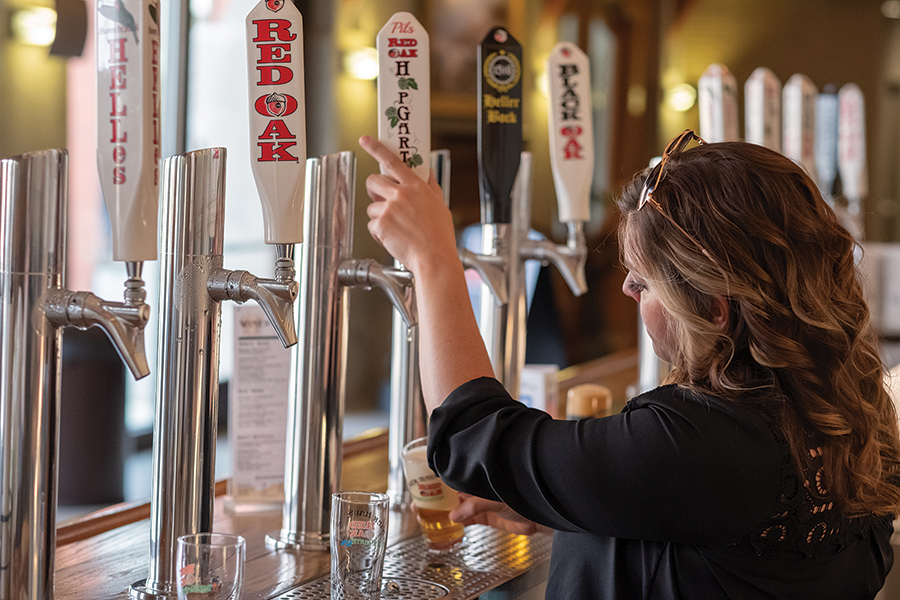
On a recent warm spring Friday evening, the bar at Red Oak Brewery’s spanking new Lager Haus and its newly completed Biergarten are filled with happy customers and an air of cheerful gratitude that another workweek is in the books. It’s time to hoist a cold Red Oak or one of half a dozen house-crafted beers on tap to toast the start of a warm and welcome weekend. 

At least that’s the feeling of the colorful owner and creator of this festive little piece of Munich, Germany — a pretty happy guy in his own right. Earlier in the day, Bill Sherrill, arguably one of the godfathers of artisan brewing in North Carolina, received some very good news about the future of crafted beer in the state.

A friend who works as a lobbyist in the North Carolina General Assembly phoned to let him know that a lengthy campaign led by Sherrill and other craft brewers to change a state law that prohibited them from producing and selling more than 25,000 barrels of beer without contracting with a wholesale distributor had succeeded.

Under the revised law, the state’s 200 craft brewers could now make and distribute 50,000 barrels on their own. It’s a victory not only for thirsty beer drinkers across the state but also a shot in the arm for smaller, independent craft brewers like Sherrill who’d essentially bumped up against the 25,000-barrel cap, limiting further growth without turning their beer over to a distributor, who probably wouldn’t keep, for instance, Red Oak refrigerated during transport as classic German lagers should be.

“It’s definitely a reason to celebrate because this will mean more jobs in the long run and be great for the state’s economy,” says a visibly pleased Sherrill. His illuminated sign by his Red Oak brewery hard by the southern flank of I-40/85 in tiny Whitsett has become something of a roadside icon and a growing attraction in recent years, underscored by the opening last fall of the brewery’s capacious Munich-style Lager Haus.

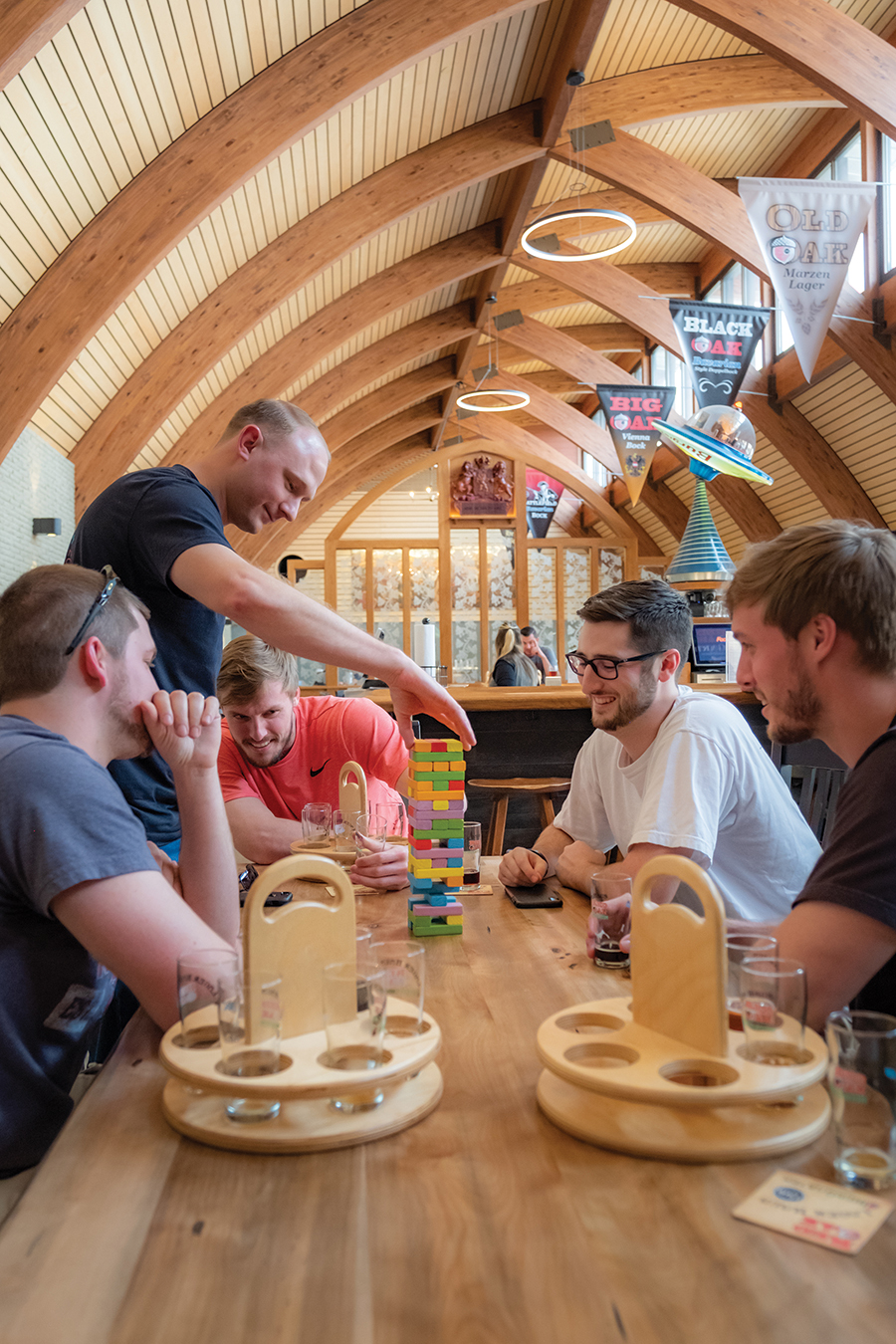
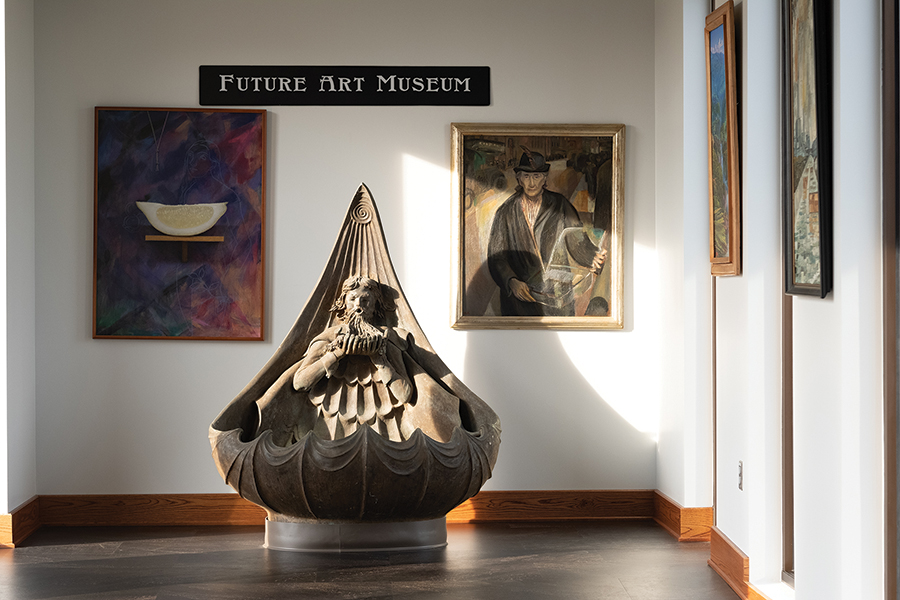
The aforementioned Biergarten, with its neat communal tables and fire pit beneath a grove of lacy bark elms, is simply the latest addition to meister Sherrill’s complex. Next up is a 10,000-square-foot office and art gallery that will showcase major North Carolina and Southern visual artists when completed sometime late this year or early next. In the meantime, his popular Lager Haus features its own eclectic works of art in the form of a 17th-century wedding settle (bench) that was given in 1640 to the Earl of Northumberland, a pair of royal family crests from England’s House of Windsor and the Royal House of Holland, a 500-year-old coat of arms from the German Millers Guild, oil paintings from ice skating legend Dick Buttons’ private collection, antiques and an illuminated “Burgie” (i.e. a vintage Burgermeister Beer sign) from the Sputnik years rotating over the bar.

“I found that during an art crawl 21 years ago in Scottsdale, Arizona,” relates Sherrill over the convivial din of his patrons. “Pretty special, isn’t it? It seems to make people happy. That’s the point.”

Indeed it seems to be one of many reasons the festive Lager Haus has become both a roadside destination and a routine gathering spot for everything from local civic groups to book clubs, family reunions and alumni evenings — even a Bible class that meets there every other Thursday.

“We have probably the widest range of patrons imaginable,” says director of customer services, Ashley Justice, with a laugh. “I’m talking about lawyers from Raleigh, college students and professors from Greensboro and Chapel Hill, business folks and Harley bikers.” Plus, she says, there are game boards for families, NASCAR on Sunday, musical Bingo on Wednesday evenings and trivia nights on Thursdays. “We host events for the sheriff’s department and local hospitals. This really is an Old World place where everyone feels welcome.”

Dogs are welcome too — treated to their own special watering holes — while  gourmet food trucks feed their masters on a rotating basis. A highlight of this ongoing festive calendar is the gifted German oom-pah band that shows up annually to perform on weekends through Oktoberfest. Sherrill also plans to add an authentic Brat Stube (Kiosk) selling German sausage.

All three entities — craft brewery, Lager Haus and art gallery — are the kind of yeoman dreams Bill Sherrill has spent a career bringing to life. In 1979, Sherrill opened Franklins Off Friendly with a talented chef named John Berres and a charismatic young house manager named Dennis Quaintance, the three of them creating one of the Gate City’s hottest restaurants over the next decade and a half. From there, Quaintance went on to start a successful wine brokerage and later partnered with construction guru Mike Weaver to open Lucky 32 restaurant; the two would later bring a pair of award-winning luxury boutique hotels, the O.Henry and Proximity, to life.

“I can’t imagine what my life and many others would have been like without Bill,” says Quaintance, who met Sherrill when he was 17 and followed him east after working for him in hotels and restaurants in California and Seattle. “He is such an original thinker. For Bill, it’s not about the money. It’s about creating things that make people happy. Bill doesn’t conform to any formula. He is completely unconventional and creates what makes him happy and shares that with the people around him.”

In 1989, after expanding the footprint of Franklin’s to include a Top 100 wine cellar, Sherrill decided to shut it down and concentrate on making the kind of German lager he’d developed a taste for while attending high school in Switzerland and traveling around the world for a full year after finishing Duke University. He went on to earn a master’s degree in hotel management at Cornell University.

His quest to find the perfect brew and the kind of equipment that could make the Bavarian-style amber lager he had in mind took him on a tour of West Coast craft breweries and across Germany before he settled on equipment found at Chesapeake Brewing Company.

He brewed his first beer in 1990, selling it mainly for the next year through his small chain of bar and grills in Winston-Salem, Chapel Hill and Charlotte.

In 2008, Sherill opened his Red Oak Brewery on a patch of family land in Whitsett, officially the state’s second-oldest craft brewing company, with eight employees and an unpasteurized beer that was so fresh it required refrigeration at all times. Today, the brewery occupies close to 30,000-square-feet and is closing in on 70 full- and part-time employees who seem to find Sherrill’s take of the Golden Rule in management style agreeable. “We have just three rules,” he notes — “Be honest, work hard and treat the customers the way you would want to be treated.”

His eight different beers are distributed as far west as Boone and Morganton, as far east as Little Washington and Calabash.

When it eventually opens, Red Oak’s art gallery will not only house a bounty of original works Sherrill has collected over decades from North Carolina and Southern artists, but also works he’s brought home from some of the 95 foreign countries he’s visited over the past half century. Among other things, he hopes the gallery will also serve as a place for seminars and round tables on the arts.

“I know it’s kind of crazy,” Sherrill allows while sharing a brew with several of his old friends from college days at Duke. “I mean, who would spend this kind of money on good beer and great art?”

He knows the answer to his own question, of course.

“Here,” he says with the Old World charm of a proud Biermeister. “It’s been a long week. Have another beer and relax.”  OH

Jim Dodson’s antidote to the brouhaha of publishing is a brew-ha-ha with one of Bill Sherrill’s craft beers.

Bohemian Rhapsody in Blue

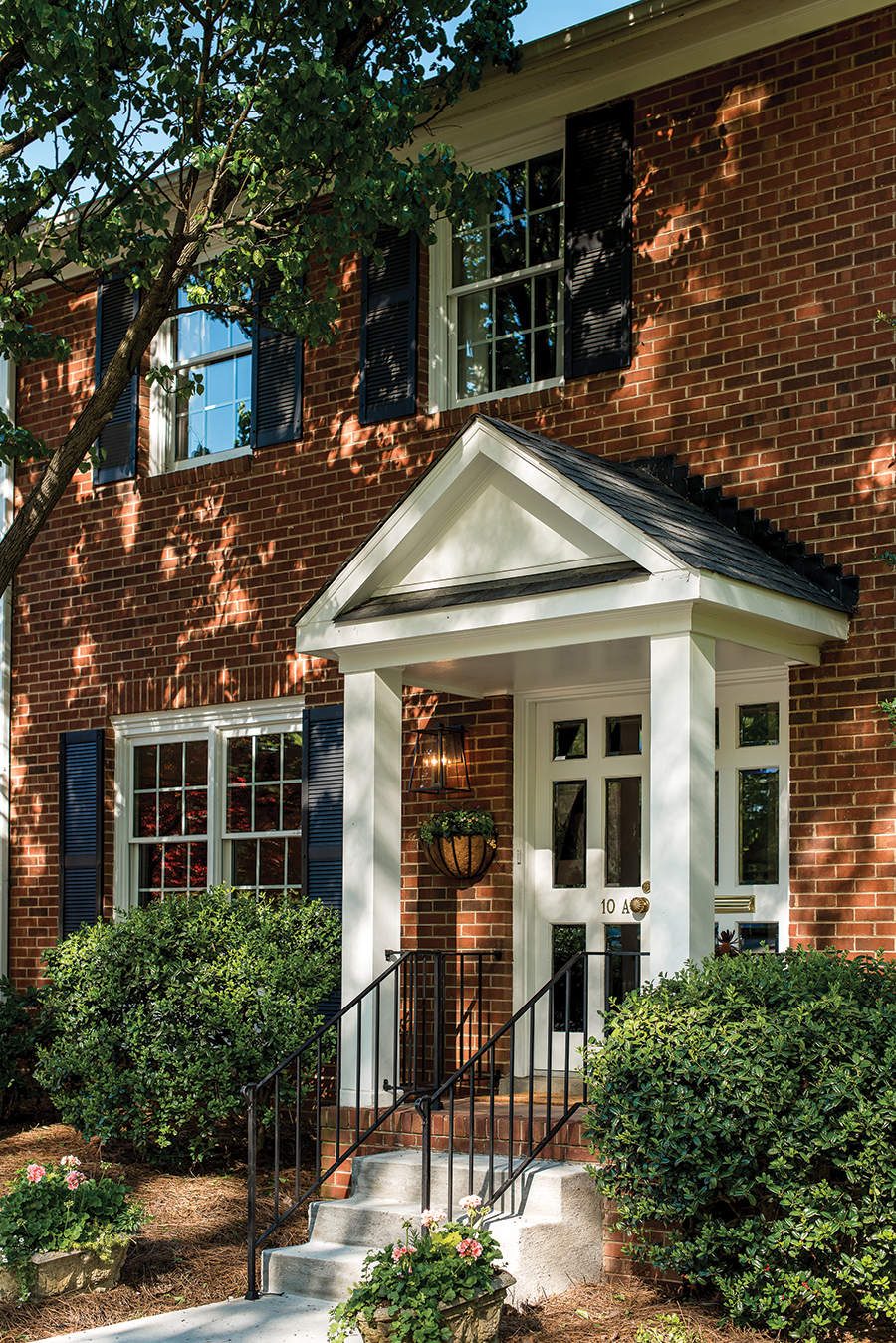
Catherine Harrill pushes aside old boundaries in her brilliantly edited new home

By Cynthia Adams     Photographs by Amy Freeman

Jazz plays softly in Catherine Harrill’s Fountain Manor townhouse when she opens the airy double French doors (ones that contractor Gary Jobe installed ages ago for a previous owner). That she says, is serendipitous. So is the fact that she already possessed the gleaming French Regency brass doorknobs now affixed to the doors. Those helped kick things up a notch from the get-go.

Like so many of the furnishings that survived a severe edit, Harrill nabbed the brass knobs at a vintage store. “I bought them without knowing where I would use them,” she says with a smile. She fondly mentions vintage resellers like Adelaide’s, The Red Collection and Carriage House as she points out old loves — that is, longtime favorites enjoying a new life after making the curating cut.

A ghost-style acrylic fixture with brass accents hangs over the entryway. Just inside the entry, a grand gold pier mirror (another vintage score) bounces light into the serene kitchen.

The house reverses the kitchen-out-of-view plan. The sleek kitchen is primary.  With white marble tile and white quartz, it is an understated study in how to create a white kitchen that isn’t sterile — and worthy of being right upfront and on view.

The refined and well-lighted space provides a sight line through the downstairs all the way to the sunroom and rear terrace — something Harrill methodically created via a gut job.

Just beyond the monochromatic kitchen is the unexpected: Fully saturated color!

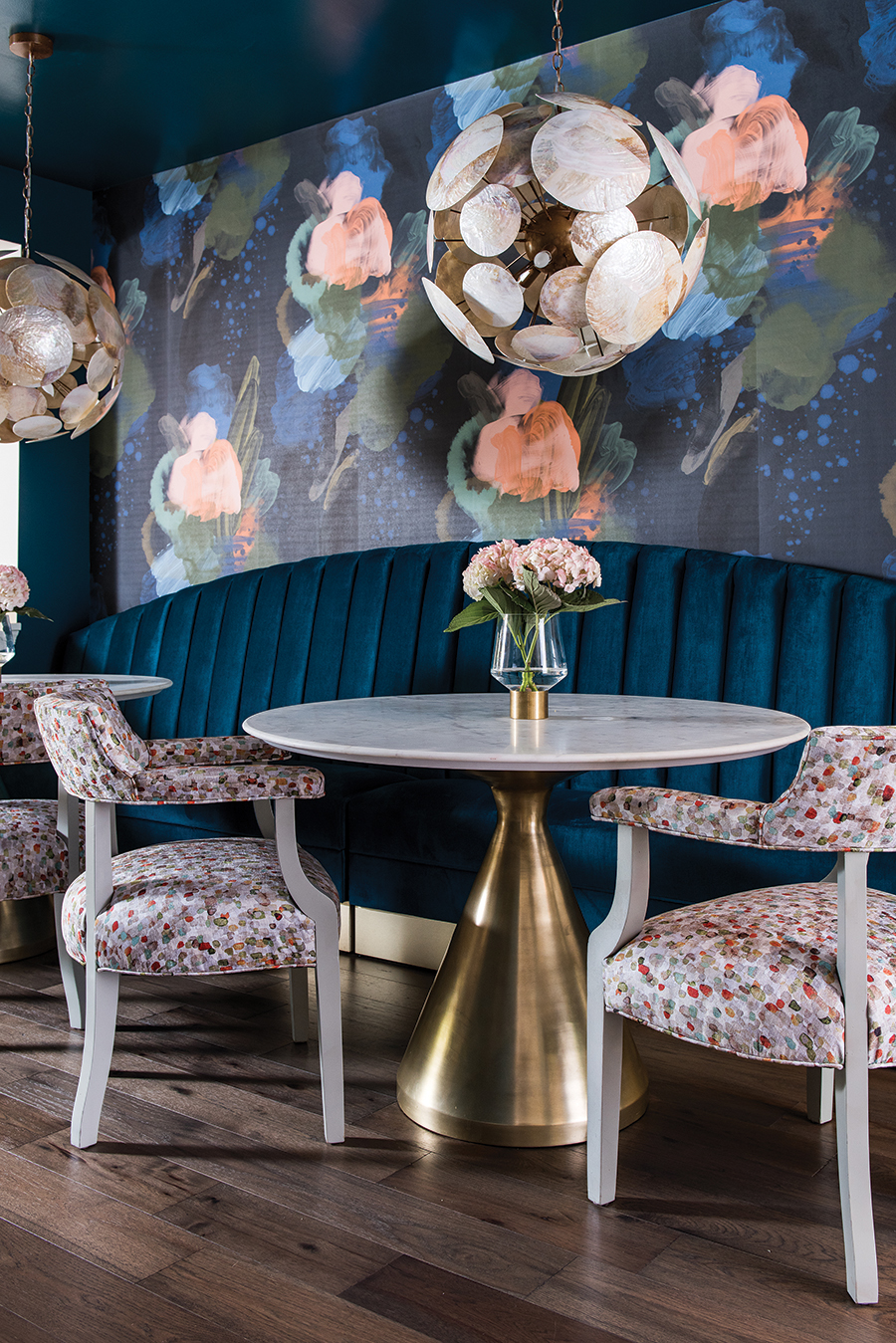
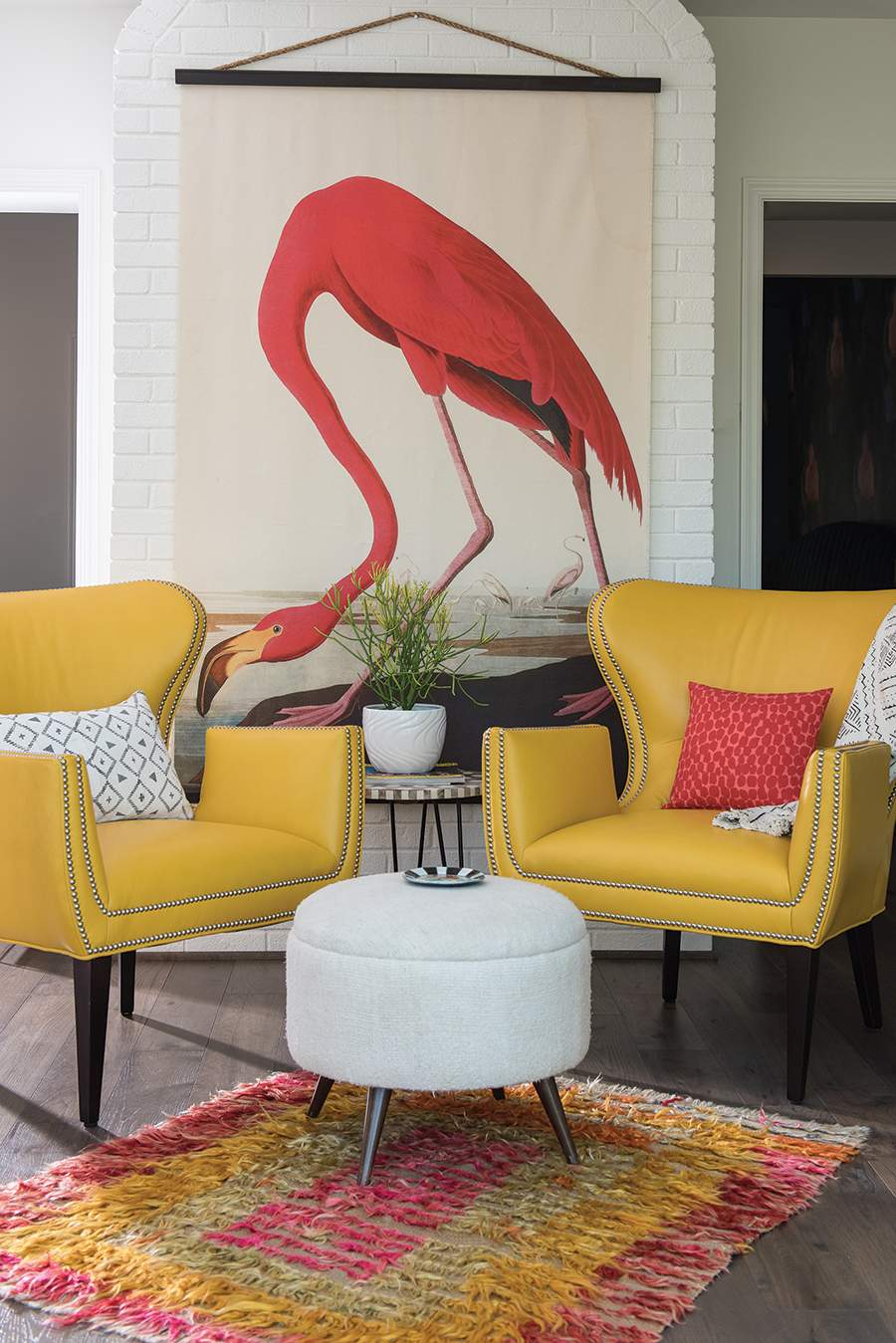
The once conventional dining room was opened up and now is done in broody, bohemian blues, even on the ceiling. It is now a space with a frisson of excitement —featuring a long and sexy velvet banquette with button tufting, two gleaming white bistro tables, vibrant wallpaper and two sculpture-like fixtures.

Is this Greensboro?

Harrill’s condo synthesizes departures from the norm, while still creating a satisfying and exciting whole — an unmistakably conscious design. Here, Bohemian chic meets Zen.

It is a revelation.

Forget Builder Bob clichés. This homeowner wasn’t having it. “I’d had enough chair rail to do me for a lifetime,” Harrill jokes, taking a seat at a sleekly modern bistro table and serving a pizza that combined fig preserves, brie and pistachios.

The combo elevating pizza to an unexpected and savory plateau is worthy of the kicky dining room.

“I have dinner here every night,” she adds with a smile of pleasure.

The soundtrack for dining in such a space is, rightly, jazz. Comprised of counterpoint, improvisation, with a hipster cachet, it is the music of creative breakthroughs. All indications are that after Harrill retired as a clinical social worker at Cone Health, she had a literal breakthrough of her own.

For not only did she discover a soundtrack for her new digs, she also blew out the rear wall in order to accommodate a creative revision, adding another 200 square feet to her living space.

She banished chair rail, along with decades of stuff during a year and a half of serious evaluation.

And she wisely chose to have her expansive vision drafted, vetted and then drawn by Greensboro residential designer Jim Weisner before she even talked to anyone about costs, avoiding the expensive mistakes witnessed on home design shows.

“He does architectural drawings. I hired Jim to do renderings before I talked to contractors. I knew from the inspection report that I needed to discuss with a professional what could be opened up structurally,” Harrill explains. He came back to discuss a few things — and they were resolved.” As it happened, they had attended the same high school.  Serendipity indeed.

Using Weisner’s plans to obtain renovation quotes, she settled upon general contractor Gary Jobe. The renovation went without a hitch.

Here’s what you should also know about why she got it all so right. Harrill is a former home stager. Aware that she was going for something different, she understood the need for a crack team to get there, from pen on paper to hammer and demo, right down to paint and fabric.

Long before Harrill became a health professional, she developed a business working with Realtors in staging listings when the HGTV network and Designed to Sell were new.  “People’s stuff intruded upon their ability to see a space.” Once decluttered and staged, homes sold.

I think we’re all ADD,” she offers. “Just having a cleaner space where your eye can rest is so different.”

Now Harrill sought aesthetic advice. “I walked in Vivid [Interiors] on Elm Street by chance, she says. “It felt right — all the color!  I wanted to break out of my comfort zone.”

Ultimately, designers Gina Hicks and Laura Mensch at Vivid guided the renovation of the dining room from concept to installation and consulted on the master bedroom, but the majority of the choices were Harrill’s.

Whereas Harrill once favored a heavier and “layered look” her new home called for something else. She points to a substantial primitive table serving as a desk in the sunroom. “Imagine putting that table here,” she reflects. The designers quickly understood that the new dining room needed something completely different than traditional furnishings. And a design which allowed for through traffic to the rooms beyond.

“Vivid’s designers, Gina and Laura, came to my apartment and I showed them a file of ideas and inspirations,” Harrill says, recalling the designers’ array of fabric swatches, paint samples and wallpaper for inspiration. Things clicked.

“Gina suggested the banquette and two tables,” she continues. The idea required a complete shift for Harrill. “But, I said, ‘OK!’ surprising us all.”

Ultimately, Harrill landed upon vintage office chairs she had painted and recovered for additional seating in the dining space.

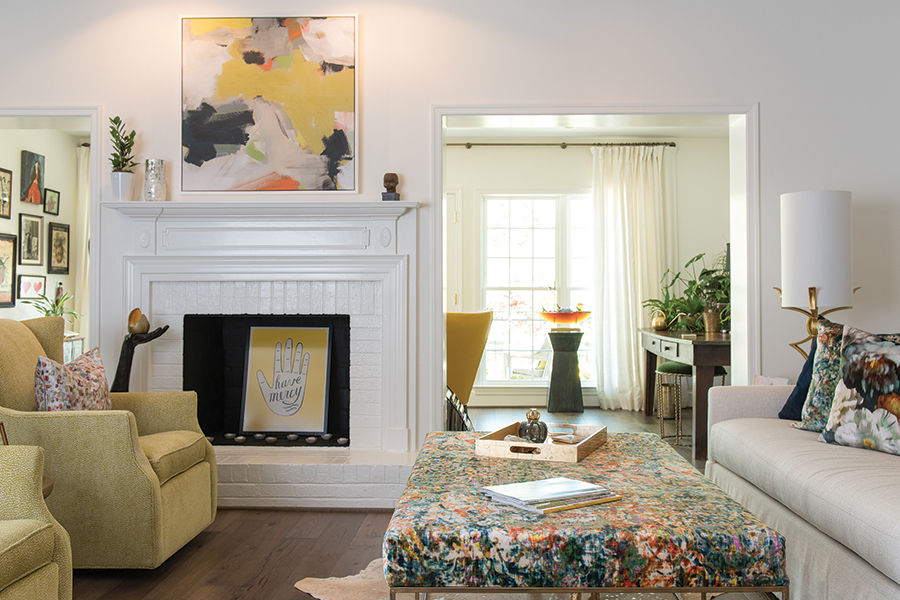
“They consulted with me, and helped me with other furniture, which included some seating and a few pieces of art.” One major piece they selected hangs over the fireplace. But the majority of the art choices are from Harrill’s own collection.

It had all incubated before the fortuitous estate sale. In the year before Harrill wandered into the sale, she had determinedly kept an eye on Fountain Manor. The community off north Elm was developed in 1973. It became her habit to drive through almost weekly noting For Sale signs. “The units sell so quickly,” she explains.

At the same time, she considered another freestanding house, having left a 4,200 square foot home in Wedgewood. Meanwhile, she rented an apartment and took stock of her possessions. “I wanted high ceilings and sidewalks,” she says, not to mention a neighborhood suited to walking.

“I realized the reason I had been looking at Fountain Manor was, I didn’t want to be isolated. I’m somewhat of a loner.” A friend, Katrina Solomon, was a resident. “I knew her 15 years,” she adds with a contented smile.

Harrill had even attempted to buy another Fountain Manor condo still languishing in bankruptcy after eight years. It was not moving according to plan and the bank was in no hurry to sell.

One day in August of 2017, Harrill was waiting for her Realtor to show her a house on Northwood, and before she could even see it the Realtor phoned to inform her someone had snapped it up. Something made Harrill drive over to Fountain Manor, where she spied an estate sale notice. She entered the sale and walked right into her future.

“I bought a yellow curio cabinet that day,” Harrill notes. (The cabinet is in the all-white kitchen — yellow has become one of her favorite punctuation points in the very edited home.) “And noted just as I was on my way out a notice that the house was going on the market that coming Monday. I called my Realtor, who came over, and we made an offer that night.”

A house and a yellow curio cabinet, all in one fell swoop. “I got the high ceilings,” she says, as another smile creeps across her face.

Time spent in an apartment had prepared Harrill for transitioning from a large home to half the space. It caused her to embrace the new, and make downsizing a creative experiment. Was it consciously planned that way? It evolved that way.

Harrill visualized something very different: a space with room for art, discovery and joy.

“I had also just retired. And, I wanted a place where I felt comfortable, that offered peace, serenity. Stuff doesn’t make you happy.” After retiring from Cone Health, her life’s routine was changing.

Harrill was, by design, shedding things that no longer fit into her life.

She was going to Marie Kondo her way to serenity.

“When I went to the apartment, I took all the stuff I wanted. When you get there, and start moving in, unpacking, you think, I’ve done this enough.” This meant family antiques. Then her cousin visited with even more family heirlooms, including china and a dining room table. She determinedly culled, aided by her former training in helping others declutter, while applying the Kondo question:  Does this spark joy?

Although Harrill had two adult children, Harrison and Hannah, she realized, “The younger people don’t have these attachments. Why was I going to save it?”

Even so, she checked in with them while culling heirlooms. “My daughter wanted my grandmother’s china. It’s beautiful, and she had a lot of happy associations with it. I kept the flatware and I use my mother’s sterling everyday — why not? — we only got to use it twice a year.” She laughs a bit ruefully. Her mother died in recent years, but her father lives in Greensboro.

There are a few nostalgic items that made the cut. “My mother and I both loved shoes. That’s a shoe mirror from Montaldo’s when it used to be downtown,” she says, pointing out the delightful mirror, which complements the velvet banquette  in the dining room. “My mother scored it. I’m not sure how.”

Montaldo’s figured into a happy memory, so the joy-sparking mirror has a place of prominence.

On Christmas Eve, she and her mother would head to the iconic downtown department store for its annual shoe sale which began at 3 p.m. “There was a gentleman who worked there with great taste. We had two hours before they closed.” Invariably, great shoes came home with the duo.

She remained in the apartment as home renovations began after Christmas of 2017, once construction permits were in place. Work proceeded smoothly, thanks to Harrill’s crack team.

The kitchen, gutted, allowed for new cabinetry to run to the ceiling and for a spacious island. With the downstairs revised, the space opened and its potential revealed itself. The awkwardly steep stairs were replaced with wider risers. The rear wall’s bump-out allowed for a generously-sized sunroom and remaining space for a smaller patio.

Harrill moved into her new home on April 10, 2018.

Her personal space is quietly neutral. The master bedroom features a graphic, Brutalist black-and-white, grass papered wall behind the bed. “Gina said it goes with the traditional kinds of things I liked in here. I have a lot more color than I’ve ever had downstairs. But for my living space, I kept it calmer,” Harrill explains.

A French gilded chaise found in a vintage store is central to the room’s edgy look, featuring hand-painted black-and-white upholstery. She accented her space with brass touches. “I’d never had matching bedside tables,” she says. “It seemed like a luxury I wanted to go for.”

A black-and-white painting by local artist Billy Cone hangs on the bedroom wall.

Baths throughout the house were redone. The master bath now features a deep soaking tub.

“The bathrooms aren’t really big,” Harrill says, but the closets are. Perfect for her beloved shoe collection.

With paint, paper and new furniture in place, and Harrill’s many pieces of art hung, there was a mere moment of self-doubt as she walked through the expansive, Bohemian space.

“I had a period of anxiety, wondering, did I make it too fancy?” admits Harrill. “I’ve always made do with whatever I could get, and that was fine. But to do a dining room like that with a banquette?”

But as Harrill came to realize, the new dining room made entertaining  easier and less formal, whereas most dining rooms molder unused. She can now place food and beverages on the large kitchen island and seat anywhere from six to nine guests — no ancestral dining table required.

And there was the joy factor.

Her kids take on the outcome? “Harrison is 27, and my daughter, Hannah Morecraft, is 30. And they like it.”

Morecraft, who lives in Raleigh, later sent an email:

“My mom’s new place is exactly her personality — creative, fun, eclectic and warm. My brother, my husband and I, and maybe especially our Bernese Mountain dog, Bear, love visiting whenever we can and spending time chatting on the patio or around the big kitchen island. I’m so glad she found a great team to help her pull it all together.”

Standing on the redesigned patio, Harrill pointed out the trees beyond a new wrought-iron fence, which affords an unobstructed view.

“I was sitting out here one day and looked at the crepe myrtles and counted them.  There were seven of them. I realized I felt like I was at home. There were crepe myrtles lining my driveway at my former home — exactly seven.”

Some things need no editing.  OH

Cynthia Adams is a contributing editor to O.Henry.

Recipe for Success

At Greensboro’s lone homegrown kitchen store, friendly is the extra ingredient

By Maria Johnson     Photographs by Sam Froleich

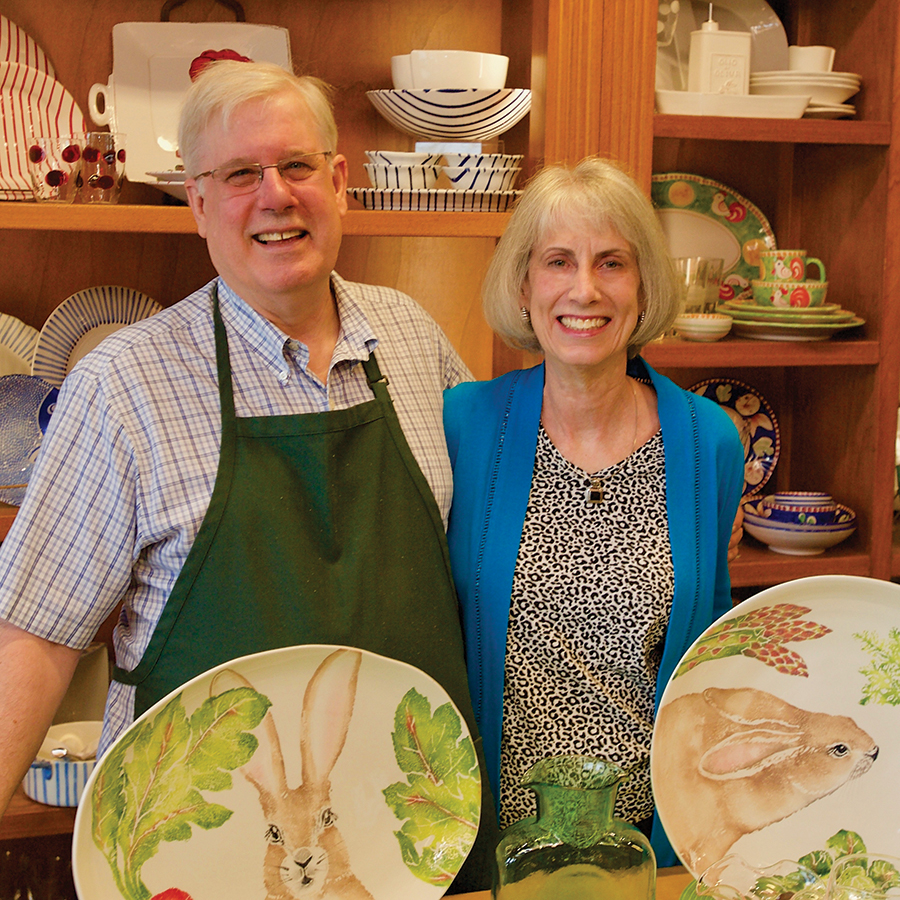
As you might expect, Julia (as in Julia Child) and Jacques (as in Jacques Pépin) love hanging out at The Extra Ingredient, a gourmet kitchen store in Greensboro.

The duo usually show up after lunch and chill in the back room, which doubles as a business office, stockroom and a surprisingly utilitarian break room, albeit one with very nice Cuisinart coffee makers.

On this particular day, Jacques and Julia are jazzed. Jacques jumps on a visitor, literally, and Julia pulls used paper napkins out of the trash and chews them with great interest.

Hmm. Flaky. Layered. One might say parchment-like.

Inspired, Jacques sniffs out a tennis ball and commences gnawing.

Felty, he seems to say, with a hint of rubber.

True, hunger makes animals of us all — and Jacques and Julia are part golden retriever — but spending time at The Extra Ingredient has a way of boosting the appetite and the ability to satisfy it.

How else to explain Art and Martha Nading’s 34 years in business? In a time when mom-and-pop stores are dropping like — sorry, foodies — flies, the shop stands as one of 17 locally owned, non-franchise stores among Friendly Center’s 130 tenants.

They’re also the only homegrown kitchen store in town.

Gone are Cook’s Corner and its later iteration, Roosters. Rest in peace, Tobacco USA. The Extra Ingredient is the only local player left on the bricks-and-mortar field with chains Williams Sonoma and Sur La Table and a few department stores with “better” home sections.

Then there’s the elephant in every retail room: the internet.

“Is Amazon going to own the entire world?” Art asks earnestly. “These things are out of our control, but we are trying to adapt. We have totally reinvented ourselves.”

The Nadings wrote the original recipe in the early 1980s. Art had just earned an M.B.A. at Wake Forest University, and he had planted a foot on the first rung of the corporate ladder at Western Electric in Greensboro.

He spent his days formulating business plans.

“I was bored,” he says. “It wasn’t very creative and everybody around me was saying, ‘I can’t wait to retire.’ It was all about what they were going to do, not what they were doing now. It was very sad.”

His bride, Martha, a UNCG alumna and a native of Winston-Salem like Art, applied her fashion merchandizing smarts at upscale women’s stores — Images in Clemmons and Montaldo’s in Greensboro, both locally owned.

An idea stirred in the young couple’s minds: What if they opened their own kitchenware store?

They loved to cook and entertain, and they relished the swell of nouvelle American cuisine or “something besides a steak,” as Art puts it. Martha Stewart’s first book, Entertaining, was published in 1982, and the Nadings ate up the do-it-yourself ethos.

At home, they served homemade bread, shrimp scampi and cannoli to their supper club friends. Heck, they even had a pasta maker, which put them in the culinary elite at the time.

Using his analytical skills, Art wrote a business plan for himself and Martha. They studied magazines about food and franchising, and they scouted the few gourmet stores that existed in the area. Winston-Salem had The Stocked Pot. Greensboro had Cook’s Corner.

Charlotte had zip. The Nadings considered launching their business there, but an opportunity appeared closer to home. A space now occupied by Athleta became vacant in Friendly Center.

Art’s father, Henry, a real estate agent who had managed Thruway Shopping Center in Winston-Salem, urged the couple to grab the chance.

“He felt Friendly Center was the best location in North Carolina,” Art says.

With financial backing from their parents — plus the young couple’s savings and a bank loan — Art and Martha opened The Extra Ingredient in 1985.

Martha came up with the store’s name while sitting — where else? — at the kitchen table. Art pounced on it because the name suggested more than cooking utensils.

‘’To me, it opened up the doors for us to be more,” he says. “It put us in the category we had to be in.”

Looking back, Art describes those early years as a relatively easy time for an energetic pair of young folks to open a store.

“People weren’t as sophisticated as they are now, “ he observes. “There was lots of room for error. It was a beautiful time to be who you wanted to be.”

Shoppers back then would have found essentially the same things they find in the store today: soothing music, helpful staff, high-end pots, pans and prep tools, serving dishes and utensils, tabletop and glassware, gadgets, linens and something exotic for the time — fresh, whole-bean coffee.

The perky smell filled the store, and the Nadings kept a pot of hot java, with tasting cups, on standby for customers. Martha made it her mission to educate people about the nature of good coffee. To wit, it’s a perishable food meant to be consumed while fresh.

“In the grocery stores, it should be with the oranges and apples,” she says.

The Joe was a hit from day one.

Then, now and always, roasted coffee beans have been the store’s top seller.

The rest of sales depended on customer tastes. For a long time, the Nadings had a secret weapon in sussing out the trends: Joel McLendon.

McLendon, a rep for various kitchen supply lines, was in his mid-70s when the Nadings were just getting off the ground. He had started out by selling toasters for Sears at age 18.

“He nurtured us along,” Martha remembers. “He had this great positivity, continuously.”

“I miss him so much,” says Art.

McLendon died in Dallas, Texas, at age 99, in 2012.

By then, the Nadings were experienced riders on the retail roller coaster.  They’d opened and closed a store in Myrtle Beach and moved to a new slot, their current location, in Friendly Center. They’d watched sales climb on the strength of the nesting boom and the proliferation of TV cooking shows  — then nose dive in the Great Recession of 2008, when sales flopped like a soufflé on standby.

A decade later, the Nadings and their dedicated staff of part-timers are still climbing back in a retail landscape altered by another major force: the roaring machine of the internet. Their strategy? Embrace it, figure it out, use it.

“You have to have Facebook. You have to have Instagram. You have to have a website,” says Martha.

“You can’t move back in time,” adds Art. “You have to move forward. It’s growing all the time, the multichannel, multimedia approach.”

Three years ago, they started selling their wares — including whole-bean coffee — from a comprehensive website. Online sales have grown steadily as customers have figured out that, item for item, the store’s prices are competitive.

“Everybody’s becoming educated to the fact that Amazon has the same prices as everybody else,” Martha notes. “Sometimes, we’re cheaper.”

The store also competes well with other bricks-and-mortar operations, says Art.

Foot traffic, while slimmer than pre-2008 levels, is steady at The Extra Ingredient, the Nadings say. They have loyal customers who are addicted to the coffee and social interaction, while others are brought in by an increasingly diverse stock.

In recent years, the store has added more packaged food — sauces, jellies, cookies, candy and such. Frames, candles, mugs and decorative umbrellas lend a gift-shop feeling. The snarky dish towels are a hit. So are trendy pieces like the Supoon, a goose-necked silicone spoon and scraper, and novelty items like the “Li’l Wieners” erasers packaged in a can like Vienna sausages.

Every Saturday, the store hosts an event for customers, whether it’s a demonstration of cobbler-making or a tasting of local honey.

“We are constantly looking for ways to make it more exciting,” says Art. “We often say we’re in the entertainment business.”

“People want to be dazzled,” adds Martha.

In some ways, the Nadings’ customers have changed over the years. No longer is the kitchen the province of women only. More men shop for kitchenware, alone or with their mates. The Nadings and their suppliers try to cultivate culinary families; couples who register for wedding gifts at the store receive a free Vietri dish that says “Amore.”

The Nadings also target shoppers who want healthy and environmentally friendly choices. The store carries reusable silicone straws — a replacement for disposable plastic ones — cast iron cookware, which is growing in popularity with young people.

Often, people come in looking for an item they remember their mothers or  grandmothers using in the kitchen. Longtime saleswoman Kelly Albright remembers a man who didn’t know the name of the tool he wanted, so she did what she usually does with stumped customers.

“You just start showing them things, and eventually you figure it out,” she says.

He wanted a pastry cutter.

Another challenge: kitchen vocabulary is often regional.

“ ‘Spatula’ has many different meanings,” Albright says laughing, adding that it can be used to describe a flipper, a bowl scraper or a flat metal blade.

Saleswoman Karen Dolan notices that many customers like to talk about what they’re cooking, and they ask for advice.

“When they come in for a springform pan for a cheesecake, they want to know how you do it,” she says.

For this reason, the Nadings hire salespeople who know their way around the kitchen and provide them with hands-on training, often by vendors, so they can explain how to use products.

“When you say, ‘I’ve used that,’ it makes a big difference to people,” says Dolan.

Shoppers appreciate the store’s community roots, too, says salesman David Hagaman.

“I think customers are aware that we are local and will specifically shop with us because of that,” he says.

The Nadings, in turn, lean local in their business dealings because they want their spending nourish the area.

“We live here,” Art says.

“It’s our community,” says Martha.

They buy coffee beans from four roasters, two of them local: Fortuna Enterprises and Piedmont Roasting Company. They also support local causes and programs such as Greensboro Urban Ministry; the Edible Schoolyard at the Greensboro Children’s Museum; The Arc of Greensboro, which provides services to people with development disabilities; and Alight Foundation, which supports local breast cancer patients and their families.

Though they’re stalking traditional retirement age — he’s 63, she’s 64 — the Nadings have no plans to turn off the lights any time soon. With their two sons grown and living elsewhere — one in Houston, Texas, and one in Telluride, Colorado — and their own parents now deceased, the couple are happy to have the store to occupy their hearts and minds.

“We are very blessed,” says Martha.

“We are in fairly decent health,” says Art. “For me, the stimulation is a way to stay healthy.”

The challenge of running a small business in the Age of Big keeps them as sharp as the premium carbon steel knives they sell.

“You can’t just be local,” says Art. “You gotta be good.”  OH

Maria Johnson is a contributing editor of O.Henry

Friendly Times

Tales from our most beloved shopping center

By Billy Ingram

My mother told me a story once about how she and a childhood friend rode their bikes into the woods west of her family’s home on West Greenway in Sunset Hills. This was back in the 1930s when Sunset Hills still had woods. She and her friend managed to get hopelessly lost in that forest before finally coming across a single cabin where a nice old hermit directed them back to civilization. That patch of woods, located well outside city limits, was to one day become the site of Friendly Center.

Friendly Shopping Center was a major part of my young life in the 1960s and ’70s — the lollipop tree at Ellis-Stone excited me as a toddler. In later years I was buying film and having pictures developed at Carolina Camera, along with shopping for art supplies and books from Wills. How well I remember inhaling those fluffy Sweet Shop cupcakes, playing endless Captain Fantastic pinball games at Brunswick Lanes and wolfing down Woolworth’s banana splits, where customers popped a balloon to determine its cost, as little as a penny (I was never so lucky — full price every time).

My Aunt Gertrude would only grocery shop at the Friendly Winn-Dixie — they were “The Beef People” after all. Our finer clothing came from Bernard Shepherd, where you’d merely sign a receipt. Your credit-worthiness was assumed, a bill would arrive in the mail. A trip to Friendly Center was de rigueur during the holidays, if only to drive past the mechanical waving Santa and sample free snacks at Hickory Farms, a permanent fixture in those days.

There was a hometown feeling to Friendly Shopping Center. With its open-air plan and proximity to postwar neighborhoods such as Starmount and Guilford Hills, it became a town square for what counted as the suburbs in those days. Moms could mail letters, meet friends for lunch, check out the latest fashions, and do the grocery shopping all in one stop. Dads could pick up dry-cleaned suits and starched shirts at Blue Bird Cleaners (conveniently located next to the ABC store). Kids could walk or ride their bikes to browse the trains and model kits at the toy store — or in the case of one 12-year-old, would-be golf writer and O.Henry editor, try to purchase a Playboy magazine at Eckerd Drug.

Contributing to the village-y vibe was the fact that the majority of the stores were locally owned. Fleet-Plummer before it relocated was your typical hardware concern but they had a big toy selection around the holidays. One Christmas, as Santa was laying out our presents, it was discovered that my sister’s Chatty Cathy doll didn’t possess the gift of gab, so Dad got Mr. Plummer out of bed to meet him at the store and replace it for one that talked.

Friendly Center was a lot smaller when I was a young man, compared to today, but considerably larger than its first incarnation.

While there were established shopping centers in Greensboro by the mid-1950s, most notably Summit, Lawndale and Plaza, none were nearly so ambitious, or what we would call today “upscale,” as Friendly Shopping Center. “Piedmont Carolina’s first and only complete regional shopping center” was designed for “casual shopping,” open Monday through Saturday.

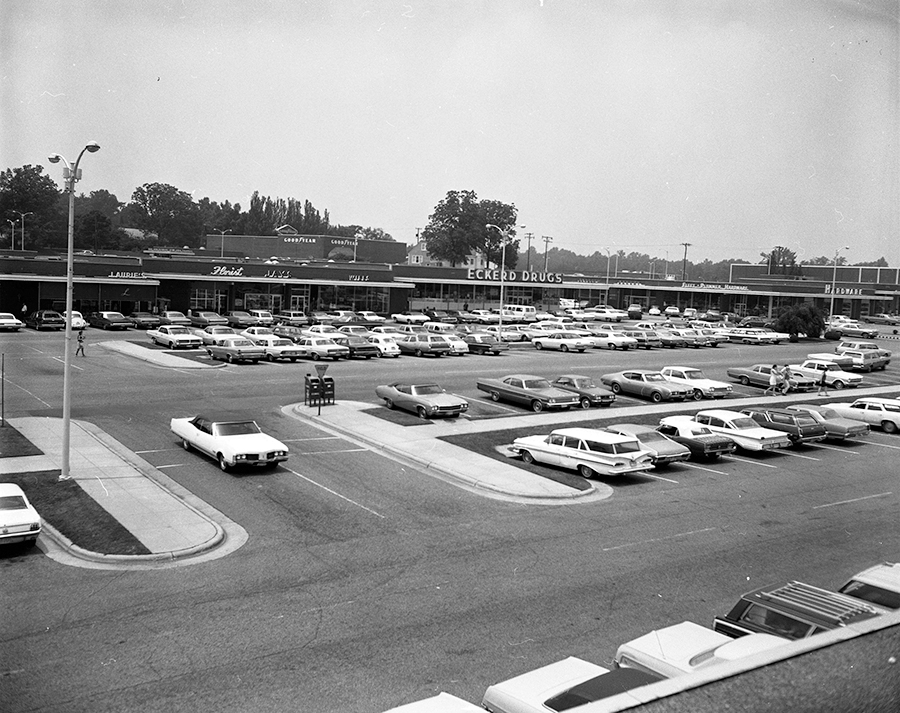
When Friendly Center debuted in 1957, it consisted of two blocks with 12 shops each:

BLOCK A: Guilford National Bank, Pleasants Hardware, Leon’s Beauty Salon, Harllee’s, Inc, Friendly Toy & Hobby Shop, Stanley’s, Inc., Junior Circle Shop, Guy Hill, Carolina Camera Center, Wills Book & Stationery, Laurie’s Sportswear, Venus Slenderizing Salon.

BLOCK B: Mason’s Florist, Jay’s Delicatessen, Harold’s, Eckerd Drug Store, Clippard Barber Shop, Blue Bird Cleaners, F. W. Woolworth Co., Belk, Kirby’s Shoe Store, Guilford Dairy Bar, Colonial Stores, Kyle’s Friendly Service.
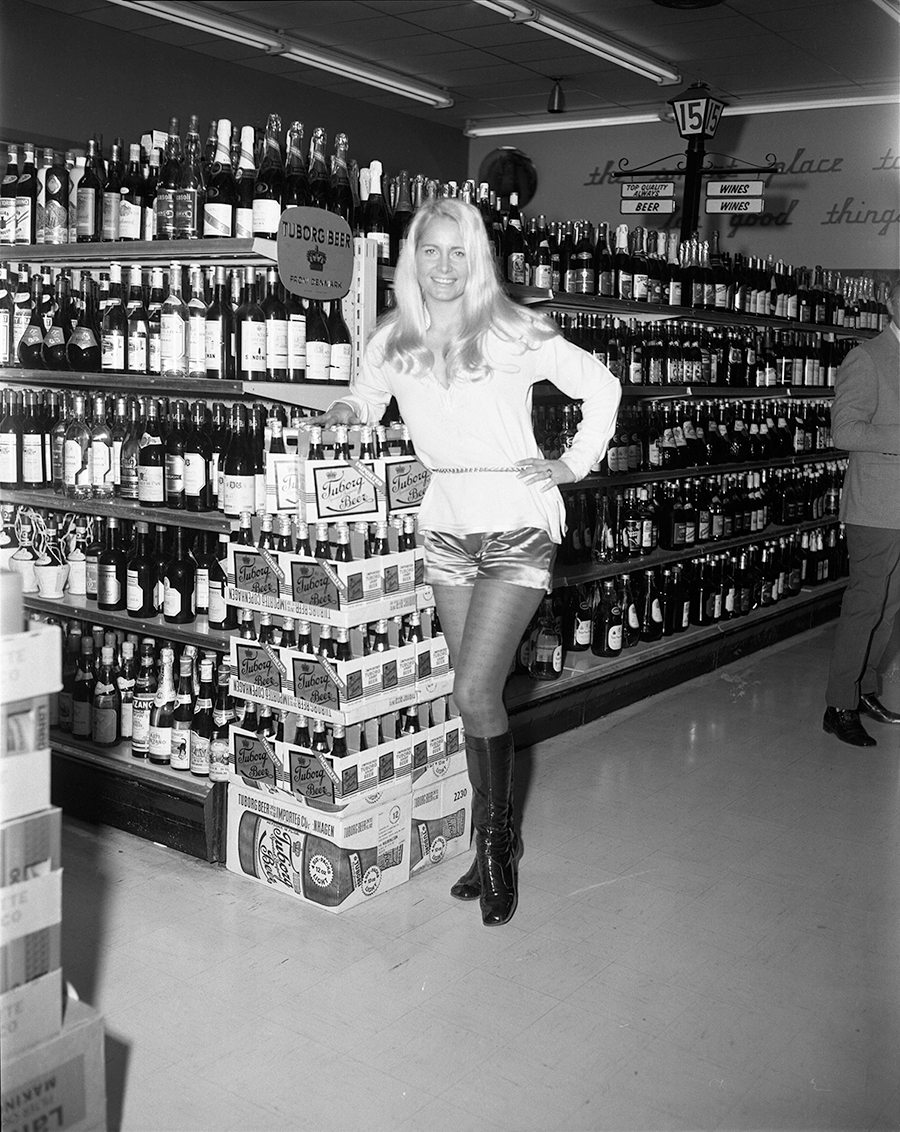
On August 1, 1957, Blanche Sternberger Benjamin, wife of Starmount cofounder Edward Benjamin, cut the ribbon to open Friendly Shopping Center to the public. Within an hour, all 1,300 parking spaces were overflowing; 25,000 shoppers flooded through the doors on that one day, representing one out of four Greensboro residents.

Behind Pleasants Hardware, previously in business for 48 years at 519 S. Elm, Mom could drop off the little ones then browse the aisles in peace while they frolicked in the children’s playground. The main attraction, stretched over a concrete pit, was a mammoth trampoline that youngsters could bounce around on for 25 cents an hour, unsupervised.

Laurie’s was the first local fashion boutique to leave downtown and head west. In business for 13 years before relocating, William and Athena Simon’s store was named for their daughter. Our first Eckerd Drug Store was at Friendly. Wills Book Store had been selling novels and paperbacks for 52 years on Elm, and this was their second location, with as much space devoted to stationery, art supplies and gifts — paperweights, bookmarks, china figurines of Beatrix Potter characters — as books.

At 24,000 square feet, Belk was the most opulent store in the center. Shoppers were greeted by a 12-foot high, 70-foot long mural facing the mezzanine floor depicting the administration building at Woman’s College (UNCG), First Presbyterian Church, and the statute of General Greene at Battleground Park.

This was Belk’s 354th store but considered important enough that John M. Belk, chairman and CEO of the company, along with his top executives, were in attendance for day one. “I worked stocking Belk before they opened in 1957,” Phil Callicutt remarked. “I became famous for not allowing Mr. John Belk in the front door. I told him to ‘Go around to the back door like the rest of the salesmen.’ I was lucky that my career with the company wasn’t hampered.” As a convenience, credit accounts could be carried over from the Belk store downtown.
Another elaborate mural, this one of crushed glass, could be found at Harold’s Restaurant. Restaurateur J. Harold Coble boasted his dining room was the most modern in town, interior designed by Ray Teague, a member International Art Association. Diners enjoyed a cosmopolitan ambiance of Philippine Mahogany, brass and crystal chandeliers, 20 contemporary art installations, 30-foot planters shielding the kitchen, and two romantic alcoves papered in Japanese grasscloth, while supping on European cuisine and flaming desserts that the maître d’hôtel adapted from Manhattan’s Roosevelt Hotel.

A considerably more downscale ambiance that included the combined aromas of plastic flowers, grease from the lunch counter and cedar shavings that lined hamster cages greeted shoppers at Friendly’s Woolworth’s. Unlike the downtown branch, it was considered a self-service operation, where you could find cheap toys, sundries, clothespins bandanas, goldfish, comic books and an abundance of poster boards used in many a school project. There won’t be any salesgirls,” the store manager bragged. “Just checkout gals.”

Flush with success, Friendly Center underwent its first expansion in 1959, adding six new units that included Ellis-Stone (which became Thalhimers), a post office, bakery, and the ABC store.

Boy Scouts in the ’60s would regularly encamp on the western edge of the shopping center; one winter morning campers woke up to several inches of unexpected snow atop their tents. Scouts purchased their official gear in Belk, their shoes at Kirby’s. Blissfully unaware of the dangers of radiation, Kirby’s Shoe Store had a fluoroscope under which children could view their feet, allowing them see right through to the bones.

Friendly Center still had room to grow, and grow it did in 1967, a push to the north that added iconic stores like Bernard Shepherd Clothing, Gate City Pharmacy, Friendly Car Wash, Cass Jewelers, Thomas Photo Supply, Harvey West Music Company, Paul Rose Department Store, K&W Cafeteria, Rosenthal’s Bootery, Bocock-Stroud Sporting Goods, Merle Norman Cosmetics, and that eclectic emporium everyone fondly remembers, Potpourri.

Besides the ubiquitous scent of patchouli, Potpourri was known for bizarro merchandise like melted soda bottles repurposed for vases, an endless array of incense, love beads, blacklight posters, pet rocks, mood rings, kitschy tchotchkes galore, in addition to the dozen jars of stick candies positioned at the register, where every purchase was placed in a glossy paper bag topped with the store’s icon, a yellow sun with bright orange rays. At one of their many sidewalk sales, I bought a 2-foot high inflatable plastic Coke bottle that hung from the ceiling of my bedroom.

Potpourri was founded by David Grimes, by all accounts beloved by those who worked for him. Grimes sold a lot of fondue kits, which became all the rage in 1967, before discovering there were no fondue cookbooks. He commissioned his own, and Potpourri Press was born. Production offices were set up behind Krispy Kreme on Mill Street where the outfit published dozens, maybe hundreds, of hippy-dippy booklets with titles like Gardening with Ferns, Lovers Dining and Napkin Folding.

In 1967, Gate City Pharmacy, like Scott Seed two years earlier, closed their downtown digs to relocate to Friendly. The drugstore is still there, but sadly, the customer-friendly garden store, smelling of potting soil and fertilizer, is not.

The center’s 1967 expansion was preceded by the state-of-the-art Terrace Theatre, opening on Christmas Day 1966 showing Walt Disney’s Follow the Boys in Ultra-Vision, on a wall-to-wall screen with 6-track stereophonic surround sound. Another groovy component at the Terrace was the plush rocking chair seating.

My cousin Billy Owens worked at the Terrace Theatre. “It was in 1970, right before I got out of ninth grade,” Billy tells me. “I was making 85 cents an hour. Now, that was just an usher job, if you were head usher, $1.15.” Membership had its privileges: Employees of the Terrace could show their pay stubs to get free admission at the Janus Theatres, the city’s first multiplex just beyond the Plaza Shopping Center at Battleground and Northwood, and the Carolina downtown.

Billy says he almost died at the Terrace — twice. “We would do kiddie matinees on Saturday morning,” he recalls. “We had an old PA system with those old metal microphones so we didn’t have much of a way to get music through it.” These events were hosted by WFMY’s George Perry (The Old Rebel). “We had this old turntable with a metal arm,” Billy says. “So I turned it on and grabbed both of those metal things at once and it zapped me and knocked me down.” When he came to, “There was The Old Rebel’s face above mine saying, ‘You OK?’ I went, ‘Yeah.’ And then I did it again!”

The next movie attraction would show up on a Sunday morning. “Big canisters that were set right out front and nobody would steal them,” Billy says. “They would book the films for a month and then, two weeks in, they’d say, ‘Held over for a third week’ then ‘Held over for a fourth week.’” A second auditorium was added on in 1974.

When asked what his favorite place at Friendly was back in the day, Cousin Billy doesn’t hesitate. “I loved Jay’s Deli, that was a lot of fun, they had great food.” He was especially fond of the Lolly Burger, “I asked them, ‘What’s in the Lolly Burger?’ They said, “Everything that’s left over.’” Jay’s would actually take cold cuts, grind them up, make patties, then fry them like a hamburger.

Besides Belk, Jay’s Deli is the only original Friendly establishment still present. But in name only, having changed ownership and menu decades ago. “Jay’s Deli was started by Sol Jacobs, who was my uncle, and Morry Jacobs, my dad,” Rick Jacobs tells me. “It was a deli and a gourmet foods store also with everything from escargot to fine cookies and meats and cheeses to go.” Rick worked there in 1970, “You had to be 18 to work in a place that served alcohol, so whenever my cousins turned 18 they went to work for Jay’s.”

Most of the sandwiches at Jay’s were named after other shops at Friendly, for instance the Mason (Mason’s Florist) was rare roast beef, slaw and Russian dressing. “The lunch rush was monumental, it was pandemonium, controlled chaos,” Rick remembers. “There was a lady named Gertrude who worked there for years and she kept it going. After the lunch rush, my first day working there, I saw Sol make himself a sandwich and get a cold beer out of the cooler and sit down. He looked up to me and said, ‘When you turn 60, you’re entitled to a beer break.’”

Jay’s most popular creation was the Atomic Submarine Sandwich, keeping a stack of them prewrapped by the register. “The customers were a big cross section, the best selling beer by far was Blatz,” Rick recalls. “One time I got upset with a lady and I mouthed off to her a little and she went to complain to Sol. He told me to go into the kitchen and stay there and I thought he was going to come in there and rip me a new one but he smiled and said, ‘This is why I own my own business, so I can do what you just did.’”

Described as a ‘radical guy,’ Sol Jacobs was very politically active, running for mayor twice against Jim Melvin in the 1970s. “All the stores leased space from Mr. Benjamin,” Rick remembers. Part of the lease agreement stated that, once a year or so, Edward Benjamin could dictate to business owners what he wanted to see displayed in their storefront window. “He wanted to do a promotion for U.S. Savings Bonds at Jay’s one month,” Rick says. “Mr. Benjamin came in with a big Savings Bond with American flags and had it all dressed up but Sol was dead set against the Vietnam War from day one and so was my father. Sol did everything Benjamin required him do but in the corner of that window he added his own sign that said something to the effect of, ‘Any money invested in Savings Bonds should be designated for troop withdrawal only.’”
In 1969, Potpourri was joined on that block by two additional shops owned by David Grimes, Greetings Galore and Reed Runners. “I loved working for Dave Grimes,” says Teresa Moore, an employee of Reed Runners for eight years beginning in 1970. “He was like an older hipster. David came back from California with the idea for the shops.” 

Reed Runners carried rattan furniture, candles, woven baskets, everything to make your apartment look like Mary Tyler Moore’s. “We had those hanging basket chairs, we sold a lot of those, also hammocks and wicker furniture,” Teresa notes. “There was nothing in the store that anybody needed but it was stuff you couldn’t find anywhere else.”

Teresa has fond memories of those days, “David Grimes was an awesome employer, he cared about his people. I think we made a little bit more than other people in terms of wages so everybody that worked there stayed for a long time because we enjoyed it.” On Saturdays David provided lunch in Potpourri’s back room for all his employees. The only unpleasant aspect according to Teresa, “We had a talking myna bird that could say ‘Hello,’ ‘How are you?,’ and ‘What’s up?’ Cleaning the cage every morning came with the job.”

Behind that row of shops was The Trophy Room tavern (where Newk’s is today), notorious for bartenders allowing underage drinking, despite the legal drinking age being 18. Decked out in manly-man décor, its walls lined with sporting awards, and an enormous aquarium separating the hunting- and fishing-themed sides, the place attracted the likes of Ron Muir, who played left wing for the city’s minor league hockey team, the Greensboro Generals. Within a few short years, The Trophy Room moved to Spring Garden near the UNCG campus where, at night, the watering hole became a disco.

By 1971, the center had grown to 65 stores, including Schiffman’s, opening a second store at Friendly. “No, there has never been a mention of closing our downtown location as it has always served as the headquarters for our organization,” Lane Schiffman informs me. “We believe both locations have been staples for us and the community since 1893 and we continue to see growth as Greensboro continues to thrive.” Situating the newer branch between Starmount and Irving Park made sense as Lane Schiffman points out: “Our father was looking to serve customers in their own backyards and had the foresight to see that Friendly Center was where Greensboro was moving. His ultimate aim was to make Schiffman’s more accessible to everyone.”

Friendly Center, coupled with the Four Seasons Mall, led to the demise of the center city as a prime retail destination, the only major player remaining after the 1970s was the original Schiffman’s.

In 1976, Friendly Center launched Forum VI, an upscale mall on the corner of Northline and Pembroke anchored on the first level by a larger K&W Cafeteria. My mom loved Forum VI, with two floors for shopping and fine dining that included Montaldo’s, Urban Artifacts, The Nicholas (later Robert’s) restaurant and Kabuto. The mall concept fizzled, empty parking spaces could usually be found right beside the front door. K&W survived however, one of the few places you can dine that looks the same as it did 40-plus years ago.

As the 1980s came to a close, Starmount announced plans to enclose Friendly Shopping Center, transforming it into an indoor mall to better compete with Four Seasons across town. For almost two years they proceeded with plans that envisioned leveling most of the stores in order to put shops where the parking was and parking where the shops were. Fortunately, they thought better of the idea. Instead, a $2 million makeover took place in 1992.
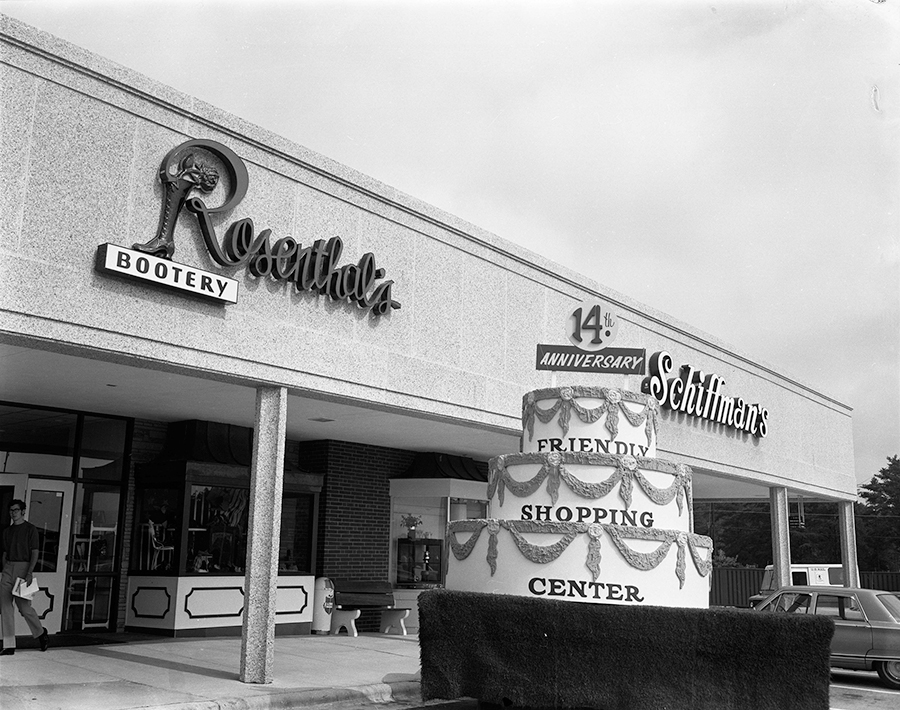
In 2006, a year after a new concept The Shops at Friendly was established, where the iconic pink glass-and-steel box housing Burlington Industries’ headquarters once stood, Starmount sold the entire complex for more than $200 million. That’s a lot of love beads and mood rings.

On December 6, 2016, I was one of about 100 people who attended the opening of a Time Capsule, buried 50 years earlier to the day alongside the Terrace Theatre. Unfortunately, the container had been breached, everything inside immersed in red clay mud. It wasn’t clear what exactly was inside.

A fitting metaphor, you may say. The past is, well, buried.

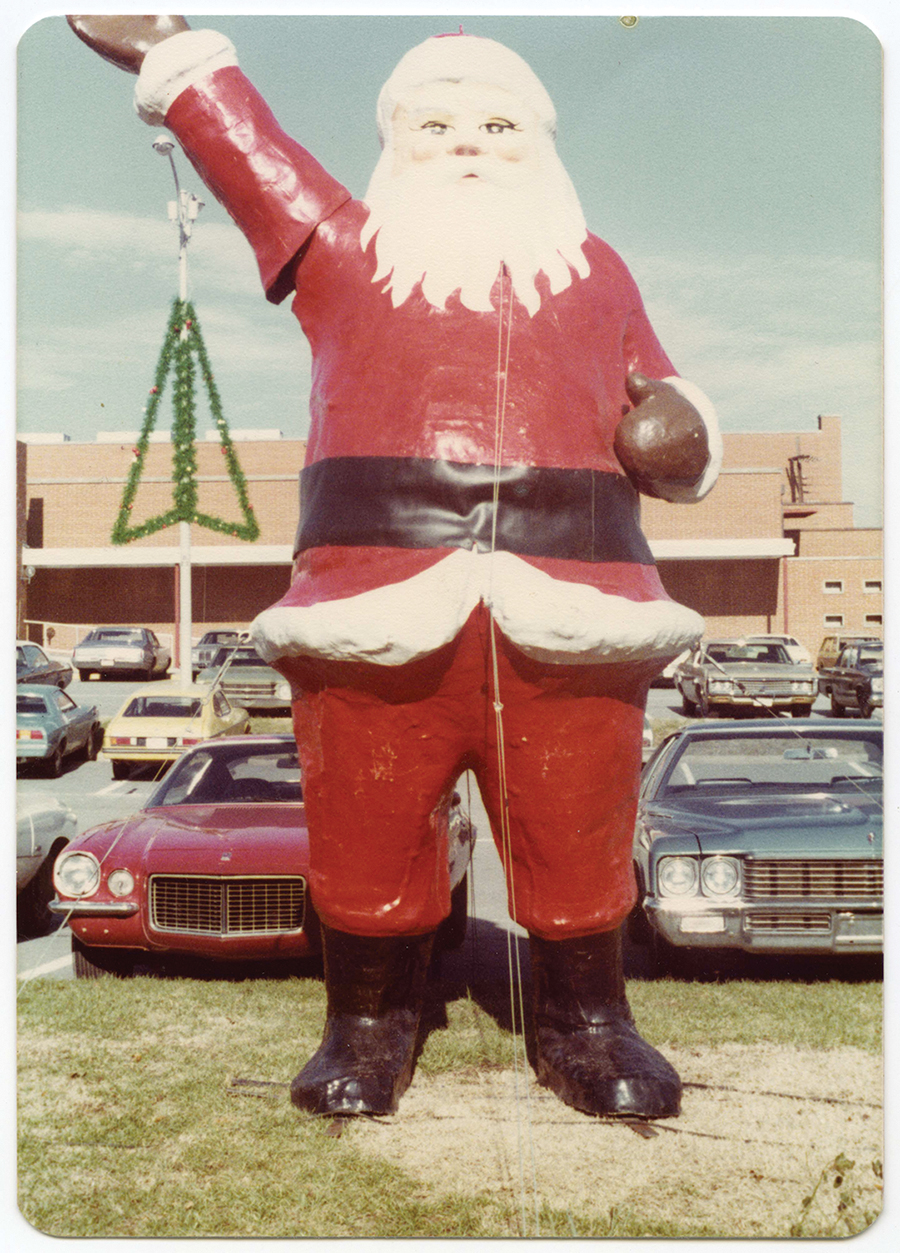
And one day, the hip and trendy national chain shops that seem so fashionable and of-the-minute will fade into memory like beloved institutions such as Potpourri and Carolina Camera. But, really, can you imagine heading west on Friendly Avenue and not seeing Santa waving at you?  OH

Billy Ingram is currently writing a book about his career as a movie poster designer for the major Hollywood studios in the 1980s and ’90s.

Got any fond Friendly memories? Please feel free to share them at facebook.com/ohenrymagazine.

April Poem

The Heaven of Lost Umbrellas

They have to be somewhere;

those ribbed and fabric

servants who have held

off storms so grandly, quietly,

and with such solemn

unassuming elegance.

They come to us

in colors but mostly

that ubiquitous black.

Plaid, polka dots, birds,

butterflies, Monet’s

water lilies . . . he must

be laughing at the irony.

Van Gogh’s sunflowers,

one grand, glorious sun

of yellow.  We have

monograms, advertisements,

golf ones big enough

to cover a room

of golfers . . . except

it never rains on a golf

course. Nor in this

way out of the way

heaven of lost things.

Here umbrellas lie

folded in resting pose.

They hold their own

handles, their work

for the moment

completed. Yet

they wait to be

unfurled

and walked

wherever

they need to go.

— Ruth Moose

To the Max

For designer and avid collector Terry Lowdermilk, nothing succeeds like excess

By Cynthia Adams     Photographs by Amy Freeman

It is so 21st-century to be a collector. When Country Living profiled collectors last year, their prized possessions sometimes numbered in the hundreds. And, the chosen objects ran the gamut: from highbrow to low, from cutting boards to stamps.

But amassing and curating specific items didn’t begin in this day and age. As far back as the Renaissance, Europeans created cabinets of curiosities, or “wonder rooms,” a pastime elevated to an art form by acquisitive Victorians.

According to neuroscientists, groupings of objects give us a pleasurable sensation, a little jolt of joy, even. This point was underscored by no less than famed designer of the Greenbrier Resort, Dorothy Draper, an affirmed “anti-minimalist.” In her 1960s Good Housekeeping column, she advised her followers to group objects in a pleasing arrangement. Groupings elevate lesser collections, she explained: “Notice how groups of small objects, when they are well-arranged, become important and effective.”

For serious collectors, (many of whom admit to having a plan of action to scoop up their collections first in the event of a house fire), the oft-repeated mantra, “less is more,” appalls. Consider Tony Duquette, the artist, film and stage designer who penned the hefty tome, More is More.

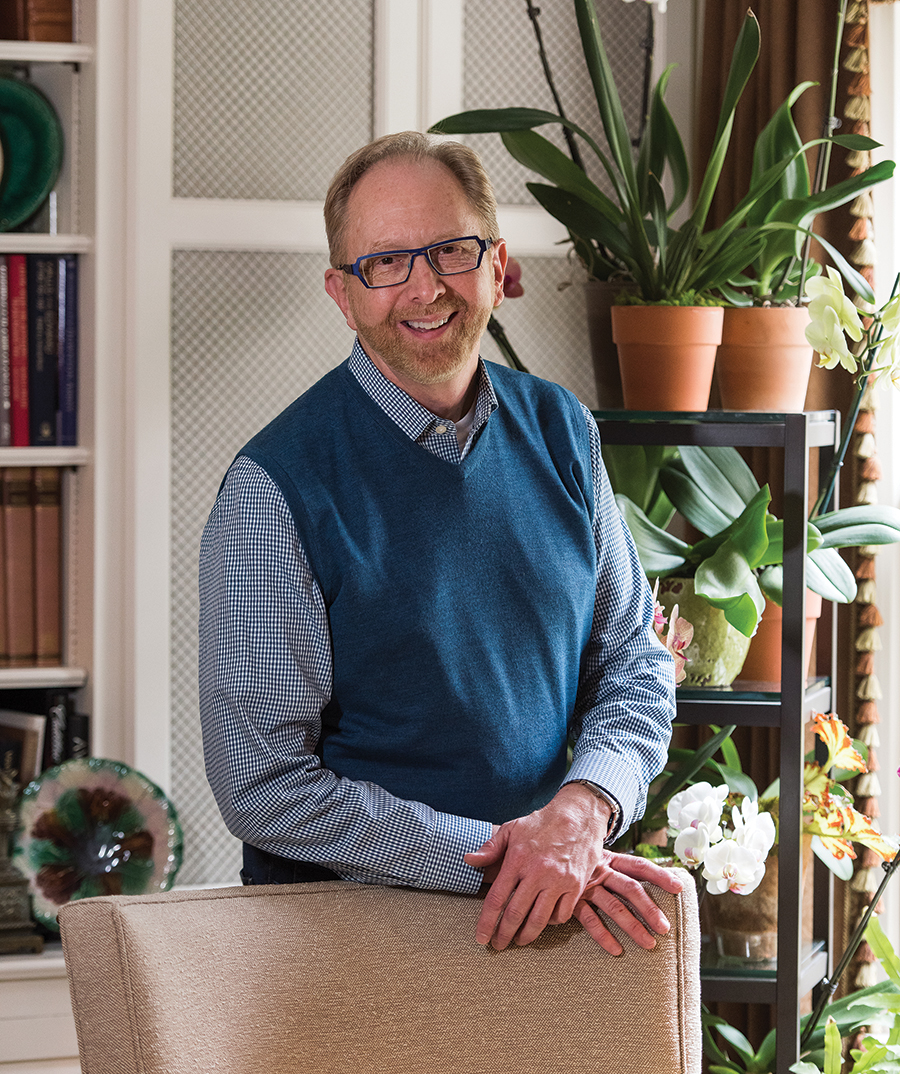
Interior designer and avid collector Terry Lowdermilk displays Duquette’s book in his living room . . . along with a whole lot more, by the way. As a neighbor and fellow collector says, Lowdermilk is a maximalist, placing him firmly in Duquette’s and Draper’s camp. His collectibles cover tabletops and chests, fill decorative cabinets, and are displayed on walls, brackets and surfaces throughout his two-story townhouse. The namesake of Terry Lowdermilk Interiors, he spends six days a week working with varied, farflung residential clients. He also keeps a home office, which he confesses, requires him to religiously dust his many collections. (He does so with pleasure, weekly.) And if his clients don’t have a collection, Lowdermilk says he’ll offer “to start something for them,” the designer laughs — and not ironically. Collections, he maintains, make a house exceptional. Collected objects whisper of history, of meaning, of a backstory worth sharing.

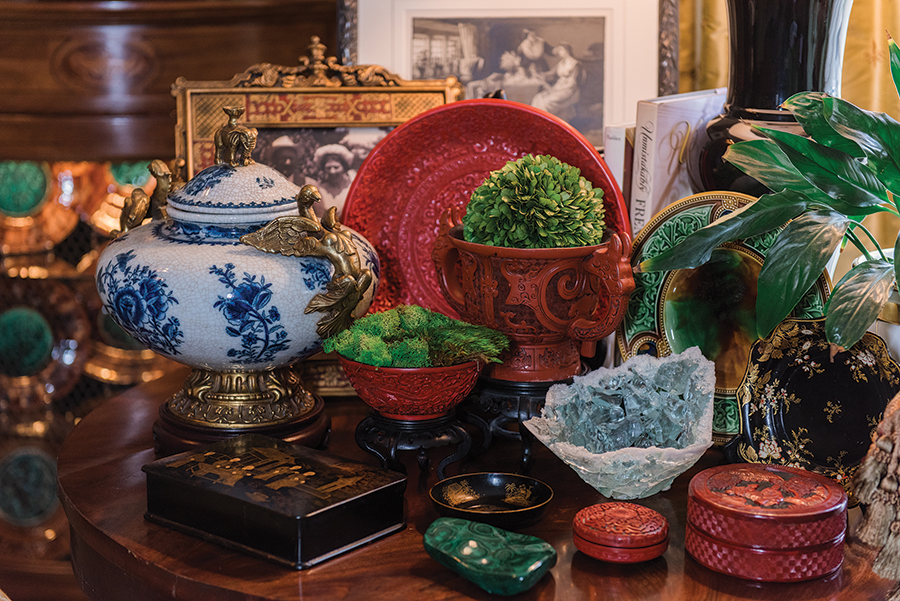
For Lowdermilk, chinoiserie accomplishes this feat. The French word (pronounced sheen-WAHZ-uh-ree) encompasses everything Chinese and East Asian, from furniture to wallpaper, china, porcelains, objets d’art, textiles and papier mâché. It became wildly popular, thanks to the Dutch East India Company, which included the collectibles in their haul back to eager Europeans. The popularity of chinoiserie never abates — and if it does, it resurfaces in a heartbeat or two. It expresses Europeans’ version of Chinese and East Asian décor, extending into gardens, architecture and even the performing arts. (Think: Gilbert and Sullivan’s comic operetta, The Mikado.) King Louis XIV admired the style, as did others to follow. The beau monde loved it as well; pagodas and pavilions interpreted the style in gardens of the well-heeled.

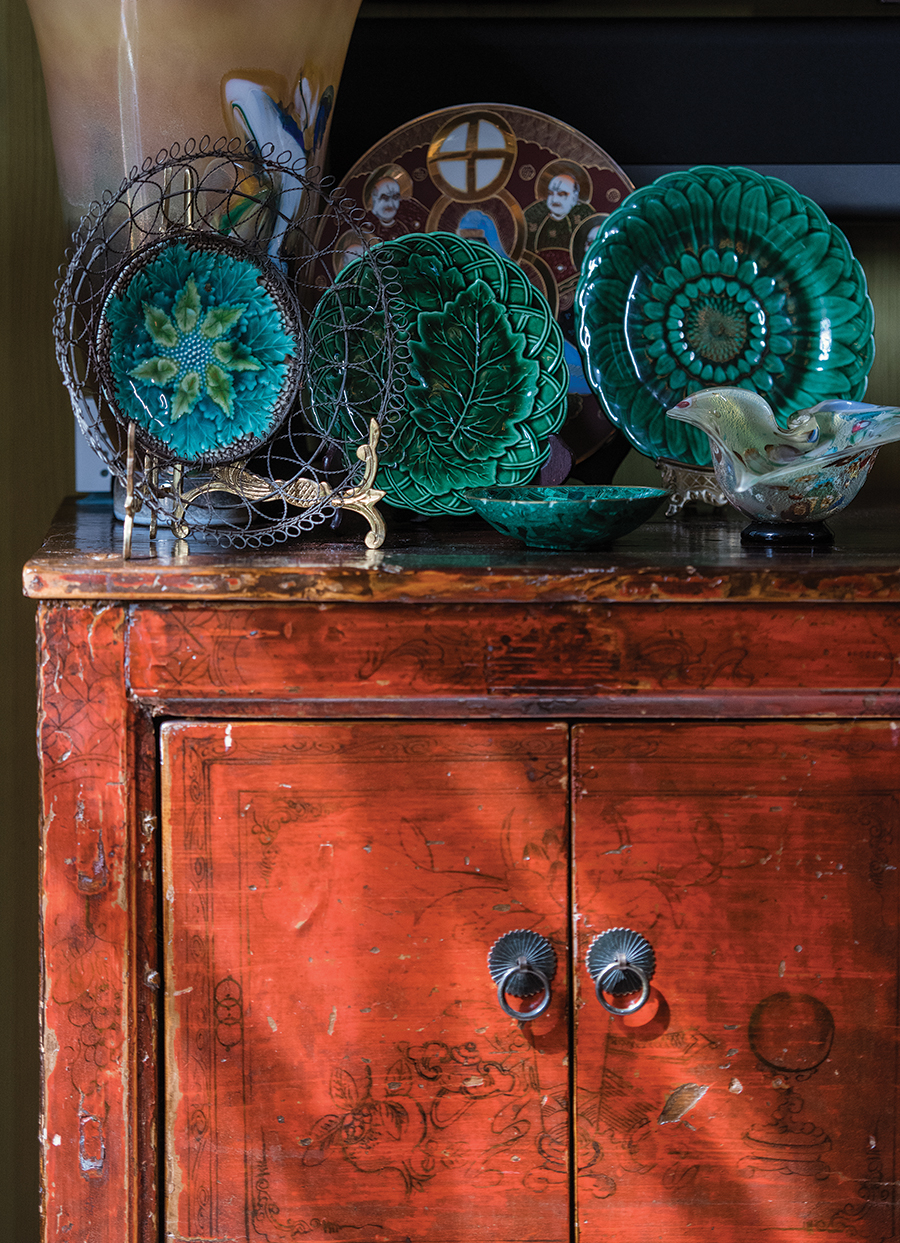
A chinoiserie cabinet takes pride of place in Lowdermilk’s dining room. The knockout statement piece was formerly in a relative’s Lynchburg house. “My cousin found one in another color he liked.” Lowdermilk couldn’t buy the cabinet fast enough, and uses it as storage for table linens, charger plates and cloth napkins. A remnant from a chinoiserie opium bed graces the foyer wall. A Japanned (lacquered) screen is in the living room. One of his most beloved collections is the assortment of French and English chinoiserie papier mâché items, many of them utilitarian objects like holders for matches and calling cards. The papier mâché imitations were inspired by more exclusive and costlier Chinese and Japanese lacquer ware. Decorated in gilt they depict various fanciful scenes in Asian landscapes.

“There are also several pieces that were gifts from close friends and clients. Along the way, in more recent years, I have become enthralled with antique cinnabar [fiery red pieces carved from mercury sulfite], as well as Japanned papier mâché and tole pieces,” Lowdermilk says. “I only have a couple of the tole, or commonly known as tin ware, which have gold Asian-styled paintings on a black background.” He admits that his papier mâché collection with gold-on-black paintings has perhaps run away with him: “I truly love the Asian feeling as well as the gold-on-black decoration. Also, the many beautiful shapes and sizes.”

As he shows his collections — with nary a dust mote in sight — Lowdermilk explains the origin of his love of luxe interiors with hand-selected collections: Chinqua-Penn, the Betsy and Jeff Penn manse in Reidsville.

“The muted colors. My love for painted murals,” the designer explains, can be traced back to this touchstone.

From his earliest memory, Lowdermilk’s family had an inside connection to the estate. Their entrée was a close family friend and personal secretary to Jeff Penn, whose family started Penn Tobacco Co. in Reidsville, which was ultimately purchased by American Tobacco Co. The secretary received frequent calls to be available when the famously globetrotting Penns shipped back antiquities and art from their travels, filling the 30-room mansion they built in 1925.

“So, when we were kids — Mrs. Penn had died by then in the early ’60’s — we would go over to Chinqua-Penn, because it had been given to the foundation at UNCG,” Lowdermilk recalls. “There were pictures of us outside, by the fountains. It was like nothing I had ever seen before. All the things! It was incredible!” he says, pausing thoughtfully. “I think that was my beginning [as a collector].”

With a particular fondness for the Penns’ extensive collection of Asian artifacts and artwork, he visited the estate on numerous occasions, eventually serving on the board of the foundation. “I learned so much about their collections, their origins and also value,” he says. “I even had the pleasure of helping to oversee the decorating of the home for Christmas for the last three or so years that it was open to the public.” 

Notice a theme?

Many of the items Lowdermilk collects echo a time when the Bohemian elite obsessed over exotic Asian wares.

Even if you couldn’t actually visit Asia with the resources of a tobacco baron or the Vanderbilt railroad heirs in Asheville, you could still possess the sort of treasures they were fond of amassing.

But Lowdermilk explains it wasn’t solely Chinqua-Penn’s riches that revealed collected opulence to his eager eyes. They were opened at an early age, while glimpsing interiors and antiques tagging along with his father, a Realtor.

“I’d go with him to sign a listing agreement, and I’d ask why didn’t we have beautiful old furnishings,” Lowdermilk remembers.

His father’s retort? “I grew up with all that dusty old stuff. I don’t want it.” Neither did he keep many family pieces. Lowdermilk’s dad wanted what so many postwar families wanted: everything brand-spanking new, with modern conveniences.

Even this twist had a silver lining. His parents’ modernity led him to the world of interior design. When Lowdermilk’s parents became engaged, they first built and furnished a house on Cornwallis Drive and hired a decorator, to impart the latest 1940’s design.

“Growing up in a home, where my parents had design help, was one aspect that enticed me into the design field,” says Lowdermilk. “I liked seeing my Mom work with the decorator, looking at fabrics, wallpapers, accessories, etc.

“They wanted to go on their honeymoon and come back to a house all ready.”

The young couple consulted Morrison-Neese Furniture Company and chose Vi Cothran, a member of their large staff. (A firm so notable they helped establish the home furnishings industry in the Triad.) Later, Cothran worked with Cashion’s Furniture and Decorating. “She helped my parents with their three homes. I always grew up in a house done by her.”

No question, he knew from early days that the profession lent proximity to beautiful objects and homes. And collections.

“Antiques were something we did not have at home, since my parents chose to leave behind older pieces from their childhood and enjoy the new home décor of the late ’40’s through the ’60’s and ’70’s.” Sure, they retained a couple of family antique pieces, “but most of the furnishings were new of the day. I realized then, that my future had antiques in it, possibly furniture pieces, and more than likely small, interesting pieces,” Lowdermilk recalls.

It was fortuitous that Lowdermilk’s father was a friend to the late Otto Zenke, Greensboro’s premier designer of that era. Ironically, Morrison-Neese was the store who brought Otto Zenke to Greensboro in 1937, according to a 2005 article by Jim Schlosser in the News & Record.

“On Saturday mornings, I would sometimes accompany my Dad to his office, which was down the street from Otto Zenke’s studio and residence,” Lowdermilk remembers. “I would ask Dad if I could go down and walk through his shop.” With Zenke’s permission, the impressionable Lowdermilk would enjoy, he recalls, “seeing many beautiful things which were inspiring. Mind you, I was around 11 to 13 at this time.”

On an outing with his mother, a teenaged Lowdermilk noticed a reproduction, French-styled plaster-on-metal, large wall bracket. “I told her I was going to buy it, and she asked why, and where would I use it? I quickly said, ‘In my bedroom!’” he smiles at the memory. “I purchased it with my own money, and today, it is still something I love, in my living room. Now, I suppose I could say it is well on its way to being an antique! At least vintage!”

From one purchase a collection was launched. “Now I have collected quite a few older wall brackets, which hold many antique items I have collected.”

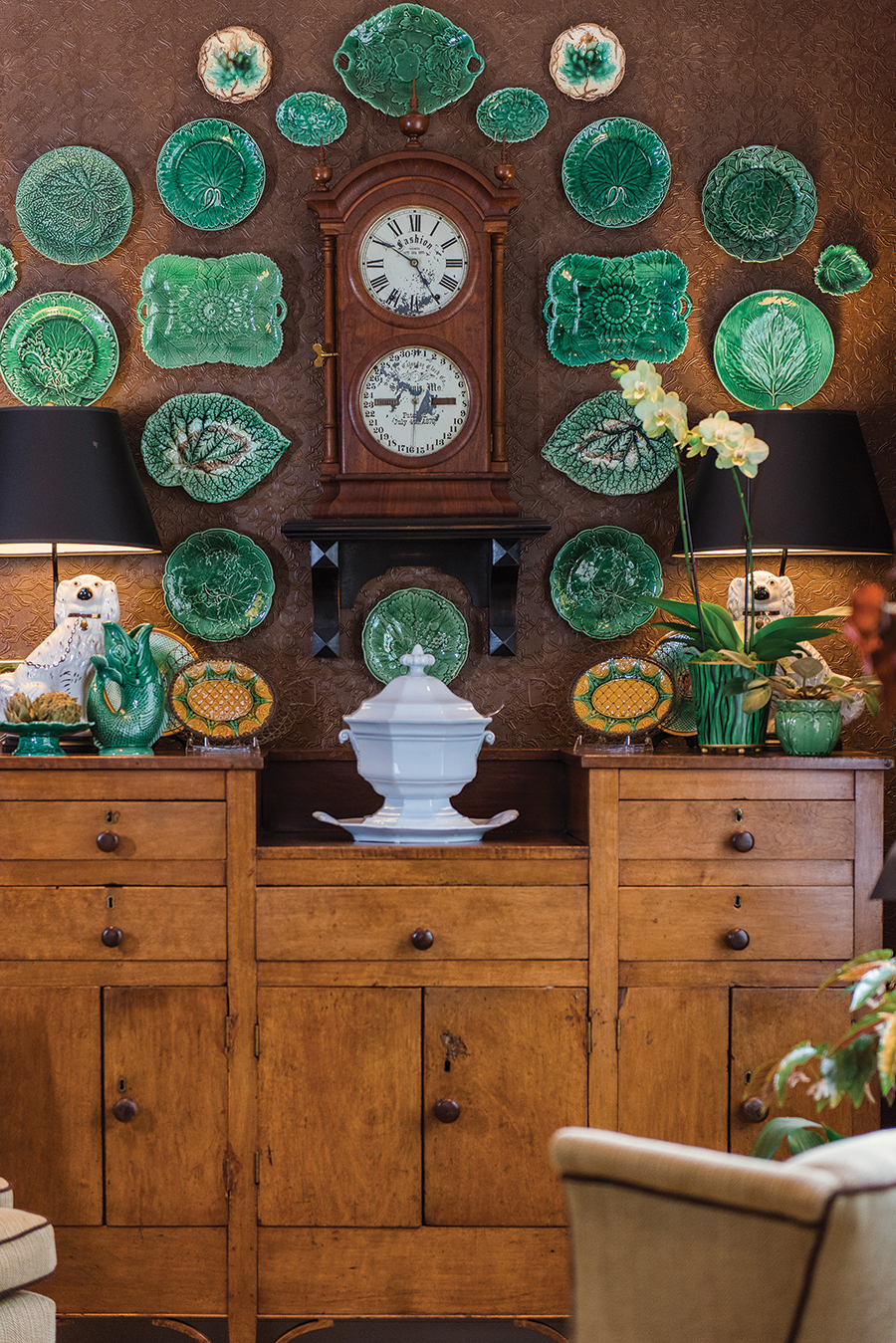
One collection spawns another, for collectors, are, if nothing else, a passionate lot, hunter and gatherer types who know where the best stuff is. Bringing it home is an irresistible impulse. In Lowdermilk’s case, that would also include Old Paris sugar boxes, European lithographs, books, clocks, and the visually stunning majolica and cinnabar.

He recalls the spark that ignited his admiration of majolica, a term for painted earthenware originating from Moorish Spain by way of Renaissance Italy. “My first antique purchase was a green majolica plate, found at Byerly’s Antiques, one of my all-time favorite places to find great things,” Lowdermilk says of the massive Triad store overlooking I-85 that closed 15 years ago. “From that time, I found many more majolica pieces there, as well as in shops all over.” He prizes a green majolica clock that was used on the film set for The Color Purple.

The cinnabar he collects is alluring both for its beauty and for its potential danger.

“Of course, the fact that red cinnabar comes from mercury sulfide — and is toxic — is one reason we do not see the genuine material used today. And, I am hoping my love for it won’t be a threat to my life! But there must be some vices in life that we enjoy that are not always healthy for us!”

The rarity and the detail of cinnabar also affects Lowdermilk. “The carving, which is so detailed, is fascinating to me in the cinnabar pieces I have, and have lusted over,” he muses.

Is there any limit to his visual curiosity and passion for collecting? Or to the idea of more always being more? Probably not. He admits to eyeing oil landscape paintings and checking out silver lusterware as avenues for his next collecting passion.

“I enjoy having these collections around me. They are my friends. Each time I have packed pieces up to move to a new home, I enjoy unpacking each and every one of them,” Lowedermilk reflects. “As with all of my antiques, I like knowing there is a story behind each and every piece. I just wish they could talk, and let me know where they have been, what they have seen, and the places where they have been allowed to reside.”  OH

Cynthia Adams is a contributing editor to O.Henry. She once lugged a Scottish marble clock home in her hand luggage, and checked a suitcase filled with brass door knobs. She perfectly understands antique addictions.

April Almanac

April is a procession of wonder.

Flowering redbud. Rising asparagus. Row after row of tulips and daffodils.

When the earliest strawberries arrive, childhood memories of roadside stands and pick-your-own patches follow. The first time your grandma took you strawberry picking, you’d never seen berries so plump or vivid. Two, three, four buckets later, you’re back in the car, eyes twinkling, belly full of fruit made sweeter because you picked it.

Easter conjures memories of Sunday hats and wicker baskets, and a grade-school field trip to a house down the street from the church. There, a classmate’s yard is dotted with dozens of colorful eggs — some painted, some plastic, all filled with candy — but all hearts are set on the coveted silver one, a super-sized treasure found in the low branches of a climbing tree when the sun hits the foil just right.

Maybe next year.

Or perhaps the true magic is discovering what you aren’t trying to find, like the robin’s nest in one of the hanging baskets.

In my early 20s (read, coin laundry days), on a visit home for Easter, my folks planted a basketful of plastic eggs in the backyard, each one filled with quarters.

Sometimes the great surprise is the wonder that grows with age.

The Last Frost

The Old Farmer’s Almanac speculates that a full moon in April brings frost. Cue the Full Pink Moon on Good Friday, April 19. While it’s not actually pink, Algonquin tribes likely named this month’s full moon for the wild ground phlox that blooms with the arrival of spring.

Consider it a signal that it’s time to plan your summer garden.

Plant now, and enjoy fresh tomatoes and cukes right off the vine.

Scope It Out

According to National Geographic, one of the top sky-watching events of the year will occur on Tuesday, April 23. On this dreamy spring morning, at dawn, watch as the waning gibbous moon approaches brilliant Jupiter as if they were forbidden lovers. Use binoculars if you’ve got them.

Devilish Alternative

My younger brother has single-handedly cleared a tray of deviled eggs at more than one Easter supper. That’s why I was particularly stunned when he told me that he was adapting a vegan diet. No more deviled eggs? Well, not exactly. But when he told me about Thug Kitchen, a vegan cookbook peppered with language that would make our granny’s draw drop, I understood. Inside: a recipe for deviled chick-pea bites. Although we can’t print that here without heavy-handed edits, check out this equally scrumptious vegan recipe from Whole Foods Market: tender roasted baby potatoes topped with spicy yolk-free filling. Brother approved.

Deviled Potatoes

Ingredients:

12 baby potatoes (about 1 1/4 pounds)

2 teaspoons extra-virgin olive oil

1/2 cup vegan mayonnaise

1/3 cup drained silken tofu

1 tablespoon Dijon mustard

1 teaspoon sweet paprika

1 teaspoon turmeric

1/2 teaspoon coarse sea salt

1/4 teaspoon ground black pepper

Method:

Preheat the oven to 350°F. Line a baking sheet with parchment paper.

Cut each potato in half crosswise. In a large bowl, toss potatoes with oil and place cut-side down on the prepared baking sheet. Roast until tender when pierced with a knife, about 30 minutes. Let cool.

Using a melon baller, scoop out center of each potato half. Combine potato flesh, mayonnaise, tofu, mustard, paprika, turmeric, salt and pepper in a food processor and pulse just until smooth. Scoop filling into potato halves. Refrigerate for at least 30 minutes (and up to 2 days) before serving.

(Want to take this deviled egg alternative to the next level? Sprinkle with finely chopped fresh parsley before serving.)

If Spring came but once in a century, instead of once a year, or burst forth with the sound of an earthquake, and not in silence, what wonder and expectation there would be in all hearts to behold the miraculous change!  — Henry Wadsworth Longfellow